Categories
Interview

“Words became my dwelling place”

A conversation with Neeman Sobhan
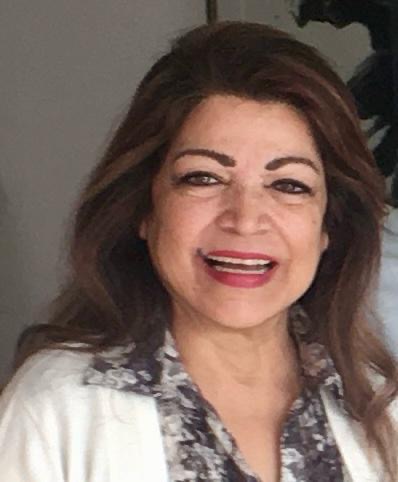
Neeman Sobhan: A Global Nomad?

Neeman Sobhan, born in the West Pakistan of Pre-1971, continues a citizen of both her cultural home, Bangladesh, and her adopted home, Italy. Her journey took her to US for five years but the majority of times she has lived in Italy – from 1978. What does that make her?

She writes of her compatriots by culture – Bangladeshis — but living often in foreign locales. Her non-fiction, An Abiding City, gives us glimpses of Rome. These musings were written for Daily Star and then made into a book in 2002. Her short stories talk often of the conflicting cultures and the commonality of human emotions that stretch across borders. And yet after living in Rome for 47 years – the longest she has lived in any country – her dilemma as she tells us in this interview – is that she doesn’t know where she belongs, though her heart tugs her towards Bangladesh as she grows older. In this candid interview, Neeman Sobhan shares her life, her dreams and her aspirations.

Where were you born? And where did you grow up? 

I was born in Pakistan, rather in the undivided Pakistan of pre-1971: the strange land we had inherited from our grandparents’ and parents’ generation when British colonial India was partitioned in 1947 down the Radcliffe line, creating an entity of two wings positioned a thousand miles apart on either side of India! The eastern wing, or East Pakistan was formerly East Bengal, and my cultural roots are in this part of the region because I come from a Bengali Muslim family. But I was born not there but in West Pakistan, which is culturally and linguistically distinct from Bengal, comprising the regions of Western Punjab, Sindh, Baluchistan and the NWFP (North-West Frontier Provinces, bordering Afghanistan), where the official language is Urdu.

So, my birthplace was the cantonment town of Bannu in the NWFP, (now KPK or Khyber Pakhtunkhwa).

Perhaps my life as the eternal migrant, living outside expected geographical boundaries started right there, at birth. 

My father’s government job meant being posted in both wings of Pakistan. So, I grew up all over West Pakistan, and in Dhaka, whenever he was posted back to East Pakistan. Much of my childhood and girlhood were spent in Karachi (Sindh), Multan and Kharian (Punjab) and Quetta (Balochistan).

How many years did you spend in Pakistan?

The total number of years I spent in undivided Pakistan (West Pakistan, now Pakistan, and East Pakistan, now Bangladesh) is about two decades, or one year short of twenty years. From my birth in 1954, my growing years, till I left the newly independent Bangladesh in 1973 when I got married and came to the US at the age of nineteen.

What are your memories about your childhood in West Pakistan? I have read your piece where you mention your interactions with fruit pickers in Quetta. Tell us some more about your childhood back there. 

I have wonderful memories of growing up in West Pakistan, in Karachi, Multan and Kharian of the late 50’s and early 60’s (despite the era of Martial Law under Field Marshall Ayub Khan, and later his military-controlled civilian government). However, the political environment is invisible and irrelevant to a child’s memories that center around family, school and playmates, till he reaches the teen years and becomes aware of the world of adults. Since, my father’ job entailed us going back and forth between West and East Pakistan, by the time we arrived in Quetta in late 1967, it ended up being my father’s last posting, because by then Ayub Khan’s regime was tottering under protests in both wings of Pakistan; and by the time (I should say in the nick of time) we left for Dhaka, it was already the turbulent year of 1970, which turned Pakistan upside down with General Yahya Khan becoming the new Marshall Law administrator. When we returned to Dhaka, it was the beginning of the end for Pakistan, with preparations for the first democratic general elections, and the blood soaked nine months war of independence for Bangladesh about to be staged.

But as a child, growing up in a Pakistan that was till then my own country, what remains in my treasure trove of memories are only the joys of everyday life, and the friendships (with those whom I never saw again, except one school friend from Quetta with whom I reunited in our middle age in Toronto, Canada!)

Also precious are the road trips with my five siblings and our adventurous mother, as we always accompanied our father on his official tours, across the length and breadth of West Pakistan.

But if I start to recount all my precious memories, I will need to write a thick memoir. And that is exactly what I have been doing over the years: jotting down my recollections of my past in Pakistan, for my book, a novel that is a cross between fact and fiction. The happy parts are all true, but the sad ones relating to the war that my generation underwent in 1971 as teenagers is best dealt with from the distance of fiction.

What I can offer is a kaleidoscopic view of some random memories: the red colonial brick residence of my family in the 60’s in Multan, one of the hottest cities of Punjab, known for its aandhi — dust storms — that would suddenly blow into the courtyard of the inner garden in the middle of the night as my sister and I slept on charpoys laid out in the cool lawn under a starlit sky, and being bundled up in our parents’ arms and rushed indoors; tasting the sweetest plums left to chill in bowls of ice; being cycled to school by the turbaned chowkidar weaving us through colourful bazars to the Parsi run ‘Madam Chahla’s Kindergarten School’ or on horse drawn tanga (carriages); learning to write Urdu calligraphic letters on the wooden takhta (board) with weed Qalam(pens) and a freshly mixed ink from dawaat (ink pots); and to balance this, my mother helping us to write letters in Bengali to grandparents back in East Pakistan on sky-blue letter pads, our tongues lolling as pencils tried to control the Brahmic alphabet-spiders from escaping the page.

In Karachi, returning home on foot from school with friends under a darkening sky that turned out to be swarms of locusts. Learning later that these grain eating insects were harmful only to crops not humans (and Sindhis actually eat them like fried chicken wings) does not take away the thrill of our adventure filled with exaggerated, bloodcurdling shrieks to vie with the screen victims of Hitchcock’s The Birds, viewed later as adults in some US campus. Picnics and camel rides on the seabeaches of Clifton, Sandspit, or Paradise Point. Near our home, standing along Drigh Road (the colonial name later changed to Shahrah-e-Faisal after King Faisal of Arabia, I later heard) waving at the motorcade of Queen Elizabeth II passing by with Ayub Khan beside her in a convertible with its roof down. That was in the 60’s. Later in 1970, embarking with my family on the elegant HMV Shams passenger ship at Karachi port for our memorable week long journey back to Dhaka across the Arabian Sea and the Indian Ocean, with a port of call at Colombo in what was still Ceylon, to disembark at Chittagong port, not knowing then that we were waving goodbye not just to the Karachi of our childhood but a part of our own country that would soon become the ‘enemy’ through its marauding army.

But I reset my memories and bring back the beauty and innocence of childhood with images of my family’s first sight of snowfall in Quetta, the garden silently filling with pristine layers of snowflakes piling into a cloudy kingdom under the freshly tufted pine trees, as we sipped hot sweet ‘kahwa’ tea, and cracked piles of the best chilgoza pine-nuts and dried fruits from Kabul. And since Quetta was our last home in Pakistan, I leave my reminiscences here.
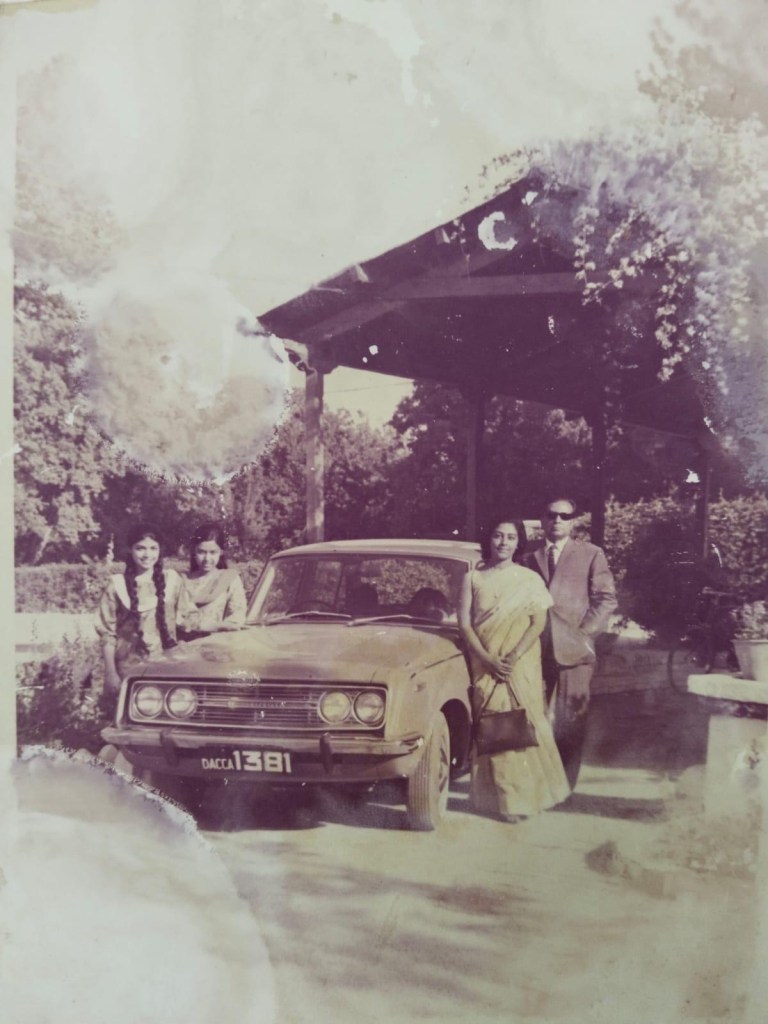
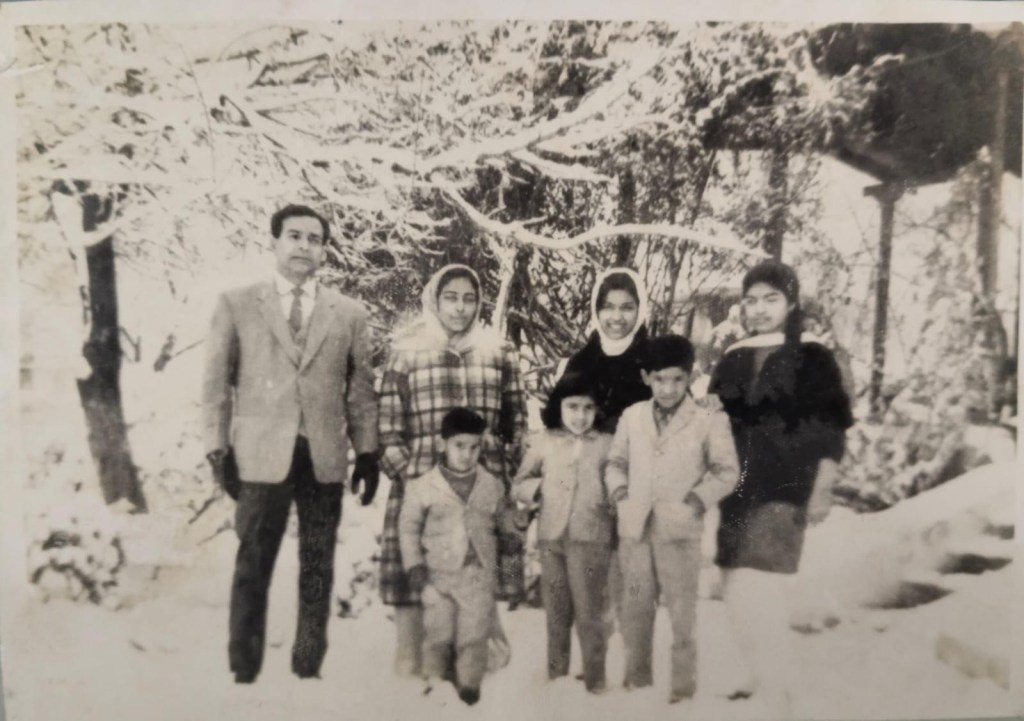
There are so many ways to enter the past. Photographs in albums discolor after a time, but words keep our lived lives protected and intact to be accessible to the next generation. I hope my novel-memoir will provide this.

How many countries have you lived in? Where do you feel you belong — Bangladesh, Pakistan, US or Italy — since you have lived in all four countries? Do you see yourself a migrant to one country or do you see yourself torn between many? 

I have indeed lived in four countries, for varying lengths of time. In the sense of belonging, each country and stage of my life has left its unique impact. But I have still not figured out where I belong.

Although I lived in Pakistan and Bangladesh from birth till I was nineteen, these were the formative years of my life, and I feel they have coloured who I am fundamentally. The culture and languages of the subcontinent is fundamental to me as a human being. Also, having shared my parent’s experience of being almost foreigners and expats in their own country, trying to speak Urdu to create a Bengali lifestyle at home in a culturally diverse world of Punjabis, Sindhis, Baluchis or Pathans, I know it made them (and us as a family), different from our compatriots in East Pakistan who never left their region and had only superficial understanding of the West Pakistanis. My introduction to a migrant’s life and its homesickness started there, observing my parents’ life.

When I moved to the US after my marriage in 1973, it was to follow my husband Iqbal, to the Washington-Maryland area, where he had moved earlier as a PhD student after giving up, in 1971, his position in the Pakistani central government where he was an officer of the CSP (Civil Service of Pakistan) cadre. These were the days of being newly married and setting up our first home, albeit in a tiny student’s apartment, because more than as a home maker, I spent 5 years attending the University of Maryland as an undergraduate and then a graduate student. We thought our future might be here in the US, he working as an economist for a UN agency, and I teaching at a university. A classic version of the upwardly mobile American immigrant life.

But before we settled down, we decided to pursue a short adventure, and Iqbal and I came to Italy in 1978, from the US, on a short-term assignment with FAO, a Rome based agency of the UN. The mutual decision was to move here, temporarily! We would keep our options open for returning to the US if we did not like our life in Italy.

Well, that never happened! And given the fact that since then, we have spent the last 47 years in Italy, the Italian phase of my life is the longest period I have ever spent in any country in the last 71 years!

Meanwhile, we slowly disengaged ourselves from the US and it was clear that if we had to choose between two countries as our final homes, it would be between Bangladesh, our original home country, and Italy our adopted home.

Still, living away from ones’ original land, whether as an expatriate or an immigrant, is never easy. Immigrants from the subcontinent to anglophone countries like the US, UK, Canada, Australia etc, do not face the hurdles that migrants to Italy do in mastering the Italian language. I am still constantly trying to improve my language skills. Plus, there is the daily struggle to create a new identity of cultural fusion within the dominant and pervasive culture of a foreign land

So, in all these years, though I love Italy and my Roman home, I do not feel completely Italian even if my lifestyle incorporates much of the Italian way of life. For example, after a week of eating too much pasta and Mediterranean cuisine my husband and I yearn for and indulge in our Bengali comfort food. Although I enjoy the freedom and casual elegance of Italian clothes, I look forward to occasions to drape a sari, feeling my personality transform subtly, softly.

Yet, I cannot conceive of choosing one lifestyle over the other. The liberty to veer between different ways to live one’s life is the gift of living between two or more worlds.

The only incurable malaise, though, is the chronic nostalgia, especially during festivals and special occasions. For example, when Eid falls on a weekday, and one has to organise the celebration a few days later over a weekend, it takes away the spontaneous joy of connecting with one’s community, forcing one instead to spend the actual day as if it were an ordinary one. I miss breaking my fasts during the month of Ramadan with friends and family over the elaborate Iftar parties with special food back in Dhaka or celebrating Pohela Boishakh (Bengali new year) or Ekushey February (21st February, mother language day) in an Italian world that carries on with its everyday business, unaware of your homesickness for your Bengali world. Over the years, when my sons were in school, I made extra efforts for. But you know you cannot celebrate in authentic ways.

Of course, these are minor matters. And I am aware that by virtue of the fact that I have dual nationality (I’m both an Italian citizen, and a Bangladeshi), I cannot consider myself a true and brave immigrant — someone who leaves his familiar world and migrates  to another land because he has no other options nor the means to return; rather, I feel lucky to be an ex-patriate and a circumstantial migrant — someone who chooses to make a foreign country her home, with the luxury of being able to revisit her original land, and, perhaps, move back one day.

Meanwhile, I feel equally at home in Italy and in Bangladesh because we are lucky to be able to make annual trips to Dhaka in winter.

Whether I am considered by others to be an Italo-Bangladeshi or a Bangladeshi-Italian, I consider myself to be a writer without borders, a global citizen. I feel, I belong everywhere. My home is wherever I am, wherever my husband and my family are. My roots are not in any soil, but in relationships.

I often quote a line by the Mexican poet Octavio Paz. “Words became my dwelling place.” It resonates with me because for me often, it is neither a tract of land, nor even people, but language, literature and my own writings that are my true sanctuary, my homeland. I feel blessed to have the gift of expressing myself in words and shaping my world through language. My home is etched on the written or printed page. My books are my country. It’s a safe world without borders and limits.

Maybe it’s the conceit of a writer and a migrant, nomadic soul, but I think our inner worlds are more substantial than our external ones.                

When I read your writing, I find a world where differences do not seem to exist among people in terms of nationality, economic classes, race or religion. Is it not far removed from the realities of the world we see around us? How do you reconcile the different worlds? 

I believe and trust in our common humanity, not the narrowness of nationality, race or religion. Nationality particularly is limiting, dependent on land, and boundaries that can shift due to physical or political exigencies. Nationality by conferring membership also necessarily excludes on the basis of manmade criteria, while humanity is boundless, all encompassing, and inclusive, based on shared natural, biological, and spiritual traits. 

In my case, I consider the whole world my family. I say this not just as idealistic hyperbole and wishful thinking, but from the fact that I have a multi-cultural, multi-racial family. Only my husband and I are a homogenous unit being Bengali Muslims by origin, but both my sons are married outside our culture, race and religion. One of my daughters in law is Chinese, the other has an English-French father and a Thai mother. So, through my grandchildren, who are a veritable cocktail, yet my flesh and blood, I am related to so many races. How can I bear malice to any people on the globe? The whole world is my tribe, my backyard, where we share festivals and food and rituals and languages. We celebrate unity in diversity.                 

Kindness and caring for others are values I hold dear in myself and others. I believe in sharing my good fortune with others, and in peaceful co-existence with my neighbours, wherever I live. I believe in living with responsibility as a good citizen wherever I find myself. And so far, the world that I see around me, perhaps narrow, is peopled with those who invariably reflect my own sense of fraternity. Maybe I am foolish, but I believe in the essential goodness of humanity, and I have rarely been disappointed. Of course, there are exceptions and negative encounters, but then something else happens that restores ones faith.        

Love is more powerful than hate and generates goodness and cooperation. Change can happen at the micro level if more people spread awareness where needed. Peace can snowball and conquer violence. The human will is a potent spiritual tool. As is the power of the word, of language.       

Literature is about connections, communications, bridges. It can bring the experiences and worlds of others from the margins of silence and unspoken, unexpressed thoughts and emotions into the centre of our attention. It brings people who live in the periphery within our compassionate gaze. Language is one of the most effective tools for healing and building trust. Responsible writers can persuasively break down barriers and make the world a safe home and haven for everyone, every creature.

You have a book of essays on Rome, short stories and poems set in Rome. Yet you call yourself a Bangladeshi writer. You have in my perception written more of Rome than Bangladesh. So which place moves your muse? 

Any place on God’s beautiful earth can move my muse. Still, the perception is not completely accurate that I have written more of Rome than Bangladesh. It is true that many of my columns, short fiction or poems are set in Rome, but they are not necessarily just about Italy and Italians. In fact, my columns and poems were written from the perspective of a global citizen, who celebrates whichever place she finds herself in.

Poetry, in any case, is never just about any place or thing, but a point of departure. It always goes beyond the visual and the immediate and transcends the particular to the philosophical. The sight of a Roman ruin may jumpstart the poem, but what lifts it into the stratosphere of meaningful poetry is the universal, the human. For example, even when my poem speaks of a certain balcony in Verona, the protagonist is not a girl called Juliet but the innocence of first love, in any city, in any era.

My book of short stories, even when located in Rome, actually concern characters that are mostly Bangladeshi. In fact, it is my fiction that makes me a Bangladeshi writer, because my stories are ways for me to preserve my memories of the Bengali world of my past and an ephemeral present. I write to root myself. I often feel that I should write more about the new Italians, the Bangladeshi immigrants generation, rather than the expats of my generation, but my writing stubbornly follows its own compass.

Regarding my book of essays, my original columns for the Daily Star were written about many other cities I travelled to, including Dhaka and places in Bangladesh, and encounters with people in various countries not just Italy. Constrained to select columns from two decades of weekly writing, for a slim volume to be published, I narrowed the field of topics to Italy and Rome. But I had many essays and travel pieces concerning China, Russia, Vietnam, Egypt, Brazil, Spain, Netherlands and many other European cities and Asian capitals. In the end, a handful of columns about Italy became my book An Abiding City: Ruminations from Rome.
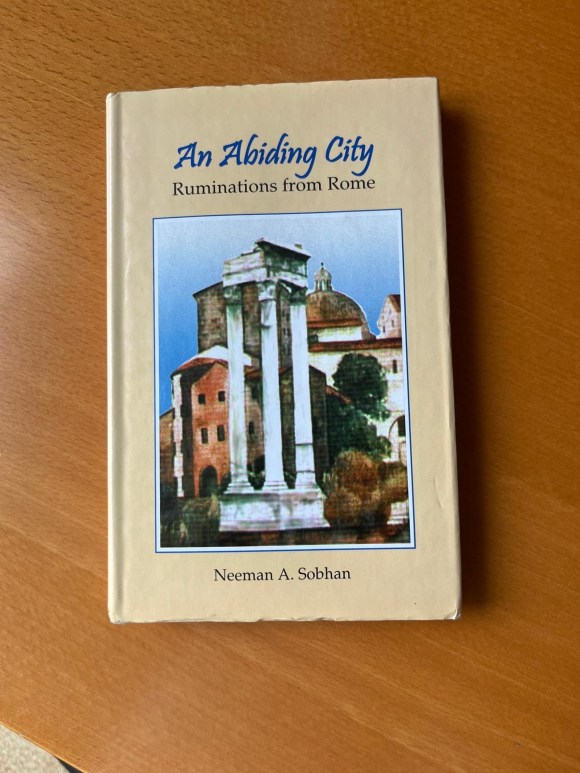
However, in the preface I said: “I must remind that the scope of the book, as suggested in the title, is ‘Ruminations FROM Rome’ not ‘Ruminations ON Rome’ with a tacit emphasis on ‘from’ because the writing relates to matters not just concerning ROME but also encompasses reflections of a more general kind. This is a collection of writings from a columnist who, within her journey through the Eternal City, also attempts to share with her readers her passage through life. I wish my fellow travellers a smooth sojourn into my abiding city, the one WITHIN and WITHOUT.”

I know that had I not lived in Rome but, say, Timbuctoo, I would find something to inspire me to write about. Of course, I am privileged to have lived in Rome and Italy, but nature is beautiful everywhere, in its own way, and there are other civilisations with rich cultures, histories, arts, cuisines, poetry and philosophy that can inspire the sensitive observer and writer.

My elder son lives in Jakarta, my younger son in Bangkok and in all the years of visiting them, I am blown away by the culture and beauty of the Indonesian and Thai worlds, and I have a notebook full of unwritten essays. And there is still so much of the world I have not seen, yet every part of this wondrous earth including my backyard is a chapter in the book of human knowledge. So, had I never left Bangladesh I would still have written. Perhaps “Doodlings from Dhaka!”

What inspires you to write?        

Many things. A face at a window, a whiff of a familiar perfume, an overheard conversation, a memory, a sublime view…. anything can set the creative machine running. Plus, if I’m angry or sad or joyous or confused, I write. It could become a poem, fiction, or a column.

The writer in me is my inner twin that defines my essential self. I am a contented wife of 52 years of marriage, a mother of two sons, and a grandmother of four grandsons (aged 8-7-6-5). These roles give me joy and help me grow as a human being. But my writer-self continues on its solitary journey of self-actualisation. 

Yet, I write not just for myself, I write to communicate with others. I write to transmit the nuances of my Bengali culture and its complex history to my non-Bengali and foreign readers and students, but more importantly to my own sons, born and brought up in Italy, and my grandchildren, whose mothers (my daughters-in-law) are from multi-cultural backgrounds, one a Chinese, and the other a combination of English, French and Thai. I write also for the younger generation of Bengalis, born or raised abroad, who understand and even speak Bangla, but often cannot read the language, yet are curious about their parents’ world and their own cultural heritage.

What started you on your writerly journey? When did you start writing? 

I have always written. As an adolescent, I wrote mostly poetry, and also kept a journal, which I enjoyed reading later. It created out of my own life a story, in which I was a character enacting my every day. It clarified my life for me. Interpreted my emotions, explained my fears and joys, reinforced my hopes and desires. Writing about myself helped me grow. 

My columnist avatar is connected to this kind of self-referral writing, but in real life it emerged by accident when I was invited to write by the editor of the Daily Star. The act of producing a weekly column was a learning experience, teaching me creative discipline and the ability to marshal my life experiences for an audience. I learnt to sift the relevant from the irrelevant and to edit reality. What better training for fiction writing? For almost two decades my experience as a columnist was invaluable to my writer’s identity.

Soon I concentrated on fiction, especially short stories that were published in various anthologies edited by others in Bangladesh, Pakistan and India. I now realised that while column writing was about my life in the present tense and about the daily world around me, my fiction could finally involve the past. The result was my collection of short stories: Piazza Bangladesh.

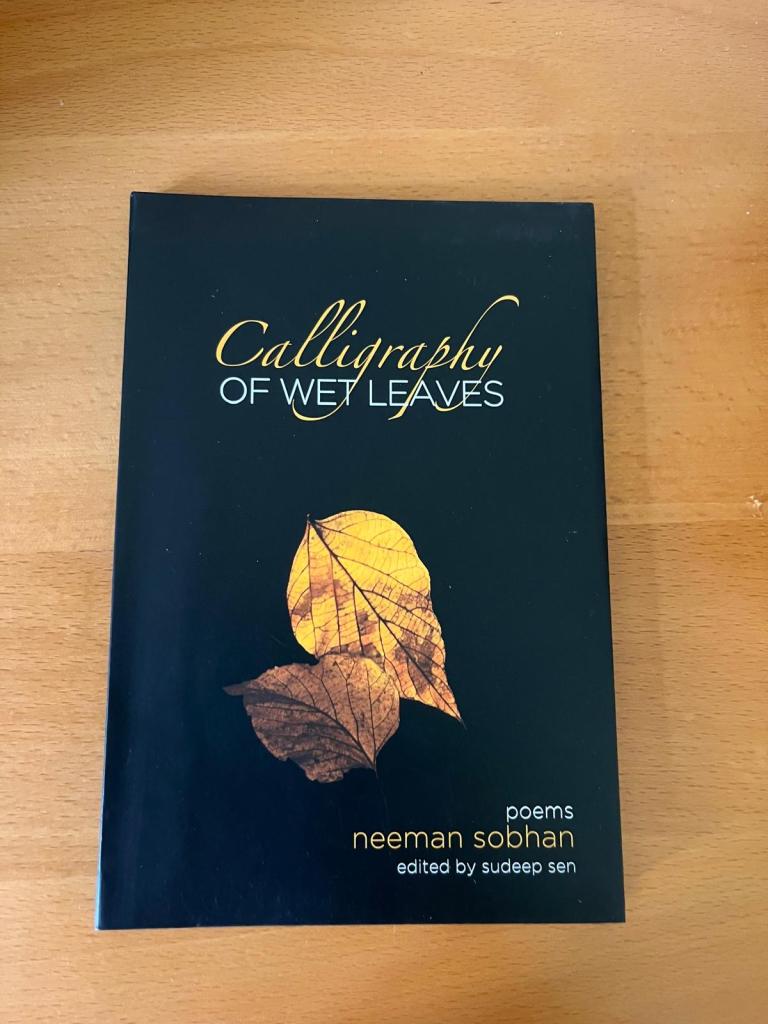
Ironically, it was my book of poems, Calligraphy of Wet Leaves that was the last to be published.

Your short stories were recently translated to Italian. Have you found acceptance in Rome as a writer? Or do you have a stronger reader base in Bangladesh? Please elaborate. 

Without a doubt, as an anglophone writer, my reader base is better not just in Bangladesh, but wherever there is an English readership. However, books today are sold not in bookshops but online, so these days readers live not in particular cities or countries but in cyberspace.      

But living in Italy as a writer of English has not been easy. The problem in Italy is that English is still a foreign and not a global language, so very few people read books in the original English. Every important or best-selling writer is read in translation. This is unlike the Indian subcontinent where most educated people, apart from reading in their mother tongues, read books, magazines and newspapers in English as well.   

This is why I was thrilled to finally have at least one of my books translated into Italian, and published by the well-known publishing house, Armando Curcio, who have made my book available at all the important Italian bookstore chains, like Mondadori or Feltrinelli. Also, through reviews and social media promotion by agents and friends, and exposure through book events and literary festivals in Rome, including a well-known book festival in Lucca, it has gained a fair readership.

That’s all I wish for all my books, for all my writing, that they be read. For me, writing or being published is not about earning money or fame but about reaching readers. In that sense, I am so happy that now finally, most of my Italian friends and colleagues understand this important aspect of my life.

 You were teaching too in Rome? Tell us a bit about your experience. Have you taught elsewhere. Are the cultures similar or different in the academic circles of different countries? 

I taught Bengali and English for almost a decade at the Institute of Oriental Studies of the University of Rome, La Sapienza., till I retired, and it was an enriching experience.

I studied for a year at the University of Dhaka before I got married and came to the US in 1973, where I continued my studies at the University of Maryland, earning my B.A in Comparative Literature and M.A in English Literature. I mention this because these experiences gave me the basis to compare the academic cultures in the Bangladeshi, American and Italian contexts.

I discovered more in common between the Bangladeshi and Italian academic worlds, especially regarding the deferential attitudes of students towards their teachers. In Italy, a teacher is always an object of reverence. In contrast, I recall my shock at the casual relationships in the American context, with students smoking in front of their teachers, or stretching their leg over the desk, shoes facing the professor. Of course, there was positivity in the informality and camaraderie too, between student and teacher. But with our eastern upbringing we cannot disregard our traditional veneration of the Guru and Master by the pupil.

In Italy it was rewarding for me to have received respect as a ‘Professoressa’ while teaching, and even now whenever I meet my old students. However, some of the negative aspects of the academic world in Italy linked to the political policies that affect the way old institutions are run, cause students to take longer to graduate than at universities in the UK or US for example.

Are you planning more books? What’s on the card next? 

I have a novel in the pipeline, a fusion of fiction and memoir, that has been in gestation for more than a decade. Provisionally titled ‘The Hidden Names of Things’, it’s about Bangladesh, an interweaving of personal and national history. It’s almost done, and I hope to be looking for a publisher for it soon. Perhaps, it has taken so long to write it because over the years while the human story did not change much, the political history of the country, which is still evolving through political crises kept shifting its goal posts, impacting the plot.

Most of my writings illustrate, consciously or inadvertently, my belief that as against political history our shared humanity provides the most satisfying themes for literature.

To share my stories with a readership beyond the anglophone one, my collection of stories ‘Piazza Bangladesh’ was translated into Italian and published recently in Italy, as ‘Cuore a Metà’ (A Heart in Half) which underlines the dilemma of modern-day global citizens pulled between two worlds, or multiple homes.

Meanwhile, my short stories, poems and columns will be translated into Bengali to be published in Dhaka, hopefully, in time for the famous book fair in February, Ekushey Boimela. Then my journey as an itinerant Italian-Bangladeshi writer will come full circle and return home.

(This online interview is by Mitali Chakravarty)

Click here to read an excerpt from An Abiding City: Ruminations from Rome

PLEASE NOTE: ARTICLES CAN ONLY BE REPRODUCED IN OTHER SITES WITH DUE ACKNOWLEDGEMENT TO BORDERLESS JOURNAL

Click here to access the Borderless anthology, Monalisa No Longer Smiles

Click here to access Monalisa No Longer Smiles on Kindle Amazon International
Categories
Stories

A Queen is Crowned

By Farhanaz Rabbani

The grand images of a historic event flashed before her eyes, as 11-year-old Jui, flanked by her sisters, sat still in the dark hall of Gulistan Cinema Hall. There was a great buzz about the new Technicolor documentary on the coronation.

The week before she had heard her elder sisters, Ruby and Shelly trying to convince their mother to let them watch it at Gulistan. For an affluent wealthy Muslim family, allowing girls to watch movies outside was unheard of. But the matriarch of the family, Zubeida, was groomed in a different manner. Born of a renowned family in Munshiganj, she was educated at the Sakhawat Memorial Girl’s High School in the 1920s. Inspired by the values of the Bengali feminist writer and the founder of her school– Begum Rokeya Sakhawat Hossein, Zubeida was an avid reader and extremely aware of the social issues of her times. When she was married at the age of 14, her husband, a renowned physician, encouraged her to read at home.

Zubeida’s sons and daughters grew up reading the latest literary journals and novels written by legendary Bengali writers. Being the third daughter and the fourth among all the siblings, Jui was surrounded by casual conversations of the latest plays in town or the scintillating songs from the All India Radio. Her immediate elder sister Shelly was a huge fan of Dilip Kumar’s songs and was often seen pressing her right ear to the battery driven radio, swaying to the mellifluous melodies of S.D. Burman. But life was not all play in Zubeida’s home.

In the evenings, as soon as everyone completed their Maghrib prayers, the children had to study. Seven children had several different techniques of playing truant during this special time. The eldest son being an avid football player, would often stay away from home playing in tournaments for the Mohammedan team. The next child Ruby looked at life in a more serious manner. She sat on her table with the hurricane lamp illuminating her social studies book. But sometimes, Jui would often see books by Kamini Roy, or Ashutosh Mukherjee or Tagore hidden within the centrefold of the schoolbooks!

Once, their father had just returned from his medical chamber to catch Shelly pressing her right ear to the small battery driven radio intently listening to the latest Dilip Kumar song.

“Ruby’s Maa!” he exclaimed, “These girls will all get married to rickshawallas! All they do, every day, is to waste time. How will they ever pass their exams?”

 While the veteran patriarch was fuming in rage, Ruby’s Maa, Zubeida, appeared to be totally undisturbed by his lamentations. She never worried about the future. With her deep faith in God, she took life one day at a time,

Ruby and Shelly were intently looking at the screen transporting themselves to Westminster Hall amid all the grandeur of the Coronation. The sultry voice of Laurence Olivier wafted through the Cinema Hall of Gulistan as images of a sparkling crown being placed on the elegantly styled head of Queen Elizabeth II mesmerized the audience.

Zubeida, in her usual quiet persuasive way, had convinced her husband to give them permission to watch the famed documentary on the coronation of the new Queen — Elizabeth II. Abu Chacha– their darowan 1 went to great lengths to get 5 rickshaws for the journey from Naya Paltan to Gulistan.

The ladies adorned themselves in their best attires. The older daughters gave special care to apply their homemade surma2 on their eyes. The younger ones were just too excited to have a day out with the ladies of the household. Zubeida wore a beautiful cream coloured saree with a black border, the dark kohl accentuating her dreamy eyes, and she had mouthful of paan that made her lips ruby red. With a splash of attar, the ladies wearing saris got on the rickshaws– all veiled meticulously — so that passersby would not see their faces.

Abu Chacha was relegated with the noble duty of guarding the ladies–perched on a sixth rickshaw keeping track of the ladies at the front. As soon as Zubeida and her daughters reached Gulistan Cinema Hall, Abu Chacha stood on guard at the front of the Hall. He was not interested in the coronation of a foreigner. His life was not affected by the wonders of the colonial rulers. His only loyalty was for Doctor Sahib — who saved his mother from her deathbed. He would dedicate his life to the service of Doctor Sahib’s family.

Jui was silent– perhaps a little overwhelmed by the discipline and formality of the whole affair. She wondered if she would ever break away from the confines of her home and see the world outside. She was always the quiet one. Since she was not as robust as her sisters, she was considered to be docile and shy.  But the 11-year-old girl had a deep-rooted desire for breaking boundaries. The ornate gilded halls of Buckingham Palace flashed throughout the screen. Huge paintings framed in gold and the elegant procession of the Royal Guards clad in red and gold transported the audience to the glamour of the crowning of the new Queen of the United Kingdom. Jui, with her innate curiosity, watched the red canopy covering the Queen as she was anointed with holy oil. She had no idea about the significance of these actions. All she noticed was the splendour of a distant world – where women did not have to travel in covered rickshaws. 

Queen Elizabeth’s calm but firm look seemed to send a message to this little girl thousands of miles away. As she sat on the cushioned seats of Gulistan Cinema, surrounded by her protective sisters, Jui suddenly felt her resolve strengthening. She wanted to know more and see more of the world. She dreamed of visiting the land of the Queen one day. She dreamed of breaking out of the confines of her home one day.

 She would be the queen of her own destiny.

.

  1. Security guard ↩︎
  2. Kohl ↩︎

Farhanaz Rabbani loves to chronicle interesting stories and events that happen around her.  She is an avid listener. Contact: fnazrs@gmail.com.

PLEASE NOTE: ARTICLES CAN ONLY BE REPRODUCED IN OTHER SITES WITH DUE ACKNOWLEDGEMENT TO BORDERLESS JOURNAL

Click here to access the Borderless anthology, Monalisa No Longer Smiles

Click here to access Monalisa No Longer Smiles on Amazon International

Categories
Essay

Walking about London Town

By Sohana Manzoor

The first thing I realised while walking around London is that not a single one of all the people I had known who had been to England, told me how charming the city is. The buses with open tops, the red telephone booths, Big Ben, the London Bridge and all those pretty buildings simply fascinated us. So, before heading out for Haworth, we walked around in London and took Duck’s tour and saw some really enchanting stuff.

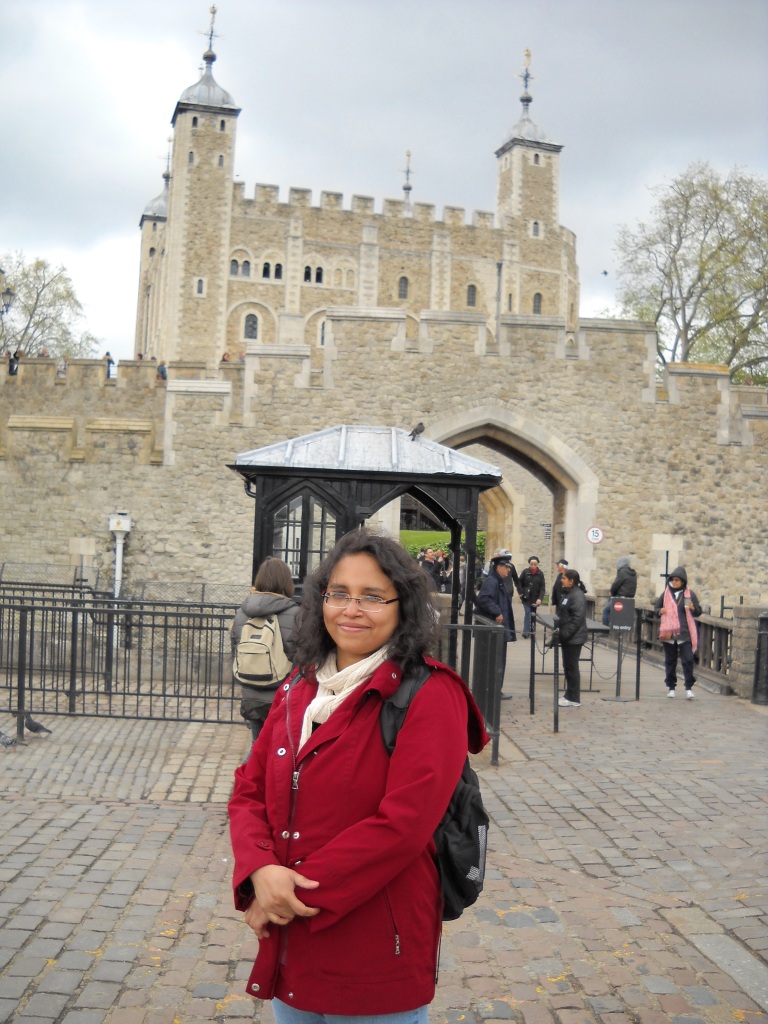
Sohana at the Tower of London

We spent a large part of a day at the famed Tower of London, which is literally a thousand years old, first built by William the Conqueror in the 11th century. Our visit began with a tour by a Beefeater (also known as a Yeoman Warder), who gave us a general overview of the Tower’s history. He had a wicked sense of humor and kept making puns like “Let’s be heading this way.” We saw Tower Hill, the site of public executions on the scaffold, and also Tower Green, where Anne Boleyn and Lady Jane Grey were executed – the spot is now commemorated by a glass sculpture with a pillow on top. The tour ended at the Chapel Royal of St Peter ad Vincula where those executed on Tower Green (including Boleyn and Jane Grey) are buried. Afterwards, we took a picture with the Beefeater outside the chapel.

Next, we went to the building that houses the Crown Jewels. Our eyes were dazzled by the rich display of crowns, scepters, and orbs bejeweled with diamonds, rubies, sapphires, and every kind of precious stone possible in the vault. We also saw the famed Kohinoor diamond, set in the Queen Mother’s crown, as well as the crown worn by the late Queen Elizabeth II. After the crown jewels, there was also a section of gold plates, serving dishes, goblets, wine jugs, etc. that were used for ceremonial occasions by various monarchs. We will probably never again see such a display of wealth, and perhaps there is no other place with so much wealth on display in one place. However, all the gold and perhaps some of the obnoxious histories attached with the splendour on display started to make me feel nauseous, so I was glad to get out into the open air.

We looked around in the White Tower, which stands in the center with a display of military equipment and history. Then we went to the Beauchamp Tower, which is known for the graffiti on the walls left by various prisoners, including some very high-profile ones. At one point, when I saw the graffiti attributed to Robert Dudley, Earl of Leicester, I stood rooted to the spot. It was incredible to think we were standing in the same room where such illustrious prisoners once lived, carving their convictions into the walls.

We walked around the grounds, taking pictures, and then came across some costumed characters, including James Scott, Duke of Monmouth, who posed with me graciously for a picture. The costumed characters put on a dramatic reenactment of James trying to claim the throne. James Scott is the fellow who required several blows of the axe, followed by a butcher knife, during his beheading on Tower Hill by the half-drunk Jack Ketch. The Beefeater told us the story in all its gory detail, though the reenactment, thankfully, included the trial but not the execution.

We took pictures, including one of Nausheen posing with a raven. These birdsare kept and bred on the grounds of the Tower. Apparently, they have kept at least half a dozen ravens since the time of Charles II, who thought the Tower would fall and the empire disintegrate if he did not always keep ravens there. There is even one beefeater whose job it is to feed and take care of the ravens! Finally, we also saw the room where Sir Walter Raleigh was imprisoned for many years, and the place where he used to walk back and forth (now called Raleigh’s Walk), and I got goose bumps.

Our day ended with a brief stop at Tate Modern, which is just across the river from the Tower. I’m not really into modern art, and as I paused in front of a famous painting by Picasso, I had to admit that I understood nothing about its greatness. To me it looked like a misshapen human figure lying on its side. Nausheen kept on dancing around the pieces and went on explaining what she had learnt in conjunction with modern poetry.

The Parliament & Big Ben

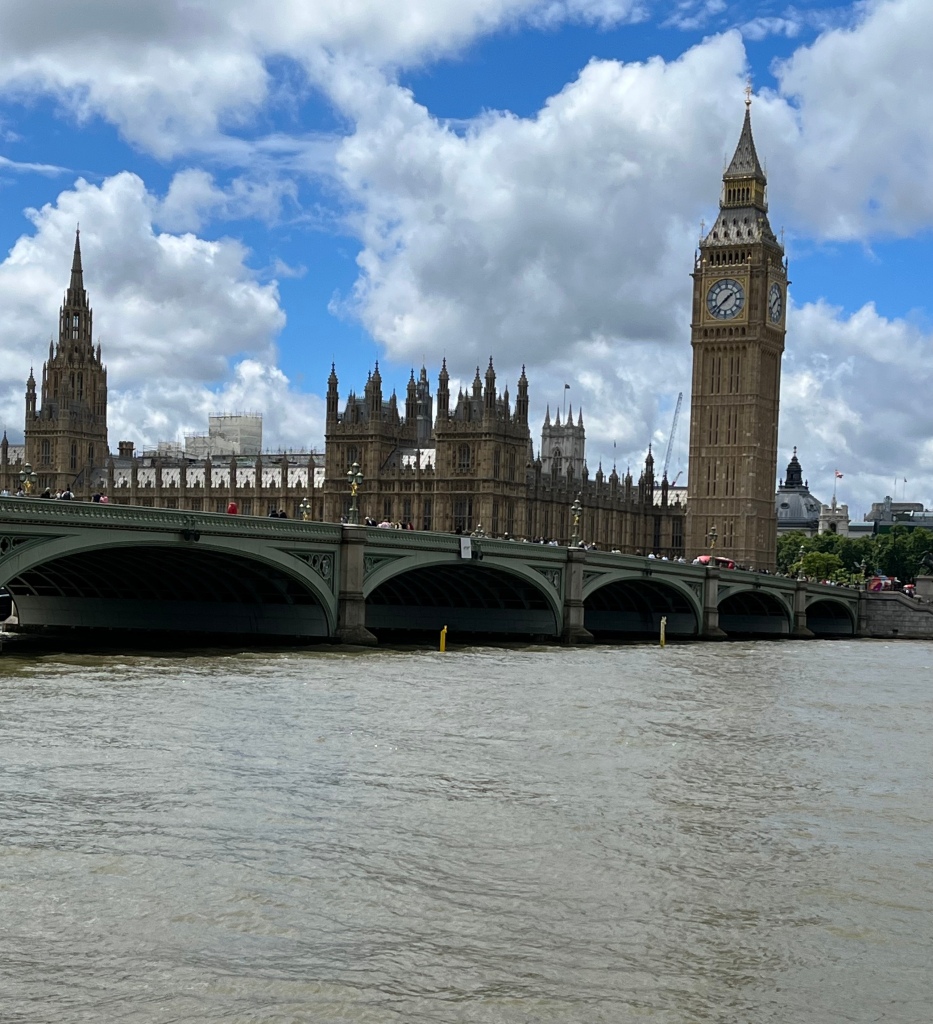
Next morning, we passed Big Ben and the Houses of Parliament on our way to Westminster Abbey where kings and queens are still coronated, and where many notable historical, political, and literary figures are buried. It was very crowded, but also a very solemn kind of place – kind of dark and gloomy, with tombs and effigies all around, and Latin epitaphs everywhere. Many of England’s kings and queens are buried here, and we saw the tombs of Henry VII, Elizabeth I, Bloody Mary, and Mary Queen of Scots. The tomb of Queen Elizabeth felt unreal – almost as if it was part of a dream I had nurtured for long.

Eventually, we made our way to the Poets’ Corner, which Nausheen was especially eager to see. She got excited seeing the tomb of Chaucer, who was the first to be buried in the Poets’ Corner. We both patted the tomb in homage to the great man. We also saw tombs of various other poets and writers, such as Austen and Dickens, and memorials to writers who are buried elsewhere, but commemorated here nonetheless, such as Shakespeare and the Brontës. Finally, we stopped at the museum shop to buy some souvenirs.

The afternoon saw us at the Tate Britain. We took a tour with one of the museum guides, who took us through the Turner wing. It was really great that they have an entire wing devoted to Turner, since his work is familiar to me from my dissertation supervisor, Dr. Collins’s course. There were also paintings by Constable and Gainsborough, but of course, Turner’s are the most dramatic and majestic. There was also a smaller wing dedicated to Blake’s prints, paintings, and engravings. However, the ones that are most familiar to us, from Songs of Innocence and Experience, are mostly elsewhere, such as in the British Museum, so there were only a handful of those.

The next day was cold and gloomy and we decided to stay in. We made plans of visiting Hampstead, the home of the young Romantic poet John Keats the day after. I knew days would be bad as I was developing a fever. But I could surely rest for one day.

Sohana Manzoor is an Associate Professor at the Department of English and Humanities at ULAB, a short story writer, a translator, an essayist and an artist. This essay was previously published in The Daily Star in January 2019.

PLEASE NOTE: ARTICLES CAN ONLY BE REPRODUCED IN OTHER SITES WITH DUE ACKNOWLEDGEMENT TO BORDERLESS JOURNAL

Click here to access the Borderless anthology, Monalisa No Longer Smiles

Click here to access Monalisa No Longer Smiles on Kindle Amazon International
Categories
Essay

Charlie and I: My Visit to Corsier-sur-Vevey

Nirupama Kotru, a film buff renews her acquaintance with Chaplin and, in the process, learns a life lesson.

“In that dark room in the basement of Oakley Street, Mother illuminated to me the kindliest light this world has ever known, which has endowed literature and the theatre with their greatest themes: love, pity and humanity.”

— Charles Chaplin, My Autobiography

He has been called a genius by scientists, philosophers, writers, humanists, film-makers and actors. His films continue to fascinate generations. They are timeless in the true sense of the word. As children, we laughed at the slapstick and the physical humour in his films. As adults, we have learnt to appreciate the world-view that lies behind some of his funniest films. Charlie being sucked into the giant machine in Modern Times (1936) remains one of the indelible memories of childhood. Later in life, one came to appreciate the thought – the causes and consequences of the Great Depression (1929–39) – that went into the writing of the film.

Charlie Chaplin has been an important influence in Indian films. Take celebrated actor-director Raj Kapoor, for instance. Raj Kapoor absorbed the mannerisms associated with Chaplin’s Little Tramp, including the waddle. It is a tribute to Chaplin’s genius that this Indian actor came to be universally recognised as the tramp, with his film Awara (the title of the film means a vagabond or a tramp) becoming a huge hit at home and abroad. Many actors after Kapoor, among them Sridevi (Mr India,1987), Mehmood (Aulad,1968), Kamal Haasan (Punnaigai Mannan,1986), and Chiranjeevi (Chantabbai,1986), channelised their inner Charlie into their performances. But it was Noor Mohammed who first adopted the Chaplin persona, and even used the screen name “Charlie” in films like The Indian Charlie (1933), Toofan Mail (1934) and Musafir (1940).

In November 2022, when I was informed that I would have to travel to Geneva for work, my first reaction was far from enthusiastic. I thought Geneva would be bitterly cold; also I needed to start planning my forthcoming family vacation to the United States. The United Nations Conference on Trade and Development (UNCTAD), under whose aegis this program of the Intergovernmental Forum on Mining was taking place in Geneva, had asked India to send a women leader in mining.

Over the next four working days, I came to love Geneva Lake Geneve, the beautiful weather, the lovely architecture and the people. But the highlight of my trip was the last day, which I had taken off. The surprising part was that none of my colleagues, including those posted in the three Indian Missions/Consulates in Geneva, had visited the Chaplin Estate (The Manor de Bain). It was sheer luck that I remembered reading about Chaplin spending the last twenty-five years of his life in Switzerland, until his death in 1977. I discovered in the nick of time that Corsier-sur-Vevey was less than a two-hour drive from Geneva. I realised that this was a once-in-a-lifetime opportunity. A quick booking of tickets on the Chaplin World website and I was off to the Manor de Bain! I decided to combine my Vevey trip with one to Gruyere, the beautiful town which lends its name to a popular kind of cheese.

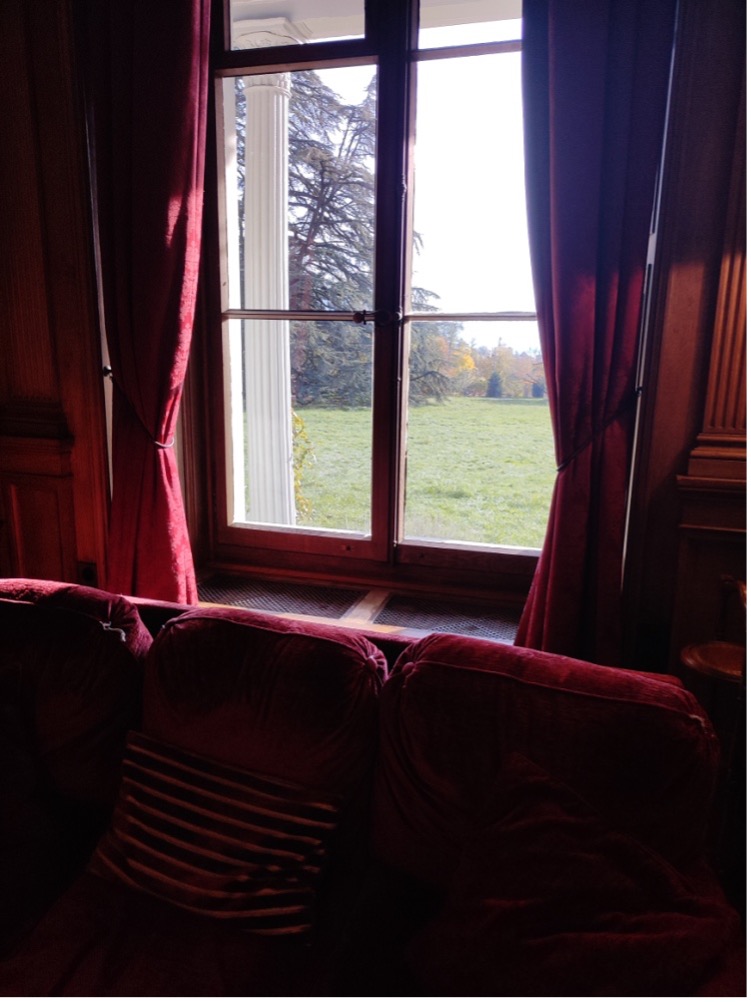
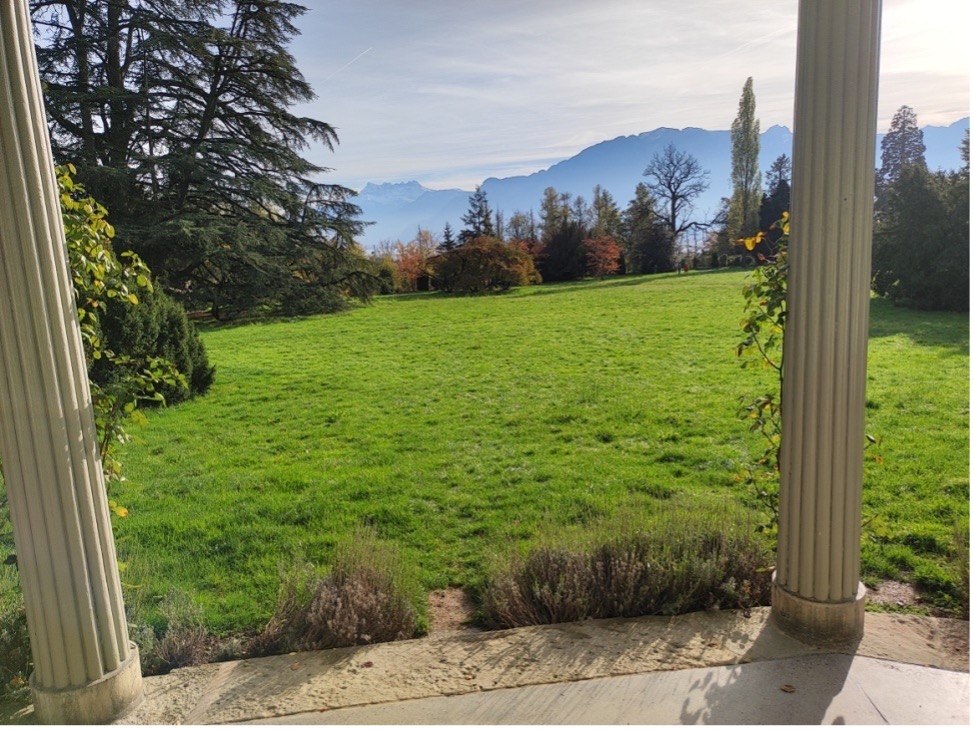
After a quick trip to Gruyere, I set off for Vevey. My heart started racing as I passed the town square in Vevey which had huge murals of Chaplin on some buildings. Finally, I entered the hallowed portals of the estate where Chaplin spent twenty-five years with his wife, Oona, and his children. Passing through his study in the main living quarters, as I entered the drawing room with its cosy sofas, I came across French windows which overlooked the massive grounds of the estate. I stopped to take a picture. Suddenly, my phone camera froze. I panicked. I tried to close the camera app and switch off my phone, but nothing worked. I thought, this was it, I won’t be able to take any more pictures to remind me of this special day. Dejected, I moved into the dining room. A lady guard came to me and asked me if I would like to write something in the visitor’s book, which I did, sitting down on a chair in the corner.

All this while I was feeling disappointed. Suddenly, I looked up to see a home video playing in a loop, of Chaplin enjoying a meal on a sunny day with family and friends. I thought to myself: Was this a sign? Was Chaplin saying, “Why are you obsessed with taking pictures? You have come so far to see my home; I want you to enjoy my estate, look at my work. Don’t let these modern gadgets rule your life. Slow down.Take it all in.”

I calmed down and went back to those French windows in the drawing room to take in the magnificent view of the estate grounds. A man walked towards me. I asked him if he could help unfreeze my phone. He suggested I switch it off and then on again. I did that, and voila! It worked. Though I was relieved when my phone came back to life, I realised that in those intervening ten-fifteen minutes when my phone was frozen, I was forced to take a breather, to reflect upon the beauty I was surrounded by, and all the blessings which make life worth living. And I went back to the study and foyer of the house to spend some more time reading more about the struggles, trials and triumphs of this great artist.

As I emerged from the main building, I thought of rounding off the visit with a leisurely walk around the grounds. Suddenly I noticed a sign which said “The Studio”. I had deliberately avoided researching on what the visit had to offer, so I decided to just go with the flow and enjoy whatever was on offer. There was a screen outside “The Studio” which said that a film screening was to start in nine minutes. I waited, and finally watched the film, a moving take on Chaplin’s life and work, with ten other viewers.

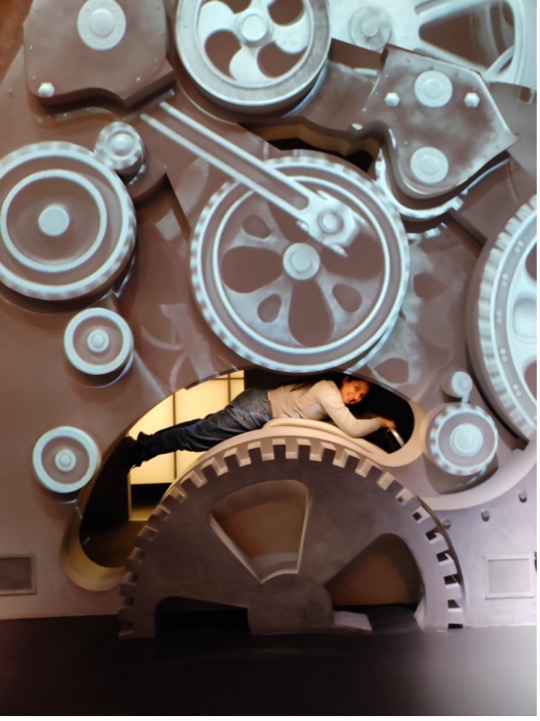
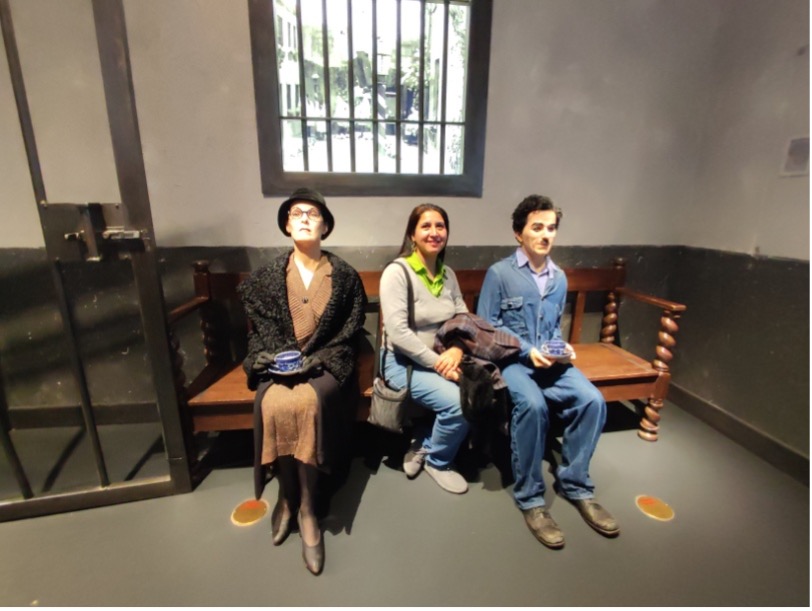
After the film ended, we were asked to move towards the screen. Suddenly, the screen disappeared and lo and behold, I found myself on a beautifully recreated set from The Kid. We were prompted to go behind the set, and to my bewilderment, what followed was one set after another – The Great Dictator, City Lights, Gold Rush, Limelight, A King in New York, whew! It was such a delight to go through those sets, to see the wax figurines, to sit on the chair from The Gold Rush with Charlie peeping from under a table, to pose next to Charlie in my own bowler’s hat, to sit on the jail bench next to him, to be swallowed by the giant machine from Modern Times. Mercifully, my camera behaved throughout the studio visit and I took many keepsake pictures. After a stroll through the beautiful grounds, I picked up some books, including Chaplin’s autobiography, and other memorabilia. I started reading the autobiography shortly after my visit and it reaffirmed my views about Charlie.

During my visit and afterwards, I got a lot of time to reflect upon how Chaplin’s films were deeply concerned with the human condition, with all the miseries and challenges brought upon it by events that the common man has no control over. Chaplin’s work includes The Gold Rush (1925), which drew from real-life events such as the Klondike Gold Rush and the Donner Party, and The Great Dictator(1940), a satire on Adolf Hitler. Limelight (1952), which depicted the frustration of a has-been comedian, can be classified as auto-fiction, as can The Kid (1921), while Modern Times has been hailed as an astute commentary on industrialisation. Levity was Chaplin’s forte, but all his films were deeply rooted in his political and social consciousness. More often than not, he had to pay a heavy price for sticking to his beliefs.

Recollecting the making of The Great Dictator, Charles says in his autobiography, “Halfway through, I began receiving alarming messages from United Artists … But I was determined to go ahead, for Hitler must be laughed at. Had I known of the actual horrors of the German concentration camps, I could not have made The Great Dictator; I could not have made fun of the homicidal insanity of the Nazis.”

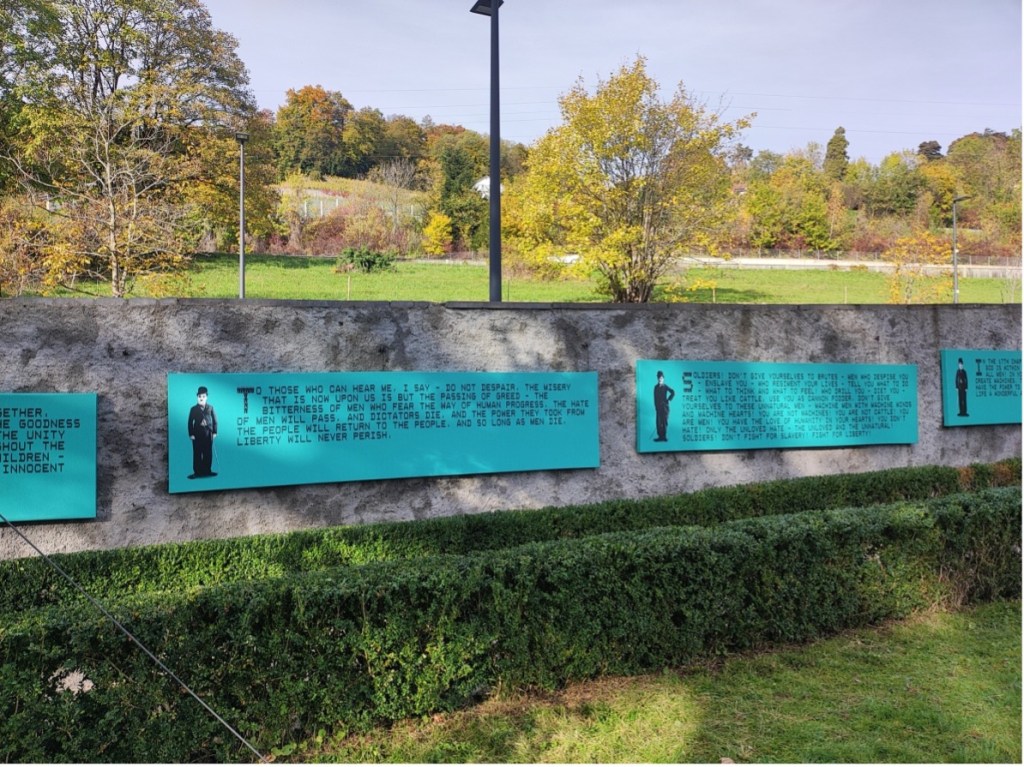
The boundary wall of the Manor de Bain. The sounds of cow bells from across the road drifted towards the estate, making for a mesmerising setting.

Chaplin was a genius who understood the power of the audio-visual medium. Since pantomime was his greatest strength, having performed bit roles in theatres during his childhood days of great hardship and penury, he used this technique to convey pathos through humour. Although he was earning quite well as a comedian-writer-director in Hollywood, by 1919, he was so frustrated with the studio system, which did not give him a free hand to write his own scripts, that he co-founded United Artists along with Douglas Fairbanks, Mary Pickford and D.W. Griffith.

His first major hit under his own banner was The Kid, which drew from his childhood experiences. So strong were his convictions about the silent film that he swam against the tide and released City Lights in 1931, well after talkies had completely taken over Hollywood. Slowly, he started warming up to the possibilities of sound in film. He used sound effects in Modern Times but no spoken dialogue. He composed and sang a charming ditty in gibberish, ‘Titine’,with some random words in French, Italian and English thrown in, for Modern Times which never fails to bring a smile to the face, even eighty-seven years after its release

Whether it was silent films or talkies, Chaplin continued to tell his stories of universal values, of hope amidst great suffering. As an artist, he never shied away from speaking truth to power. Like most great artists, he did not accept manmade boundaries. Although he was English by birth, he was criticised for not fighting in World War I. He had long arguments with Winston Churchill about Mahatma Gandhi and the struggle of the Indian people for freedom. In fact, he met Gandhi-ji shortly after meeting Churchill, during a trip to London, and questioned him at length about his abhorrence for machinery. He returned from the meeting with great admiration for Gandhi-ji’s strategies for achieving independence and his principles of non-violence and truth. His conversation with Gandhi-ji influenced his writing of Modern Times, especially the Gandhian theory about modernisation and rapid industrialisation being the cause of unemployment and rising inequality. The fearless artist once made an uncharitable remark about the English royalty, telling Churchill, “I thought socialists were opposed to a monarchy”, to which Winston Churchill replied, with a laugh, “If you were in England, we’d cut your head off for that remark.”

Being wary of the ways of Hollywood where an artist was judged by his or her success at the box office, he made few friends in the film industry. Chaplin was happy spending time visiting his childhood haunts on his trips to London, and also enjoyed wining and dining with film stars, princes and princesses, prime ministers and presidents, scientists, philosophers, poets and writers. He was friends with Mary and Douglas Fairbanks, Albert Einstein, George Bernard Shaw, H.G.Wells, Harold Laski, Aldous Huxley, Theodore Dreiser, et al. He went to Lucerne in Switzerland to meet India’s first prime minister, Jawaharlal Nehru, expressing his surprise at finding him “a small man like myself”. Chaplin invited Pt Nehru to his estate in Vevey for a meal. They had a long chat on the way, which left Chaplin impressed with the “…man of moods, austere and sensitive, with an exceedingly alert and appraising mind”.

Chaplin was a pacifist and a philosopher, and was derided for his views in America – not just mocked, but harassed by the FBI under its founding director, J. Edgar Hoover. In 1952, the country which has historically been considered the land of free speech hounded Charlie out of its borders under the mistaken impression that he was an avowed communist, and told him to never come back. Chaplin even narrowly escaped an assassination attempt in Japan.

Chaplin’s autobiography ends in 1964, on a poignant yet hopeful note, just like Charlie’s films, with Chaplin expressing his sadness at having to leave America, but also describing his happy days in Switzerland, where he befriended several artists who lived in the area. Eight years later, in 1972, Charles Spencer Chaplin was called back to America by the Academy of Motion Picture Arts & Sciences to receive an Honorary Oscar. After initial hesitation, Chaplin decided to attend the ceremony, which would end his twenty-year exile from America. He went on to receive an unprecedented standing ovation lasting twelve minutes. Cries of “Bravo!” filled the auditorium and Chaplin was clearly overwhelmed. It was an emotional homecoming for the man who had left Los Angeles in extremely unpleasant circumstances in 1952.

Chaplin was knighted by Queen Elizabeth II in 1975, but by then he was frail and had to accept the honour in a wheelchair. He passed away in 1977, but his legacy lives on. I hope cine buffs like me keep rediscovering him, for The Tramp is timeless.

(The photographs have been provided by the author, except for the book cover)

Nirupama Kotru is an officer of the Indian Revenue Service,1992 batch. Ms.Kotru has served in the Income Tax Department at Mumbai, Chennai, Delhi and Pune. On deputation, she served as Director (e Governance) in Ministry of Corporate Affairs and as Director (Films) in M/o Information & Broadcasting, where she looked after policy issues such as censorship, India’s participation in film festivals abroad, archiving, film schools and production of films.

As Joint Secretary in Ministry of Culture she has looked after prestigious national akademis such as Sahitya Akademi and National School of Drama, and national museums such as Indian Museum and Victoria Memorial Hall &Museum. She is presently posted as Joint Secretary& Financial Advisor, Ministries of Coal, Mines & Minority Affairs. She has released an album of bhajans called Upasana. She has also written around thirty articles on cinema and other topics such as parenting. She is currently co-authoring an anthology on Hindi cinema of the 1970s.

.

PLEASE NOTE: ARTICLES CAN ONLY BE REPRODUCED IN OTHER SITES WITH DUE ACKNOWLEDGEMENT TO BORDERLESS JOURNAL. 

Click here to access the Borderless anthology, Monalisa No Longer Smiles

Click here to access Monalisa No Longer Smiles on Kindle Amazon International
Categories
Editorial

When Autumn Leaves Start to Fall…

                     “Where are the songs of Spring? Ay, where are they?
                      Think not of them, thou hast thy music too…”

                                 — John Keats (1795-1851), To Autumn
Art by Sybil Pretious

For long writers have associated autumn with “mellow wistfulness”. That loss of spring, or loss of youth is not bleak or regretful has been captured not just by Keats but also been borne out by historical facts. Anthropocene existence only get better as the human race evolves … If we view our world as moving towards an autumn, we perhaps, as Keats suggests, need to find the new “music” for it. A music that is ripe and matures with the passage of time to the point that it moves more towards perfection. Though sometimes lives fade away after autumn gives way to winter as did those of  Queen Elizabeth II (April 21st 1926 – September 8th 2022) after a reign of seventy historic years and Mikhail Gorbachev (2nd March 1931 – 30thAugust 2022) with his admirable efforts to bridge divides. Both of them have left footprints that could be eternalised if voices echo in harmony. Thoughts which create bonds never die – they live on in your hearts and mine.

Imagine… ten thousand years ago, were we better off? Recorded history shows that the first war had already been fought 13,000 years ago. And they have continued to rage – but, at least, unlike the indomitable Gauls in Asterix[1] comics – not all jumped into the fray. They did during the last World Wars — which also led to attempts towards institutionalising humanitarian concerns and non-alignment. Yes, we have not had a perfect world as yet but as we age, the earth matures and we will, hopefully, move towards better times as we evolve. Climate change had happened earlier too. At a point, Sahara was green. Continental shifts split Pangaea  into seven continents – that was even earlier. That might have driven the dinosaurs to extinction. But I am sure mankind will find a way out of the terror of climate change and wars over a period of time, as long as we believe in deciphering the sounds of autumn as did Keats in his poem.

Tagore had also sung of the joys of autumn which happens to be a time for festivities. Professor Fakrul Alam has translated three such songs, reflecting the  joie de vivre of the season, The translation of a small poem, Eshecche Sarat[2], brings the beauty of the season in Bengal to the fore. We have a celebration of youth and romance in a Balochi folksong, an anti-thesis to autumn and aging, translated for us by Fazal Baloch and also, poetic prose in quest of God and justice by Haneef Sharif, translated from Balochi by Mashreen Hameed. Lost romance recapitulated makes interesting poetry is borne out by Ihlwha Choi’s translation of his own poem from Korean. But the topping in our translation section is a story called ‘Nagmati[3]’ by eminent Bengali writer, Prafulla Roy, translated by no less than a Sahitya Akademi winning translator – Aruna Chakravarti. This story illustrates how terrifying youthful follies can lead to the end of many young lives, a powerful narrative about the snake worshipping community of Bedeynis that highlights destruction due to youthful lusts and an inability to accept diverse cultures.  

When this cultural acceptance becomes a part of our being, it creates bonds which transcend manmade borders as did the films of Satyajit Ray. His mingling was so effective that his work made it to the zenith of an international cinematic scenario so much so that Audrey Hepburn, while receiving the Oscar on his behalf, said: “Dear Satyajit Ray. I am proud and privileged to have been allowed to represent our industry in paying tribute to you as an artist and as a man. For everything you represent I send you my gratitude and love.”

This and more has been revealed to us in a book, Satyajit Ray: The Man Who Knew Too Much, authored by a protagonist from Ray’s film, Barun Chanda. This book brought out by Om Books International reflects not just Ray as a person but also how he knitted the world together with his films and took the Indian film industry to an international level. Barun Chanda has been interviewed with a focus on Satyajit Ray. Keith Lyons has also interviewed a man who has defied all norms and, in the autumn of his life, continues his journey while weaving together cultures across, China, India and Thailand by his ethnographic studies on tribes, Jim Goodman. Goodman says he left America when speaking for a war-free world became a cause for censorship. This makes one wonder if war is a game played for supporting a small minority of people who rule the roost?  Or are these ramblings of a Coleridge writing ‘Kubla Khan’ under the influence of narcotics?

Poetry also brings the season into our pages with an autumnal interpretation of life from Michael Burch. More poetry from Sunil Sharma, Ryan Quinn Flanagan, Gayatri Majumdar, George Freek, Ron Pickett, Sutputra Radheye, Marianne Tefft brings a wide range of concerns to our pages – from climate to the vagaries of human nature. Poetry by an Albanian writer, Irma Kurti, and photographs by her Italian spouse, Biagio Fortini, blend together the colours of humanity. Rhys Hughes as usual, makes it to the realm of absurd – perhaps voicing much in his poetry, especially about the environment and human nature, though he talks of woodpeckers on Noah’s ark (were there any?) and of cows, yetis, monkeys and cakes… He has also given us a hilarious cat narrative for his column. Can that be called magic realism too? Or are the edges too abstract?

A book excerpt from Hughes’ Comfy Rascals Short Fiction and a review of it by Rakhi Dalal makes us wonder with the reviewer if he is a fan of Kafka or Baudelaire and is his creation a tongue-in-cheek comment on conventions? A book review by Hema Ravi of Mrutyunjay Sarangi’s A Train to Kolkata and Other Stories and another by Bhaskar Parichha of Netaji Subhash Chandra Bose’s Life, Struggle and Politics, authored by Netaji’s nephew’s wife, Krishna Bose, translated and edited by her son, Sumantra Bose, unveils the narratives around his life and death.

A leader who quested for freedom and roamed the world after being passed over by the Congress in favour of Nehru, Netaji raised an army of women who were trained in Singapore – not a small feat in the first half of the twentieth century anywhere in the world. His death in an air crash remained an unsolved mystery — another one of those controversies which raged through the century like the Bhawal case. In his review, Parichha spells out: “Aiming to bring an end to the controversies and conspiracy theories surrounding the freedom fighter, the over 300-page book gives a detailed and evidence-based account of his death in one of its chapters.”

Our book excerpts in this edition both feature writers of humour with the other being the inimitable Ruskin Bond. We have an excerpt of Bond’s nostalgia from Between Heaven and Earth: Writings on the Indian Hillsedited by Ruskin Bond and Bulbul Sharma.

Our non-fiction also hosts humour from Devraj Singh Kalsi about his interactions with birds and, on the other hand, a very poignant poetic-prose by Mike Smith reflecting on the vagaries of autumn. From Japan, Suzanne Kamata takes us to the Rabbit Island – and murmurings of war and weapons. We have the strangest story about a set of people who are happy to be ruled by foreign settlers – we would term them colonials – from Meredith Stephens. G Venkatesh delights with a story of love and discovery in Korea, where he had gone in pre-pandemic times. Paul Mirabile travels to Turkey to rediscover a writer, Sait Faik Abasiyanik (1906-1954). And Ravi Shankar gives us an emotional story about his trek in the Himalayas in Nepal with a friend who has passed on. Candice Louisa Daquin has written of the possibilities towards integrating those who are seen as minorities and marginalised into the mainstream.

The edition this time is like Autumn – multi-coloured. Though I am not able to do justice to all our contributors by mentioning them here, my heartfelt thanks to each as every piece only enriches our journal. I urge you to take a look at the September edition.

I would like to give huge thanks to our readers and our team too, especially Sohana Manzoor and Sybil Pretious for their artwork. We could not have come this far without support from all of you.

Thank you.

Happy Reading!

Mitali Chakravarty

borderlessjournal.com


[1] The men in the indomitable Gaulish village (which the Romans failed to conquer) in times of Julius Caesar loved to jump into a fight for no reason…Asterix was the protagonist of the comics along with his fat friend Obelix

[2] Arrival of Autumn

[3] Snake Maiden