Categories
Stories

Pier Paolo’s Idyll

By Paul Mirabile

In order to build a new low-cost residential complex twenty kilometres to the West of Rome, hundreds of hectares of low-lying hills, orchards, several depopulated hamlets and unplanted vineyards had been cleared by an army of bulldozers, cranes and cheap labour with picks and shovels. In the 1960s, housing construction in Italy had mushroomed out in an erratic, rampaging spectacle beyond any public or private circumspection.

Pier Paolo and his middle-aged mother benefitted from one of these new, but hastily built residential flats on the tenth floor of a fifteen-storey tower. His father had abandoned the family four or five years ago, forcing the boy’s mother to work as a seamstress for the hundreds of residents of their tower. He himself had dropped out of school to work at a nearby wine factory in the industrial zone. Their meagre incomes paid the rent, permitted them to eat two or three meals a day and dress decently.

Everyday, Pier Paolo shuffled lazily to the factory at eight o’clock. To reach the small factory, he crossed an immense horizonless, treeless esplanade paved in the most banal ugly grey paving stones. What caught his attention, however, was a low rising stretch of grassy dirt mounds which ran for a lengthy distance along a high, barbed wire metal barrier which separated the dirt mounds from a rocky embankment leading downwards to a newly build avenue. These low dirt knolls, according to the season, blushed a poppy spring red, a leafy, autumnal brown, a wintry white then a lush, verdant green in the summer. On his off days, he would walk through the low hillocks from one point to the other. They covered an area of about twenty-five metres by ten metres. His constant crossings in this forgotten pile of dirt had traced footpaths in and around the knolls, the low bushes and over broken roots.

Pier Paolo enjoyed these pleasant promenades. Below, on one side, buzzed speeding vehicles. On the other, lay the empty, treeless esplanade where hardly a soul appeared, save a few workers, housewives pushing carts of food, flowers or trinkets to be sold in the neighbourhood market, one or two old school comrades and stray dogs. It was at that particular movement of contemplation that Pier Paolo experienced a tinge of excitement, a mounting commotion that would endorse and embolden his existence, would prompt his escape from the boring walls of a suffocating flat, the ugly concrete and metal of their block residence …

Returning from the factory one afternoon at the beginning of June, Pier Paolo walked briskly over the range of shaggy mounds of piled up dirt for an hour or so before finally deciding  upon a spot that would suit his adventure nicely. Hidden from the eyes of those who crossed the esplanade, a small concavity in the rim of a grassy hillock would afford him a place to sleep. He only needed to erect a make-shift lean-to, not to protect him from the rain — during the spring and summer months it never rained — but from the scorching heat. Yes, Pier Paolo resolved to live with nature on this diminutive tract of earth that had miraculously survived the building contractors’ bulldozers and cranes.

He hastened home to his mother who was busy sowing a marriage dress for her second storey neighbour. Pier Paolo excitedly explained his adventure. It would last through not only for the summer months, but also through autumn before the heavy rains set in. She listened passively, her mouth agape. Had her son gone completely daft? No, he appeared quite normal, even serious. He would rise with the rising sun, have his breakfast at the café near the factory, lunch at the factory canteen, and as to diner he would buy deli meats, olives, cheese and bread at the grocer’s.

“Why not eat diner here with me?” his mother suggested in her soft, meek voice.

“Of course I’ll eat with you mummy, but only on weekends. I must live permanently in my new environment. I’m eighteen year’s old, and it will be an adventure to sleep out in such primitive and natural surroundings without neighbours’ screaming and shouting, loud parties until four in the morning, lifts breaking down all the time. I want to breathe fresh air, if that is all possible in this godforsaken dump.”

His mother flushed at these last words, but held her tongue, astonished at her son’s resolution. “You see mummy, I want to look up at the stars and not at the cracks in the ceiling of my room.” His mother nodded her head, thimble on her thumb, needle and thread between her index and middle finger. He was right, there were many cracks and fissures in the ceilings and walls of their ‘new’ flat ! Well, he did show ingenuity and imagination. He wouldn’t take no for an answer, and besides, he wouldn’t be far from home …

So Pier Paolo packed a few belongings in his back-pack, rolled up his sleeping bag, kissed his mother on her wrinkled forehead and strolled to his ‘earthy paradise’ as he facetiously called his up-coming ‘residence’.

The first two weeks Pier Paolo did eat with his mother on Sundays and also gave her his clothes to be washed, cleaned and dried, made ready for work on the morrow. However, the following weekends he did his own washing at the launderette for a few lira, and ate sandwiches at his hilly home instead of with his mother. It certainly was not out of anything against her. He loved her very much. But Pier Paolo wished to be on his very own, especially on his off days and at night, lying on his sleeping bag outside the lean-to, observing the stars and the moon as they moved slowly across the universe. Up till then, no one had disturbed him. A stray dog did sniff about his installation on several occasions, but the animal seemed friendly, and Pier Paolo threw it some slices of salami and pepperoni. The only other ‘visitors’ to his comfortable solitude were the sparrows who gayly pecked at the crumbs of bread that he scattered for them just below his shelter.

Oh how after a hard day’s work at the factory he relished those calm, starry evenings, the light whir of vehicles below beyond the barbed-wire barrier, the absolute silence of the esplanade behind him! He really felt quite at home amongst the natural elements; the ants building their ant-hills, the bees doing their dance amidst the honeysuckles, the birds chirping in and out of the bushes. The poppies and daisies were in bloom, too. Alas, many of the grassy knolls and thorny footways had been littered with coke bottles and caps, beer cans or liquor bottles, yellowed magazine and newspaper pages, cigarette studs, all thrown there by returning workers from the industrial area or gangs of drunken adolescents. Pier Paolo, struggling through the prickly weeds, would clean the mess the best he could, but invariably the same lot or other litter-louts would fling whatever trash they had into his ‘paradise’ as if it were a huge rubbish bin. Did these individuals know that Pier Paolo had taken up residence in those piles of grassy mounds? Even if they did, nothing would have prevented them from tossing whatever they had into it, accompanied by drunken guffaws and mindless giggles.

The sea must not have been far off, or so he imagined. For at times he heard the whir of a winged seagull. He stood to catch sight of it, but only the blurry orange glow of the high rising tower lights far off at the end of the esplanade marked the sky. The towers resembled so many indistinct parapets of flickering light-bulbs which loomed ominously at the end of the soundless esplanade. That vastness of ugly emptiness had always frightened him, and at those times he would turn his back to this sinister, featureless urban landscape and dwell upon the images of faraway scenes that crossed his imagination. No, those electric lights would not chase away his stars …

One star-filled night, he envisaged pink and amber sands of a horizonless desert whose barkans[1] and chots[2] left him breathless; the heat of the sands made him sweat under the blazing hot sun in an azure sky of pure, unpolluted, untainted opal. In another vision, he pictured himself deep in a chain of snow-clad crested mountains, trekking with difficulty over ribbed glaciers and ice-laden passes, the blues of the mountains inviting him to penetrate ever deeper so as to discover the arcane entrance to the subterranean kingdom of the King of the World.

Pier Paolo’s imagination soared to new heights night after night following a hard day’s work. It were as if he had mounted a magic carpet which floated under rainbows, over wide forests and turquoise seas. These fantastic images slid him slowly into a deep, healthy sleep. He awoke refreshed and vigorous, ready for a hearty breakfast at the café and work. In fact, he had never worked as hard as he did now, loading the train cars with heavy cartons of wine, working rapidly at the conveyor belt packaging wine bottles.

Many of the workers admired the young Pier Paolo for his renewed energy, his replenished stamina and spirit. At the sound of the whistle, he showered, bought some prosciutto, pepperoni, provolone, olives, pistachios and bread from the grocer’s, then returned merrily to his shaggy-mounded home. His muscles ached, but gradually relaxed when the stars began to pop out forming clusters of scintillating comfort …

He saw himself on the Niger River somewhere in Mali, drifting in a canoe on the slow moving current, wild geese cackling on the wing, hippopotami bellowing and rumbling in the deep waters, camels grunting from the arid sand-filled shores. He drifted and drifted as the heat bore heavily upon him, lying upon sacks of corn, munching on dates, tomatoes and boiled fish …

A sudden barking! It was the stray dog. Pier Paolo shook himself out of his dreamy stupor, threw the poor scraggy creature a slice of pepperoni, then closed his weary eyes and slept soundly. Darkness crept over the hilly mounds, mantling their denizen in another tranquil night of peaceful repose.

Oddly enough, after having devoured the slice of pepperoni, the dog never returned to visit our grassy-mounded denizen. He had other visitors, however — a motley lot of out-of-schoolers who seemingly scented the presence of someone living amidst the abandoned lot, and who endeavoured to confirm it. It was a Saturday afternoon. Pier Paolo was busy reading an interesting detective story when suddenly he found himself encircled by three ragamuffin boys and two very buxom girls! They all sized him up, noses in the air as if sniffing the warm breeze of a July day.

“Who are you mate?” a skinny boy questioned with overt contempt. He appeared to be the ‘chief’ of the pack. Pier Paolo stood up. He was much taller than any of them and more broad-shouldered. The others held their ground, but one or two scraped the dirt with their worn-out shoes, biting their lips.

“I’m the king of these mounds. What of it?”

“The king?” guffawed the skinny chap out of the corner of his distorted mouth.

“Yea, the king,” repeated Pier Paolo, heightening his voice with an added tinge of condescension.

“Very well, king. Then what if we were to dethrone you and turn your monarchy into a democratic state?” The others sniggered at this show of rhetoric, albeit hesitantly.

“Go ahead, Mister Democrat!” responded the monarch, tightening his fists, smiling through clenched teeth. No one moved. The warm breeze made the democrats sway in their fixed positions like a herd of paper tigers.

“Ah, let it go,” interrupted one of the girls. “Let him rule over his trash-filled kingdom.” And she turned to leave, followed shortly by the other girl then the three boys, who exchanged menacing glances with Pier Paolo. The ‘chief’ bowed in affected reverence to the ‘king’ and mumbled something unintelligible. When they had reached the esplanade, Pier Paolo scoffed at this unexpected intrusion, crawled under his lean-to and went back to his afternoon reading …

The August heat dried all the perfumed poppies and dainty daisies that Pier Paolo had planted around his lean-to. The heat had become unbearable, driving through the palm-leaf roof of his make-shift shelter. It was holiday for most of the workers at the wine factory, but Pier Paolo volunteered to work the whole month, not only for higher wages, but for showering and the afternoon hot meals. He did visit his mom every now and then, but was living mostly on deli meats, olives, cheese, fruit and bread. Because of the heat, he showered every day and took his clothes to the launderette every two days. It’s true that this kind of a diet began to bore him, however, his solitary refuge had really become his royal paradise!

Every Saturday and Sunday, he roamed through his ‘kingdom’ searching the nooks and crannies for unusual objects: a broken tombstone dating from the seventeenth century judging from the Latin inscription, a yellow-paged book of verses by a poet unknown to him, several of which he managed to read but hardly understood. He discovered a rusted compass and magnifying-glass, half-buried in one of the weedy mounds. In a riot of dead roots he rummaged out a photo of a young girl dressed as if to go to church, all in white with a huge black crêpe de chine hat. He collected these treasures and put them in a box for safe-keeping. They represented objects reminiscent of some by-gone era.

One day he stumbled upon a huge footprint, much bigger than any print he had ever seen.

“A dinosaur?” he thought excitedly.

He scoured the knolls for any dinosaur bones but found none. Where did that enormous footprint come from? Pier Paolo grew somewhat apprehensive. His kingdom indeed enclosed a myriad mysteries. And this one drew him further before the advent of humankind …or so he thought.

One fine sunny morning, the black dog he had fed, suddenly appeared with a huge bone in its mouth. Pier Paolo threw it a few slices of salami he had been munching on but the dog shook its shaggy head and plodded off behind a knoll. He raised a quizzical eyebrow. Did the dog not like salami? Perhaps that bone was a dinosaur bone. He shrugged his shoulders sniffing the hot air.

During the month of August he hardly visited his mother. He hardly spoke to his colleagues at the factory. They eyed him nervously. The boy seemed so estranged, aloof with a distant look in his eyes. He would look straight through you and beyond, somewhere far, far away. His gait too had slackened. This being said, he carried out his tasks as usual.

He let his hair grow long, dishevelled. He grew a wispy beard, uncombed. His clothes, although clean, hung on him like a bag, and a bit bedraggled to boot as if he had slept in them. Which he always did, needless to say. All he yearned for was to return to his solitary retreat in the evening, lie down and stare at the emerging stars. They drew him upwards and outwards. The sun having set, the heat ceased to vex him. The crickets discontinued their August chorus. Other sounds, alien, rose to a high pitch in his head…the tinkling of camel bells across the sandy wavelets of the Gobi or the Sahara deserts. There he was again, riding atop a camel, a white, gleaming, silken turban wound about his head, his body protected by a satin djellaba. He had sailed the high seas for many moons before disembarking in this ocean of ergs[3] whose vibrant colours made his eyes squint. The cleanliness of such an expanse delighted him, such a contrast to the concrete ugliness and filth of all those horrid towers! As the ship disappeared over the rim of the watery horizon, he stood between the vastness of the desert and the sea, the first in front of him, the second behind, ready to penetrate unknown territories. Above, a translucent blue sky. The camels plodded onwards; a sudden crispy sound alerted him to a change in the landscape, the camels’ hooves now trudged over stetches of slaty black sands that the dried lava of a volcano eruption had deposited thousands and thousands of years ago. The camels trudged and trudged ; the crusty slaty sands crunched and crunched until Pier Paolo fell asleep …

Pier Paolo, after five weeks of not visiting his mother, spent a Sunday with her. So happy was she to see her son that the cheerful woman cooked him his favourite dish: eggplant parmigiana. She bought him the best provolone and caciocavallocheeses that she could afford, and served him a vintage Chianti wine. As a special treat for dessert, she fried him Sicilian sfince[4]. How he wolfed those delicious delicacies down! Pier Paolo hadn’t eaten such sweets for over three months. He had become so thin, his long hair and beard framed an emaciated face, whose bulging eyes bore a wild look. Yet he remained very polite, mild-mannered, even tender towards his loving mother throughout the afternoon. When he closed the door behind him, she held back her tears. Would she hold them back when his final hour came?

It was a warm September afternoon, 1975. Next to his lean-to, Pier Paolo sat reading a novel by Alberto Moravia, ‘Gli Indifferenti’[5], the 1929 edition. He sniffed the cool autumn air, admired the pleasant scents of the poppies and honeysuckles around which the bees were busily buzzing. From behind the mounds, he heard a few vehicles screech to a halt, followed by many coarse voices. The boy stood, walked over the mounds and noticed five or six men in ties and two policemen staring up at him. A big fat man, probably a building contractor by the look of his clothes, waved to him to come down. With overt disdain, he turned and returned to his novel. Shortly after, though, he found himself surrounded by these intruders to his privacy. He stood, miffed to the marrow!

“You’re trespassing, sirs. And encroaching on my afternoon reading.” This was stated with calm but obvious scorn. All the men laughed so loud that it brought a series of yowls from the stray dog, who had been observing the scene from atop the knoll where Pier Paolo had built his lean-to. It was showing its teeth, yet uttered not a growl.

“Clear out boy, you’ve had your fun for the summer. The neighbours are complaining about you. Anyway the city is about to level all this and pave it clean.” The fat man certainly gave himself airs, puffing out his chest.

Pier Paolo, with a thin smile, replied wearily: “What neighbours? No neighbour has ever said anything about my being here. They don’t even know I’m here.”

“Listen, don’t muck about with us. I’m telling you to push off or we’ll be forced to drag you off,” the other said in a offensive tone, his face turning a beet-red.

Pier Paolo clenched his fists: “This is my kingdom, fatty. I and only I decide when to leave!”

The dog yowled again. The fat contractor kicked down the lean-to in a spate of anger. Pier Paolo, taken aback by this display of uncalled for violence, lashed out at him with two or three well-placed blows to the face. ‘Fatty’ fell backwards to the ground, spitting out a tooth and much blood.

One of the policemen grasped Pier Paolo by the shoulder ; the young boy showing unusual strength knocked his arm away and struck the policeman’s jaw with his elbow, then continued to strike him in the ribs with a volley of punches. Just then from above, the dog leapt into the crowd barking hysterically. It fell onto one of the men biting into the neck. The dog had gone mad. The other policeman took out his pistol and shot it dead.

Pier Paolo, stunned by the gunshot and the dog lying limp next to his broken lean-to, flew into a rage and attacked the policeman, seething like an animal, gnashing his teeth. He struck blow after blow, uncontrollably. Now the rest of the men pounced on the boy beating him mercilessly to the ground, kicking him in the head. The policeman broke up the beating, handcuffed the half-unconscious Pier Paolo and dragged him off to the police car …

The badly beaten boy was taken to hospital. Upon his release, he was immediately arrested and charged for assault and battery on the two policemen and on two municipal civil servants. At the trial the accused, who had no defence, was sentenced to two years imprisonment and a 50.000 lira fine, which he refused to pay on the grounds that neither he nor his mother could afford such a sum. The judge slapped on another year of imprisonment.

Confined to stare at four concrete walls many hours a day, Pier Paolo gradually slipped out of the reality of his circumstances. He took no food nor spoke to anyone. He merely lay prostrate on his little cell bed like one awaiting death. No more wonderful images of deserts, mountains and seas crossed his benumbed mind.

Death stole upon Pier Paolo in violent spasms on the evening of the second of November, 1975. Apparently, he had starved himself to death.

His lonely mother sewed and sewed, no longer able to retain her tears. No neighbour came to comfort her; no religious authority to commiserate with her grief.

As to Pier Paolo’s kingdom or paradise, on one dreary November day, several bulldozers levelled the shaggy mounds. The area that had been his home now became an extension of the paved esplanade up to the barrier of the embankment.

[1] Crescent-shaped sand dunes.

[2] Large lake-like salt deposits.

[3] Large wavy dunes.

[4] Made of ricotta, unbleached flour and unsalted butter, rolled into balls and fried. When cooled, sugar powder is sprinkled on them. They are generally eaten on Saint Joseph’s day in Sicily.

[5] Translated in English as ‘The Indifferent Ones’ or ‘The Time of Indifference’ by Alberto Moravia(1907-1990)

.

Paul Mirabile is a retired professor of philology now living in France. He has published mostly academic works centred on philology, history, pedagogy and religion. He has also published stories of his travels throughout Asia, where he spent thirty years.

.

PLEASE NOTE: ARTICLES CAN ONLY BE REPRODUCED IN OTHER SITES WITH DUE ACKNOWLEDGEMENT TO BORDERLESS JOURNAL

Click here to access the Borderless anthology, Monalisa No Longer Smiles

Click here to access Monalisa No Longer Smiles on Kindle Amazon International
Categories
Contents

Borderless April, 2024

Art by Sohana Manzoor

Editorial

April Showers… Click here to read.

Translations

Baraf Pora (Snowfall) by Rabindranath Tagore, gives a glimpse of his first experience of snowfall in Brighton and published in the Tagore family journal, Balak (Children), has been translated from Bengali by Somdatta Mandal. Click here to read.

Himalaya Jatra ( A trip to Himalayas) by Tagore, has been translated from his Jibon Smriti (1911, Reminiscenses) by Somdatta Mandal from Bengali. Click here to read.

Bhumika (Introduction) by Tagore has been translated from Bengali by Ratnottama Sengupta. Click here to read.

The Fire-grinding Quern by Manzur Bismil has been translated from Balochi by Fazal Baloch. Click here to read.

The Tobacco Lover by Ihlwha Choi has been translated from Korean by the poet himself. Click here to read.

Pochishe Boisakh (25th of Baisakh) by Tagore(1922), has been translated from Bengali by Mitali Chakravarty. Click here to read.

Pandies Corner

Songs of Freedom: Dear Me… is an autobiographical narrative by Ilma Khan, translated from Hindustani by Janees. These narrations highlight the ongoing struggle against debilitating rigid boundaries drawn by societal norms, with the support from organisations like Shaktishalini and pandies’. Click here to read.

Poetry

Click on the names to read the poems

Michael Burch, Kirpal Singh, Scott Thomas Outlar, Nusrat Jahan Esa, George Freek, Snigdha Agrawal, Phil Wood, Pramod Rastogi, Stuart McFarlane, Ahmad Al-Khatat, Shamik Banerjee, Ryan Quinn Flanagan, Lisa Sultani, Jenny Middleton, Kumar Bhatt, Rhys Hughes

Poets, Poetry & Rhys Hughes

In The Desk, Rhys Hughes writes of his writerly needs with a speck of humour. Click here to read.

Musings/Slices from Life

Heatwave & Tagore

Ratnottama Sengupta relates songs of Tagore to the recent heatwave scorching Kolkata. Click here to read.

The Older I get, the More Youthful Feels Tagore

Asad Latif gives a paean in prose to the evergreen lyrics of Tagore. Click here to read.

No Film? No Problem

Ravi Shankar takes us through a journey of cameras and photography, starting with black and white films. Click here to read.

Musings of a Copywriter

In Witches and Crafts: A Spook’s Tale, Devraj Singh Kalsi finds a ghostly witch in his library. Click here to read.

Notes from Japan

In Of Peace and Cheese, Suzanne Kamata gives us a tongue in cheek glimpse of photo-modelling mores. Click here to read.

Essays

Discovering Rabindranath and My Own Self

Professor Fakrul Alam muses on the impact of Tagore in his life. Click here to read.

The Lyric Temper

Jared Carter explores the creative soul of poets through varied times and cultures. Click here to read.

Bengaliness and Recent Trends in Indian English Poetry: Some Random Thoughts

Somdatta Mandal browses over multiple Bengali poets who write in English. Click here to read.

Stories

Hope is the Waking Dream of a Man

Shevlin Sebastian gives a vignette of life of an artist in Mumbai. Click here to read.

Viceregal Lodge

Lakshmi Kannan explores patriarchal mindsets. Click here to read.

The Thirteen-Year Old Pyromaniac

Paul Mirabile gives a gripping tale about a young pyromaniac. Click here to read.

Conversation

Ratnottama Sengupta in conversation about Kitareba, a contemporary dance performance on immigrants, with Sudarshan Chakravorty, a choreographer, and founder of the Sapphire Dance Company. Click here to read.

Book Excerpts

An excerpt from Jessica Mudditt’s Once Around the Sun – From Cambodia to Tibet. Click here to read.

An excerpt from Bhaskar Parichha’s Biju Patnaik: The Rainmaker of Opposition Politics. Click here to read.

Book Reviews

Meenakshi Malhotra reviews Mahasweta Devi: Writer, Activist, Visionary, edited by Radha Chakravarty. Click here to read.

Basudhara Roy reviews Out of Sri Lanka: Tamil, Sinhala and English Poetry from Sri Lanka and its Diasporas, edited by Vidyan Ravinthiran, Seni Seneviratne, Shash Trevett. Click here to read.

Swagata Chatterjee reviews Sanjukta Dasgupta’s Ekalavya Speaks. Click here to read.

Bhaskar Parichha reviews Bhang Journeys: Stories, Histories, Trips and Travels by Akshaya Bahibala. Click here to read.

.

Click here to access the Borderless anthology, Monalisa No Longer Smiles

Click here to access Monalisa No Longer Smiles on Amazon International

Categories
Editorial

April Showers

Whan that Aprill with his shoures soote
The droghte of March hath perced to the roote,
….
Thanne longen folk to goon on pilgrimages.

— Prologue, The Canterbury Tales, Geoffrey Chaucer (1342-1400)

Centuries ago, April was associated with spring induced travel… just as pilgrims set out on a journey in Chaucer’s Canterbury Tales. Some of the journeys, like to Mecca, become a part of religious lore. And some just add to the joie de vivre of festivities during different festivals that punctuate much of Asia during this time — Pohela Boisakh (Bengali), Songkran (Thai), Navavarsha (Nepali), Ugadi (Indian), Vaisakhi (Indian), Aluth Avurudda (Sri Lankan) and many more.

A hundred years ago, in April 1924, Tagore had also set out to journey across the oceans to China — a trip which, perhaps, led to the setting up of Cheena Bhavan in Vishwa Bharati. Recently, Professor Uma Dasgupta in a presentation stated that Tagore’s Nobel prize winning Gitanjali, and also a collection called The Crescent Moon (1913), had been translated to Chinese in 1923 itself… He was renowned within China even before he ventured there. His work had been critically acclaimed in literary journals within the country. That arts connect in an attempt to override divides drawn by politics is well embodied in Tagore’s work as an NGO and as a writer. He drew from all cultures, Western and Eastern, to try and get the best together to serve humankind, closing gaps borne of human constructs. This spirit throbbed in his work and his words. Both towered beyond politics or any divisive constructs and wept with the pain of human suffering.

This issue features translations of Tagore’s writings from his childhood — both done by professor Somdatta Mandal — his first trip with his father to the Himalayas and his first experience of snow in Brighton. We have a transcreation of some of his lyrics by Ratnottama Sengupta. The translation of his birthday poem to himself — Pochishe Boisakh (his date of birth in the Bengali calendar) along with more renditions in English of Korean poetry by Ihlwha Choi and Manzur Bismil’s powerful poetry from Balochi by Fazal Baloch, add richness to our oeuvre. Bismil’s poetry is an ode to the people — a paean to their struggle. It would seem from all the translations that if poets and writers had their way, the world would be filled with love and kindness.

Yet, the world still thunders with wars, with divides — perhaps, there will come a time when soldiers will down their weapons and embrace with love for, they do not fight for themselves but for causes borne of artificial human divides. It is difficult to greet people on any festival or new year, knowing there are parts  of the world where people cannot celebrate for they have no food, no water, no electricity, no homes and no lives… for many have died for a cause that has been created not by them as individuals but by those who are guided solely by their hankering for power and money, which are again human constructs. Beyond these constructs there is a reality that grows out of acceptance and love, the power that creates humanity, the Earth and the skies…

Exploring the world beyond these constructs are poems by Scott Thomas Outlar, Nusrat Jahan Esa and Shamik Banerjee, who spins out an aubade to Kanchenjunga extolling the magnificence of a construct that is beyond the human domain.  Michael Burch brings in the theme of evolution and adaptation — the survival of the fittest. We have colours of life woven into our issue with poetry from Ryan Quinn Flangan, Kirpal Singh, George Freek, Stuart McFarlane, Lisa Sultani, Jenny Middleton, Phil Wood, Kumar Bhatt, Snigdha Agrawal and more. Rhys Hughes adds a zest of humour as he continues to explore signs and names with poetry and, in his column, he has written to extoll the virtues of a writing desk!

Humour is brought into non-fiction by Devraj Singh Kalsi’s narrative about being haunted by an ancient British ghost in Kolkata! Suzanne Kamata adds to the lightness while dwelling on modelling for photographs in the Japanese way. Ravi Shankar plunges into the history of photography while musing on black and white photographs from the past.

Tagore again seeps into non-fiction with Professor Fakrul Alam and Asad Latif telling us what the visionary means to the Bengali psyche. Starting with precursors of Tagore, like Michael Madhusudan Dutt, and post-him, Sarojini Naidu, Mandal has shared an essay on Bengaliness in contemporary poetry written by those born to the culture. Jared Carter has given discussed ‘the lyric temper’ in poetry — a wonderful empathetic recap of what it takes to write poetry. Exploring perspectives of multiple greats, like Yeats, Keats, George Santyana, Fitzgerald, Carter states, “Genuine lyricism comes only after the self has been quieted.”

Sengupta has conversed with a dance choreographer, Sudershan Chakravorty, who has been composing to create an awareness about the dilemmas faced by migrants. An autobiographical narrative in Hindustani from Ilma Khan, translated by Janees, shows the resilience of the human spirit against oppressive social norms. Our fiction has stories from Lakshmi Kannan and Shevlin Sebastian urging us to take a relook at social norms that install biases and hatred, while Paul Mirabile journeys into the realm of fantasy with his strange story about a boy obsessed with pyromania.

We carry excerpts from journalistic books by Jessica Muddit, Once Around the Sun: From Cambodia to Tibet, and by Bhaskar Parichha, Biju Patnaik: The Rainmaker of Opposition Politics.  Parichha has also reviewed for us an interesting book by Akshaya Bahibala, called Bhang Journeys: Stories, Histories, Trips and Travels. Basudhara Roy has explored migrant poetry in Out of Sri Lanka: Tamil, Sinhala and English Poetry from Sri Lanka and its Diasporas, edited by Vidyan Ravinthiran, Seni Seneviratne, Shash Trevett. Meenakshi Malhotra has discussed the volume brought out by Radha Chakravarty on the legendary Mahasweta Devi — Mahasweta Devi: Writer, Activist, Visionary. Meenakshi concludes her review contending:

“It is an ironical reflection on our times that a prolific and much awarded Indian writer– perhaps deserving of the Nobel prize — should be excised from the university syllabus of a central university. This move has, perhaps paradoxically, elicited even more interest in Mahasweta Devi’s work and has also consolidated her reputation as a mascot, a symbol of resistance to state violence. A timely intervention, this volume proves yet again that a great writer, in responding to local, regional, environmental ethical concerns sensitively, transcends his/her immediate context to acquire global and universal significance.”

There is more content than I mention here. Do pause by our current issue to take a look.

I would hugely like to thank the Borderless team for their unceasing support, and especially Sohana Manzoor, also for her fantastic art. Heartfelt thanks to all our wonderful writers and our readers. We exist because you all are — ubuntu.

Hope you have a wonderful month. Here’s wishing you all wonderful new years and festivals in March-April — Easter, Eid and the new years that stretch across Asian cultures.

Looking forward and hoping for peace and goodwill.

Mitali Chakravarty

borderlessjournal.com

.

Click here to access the content page for the April 2024 Issue.

.

READ THE LATEST UPDATES ON THE FIRST BORDERLESS ANTHOLOGY, MONALISA NO LONGER SMILES, BY CLICKING ON THIS LINK.

Categories
Stories

The Thirteen-Year Old Pyromaniac

By Paul Mirabile

Tommy sat down to dinner with his parents. Roast beef and mash again. He grimaced. His mother, a cashier at Lidl[1], and his father, a travelling salesman, threw him cursory looks: “Tommy, you should eat, meat is so dear,” his mother lamented.

“Eat up boy, money doesn’t grow on trees you know,” barked his father, wheezing irritably, followed by a huff that brooked no further comment on the subject.

Tommy slouched over his plate and wolfed down the food without a word. He left the table, as always, casting a contrary glance at his father, who ate his meal in silence, a ritual to which he demanded both his wife and his son to observe scrupulously.

Tommy slipped outside into the warm breeze of late summer, sitting down on the steps of his parents’ (the bank’s!) town council flat. How his father unnerved him with his tyrannical rules and stentorian ditties. “He’s gone almost half the year selling his cheap, nasty wares, and here he is laying down the law like a bloody dictator. Poor mommy does all she can to meet his inept demands, but when she can’t she cries her eyes out,”  he fumed inwardly, clenching his fists.

Tommy took out a box of matches, lighting each one, then flicking them into the yellowing grass of their front garden. He enjoyed watching the little sticks sail into the night air all alit, only to fall extinguished on the stone walk-way or grass. He loved the sulphurous smell of the sparks, the vision of the orange flame. They aroused a shiver of excitement in his belly and spine. The door opened. His father snorted: “Whatever are you doing with all those matches ? Matches don’t grow on trees.” And in a heightened voice, “Stop wasting them …” He slammed the door shut. Tommy clenched his fists, his lips whitening in constrained animosity …

Tommy began his incendiary career at school. Armed with a box of matches that he had pinched from the local grocers, he set fire to the large rubbish bin in one of the maintenance rooms on the first floor of the building, causing billows of smoke to fill corridors and lungs of children and teachers as they rushed about either to escape or extinguish it. The fire was not serious in itself. However, the bin contained plastic substances whose horrible odours and ochre-yellow fumes made everyone retch or choke. Several children collapsed from smoke inhalation. Since no one had suspected Tommy, or any other child for that matter, the school board of directors concluded that it was due to an act of negligence. Hence, the elderly maintenance man was promptly sacked!

The thirteen-year old Tommy’s maiden exploit filled his lungs with pride, and would incite him to bigger deeds of daring …

And bigger deeds they indeed were: Southwold’s supermarket fell prey to Tommy’s insatiable fiery appetite. He had spotted an area outside the supermarket where hundreds and hundreds of wooden boxes, crates and cartons had been stacked all along the wall. This storage area was fenced off from a vacant lot which ran the whole length of it. In full daylight, the defiant Tommy sprinkled gasoline all along the mass spread of boxes, crates and cartons, then tossed matches into them. He ran and lay low under the scant bushes of the lot as the fire took hold and spread. Soon the flames were licking the wall, arching high over the roof of the supermarket (it wasn’t Lidl where his mother worked!), casting sparks into the hot, August air.

Tommy crawled away to safety into a nearby woods where he observed the now roaring flames with gratifying glee. Sirens drowned out the shrills of clients and supermarket personnel. The young arsonist dusted himself off, pushed back his tousled hair, and like all seasoned arsonists have done (and will always do), stepped gingerly into the gathering crowd that watched the fiery spectacle, listening to them conjecture unintelligently on the origins of the fire. He covered his mouth, concealing a victorious smile, mesmerised by the grandeur of the blaze. The thirteen-year-old Tommy eyed the spectators with disdain, his shrewd mind already kindling his next performance for all to see — one that would ‘bring down the house’, as his father would always jeer with that gross guffawing of his.

In that nearby woods which separated the shopping mall and the school from Tommy’s neighbourhood, a gang of ruffians had built a huge tree-fort in an aged oak, whose horizontal growth provided an excellent setting for their fort. It was very long, sloping upwards into the large leafy branches, built with brand new wood stolen from the construction sites and roofed with a huge metal sign that the rowdies, no doubt, had pilfered from some warehouse. The fort was furnished with stolen furniture, pieces of carpet, framed pictures, curtains and all sorts of knick-knacks. Tommy despised this gang of thugs who constantly stopped him on his way to school on the wide path that divided the woods in two, either to filch his lunch money, which they deemed ‘toll fee’ for passage through ‘their territory’, or simply to slap him about a bit ‘just for fun’. Tommy could have gone around the woods, but that would have implied a forty-five minute trek. Class began at eight.

Tommy’s heart, aflame by these extorting blighters, especially by their crass, vulgar laughter, carried out his revenge with ardent savagery and meticulous precision …

Four days later, at five o’clock in the afternoon, gigantic flames spearing upwards from the clearing of the woods were seen miles away. Even the heat was felt in the nearby neighbourhoods. Indeed, Tommy had thought out his plan of action with methodical mania. He knew when the wretched hooligans would be out of their lair of lechery, all eleven of them, out on ‘errands’ as they snickered; that is, stealing, extorting, fighting. He spread two small jerrycans of gasoline, siphoned from his father’s car, thick over the tree-fort, trunk and branches of the oak. He felt a pang of sorrow for the aged oak … but what must be done must be done, right ? When these preliminaries had been accomplished the rest was child’s play. The dryness of the tree and the wood of the fort produced a conflagration that even took Tommy by surprise, all the more as it spread at an incredible speed out of the clearing into the surrounding wooded areas. Alarmed but fascinated by the raging, arching, yellowish-orange flames, he threw more and more brushwood into the sweeping blaze, screaming at the top of his lungs – “Feed the fire! Feed the fire! Feed the fire!” But this unexpected madness nearly cost him dearly, for at that very hysterical moment, one of the ruffians who had probably seen the flames from afar on his way back to the tree-fort, overheard Tommy’s uncontrollable cries and spotted the arsonist on the edge of the clearing, flinging dead wood into the flying sparks that shot out from all quarters of the main blaze. 

“Hey you!” the lad shouted. Tommy didn’t need to turn around. He recognised the voice. He took to his heels through the twisting paths of the woods which had not as yet been touched by the lapping flames, running as fast as he could. He heard the other pacing after him, yelling at the top of his voice words that struck fear in Tommy’s little heart. But Tommy knew the woods like his hand. He veered off the path and darted into a pocket of thick thorny undergrowth, his face and hands pricked and slashed. The pursuing lad stopped, out of breath, hesitant to follow, for now the unfurling blazes were curling up in front him! Knowing that the criminal had escaped, he back-tracked, hoping to escape. He did, for the morning newspapers reported no deaths from the tragic incident. As to the arsonist, he battled through thorn and thicket, managing to flee by way of a tiny footway which led him behind his neighbourhood. He waited in a copse of willows and, under the cover of darkness, made for his parents’ flat, looking furtively at the rising flames, which by then had all but devoured the woodlands. At ten o’clock he reached his doorstep, seen by no one …

Sirens screamed well into the night, accompanied by the coarse calls of clusters of men, apparently out in search for the culprit.

Tommy, exhausted by the fire and his flight, silently opened the front door, slid in and tip-toed upstairs to wash his face and hands, smelling of smoke and streaked with dried blood from the thorns. Once this operation completed, he stepped outside, then stood on the steps of the flat, watching the crimson glow of the conflagration light up the sky. Many neighbours were doing the same, some standing and talking in the middle of the high street. His father and mother stepped outside to watch the spectacle.

“How awful! How terribly awful!” wailed his mother, hands cupped over her mouth.

“I hope they catch the animal and skin him alive!” his father yelped in a burst of his usual condemnatory judgement. “I’ll be the first to lend a helping hand,” he added in a angry voice, spitting out a cigarette stub into the garden flower-bed. Tommy listened, a slight grin spreading over his aching face.

“Tommy, what are you doing here on the steps at this hour?” his mother suddenly enquired rather nervously, as if she had just emerged from some trance.

“I’m doing what you and everyone else in the neighbourhood are doing, mommy, watching the fire.” This pertinent answer prompted no reply.

The next morning at breakfast, Tommy explained away the scratches on his face and hands because of their cat, whose viciousness was quite known to them all if caressed the wrong way.

“Please don’t muck about with the cat, dear,” his mother lovingly reprimanded. “Look at your face and hands.” Tommy shrugged his shoulders at this show of motherly concern, thanking his stars that his father was out early that morning at some sales show in connivance with his associates to fleece their clients. His mother harped on about the woodland fire and all the rumours and gossip that conflated it. Tommy hardly listened.

The three devastating fires that broke out in the wheat and rye fields and in the orchards of the neighbouring villages and hamlets west of Southwold during September convinced the police that they were not dealing with some feckless firebug, but a shrewd and odious serial compulsive pyromaniac. And since there had been no rain for months, the fields and orchards went up like ‘a box of matches’ as the expression goes. And yet, not one single shred of evidence could be brought against him (or her?). No one had seen anyone near the fires, nor had that ‘anyone’ left a clue of his or her identity by inadvertence. The adolescent who had pursued Tommy in the woods, when interrogated by the police, admitted that because of the smoke and the hood over the fugitive’s head he could not give any clear portrait of the heathen.

Meanwhile, vigilante squads had been formed to track down and ferret out the beast, corner him (or her?) in his or her lair or den …

Tommy read or heard all these trumpetings with considerable apathy, working hard at school, keeping to himself, playing the shy, reserved boy during recreation or when out with a friend or two. His conscious was clear … his keen sense of survival, too. How he jeered inwardly at all this fuss over him: Little Tommy Harper, the pyromaniac! It did indeed hoist his pride. His mother and father talked unceasingly about the misbegotten pyromaniac at dinner night after night, his father booming out his usual commonplace clichés, his mother, those exasperating soughs and sighs. As to Tommy, he remained silent, meditating on the fact that his father had suspended his sacred ritual of silence at the table — at least for this major event– but more importantly, mulled over his next exploit, one that would go down in the chronicles of their precious sea-side town. What Tommy did not know, and this goes without saying, that this chronicled exploit –for indeed it was chronicled– would be his last …

The origin of the daring deed lay in an ugly tussle between Tommy and one of his classmates over a boat-outing at the boy’s father’s boat some five miles or so from Southwold on the River Blyth. It seems that the boy’s father, for some unknown reason, had taken a disliking to Tommy’s father, a dislike which then tainted Tommy. When the classmate invited several mates on his father’s catamaran one Saturday morning, Tommy was overtly excluded. He demanded an explanation for this unfair ostracism. He was given none! The boy merely smiled in unconcealed contempt. Tommy, fists clenched, knocked him down and began pummelling him with vicious blows until two or three teachers came to the battered boy’s rescue. The incident occurred during recreation and created quite a stir at school.

Tommy was, henceforth, not only shunned by his fellow mates, but was suspended from school for three days. His father in a spurt of terrible wrath, took the belt to him, beating him so hard that the boy’s mother had to intervene to avoid her son from fainting: “I’ll have no blood in this house ! No blood!” she raged and ranted, putting an end to the thrashing. The red-faced father pushed his son to the floor and marched out of the house …

A week later Tommy had thoroughly refined his plan. Nothing would curb his revenge. How sweet it would be… He would reduce that boat to cinders! Everything up in crisp, crimson flames! Everything: yachts, catamarans, the boat-house and club. Everything! That’ll teach them all what it means to be humiliated, banned like an outlaw. “Fire for fire! Feed the fire! Feed the fire! Feed the fire!” he repeated to himself raving.

On one very warm night, at the beginning of October, Tommy slipped out of the flat at midnight. His father had gone off on one of his ‘travelling tours’ and his mother was fast asleep. He dressed all in black, a hood hid his blond hair. As always, he had three jerrycans of gasoline stuffed in a backpack, siphoned from a neighbour’s car, along with two or three large boxes of matches and his father’s pruning shears.

The walk to the waterfront took him over three hours, but the effort would be worth its weight in gold. He had studied the area inside and out, had even drawn a map of it. The pruning shears got him into the enclosure. From there, the rest would be easy. First targets: the boat-house and club. He saturated their walls with enough siphoned gasoline to ignite the Tower of London. Then to the yachts and catamarans he skipped gayly, the berthed vessels dancing lightly in their slips[2]. Yachts, motor boats and catamarans were soaked with what was left of the gasoline, Tommy jumping from one to the other in a state of uncontrolled dementia. Above him, a full moon girt with a golden halo seemed to fuel fire to the leaping lunatic, giggling and choking with laughter at each wild hurl of gasoline: “Feed the fire! Feed the fire! Feed the fire!” he howled into the darkened air …

Suddenly hurried footsteps! A torch carved out a hollow tunnel of hazy light in his direction. No time to lose; it was the watchman on to him. He had not counted on that. He lit several matches, igniting boat after boat. The torchlight swung from left to right, the footsteps hurried here and there as flames burst into the blackness. From the boats Tommy then jumped onto the floating dock, hurrying to the boat-house and once there threw matches randomly at the saturated walls. A curtain of flames shot up, spiralling speedily towards the rooftop. The whole house went up like a rocket ship out of its launch. Two small explosions followed.

“There must have been demijohns of gas inside,” Tommy thought. As he raced to the marina club-house to complete his crazed ravaging two or three gunshots rang out, one of which ricocheted metallically off a crane just to the left of him next to a boat ramp. “He’s shooting at me the bloody git!” Tommy lashed out, scowling. He ran and cringed for cover behind stacks of buoys and coils of rope. The marina club-house still lay several feet to his right, but here the desperate arsonist hesitated. He had no cover to reach it, and worse still, because of the dark and the spiralling smoke he couldn’t see the watchman. Could the bugger see him? Tommy had never been confronted by such a perilous predicament. Escaping from pursuing ruffians was one thing but dodging bullets was another. This was no police or action picture. Tommy realised that one bullet could put an end to his life in a split second.

Tommy baulked at the idea of running to that awaiting target, but completely obsessed with it, he was about to take the risk. However, something unexpected happened. Unknowingly he had hid behind the buoys and coils of rope that had been piled up on a pontoon moored to one of the many floating docks on the river waters. The ropes that moored the pontoon to the dock had been burnt away by the flames racing out of the marina boat-house, flames that had all of a sudden surrounded Tommy. About to dash towards the boat-club to escape the approaching flames, he realised that the pontoon was moving out into the river, slowly. The River Blyth that led out to the Broads … then to the ocean! A few more shots rang out in his direction. He caught sight of the watchman, it was good Mister Knowles, the father of one of his classmates. The man, well over his fifties stumbled then fell, lying still as the flames seemed to engulf his body. Tommy screamed in despair. An arsonist he indeed was… but a murderer ?

Sirens rang out in the heat of this dreadful night. Firemen and police had since entered the marina battling through the blazes and stifling smoke with tons of water sprayed at random. Had they seen Mister Knowles body? Would they be able to save him?

Torchlights swept the marina then swerved into the river. Hidden securely behind the buoys and rope the cringing boy could not be seen, yet the police were training their torches on it as if suspecting something. “They’ll get the rubber boats out after me,” Tommy fretted. “I’m done for !” As his father had said, they would skin him alive! Already the lynching squads were out in the nearby streets, tracking the heathen who had struck again. And those blokes were no choir boys.

The pontoon moved quicker and quicker towards the Broads where the fierce swells tossed and rocked the fragile vessel. Tommy thought of putting on a buoy but he couldn’t swim, and anyway the vigilantes would be scouring the marshes along the river in search of the fugitive; he could hardly stay in the water, floating about like a cork in a pond or an apple bobbing up and down in a barrel. Thick grey, fleecy clouds slid athwart the halo of the moon. Tommy was suddenly swallowed up in a shroud of gloom as the pontoon bounded out beyond the Broads into the rising rolls and swells. The thirteen-year old Tommy Harper screamed for his mommy. A scream that no ear heard!

Further and further out the doomed passenger, stranded on the pontoon, was borne into the darkness and distance …

*

After months and months of searching for the pontoon, the naval patrols and the local police abandoned their hunt. All that they were able to find were two or three floating buoys. As to the sudden disappearance of thirteen-year old Tommy Harper, it was said that he had absconded from home. Oddly enough, the police never suspected the boy of the fires, believing his disappearance, and the end of the series of tragic conflagrations, a mere coincidence. Furthermore, the only person to have had a clear view of the criminal, Mr Knowles, had unfortunately died of smoke inhalation, the firemen arriving too late to resuscitate him. When neighbours of dubious doubts questioned Mrs Harper about this ‘coincidence’ over a cup of tea at bridge she would reply in lachrymose accents, wringing her knotty hands: “Why would my Tommy ever do that ?” 

One or two neighbours of the Harpers believed that they had caught sight of a boy who bore a remarkable resemblance to their son in Amsterdam, walking up and down the streets, handing out leaflets. This information, however, was never investigated. Besides, Mr Harper, ravaged by all this gossip and hearsay about his son threw up his hands and declared :

“I’ve washed my hands of that boy. Let him go to the devil!”{ His poor mother on the other hand, cried and cried every day and night, praying that her only son, her little Tommy, would cheerfully come walking through their front door …

He never did.

.

[1]          A German founded discount supermarket chain located in many European countries

[2]          A docking area for boats in a marina.

.

Paul Mirabile is a retired professor of philology now living in France. He has published mostly academic works centred on philology, history, pedagogy and religion. He has also published stories of his travels throughout Asia, where he spent thirty years.

.

PLEASE NOTE: ARTICLES CAN ONLY BE REPRODUCED IN OTHER SITES WITH DUE ACKNOWLEDGEMENT TO BORDERLESS JOURNAL

Click here to access the Borderless anthology, Monalisa No Longer Smiles

Click here to access Monalisa No Longer Smiles on Kindle Amazon International
Categories
Contents

Borderless, March 2024

Art by Sohana Manzoor

Editorial

‘If Winter Comes, Can Spring be Far Behind…’ Click here to read.

Translations

Travels of Debendranath Tagore are narratives translated from Bengali by Somdatta Mandal. Click here to read.

The Yellow Flower, a narrative by Haneef Sharif, has been translated by Fazal Baloch from Balochi. Click here to read.

Ye Shao-weng’s poetry ( 1100-1150) has been translated from Mandarin by Rex Tan. Click here to read.

Nazrul’s Amamai Nahi Go Bhalobashleo (Even if you don’t love me) has been translated by Professor Fakrul Alam from Bengali. Click here to read.

Rough Stone by Ihlwha Choi has been translated from Korean to English by the poet himself. Click here to read.

Phalgun or Spring by Rabindranath Tagore has been translated from Bengali by Mitali Chakravarty. Click here to read.

Conversations

A discussion with Radha Chakravarty on her new book, Subliminal, and a brief review of the book. Click here to read.

Jagari Mukherjee interviews Rajorshi Patranabis, discussing his new book, Checklist Anomaly and Wiccan philosophy. Click here to read.

Poetry

Click on the names to read the poems

Rhys Hughes, Alpana, Ron Pickett, Shamik Banerjee, Stuart McFarlean, Baisali Chatterjee Dutt, John Grey, Shahalam Tariq, Jim Murdoch, Kumar Ghimire, Peter Magliocco, Saranyan BV, Rex Tan, Samina Tahreem, Luis Cuauhtémoc Berriozábal

Poets, Poetry & Rhys Hughes

In Lines for Loons, Loonies and Such-like, Rhys Hughes shares a rare treat. Click here to read.

Musings/Slices from Life

The Elusive Utopia?

Farouk Gulsara discusses the ideal of a perfect world. Click here to read.

Serenading Sri Lanka

Mohul Bhowmick backpacks in Sri Lanka with a camera. Click here to read.

Musings of a Copywriter

In A Conversation with God, Devraj Singh Kalsi has a bargaining chip. Click here to read.

Notes from Japan

In Cherry Blossom Forecast, Suzanne Kamata brings the Japanese ritual of cherry blossom viewing to our pages with her camera and words. Click here to read.

Stories

Prison Break

C.J.Anderson-Wu gives a poignant flash fiction. Click here to read.

Terrace

Rakhi Pande relates a strange tale from Goa. Click here to read.

The Temple-going Snake

Devraj Singh Kalsi almost creates a fable but not quite. Click here to read.

Monsoon Arc

K.S. Subramaniam shows the human spirit pitched against the harshness of monsoon storms. Click here to read.

Felipe Jimenez’s Quest of the Unheard

Paul Mirabile travels to Spain of Goya’s times with an imaginary friend who takes after perhaps, Don Quixote? Click here to read.

Essays

Where the Rice is Blue and Dinosaurs Roar…

Ravi Shankar takes us on a tour of a Malaysian town. Click here to read.

Conquering Fears: Bowing to the Mountains 

Keith Lyons tells us of his challenging hike in New Zealand. Click here to read.

Book Excerpts

An excerpt from Out of Sri Lanka: Tamil, Sinhala and English Poetry from Sri Lanka and its Diasporas edited by Vidyan Ravinthiran, Seni Seneviratne and Shash Trevett. Click here to read.

An excerpt from Rajat Chaudhuri’s Spellcasters. Click here to read.

Book Reviews

Somdatta Mandal reviews Ilse Kohler-Rollefson’s Camel Karma: Twenty Years Among India’s Camel Nomads. Click here to read.

Rakhi Dalal reviews Anuradha Kumar’s The Kidnapping of Mark Twain: A Bombay Mystery. Click here to read.

Bhaskar Parichha reviews Mafia Raj: The Rule of Bosses in South Asia by Lucia Michelutti, Ashraf Hoque, Nicolas Martin, David Picherit, Paul Rollier, Clarinda Still. Click here to read.

.

Click here to access the Borderless anthology, Monalisa No Longer Smiles

Click here to access Monalisa No Longer Smiles on Amazon International

Categories
Editorial

‘If Winter Comes, Can Spring be Far Behind…’

Where the mind is without fear

Where the world has not been broken up into fragments

Where the clear stream of reason has not lost its way

Where the mind is led forward by thee
Into ever-widening thought and action…

— ‘Where the Mind is without Fear’ (1910), by Rabindranath Tagore

As we complete the fourth year of our virtual existence in the clouds and across borders, the world has undergone many changes around us, and it’s not only climate change (which is a huge challenge) but much more. We started around the time of the pandemic — in March 2020 — as human interactions moved from face-to-face non-virtual interactions to virtual communication. When the pandemic ended, we had thought humanity would enter a new age where new etiquettes redefining our social norms would make human existence as pandemic proof as possible. But before we could define new norms in the global context, takeovers and conflicts seem to have reft countries, regions and communities apart. Perhaps, this is a time when Borderless Journal can give a voice to all those who want to continue living as part of a single species in this world — where we can rise above our differences to find commonalities that make us human and part of the larger stream of humanity, that has been visualised by visionaries like Tagore or John Lennon — widely different cultural milieus but looking for the same things — humankind living together in harmony and moving towards a world without violence, without hate, without rancour and steeped in goodwill and love.  

Talking of positive values does not make sense in a world that seems to be veering towards darkness… Many say that humankind is intrinsically given to feelings of anger, hate, division, lust, shame and violence. But then we are just as much inclined towards happiness, fun, love, being respectful and peaceful. Otherwise, would we be writing about these? These are inherited values that have also come down to us from our forefathers and some have been evolving towards embalming or healing with resilience, with kindness and with an open mind.  

If you wake up before sunrise, you will notice the sky is really an unredeemable dark. Then, it turns a soft grey till the vibrant colours of the sun paint the horizon and beyond, dousing with not just lively shades but also with a variety of sounds announcing the start of a new day. The darkest hours give way to light. Light is as much a truth as darkness. Both exist. They come in phases in the natural world, and we cannot choose but live with the choices that have been pre-made for us. But there are things we can choose — we can choose to love or hate. We can choose resilience or weakness. We can choose our friends. We can choose our thoughts, our ideas. In Borderless, we have a forum which invites you to choose to be part of a world that has the courage to dream, to imagine. We hope to ignite the torch to carry on this conversation which is probably as old as humanity. We look forward to finding new voices that are willing to move in quest of an impractical world, a utopia, a vision — from which perhaps will emerge systems that will give way to a better future for our progeny.

In the last four years, we are happy to say we have hosted writers from more than forty different nationalities and our readers stretch across almost the whole map of the world. We had our first anthology published less than one and a half years ago, focussing more on writing from established pens. Discussions are afoot to bring out more anthologies in hardcopy with more variety of writers.

In our fourth anniversary issue, we not only host translations by Professor Fakrul Alam of Nazrul, by Somdatta Mandal of Tagore’s father, Debendranath Tagore, but also our first Mandarin translation of a twelfth century Southern Song Dynasty poet, Ye Shao-weng, by Rex Tan, a journalist and writer from Malaysia. From other parts of Asia, Dr Haneef Sharif’s Balochi writing has been rendered into English by Fazal Baloch and Ihlwha Choi has transcreated his own poetry from Korean to English. Tagore’s Phalgun or Spring, describing the current season in Bengal, adds to the variety in our translated oeuvre.

An eminent translator who has brought out her debut poetry book, Radha Chakravarty, has conversed about her poetry and told us among other things, how translating to English varies from writing for oneself. A brief overview of her book, Subliminal, has been provided. Our other interviewee, Rajorshi Patranabis — interviewed by Jagari Mukherjee — has written poetry from a Wiccan perspective — poetry on love — for he is a Wiccan. We have poetry by Luis Cuauhtémoc Berriozábal, Jim Murdoch, Alpana, Baisali Chatterjee Dutt, John Grey, Shahalam Tariq, Saranyan BV, Rex Tan, Ron Pickett with poetry on the season and many more. Humour is brought into poetry with verses woven around a funny sign by Rhys Hughes . His column this month hosts a series of shorter poems — typically in Hughes’ own unique style.

Devraj Singh Kalsi has explored darker shades of humour in his conversation with God while Suzanne Kamata has ushered in the Japanese spring ritual of gazing at cherry blossoms in her column with photographs and narrative. Keith Lyons takes us to the beautiful Fiordlands of New Zealand, Ravi Shankar to Malaysia and Mohul Bhowmick trapezes from place to place in Sri Lanka. Farouk Gulsara has discussed the elusiveness of utopia — an interesting perspective given that we look upto ideals like these in Borderless. I would urge more of you to join this conversation and tell us what you think. We did have Wendy Jones Nakashini start a discussion along these lines in an earlier issue.

We have stories from around the world: C.J.Anderson-Wu from Taiwan, Paul Mirabile from France, Rakhi Pande, Kalsi and K.S. Subramaniam from India. Our book excerpts are from Out of Sri Lanka: Tamil, Sinhala and English Poetry from Sri Lanka and its Diasporas edited by Vidyan Ravinthiran, Seni Seneviratne and Shash Trevett and a Cli-fi book that is making waves, Rajat Chaudhauri’s Spellcasters. Mandal has also reviewed for us Ilse Kohler-Rollefson’s Camel Karma: Twenty Years Among India’s Camel Nomads. Bhaskar Parichha has discussed Mafia Raj: The Rule of Bosses in South Asia by Lucia Michelutti, Ashraf Hoque, Nicolas Martin, David Picherit, Paul Rollier, Clarinda Still — a book written jointly by multiple academics. Rakhi Dalal in her review of Anuradha Kumar’s The Kidnapping of Mark Twain: A Bombay Mystery has compared the novel to an Agatha Christie mystery!

I would want to thank our dedicated team from the bottom of my heart. Without them, we could not have brought out two issues within three weeks for we were late with our February issue. A huge thanks to them for their writing and to Sohana Manzoor for her art too. Thanks to our wonderful reviewers who have been with us for a number of years, to all our mentors and contributors without who this journal could not exist. Huge thanks to all our fabulous loyal readers. Devoid of their patronage these words would dangle meaninglessly and unread. Thank you all.

Wish you a wonderful spring as Borderless Journal starts out on the fifth year of its virtual existence! We hope you will be part of our journey throughout…

Enjoy the reads in this special anniversary issue with more content than highlighted here, and each piece is a wonderful addition to our oeuvre!

Mitali Chakravarty

borderlessjournal.com

Click here to access the content page for the March 2024 Issue.

.

READ THE LATEST UPDATES ON THE FIRST BORDERLESS ANTHOLOGY, MONALISA NO LONGER SMILES, BY CLICKING ON THIS LINK.

Categories
Stories

Felipe Jimenez’s Quest of the Unheard

By Paul Mirabile

Ever since his boyish days at the Seminary in Zamora, Spain, Felipe Jimenez acquired an unsual passion for mediaeval Visigothic architecture. A passion rarely shown in the mid 1800s. Another passion, too, swelled Felip’s heart and pride, one seemingly incongruous to the first: his fascination for the Quinta del Sordo, or the Villa of the Deaf; the villa or country-house where Francisco de Goya[1], a famed painter, alone and dwelling in his soundless world, drove out the fears and torments that haunted his sleepless nights by depicting a series of the most incredible frescoes that any painter up till then had painted. Frescoes that came to be called ‘pinturas negras[2]. Why Felipe Jimenez had associated these two passions into one maniacal life project is the drama of his heart and of this tale …

In the mid 1800s the only means of exploring the Spanish countryside with any speed was on horseback. Felipe prided himself as an excellent horseman. He loved horses, especially his own, whom he named with endearing irony, Rocinante[3]. As he roamed Northern Spain in search of the three extant Visigothic churches, he himself questioned his love of mediaeval art: Was it his voracious readings of mediaeval castles and knights? The glorious battles between Visigoth Christians and Muslim Arabs? The silent stones of ruined churches, castles and hamlets to whose voices no one wished to lend an ear?

And Goya’s frescoes? The deaf Master’s tortured figures and thickly layered pigments impressed on the solitary walls might have reflected the bleak, lonely landscape that Felipe was now traversing speedily. Reflected the bleakness, too, of his soul for a reason that he could not understand. He thought, spurring his steed faster, that the oddity of his passions might have been kindled, unknowingly, by the unexpected encounter of two very apparently contradictory visions, yet out of which Felipe had been magically touched or enlightened because of their estranged association, because of their incompatible commonalities.

With a genuine thirst to sate these emotions, our rider rode on and on until he came upon the seventh century Visigothic church of San Pedro de la Nave in his own region of Zamora. A pure joy to lit up his eyes when he saw the sculptured capitals[4] of twittering birds and intoxicating flowers, of the beloved Daniel in the Lion’s den, soothing the roaring beasts with his melodious chanting, of Saint Philip’s outstretched hands conducting his chant to Creation. These tickled Felipe’s ears as he listened to their concerted canticle. He had never before experienced such fineness of hewn stone and arched forms.

From his shoulder-bag he procured a sketchbook and began drawing the animated capitals, one after the other, carefully noting each cry of the bird, each chant of Daniel and of Philip. When this task had been meticulously completed, he stepped outside into the blackness of night, breathed in the thick air, then retrieved his bed-roll, rolled it out and slept peacefully against the outer wall of the church, whose stones, still hot from the scorching afternoon sun, afforded him warmth against the chills of the early autumnal night. He awoke refreshed, bathed in the swathes of a pure, reddish, morning glow.

Now if these treasures aroused enthusiasm in Felipe’s heart, greater would be the treasure trove that awaited him to the south of the great city of Burgos, when some weeks later, he discovered the seventh century chapel of Quintanilla de las Viñas, perfectly intact. Dismounting from his trusty but fatigued steed, in awe he admired the outer friezes[5] of exquisitely sculptured partridges and peacocks,  feasted his dust-filled eyes upon festoons of interweaving vines and clusters of hanging grapes. They were almost real to the touch those plump clusters! He listened in a sort of dazed ecstasy to the imagined screams of the partridges and peacocks as they paraded their plumage and fanned their tails inside the frieze. The sweetness of the grapes dripped off each pregnant cluster. How Felipe longed to quench his thirst by picking each one out of its stony bezel.

Unable to enter the chapel, the door being barred, Felipe brought out his sketchbook and reproduced those screams and sweet drippings as best as his artistic talents enabled him. He was an excellent artist. As he closed his sketchbook, a sudden thrill shot up his spine — a thrill that he had never experienced before. Felipe rode off filled with wonder, the early autumnal sun setting red and round over the arid plains of northern Spain. Had it all been an intimate communion with those birds and grapes? Had others bore witness to those storied stones? Felipe patted Rocinante’s jowls affectionately: all these questions remained enshrouded in the mystery of Spain … his own story within Spain’s … 

Over the scorching plains Felipe galloped wildly in search of the last Visigothic church, San Juan de Baños, locatedin the region of Palencia. He arrived after five or six days of riding under the blazing sun, sleeping under the gelid stars.

This jewel outshone the other two: the basilica-plan church’s naves[6] were supported by the most perfectly intact groined vaults[7]: they left him breathless. He began sketching them in feverish excitement. But what really astounded the drawer was the triumphal arch that welcomed the church-goer within. An arch that he had never laid eyes on before.

Just then Rocinante began pawing the hard soil with the hoof of her foot. She  snorted and pawed with steady blows in an unusual way. Felipe ran over to her. He noted that her horse-shoe had been displaced. As he bent to reshoe his horse, it occurred to him that Rocinante’s iron shoe bore an exact resemblance to the welcoming entry arch of the church. When he had finished the shoeing, he resumed his drawing, marking every detail of this incredible arch: It can’t be compared to the Moorish arch or to the Roman one- he mused. He then decided to coin this novelty the arco de herradura[8]; that is, the horse-shoe arch, for indeed unlike all the arches found in Spain, the opening at the bottom of this one was much narrower than its full span. But what attracted him most about this original work of art were the two abutting ends of the arches supported by the tops of the columns which gave the impression that they sought to join together to form a circle. Of course this impression was one of an artist’s …

Overjoyed by his coined expression, thanks to his trusty dark-maned Rocinante whose shoe had been properly shod, Felipe spent the rest of the day studying the church inside and out. When twilight set in he pulled out his bed-roll, lay down at the apse[9] of San Juan de Baños, imagining in his head his next and last halt, Recaredopolis, the only Visigothic town to be founded by the migrating Northern-Germanic peoples, built by King Leovigilda’s excellent craftsmen in 578 and finished by his son, King Recaredo, the first Catholic Visigothic king of Spain, baptised in 586. According to his map, Recaredopolis was located eighty kilometres from Madrid in a hamlet called Zorita de las Canes. According to several learned acquaintances, he had been informed that the hamlet lay in stoic silence, ignored by archeologists, unvisited by the curious. He liked that. He would ride to it at the red of dawn …

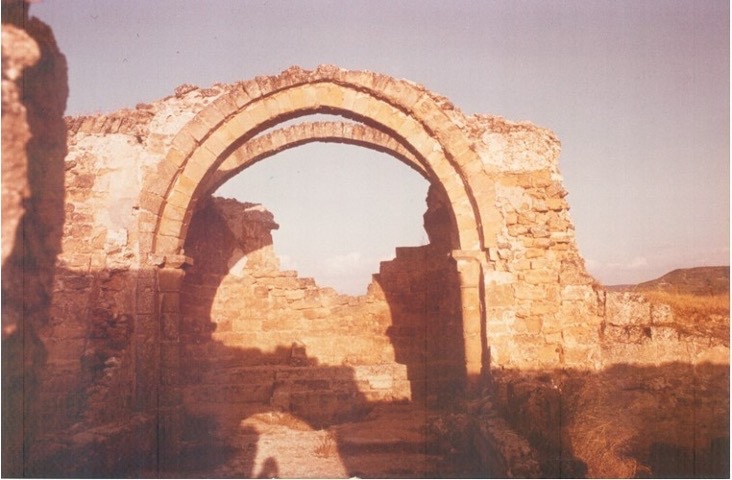
Five days later, the dark-maned Rocinante carried her exhausted rider, face-blistered and throat-swollen into Zorita de las Canas, then straight to Recaredopolis. Here the silence of the still standing stones welcomed the quester. Trotting through the remaining edifices he pulled up his steed before a horse-shoe arch, more or less identical to the one that he had admired and sketched at San Juan de Baños. The domed roofs of the churches and chapels had fallen into decay, but the untouched stones rang of a superior, magnanimous craftsmanship. This sixth century town had withstood the upheavels of History, the turbulence of Time, although the two-storey palace had lost its second storey entirely and the granary had been reduced to two walls and piles of heaped up stone.  

The horseshoe arch at Recaredopolis. Photo Courtesy: Paul Mirabile

Felipe let his horse roam about looking for a good feed whilst he meandered in and out of the moss-clad walls of the dilapadated palace, granary and sanctuary, filling his sketchbook with copy after copy of this fabulous mediaeval architectural trove. It seemed to him that no one, besides the villagers, had stepped foot in these ruins. Felipe felt estranged from himself, staggering about in a queer trance-like state from wall to wall, all so silent, yet deafening to his ears, so lyrical, so ecstatic that they strove to enter into communion with him. He sketched until the advent of night …

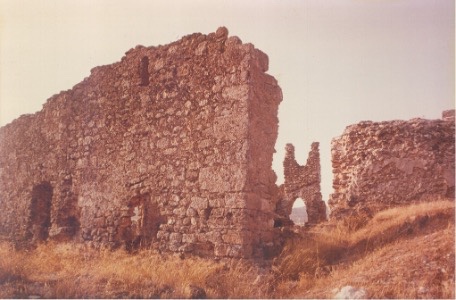
The ever-standing mediaeval sanctuary walls. Photo Courtesy: Paul Mirabile

Felipe built a fire and cooked a few potatoes and green peppers over it on a make-shift spittle. Lying on his bed-roll as he had done for so many star-studded nights, hands behind his head, he scrutinized the Autumn moon’s face mottled with huge black spots, listening to the deep, warm silence that surrounded him. He suddenly sat up: Had he not heard a runeful moaning skipping over the dry, empty plains? He bit his lower lip. The night air began to chill him. He continued to listen, attentively, his heart pounding painfully. Nothing. No one. Something frightened him: The horrors of war. Of famine and poverty ? Of old age creeping up upon him ? Or the ugliness of human depravity ? But why are these thoughts plaguing him at this very uninvited moment, as he lay so peaceful in this lieu of broken stones and tales ? 

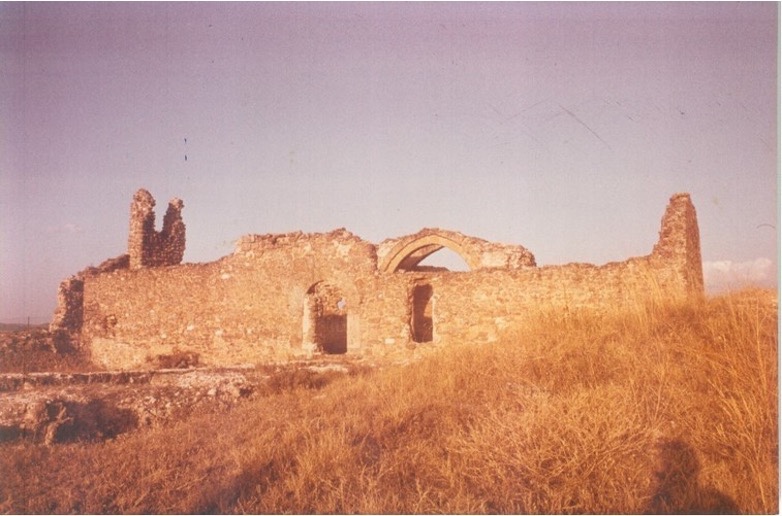
The sanctuary rising over the dry, grass-swept plain. Photo Courtesy: Paul Mirabile

He counted the stars, mentally tracing the curved contours of the waxing alabaster moon. Nothing stirred. No breath of wind, no call or cry from animal or bird. Felipe felt a surge of loneliness here as if the slow decay and negligence of the ruins resembled his own, physically and mentally … He was well over fifty, and the hardships of aging were slowly creeping up on him. His hand trembled when he drew. His back hurt from riding. His mind thought thoughtless thoughts, adrift between the past and the present in some sort of dark chaos. 

Felipe ignored the fact that no thought arises by thinking. Thoughts burst upon you at the most unsuspecting moments. They dance and whirl about then penetrate as quickly as that! The thinker must welcome them no matter how abrupt, unforeseen, painful. Yet, Felipe was keen on welcoming them, eager to decipher their subtle choreography.

He awoke in a dull trance. The sun rose lethargically over the voiceless ruins, the curling, misty plains. He watched its entrance into the world whilst the dancing thoughts that had spun him about during the night, and at present were jarring him out of sleep, grew brighter and brighter into figures of acts to be enacted. He threw dirt over the embers of the fire, rolled up his rug, saddled the munching Rocinante, and with a last glimpse of Visigoth Spain, galloped at full speed towards Madrid.

However, not to the big city. What had he to do with big cities ? No, Felipe Jimenez spurred desperately to Manzanares, twenty kilometres outside of Madrid, where there, the enigma of his quest would be resolved, or so he hoped! For a wild, dancing thought had overwhelmed him last night. A thought so feral that it would surely unlock the door to the mystery of an overt sense of hopelessness. Felipe imagined that hidden recess, heard its muffled invocations. To Manzanares he thus rode hard. To the Quinta del Sordo (Villa of the Deaf) where those welled up voices would overflow and spill forth the truth of centuries and centuries of silent exuberance, ecstasy and crime … To him and him alone ? That sacred communion remained to be seen …

Francisco de Goya’s voice, one that the great painter no longer heard since his deafness had severed him from the rest of the world, lay dorment in that villa; or so it was said. The great Master heard only faint murmurs of the Other World, murmurs that conducted his hand, steered his strokes, governed his unbridled imagination.

To those strange frescoes Felipe flew, thrilled that the hidden recesses of somber existence would be laid bare at that villa, illumined by the fourteen pinturas negras (black paintings), those black, ochre and brown pigments telling a tale that no historian, no archaeologist, no artist has ever told. Muteness, deafness, voicelessness — beacons of existential raison d’être

Three days later, Felipe Jimenez and Rocinante arrived at the villa as wreaths of fog were lifting off the slow, rolling wavelets of the River Manzanares. He dismounted, tied his horse to a tree and stood for several minutes in front of a quaint, two-storey country house behind which rose a range of shaggy hillocks hardly visible in the morning haze. Between the wisps of mist he noted that the front walls were in a deplorable state, suffering no doubt from the humidity and heavy rains. The alabaster sheen of the roughcast had crumbled off in large, mossy patches into a front garden overgrown with yellowing quitch grass, spiky thistles and thorny nettles. Flower beds had become weedy, rank.

He walked up to the front door and knocked: once … twice … thrice: No one.

Felipe laughed and thought: “Of course, he can’t hear. He’s deaf !” Mustering a bit of courage, he pushed open the heavy door; it had been left unbarred. He peeked inside, then slipped in quietly. Once inside, the silence frightened him. All the shutters had been shut in the dining room. There was hardly any furniture. A foul odour of dissolution made him dizzy.

“Señor …  Señor Goya?” Felipe called in a feeble voice unlike his own, the echo filling the room and his ears with unfamiliarity. “Are you out ? Yes, you must be out!” he assured himself, after which he rapidly threw open the shutters allowing streams of greyish, morning, misty light into the Master painter’s dining room. He gasped in disbelief. Painted on the dirty, unpapered walls were six frescoes that glowered at him in irate mockery. Yes, they eyed this intruder, this interloper’s every gesture with incensed scorn: there, the toothless guffawing of two old men hunched over their bowls slurping soup, fleshless faces sneering in gnarled lechery. Whether it was the dull light or the artistic acuteness of Goya’s brush work, their faces gave the impression of being embossed with warts or malignant tumours. Their clothes drooped on them like tattered rags (Dos viejos comiendo sopa)[10] !

Then Felipe approached a most peculiar scene: the mythological god of Time, Saturn, its eyes popping out of its sockets, was chewing one of his sons alive in bloody gluttony, the ruthless, long-haired creature believing that if he devoured his sons, one by one, he would never be dethroned by them, thus interrupting the course of Time (Saturno devorando uno de sus hijos)[11]. To his left, the most frightening of all frescoes: El Aquelarre[12]. Felipe drew closer. Yes, this was the Master’s most horrid depiction of his mindset: a black mass! It was a huge depiction of a motley crew, attired in tatters, gloating, mottled faces tormented, distorted by unhealthy beliefs, listening in starry-eyed reverence to a goat-like creature, yes, Satan himself, robed in black, horns held high in haughty hallowedness. Upon these dank, lonely walls Goya expunged from his tortured mind the two pillars of his psyche: the ecstatic and the grotesque  …

In a state of feverish agitation Felipe took out his sketchbook and traced the six frescoes one after the other like a madman attempting to capture each frightful feature, every desperate detail, each and every harrowing stroke of the Master’s demoniacal brush.

Sketching as best he could, given the dusky dimness of the late morning light and the dark pigments of the paintings, Felipe, after having drawn the downstairs frescoes now rushed head-long upstairs to Goya’s study. He shrank back in a dazed shock overwhelmed by the sight of the other eight masterpieces. All of them depicted the dark recesses of a man’s deranged mind, a mind enmeshed in  darkened  recesses, questioning and questioning and questioning. Felipe went from one to the other gaping at the cheerless existence of an artist, whilst the artist’s cheerless figures gaped at him, at this unwelcomed stranger. With much difficulty he discerned two warty, bizarre figures suspended dreamily in mid-air as if set free from Earth’s weightiness, sailing over a battlefield where they observed the drama below in ecstatic grotesqueness. In the background upon a hill an embattled castle lent a glum foreboding to the outcome of the scene (Visión fantástica)[13]. And there, on the back wall, two men, buried up to their knees, battling to the death with cudgels, a delightful technique that only the Spaniards could have invented. (Duelo a garrotazos)[14].

“Hobgoblins, all of them!” Felipe cried out involuntarily in crazed delirium. He had lost control of himself, sketching and sketching the figures that glowered at him, talking aloud in an effort to expurgate the evil that gradually filled his soul. The horrors of war, death, violence.

The most phantasmagorical visions had been assembled here in this dreadful villa during the restless nights of a his heart, painted by the Master of painters who had shunned all contact with the outside world. A solitary, mute communion had occurred within these demented walls, whose commerce wallowed in the mire of old age decrepitude, of sickening lust for glorious butcheries and triumphant slaughtering. Did Francisco de Goya love the smell of blood?

Felipe hardly understood the obsession that had nettled him for so many years whilst he sketched until his wrist ached. The mute stones … the deaf ears … the pounding silence that had entombed the landscape with courtly crimes, pogroms and despot debaucheries, all of which had crumbled into speechless stone, into hollow, unspoken edifices.  Indeed, all had fallen into decay, a slow decay, like the colourless figures painted on these waning walls ; like Goya’s mind ! “And mine ? Yes, mine too ! Ecstasy and grotesqueness : the mindset of our national character …” he acknowledged ingloriously.

Felipe, utterly exhausted, completed his sketching just before nightfall. He tip-toed down the stairway to the front door that he had left ajar. A last glimpse behind him saddened his heart; he had not met the Master. Yet, at the same time, a faint voice told him it would have been a fruitless meeting: the deaf have no one but themselves to converse with.

Furthermore, perhaps that meeting would have divulged the dreadful truth of Goya’s painted visions, and more importantly, the truth of those stones whose own untold story might have spoken a truth that only Felipe would have comprehended, enwrapping him thus in many veils of a strange, naïve self-satisfied truth. A truth that went beyond human reasoning, struggling in a twilight zone of Felipe’s own story within the quagmire.

It stands to reason that Felipe Jimenez had experienced what some call the ‘sense of the past’. A troubling experience that may occur at any instant of time or by incessant galloping between the past and the present. Nevertheless, it must be recorded that Felipe never really believed that he would fully join or unite the stony vestiges of a lost kingdom to the ‘black paintings’ by Francisco de Goya. Perhaps this sentiment or fantasy can be compared to the horse-shoe arch whose two bottom abutting stones sought to conjoin in a circle … in vain …

Be that as it may, our heroic Felipe died without friends or family. Only three of his sketches have been preserved. Oddly enough, they were discovered on the inside cover of a 1780 Royal Spanish Academy edition of El Ingenioso Hidalgo Don Quijote de la Mancha written by Miguel de Cervantes[15], edited by Joaquin Ibarra. In this same edition were also found several scattered notes in the margins presumedly jotted down by Felipe.

Felipe Jimenez’s tomb has never been located. Does this obliterate his existence ? I for one believe he did exist. However, many historians contend that he never existed at all …

.

[1]          Francisco de Goya (1746 – 1828) born in Fuentedetodos, Spain died in Bordeaux, France.

[2]        ‘The Black Paintings’.

[3] Don Quixote’s mangy horse was named as such. Miguesl Cervantes’ Don Quixote was published in 1605.

[4]        Head or top of a column or pillar.

[5]        A horizontal band of sculpture usually filled with animal or vegetal motifs.

[6]        The central aisle of a church.

[7]        Arches supporting intersecting vaults or arched roofs.

[8]        ‘Herradura’ means ‘horse-shoe’. It comes from the Spanish ‘hierro’ ‘iron’.

[9]        A large domed recess at the end of a chapel or church.

[10]      ‘Two old Men eating Soup’ (1819-1823). All the frescoes were painted during that time period.

[11]      ‘Saturn devouring one of his Sons’.

[12]      ‘Witches’ Sabbath’.

[13]      ‘Fantastic Vision’.

[14]      ‘Duel with cudgels’.

[15]      The Ingenous Gentleman, Don Quixote of La Mancha by Miguel de Cervantes Saavedra (1547-1616)

.

Paul Mirabile is a retired professor of philology now living in France. He has published mostly academic works centred on philology, history, pedagogy and religion. He has also published stories of his travels throughout Asia, where he spent thirty years.

.

PLEASE NOTE: ARTICLES CAN ONLY BE REPRODUCED IN OTHER SITES WITH DUE ACKNOWLEDGEMENT TO BORDERLESS JOURNAL

Click here to access the Borderless anthology, Monalisa No Longer Smiles

Click here to access Monalisa No Longer Smiles on Kindle Amazon International
Categories
Contents

Borderless, February 2024

Art by Sohana Manzoor

Editorial

Finding Godot?… Click here to read.

Conversations

Ratnottama Sengupta talks to Ruchira Gupta, activist for global fight against human trafficking, about her work and introduces her novel, I Kick and I Fly. Click here to read.

A conversation with Ratna Magotra, a doctor who took cardiac care to the underprivileged and an introduction to her autobiography, Whispers of the Heart: Not Just a Surgeon. Click here to read.

Translations

Two poems by Nazrul have been translated from Bengali by Niaz Zaman. Click here to read.

Masud Khan’s poetry has been translated by Fakrul Alam. Click here to read.

The White Lady by Atta Shad has been translated from Balochi by Fazal Baloch. Click here to read.

Sparrows by Ihlwha Choi has been translated from Korean by the poet himself. Click here to read.

Tagore’s Dhoola Mandir or Temple of Dust has been translated from Bengali by Mitali Chakravarty. Click here to read.

Pandies Corner

Songs of Freedom: What are the Options? is an autobiographical narrative by Jyoti Kaur, translated from Hindustani by Lourdes M Supriya. These narrations highlight the ongoing struggle against debilitating rigid boundaries drawn by societal norms, with the support from organisations like Shaktishalini and pandies’. Click here to read.

Poetry

Click on the names to read the poems

Rhys Hughes, Maithreyi Karnoor, Luis Cuauhtémoc Berriozábal, Sivakami Velliangiri, Wendy Jean MacLean, Pramod Rastogi, Stuart McFarlean, Afrida Lubaba Khan, George Freek, Saranyan BV, Ryan Quinn Flanagan, Sanjay C Kuttan, Peter Magliocco, Sushant Thapa, Michael R Burch

Poets, Poetry & Rhys Hughes

In City Life: Samples, Rhys Hughes takes on the voice of cities. Click here to read.

Musings/Slices from Life

Ratnottama Sengupta Reminisces on Filmmaker Mrinal Sen

Ratnottama Sengupta travels back to her childhood wonderland where she witnessed what we regard as Indian film history being created. Click here to read.

Suga Didi

Snigdha Agrawal gives us a slice of nostalgia. Click here to read.

Healing Intellectual Disabilities

Meenakshi Pawha browses on a book that deals with lived experiences of dealing with intellectual disabilities. Click here to read.

Musings of a Copywriter

In Hobbies of Choice, Devraj Singh Kalsi explores a variety of extra curriculums. Click here to read.

Notes from Japan

In Becoming a Swiftie in my Fifties, Suzanne Kamata takes us to a Taylor Swift concert in Tokyo. Click here to read.

Essays

Walking about London Town

Sohana Manzoor takes us around the historic town. Click here to read.

How Do You Live?

Aditi Yadav explores the universal appeal of the translation of a 1937 Japanese novel that recently came to limelight as it’s rendition on the screen won the Golden Globe Best Animated Feature Film award (2024). Click here to read.

The Magic Dragon: Cycling for Peace

Keith Lyons writes of a man who cycled for peace in a conflict ridden world. Click here to read.

Stories

A Night at the Circus

Paul Mirabile tells a strange tale set in Montana. Click here to read.

Echoes in the Digital Expanse

Apurba Biswas explores a futuristic scenario. Click here to read.

Two Countries

Ravi Shankar gives a story about immigrants. Click here to read.

Chadar

Ravi Prakash writes about life in an Indo-Nepal border village. Click here to read.

Just Another Day

Neeman Sobhan gives a story exploring the impact of the politics of national language on common people. Click here to read.

Book Excerpts

An excerpt from Nabendu Ghosh’s Journey of a Lonesome Boat( Eka Naukar Jatri), translated from Bengali by Ratnottama Sengupta. Click here to read.

An excerpt from Upamanyu Chatterjee’s Lorenzo Searches for the Meaning of Life. Click here to read.

Book Reviews

Somdatta Mandal reviews The History Teacher of Lahore: A Novel by Tahira Naqvi. Click here to review.

Basudhara Roy reviews Srijato’s A House of Rain and Snow, translated from Bengali by Maharghya Chakraborty. Click here to read.

Bhaskar Parichha reviews Toby Walsh’s Faking It : Artificial Intelligence In a Human World. Click here to read.

.

Click here to access the Borderless anthology, Monalisa No Longer Smiles

Click here to access Monalisa No Longer Smiles on Amazon International

Categories
Editorial

Finding Godot?

Discard all prayers,
Meditation, hymns and rituals.
Why do you hide behind
Closed doors of temples?
....
There is no God in this house.

He has gone to visit the
Farmers who plough the hard ground,
The workers who break rocks ...


— Tagore, Dhoola Mandir or Temple of Dust (1910)

Love is a many splendoured thing and takes many forms — that stretches beyond bodily chemistry to a need to love all humankind. There is the love for one’s parents, family, practices one believes in and most of all nurtured among those who write, a love for words. For some, like Tagore, words became akin to breathing. He wrote from a young age. Eventually, an urge to bridge social gaps led him to write poetry that bleeds from the heart for the wellbeing of all humanity.  Tagore told a group of writers, musicians, and artists, who were visiting Sriniketan in 1936: “The picture of the helpless village which I saw each day as I sailed past on the river has remained with me and so I have come to make the great initiation here. It is not the work for one, it must involve all. I have invited you today not to discuss my literature nor listen to my poetry. I want you to see for yourself where our society’s real work lies. That is the reason why I am pointing to it over and over again. My reward will be if you can feel for yourself the value of this work.”

And it was perhaps to express this great love of humanity that he had written earlier in his life a poem called Dhoola Mandir that urges us to rise beyond our differences of faith and find love in serving humankind. In this month, which celebrates love with Valentine’s Day, we have a translation of this poem that is born of his love for all people, Dhoola Mandir.  Another poet who writes of his love for humanity and questions religion is Nazrul, two of whose poems have been translated by Niaz Zaman. Exploring love between a parent and children is poetry by Masood Khan translated from Bengali by Fakrul Alam. From the distant frontiers of Balochistan, we have a poem by Atta Shad, translated from Balochi by Fazal Baloch, for a fair lady — this time it is admiration. Ihlwha Choi translates poetry from Korean to express his love for a borderless world through the flight of sparrows.

Love has been taken up in poetry by Michael Burch. Borne of love is a concern for the world around us. We have powerful poetry by Maithreyi Karnoor that expresses her concern for humanity with a dash of irony or is it sarcasm? Luis Cuauhtémoc Berriozábal expresses his admiration for the poetry of Italian Poet Antonia Pozzi (1912-1938) in poetry. We have poems by Stuart McFarlane, Pramod Rastogi, Afrida Lubaba Khan, George Freek, Saranyan BV, Ryan Quinn Flanagan and many more. Rhys Hughes brings humour into poetry and voices out in his column taking on the persona of two cities he had lived in recently. There is truth and poignancy in the voices of the cities.

Suzanne Kamata writes a light-hearted yet meaningful column on the recent Taylor Swift concert in Tokyo.  Aditi Yadav takes up the Japanese book on which was based a movie that won the 2024 Golden Globe Best Animated Feature Film Award. Sohana Manzoor journeys to London as Devraj Singh Kalsi with tongue in cheek humour comments on extracurriculars that have so become a necessity for youngsters to get to the right schools. Snigdha Agrawal gives us a slice of nostalgia while recounting the story of a Santhali lady and Keith Lyons expresses his love for peace as he writes in memory of a man who cycled for peace.

Ratnottama Sengupta also travels down the memory lane to recall her encounters with film maker Mrinal Sen as he interacted with her father, Nabendu Ghosh. She has translated an excerpt from his autobiography to highlight his interactions with Ghosh. The other excerpt is from Upamanyu Chatterjee’s latest novel, Lorenzo Searches for the Meaning of Life.

In reviews, Somdatta Mandal has explored Tahira Naqvi’s The History Teacher of Lahore: A Novel. Srijato’s A House of Rain and Snow, translated from Bengali by Maharghya Chakraborty, has been discussed by Basudhara Roy and Bhaskar Parichha has reviewed Toby Walsh’s Faking It: Artificial Intelligence in a Human World. News and Documentary Emmy Award winner (1996) Ruchira Gupta’s daring novel born of her work among human traffickers, I Kick and I Fly, has been brought to our notice by Sengupta and she converses about the book and beyond with this socially conscious activist, filmmaker and writer. Another humanist, a doctor who served by bridging gaps between patients from underprivileged backgrounds, Dr Ratna Magotra, also conversed about her autobiography, Whispers of the HeartNot Just a Surgeon: An Autobiography , where she charts her journey which led her to find solutions to take cardiac care to those who did not have the money to afford it,

We have fiction this time from Neeman Sobhan reflecting on how far people will go for the love of their mother tongue to highlight the movement that started on 21st February in 1952 and created Bangladesh in 1971. Our stories are from around the world — Paul Mirabile from France, Ravi Shankar from Malaysia, Sobhan from Bangladesh and Ravi Prakash and Apurba Biswas from India — weaving local flavours and immigrant narratives. Most poignant of all the stories is a real-life narrative under the ‘Songs of Freedom’ series by a young girl, Jyoti Kaur, translated from Hindustani by Lourdes M Supriya. These stories are brought to us in coordination with pandies’ and Shaktishalini, a women’s organisation to enable the abused. Sanjay Kumar, the founder of pandies’ and the author of a most poignant book about healing suffering of children through theatre, Performing, Teaching and Writing Theatre: Exploring Play, writes, “‘Songs of Freedom’ bring stories from women — certainly not victims, not even survivors but fighters against the patriarchal status quo with support from the organisation Shaktishalini.”

While looking forward in hope of finding a world coloured with love and kindness under the blue dome, I would like to thank our fabulous team who always support Borderless Journal with their wonderful work. A huge thanks to all of you from the bottom of my heart. I thank all the writers who make our issues come alive with their creations and readers who savour it to make it worth our while to bring out more issues. I would urge our readers to visit our contents’ page as we have more than mentioned here.

Enjoy our February fare.

Mitali Chakravarty

borderlessjournal.com

Click here to access the content’s page for the February 2024 Issue.

.

READ THE LATEST UPDATES ON THE FIRST BORDERLESS ANTHOLOGY, MONALISA NO LONGER SMILES, BY CLICKING ON THIS LINK.

Categories
Stories

A Night at the Circus

By Paul Mirabile

The good folk of Black Rock, Montana, USA, were not overly enthusiastic that a small, travelling circus would be coming to their peaceful town to make a one-night performance. They had heard disturbing stories about this circus from people out of state who had seen it or pretended to have seen it. Rip Branco, the mayor of Black Rock, felt a bit reluctant about authorising the performance, but the owners’ arguments won him over, half-heartedly. Besides, the children of Black Rock had never had the pleasure of seeing a circus, nor their parents for that matter.

So, many posters of the coming circus were nailed or pasted on the outer walls of the townhall, the school and at the farmers’ and factory workers’ cooperatives.

Strange tales circulated throughout the region: the performers originated from the Old World speaking alien tongues. Hearsay spread that many of the performers were abnormal individuals, freaks of nature, they said; and that the whole show was a razzle-dazzle of shamelessness, cynicism. What if this hearsay was the truth! The majority of the folks of Black Rock were convinced of its veracity.

In spite of all this hullabaloo the circus rumbled into town. Through the narrow, main avenue of Black Rock, lined with shops, banks, the townhall, the police-station and the Wednesday open-air market, crawled ten or eleven caravans painted in colourful figures of clowns, mountebanks, lions and elephants, and odd looking creatures whose appearances the townspeople, gaped at wide-eyed. They watched this slow-moving spectacle as they stood on each side of the avenue like rows of sentinels or pine-trees. The rear-guard of the caravan was composed of a cage with two dozing lions, behind whom plodded two baby elephants, lethargically swaying their trunks, every now and then emitting a trumpeting cry as if they were announcing the arrival of the courtly cortege …

No one uttered a word as the caravan disappeared into the weedy fields outside the town, designated by the mayor for their one-night performance.

Before the astonished eyes of the townsfolk, many of whom had rushed out to the field leaving their shops unoccupied, men, women and other ‘odd’ individuals scrambled to and thro, pitching, erecting, raising, until the top-tent loomed large and welcoming before them. Admission was a mere two dollars, a comfortable fee for the good people of Black Rock, a fee, too, considered a largesse on the part of the owners given the fact that the performers had no peer on earth … Or so they said.

At eight o’clock sharp the flaps of the big-top were flung open to the mistrustful but curious folks of Black Rock. Mayor Rip Branco, with his wife and two young boys, was the first to be admitted, then the town’s children, all to be seated in the first six or seven rows of the grandstand. Next to shuffle in were the farmers, factory workers, bankers and shopkeepers with or without their wives, conducted to the stalls flanking the grandstand. No animals were permitted. Many of the men grumbled protestations or sardonic remarks, but the ticket seller, a smiling dwarf sporting a torero costume, took no heed.

When the spectators had settled in comfortably the lights went out. A blast of music boomed out of the pitch black. Trombones, trumpets, hand-drums and tambourines filling the big-top with rhythms and melodies very foreign to the ears of the spectators. A huge spotlight fell on five or six colourfully-dressed individuals in the ring masquerading as some sort of rag-time band, blowing or banging their instruments as they danced about in happy-go-lucky abandon. The ring-master stepped out of this motley crew, pushing and shoving them aside, lashing out with his whip towards the more recalcitrant ones, who, in defiance of the snapping whip, blew out scales of disobedience. He bowed to the spectators in the most obsequious manner, doffing his black top hat. One of the musicians handed him a huge megaphone and he bellowed :

“Ladies and gents … and children too, tonight is the night of all nights, one you will never forget. All of you will witness the most rollicking merry-makers that have stalked our good earth; the most incorrigible buffoons who have ever lived. Your eyes will feast upon a jamboree of dancing, jestering and cavorting oddities whose dazzling shenanigans have always made children shriek, women scream, men doubt their senses. But I can assure you every stunt, every act, every gesture, however burlesque, is of the utmost authenticity.” Whether all the spectators were able to decipherthe ring-master’s opening tirade is difficult toassess. In any case, he went on: “ Now, let me present the strongest man on Earth, the nameless giant of Central Asia.” And as he cracked his whip the musicians fled into the darkness behind him. Out of that mysterious dark, the nameless giant charged into the middle of the arena like a raging bull. The master of ceremonies fled as if for his life. Snorting and grunting, the colossus, clad only in a tiger-skin loin-cloth, flexed his biceps, threw out his mighty chest, tightened his thigh muscles. He was indeed a mountain of muscle. Meanwhile popcorn and cotton candy were being distributed to the children, free of charge. Mayor Branco and his family also benefitted from this boon …

The strongman made horrible grimaces at the children who shrank back in their seats, squealing. He stomped about snarling and growling, flaunting his muscle-laden body until out rushed seven little dwarves dressed as toreros, all of them brandishing a bullfighter’s cape. They swarmed about the now enraged strongman, waving their capes and taunting him with obscene gestures and cuss words. The strongman charged into them head down like a bull, snorting and panting, swinging his bull-like neck from left to right, knocking a few dwarves to the sandy soil of the arena. Just as the crowd began to display overt displeasure at this unseemly spectacle with hoots and hollers (except the children who were cheering on both), two dwarves jumped up on to the strongman’s massive shoulders, followed promptly by all the rest, where gradually they formed a little pyramid atop this mountain of a man, who presently much appeased, pranced about in the spotlight with his ‘captured’ dwarves’, singing a song in some alien tongue. The dwarves hectored the dwarf-bearer, chaffing him with the crudest of names, smacking his massive face or slapping the top of his bald head with pudgy hands. With one mighty shake of the head, the strongman shook them all off into the air like so many swarms of flies, they, tumbling and rolling away, far enough from him where they continued to gesture indecorously.

Many spectators began to boo and hoot. Others laughed and cheered, especially the children, who munched happily on their cotton-candy and popcorn. “Shame! Shame!” cried out several women from the stalls. But their rebukes were drowned out by two or three applauding groups of farmers who apparently had been drinking before the performance. In fact many men were drunk, and the majority were taking much delight in this unusual spectacle …

Just then, at the crack of the ring-master’s whip, the dwarves rolled out of the arena and the strongman stomped away, bowing to the crowd. Into the ring now appeared five very weird-looking creatures, and behind them, as if by magic, a long, high tightrope that had been erected, held up by two very high wooden ladders. The spectators were baffled: humans or animals? Three, perhaps women, had faces of lions, whose ‘manes’ grew out of their cheeks, rolling in thick strands down to their feet. It was a horrible sight! But more horrible still were the two-headed and the mule-faced women, dark faces drooping down to their necks. Gasps rose from the crowd. Cries of indignation followed.

“Freaks ! Monsters!” they rasped and raged at the smiling ring-master who introduced his acrobats and trapeze performers, one by one, as the finest in the land whilst they speedily climbed up the ladders, three to the left, two to the right. At the top, they tip-toed out on to the thin wire where in burlesque abandon they danced and pranced and sang, the wire swaying to and fro. One or two juggled little red balls, tossing them over the heads of the others who attempted to catch them. Far below, the master of ceremonies whipped his whip and the merry acrobats danced and pranced all the more ardently, one or two on one foot, as the wire rocked, rolled and pitched like a boat. Terrified shrieks rose from the now standing crowd. Farmers and factory workers showed their fists. Women shouted abuse. As to the children and Mayor Branco, they clapped in rhythm to the singing quintet rocking and rolling on that tightrope.

At that point Mayor Branco turned towards the displeased crowd behind him, confused about what attitude to adopt. There was no doubt that the acrobats and trapeze performers were genuine artists ; their antics on that high wire brooked no belief of beguilement. And however ‘freakish’ they appeared to be, this awful birth-born deformity should welcome a hearty appraisal. Which the good mayor did from the bottom of his heart when the five performers had slid down the ladders, taken their bows in the middle of the ring and disappeared behind the rear flaps of the top-tent.

Much of the crowd were on its feet, red-faced (due to their drinking ?), shouting down to the ring-master as he cracked his whip violently: once … twice … thrice, signal which brought out two ferocious, roaring lions[1] shaking their manes. The spotlights followed their proud steps as they neared the front rows of the grandstands. There they sniffed the cotton candy of the now terrified children who recoiled in their seats. Their parents rushed to their rescue, but this was unnecessary, for another crack of the whip — and the accompanying spotlight — brought out a three-legged man and a pin-headed man. They strolled towards the sniffing lions, calling them by their names. One of the lions began lapping the popcorn out of the outstretched hands of several children who squealed in wary delight. Then the lion licked those charitable hands in grunting gratitude.

The pin-headed man whistled. The huge beast turned and trotted to him. He waved to the crowd then opened the lion’s mouth, pushing his pin head into it. As to the three-legged man, he had hopped on to the other lion’s back, two legs at its flanks and one lying over its fluffy mane. With a deafening yelp and roar, they galloped around the ring as if they were at a rodeo show, rushing around the pin-headed man whose whole tiny body had by now completely disappeared in that lion’s open mouth. The crowd held their breaths uncertain of the stance they should take on this stunt. Could a man possibly crawl into a lion’s massive maw ? The drunken farmers laughed grossly. Their wives sneered in contempt. The children sat in excited expectation.

Meanwhile another spotlight had fallen on a beautiful milky-white woman clad in a silken gown, standing upright against a large board placed behind her. Another spotlight swung to the left where a legless man, using his arms like a pair of crutches, had positioned himself ten or fifteen feet from the upright woman, a huge leather belt girding his chest from which hung dozens of kitchen knives. Between this scene and the lion-tamers’ antics, the spectators remained nonplussed, no longer hooting or hectoring.

The legless man swiftly took a knife and threw it at the lovely girl; it drove into the back board a quarter of an inch from the crown of her head. Here the crowd puffed in awe. Many women covered their eyes whilst the children were all eyes! He threw another and another. After each knife thrown, the crowd gasped a huge gasp! The legless man continued his act, each knife working rapidly downwards from the woman’s head, around her exquisite shoulders, along her slim, graceful hips, lengthwise her bare, slender legs until reaching those minute feet of hers. When he had finished his knife-throwing performance, the beaming, long-haired woman stepped out from the contour of the knives, the spotlight proudly exhibiting her ravishing silhouette configured on the board. With a gesture of triumph, she pointed to that silhouette, then glided over to the legless man, took him by the arm and both bowed reverently to the crowd. The men jumped up cheering wildly, either out of respect for the knife-throwing performer or for the ravishing beauty of the woman. As to their wives, they remained seated, smugly looking towards the ring, disregarding their drunken husbands’ sonorous applause. Mayor Branco was on his feet applauding along with his two boys, his wife tugging at his sleeve to sit so as not to make a spectacle of himself.

All of a sudden two spotlights swept over the galloping lion and the one that, it would seem, had all but swallowed the pin-headed man. But no ! Look … there … The lion yawned a wide yawn and out of that yawn the pin-headed man leapt, running about the ring crying out: “I’ve lost me head ! I’ve lost me head!” The crowd, stunned by these uncouth shenanigans, again began yelling insults. As to the galloping lion and its whooping cavalier, they darted to the right, where in front of them a huge hoop had been magically placed; a fiery hoop whose leaping flames hissed and sizzled. Through the hoop they jumped followed by the other lion, tailed by the waddling pin-headed man who dived through the hoop, tumbled over on the other side, got up, dusted himself off, then bowed to the hypnotised spectators. The children at once howled with joy. The adults, hesitant as to the ‘quality’ of this extravagant act, remained stoic, frowning.

The band struck up a local tune, horns and drums ushering in a motley gaggle of clowns rushing about the ring like escaped madmen from an asylum. In their frantic scuffle, two or three of them were tossing about a strange object, flinging it about like a football. A sudden shiver of horror swept through the crowd: those merry-making buffoons were passing a living torso to one another! A man without arms or legs! He had a huge smile on his face as he sailed in the air from one pair of arms to another. Then the clowns broke into a song: “ Zozo the clown and his funny hat, patches on his pants and he’s big and fat, long flappy shoes and a round, red nose, makes people laugh wherever he may go!” These lyrics were repeated without respite as they played football with the torso, who, and it must be stated here, was crying out for joy!

Enough was enough! “ Monsters! Monsters!” cried out groups of red-faced, infuriated men from the back of the stalls, screwing up their eyes. Rotten tomatoes were thrown at the shameless buffoons by the farmers who had brought them along for the occasion. Ladies screamed. The children sat in dazed awe, following each pass of the laughing torso as if they were following a football match. The frolicking clowns, undismayed by the tomatoes, performed cartwheels and somersaults from one end of the ring to the other.

But it was the following scene that left the crowd dumbfounded. As the laughing torso was thrown from clown to clown, spurts of orange flames spouted from his mouth! Long fiery flames that carved out tunnels of blazing light as he arched high in the air. This surreal scene rendered the crowd, momentarily, mute with puzzled, ambiguous emotions. They soon, however, regained their initial, infuriated state. 

In the last rows of the stalls, rowdies were making a tremendous row, brawling with the bankers and notaries who had shown, up till then, an impassioned interest in these performances. Fisticuffs broke out. Faces were slapped or punched. Hair and beards were pulled. Clothes torn. Ladies knocked over. Things were indeed getting out of hand. Whistles blew. The local security guards rushed into the upper stalls roughly handling the more pugnacious men, untangling the tangles of rioters one by one, unknotting the knots of brawlers that rocked the stalls.

At that stormy moment, trumpets, trombones, drums and cymbals sounded below, silencing the brawlers for a brief moment. Then from out the side flaps two baby elephants charged, trunks held high, trumpeting louder than the fanfare! Atop them, seated in howdahs apparelled in the most royal regalia were yelping mahouts fitted out in cowboy costumes, waving their huge cowboy hats at the now stupefied spectators. The elephants chased the clowns around the ring, grabbing a few with their trunks, rolling them up then flinging them into the air. The elephants had gone amok, lifting their trunks for all to see their huge flabby smiles. The living torso was passed high over the mahouts’ reach, mouthing furious flames galore, landing with a thud in the arms of a receiving clown on the other side. The children in the front rows were on their feet howling with merriment, laughing along with the clowns and elephants as the chase continued on its merry-go-round way. And here the band struck up a favourite tune to which all the clowns sang: “Zozo the clown and his funny hat, patches on his pants and he’s big and fat, long flappy shoes and a round, red nose, makes people laugh wherever he may go.”

This boisterous chorus was joined by children, some of whom had internalised the tune. Their voices rose in unison, rising far above the brawling, bickering and rioting behind them in the upper stalls. To tell the truth, some of the farmers, factory workers and bankers had also joined in the singing. How they enjoyed those yelping ‘cowboys’ whooping it up atop the baby elephants.

Mayor Branco sized up the maddening bedlam, reluctant to decide who were the madder: the performers or the crowds! Yet, deep down, oh how he was enjoying himself that evening. For him, it would be the most memorable night of his life. And I will add here, for most of the other good folk of Black Rock, be they the howling children, the appalled women or the obdurate men …The madness grew even madder when from out of the side flaps the seven little dwarves scrambled, dashing up to the elephants, waving their capes. One or two of these mischievous acrobats had been on stilts and were trying to distract the rampaging mahouts with their capes. The mahout-cowboys riposted by letting fly their lassoes, the nooses catching one or two of the rascally dwarves who were toppled from the stilts and dragged mercilessly in the wake of the plodding elephants. The ring had become a veritable pandemonium of lunacy and delirium …

Suddenly all the spotlights went out. A sudden lull crept over the ring, creeping stealthily up into the stands. A deep lull during which time not one drunken cry from the adults, not one choking laughter from the children, not one trumpet from the elephants nor yelp from either the cowboy-mahouts or  clowns or dwarves were heard. The lull must have lasted a minute or two …

The lights suddenly flooded the ring where all the performers and animals had mustered in humble expectancy. Silently they stood (or were held!) searching out the crowd for compassion, understanding, appraisal. The master of ceremonies stepped out from amongst them. He doffed his top hat :

“Ladies, gents and children. The performances that you have experienced tonight will not go unnoted in the chronicles of Black Rock.” (Whether this opening remark meant to be ironic is not for your narrator to say. In any case, it provoked a few snickers from the upper stalls.) “Yes, many of you have exhibited displeasure and resentment. Monsters you cry out? Freaks you bellow in bitter tones! Well, yes, if by monsters you mean these humble unfortunates who have had the courage to show themselves, to exhibit themselves to the public as true artists, and not sulk in self-pity or hide out like criminals or unwanted wretches out of the righteous eye of the public. But why display such ill-feelings towards them, may I ask? Because many of my performers suffer from birth deformities? Because they are physically unlike normal people? No! Their terrible deformities do not, and will never deprive the public the goodness and nobleness of their hearts of gold … their feelings of sincerity when performing for you. But this sincerity must be reciprocal. If not, their disfigurement will be interpreted as a ticket to the streets, a paid fare for lethal medical experiments in clinics, tearful departures for the zoos where they will be put into cages like savage animals … We are a grand and hard-working family whose every member holds equal status. But their livelihood, ladies and gents, depends on your good will, your protection against dangerous individuals whose illicit, murderous intentions would have killed them off long ago or maimed them even more. Here, within the sanctuary of this vast tent, look not at those deplorable disfigurements, but consider fairly and honourably their long, long hours of labour, their unquestionable talent, their dauntless courage and human dignity.”

The fanfare struck up one of rag-time tunes to whose familiar melodies all the children stamped and clapped. Their mothers and fathers also clapped. Farmers, shop-keepers, bankers and factory workers alike imitated the gaiety of the children. Even the security guards joined in the revelry. As to those adamant hooters and rioters, they stalked out of the top-tent, raising their fists, spitting out drunken obscenities … Which were drowned out by the general mirth and merriment.

All the performers bowed. The baby elephants held their trunks high, the lions shook their proud, bushy manes.  With the crack of the whip the lights went out.

The good folk of Black Rock Montana filed out of the top-tent singing the Zozo tune. Mayor Rip Branco was the last to leave, a bright, beaming smile on his round face.

And as Shakespeare once had occasion to record: All’s well that ends well.

[1] The story is set in indeterminate times (the author claims around 1970s) before animals were banned from performing in circuses.

https://www.fourpawsusa.org/campaigns-topics/topics/wild-animals/worldwide-circus-bans

https://www.four-paws.org/our-stories/press-releases/october-2021/one-million-signatures-supporting-the-end-of-the-use-of-circus-animals

.

Paul Mirabile is a retired professor of philology now living in France. He has published mostly academic works centred on philology, history, pedagogy and religion. He has also published stories of his travels throughout Asia, where he spent thirty years.

.

PLEASE NOTE: ARTICLES CAN ONLY BE REPRODUCED IN OTHER SITES WITH DUE ACKNOWLEDGEMENT TO BORDERLESS JOURNAL

Click here to access the Borderless anthology, Monalisa No Longer Smiles

Click here to access Monalisa No Longer Smiles on Kindle Amazon International