Five poems by Pravasini Mahakudahave been translated to English from Odia by Snehaprava Das. Click here to read.
A Poet in Exileby Dmitry Blizniuk has been translated from Ukranian by Sergey Gerasimov. Click hereto read.
Kalponik or Imaginedby Tagore has been translated from Bengali by Mitali Chakravarty. Click hereto read.
Pandies Corner
Songs of Freedom: The Seven Mysteries of Sumona’s Life is an autobiographical narrative by Sumona (pseudonym), translated from Hindustani by Grace M Sukanya. These stories highlight the ongoing struggle against debilitating rigid boundaries drawn by societal norms, with the support from organisations like Shaktishalini and Pandies. Click here to read.
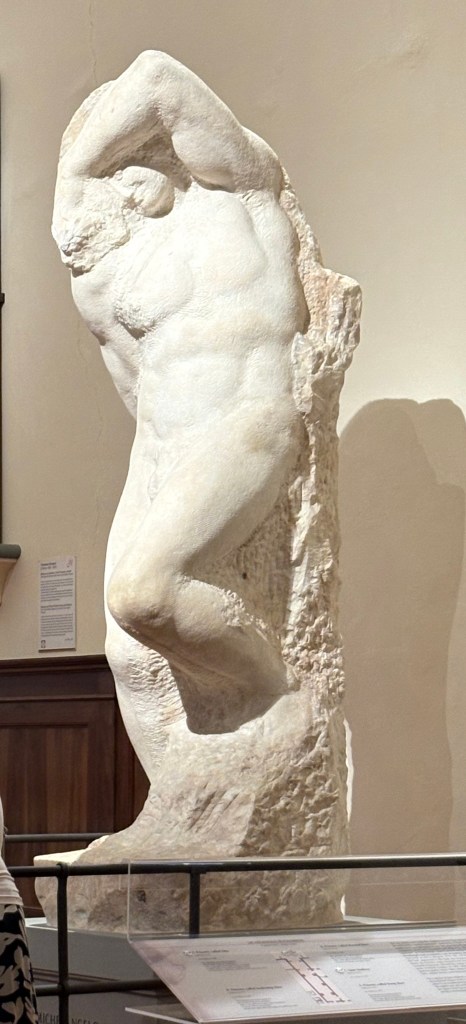
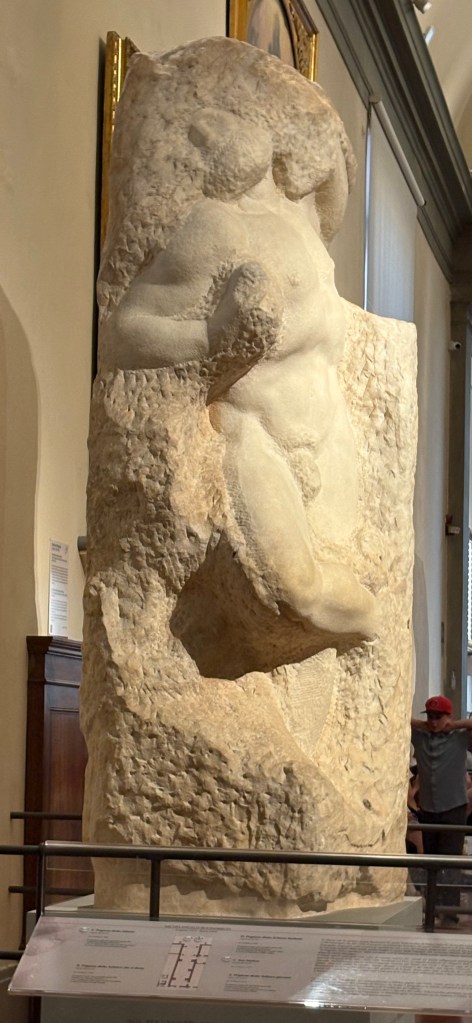
Incomplete statues of Michelangelo in Accademia Gallery, Florence
In the Accademia Gallery, Florence, are housed incomplete statues by Michelangelo that were supposed to accompany his sculpture of Moses on the grand tomb of Pope Julius II. The sculptures despite being unfinished, incomplete and therefore imperfect, evoke a sense of power. They seem to be wresting forcefully with the uncarved marble to free their own forms — much like humanity struggling to lead their own lives. Life now is comparable to atonal notes of modern compositions that refuse to fall in line with more formal, conventional melodies. The new year continues with residues of unending wars, violence, hate and chaos. Yet amidst all this darkness, we still live, laugh and enjoy small successes. The smaller things in our imperfect existence bring us hope, the necessary ingredient that helps us survive under all circumstances.
Imperfections, like Michelangelo’s Non-finito statues in Florence, or modern atonal notes, go on to create vibrant, relatable art. There is also a belief that when suffering is greatest, arts flourish. Beauty and hope are born of pain. Will great art or literature rise out of the chaos we are living in now? One wonders if ancient art too was born of humanity’s struggle to survive in a comparatively younger world where they did not understand natural forces and whose history we try to piece together with objects from posterity. Starting on a journey of bringing ancient art from her part of the world, Ratnottama Sengupta shares a new column with us from this January.
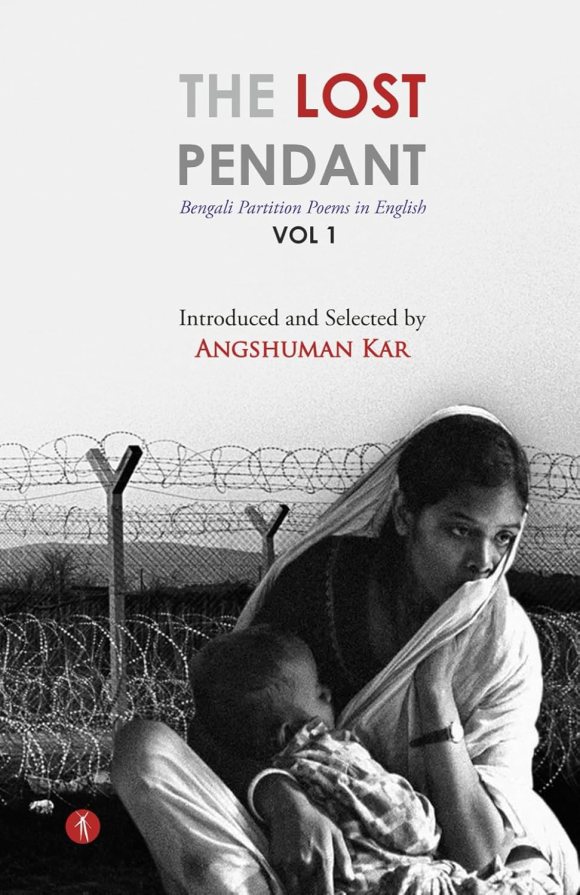
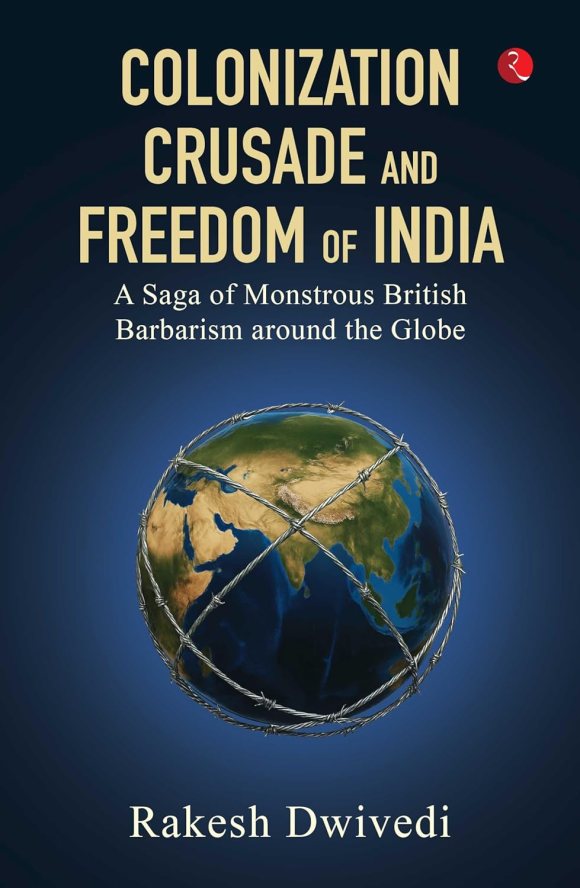
Drenched in struggles of the past is also Showkat Ali’s The Struggle: A Novel, translated from Bengali by V. Ramaswamy and Mohiuddin Jahangir. It has been reviewed by Somdatta Mandal who sees it a socio-economic presentation of the times. We also carry an excerpt from the book as we do for Anuradha Marwah’s The Higher Education of Geetika Mehendiratta. Marwha’s novel has been reviewed by Meenakshi Malhotra who sees it as a bildungsroman and a daring book. Bhaskar Parichha has brought to us a discussion on colonial history about Rakesh Dwivedi’s Colonization Crusade and Freedom of India: A Saga of Monstrous British Barbarianism around the Globe. Udita Banerjee has also delved into history with her exploration of Angshuman Kar’s The Lost Pendant, a collection of poems written by poets who lived through the horrors of Partition and translated from Bengali by multiple poets. One of the translators, Rajorshi Patranabis, has also discussed his own book of supernatural encounters, Whereabouts of the Anonymous: Exploration of the Invisible. A Wiccan by choice, Patranbis claims to have met with residual energies or what we in common parlance call ghosts and spoken to many of them. He not only clicked these ethereal beings — and has kindly shared his photos in this feature — but also has written a whole book about his encounters, including with the malevolent spirits of India’s most haunted monument, the Bhangarh Fort.
Bringing us an essay on a book that had spooky encounters is Farouk Gulsara, showing how Dickens’ A Christmas Carolrevived a festival that might have got written off. We have a narrative revoking the past from Larry Su, who writes of his childhood in the China of the 1970s and beyond. He dwells on resilience — one of the themes we love in Borderless Journal. Karen Beatty also invokes ghosts from her past while sharing her memoir. Rick Bailey brings in a feeling of mortality in his musing while Keith Lyons, writes in quest of his friend who mysteriously went missing in Bali. Let’s hope he finds out more about him.
Charudutta Panigrahi writes a lighthearted piece on barbers of yore, some of whom can still be found plying their trade under trees in India. Randriamamonjisoa Sylvie Valencia dwells on her favourite place which continues to rejuvenate and excite while Prithvijeet Sinha writes about haunts he is passionate about, the ancient monuments of Lucknow. Gulsara has woven contemporary lores into his satirical piece, involving Messi, the footballer. Bringing compassionate humour with his animal interactions is Devraj Singh Kalsi, who is visited daily by not just a bovine visitor, but cats, monkeys, birds and more — and he feeds them all. Suzanne Kamata takes us to Kishi, brought to us by both her narrative and pictures, including one of a feline stationmaster!
We've run away from the simmering house
like milk that is boiling over. Now I'm single again.
The sun hangs behind a ruffled up shed,
like a bloody yolk on a cold frying pan
until the nightfall dumps it in the garbage…

('A Poet in Exile', by Dmitry Blizniuk, translated from Ukranian by Sergey Gerasimov)
In translations, we have Professor Fakrul Alam’s rendition of Nazrul’s mellifluous lyrics from Bengali. Isa Kamari has shared four more of his Malay poems in English bringing us flavours of his culture. Snehaparava Das has similarly given us flavours of Odisha with her translation of Pravasini Mahakuda’s Odia poetry. A taste of Balochistan comes to us from Fazal Baloch’s rendition of Sayad Hashumi’s Balochi quatrains in English. Tagore’s poem ‘Kalponik’ (Imagined) has been rendered in English. This was a poem that was set to music by his niece, Sarala Devi.
After a long hiatus, we are delighted to finally revive Pandies Corner with a story by Sumona translated from Hindustani by Grace M Sukanya. Her story highlights the ongoing struggle against debilitating rigid boundaries drawn by societal norms. Sumana has assumed a pen name as her story is true and could be a security risk for her. She is eager to narrate her story — do pause by and take a look.
In fiction, we have a poignant narrative about befriending a tramp by Ross Salvage, and macabre and dark one by Mary Ellen Campagna, written with a light touch. It almost makes one think of Eugene Ionesco. Jonathan B. Ferrini shares a heartfelt story about used Steinway pianos and growing up in Latino Los Angeles. Rajendra Kumar Roul weaves a narrative around compassion and expectations. Naramsetti Umamaheswararao gives a beautiful fable around roses and bees.
With that, we come to the end of a bumper issue with more than fifty peices. Huge thanks to all our fabulous contributors, some of whom have not just written but shared photographs to illustrate the content. Do pause by our contents page and take a look. My heartfelt thanks to our fabulous team for their output and support, especially Sohana Manzoor who does our cover art. And most of all huge thanks to readers whose numbers keep growing, making it worth our while to offer our fare. Thank you all.
Here’s wishing all of you better prospects for the newborn year and may we move towards peace and sanity in a world that seems to have gone amuck!
The Lost Pendant brings together poems translated from Bengali by translators such as Himalaya Jana, Mandakranta Sen, Rajorshi Patronobish, Sanjukta Dasgupta, Angshuman Kar, and Souva Chattopadhyay. Through these compelling translations, the volume makes a significant intervention in Partition literature, arriving at a moment when revisiting the lingering spectres of the event has become especially urgent. The Partition of India in 1947, which divided the subcontinent into India and Pakistan, resulted in one of the largest mass migrations in history and left enduring scars of displacement, violence, and fractured identities. As the editor, writer and academic, Angshuman Kar, notes in the book’s introduction how Partition remains a 78-year-old wound that continues to bleed.
The anthology showcases poetry from the eastern parts of the subcontinent, chiefly Bengal, Assam, and Bangladesh, featuring works by 41 poets from India and Bangladesh. Kar does not simply compile these poems but thoughtfully curates them to reveal several critical nuances. He invokes the concept of “buoyant memory,” introduced in his earlier work, Divided: Partition Memoirs from Two Bengals, to depict how “forgetting the past is impossible for the direct victims of Partition.” He also draws attention to the disproportionate representation of upper-caste Hindu Bengali poets, in contrast to the relative invisibility of Muslims and those from marginalised communities. This imbalance extends to gender as well, with a noticeable disparity between male and female poets in the collection.
The book is structured in two parts, respectively featuring poets from India and Bangladesh. The Indian section is notably larger and presents a wide range of emotions, reflecting both the immediate trauma of Partition and its long-lasting reverberations over the years. Many of the poems in this section express a deep nostalgia for a lost homeland. For instance, Alokeranjan Dasgupta’s ‘Exile’ evokes memories of abandoned spaces. Similarly, Ananda Sankar Rai’s ‘The Far Side’ laments the estrangement from what was once familiar. He writes, “Once it was a province, now an alien land / where you must enter passport in hand.” Basudeb Deb’s ‘Picture of My Father’ constructs a powerful portrait of the nation through the figure of the father: “Swadeshi movement war sirens famine flood / Riot and partition written in the wrinkles on his forehead.” After the father’s death, only a walking stick remains. The poem draws a powerful parallel between the futility of the father’s dismissive words, “This country is not a pumpkin that you can cut it in one blow”, and the uselessness of the walking stick after his passing. This object comes to embody the spirit of the deceased father, “just another old toy”, offering a stark commentary on how individuals became pawns in the hands of the state.
Several poets in the anthology focus intensely on the experiences of refugees, capturing both their suffering and the complexities of their identities. In ‘The Refugee Mystery’, Binoy Majumdar laments the loss of linguistic roots, noting how “the Bangals now speak the dialect of Kolkata all the time, having forgotten the dialects of Barishal and Faridpur / The Moslems of Dhaka are heard singing and speaking in the radio with the lilt of Uluberia.” His reflections emphasise the deep connection between language and social identity. This theme finds a resonance in Sunil Gangopadhyay’s poem ‘That Day’, where he writes, “On one side they named the waters Pani / on the other side–Jol.” Through this simple yet evocative contrast, Gangopadhyay underscores how a shared concept can be articulated through divergent linguistic expressions in India and Bangladesh, which become subtle yet potent markers of socio-linguistic divisions. Such poems provoke profound questions: Can the adoption of a new dialect truly redefine one’s identity? How does one navigate the tension between past and present linguistic selves, and is reconciliation even possible?
Viewed through the intertwined lenses of faith and suffering, poetry often functions as a repository of collective memory and a means of resilience. In this regard, Devdas Acharya’s three poems present a poignant exploration of the lived experiences of refugees in post-Partition India. A recurring and haunting image emerges in his work: a grieving father, who has recently lost a child to hunger, standing before a deity symbolically embodied by a swadeshi leader. This image encapsulates both the profound deprivation endured by displaced communities and their simultaneous reliance on unshaken faith. Despite the magnitude of loss, what sustained many refugees was a deeply rooted belief system that imbued their suffering with meaning.
By foregrounding the gendered dimensions of violence, Partition poetry exposes how women’s bodies became contested sites of power and trauma. In “She, on the Platform of a Station”, Krishna Dhar powerfully captures the plight of women during Partition. She writes, “Chased from the other side of the border, escaping fire and the fangs and tongues of wolves, one day she arrived,” evoking the image of a refugee woman doubly marginalised– “devastated by Partition” and simultaneously “dodging the eyes of the hyenas.” Here, the metaphorical wolves and hyenas represent predatory men who treated women’s bodies as extensions of territorial conquest. Kar points out in the introduction that very few women wrote poetry about their Partition experiences, largely because they were already engaged in the broader struggle for gender equality. While women’s memoirs on Partition exist, poetry by women addressing these themes, particularly from the 1970s, is strikingly limited. This absence is significant, as women’s experiences are crucial to understanding how deeply gendered the space of the subcontinent was during and after Partition.
Following independence, conflicts often emerged within the nation, revolving around issues of region, language, religion, and ethnicity. In ‘The Diary of a Refugee’, Shaktipada Brahmachari reflects on his sense of belonging across borders, juxtaposing his memories of a past home in Bengal with his present life in Assam. He writes, “The world is my home now, in Bangla my love I spell–Prafulla and Vrigu are the cousins of my heart,” referencing two leaders of the Asom Gana Parishad. While refugees in Assam experienced a more complex form of marginalisation due to ethno-linguistic differences, Brahmachari portrays a gradual process of acceptance, where both the homeland he left and the land he adopted come to hold emotional significance.
Across the border in Bangladesh, the theme of displacement persists. In “Leaving Home”, Jasimuddin asserts, “this land is for Hindus and Muslims,” calling on educators to return and “build the broken schools once more…we will find out our beloved brother, whom I lost,” a poignant appeal for reconciliation and return of Hindu families displaced by Partition. The motifs of memory and loss recur throughout most of these poems, a trope common between both the nations. This sense of finality is further echoed in Binod Bera’s lament: “Our nation is now three, all three are independent, and love lives an alien existence.” The emotional chasm created by Partition, and the subsequent loss of mutual affection, renders any notion of return futile.
The collection deserves commendation for its ambitious effort to recover voices from Bengali literature and render them accessible to a global readership beyond linguistic boundaries, through gripping translations. It is the first-ever translated collection of Bengali Partition poetry that captures the angst of the original poems with perfect nuance. The very title, The Lost Pendant, merits particular attention, for it resonates with themes of liminality and the fractured sense of identity experienced by the refugee poet Nirmalyo Bhushan Bhattacharya, better known by his pseudonym, Majnu Mostafa. Born in Khulna, Bangladesh, yet spending much of his life in Krishnanagar, India, Bhattacharya embodies the dislocation and dual belonging of Partition’s afterlives. As Kar insightfully observes, the choice of pseudonym can be read as a deliberate act of defiance, “a strategy to cross the boundaries set up by religious politics and fundamentalism–a move much needed in the subcontinent of our times.” In this sense, The Lost Pendant is not merely an anthology but a work of cultural recuperation as it attempts to resurrect poets whose voices risked erasure, while simultaneously protecting their oeuvres from the twin threats of historical amnesia and linguistic inaccessibility.
.
Udita Banerjee is an Assistant Professor of English at VIT-AP University. Her work has previously been published in platforms such as Outlook Weekender, Borderless Journal, Indian Review, and Poems India.
PLEASE NOTE: ARTICLES CAN ONLY BE REPRODUCED IN OTHER SITES WITH DUE ACKNOWLEDGEMENT TO BORDERLESS JOURNAL
Title: Colonization Crusade and Freedom of India: A Saga of Monstrous British Barbarianism around the Globe
Author: Rakesh Dwivedi
Publisher: Rupa Publications
Rakesh Dwivedi’s Colonization Crusade and Freedom of India is an unflinching indictment of British imperialism and a forceful challenge to the long-standing narrative of colonialism as a “civilizing mission”. Written with the precision of a seasoned constitutional lawyer and the moral urgency of a historian disturbed by selective memory, the book seeks to dismantle the myths surrounding the British Empire while situating India’s freedom struggle within a wider global context of colonial violence.
At its core, the book argues that British rule in India was not an aberration of excesses but a carefully structured system of exploitation sustained by economic plunder, engineered famines, racial hierarchies, and institutionalised violence. Dwivedi rejects euphemisms such as “benevolent administration” or “rule of law,” insisting instead on naming colonialism for what it was: a barbaric enterprise masked by moral rhetoric. In doing so, he aligns himself with a growing body of postcolonial scholarship that seeks to recover suppressed histories of suffering and resistance.
One of the book’s notable strengths is its global frame. Dwivedi does not treat India in isolation but links the subcontinent’s experience to British imperial conduct in America, Africa, the Middle East, and Asia. By drawing parallels between policies of extraction, demographic manipulation, and divide-and-rule strategies across continents, he underscores the systemic nature of empire. This comparative approach lends weight to his claim that colonial brutality was not incidental but intrinsic to imperial governance.
The chapters dealing with famines, wartime exploitation, and economic drain are particularly compelling. Using archival material, parliamentary debates, and secret British records, Dwivedi exposes how starvation and deprivation were often outcomes of deliberate policy choices rather than natural calamities. His discussion of India’s role during the World Wars—both as a resource base and as expendable manpower—adds a crucial geopolitical dimension to the freedom struggle, reminding readers that independence was shaped as much by global power shifts as by internal resistance.
Dwivedi’s legal background is evident in his methodical narrative. He builds his case like a prosecution brief—marshalling evidence, anticipating counter-arguments, and dismantling colonial apologetics with forensic rigor. This gives the book a distinctive voice, though at times the prosecutorial tone may feel relentless. Readers looking for narrative subtlety or emotional restraint may find the language uncompromising, even polemical. Yet this stylistic choice appears deliberate: the book is less concerned with balance than with moral clarity.
The treatment of Partition is another significant aspect. Dwivedi views it not merely as a tragic inevitability but as a consequence of imperial betrayal and strategic manipulation. His critique of British exit policies challenges sanitized accounts of decolonisation and raises uncomfortable questions about responsibility, culpability, and historical accountability.
That said, the book’s sweeping scope occasionally works against it. The ambition to cover centuries of imperial history across multiple regions can lead to dense passages that demand close attention. Some readers may also wish for greater engagement with alternative historiographical perspectives. However, these limitations do not diminish the book’s central achievement: forcing a re-examination of colonial history stripped of nostalgia and imperial self-congratulation.
Colonization Crusade and Freedom of India is not a neutral history—it is a corrective one. It speaks directly to contemporary debates about historical memory, reparations, and the politics of remembrance. In an age when empire is often romanticised in popular culture and public discourse, Dwivedi’s work serves as a necessary provocation.
This book will resonate most with readers interested in colonial studies, Indian history, geopolitics, and the ethics of empire. Whether one agrees with all of Dwivedi’s conclusions or not, his argument compels engagement. It stands as a powerful reminder that freedom was not gifted to India—it was wrested from an empire whose legacy must be confronted, not softened.
.
Bhaskar Parichha is a journalist and author of Cyclones in Odisha: Landfall, Wreckage and Resilience, Unbiased, No Strings Attached: Writings on Odisha and Biju Patnaik – A Political Biography. He lives in Bhubaneswar and writes bilingually. Besides writing for newspapers, he also reviews books on various media platforms.
PLEASE NOTE: ARTICLES CAN ONLY BE REPRODUCED IN OTHER SITES WITH DUE ACKNOWLEDGEMENT TO BORDERLESS JOURNAL
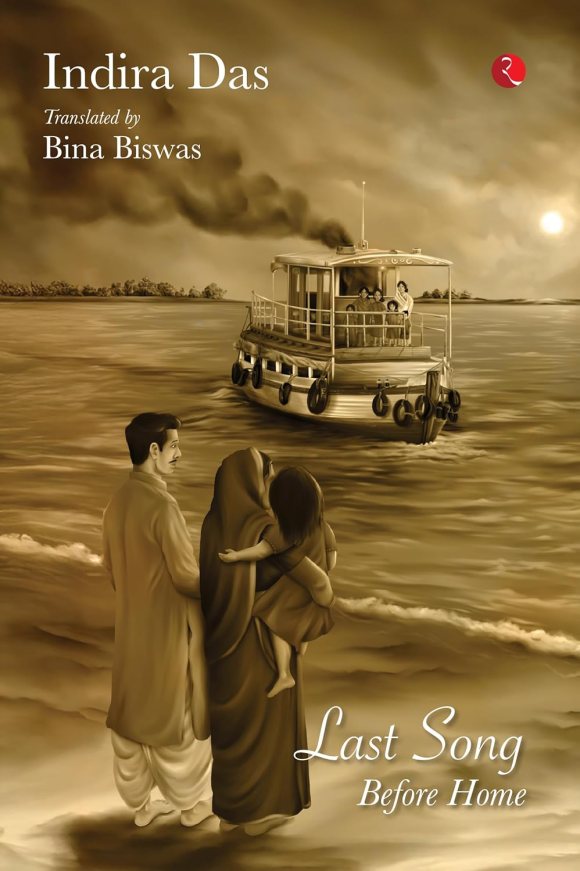
Last Song Before Home, the English translation of Indira Das’s Bengali memoir Shuru Theke Phera – Mayer Smritikatha[1], emerges as a luminous elegy to the fragility of memory and familial bonds. Translated by Bina Biswas, the book chronicles the author’s mother, Gayatri Das, navigating vascular dementia post-stroke. Through an epistolary structure of imagined letters, Das captures the slow erosion of self, where recollections surface like half-remembered melodies amid Bengal’s partitioned landscapes. The thematic depth and stylistic finesse position it as a vital contribution to South Asian memoir literature.
Central themes orbit memory as both lifeline and tormentor. Dementia strips Gayatri of chronology, yet fragments—rain-soaked courtyards, Partition’s unspoken wounds—resurface as anchors of identity. Das reframes loss as resistance, transforming maternal decline into a testament to resilience. Sisterhood underscores this; bonds with siblings weave a tapestry of shared silences, countering isolation’s void.
Partition looms subtly, not as a historical spectacle but an intimate scar—displaced homes echo in Gayatri’s fading queries: “Where is home?” This mirrors postcolonial Bengal’s flux, where personal trauma intersects collective upheaval. Dignity persists through ritual: songs hummed off-key, hands folding faded saris. Das elevates the mundane, critiquing modernity’s erasure of oral legacies. Resilience triumphs, not via triumph, but quiet defiance—memory’s “last song” before oblivion. The memoir critiques gendered aging in India, where women’s stories dissolve unspoken, urging reclamation.
A practicing gynaecologist, Das’s prose, via Biswas’s fluid translation, mimics dementia’s rhythm: elliptical sentences drift, loop, and fracture like synapses firing erratically. “The courtyard bloomed once, or was it twice? Rain came, carrying voices from across the river.” This stream-of-consciousness narrative eschews linear plot for associative flow, evoking Woolfian interiority fused with Bengali lyricism—sensory motifs—jasmine perfume, monsoon mud—ground abstraction, rendering emotion tactile.
In the translator’s note, Biswas, who is a poet and academician, says: “This book is not simply a narrative-it is a mosaic of survival, and the search for belonging. As John Berger once wrote, ‘Never again will a single story be told as though it is the only one.’ The protagonist’s journey is part of a greater collective-a shared history of migration, exile, and emotional displacement. Her voice rises in a chorus of the grieving, each thread woven with shared loss and a fierce resolve to cling to identity.
“She is a figure many will recognize: a woman who, though exiled by circumstance, carries the remnants of home in every gesture and memory. Her story becomes a vessel for inherited struggle, for resilience passed from one generation to the next. As Milan Kundera so memorably stated, ‘The struggle of man against power is the struggle of memory against forgetting.’”
Epistolary form innovates: letters to an absent self-blur authorial voice, fostering intimacy without sentimentality. Repetition (“Remember? No, forget.”) mirrors cognitive loops, building hypnotic cadence. Das avoids melodrama; understatement amplifies pathos— a single, misplaced utensil evokes existential ache. Cultural bilingualism enriches: Bengali idioms, untranslated, preserve authenticity, challenging monolingual readers. Pacing accelerates in crescendo passages, where songs bridge eras, culminating in cathartic release.
Last Song Before Home transcends memoir, becoming a philosophical meditation on impermanence. Its strengths—haunting style, layered themes—outweigh minor translation hiccups, like occasional stiffness. Essential for readers of Partition literature or aging narratives, it earns four stars for profound humanity. Das not only mourns but hymns endurance, leaving echoes that linger.
[1] Translates to: Returning from the Beginning: Memories of Mother
.
Bhaskar Parichha is a journalist and author of Cyclones in Odisha: Landfall, Wreckage and Resilience, Unbiased, No Strings Attached: Writings on Odisha and Biju Patnaik – A Political Biography. He lives in Bhubaneswar and writes bilingually. Besides writing for newspapers, he also reviews books on various media platforms.
PLEASE NOTE: ARTICLES CAN ONLY BE REPRODUCED IN OTHER SITES WITH DUE ACKNOWLEDGEMENT TO BORDERLESS JOURNAL
Nazrul’s Musafir, Mochh re Aankhi Jol(O wayfarer, wipe your tears) has been translated from Bengali by Professor Fakrul Alam.
Art by Sohana Manzoor
O wayfarer! Wipe your tears,
Return only with yourself.
The flower blooming on its own
Shed all by itself.
O foolish one! So hapless is your state,
Will you now build your nest in water?
Thirsts are not quenched here
For this is no lake to allay thirsts.
Will the bokul that didn’t bloom in monsoon
Blossom when it’s winter?
On this path forever, errors shed
Covering the grove of frustration.
Oh poet! You’ve illuminated many lamps
With your own light
But your own revered Krishna hasn’t come
To light up the darkness pervading your world.
A rendition of the lyrics by Feroza Begum (1930-2014) in original Bengali
Born in united Bengal, long before the Partition, Kazi Nazrul Islam(1899-1976) was known as the Bidrohi Kobi, or “rebel poet”. Nazrul is now regarded as the national poet of Bangladesh though he continues a revered name in the Indian subcontinent. In addition to his prose and poetry, Nazrul wrote about 4000 songs.
Old -- almost historical bricks of the house built before Partition, decaying wooden chaukath, deewal*, light on blue home walls, iron rod terrace, and steep stairs to the roof -- Few memories my eyes gather from old pictures like a camel collects water in its hump. My five-year-old self sitting on Papa’s lap next to Amma* and Ma, old black and white TV playing in the background. Papa’s white kurta, Amma’s pastel and Ma’s brown floral saree and my red and white checkered dress. And smiles -- as if that was how we were all to live. Together forever.
*chaukhat – door step; deewal: walls *Amma -- the poet calls her grandmother Amma.
A KEEPSAKE
It is neatly folded, tucked to the farthest stack of clothes in my almirah. Your white chiffon saree -- black and white flowers speckled all over it. I haven’t yet worn it, not even once and I have it for nearly twenty years.
I remember the day you opened your trunk, the only worldly possession you had and said -- have something for yourself.
Did you somehow know Amma, it was to be our last meeting? With hesitation I fumbled through your things till I saw this saree I had always liked.
When you put it on, your tenderness would seep into the texture of the fabric. Its sheerness akin to the spark I noticed at times, in your seldom happy eyes.
Now sometimes I take it out, touch the fabric, rub it against my skin, and put it back inside. Afraid to wear this keepsake, lest it wither away with time.
Rakhi Dalal writes from a small city in Haryana, India. Her work has appeared in Kitaab, Scroll, Borderless Journal, Nether Quarterly, Aainanagar, Hakara Journal, Bound, Parcham and Usawa Literary Review.
.
PLEASE NOTE: ARTICLES CAN ONLY BE REPRODUCED IN OTHER SITES WITH DUE ACKNOWLEDGEMENT TO BORDERLESS JOURNAL
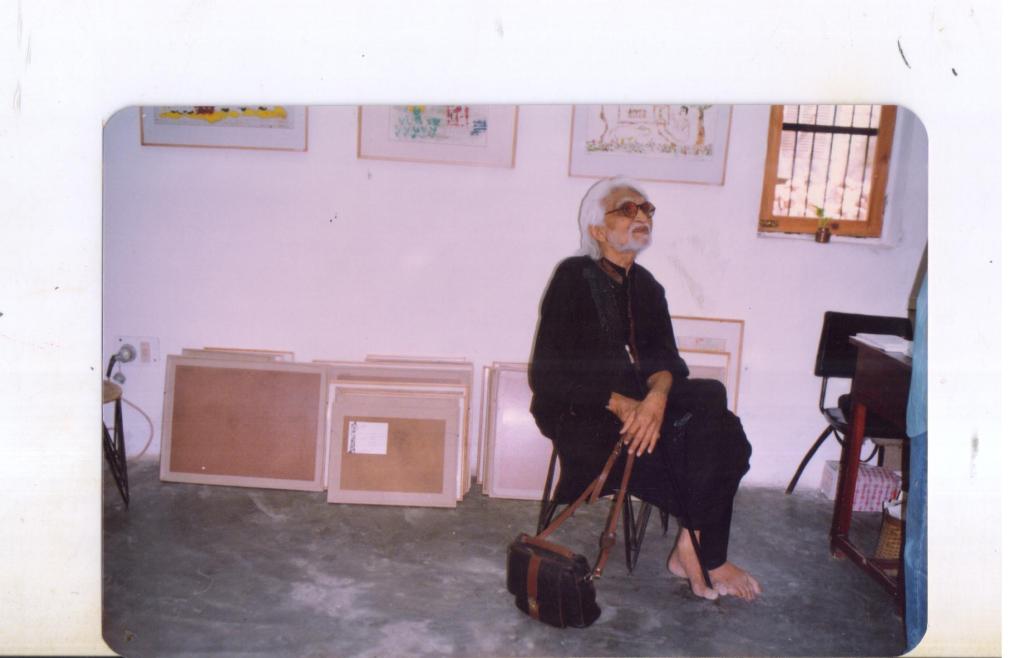
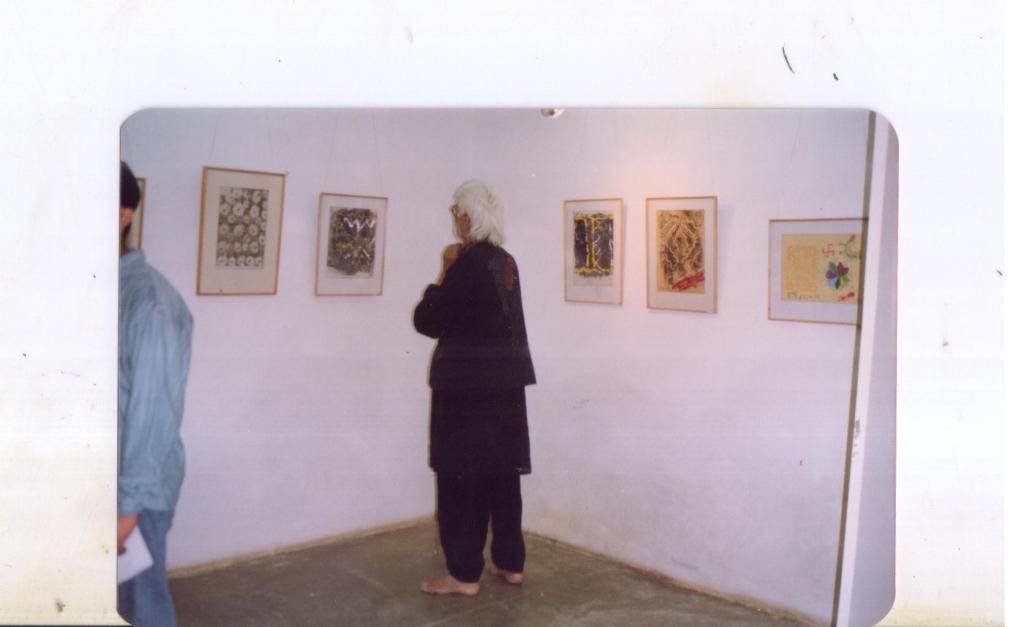
MF Husain at the opening of the exhibition “A Tree In My LIfe” in 1995. With him are Dolly Narang (who conceptualised the show) and others. Fifty one artists from all over the country were invited to participate. The exhibition included M.F. Husain, Raza, Ganesh Pyne, Paritosh Sen, Arpana Caur, Vivan Sundaram along with promising and emerging artists. Photo provided by Dolly Narang
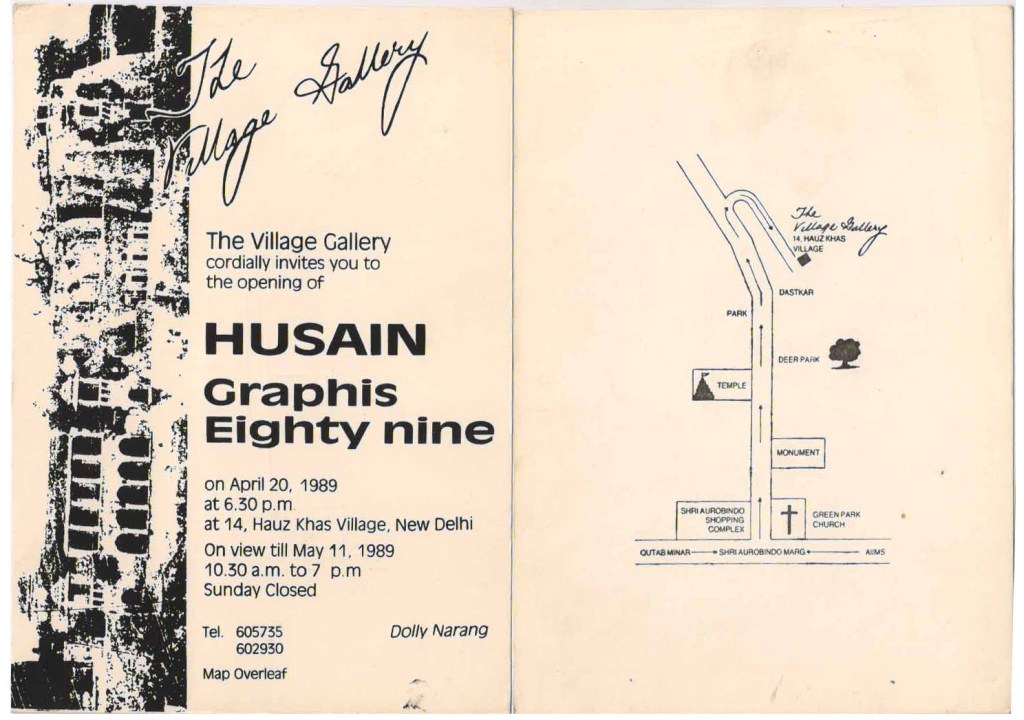
It was 1989 when I turned my passion for art into reality by opening The Village Gallery. My experience from conceptualising till the launch of my new initiative, as I negotiated unchartered waters, brought me in contact with artists and the art world. And I had some interesting experiences as I began to fathom the nuances of this unique field.
Growing up, I was a dreamer living in my own world of happy make believe. Enveloped by the warmth and attention of my joint family I was the cherished firstborn of my parents and my grandfather, Bauji[1]. Their adoration wrapped me in a cocoon sheltering me from the outside world. I grew up safe, protected and loved in our home in East Patel Nagar in West Delhi.
My mother laid claim to my creative spark. She revealed one day that while she was in the serene hills of Shimla with her parents as she carried me, she was learning how to paint. My mother proudly attributed my artistic side was all because of the genes passed on from her. Her creativity much later matured into fashion design and she became a successful fashion designer in the 1960s opening a high fashion boutique catering to New Delhi’s expat and diplomatic community. Her design skills were honed. She was much ahead of her time.
My Naniji[2] embroidered sequins and beads (maternal grandmother) on small evening clutch bags as gifts. That was her passion as it helped to overcome the grief of the loss of my grandfather who passed away suddenly in his mid 40s following the Partition and the trauma of 1947, when the Indian subcontinent was split into two. My Uncle, my father’s youngest sibling, unleashed his photographic skills to capture my childhood. He won a prize for one of these photographs.
I remember as a child being fascinated by Bauji making decorative paper lanterns. He used fragile kite paper of vibrant green, pink and yellow, slowly and meticulously applying glue on the paper to paste them onto thin bamboo sticks. I must have been four or five years old. The memory is so clearly embedded in my consciousness. He was a banker with a hectic work schedule involving travel. Our family had been uprooted during the Partition from Lyallpur in 1947 and we were in the throes of resettling ourselves. Yet, he found time to follow his creative calling.
As a child, I was fascinated by art and spent hours by myself doodling and drawing. Growing up, I have fond memories of my art class when I was in 7th or 8th grade in school. This was my happy space. My art teacher, Mrs. Dorothy Rahman, I remember was helped me to nurture my creativity with kindness and patience. She gave me special permission to work in art class during lunch hour. I loved working with my hands. Feeling the clay between my hands was exhilarating so clay was my chosen medium. Mrs. Rahman gave me a piece of soapstone a soft material and chiselling tools to chisel. This new medium opened up thrilling moments of more exploration.
My class had some students who were naturally gifted. Their effortless creativity left me feeling somewhat inadequate. At the same time, this pushed me to work harder to hone my skills. The confluence of my family’s creative influences and the circumstances unfolding before me led me to dream of starting an art gallery and I did do exactly that.
I nurtured a desire to start my gallery with the art of the famed MF Husain. Though it seemed an impossible dream, it happened. I went ahead and I shared my idea with Arpana Caur, my childhood playmate and college mate who had made a niche for herself in the art world and received recognition as a painter of great talent and promise. Caur encouraged me to chase my dreams. The first one person show at my newborn gallery was of Husain serigraphs and lithographs. It was a coup of sorts if I may say so myself for a new and unknown gallery and it stirred some excitement.
When I tried to contact him, Husain Sahib finally answered the phone. The conversation was polite and formal. He gave me appointment at his Canning Lane residence in Delhi, a charming colonial style government accommodation.
I had been warned of his proclivity for not arriving on time or not showing up at all. I reached his house expecting in all probability not to find him there.
His single storey home lay in a verdant environment. I was seated in a simple and well-appointed living room surrounded by vibrant colors of his paintings adorning the walls. Without keeping me waiting, a towering, calm and dignified figure emerged from the adjoining room. I introduced myself somewhat timorously trying to read his expression as I spoke. I remember saying, “Husain Sahib, I am planning to open a gallery in a new location, Hauz Khas Village. I would like to have a show of your limited-edition prints. I won’t be able to buy your works though. I was wondering if it would be feasible to pay for the prints once they are sold at the exhibition.”
This was the general tone of my brief monologue as he listened politely and patiently. I waited anxiously for his response. There was none.
Our meeting must have lasted fifteen minutes with mostly me muttering something to prove my credentials and at the same time trying to gauge his reaction as I continued with my monologue.
Once I finished talking, he stood up and walked into a room attached to the living room where we were sitting. I waited, confused by his disappearance. Soon he emerged with a thick roll of black sheets and handed it to me saying you can have a show of these prints. I accepted it in complete disbelief. Thanked him and left. I thought later that I did not give my contact details and neither did he ask for them. This was my first meeting with MF Husain.
Once the gallery interiors were ready I requested Husain Sahib if he could come to see the new space and give his suggestions before the inauguration. He arrived on the appointed day accompanied by his son Mustafa, a tall and dignified young man who came with a camera slung around his neck.
Both father and son walked around the gallery silently. It had a raw rustic interior with a cement floor and lime washed walls. I waited for their reaction, not quite sure how they would respond to the raw rusticity of the environment both internal and external. To make matters worse, a buffalo belonging to a villager put its head through the entrance door and snorted loudly. ‘This is all I need,’ I thought, ‘especially when I am trying to make an impression.’ Just as I was going to apologize, to my surprise Husain Sahib smiled and softly said, “That’s nice.”
Mustafa added: “My father loves the rustic environment”. Both lingered for a while enjoying the peaceful and unpretentious village setting as Mustafa took photographs.
While planning the execution for the show of his graphics, I had the opportunity to interact more frequently with Husain Sahib. He wanted the show to have the title ‘Husain Graphis 89’. “The word graphics to be spelt without a ‘c’, as it is spelled in French,” he said. Cards were printed announcing the exhibition of “Husain Graphis 89”. As the exhibition cards were delivered to their addressees, I was inundated with calls advising me that the word “graphics” had been misspelled in the card. I had a lot of explaining to do in call after call.
Photo provided by Dolly Narang
The prints were up on the gallery walls. A few days before the opening of Husain Graphis ‘89, the artist himself visited the gallery. As he made himself comfortable in the midst of his serigraphs and lithographs, he said something that has stayed with me as a source of guidance ever since. He waved his hands gently across the wall and said: “Make the walls of your gallery something that every artist will be proud to hang their works on.” These words illuminated my path forward as I was inspired to conceptualise a series of shows which went onto make history.
The inauguration of Graphis’ 89 was done by SK Misra, the Secretary of Tourism at the time and a close friend of Husain Sahib’s. He had wanted him to inaugurate the show. Husain Sahib flew off to Bombay the same evening so was not present at the inauguration. Of course, we were all disappointed. The inauguration was on schedule with Misra painting a lamp on a canvas. This unique idea was suggested by the eminent scenographer, Rajeev Sethi. Misra was caught off guard when asked to paint a lamp instead of lighting it. However, he painted with the flourish of a seasoned artist.
There was a self portrait of Husain on display in Graphis’89 exhibition which had a thick red line running down the face. It generated much curiosity and many queries from viewers who wanted to know the deeper meaning behind the red line, expecting a profound philosophical response about the artist’s thoughts or his life experience behind this. During a visit to the gallery, I mentioned to Husain Sahib that I was being asked repeatedly by visitors what was the meaning behind this thick and bright red line. He simply said: “I liked it and I painted it.”
The next exhibition that I curated in 1989 was ‘Self Portraits’. Twenty-four artists, from masters to beginners, were invited to showcase self-portraits in this exhibition held in October 1989. Husain Sahib loaned his self-portrait, an oil on canvas. Fortunately, Husain Sahib was in Delhi for the opening. He arrived walking barefeet down the kuccha[3] path leading to the gallery. Just a few feet ahead of the gallery he saw the Choudhry[4] of the village reclined on his charpai[5] smoking his hookah. Husain Sahib was so excited by this sight that he requested for the charpai to be shifted outside the gallery. I conveyed his request to Choudhry Sahib who immediately agreed and pulled his charpai over. Both Husain Sahib and Choudhry Sahib sat together on the charpai savoring the experience.
The guests at the opening, several of them old friends of Husain Sahib were surprised to catch him here. There was rambunctious camaraderie and backslapping in full public view on this village street. It occurred to him that he wanted to have his good friend and gallerist DV Chawla there. He requested that I send the car to pick him up from the Oberoi Hotel where his gallery was located. Delhi being free from the dense traffic that the city is afflicted with today, he arrived soon enough.
As Mr Chawla arrived, there was more lively celebration of old friendships. they all enjoyed the exhibition. The self-portraits were replete with humor or marked by self-mockery. Some were self-effacing while others, thought provoking
Husain Sahib joked that the real Husain was in the painting hung on the wall of the gallery and the flesh and blood sitting outside was fake.
The exhibition of self-portraits was followed by ‘The Other Ray’ in 1990, an exhibition of the graphic design, children’s drawings, and film sketches, set design drawings, film posters by Satyajit Ray. Together, we selected the works for the exhibition. In the process Ray was surprised to see all the work that he had created compelling him to remark: “I had forgotten I had done all this work.”
Husain at the Village Gallery. MF Husain liked walking bare-feet. Photographs provided by Dolly Narang
The opening was in October 1990. I met Husain Sahib to invite him for the preview. When he heard of ‘The Other Ray’ exhibition he asked me where the works were lying as he wanted to see them. I told him that they were lying at home and suggested it would be better to view them once they are properly hung in the gallery. But he was insistent on seeing them right away and didn’t want to wait for the opening. So, we drove to my house from AIFACs. He was overwhelmed to see the works and started to reminisce of his association with Ray. Unfortunately, I did not have a tape recorder at the time to record his thoughts but fortunately The Illustrated Weekly carried these reminiscences as an article in an issue. It’s a truly poignant piece filled with precious memories.
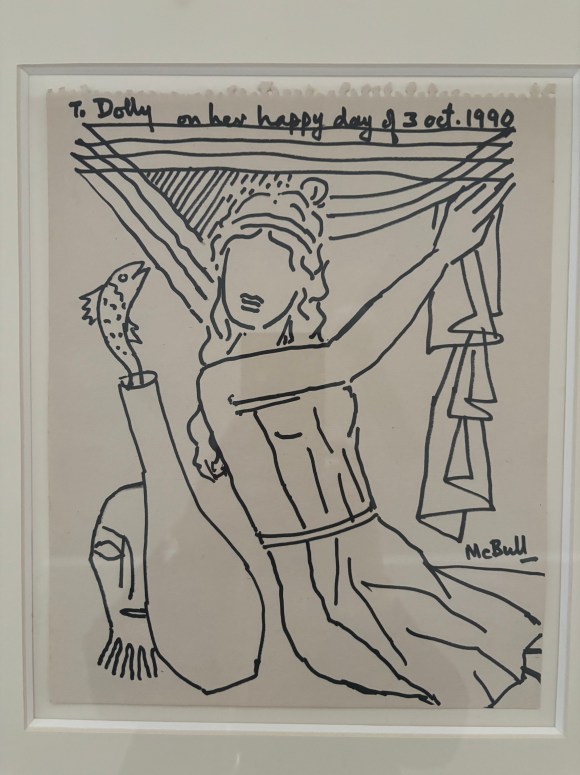
We got into the car to drive him home and had driven away for just a few minutes. All this while it was churning in my mind. Should I, should I not. But finally plucked up courage to tell him that it was my birthday a few days later and could I request him for a drawing.
He asked the driver to turn back to the house. He asked for sketch paper. And resting the paper on the bonnet of the car made a drawing.
These are some of the memories I am penning down here. There are many more…
The sketch made by Maqbool Fida Husain for Dolly Narang on her birthday: Husian signed himself McBull, a humorous take on his first name, Maqbool. He was known to sign his name in various ways. Photo provided by Dolly Narang
.
[1] respectful address for an elder patriarch of the family
Dolly Narang , a gallerist, has conceptualised innovative pathbreaking exhibitions. A recent student of sculpture, she has the satisfaction of experiencing both personal and spiritual evolution as a Pranic healer and as a grandmother.
.
PLEASE NOTE: ARTICLES CAN ONLY BE REPRODUCED IN OTHER SITES WITH DUE ACKNOWLEDGEMENT TO BORDERLESS JOURNAL
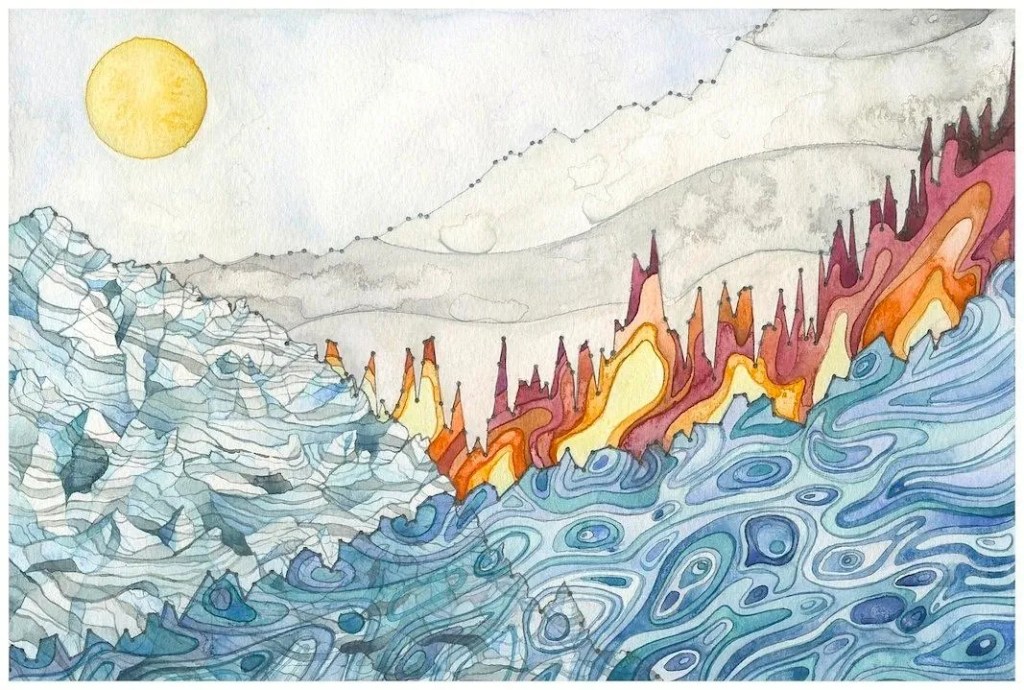
Landscape of Change by Jill Pelto, Smithsonian. From Public Domain
Hope is the mantra for all human existence. We hope for a better future, for love, for peace, for good weather, for abundance. When that abundance is an abundance of harsh weather or violence wrought by wars, we hope for calm and peace.
This is the season for cyclones — Dana, Trami, Yixing, Hurricanes Milton and Helene — to name a few that left their imprint with the destruction of both property and human lives as did the floods in Spain while wars continue to annihilate more lives and constructs. That we need peace to work out how to adapt to climate change is an issue that warmongers seem to have overlooked. We have to figure out how we can work around losing landmasses and lives to intermittent floods caused by tidal waves, landslides like the one in Wayanad and rising temperatures due to the loss of ice cover. The loss of the white cover of ice leads to more absorption of heat as the melting water is deeper in colour. Such phenomena could affect the availability of potable water and food, impacted by the changes in flora and fauna as a result of altered temperatures and weather patterns. An influx of climate refugees too is likely in places that continue habitable. Do we need to find ways of accommodating these people? Do we need to redefine our constructs to face the crises?
Echoing concerns for action to adapt to climate change and hoping for peace, our current issue shimmers with vibrancy of shades while weaving in personal narratives of life, living and the process of changing to adapt.
An essay on Bhaskar Parichha’s recent book on climate change highlights the action that is needed in the area where Dana made landfall recently. In terms of preparedness things have improved, as Bijoy K Mishra contends in his essay. But more action is needed. Denying climate change or thinking of going back to pre-climate change era is not an option for humanity anymore. While politics often ignores the need to acknowledge this crises and divides destroying with wars, riots and angst, a narrative for peace is woven by some countries like Japan and Rwanda.
Suzanne Kamata recently visited Rwanda. She writes about how she found by educating people about the genocide of 1994, the locals have found a way to live in peace with people who they addressed as their enemies before… as have the future generations of Japan by remembering the atomic holocausts of 1945.
In translations, we have poetry from varied countries. Ihlwha Choi has self-translated his poem from Korean. Ivan Pozzoni has done the same from Italian. One of Tagore’s lesser-known verses, perhaps influenced by the findings of sensitivity in plants by his contemporary, Jagadish Chandra Bose (1858-1937) to who he dedicated the collection which homed this poem, Phool Photano(making flowers bloom), has been translated from Bengali. Professor Alam has translated Nazrul’s popular song, Tumi Shundor Tai Cheye Thaki (Because you are so beautiful, I keep gazing at you).
Stories travel around the world with Paul Mirabile’s narrative giving a flavour of bohemian Paris in 1974. Anna Moon’s fiction set in Philippines gives a darker perspective of life. Lakshmi Kannan’s narrative hovers around the 2008 bombing in Mumbai, an event that evoked much anger, violence and created hatred in hearts. In contrast, Naramsetti Umamaheswararao brings a sense of warmth into our lives with a story about a child and his love for a dog. Sreelekha Chatterjee weaves a tale of change, showcasing adapting to climate crisis from a penguin’s perspective.
Trying something new, being out of the box is what helped humans move out from caves, invent wheels and create civilisations. Hopefully, this is what will help us move into the next phase of human development where wars and weapons will become redundant, and we will be able to adapt to changing climes and move towards a kinder, more compassionate existence.
Thank you all for pitching in with your fabulous pieces. There are ones that have not been covered here. Do pause by our content’s page to see all our content. Huge thanks to the fantastic Borderless team and to Sohana Manzoor, for her art too.
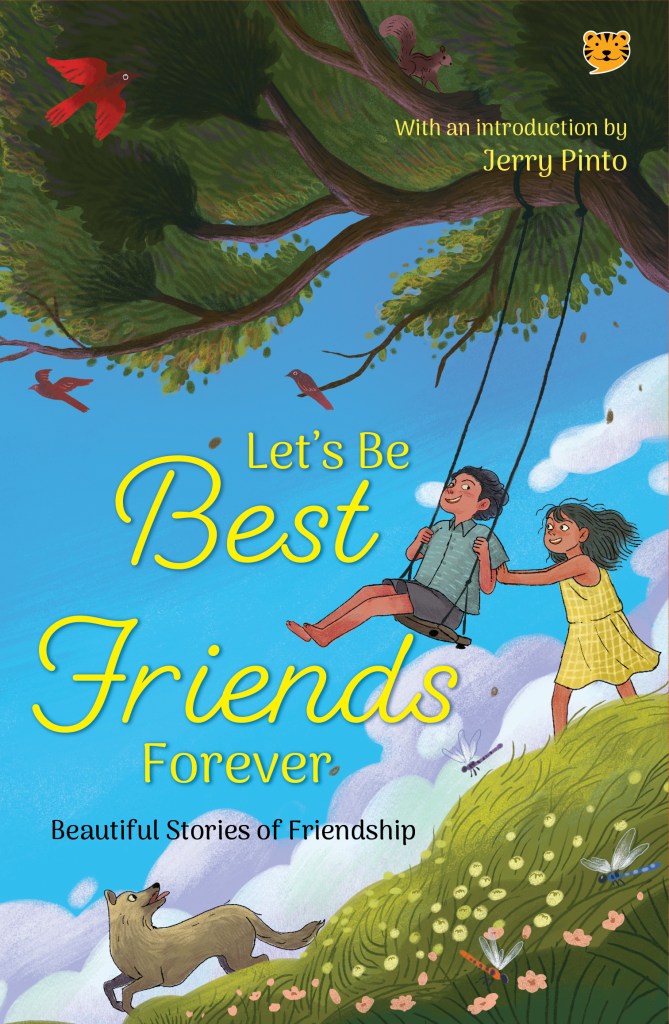
Title:Let’s Be Best Friends Forever: Beautiful Stories of Friendship
Publisher: Talking Cub, Speaking Tiger Books
From ‘The Tunnel of Friendship’ by Ruskin Bond
I had already started writing my first book. It was called Nine Months, but had nothing to do with a pregnancy; it referred merely to the length of the school term, the beginning of March to the end of November, and it detailed my friendships and escapades at school and lampooned a few of our teachers. I had filled three slim exercise books with this premature literary project, and I allowed Azhar to go through them. He was my first reader and critic. ‘They’re very interesting. But you’ll get into trouble if someone finds them,’ was his verdict.
We returned to Shimla, having won our matches against Sanawar, and were school heroes for a couple of days. And then my housemaster discovered my literary opus and took it away and read it. I was given six of the best with a Malacca cane, and my manuscript was torn up. Azhar knew better than to say ‘I told you so’ when I showed him the purple welts on my bottom. Instead, he repeated the more outrageous bits he remembered from the notebooks and laughed, till I began to laugh too.
‘Will you go away when the British leave India?’ Azhar asked me one day.
‘I don’t think so,’ I said. ‘My stepfather is Indian. My mother’s family have lived here for generations.’
‘Everyone is saying they’re going to divide the country. I think I’ll have to go away.’
‘Oh, it won’t happen,’ I said glibly. ‘How can they cut up such a big country?’
‘Gandhi will stop them,’ he said.
But even as we dismissed the possibility, Jinnah, Nehru and Mountbatten and all those who mattered were preparing their instruments for major surgery.
Before their decision had any effect on our life, we found a little freedom of our own—in an underground tunnel that we discovered in a corner of the school grounds. It was really part of an old, disused drainage system, and when Azhar and I began exploring it, we had no idea just how far it extended. After crawling along on our bellies for some twenty feet, we found ourselves in complete darkness. It was a bit frightening, but moving backwards would have been quite impossible, so we continued writhing forward, until we saw a glimmer of light at the end of the tunnel. Dusty, a little bruised and very scruffy, we emerged at last on to a grassy knoll, a little way outside the school boundary. We’d found a way to escape school!
The tunnel became our beautiful secret. We would sit and chat in it, or crawl through it just for the thrill of stealing out of the school to walk in the wilderness. Or to lie on the grass, our heads touching, reading comics or watching the kites and eagles wheeling in the sky. In those quiet moments, I became aware of the beauty and solace of nature more keenly than I had been till then: the scent of pine needles, the soothing calls of the Himalayan bulbuls, the feel of grass on bare feet, and the low music of the cicadas.
World War II had just come to an end, the United Nations held out the promise of a world living in peace and harmony, and India, an equal partner with Britain, would be among the great nations…
But soon we learnt that Bengal and Punjab provinces, with their large Muslim populations, were to be bisected. Everyone was in a hurry: Jinnah and company were in a hurry to get a country of their own; Nehru, Patel and others were in a hurry to run a free, if truncated, India; and Britain was in a hurry to get out. Riots flared up across northern India.
At school, the common room radio and the occasional newspaper kept us abreast of events. But in our tunnel Azhar and I felt immune from all that was happening, worlds away from all the pillage, murder and revenge. Outside the tunnel, there was fresh untrodden grass, sprinkled with clover and daisies, the only sounds the hammering of a woodpecker, and the distant insistent call of the Himalayan barbet. Who could touch us there?
‘And when all wars are done,’ I said, ‘a butterfly will still be beautiful.’
‘Did you read that somewhere?’ Azhar asked.
‘No, it just came into my head.’
‘It’s good. Already you’re a writer.’
Though it felt good to hear him say that, I made light of it. ‘No, I want to play hockey for India or football for Arsenal. Only winning teams!’
‘You’ll lose sometimes, you know, even if you get into those teams,’ said wise old Azhar. ‘You can’t win forever. Better to be a writer.’
One morning after chapel, the headmaster announced that the Muslim boys—those who had their homes in what was now Pakistan—would have to be evacuated. They would be sent to their homes across the border with an armed convoy.
It was time for Azhar to leave, along with some fifty other boys from Lahore, Rawalpindi and Peshawar. The rest of us—Hindus, Christians, Buddhists, Sikhs and Parsis—helped them load their luggage into the waiting British Army trucks that would take them to Lahore. A couple of boys broke down and wept, including our departing school captain, a Pathan who had been known for his unemotional demeanour. Azhar waved to me and I waved back. We had vowed to meet again some day. We both kept our composure.
The headmaster announced a couple of days later that all the boys had reached Pakistan and were safe. On the morning of 15 August 1947, we were marched up to town to witness the Indian flag being raised for the first time. Shimla was still the summer capital of India, so it was quite an event. It was raining that morning. We were in our raincoats and gumboots, while a sea of umbrellas covered the Mall.
(Extracted from Let’s Be Best Friends Forever: Beautiful Stories of Friendship, with an introduction by Jerry Pinto. Published by Talking Cub, the children’s imprint of Speaking Tiger Books.)
ABOUT THE BOOK
An Afghan trader and a young Bengali girl form a touching connection that transcends cultural barriers in Rabindranath Tagore’s classic story ‘The Kabuliwala’. Jo March and Laurie from Little Women meet at a dull party and become companions for life. L. Frank Baum’s timeless characters Dorothy and Toto adventure around Oz forging magical bonds of friendship.
The brave queen of Jhansi and her ally Jhalkaribai come together to fight for freedom and dignity; Jesse Owens narrates an inspiring tale of sportsmanship and solidarity from his Olympic days; and twelve-year-old Kamala and her friends, Edward, Amir and Amma, endure the Partition riots together in Bulbul Sharma’s heart-warming story.
In these pages you will also meet Nimmi and her best pal, Kabir, whose school misadventures include spirited debates; Sunny, whose love for books leads to a new friendship on a trip to Darjeeling; Cyril and Neil, who face life’s challenges with inventive word games, and Siya, who discovers that true friends can come in the most unexpected forms—even as a cherished doll.
Animal lovers will delight in the escapades of Gillu, the charming squirrel, Harold, the handsome hornbill, Rikki-tikki-tavi, the loyal mongoose, Hira and Moti, the powerful oxen, and Bagheera, the brave panther who looks after the young boy Mowgli.
With stories from beloved and popular authors—Ruskin Bond, Rudyard Kipling, Mahadevi Varma, Jerry Pinto, Shabnam Minwalla, and many more—Let’s Be Best Friends Forever is an enchanting collection that celebrates the universal power and beauty of friendship.
.
PLEASE NOTE: ARTICLES CAN ONLY BE REPRODUCED IN OTHER SITES WITH DUE ACKNOWLEDGEMENT TO BORDERLESS JOURNAL


 Borderless