Poems of Longing by Jibananada Das homes two of his poems translated from Bengali by Professor Fakrul Alam. Clickhereto read.
Four cantos from Ramakanta Rath’sSri Radha, translated from Odiya by the late poet himself, have been excerpted from his full length translation. Clickhere to read.
Naramsetti Umamaheswararao takes us back to school. Click here to read.
Conversation
Ratnottama Sengupta talks to filmmaker and author Leslie Carvalhoabout his old film, The Outhouse, that will be screened this month and his new book, Smoke on the Backwaters. Clickhere to read.
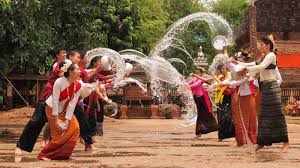
Offerings during Qing Ming Jie, a festival honouring ancestorsSongkran(Thai New Year) CelebrationsFestivals in April: From Public Domain
April is a month full of celebrations around the world. Asia hosts a spray of New Year festivities. Then there are festivals like Qing Ming Jie, Good Friday and Easter. All these are in a way reminders of our past. And yet, we critique things as old fashioned! So, where does tradition end and ‘outdated’ or ‘outmoded’ start? Meanwhile we continue to celebrate these festivals with joy but what happens to those who have lost their home, family and their living due to war or climate disasters? Can they too join in with the joie de vivre? Can we take our celebrations to them to give solace in some way?
In our April issue, we have stories from climate and conflict-ridden parts of the world. From Bangkok, Amy Sawitta Lefevre gives an eyewitness account of the March 28th Earthquake that originated in Myanmar. While in her city, the disaster was managed, she writes: “I’m also thinking of all the children in Myanmar who are sleeping in the open, who lost loved ones, who are feeling scared and alone, with no one to reassure them.” As news reels tell us, in Myanmar there have been thousands of casualties from the earthquake as well as shootings by the army.
From another troubled region, Pakistan, Zeeshan Nasir gives a heartrending narrative about climate change, which also dwells on the human suffering, including increase in underage marriages.
Human suffering can be generated by rituals and customs too. For instance, if festivals dwell on exclusivity, they can hurt those who are left out of the celebrations. Odbayar Dorje muses along those lines on Mongolian traditions and calls for inclusivity and the need to change norms. On the other hand, Devraj Singh Kalsi hums with humour as he reflects on social norms and niceties and hints at the need for change in a light-hearted manner. Farouk Gulsara makes us laugh with the antics of his spoilt pet cat. And Suzanne Kamata dwells on her animal sightings in Kruger National Park with her words and camera while Meredith Stephens takes us sailing on stormy seas… that too at night.
Art is brought into focus by Ratnottama Sengupta who introduces artist Haren Thakur with his adaptation of tribal styles that has been compared to that of Paul Klee (1879-1940). She also converses with filmmaker Leslie Carvalho, known for his film The Outhouse, and his new novel, Smoke on the Backwaters. Both of these have a focus on the Anglo-Indian community in India. Also writing on Indian film trends of the 1970s is Tamara Raza. Bhaskar Parichha pays tribute to the late Ramakanta Rath (1934-2025), whose powerful and touching poetry, translated from Odia by the poet himself, can be found in our translations section.
We have an excerpt from Professor Fakrul Alam’s unpublished translation of Tagore’sRed Oleanders. It’s a long play and truly relevant for our times. Somdatta Mandal shares with us her translation of Tagore’s essay called ‘The Classification in Society’, an essay where the writer dwells on the need for change in mindsets of individuals that make up a community to move forward. A transcreation of a poem by Tagore for his birthday in 1935 reflects the darkness he overcame in his own life. Two poems expressive of longings by Jibananada Das have been translated from Bengali by Professor Alam aswell. From Balochistan, we have an excerpt from the first Balochi novel, Nazuk, written by the late Syad Zahoor Shah Hashmi and rendered into English by Fazal Baloch. Among contemporaries, we have a short story by Bitan Chakraborty translated from Bengali by Kiriti Sengupta, a poignant story that reflects on gaps in our society. And a Korean poem by Ihlwha Choi rendered to English by the poet himself.
This issue has been made possible because of support from all of you. Huge thanks to the team, all our contributors and readers. Thanks to Sohana Manzoor for her fabulous artwork. Do pause by our contents page as all the content could not be covered here.
Perhaps, world events leave a sense of pensiveness in all of us and an aura of insecurity. But, as Scarlett O’ Hara of Gone with the Wind[2] fame says, “After all, tomorrow is another day.”
Looking forward to a new day with hope, let’s dream of happier times filled with sunshine and change.
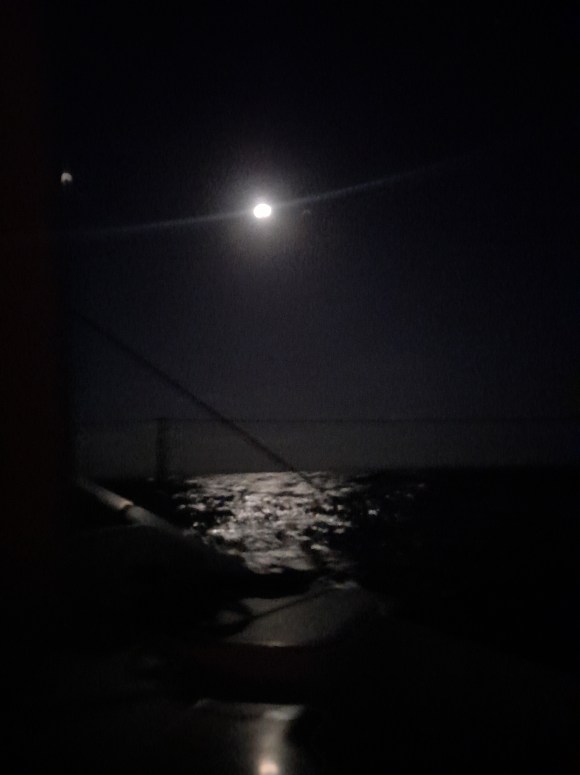
I looked out at the waters beyond the stern. The black waves danced in the moonlight. The swell pushed the boat in all directions, slapping against the water. I was unable to move around the boat without planning every movement. Thankfully, all the edges were rounded so even if I bumped into something I would not get hurt. I had remained in my pyjamas all day because I was unable to stay still enough to open drawers, retrieve clothing, and get dressed. I was unable to comb my hair because walking to the cupboard and retrieving my comb was too hard given all the bumps. Our bags had all fallen to the floor.
“I’m not scared,” replied Alex.
He looked at me straight in the eye. Suddenly I knew that it was not dangerous. If not dangerous, it was uncomfortable, but as far as Alex was concerned, we were not in danger.
We had left False Entrance off the mid-west coast of Western Australia at 4 am. There was an easterly wind predicted at this time. At 3 am, the anchor alarm had sounded. Alex rose and confirmed that this was because of the wind change. He spent thirty minutes trying to raise the anchor because the windless was malfunctioning. I could hear the anchor chain churning above the cabin where I was lying. Alex had to raise it by hand.
“At least I’ve done my morning workout!” he quipped.
Then I heard the motor turn on, and before long we left the safety of False Entrance for the swell of the Indian Ocean. The easterly blew for several hours pushing us south but then changed direction. This required us to head away from shore towards the Abrolhos Islands. Once the wind shifted Alex had to turn the motor on, and we thumped across the swell. Because of the high cliffs lining the mainland coast there would be no bay to shelter in for twenty-four hours. This wild stretch of coastline had claimed dozens of ships since Dutch vessels first arrived in the 1600s.
“What’s our latest estimated time of arrival?” I asked.
“The forecast was off, so we won’t be at Port Gregory until 3 am.”
We continued riding across the slapping swell. All I could complain about was the discomfort. I knew from Alex’s tone that we were not in danger, and we need not worry. He remained at the helm until we were safely at Port Gregory, while I rested in the cabin and braced myself for every slap against a wave. I put two pillows under my head to cushion myself.
I heard the familiar dropping of the anchor and realised we must be in Port Gregory. Alex spent the next ten minutes making everything ship-shape before going to bed. I looked at my phone. It was 2.57 am. Our voyage had taken almost 23 hours.
“It was tedious,” was his only complaint the next morning. Not scary, uncomfortable, or exhausting. Just tedious, in his typical understated way.
We gratefully slept until the sun forced its way through the cabin hatches at 8 am, and then, we roused ourselves for a comfortable breakfast at anchor. The skies were blue, and the waters calm.
“The wind is in the right direction. We’ll get to Geraldon in five or six hours. We should be able to sail the whole way, without motoring.”
How could the wind change so suddenly? How was it possible to have capricious winds one day and friendly ones the next? Alex raised the sails, and for the next six hours the wind ushered us on our way. Instead of erratic slapping, the keels produced a regular whooshing sound. The bucking bronco[1] had turned into a docile, ageing Clydesdale[2]. The first sign of the approaching Port of Geraldton was bulk carriers anchored out at sea, waiting their turn to load grains for export. As we entered the bay we had to make our way through the massive channel markers and dodge the lobster pot buoys. Once in the bay, we were greeted by live music from the amphitheatre on the shorefront lawns. We heard the sound of children playing in the water, on the beach, and on the playgrounds.
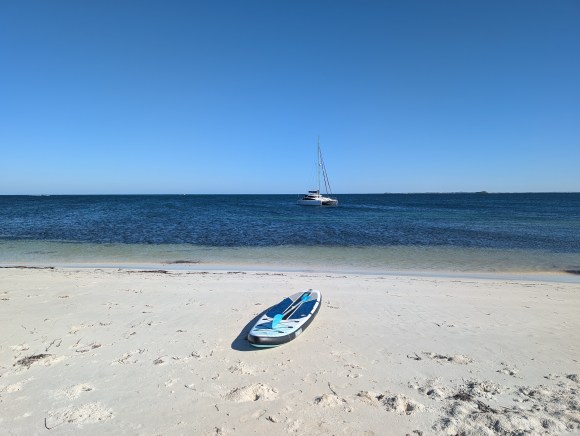
Alex anchored and by this time the windless had stopped malfunctioning. We then lowered the paddleboard. Alex knelt at the rear and I at the front, relieved to dismount our steed of the seas. I held myself steady as he paddled firmly behind me to the shore. We alighted at the sand, pulled the paddleboard to a safe height, and washed the sand off our flip-flops under a tap. A wall of hot air from the land accosted us, and the ground continued to gently canter beneath us as our bodies recalibrated to being on terra firma. Our discreet entry on the paddleboard had attracted no attention. We walked past children playing in the foreshore fountain, found a place to sit on the lawn alongside other family groups, and tuned in to savour the comforting 1970s pop music being performed by the live band.
Meredith Stephens is an applied linguist from South Australia. Her recent work has appeared in Syncopation Literary Journal, Continue the Voice, Micking Owl Roost blog, The Font – A Literary Journal for Language Teachers, and Mind, Brain & Education Think Tank. In 2024, her story Safari was chosen as the Editor’s Choice for the June edition of All Your Stories.
PLEASE NOTE: ARTICLES CAN ONLY BE REPRODUCED IN OTHER SITES WITH DUE ACKNOWLEDGEMENT TO BORDERLESS JOURNAL
Jibanananda Das’ poems on war and for the common masses have been translated from Bengali by Professor Fakrul Alam. Click here to read.
A Scene with an Aged Queen, a poem by Ihlwha Choi has been translated from Korean by the poet himself. Clickhere to read.
Tagore’sEsho Bosonto, Esho Aj Tumi(Come Spring, Come Today) has been translated from Bengali by Mitali Chakravarty. Click here to read.
Pandies’ Corner
For Sanjay Kumar: To Sir — with Love has been written for the founder of pandies’ theatre by Tanvir, a youngster from the Nithari village where pandies’ worked with traumatised victims. Over time, these kids have transcended the trauma to lead fulfilling lives. The late Sanjay Kumar passed on this January. This is a tribute to him by one of his students. It has been translated from the Hindustani original by Lourdes M Surpiya. Click here to read.
Drops of water gather to make a wave. The waves make oceans that reshape land masses over time…
Five years ago, on March 14th, in the middle of the pandemic, five or six of us got together to start an online forum called Borderless Journal. The idea was to have a space that revelled with the commonality of felt emotions. Borderless was an attempt to override divisive human constructs and bring together writers and ideators from all over the Earth to have a forum open to all people — a forum which would be inclusive, tolerant, would see every individual as a part of the fauna of this beautiful planet. We would be up in the clouds — afloat in an unbordered stratosphere— to meet and greet with thoughts that are common to all humans, to dream of a world we can have if we choose to explore our home planet with imagination, kindness and love. It has grown to encompass contributors from more than forty countries, and readers from all over the world — people who have the same need to reach out to others with felt emotions and common concerns.
Borderless not only celebrates the human spirit but also hopes to create over time a vibrant section with writings on the environment and climate change. We launch the new section today on our fifth anniversary.
Devraj Singh Kalsi with a soupçon of ironic amusement muses on humans’ attitude to the fauna around him and Farouk Gulsara lays on a coating of sarcasm while addressing societal norms. Meredith Stephens brings us concerns for a green Earth when she beachcombs in a remote Australian island. Prithvijeet Sinha continues to familiarise us with his city, Lucknow. Suzanne Kamata, on the other hand travels to Rwanda to teach youngsters how to write a haiku!
Professor Fakrul Alam takes us to libraries in Dhaka with the hope that more will start writing about the waning of such paradises for book lovers. Other than being the month that hosts World Environment Day, March also homes, International Women’s Day. Commemorating the occasion, we have essays from Meenakshi Malhotra on the past poetry of women and from Ratnottama Sengupta on women in Bengali Cinema. Sengupta has also interviewed Poulami Bose Chatterjee, the daughter of the iconic actor Soumitra Chatterjee to share with us less-known vignettes from the actor’s life. Keith Lyons has interviewed Malaysian writer-editor Daphne Lee to bring to us writerly advice and local lores on ghosts and hauntings.
We also have a translation by Lourdes M Supriya from Hindustani of a student’s heartrending cry to heal from grief for a teacher who faced an untimely end — a small dirge from Tanvir, a youngster with his roots in Nithari violence who transcended his trauma to teach like his idol and tutor, the late Sanjay Kumar. With this, we hope to continue with the pandies corner, with support from Lourdes and Anuradha Marwah, Kumar’s partner.
Borderless has grown in readership by leaps and bounds. There have been requests for books with writings from our site. On our fifth anniversary, we plan to start bringing out the creative writing housed in Borderless Journal in different volumes. We had brought out an anthology in 2022. It was well received with many reviews. But we have many gems, and each writer is valued here. Therefore, Rhys Hughes, one of our editorial board members, has kindly consented to create a new imprint to bring out books from the Borderless Journal. We are very grateful to him.
We are grateful to the whole team, our contributors and readers for being with us through our journey. We would not have made it this far without each one of you. Special thanks to Sohana Manzoor for her artwork too, something that has almost become synonymous with the cover page of our journal. Thank you all from the bottom of my heart.
Wish you all happy reading! Do pause by our content’s page and take a look at all the wonderful writers.
We sail into Turtle Bay on East Wallabi Island. I make my way barefoot to the bow. Then I hold the boat hook and crouch at the edge, extending it towards the buoy. I loop the hook under the thick slimy rope covered in algae and yank it upwards.
“It’s too heavy!” I yell, my voice disappearing into the wind.
Alex must have heard because he abandons the helm and races to the bow. He grabs the boat hook from my hands and pulls up the rope, securing the buoy to the cleat.
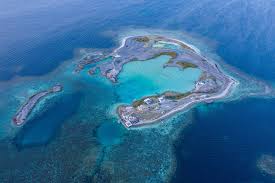
Turtle Bay is a wide horseshoe. The waters are glistening turquoise and are surrounded by white sands. It’s uninhabited but small planes of tourists regularly fly in and out to walk and dive. Night is descending and it’s too late to disembark, so we look longingly at the shore and wait for the morning.
Once day breaks, we head ashore on the stand-up paddleboard. Alex places his phone in a waterproof bag. He alights from the stern and kneels on the back of the paddleboard. I kneel at the stern and carefully slide over to kneel at the front of the paddleboard. Alex paddles to shore behind me and I try to remain as still as I can, unresponsive to the moving water beneath me, retrieving the muscle memory of riding wayward horses in my youth. Once we arrive, we alight as quickly as we can and drag the paddleboard away from the water’s edge.
A shaft of light catches my eye, and I reach down to pick up the object. It’s a small purple shell lined with brown flecks. As the sun is blinding, I am forced to continue casting my eyes downward. Never have I seen such an array of shells on a beach. Alex, on the other hand, finds his attention caught by even brighter hues than the shells. A blue plastic wrapping. A broken glass bottle. An aluminium-insert from boxed water. He retrieves these items unflinchingly. We continue to walk around this uninhabited island and find yet more rubbish washed up ashore. Most of it is plastic bottles and brightly coloured bottle tops. Then we spot a large blue plastic tub. Alex picks it up and places the rubble within. I respond with strong disgust, so am ashamed to say that I do not help him. Alex does not chide me for this, and I am grateful that he withholds judgement. I continue to admire the multi-coloured shells washed up by the tide.
We beat our way back through the fierce heat to the section of beach where the paddleboard is waiting. Alex affixes the bucket of rubbish to the stretchy cords at the front of the paddleboard. Spray surges as each wave hits the shore. He waits for a lull between the swell. After several more waves hit the shore there is a momentary calm, and he pushes the board forward. I climb on and crouch behind the rubbish. Alex mounts the board behind me and paddles towards the boat. I’m no longer a retiree, but a teenager at the beach with her boyfriend. I close my eyes and now I am keeping balance on my lively horse. Suddenly, when we have nearly reached the boat, I sense Alex is worried. The tide is pushing us away from the boat and he paddles harder. Will the wind push us into the vast empty seas out of the range of mobile devices? Just as we reach the stern Alex thrusts his paddle into the water to do a U-turn. I find myself parallel with the boat, grab the steel handle, and slide onto the boat without tipping Alex and the rubbish into the depths.
All is secure, and now it’s time to sail back to the mainland. We head north-east to the tiny township of Port Gregory, with its population of eighty, renowned for a submarine shelling in 1943, and a vast pink salt lake. After anchoring in the bay, we again secure the rubbish to the front of the paddleboard and kneel behind it. Once on the shore, we are reassured by the sight of multiple rubbish bins. Port Gregory is too remote for recycle bins, so we reluctantly place the island rubbish into one of the general bins, and trudge through the heat to explore the town.
Port Gregory. From Public Domain
Meredith Stephens is an applied linguist from South Australia. Her recent work has appeared in Syncopation Literary Journal, Continue the Voice, MickingOwl Roost blog, The Font – A Literary Journal for Language Teachers, and Mind, Brain & Education Think Tank. In 2024, her story Safari was chosen as the Editor’s Choice for the June edition of All Your Stories.
PLEASE NOTE: ARTICLES CAN ONLY BE REPRODUCED IN OTHER SITES WITH DUE ACKNOWLEDGEMENT TO BORDERLESS JOURNAL
Sometimes I wonder what makes us exclusive as a species on Earth? Do we really have some kind of superiority over the flora and fauna without which we may not survive? With multiple species of wildlife being threatened by human exploits, perhaps there is a need to remind ourselves of our dependence on our planet and the lives it supports while acknowledging our existence as just one of the many species. In this issue, we celebrate life on this planet… I do not know if a cockroach or a cow would be considered wildlife, but it seems only right to see all of them as our brethren… along with yetis who could be a figment of the human mind… Enjoy some of our selected fare from around the world on World Wildlife Day today.
Jibananada Das’sAndhar Dekhecche, Tobu Ache (I have seen the dark and yet there is another) has been translated from Bengali by Professor Fakrul Alam. Click here to read.
Manish Ghatak’sAagun taader Praan (Fire is their Life) has been translated from Bengali by Indrayudh Sinha. Click hereto read.
Manzur Bismil’s poem,Stories, has been translated from Balochi by Fazal Baloch. Click here to read.
Homecoming, a poem by Ihlwha Choi on his return from Santiniketan, has been translated from Korean by the poet himself. Click here to read.
Tagore’sShotabdir Surjo Aji( The Century’s Sun today) has been translated from Bengali by Mitali Chakravarty. Clickhereto read.
Paul Mirabile wraps his telling like a psychological thriller. Clickhere to read.
Conversations
Ratnottama Sengupta converses with Divya Dutta, an award-winning actress, who has authored two books recently, Stars in my SkyandMe and Ma. Clickhere to read.
Painting by Claud Monet (1840-1926). From Public Domain
Acknowledging our past achievements sends a message of hope and responsibility, encouraging us to make even greater efforts in the future. Given our twentieth-century accomplishments, if people continue to suffer from famine, plague and war, we cannot blame it on nature or on God.
–Homo Deus (2015),Yuval Noah Harari
Another year drumrolls its way to a war-torn end. Yes, we have found a way to deal with Covid by the looks of it, but famine, hunger… have these drawn to a close? In another world, in 2019, Abhijit Banerjee had won a Nobel Prize for “a new approach to obtaining reliable answers about the best ways to fight global poverty”. Even before that in 2015, Yuval Noah Harari had discussed a world beyond conflicts where Homo Sapien would evolve to become Homo Deus, that is man would evolve to deus or god. As Harari contends at the start of Homo Deus, some of the world at least hoped to move towards immortality and eternal happiness. But, given the current events, is that even a remote possibility for the common man?
Harari points out in the sentence quoted above, acknowledging our past achievements gives hope… a hope born of the long journey humankind has made from caves to skyscrapers. If wars destroy those skyscrapers, what happens then? Our December issue highlights not only the world as we knew it but also the world as we know it.
In our essay section, Farouk Gulsara contextualises and discusses William Dalrymple’s latest book, The Golden Road with a focus on past glories while Professor Fakrul Alam dwells on a road in Dhaka , a road rife with history of the past and of toppling the hegemony and pointless atrocities against citizens. Yet, common people continue to weep for the citizens who have lost their homes, happiness and lives in Gaza and Ukraine, innocent victims of political machinations leading to war.
Just as politics divides and destroys, arts build bridges across the world. Ratnottama Sengupta has written of how artists over time have tried their hands at different mediums to bring to us vignettes of common people’s lives, like legendary artist M F Husain went on to make films, with his first black and white film screened in Berlin Film Festival in 1967 winning the coveted Golden Bear, he captured vignettes of Rajasthan and the local people through images and music. And there are many more instances like his…
It's always the common people who pay first. They don’t write the speeches or sign the orders. But when the dust rises, they’re the ones buried under...
Echoing the theme of the state of the common people is a powerful poem by Manish Ghatak translated from Bengali by Indrayudh Sinha, a poem that echoes how some flirt with danger on a daily basis for ‘Fire is their life’. Professor Alam has brought to us a Bengali poem by Jibanananda Das that reflects the issues we are all facing in today’s world, a poem that remains relevant even in the next century, Andhar Dekhecche, Tobu Ache (I have seen the dark and yet there is another). Fazal Baloch has translated contemporary poet Manzur Bismil’s poem from Balochi on the suffering caused by decisions made by those in power. Ihlwha Choi on the other hand has shared his own lines in English from his Korean poem about his journey back from Santiniketan, in which he claims to pack “all my lingering regrets carefully into my backpack”. And yet from the founder of Santiniketan, we have a translated poem that is not only relevant but also disturbing in its description of the current reality: “…Conflicts are born of self-interest./ Wars are fought to satiate greed…”. Tagore’s Shotabdir Surjo (The Century’s Sun, 1901) recounts the horrors of history…The poem brings to mind Edvard Munch’s disturbing painting of “The Scream” (1893). Does what was true more than hundred years ago, still hold?
Reflecting on eternal human foibles, Naramsetti Umamaheswararao creates a contemporary fable in fiction while Snigdha Agrawal reflects on attitudes towards aging. Paul Mirabile weaves an interesting story around guilt and crime. Sengupta takes us back to her theme of artistes moving away from the genre, when she interviews award winning actress, Divya Dutta, for not her acting but her literary endeavours — two memoirs — Me and Ma and Stars in the Sky. The other interviewee Lara Gelya from Ukraine, also discusses her memoir, Camels from Kyzylkum, a book that traces her journey from the desert of Kyzylkum to USA through various countries. In our book excerpts, we have one that resonates with immigrant lores as writer VS Naipual’s sister, Savi Naipaul Akal, discusses how their family emigrated to Trinidad in The Naipauls of Nepaul Street. The other excerpt from Thomas Bell’s Human Nature: A Walking History of the Himalayan Landscape seeks “to understand the relationship between communities and their environment.” He moves through the landscapes of Nepal to connect readers to people in Himalayan villages.
The reviews in this issue travel through cultures and time with Somdatta Mandal’s discussion of Kusum Khemani’s Lavanyadevi, translated from Hindi by Banibrata Mahanta. Aditi Yadav travels to Japan with Nanako Hanada’s The Bookshop Woman, translated from Japanese by Cat Anderson. Jagari Mukherjee writes on the poems of Kiriti Sengupta in Onenessand Bhaskar Parichha reviews a book steeped in history and the life of a brave and daring woman, a memoir by Noor Jahan Bose, Daughter of The Agunmukha: A Bangla Life, translated from Bengali by Rebecca Whittington.
We have more content than mentioned here. Please do pause by our content’s page to savour our December Issue. We are eternally grateful to you, dear readers, for making our journey worthwhile.
Huge thanks to all our contributors for making this issue come alive with their vibrant work. Huge thanks to the team at Borderless for their unflinching support and to Sohana Manzoor for sharing her iconic paintings that give our journal a distinctive flavour.
With the hope of healing with love and compassion, let us dream of a world in peace.
“So relieved that we will make good time today,” I declare. “I’ve had enough of arriving in the dark.”
“We have to stop to get diesel on the way but that won’t make too much of a difference,” Alex reminds me.
We head south of Adelaide to the most fertile part of the state. The coast is lined with stately Norfolk pines, and further south there are rolling green hills lined with heritage gums. There are more cattle than you could count, mobs of kangaroos, and horses wearing coats to protect them from the winter chills. We arrive in Yankalilla, the last town before our departure point, and fill the jerry cans with diesel. There is no fuel at Wirrina Cove, as the marina went out of business a few years ago, so we have to haul diesel to the boat.
We leave Yankalilla and head past yet more horses. After the turn-off for Wirrina I catch a glimpse of my favourites, two Clydesdales, one of whom has a forelock that reaches down past his nostrils. At the marina, we park in front of a tree to protect the car from the harsh marine environment. It’s mid-morning so there should be plenty of time to arrive in Kangaroo Island before darkness. My border collie, Haru, springs from the car, and happily trots down the finger wharf behind me as I carry my luggage to the boat. It’s hard for me to make the leap onto the boat from the finger wharf but Haru skips in while I am still worrying about how not to fall in the water.
“There is less wind than forecast. We’ll have to motor-sail,” bemoans Alex.
I move to the trampoline at the bow to savour the view of boats in their berths opening out in front of me as we exit. Haru sits next to me and whinges every time I stop patting her. Once we are in open water the boat starts rocking, and I walk back along the side of the boat, all the while gripping the side with my right hand, until I am safely inside. Haru trots lightly alongside me.
The waves become increasingly bouncy and Haru frowns. She eyes her crate which is sitting just inside the doorway. I open the flap, and she heads in and curls herself on the old silk cushions and Alex’s old woollen jumper lining the bottom of the crate. She prefers the safety of the crate to sitting outside with the possibility of being splashed.
I abdicate the task of sailing to Alex and watch him at the helm, while I settle myself on the couch, placing cushions behind my head and covering myself with a blanket. I can’t confidently move around on the boat when it is rocking this much, so I stretch my headphones over my head and listen to music, while watching Alex raise the sails and maneuver the boat towards Kangaroo Island. I feel a twinge of guilt at lying down in warm comfort while Alex busies himself with sailing, but he doesn’t seem to mind, so I close my eyes and revel in the music.
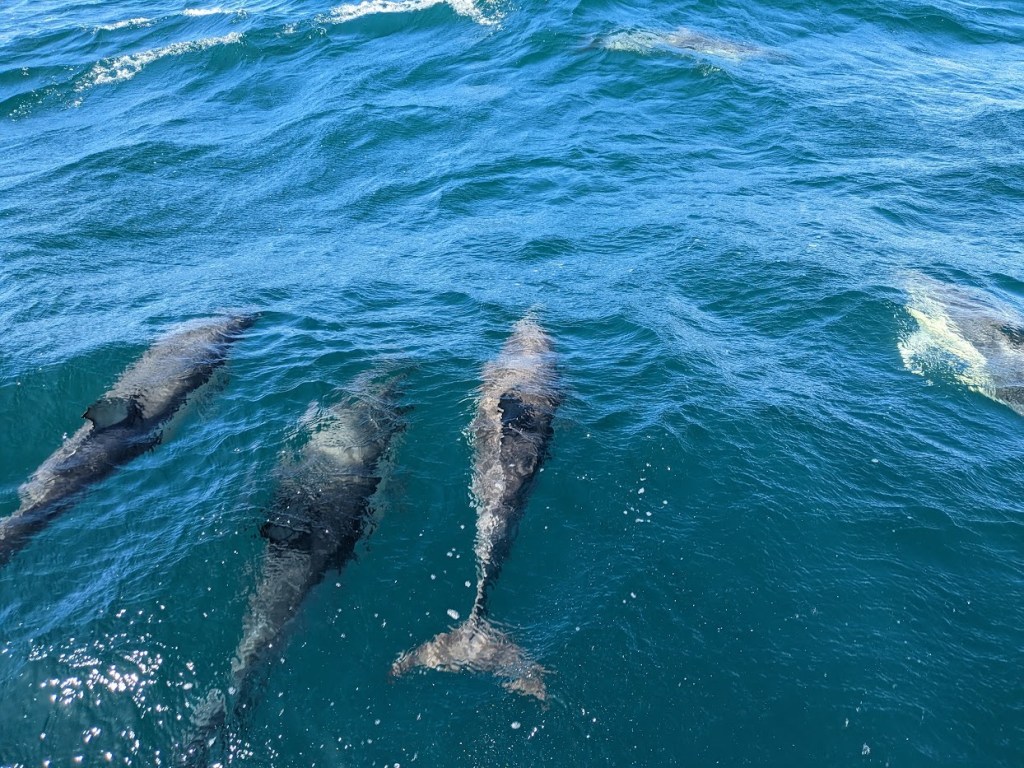
After several hours, we reach the middle of Investigator Strait. I glance outside and can see dorsal fins rising from the waters. As much as I like lying down with a blanket and listening to music, I cannot ignore pods of dolphins. I rise and brace myself for the cold and wind outside the boat. I head towards the bow, but the rocking motion and the cold winds defeat me. From the stern I can see dolphins swimming alongside the boat, and as I gaze into the distance yet more dolphins are breaching as they head towards us. Of our many crossings of Investigator Strait there has never been a time when I have not witnessed pods of dolphins, but the sense of wonder never diminishes.
Despite my determination not to arrive in darkness, by late afternoon the sun begins to slip into the horizon and Point Marsden is still well in the distance. The sky erupts in bright orange, and I hope the light will hold out till we reach our mooring. Heading for Point Marsden is like trying to reach the summit of a mountain. Finally, we pass the point and head into the bay, but darkness has already fallen. Alex locates the mooring buoy in the distance. I grab the boat hook and head to the bow. I crouch on the trampoline and stretch the hook out in front of me over the dark water. Haru crouches at my side and brushes herself against me, willing me to hook the buoy on the first attempt. I stretch forward, hook the buoy, and drag it up to the bow. I call Alex, and he leaves the helm to secure it.
Alex lowers the dinghy, and we prepare to alight. We lift our bags in, and I carefully place one leg into the centre and ease myself in. Meanwhile, Haru has delicately skipped into the dinghy behind me. Finally, Alex enters, unties the ropes, turns the outboard motor on and takes us to the shore. We shine the torch in front of the boat and locate the cove. It’s high tide. Alex hops out into chest-high cold dark waters. He pulls the dinghy towards the rocks and secures it. I clamber out and perch myself on a rock. Alex hands me the bags. I place them on a higher rock just behind me. Then he hands me his backpack containing our laptops. I hold on to them tightly, afraid to place them on the rock in case water rushes over them. Alex picks up Haru and holds her above the water, before placing her on the shore. Then he takes the backpack from me, picks up the bags, and returns to the shore. I pick my way in the dark over slippery rocks, not moving one leg until the other has been firmly anchored. We reach the sand and walk up the switchbacks. Haru delights in running along the switchbacks after having been confined to the boat.
I tread carefully in the dark up the hill, Haru brushing her side against my calf. The holiday house is in sight, and just as I am about to reach the road leading to the house I fall over a boulder and gasp. How did I manage to navigate the submerged rocks in darkness and yet stumble on land?
‘“Oh sorry!” exclaims Alex. “That’s because I wasn’t holding your hand.”
He grabs my hand, and we walk up the last part of the track to the house. We enter and I make a doggie dinner for Haru. Then I collapse on the sofa and Alex makes a fire. After the adventure of arriving by boat and walking up the steep hill in the dark, the pleasure of lounging on a sofa and warming to a fire is multiplied. I am looking forward to spending the next day curling up on the sofa, reading a book in the sunshine, and taking Haru for walks.
A few minutes later the phone rings.
“Auntie May is not doing well. You have to come home as soon as you can!” urges my sister Jemima.
Great Auntie May, aged 103, is my oldest living relative. She was in the nursing home for two decades, even outliving her sons, before moving to the palliative care ward of the hospital. I remember the card from the Queen which she posted on her dressing table three years earlier. She once said that she had lived too long, because her sons and friends had passed. Because her grandchildren are interstate, it is up to her grand-nieces and grand-nephews to visit her.
“OK. We’ll be there as soon as we can!” I reassure Jemima.
“Alex, Auntie May is doing poorly. We have to get back to the mainland as soon as we can.”
“I’ll just check the weather,” he replies. “The wind is in the wrong direction. It’s a north-northeasterly. It may be too rough.”
His brow furrows as he scrutinizes the forecast.
“Can we fly home instead of sailing?” I ask.
“The weather will be getting worse over the week, so it won’t even be safe to let the boat stay on its mooring. Perhaps we can sail to the marina in Penneshaw and leave the boat there. Then we can catch the bus home from there.”
We decide to leave the next morning, but it is noon by the time we lock the front door. I dress Haru in her lifejacket, and don mine as well. We head back down the hill, and down the switchbacks to the shore. Alex picks up Haru and places her in the dinghy. She stands tall, ears pricked, the wispy hairs on her forelegs blowing in the wind, trusting that we will join her.
Alex places the bags in the dinghy. It’s too far away for me to board. If I walk to the dinghy in freezing water, I won’t be able to hop in from water at chest height. Alex pushes the dinghy to the rock I am standing on, and I leap in. He switches on the outboard motor, and we bump over the waves to the boat. Haru is at the front, and she winces as sprays splash onto her face. I pull her back against me to protect her from the sea-sprays. The boat is bobbing in the water. Alex grabs the rope to secure us. I stretch my left leg onto the boat, but the dinghy moves away, and my legs are thrown apart. I don’t want to fall victim to the cold water below. I move my left leg back into the dinghy. The waves are thrusting the dinghy towards the stern.
“Move back. It’s safer to alight from further back,” advises Alex.
Meanwhile Haru jumps effortlessly onto the boat, undeterred by the rough conditions.
“Now!” urges Alex, during a lull in the waves.
This time I extend my left leg onto the boat and somehow the rest of my body follows. Haru is standing expectantly at the bow wondering what all the fuss has been about. Alex raises the dinghy, then the sails, and we head towards Investigator Strait. Once we are in the boat the sea conditions are not as difficult as we had anticipated.
“I think we can sail across to the mainland in these conditions. We don’t need to leave the boat at Penneshaw after all,” Alex informs me.
The sea is bumpy but not enough to make me seasick. I bring Haru inside, and swaddle myself in blankets and locate my headphones, leaving Alex to manage the sailing. Six hours later we arrive at Wirrina Cove and drive back towards Adelaide in darkness.
“Let’s head straight to the hospital!” I urge Alex. “We can’t afford to waste any time.”
Alex floors the accelerator on the freeway, weaving past slow coaches who are blocking our way. Haru curls herself up on the back seat, oblivious to the drama around her.
We arrive at the palliative care ward and enter through the back door where visitors are allowed to enter with their dogs. Will Auntie May have waited for us? We make a beeline for her room. Auntie May is propped up on pillows and beams when she sees us. Haru jumps onto her bed and lies down facing her waiting for a pat.
“I had a bad turn, but I am feeling better today. Did you sail all the way back from Kangaroo Island to see me?”
“Yes, we did.”
“I’m sorry to have put you out. I’m feeling much better now.”
Alex and I glance at each other, and I catch the relief in his eyes. Even though she is 103, we aren’t ready to say goodbye. We hope she will make at least 110.
A few days later the phone rings. It’s the nurse from the palliative care ward.
“Would you come and pick up your Great Aunt May please? She is doing much better than expected and we need to move her out of the palliative care ward. The social worker has found a room with an ocean view for her in the Star of the Sea Nursing Home.”
Later we celebrate Auntie May’s 104th birthday at the nursing home, and next year we look forward to celebrating her 105th birthday. We continue to sail back and forth to Kangaroo Island, choosing our weather to only sail in favourable seas, never hurrying back. Haru continues to sail with us and enjoys visiting Auntie May just as much as we do.
.
Meredith Stephens is an applied linguist from South Australia. Her recent work has appeared in Syncopation Literary Journal, Continue the Voice, MickingOwl Roost blog, The Font – A Literary Journal for Language Teachers, and Mind, Brain & Education Think Tank. In 2024 her story Safari was chosen as the Editor’s Choice for the June edition of All Your Stories.
PLEASE NOTE: ARTICLES CAN ONLY BE REPRODUCED IN OTHER SITES WITH DUE ACKNOWLEDGEMENT TO BORDERLESS JOURNAL



 Borderless