Categories
Discussion

Bridging Cultures across Time and Space

In Conversation with Translators

Translators are bridge builders across cultures, time and place. We have interviewed five of them from South Asia. While the translators we have interviewed are academics, they have all ventured further than the bounds of academia towards evolving a larger literary persona.

The doyen of translation and the queen of historical fiction, Aruna Chakravarti,  and poet, critic and translator, Radha Chakravarty , feel their experience at bridging cultures has impacted their creative writing aswell. Somdatta Mandal, is prolific with a huge barrage of translations ranging from Tagore, to women to travellers, despite being an essayist and reviewer, claims she does not do creative writing and views translations as her passion. Whereas eminent professor and essayist from Bangladesh, Fakrul Alam tells us that translating helped him as a teacher too. Fazal Baloch, translator and columnist from Balochistan, tells us that translation is immersive, creative and an art into itself. We started the conversation with the most basic question – how do they choose the text they want to translate…

How do you choose which texts to translate?
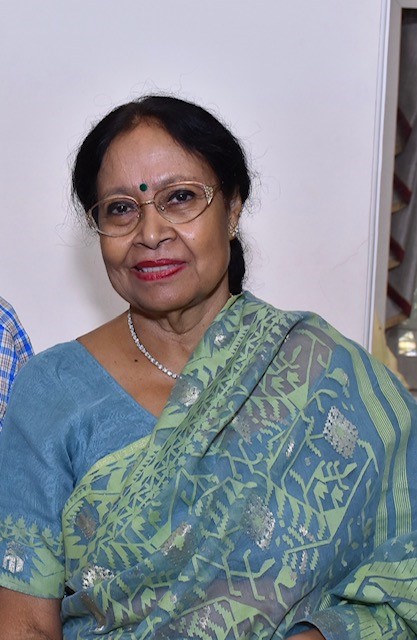
Aruna Chakravarti

Aruna Chakravarti: A translation is an attempt at communication on behalf of a culture, a tradition and a literature. Choosing an author and, more importantly, the most significant areas of his or her work are the first steps towards this communication, because it is only through translation that masterpieces from a small provincial culture become universal ones. Since I come from Bengal, I have always chosen the best of its literature for translation. My first translation was of Rabindranath Tagore’s lyrics. Rabindranath once said that even if all his other work fades to oblivion, his songs would remain. Saratchandra Chattopadhyay, a leading writer of 19th and early 20th century Bengal, considered Srikanta the best of his novels and the most suited to be conveyed to a global readership. I translated Srikanta. Sunil Gangopadhyay is hailed as the most eminent writer of present-day Bengal.  My translations of his novels and short stories are extraordinarily well received by non-Bengali readers, to this day.

Radha Chakravarty

Radha Chakravarty: Every occasion is different. Sometimes a text chooses itself because I feel compelled to translate it. Sometimes I select texts to translate, in response to suggestions or requests from editors, readers and friends who read. Several of my books in translation evolved alongside my research interests as a scholar and academic. For instance, Vermillion Clouds, my anthology of stories by Bengali women, developed from my general interest in feminist literature and my desire to bring texts from our own culture to the English-speaking world. My translations of Mahasweta Devi’s writings, especially the stories on motherhood in the collection titled In the Name of the Mother, happened when I was working on a chapter about Mahasweta for my PhD thesis. Our Santiniketan, my translation of her childhood memoir, emerged from my interest in her writings, as well as my admiration for Rabindranath Tagore. The translations of Chokher Bali1, Farewell Song (Shesher Kabita) and Four Chapters reflect my special fascination with Tagore’s woman-centred novels, for this was also the subject of my post-doctoral work. Later, I developed this research into my book Novelist Tagore: Gender and Modernity in Selected Texts. For my edited anthology Shades of Difference, a compilation of Tagore’s works on the theme of universality in heterogeneity, the selection involved a great deal of thinking and research. And translating Kazi Nazrul Islam’s essays turned out to be an incredible learning experience.
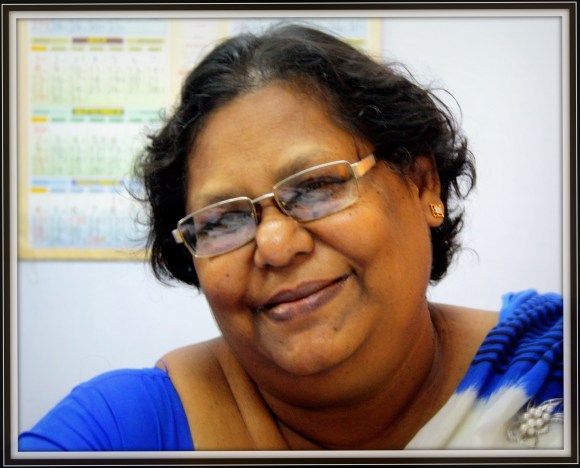
Somdatta Mandal

Somdatta Mandal: I have been translating different kinds of texts over the last couple of decades, and I have no fixed agenda of what I choose to translate. Usually, I am assigned some particular text by the author or a publisher, but sometimes I pick up texts which I like to do on my own. Since I have been working and researching on travel writing for a long time, I have chosen and translated several travel texts from Bengali to English written by women during the colonial times. I have also translated a lot of Rabindranath Tagore’s essays, letters and memoirs of different women related to him. Recently I translated a seminal Bengali travel text of a sadhu’s sojourn in the Himalayas in the late nineteenth century. I have a huge bucket list of texts that I would love to translate provided I find some publisher willing to undertake it. Since copyright permissions have become quite rigid and complicated nowadays, I have learnt from my own experience that it is always advisable to seek permission from the respective authorities before venturing into translating anything. Earlier I was naïve to translate stories which I liked without seeking necessary permission from the copyright holder and those projects ultimately did not see the light of day.
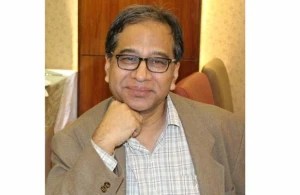
Fakrul Alam

Fakrul Alam: I have no fixed policy on this issue. Sometimes the texts choose me, so to speak. For instance, I began translating poems from Bengali when I first read Jibanananda Das’s “Banalata Sen”. The poem got hold of me and would not let go. I felt at one point an intense desire to translate it and read more of Jibanananda’s poems. Translating the poem elated me and having the end product in my hand in a printed page was joyous. The more poems I read by Jibanananda afterwards, the more I felt like rendering them into English, as if to share my delight and excitement at coming across such wonderful poems with readers who would not have read them in Bengali. That led to my first book of translations, Jibanananda Das: Selected Poems (Dhaka, UPL, 1999). As I ended my work on Jibanananda I thought: why not translate some poems by Rabindranath too? I had climbed one very high mountain satisfactorily and so why not venture forth and climb the topmost peak of Bengali literature?  And so, I began translating Rabindranath’s poems as well as his songs. I had grown up with them, but till now had never imagined I could render them into English. Kumkum Bhattacharya, a dear friend who at that time was in charge of Viswa-Bharati’s publishing wing, Granthana Vibhaga, had seen samples of my work and told me to think of an anthology of his translated works to be published in Tagore’s sesquicentenary year for them. This led me to the poems, prose pieces and songs by him that I translated for The Essential Tagore (Cambridge, Mass, Harvard UP, 2011 and Kolkata: Viswa Bharati, 2011), a book that I had co-edited (with Radha Chakravarty). My last book of translations, Gitabitan: Selected Song-Lyrics of Rabindranath Tagore (Dhaka: Journeyman Books, 2023) alsocame out of this same compulsion of translating works in Bengali. This particular work is a book of translations of nearly 300 songs that I love to listen to again and again—songs that made me feel every now and then that I had to translate them, especially when I heard them sung by a favourite Tagore singer. My translations of a few Kazi Nazrul Islam’s poems and some of his songs are also the result of such compulsive feelings. 

However, I also translated some works because I was requested to do so by people who knew about my Jibanananda Das and Tagore translations and who felt that I would be a competent translator of works they felt were worth presenting to readers in English versions of Bengali books very dear to them. My three translations of works by Sheikh Mujibur Rahman, The Unfinished Memoirs (Dhaka: UPL Books, 2012), The Prison Dairies (Dhaka: Bangla Academy, 2017), and New China 1952 (Dhaka: Bangla Academy, 2021) were all outcomes of requests made to me to translate them. Translating Ocean of Sorrow, the epic 1891 novel by Mir Mosharraf Hossain, has been the most challenging translating work I have had to undertake till now (Dhaka: Bangla Academy, 2016). I would not have dared take on the task of translating such a long and demanding prose work if Shamsuzzaman Khan, the Director of the Bangla Academy of that period, had not kept requesting me to translate this classic of Bengali Literature.

I will end my response to this question by saying that every now and then I translate poems and prose pieces by leading writers who are my contemporaries and who keep requesting me to translate them. Occasionally, I will also translate poems by major poets of our country of the last century—poets like Shamsur Rahman and Al Mahmud—because a poem or two by them had gripped me and made me feel like venturing forth into the realm of translation.  
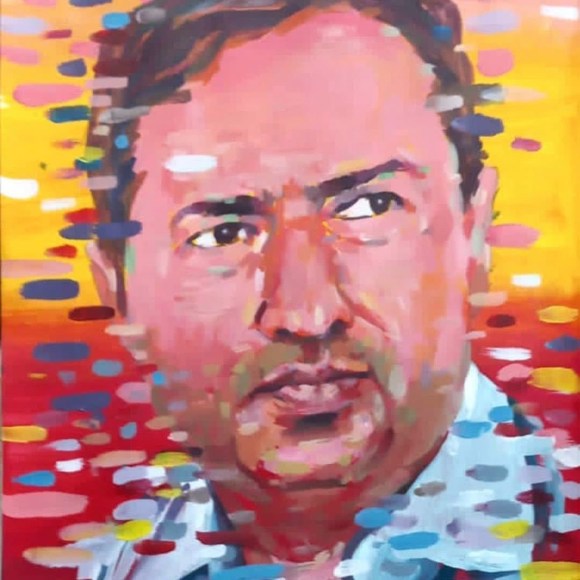
Fazal Baloch

Fazal Baloch: Translating poetry and prose are two very different endeavors. Poetry often makes an immediate impact. Sometimes just a few lines strike me powerfully on the first reading, creating an atmosphere that sets the translation process in motion. In other words, I tend to translate the verses that stir something in me or resonate deeply.

Prose translation, by contrast, works differently. It usually unfolds after a longer process and often requires multiple readings of the text. At times, it even calls for a more deliberate, conscious effort.

Does translating impact your own writing?

Aruna Chakravarti: Yes, it does.  While translating the great masters of Bengali literature I have learned much that has impacted my own writing. From Rabindranath I learned that prose need not necessarily be dry and matter of fact. It could be imbued with lyricism without appearing sentimental and over emotional.  Saratchandra taught me the importance of brevity and precision. Search all his novels and you will not find one superfluous word. I try to follow his example and shun over-writing. From Sunil Gangopadhyay, I learned the art of dialogue. His direct, no-nonsense style and use of colloquialisms work best in dialogue.  

Radha Chakravarty: Yes indeed. As I have just indicated in my answer to your previous question, my translations often take a course parallel to my research, and the two strands of my work sometimes become inseparably interrelated. In my critical works on Indian literature, I remain conscious of bringing these writings to an audience beyond India. Hence an element of cultural translation infuses my analysis of texts by Indian writers. In my own English poetry, when I write about Bengali settings and themes, bilingual overtones often seep in.

Somdatta Mandal: No, not at all. I am not a creative writer per se, so there is no way that translation can influence my own writing.

Fakrul Alam: I will start answering the question by saying that apart from translating and writing nonfiction essays in the creative mode, I have not authored literary works. I am first and foremost an academic. Inevitably, translating Rabindranath’s works have impacted on me academically. By now I have at least one collection of essays on various aspects of Rabindranath’s life and enough essays on him that can lead to another such book. No doubt coming to know Rabindranath so intimately through the kind of close reading that is essential for translation work has made me more sensitive to him as a thinker, educator and visionary, as well as a poet and writer of prose and fictional works. Reading literary creations by him, his letters and lectures that I came across because of my involvement with his work has also lead me to editing; the work I did as co-editor of The Essential Tagore is surely proof of that.

Let me add that my translations have also impacted on my teaching. I am now able to draw on comparisons with Bangladeshi writers and Bengali literature for comparison and contrast in the classroom when I teach texts written in English to my students.  Reading up on the authors I have translated has also equipped me to be more aware of Bangladesh’s roots and national identity formation. This has led me to essays on these subjects.   

Fazal Baloch: Translation is not separate from the process of creativity. Through it, we enter a new world of meaning and explore the experiences of others through a creative lens. As a writer, I find translation essential for nurturing and enriching the mind. It is also worth noting that translation is not partial or fragmentary but a complete and holistic act. When I translate, I move with its current just as I do when I write. Both processes unfold in their own rhythm without obstructing one another. In fact, it is through translation that I have come to recognize and understand great works of creativity in a deeper way.

What is the most challenging part of translation? Do you need to research when you translate?

Aruna Chakravarti:  Yes, since a major part of my translation work was set in 19th century Bengal, I needed to understand and imbibe the ethos and ambience of the times. Being a Probasi Bangali who has lived outside Bengal all her life, this was important. Consequently, a fair amount of research was involved. This has stood me in good stead in my own writing.

Speaking about challenges there are many. The more divergent the two literary traditions the greater the dilemma of the translator. But the test of a good translation is the absence of uncertainty, hesitation and strain. Since translation undertakes to build bridges across cultures it is important that it reads like a creative work. The language must be flowing and spontaneous; one that readers from other languages and cultures don’t feel alienated from. One that they are willing, even eager to read. One they can sail through with effortless ease.

On the other hand, readability or beauty of language cannot be the sole test of a good translation. If the translator becomes obsessed with sounding right in the target language, he/she could run the risk of diluting and distorting the original text which would be a disservice to the author. The reader should hear the author’s voice and be conscious of the source language and culture, down to the finest nuance, if the translation is a truly good one. A good translator is constantly trying to keep a balance between Beauty and Fidelity. No translation is perfect but the finer the balance…the better the translation.

Radha Chakravarty: When translating from Bengali into a culturally distant language like English, the greatest challenge is to bring the spirit of the original alive in the target language, for readers who may not be familiar with the local context. Literal translation does not work.

The need for research can vary, depending on the nature of the text being translated, the purpose of the translation, and the target readership. Some texts travel easily across cultural and linguistic borders, while others need to be interpreted in relation to the time, place and milieu to which they belong. The latter demand more research on the part of the translator, who must act as the cultural mediator or interpreter. When translating Tagore’s writings for my anthology The Land of Cards: Stories, Poems and Plays for Children, I found that these works speak to all children without requiring too much explanation or contextualization; very often the context becomes clear from the writing itself. But Boyhood Days, my translation of Tagore’s childhood memories in Chhelebela, required greater contextualization, for present day readers to grasp unfamiliar details of life in old-world Kolkata.

Somdatta Mandal: The most challenging part of translation is to maintain the readability of the text which I consider to be of foremost importance for any text to communicate with its readers. However, this readability should not be achieved at the cost of omission or suppression of portions of the original. Instead of rigidly following one particular criterion, usually my focus has been to choose what best communicates the nuances of the Source Language [SL]. Sometimes of course when it is best to do a literal translation of cultural material rather than obfuscate it by transforming it into an alien idiom taken from the target language resulting thus in a significant loss of the culture reflected in the original text.

As for doing research when I translate, the answer depends on what kind of text I am working on. If it is a serious academic piece, then occasionally I must consult the dictionary or the thesaurus for the most suitable word. Sometimes contextual or historical references need special attention and background research but such instances are occasional. What really attracts me towards translation is the inherent joy of creativity – of being free to frame the writer’s thoughts in your own words.

Fakrul Alam: The most challenging part of translation is getting it right, that is to say, conveying the words and feel of the original as accurately as possible.  But “getting it right” also means being able to convey the form and tone of the original as well as is possible.  In every way the translator must carry on his translating shoulder the burden of accuracy whenever and whatever he or she is into translating. In this respect a translator like me is different from creative people who take on the task of translating ready to take liberties to render the original in distinctive ways that will bear their signatures. They do not feel constrained like translators of my kind who never dare to move away more than a little distance from the original in order to convey the tone and the meaning as imaginatively and creatively as is possible for them.

I have a simple method when it comes to translating. My first draft is the result of no aid other than printed and/or online dictionaries. If there are allusions I come across when readying the first draft, I Google. Lately, AI has been very helpful in this regard—it even gives me the English equivalence for quite a few Bengali words when, for instance, I type the title in English of a Bengali song-lyric by Rabindranath. Then I compare my translation with that of other translations available online to see if my version is deviating to much from the ones I see.

Occasionally, I will need to do research on the work I am translating. In translating Mir Mosharraf Hossein’s epic novel, for example, I kept searching on the net to know more about the characters and situations of history he had rendered into his narrative than I knew from his writing. I will also do a lot of research if and when I feel a poem or prose work needs to be contextualized and footnotes or end notes needed by readers to understand what is being depicted fully. Thus, for Jibanananda Das’s “Banalata Sen” alone I had to Google a number of times to understand fully the imaginative geography of the piece and get a feel of the real-life equivalents of the places and characters mentioned. In particular, for the first stanza of the poem I had to look for glossaries I intended to provide on words like Vimbisar, Vidarbha, Sravasti and Natore for overseas readers.

Fazal Baloch: Translation is not simply the process of transferring of text from one language to another; it is more like a conversation between cultures, a process through which they come closer and begin to understand one another.

For me, the most challenging part of translation is working with idiomatic and metaphorical expressions. Every language has its own unique idioms and linguistic frameworks, and these are often difficult to carry over into another language. To meet this challenge, I often need to conduct research and explore the etymological roots of words.

What is more important in a translation? Capturing the essence of the work or accuracy?

Aruna Chakravarti:  Capturing the essence of the work is certainly more important than accuracy.  Translators shouldn’t translate words. They should convey the spirit, the intent of the work. There are some authors so obsessed with their own use of language… they want translators to find the exact equivalent for each word they have written. This is a bad idea. Firstly, it is simply not possible to find exact equivalents. At least, not in languages as diverse as Bengali and English. Secondly, the job of the translator is not to satisfy the author’s ego. It is to transfer a literary gem from a small readership to a larger, more inclusive one. If one is unable to do so, the author revered in his own country will fail to speak meaningfully across the language barrier and the onus of the failure will fall on the translator.

Radha Chakravarty: A literary text is a living reality, not a corpus of printed words on the page. It is this living spirit that needs to animate the translated text, rather than precise verbal equivalence. The popular emphasis on fidelity in translation is misplaced. For literary translation cannot be a mechanical exercise. It is, in its own right, a creative process, which depends, not on rigid verbal ‘accuracy’, but on the translator’s ability to recreate, in another language, the very soul of the original. Perhaps ‘transcreation’ is a good word to describe this.

Somdatta Mandal: Regarding translation, it must be kept in mind that though something is always lost in translation, one must always attempt to strike the right balance between oversimplification and over-explanation. Translation is also creative and the challenges it poses are significant. The intricate navigation between the source language and the translated language shows that there are two major meanings of translation in South Asia – bhashantar, altering the language, and anuvad, retelling the story. Without going into major theoretical analyses that crowd translation studies per se, I feel one should have an equal grasp over the SL and the TL [Translated Language] to make a translated piece readable. I translate between two languages – Bengali and English. Sometimes of course, cultural fidelity must be prioritised over linguistic fidelity.

Translating has caught up in a big way over the past five or six years. Now big publishing houses are venturing into publishing from regional bhasha [Language] literatures into English and so the possibilities are endless. Now every other day we come across new titles which are translations of regional novels or short stories. Translating should have as its prime motive current readability and not always rigidly adhering to being very particular about remaining close to each individual line of the source text. The target readership should also be kept in mind and so the choice of words used, and glossary should be eliminated or kept to a minimum. The meaning of a foreign word should as far as possible be embedded within the text itself. All these issues would make translating an enjoyable experience. Way back in 1995, Lawrence Venuti popularised the term ‘foreignized’ so that readers can get access to the source culture as well. He used the term to explain the kind of translation that ‘signifies the difference of the foreign text by disrupting the cultural codes that prevail in the target language.’ Thus, the idea of translation is not to just communicate the plot but also to make readers familiar with the traditions, rituals, and world views of the other.

Fakrul Alam: To me the most important goal is to come as close to the original in every possible way. This means aiming for accuracy, but surely it also means coming as near as possible to the essence of the original. In other words, as far as I am concerned, accuracy will lead to essence. But as I indicate above, most creative writers doing translation will go for the essence and forego accuracy. But knowing something will be lost in translation I will try to minimize the loss by sticking close to the original in every possible way—word meaning, the rhythm of speech, sound elements and imagery. Of course, a man’s reach should exceed his grasp but what else is going to bring the translator close to cloud nine? 

Fazal Baloch: Both essence and accuracy matter, but in poetry translation, the limited space to maneuver often makes essence the priority. As I mentioned earlier, the goal of translation is not only to carry over the meaning of the words but also the rhythm, tone, emotion, and cultural context that bring the original to life.

In practice, this means the translator has to balance several tasks at once: preserving cadence and rhythm, maintaining poetic flow, and ensuring semantic clarity. Yet above all, the translator must not lose the spirit of the original when choosing between essence and accuracy.

Prose, on the other hand, offers more freedom. Because it allows greater room to preserve meaning, accuracy tends to matter more, though essence still plays a role.

In short, poetry often gives more weight to essence, while prose allows essence and accuracy to work together more harmoniously.

  1. Best friend from Childhood, literally Sand from the Eye ↩︎

Bios of Featured Translators:

Aruna Chakravarti has been the principal of a prestigious women’s college of Delhi University for ten years. She is also a well-known academic, creative writer and translator. Her novels, JorasankoDaughters of JorasankoThe InheritorsSuralakshmi Villa and The Mendicant Prince have sold widely and received rave reviews. She has two collections of short stories and many translations, the latest being Rising from the Dust. She has also received awards such as the Vaitalik Award, Sahitya Akademi Award and Sarat Puraskar for her translations.

Radha Chakravarty is a poet, critic and translator based in Delhi, India. She has published over 20 books, including translations of major Bengali writers such as Rabindranath Tagore, Bankimchandra Chatterjee and Kazi Nazrul Islam, anthologies of South Asian writing, and several critical monographs. She has co-edited The Essential Tagore (Harvard and Visva-Bharati), named Book of the Year 2011 by Martha Nussbaum. She was Professor of Comparative Literature and Translation Studies at Ambedkar University Delhi.

Somdatta Mandal is the Former Professor of English and Chairperson at the Department of English & Other Modern European Languages, Visva-Bharati, Santiniketan. Somdatta has a keen interest in translation and travel writing.

Fakrul Alam is an academic, translator and writer from Bangladesh. He has translated works of Jibonananda Das and Rabindranath Tagore into English and is the recipient of Bangla Academy Literary Award (2012) for translation and SAARC Literary Award (2012).

Fazal Baloch is a writer and translator. So far, he has published seven English anthologies and one Urdu collection of his translations. His. works include “God and the Blind Man: Selected short stories by Munir Ahmed Badini (Balochistan Academy of Science and Research, 2020), The Broken Verses: Aphorism and Epigrams by Sayad Hashumi (Balochi Academy Quetta 2021), Rising Stars: English Translations of Selected Balochi Literature by the Writers under the Age of Fifty (Pakistan Academy of Letters Islamabad 2022), Muntakhib Balochi Kahaniyan (Pakistan Academy of Letters Islamabad 2022), Adam’s Remorse and Other Poems by Akbar Barakzai (Balochi Academy Quetta 2023), “Why Does the Moon Look So Beautiful?: Selected short stories by Naguman” (Balochistan Academy Turbat, revised edition 2024) and “Every Verse for You”: Selected Poetry by Mubarak Qazi (Balochistan Academy Turbat, revised edition 2025). His translations have also been included in different anthologies such as ‘Silence between the Note’ (Dhauli Books India, 2019), Unheard Voices: Twenty-One Short Stories in Balochi with English translations (Uppsala University Sweden, 2022) and ‘Monalisa No Longer Smiles: An Anthology of Writings from across the World (Om Books International, 2022). He also contributes literary columns to various newspapers and magazines. He lives in Turbat Balochistan where he serves as an Assistant Professor at Atta Shad Degree College Turbat.     

(The interviews were conducted via email by Mitali Chakravarty)

PLEASE NOTE: ARTICLES CAN ONLY BE REPRODUCED IN OTHER SITES WITH DUE ACKNOWLEDGEMENT TO BORDERLESS JOURNAL

Click here to access the Borderless anthology, Monalisa No Longer Smiles

Click here to access Monalisa No Longer Smiles on Kindle Amazon International

Categories
Interview Review

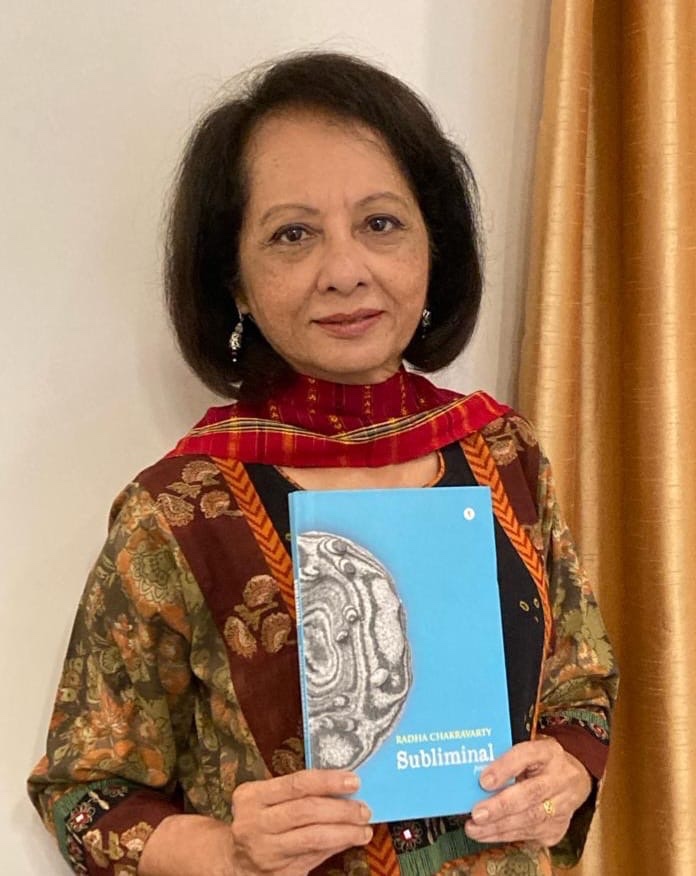
The Subliminal World of Radha Chakravarty’s Poetry

In conversation with Radha Chakravarty about her debut poetry collection, Subliminal, published by Hawakal Publishers

Radha Chakravarty

Words cross porous walls
In the house of translation—
Leaf cells breathe new air.

We all know of her as a translator par excellence. But did you know that Radha Chakravarty has another aspect to her creative self? She writes poetry. Chakravarty’s poetry delves into the minute, the small objects of life and integrates them into a larger whole for she writes introspectively. She writes of the kantha — a coverlet made for a baby out of soft old sarees, of her grandmother’s saree, a box to store betel leaves… Her poetry translates the culture with which she grew up to weave in the smaller things into the larger framework of life:

Fleet fingers, fashioning
silent fables, designed to swaddle
innocent infant dreams, shielding
silk-soft folds of newborn skin
from reality’s needle-pricks,
abrasive touch of life in the raw.

--'Designs in Kantha’

She has poignant poems about what she observes her in daily life:

At the traffic light she appears 
holding jasmine garlands
selling at your car window for the price
of bare survival, the promise
of a love she never had, her eyes
emptied of the fragrance
of a spring that, for her, never came.

--‘Flower Seller’

Some of her strongest poems focus on women from Indian mythology. She invokes the persona of Sita and Ahalya — and even the ancient legendary Bengali woman astrologer and poet, Khona. It is a collection which while exploring the poet’s own inner being, the subliminal mind, takes us into a traditional Bengali household to create a feeling of Bengaliness in English. At no point should one assume this Bengaliness is provincial — it is the same flavour that explores Bosphorus and Mount Everest from a universal perspective and comments independently on the riots that reft Delhi in 2020… where she concludes on the aftermath— “after love left us    and hate filled the air.”

The poems talk to each other to create a loose structure that gives a glimpse into the mind of the poetic persona — all the thoughts that populate the unseen crevices of her being.

In Subliminal, her debut poetry book, Radha Chakravarty has brought to us glimpses of her times and travels from her own perspective where the deep set tones of heritage weave a nostalgic beam of poetic cadences. Chakravarty’s poems also appear in numerous journals and anthologies. She has published over 20 books, including translations of major Bengali writers such as Rabindranath Tagore, Bankim Chandra Chatterjee, Mahasweta Devi and Kazi Nazrul Islam, anthologies of South Asian writing, and several critical monographs. She has co-edited The Essential Tagore (Harvard and Visva-Bharati), named ‘Book of the Year’ 2011 by Martha Nussbaum.

In this conversation, Radha Chakravarty delves deeper into her poetry and her debut poetry book, Subliminal.

Your titular poem ‘Subliminal’ is around advertisements on TV. Tell us why you opted to name your collection after this poem.

Most of the poems in Subliminal are independent compositions, not planned for a pre-conceived anthology. But when I drew them together for this book, the title of the poem about TV advertisements appeared just right for the whole collection, because my poetry actually delves beneath surfaces to tease out the hidden stories and submerged realities that drive our lives. And very often, those concealed truths are startlingly different from outward appearances. I think much of my poetry derives its energy from the tensions between our illusory outer lives and the realities that lurk within. In ‘Memories of Loss’, for example, I speak of beautiful things that conceal painful stories:

In a seashell held to the ear
the murmur of a distant ocean

In the veins of a fallen leaf
the hint of a lost green spring

In the hiss of logs in the fire,
the sighing of wind in vanished trees

In the butterfly’s bold, bright wings,
The trace of silken cocoon dreams

So, when and why did you start writing poetry?

I can’t remember when I started. I think I was always scribbling lines and fragments of verse, without taking them seriously. Poetry for me was the mode for saying the unsayable, expressing what one was not officially expected to put down in words. In a way, I was talking to myself, or to an invisible audience. Years later, going public with my poems demanded an act of courage. The confidence to actually publish my poems came at the urging of friends who were poets. Somehow, they assumed, or seemed to know from reading my published work in other forms, that I wrote poetry too.

Did being a translator of great writers have an impact on your poetry? How?

Yes, definitely. In particular, translating Tagore’s Shesher Kabita (as Farewell Song), his verses for children, the lush, lyrical prose of Bankimchandra Chatterjee (Kapalkundala) and the stylistic experiments of contemporary Bengali writers from India and Bangladesh (in my books Crossings: Stories from India and Bangladesh, Writing Feminism: South Asian Voices, Writing Freedom: South Asian Voices and Vermillion Clouds) sensitised me to the way poetic language works, and how the idiom, rhythm and resonances change when you translate from one language to another. Translating poetry has its challenges, but it also refined my own work as a poet. Let me share a few lines of poetry from Farewell Song, my translation of Tagore’s novel Shesher Kabita:

Sometime, when you are at ease, 
When from the shores of the past,
The night-wind sighs, in the spring breeze,
The sky steeped in tears of fallen bakul flowers,
Seek me then, in the corners of your heart,
For traces left behind. In the twilight of forgetting,
Perhaps a glimmer of light will be seen,
The nameless image of a dream.
And yet it is no dream,
For my love, to me, is the truest thing …

What writers, artists or musicians have impacted your poetry?

For me, writing is closely associated with the love for reading. Intimacy with beloved texts, and interactions with poets from diverse cultures during my extensive travels, has proved inspirational.

Poetry is also about the art of listening. As a child I loved the sound, rhythm and vivacity of Bengali children’s rhymes in the voice of my great-grandmother Renuka Chakrabarti. She has always been a figure of inspiration for me, a literary foremother who dared to aspire to the world of words at a time when women of her circle were not allowed to read and write. A child bride married into a family of erudite men, and consumed by curiosity about the forbidden act of reading, she took to hiding under her father-in-law’s four-poster bed and trying to decipher the alphabet from newspapers. One day he caught her in the act. Terrified, she crept out from her hiding place, and confessed to the ‘crime’ of trying to read. Things could have gone badly for her, but her father-in-law was an enlightened individual. He understood her craving to learn, and promised that he would teach her to read and write. Under his tutelage, and through her own passion for learning, she became an erudite woman, equally proficient in English and Bengali, an accomplished but unpublished poet whose legacy I feel I have inherited. Subliminal is dedicated to her.

As a child I absorbed both Bengali and English poetry through my pores because in our home, poetry, and music were all around me. I was inspired by Tagore and Nazrul, but also by modern Bengali poets such as Jibanananda Das, Sankho Ghosh and Shamsur Rahman. In my college days, as a student of English Literature, I loved the poetry of Shakespeare, Donne, Yeats, T. S. Eliot and the Romantics.

Later, I discovered the power of women’s poetry: Emily Dickinson, Sylvia Plath and Adrienne Rich, to name a few. I am fascinated by the figure of Chandrabati, the medieval Bengali woman poet who composed her own powerful version of the Ramayana. Art and music provide a wellspring of inspiration too, for poetry can have strong visual and aural dimensions.

You translate from Bengali into English. How is the process of writing poetry different from the process of translation, especially as some of your poetry is steeped in Bengaliness, almost as if you are translating your experiences for all of us?

Translation involves interpreting and communicating another author’s words for readers in another language. Writing poetry is about communicating my own thoughts, emotions and intuitions in my own words. Translation requires adherence to a pre-existing source text. When writing poetry, there is no prior text to respond to, only the text that emerges from one’s own act of imagination. That brings greater freedom, but also a different kind of challenge. Both literary translation and the composition of poetry are creative processes, though. Mere linguistic proficiency is not enough to bring a literary work or a translated text to life.

English is not our mother tongue. And yet you write in it. Can you explain why?

Having grown up outside Bengal, I have no formal training in Bengali. I was taught advanced Bengali at home by my grandfather and acquired my deep love for the language through my wide exposure to books, music, and performances in Bengali, from a very early age. I was educated in an English medium school. At University too, I studied English Literature. Hence, like many others who have grown up in Indian cities, I am habituated to writing in English. I translate from Bengali, but write and publish in English, the language of my education and professional experience. Bengali belongs more to my personal, more intimate domain, less to my field of public interactions.

Both Bengali and English are integral to my consciousness, and I guess this bilingual sensibility often surfaces in my poetry. In many poems, such as ‘The Casket of Secret Stories,’ ‘The Homecoming’ or ‘In Search of Shantiniketan’, Bengali words come in naturally because of the cultural matrix in which such poems are embedded. ‘The Casket of Secret Stories’ is inspired by vivid childhood memories of my great-grandmother’s  daily ritual of rolling paan, betel leaves stuffed with fragrant spices, and arranging them in the metal box, her paaner bata[1]. When she took her afternoon nap, my cousins and I would steal and eat the forbidden paan from the box, and pretend innocence when she woke up and found all her paan gone. Of course, from our red-stained teeth and lips, she understood very well who the culprits were. But she never let on that she knew. It was only later, after I grew up, that I realised what the paan ritual signified for the housebound women of her time:

In the delicious telling,
bright red juice trickling
from the mouth, staining
tongue and teeth, savouring
the covert knowledge
of what life felt like in dark corners
of the home’s secluded inner quarters,
what the world on the outside looked like
from behind veils, screens,
barred windows and closed courtyards
where women’s days began and ended,
leaving for posterity
this precious closed kaansha* casket,
redolent with the aroma of lost stories

*Bronze

But I don’t agree that all my poetry is steeped in Bengali. In fact, in most of my poems, Bengali expressions don’t feature at all, because the subjects have a much wider range of reference. As a globe trotter, I have written about different places and journeys between places.

Take ‘Still’, which is about Mount Everest seen from Nagarkot in Nepal. Or ‘Continental Drift’, about the Bosphorus ferry that connects Asia with Europe. Such poems reflect a global sensibility. My poems on the Pandemic are not coloured by specific Bengali experiences. They have a universal resonance. I contributed to Pandemic: A Worldwide Community Poem (Muse Pie Press, USA), a collaborative effort to which poets from many different countries contributed their lines. It was a unique composition that connected my personal experience of the Pandemic with the diverse experiences of poets from other parts of the world. The poem was nominated for the Pushcart Prize. I guess my poems explore the tensions between rootedness and a global consciousness.

What are the themes and issues that move you?

I tend to write about things that carry a strong personal charge, but also connect with general human experience. My poems are driven by basic human emotions, memory, desire, associations, relationships, and also by social themes and issues. Specific events, private or public, often trigger poems that widen out to ask bigger questions arising from the immediate situation.

Sometimes, poetry can also become for me what T. S. Eliot calls an “escape from personality,” where one adopts a voice that is not one’s own and assume a different identity. ‘The Wishing Tree’ and the sequence titled ‘Seductions’ work as “mask” poems, using voices other than my own. This offers immense creative potential, similar to creating imaginary characters in works of fiction.

There are a lot of women-centred poems in Subliminal. Consider, for example, ‘Designs in Kantha’, ‘Alien’, ‘River/Woman’, ‘That Girl’, ‘The Severed Tongue’ and ‘Walking Through the Flames’. These poems deal with questions of voice and freedom, the body and desire, and the legacy of our foremothers. Some of them are drawn from myth and legend, highlighting the way women tend to be represented in patriarchal discourses.

The natural world and our endangered planet form another thematic strand. I am fascinated by the hidden layers of the psyche, and the unexpected things we discover when we probe beneath the surface veneer of our exterior selves. My poems are also driven by a longing for greater connectivity across the borders that separate us, distress at the growing hatred and violence in our world, and an awareness of the powerful role that words can play in the way we relate to the universe. ‘Peace Process’, ‘After the Riot’ and ‘Borderlines’ express this angst.

How do you use the craft of poetry to address these themes?

Poetry is the art of compression, of saying a lot in very few words. Central to poetry is the image. A single image can carry a welter of associations and resonances, creating layers of meaning that would require many words of explanation in prose. Poems are not about elaborations and explanations. They compel the reader to participate actively in the process of constructing meaning. Reading poetry can become a creative activity too. Poems are also about sound, rhythm and form. I often write “in form” because the challenge of working within the contours of a poetic genre or form actually stretches one’s creative resources. In Subliminal, I have experimented with some difficult short forms, such as the Fibonacci poem, the Skinny, and the sonnet. Take, for instance, the Skinny poem called ‘Jasmine’:

Remember the scent of jasmine in the breeze?
Awakening
tender
memories
bittersweet,
awakening
buried
dormant
desires,
awakening,
in the breeze, the forgotten promise of first love. Remember?

The last two lines of the poem use the same words as the beginning, but to tell a different story. The form demands great economy.

I pay attention to the sound, and even when writing free verse, I care about the rhythm.  Endings are important. Many of my poems carry a twist in the final lines. I mix languages. Bengali words keep cropping up in my English poems.

Are your poems spontaneous or pre-meditated?

The first attempt is usually spontaneous, but then comes the process of rewriting and polishing, which can be very demanding. Some poems come fully formed and require no revision, but generally, I tend to let the first draft hibernate for some time, before looking at it afresh with a critical eye. Often, the final product is unrecognisable.

Which is your favourite poem in this collection and why? Tell us the story around it.

It is hard to choose just one poem. But let us consider ‘Designs in Kantha’, one of my favourites. Maybe the poem is important to me because of the old, old associations of the embroidered kantha with childhood memories of the affection of all the motherly women who enveloped us with their loving care and tenderness. Then came the gradual realisation, as I grew into a woman, of all the intense emotions, the hidden lives that lay concealed between those seemingly innocent layers of fabric. The kantha is a traditional cultural object, but it can also be considered a fabrication, a product of the creative imagination, a story that hides the real, untold story of women’s lives in those times. Behind the dainty stitches lie the secret tales of these women from a bygone era. My poem tries to bring those buried emotions to life.

As a critic, how would you rate your own work?

I think I must be my own harshest critic. Given my academic training, it is very hard to silence that little voice in your head that is constantly analysing your creative work even as you write. To publish one’s poetry is an act of courage. For once your words enter the public domain, they are out of your hands. The final verdict rests with the readers.

Are you planning to bring out more books of poems/ translations? What can we expect from you next?

More poems, I guess. And more translations. Perhaps some poems in translation. My journey has taken so many unpredictable twists and turns, I can never be quite sure of what lies ahead. That is the fascinating thing about writing.

Thank you for giving us your time.

[1] Container for holding Betel leaves or paan

(The online interview has been conducted through emails and the review written by Mitali Chakravarty.)

Click here to read poems from Subliminal.

PLEASE NOTE: ARTICLES CAN ONLY BE REPRODUCED IN OTHER SITES WITH DUE ACKNOWLEDGEMENT TO BORDERLESS JOURNAL. 

Click here to access the Borderless anthology, Monalisa No Longer Smiles

Click here to access Monalisa No Longer Smiles on Kindle Amazon International

Categories
Excerpt

Out of Sri Lanka

Title: Out of Sri Lanka: Tamil, Sinhala and English Poetry from Sri Lanka and its Diasporas 

Editors: Vidyan Ravinthiran, Seni Seneviratne and Shash Trevett. 

Publisher: Penguin India (Vintage)

AAZHIYAAL
(b. 1968)

Aazhiyaal (the pen name of Mathubashini Ragupathy) was born in Trincomalee in Eastern Sri Lanka. She taught English at the Vavuniya Campus, Jaffna University, before moving to Australia in 1997 where she worked for two decades in the IT sector and commercial management in Canberra. Aazhiyaal has published four collections of poetry in Tamil: Uraththup Pesa (2000), Thuvitham (2006), Karunaavu (2013) and Nedumarangalaai Vazhthal (2020), the last honoured by Canada’s Tamil Literary Garden. Her poems have appeared in anthologies and have been translated into several languages. She in turn has translated Australian Aboriginal poetry into Tamil (Poovulagaik Kattralum Kettalum, 2017). Aazhiyaal writes about women’s place within patriarchy and uses her work to make sense of the war in Sri Lanka: ‘I believe that poetry is the antidote to the present rat-race. It is needed, it is necessary.’


Unheeded Sights

After the rains
the tiled roofs shone
sparklingly clean.
The sky was not yet minded
to become a deeper blue.
The tar roads reminded me
intermittently of rainbows.
From the entire surface of the earth
a fine smoke arose
like the smoke of frankincense, or akil wood,
the earth’s scent stroking the nostrils,
fragrant as a melody.

As the army truck coming towards me
drives away,
a little girl transfers her candy-floss
from one hand to the other
raises her right hand up high
and waves her tiny fingers.

And like the sweet surprise
of an answering air-letter
all the soldiers standing in the truck
wave their hands, exactly like her.

The blood that froze in my veins
for an instant, in amazement,
flows again rapidly, asking aloud,
‘War? In this land?
Who told you?’

[tr. from Tamil by Lakshmi Holmström]


BASHANA ABEYWARDANE
(b. 1972)

Rohitha Bāshana Abeywardane was a member of the founding editorial board and later editor in chief of the Sinhala alternative weekly newspaper Hiru. In 2003, he was one of the activists who organised the Sinhala-Tamil Art Festival. His journalistic commitments brought on threats to his life, and he had to leave Sri Lanka. He continues to publish and coordinates Journalists for Democracy in Sri Lanka, an organisation founded by journalists in exile. Following a stay in the Heinrich Böll House, Langenbroich, Abeywardane took part in the PEN Writers in Exile Program from September 2007 to August 2010. Today, he lives in Germany with his wife.


The Window of the Present

Nightmares, long dead,
peer through the shattered panes
of the window of the present.

The dead of the south, killed on the streets,
with bullet-riddled skulls,
walk once again, through an endless night,

and those of the north drowned in deluges of fire
when rains of steel drench their unforgiving earth,
gaze through the shards of glass empty eyed;

as slaughtering armies, prowl under starless skies,
upholding sovereignty
with blood-soaked hands.

PACKIYANATHAN AHILAN
(b. 1970)

Born in Jaffna in the north of Sri Lanka, Packiyanathan Ahilan has lived through the thirty-year civil war. An academic as well as a poet, he has published three collections of poetry and is Senior Lecturer in Art History at the University of Jaffna. As well as writing about the visual arts, poetry, theatre and heritage, he curates art exhibitions and is co-editor of Reading Sri Lankan Society and Culture (Volumes 1 & 2). Ahilan’s poetry is sparse and staccato, like a heartbeat: he is one of the most influential poets writing in Tamil in Sri Lanka today.


Days in the Bunker III

Good Friday.
The day they nailed you
to the cross.

A scorching wind
blew across the land and the sea.
One or two seagulls
sailed in an immaculate sky.
The wind
howling in the palm trees
spoke of unfathomable terror.
That was the last day of our village.

We fishermen came ashore,
only the waves
returned to the sea.
When the sun fell into the ocean,
we too fell
on our knees
and wept.

And our lament
turned slowly into night.

In the distance
our village was burning
like a body being cremated.

Good Friday.
The day they nailed you
to the cross.

[tr. from Tamil by Sascha Ebeling]


A Poem about Your Village and My Village

1
I do not know.
I do not know if your village
is near the ocean with its wailing waves
or near a forest.
I do not know your roads
made from red earth and
lined with tall jute palms.
I do not know
the birds of your village
that come and sing in springtime.
I do not know
the tiny flowers along the roadsides
that open their eyelids when the rains pour down.
I do not know the stories
you tell during long nights
to the sound of drumbeats
or the ponds in your village
where the moon goes to sleep.

2
Tonight,
when even the wind is full of grief,
you and I know one thing:
Our villages have become
small
or perhaps large
cemeteries.
The sea with its dancing waves
is covered with blood.
All forests with their
trees reaching up to the sky
are filled with scattered flesh
and with the voices of lost souls.
During nights of war
dogs howl, left to themselves,
and all roads and the thousands
of footprints our ancestors left behind
are grown over with grass.
We know all this,
you and I.
We now know about
the flowers that died,
the abandoned lines of poetry,
the moments no one wants to remember.


3
But
do you know
if the burnt grass
still has roots,
or if the abandoned poems
can still be rooted in words?
If, like them, you do not know
whether our ancient flames
are still silently smouldering
deep down in that ocean
covered with blood,
know this today:
They say that
after he had lain in hiding
for a thousand years
one day
the sun rose again.

[tr. from Tamil by Sascha Ebeling]

ABOUT THE BOOK:

Out of Sri Lanka shines light upon a long-neglected national literature by bringing together, for the first time, Sri Lankan and diasporic poetry written in and after Independence.  Featuring over a hundred poets writing in English, or translated from Tamil and Sinhala reshapes our understanding of migrational poetics and the poetics of atrocity. Poets long out of print appear beside exciting new talents; works written in the country converse with poetry from the UK, the US, Canada and Australia. Poems in traditional and in open forms, concrete poems, spoken word poems, and experimental post-lyric hybrids of poetry and prose, appear with an introduction explaining Sri Lanka’s history.

There are poems here about love, art, nature – and others exploring critical events: the Marxist JVP insurrections of the 1970s and 80s, the 2004 tsunami and its aftermath, recent bombings linked with the demonisation of Muslim communities. The civil war between the government and the separatist Tamil Tigers is a haunting and continual presence. A poetry of witness challenges those who would erase, rather than enquire into, the country’s troubled past. This anthology affirms the imperative to remember, whether this relates to folk practices suppressed by colonisers, or more recent events erased from the record by Sinhalese nationalists.

 ABOUT THE EDITORS:

Vidyan Ravinthiran was born in Leeds, to Sri Lankan Tamils. His first book of poems, Grun-tu-molani (Bloodaxe, 2014), was shortlisted for the Forward Prize for Best First Collection, the Seamus Heaney Centre Poetry Prize and the Michael Murphy Memorial Prize. His second, The Million-petalled Flower of Being Here (Bloodaxe, 2019) was shortlisted for the Forward Prize for Best Collection, the T.S. Eliot Prize and Ledbury Munthe Poetry Prize for Second Collections. After posts at Cambridge, Durham and Birmingham, he now teaches at Harvard.

Seni Seneviratne, a writer of English and Sri Lankan heritage published by Peepal Tree Press, with books including Wild Cinnamon and Winter Skin (2007)The Heart of It (2012), and Unknown Soldier (2019), which was a Poetry Book Society Recommendation, a National Poetry Day Choice and highly commended in the Forward Poetry Prizes 2020.

She is currently working on an LGBTQ project with Sheffield Museums entitled Queering the Archive and her latest collection, The Go-Away Bird, was released in October 2023. She lives in Derbyshire.

Shash Trevett is a Tamil from Sri Lanka who came to the UK to escape the civil war. She is a poet and a translator of Tamil poetry into English. Her pamphlet From a Borrowed Land was published in 2021 by Smith|Doorstop.

Shash has been on judging panels for the PEN Translates awards and the London Book Fair, and was a Visible Communities Translator in Residence at the National Centre for Writing. Shash is a Ledbury Critic, reviewing for PN Review and the Poetry Book Society and is a Board Member of Modern Poetry in Translation. She lives in York.

Categories
Poetry

Poetry by Radha Chakravarty

DESIGNS IN KANTHA 

Sewn into soft, worn layers,
forgotten fabric of grandmother tales –
patterns of the past,
secret memories, hidden designs,
intriguing patterns in silk strands
dyed in delicate dreamy shades—
embroidered story-lines
in exquisite, dainty kantha-stitch.

Years of laughter, heartache, bliss,
tears and yearning, rage, despair—
worked by artful needle into
guileless fictions of innocence,
pure and tender baby love.

Fleet fingers, fashioning
silent fables, designed to swaddle
innocent infant dreams, shielding
silk-soft folds of newborn skin
from reality’s needle-pricks,
abrasive touch of life in the raw.


(Previously published in Journal of the Poetry Society of India. Vol. 31 & 32, 2020-2021)


UPROOTED

Fallen tree on concrete sidewalk –
thirsty roots clawing the air, screaming silently
for the succour of your own familiar soil,
where all these years I saw you live and grow,
blossom and bear fruit, and spread your shade
while, in your green branches, joyous songbirds nested—

Fallen tree, forgotten forbear, uprooted
to make way for the merciless coldness of concrete—
your plight robs me of my breath.
I remember now my human ancestors,
uprooted, like you, from native soil,
by the concrete-hard harshness
of a land divided, under foreign rule,
displaced persons forced to find
new homes, on alien, unfamiliar soil—
in a different world, indifferent to the fate
of trees or men who stand in the way
of progress, the high road of history—
dispensable, left to live or die,
in a world where the climate has changed.

Fallen tree, your exposed roots lay bare
the callousness of our world, which destroys
trees, fish, birds, people, and our own ancestral roots,
to build in steel, concrete and plastic
its developing story of growth, even as it blindly
digs its own grave.


[From Subliminal: Poems, Hawakal, 2023]


Radha Chakravarty
 is a poet, critic and translator based in Delhi, India. Her new book of poetry, Subliminal: Poems, has recently been published by Hawakal. Her poems also appear in numerous journals and anthologies, including Journal of the Poetry Society of IndiaContemporary Major Indian Women Poets, Narrow Road JournalSoul SpacesCulture Cult, The Poet (Lockdown 2020)Krishna in Indian Thought, Literature and Music and Indian Poetry through the Passage of Time. She has published over 20 books, including translations of major Bengali writers such as Rabindranath Tagore, Bankimchandra Chatterjee and Kazi Nazrul Islam, anthologies of South Asian writing, and several critical monographs. She has co-edited The Essential Tagore (Harvard and Visva-Bharati), named Book of the Year 2011 by Martha Nussbaum. She contributed to Pandemic: A Worldwide Community Poem (Muse Pie Press, USA), nominated for the Pushcart Prize 2020. She was Professor of Comparative Literature and Translation Studies at Ambedkar University Delhi.

.

PLEASE NOTE: ARTICLES CAN ONLY BE REPRODUCED IN OTHER SITES WITH DUE ACKNOWLEDGEMENT TO BORDERLESS JOURNAL

Click here to access the Borderless anthology, Monalisa No Longer Smiles

Click here to access Monalisa No Longer Smiles on Kindle Amazon International
Categories
Review

Fixing a Fractured World

Book Review by Bhaskar Parichha

Title: Permacrisis: A Plan to Fix a Fractured World 

Authors: Gordon Brown, Mohamed El-Erian, Michael Spence, Reid Lidow 

Publisher: Simon & Schuster UK

A nation or region’s success depends on three things: growth, economic management, and governance. The three dimensions are interconnected and affect each other. Growing an economy is a fundamental part of economic development. Factors like productivity, technological innovation, and sector expansion are all part of it. Infrastructure, education, and research and development are key to sustainable growth. Strong growth can create jobs, raise incomes, and improve living standards.

Governments and institutions take policies and decisions to maintain the economy’s stability and effectiveness. Setting fiscal policies, regulating financial markets, and overseeing trade and investment are tasks involved. The goal of effective economic management is to promote stability, increase competitiveness, and grow the economy. For macroeconomic stability and progress, it takes inflation, budget deficits, and exchange rates into account.

Countries and regions are governed by rules and structures. It includes political institutions, legal systems, and decision-making processes. By promoting transparency, accountability, and participation, sound governance ensures power is exercised fairly and justly. Decisions are made keeping in view society’s most beneficial interests, and citizens’ rights are protected. Maintaining stability, attracting investment, and promoting economic development requires strong governance.

Growth, economic management, and governance reinforce each other. Sustainable economic growth requires effective economic management, ensuring resources are allocated efficiently and policies support it. Effective governance promotes stability and attracts foreign investment through efficient economic management. A well-functioning governance system ensures that economic growth benefits are distributed equitably. After the recent pandemic, economists are worried about a prolonged crisis. Could we be experiencing a permacrisis? It is likely that the current state of the world will lead to anxiety, and that is what this book tells us in splendid detail.

Permacrisis: A Plan to Fix a Fractured World by Gordon Brown, Reid Low, Mohamed A. El-Erian and Michael Spence looks at the economic downturn the world is struggling through right now.

After holding the office of Chancellor of the Exchequer for over a decade, Gordon Brown became Prime Minister. During the 2009 London G20 summit, he mobilised global leaders to walk the world back from the brink of a second Great Depression. He is currently serving as the UN Special Envoy for Global Education, spearheading efforts to ensure quality, inclusive education for all children. He is also a Global Health Finance Ambassador for the World Health Organization. Brown holds a PhD in history from Edinburgh University.

Mohamed A. El-Erian is President of Queens’ College Cambridge. As Chief Economic Advisor at Allianz, he formerly served as Co-Chief Investment Officer and Chief Executive of PIMCO. Besides columnising for Bloomberg Opinion, he’s also a Financial Times contributor. He is a Senior Global Fellow at the Lauder Institute and Rene M. Kern Practice Professor at Wharton School. Before joining Harvard Management Company, he was a managing director at Solomon Smith Barney/Citigroup. His books When Markets Collide and The Only Game in Town were New York Times bestsellers.


Michael Spence is Emeritus Professor of Management at Stanford University. He is a Senior Fellow at Stanford’s Hoover Institution, and a Council on Foreign Relations Distinguished Visiting Fellow. He is an adjunct professor at Bocconi University and an honorary fellow at Magdalen College. He authored The Future of Economic Growth in a Multispeed World. He was Dean of the Stanford Business School from 1990 to 1999, and Dean of the Harvard Faculty of Arts and Sciences from 1984 to 1990. His awards include the John Kenneth Galbraith Prize for teaching excellence and the John Bates Clark Medal. He won the Nobel Prize in Economic Sciences for his work in information economics in 2001.

Reid Lidow served as Los Angeles Mayor’s Executive Officer. Reid worked on Gordon Brown’s campaigns before. During his undergraduate studies at USC, Reid double majored in International Relations and Political Science. He received a Gates Cambridge Scholarship and an MPhil in Development Studies from Queens’ College, Cambridge. 

As some of the most highly respected and experienced thinkers of our time, these friends found that their pandemic zooms increasingly focused on a cascade of crises: sputtering growth, surging inflation, poor policy responses, an escalating climate emergency, increasing inequality, a rise in nationalism, and a decline in international cooperation. They shared their fears and frustrations with each other. The more they talked, the more they realised that, despite past mistakes that set the world on this bumpy path, there is a better path to a brighter future. Their varied perspectives contributed to their pursuit of a common goal: attainable solutions to the world’s fractures. Those thoughts are reflected in this book.

According to the authors, our current permacrisis is a result of broken approaches to growth, economic management, and governance. Even though these approaches are flawed, they can be repaired. A provocative, inspiring plan to change the world is the need of the hour. The book illustrates how we can prevent crises and improve the future for the benefit of the many and the few. According to the book, problems that remain unresolved for a prolonged period of time will only worsen; this is what happens in a permacrisis, which is why we must act quickly.

This instructive book provides a sensible plan of reform that can be used to create a world that is fairer and more equitable.

.

Bhaskar Parichha is a journalist and author of UnbiasedNo Strings Attached: Writings on Odisha and Biju Patnaik – A Political Biography. He lives in Bhubaneswar and writes bilingually. Besides writing for newspapers, he also reviews books on various media platforms.

.

PLEASE NOTE: ARTICLES CAN ONLY BE REPRODUCED IN OTHER SITES WITH DUE ACKNOWLEDGEMENT TO BORDERLESS JOURNAL

Click here to access the Borderless anthology, Monalisa No Longer Smiles

Click here to access Monalisa No Longer Smiles on Kindle Amazon International

Categories
Musings

Migrating to Myself from Kolkata to Singapore

By Asad Latif

Sir Stamford Raffles (1781-1826). Courtesy: Creative Commons

May I be so bold as to claim that I travelled in the footsteps of Sir Stamford Raffles? That agent of the East Indian Company’s visit to Calcutta (as it was known then, and for much later, till it resumed the phonetic spelling of its original name), led him to set up Singapore as an English trading settlement in 1819. “Footsteps” would be the wrong metaphor, of course. “Seasteps” would have been accurate, since Raffles travelled to Calcutta by sea and arrived water-borne to Singapura (as it was known then). In my case, however, I arrived in Singapore sky-borne, in an aircraft that conveyed me from what was then home to what would become home. Footsteps, seasteps or airsteps, I arrived in Singapore. The year was 1984. I was 27.

Today, at 65, I remember my passage from back home to this home as if it occurred yesterday. I had worked in Hong Kong briefly in 1984 and had been exposed to life in a successful British colony that was in the throes of its return to Chinese rule. Singapore was different. It had merged with the Malaysian Federation in 1963, had separated from it in 1965, and had gone on to carve out an extremely successful space for itself in the international sphere.

Prime Minister Lee Kuan Yew was a household word in Singapore. Not everyone loved him, but no one could deny his singular agency in having created a magnificent city-state that could sustain its independence in spite of its lack of natural resources. To arrive in Singapore was to embrace the possibilities of time.

Calcutta, too, was a historical city par excellence, but its rundown buildings and potholed streets, to say nothing of its potbellied children living on homeless streets, belied the promise of the future. To arrive in Singapore, it appeared, was to have exchanged failure for success.

That was an illusion, of course. All expatriates suffer from a global disease: They latch on to what they love in their countries of arrival by trying to erase what had loved them in their countries of departure. Take the potholed streets of Calcutta, for example. They had conveyed me to College Street on that glad day in 1974 when I joined the English Department of Presidency College. Without that first footfall in the corridors of the greats, I might never have come to Singapore, never got my Chevening Scholarship to Cambridge, my father’s university, and never won the Fulbright to Harvard. The potholes of Calcutta are not as numerous as the culturally blind allege them to be. Nevertheless, they led me on the way to be myself, wherever on earth I would ultimately be.

The way I see it, no matter how far or close wanderings might lead, one migrates ultimately to oneself. Hence, when I left my Calcutta for what would become my Singapore, I did no more than search for a version of my selfhood that would extend my material and imaginative boundaries. In the course of my journey, I discovered that the only borders lie within, borders between being and becoming. In the process of becoming by winnowing the unwanted aspects of being, one returns to a renewed if only autumnal sense of being. Time passes. One passes with it, letting go of the distant past as much as one does the receding immediate past. To live is to gather the passage of time within oneself, hoping that all borders will merge into a lasting apprehension of oneself in the expanding fullness of a single world.  

Calcutta and Singapore are two sides of me. These two great imperial cities have outlived their provenance. Calcutta was once the capital city of colonial India: Today it remains the nation’s cultural capital but political power resides in Delhi (naturally) and there are at least two economic capitals, Mumbai and Chennai. This is why I, along with many of my hapless fellow-Bengalis, suffer from an incurable cultural fetish for the past. That was when the Almighty spoke Bengali – He appears to be switching increasingly to Hindi – and was busy creating top-class poets and formidable social reformers in Bengal. The divine supply of poets and composers has not ebbed but the demand-side having moved to Mumbai, many of the best composers have shifted there and to make a name for themselves. Never mind. Their names remain Bengali, and their fame spreads the vintage mystique of Calcutta like a lingering perfume in India and beyond. I feel happy for the Calcutta part of me.

Singapore, a great trading post, is a now a city-state. Statehood has allowed the nascent nationalism of the colonial era to flourish and grow into a genuine sense of political self. Sovereign Singapore was not expected to survive, but it has done so with a definitiveness that makes the prognoses of the 1960s laughable today.  The national self-confidence of Singapore gives me confidence in my decision to take up Singapore citizenship in 1999. It had not been an easy decision, but I took it when I realised that I would be giving up my Indian citizenship but not my Indian-ness. My Singapore Identity Card records my race as Indian. I could keep the Calcutta part of me intact while adding to it a new Singaporean me.

So, yes, I am grateful that Raffles travelled to Calcutta to set up Singapore. Obviously, he did not do so with my fortunes in mind, but the umbilical connection that he created between the two great port cities has made it easier for me to migrate from India to Singapore. Ultimately, I have done nothing more than migrate to me.  

    .


 Asad Latif is a Singapore-based journalist. He can be contacted at badiarghat@borderlesssg1

PLEASE NOTE: ARTICLES CAN ONLY BE REPRODUCED IN OTHER SITES WITH DUE ACKNOWLEDGEMENT TO BORDERLESS JOURNAL. 

Click here to access the Borderless anthology, Monalisa No Longer Smiles

Click here to access Monalisa No Longer Smiles on Kindle Amazon International

Categories
Conversation

Spanning Continental Narratives

He has translated Kalidasa’s Meghaduta and Ritusamhara from Sanskrit to English and then imbibed them to create Monsoon: A Poem of Love & Longing in a similar vein. Meet the poet, Abhay K, who also juggles multiple hats of diplomat, editor and translator. He tells us how he tries to raise awareness and create bonds through poetry. He is the author of a dozen poetry books and the editor of The Book of Bihari Literature (Harper Collins India). He has received the SAARC Literature Award for 2013. His ‘Earth Anthem’ has been translated into more than 150 languages and performed by Kavita Krishnamurthy, a well-known Indian voice.

Monsoon: A Poem of Love & Longing has 150 quartrains and is split into chapters. A passionate poem that yearns and sends love through the salubrious journey of the monsoon from its point of origin, Madagascar, to Kashmir, the verses caress various fauna, among them some endangered like indri indri, sifaka and more. Spanning the oceans, lands, nature and a large part of India, it reaches his beloved with his message from Madagascar.

Is it eco-poetry? Academia might be moving towards that decision. Monsoon: A Poem of Love & Longing has been chosen by a Harvard University’s assistant professor, Sarah Dimick, for a book project on Climate and Literature. In this exclusive, Abhay K describes not only how his passion for beauty, turned him, a diplomat, into an award-winning poet and translator but his subsequent journey.

Abhay K

What made you opt to translate Kalidasa’s poetry?

It was during the Covid-19 pandemic that I read a poem by the British poet laureate, Simon Armitage, titled ‘Lockdown’ which made a reference to Meghaduta. At that time, I was posted as India’s 21st Ambassador to Madagascar and Comoros and I thought of writing a poem on the lines of Kalidasa’s Meghaduta. This is when I decided to closely read Meghaduta and in the process I got inspired to translate it. However, later, I did write a book length poem titled Monsoon which was published by Sahitya Akademi in 2021. 

Did you translate both, Meghaduta and Ritusamhara, one after another? These are both books that have been translated before. Did you draw from those? Or is it your own original transcreation of the texts?

Yes, first I translated Meghaduta and after its publication, I decided to translate Ritusamhara. There are over 100 translations of Meghaduta available, I have read some of them, but none had been translated by a poet. Therefore, I decided to translate Meghaduta myself to give it a poetic rendition in contemporary English. I had studied Sanskrit in my high school, and it came handy while translating both Meghaduta and Ritusamhara

Your book, Monsoon, is based on Meghduta. Can you tell us a bit about it? Is it part autobiographical?

Monsoon is inspired from both Meghaduta and Ritusamhara. It begins near Madagascar where monsoon originates and travels along its path to Reunion, Mauritius, Seychelles, Comoros, Maldives, Sri Lanka, Andaman, and the Indian subcontinent. It carries a message of love and longing from Madagascar to Kashmir valley. It is purely work of imagination. 

Tell us a bit about Kalidasa’s Ritusamhara, which is supposed to be especially relevant in the current context of climate change.

I have not come across any other poet who describes the lives of diverse plants and animals in such detail and with such empathy. In Ritusamhara, Kalidasa delights us with these vivid descriptions of plants, insects and flowers in the rainy season.

Like jade fragments, the green grass rises
spreading its blades to catch raindrops,
red Indragopaka insects perch on fresh
leaf-buds bursting forth from the Kandali plants
the earth smiles like an elegant lady
draped in nature’s colourful jewels. 2-5

Aroused by the sunrays at sunrise,
Pankaja opens up like glowing face
of a young woman, while the moon
turns pale, smile vanishes from Kumuda
like that of the young women,
after their lovers are gone far away.  3-23

The fields covered with ripened paddy
as far as eyes can see, their boundaries
full of herd of does, midlands filled with
sweet cries of graceful demoiselle cranes.
Ah! What passion they arouse in the heart!   4-8

Kalidasa’s genius lies in bringing together ecological and sensual to create sensual eco-poetry of everlasting relevance. Ritusamhara highlights this fundamental connection between seasons and sensuality. As we face the triple threat of climate change, biodiversity loss and environmental pollution owing to our ever-growing greed and culture of consumerism, we face the challenge of losing what makes us human. It is in these unprecedented times, reading and re-reading Kalidasa’s Ritusamhara becomes essential.

True. Closer to our times Tagore also has written of the trends of which you speak. But there is a controversy about the authorship of Ritusamhara— it is supposed to have been written earlier. What is your opinion?

It is an early work of Kalidasa. There are many words from Ritusamhara that are used in Meghaduta

What were the challenges you faced translating Kalidasa’s poetry, especially in mapping the gaps created by the time span that has passed and their culture and ethos to modern times.

I think Kalidasa’s works bear strong relevance to the modern times. He can easily be our contemporary eco-poet. In fact, Ritusamhara is a fine work of eco-poetry because of the sensitivity shown by Kalidasa in handling the plight of animals in scorching summer, treating rivers, mountains and clouds as personas among other things. 

You have also translated Brazilian poets? Are these contemporary voices? Did these come before Kalidasa’s translation?

I translated poems of 60 contemporary Brazilian poets and compiled them in a poetry collection named New Brazilian Poems which was published in 2018 by Ibis Libris, Rio de Janeiro, Brazil. My translation of Meghaduta and Ritusamhara was published in 2022. 

Your range of translations is wide. How many languages have you translated from? What has been the impact of translating both Kalidasa and other poets from various languages on your poetry?

I have mainly translated from Magahi, Hindi, Sanskrit, Russian, Portuguese, and Nepali. Translating the work of Kalidasa and other poets has enriched my own poetry writing. Translating poets whose works I love and admire, offers me the opportunity to read their work very closely and provided rich insights which in turn inspires my own poetic works. 

How as a diplomat did you get into poetry? Or has this been a passion?

I started writing poetry in Moscow where I started my career as a diplomat. It was the beauty and grandeur of Moscow that turned me into a poet. 

You are a polyglot. What made you pick up this many languages? Do you read poetry in all of them? You have already translated from Portuguese and Sanskrit. Do you want to translate from all these languages? What makes you pick a book for translation?

As a diplomat, I get posted to a new continent every three years and I have to pick up the local language to communicate more effectively. I try to translate from as many languages as possible as it helps in building literary bridges across continents. I translate books I truly love and admire. 

Do you have any more translations or your own work in the offing? What are your future plans as a poet?

I have translated the first Magahi novel Foolbahadur and Magahi short stories, which is likely to come out in the near future.

My new love poem of 100 rhyming couplets titled Celestial, which takes one on a roller coaster ride to all the 88 constellations visible from the Earth, will be published by Mapin India in 2023. My new poetry collection, In Light of Africa, a book of light and learning and unlearning the myths and stereotypes about Africa. The narrative spans the continent of humanity’s birth through time and space—from the ancient Egyptian pharaohs to modern bustling cities…introducing you to Africa’s rich history, culture, cuisine, philosophy, monuments, personalities—and its remarkable contribution in shaping our modern world. This collection is likely to be published this year or in 2024. 

Thank you for giving us your time.

(The interview has been conducted online by emails by Mitali Chakravarty)

Click here to read an excerpt from Monsoon

PLEASE NOTE: ARTICLES CAN ONLY BE REPRODUCED IN OTHER SITES WITH DUE ACKNOWLEDGEMENT TO BORDERLESS JOURNAL

Click here to access the Borderless anthology, Monalisa No Longer Smiles

Categories
Interview

Bridge over Troubled Waters

In Conversation with Sanjay Kumar, the founder of Pandies, a socially responsible theatre group

Some members of Pandies, with Sanjay Kumar sitting in the right hand corner.

Festivals often involve pageantry where people connect, reach out and have fun through performances. These can range from high class shows in halls to entertaining performances in street corners, individual buskers or theatricals at home. Brecht (1898-1956), often taught in universities,  popularised socially responsible epic theatre.  Epic theatre connects the players, imbued with welfarism and a sense of social responsibility, to educate the audience, subsequently encouraged to question and move towards altering their present reality to a more egalitarian one. Add to this students who look for more than just academic growth in universities and a young dynamic professor in the 1980s, and the end result is a volunteered ‘institution’ that has blossomed over three decades into a strangely named group – Pandies.

Sanjay Kumar

Founded in 1987 by Sanjay Kumar, an academic from Delhi University with residencies in Italy and the United States for the welfare of exploited children, the group evolved into a major voice trying to reach out to all strata of society. Kumar evolved a form of theatre to channelise the energy of students towards creating an awareness for the need to grow by helping the less fortunate. He tells us by the way of introduction: “We have been working with twenty slums or bastis in Delhi, have had interactions with a hundred schools and about twenty-five colleges. A minimum of hundred presentations are held each year. The major issue till 2000 was gender-sensitisation. Each year, pandies’ latches on to a different theme. After performing in the proscenium theatre, it takes adaptations of the same to diverse places. The group also works on issues related to environment. The adaptable, flexible, bilingual (at times multi-lingual) scripts are totally ours. The group is constantly exploring, searching for better modes to get its meaning across. Songs, dances, choreographed sequences are all a part of its repertoire. One of the most successful modes is an extremely interactive discussion at the end where the activist even narrates relevant anecdotes to get its audience to talk. The group has evolved a mega network in and around Delhi consisting of women, HIV activists, environmentalists, school and college teachers and students, progressive women from various communities including slums, victims of rape, attempted murder.” His work has reached across to multiple countries, universities (including Harvard) and has found credence among number of hearts across the East and the West.

The most impressive performance I saw was online with young refugees from Afghanistan and migrant workers in slums. They have worked with Non-Governmental Organisations (NGOs)  that work with children, sex workers and women, thus educating and learning from them and exposing them to our, more secure world where the maximum need a young student has, is to score well to get into the right university and for their family and friends to travel, to have freedom of speech and better lives. Perhaps, the best way to comprehend this kind of drama is to let Sanjay Kumar take over and introduce the work they are doing, bridging gaps at multiple levels.

Tell us about the inception of pandies’. How old is the group?

The incipience of the group goes back to college really to the year 1987 when we did the first play from Hansraj (a college under Delhi University), though we registered later in 1993, as we broke away. As I got free from MPhil, I decided to start theatre in the college in a way that steers it clear of the festival circuit of doing 25-30 minutes plays and winning small cash awards at various college fests. The College Drama Society was revived in 1987 and under that banner we did six plays, one each a year on the trot: Lorca’s Blood Wedding (1933), Ngugi’s The Trial of Dedan Kimathi (1974), Strindberg’s The Dream Play (1901), Vicente Lenero’s The Bricklayers (1976), Genet’s The Balcony (1957)and Brecht’s The Caucasian Chalk Circle (1944).  Each was a full-length play of at least 100 minutes.

We were doing plays at a semiprofessional level, all having a run of five to seven days in Delhi’s leading theatre halls. The bookings were being done in the name of the college but from the beginning no money was put forth by the college. The funding was collected by the students from small donations. The group was getting too big for the college. There was a constant targeting from many in the administration and the faculty, accusations of the openly sexual content of the plays, of the insubordinate behaviour of the students, of classes being bunked. And then as the group evolved, there were many students who had graduated but still wanted to be there and as the reputation grew with the choice of plays and quality of production (contemporary reviews read us at par with professional groups), many students from other colleges wanted to join us. Things came to a head with the college administration in 1993. We had already booked at the auditorium in the name of the college and were rehearsing for Macbeth. We decided to launch our own group (the work normally took about six months) and in two months we registered and collected money enough to go under the new banner — Pandies’ theatre.   The relationship with structures of the university remains tricky, there are those among the younger teachers and of course students who love us but the old and orthodox are still a bit wary.

Was this theatre started for the needs of the students/ teachers or to create an interest in academic curriculum?

Yes, at that time the syllabus had a totally first world bias (the bias is still there but less), to get in plays that speak to us. They may be first world, but they critique our oppressor — Brecht,  Rame, Genet.

 What was the gel that bound the group together ? Was it used to satisfy the needs of  the students, teachers or society. Can you elaborate? 

The first thing was the love of theatre. It’s like a bug, and the heady thing about a collectivism trying its own thing, charting paths not done in college before. And then the activism took over and went way beyond the love. We started pandies’ with a view that our world is not the way we want it. We wanted to make it better for more people. Even the plays from 1987 to 1993 were exploring non-canonical theatre. 

The first point of attack was the huge gender bias. We felt we were living in a misogynist, rape friendly society. Series of proscenium plays attacked that. We tied up with the feminist NGO, Shakti Shalini. Our ties go back to 1996, with LGBT movements and women’s movements. Veils had more than hundred shows, theatres, colleges, schools and markets and slums and villages. We were asking for  change in rape laws in the country. She’s MAD took stories from women’s organisations about laws of mental illness being consistently used against women to label them mad to take away their property rights, custody of children and provide a veneer over patriarchal violence. Again a play that sought legislative reform was Danger Zones. It explores what happens when you are lesbian and do not have a big wallet or parents to save you — forced marriages, sale into prostitution. 

Equally important, in fact more so in later years has been the attack on religious bigotry. Gujarat was a breaking point. We had years of series workshops with impoverished youth in slums exposing the rhetoric of  bigotry. We start with the Sikh pogrom of ’85 and go on to dissent against what our society has evolved to under a right wing dispensation, the religious supremacism of our world.

When you work with young boys, drug peddlers and sex workers, aged eight to fourteen, you return home a wreck and in need of therapy. But if you keep that fire alive inside you, you know how to take on the oppressors.

It is about a naked politics. We seek to rouse people from slumber, awaken a critical understanding of the world we live, of the forces that govern us — patriarchy, capitalism and, the tying factor of all oppression — religion.

The need was and remains the need of our times and our ethos.

How did the name evolve? And your group evolve?

It goes back to 1993 and is fully in keeping the with ‘play’ aspect of the group which likes to play with politics with its audience. It emerged from collective decisioning that has been the hallmark of pandies’ functioning. The name is a take ‘off’, ‘away’ from Mangal Pandey and the revolt of 1857. Actually, from the inability of the British to get Indian pronunciations correct. Pandey became Pandy, a hated expletive for the British commanders and continued in their letters even 50 years after the suppression of the revolt. ‘Pandy’ was one who was a part of the British structure, in their employ (Jhansi’s soldiers were not Pandies for instance), earned from them and rose against them. The hatred conveyed by the word was many times higher than in the simple expletives of  traitor or the Hindustani ‘gaddaar.’ While it has a historical solidity, it also has a playful aspect just beneath, for many of the young in the group it was also deliciously close to panties and pondies (slang for pornographic literature), the sexual aspects for which the group was falsely castigated while in college, and what we loved to grin and laugh at.

We broke away in 1993, four teachers and about thirty students. Starting as a proscenium English group with an activist leaning in 1993, by 1996 we had turned totally activist. Starting with about thirty-five members (still the core for each project), the group soon acquired more than hundred members (today it has more than that, people go away and many return, even after a decade or fifteen years, to do that “better thing”).  A strong presence of young, motivated women gave the group a feminist essence. And seeking overtly to make our ethos better, the group stressed a Left Feminist Atheist core as the law of its work from the very beginning. Activism, simply the overt statement that we are not okay with our world the way it is and seek a systemic change and are willing to do our bit as theatre enthusiasts for it.

Our three primary areas of work are : a. Proscenium: The plays are always activist and many of our own scripts and many adapted, some activist plays (Brecht, Rame and other activist scripts including agit prop) in the original; b. Theatre outside proscenium: What is usually called street theatre, nukkad natak, guerrilla theatre, the group has done actually thousands of performances and c. Workshop theatre: Where activist facilitators create plays with communities, staying with them or visiting them regularly — razor’s edge work has been done with young boy sex workers picked from platforms and housed in shelters, in the cannibalised village of Nithari, in women’s shelters, with refugees and in Kashmir.  The process consists of getting ‘stories’ from the margins and creating theatre from them, performed usually by the community members, and at times along with Pandies.

Were you influenced by any theatre/art forms/writers or any external events to evolve your own form?

From the international activist tradition Brecht has been the most solid influence, his mode of showing what is obvious but we refuse to see it. Boal, Franca Rame, Dario Fo. The entire traditions of left swinging realism and alienation. In our own traditions the influence is more subtle, Indian People’s Theatre Association (IPTA) itself and Janam (a  more contemporary people’s theatre group). We also borrow from the political and popular traditions of the subcontinent — Dastaan Goi, Jatra, Tamasha and Nautanki to name a few.

What impacts us most is the politics. Theatre is about critique, it’s about my ability to say ‘no’ and my desire to ask ‘why.’ We look back through history, history that tells us nothing can be permanent, that is record of those who stood and fought tyranny and authoritarianism. Gujarat 2002 was difficult and so was Babri Masjid but so was the emergency of 70s and never forget the anti-Sikh pogrom of the mid 80s at the heart of the country where I live.

Yes, and what is happening today, here and all over the globe cries for activist intervention.

What were the kind of content you started with? I heard you even adopted out of Aruna Chakravarti’s novel (Alo’s World?) to make a play. So, what was the content of your plays? Were you scripting your own lines?

We started with adaptations of plays with explicitly activist content which could be made more activist and imposed on our reality. Ibsen’s Ghosts, inspirations from Simon de Beauvoir, Doris Lessing. And post-1996, we were creating more and more from our own scripts, often containing multiple plays tied with thematic thrusts. And again, in times of repression one reverts to adaptations, of those who stood up to the challenge of their times, specially at the doors of gender, religion and class (the three themes of Pandies).

What we did for Aruna was akin to what we have done for other friends of Pandies, fiction writers, create small dramatic enactments based on parts their novels/short stories to go along with the launch and publicity of their works.

Have you moved away from your earlier models? What is your new model?

From proscenium to (while retaining proscenium) community theatre to (while retaining proscenium and community) workshop theatre that was the trajectory of Pandies before the pandemic struck our world. 

The pandemic thrust us into a new model of cyber theatre. The group meets every Sunday but with Covid and the lockdown, we all went hibernating for a few months, awestruck by what struck us.

And then we started meeting online. It was amazing, we were able to connect with members in US, in Philippines, in UK and in different parts of India. There was the frigidity of the online mode but the ability to converse with so many people in their respective bubbles was just great. We met every Sunday. And started with storytelling for each other. With around thirty people that process took some Sundays. And then we started thinking of doing online plays using zoom. These were live online, no recording and each ending with a question-and-answer session with our audiences.

What was happening around us, the pandemic, and the equally deadly forays of our right-wing rulers made us look for avante garde activist plays from the past. We turned deliberately to the American tradition (important to let it be known that even the most decadent capitalist center has a solid activist theatre tradition) and did one agit prop and one proto-feminist play. Subterfuge was important and it was also important to say that even in the darkest of hours people have stood up to tyranny and fascism. Clifford Odets’ Till the Day I Die (1935), an anti-Nazi play of the agit prop tradition is aimed as much at Hitler as at McCarthy and relevant against all fascist governments. Broadcast simultaneously on Zoom and Facebook, the play got over 7000 hits. Sophie Treadwell’s Machinal (1928) was the second, a proto feminist play it raised issues of mainstream violence and suppression of ‘other’ voices. We were making quite an impact. Our audience was not confined to people from one city but spread internationally as friends all over the world who had wanted to see our plays (we have travelled and performed abroad twice, once in Manchester with an anti-fascist play — Cleansing in 2002 and in New York in 2012 with Offtrack, based on the lives of young boys ‘rescued’ from platforms in India).

We decided to connect with communities that we work with at least in and around Delhi through zoom. And we discovered the horrors for ourselves. While the rich had actually been ‘worried’ over the lockdown, the poor had taken an unfathomable hit. The incidence of domestic violence was at a peak (lockdown, problems getting ‘booze’, little help from cops and NGOs). Our young friends — now in late 20s, with whom we had been performing since 2006 since the Nithari (slum outside Delhi) pogrom had been thrown out of their meagre jobs, belonging to families of migrant labour — had seen it all and refugees from Afghanistan — in a bad state anyways — were really hit. And they were all artists, performers and storytellers par excellence. So, we decided on a storytelling festival where people from these sectors would narrate their stories in the same cyber format. And we asked our audience to put in some money and that was entirely distributed among the participants. The stories that emerged, personal and fiction derived from personal, were simple exhilarating.

What and how many languages do you use and how do you bridge linguistic gaps?

Language is highly political. We set out as an English group but with Macbeth itself some crucial scenes were being rendered in Hindustani (the opening scene and the porter scene). By 1996, as the group was going totally activist, a multi-language form had evolved. We were still keeping a section of English in the proscenium (had to be translated or made easier in the slums and villages shows) but sections of Hindustani and diverse languages of North India are being introduced. A recent example is an adaptation of Manto’s(1912-1955) stories and writings (Saadat Hasan Manto: Pagaleyan da Sardar), about 60 percent in Punjabi and 40 in English with no other language used (Punglish). We do a lot of translation work, including at times on the spot.

Who does your scripting? How do your scripts evolve?

The original scripts are a collective, collated exercise and emerge after months of workshopping on an issue within the group. Most of the Scripts are written by me or my colleagues from Delhi University, Anuradha Marwah and Anand Prakash.

Who are your crew members and how many team members do you have? How many did you start with?

The total number is above 100. Many leave for a while and return from careers and families. It is strictly volunteer group. The group has tried variously models and the one that works and keeps it activist intent intact is the one where we do not pay ourselves for our time. A project involves a total of about thirty people.

What was the reaction of your colleagues when you started Pandies? Did it find acceptance/ support did you receive from among your colleagues, the academics, and the media?

I would like to add that the reactions from colleagues and academia have been interesting and mixed. Pandies is the first and possibly the only story, of a group tracing its origins in college society theatre and move on without a break to establish not just a national but an international reputation. Even as the model evolved from proscenium alone to in-your-face activism, from seeking and getting funding to putting in your own money and/or collecting it from the audience but never compromising on the political content of what you do. It makes people uncomfortable, especially in the early years, say the first decade — “is this theatre at all?” Today it is seen a story, as an experiment that worked  — the sheer survival of the group from 1987 to 2021 and beyond creates a space for admiration. Students spread across this university, over other universities in India and abroad have been the most ardent support system.

The media has been supportive, quite a bit actually. Over the years, the Pandies’ fan club has extended there too. We got some adverse reviews to begin with but more from those from the academia, who were writing in papers and journals, who had problems of simply — I cannot see activist success stories from the university itself.

What has been the impact on the people who are part of the Pandies? What has been the impact on the audience?

When you do political theatre the impact is on all sides of the spectrum. And the best place to measure the success is your own side. The empathy, the killing guilt and the desire to do more manifest in the group members, especially after series of tough workshop theatre evidences the impact.  

I saw your play in an on online forum. What exactly made you move towards what you called cyber theatre?

Basically, the pandemic. But it has been a good experience, sheerly in terms of reach and numbers (the first play had 7000+ hits though we never got near that again, also we were ticketing plays after the first). We always crib about the reach of market theatre and how activist theatre falls by the side. The cyber medium actually gives an international access to live theatre. Think the potential is huge.

How would others access these plays?

Amazingly the reach of the smart phone is huge. When we worked with communities, we did send out signals to make available smart phones for our performers and their local audience but discovered that not much was required. The internet does at times pose problems, even for us, there are technical glitches at times but then we have glitches everywhere. And technology, as young techie at Pandies told me, is to be used and not feared. If the audience can suspend disbelief in theatre, what’s a glitch or two on screen.

The potential far outweighs the hurdles.

You had interesting pieces (or rather pieces) evolving out of slums and migrant workers. You had an interesting take on why slums develop. Can you tell us?

The ignored margins of our world. Metropolitan cities, and I speak of Delhi — my abode specifically, attract people from all over. The prospects are great, and it is not untrue, as we have seen in our experiences of performing in so many slums and more importantly creating theatre with those who live there, that life is actually better for most. They earn more, eat better and find better school and health facilities. The trajectory is both simple and awful, many villages around Delhi become abodes for migrants, first on rent and then ownership. These margins are also the blot for the rich and famous who live around there in big bungalows and condominiums. They berate the residents for being thieves and drug peddlers and use them for a supply of menial help, maids, drivers, and the same kind of drugs. Working with them and creating theatre one realises that the grievances from the other side are worse — of exploitations, profiling and being treated worse than animals.

What was the impact of this piece on migrant workers and the theatre you had with Afghan refugees among your audience? Who are the people that constitute your audience? How do they respond to these plays? Do you have collaborations with more universities or theatre groups?

In the preceding decades Pandies has performed in practical every college in Delhi University besides performing in universities all over including IITs (Indian Institute of Technology), TISS (Tata Institute of  Social Sciences), Jammu, Bangalore and colleges of Rajasthan and Jharkhand. The tie-ups and collaborations are specific project related. Pandies has over the years been very zealous of guarding its artistic and political independence and anything that seeks to compromise that even slightly is not welcome. We have long lasting collaborations with organisations that work in areas we are in — Shakti Shalini (NGO Women’s group), or Saksham in Nithari (NGO running schools for children).

Can you tell us its reach — universities, theatre halls, small screen? How far have you been able to stretch out in thirty years? Tell us about the growth.

Bourgeois theatre rules the world. It’s connected  and money generates more money. pandies’ endeavour has been to connect not just at the university levels, not just at national levels but at international levels, evolve collectives that deal with exploitation and oppression at diverse levels.

We perform and do workshops. The group’s reach has been wide. Going on a narrower, sharper course over the last decade to be able to work with the severely marginalised, those who don’t even come on the space of development of the downtrodden.

The nature of our theatre enables us to connect with the underserved and more than 80 percent of the work does not come on the page of the dominant middle class. Performances and presentations all over the country and many abroad use the pandies’ template, Syrian refugees in Greece (2018), Gypsy communities of Ireland (2013), communities in NYC (2012) and nooks and corners of our own country including the Muslim valley of Kashmir where angels fear to tread.

What are your future plans?

As the world opens up, all varieties of work have started again. Workshops with our underserved margins and a full-length proscenium production are both long overdue.

At the same time the cyber experience has taught us the importance of reach, that those who go physically away don’t have to opt out of working for the group.

So yes, we seek a malleable form, a hybrid that combines stage theatre with all its power and is available online live, and the online form too will merge together to the performance which will be more far reaching and accessible. Given the group’s depth we will get there and soon.

Thank you.

(This is an online interview conducted by Mitali Chakravarty.)

PLEASE NOTE: ARTICLES CAN ONLY BE REPRODUCED IN OTHER SITES WITH DUE ACKNOWLEDGEMENT TO BORDERLESS JOURNAL

Categories
Essay

Corporations are Human Creations. We Can’t Let Them Threaten our Survival

By David Korten

We live in a world in extreme crisis. By the estimates of the Global Footprint Network, the human species currently consumes at a rate 1.7 times what Earth’s regenerative systems can sustain. Yet billions of people face a daily struggle for survival that strips them of happiness and fulfillment of their human potential.

A growing concentration of financial wealth puts ever more political power in the hands of fewer and fewer people. According to Oxfam, twenty-six billionaires now hold personal financial assets greater than those of the poorest half of humanity (3.9 billion people).

This rapidly accelerating environmental and social crisis is a direct and predictable consequence of global rules that facilitate a concentration of economic and political power in corporations — rules that provide minimum accountability for the consequences of how they use that power to monopolize markets, evade taxes, and operate in whatever place offers the cheapest labor and least environmental protections.

As Allen White has correctly noted, appeals to corporations to exercise conscientious self-regulation do not work. The reason is simple. Mentally healthy living humans have a conscience. Corporations are constructs of law. They have no conscience beyond whatever responsibilities the law may require of them — backed by strict enforcement.

Corporations that are under the control of individual humans — rather than the financial markets — may act responsibly when those individuals possess a deep concern for the common good. Such corporations, however, are rare — at least among those of any consequential size.

Most large corporations are captives of financial markets that drive the pursuit of short-term financial gain with no concern for the social or environmental consequences. Not only do they fail to serve the common good, but they are also driving us all toward civilizational collapse. Indeed, they are driving us toward human self-extinction.

These conditions create an imperative for urgent structural change. Fortunately, corporations are entirely human creations. Indeed, there is no equivalent in nature. If they do not serve our needs, humans have both the right and the means to change — even eliminate — them.

Corporate purpose

Allen White notes there was a time in the early United States when corporations were chartered only for a specific length of time to fulfill a designated public purpose, such as to build a bridge or a canal. The former colonies had fought a brutal war to gain their freedom from the abuses of imperial rule, including the state-sanctioned monopoly power of the British East India Company. They were acutely aware of the potentials for abuse of corporate power, and they wanted none of it.

Despite that early public awareness, corporate interests have been able to mount a relentless drive for power that has, over time, reduced US democracy to little more than an aspiration. Indeed, the United States has become a global driver of the processes by which global corporations pursue with impunity the destruction of Earth’s capacity to support life. And ironically, they do so for the primary purpose of growing the fortunes of billionaires.

It is worth remembering that a corporation exists only when a government has issued a charter. There is no legitimate reason for any democratically accountable government to issue a corporate charter other than to serve a public purpose. Similarly, there is no legitimate reason why a corporation chartered by one government jurisdiction has any inherent right thereby to do business in any other jurisdiction unless granted that privilege by the people of that jurisdiction through their government.

That current law contradicts these simple truths is a consequence of corporate interests’ ability to manipulate the legal system.

Current rules governing corporate conduct encourage and reward what should be treated as criminal behavior. Consider the following examples:

1. They allow corporations to reap the rewards of their decisions without bearing the full costs. For example, when they evade paying taxes, they evade paying their fair share of the costs of infrastructure, education, or other essentials of doing business.

2. They allow the corporation to assess value only in terms of financial costs and returns, thus ignoring the need to secure the health of Earth’s regenerative systems on which all life depends.

3. They allow corporations to use their enormous financial resources and centralized decision-making to shape public opinion and pressure politicians to assure that laws favor corporate interests instead of public interests.

Calls for corporate responsibility generally assume that those who work for corporations, especially top management, are free to exercise moral responsibility on behalf of the corporation should they choose to do so. This ignores an important reality. Unless they own the corporation, those who lead a corporation only appear to be in charge. They serve only at the pleasure of financiers who compete for control of any corporation that is not taking full advantage of opportunities to maximize profits – which often means externalizing costs.

Business in service to community

Science is coming to recognize what many indigenous people have long understood: life exists – can only exist – in diverse communities of living beings that self-organize to create and maintain the conditions of their own existence. The concept is captured by the South African term ubuntu, which translates to “I am because we are.”

This basic frame of how life organizes is demonstrated in a very personal way by the human body. For each of us, our body consists of tens of trillions of cells and micro-organisms that self-organize beyond our conscious awareness to create and maintain the vessel of our consciousness and the vehicle of our agency. On a far grander scale, the countless living organisms that comprise Earth’s community of life similarly self-organize to create the conditions on this planet essential to life’s existence.

The purpose of all human institutions—including corporations—must be to serve human well-being and the health of the planet on which we all depend.

Trying to set and enforce rules at a global level to force transnational corporations to serve the people and planet they were created and designed to exploit would be an exercise as futile as a call for voluntary responsibility. Any global institution created to implement such rules will be subject to nearly instant co-option by the very corporations it is created to control.

A better solution is to break up transnational corporations and restructure them in ways that assure community accountability. How this might be done to best serve the well-being of people and Earth is a topic worthy of serious discussion, with implications well beyond the corporation.

With few exceptions, humans have fallen into a pattern of organizing around hierarchical institutions that centralize power. Capitalism vs. socialism is a false choice specifically because both, as currently understood and practiced, centralize rather than distribute power. Thus, they diminish local control and responsibility and suppress essential local adaptation to changing local conditions. Electing the leaders who head those institutions is only a partial corrective.

Our challenge in learning to function as a global society dependent on the health of a living Earth is to learn to organize as life organizes – within holonic structures that self-organize from the bottom up in response to constantly changing local conditions, with the support of higher system levels. It is a frame for which we barely have the language needed for a coherent discussion. Yet it is the way that life has organized since life first emerged. And it is the way we must now learn to organize.

The closest human approximations would probably be the organizational forms common to most indigenous societies. In the business sector of contemporary societies, they might be the varied forms of cooperative organization based on cooperative ownership.

The work of developing creative options would be a fitting challenge for schools of management interested in creating organizational models for the new human civilization we must now create together.

Dr. David Korten is the author of Agenda for a New EconomyThe Great Turning: From Empire to Earth Community, and the international best seller When Corporations Rule the World. He is board chair of YES! Magazine, co-chair of the New Economy Working Group, a founding board member of the Business Alliance for Local Living Economies, president of the Living Economies Forum, and a member of the Club of Rome. He holds MBA and PhD degrees from the Stanford University Graduate School of Business and served on the faculty of the Harvard Business School.

First Published in Countercurrent.org