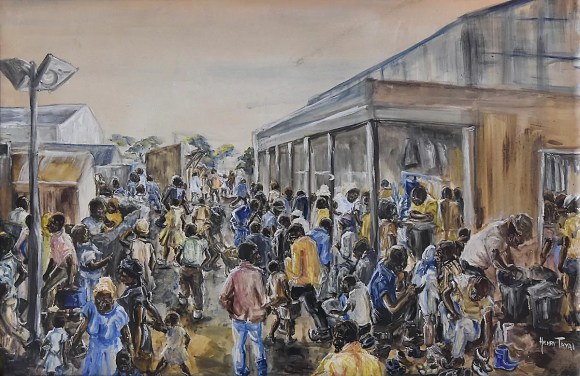
Art by Henry Tayali(1943-1987). From Public Domain
Let us imagine a world where wars have been outlawed and there is only peace. Is that even possible outside of John Lennon’s song? While John Gray, a modern-day thinker, propounds human nature cannot change despite technological advancements, one has to only imagine how a cave dweller would have told his family flying to the moon was an impossibility. And yet, it has been proven a reality and now, we are thinking living in outer space, though currently it is only the forte of a few elitists and astronomers. Maybe, it will become an accessible reality as shown in books by Isaac Asimov, Arthur C Clarke or shows like Star Trek and Star Wars. Perhaps, it’s only dreamers or ideators pursuing unreal hopes and urges who often become the change makers, the people that make humanity move forward. In Borderless, we merely gather your dreams and present them to the world. That is why we love to celebrate writers from across all languages and cultures with translations and writings that turn current norms topsy turvy. We feature a number of such ideators in this issue.
Nazrul in his times, would have been one such ideator, which is why we carry a song by him translated by Professor Fakrul Alam. And yet before him was Tagore — this time we carry a translation of an unusual poem about happiness. From current times, we present to you a poet — perhaps the greatest Malay writer in Singapore — Isa Kamari. He has translated his longing for changes into his poems. His novels and stories express the same longing as he shares in The Lost Mantras, his self-translated poems that explore adapting old to new. We will be bringing these out over a period of time. We also have poems by Hrushikesh Mallick translated from Odia by Snehprava Das and a poignant story by Sharaf Shad translated from Balochi by Fazal Baloch.
Book reviews homes an indepth introduction by Somdatta Mandal to Banu Mushtaq’s Heart Lamp: Selected Stories, translated from Kannada by Deepa Bhasthi. We have a discussion by Meenakshi Malhotra on Contours of Him: Poems, edited and introduced by Malaysian academic, Malachi Edwin Vethamani, in which she concludes, “that if femininity is a construct, so is masculinity.” Overriding human constructs are journeys made by migrants. Rupak Shreshta has introduced us to immigrant Sangita Swechcha’s Rose’s Odyssey: Tales of Love and Loss, translated from Nepali by Jayant Sharma. Bhaskar Parichha winds up this section with his exploration of Kalpana Karunakaran’s A Woman of No Consequence: Memory, Letters and Resistance in Madras. He tells us: “A Woman of No Consequence restores dignity to what is often dismissed as ordinary. It chronicles the spiritual and intellectual evolution of a woman who sought transcendence within the rhythms of domestic life, turning the everyday into a site of resistance and renewal.” Again, by the sound of it a book that redefines the idea that housework is mundane and gives dignity to women and the task at hand.
We wind up the October issue hoping for changes that will lead to a happier existence, helping us all connect with the commonality of emotions, overriding borders that hurt humanity, other species and the Earth.
Huge thanks to our fabulous team, especially Sohana Manzoor for her inimitable artwork. We would all love to congratulate Hughes for his plays that ran houseful in Swansea. And heartfelt thanks to all our wonderful contributors, without who this issue would not have been possible, and to our readers, who make it worth our while, to write and publish.
Recently I came to know my past. Not the past of this lifetime but the cumulative past of several lives prior to this birth. I have always been curious to know whether I was a human being earlier or whether I was a bird or an animal.
In case I had been a bird, whether I was something cute like a parrot or a peacock. Or a high-flying eagle or vulture? In case I was an animal, whether I was something domestic like a cat or a dog? Did I bite someone to give him rabies and cause his untimely death? Or was I predatory like the ferocious tiger or crocodile in any one of my previous births?
Although I would have loved to hear I was a donkey, a horse or a deer, in this exact order of preference, the clarity that came my way settled all doubts and confirmed I was a human being in all my previous births — a really old soul that did all sorts of wicked things like abusing power and exploiting people for personal aggrandisement. But God had always been kind to send me back as a human being to atone for my sins, which I never did. This is precisely why I have been rendered a victim to pay for all the misdeeds in this lifetime, with no sympathisers to relieve my emotions. Something like a past life regression therapy session sounds quite an exciting idea but once the dirty secrets are exposed and you get to know the huge backlog of cardinal sins blocking your path to divinity, you come to terms with the bitter truth that you are solely responsible for everything that is not right in your present life and nobody else deserves an iota of blame for the current mess.
I was told I should clear the heavy backlog and aim for salvation. Frankly speaking, I have never ventured beyond the stage of salivation and here I was asked to mend my ways and attain salvation. Why should I do that when I find this world so attractive and the Lord so forgiving that He keeps sending me back in one human form after another? I love returning again and again to this world also known as a playground. Despite my overloaded dustbin of sins, I must be doing something really good and impressive that compels God to give me another chance to stage a comeback. Why don’t these card readers focus on that aspect and stop becoming my misfortune tellers?
I am perfectly fine with my emergence as a villain and there is absolutely nothing that I can do to undo the past. I can make the best possible use of the present and set things right. Before that I must know what exactly I did in my last birth at least. I was told I was a commander of an invading army marching in with the sole intent of pillaging. That’s horrible, to say the least. Did I slaughter people with my sword or put them in a gas chamber? The information I could ferret out was limited. But it was still adequate to suggest I was a conqueror of foreign lands and added one territory after territory. It was shameful indeed. I looked up in the mirror to see if I had any facial resemblance to the notorious invaders from the previous centuries. To be honest, I did look like one, but the fact that he did not enter this part of the world made me feel somewhat relieved.
For some weeks, I grew a beard and the resemblance grew further, making some of my friends cast suspicious looks and draw nasty parallels. How do I reveal to them that even if the name they were guessing is not correct, I was indeed an invader on horseback! In the contemporary democratic setup, this sounds horrific but it was a glorious achievement back in those days. The way the empires were built and expanded and controlled. What was right and justified then seems so inhuman a few centuries later. But the brutality of the past just to gain geographical heft cannot be held right. Surely, in the eyes of God I was a sinner even though I did it for growing an empire. I have been dumped in this part of the world where simple, innocent people were tortured. I have been made to suffer endlessly in silence as an act of retribution. To get a taste what I delivered to others. Fair enough.
For a while I was thrilled to hear that I was an invader, a plunderer, a marauder. Imagine the immense power I wielded then, and make a contrast with this moribund life where I do not enjoy any power at all. More powerless than a clerk or a peon, and always at the mercy of corporate bosses whose permissions and approvals have made my life a living hell.
Now I come across people who show me their power – as much as they can, wherever they can. I get threatened, abused and thrashed by powerful people inside their homes, inside the holy places by powerful committees and organisers. I have to take it all lying down and treat this ill-treatment without retaliation as it would lead to further misconduct and multiply my sins.
I need to forget I deserve any form of respect anywhere because I did not respect people in my previous births. I need to forget I have any power or I can gain any kind of power because I am that old, withered soul that will start misbehaving and misusing power if I sniff it again. I have been destined to stay away from all shades of power and authority – and quite rightly so. I have been condemned to spend the entire life facing its misuse. If I crib or complain that the people are not doing things right, I will lose the battle forever. That’s what I have been told and warned. I have to tolerate everything that comes my way and write off the bad debts of the previous lives. Only then I will manage to come back in human form and enjoy this material world once again. The irresistible greed to be granted another chance to enter this beautiful world seems to prevail over me. I find one lifetime of sacrifices is not quite a heavy price to pay for my past misdemeanours.
As I was still battling with the startling disclosures from the distant, murky past, some prophecies inflicted deeper wounds. I was told I was destined to die at the hands of women, not one but two, one old and one young, both related to the same family. This was also linked to my past life since I had massacred a family and the matriarch of that family was an embittered soul planted in my life by the divine. I was informed she had already entered my life quite effortlessly through an alliance of sorts. Although she is very good at the moment, she will spring a nasty surprise that will devastate me in the coming three years.
The burden of the past was not off my chest and now the astrologer’s prediction has made me nervous. A sure sign of madness if I start seeing my killer in every lady in my life, right from the domestic help to the employer who is also a lady. On my further insistence, two alphabets were revealed. I was asked to be careful about women with names starting with these alphabets: K and V. But there were more than two women with names starting those alphabets. It was all so confusing and devastating.
Hey, wait! Could it also be a woman doctor in the hospital who will packs my departure bags on the operating table? Well, there are thousands of ways of dying a shameful, painful death and I can go on listing hundreds of possible ways and end up damaging my frayed nerves. I should forget it all and prepare myself to meet my end, my nemesis. Just like a woman who brought me into this world, another woman is destined to take me away from this world. No big deal!
Through some dark practices and evil spells, the vengeful lady will take me to the hills and something scary will happen all of a sudden there, resulting in my untimely, unplanned death. It means the lady and her accomplice will play a stellar role, but not a direct role like holding a gun at me or bumping me off near a blind curve or pushing me from a cliff after a selfie shot. Since I played a direct role in the devastation of that family in my last avatar, I should be ready to take the worst direct hit. As per the reported forecast, these women will not turn into cold-blooded killers and they will regret the fatal outcome since they themselves carry no sinister plan of that kind – driven by the singular motive to make me sign some will. The story spirals out of control and takes an unexpected turn. They will be held indirectly responsible for my passing away from this world. As a result, they will not bear a heavy karmic baggage for my death either. Which means God is a clever player who takes no blame and leaves the final judgment on our own deeds and misdeeds.
I am filled with negativity now, and I don’t think I will survive with this last burden. Something will blow up inside my brain so I must stop thinking about the past and the future and simply focus on the present. Isn’t that what great sages and thinkers have been saying all along? But why is it that the past and the future are more attractive than the present? Since I have been assured that I have three more years to perform good deeds, I must concentrate on that. At least a thousand good deeds should save me well in the years ahead – and in the afterlife.
I do not have the complete details of the potential women killers so I should stop worrying and forget their gameplan. Before I could firm up my mind with this template, women relatives proposed the idea of a visit to the hillside. I was shocked my doomsday could be coming earlier than scheduled! Or was it that God is finally trying to be kind and help me know my killers in advance? Those alphabets matched perfectly with the forecast and those two women relatives comprised my inner circle. It was shocking to know these well-behaved, sophisticated ladies would me lead to my death. Should I reveal to them that they will kill me some day? Would they believe me? Were they thinking along those lines? Would they be surprised to know how I read their minds? Or would they call me mad? I chose to rest this issue and scaled down my interactions with them. Perhaps in the coming years I would do something to offend them. These scorned women will gang up and bump me off. Well, by rejecting their proposed trip, I had already vexed them. They could sense I was avoiding them and they wanted to know the reason for my refusal.
One lady treated me like a son and I could not visualise her being the mastermind. One fine day, the lady arrived and suggested she wanted me to write a book on her failed marriage. Maybe, I should duck this proposal by citing my incompetence to write a book. Being aware of my dabbling in creative pursuits, she claimed to be a regular reader of my morose prose. I thought switching to gifting on happy occasions and festivals would foster bonhomie. I had no idea of what would transpire in the coming years that would enrage her so much. Therefore, the best option was to snap ties and remain aloof. The fear of her seeking umbrage made me reconsider this move. I said I write short pieces and I do not have the potential to write a book at the moment. In the years ahead, if I felt confident about the project, then I would like to give it a shot.
I consulted therapy experts to guide me through this crisis but they seemed clueless in this regard. They had no knowledge to help reduce anxiety and stress in a person who is forewarned of his imminent death. All they could suggest was meditation and it meant connecting with the same divine power that had signed my death note. I chose to spend maximum time doing good deeds – feeding birds and animals featured on the top of my list. Creating a buffer stock of good deeds would make me a deserving candidate for royalty in my next birth. But the downside was I would most probably indulge in exploitation of subordinates and assert my power and resourcefulness – repeating the same cycle once again. Hence it was equally risky to be super good.
Hey come on, commit some mild mischief in this lifetime to become ineligible for rebirth as royalty. Being an ordinary human being wandering in anonymity, despite being a habitual, small-scale sinner, is a far better deal than hogging the limelight as a leading monster without a parallel.
Devraj Singh Kalsiworks as a senior copywriter in Kolkata. His short stories and essays have been published in Deccan Herald, Tehelka, Kitaab, Earthen Lamp Journal, Assam Tribune, and The Statesman. Pal Motors is his first novel.
PLEASE NOTE: ARTICLES CAN ONLY BE REPRODUCED IN OTHER SITES WITH DUE ACKNOWLEDGEMENT TO BORDERLESS JOURNAL
For the entire month Sandy was upset in her newly set-up office. Swanky, plush glass cabin with mood lighting and a deluxe leather couch to sink in could not prevent the buzz in her head. How to get rid of the creative consultant her husband had hired as a temporary replacement for her creative protégé who went on maternity leave for six months had emerged as her consistent worry.
Despite being the creative controller of S&S, the independent, mid-sized advertising agency positioned to be idea-driven, she could not do much to infuse creativity and rein in the team of acolytes who praised her recycled, AI-inspired work to the skies to keep their jobs safe. With the termite called mediocrity hollowing the agency from inside, client retention emerged as a big challenge. One fine afternoon she was informed by her strategist husband, Snehasish, about the probable loss of key clients and his desperate bid to onboard an overseas major to offset this financial setback.
The scapegoat she found apt for this occasion was none other than Mohit. This was the biggest as well as the brightest idea to hit her after several months of creative drought. With a sudden burst of energy, she lifted herself out of the couch and approached her loyalist manager, Adarsh, waiting for her order. Raising her heels, she looked straight into his sunken brown eyes, and snaked her arms around his neck.
“I want you to do me a small favour, baby,” Sandy poured into his wax-laden ear in her faintly husky voice.
For the man surviving and thriving on her benevolence, saying no was impossible even if his moral compass did not allow. Before she disclosed her plan, Adarsh blinked its confirmed execution.
“By the time I am back from my vacation, do whatever it takes to ensure Mohit is thrown out of my agency.” Sandy ticked him off for the dirty job and landed a dry peck on his beard cheek before stomping out of the agency corridor, rushing down the high-speed elevator, and reaching the parking bay with the remote keys pressed from a distance to unlock her sedan.
Seated behind the steering wheel, she pushed the shades up her forehead and booked herself business class, texted Snehasish about her trip, and rushed home to take a shower and pack her travel bags.
“Bon voyage -” he texted back, regretting he was unlikely to see her off at the airport as he was yet to ink the deal with a beverage client arriving from Dhaka in Kolkata during the weekend.
*
Adarsh was aware of the creative skills Mohit possessed. He had what it takes to be classified as an asset but merit alone does not decide the fate of an employee in any organisation – more so in a flippant, flamboyant profession like advertising and media. Maintaining a low profile, with the hope of getting noticed, was what Mohit believed in, expecting his work to speak volumes. But the unabashed self-promotion by his team mates eclipsed his presence and trivialised his output.
Although Adarsh was much higher up the ladder in terms of designation, the presence of Mohit scared him at times. It was a matter of relief – and perverse delight – for Adarsh to know that Mohit was not in the good books of the agency owner. All he had to do at the earliest was form a core team of account managers and designers and brief them regarding the urgent need to eliminate Mohit.
He cherry-picked Amar and Ragini to lead this mission. Since Ragini had worked closely with Mohit who pricked her ego several times in the past, she was thrilled to be chosen for the special task and recalled the earlier episodes of friction, primarily to justify her moral descent. However, she was slightly disappointed that Sandy Madam did not confide in her despite her frequent visits to her penthouse apartment over the weekends to binge-watch with her and later smoke flavoured hookah in royal style under the star-lit sky before going for a dip in her private pool.
“Trust me, Sir,” Ragini assured Adarsh, picking up her bottle of chilled beer from the table when she noticed the other guys had already polished down their drinks. Quite fond of Ragini, Amar saw this was the perfect opportunity to spend maximum time with her. He seconded her every move and sentence, making it sound like it was a petty gig. Although Ragini did not reciprocate his feelings, she kept their relationship within the realm of friends with benefits, spending time together in pubs and discotheques late at night, when Adarsh returned to his cocoon, to his family fold to play the role of a doting husband. For Amar, keeping the hope of a happy union alive was the ultimate driving force.
“Make sure Mohit faces rejections every day. Get negative feedback from clients for his submissions, set crazy deadlines for him, double his workload, add power-points to his responsibilities, make him redo every piece of crap he writes, and do not hesitate to call him a difficult, outdated person to work with. You have full freedom and my unconditional support but make sure you keep me in the loop,” Adarsh waxed eloquent while tearing the plastic cover of a new pack of imported cigarettes.
He knew Ragini would make it unbearable for Mohit to survive in this toxic environment and he would dash off his resignation within a week. On several occasions in the past, Ragini had rushed to his cabin, spewing venom against Mohit. But he never took any strict action based on her complaints as he was under the false impression that Mohit was the new, emerging favourite poster boy with the agency owners. Sandy’s startling disclosure reversed Adarsh’s inference, making him curious to ferret out what had annoyed her so much in just a month that she wanted him axed in a single deft stroke.
To mount a second line of attack, he briefed Samit, the senior account director, to engage Mohit in client meetings, brainstorming sessions, and critique his past work, to make it seem it was quite frustrating to get approvals for his work. Collective onslaught would demoralise Mohit faster and he would tender his exit note. His past observations encouraged him to believe that Mohit would display immature behaviour under pressure.
“You cannot write proper English, with absolutely no knowledge about the nuances of grammar,” Ragini exploded in the presence of several junior employees one afternoon. Such acerbic comments did not hurt Mohit who gauged that this allied gang of detractors had been activated against him. Being confident of his ideation skills, Mohit had the strength to pulp what others wrote and submitted. He could defend his original work but he thought it was not the wise thing to do at this stage.
Mohit invited Ragini for a serious discussion on the nitty-gritties of grammar usage and explain to her why it was a good and accepted practice to delete articles from headlines. He could share multiple examples of great print ads with missing articles from the headlines. When she found this would embarrass her, she went for a quick huddle in the conference room to discuss deliverables with designers. She emerged when she saw Mohit was nowhere around and rushed straight to Adarsh’s cabin and firmly shut the door behind her, to update and discuss what to do next since their negative approach didn’t seem to work.
Contrary to expectations, Mohit had decided to persist and resist all opposition. With a singular focus, he carried on with his job and took all forms of criticism in his stride, making strong commitments to fix his non-existent flaws at the earliest. That left no room for knee-jerk reaction and it became clear that Mohit was not going to quit even if these guys engaged in verbal spats and fired a fusillade of salvoes.
Lighting up a cigarette flicked from Adarsh’s pack to reduce her stress, Ragini sat on the table and blew out smoke rings, waiting for him to break the silence. Using her other hand, she playfully pulled his handlebar moustache grown as a tribute to a living legend, egging him to crack something new. Unwilling to disclose that he had already deployed another missile called Samit, Adarsh wanted to wait for a couple of days and see how things panned out.
“Mohit is not the kind of guy to swallow insults on a daily basis, I am sure he would go on an unannounced leave and then stringent action against him, just waiting for one day of absence and he is kicked out,” Adarsh revealed, stroking her hair as a sensitive, caring gesture of assurance.
Mohit proved to be a tough nut to crack as the worst humiliations heaped on him went waste. They raised storms that would not capsize his boat. With an accommodative, tolerant mindset, he prepared himself for every challenge. Mohit had realised the band of opponents had teamed up to isolate him in the absence of Sandy Madam. He decided to report this matter to her once she returned from vacation, reposing full faith in her justice system.
*
The news of Mohit’s imminent departure was leaked to the colleagues by none other than Ragini. She could not contain the excitement even though nothing was achieved yet. She went around spreading the false information that her ideas were far better than Mohit’s, and she had to rectify his errors.
“Adarsh Sir is fed up with Mohit and he is looking for a subtle way to dump that jerk,” Ragini told one of her confidantes who happened to like Mohit for his dashing personality.
The rapport between Ragini and Adarsh was an open secret. The way she thrust the birthday cake slice into his mouth just last week was ample visual proof of their flirtatious bond captured on smartphones and shared across profiles.
Mona and Ragini had joined S&S around the same time with the same level of experience. Familiar with her gossip-mongering nature, Mona went and asked Mohit if everything was fine at work. He pretended to be fine but she concluded from his downcast eyes that something wasn’t. After his denial, she could not alert him that his days were numbered in this agency. Nobody here, not even the peon, could survive without the support and approval of Adarsh. What Ragini said regarding Mohit was a forecast – much more accurate and reliable than any weather alert or astrological prediction. The planets could change in Mohit’s favour any time, but the combined brutal attack of Adarsh and Ragini could not prevent his unceremonious exit from S&S.
Almost the entire team was up against Mohit. False allegations were propped up against him – including the grave charge that due to his flawed writing, the agency lost business. No sympathy came his way and Mohit could sense that the campaign to defame him was more successful than any social media campaigns done for the clients.
Strong indicators began to surface. Nobody bothered to greet Mohit inside the office. His presence was overlooked — as if he was an outsider. Nobody asked him to join the group for lunch outside. He was left alone. This intentional boycott began to affect Mohit who felt his presence was not required anymore. Though he had promised to ignore the rival group plotting against him, he was assuaged with the dismissive attitude of his other colleagues who happened to bond well with him earlier. Particularly Vishesh.
Earlier, Adarsh had urged Ragini and Samit to flood him with work, to wear him out. But this approach underwent a complete overhaul: Mohit was made to sit idle for the entire day, with executives approaching other writers, including trainees, to work on the brands he handled earlier. Half of the day he sat gazing out of the window and felt ashamed, and then tried to seek assignments from Ragini. She was blunt in saying it was useless to provide him with briefs when fast turnaround and quick approvals were required.
Mohit was left with no choice but to approach Adarsh for clarity as he knew these scheming tactics wouldnot work without his consent. Guided by instinct, he chose to avoid any escalation in the absence of Sandy Madam. He turned back without knocking on his cabin door. The only helpline to tide over this crisis was to lie low for another week. He made himself comfortable with idleness and focused on watching ads. He was attending office every single day and he was getting paid on time so there was no reason to get rattled. Many people in the office pretended to do a lot of work even though their output was much below par. He saw inferior work getting approved but he kept himself out of it. Unless adverse communication came from the management side, he should enjoy his relaxed stay and keep himself occupied with creative pursuits. He knew everything would get resolved once Sandy Madam came back.
One fine day, the inevitable happened. Mohit was asked by Adarsh to visit his chamber for a quick chat. He entered the room and kept standing. Adarsh put his legs on the teakwood table and began in a mellowed voice, with eyes cast on his tablet screen: “As you can see, there is not much work. Half the day you solve crossword and watch ads. The business scenario is bleak. Two of the clients you handled are leaving us after five years and it is tough for all. I am sorry but the bitter truth has to be told. This is your last month. Snehasish will give you a call shortly and explain it better. The severance package and all that stuff.”
Mohit emerged with a forlorn expression, walking like a ghost without any spirit to live. All his suppressions proved useless. His creative work had gone waste, unrecognised and belittled. More shocking for him was the fact that the top management brass was also skewed in favour of his dismissal. All this while he was thinking it was a gang in the office helmed by Adarsh. When Snehasish called up in the evening, he minced no words and coldly conveyed that his services were no longer required and he would get paid for another month without doing any work. He was assured that the entire process would be smooth, no hiccups, no hurdles.
Reporting for work to get paid and not doing any work was unethical. Mohit thought he should forget the salary bait and quit right away to show he did not care two hoots. That would be a heroic, dignified exit in front of all employees. But then, the domestic realities broke his resolve. He thought how he would disclose the sudden job loss news to his wife. So, he went to Adarsh and requested him to be considerate.
“My spouse is undergoing treatment and if I sit at home now… At least for two months, let me continue. Once she recovers, I will stop coming here. I can show you her medical reports. I can’t take any risk with her health. I am not lying, Sir.”
This was the first request ever made by Mohit to any company honcho – the only favour he sought. He was shown no leniency and advised to get in touch with Snehasish for a reconsideration.
Mohit felt Adarsh must have disbelieved his story and called it a fake narrative to hang on for some more time on sympathetic grounds. When he gave a buzz after office hours, it was dropped. A clear indication he would not get any extension. When the truth he spoke was brushed aside, he saw no point in coming to the office where he had worked for almost a year. He was still not ready to believe that Snehasish was involved in this conspiracy. When did this drastic change happen? What led to this change of heart? He could go on thinking and thinking without finding any answers.
*
That Snehasish was the mastermind that planned his termination was difficult to accept. How could he alone be the architect of his fall from grace? Sandy Madam also came under his scanner even though throughout his working phase there was not a single moment of distrust or dislike between the two. Sandy Madam was sensitive to his needs so Mohit removed all doubts for the time being. She would either go against her husband and reinstate Mohit or she would toe his line like a devoted partner. That was the sole reason why he did not burn bridges yet, with the hope of reconciliation flickering somewhere despite near-unanimity inside the office regarding his expulsion.
Mohit was immersed in worries about how his wife would react to his job loss. He was left with no option but to tell her the truth if she did not guess it on her own. Finding her husband at home during the week days had already raised her suspicions and he could not keep lying. Working from a remote location was no longer an available excuse after the pandemic ended. With divine strength, she remained calm and held his hand in support, assuring him of good times coming their way soon. Tears welled up in his eyes in gratitude to God who had already simplified his tough task by blessing her with maturity.
When Snehasish called him up again, he was specific and abrasive: “Mohit, no point begging for an extension. Don’t crib. Your wife is ill but we are not here to finance her medical bills. We don’t run a bleeding business or conduct any charity. As you know, we lost two accounts you handled and there is no way we can continue this contract.”
Mohit could not believe this was the same employer he knew a year earlier. He had been soft-spoken and polite and now he had shown the colours of a chameleon. He understood he was held responsible for the loss of business. But surprisingly, he did not find any faults with those who mishandled these accounts and the designers who played the fool by offering them the same templates.
When it was a matter of saving himself, Mohit had to speak the truth. Even if that failed to bring any positive outcome, he would at least have the satisfaction of releasing it all.
“Sir, you cannot fully blame me for the business loss. There were other reasons. Account guys took them for granted.”
This made Snehasish furious.
“You are making these wild allegations to save yourself. Why were you silent earlier? Grow up, man. I will still write a recommendation letter for you — good luck finding another employer.”
He did not wait for a formal closure and disconnected without waiting for Mohit’s reaction.
Those who wrote pedestrian stuff were retained was a reality yet to sink in. Mohit realised it was futile to wait for Sandy’s return from London. He had no hope she would go against the majoritarian view and reverse what her husband had decided. After all, Mohit was not worth defending and making a ruckus about within the family. But he did message Sandy Madam about his lay-off. It was seen after two days and she chose not to respond, making him suspect she was an accomplice who knew what was about to unfold.
The way the chain of events had unfolded seemed to hold many more secrets. He was not informed by Adarsh or Snehasish that a new big client was roped in. Why would they share this good news and strengthen his case regarding retention? In fact, he got to know about this from a trade magazine that listed the account movement.
Even though he was given a month’s timeframe, Mohit found it humiliating to continue in that role. Since their guns and knives were already out, there was no point in facing his colleagues who would make fun and keep him idle for the day. When he found he had been evicted from all client groups by Adarsh, he saw it was meaningless to go to office unless he intended to carry a gun and blow up their brains. A pool of blood inside the office, with multiple casualties. Ragini’s blood-soaked tank top, with Adarsh’s lifeless ring-studded hand resting on her bust formed a gory image in his fecund mind. Had he not been married with domestic responsibilities he would have hit the headlines as a cold-blooded killer who massacred almost the entire team in a manic state.
Despite losing his only source of income, with ailing wife at home, no life support around, he could not think of suicide as a solution. The fear of failure in this act and the love for his soulmate made him abandon extreme negativity. Being punished despite doing good work was not easy to digest. The ways of the world were not going to change for Mohit. Expecting kindness from selfish people was his mistake. He would soon be forgotten and replaced within a week, and to sacrifice your precious life for such thankless people would be an act of foolishness.
*
It came as a bolt from the blue when Mona met him outside the office over a cup of coffee at a nearby café. The information she provided was an eye-opener of sorts. Stirring brown sugar in her cup of cappuccino, Mona chose to cross-check certain details before she shared some vital information.
“Did you know you were hired for a temporary period, Mohit?”
“No. Not at all. There was nothing temporary mentioned in the letter.”
“You were a replacement for Jyoti who is joining back next month. She was on maternity leave actually.”
“Who told you this?” Mohit asked, his coffee turning cold.
“It is a known fact. Everybody is excited about her comeback. Sandy and Jyoti are great pals.”
“Could you share more details,” Mohit requested her.
“I don’t know much but it is Jai-Veeru[1] type of bonding. Sandy will shut down her agency if Jyoti decides to leave. I mean, you can guess their mutual fondness. I don’t need to specify more…”
“You are suggesting my time was limited here – but Sandy never disclosed that.”
“Come on, nobody joins for six months. Initially, you are supposed to be here for six months but your quality performance made it tough to get rid of you. You survived more.”
“I never got to smell that,” Mohit mourned the delay, “just the client loss story is offered to me…”
“Client loss does not bother Sandy at least. And don’t think Jyoti is back because she is a powerhouse of talent. Believe me, she is a mediocre writer,” Mona explained, and started sharing her own plans of leaving the agency because of Adarsh who had nothing to do with principles.
“He calls me up on holidays at odd hours and chats endlessly. My family does not like that. He thinks every female employee in advertising smokes and drinks and loves to sit on his lap. I have always maintained a safe distance, unlike Ragini. That’s why she grew so fast while I am stuck without a promotion for two years.”
“Precisely for this reason I think advertising is not moral. But I also feel creative people are supposed to be good human beings. My exposure has convinced me I am wrong. Creative people can be mean and awful just like in any other profession,” Mohit shared his generic assessment about the profession he had now decided to quit forever.
Slightly taken aback to hear that Mohit had decided to switch his career at this advanced stage, Mona felt she was also a contributor to his setback. Experiences of this kind are change makers, but she believed Mohit would continue to keep his relationship with words alive irrespective of what he pursued in life.
“On a lighter note, your unceremonious exit was an ideal occasion to cut the blueberry cheese cake,” Mona disclosed how the agency guys celebrated his departure and showed the photos on her mobile. “Though it was not announced like that, that was the main intent. Ragini and Adarsh danced together and Amar sat in a corner and guzzled beer. And yes, Sandy loved their pics and commented she missed the party.”
“She is returning soon?” Mohit asked for an update.
“Yeah, next Monday she joins office,” Mona informed him, “Do you want to meet her and discuss?”
“Oh, it was all premeditated and planned,” Mohit connected the dots though there were many loose ends he could not put together yet. “Perhaps Ragini could throw light on this matter. Being an insider and confidante. She is your friend, isn’t it?”
“Do you really think so? Don’t be naïve. Adarsh will strangle her. But I have a hunch she is a mere pawn being used by Adarsh. The remote control is elsewhere. Do stay in touch and if I get to know anything big, I will give you a buzz. Pray your wife has a speedy recovery,” Mona concluded the chat and rose up to leave before the grey skies opened up.
To pore over the past and sulk was not a healthy indulgence but for Mohit this was a critical phase of life and such betrayals made him think the world is there to make things worse for him. His personal problems weighed him down. He hated to use the name of the last agency in his resume. He found it was better to call himself unemployed than to mention the name of his last employer. Besides, he was sure Adarsh or Sandy would not have nice things to say.
Mona had specified the reason for his exit was Jyoti. While it was a convincing ground, there was something more than that, something that remained buried within. Adarsh and Mohit had the same queries. But the chances of Adarsh excavating the real truth were higher because he was close to Sandy.
*
When Sandy returned after a grand holiday, she found the entire office decked with marigold flowers to welcome her back. Adarsh had beautified her private cabin with her favourite upholstery and silk curtains. After spending a few minutes with the entire team, she asked Ragini to meet her in the cabin. She walked behind Sandy and followed her footsteps.
Dropping her vanity bag and silk stole on the sofa, Sandy asked her, “So how does it feel to be working without Mohit around? He insulted you a lot.”
Sandy collapsed on the sofa and pulled Ragini to sit beside her.
“It is nice and relaxing, honestly, Ma’am,” Ragini glowed with joy.
“I have some good news for you. Get ready to helm the new account we have won. You have bigger responsibilities and a fat package with perks,” Sandy rewarded her for being a loyalist.
Adarsh joined the two and Ragini got up to leave. Sandy did not stop her, but promised a cool, heady celebration at her apartment soon. She mentioned to Adarsh that Ragini was promoted. Adarsh congratulated her, holding her hand and squeezing it hard, and then opened the door for her like a perfect gentleman. Ragini turned around and asked, “Ma’am, can I make this news public? I mean to my colleagues.”
“Of course, sweetheart, Adarsh will shoot an email by the end of the day,” Sandy assured her and she gently closed the door. They could hear the celebratory outburst outside, with Ragini making the grand announcement and getting a huge round of applause.
“Have we done the right thing from the agency perspective?” Adarsh asked Sandy, sitting beside her, without specifying the context.
“You mean his exit?” Sandy asked though she understood he was referring to that.
“Jyoti is joining soon and that is good for you. But there is a hell lot of pending work and we need sharp writers.”
“Hire one. Released a job ad,” Sandy said casually, “You will get hundreds of applicants and we do not pay very bad either.”
“If it was affordable, why did we need to do this exit drama and now go through the same recruitment process? I mean, you knew very well Mohit was a good writer.”
“Is it that you are not convinced with my reason. You suspect the truth is something else?”
“Yes, I am sure the truth is completely different.”
“Okay, then hear me out. I have not suffered so much like I did in the past one year. Snehasish hired him but I was never comfortable. His presence made me feel low. I sank into depression. This guy getting paid here out of my pocket proves to be a better writer. The hospital client rejects mine and okays his headlines. I handled this client for three years. But now it is such a smooth process between the two of them. What message does it give to my team here? There is a better writer in this office than Sandy. I can’t take it lying down. I want my team to be less qualified than me so I can control and manipulate with ease. Those who know more, they can go elsewhere. If he is so talented, let him go to any MNC agency – what is he doing here? Look, I don’t nurture creative talent here. I set him free. Prove your worth and get the dream job,” Sandy burst forth with all the filth of jealousy.
“I sensed something of this kind, Sandy. I can feel your anger simmering within, with a smiling face covering your real self for so long. This couldn’t go on. And yes, I was going through Mohit’s previous portfolio and he is damn creative. Strong ideator!”
“Since when did we aspire to become a creative boutique agency. We are into billings, right?” Sandy brought him back on track.
“And one more thing, that fellow is a writer who pens stories. I have not written a single book and he flaunts a literary background, which was not my forte. Else, I would have chucked him out on day one. Ragini forwarded the links to his published works. I don’t want novelists here. I asked Snehasish to find a way to eject him when Jyoti decided to rejoin. I was jolted last month when he said he was assisting a big shot in the scripting of a Bollywood film. His presence pricked my self-worth. As the creative boss here, I cannot tolerate a more talented person. Simple as that. Sometimes he behaved like a literary rockstar and sometimes like an auteur. He forgot he was a copy guy first. Other fancy titles are dreams, advertising is the reality.”
“He was pleading his wife was ill and asked to be allowed for two months. This was his last request.”
“Why are you spoiling my good mood, buddy. Give me a can of beer, please,” Sandy demanded with a vexed look and raised her feet on the sofa without removing her stilettoes.
Adarsh rushed out and fetched two chilled cans from his mini fridge.
As she cooled down with the first sip, she said, “Pay him compensation for two months instead of one. Does that lessen your guilt? Where the hell is Snehasish, not yet back from Kolkata?”
“He said the deal is done but he stayed behind for a recce in Eastern India as we wish to set up a new branch there.”
“Big news for me! I think he will do a fab job and then return to give me a lovely surprise. I called him before boarding the flight and he said he was stuck,” Sandy said while taking off her baseball cap, and urging him to be left alone for a while.
Adarsh returned to his cabin and released the funds and mailed Mohit about the severance details. He wished him good luck and also put it on record, “You are a damn good writer. And Sandy cannot write like you. Cheers.”
When Mohit read this mail, he could not understand why Adarsh had a change of opinion but he felt he was also an employee worried about his job. He forgave Adarsh in an instant and realised the politics of compulsion.
*
To kickstart her literary career, Sandy self-published a poetry collection and hired a PR team. She asked her staff to praise her work, to help her become a literary heavyweight. But soon she ran out of luck – when her office was flooded with anonymous letters containing the same message: Sandy cannot write.
The letters addressed to Sandy were brought to the conference table by Ragini who opened these to read fan praise. She was shocked to get Sandy cannot write printed messages in these letters. Unfortunately, Sandy accessed these letters and felt hurt as the pile-up became heavier with each passing day. So deeply affected by the content, Sandy realised she was not an artist. The communication was like a divine confirmation. She began to hallucinate and read the same message everywhere: Sandy cannot write. She took an overdose of sleeping pills to calm her agitated mind. Sometimes she picked up the marker pen and wrote the same message herself on the mirror and began to laugh loudly. The hard outer shell was broken by a single line and her sensitive inner self was revealed to all her employees. She could not take rejection in her stride – the first big quality of pursuing any art form.
Snehasish returned to find Sandy in this pitiable condition. As a precautionary step, he kept her confined to the apartment, with Ragini allowed to visit her sometimes as a caregiver. Sandy did not handle any accounts now. S&S premises was sold and the agency decided to move to a new, quieter address in the hope of receiving no such letters.
One day, Mona called up Mohit and asked him to meet her at the same café in the evening. When they met at the scheduled hour, Mona told him of Sandy’s deteriorating mental health, referring to it as a karmic blow. She mentioned letters carrying Sandy cannot write messages bombarded their office and now they had relocated. He sympathised with her but he was not sure whether he should reveal the name of the prime suspect. Only he knew who was hammering Sandy through those letters.
“I know you guys suspect I am behind this foul play. That is why you came here to find out. Trust me, I am not involved. I have far better things to do than stalk an old lady. Though I think I know who is doing this to Sandy, I do not know why he is up to it. Certainly not for me. The rest is for Snehasish to dig up if he cares for his ailing wife.”
Mohit stood up and prepared to leave the spot. He fished out the termination email print-out from his pocket, asking her to keep the proof and forward it to Snehasish in case it carried any worth. The striking similarity between the letters and the last sentence of the email left Mona in a state of shock. Was Adarsh the real culprit? Or Mohit hiding his revenge story with this unputdownable evidence?
.
[1] Jai-Veeru, 2009 Bollywood film about two friends
Devraj Singh Kalsiworks as a senior copywriter in Kolkata. His short stories and essays have been published in Deccan Herald, Tehelka, Kitaab, Earthen Lamp Journal, Assam Tribune, and The Statesman. Pal Motors is his first novel.
PLEASE NOTE: ARTICLES CAN ONLY BE REPRODUCED IN OTHER SITES WITH DUE ACKNOWLEDGEMENT TO BORDERLESS JOURNAL
Naramsetti Umamaheswararao makes up a new fable. Click here to read.
Feature
A review of Jaladhar Sen’s The Travels of a Sadhu in the Himalayas, translated from Bengali by Somdatta Mandal, and an online interview with the translator. Click here to read.
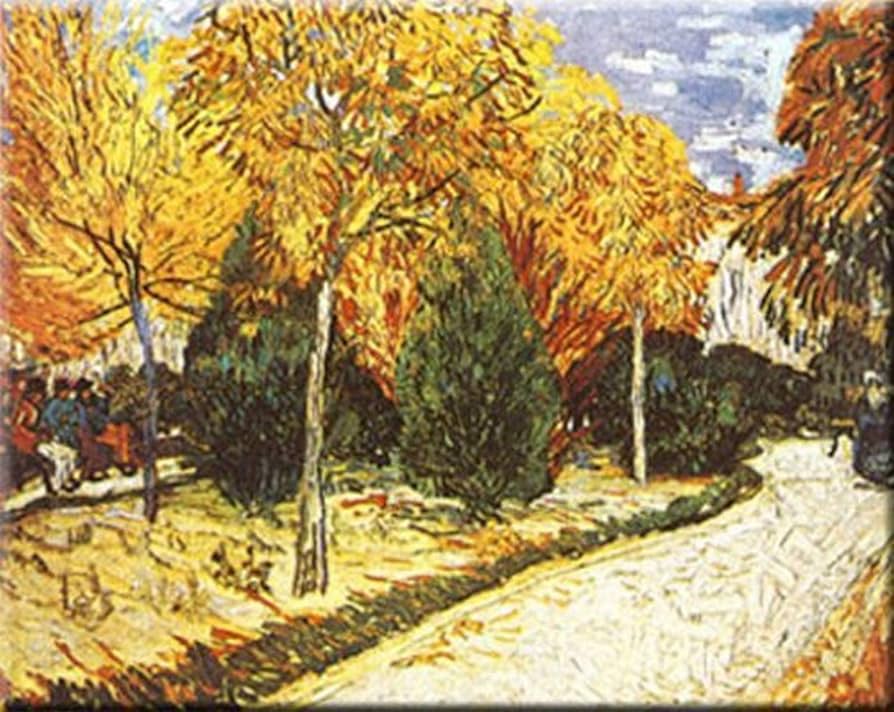
Autumn Garden by Vincent Van Gogh (1853-1890). From Public Domain
September heralds the start of year-end festivities around the world. It’s autumn in one part and spring in another – both seasons that herald change. While our planet celebrates changes, dichotomies, opposites and inclusively gazes with wonder at the endless universe in all its splendour, do we? Festivals are times of good cheer and fun with our loved ones. And yet, a large part of the world seems to be in disarray with manmade disasters wrought by our own species on its own home planet. Despite the sufferings experienced by victims of climate and war-related calamities, the majority will continue to observe rituals out of habit while subscribing to exclusivity and shun change in any form. Occasionally, there are those who break all rules to create a new norm.
One such group of people are the bauls or mendicants from Bengal. Aruna Chakravarti has shared an essay about these people who have created a syncretic lore with music and nature, defying the borders that divide humanity into exclusive groups. As if to complement this syncretic flow, we have Professor Fakrul Alam’s piece on a human construct, literary clubs spanning different cultures spread over centuries – no less an area in which we find norms redefined for, the literary, often, are the harbingers of change.
Mandal, herself, has a brilliant translation featured in this issue. We have a review of her book, an interview with her, and an excerpt from the translation of Jaladhar Sen’s The Travels of a Sadhu in the Himalayas. Written and first published in the Tagore family journal, Bharati, the narrative is an outstanding cultural bridge which even translates Bengali humour for an Anglophone readership. That Sen had a strictly secular perspective in the nineteenth century when blind devotion was often a norm is showcased in Mandal’s translation as well as the stupendous descriptions of the Himalayas that haunt with elegant simplicity.
Our fiction this month seems largely focussed on women’s stories from around the world. While Fiona Sinclair and Erin Jamieson reflect on mother-daughter relationships, Anandita Dey looks into a woman’s dilemma as she tries to adjust to the accepted norm of an ‘arranged’ marriage. Rashida Murphy explores deep rooted social biases that create issues faced by a woman with a light touch. Naramsetti Umamaheswararao brings in variety with a fable – a story that reflects human traits transcending gender disparity.
The September issue would not have been possible without contributions of words and photographs by many of you. Huge thanks to all of you, to the fabulous team and to Sohana Manzoor, whose art has become synonymous with our journal. And our heartfelt thanks to our wonderful readers, without who the effort of putting together this journal would be pointless. Thank you all.
Belated realisation that it played a key, though passive, role in the demolition of homes owned by minority communities generated a sense of remorse. So much so that it has now chosen to demolish what was an item of proud display inside its own home. Whether this fall-out is entirely an act of atonement or just a far-sighted move to avoid tons of rubble of its own reputation built over the years is a matter of speculation at this point. So long as the earth-moving juggernaut refuses to explain whether it has also embarked on a search for the meaning of life, quite like Lorenzo[1], the façade of credibility will continue to be bull-dozed by carping critics and authors.
The three alphabets of its brand name, sounding strikingly similar to ABC, facilitate quick, easy recall of its association with acts of destruction deemed legal though held morally incorrect and interpretative[2]. With images of the demolition drives flashing across various media channels, one name that stands readable is that of the behemoth monster employed and operated to execute controversial missions. While there are domestic brands for everything, this foreign giant emerges as the clear favourite in the construction business. Delivering targets with agility and precision is what has portrayed the entity in bad light. The crushing potential has built the negative brand image that cannot be demolished now. Usually, brands are switched when they do not meet the needs, but in this case, its preferred status due to super performance has wrecked its brand image. Ironical, isn’t it?
The intellectual voices remain shrill, signing letters to lampoon the role of the company in destroying homes and building literary careers. These contradictions cannot go together is the common refrain. Is there any sane voice to enlighten writers that the company does not sponsor the destruction of homes and it cannot insert any clause before product sale to prohibit its use in the razing of homes with it? Surely, they know a manufacturer has no control over how its product will be used or misused. On this count, the corporate shenanigan cannot be held responsible.
Literature gives space to all – including criminals and gangsters – to tell stories and many such memoirs gain legitimacy as works of art later. Misled folks, misfits, and all sorts of misleading characters enjoy the freedom to enter the world of books in some form or the other. If an underworld don decides to set up a chain of brick-and-mortar bookstores and launch a publishing house, the reaction of published authors is a predictable boycott. The literary world that boasts of freedom of speech for all is much likely to shrink and apply the moral compass to ensure its ouster even if the intent of the new entrant is reformist. The world of writing should be, ideally speaking, like a place of worship where the identity of a visitor or his background does not matter when he bows before the Lord.
When a large group of authors come together to use the collective power of the pen to dismantle the role of an award sponsor and question its right to distribute such awards, there is not much the corporate player can do to remain engaged in it. The prize tried to promote writers and writing, not just English but other regional languages, and the hefty prize money enabled many winners to earn a decent income from the job of writing. Now the critical authors seem to rejoice that their objections have been powerful enough to make the company do a rethink or at least for the time being stay out of the awards game. One hopes the protesting writers also launch a similar drive against respected awards that have ignoble connections — many of which they have also competed for or served as a jury member.
The winners and shortlisted authors of this prize will have nice memories of its brief existence, and they will credit it for bringing regional writers to global limelight. There is another side of this story that requires focus. With Indian regional writers also winning the much bigger and more prestigious International Booker prize (two winners in five years), the unique distinction for bringing regional literature to the global platform gets shared unequally between the two prizes. It cannot champion itself as the sole promoter of Indian languages and literature anymore. That the apparently defunct prize was the first one to give a major boost to Indian regional literature is its solid, solitary achievement that should not be brushed aside on account of the recent episodes of misuse of its quality products.
Whether the discontinuation is permanent or temporary will be clear within a year – in case the company makes a formal announcement regarding its fate. Till then, speculation gathers froth that the award will have a new avatar and broaden its range and reach to align with the expansive mindset of the flagship corporate brand. As a British major, it is already a force to reckon with in developing countries and it would probably not like to disassociate itself from the world of literature forever. But in case it has already decided to give the prize a silent burial, the voices of dissent will also go down the same path. With some more awards calling it the end of their journey, there is a lot of suspense in the story that will unfold over a period of time.
Many governments the world over have committed atrocities but they continue to be associated with prestigious awards. The sheen of respectability for decades seems to carry global acceptance. For new entrants in literature or cinema, a litmus test is always involved. When there is so much flak to face, to pass the test of time, to prove purity in earnings and non-involvement in fraudulent activities, one thing emerges quite clearly: the new awards cannot beat the veteran ones even if they are tainted.
In such a murky, unequal scenario, isn’t it better to demolish all awards? Awards were set up to recognise talent, to make the tough journey easy with encouragement and monetary compensation. But awards have failed in their objective and turned creative people into chronic fame-seekers. Once it goes out of the system forever, writers will realise they have to write well to be read more. If they do not earn handsome royalty, they will have to pursue some other jobs for a living. This hard truth should be crystal clear. There’s no ray of hope that a big award will come their way to take care of their pension needs.
Writing is addictive because those who want to write will write irrespective of whether there is money or agony. Many classics that are read today have never won any award – because there were no awards to contest and win. Many great authors have produced masterpieces but they never had trophies to display as a mantlepiece. A return to such a perfect world will demolish the false gods of literary stardom.
.
[1]Lorenzo Searches for the Meaning ofLife by Upamanyu Chatterjee was given the JCB award in 2024. Funded by a construction company, (Joseph Cyril Bamford from UK), the award was started in 2018 and closed down in 2025.
Devraj Singh Kalsiworks as a senior copywriter in Kolkata. His short stories and essays have been published in Deccan Herald, Tehelka, Kitaab, Earthen Lamp Journal, Assam Tribune, and The Statesman. Pal Motors is his first novel.
PLEASE NOTE: ARTICLES CAN ONLY BE REPRODUCED IN OTHER SITES WITH DUE ACKNOWLEDGEMENT TO BORDERLESS JOURNAL
Nazrul’s Jonomo, Jonomo Gelo(Generations passed) has been translated from Bengali by Professor Fakrul Alam. Click here to read and listen to a rendition by the famed Feroza Begum.
Ajit Cour‘s short story, Nandu, has been translated from Punjabi by C Christine Fair. Click here to read.
The Scarecrowby Anwar Sahib Khan has been translated from Balochi by Fazal Baloch. Click here to read.
Naramsetti Umamaheswararao moulds children’s perspectives. Click here to read.
Notes from Japan
In American Wife,Suzanne Kamata gives a short story set set in the Obon festival in Japan. Click here to read.
Conversation
Neeman Sobhan, author of Abiding City: Ruminations from Rome, discusses shuttling between multiple cultures and finding her identity in words. Click here to road.
Storm in purple by Arina Tcherem. From Public Domain
If we take a look at our civilisation, there are multiple kinds of storms that threaten to annihilate our way of life and our own existence as we know it. The Earth and the human world face twin threats presented by climate change and wars. While on screen, we watch Gaza and Ukraine being sharded out of life by human-made conflicts over constructs made by our own ‘civilisations’, we also see many of the cities and humankind ravaged by floods, fires, rising sea levels and global warming. Along with that come divides created by economics and technology. Many of these themes reverberate in this month’s issue.
From South Australia, Meredith Stephens writes of marine life dying due to algal growth caused by rising water temperatures in the oceans — impact of global warming. She has even seen a dead dolphin and a variety of fishes swept up on the beach, victims of the toxins that make the ocean unfriendly for current marine life. One wonders how much we will be impacted by such changes! And then there is technology and the chatbot taking over normal human interactions as described by Farouk Gulsara. Is that good for us? If we perhaps stop letting technology take over lives as Gulsara and Jun A. Alindogan have contended, it might help us interact to find indigenous solutions, which could impact the larger framework of our planet. Alindogan has also pointed out the technological divide in Philippines, where some areas get intermittent or no electricity. And that is a truth worldwide — lack of basic resources and this technological divide.
On the affluent side of such divides are moving to a new planet, discussions on immortality — Amortals[1] by Harari’s definition, life and death by euthanasia. Ratnottama Sengupta brings to us a discussion on death by choice — a privilege of the wealthy who pay to die painlessly. The discussion on whether people can afford to live or die by choice lies on the side of the divide where basic needs are not an issue, where homes have not been destroyed by bombs and where starvation is a myth, where climate change is not wrecking villages with cloudbursts. In Kashmir, we can find a world where many issues exist and violences are a way of life. In the midst of such darkness, a bit of kindness and more human interactions as described by Gower Bhat in ‘The Man from Pulwama’ goes some way in alleviating suffering. Perhaps, we can take a page of the life of such a man. In the middle of all the raging storms, Devraj Singh Kalsi brings in a bit of humour or rather irony with his strange piece on his penchant for syrups, a little island removed from conflicts which seem to rage through this edition though it does raise concerns that affect our well-being.
Parichha has also reviewed a book by another contemporary Odia woman author, Snehaprava Das. The collection of short stories is called Keep it Secret. Madhuri Kankipati has discussed O Jungio’s The Kite of Farewells: Stories from Nagaland and Somdatta Mandal has written about Chhimi Tenduf-La’s A Hiding to Nothing, a novel by a global Tibetan living in Sri Lanka with the narrative between various countries. We have an interview with a global nomad too, Neeman Sobhan, who finds words help her override borders. In her musing on Ostia Antica, a historic seaside outside Rome, Sobhan mentions how the town was abandoned because of the onset of anopheles mosquitos. Will our cities also get impacted in similar ways because of the onset of global ravages induced by climate change? This musing can be found as a book excerpt from Abiding City: Ruminations from Rome, her book on her life as a global nomad. The other book excerpt is by a well-known writer who has also lived far from where he was born, MA Aldrich. His book,From Rasa to Lhasa: The Sacred Center of the Mandala is said to be “A sweeping, magnificent biography—which combines historical research, travel-writing and discussion of religion and everyday culture—Old Lhasa is the most comprehensive account of the fabled city ever written in English.”
With that, we come to our fiction section. This time we truly have stories from around the globe with Suzanne Kamata sending a story set in the Bon festival that’s being celebrated in Japan this week for her column. From there, we move to Taiwan with C. J. Anderson-Wu’s narrative reflecting disappearances during the White Terror (1947-1987), a frightening period for people stretched across almost four decades. Gigi Gosnell writes of the horrific abuse faced by a young Filipino girl as the mother works as a domestic helper in Dubai. Paul Mirabile gives us a cross-cultural narrative about a British who opts to become a dervish. While Hema R touches on women’s issues from within India, Sahitya Akademi Award Winner, Naramsetti Umamaheshwararao, writes a story about children.
With such hope growing out of a neolithic burial chamber, maybe there is hope for life to survive despite all the bleakness we see around us. Maybe, with a touch of magic and a sprinkle of realism – our sense of hope, faith and our ability to adapt to changes, we will survive for yet another millennia.
We wind up our content for the August issue with the eternal bait for our species — hope. Huge thanks to the fantastic team at Borderless and to all our wonderful writers. Truly grateful to Sohana Manzoor for her artwork and many thanks to all our wonderful readers for their time…
The doctor is shocked to hear my advice when he prescribes pills and capsules. Accustomed to customisation offers almost everywhere, I am quick to spell out my preference: syrup. As expected, he casts a befuddled look, and takes a while to cool down by closing his eyes, to distract his agitated mind. Here’s a fussy patient sitting right in front of the trained physician, showing the gall to be choosy during a bout of illness, directing the medical practitioner to write what he loves to drink to get cured. Had he not been a member of this noble profession and contractually bound to be courteous, his anger would have compelled him to throw the patient out of his chamber along with his fees.
My fascination for syrups dates back to childhood days. Dr Nandy, a gentle paediatrician, kept the tender organs of a developing kid safe from the side-effects of pellet-size capsules. Whenever my mother took me to him for liver concerns, poor appetite issues, gastric problems or cough and cold complications, he always gave syrups the first chance to cure me. Most of the time, these seemed to suit me well. So much so that I loved to memorise the names and recall them with ease in front of the doctor during the next visit, hoping he would add one of these in the fresh prescription he wrote for me.
Whenever I find these bottles lined up on the shelves inside medical stores even today, I am thrilled beyond measure to discover that these, much like classics, have survived the test of time, despite the arrival of newer brands. My instant query relates to how well these age-old brands are doing in the competitive market, and the chemist does not disappoint by saying most of these record higher sales vis-à-vis several new and heavily promoted brands.
The fear of vitamin deficiency haunts me and this explains my inclination to pop supplements from time to time, with fortnightly breaks thrown in between. Since many of these are sold over the counter, without a valid prescription, I feel it safe to down them without medical recommendations. The first one is the Vitamin B complex syrup that I am fond of – the sweet taste makes me feel tempted to slurp a spoonful twice a day, sticking to the standard dosage limit printed on the label.
Cough syrups are addictive for some who consume these throughout the year. The sleep-inducing impact slows them down and they tend to relax, not knowing a thing about the harmful effect on their vital organs. As the chemist in the neighbourhood informs me that I should avoid these though the taste is good even if it’s sugar free. I am left with no option but to cough and prove that I need it genuinely and desperately. He offers herbal brands instead, which are costlier but supposedly healthier and safer when consumed in moderation, proving himself to be a true devotee of the bearded yoga instructor who has stretched all possible limits to ramp up the profitability of his medical business empire.
The pineapple or mixed fruit flavour of the enzyme-boosting appetiser syrup features on top of my list in every season. The pure delight of enjoying the yummy flavour is further enhanced as it makes me crave for more. Instead of two chhole bhatura, I can gobble up four and still find space to add a sweet dish like kheer[1]. When it comes to developing more appetite for a heavy lunch punctuated with burps, trust the syrup to work wonders. In case there is a persistent feeling of heaviness, this is the right time to consume a teaspoonful of antacid syrup to neutralise digestive threats forming alliances inside me. These have retained their charm over the years and I prefer to have a dedicated cabinet for these, just like those who flaunt a wine cabinet to mirror their class.
My last visit to a very senior doctor to find relief from stress and anxiety did not produce results of my choice as he ruled out the possibility of syrups being effective in my case. He wrote down the name of a sleep-inducing drug to relax my jangled nerves. I discontinued the dose after having a few pills that produced some side effects I was not ready to face. I switched to bananas for higher magnesium and preferred darker chocolates to boost up feel-good hormones to battle rejections with a smiling visage.
Being a vegetarian, my mother was deprived of Omega 3 as chia seeds were not a household name yet. She kept having capsules that were specified to be non-vegetarian. Despite knowing the truth, she made no distinction between vegetarian and non-vegetarian stuff when it came to life-saving medicines. When I approached the doctor to know if a syrup for Omega 3 enrichment existed, he suggested a new syrup. I started enjoying the awesome taste as it is cheaper and affordable than walnuts and seeds. To keep nerves strong in a precarious profession like advertising is a priority and the consumption of a syrup for better nerve function is justified. What goes on inside the brain and the damage caused due to creative exhaustion is something undetected until the symptoms of shaky hands begin to disturb. One never knows when one reaches the excess level using supplements to stay healthy.
When the snack break phase started, I switched to protein shakes and protein bars to imitate body builders and gym goers. Always being deficient in terms of protein, I found this to be a good source to regain muscles, to punch mobsters and gangsters with my powerful fist. From a practical angle, this would mean I was strong enough to lift shopping bags and gaze at my brawny biceps without feeling ashamed that they lacked firmness. Guzzling syrupy, sugary protein and energy boosting drinks might not be the healthiest way to stay fit, but it is certainly one of the most effective ways for protein-keen people to build strength and stamina without burning a hole in the pocket. With discount offers raining across online platforms at odd hours, I am always on the lookout for the steal deal to pick up protein-rich drinks. My calf muscles need to remain strong enough to enable my long, winding walks to connect with nature and ideate, to climb three floors without feeling breathless and worn-out.
Whenever I am travelling within the country, I prefer to carry my syrup bottles as I am not sure of getting the same brands elsewhere. I do not forget to consume these during breakfast, post lunch and after dinner. Many doctors I met in my circle have found it funny that I was so obsessed with syrups.
After I discovered from articles that many creative people, not just writers, were fond of syrups and they were legends, my confidence has grown manifold. Even if I cannot compare my output with their body of work, what enters my body does some good work indeed.
The other day, my chemist made an attempt to break my bonding with syrups and suggested that I should consult good doctors for pills because syrups are not right for my age. I did not understand what made him suggest this, but I felt he realised I was old enough to fatten his medical income. These syrups were nominally priced and of no use for his profitability. To sound less hurtful, I said I would add an iron supplement next month but it was a lollipop he was not interested in. Even if he stopped giving discounts on syrups, I was okay with that.
I produced prescriptions which were old, and he refused to sell on the basis of these. I confessed the doctors who wrote these prescriptions were no longer alive. I had to produce a new prescription and so I was forced to approach a young doctor who sat in his shop. I told the doctor I have no health reason to consult him for but I want his permission to keep drinking these syrups. He refused to write down the names but when I came out with a forlorn look and paid the fees, the chemist gave me a hamper of syrups again! Was he trying to make an extra buck forcing me to consult with the doctor on his premises?
Devraj Singh Kalsiworks as a senior copywriter in Kolkata. His short stories and essays have been published in Deccan Herald, Tehelka, Kitaab, Earthen Lamp Journal, Assam Tribune, and The Statesman. Pal Motors is his first novel.
PLEASE NOTE: ARTICLES CAN ONLY BE REPRODUCED IN OTHER SITES WITH DUE ACKNOWLEDGEMENT TO BORDERLESS JOURNAL
Ratnottama Sengupta muses on her encounter with the writings of eminent artist and writer, Dhruba Esh, and translates one his many stories, Amiyashankar Go Back Home from Bengali. Click here to read.










 Borderless