
Categories
celebrations

Six Years of Borderless Journal…

Art by Sohana Manzoor

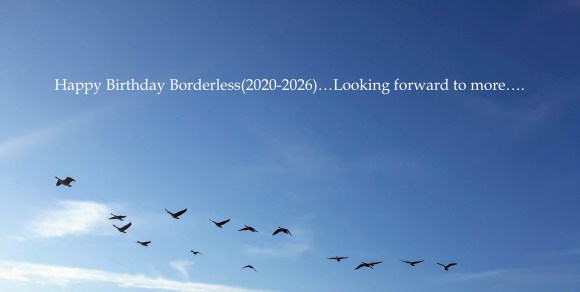
Six years ago, a few of us got together to bring out the first issue of Borderless Journal. We started as a daily blog and then congealed into a monthly journal offering content that transcends artificial borders to meet with the commonality of felt emotions, celebrating humanity and the Universe. Today as we complete six years of our existence in the clouds, we would like to celebrate with all writers and readers who made our existence a reality. We invite you to savour writings collected over the years that reflect and revel in transcending borders, touching hearts and some even make us laugh while exploring norms. 

In this special issue. we can only offer a small sample of writings but you can access many more like these ones at our site…Without further ado, let us harmonise with words. We invite you to lose yourselves in a borderless world in these trying times.

Poetry

Click on the names to read

Jared CarterSnehaprava Das,  Manahil Tahir, Ryan Quinn Flanagan,  Luis Cuauhtémoc BerriozábalSaptarshi Bhattacharya, John Swain, Ron Pickett, Saba Zahoor, Momina Raza, Annette GagliardiJenny Middleton, Afsar Mohammad, Rhys Hughes, George FreekMitra SamalLizzie PackerShamik BanerjeeMaithreyi Karnoor,  Hela Tekali, Rakhi Dalal, Prithvijeet SinhaAsad Latif, Stuart MacFarlane

Isa Kamari translates his poems from Malay in The Lost Mantras. Click here to read.

Two of her own Persian poems have been written and translated by Akram Yazdani. Click here to read.

A Poet in Exile by Dmitry Blizniuk has been translated from Ukranian by Sergey Gerasimov. Click here to read.

Refugee in my Own Country/ I am Ukraine… Poetry by Lesya Bakun of Ukraine. Click here to read. 

Sukanta Bhattacharya’s poem, Therefore, has been translated from Bengali by Kiriti Sengupta. Click here to read.

Amalkanti by Nirendranath Chakraborty has been translated from Bengali by Debali Mookerjea-Leonard. Click here to read

Ye Shao-weng’s poetry ( 1100-1150) has been translated from Mandarin by Rex Tan. Click here to read.

Rebel or ‘Bidrohi’, Nazrul’s signature poem, ‘Bidrohi‘, translated by Professor Fakrul Alam. Click here to read.

Manish Ghatak’s Aagun taader Praan (Fire is their Life) has been translated from Bengali by Indrayudh Sinha. Click here to read.

Tagore’s poem, Tomar Shonkho Dhulay Porey (your conch lies in the dust), has been translated from Bengali by Mitali Chakravarty as ‘The Conch Calls’. Click here to read.

Waiting for Godot by Akbar Barakzai; Akbar Barakzai’s poem has been translated by Fazal Baloch. Click here to read.

Ihlwha Choi spent some time in Santiniketan and here are poems he wrote in reaction to his observations near the ‘home of R.Tagore’, as he names Santiniketan and the Kobiguru. Click here to read Nandini.

Fiction

Flash Fiction: Peregrine: Brindley Hallam Dennis tells us the story of a cat and a human. Click here to read.

Rituals in the Garden: Marcelo Medone discusses motherhood, aging and loss in this poignant flash fiction from Argentina. Click here to read.

Navigational Error: Luke P.G. Draper explores the impact of pollution with a short compelling narrative. Click here to read.

Henrik’s Journey: Farah Ghuznavi follows a conglomerate of people on board a flight to address issues ranging from Rohingyas to race bias. Click here to read.

The Magic Staff , a poignant short story about a Rohingya child by Shaheen Akhtar, translated from Bengali by Arifa Ghani Rahman. Click here to read.

A Cat Story : Sohana Manzoor leaves one wondering if the story is about felines or… Click here to read. 

Pus Ki Raat or A Frigid Winter Night by Munshi Premchand has been translated from Hindi by C Christine Fair. Click here to read. 

American WifeSuzanne Kamata gives a short story set set in the Obon festival in Japan. Click hereto read.

Hena, a short story by Nazrul, has been translated from Bengali by Sohana Manzoor. Click here to read. 

A Queen is Crowned: Farhanaz Rabbani traces the awakening of self worth. Click here to read.

A Penguin’s Story: Sreelekha Chatterjee writes a story from a penguin’s perspective. Click here to read.

Disappearance by Bitan Chakraborty has been translated from Bengali by Kiriti Sengupta. Click here to read.

The Sixth Man: C. J. Anderson-Wu tells a story around disappearances during Taiwan’s White terror. Click here to read.

Looking for Evans: Rashida Murphy writes a light-hearted story about a faux pas. Click here to read.

Used Steinways: Jonathan B. Ferrini shares a story about pianos and people set in Los Angeles. Click here to read.

The Beaten Rooster, a short story by Hamiruddin Middya, has been translated from Bengali by V Ramaswamy. Click here to read.

The Onion: JK Miller brings to us the story of a child in Khan Yunis. Click here to read.

Santa in the Autorickshaw: Snigdha Agrawal takes us to meet a syncretic spirit with a heartwarming but light touch. Click here to read.

The Untold Story: Neeman Sobhan gives us the story of a refugee from the 1971 Bangladesh Liberation War. Click here to read. 

The Wise Words of the Sun: Naramsetti Umamaheswararao relates a fable involving elements of nature. Click here to read.

The Headstone, a poignant story by Sharaf Shad has been translated by Fazal Baloch. Click here to read.

Sandy Cannot Write: Devraj Singh Kalsi takes us into the world of adverstising and glamour. Click here to read.

Musalmanir Galpa (A Muslim Woman’s Story) Tagore’s short story has been translated by Aruna Chakravarti. Click here to read.

Non-Fiction

 Haiku for Rwandan Girls: Suzanne Kamata writes of her trip to Africa where she teaches and learns from youngsters. Click here to read.

Menaced by a Marine Heatwave: Meredith Stephens writes of how global warming is impacting marine life in South Australia. Click here to read.

 ‘All Creatures Great and Small’: Devraj Singh Kalsi writes of animal interactions. Click here to read.

One Life, One Love, 300 Children: Keith Lyons writes of a woman who looked after 300 children. Click here to read.

When West Meets East & Greatness Blooms: Debraj Mookerjee reflects on how syncretism impacts greats like Tagore,Tolstoy, Emerson, Martin Luther King Jr, Gandhi and many more. Click here to read.

The Day Michael Jackson Died: A tribute  by Julian Matthews to the great talented star who died amidst ignominy and controversy. Click here to read.

Amrita Sher-Gil: An Avant-Garde Blender of the East & West: Bhaskar Parichha shows how Amrita Sher-Gil’s art absorbed the best of the East and the West. Click here to read.

Dramatising an Evolving Consciousness: Theatre with Nithari’s Children: Sanjay Kumar gives us a glimpse of how theatre has been used to transcend trauma and create bridges. Click here to read.

Potable Water Crisis & the Sunderbans: Camellia Biswas, a visitor to Sunderbans during the cyclone Alia, turns environmentalist and writes about the potable water issue faced by locals. Click here to read.

T.S Eliot’s The Waste Land: Finding Hope in Darkness: Dan Maloche muses on the century-old poem and its current relevance. Click here to read. 

 My Love for RK NarayanRhys Hughes discusses the novels by ths legendary writer from India. Click here to read.

Travels of Debendranath Tagore : These are travel narratives by Debendranath Tagore, father of Rabindranath Tagore, translated from Bengali by Somdatta Mandal. Click here to read.

The Comet’s Trail: Remembering Kazi Nazrul Islam: Radha Chakravarty pays tribute to the rebel poet of Bengal. Click here to read.

From Srinagar to Ladakh: A Cyclist’s Diary: Farouk Gulsara travels from Malaysia for a cycling adventure in Kashmir. Click here to read.

 Baraf Pora (Snowfall): This narrative gives a glimpse of Tagore’s first experience of snowfall in Brighton and published in the Tagore family journal, Balak (Children), has been translated by Somdatta Mandal . Click here to read.

In The Hidden Kingdom of Bhutan: Mohul Bhowmick explores Bhutan with words and his camera. Click here to read.

The Day of Annihilation: An essay on climate change by Kazi Nazrul Islam has been translated from Bengali by Radha Chakravarty. Click here to read.

Reminiscences from a Gallery: The Other Ray: Dolly Narang muses on Satyajit Ray’s world beyond films and shares a note by the maestro and an essay on his art by the eminent artist, Paritosh Sen. Click here to read.

The Bauls of Bengal: Aruna Chakravarti writes of wandering minstrels called bauls and the impact they had on Tagore. Click here to read.

The Literary Club of 18th Century London: Professor Fakrul Alam writes on literary club traditions of Dhaka, Kolkata and an old one from London. Click here to read.

From Madagascar to Japan: An Adventure or a Dream: Randriamamonjisoa Sylvie Valencia writes of her journey from Africa to Japan with a personal touch. Click here to read.

250 Years of Jane Austen: A Tribute: Meenakshi Malhotra pays a tribute to the writer. Click here to read.

The Chickpea That Logged More Mileage Than You: Ravi Varmman K Kanniappan gives an interesting account of the chickpeas journey through time and space, woven with a bit of irony. Click here to read.

The Day the Earth Quaked : Amy Sawitta Lefevre gives an eyewitness account of the March 28th earthquake from Bangkok. Click here to read.

Where Should We Go After the Last Frontiers: Ahamad Rayees writes from a village in Kashmir which homed refugees and still faced bombing. Click here to read.

The Last of the Barbers: How the Saloon Became the Salon (and Where the Gossip Went): Charudutta Panigrahi writes an essay steeped in nostalgia and yet weaving in the present. Click here to read.

That Time of Year: Rick Bailey muses about the passage of years. Click here to read.

The Untold Stories of a Wooden Suitcase: Larry S. Su recounts his past in China and weaves a narrative of resilience. Click here to read.

Adventures of a Backpacking Granny: Sybil Pretious recalls her travels across the world post sixty, including Kiliminjaro. Click here to read.
Categories
Contents

Borderless, July 2022

Art by Sohana Manzoor

Editorial

Whispers of Stones… Click here to read.

Translations

Tagore’s Mono Mor Megher Shongi (‘The Clouds, My Friends‘)has been translated by Professor Fakrul Alam. Click here to read.

The Welcome, a skit by Tagore, has been translated by Somdatta Mandal. Click here to read.

The Bus Conductor, a short story by Dalip Kaur Tiwana has been translated from Punjabi by C. Christine Fair. Click here to read.

Hasan Sol: A Balochi Folktale from Geedi Kessah-4(Folktales Vol: 4) compiled and retold by Gulzar Khan Mari, has been translated by Fazal Baloch from Balochi. Click here to read.

Cry of the Sunflower written in Korean and translated to English by Ihlwha Choi, a poem for Ukraine. Click here to read.

Tagore’s Nobobarsha (or ‘New Rains’) has been translated by Mitali Chakravarty. Click here to read.

Pandies’ Corner

This narrative is written by a youngster from the Nithari village who transcended childhood trauma and deprivation. Lockdown had been written in Hindustani by Jishan and translated to English by Grace M Sukanya. Click here to read.

Poetry

Click on the names to read

Michael R Burch, Supatra Sen, Jenny Middleton, Pramod Rastogi, Ron Pickett, George Freek, Devangshu Dutta, Candice Louisa Daquin, David Francis, Raja Chakraborty, Michael Lee Johnson, Ashok Suri, Ryan Quinn Flanagan, Sutputra Radheye, Maid Corbic, Rhys Hughes

Poets, Poetry & Rhys Hughes

In The Anthology in my Mind, Rhys Hughes talks of a make believe anthology. Click here to read and find out what he imagines.

Conversations

Eminent film journalist, Ratnottama Sengupta, converses with legendary actress, Deepti Naval, on her literary aspirations at the Simla Literary festival, Unmesh, in June 2022. Click here to read.

Keith Lyons interviews Steve Carr, a writer who has written 500 short stories and has founded the Sweetycat Press. Click here to read.

Stories

A Cat Story

Sohana Manzoor leaves one wondering if the story is about felines or… Click here to read.

My Christmas Eve “Alone”

Erwin Coomb has a strange encounter at night. Is it real? Click here to read.

Bus Stop

The story by Rinu Antony focusses on chance encounter at a bus stop. Click here to read.

Murder at the ‘Pozzo di San Patriza’

Paul Mirabile travels to 1970s Italy to experience a crime inside a sixteenth century well. Click here to read.

Musings/ Slices from Life

Grune Point and an Inkling of Eternity

A poetic account by Mike Smith as he explores the area that hovers between England and Scotland. Click here to read.

Olympic Game Farm: Meeting and Greeting Animals from Disney Movies

Hema Ravi visits a farm that houses animals that had a past in Disney. Click here to read.

Notes from Japan

In A Visit to the Isamu Noguchi Garden Museum, Suzanne Kamata visits a Museum dedicated to an American Japanese artist. Click here to read.

Musings of a Copywriter

In Shopping for my Funeral, Devraj Singh Kalsi goes on a bizarre spree. Click here to read.

Mission Earth

In On a Bamboo Bicycle from Thailand to Indonesia, Kenny Peavy revisits his trip across Asia exploring the biodiversity and conservation efforts. Click here to read.

Essays

Discovering Books and Places: The Voyage from Eden

Meredith Stephens sails the Australian coastline, recording her experiences with words and her camera. Click here to read.

Trekking to Tilicho Lake

Ravi Shankar treks up to Tilicho Tal at 4940 m. Click here to read his trekking adventures.

A Modern-day Animal Fable with Twists

Dan Meloche visits a contemporary Canadian novel written as an animal fable to draw an unexpected inference. Click here to read.

The Observant Immigrant

Is it okay to be ordinary? by Candice Louisa Daquin explores the responses of people to being accepted as ordinary. Click here to read.

Book Excerpts

An excerpt from The Mendicant Prince (based on the Bhawal sannyasi case) by Aruna Chakravarty. Click here to read.

An excerpt from Nabendu Ghosh’s Dadamoni: The Life and Times of Ashok Kumar. Click here to read.

Book Reviews

Meenakshi Malhotra reviews Tagore’s Gleanings of the Road translated by Somdatta Mandal. Click here to read.

Rakhi Dalal reviews Geetanjali Shree’s Mai, Silently Mother, a Sahitya Akademi winning translation of the Hindi novel by Nita Kumar. Click here to read.

Indrashish Banerjee reviews Nabendu Ghosh’s Dadamoni: The Life and Times of Ashok Kumar. Click here to read.

Bhaskar Parichha reviews Prosanta Chakrabarty’s Explaining Life Through Evolution. Click here to read.

Categories
Essay

A Modern-day Animal Fable with Twists

Dan Meloche visits a contemporary Canadian novel written as an animal fable to draw an unexpected inference

Apologues, or animal fables, deepen our understanding of aspects of the human experience. In both Richard Adams’s Watership Down and George Orwell’s Animal Farm, the authors’ anthropomorphised rabbits and farm animals struggle with class division, malevolent leadership, and violence. Mirroring current or historical political realities, these books remain popular as cautionary tales. Similarly cautionary, Andre Alexis’s award-winning novel,  Fifteen Dogs: An Apologue (2015), provides a twist to the typical apologue genre. Alexis’s animals are not attributed human qualities but become human-like when transformed with human consciousness. Less politically and more philosophical, Alexis’s apologue highlights each dog’s response to the dubious gift of human consciousness and intelligence:

“‘I’ll wager a year’s servitude,’ said Apollo, ‘that animals – any animal you choose – would be even more unhappy than humans are, if they had human intelligence.

An earth year? I’ll take that bet, said Hermes, but on condition that if at the end of its life, even one of the creatures is happy, I win.’”

Only three dogs embrace the gift of human consciousness that leads to a “new language flowered within them”. This new language is most significantly embraced by Prince, the only dog that is happy at the end of his life. Throughout the novel, Alexis traces Prince’s journey and the path that leads to his happiness. His path begins with exile after defying pack leadership by refusing to curb his desire for language expansion and poetic expression. Also separated from the pack are two other human consciousness embracers, Benjy and Majnoun. When Benjy and Majnoun die, Prince becomes the lamplighter of their endangered language. Until his death, Prince carries with him Hermes warning: “if you die, your way of speaking dies with you.” By passing on his poetry, Prince abides the warning, saves the language, and ensures his happiness in his darkest hour.

At the outset, Prince revels in his expanded consciousness in the face of threatening forces. Following their escape from the veterinarian clinic, the dogs gather in a coppice to begin the sorting out of dogs wishing to stay “dog” and dogs willing to explore their new expanded consciousness., Atticus, the “crumpled-face” and “natural hunter of small animals,” assumes pack leadership and encourages his fellow canines to stay “dog” and deny the gift of human consciousness. For Atticus and his sycophants, denying human consciousness means denying language development and other ‘non-dog’ behaviour. According to Atticus, dogs already have a language of barks and growls sufficient to communicate basic need and social standing. To Prince, who “entirely embraced the change in consciousness,” language expansion is necessary to express the “new way of seeing, an angle that made all that he had known strange and wonderful.”

Overwhelmed by the wonder of his heightened consciousness, Prince moves beyond his old ‘dogness’ to declare his expanded awareness and express himself in verse:

“The grass is wet on the hill.

The sky has no end.

For the dog who waits for his mistress,

Madge, noon comes again.”

In the last line, Prince plays on the name of his friend Majnoun, a similarly awoken dog. This connection with Majnoun affirms Prince’s poetic spirit and establishes fidelity to the new language. However, Atticus’s henchmen Max, Frick, and Frack are more interested in affirming pack order and want to tear Prince to pieces. Oblivious to Frack and Frick’s menacing postures, Prince, encouraged by from Athena, Bella, and Majnoun, indulges his small audience with more verse:

“Beyond the hills, a master is

who knows our secret names.

With bell and bones, he’ll call us home,

winter, fall, or spring.”

With his cryptic suggestion of a new order of things, Prince’s words are enlightening to some and enraging to others. This second poem entrenches the pack’s two camps: those wanting more poetry, thereby embracing the gift of consciousness, and those unsettled by the “strange talk.” Threatened by Prince’s poetry, the latter camp acts to secure pack order.

After a murderous pack cleansing, Prince escapes into exile to revel in his expanded consciousness. With that comes more poetry, more language. Yet, what good is a language in solitude? Rambling through Toronto’s urban expanse, Prince craves reunion with his pack mates: “But what am I without those who understand me?” Also exiled, Majnoun and Benjy remain psychically connected to Prince. Inspired by Prince and his artful musings on his expanded consciousness, Majnoun tries his hand at poetic expression. Despite its curious subject, Majnoun’s verse is presented as love poetry to his master Nira:   

“In China, where wild dogs are eaten,

I am dismayed to be in season.

I curse men who think of me as food

and dream of rickshaws, and lacquered wood.”

Also inspired by the poet dog, Benjy draws on Prince’s courage to ponder what is seen through their new human lens. Looking across the limitless expanse of Lake Ontario, Benjy wonders: “Why should this bluish, non-land be? And how far did it extend?” Benjy’s philosophical rumination then causes the poet dog, Prince, to magically appear.

Overcome with joy and “tongue lolling out,” Prince revels in his delight in seeing Benjy. Mostly, Prince is happy to affirm that their pack language lives on in at least one other dog. With hope renewed, Prince circles the embarrassed Benjy: “It was as if he were chasing the delight that animated him.” His animation is quickly deflated when Benjy tells Prince of the pack’s obliteration in the Garden of Death. For Prince, the dwindling pack size threatens preservation of the pack’s language: “And his cries were such an unfettered expression of grief that even the humans in the distance stopped to listen.” To affirm the language’s vibrancy, Prince offers a poem as balm:     

“With one paw, trying

the edges of the winter pond,

finding it waters solid,

he advances, nails sliding,

still far from home.”

Nonplussed, Benjy shows no interest in Prince’s description of a dog’s tenuous existence: “He knew no word for boredom, but the feeling was accompanied by a nearly palpable desire to have Prince stop talking.” Less interested in the pack language, Benjy is more interested in reciting Vanity Fair to his master. For Benjy, this party trick secures home and comfort better than a dying language. When Benjy brings Prince home with him, the English speaking, literature quoting Benjy receives an enthusiastic reception while Prince is shown the curb: “In this way, as suddenly as he’d regained a pack mate, Prince lost the dog he believed was the last to share his language.” As the three remaining dogs approach death, the fate of their pack language moves closer to extinction.

While Prince dies happy, his consciousness embracing counterparts, Benjy and Majoun, share crueler fates. After killing off most of the pack (Atticus, Rosie, Frick and Frack) by leading them to a “garden of death,” Benjy invokes a retributive Zeus. Fulfilling Atticus’s final wish, Zeus punishes Benjy with a horrific death: “as if a fire were moving deliberately through the den of his body”. In his moment of death, Benjy “conjures hope” for a place where a just world establishes “balance, order, right and pleasure”. Although Hermes pleads his case that hope is a manifestation of happiness, Apollo dismisses hope as “a dimension of the mortal, nothing more.”

After a five-year vigil pining for his missing master, Majnoun approaches death heavy with the ravages of unreciprocated love. Tormented with more than just a broken heart, Majnoun struggles with unresolvable questions: “What, he wondered, did it mean to be human?” As Hermes tried to explain to Majnoun, a dog will never understand love the same way as a human. Unable to square his canine-human experience, Majoun rests uneasily “adrift between species.” Bearing witness to Majnoun’s philosophical torments, Zeus strong arms the Fates to mercifully cut short the thread of the lovestruck dog’s life.  Heart-broken, philosophically perplexed and, consequently, unhappy, Majnoun makes his transition.

How, then, is Prince’s response to consciousness different from the experiences of his awoken confederates? Benjy’s final appeal for a just world can only be followed with the unhappiness that results from recognising that such a thing is impossible. Also given to unreasonable expectations, Majnoun cannot find happiness as he’s unable to neither bridge the canine-human divide, nor mend his broken heart. While Benjy and Majnoun base their happiness on things over which they have no control (the entire world and Nira’s love), Prince’s goal is to preserve the pack language: “There was at least one thing he loved, one thing that would be with him always; his pack’s language.”

By saving the pack language, Prince saves himself from misery. In his death throes, Prince loses his sight. Fearing the same fate for his language, “in a heroic effort to preserve his language, Prince began to speak his poems to the woman.” When Prince hears his human guardian repeat his poetry, happiness comes: “Somewhere, within some other being, his beautiful language existed as a possibility, perhaps as a seed.”

For Hermes and Apollo, that seed represents access to the eternal. As they both agree to the indisputability of Prince’s happiness prior to death, the sons of Zeus acknowledge the notion claimed by all immortals that “all true poetry existed in an eternal present, eternally new, its language undying.” By preserving the language and passing on his poetry, Prince gains access to the eternal. As his poetry exists eternally, so will he, thus overcoming the greatest fear of those governed by human consciousness. In a uniquely human way, Prince’s happiness comes from realising that the surest antidote to the fear of death is the most transcendent and eternal of emotions: “In his final moment on earth, Prince loved and knew that he was loved in return.”

Dan Meloche is a full-time professor at Algonquin College in Ottawa. When he isn’t teaching English and economics, he reads widely and writes literary criticism, reviews, poetry, and personal account essays.

.

PLEASE NOTE: ARTICLES CAN ONLY BE REPRODUCED IN OTHER SITES WITH DUE ACKNOWLEDGEMENT TO BORDERLESS JOURNAL