Categories
Stories

A Troubled Soul

By Mahim Hussain

Amma[1], it . . . it feels like fire is running through my veins!”

These were the words Abir uttered sitting on the rear seat of their car. His mother, a fifty-five-year-old woman, was sitting right beside him. She was trying to help her son any way she could to relieve him of his suffering. With moist eyes, she kept massaging Abir’s hands and neck constantly.

“Everything is going to be all right, abba[2]. Try to relax,” she said to her son.

Leaving other cars behind, the white Toyota sped through the street – piercing the thickness of the night. Their deft driver devoted all his attention to dodging and overtaking other cars on the road. The car had headed to the Labaid Hospital, situated in the Dhanmondi area of the bustling city of Dhaka.

Abir’s older brother, Rafique, was sitting in the front seat next to the driver. He kept turning back frequently to see how his younger brother was doing.

Amma . . . I can’t breathe . . . I can’t breathe amma!” Abir cried out to his mother.

Abir’s mother pleaded with Rafique to lower the wind shield on his side. Without being asked, the driver flicked a switch swiftly, and the windshield came down with a whirring sound. Abir, with the help of his mother, managed to get his head out of the window to breathe fresh air. With his head sticking outside the car, he could see the taillights of the passing cars growing faint in the distance. To the boy, it seemed like red and yellow fairies were flying in the darkness. Soon, Abir slid back on his mom’s lap, as he could no longer bear the weight of his head.

“Don’t worry, amma. We will get their soon,” Rafique tried to console his anxious mother.   

About forty minutes later, the car entered through the lofty gate of the hospital – battling an abysmal traffic jam. They were lucky it was a weekend. On any other night of the week, it would have taken them at least an hour and a half to get there from the Mirpur area. By the time they arrived at the emergency entrance, Abir had already lost his consciousness. He could not move any of his limbs or open his eyes.

A door man and two female nurses came out of the emergency department running. They carefully hauled Abir out of the car. Then, putting him on a stretcher, they hastily took the boy inside the emergency department. Rafique and his mother ran after them, frantically.

Passing a long corridor, they entered a ward. The nurses again lifted Abir gently off the stretcher and laid him on one of the empty beds. At ten-thirty of the night, the whole ward was empty and quiet. The nurses started to commence their usual protocol. One nurse put a clip of a pulse meter on the boy’s index finger of his right hand. It was attached to a screen above the bed with a cord. Another nurse tied the strap of a blood pressure machine, connected to the same screen. While Abir’s family was worried to see him unconscious, one of the nurses tried to calm them down. She told Rafique to accompany her to the information desk and fill out some forms. The other nurse kept her eyes on the screen, monitoring the patient’s vitals.

After observing the patient for about ten minutes, the nurse blurted out: “His pulse is too weak. I am calling the duty doctor.”

“Ha! What happened nurse? What’s wrong with my son?” cried out the mother.

Without responding to her, the nurse ran out of the ward in a hurry. Abir’s mother was in tears. She started rubbing Abir’s chest incessantly, overwhelmed by apprehension.

Before long, the nurse came running with the duty doctor. After glancing at the monitor for a moment, the doctor turned around and said to the nurse: “The pulse and pressure rates are too low. We can’t treat him here.”

By this time, Rafique was back. The female doctor told him that they didn’t have all the equipments in the emergency ward to treat a critical patient like his brother.

While the doctor and Rafique were engaged in a discussion, suddenly, Abir started having convulsion.

“Nurse, call the ICU upstairs. Tell them that we are bringing a patient, quickly!” the doctor passed the order.

As the hospital staff pushed the movable bed and took the boy inside an elevator, Abir’s mother started to lament.

“What’s happened to my little boy, Rafique? Bring my Abir back to me . . .  bring him back!”                     

Rafique took his mother in his arms and held her tightly. He too was on the verge of falling apart. But he bit his lips and managed to keep his poise. Rafique was the eldest son. If he had broken down, who was going to take care of his family? With glistening eyes, Rafique recalled the fateful day when it all started.

Rafique entered their apartment of a three-storied building with a heavy, black briefcase in his hand. Their family doctor walked behind him with brisk steps. Going past the dining room, they walked straight inside Abir’s bedroom.

As soon as they entered, Rafique felt a piece of glass getting crushed under his left shoe. Raising his head, he saw broken pieces of a plate and some food were strewn all over the floor. His mother was cleaning up the mess with a sweep and a scraper. His father, seated on Abir’s bed, stood up seeing the doctor.

“Look, doctor, what he has done to himself this time,” said Abir’s father, pointing at his son in the bed.

The doctor looked at the boy over his reading glasses.

Sixteen-year-old Abir was lying in the bed quietly. But his chest was rising and falling in quick succession. He had his face covered with his forearms. A white bandage was wrapped around his left wrist. On one side of the bandage, blood had seeped through and had left a big stain.

“Some time last night, he tried to cut the veins of his wrist with a blade,” Abir’s father related with a distressed tone. “This morning we found him in the bed with blood all over the bed sheet.”

The doctor kept his gaze fixed on the boy and listened to Abir’s father intently.

 “Moreover, he has not eaten anything in two days. A few minutes ago, his mother brought some food for him. But as soon as she got close to him, he took the plate off her hand and smashed it on the floor. He has been having angry outbursts quite frequently these last few days,” added the father.

The doctor slowly walked to the bed and sat beside the boy warily.

“Well, dear boy. Let uncle see your hand,” saying this, he gently picked up Abir’s wounded hand. The doctor examined his wrist from different angles and tried checking his pulse.

Only a few moments had passed, when suddenly, Abir sat up and pulled his arm out of the doctor’s hand with a savage jerk.

“Let go of my hand, you devil!” screamed the boy.

The doctor jumped off the bed, and Abir’s parents lunged to restrain the boy. Rafique kept the doctor from losing balance, and quickly took him in the dining room.

He sat the doctor at the table and poured him a glass of water.

Glug, glug, glug, ahh . . .

“Rafique, I don’t think Abir was able to cut any of his major veins. If he did, he would have bled out over the night and have been unconscious by now. The bandage on his wrist was done nicely and the bleeding has stopped.” confirmed the doctor. “However, as you have shared with me earlier, Abir has been showing such erratic behavior for several months now. So, his problem is actually psychiatric rather than physical.”

“Yes, doctor. We have taken him to a psychiatrist named Samsul Huq, twice. But during the last session, he suddenly got violent and hurled a glass of water at the doctor. Thankfully no one got hurt. But after that, we could not take him to the doctor again,” shared Rafique.  

“Humn . . . At this moment, he is not in the condition to be taken anywhere. So, I suggest you go back to the psychiatrist and tell him about Abir’s present condition,” concluded the doctor.                                                                     

*

Doctor Huq’s chamber was in a mental health rehabilitation center in the affluent neighbourhood of Gulshan. Rafique had been sitting outside his chamber with other visitors. It was a big lobby under a wooden shed. There were about thirty people outside the chamber, waiting for their turn. A middle-aged man was sitting behind a small table facing the visitors. As patients were coming out of the room, the assistant was calling the next person in serial. Rafique had been waiting there for about two hours now. Feeling bored and exhausted, he was snoozing sitting on his cozy little chair.

“Mr. Rafique Ahmed . . . who is Rafique Ahmed?” inquired the assistant sternly.

When his name was called loudly a second time, Rafique woke with a shudder. In frenetic motion, he got off the chair and almost dashed inside the chamber.

It was a spacious, soundproof room with a gigantic air-cooler hanging above the door. On the far end of the room, there was a big mahogany desk. In the middle of the desk, there was a plastic dummy head with an open brain coming out of it. Beside it, there was a pile of big, thick medical books and journals on one side of the desk. On the other side were two pen holders containing pens of different colors and design. In the front of the desk, there were two cane-made chairs for the visitors to sit on. A few feet from them lay a big, comfortable couch on which a patient could easily lie down. The doctor was sitting on the other side of the desk on a reclining chair the size of a throne.

Professor Huq was an elderly man with long, cotton-like beard and hair. He always wore a fatua[3] and loose pajamas and a big smile on his face. As soon as Rafique entered, the doctor recognised him. It was Rafique who had accompanied Abir to his clinic a week ago. The doctor nodded and made a gestured with his hand, telling him to take a sit.

“How are you doing? Didn’t you bring your brother today?” asked the doctor.

“No, doctor, Abir is not doing too well. He is having mood swings again. Two days ago, he tried to kill himself by slashing his wrist. We don’t understand what is going on with him. Why is he acting like this, doctor?” exclaimed Rafique in a tensed voice.

“Well, Mr. Rafique, I’ve told you on the first day that Abir is showing symptoms of bi-polar disorder. A typical bi-polar person has periods of energetic activities followed by bouts of severe depression. But some of these symptoms may vary from person to person. In your brother’s case, he has moments of angry outbursts followed by long periods of depression. And it’s not uncommon for bi-polars to have suicidal thoughts,” informed the doctor.

“But, doctor, how are we supposed to thwart him from harming himself?” inquired Rafique.

“The condition he is in right now, he needs to take some medications. Here, I am writing down the name of a medicine called Lithosun SR, which contains the chemical lithium. Across the world, lithium has been proven to prevent suicidal thoughts. But there is a catch. Too much of lithium can cause toxicity in the blood, which could be fatal. Therefore, he should take exactly 400 mg per day, and not more than that. In addition, Abir needs to have his blood tested every fortnight to check the level of lithium in his body,” enlightened the doctor.

After that, he tore a page from his pad and handed it to Rafique.

*


At six in the evening on the Friday night, Abir was sitting on his study table. It was a medium sized table with a bookshelf attached on one side. The shelf was laden with books, copies and note papers. A history book was open in front of him. Because of his illness, the boy had not been able to attend his school for two months. His final term exam was in two weeks. After taking the prescribed medication for a month, his thoughts of self-harm started to subside.

It had been an hour. The boy was struggling to focus on the book. But so far, he had not been able to read a single line. He was having difficulty concentrating. All kinds of negative thoughts were churning inside his fragile mind. Soon, fat tears started trickling down his cheeks. Abir could not fathom, why was he unable to control his emotions? Why did he feel so gloomy and miserable all the time?

Unable to bear the frustration anymore, suddenly he stood up with a grunt and tore the book into small pieces. Then, he picked up other books from the bookshelf and started throwing them in the air. This rampage lasted a few minutes. Then, he dashed away from the table, crashed on his bed and started to sob burying his face in the pillow.

After lying there motionless for a while, the boy raised his head for a moment. Incidentally, his eyes fell on the side table attached to his bed. He saw the container of his medication lying on the table, beside his bottle of water.

If I took some extra pills, it should help me get rid of the melancholic thoughts.

Slowly, he clambered on the side of the bed and picked up the container. Popping it open in a fit of impulse, her started pushing several pills down his throat at once and drank a lot of water. Afterward, he lay in the bed, still struggling to harness his emotions.

Around 08:00 p.m., Abir’s mother knocked on his door.

Baba[4] Abir? Come out, son. Dinner has been served.”

Not getting any response for a while, she opened the door which was unlocked from inside. Walking in, she was flabbergasted to find torn books and papers scattered on the floor. Facing the other way, her son was lying in the bed and seemed to be asleep.

The mother walked to the bed and sat next to him.

“Abir? What’s wrong, abba?”                        

There was no response. His mother got little concerned. She held his shoulder and turned his torso toward her.

“Wake up, sweetheart. The dinner is getting cold.”

After calling him several times, the boy lifted his heavy eyelids gradually.

Amma . . . I am not feeling so well. My . . . my head is throbbing in pain.”

Saying these words, the boy closed his eyes again. His mother nudged his shoulder several times, trying to keep him awake. But the boy slowly succumbed deeper and deeper to the side effect of the medicine.

“Mr. Rafque . . . Mr. Rafique!”

The voice of the duty doctor brought the man back to present time.

“What’s going on, doctor? How is my little brother doing,” asked Rafique agitatedly.

“Your brother has been shifted to the ICU. The overdose of the medicine has rendered him unconscious. We are trying to separate the toxic substance in his blood with some medicines and saline. But his pulse rate is still low. Nothing can be said until few hours pass,” reported the doctor and walked away.

Hearing this news, Abir’s mother started wailing and was at the brink of losing her senses. Rafique laid his mother on a bed and tried to pacify her.

Meanwhile, Abir lay in one corner of the ICU with all kinds of tubes and electric wires attached to his body – battling with death.

.

[1] Mother

[2] Father

[3] A short, kameez-like collarless shirt worn by people of South Asia

[4] Father

Mahim Hussain is a 38-year-old man and lives in Dhaka, Bangladesh. He couldn’t finish high school diploma. However, that did not deter him from reading and learning on his own.

PLEASE NOTE: ARTICLES CAN ONLY BE REPRODUCED IN OTHER SITES WITH DUE ACKNOWLEDGEMENT TO BORDERLESS JOURNAL

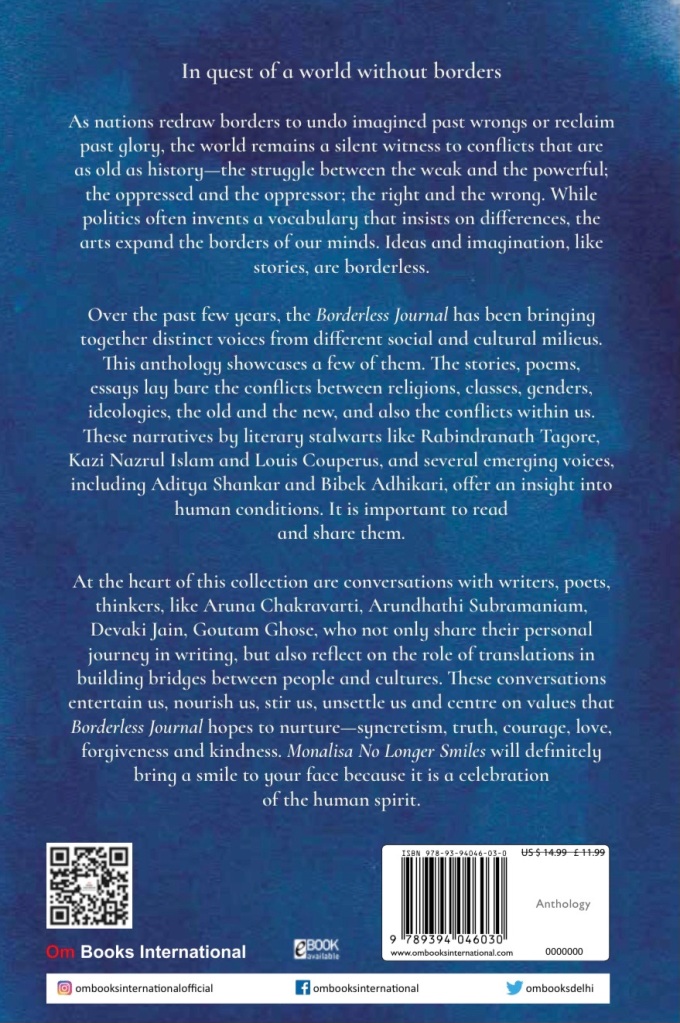
Click here to access the Borderless anthology, Monalisa No Longer Smiles

Click here to access Monalisa No Longer Smiles on Kindle Amazon International

Categories
Poetry

Masud Khan in Translation by Fakrul Alam

Homa-birds are mythical birds of Iranian origin
HOMA-BIRD 
 
Once I fall, how much must I drop down before I can rise up again? 
 
As this thought crosses my mind, I am reminded of the Homa-bird found high in the sky. It even lays its eggs there. The eggs then fall down. But because the bird lives so high in the sky its eggs take ages to fall. Its chicks hatch even as the eggs descend. And then it’s time for the chicks to fall. As they begin to fall the chicks sprout eyes and feathers and wings. And one day they discover that they are falling down and down. It is then that they begin to fly to their mothers high up in the sky. They fly so high now that they emerge as specks scattered all along the spread-out body of the sky
 
We are of the breed of these birds. We procreate, raise children; we drop down and rise up again!
 
[Homapakhi; Translated by Fakrul Alam]          

GONE WHO KNOWS WHERE 

An unending queue of children flowed forward
Going who knows where?
 
With great difficulty, I spotted my own child there.
But when I tried kissing him 
I ended up kissing someone else’s child!
 
And then I lost him— lost him forever! 
Dazed, distressed— I seem doomed to a lifetime of waiting.
 
[Aggato Uddesh; Translated by Fakrul Alam]


REJECTION
 
Abruptly today a baby is expelled from its mother’s breasts.
Though it keeps gravitating towards her— hopefully— 
It continues to be rejected. Startled, it still keeps trying.... 
   
How can the innocent baby make sense of such evictions? 
It can comprehend nothing— neither the implications 
Nor the reasons behind its mother’s bizarre actions. 
All it can do is wonder— is mother playing with it? 
Or is she just being cruel, suddenly unmotherly, 
Distracted by the sudden heat wave of the season? 
  
The baby broods, all alone, helpless. And then once again 
It turns towards its mother, only for another round of rejection... 
  
Now inconsolable, it breaks out into tears, feeling hurt     
And rejected, sobbing endlessly till sleep silences it... 
  
Only its craving for love keeps striking one’s ears 
Its magnitude scattering here, there, everywhere! 
      
[Protyakhyan; Translated by Fakrul Alam]          

Masud Khan (b. 1959) is a Bengali poet and writer. He has, authored nine volumes of poetry and three volumes of prose and fiction. His poems and fictions (in translation) have appeared in journals including Asiatic, Contemporary Literary Horizon, Six Seasons Review, Kaurab, 3c World Fiction, Ragazine.cc, Nebo: A literary Journal, Last Bench, Urhalpul, Tower Journal, Muse Poetry, Word Machine, and anthologies including Language for a New Century: Contemporary Poetry from the Middle East, Asia, and Beyond (W.W. Norton & Co., NY/London); Contemporary Literary Horizon Anthology,Bucharest; Intercontinental Anthology of Poetry on Universal Peace (Global Fraternity of Poets); and Padma Meghna Jamuna: Modern Poetry from Bangladesh(Foundation of SAARC Writers and Literature, New Delhi). Two volumes of his poems have been published as translations, Poems of Masud Khan(English), Antivirus Publications, UK, and Carnival Time and Other Poems (English and Spanish), Bibliotheca Universalis, Romania.  Born and brought up in Bangladesh, Masud Khan lives in Canada and teaches at a college in Toronto.

Fakrul Alam is an academic, translator and writer from Bangladesh. He has translated works of Jibonananda Das and Rabindranath Tagore into English and is the recipient of Bangla Academy Literary Award (2012) for translation and SAARC Literary Award (2012).

PLEASE NOTE: ARTICLES CAN ONLY BE REPRODUCED IN OTHER SITES WITH DUE ACKNOWLEDGEMENT TO BORDERLESS JOURNAL

Click here to access the Borderless anthology, Monalisa No Longer Smiles

Click here to access Monalisa No Longer Smiles on Kindle Amazon International

Categories
Poetry

Carnival Time

Poetry by Masud Khan, translated from the Bengali poem, ‘Aj Ullash Diba’ by Fakrul Alam

Courtesy: Creative Commons
It’s carnival time today.
Serfs and plebeians pour into streets.
Behold the giggling, decked up undertaker’s wife, 
That man over there, completely soused, is her spouse! 
He holds his pay tight in his fists and grins grotesquely, 
See the sweeper there, lips reddened by betel leaf!

There he is— the constable— sporting a shiny wristband. 
And look at that rotund young eunuch—
All merry, like dusky Abyssinians or Afghan revellers in the rain. 

Today it’s time to collect wages and bonuses and forget files. 
Today superiors have trade place with subordinates

And mandarins have transformed themselves into mere clerks.

The roly-poly slave and Kishorimohon Das
Sleep fitfully next to each other near the town reservoir, 
Stirred again and again by the mayor’s snores,

The hapless water bearer gets completely wet. 
The woman over there is a streetwalker,
Visiting town for the first time with her snotty-nosed brother. 
That man there trades in lead, and there is the perfume seller, 
He is the accountant, and he, the treasurer,
And next to him on this day of intermittent rain 
Is the petty thief’s no-good brother.
And there— leaning, bent by the weight of his imagination, 
As if in a trance, is the poet, the king of poets!

This day all have spilled out into the streets and stroll there 
Endlessly — intransitive
Wrapped in newly spun silk.


Masud Khan (b. 1959) is a Bengali poet and writer. He has, authored nine volumes of poetry and three volumes of prose and fiction. His poems and fictions (in translation) have appeared in journals including Asiatic, Contemporary Literary Horizon, Six Seasons Review, Kaurab, 3c World Fiction, Ragazine.cc, Nebo: A literary Journal, Last Bench, Urhalpul, Tower Journal, Muse Poetry, Word Machine, and anthologies including Language for a New Century: Contemporary Poetry from the Middle East, Asia, and Beyond (W.W. Norton & Co., NY/London); Contemporary Literary Horizon Anthology,Bucharest; Intercontinental Anthology of Poetry on Universal Peace (Global Fraternity of Poets); and Padma Meghna Jamuna: Modern Poetry from Bangladesh(Foundation of SAARC Writers and Literature, New Delhi). Two volumes of his poems have been published as translations, Poems of Masud Khan(English), Antivirus Publications, UK, and Carnival Time and Other Poems (English and Spanish), Bibliotheca Universalis, Romania.  Born and brought up in Bangladesh, Masud Khan lives in Canada and teaches at a college in Toronto.

Fakrul Alam is an academic, translator and writer from Bangladesh. He has translated works of Jibonananda Das and Rabindranath Tagore into English and is the recipient of Bangla Academy Literary Award (2012) for translation and SAARC Literary Award (2012).

PLEASE NOTE: ARTICLES CAN ONLY BE REPRODUCED IN OTHER SITES WITH DUE ACKNOWLEDGEMENT TO BORDERLESS JOURNAL

Click here to access the Borderless anthology, Monalisa No Longer Smiles

Click here to access Monalisa No Longer Smiles on Kindle Amazon International

Categories
Poetry

Addendum

By Md Mujib Ullah

addendum

if you look at my journey, from your point of view,
you will find, i have been grateful to people
who nurture me, encourage me, and criticise me to be better,
to make me a thoughtful and considerate human 
in times of crises, in the era of finance.
how can i forget those moments? 
i don’t ask you to be on my side
rather i want my own space, my territory.    
if you don’t know what’s happening inside and around the world,
how can you be updated? how can you be on par? 
you may not know what a bird thinks, and how a fish smiles in our region.
checking me is a violation, i am not a weapon of chess. 
and it matters when you don’t make any assumptions
about the issues. you are not heard of. do you know
what i am doing now apart from typing verses 
with my hands and looking at the device’s screen?
while you care about these, i am on top of the hour of hope.
i look outside my windows on a spring afternoon, 
to see how leaves fall from the trees, and to enjoy the breeze. 
pause. no endnote. no final full-stop. a continual task…

Md Mujib Ullah from Sandwip, Chittagong, Bangladesh, is a researcher, writer, and translator. His poems have appeared in Journal of Poetry TherapyTextAsiaticCapitalism Nature Socialism, and Postcolonial Text.  

PLEASE NOTE: ARTICLES CAN ONLY BE REPRODUCED IN OTHER SITES WITH DUE ACKNOWLEDGEMENT TO BORDERLESS JOURNAL

Click here to access the Borderless anthology, Monalisa No Longer Smiles

Click here to access Monalisa No Longer Smiles on Kindle Amazon International

Categories
Poetry

Kurigram

By Masud Khan: Translated from Bangla by Professor Fakrul Alam

Courtesy: Creative Commons
I’ve never been to Kurigram.

In the dead of night, sleeping Kurigram steadily detaches itself 
From the world that we know.
Ignores gravity completely 
Taking off with its tiny kingdom 
To some far-off galaxy.

We keep looking then at the deep blue of the sky 
While the tiny village becomes a speck up high.

For a long while Kurigram floats from one dome of heaven to another.
Till that star in the southern sky that pursued it so single-mindedly 
Settles by its side and claims it as its own.
Then from this new luminary
A mild red vaporous smell wafts across the sky.

In that realm, in Kurigram,
The Kingfisher and the Pankouri bird are stepbrothers. 
When all the rivers of Kurigram become calm
The two brothers make the river their home 
Squabbling with each other like families bickering!

When the river calms down again
The womenfolk, once bound by scriptural edicts, 
Throng to the riverbank.
Breaking all barriers,
They sparkle like large resplendent crystals.
 
Suddenly, a lonely babui bird, sans weaving skills, 
Perched on a battered old mast, starts swinging,
Finally settling down on the translucent steel-foiled river water. 
Kurigram, ah Kurigram!

Where Kurigram used to be
Is a dark and solitary space now.

Alas, I’ve never been to Kurigram
And I don’t think I ever will!

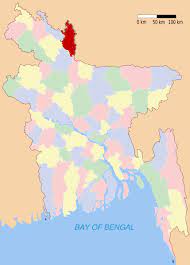
Kurigram—An innocuous town located in the northern region of Bangladesh
Paankouri—A species of bird, black in colour, found in marshes and rivers
Babui—A species of weaving bird
Kurigram is marked in red. Courtesy: Creative Commons

Masud Khan (b. 1959) is a Bengali poet and writer. He has, authored nine volumes of poetry and three volumes of prose and fiction. His poems and fictions (in translation) have appeared in journals including Asiatic, Contemporary Literary Horizon, Six Seasons Review, Kaurab, 3c World Fiction, Ragazine.cc, Nebo: A literary Journal, Last Bench, Urhalpul, Tower Journal, Muse Poetry, Word Machine, and anthologies including Language for a New Century: Contemporary Poetry from the Middle East, Asia, and Beyond (W.W. Norton & Co., NY/London); Contemporary Literary Horizon Anthology,Bucharest; Intercontinental Anthology of Poetry on Universal Peace (Global Fraternity of Poets); and Padma Meghna Jamuna: Modern Poetry from Bangladesh(Foundation of SAARC Writers and Literature, New Delhi). Two volumes of his poems have been published as translations, Poems of Masud Khan(English), Antivirus Publications, UK, and Carnival Time and Other Poems (English and Spanish), Bibliotheca Universalis, Romania.  Born and brought up in Bangladesh, Masud Khan lives in Canada and teaches at a college in Toronto.

Fakrul Alam is an academic, translator and writer from Bangladesh. He has translated works of Jibonananda Das and Rabindranath Tagore into English and is the recipient of Bangla Academy Literary Award (2012) for translation and SAARC Literary Award (2012).

PLEASE NOTE: ARTICLES CAN ONLY BE REPRODUCED IN OTHER SITES WITH DUE ACKNOWLEDGEMENT TO BORDERLESS JOURNAL

Click here to access the Borderless anthology, Monalisa No Longer Smiles

Categories
Stories

Letting Go

By Tasneem Hossain

Courtesy: Creative Commons

“If only you had some wisdom, then you would not have raised that issue. I am going to block you. I am going to sever all ties with you. Bye!” The harsh words kept echoing in Farzana’s head. Her eyes moistened. She could not control the incessant tears rolling down her cheeks. The man behind the counter looked at her sympathetically. Farzana tried to smile back but her face distorted. She had never ever been able to control her emotions.

She was standing in the immigration line to board the next plane to New York from Dhaka.

The last one year came flashing back.

She had come in contact with Tariq during an official online meeting in Bangladesh.

He was a man of great repute. They had to contact each other often for business purpose. Gradually, their relationship changed from that of an acquaintance to very close friends. They would talk almost every day. He would go on telling her about his life. How he had built a million dollar business. How unfortunate he had been in his personal life. She would listen patiently.

She met him twice during two workshops on financial management. Tariq had invited her many times but somehow they had never been able to meet in the real world.

Tariq was a short squarely built man. But there was an air of personality that was undeniably magnetic. His well-articulated deep voice and the twinkling smile in his eyes were enough to make women swoon over him. He was witty and had a sense of humour that made him very attractive. He had sharp twinkling eyes but something told Farzana that he was a sad man, hiding behind his witty and jovial nature.

Their professional relationship turned into friendship.

Tariq would tell her details of the problems he faced in life and ask her to pray for him. Farzana became emotionally attached to him as a friend and would pray for him religiously every day.

Four months passed. One day they were chatting lightly and having fun in an online conversation on Messenger. Suddenly, Tariq got irritated and muted the Messenger box. She had never faced anything like this before. She felt insulted. She called and urged him to unmute, but he was reluctant.

A week later Farzana sent Tariq birthday wishes on his phone.

He called her and apologised. He told her he was very sick that day and couldn’t control his anger and, hence, had muted her.

Life became normal. Months passed. Farzana would wait for him to call or message her. When he called he would go on talking about his problems, his life and sometimes even flirt with her. Farzana knew he was just having fun. She would ask him to be serious and then again they would have the normal conversations.  

She never called him because he was a busy person and he would remain sick for days too. Sometimes Farzana had doubts that he was lying to her.

“Why? We are not romantically involved. We are just friends so why does he lie to me?” she would ponder.

*

She was getting ready to meet Tariq today. He had invited her for a candle light dinner in one of the fanciest restaurants ‘Rose La France’. This was the first friendly meeting with him. Farzana wore a pink chiffon blouse and saree. The white pearl necklace set with earrings and bangles were a perfect match: simple, yet elegant.  As she looked in the mirror, a smile curled up on her face. The reflection of a tall fair woman with an athletic supple and strong physique with a pair of hazel coloured eyes and thick black eyelashes stared back. She brushed her shoulder length wavy auburn hair. She was an attractive woman in her 30s. She was aware of the fact that her presence, anywhere, made quite a few heads turn.

Tariq picked her from her home and they drove to the restaurant. Somehow Farzana felt very conscious of herself as Tariq smiled at her.

“You look ravishing.”

“Thank you,” she smiled.

“Is it happening? Is he falling in love with me?” Farzana was quiet for a while.

Farzana wanted to change the topic, “You can recite so well. Please recite the poem you were reciting on that day over the phone.”

“First you have to kiss me,” Tariq said mischievously.

Farzana burst into laughter. She couldn’t stop laughing.

Tariq looked intently at her.  

*

“Why do you text? Don’t text me.” suddenly Tariq fumed one day.

Click!No sound on the other end. Farzana called every other day to check but the calls would only show ‘calling’, no ‘ringing’ sign. The messages she sent also didn’t pass through.

After trying a few days she realised he had blocked her everywhere without any reason that she could think of. She would cry long nights. No one knew that she was suffering inwardly as she would act totally normal in front of her family.

Farzana knew that Tariq was the only child and couldn’t control his emotions, but deep down he was a compassionate man. He always made amends so sweetly and genuinely that it was impossible to resist.

*

Tariq loved the way Farzana talked. The smile on her lips and twinkle of her eyes somehow vibrated through the calls. He could visualise the innocent smile on her happy face talking with fervour. She would also listen to him talk patiently for hours.

“Oh Lord I am in love with this angel!” The moment it popped in his head, he felt his nerves playing havoc in his mind. He cut off the line. He blocked every single thing: Telephone, Facebook, WhatsApp and Viber.

“No, I cannot destroy her life. She is such a kind soul. I am not suitable for her. I am a devil, and she is an angel. What if I propose her and get married? What then?” He kept rambling, “I am sick and she will suffer seeing my illness. I cannot let anything sadden her.”

Tariq had a very traumatic childhood. His father was an alcoholic and mother was on drugs. Almost each day they would have fights. The fights did not end just in verbal abuse but would turn into physical scuffles.

He lived in terror of such violence as sometimes he would also become the victim.

His father would point at him and say: “Ah. This bastard! Who is his father? Tell me now or I will kill him.”

His mom would just sit there and keep laughing and say. “Why? aren’t you man enough to have a child of your own?”

His father would then push away Tariq and start kicking his mother.

One day Tariq’s grandparents came and took him away. That was the turning point for him. He had a loving aunt who started looking after him. Slowly his life became more meaningful. He started to have great results at school.Soon he got involved in sports. The confidence in him attracted the attention of his teachers and they started mentoring him for inter school competitions.

Success followed him everywhere. It was as if he was with vengeance erasing his past life and pouring the best that he had into his present. Rather than being defeated by the harsh childhood he had had, he became adamant to succeed. But the trauma remained with him. Often he would have panic attacks and it was difficult to calm him down.

On top of that he was diagnosed with bi-polar disorder on his 39th birthday. Occasionally, he would become violent and would hurl abuses at anyone who came in contact with him. It seemed as if his parents’ demons overpowered him during those times. He seldom remembered what he had done. He was an informed man and knew the consequences and symptoms of this disease.

As he had suffered in his childhood, he didn’t want anyone to be hurt by his behaviour. So he asked his caretaker to tell him everything that happened during those attacks. Later when he regained sanity, he would beg forgiveness in such a gentle way that no one could stay angry with him.

Though he was a famous and moneyed man, his compassionate nature earned him respect from everyone who came in contact with him.

*

For some days she had been having stomach aches. She saw a doctor and had to do some tests.

“You have appendicitis and need surgery,” the doctor informed.

“If something goes wrong and I die?” she mused.

She knew it involved a major surgery. Though fatality was rare but it could happen.

She didn’t want to leave the world with the regret of not having talked with Tariq. So she contacted Tariq’s friend, told him about her surgery and requested him to tell Tariq to call.

That evening Tariq called. He was very rude with her and threatened that he would not unblock her. She pleaded that she wanted just to talk normally with him before the surgery. She wanted to be mentally strong and prepared. She just wanted him to be friends again. He cut off the line.

The next evening Farzana called him. He had unblocked her. They talked for an hour. Farzana disclosed to him about the surgery next morning. The call ended on a friendly note of wishes and prayers.

The next morning, as Farzana was getting ready, he called her and wished her. These small little gestures made him irresistibly charming.

The surgery was successful.

Days passed. Farzana was happy. Sometimes in the mornings Farzana would see that Tariq had called her at night, knowing fully well that she did not take calls at night. She would say “sorry” in her texts.

“Has he fallen in love?” She would muse.

Another evening he called and told her that he was sick. Farzana was concerned.

“You know I have been praying the whole night for your…”

Stop! She was cut short in the middle of her sentence.

“You know what? This is why I don’t want to talk to you. If only you had some wisdom, then you would not have raised that issue. I am going to block you; I am going to sever all ties with you. Bye!”

*

Tariq knew that Farzana had developed a soft corner for him over time. He had fallen madly in love with her. She was there all the time in his heart.Whatever he did he could not get her out of his head. Her gentle sweet smile was like a magnet and oh her eyes! Those had so much innocence and concern that they were irresistible. He had fallen madly in love with her.

He knew that if she saw his condition when he had those panic attacks, she would not be able to bear it. She was too gentle. She would be heartbroken for him and he could not let that happen.

He would call her but somehow it was so painful not to be with her that he would become rude and cut the line off. There was an unbearable silence as Farzana sat dumbfounded. She couldn’t say a word.

Suddenly all emotions dried up. She knew that Tariq was a self-made man. Though soft at heart, it had made him proud and egoistic too. But it did not give him the right to be so discourteous and ungrateful towards her. He knew fully well that she wished him well unconditionally and his welfare had always been a priority for her. 

“This is the end,” she muttered. “I have been supportive of him all through, prayed for him every day. Yet, he treats me like trash. He knows that I care for him too much. Perhaps, this is why he has taken me for granted.”

The thought of abandoning him suddenly made her realise that she was in love with him. It would be unbearable for her to part with him. 

She couldn’t take it anymore. “I have been sympathetic all through but there’s a limit to being compassionate. He has his tantrums, but I am also human. I have my pride.”

In her heart she knew that she loved him. But there was no hope for this love to materialise. So she needed to leave him before she did anything irrational.

Her decision was final.

She decided to go back to the USA. She knew if he was ever alone and needed her, she would come back to help him; give him company in his old age. But right now she needed to leave.

“Your ticket Madam.”

“Oh, sorry,” Farzana replied unmindfully. She showed the ticket and passport to the immigration officer.

Leaving Tariq without telling him was painful. She couldn’t hold back her tears. The man behind the counter looked concerned. Farzana gave him a reassuring smile and wiped away her tears confidently.

She felt a heavy stone lifted away from her chest. Too much neglect and verbal abuse had made her strong. She was free now.

“Thank you,” she smiled and waved. “Have a wonderful day!”

As she walked towards the shuttle bus, she felt the warmth of the sun on her face. Everything around her wore a brighter look. She was ready to face the world: alone but stronger. The needle pricked her heart and she flinched in pain.

“Is he thinking about me and in pain?”

Whenever Tariq needed her she had this feeling inside.

“It can’t be!” Her pace slowed down.  

Tariq stood behind the glass looking at the girl whom he loved with all his heart. He prayed silently. Teardrops rolled down his cheek for the first time

She would never know…

.

Tasneem Hossain is a multilingual poet, op-ed, columnist, fiction writer, translator and trainer. Her writings have appeared in different countries. She has authored two poetry books and a book of prose.

PLEASE NOTE: ARTICLES CAN ONLY BE REPRODUCED IN OTHER SITES WITH DUE ACKNOWLEDGEMENT TO BORDERLESS JOURNAL

Click here to access the Borderless anthology, Monalisa No Longer Smiles

Categories
Poetry

History by Masud Khan

Translated by Professor Fakrul Alam from the Bengali poem, Itihas (History)

Masud Khan
How then can an authentic history of the world be written? The one who writes— who is he and where is he writing from? When is he writing? From which vantage point is he writing and for what reason? All these factors will decide the truth of the history. And in any case the subject itself is bound by its own conventions and is inevitably subjective.

Is it then impossible to write an authentic history of the world?

No! In the light already reflected from the surface of the world till now is impressed the history of the world— chronologically! Which is to say, the history of the world is in the light dispersed from the world. And that must be authentic version of the history of the world since it’s being written naturally. Perhaps in kingdom after kingdom of the cosmos someone or the other is sighting that history through telescopes, unknown to us all.

But will such a history be absolutely authentic? What about the chapters of history that are dark and depressing? Of episodes that have been denuded of light and have become shrouded in darkness and decadence? Of episodes that have never exuded light and will never reflect any radiance anywhere? What about them?

And what about the history of people who are dark or tan-brown?

Perhaps their evolution has become blurred in the lenses of telescopes; perhaps their histories have become obscure in the telling— since they are dark and tan-brown; perhaps because they are able to transmit only a feeble light they are deemed to be totally incapable of reflecting any light at all!

Does this mean that the history of dark and tan-brown people will remain obscure forever in the history of mankind? And in nature? Bereft of light and therefore of history too?

Masud Khan (b. 1959) is a Bengali poet and writer. He has, authored nine volumes of poetry and three volumes of prose and fiction. His poems and fictions (in translation) have appeared in journals including Asiatic, Contemporary Literary Horizon, Six Seasons Review, Kaurab, 3c World Fiction, Ragazine.cc, Nebo: A literary Journal, Last Bench, Urhalpul, Tower Journal, Muse Poetry, Word Machine, and anthologies including Language for a New Century: Contemporary Poetry from the Middle East, Asia, and Beyond (W.W. Norton & Co., NY/London); Contemporary Literary Horizon Anthology, Bucharest; Intercontinental Anthology of Poetry on Universal Peace (Global Fraternity of Poets); and Padma Meghna Jamuna: Modern Poetry from Bangladesh (Foundation of SAARC Writers and Literature, New Delhi). Two volumes of his poems have been published as translations, Poems of Masud Khan (English), Antivirus Publications, UK, and Carnival Time and Other Poems (English and Spanish), Bibliotheca Universalis, Romania.  Born and brought up in Bangladesh, Masud Khan lives in Canada and teaches at a college in Toronto.

Fakrul Alam is an academic, translator and writer from Bangladesh. He has translated works of Jibonananda Das and Rabindranath Tagore into English and is the recipient of Bangla Academy Literary Award (2012) for translation and SAARC Literary Award (2012).

PLEASE NOTE: ARTICLES CAN ONLY BE REPRODUCED IN OTHER SITES WITH DUE ACKNOWLEDGEMENT TO BORDERLESS JOURNAL

Click here to access the Borderless anthology, Monalisa No Longer Smiles

Categories
Tribute

Celebrating Freedom

Painting by Sohana Manzoor

The right to exist with freedom to choose is threatened when dictatorial regimes try to erase a culture or linguistic group as we can see in the current conflict that rages between Russia and Ukraine. In 1971, Bangladesh came into existence over a similar issue. The colonials had divided the Indian subcontinent on the basis of religion — not culture. Before this division, Bengal was a whole. In 1905, Tagore had marched against the British directive to divide Bengal and Lord Curzon, the Viceroy of India. In 1911, Bengal was reunited to be slashed again in 1947 and made a part of Pakistan with Urdu as its national language. Bangladesh fought a war to find the right to exist as an entity outside of Pakistan — adopting their favoured language Bangla. Throwing off the yoke of Urdu, Bangladesh came to its own. On 16th December, the battle against cultural hegemony was won with warplanes drawing to a halt.

Celebrating freedom from oppression, we have an article by Fakrul Alam giving the historical background of the struggle. A musing from across the border about the 1971 refugee exodus into India has been written by Ratnottama Sengupta. Asad Latif muses on the need to identify with a culture. We have translations of poetry by Nazrul to add a dash of seasoning.

Poetry

Translations of Nazrul Islam, the rebel poet of Bangladesh… Click here to read.

Prose

The Birth of Bangladesh & the University of Dhaka: Professor Fakrul Alam takes us through the Partitions of Bengal which ultimately led to the creation of Bangladesh, with focus on the role of Dhaka University. Click here to read.

Joy Bangla: Memories of 1971: Ratnottama Sengupta recaptures a time when as a teenager she witnessed a war that was fought to retain a culture. Click here to read.

Epaar Bangla, Opaar Bangla:  Bengals of the Mind: Asad Latif explores the need of a person to exist as belonging to a particular cultural group, in this case Bengal. Click here to read. 

Categories
Stories

       Two Faces of a Mirror

By Tulip Chowdhury

Asma, the mother of two children, was deep in thought. She mumbled, “Poverty has a similar picture everywhere; a vast void, an ugly monster crying with endless wants.” She was thinking out loud.  

The early hours of the day were peaceful for her, with children sleeping, and it was the only part of the day that she could enjoy solitude. She would get the mud stove going and cook the rice when the sky became brighter. The fire was kept going with sticks and dry leaves her daughter, Sumi, collected from the nearby thickets.

 Poverty, malnourishment, and hard work made Asma look older than her actual age. At mid-thirty, most of her hair had turned white. As she reflected on her complicated life in Ramna, a village in Bangladesh, tears welled in her eyes. As a farmer’s wife, they had good days in the past when harvests were good crops, and they had enough rice to eat for the year. But farming for a couple of years was riddled with natural calamities in the delta. Monsoons were unpredictable; either drought or flooding affected their crops.

“Somehow, life seems to pressure people like us, the needy all the more,” Asma continued in her monologue. Talking to herself had become a thing lately. While the heart and the mind battled over reasons and passions, she found it easier to voice her worries to herself. Asma heard a yellow bird calling loudly from a nearby tree. The bird’s “Coo, coo.” broke into the quiet morning. The villagers believed yellow birds call to announce forthcoming weddings. Asma wondered who was getting married and what message the bird was bringing. She smiled as daydreams came with thoughts of having her daughter, Sumi, a twelve-year-old daughter married — the sooner, the better. Sumi was not a teenager and hadn’t had her first menstruation cycle, but that didn’t mean she had to wait long. Girls got married as early as eleven or twelve in the village. Asma could well imagine how days would fly. Her daughter would reach puberty, and there would be a hurry to find a husband.

On the other hand, she remembered some television programmes she had watched in the landlord’s house about the adverse effects of early marriages. Belonging to the village meant abiding by its norms and marrying off girls as soon as possible. The older girls had fewer chances of finding a husband. It seemed to Asma that men looked at girls like guavas,  neither too young nor too old, just the right crunch to satisfy their desires. “Those TV ads about the marriage age for girls at eighteen, who cares about them?” she spoke aloud as if asking the gust of wind that touched her face. The coconut trees standing in the corner of the yard had droopy branches that swayed with the wind as if nodding in agreement. Asma reached for her long hair hanging down her back and, with an expert twist, made a bun that settled on her nape. Her gentle eyes, pert nose, and wide mouth on her oval face held an air of quiet grace and kindness. She smiled as she heard the yellow bird call again.

She wondered if the bird was a messenger for the girl named Lucky from the village. Lucky’s mother had confided that her daughter had just had her first menstruation. And if that was so, it would mean a little feast waiting for them. She hoped that Lucky’s mother would send an invitation. It seemed ages since she had some excellent food like pulau and korma.

Her happy thoughts suddenly broke the note when a crow called out ominous notes of “Caw, caw”. The bird dimmed the lights of hope for Asma. Something sad about that bird’s call sent a shiver down her spine. The crow was not a bird the villagers favoured. A gust of cold wind swept through the trees around the yard, and it was a reminder that winter was not far away. The sun climbed higher. Although the sky was bright with the rising sun of autumn, she worried about the coming cold days when her children would suffer from a lack of warm clothes. God, why did the cold days have to come? It only brought more trouble for her. Asma had a firm belief in God but often could not connect to harsh life and the different ways of life He gave to people. There was discrimination somewhere; why did the village landlord have so much wealth and her husband, such a good man, had so little? This was a puzzle. Asma stared at the infinite sky with endless unanswered questions.

The rising sun’s warmth reminded her that it was time to prepare food. She knew that the little bit of rice was in the pot was not enough for all of them. That meant borrowing again. She called out to her daughter, “Sumi. Sumi, wake up and get some rice from the Boroma[1] from Jamindar Bari. We don’t have enough to cook today. “

Jamindar Bari was the landlord’s house, and they had always been kind enough to lend some rice every now and then. Sumi joined her mother on the porch and asked, “Will they allow us to borrow? We didn’t return the last rice.”

“Hmmm?” Asma carefully observed her daughter’s sleepy face, noting the unkempt hair that framed her oval face. The girl’s large, dark eyes were questioning as she looked at her mother. Her eyes closed for a second, reflecting momentarily on the possibility of not having any meals for the day. She could picture her two children sitting with empty plates with hunger raging in their stomachs. Tears welled up in her eyes. Drying them with the end of her sari, she came up with an idea.

“Tell your Boroma that your father has gone to the next village for some work and when he returns, we will be sure to return the rice.”

Boroma was a kind woman, and it was challenging to think up excuses every time she failed to keep her word and return the things she took from her rich neighbour. She felt resentment against her husband, Kutub, for his inability to provide them with enough food and clothing. But then she told herself that at least she had a good man who had not married a second wife, a man who did not beat her and, most importantly, had not been unfaithful to her. And Asma felt relieved that her husband did not visit any red light areas. If he did, she would have heard the rumours. Though a small community, the villagers were undoubtedly quick to catch on gossip.

As Sumi started to walk toward the landlord’s house, Asma sighed. Despite the sorrows about life’s unfairness, she felt proud to be the only wife of a good man. She had endless unfulfilled needs, but at least she could hold her head high regarding family matters. The vicious cycle of poverty had gnawed at that. Manik, Asma’s four-year-old son, came out of the house to ask for some sweets, and he was hungry upon waking from sleep.

“Where can I get sweets all of a sudden?” She asked her son as she lovingly hugged his frail little body. He had been in better health when she had been breastfeeding him. But now, with the bit of food she managed to put on his plate, he had grown much thinner.

Manik looked at his mother for a while and then asked,”Where did Ruku get his sweet? I just saw him eating some yesterday.” Ruku was the son of Hiram Khan, the owner of the only barber shop in the village. They were pretty well off, with the store doing good business.

“They have bought it from the sweet shop, but I don’t have the money to buy any for you.” Asma looked at her son’s crestfallen face and added,” Maybe when your Baba comes, he will get some for you.”

“Why don’t you have money? Ruku’s mother gave the sweets to him.”

Asma wished that she had an answer to her son’s question. She said, “It is Allah’s will, son, and don’t question His ways.” She could not find better words of consolation for her little son. Perhaps someday things would change, and maybe she would have enough to eat and have proper clothes to wear. Possibly her husband will eventually own a shop and not depend on nature for rice.

*

As Asma waited for her daughter to return with the rice, she continued to look at the sun, climbing higher in the sky. She needed to cook the rice soon, for Manik would ask for food. Just then, her husband Kutub walked into the yard. She was surprised that he was two more days earlier than his due day. But she noted that he was smiling and looked happy. Maybe he found some unexpected money and had come home before.

Asma’s hopes spread wings and filled her heart with excitement. Her husband’s smiling face touched her with joy, and she smiled back. “Why, you are up early. Have you got some good luck?” She asked, taking her husband’s shirt from his hand.

“Wait, let me sit down, and then I have something to tell you,” Kutub said, settling down on an old bamboo bench that served as a sitting place for him. Asma sat still with rapt attention, wondering what right turn was coming from her husband.

Kutub began, “There is a village nearby called Shaina, and I went to work there for a rich farmer last month, remember? The farmer has his sons in Saudi Arabia who send him money and are rich. The farmer has a widowed daughter.” Kutub paused, looking intently at his wife. Asma listened with anticipation, getting more hopeful every moment. She knew about that look on her husband’s face, the rare light that lit up his eyes.

While they were talking, Sumi returned with rice, her mother instructed  her mother to start cooking the rice. Kutub was silent until his daughter moved away. And then he continued,

“It seemed the farmer knows our landlord and asked him about me. Our landlord praised me. The root of all this is that the farmer wants to get his daughter married to me. And since having a second wife is allowed in the village and common too, I was the man of choice.”
Here Kutub stopped. He looked for a long while at his wife’s sweet, honest face. “And so, the farmer wants me to marry his daughter, and in return, he will send me off to Saudi Arabia. Imagine how much money I could earn once in the country of the Saudis. Why we will be rich! You should have seen the farmer’s grand house filled with expensive furniture and the food they eat. They live like kings. I should accept the offer. What do you think?”

Asma could hardly grasp what he was talking about at first, then slowly, the reality of the sacrifice and the reward sunk in. Her husband was about to get a second wife in return, and she could enjoy some good days. Her first impulse was to shout, “No!” and run away.

But then, a voice seemed to tell her that Kutub was doing this for her and the children. The marriage would bring money into her home; they would finally not be hungry anymore. Yet another voice wailed inside her; the dignity of being her husband’s only wife would be lost. Why had she strutted like a proud peacock because her husband had no second woman?

 Asma thought of the poverty and all that they needed and didn’t have. A marriage to bring in money from Saudi Arabia would be the solution to their poverty.

Asma had tears running down her face as she asked, “Is the rich man’s daughter beautiful?”

Suddenly, she began to see her husband in a new light. She still liked to believe in his goodness and wanted to think that what he was about to do was for their good, for their children’s sake. She tried to feel good with the thought that he was only going away to Saudi Arabia to bring money for them. The second marriage was a medium to bring happiness to her and the children.

She half listened to Kutub talking away about how wealthy his to-be in-laws were and how well off Asma and the children would be if only he could enter that luxurious house. They could even make a new home in the village, and all could live happily. “You will always be my first wife, the Borobou ( Senior wife); the second one shall look up to you for advice.”

Asma sat there listening to her husband, trying to picture happier days when her children would have their plates filled with rice. She felt gladto think  the weight of poverty would lighten. Yet, somewhere deep in her soul, she felt a deep void, as if somebody was stealing something—a puzzled expression set on her eyes. Indeed, life can be perplexing; poverty can play vicious games.

The yellow bird called again, and Asma wanted to say aloud to her husband, “I didn’t know the wedding messenger bird was bringing news of my husband’s second marriage.” No wonder the crow had joined the yellowbird and sent its warning notes too.

Asma thought life reflected two sides of the mirror. She had yet to find if there were a third perspective too.

[1] Landlord’s wife: literally senior mother

Tulip Chowdhury is an educationaist and a writer. She enjoys connecting to nature and has authored several books. She writes from Massachusetts, USA.

PLEASE NOTE: ARTICLES CAN ONLY BE REPRODUCED IN OTHER SITES WITH DUE ACKNOWLEDGEMENT TO BORDERLESS JOURNAL

Click here to access the Borderless anthology, Monalisa No Longer Smiles

Categories
Editorial

We Did It!

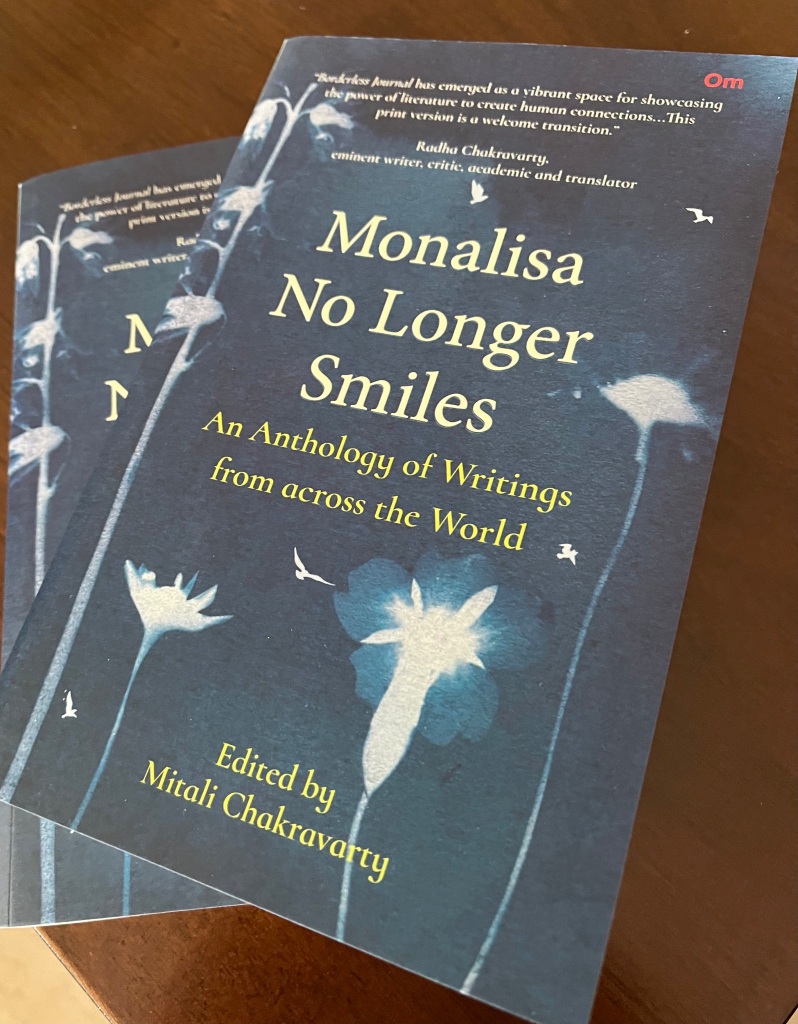
That good things happen despite darkness, despite prognostications of doom, that light glimmers hope if you strive to focus on your strength in hard times is borne true both in fiction and in life. Perhaps, we cannot get back the old ways (but is that what we want?) but new paths emerge. Old gives way to new. And while trying to gather pearls of human excellence — borne not of awards or degrees but of bringing out the best, the kindest, the most loving in human hearts — we managed to create with a team an outstanding anthology. Woven with the writings of old and new — we created a tapestry together that the editor in chief of our publishing house said was “classy, literary, engaging and international”. That one of the oldest and most reputed publishing houses in India with bookshops countrywide took it on was also an unusual event! We are truly grateful to Om Books International, Shantanu Ray Chaudhuri and Jyotsna Mehta along with all our writers and readers who made our anthology a reality, and to Radha Chakravarty and Fakrul Alam for the kind words they bestowed on our effort.

Click here to access the Borderless anthology, Monalisa No Longer Smiles

Please greet our first anthology, Monalisa No Longer Smiles, with love and friendship. It could be the perfect Christmas gift in the spirit of the season! And as the blurb says, “it will definitely bring a smile to your face because it is a celebration of the human spirit.”

The anthology is different from our journal in as much as it has a sample of an eclectic collection that has been honed with further editing and has some new features. Most of the writing is from our first year and showcases our ethos, except for Lesya’s poetry and interview. Lesya Bakun from Ukraine is still on the run, looking for a refuge — she cannot return home like you or I can. Her family is scattered across number of countries. Her cousin, who was guarding the factory at Azovstal, was taken prisoner. We included her story in the anthology hoping to create global empathy for refugees as the numbers will increase not only due to war but also due to climate change.

The reason we felt a hardcopy anthology was a good idea was because nothing beats the joy of having a bunch of interesting reads in the warmth of your hands (especially where internet cannot reach or is unavailable). In any case, books with the feel of paper, the rustling whispers which carry voices of leaves can never be replaced as Goutam Ghose had also said in his interview which is now part of our anthology.

And that is why we celebrate more books… this time we feature Singaporean prima donna of literature, Suchen Christine Lim, with her new book Dearest Intimate, a novel that spans more than hundred years including the harrowing Japanese invasion during World War II. She shared sound advice with writers: “Suffering is good for the writer. It will deepen lived experience and expand the heart’s empathy.” And perhaps that is what is echoed through the experiences of the other writer interviewed on our pages by Keith Lyons. This is a writer who not only brought out his own books but was a regular contributor of travel pieces for Frommer’s and National Geographic traveling to unexplored destinations — Christopher Winnan. Another writer Lyon had interviewed recently, Steve Carr, has passed on. We would like to convey our heartfelt condolences to his family and friends.

We have a number of books that have been reviewed. Reba Som reviewed Aruna Chakravarti’s Through the Looking Glass: Stories that span eras spread across time. Somdatta Mandal has reviewed Shehan Karunatilaka’s The Birth Lottery and Other Surprises and Bhaskar Parichha, Rahul Ramagundam’s The Life and Times of George Fernandes. Basudhara Roy has written of Afsar Mohammad’s Evening with a Sufi: Selected Poems, translated from Telugu by the poet and Shamala Gallagher, verses that again transcend borders and divides. We have an excerpt from the same book and another from Manoranjan Byapari’s How I Became a Writer: An Autobiography of a Dalit, translated from Bengali by Anurima Chanda.

More translations from Bengali, Balochi and Korean enrich our November edition. Fazal Baloch has translated a story by Haneef Shareef and Rituparna Mukherjee by Shankhadeep Bhattacharya. We have the translation of an inspirational Tagore poem helping us find courage (Shonkho Dhulaye Pore or ‘the conch lies in the dust’). Another such poem by Nazrul has been rendered in English from Bengali by Professor Fakrul Alam. He has also shared an autobiographical musing on how he started translating Tagore’s Gitabitan, which also happens to be his favourite book. More discussion on the literary persona of TS Eliot and the relevance of his hundred year old poem — ‘The Waste Land’ by Dan Meloche adds variety to our essay section.

Evoking the genius of another outstanding artiste, Kishore Kumar, who happened to pen thought provoking dialogues in some films, is Shantanu Ray Chaudhuri’s essay, review of a recent book on the legendary actor-singer and an interview with the authors. Infringing the boundaries of literary with popular culture and art and integrating all forms into a wholistic bundle has been part of our ethos. In that spirit we have a musing by Prithvijeet Sinha on Edvard Munch’s famous painting called Scream. We have non-fiction from Australia spanning Meredith Stephens’s recent brush with Covid, Mike Smith visits a Scottish beach in the footsteps of a novelist, Ravi Shankar has given us a poignant piece for a late friend and Candice Lousia Daquin talks of the existence of bi-racial biases. In contrast, Suzanne Kamata sent a narrative that bridges divides showcasing a German wife of a Japanese scientist that draws us to conclude that biases erode over time to create an acceptance of bi-racial people. Devraj Singh Kalsi brings in humour with his funny narrative about a guitarist. Rhys Hughes writes in a lighter vein on Indian cuisine in his column and spouts more funny poetry bordering on the absurd.

Jared Carter has shared beautiful poetry on murmuration in birds and we have touching verses from Asad Latif for a little girl he met on a train — reminiscent of Tagore’s poem Hide and Seek (Lukochuri). Michael R Burch has given us poems setting sombre but beautiful notes for the season. We host more poetry by Luis Cuauhtémoc Berriozábal, Quratulain Qureshi, Jim Bellamy, Gayatri Majumdar, Ryan Quinn Flanagan, Alpana, Jonathan Chan, Saranyan BV, George Freek and many more. We have stories from around the world: India, France and Bangladesh.

Gathering all of your thoughts in strings of words from all corners of the world, we present to you the bumper November issue of Borderless Journal . Thank you all for sharing your thoughts with us. Thanks to Sohana Manzoor for her fantastic painting and more thanks to the whole Borderless team for seeing this issue through. We would not have been able to do the anthology or these issues without each one of you — writers and readers.

Thank you all from the bottom of my heart.

There is always hope for a new tomorrow!

Mitali Chakravarty

borderlessjournal.com

Click here to access the Borderless anthology, Monalisa No Longer Smiles