Categories
Greetings

Happy Birthday Borderless

Borderless Journal started on March, 14, 2020. When the mayhem of the pandemic had just set in, we started as a daily with half-a-dozen posts. Having built a small core of writings by July, 2020, we swung to become a monthly. And we still continue to waft and grow…
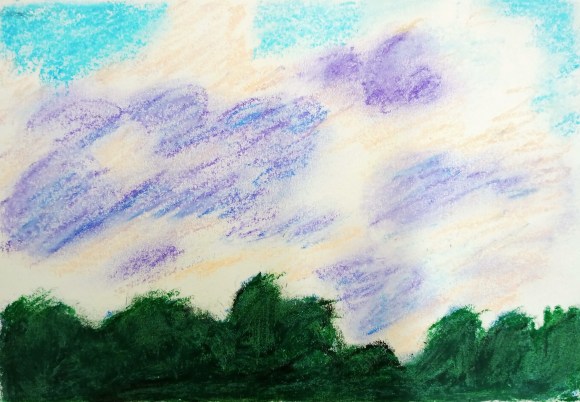
Art by Sohana Manzoor

We like to imagine ourselves as floating on clouds and therefore of the whole universe. Our team members are from multiple geographies and we request not to be tied down to a single, confined, bordered land. We would welcome aliens if they submitted to us from another galaxy…

On our Fifth Anniversary, we have collected celebratory greetings from writers and readers stretched across the world who share their experience of the journal with you and offer suggestions for the future. We conclude with words from some of the team, including my own observations on being part of this journey.

Aruna Chakravarti

Heartiest congratulations to Borderless on the occasion of its fifth anniversary! Borderless, an international journal, has the distinction of carrying contributions from many eminent writers from around the world. From its initiation in 2020, it has moved from strength to strength under the sensitive and skillful steering of its team. Today it is considered one of the finest journals of its kind. I feel privileged to have been associated with Borderless from its very inception and have contributed substantially to it. I wish to thank the team for including my work in their distinguished journal. May Borderless move meaningfully towards the future and rise to greater and greater heights! I wish it every success.

Professor Fakrul Alam

Five years ago, when Borderless set out on its literary voyage, who would have imagined the length and breadth of its imaginative crossings in this span of time? The evidence, however, is digitally there for any reader who has seen at least some of its issues. Creative writing spanning all genres, vivid illustrations, instant links giving resolute readers the option to track a contributor’s creative voyaging—here is boundless space always opening up for those seeking writing of considerable variety as well as originality. The best part here is that unlike name-brand journals, which will entice readers with limited access and then restrict their spaces unless you subscribe to them, all of Borderless is still accessible for us even though it has attracted a wide readership in five years. I certainly hope it will stay that way.

And what lies ahead for Borderless? Surely, more opportunities for the creative to articulate their deepest thoughts and feelings in virtual and seemingly infinite space, and innumerable avenues for readers to access easily. And let us hope, in the years to come Borderless will extend itself to newer frontiers of writing and will continue to keep giving space to new as well as emerging writers from our parts of the world.

May the team of Borderless, continue to live up to their claim that “there are no boundaries to human imagination and thought!”

Radha Chakravarty

Since its inception, Borderless Journal has remained true to its name, offering a vital literary space for writers, artists and scholars from around the world to engage in creative dialogue about their shared vision of a world without borders. Congratulations Borderless, and may your dream of global harmony continue to inspire.

Somdatta Mandal

According to the famous Chicana academic and theorist Gloria Anzaldua, the Borderlands are physically present wherever two or more cultures edge each other, where peopIe of different races occupy the same territory, where under, lower, middle and upper classes touch, where the space between two individuals shrinks with intimacy. Hatred, anger and exploitation are the prominent features of this landscape. There, at the juncture of cultures, languages cross-pollinate and are revitalized; they die and are born. Borders are set up to define the places that are safe and unsafe, to distinguish us from them. A border is a dividing line, a narrow strip along a steep edge. A borderland is a vague and undetermined place created by the emotional residue of an unnatural boundary. It is in a constant state of transition. The prohibited and forbidden are its inhabitants.

About five years ago, when a new online journal aptly called Borderless Journal was launched, these ideas which we had been teaching for so long were simply no longer applicable. Doing away with differences, with limits, it became a suitable platform where disparate cultures met, where people from all disciplines could express their views through different genres, be it poetry, translation, reviews, scholarly articles, creative writing and so on. Many new writers from different parts of the world became regular contributors to this unique experimentation with ‘borderlessness’ and its immense possibilities are very apt in this present global context where social media has already changed many earlier notions of scholarship, journalism, and creativity.

Jared Carter

In its first five years Borderless has become an important witness for international peace and understanding. It has encouraged submissions from writers in English based in many different countries, and has offered significant works translated from a wide range of national literatures. Its pages have featured writers based in India, Pakistan, China, Taiwan, Japan, South Korea, Australia, the UK, and the US. In the future, given the current level of world turmoil, Borderless might well consider looking more closely toward Africa and the Middle East. As the magazine continues to promote writing focused on international peace and freedom, new horizons beckon.

Teresa Rehman

The best part of this journal is that it is seamless and knows no margins or fringes. It is truly global as it has cut across geographical borders and has sculpted a novel literary genre called the ‘borderless’. It has climbed the mountains of Nepal, composed songs on the Brahmaputra in Assam, explored the hidden kingdom of Bhutan, walked on the streets of Dhaka, explored the wreckage of cyclones in Odisha, been on a cycling adventure from Malaysia to Kashmir, explored a scenic village in the Indo-China border, taken readers on a journey of making a Japanese-Malayalam dictionary, gave a first-hand account of the war in Bosnia-Herzegovina and described the syncretic culture of Bengal through its folk music and oral traditions. I hope it continues telling the untold and unchartered stories across mountains, oceans and forests.

Kirpal Singh

In a world increasingly tending towards misunderstandings across borders, this wholesome journal provides a healthy space both for diverse as well as unifying visions of our humanity. As we celebrate five distinguished years of Borderless Journal, we also look forward to another five years of such to ensure the underlying vision remains viable and visible as well as authentic and accurate.

My heartfelt Congratulations to all associated with this delightful and impressive enterprise!

Asad Latif

The proliferation of ethnic geographies of identity — Muslim/Arab, Hindu/Indian, Christian/Western, and so on — represents a threat to anything that might be called universal history. The separation and parcelling out of identities, as if they are pre-ordained, goes against the very idea (proclaimed by Edward Said) that, just as men and women create their own history, they can recreate it. Borders within the mind reflect borders outside it. Both borders resist the recreation of history. While physical borders are necessary, mental borders are not. This journal does an admirable job in erasing borders of the mind. Long may it continue to do so.  

Anuradha Kumar

I have been one of Borderless’ many readers ever since its first issue appeared five years ago. Like many others, I look forward with great anticipation to every issue, complete with stories, , reviews, poems, translations, complemented with interesting artwork. 

Borderless has truly lived up to its name. Within its portal, people, regardless of borders, but bound by common love for literature, and the world’s heritage, come together. I would wish for Borderless to scale even greater heights in the future. As a reader, I would very much like to read more writers from the ‘Global South’, especially in translation. Africa, Asia and Australasia are host to diverse languages, many in danger of getting lost. Perhaps Borderless could take a lead in showcasing writers from these languages to the world. That would be such an invaluable service to readers, and the world too.   

Ryan Quinn Flanagan

To me, Borderless Journal is a completely free and open space.  Topics and styles are never limiting, and the various writers explore everything from personal travelogues to the limp of a helpful druggist.  Writers from all corners of the globe contribute, offering a plethora of unique voices from countless circumstances and walks of life. Because of this openness, Borderless Journal can, and likely will continue to grow and expand in many directions simultaneously.  Curating and including many new voices along the way.  Happy 5th Birthday to a truly original and wonderfully eclectic journal!

George Freek

I feel the Borderless Journal fills a special spot in the publishing world. Unlike many journals, which profess to be open-minded and have no preference for any particular style of poetry, Borderless actually strives to be eclectic. Naturally, it has its own tastes, and yet truly tries to represent the broad spectrum which is contemporary poetry. I have no advice as to where it should go. I can only say keep up the good work, and stooping to a cliche, if it’s not broken, why try to fix it?

Farouk Gulsara

They say time flies when one is having fun. It sure does when a publication we love regularly churns out its issues, month after month, for five years now.

In the post-truth world, where everybody wants to exert their exclusivity and try to find ways to be different from the person standing next to them, Borderless gives a breath of fresh air. At a time when neighboring countries are telling the world they do not share a common history, Borderless tries to show their shared heritage. We may have different mothers and fathers but are all but “ONE”! 

We show the same fear found in the thunderous sounds of a growling tiger. We spill the exact hue of blood with the same pain when our skin is breached. Yet we say, “My pain is more intense than yours, and my blood is more precious.” Somehow, we find solace in playing victimhood. We have lost that mindfulness. One should appreciate freedom just as much as we realise it is fragile. Terrorism and fighting for freedom could just be opposing sides of the same coin.

There is no such thing as a just war or the mother of all wars to end all wars as it has been sold to us. One form of aggression is the beginning of many never-ending clashes. Collateral damage cannot be justified. There can be no excuse to destroy generations of human discoveries and turn back the clock to the Stone Age. 

All our hands are tainted with guilt. Nevertheless, each day is another new day to make that change. We can all sing to the tune of the official 2014 World Cup song, ‘Ola Ola,’ which means ‘We are One.’ This is like how we all get together for a whole month to immerse ourselves in the world’s favourite sport. We could also reminisce about when the world got together to feed starving kids in Africa via ‘Band-Aid’ and ‘We Are the World’. Borderless is paving the way. Happy Anniversary!

Ihlwha Choi

I sincerely congratulate Borderless Journal on its 5th anniversary. I am always delighted and grateful for the precious opportunity to publish my poetry in English through this journal. I would like to extend my special thanks for this.

Through this journal, I can read a variety of literary works—including poetry, essays, and prose—from writers around the world. As someone for whom English is a foreign language, it has also been a valuable resource for improving my English skills. I especially enjoy the frequent features on Rabindranath Tagore’s poetry, which I read with great joy. Tagore is one of my favourite poets.

I have had the privilege of visiting Santiniketan three times to trace his legacy and honor his contributions to literature and education. However, one aspect I find a little disappointing is that, despite having published over 30 poems, I have yet to receive any feedback from readers or fellow writers. It would be wonderful to have such an opportunity for engagement.

Additionally, last October, a Korean woman received the Nobel Prize in Literature—the first time an author from South Korea has been awarded this honor by the Swedish Academy. She is not only an outstanding novelist but also a poet. I searched for articles about her in Borderless Journal but was unable to find any. Of course, I understand that this is not strictly a literary newspaper, but I would have been delighted to see a feature on her.

I also feel honoured that one of my poems was included in the anthology Monalisa No Longer Smiles: An Anthology of Writings from across the World. I hope such anthologies will continue to be published. In fact, I wonder if it would be possible to compile and publish collections featuring several poems from contributing poets. If these were made available on Amazon, it would be a fulfilling experience for poets to reach a broader audience.

Moving forward, I hope Borderless Journal will continue to reach readers worldwide, beyond Asia, and contribute to fostering love and peace. Thank you.

Prithvijeet Sinha

The journey of authorship, self-expression and cultural exchange that I personally associate with Borderless Journal’s always diverse archives has remained a touchstone ever since this doorway opened itself to the world in 2020. Going against the ramshackle moods of the 2020s as an era defined by scepticism and distances, The journal has upheld a principled literary worldview close to the its pages and made sure that voices of every hue gets representation. It’s also an enterprise that consistently delivers in terms of goodwill and innocence, two rare traits which are in plenteous supply in the poems, travelogues, essays and musings presented here.

The journey with Borderless has united this writer with many fascinating, strikingly original auteurs, buoyed by a love for words and expression. It is only destined for greatness ahead. Happy Birthday Borderless! Here’s to 50 more epochs.

From Our Team

Bhaskar Parichha

As Borderless Journal celebrates its fifth anniversary, it is inspiring to see its evolution into a distinguished platform for discourse and exploration. Over the years, it has carved a unique niche in contemporary journalism, consistently delivering enlightening and engaging content. The journal features a variety of sections, including in-depth articles, insightful essays, and thought-provoking interviews, reflecting a commitment to quality and fostering dialogue on pressing global issues.
The diverse contributions enrich readers’ understanding of complex topics, with a particular focus on climate change, which is especially relevant today. By prioritising this critical issue, Borderless informs and encourages engagement with urgent realities.
Having been involved since its inception, I am continually impressed by the journal’s passion and adaptability in a changing media landscape. As we celebrate this milestone, I wish Borderless continued success as a beacon of knowledge and thoughtful discourse, inspiring readers and contributors alike.

Devraj Singh Kalsi

Borderless Journal has a sharp focus on good writing in multiple genres and offers readable prose. The platform is inclusive and does not carry any slant, offering space to divergent opinions and celebrating free expression. By choosing not to restrict to any kind of ism, the literary platform has built a strong foundation in just five years since inception. New, emerging voices – driven by the passion to write fearlessly – find it the ideal home. In a world where writing often gets commercialised and compromised, Borderless Journal is gaining strength, credibility, and wide readership. It is making a global impact by giving shape to the dreams of legendary poets who believed the world is one.  

Rakhi Dalal

My heartiest congratulations to Borderless and the entire team on the fifth Anniversary of its inception. The journal which began with the idea of letting writing and ideas transcend borders, has notably been acting as a bridge to make this world a more interconnected place. It offers a space to share human experiences across cultures, to create a sense of connection and hence compassion, which people of this world, now more distraught than ever, are sorely in need of. I am delighted to have been a part of this journey. My best wishes. May it continue to sail through time, navigating languages, literature and rising above barriers!

 Keith Lyons

Is it really five years since Borderless Journal started? It seems hard to believe. 

My index finger scrolls through Messenger chats with the editor — till they end in 2022. On the website, I find 123 results under my name. Still no luck. Eventually, in my ‘Sent’ box I find my first submission, emailed with high hopes (and low expectations) in March 2020. ‘Countdown to Lockdown’ was about my early 2020 journey from India through Thailand, Malaysia, Indonesia, and Australia to New Zealand as COVID-19 spread.

Just like that long, insightful trip, my involvement with Borderless Journal has been a journey. Three unique characteristics stand out for me. 

The first is its openness and inclusiveness. It features writers from all over the globe, with various contributions across a wide range of topics, treatments and formats. 

The second feature of the journal is its phenomenal growth, both in readers and writers, and in its reach. Borderless really does ‘walk the talk’ on breaking down barriers. It is no longer just a humble literary journal — it is so much bigger than that. 

The third unique aspect of Borderless is the devotion endowed in nurturing the journal and its contributors. I love the way each and every issue is conceived, curated, and crafted together, making tangible the aspiration ‘of uniting diverse voices and cultures, and finding commonality in the process.’

So where can we go from here? One constant in this world is change. I’d like to think that having survived a global pandemic, economic recession, and troubling times, that the core values of Borderless Journal will continue to see it grow and evolve. For never has there been a greater need to hear the voices of others to discover that we are all deeply connected.

Rhys Hughes

I have two different sets of feelings about Borderless Journal. I think the journal does an excellent job of showcasing work from many different countries and cultures. I want to say it’s an oasis of pleasing words and images in a troubled sea of chaos, but that would be mixing my metaphors improperly. Not a troubled sea of chaos but a desert of seemingly shifting values. And here is the oasis, Borderless Journal, where one can find secure ideals of liberty, tolerance, peace and internationalism. I appreciate this very much. As for my other set of feelings, I am always happy to be published in the journal, and in fact I probably would have given up writing poetry two years ago if it wasn’t for the encouragement provided to me by regular publication in the journal. I have written many poems especially for Borderless. They wouldn’t exist if Borderless didn’t exist. Therefore I am grateful on a personal level, as a writer as well as a reader.

Where can Borderless Journal go from here? This is a much harder question to answer. I feel that traditional reading culture is fading away year after year. Poets write poetry but few people buy poetry books. They can read poems at Borderless for free and that is a great advantage. I would like to see more short stories, maybe including elements of fantasy and speculative fiction. But I have no strategic vision for the future of the journal. However, one project I would like to try one day is some sort of collaborative work, maybe a big poem with lots of contributors following specific rules. It’s an idea anyway!

Meenakshi Malhotra

Borderless started with a vision of transcending the shadow lines and has over time, evolved into a platform where good writing from many parts of the world finds  a space , where as “imagination bodies forth/ The forms of things unknown, the poet’s pen/Turns them to shapes and gives to airy nothing/A local habitation and a name.”

It has been a privilege to be a part of Borderless’s journey over the last few years. It was a journey based on an idea and a vision. That dream of creating solidarity, of transcending and soaring over borders and boundaries, is evident in almost every page and article in the journal.

Mitali Chakravarty

Looking at all these responses, thinking on what everyone has said, I am left feeling overwhelmed.

Borderless started as a whimsical figment of the imagination… an attempt to bring together humanity with the commonality of felt emotions, to redefine literary norms which had assumed a darker hue in the post Bloomsbury, post existentialist world. The journal tried to invoke humour to brings smiles, joys to create a sense of camaraderie propelling people out of depression towards a more inclusive world, where laughter brings resilience and courage. It hoped to weave an awareness that all humans have the same needs, dreams and feelings despite the multiple borders drawn by history, geographies, academia and many other systems imagined by humans strewn over time.  

Going forward, I would like to take up what Harari suggests in Homo Deus — that ideas need to generate a change in the actions of humankind to make an impact. Borderless should hope to be one of the crucibles containing ideas to impact the move towards a more wholesome world, perhaps by redefining some of the current accepted norms. Some might find such an idea absurd,  but without the guts to act on impractical dreams, visions and ideas, we might have gone extinct in a post-dino Earth.

I thank the fabulous team, the wonderful writers and readers whose participation in the journal, or in engaging with it, enhances the hope of ringing in a new world for the future of our progeny.
Categories
Stories

The Useless Idler

By Paul Mirabile

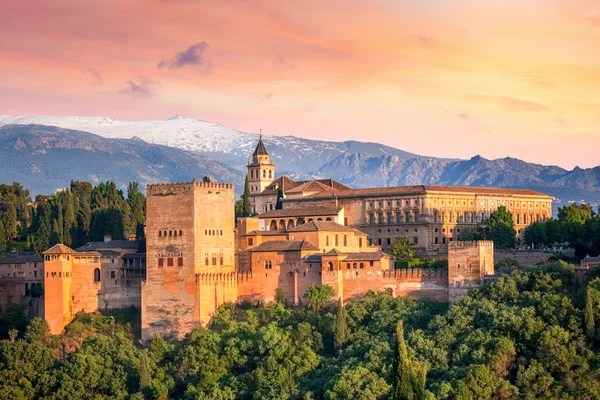
Alhambra Palace, Spain. From Public Domain

No one knew his name nor wished to know it. Only his face attracted those who came into contact with him. So it was said. A face whose huge, glowing eyes were turned both inwards and outwards, simultaneously. A face whose florid complexion, cheery and unfurrowed, bespoke a life of leisure, albeit not one of procrastination; a life of ease, but not sloth. In short, a life of early, unfought for independence.

I met my nameless stranger one fine autumn day in the Andalucian town of Granada, Spain, where he had been residing for several months, visiting the Alhambra Palace every day during those months. We had met in a small, non-distinct eatery, and he was very willing to converse with anyone who had leisure to tete a tete. We fell into lively conversation. Taken aback by his daily visits to the remarkable Palace, I enquired why he spent so many hours there.

“The Palace was built as a sign of religious, political and cultural power,” he began, munching energetically on his paella of rabbit. “But since 1492, that sign has been condemned to utter uselessness, reduced to a mere tourist attraction, however noteworthy. It has become completely useless since its mediaeval abandonment  because it’s been drained of its original value.” Here he paused, I imagine, for me to intercede. I didn’t …

“You see, this is what attracts me most to the Alhambra; its utter uselessness for our world today. I do not consider mass tourism as an instrument of usefulness.” I kept silent to goad him on, for the turn of conversation piqued my curiosity.  “The Alhambra epitomises all that I have spent my own life experiencing, consciously: the pleasures of uselessness.”

“Is uselessness a pleasure?” I nettled with a sunny smile.

“That depends upon whom it has been bestowed, sir. That depends for whom it has benefitted. The circumstances of my life and will to understand and decipher them, have conspired to draw me now into and outside of myself. My own self has become as useless as the objects that I set my eyes on each and every day as I saunter through the streets, gardens or palaces of wherever I happen to be. I have realised that such an absorption into social uselessness, and thus distance from social use, has constituted my raison d’être. And there lies the pleasure: this mode of existence is a project of life; a pure project of pleasurable uselessness to society and to myself.” His face, alit with integrity, bent low to attack the chorizos cooked in white wine sauce.

“When did you begin experimenting your project?” I asked, sipping my sangria.

“I would formulate it differently: When did uselessness experiment me!” he mumbled, his mouth full of chorizo. “It all began in Africa some thirty or forty years back, during my youthful days wandering through the Sahara desert en route to Timbucktoo. The Blue Men of the Sahara appeared absolutely useless to anyone or anything that we Europeans would call useful.”

“Such as?”

“Well, a roof over one’s head, a shower every hour, a steady, well-paid job, a car and such things … what we Europeans would term as useful, conditioned to adhere to the philosophy of infinite progress; to infinite social and political usefulness. All the Blue Men seemed to require were a few hours of sleep, food, water and the desire to procreate. Needs that all mankind need so as to account for our very presence on Earth. I lived in the desert for over a year, and little by little discovered that this lifestyle suited a possibility of existence, a life not of a desert-nomad mind you, but one of a useless idler, which as time went by, proved possible, be it in the cities of Europe and Asia or in their countryside towns and villages.”

“As I understand it, social success has no meaning for you at all?”

“Not at all. Success only invites humiliation or cruel jealousy, and the pursuit of wealth is a path marked by ruthlessness. I earn my living simply to eat, to dress according to the climate, to have a roof over my head when needed.”

“But a roof over one’s head could be expensive…” I intervened.

“I spend most of my nights out under the stars when the weather is warm. With the coming of winter, I seek refuge in Catholic missions, poor men’s shelters or in the numerous Salvation Army shelters. Any asylum that will not turn me down. As far as any permanent residence, I have taken up lodgings in the homes of generous people for a meagre fee, or have laboured on farms for my food and bed. Do not confuse uselessness with doing nothing. I’m no couch potato; I have done many things, but they do not fit into our social machine of imposed well-being. My life may appear negative to those who hold me in contempt, but my usefulness is as useful to mankind as it is to myself. Don’t forget what one Belgium writer once wrote: ‘It is thanks to a certain number of men who seem useless that there will always be a certain number of useful men.’”

“Who wrote that?”

“I forgot. But what difference does it make?” He wiped his mouth delicately, smacking his lips. He proceeded: “I imagine you probably believe me to be a social parasite or a social zero as Balzac once wrote, useless even as a human being. But read Friedrich Nietzsche on this point,” and he quoted: “’The value of a human being does not lie in his usefulnes; for it would continue to exist even if there were nobody to whom he could be useful.’”

“Quite an imposing thought,” I acknowledged, sitting back. “But you must admit that you have been useful to the kind people who hire you on or who lodge you, even for a small fee.”

He snorted: “Perhaps. But I cannot speak on their behalf, only mine.” I noted that he wiggled out of that one quite ingeniously. His face shone with a strange light. An aura of mystery gradually covered it like a gossamer veil. The light suddenly went out.

“I’m sure your effort to separate yourself from the social body must be a terrible struggle,” I pursued without irony. “I believe that to be estranged from the social body is commensurate with  being estranged from one’s own self. Am I right in assuming this?” 

“Perhaps, but not from the individuals of those societies. I am not a misantrope. This being said, solitude, fasts and meditation have prepared me for outer trials and tribulations, which I believe, without vanity, to have overcome.” He began picking his teeth with a very long fingernail.

“And God?” I rebounded, eyeing him steadily. His lips broke into an artful grin.

“He has been my only Friend since the beginning, sir. And why is that? Because we have been useless to each other since our initial communion.” He stood, evidently undesirous to develop this rather paradoxical statement. I let it drop …

We slipped outside and my nameless companion suggested that we have a quick jaunt through the ‘Arab Market’ in Zacaten. Indeed, the weather was warm, that Autumn weather which I have always found so stimulating in Granada; Granada, perched high in her mountainous refuge like an eagle in her lofty nest. My strolling companion strolled into my reverie.

“Look at the sky, a bluish turquoise which reminds me so much of the domes of the mosques in Bukhara, Uzbekistan. That turquoise which solicits silence and contemplation.”

“So you’ve visited Uzbekistan?”

“More than visited, my friend. I lived there for five years studying under the spiritual guidance of the Nakishbendi Brotherhood, a Sunna movement founded by the Shah Nakishbend, and which has survived the anti-religious crusade of the Soviet Union. With those kind and learned monks I learnt the virtues and powers of silence, contemplation, discipline, simplicity and periodical talks.”

“In what language did you speak to them?” I ventured, a bit intrigued by this singular experience.

“In Uzbek, of course!” he responded dryly. “I also learned to read Arabic.”

“But are silence and talks not contradictory?”

“Not at all, sir. Clusters of roses certainly grow silently, but good soil, air and pure water are needed for their basic growth. If accompanied by a soft, melodious voice, they grow better. Roses heed to that voice as silence heeds to constructive talks. It was during the alternating passages of silence and talks that our spiritual guides opened our eyes and senses to the uselessness of worldly matters, and since then, this uselessness has become my second nature, even my first! Mind you, this discovery has nothing to do either with self-love or atomistic individualism. As I said, I have relations with people, albeit brief; and although I keep aloof from community aggregation and national gatherings, I have never spend my life gloating in an ivory tower. No sir, I live for wanderlust not social or individual hubris! The lust for wandering … And when one wanders one cannot but converge with people, learn from them. This does not necessarily mean that I derive an extraordinary pleasure from communicating with them. To tell the truth, I prefer my own company, if I may say so …”

“But you surely feel a responsibility towards others?” I pursued, more and more fascinated by this nameless chap, who by now had led me into a marvellous little garden out of whose spouting fountain splashed tinkling sprays here and there.

“Responsibility?” he chortled, as we sat down enjoying the perfumed scents of honeysuckles and roses. “Responsibility is only towards oneself. My words or gestures will be felt by others. Would you harm or humiliate your fellow man? Uselessness does not mean selfishness or egoism. In fact, it disciplines you to an awareness of others, an awareness those who whole-heartedly believe in social relevance will never come to understand for they must belong to a community, club or ideology in order to give pride and reason to their usefulness. They discredit the experience of uselessness. Don’t get me wrong, I do not live in a fantasy world like those who tout infinite progress or community spirit. These are abstract schemas for me. My Way is to strive to overcome anger, hate and jealousy within my own sphere of existence. This entails peeling away the veils that dim the lucidity of reality; my reality of being useless to the devastating machine of the useful well-being of mankind.”

“I would then conclude that your manner of living may be called cynical or indifferent?”

He was mortified by my question. “Cynical? A cynic questions then condemns derisively the circumstances that emerge before him or her; I neither question nor condemn. I simply carry on from place to place, experimenting novel circumstances, accepting them as if they had always been mine. Indifference? Well, if you mean stepping back and out of the world’s commerce, and not to take either that commerce or oneself seriously, then I am indifferent. The crisis of many individuals today is that they take themselves much too seriously, much more seriously than the seriousness of their work or vocations. And when this self-seriousness is struck down or dethroned a dreadful sense of uselessness seizes them, causing depression, or worse, suicide. My uselessness to myself and to others is more serious than myself. I am in the world but not of it!”

As we sat in silence, I gradually felt myself transported to another dimension of time and space. Scenes of my own life flashed before my eyes, lively colourful scenes and gloomy ones. I could not resolve whether this nameless fellow fascinated or revolted me. My own life had been ensnared in a web of social irresponsibility and imposed representations. I had become one of the many cogs in the slow and steady vast social wheel that turns and churns, and I sensed that mine had become worn-out and useless. I had so yearned to be of some use to society … But now? Yes, now? How could I restore my previous enthusiasm that had long been abandoned? I had to admit, though, that this man’s experiments heightened my ardour to … to do what? Was he sent to me like some mentor? He suddenly stood and bid me a good day with a whimsical smile, as though he had been reading my thoughts.

Before leaving, however, he said: “Tomorrow I shall have a walk in the gardens of the Alhambra. Please join me, I’m sure we have much to discuss. Meanwhile, let silence be your companion until that walk.” And he disappeared into the milling crowd.

Waking early the next morning, I resolved to meet my new and somewhat eccentric companion at the beginning of the long avenue that leads to the Gate of Justice. An avenue lined with sentinels of cypress and other trees, within whose morning freshness ran a warren of narrow paths.

We met at precisely eight o’clock. With a sort of fraternal benevolence, he took my arm and we strolled upwards past the Gate of Justice, the pompous palace of King Carlos the Fifth, paid our tickets and entered the palace proper, almost religiously, under the storied vaulted corridors, by the pencilled ornaments and tiled walls of arabesque blue, over the smooth, shiny marbled floors.

“Have you read Washington Irving?” he asked in a quavering voice, as if not to disturb the mediaeval palace denizens.

“Yes, a marvellous story-teller and keen observer,” I replied softly.

“You know he led a life of ridiculous usefulness until sojourning within the walls of this soporific fairyland. Gradually Irving fell under the pleasant and industrious spell of uselessness.”

I stopped walking.

“How so? That’s contradictory!”

“Is it?” he beamed, smiling that wide, wicked, whimsical smile. “Yet so it was. He learnt through daily experience that this whole palace of enchantment lies under the layers of absolute uselessness. Layers and layers of poetry, conversation, lyrical jousts and insignificant gestures which disappeared as quickly as they were conceived. Nothing! Nothing remains of that imagined uselessness. And that is precisely why he wrote his Tales of the Alhambra[1] ; it was out of the need to express his useless life within these lyrical stones.”

My sauntering companion fell silent. Only our footfalls could be heard weaving in and out of the slender colonnades, intermingling with the chanting fountains. The blue ceramic shone on the walls like a mirror reflecting the azure …

“I see your point, I think. Before dusk, at times I watch the sun glide from East to West over the Palace walls, the dark greys slipping into ochre reds, soon to be daubed, as the sun sets, by the overglow tones of chestnut, roan and dun.”

“Yes!” he whispered excitedly. “That is perfect uselessness. It serves absolutely no purpose to anyone … even to yourself. For, unlike Irving, who snapped his experiment in uselessness,  succumbing to the desire of writing it down for all and sundry to share, I presume that in your case you have no urgency to express any posthumous glory?”

I shook my head thoughtfully, then asked: “You don’t feel the desire to keep a diary?”

“Write? A diary? What for — to satisfy my blotted ego seeking a useful outlet? These are vain insinuations, my good friend. No, it is quite enough to feast my sovereign eyes, to feed my independent emotions on this marvellous honeycomb frostwork and these fine, mullioned windows[2]. These artifices are as useless as the ephemeral poetry and conversations that rang euphoniously within the hallowed halls and courts. And indeed, why should we, mere strangers to this mediaeval marvel, impose an artificial usefulness to it all? Why should we break into lyrical extravagances of the budding rose or the flight of the owl? Into flights of phantasy poeticising upon the Towers above us where verses of love spilled forth their honied fragrances into a void of mute forgetfulness? None of that for me, sir. Within these courts and gardens I have come to the inevitable conclusion that my Destiny lies in perfect uselessness; namely, in my refusal to reanimate the beauty or the ugliness that has crossed my path for the past fifty years in Asia, Europe, the Americas and Africa. I decline to spoil the uselessness of beauty and ugliness, to encumber my spirit and soul by searching for a ‘proper use’ for such human emotions and achievements.”

We had walked through the remarkable Court of Lions and were now entering the gardens of Lindaraxa, Sultan Boadil’s[3] wife. We sat down inhaling the gay scents of roses, oranges and lemons.

He sniffed the air, then murmured: ”A vague of indescribable awe was creeping over me,” here hepaused, lifting his eyes upwards: ”Everything began to be affected by the working of my mind, the whispers of the wind among the citron-trees beneath my window had something sinister…” My companion had chanted this broken sentence in a sort of drawn-out litany. “Yes, something sinister, indeed,” he ruminated to himself. “That point of inspiration led Irving from absolute uselessness to the search for putting uselessness to use. I enjoy reading Irving, but will never convert a ‘something sinister’ to a million-copy, world-wide read book.”

The sun rose higher and higher coating the pink tongues of dawn with a purplish blue. I turned to him: “Still, I cannot see how we as humans can escape from being useful Beings!” He looked at me, his facial features had suddenly hardened, or perhaps it was due to the effects of the shadows off the sun-lit fruit trees.

“Does my speaking to you now fulfil an emotional need? Was our conversation a psychological issue to such a profound hoarding of uselessness?” I asked.

He laughed so loud that a few puffy-eyed guards turned their heads in our direction. “Dear fellow, you have hardly understood our morning jaunt. We are simply idling our time away as uselessly as possible, as useless as a leaf dropping from that citron-tree, as a person who labours all his life to survive, a hermit in his remote cave, a desert-dweller, a traveller without name or record. How many of those intrepid souls took refuge in monasteries of the East and there left no trace of their earthly footfalls? They experienced true uselessness …”

“Even to God towards whom they must have addressed their prayers?” I enquired. He raised a quizzical eyebrow.

“That is neither for you nor me to answer, my friend.” He stood, shook my hand and left the gardens back through the Palace halls.

I felt a bit put out by his prompt and unexpected departure. It were as if he had abandoned me to unravel that last enigmatic thought of his. A silly feeling of course, but one that clung to me like the scents of the roses, oranges and lemons. My mind slowly became dull, my body numb. Had the nameless wanderer put me under a magical spell? The redolence and balminess of the gardens added to my discomfiture. At the same time, however, I understood that idleness is not a state or a condition which I could bear or champion as he does. I rose, heavily. Enough of this palatial beguiling and futile jaunting. That man, whoever he is, taught me a sound lesson: a person is born into our world to accomplish a particular use, one that is his or hers alone. There is no doubt in my mind about this.

I dragged myself from the gardens back to my hotel in the Old Market at Zacatin, an effort that enlisted all my emotional and physical strength.

I must confess that during the following days, in spite of my firm resolution towards usefulness, I idled my time away seeking out that nameless idler, tramping from street to street, garden to garden, restaurant to restaurant. Every morning I rose early and scoured the halls, courts and gardens of the Alhambra.

He had vanished into thin air, as the saying goes …

*

A few years later back in Amsterdam, my eye caught sight of a book entitled The Denizen of the Underworld : The Art of Uselessness. I bought it out of some urgent curiosity that I could and still not explain rationally. The first sentences read : ”I am without shame, without guilt, without bad conscious. I truly prefer my cave swimming with mermaids, dwarves labouring at the furnaces, fairies hunting out medicinal plants. Here I breathe the air of pure uselessness, shielded against the charm and seduction of use.”

The author of the book had an odd name — Vigilius de Silentio — a name that might have fitted the face of my nameless companion whom I had met so many years ago in Granada. On second thoughts, though, that name could have fitted any face.

To tell the truth, the book bored me to death …                   

.

[1]        Washington Irving, edition Edilux, Granada, Spain.    

[2]        A vertical element made of wood or stone that divides a window in two. It is applied in Islamic and Armenian architecture.

[3]        The last Sultan of Muslim Spain, exiled to North Africa.

Paul Mirabile is a retired professor of philology now living in France. He has published mostly academic works centred on philology, history, pedagogy and religion. He has also published stories of his travels throughout Asia, where he spent thirty years.

.

PLEASE NOTE: ARTICLES CAN ONLY BE REPRODUCED IN OTHER SITES WITH DUE ACKNOWLEDGEMENT TO BORDERLESS JOURNAL

Click here to access the Borderless anthology, Monalisa No Longer Smiles

Click here to access Monalisa No Longer Smiles on Kindle Amazon International

Categories
Slices from Life

The Pearl of the Indian Ocean

By Ravi Shankar

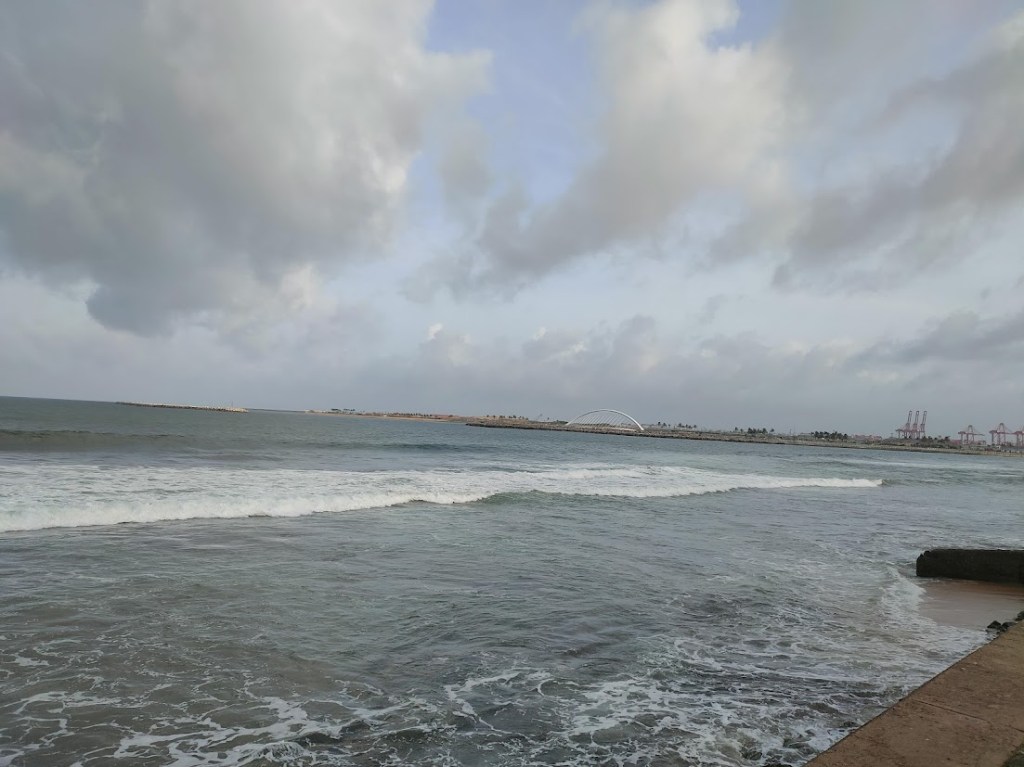
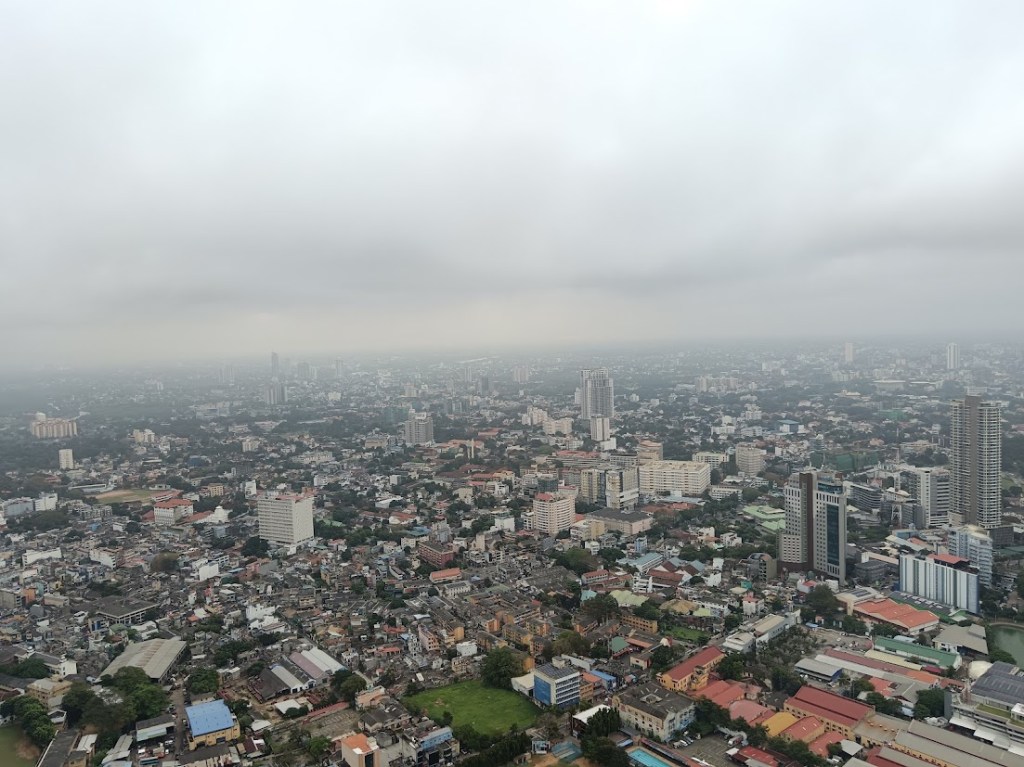
A panoramic view of Colombo. Photo courtesy: Ravi Shankar

My impressions of Colombo and Sri Lanka were positive. I was aware of the high human development indicators of the island nation, progress in access to essential medicines and the civil war. Sri Lanka shares many similarities with the state of Kerala in Indian in terms of topography, culture, food habits, high human development, outmigration, militant trade unions and a passion for egalitarian development. I also remembered the recent violent uprising against the former president and the image of the public frolicking in the pool at the presidential palace.

I was happy to receive an invitation to travel to Colombo in July 2023. I was invited to The Colombo Medical School, which was established by the British in 1870 and is one of the older schools in South Asia. It is the premier medical school of the country, and a new tower block has been constructed. The twenty-story tower is spacious and houses various departments. the humanities. The school was the first to start a Department of Medical Humanities (using art in the education of doctors) in South Asia. The physiology department has created a museum consisting of old instruments and apparatus that are no longer used. This is an excellent idea, and you remain in touch with the history of medicine.

The hotel where I stayed was located on Galle Face Road with the beach and the Galle Face green on the other side of the road. The beach was clean, and the park was originally laid out in 1859 by the British Governor General Sir Henry Ward. The Dutch had placed the cannons facing the ocean as a defence against the Portuguese. Sri Lanka had changed hands multiple times among the different colonial powers.

One of the striking features of Colombo is its cleanliness. The buses may be old and crowded but they are colourful. There are also rickshaws in a variety of colours, mainly green and red though yellow ones were less common. The kittul jaggery harvested from the fishtail palm or the jaggery palm is famous and I loved the gingelly rolls made with this jaggery. My second visit was in early January this year. The apartment where I stayed was attached to an old Sri Lankan house. The location was near to all conveniences but away from the noise and traffic.

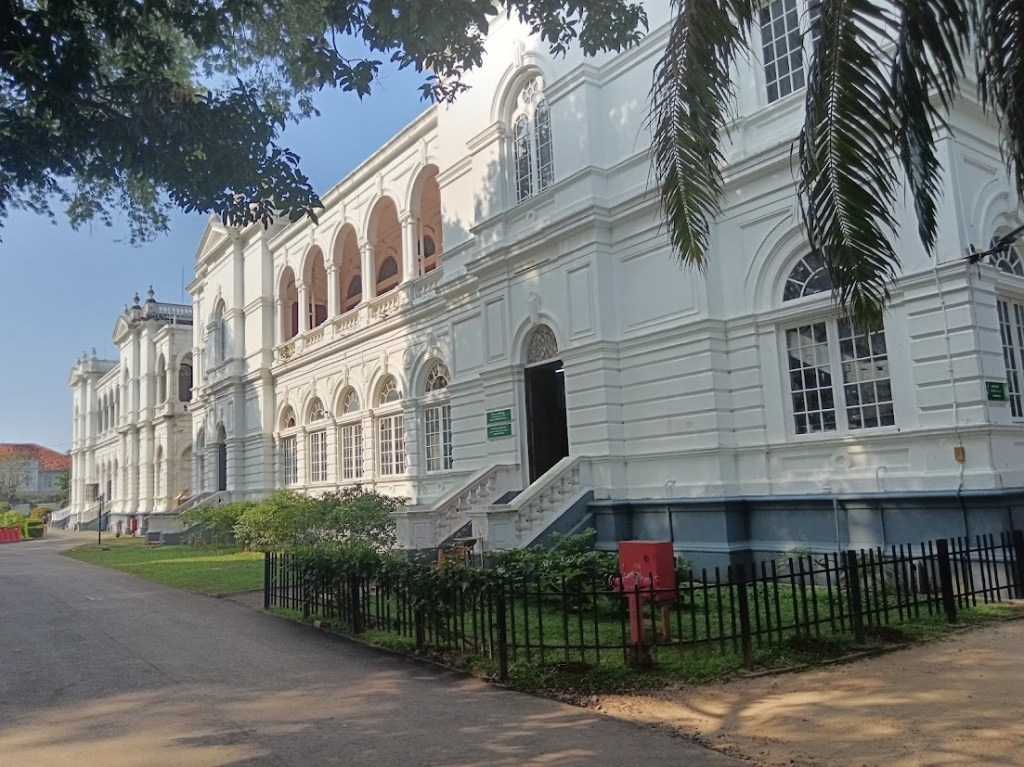
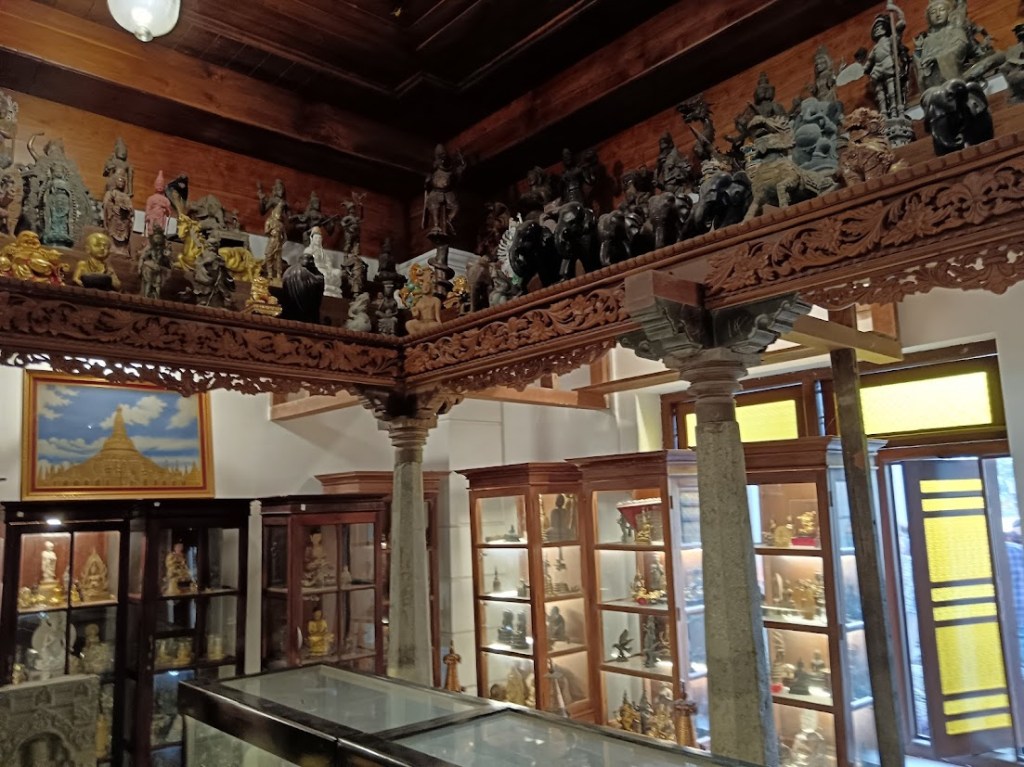
I visited the Sri Lankan national museum, the largest in the country. It was established by Sir Gregory, the British governor of Ceylon (as Sri Lanka was then called) in 1877. The museum is housed in a white, neo-Baroque building and offers a fascinating glimpse into Sri Lanka’s past. The museum is well maintained though it is not air conditioned. The humidity is a constant presence in Colombo. The collection of antiques at the museum is extraordinary.

On my last evening in Colombo, I did some sightseeing. We went to the Gangaramaya temple, the most important one in Colombo. The architecture is a mix of Sri Lankan, Indian, Thai, and Chinese styles. The temple was started by the famous scholar monk Hikkaduwe Sri Sumangala Nayaka Thera in the late 19th Century. The temple has a rich collection of Buddha statues and huge collections of ivory that must be worth millions if not billions. Our next stop was the Lotus tower at 351.5 metres, the largest self-supported structure in South Asia. The lotus is a symbol of purity. view of Colombo city from the observation tower at the top is excellent. I could see the Galle Face Road where I had stayed during my last visit. We could see the Sri Lankan railway depots and stations.

Colombo is a fascinating city. There is plenty to see and do. Recent economic events have hit the island hard. During my subsequent visit I plan to explore other parts of this magical country. Serendip/Serendib was the ancient Persian/Arab name for the country. The name is believed to be derived from the Sanskrit Simhaladwipa (dwelling place of Lion’s Island). The lion occupies a prominent place on the Sri Lankan flag.

The three princes of Serendip in an ancient story had the knack of making unexpected discoveries and is the root of the word serendipity in English. Visit Colombo and Sri Lanka, who knows what serendipitous discoveries await you?

Photo Courtesy: Ravi Shankar

Dr. P Ravi Shankar is a faculty member at the IMU Centre for Education (ICE), International Medical University, Kuala Lumpur, Malaysia. He enjoys traveling and is a creative writer and photographer.

.

PLEASE NOTE: ARTICLES CAN ONLY BE REPRODUCED IN OTHER SITES WITH DUE ACKNOWLEDGEMENT TO BORDERLESS JOURNAL

Click here to access the Borderless anthology, Monalisa No Longer Smiles

Click here to access Monalisa No Longer Smiles on Kindle Amazon International

Categories
Excerpt

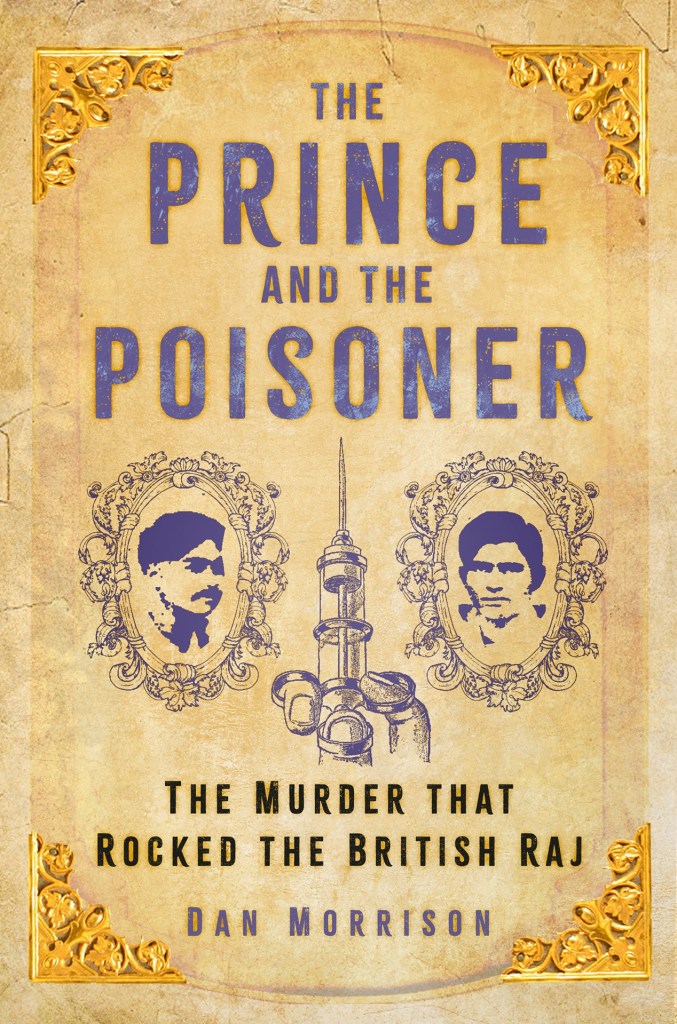
The Murder that Shocked the World


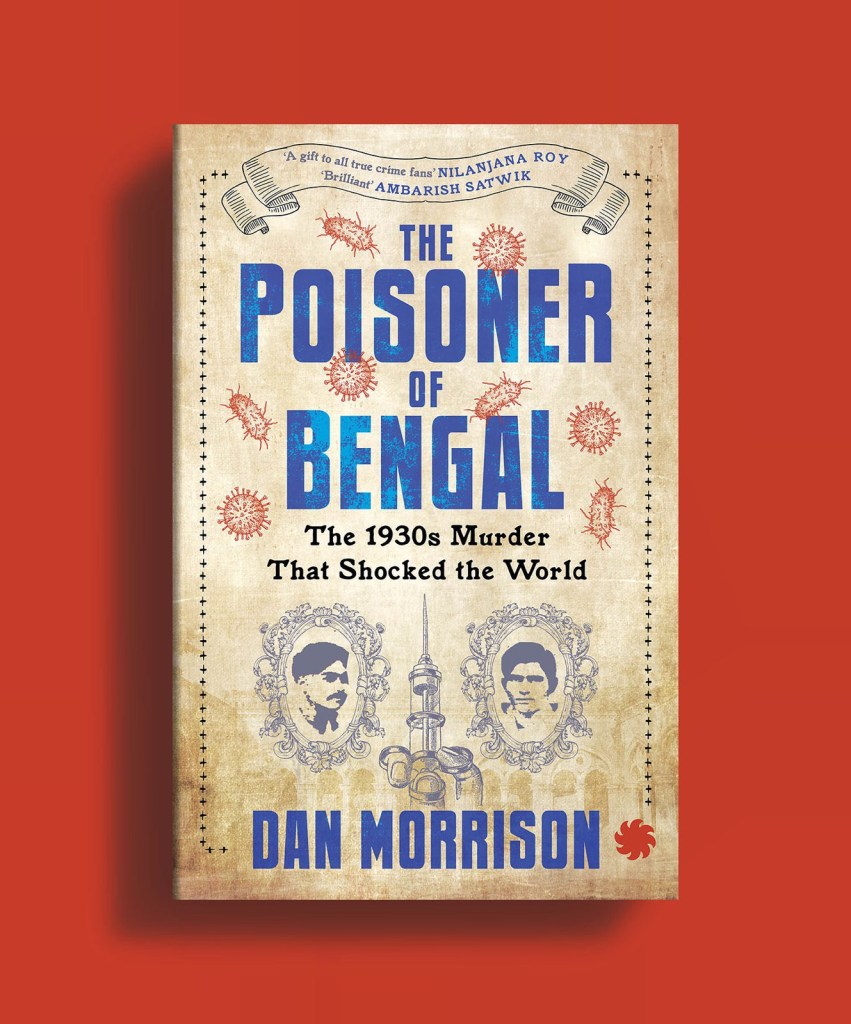
Titles: The Poisoner of Bengal/The Prince and the Poisoner

Author: Dan Morrison

Publishers: Juggernaut (India)/ The History Press (UK)

November 1933: Howrah Station

For most of the year, Calcutta is a city of steam, a purgatory of sweaty shirt-backs, fogged spectacles, and dampened décolletage. A place for melting. In summer the cart horses pull their wagons bent low under the weight of the sun, nostrils brushing hooves, eyes without hope, like survivors of a high desert massacre. The streets are ‘the desolate earth of some volcanic valley’, where stevedores nap on pavements in the shade of merchant houses, deaf to the music of clinking ice and whirring fans behind the shuttered windows above.

The hot season gives way to monsoon and, for a while, Calcuttans take relief in the lightning-charged air, the moody day- time sky, and swaying trees that carpet the street with wet leaves, until the monotony of downpour and confinement drives them to misery. The cars of the rich lie stalled in the downpour, their bonnets enveloped in steam, while city trams scrape along the tracks. Then the heat returns, wetter this time, to torment again.

Each winter there comes an unexpected reprieve from the furious summer and the monsoon’s biblical flooding. For a few fleeting months, the brow remains dry for much of each day, the mind refreshingly clear. It is a season of enjoyment, of shopping for Kashmiri shawls and attending the races. Their memories of the recently passed Puja holidays still fresh, residents begin decking the avenues in red and gold in anticipation of Christmas. With the season’s cool nights and determined merriment, to breathe becomes, at last, a pleasure.

Winter is a gift, providing a forgiving interval in which, sur- rounded by goodwill and a merciful breeze, even the most determined man might pause to reconsider the murderous urges born of a more oppressive season.

Or so you would think.

On 26 November 1933, the mercury in the former capital of the British Raj peaked at a temperate 28°C, with just a spot of rain and seasonally low humidity. On Chowringhee Road, the colonial quarter’s posh main drag, managers at the white- columned Grand Hotel awaited the arrival of the Arab-American bandleader Herbert Flemming and his International Rhythm Aces for an extended engagement of exotic jazz numbers. Such was Flemming’s popularity that the Grand had provided his band with suites overlooking Calcutta’s majestic, lordly, central Maidan with its generous lawns and arcing pathways, as well as a platoon of servants including cooks, bearers, valets, a housekeeper, and a pair of taciturn Gurkha guardsmen armed with their signature curved kukri machetes. Calcuttans, Flemming later recalled, ‘were fond lovers of jazz music’. A mile south of the Grand, just off Park Street, John Abriani’s Six, featuring the dimple-chinned South African Al Bowlly, were midway through a two-year stand entertaining well-heeled and well-connected audiences at the stylish Saturday Club.

The city was full of diversions.

Despite the differences in culture and climate, if an Englishman were to look at the empire’s second city through just the right lens, he might sometimes be reminded of London. The glimmer- ing of the Chowringhee streetlights ‘calls back to many the similar reflection from the Embankment to be witnessed in the Thames’, one chronicler wrote. Calcutta’s cinemas and restaurants were no less stuffed with patrons than those in London or New York, even if police had recently shuttered the nightly cabaret acts that were common in popular European eateries, and even if the Great Depression could now be felt lapping at India’s shores, leaving a worrisome slick of unemployment in its wake.

With a million and a half people, a thriving port, and as the former seat of government for a nation stretching from the plains of Afghanistan to the Burma frontier, Calcutta was a thrumming engine of politics, culture, commerce – and crime. Detectives had just corralled a gang of looters for making off with a small fortune in gold idols and jewellery – worth £500,000 today – from a Hindu temple dedicated to the goddess Kali. In the unpaved, unlit countryside, families lived in fear of an ‘orgy’ of abductions in which young, disaffected wives were manipulated into deserting their husbands, carried away in the dead of night by boat or on horseback, and forced into lives of sexual bondage.

Every day, it seemed, another boy or girl from a ‘good’ middle- class family was arrested with bomb-making materials, counterfeit rupees, or nationalist literature. Each month seemed to bring another assassination attempt targeting high officials of the Raj. The bloodshed, and growing public support for it, was disturbing proof that Britain had lost the Indian middle class – if it had ever had them.

Non-violence was far from a universal creed among Indians yearning to expel the English, but it had mass support thanks to the moral authority of Mohandas Gandhi. Gandhi, the ascetic spiritual leader whose campaigns of civil disobedience had galvanised tens of millions, was then touring central India, and trying to balance the social aspirations of India’s untouchables with the virulent opposition of orthodox Hindus – a tightrope that neither he nor his movement would ever manage to cross.

And from his palatial family seat at Allahabad, the decidedly non-ascetic Jawaharlal Nehru, the energetic general secretary of the Indian National Congress, issued a broadside condemning his country’s Hindu and Muslim hardliners as saboteurs to the cause of a free and secular India. Nehru had already spent more than 1,200 days behind bars for his pro-independence speeches and organising. Soon the son of one of India’s most prominent would again return to the custody of His Majesty’s Government, this time in Calcutta, accused of sedition.

It was in this thriving metropolis, the booming heart of the world’s mightiest empire, that, shortly after two o’clock in the afternoon on that last Sunday in November, well below the radar of world events, a young, slim aristocrat threaded his way through a crowd of turbaned porters, frantic passengers, and sweating ticket collectors at Howrah, British India’s busiest railway station.

He had less than eight days to live.

About the Book:

A crowded train platform. A painful jolt to the arm. A mysterious fever. And a fortune in the balance. Welcome to a Calcutta murder so diabolical in planning and so cold in execution that it made headlines from London to Sydney to New York. 

Amarendra Chandra Pandey, 22, was the scion of a prominent zamindari family, a model son, and heir to half the Pakur Raj estate. Benoyendra Chandra Pandey, 32, was his rebellious, hardpartying halfbrother – and heir to the other half. Their dispute became the germ for a crime that, with its elements of science, sex, and cinema, sent shockwaves across the British Raj. 

Working his way through archives and libraries on three continents, Dan Morrison has dug deep into trial records, police files, witness testimonies, and newspaper clippings to investigate what he calls ‘the oldest of crimes, fratricide, executed with utterly modern tools’. He expertly plots every twist and turn of this repelling yet riveting story –right up to the killer’s cinematic last stand. 

About the Author:

Dan Morrison is a regular contributor to The New York Times, Guardian, BBC News and the San Francisco Chronicle. He is the author of The Black Nile (Viking US, 2010), an account of his voyage from Lake Victoria to Rosetta, through Uganda, Sudan and
Egypt. Having lived in India for five years, he currently splits his time between his native Brooklyn, Ireland and Chennai.

.

PLEASE NOTE: ARTICLES CAN ONLY BE REPRODUCED IN OTHER SITES WITH DUE ACKNOWLEDGEMENT TO BORDERLESS JOURNAL

Categories
Interview Review

To Egypt with Syed Mujtaba Ali and Nazes Afroz

A discussion with Nazes Afroz along with a brief introduction to his new translation of Syed Mujtaba Ali’s Tales of a Voyager (Joley Dangay), brought out by Speaking Tiger Books.

Translations bridge borders, bring diverse cultures to our doorstep. But here is a translation of a man, who congealed diversity into his very being — Syed Mujtaba Ali (1904-1974), a student of Tagore, who lived by his convictions and wit. Like his guru, Mujtaba Ali, was a well-travelled polyglot, who till a few years ago was popular only among Bengali readers with his wide plethora of literary gems that can never be boxed into genres precisely. People were wary of translating his witty but touching renditions of various aspects of life, including travel and history from a refreshing perspective, till Nazes Afroz, a former BBC editor, took it up. His debut translation Mujtaba Ali’s Deshe Bideshe as In a Land Far from Home: A Bengali in Afghanistan in 2015 was outstanding enough to be nominated for the Crossword Prize. Recently, he has translated another book by Mujtaba Ali, Tales of a Voyager (Joley Dangay[1]), a book that takes us back a hundred years in time — a travelogue about a sea voyage to Egypt and travel within.

This narrative almost evokes a flavour of Egypt as depicted by Agatha Christie’s Death on the Nile (1937) or The Mummy (film, set in 1932), simply because it is set around the same time period. Afroz in his introduction sets the date of Mujtaba Ali’s travels translated here between 1935 and 1939. The book was published in 1955. This book is a treasure not only because it gives a slice of historic perspective but also weaves together diverse cultures with syncretism.

Mujtaba Ali has two young travel companions, Percy and Paul, who despite being British (one of them is on the way to study in Oxford) seem to have a fair knowledge of Indian lore and there is the inimitable Abul Asfia Noor Uddin Muhammad Abdul Karim Siddiqi, who almost misses a train while trying to argue about the discrepancies shown in the time between his Swiss watch and the clock at Cairo. The description is sprinkled with tongue-in-cheek humour.

The voyage starts at Sri Lanka and sails through the Arabian Sea to Africa, where the ship pauses at Djibouti. Here, Mujtaba Ali expands his entourage with the addition of the long-named Abul Asfia, well-described in the blurb as a man who “carried toffees, a gold cigarette case, and other sundry items in his capacious overcoat pocket and who had the answer to all problems though he barely spoke a word ever.” Afroz himself has given an excellent introduction to the writer and the book — almost in the style of Mujtaba Ali himself. This is a necessary addition as it highlights Mujtaba Ali’s perspectives and gives his background to contextualise the relevance of this translation.

Mujtaba Ali’s style is poetic and humorous. It demystifies erudition and touches the heart simultaneously. His ability to laugh at himself is inimitable. He tells us a story about how the giraffe from Africa was introduced to China by a king from Bengal. At the end, he and his companions reflect about the tallness of this tale!

Mujtaba Ali contends: “‘…One of my friends is learning Chinese in order to read Buddhist scriptures in that language. Possibly you know that many of our ancient scriptures were destroyed with the decline of Buddhism in India. But they are still available in Chinese translations. My friend came across this story while searching for Buddhist scriptures. He had it translated and published in Bengali with the copy of the painting in a newspaper. Or else Bengalis would never have known of this because there is no mention of it in our history books or documents in the archives in Bengal.’”

The irony is not lost that Buddha is of Indian origin and yet an Indian has to learn Chinese to read the scriptures. The narrative continues with more dialogues:

“Percy said, ‘But sir, it didn’t sound like history. It [the giraffe’s story] exceeds fiction.’

“I [Mujtaba Ali] replied, ‘Why, brother? There is the saying in your language, ‘Truth is stranger than fiction.’

“And my personal opinion was that if the narrative of an event could not rouse interest in someone more than fiction, then that event had no historical value. Or I would say that the narrator was not a true historian. In our land, most of our historians are such dry bores.”

As Mujtaba Ali’s renditions are colourful – is he a ‘true historian’ by his own definition? Such narratives dot the travelogue, generating curiosity about major issues in a light vein and linking ancient cultures with the commonality of human needs, creating bridges, taking us to another time, finding parallels and making learned, hard concepts comprehensible by the simplicity of his observations.

Similarly, he says of the rose: “The Mughal-Pathan era of India ended a long time ago, but can we say for how long the roses brought by them will continue to give us fragrance?”

Some of his renditions are poetic and beautiful. Mujtaba Ali watches the sunrise by the pyramids and describes it: “Streaks of light were gradually lighting up the liquid darkness. The white parting in the middle of black hair was becoming visible. There was a light daubing of vermillion on that.”

Borrowing from diverse cultures, Mujtaba Ali skilfully weaves the commonality of cultures, customs and countries into his narrative under the umbrella of humanity. Afroz with his journalistic background and a traveller himself, is perhaps the best person to translate this narrative of another traveller from the past. The depth of erudition simplified with humour has been well captured in this translation too. In this interview, Afroz discusses more about the author, his new translation and the relevance of the book in the present context.

Nazes Afroz

You have translated two books by Mujtaba Ali. Is he essentially an essayist? Were there many essayists and travel writers at that point, especially from within Bengal? Where would you place him as a writer in the annals of Bengali literature?

I don’t think that ‘essentially an essayist’ is the right description of Mujtaba Ali. Of course he wrote many essays but his repertoire included novels, short stories, funny anecdotal pieces based on his experiences (in Bangla they are called romyorochona) and stories from his travels, his encounters with extremely interesting people across the globe. He was deeply interested in culinary experiences. So he wrote a lot about food habits, multitude of cuisine and also gave recipes. Hence, it is difficult to box him into one genre of writing. With the publication of his first book, Deshe Bideshe, (serialised in 1948 in Bangla literary magazine Desh and as a book in 1949) he instantly occupied a significant place in Bengali literature.

Syed Mujtaba Ali

His Bangla prose, steeped in effortless and seamless multilingual and multicultural references, swept the discerning readers of Bangla literature off their feet. It was not only the prose that he created but the breadth and depth of subjects his pen touched was unparalleled. No author in Bangla language has been able to write on such a wide range of topics till date.

Coming to the other part of the question about travel writers and essayist in Bengal in early part of the twentieth century: the short answer is, yes there were many. Travel writing has been an important genre in Bangla literature. Bengalis had been travelling – for pilgrimage, for rest and recuperation following illnesses, or just for pleasure since the middle of the nineteenth century, which was the time of Bengal renaissance. Writers who undertook such journeys, wrote about their travels too. So Mujtaba Ali is no exception in that regard. He followed in the footsteps of his predecessors and also his peers.

You have called the book ‘Tales’ of the Voyager — would you say that some of the stories are like tall tales here — perhaps tales to convey an idea or a thought which in itself would be larger than history in explaining the truth of a civilisation, like the tale of the giraffe? Would you see this as a comment on the gap between popular and documented narratives in history and on the different interpretations of history? 

Ali was an excellent raconteur. He was also gifted with an almost eidetic memory. This allowed him to learn a dozen languages – some with native proficiency. He was a voracious reader too. So, not only did he read tomes on history and philosophy in many languages across cultures but also he gathered fascinating tales from many corners of the world as he loved storytelling. Whenever opportunities came, he masterfully wove those stories into his writing. Thus the tale of the giraffe’s journey from Africa to China via Bengal found its way in this book as he was narrating stories from the east coast of Africa. There is another thing that makes Ali’s writing attractive. He weaves in fascinating quirky funny stories while discussing something apparently dense and dry. I have not come across many writers who have done that. I don’t know whether to name it as his comment on bridging the gap between popular and documented history. There’s no evidence to prove that he was trying to achieve that as he never mentioned it. We could only conclude that it was a style that he invented and mastered in an effort to engage with his readers.

A writer that came to mind while reading this book of Mujtaba Ali is, one who is really more entertaining than accurate –Marco Polo. We know he lived five centuries before Mujtaba Ali. Mujtaba Ali of course is erudite, a scholar, but he seems to have a similar fire within him, a wanderlust. Do you think he would have been impacted by the writings of Marco Polo? Was wanderlust not a very typical phenomenon that was part of the culture that had evolved in Bengal post the Tagorean renaissance? Did Mujtaba Ali also travel for wanderlust? 

Reading Ali’s books, one may think that he had wanderlust in the true sense. It will be correct to assume that he was fidgety; he refused to settle down; he moved jobs; he moved cities and even continents. But to be  truly smitten by wanderlust, one has to enjoy the travel, which wasn’t possibly the case for Ali. His son told me that even though he travelled extensively, Ali didn’t enjoy travelling much. There had been many, of his time, who were really smitten by wanderlust — like Rahul Sankrityayan (1893-1963, walked to Tibet twice and wrote only in Hindi), Bimal Mukherjee (1903-1996, a true globetrotter who cycled to London from Kolkata), Umaprasad Mukhopadhyay (1902-1997, who crisscrossed the Himalayas from one end to another), Probodh Kumar Sanyal (1905-1983, his travelogues of the Himalayas), Premankur Atorthi (1890-1964, author of Mahasthobir Jatok) — to name a few. While these authors were inherently bohemian and were drawn towards travelling only for the sake of it, Ali was more of an unsettled soul who travelled with a particular purpose and wrote about his experiences as he had picked up fascinating stories and observed connections between cultures. Because he loved to tell stories and also because he was infused with the idea of internationalism that he inculcated from Tagore, there was no way he could escape but narrating the stories and cultural experienced from his travels.

Tales of a Voyager takes us on a sea voyage to Egypt. Did you travel to Egypt while translating the book? Would you say that the Egypt of those times still resonates in the present day — especially after the 2011 uprising?

Even before his one night stopover in Cairo that he narrated in Tales of a Voyager, Ali had previous experience of Cairo where he spent a year as a post-doctoral scholar in 1933-34 at the Al-Azhar University. So there are many short pieces on Cairo and Egypt by him in his other books. He raved about the café-culture of Cairo and came to the conclusion that Egyptians surpassed the Bengali in terms of adda—hours of the purposeless sessions of chitchat and chinwag. I have been to Cairo at least half a dozen times and realised how acute his observation was. I witnessed in person why Ali mentioned that this was a city that never slept. The cafes and shops were open all night and the streets were full of people with families including children until well past midnight.

Late night, a cafe in Cairo. Photo Courtesy: Nazes Afroz

As expected, the political landscape that you mention in the question, would be completely different between Ali’s time in the 1930s and in 2010 when I started visiting Cairo. When Ali first went to Cairo in 1933, Cairo had just gained full independence from the forty years of British occupation (not as an annexed state but more of a protectorate). So there are some references of the political figures like Sa’ad Zaghloul Pasha[2] in his various writings but the main focus was on its cultures.

When I started travelling to Cairo from 2010, I witnessed some similarities in the cultural traits as elaborated by Ali. But politically by then, Egypt had moved far from where it was in the 1930. It had become an architect of the Non-Aligned Movement in the 1950s. It was the most prosperous country in North Africa and an important leader among the Arab nations. But it was also reeling under the oppression of one party rule and the youth were bubbling to break away from that. This is something we witnessed unfolding from 2011.

What were the challenges you faced while translating this book? Was it easier to handle as it was the second book by the same author? 

The main challenge of translating Mujtaba Ali is transposing his unique language steeped in multi-lingual references into English. Also to get his oblique sense of wit and puns from Bangla into another language, which at times, may not have the right words for them. Translating the second book of the same author doesn’t make it easier as the challenges I just mentioned remain for every book.

Tell us what spurs you on to continue translating Mujtaba Ali. Please elaborate.

Syed Mujtaba Ali’s writing had a huge influence on me from my young age. His writing shaped my worldview, planted the seeds of curiosity about many societies, taught me how to make friends in distant lands and start making connections between cultures. So what I’m today is largely due to his writing. As an avid reader of his texts, I felt that it was my duty to introduce him to a wider readership. That’s the motivation of my taking up the translation of Ali. It is also a tribute to a writer who had such an impact on me.

In your introduction you have written of Mujtaba Ali and his writing. What had he written to be put on the Pakistani watchlist in 1950s? 

He had penned an essay opposing the imposition of Urdu as Pakistan’s national language on the Bengalis who were in majority in the newly created East Pakistan. He even predicted how the Bengalis would rebel against such a policy, which came true in 1952 in the form of the Language Movement. He wrote this when he was the principal of a government college in Bogura. So he drew wrath of the Pakistani leaders and an arrest warrant was issued against him. That was the time when he left Pakistan and returned to India in 1949.

There also the other difficult personal situation. His wife (married in 1951) who was from Dhaka and was working in the education ministry, continued to live in East Pakistan with their two sons while he lived in India working for the Indian Government. So Pakistanis always thought he was an Indian spy while he was under suspicion in India that he was on the side of Pakistan!

Did Mujtaba Ali participate in the political upheaval between Pakistan and Bangladesh? Please elaborate if possible. 

Ali was hugely affected in 1971 because of his personal situation as I just mentioned. I don’t know how deeply he was involved with the liberation war in Bangladesh but he wrote a novel, Tulonaheena (his last novel), against that backdrop – based in Kolkata, Shillong and Agartala and told through the story of a lover couple – Shipra and Kirti. So it is likely that he was involved in some capacity with the war efforts.

Mujtaba Ali studied in Santiniketan — that would have been in the early days of the university. Would he have been influenced by Tagore himself and the other luminaries who were in Santiniketan at that time? Can you tell us how? And did that impact his work and outlook? 

The simple answer is: it was huge. Tagore was the polar star for Mujtaba Ali, which he acknowledged every now and then in his writing. This experience also decided his life’s journey. He imbibed humanism and internationalism as a direct student of Tagore in Santiniketan. He also developed deep apathy towards all sorts of bigotry. So it was not surprising that he would find it very difficult to accept a country that was created on the basis of religion.

Do you find him relevant in the present-day context? Is your writing influenced or inspired by his style?

I feel that his relevance will never fade. His ability to create cultural connection from different corners of the world will continue to fascinate readers for generations. Yes, in this globalised world when information from around the world are at our finger tips with the click of a button but one also needs to learn how to look at those information beyond mere facts and go deep underneath to make a sense. Apart from being fun and entertaining read, I feel his writing is one such training tool to learn how to make cultural connections. This way, if one wants, one can truly become a global citizen.

As for me, my outlook towards the world is massively influenced by Ali’s writing but not my writing style. It’s simply because I’m not a polyglot like him! I’ll not be able to come anywhere close to his style even if I try.

Well, that is for the reader to judge I guess! You have books on Afghanistan. But you do travel with your camera often. Will you write of your own travels at some point — like Mujtaba Ali but in English?

I have only one book on Afghanistan – a cultural guide book that I co-authored with an Afghan friend. I was working on my own book on Afghanistan, which would have capture one decade of Afghan history and interspersed with my own direct experiences of the country between 2002 and 2015. But the research got stalled for lack of funding. I hope to revive it at some point. And, yes I would like to do my own writing from my travels. That’s there in the wish list.

What are your future plans as a journalist, writer and photographer? 

Travel more, see the world more, make more friends and photograph more!

Thanks a lot for giving us your time and the wonderful translation.

[1] Literal translation from Bengali, In Water and On Land

[2] 1857-1957, Egyptian revolutionary and statesman

Read the excerpt from Tales of a Voyager by clicking here


(The online interview has been conducted through emails by Mitali Chakravarty)

PLEASE NOTE: ARTICLES CAN ONLY BE REPRODUCED IN OTHER SITES WITH DUE ACKNOWLEDGEMENT TO BORDERLESS JOURNAL. 

Click here to access the Borderless anthology, Monalisa No Longer Smiles

Click here to access Monalisa No Longer Smiles on Kindle Amazon International

Categories
Poetry

The Grave is Wide…

Poetry by Michael R. Burch

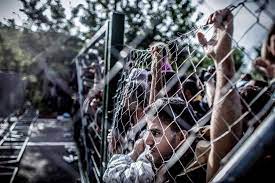
Courtesy: Creative Commons
Epitaph for a Refugee Child
		
I lived as best I could, and then I died.
Be careful where you step: the grave is wide.

Epitaph for a Refugee Mother

Find in her pallid, dread repose,
no hope, alas!, for a human Rose.

who, US?

jesus was born 
a palestinian child
where there’s no Room 
for the meek and the mild

... and in bethlehem still 
to this day, lambs are born
to cries of “no Room!” 
and Puritanical scorn ...

under Herod, Trump, Bibi
their fates are the same— 
the slouching Beast mauls them
and WE have no shame:

“who’s to blame?”

(First published in Setu)


Excerpts from “Travels with Einstein”


I went to Berlin to learn wisdom
from Adolph. The wild spittle flew
as he screamed at me, with great conviction:
“Please despise me! I look like a Jew!”

So I flew off to ’Nam to learn wisdom
from tall Yankees who cursed “yellow” foes.
“If we lose this small square,” they informed me,
earth’s nations will fall, dominoes!”

I then sat at Christ’s feet to learn wisdom,
but his Book, from its genesis to close,
said: “Men can enslave their own brothers!”
(I soon noticed he lacked any clothes.)

So I travelled to bright Tel Aviv
where great scholars with lofty IQs
informed me that (since I’m an Arab)
I’m unfit to lick dirt from their shoes.

At last, done with learning, I stumbled
to a well where the waters seemed sweet:
the mirage of American “justice.”
There I wept a real sea, in defeat.

(First published in Café Dissensus)

Michael R. Burch’s poems have been published by hundreds of literary journals, taught in high schools and colleges, translated into fourteen languages, incorporated into three plays and two operas, and set to music by seventeen composers.

PLEASE NOTE: ARTICLES CAN ONLY BE REPRODUCED IN OTHER SITES WITH DUE ACKNOWLEDGEMENT TO BORDERLESS JOURNAL

Click here to access the Borderless anthology, Monalisa No Longer Smiles

Click here to access Monalisa No Longer Smiles on Kindle Amazon International

Categories
Interview Review

Born Free to Follow your Heart

Anthony Sattin, an award winning journalist and travel writer in conversation about Nomads: The Wanderers Who Shaped our World, his recent book published by Hachette, India.

A breath-taking narrative that travels with the freedom of nomads, drawing from folklore, history and modern movements to give voice to an idea that might help move towards a more progressive and hopeful future — Anthony Sattin has achieved all this in a single book called Nomads: The Wanderers Who Shaped our World, a non-fiction that touches the heart with the concept of unifying humanity beyond the borders of ‘isms’ drawn over time. It explores the history of people who often have not been chronicled in conventional texts.

We are living in times where floods, forest fires, wars and divides are ravaging humanity as it wakes up from the coils of a pandemic that had almost stilled all normal interactions and economic activities for more than two years. The unrests and the changes attributed to “climate change” call for “continued solidarity” and a united front from all humanity as indicated by UN Secretary-General Antonio Gueterres and global guru Harari. In times such as these, an attempt to revive the concept of asabiyya, or bonds based on felt interests, is laudable and a necessity for the world to move forward. And that is exactly what Sattin has done in his recent book.

He has travelled with nomads; folklores, starting with Cain and Abel, Gilgamesh and Enkidu; history, Gobelki Tepe or Potbelly Hill, the place where he locates what might have been Eden, Achaemenid kings, Persian nomads, Mongols, Mughals to global nomads — spanning 12, 000 years of history.

In his book, Sattin tells us: “We are living at a time when the world — our world — shaped by the age of Reason and Enlightenment, powered by industrial and technological revolutions is faltering.  Social contracts are fraying and communications are breaking down. The raw materials and natural resources are becoming scarce, and the consequence of our actions … are written large across landscapes, the climate, the fabric of our lives…Change is needed.”

Sattin “traces the shifting relationships between people who move and those who were settled” to find the concept of asabiyya or the sense of bonding popularised by an Arab philosopher called Ibn Khaldun (1332-1406). Perhaps, this is an ideal that could benefit humankind if we were all to see ourselves as one tribe. He has mentioned modern attempts at asabiyya, like the call given by ‘Black Lives Matter’, to contextualise the concept for us and to show how a movement born from within the hearts of people could touch and change attitudes.

The book is divided into three parts after an initial introduction from Mount Zagros, where Sattin was rescued from a bout of sunstroke by nomads: the first part is called ‘The Balancing Act’, where he explores ancient folklore and history, Huns, Hyksos, Scythians, Xiongnu and more: the second part is called ‘The Imperial Act’, from  ‘The rise of the Arabs to the Fall of Mongols’ where kingdoms and world history is brought into play and the importance of asabiyya is introduced with historic instances and the last part is called ‘The Act of Recovery’, where changes towards redefining the world in terms of ideals aligned with asabiyya are explored.

The scope of the non-fiction is clarified at the start of the book from Mount Zagros. He starts the first section interestingly in a locale, termed by him as “Paradise” in 10,000 BC with a global population of ‘Perhaps 5 million’, of which he lists the nomad population as ‘Most of the number’. As he unfolds the history of mankind, from the past we find echoes of what could be called mobile or nomadic bonds that embrace to expand and heal civilisations. Sattin has been exploring such bonds for the last forty years.

Described as “a cross between Indiana Jones and a John Buchan hero” and “one of the key influences on travel writing today”, Sattin started his interactions with bedouins at age nineteen and found them nurturing. He elucidates: “After I left school, I went travelling in the Middle East. In the Sinai Peninsula, at that time, there were no hotels or other facilities outside of Sharm el Sheikh. So, I and the friend I was travelling with relied on the Bedouins for many things — they brought us fish and other food, they told us stories about the magical places in the desert mountains and although we had been told that they would rob us, they looked after us.”

Anthony Sattin. Photo Courtesy. John Murray/Hachette India. 

Sattin has several non-fictions under his belt and is an award-winning journalist, who writes in a number of well-known journals, like the Sunday Times, the Conde Nast Traveller and the Financial Times. An editorial advisor to the Geographical magazine, he is also a fellow of the Royal Geographical Society and a founder-member of Travel Intelligence and ASTENE (the Association for the Study of Travel in Egypt and the Near East). He was the director of the Principal Film Company, has written, advised and presented on television and radio productions, including the BBC.

In this exclusive conversation, Sattin discusses Nomads, and tells us how the book came to be.

What made you think of writing a book on nomads, who — you have stated in your book — now constitute only 40 million in a world of 7.8 billion humans?

Every book has its moment, and this is the right time for Nomads. It came out of a lifelong interest in people who live on the move and on the problems of settled society, especially with cities – some of the first thoughts in Nomads occurred decades back when I read Lewis Mumford’s The City in History[1]. But I also have many ideas for books in my head at any one time and they don’t all get written! And some of them sit around for ages and then it seems to me to be the right moment to write. The way our world has changed in the past decade helped shape my sense that this is the moment to write about open borders and freedom of movement. I also wanted to write something that would stretch me more than anything else I had written. Twelve thousand years of history seemed like a big enough challenge…

How long did it take you to research and write the book? What kind of research did you do?

I began shaping the idea nine years ago, after I finished my previous book, Young Lawrence[2], about how the second son of an anonymous, middle class Oxford family became Lawrence of Arabia. The proposal took more than a year to get right – as my editor at WW Norton in New York pointed out, a subject this big can be about everything and nothing. Then there were years of research, particularly in the Bodleian Library at Oxford and the London Library, which is a wonderful place, the largest private library in the world and which serves as my home from home. I had many conversations over the years with scholars, people in publishing, fellow writers, travellers and nomads. And then there was the travelling with nomads, the writing and rewriting.

You travelled and lived among nomads for some time? How many years? Were your travels affected by the pandemic? If so, how did you bypass that?

I have been meeting nomads for more than forty years, particularly in North Africa and the Middle East, where I have travelled extensively. When I was 19, I was looked after by Bedouin in the Sinai Desert. In 2010, I was back there on a camel trek with a guide who impressed me because he knew every mountain, every watering place and every cave, including one which he pointed out as the place where he was born.

In Mali, I spent time with Touareg nomads, who came together each year at a place in the desert beyond Timbuktu – these tribes used to be at war with central government (and are again), but a treaty had been brokered and one of the terms was that tribal and government leaders would meet once a year to sort out grievances. They also played music, danced, raced camels… How could one not be swept away?

Specifically for Nomads, I went to Iran to spend some time with the Bakhtiari, a large nomad tribe who I had chosen in part because they claim lineage that goes back millennia, because they had played a part in the making of modern Iran but also because in the 1920s, a movie[3] was made of their annual migration into the Zagros Mountains, amazingly by the director and producer[4] whose next movie was the original King Kong! The Bakhtiari taught me much about the challenges facing nomads today.

Can you tell us of a few interesting experiences while moving with nomads which are not part of the book?

When I first went into the Zagros Mountains to meet the Bakhtiari, I was taken by a guide (being British, I had to have a guide for my entire stay in Iran) and he could not understand why I would waste my money and my time going into the mountains. He was from the city and exhibited age-old prejudices against people who lived on the move, whom he called ‘primitives”. But I am not a nomad and although I don’t find them primitive, I do find some aspects of their lives very challenging: years ago, on a camel trek in the Thar Desert, I caught what I now assume was sunstroke and thought I was going to pass out. My guide – there were just the two of us travelling – got me out of the desert. At the first village we reached, he had someone bring a bed out of a house and placed in the shade of a tree. I lay down and remember no more until about four hours later when I woke to find myself surrounded by the whole village. They had been angry with the guide for bringing me to them – think of all the trouble they would face if I died! When I woke, in the middle of this scene, the whole crowd burst into cheers like a scene out of a Bollywood movie.

You have spoken of ‘asabiyya’ taught by Ibn Khaldun. Can you explain the concept briefly and tell us if this can be of relevance in the current global situation?

Asabiyya is a sense of group feeling, something that binds people together. Ibn Khaldun thought it had shaped the world and found that it was most powerful among nomads and people who lived in the desert, in part because they must rely absolutely on each other. When this group feeling is channelled by a leader – the Prophet Muhammed, for instance – it can lead the group towards extraordinary achievements, as when the first Arabs overcame the might of the better-trained and armed Byzantine and Persian armies. It might all sound like something from long ago but I think there is a sense, in our own time, of someone like Greta Thurnberg having channelled that same feeling to force our leaders to pay attention to the climate emergency.

At a point you tell us that “…cities posed existentialist risks, and their temptations could overwhelm the asabiyya and nomads would lose their identity.” Why was maintaining their identity for the nomads so essential? Do you think this is something that needs revival in the present?

The existential risks I mention are the ones that rob nomads of their asabiyya and therefore of their power. Ibn Khaldun had seen this first hand: in North Africa, several small reformist movements had come out of the harsh desert or mountains to the south and overwhelmed the courts and kingdoms along the north coast. But each of those movements had fallen apart within a few generations as the pure people of the desert found themselves corrupted by living in cities. As for identity, it is important for all of us to know who we are and where we have come from — that was one reason to write the book, because very little is taught about nomads in western schools.

Your book touches upon number of issues — including faith. Given the fact that the great Khan had a Nestorian church, a mosque and a Buddhist temple in his capital city despite following the Shamanistic faith, would you say that an openness or tolerance in beliefs and faiths led to a more strongly tethered kingdom, as they did not really seem to have concepts of permanent national boundaries then? Is this not a dichotomy that you create a strongly tethered kingdom and yet are open to move on, leaving the old capital behind? And is it not wasteful?

I think there are two things going on here. On the one hand, a belief in freedom of conscience, the right to follow any or no religion. This was certainly something the great Mongol khans believed in. They were mostly animists, believing in the Sky Father and reliant on signs and omens, but they were not adverse to being prayed for and blessed by an imam or priest. Even the Ottomans, who came out of a nomadic tradition and were clearly Muslims, thought it important to allow freedom of conscience in their empire. What mattered was not who you prayed to, but whether you were prepared to acknowledge the sovereignty of the khan or the sultan. Some of the most successful periods in human history have flourished because of this idea.

A strongly tethered kingdom is another issue. For nomads, cities and capitals were not as important as lands, particularly hunting and grazing lands. The Mongol khans, like ancient Persian emperors and many other nomad leaders, recognised the need for a pivotal meeting place, a capital, but they were mostly more interested in spending time elsewhere and on the move. A leader such as Attila, the Hun ruler, had no interest in the cities he conquered.

You mention British author, Bruce Chatwin(1940-1989), as having said “we are born to move, that we must move or die.” Can you explain what that would mean? In the current context, people talk of roots and homeland. If they keep moving what happens to their firm conviction in homeland?

It depends what sort of ‘moving’ we are talking about. On a mundane and personal level, research now tells us that we are less likely to get ill and more likely to live longer if we walk 10,000 steps a day. On a national and global scale, we need interaction, we need to live lighter, we need to be nimble on our feet and in our thoughts.  

You have divided the world into two groups — nomads and settlers — and said we need a bit of both. Can you tell us how and why?

Humans began to settle and cultivate some 12,000 years ago and since then, like Cain and Abel, humans have broadly been divided into those who stay in one place, usually either cultivating the land or living in towns/cities, and those who live on the move. For most of history they have lived in a state of mutual dependence and often even in harmony. A world without nomads, with everyone fixed in one place – which seems to be where we are heading – is a smaller, less rich, less fertile world.

In a post-pandemic world, would the nomadic lifestyle you have written of be feasible, especially with all the governmental issues creeping in? 

The word nomad comes from a very old Indo-European word meaning pasture or a fixed area, which suggest the right to graze. But if you take a broad view of what it means to be a nomad in the 21st century, you might also include digital nomads and others who move to work or just because that is how they want to or have to live. That might not have been possible during the pandemic, when we were all locked down, but the number of people on the move now in many parts of the world is right back up and that can only be a good thing – we need to mix and meet, to exchange experiences and opinions.

If we opt for a mobile lifestyle, would we need to redefine borders as of old? Would that take us back to a pre-nationalistic era? Do you think we should be redefining our mindsets and our isms? Do you suggest we all go back to an intermittent nomadic lifestyle?

We should always be questioning mindsets and isms! Happily, we are living through a golden age of revisionist history shaped by a number of forces, decolonialism, Black Lives Matter and #MeToo among them. We also live in an age of misinformation on a massive scale. Nomads has come out of a need I had to shine some light on a way of life that is either entirely missing, or misrepresented in our histories.

Are you planning to write more on this issue or move on to something else? Would you share with us your next project?

There is much more to be written about this issue, but after spending most of the past eight years working on Nomads, it is time for me to look elsewhere. I hope I have stimulated a debate about nomads that will encourage others to look further. Meanwhile my thoughts are turning to Egypt — and to Italy, from where I am writing today.

Thanks for giving us your time during your travels.


[1] First published in 1961

[2] First published in 2014

[3] Grass (1925)

[4] Merian C. Cooper (1893-1973)

(This review and online interview is by Mitali Chakravarty)

.

PLEASE NOTE: ARTICLES CAN ONLY BE REPRODUCED IN OTHER SITES WITH DUE ACKNOWLEDGEMENT TO BORDERLESS JOURNAL