I wait
weighing words against memories
memories against poetry
poetry against noise
noise against feeling
feeling against time
only to arrive
at the deepest homecoming of words
-	‘Homecoming’
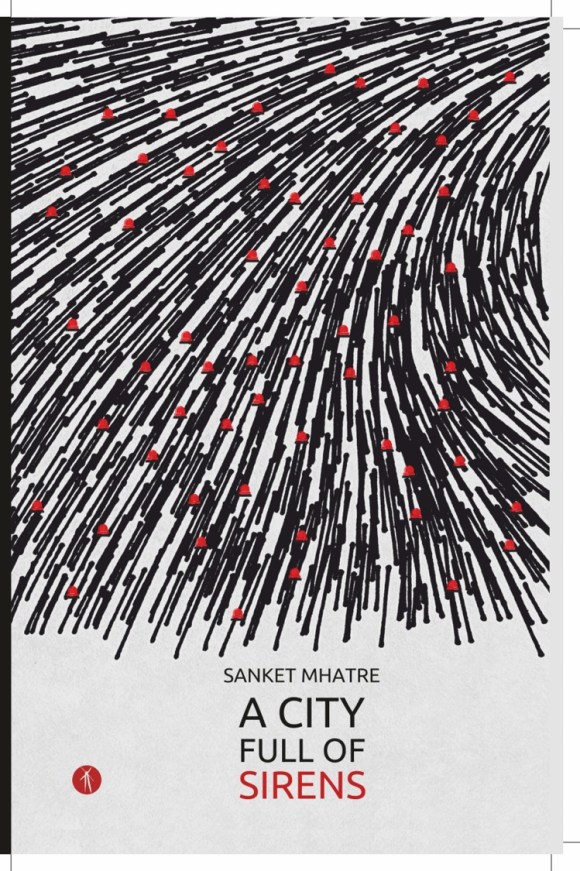
Something irreplaceably urgent yet inconsolably fragile commands the readers’ attention in Sanket Mhatre’s A City Full of Sirens. There is, to begin with, the orderly chaos of the book cover that with its startling depiction of noise and alarm, summons us to a danger that is as neurological as it is existential, as concretely physical as it is metaphysical, and as identifiable as it is, ultimately, anonymous.
Darkness asphyxiates
shifting the axis of your soul
madness froths
bubbles of hurt
shadows of shards
inserting lost files of remembrance
pulse rising –
raising a question at boiling point
Here is an understanding of the city as both protagonist and witness, as conquistador and vanquished, as healer and diseased. Mhatre is mostly talking about Mumbai (“Andheri East doesn’t realize/ that it is sleeping in a belly of void/ It is only a matter of time/ until all the lights go out”) but his city could be “the broken arteries of Kolkata” (‘Mid-flight’) or precisely any cityscape where life routinely unravels amidst disillusionment, betrayal, threat and hope, every poem to it being “a wound or a flower or a piece of sunshine” “written on the threshold of vulnerability and despair” as “a letter trying to find its own footprint on the shifting axis of time and circumstance” (‘Introduction’)
Tortuous and tortured, Mhatre’s city is a site of bereavement, uncertainty, imperilment, disease, derangement and more, its inhabitants choiceless in their compulsion to wear its frayed fabric upon their skin. But this is not all. Lurking within these poems is also the decisive realisation of the city as a human construct, a mirror that reflects rather than distorts or imposes human irresponsibility and disorder. In the title poem of the collection, for instance, the city is a patient incapable of being saved by its nonchalant dwellers:
the city has been suddenly diagnosed with Stage 3C
and all of us who matter to her:
slum dwellers, middle class, uber rich
upper caste, sub-middle-sub-lower, lower,
converts, casteless, outcasts, pimps and city planners
were late by a minimum of ten months in pre-empting this disease
Mhatre’s cities emit steady sirens of disaster – biological, ecological, technological, moral and aesthetic. But redemption, too, is to be found here alone (“Clay hands in a relentless prayer to -/ everything the earth stands for/ and everything that rises upwards from it.” – ‘A Kiss of Cotton’) for only what hurts has the ability to effectively transform – “anything that doesn’t change our body can never change us”. (‘Culture of Transience’) What, chiefly, reconciles the city as wound to the city as mirror, is the imperative of language and its expressive potential for love and poetry. (“A verse could be an open road” – ‘These Years with Her’)
A City Full of Sirens is a dense interrogation of the city, its sirens of overpopulation, congestion, capitalism and climate change, and an exploration of the fullness or plenitude of language that can somehow soften all of this and make it more bearable for life and time. Firmly rooting this collection is a momentous faith in the capacity of words to resist postmodern fragmentation by building bridges across emotions, cultures, and epistemologies. Mhatre’s imagination in poetry is luxuriantly metaphorical. In almost every poem, words defy ordinary appearances to transform into winged images in deep conversation with a reality tangential to the page. In ‘Anuvaad[1]’, as the poet says, all languages are born “from the same birdsong”. In ‘The Concept of Distance’, every stanza offers a new perspective into distance – “The space of pain between two alphabets, now divorced,/ looking on either side of a sentence”. In ‘Morphing into Everything’, the beloved and the city coalesce into one:
my fortresses crumble
dissolve mid-sea
rebirth as an archipelago
sink into her navel
populate her mind
germinate on her dermis
disintegrate into a thousand birds
taking early flight
In each of the fifty-six poems in the collection, is a seamless interweaving of self and space. Most of Mhatre’s sirens are symbolic, conjured through the weight and immediacy of metaphor. In each poem is this sense of something that must be overcome — a lurking claustrophobia, an unnamed distrust, a haunting faithlessness, a constant suggestion of order tipping into anarchy.
An acute precariousness, marked by a vital need to thresh out feeling on the floor of language, is the signature of this collection.
Very significantly, many of these poems are about poetry itself — its genesis, composition, structure, and its relentless shapeshifting ability to weld disparate worlds and subjectivities into a coherent experiential whole. Unravelling within this book’s narrative arc is an empathetic journey of the body and spirit, its goal being to discover “the completeness of existence…Time. Tide. Man. Woman. Humanity. Age. Difference. Distance”. (‘Rain Being’) Passion configures these poems in various ways and not least through the erotic of language. In the best poems here, love, poetry, woman and city become indistinguishable from one another, permeating ontological and aesthetic boundaries and accomplishing a spiritual surrealism that marks the distinctness of this collection.
A City Full of Sirens is, thus, about cities that are both germane and antithetical to poetry, about a “confabulated planet” and mutating geographies “stretching/ through thick mesh of bones and arteries/ pulp synchronized to our heartbeats/ birdsong to a breath/ while ink sprawls/ on a dream of half-slept pages”. (‘Vertical Forests’) It is equally about the inhabitants of the cityscape, the reconciliation of their numerous fragments and roles – “a new you added everyday/ an old you subtracted”. (‘The Queue’), intending “to geolocate/ the fulcrum of our absolute feeling/ outliving erasures”. (‘Synthesis’)
The collection remains remarkable for its obsession with language, its authentic emotional inflections, its charged candour, and its oscillations across a wide thematic range of existence, estrangement, erosion, and redemption. Annihilation, disease and death watermark these poems in undeniable ways but the energy of the book lies in its refusal to be contained within scripts of hopelessness or pain. Summoning optimism to thought and agency to action, A City Full of Sirens makes a palliative of poetry and crafts an entourage of life’s resilience to learn from every setback –
I was never the rain.
Until you cloud-burst me with words.
You gave me the first drop.
It’s my turn to take you in.
--‘Rain Being’
Basudhara Roy teaches English at Karim City College affiliated to Kolhan University, Chaibasa. Author of three collections of poems, her latest work has been featured in EPW, The Pine Cone Review, Live Wire, Lucy Writers Platform, Setu and The Aleph Review among others.
.
PLEASE NOTE: ARTICLES CAN ONLY BE REPRODUCED IN OTHER SITES WITH DUE ACKNOWLEDGEMENT TO BORDERLESS JOURNAL
UNUTTERABLE SILENCE

In Silence I came into existence
Without uttering a single word
Very few things I know recently
It all comes through a whisper

Words fall asleep in this temple of mine
Everything gives birth to a perception
Silence Is all I have learnt so far
The sky is full of dots  like this farthest star

Why shall I speak while the answer is inside
All I can utter is a simple sigh
I breathe but what exists is Silence
Dots and full stops make me just wonder

In Silence all the questions are answered
We came to earth without making a noise
But the inside is full with modes of speech
And utterances are just left unanswered

In Silence pertains all the sounds of existence
The essence of life is left speechless
Sounds and tones are born out of this quietness
The soul is the place where Silence is taught
Hela Tekali hails from Tunisia. She is a poet, a novelist, a translator, an editor, a reviewer, and currently writing a play ( a tragedy). She is by profession an English teacher at the Faculty of Law and Political Sciences in Tunisia. She has published more than 11 books of poetry , prose and two novels.
.
PLEASE NOTE: ARTICLES CAN ONLY BE REPRODUCED IN OTHER SITES WITH DUE ACKNOWLEDGEMENT TO BORDERLESS JOURNAL
The prawn curry was getting cold. “What’s taking you guys this long to finish a match point?” I demanded while dipping my index finger in the curry bowl and touching it to my tongue. “We never got to the end, Nina. Siddh fell on the grass and couldn’t get up after. He’s in immense pain. We’re going to have a long night,” Arko said.
The line clicked, but I stood there holding the telephone.
Little did we know then that Siddh would not be able to stand on his feet that evening and every evening until after two months.
Only last week, my favourite trio – brother Siddh, his wife, Saanvi, and their toddler, Uma, had arrived in India for a grand family reunion. This week the fun was planned at my home. After spending a day indoors, we slid into our sneakers for a walk in the park. The toddler at the swing, sisters-in-law chewing the fat, the boys at a badminton rally – the season of life we were all waiting for was finally here.
The twilight hours chimed in with the chirping of crickets. My niece asked me while rubbing her eyes, “What time do crickets go to bed?” “Not until morning. Crickets are night creatures,” I said. “Let’s sing a lullaby to crickets so they hit the bed on time,” Uma urged. Saanvi and I decided to walk back home, so the only person who went to bed on time was Uma.
The boys stayed on…
This park has an endearing presence in my life—an all-weather friend, where I end up on my good days and bad days. Just a stone’s throw away from where I live, the road to the house of this picturesque friend is never too long.
When I learned that Siddh had broken his leg in the lap of this green landscape…in the lap of my trusted friend, I felt thoroughly betrayed. No one had told me the road to the house of a friend could be bumpy too!
It took a village to lift my brother and settle him into a wheelchair. One emergency room, two hospitals, and three X-rays later, Siddh came home post-midnight…leaning on a walking frame, trembling in pain, falling apart.
The house went dead and silent, broken frequently by Siddh’s grunts and groans. Hiding behind the door tugging at a curtain, I anguished over what was tougher – to be afflicted by pain or watch someone you love suffer in pain.
The misery continued the following day – dialling up ambulances, moving between stretchers, painstakingly slow MRIs, mammoth injections, multiple doctor consultations, and whatnot. Reports said Siddh had suffered both a fracture and a ligament tear resulting in a full leg cast for six weeks!
The season of life we were all waiting for had gone awry. If there were a list of the ‘biggest holiday failures’, this would feature right at the top. Siddh seemed crestfallen – six weeks of staying in bed! Saanvi had a bewildered look on her face. Uma showed a big heart in saying she could wait until the next day for her Papa’s leg to get better so they could play chase. The dispirited Mom, Dad, and cousins drifted in different directions to make arrangements. Arko and I looked at each other and then looked around – we had gone from two to five to nine folks in a span of three days. Suddenly, my mind went elsewhere, “When was the last time we got together as one big family, with three generations living under one roof? When was the last time we sat face-to-face, speaking for hours, without a virtual screen orchestrating our conversations?”
I insisted that the trio stay with us during the recovery period. While no amount of caregiving could alleviate Siddh’s pain during the initial stage, nestling in a place of warmth and care helped him get through one day at a time. When he showed indomitable resilience in not just returning to working remotely only a few days after the accident but also stepping out on a whim while still using a walking aid, it only reaffirmed my belief that families do have the placebo effect.
Making lemonade out of lemons life had thrown at us, we often brought the house down with game nights, barbecue, drinks, karaoke, good music, and all that. On his birthday evening, when Siddh entered the living area, clacking his walker against the floor, shielding his discomfort with a grin, the message on the birthday cake sent him and everyone else into peals of laughter – Happiness is NOT playing badminton. The icing on the cake exhibited a passionate boy in the act of hitting a shuttle with a badminton racquet, wearing a replica of the red tee Siddh had worn on the evening he fell. Tongue-in-cheek, but everything is fair in love and life.
From sharing homes and hearts to strengthening family bonds, it only felt like this page in the book of our lives was written in stars.
Days and weeks rolled by. The long leg cast came off. The season of life began anew.
.
Siddh and Saanvi posted a handwritten note from London, “Years ago, anthropologist Margaret Mead was asked by a student what she considered to be the first sign of civilisation in a culture.
“Mead said that the first sign of civilisation in an ancient culture was a femur (thighbone) that had been broken and then healed. Mead explained that in the animal kingdom, if you break your leg, you die. You cannot run from danger, get to the river for a drink or hunt for food. You are meat for prowling beasts. No animal survives a broken leg long enough for the bone to heal.
“A broken femur that has healed is evidence that someone has taken time to stay with the one who fell, has bound up the wound, has carried the person to safety and has tended the person through recovery. Helping someone else through difficulty is where civilisation starts, Mead said.”
I cast my mind back to the evening we saw them off at the airport. A strange sense of accomplishment filled me – Siddh back on his feet, Saanvi’s beaming face, and Uma settled in my arms, making a toddler promise to visit Nina’s home in India ‘next week’.
Storing the sweet note of love in my memory box, I thought to myself, “There’s nothing more fulfilling than being there for your family in a difficult time. We are at our best when we lift each other up.”
Saumya Dwivedi often pens down anecdotes about her life. Her story ‘To the deep end’ has been published in a morning English daily. Passionate about skydiving, she keeps the spirit of flying alive in whatever she does.
PLEASE NOTE: ARTICLES CAN ONLY BE REPRODUCED IN OTHER SITES WITH DUE ACKNOWLEDGEMENT TO BORDERLESS JOURNAL
LOOSE LEAVES

Trifling through loose leaves.
Searching for the young me,
same as the old me. Did I write
anything of value then? Do I
write anything of value now?
We all have our detractors.
It is best to let all criticism
slide across your back. Pay
no mind and forge forward
like rockets in the sky. All you
need to do is lay your heart
bare. Whether pure of thought
or dirty ramblings, write it
all down as best you can.
Scrap it and throw it away if
you can make it better. Loose
leaves fill entire cemeteries,
where words go away to die.
Sometimes you can pick one
out of the many that are worthy
to be kept alive or resurrected.


OUT OF BED

I drag myself out of bed
into the city where the cold
wind blows. I go where the skies
appear like mirrors, pale and
pure, in the October twilight.
In the melancholy streets
my restless feet wander. I
walk with trepidation. I
feel myself pulling away.
Art byLuis Cuauhtémoc Berriozábal
Born in Mexico, Luis Cuauhtémoc Berriozábal lives in California and works in the mental health field in Los Angeles, CA.His poetry has been published by Blue Collar Review, Borderless Journal, Escape Into Life, Kendra Steiner Editions, Mad Swirl, SETU, and Unlikely Stories.
PLEASE NOTE: ARTICLES CAN ONLY BE REPRODUCED IN OTHER SITES WITH DUE ACKNOWLEDGEMENT TO BORDERLESS JOURNAL
Shantanu Ray Chaudhuri in conversation with M.S. Viraraghavan and Girija Viraraghavan
M.S. Viraraghavan and Girija Viraraghavan
In their new book Roses in the Fire of Spring: Better Roses for a Warming World and Other Garden Adventures (Running Head, 2023), world-renowned rose hybridisers, M.S. Viraraghavan and Girija Viraraghavan, record their journey of over fifty years, creating more than a hundred new rose varieties, in a range of colours, shapes and types. The authors spoke to Shantanu Ray Chaudhuri on their lifelong passion for the rose.
The passion for roses goes back a long way – can you recall the first moments when you realised that this was a ‘calling’ you had to follow? Any epiphanic moment that leaps to the mind?
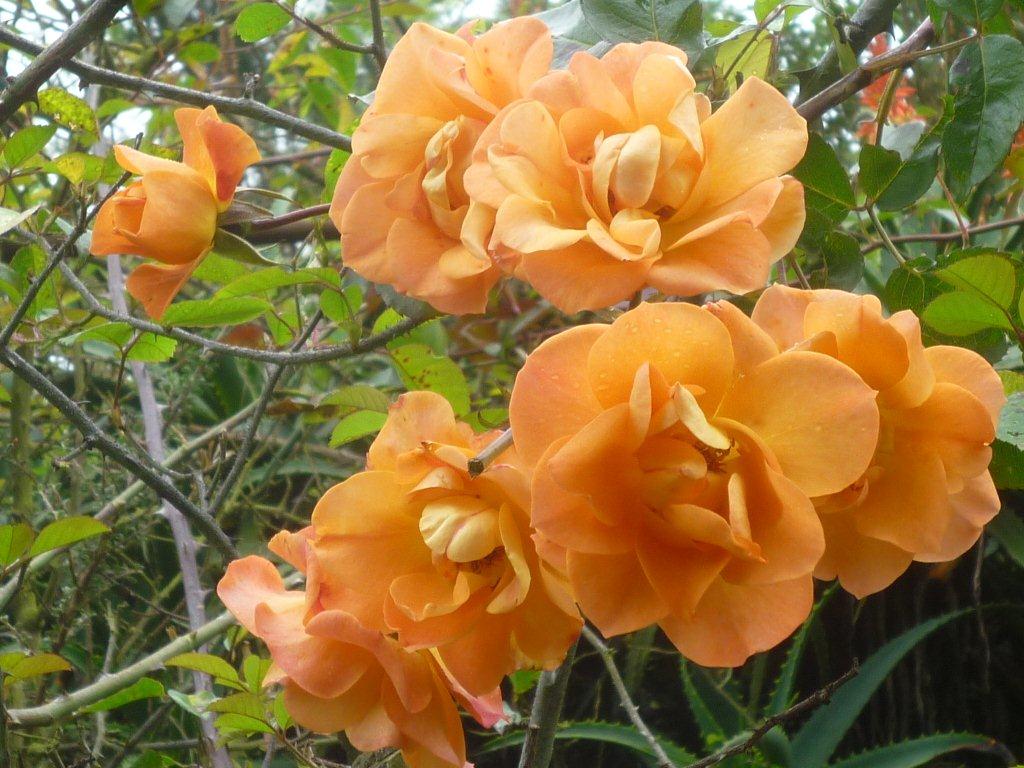
From quite a young age, Viraraghavan was fascinated with roses, but the epiphanic moment was really when his family spent summer vacations in Coonoor, staying at the government guesthouse within Sim’s Park, which overlooked a rose garden. Every morning, he would wander about this garden which was a blaze of colour of the new roses created from the golden rose of Persia, R. foetida by Pernet Ducher, a great French rose breeder. The brilliant, never-before-seen colours of these roses amazed him – from bright gold and apricot to dazzling oranges and reds. In particular, one of the golden roses took his breath away – ‘Julien Potin’, aptly named for a jeweller – its vivid colour was quite overwhelming for the boy of thirteen, already thrilled with roses. From this came the intoxicating thought: ‘If Pernet Ducher could do it, why not I?’
There’s a delightful little bit about Viraraghavan sir’s viva-voce for the IAS and how his knowledge of roses played an important part in him getting through that. Would you like to share that with our readers?
A difficult part of the IAS examination is the viva-voce, where a panel of senior administrators question the aspirant about various aspects of his or her life and ambitions. Viraraghavan was in the middle of this interview when the Chairman, by chance a learned rose grower, asked him what his hobbies were. ‘Growing roses,’ was the response. The next question was meant to be a googly to confuse a nervous candidate. ‘What roses can you grow in Madras City?’ But Viraraghavan had read the CompleteGardening in India by K.S. Gopalaswamiengar, well-known horticulturist of Bangalore, many times, so my answer was nearly verbatim from the chapter on various kinds of roses which do well in low-to-medium elevations, i.e., warm climates, so he reeled off the different rose classifications: Teas, Noisettes, Bourbons, Chinas, Hybrid Teas, Hybrid Perpetuals. The interview committee then decided it was prudent to go on to other questions rather than get a lecture from a young and seemingly unflurried candidate! But his capacity to master detailed information on various subjects had been noted, and he came through with flying colours (pun intended).
You mention making your presence on the world stage as late as 2000. Please give us a brief account of your work on roses before and after – a potted highlights package, if one can call it.
From the start, our rose breeding focused on creating better roses for warm climates based on the dictum of India’s pioneer rose breeder, B.S. Bhatcharji of Bengal and Bihar, who had stressed the need for a separate breeding line for warm climates as distinct from the Western focus on creating cold-hardy roses suitable for them. Thus, in the early years, our work was with those roses which, though Western, performed well in hot climates, and we had bred many which did well in Hyderabad where we lived. Then, after perusal of many books on roses, we realised the potential in two Indian rose species Rosa gigantea (from northeast India) and Rosa clinophylla (perhaps the world’s only tropical rose species). After getting them with great effort, we began to work with them. At every annual national rose convention in India we would present updates of our work. In 1999, at what happened to be a World Regional Rose Convention, in Jaipur, Viraraghavan’s talk, as always, focused on the breeding with the two rose species mentioned. After the talk, the World Federation of Rose Societies President, Helga Brichet, and Vice-President (South America), Mercedes Villar, came up to him and said they had never before heard of this kind of rose work or of these rose species and invited him to be a speaker at the next World Rose Convention to be held in May 2000 in Houston, Texas.
That was the start of a further phase of rose breeding with the realisation that other than India, several warm parts of the world were also looking for roses that would do well there. These two rose species had been personally collected by us from their native habitat. At Houston, and in other places, people were fascinated by this aspect, which no earlier breeder had undertaken, that is, personally collecting rose species in the wild, at great risk, growing them and using them in creating new roses; starting from scratch as it were. It made sense to them when Viraraghavan explained the dictum of that great German breeder Wilhelm Kordes I who said –‘The soup ladle will only bring out what is already in the tureen’, meaning that fresh genetic input was required if new and different roses are to be created. The enthusiastic response to his ideas strengthened his determination to go ahead with this new rose breeding line. There is nothing as intoxicating as the realisation that the rose world is watching our work with great interest.
One of the most fascinating sections of the book is the one titled ‘The Ones Who Came Before’. Please provide readers with a short account of these legendary influences.
Karrie’s Rose. Photo courtesy: M.S. Viraraghavan and Girija Viraraghavan
We had noticed that invariably roses were named for famous people with often no connection to the world of roses. This made us think: why not name our roses for the intrepid plant-hunters who had discovered roses in the wild, on mountains and in forests, and botanists who had contributed to the knowledge on plants.
One wild Indian rose is R. gigantea, from our north-east, and Myanmar. Three great plant hunters were responsible for collecting this species in the wild – Sir George Watt, General Sir Henry Collett and Frank Kingdon Ward. We decided to name our rose hybrids for all three. Sir George was a medical doctor with an interest in botany, and worked as a surveyor with the British India government. During the course of his work, in the 1880s, he found Rosa gigantea growing on the slopes of Mt Sirohi, now in Manipur, and collected specimens. Almost simultaneously, so did Sir Henry Collett, except in the Shan Hills in what is now Myanmar. Both specimens were identified as being the same and named by the great Belgian taxonomist of the time, François Crepin. Climbing Mt Sirohi in 1990, we came across and collected plants from perhaps the precise location that Sir George had found Rosa gigantea. We named our first hybrid, a creamy yellow climbing rose, for him. We then felt it should be planted near his ancestral home in Scotland. With the help of the Royal Botanic Garden, Edinburgh, we managed to get this new rose planted in the Logan Botanic Garden, very near Sir George’s birthplace. Some years later we embarked on a sentimental journey, along with his descendants and his associates’ descendants, visiting his grave and the hospital he had worked in after retiring from India, to see the rose blooming in Logan.
We named a second seedling we had bred from R. gigantea for General Sir Henry Collett, a rose with big creamy white blooms that has been planted in suitable areas in Britain as well, and, gratifyingly, being grown by some of his descendants. A third rose, a climber with blooms of yellow-suffused pink, was named for Frank Kingdon Ward, the legendary and intrepid plant hunter who collected innumerable new and wild Himalayan plants despite his surprising acrophobia! We then came across a piece by the then BBC 4 gardening anchor, Matthew Biggs, who had visited Kingdon Ward’s grave in Grantchester near Cambridge. He wrote about the neglected condition of the grave of one of the world’s greatest plant explorers. So we decided to make amends by planting ‘Frank Kingdon Ward’ by the wall nearest his grave in the churchyard in a moving ceremony organised by Matthew Biggs, and attended by a number of well-known British horticulturists, as also the family. An urn with the ashes of Sheila Macklin, Kingdon Ward’s wife, for whom he had named a Himalayan lily, and who had died just the previous year, was interred near his grave, and close to where the rose was planted.
We have also named a rose for Leschenault de la Tour, the great French plant explorer who found a beautiful new rose species, called Rosa leschenaultiana after him, in the Western Ghats in the early 1800s; our rose named for him is a climber with pure white blooms.
And of course we have a rose to celebrate the remarkable life and career of the great Indian botanist and cytogeneticist, E.K. Janaki Ammal, who co-wrote the Chromosome Atlas of All Cultivated Plants in 1945. She studied botany at Michigan State University in the 1920s on a full scholarship, later receiving a PhD and DSc honoris causa. Back in India, she played a vital role in creating the ‘Noble’ strain of sugarcane – an extraordinary hybrid of sugarcane and bamboo leading to varieties thick as a man’s arm in contrast to the pencil-thin traditional varieties. But credit was stolen by seniors at the research station, and so she went off to Britain. There she worked at famous institutes, including John Innes, Kew and the Royal Horticultural Society. Later, she met the then Prime Minister Jawaharlal Nehru on a plane, and he put her in charge of reforming the Botanical Survey of India in Calcutta. But sadly she was a forgotten figure by the time of her death in 1984. Our rose named for her has the same colour hues as the saris she wore – orange yellow and saffron. A plant of this rose was planted in 2020 at the World Regional Rose Conference Kolkata, at the Botanical Survey of India garden. The rose has also been planted in the John Innes Institute, in Kew and the Royal Horticultural Society’s garden in Wisley in the UK.
If one were to ask you of one moment each – one particular achievement in the journey and one abiding regret – what would these be and why?
There can be no doubt that the moment which was special in our rose breeding career was the moment described above, when Helga Brichet and Mercedes Villar came up to us in Jaipur in 1999, and said they had never heard such a new approach to breeding roses, pioneered by us, of using two Indian rose species to create a new line of warm-climate roses. It was their invitation to speak in Texas launched us on to the world stage of roses.
As for an abiding regret, that’s all too easy to answer. It’s the systematic neglect of Indian-bred roses by the rose-growing public of India, who remain fascinated by roses raised in Europe and the U.S. though they are utterly unsuited for Indian climates. This unreasonable preference for foreign rose varieties is part of the general craze for all things foreign. Fortunately, more recently, there has been a change, and young rose breeders and growers are realising that Indian bred roses do better in the heat and are slowly beginning to grow these.
Give us an insight into the challenges and pitfalls of growing and creating roses in India, as informed by your journey. Interesting story that highlighted these.
The main challenge was getting Indian roses accepted by the Indian rose growing public, as highlighted above. Indeed, now our roses are being grown in India, perhaps because they are being grown around the world! Another thing is one must learn patience. It takes us about eight to nine years to name and release a new rose. It is a long process, of the actual crossing of two roses, waiting for the fruit to ripen, then harvesting the fruit (rose hips), collecting the seeds, stratifying them in the refrigerator (if one lives on the hot plains), sowing the seed, waiting for the seedlings to sprout, growing the plant for a number of years to test its potential, and suitability, and only then finding a name and releasing it, by sending to a rose nursery to make more plants.
Our long career in rose breeding and our connected travels around the world has provided us with many interesting, even hilarious experiences. We were in Japan, at the Sakura Rose Garden. With us was a group of people including our friend, the well-known Japanese plant scientist, Dr Yuki Mikanagi. We were looking at a rose plant, with dark pinkish-red blooms with white on the reverse, bred by us and as yet unnamed. Yuki said she liked this rose very much. We immediately told her that we would name it for her. She said: ‘But this rose is red and white, whereas my name means “snow” in Japanese. Viru’s instant response was, ‘Then we will it name it Blushing Yuki,’ much to the delight of Yuki and everyone.
In his government service days, when we lived in Hyderabad, Viru would tend to his roses, watering and spraying them with fertilizers before leaving for office. There would be a number of telephone calls for him about some official matter. Girija would answer the phone (landline in those days), and when she told the callers he was busy spraying, they would hear it as ‘praying’ and immediately apologise: ‘Please do not disturb him when he is at his prayers’.
Both of us were hands-on gardeners, doing most of the work ourselves and you cannot garden without muddy hands and clothes. Very often visitors would mistake us for the garden help and request us to take them to the master or the mistress of the house. The looks on their faces when they realised who we were would make us laugh.
On one occasion, we were in California to receive the ‘Great Rosarians of the World’ Award. At the ceremony, we both first gave a talk on ‘Roses in India, Past Present and Future’. At the end of the ceremony, an earnest old lady came up to us and asked, in all seriousness, ‘Do roses grow in India?’
For most of us, roses are red and a Valentine’s Day Gift. Appendix 1 of your roses runs to 50 pages! Tell us briefly of some of the interesting ones, in particular the very evocative names you have, for example, Kindly Light, Meghamala/Wine-dark Sea, Twilight Secret. What goes into giving a name to a rose?
Apart from the roses we have named for friends, for other roses we like to give evocative names.
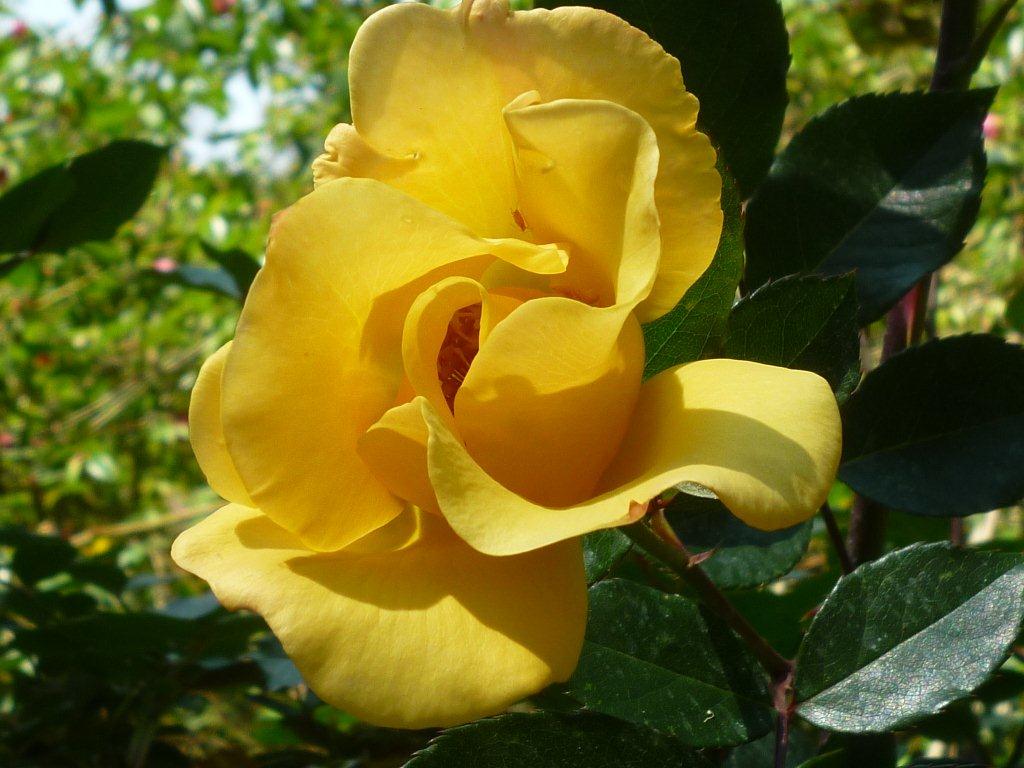
KINDLY LIGHT: we named this lovely white shading to soft pink rose after the hymn ‘Lead, Kindly Light’, a favourite of Mahatma Gandhi’s. We have the practice of giving two names to some of our roses, one better understood in India, if it is a Sanskrit word, and one for the West. This rose is named ‘Swami Vinayananda’ in India, for a monk of the Ramakrishna Mission order. He was great plantsman, his book on dahlias is a definitive work on all aspects of dahlia growing and he was very good rose grower.
MEGHAMALA/WINE-DARK SEA: One more example of two names for a rose. Meghamala translates as ‘garland of clouds’. The name for our rose was inspired by the purple garland-like pattern, reminiscent of clouds, on the petals of this rose, which otherwise are dark orange-red in colour. ‘Meghamala’ is from a line by Devulapalli Krishna Sastri, beloved modern poet of the Telugu language, to whom the rose is a tribute. ‘Wine-Dark Sea’ derives from Homer’s epithet, in both the Iliad and Odyssey, of the purple shadows of approaching night on the orange-red waters reflecting the rays of a setting sun on the Aegean Sea.
ALLEGORY OF SPRING: We named a very special light-pink rose with intriguing pointed petals after the famous Botticelli painting La Primavera, also called ‘Allegory of Spring’.
INCENSE INDIGO: An indigo purple rose with an enticing fragrance was the inspiration for this name.
TWILIGHT SECRET and TWILIGHT TRYST: Two purple-hued roses that remind one of the late evening, shadowy light, romantic secrets and trysts.
AHIMSA: We gave this name to a golden yellow rose borne on a plant without any thorns (prickles), thinking of the Mahatma’s philosophy of non-violence.
KUSABUE’S GUARDIAN ANGELS: Kusabue is the name of a rose garden in Sakura City, Japan, entirely looked after by volunteers, all very senior citizens. This is our tribute to them.
Golden ThresholdKanyakumariPhoto Courtesy: M.S. Viraraghavan and Girija Viraraghavan
Shantanu Ray Chaudhuriis a film buff, editor, publisher, film critic and writer. Books commissioned and edited by him have won the National Award for Best Book on Cinema twice and the inaugural MAMI (Mumbai Academy of Moving Images) Award for Best Writing on Cinema. In 2017, he was named Editor of the Year by the apex publishing body, Publishing Next. He has contributed to a number of magazines and websites like The Daily Eye, Cinemaazi, Film Companion, The Wire, Outlook, The Taj, and others. He is the author of two books: Whims – A Book of Poems(published by Writers Workshop) and Icons from Bollywood (published by Penguin/Puffin).
.
PLEASE NOTE: ARTICLES CAN ONLY BE REPRODUCED IN OTHER SITES WITH DUE ACKNOWLEDGEMENT TO BORDERLESS JOURNAL
I’ll begin this brief essay by reflecting on my time in university. There was no paper on Indian writing in English when I was a student at Sri Venkateswara University in Tirupati studying for my master’s degree in English literature between 1977 and 1979. Many English departments were adamant about sticking with a colonial attitude and emphasizing teaching British literature. The teachers (professors), many of whom had returned from abroad, primarily from the UK with highly sought-after PhDs, propagated this notion and fervently supported British literature. They maintained the same colonial perspective and made English departments more English-centric (British) than what is apparent today with more democratisation in the curriculum. Many of these teachers with UK training had a prejudicial perspective on Indian writing in English.
Because it was still in its infancy, these professors with UK training did not support it. The literature that had blossomed in the UK was widely believed to represent what was meant by English literature at the time. They didn’t think much of other English literature works. Within this hostile setting, Professors MK Naik, CD Narasimaiah, and KR Srinivasa Iyengar worked arduously to develop Indian Writing in English (IWE) as a subject and make it an integral part of English departments at all universities. They fervently argued for the cause of Indian writing in English through their writing and publication of several articles and speeches. K.R. Srinivasa Iyengar’s seminal work Indian Writing in English (1984) and M.K. Naik’s Dimensions of Indian English Literature (1984), Indian English Literature: 1980-2000: A Critical Survey (1982), and Studies in Indian English Literature (1987) have strengthened the case for writings in English in India. They were all successful in having IWE included in the study of English literature. Many English departments in the universities didn’t start providing IWE as a course or even as a component of the curriculum until the 1980s. The new group of professors, which included the aforementioned three professors along with Professor P. Lal, who supported IWE, had replaced many earlier professors who had a limited perspective on it. It eventually evolved into an autonomous course over time.
In this light, I’d want to think back on a comparable experience I had in 2011, when I joined the Central University of Tamil Nadu in Thiruvarur as a regular faculty. At that time, a paper on IWE was not offered as part of the MA in English Literature. I had a terrible experience when I asked how the students could graduate from the university with a degree without having studied IWE. I claimed that such a degree lacked credence. In one of the Board of Studies meetings, I passionately argued in favour of it and won approval. The result was that it was transformed into an independent course, integrating with the core curriculum. I taught this subject, which included poems by Jayanta, until my departure from the institution in 2019.
Lal did a fantastic job advancing Indian writing in English. In Kolkata, he founded a publishing house called Writers Workshop, where he encouraged a number of new budding poets to write their works in English and submit them for publication. In his book History of Indian English Literature, M.K. Naik notes that only P. Lal published the first books of contemporary Indian poets who achieved success in Indian and international English poetry. It was true. All of the poets that Lal published under the Writers Workshop imprint became well-known figures around the globe. It was thought that any poet who was published by the Writers Workshop would become well-known in their field. Of them was Jayanta.
As a Post-graduate student, I read and studied only three Indian English poets—Nissim Ezekiel, A.K. Ramanujan, and Kamala Das as well as two novelists, R.K. Narayan, and Mulkraj Ananad. These were all part of the Commonwealth Literature (now New Literatures) paper, which covered the full range of post-colonial texts. This was my first introduction to Indian writers who wrote in English. For reasons best known to the group responsible for formulating the syllabus, Jayanta Mahapatra was excluded from the curriculum. I had no knowledge of Jayanta and had never read any of his poetry. I didn’t read two of his widely anthologized poems, “Indian Summer” and “Hunger,” which are recognized as classics in contemporary Indian English literature, until after I had finished my post-graduation. This served as my initial exposure to Jayanta’s poems.
I was fascinated by his writing after reading these two poems, especially because of the two components of imagery and elegant diction. I looked through other collections of his poems. By chance, I discovered a venerable anthology called Ten Twentieth Century Indian Poets, which was chosen and edited by R. Parthasarathy and published by OUP. At the time, this was the sole anthology on the market, and all universities required students to consult it when discussing Indian poets who wrote in English though other anthologies followed later such as, Indian Poetry in English (1993), edited by Makarand Paranjape, The Oxford Anthology of Modern Indian Poetry (1994) edited by Vinay Dharwadker and A.K. Ramanujan, and Twenty-five Indian Poets in English (1995), edited by K.S. Ramamurti. The poets who were included in the anthology were acknowledged as having achieved popularity and recognition on a global scale. It was a canon-like text for reference. It contained “A Missing Person”, “The Whorehouse in a Calcutta Street”, and “Indian Summer” from Mahapatra’s collection, A Rain of Rites, and “The Logic”, “Grass”, and “Lost” from other anthologies. I eventually had to look for his poetry collections after this reading. Luckily, my hands fell upon his two collections: Svayamvara and Other Poems (1971), Calcutta: Writers Workshop and Relationship (1980), New York: Greenfield Review Press. I read them avidly.
At that point in time, I read Jayanta purely for enjoyment. I wasn’t really taking his poetry very seriously. I never tried to review any of his poetry books or to write an article about his poetry. Despite this, I still thought highly of him, but I never had the chance to visit Cuttack and meet him in person since I was too busy attending to my academic obligations and immersed in my career. The most wonderful news was that I had been chosen for the 2014 Rock Pebbles National Award for Creativity, instituted by the Rock Pebbles Trust, which would be presented to me in Bhubaneswar by the legendary poet Jayanta Mahapatra. I realised that my dream was actually coming true.
He was already 85 in 2014. I arrived at the location considerably earlier in order to see this poet in his physical appearance. I had heard of him and read about him in books up to that point. Now I could actually communicate with him and see him in person. I was watching him approach from where I was standing by the venue’s entrance. He arrived at the location at precisely half past ten, joined by a couple of event organisers. Despite his aged appearance, he was nimble and exuded the assurance that, due to his asthma, he would live for a few more years despite whatever happened. I did not hear any gasps as he was moving. He was hospitalised, but he managed to survive the coronavirus. The ten years that passed between then and August 27, 2023 were a tremendous adventure in his life as a writer in general and as a poet in particular. He was engaged throughout the proceedings and talked for fifteen minutes, albeit a little erratically. Even so, I could understand what he was saying. A poet with a scientific background could sound like an English professor. He had a thorough understanding of Indian poetry, and he spoke with authenticity and assurance. He was distinct from the other poets since he was not a poet from the Bombay school. Over time, he was able to distinguish himself from his peers by developing a serene, peaceful poetic voice of his own.
He acted in this manner, and I was so moved by him that I asked for his blessings at the conclusion. He generously bestowed his blessings upon me, and I was so overjoyed that I continue to treasure them for the rest of my life. I always mentioned his name whenever the topic of Indian poetry in English came up in conversation and discussion. Even though he was a poet par excellence and the recipient of numerous national and international honours, he was such a modest being that he never showed any arrogance or pride. I observed this humility in him, and I had the impression that he could communicate it not just with words but also with his actions. He was so worn out at the end of the event from travelling from his home in Cuttack to Bhubaneswar. Despite my intention, I did not continue talking to him after realising the circumstances. I recognised him, and I felt so happy that I received the award and the honour from his hands. This was sufficient for me, I reasoned. I could learn the rest by reading his poetry! I must express my sincere gratitude to Dr. Udayanath Majhi, editor of the journal, for including me in the celebration and giving me the chance to meet the great poet by conferring me with the Rock Pebbles award and honour, a wish that had been gnawing at the back of my mind for a very long time and was finally realised.
IN MEMORIAM
(A Tribute to Jayanta Mahapatra)

With the muse
who had been
with you over sixty years,
you abruptly
walked away surreptitiously
leaving the memory behind.

You have permanently
migrated to a distant land,
reconciling;
moved to another world…
leaving behind
your distinct footprints
unerasable in your poetry, forever.

Though you were not of the Bombay School
you carved a niche
distinguishing yourself from your peers
by creating a serene, meditative lyrical voice
in the world of poetry
‘after a mountain of rejection slips’.

You might be
not present in the form
yet,
I feel
your poetry
cracks and cackles with vibrant vivid imagery;
a torchbearer for the aspiring…

You have departed for
Heavenly abode
but somehow as a poet
is always a poet forever
you proved, otherwise
glistening in the firmament
as an early-morning and evening star
silencing grumbling dark clouds;
and, you still peep out
of a poem
in the book
of my living room
to ensure
that everything is fine
with Indian poetry in English
in your absence, eternally.
K.V. Raghupathi, A former academic, poet, short story writer, novelist, critic, and book reviewer, has so far published thirteen collections of poetry, two short story collections, and two novels, and edited eight critical works and is widely published and anthologised both in online and print journals. He currently lives in Tirupati. He can be reached at drkvraghupathi9@gmail.com
PLEASE NOTE: ARTICLES CAN ONLY BE REPRODUCED IN OTHER SITES WITH DUE ACKNOWLEDGEMENT TO BORDERLESS JOURNAL
While we celebrate the life and works of Jayanta Mahapatra, we are reminded that his poetry transcends time and place. It invites us to contemplate our own existence, our relationships, and our place in the world. Through his words, he has left an indelible mark on the world of literature, demonstrating that poetry has the power to illuminate the soul and bridge the gaps that separate us.
In the realm of Indian English poetry, few names shimmer as brightly as Jayanta Mahapatra’s. With his pen as his brush and words as his palette, Mahapatra has painted a rich tapestry of emotions, existential contemplations, and cultural explorations across his entire oeuvre. His poetic journey is a testament to the transformative power of words, a journey that has touched the hearts and minds of readers across the globe. Born in Cuttack, Odisha, in 1928, Jayanta Mahapatra emerged as a prominent figure in Indian English poetry during the latter half of the 20th century. His literary contributions are marked by an intricate interplay between his Odia heritage and a universal sensibility, transcending geographical and linguistic boundaries. His poetry resonates with the human soul, delving into the complexities of existence and the nuances of human emotions.
Mahapatra’s poetry is characterised by its profound introspection. He peers into the innermost recesses of the human psyche, unearthing the facets of identity, memory, love, and loss. His verses serve as mirrors, reflecting not only his own experiences but also inviting readers to confront their own inner landscapes. This journey of self-discovery is a central theme in much of his work. A Rain of Rites(1976), marked his debut in the world of poetry. In this collection, Mahapatra’s poetic voice emerges with striking clarity. He grapples with the isolation of the individual in a complex world, where traditions and rituals rain down upon us like a deluge. His poems often evoke a sense of longing and the search for self-identity, themes that resonate with many who grapple with the modern human condition. Some of his most celebrated poems like “Five Indian Songs”, “Samsara”, “The Whorehouse in a Calcutta Street”, “Hunger”, and “Dawn at Puri” are featured in this collection.
Mahapatra’s deep connection to his homeland, Odisha, infuses his poetry with a unique sense of place and culture. His verses are filled with vivid depictions of Odisha’s landscapes, its people, and its age-old traditions. The collections Shadow Space (1997), Life Signs (1983) and Waiting (1979) stand as testaments to this connection. Through his words, he transports readers to the shores of Puri, the temples of Konark, and the chaotic streets of Cuttack in poems at the same time intertwining them with stark social evils such as rape, poverty, widowhood and casteism. Mahapatra often juxtaposes moments of exquisite beauty with stark desolation in his poems. This interplay between the beautiful and the unsettling creates a sense of dissonance that challenges conventional notions of aesthetics and forces readers to grapple with the coexistence of contrasting elements in life.
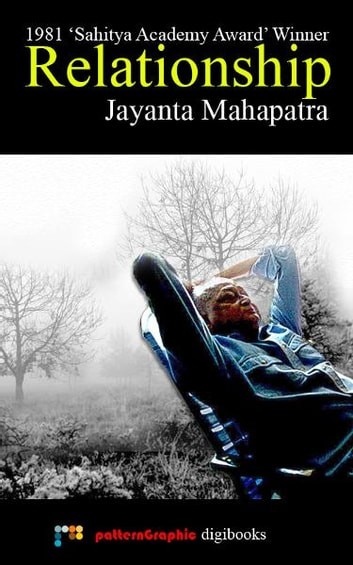
In “Relationship” (1980), the book that fetched him the Sahitya Akademi Award, Mahapatra delves into the intricate web of human connections of his personal life. Briefly, “Relationship” is a single poem that deals with the diverse relationships the poet shares with the Konark temple, Kalinga war, friends, parents, anxieties, scruples, suffering, and glory and decay of Odisha. In his words, the poem “was a romance with my own land and with my innermost self”. He explores the complexities of relationships, both personal and societal, with a keen and compassionate eye. Many of his poems resonate with readers on a universal level, as they ponder the nature of love, the fragility of bonds, and the ever-shifting dynamics of human interaction.
Mahapatra’s poetry often treads the fine line between the spiritual and the worldly. In Temple (1987), he dives deep into the realm of faith and spirituality. His verses serve as a bridge between the sacred and the profane, inviting readers to reflect on the profound interplay between the material and the divine. These poems are an exploration of the human quest for transcendence, a theme that has been a consistent thread in his work. In his collections such as Hesitant Light (2016), Land (2013), Random Descent (2005) The False Start (2001), Mahapatra continued to delve into existential questions with unwavering honesty. A number of his poems serve as a mirror to the complexities of life, urging readers to confront the transient nature of existence, the ever-elusive pursuit of meaning, and the relentless passage of time. Throughout his career, Jayanta Mahapatra has exhibited a strong sense of social consciousness. He uses his poetry as a medium to address issues of poverty, inequality, and human suffering. His empathetic voice bears witness to the world’s injustices, serving as a reminder of the poet’s responsibility to shed light on society’s darker corners. His poetry challenges us to confront uncomfortable truths and advocate for change through the power of words in poems such as “Crossing the River”, “Village Mythology”, “Progress”, “Bazaar Scene”, “These Women”, “Blind Singer in a Train”, “Hunger” and many others.
Jayanta Mahapatra’s literary journey has been paved with accolades and awards that reflect his enduring impact on literature. He was honoured with the Sahitya Akademi Award in 1981, the Commonwealth Poetry Prize in 1987, and the Padma Shri, one of India’s highest civilian honours, in 2009. These accolades acknowledge not only his literary prowess but also his ability to touch the hearts of readers with his profound insights and evocative verses.
Jayanta Mahapatra’s legacy is not confined to his words on paper; it lives on in the hearts and minds of those who have been touched by his verses. His poetry is a timeless gift to humanity, a profound reflection on the human experience, and an enduring testament to the power of the written word. It becomes a powerful catalyst for introspection and reflection. A deeper understanding of both the self and the world challenges readers to confront uncomfortable truths, inviting them to embark on a journey of self-discovery and intellectual engagement. His work not only unsettles but also deeply enriches and provokes us to think. We are reminded that his legacy will continue to inspire and resonate and Jayanta Mahapatra’s name will forever remain etched in the annals of literature, a testament to the enduring power of the poet’s voice.
.
Dikshya Samantarai is a PhD Research Scholar from the Department of English, School of Humanities, IGNOU. Working on the representation of body politics in Jayanta Mahapatra’s poetry, her research contributes to the ambit of critical discourses in Indian English.
PLEASE NOTE: ARTICLES CAN ONLY BE REPRODUCED IN OTHER SITES WITH DUE ACKNOWLEDGEMENT TO BORDERLESS JOURNAL
Our population crossed the 8 billion mark in November, 2022. As we move towards trying to hunt for alternative domiciles for our ever-expanding population, even in outer space, we still have to take into account the increased movement of people across the Earth in search of alternative homes driven by external circumstances or by personal needs.
Some have lost their homes and lands to war, some to climate emergencies and some moved out out of choice. Here we have collected narratives of past and present migrations, emphasising the fluidity of borders, despite the lines drawn artificially by manmade constructs. In an earlier interview, Anthony Sattin talks of nomadic migrations and the concept of asabiyya, or brotherhood, which tied humans to ideas and ideals instead of a piece of land mooted in Arabia by Ibn Khaldun in the fourteenth century. Has the time come to revive this concept with conflicts and the climate crises becoming real? As weapons, fire and water affect our habitats, one wonders if reverting to the concept of nomadic existence is not becoming a necessity… This small collection of writings will hopefully highlight the concerns.
In Belacan, Farouk Gulsara shares a narrative based on the life of a migrant in 1950s Malaysia. Clickhereto read.
Ujjal Dosanjh, former Minister from Canada and former Premier of British Columbia, talks of his own journey and learning as he migrated out of India to Canada. Click hereto read.
In Mister, They’re Coming Anyway, Timothy Jay Smith writes on the refugee crisis in Lesbos Island, Greece, in 2016 with photographs by Michael Honegger. Click here to read.
An excerpt from Ramy Al-Asheq’sEver Since I Did Not Die, translated from Arabic by Isis Nusair, edited by Levi Thompson. The author was born in a refugee camp. Click hereto read.
Ujjal Dosanjh, former Minister from Canada and former Premier of British Columbia, discusses his autobiography, Journey After Midnight – A Punjabi Life: From India to Canada, and the need for a world with less borders. Click hereto read.
Professor Fakrul Alam discusses his new book of Tagore translations, Gitabitan: Selected Song-Lyrics of Rabindranath Tagore. Click here to read.
Translations
Tagore’sMusalmanir Galpa(A Muslim Woman’s Story) has been translated from Bengali by Aruna Chakravarti. Clickhere to read.
Masud Khan’s poem,In Another Galaxy, has been translated from Bengali by Professor Fakrul Alam. Click hereto read.
Wakeful Stays the Door, a poem by Munir Momin, has been translated from Balochi by Fazal Baloch. Click here to read.
Songs of Freedom: An Ordinary Taleis a narrative by Nandani based on her own experiences, translated from Hindustani by Janees. These narrations highlight the ongoing struggle against debilitating rigid boundaries drawn by societal norms, with the support from organisations like Shaktishalini and Pandies. Click hereto read.
“Other echoes
Inhabit the garden. Shall we follow?
Quick, said the bird, find them, find them…”

— TS Eliot, ‘Four Quartets: Burnt Norton’(1936)
Humans have always been dreamers, ideators and adventurers.
Otherwise, could we have come this far? From trees to caves to complex countries and now perhaps, an attempt to reach out towards outer space for an alternative biome as exploring water, in light of the recent disaster of the Titan, is likely to be tougher than we imagined. In our attempt to survive, to live well by creating imagined constructs, some fabrications backfired. Possibly because, as George Orwell observed with such precision in Animal Farm, some perceived themselves as “more equal”. Of course, his was an animal allegory and we are humans. How different are we from our brethren species on this beautiful planet, which can survive even without us? But can humanity survive without Earth? In science fiction, we have even explored that possibility and found home among stars with the Earth becoming uninhabitable for man. However, humanity as it stands of now, continues to need Earth. To live amicably on the planet in harmony with nature and all the species, including our own, we need to reimagine certain constructs which worked for us in the past but seem to have become divisive and destructive at this point.
Ujjal Dosanjh, former Minister in the Canadian cabinet and former Premier of British Columbia, in his autobiography, Journey After Midnight – A Punjabi Life: From India to Canada, talks of regionalism as an alternative to narrow divisive constructs that terrorise and hurt others. He writes in his book: “If humanity isn’t going to drown in the chaos of its own creation, the leading nations of the world will have to create a new world order, which may involve fewer international boundaries.” We have a candid conversation with him about his beliefs and also a powerful excerpt from his autobiography.
An interview with Professor Fakrul Alam takes us into Tagore’s imagined world. He discussed his new book of Tagore translations, Gitabitan: Selected Song-Lyrics of Rabindranath Tagore. He has brought out a collection of 300 songs translated to English. In a bid to emphasise an inclusive world, we also have a translation of Tagore’s ‘Musalmanir Galpa’ (A Muslim Woman’s Story) by Aruna Chakravarti. A transcreation of his poem, called ‘Proshno or Questions’ poses difficult challenges for humanity to move towards a more inclusive world. Our translation by Ihlwha Choi of his own Korean poem to English also touches on his visit to the polymath’s construct in the real world, Santiniketan. All of these centring around Tagore go to commemorate the month in which he breathed his last, August. Professor Alam has also translated a poem from Bengali by Masud Khan that has futuristic overtones and builds on our imagined constructs. From Fazal Baloch we have a Balochi translation of a beautiful, almost a surrealistic poem by Munir Momin.
We travel to Andaman with Mohul Bhowmick and further into Sierra with Meredith Stephens. Ravi Shankar travels back in nostalgia to his hostel and Kathleen Burkinshaw dives into the past — discussing and responding to the media presentation of an event that left her family scarred for life, the atomic holocaust of 1945 in Japan. This was a global event more than seven decades ago that created refugees among the survivors whose homes had been permanently destroyed. Perhaps, their stories are horrific, and heart wrenching like the ones told by those who suffered from the Partition of India and Pakistan, a divide that is celebrated by Independence Days for the two nations based on a legacy of rifts created by the colonials and perpetrated to this day by powerbrokers. Aysha Baqir has written of the wounds suffered by the people with the governance gone awry. Some of the people she writes of would have been refugees and migrants too.
A poignant narrative about refugees who flock to the Greek island of Lesbos by Timothy Jay Smith with photographs by Michael Honegger, both of whom served at the shelters homing the displaced persons, cries out to halt wars and conflicts that displace them. We have multiple narratives of migrants in this issue, with powerful autobiographical stories told by Asad Latif and Suzanne Kamata. Paul Mirabile touches on how humans have adopted islands by borrowing them from seas… rather an unusual approach to migrations. We have an essay on Jane Austen by Deepa Onkar and a centenary tribute to Chittaranjan Das by Bhaskar Parichha.
The theme of migrants is echoed in stories by Farouk Gulsara and Shivani Shrivastav. Young Nandani has given an autobiographical story, translated from Hindustani to English by Janees, in which a migration out of various homes has shredded her family to bits — a narrative tucked in Pandies Corner. Strange twists of the supernatural are woven into fiction by Khayma Balakrishnan and Reeti Jamil.
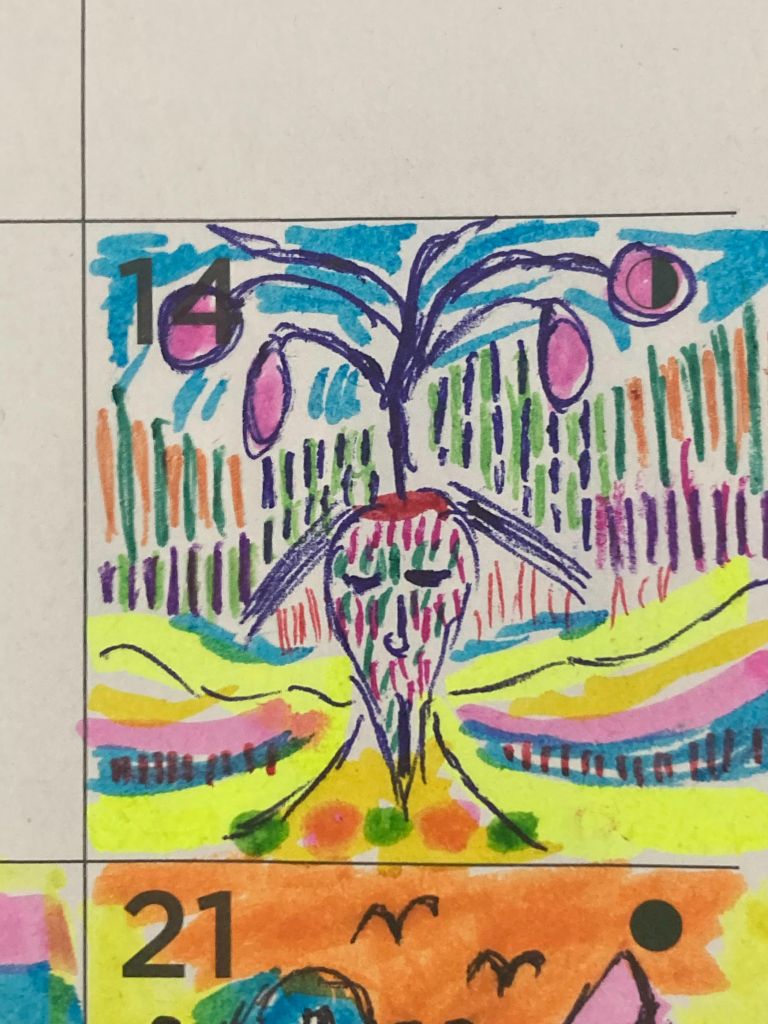
I would like to give my grateful thanks to our wonderful team at Borderless, especially to Sohana Manzoor for her fabulous artwork. Huge thanks to all our gifted contributors and our loyal readers. Borderless exists today because of all of you are making an attempt to bringing narratives that build bridges, bringing to mind Lennon’s visionary lyrics:
You may say I'm a dreamer
But I'm not the only one
I hope someday you'll join us
And the world will live as one







 Borderless