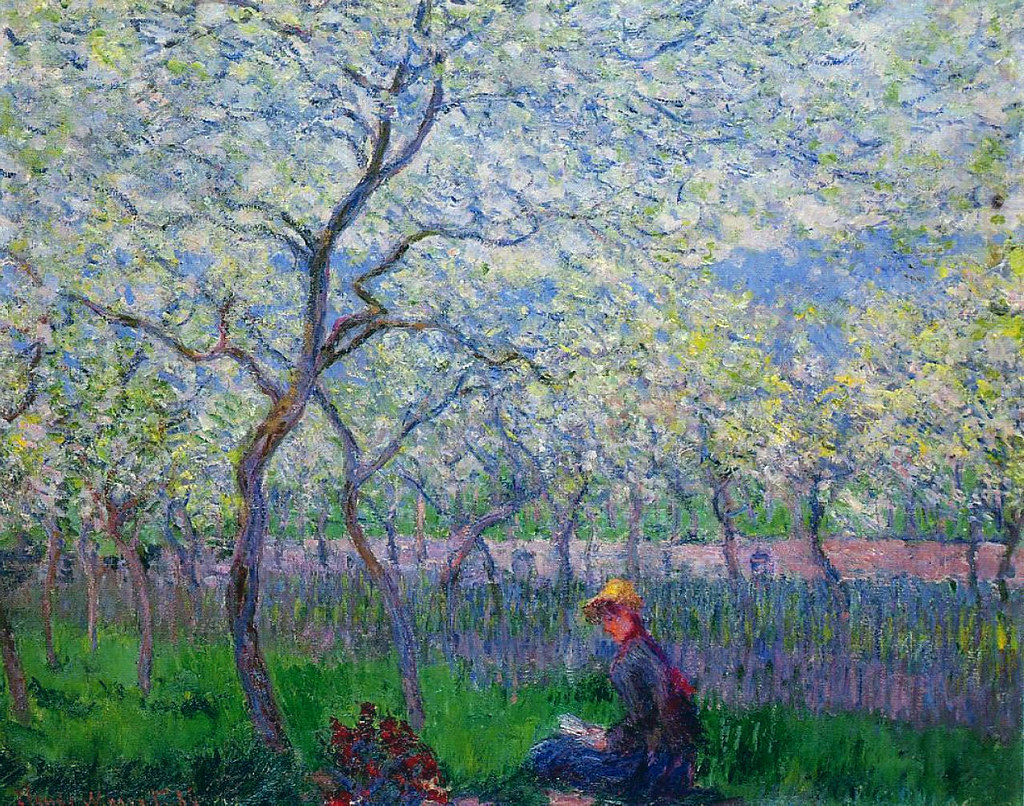
Orchard by Oscar-Claude Monet(1840-1926). Courtesy: Creative Commons
MOMENTS
(for Beth)

There were moments
full of promise,
like the petal-scented rainfall
of early spring,
when to hold you in my arms
and to kiss your willing lips
seemed everything.

There are moments
strangely empty
full of pale unearthly twilight
—how the cold stars stare!—
when to be without you
is a dark enchantment
the night and I share.

(Originally published by Tucumcari Literary Review)


WATER AND GOLD

You came to me as rain breaks on the desert
when every flower springs to life at once.
But joys are wan illusions to the expert:
the Bedouin has learned how not to want.

You came to me as riches to a miser
when all is gold, or so his heart believes,
until he dies much thinner and much wiser,
his gleaming bones hauled off by chortling thieves.

You gave your heart too soon, too dear, too vastly;
I could not take it in; it was too much.
I pledged to meet your price, but promised rashly.
I died of thirst, of your bright Midas touch.

I dreamed you gave me water of your lips,
then sealed my tomb with golden hieroglyphs.

(Originally published by The Lyric)


LADY’S FAVOUR

May
spring
fling
her riotous petals
devil-
may-care
into the air,
ignoring the lethal
nettles
and may
May
cry gleeful-
ly Hooray!
as the abundance
settles,
till a sudden June
swoon
leave us out of tune,
torn,
when the last rose is left
inconsolably bereft,
rudely shorn
of every device but her thorn.

(Originally published by The Lyric)


ROSES FOR A LOVER, IDEALISED

When you have become to me
as roses bloom, in memory,
exquisite, each sharp thorn forgot,
will I recall—yours made me bleed?

When winter makes me think of you—
whorls petrified in frozen dew,
bright promises blithe spring forsook,
will I recall your words—barbed, cruel?

(Originally published by The Lyric)
Michael R. Burch’s poems have been published by hundreds of literary journals, taught in high schools and colleges, translated into fourteen languages, incorporated into three plays and two operas, and set to music by seventeen composers.
PLEASE NOTE: ARTICLES CAN ONLY BE REPRODUCED IN OTHER SITES WITH DUE ACKNOWLEDGEMENT TO BORDERLESS JOURNAL
Poet, creative writer and teacher Adam Aitken talks about cross-cultural identity, and the challenges of travel, writing, and belonging with Keith Lyons.
Adam Aitken
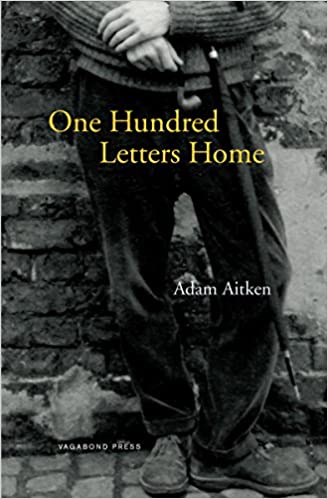
Adam Aitken is a London-born teacher and writer with a PhD in creative writing. He migrated to Sydney after spending his early childhood in Thailand and Malaysia. His poetry and prose have been widely anthologized. He has published poetry, chapbooks, essays on Asian Australian literature, book reviews, and was co-editor of Contemporary Asian Australian Poets. The story of his mixed heritage is featured in his creative non-fiction work One Hundred Letters Home. In this exclusive, he shares about the challenges of writing, identity and place.
You were born in the UK and have spent most of your adult life in Australia but tell us about your early childhood in Thailand and Malaysia.
It was a very happy childhood, and I was spoilt by everyone, except my mother, who was chronically anxious every time my father appeared. I was unaware of it at the time, but they were not happy together. I remember my fourth birthday in Birkenhead Liverpool. Then we moved to Southeast Asia. In Thailand, my father was almost always absent. I had good schooling in Kuala Lumpur, at a Catholic pre-school run by the Good Shepherd order. I remember my first day, I was illiterate in prayers and scared of the large carving of Jesus crucified and bleeding from his crown of thorns. Around seven, I went to an international school in Bangkok, which was great except for the bullying I received from an American kid. After he hit me on the head with his sneaker, I reported him, and he was publicly shamed. There are few worse things you can do than insult someone with your shoe, especially by touching the head.
What was your experience like moving to Australia when you were still young? How did your sense of identity or ‘home’ develop?
Worse, the racism in Perth was total, violent, totalitarian. Teachers were complicit. Nothing was done about it. My brother and I were once howled out of the school as we went home. I am afraid that when I talk about the worst aspects of ‘Whiteness’, I remember that time. My father was again absent, unable to get a job he liked and implicated in a civil adultery case involving another couple. We left for Sydney after a year. My poem ‘The Far East’, is an attempt to record that kind of trauma.
When did you first discover that you liked writing creatively, and in particular, writing poetry?
About aged 14, after six years living in Sydney, I started to enjoy my English classes. I had a fabulous teacher Rick Lunn, who I think became a successful sci-fi writer. I will never forget the magic of listening to ‘The Rime of the Ancient Mariner‘. After that I had access to David Malouf’s library in Sydney, when we stayed at his flat for a few months. I discovered the alternative reality that books provide. I bought a typewriter and enjoyed the process of typing on paper. A few years later I attended a poetry reading at Exiles Bookshop in Sydney and was enchanted by the strange glamour and seriousness of the writers. Martin Johnson, John Forbes, Gig Ryan, John Tranter were all there.
What early recognition or encouragement meant you saw being a writer as a career option?
At my primary school, I wrote a poem about a forest walk we did, and on seeing a sea eagle, and that was read to the whole class. At high school in Sydney, a poem or two made it into the school magazine. I think the English Master also recognised me and encouraged me. I was lucky to grow up in a time when creative writing was still valued but not necessarily seen as a vocation for which tertiary qualifications were essential, but at Sydney University, I enjoyed lunchtime poetry workshops when there were no creative writing courses to do at all. I met practising writers in a very informal atmosphere and so ‘being a poet’ seemed a comfortable choice. My mentors were real writers but there was no pressure of assessment. The goal was to get poems into magazines. This happened when I was in 3rd year. I had great lecturers who loved poetry. I was published in Southerly. I featured in an issue of Chris Mansell’s Compass. It was a thrill to have a few pages in a well printed and produced ‘zine. I also read at what was then the largest reading in Sydney, The Harold Park Hotel. Probably Sydney’s most dynamic place at the time, and since.
How did you develop your mastery of the craft, own voice and style?
I baulk at this question as I am not sure how I can define my voice or style. Certainly, early imitation of other poets, practice and attention to poetic technique (metaphor, simile etc.) helped me develop the craft. Listening to poetry out loud helps. Revising and trying out new versions. It’s like writing music. I also have a very good ear for languages so pick up stylistic and prosodic patterns quite quickly. I listened to early advice about metrics and line endings and spent a lot of time reading traditional verse and learning the metres and forms (ie. sonnets), even though I don’t apply them much these days. Writing ‘in the style of’ is an enjoyable exercise and imitating others is fun, even though it can be unoriginal. I tend to allow a line or sentence to suggest its own metrics, then use that to write a draft. I am very much more into allowing content to dictate form.
What do you think is unique about your work, that makes it distinctly yours?
In terms of the questions of form and craft, I don’t think there are many Asian Australian poets who had a traditional training in English Lit, augmented by Modern American literary influences (like the Imagists, Ezra Pound, and the New York School). I was there in the early days of postmodern theory. I was starting out during the ‘Poetry Wars’ in the ‘seventies. I also studied linguistics and became an English language teacher. I was there in the heady days of the Sydney early ’80s. I think this gives me a kind of technical awareness of language and grammar, form and genre. I am probably one of most well know of migrant poets for having been recognised since then. I was fortunate to not have to work so much and so I had plenty of time to develop my craft. On a personal level I don’t know many other Australian poets who have had my parents who were literary enthusiasts, and both culturally eclectic. Of course, Thai heritage has given me a lot. Few Asian Australian writers have had a childhood like mine, or possibly the eclectic experience of reading as I have had. I don’t know of any Asian Australian writer who has explored their cross-cultural heritage as I exhaustively as I have in both poetry and memoir.
How do you communicate through poetry something very personal, to an audience that is on the outside?
I received a ‘New Critical’ dogma about the poem being an impersonal object, but it did not stop me reading Sylvia Plath or Frank O’Hara. I begin by thinking about how the personal could be interesting to someone I don’t know. Attend to the particulars and details of the personal, and to avoid sentimentality. Be as brave as possible as to the trauma of an experience and celebrate the positive. My own preference is to avoid histrionic outbursts, something a learned writing my memoir. Again, the particulars and exactitude of description work better than bare statements. I do still hold to the dictum of showing, not telling.
One of the characteristics of your work is attention to detail. Does that start with being observant and taking notes? How do you then find the most poignant moments or parts?
I often know I have a poignant subject, but often writing leads you to it. The previous answer is relevant here also. I don’t do a lot of notes, but I do a lot of drafts that grow into larger structures. What seems poignant early may pale into insignificance later, so I do a lot of revisiting of old notes and drafts. I often take note of dreams and reflect on what they might mean. I have always been interested in painting, photography, and films, (which I studied at Uni) so I do spend a lot of time thinking about what is ‘in the scene’, what the detail is, how close ups and panning work, what a montage is. As a child I liked to look through microscopes at insects. As far as grammar in concerned, I am fascinated by how grammars work in other languages, and in the etymology of words.
How do you go about writing a poem?
Again, often I start with a fragment, a line, a phrase, and go from there. Sometimes, I set out trying to describe a scene, a photo, a painting, an experience of looking, whether that be looking at a film or a view. Interior monologue or talking to myself and putting thought onto a page helps. I occasionally address a theme, most often at the instigation of a journal issue callout. I also have a long running series of satiric poems written in the character of an avatar, though I sometimes doubt that these amount to anything lasting.
Is poetry about finding meaning and making sense, or looking at something from different perspectives?
The Cubist method has a lot going for it, and I don’t really make the distinction between making sense and the various means we use to perceive of something. I do struggle with the fragmented poem that does not seem to find meaning, that I can’t find the sense in, or that lacks context, a heritage, a precedent in a more powerful text. But that is part of the job, to struggle towards meaning, using what is at hand.
How different is it writing an essay or review, does it use a different part of your brain or a different process?
Well, audience and purpose are more important in an essay, though not as important as I often thought. A review should help a reader decide whether to go and read the text, and I am pragmatic about this. I find writing essays almost impossible now, because I don’t have the patience and attention span needed. Essays and reviews (arguably) have strong generic patterns to follow, whereas I write poetry without constraining myself too strictly to generic considerations. Long forms are exhausting, and my eyesight is deteriorating and so long sessions at the computer are unpleasant.
If the financial rewards from writing aren’t great, does being a writer mean you have to hold a ‘day job’ or other income streams (teaching) to enable you to write?
I have always earned most of my income from teaching English as a Foreign Language, but since COVID, I live on savings. In the space of my career, grants and prizes have only amounted to about a year or two of an average income salary. I admire my peers who are full time creative writing academics but still manage to produce books in between the admin and marking. I’ll be taking up a Visiting Writer job in Singapore in 2024, and I am very much looking forward to that.
How useful have awards, being shortlisted for prizes, and residencies been to your progression as a writer? What specific things have been springboards into new worlds?
Apart from allowing me to take time off from the day job, residencies and grants have helped me to keep going and to believe in myself and has added some motivation for many in the community of like-minded poets where I live now. It is interesting to follow up on what writers have written after a stint in Rome for example.
Residencies help you reside for a longer time than average in places that you can explore. The most difficult residency I have had was probably the Paris Studio, even though I found writing time. I was overwhelmed by ‘Paris’ as a grand subject and theme and had to learn to look for the personal relevance and the original detail again. My stint as Visiting Writer in Hawai’i was powerful, as I had to rethink my use of English and my relationship with the local scene. Working with creative writing students there taught me a lot and brought me into a new way of writing that was alive to vernacular American and local patois.
Certainly, winning a postgraduate award to do a doctorate in creative writing cemented my self-belief while giving me four years of income and time to write my memoir and a thesis on hybridity and cross-cultural desire as a theme in Australian writing. My most productive period was funded by an Australia Council grant that allowed me to live and write for a year in Cambodia. While time and freedom to read and write is unarguably valuable, it allows writers to defamiliarise their surroundings. I was challenged to really question my own privilege as a w\Westerner, and as a relatively wealthy Asian Australian living in a poor country. I was already familiar with the history of the region, but the time there allowed me to have encounters with the real actors (and their descendants) in that history.
How has travel in Asia reinforced/challenged your sense of self and personal/national identity? Do you feel like an Australian, or more of a global citizen?
Travel always brings up questions of where you come from, and where you are headed, but most importantly you begin to situate your identity across a range of places. I am talking about Thailand and France, which have personal family ties. I have spent a lot of time learning French and Thai, in order to be able to feel more at home with people in these places. I feel more intimate with these regions, but not at all with places like the UK, where I was born. Obviously, Sydney is my home, and Sydney is not Cairns or Melbourne, places with which I have a lot less intimacy. I think Sydney was once more of a community, but almost none of my closest university friends live here, and a lot of writers I know have moved elsewhere.
I don’t believe that I personally can embody the concept of a Global Citizen, which is a fiction unless you are rich enough to be able to go where-ever you like and whenever you like and can afford to live anywhere.
I recently flew back from Bali, and the crowd at Denpasar airport were for the most part Australians — somewhat diverse, but also unfamiliar to me, people who would probably not want to hang out with me!
In your memoir One Hundred Letters Home what did you learn about your parents and yourself?
I learned that having intended to explore my mother as the leading agent in our lives, I became drawn into my relationship with my father. He took over the book as a subject, and I learned how complex he was. I learned also that there was a whole stretch of his life that were off limits to me, and I didn’t know enough to write about them. I learned that writing about parents can be a frustrating way to get to learn about yourself. I did learn a lot about my own attempts at identity transformation, I mean the attempt to ‘become a Thai man’. The book is self-analysis, though I did not intend it to be limited by that theme. I think I learned more about intergenerational trauma that is specific to Australian men who were born last century, and of course, more about ways of writing about the father-son relationship that move beyond Freud.
I also learned a lot about my father’s ancestry, that he was descended from an Army family, even though he had been an anti-Vietnam war Moratorium activist. I learned how his branch of the family had been rich, but that a lot of the wealth had never come done to him. I learned that I am the descendant of the founder of Victoria Brewery, or VB. I also learned that my great-grandfather was a survivor of Gallipoli and the Western Front. My father never told me any of this. I also learned that my maternal great-grandfather had been a Protestant Minister of the Australian church, and that he was a pacifist and a teetotaller.
How does writing challenge the status quo/ colonialism/ stereotypes? Was your first poetry collection seeking to challenge Marco Polo’s narrative?
Writing should, in some aesthetic way ‘contaminate’ the status quo, while calling out the conditions of oppression. Naming the invader, and resisting is the intention. Methods can vary from diction and descriptions of outright violence to underhand subversion. Poison the invader’s food, dress as them, but turn it to your advantage. My first book Letter to Marco Polo was a way of putting together poems about foreign travel, as I had spent a year in Thailand and the title of the book seemed obvious after I had written the poem that goes by that title. I liked the casual postcard style of address, – ‘Dear such-and-such the natives do this and that…’ Then it was easy to parody the renaissance ‘travel’ genre (which is a fantasy genre for sure), and it felt like a duty to write my own questions of travel, and to add ‘reality’ to the encounter by re-casting the traveller’s gaze as that of a lost son returning to his ancestral home. My encounters with my mother’s family were life-changing and Letter to Marco Polo was a snapshot into that encounter.
John Kinsella has commented on how my recent poems enact the colonial voice in order to undermine it, which seems paradoxical. He refers to these lines in Revenants (2022):
I read my father’s letter on Hong Kong,
how he loved it:
the heat, the beer in bottles, the tailoring, the freedom.
I imagine him reading Somerset Maugham
with the temperature at 105. Waited on by one silent Chinese boy (sic)
who lights his cigarettes.
Eastern food, and chopsticks. If you can’t use them you can’t eat!
Dense traffic and ceaseless din.
John Kinsella saw me draw attention to colonialism through citing Maugham, and quoting his and my father’s language, only to undermine it, which is a form of irony. John explains it better than I can:
“He contests the language of bigotry (always seeking to ‘centralise’ itself) through the ‘borrowed’ or ‘quoted’ language, as he does through the evocation of a bigoted colonialist and lauded British writer such as Maugham. A colonial positioning takes place and then is undone. The aligning of ‘tailoring’ and ‘freedom’, and the lighting of the cigarettes in the arrangement of master and mastered is painful and unaugmented. It is what it is. The chopsticks line is configured against the Western cliché of density and noise. This weaving of the marginal into the central dialogue of colonial behaviour and colonial imposition is polysituated into the fact of inheriting the array of experiences and impositions, and acting and enacting out of conflicting experiences. Aitken’s poems de-centre racist discourse. They break the binaries. That is not to say that Aitken is aligning his voices as either ‘subaltern’ or ‘master’, but rather attempting to deconstruct the language of such experience without owning that experience.”
It makes some sense to think of this approach as a tactic of mimicry and soft parody, I suppose, rather than a didactic approach.
What’s your process for bringing together work created in different places — such as in Revenants — to create something that is linked and unified?
I had originally intended to put together poems only situated in France, but then I found I wanted the poems situated in other places. Early drafts did not achieve much linking and unification, but Giramondo’s editor Lisa Gorton and I worked through drafts to find something more or less unified. What were unifying tropes were linked to how my father’s travel and my own were comparable: we had both travelled to Asia. We were both foreigners in alien territory and I wanted the book to work on one level as an elegiac dialogue with my father who died in 2017. Memory and the return and siting/sightings of the spirit, of the revenant, were emplaced, embodied and situated, and every place in Revenants has some allusion to the idea of a return of the past. In a way I am mining a post-romantic pantheism. Or perhaps, it’s the spirit, or mana, or the Dreaming (though I am wary of appropriation here!)One can return to a place and feel the past come back through that place, just as one can read a poem and it evokes their presence by quite simply addressing the dead. I speak to the tombstones; I tell my monsters to go away; I speak to my father as if he were listening etc. Of course, in the end the book is tonally and stylistically consistent despite the intertextuality. The unity has to do with editing, the order of the poems, and compression of the lines themselves. I use quoted material economically, but there is quite clearly a ‘lyrical’ pulse to the whole collection.
What are you working on next?
There are the dramatic monologues I have collected over the last 11 years, but also more poems that did not fit into Revenants, but still seem to have legs. I have just returned from three months travel in Thailand, Malaysia and Bali, and I haven’t really written anything related to that yet. I spent time in around 35 hotels, so this suggests a framing device and maybe a new title.
For aspiring writers, what’s your advice?
I have often felt like giving up, but I remind myself that not writing is like death. Persistence but also having a supportive network, especially if you are putting together a book. It’s very important to have trusted readers who are also critical. I don’t react so much to unhelpful reviews these days, though I asked ChatGPT what adverse criticism my poetry has generated and it listed ‘overly experimental’, obscure’ and ‘difficult’. I have always fretted about not connecting with readers, but there are readers for all kinds of poetry these days. My advice is read a lot.
Keith Lyons (keithlyons.net) is an award-winning writer, author and creative writing mentor, who gave up learning to play bagpipes in a Scottish pipe band to focus on after-dark tabs of dark chocolate, early morning slow-lane swimming, and the perfect cup of masala chai tea. Find him@KeithLyonsNZor blogging at Wandering in the World (http://wanderingintheworld.com).
.
PLEASE NOTE: ARTICLES CAN ONLY BE REPRODUCED IN OTHER SITES WITH DUE ACKNOWLEDGEMENT TO BORDERLESS JOURNAL.
A translation from Nabendu Ghosh’s autobiography, Eka Naukar Jatri(Journey of a Lonesome Boat), translated by Dipankar Ghosh, from Bengali post scripted by Ratnottama Sengupta. Clickhereto read.
Ueharaby Kamaleswar Barua has been translated from Assamese and introduced by Bikash K. Bhattacharya. Clickhere to read.
Kurigram by Masud Khan has been translated by Professor Fakrul Alam from Bangla. Clickhere to read.
Bonfire by Ihlwha Choi has been translated from Korean by the poet himself. Clickhere to read.
In Indian Pale Ale, Rhys Hughes experiments with words and brews. Click here to read.
Conversation
Being fascinated with the human condition and being vulnerable on the page are the two key elements in the writing of fiction, author and poet Heidi Northtells Keith Lyons in a candid conversation. Clickhere to read.
In Multicultural Curry, Suzanne Kamata reflects on mingling of various cultures in her home in Japan and the acceptance it finds in young hearts. Clickhere to read.
Ratnottama Sengupta explores the poetry in lyrics of Bollywood songs, discussing the Sahityotsav (Literary Festival) hosted by the Sahitya Akademi. Clickhere to read.
Imagine a world without wars, without divisions, where art forms flow into each other and we live by the African concept of Ubuntu — I am because you are’ — sounds idyllic. But this is the month of March, of poetry, of getting in touch with the Dionysian elements in ourselves. And as we have said earlier in the introduction of Monalisa No Longer Smiles: An Anthology of Writings from across the World, what could be a better spot to let loose this insanity of utopian dreams than Borderless Journal!
Having completed three years of our Earthly existence on the 14th of March, we celebrate this month with poetry and writing that crosses boundaries — about films, literature and more. This month in the Festival of Letters or Sahityaotsav 2023, organised by the Sahitya Akademi, films were discussed in conjunction with literature. Ratnottama Sengupta, who attended and participated in a number of these sessions, has given us an essay to show how deep run the lyrics of Bollywood films, where her father, Nabendu Ghosh, scripted legends. It is Ghosh’s birth month too and we carry a translation from his Bengali autobiography which reflects how businessmen drew borders on what sells… After reading the excerpt from Nabendu’s narrative translated by Dipankar Ghosh and post-scripted by Sengupta, one wonders if such lines should ever have been drawn?
Questioning borders of a different kind, we have another piece of a real-life narrative on a Japanese Soldier, Uehara. Written by an Assamese writer called Kamaleswar Barua, it has been translated and introduced by Bikash K. Bhattacharya. The story focusses on a soldier’s narrative at his death bed in an alien land. We are left wondering how his need for love and a home is any different from that of any one of ours? Who are the enemies — the soldiers who die away from their homes? What are wars about? Can people live in peace? They seemed to do so in Kurigram, a land that has faded as suggests the poem by Masud Khan, brought to us in translation from Bangla by Professor Fakrul Alam, though in reality, the area exists. Perhaps, it has changed… as does wood exposed to a bonfire, which has been the subject of a self-translated Korean poem by Ihlwha Choi. Tagore’s poem, Borondalatranslated as ‘Basket of Offerings’, has the last say: “Just as the stars glimmer / With light in the dark night, / A spark awakens within/ My body. / This luminosity illuminates / All my work.” And perhaps, it is this luminosity that will also help us find our ideal world and move towards it, at least with words.
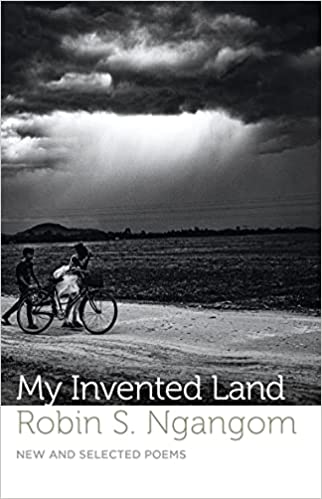
We have a book review by Aruna Chakravarti of Bornali Datta’sIn A Better Place: A Doctor’s Journey, a book that is set amidst immigrants and takes up certain social issues. Baba Padmanji’s Yamuna’s Journey, translated from Marathi by Deepra Dandekar, one of the oldest Indian novels has been discussed by Somdatta Mandal. Bhaskar Parichha has told us about S.Irfan Habib’s Maulana Azad – A Life. Basudhara Roy has brought out the simplicity and elegance of Robin Ngangom’sMy Invented Land: New and Selected Poems. He writes in the title poem that his home “has no boundaries. / At cockcrow one day it found itself/ inside a country to its west,/ (on rainy days it dreams looking east/ when its seditionists fight to liberate it from truth.)”. We also carry an excerpt from his book. Stories by Jessie Michael, Brindley Hallam Dennis, Sangeetha G and Shubhangi bring flavours of diversity in this issue.
Our journey has been a short one — three years is a short span. But, with goodwill from all our readers and contributors, we are starting to crawl towards adulthood. I thank you all as caregivers of Borderless Journal as I do my fabulous team and the artists who leave me astounded at their ability to paint and write — Sohana Manzoor, Gita Vishwanath and Pragya Bajpai.
Thank you all.
Looking forward to the next year, I invite you to savourBorderless Journal, March 2023, where more than the treasures mentioned here lie concealed.
Borondala(Basket of offerings) was written by Tagore in 1928 and published in a collection called Mahua in 1929.
Mahua(1929), named after Madhuca Longifolia, a tropical treeBorondala or basket offerings. Courtesy: Creative Commons
BASKET OF OFFERINGS

Today, in this quiet bower,
Within my being
My offering has grown
Into a garland of light.
In this spring, with climbers
Of leaves and flowers,
My verses waft in the dawn
Of the golden rays.
My whole being dances
Swinging with rhythm.
If this song doesn’t find form
I will die of shame.
Oh beloved, my body reverberates
To the beat.
I have not got you an
external offering,
My prayer flows from my own
Being like a stream.
My heart leaps
Free of my being
Impatiently pleading
A meeting with you.
Just as the stars glimmer
With light in the dark night,
A spark awakens within
My body.
This luminosity illuminates
All my work.
This poem has been translated by Mitali Chakravarty with editorial input from Sohana Manzoor & Anasuya Bhar
PLEASE NOTE: ARTICLES CAN ONLY BE REPRODUCED IN OTHER SITES WITH DUE ACKNOWLEDGEMENT TO BORDERLESS JOURNAL
Poem for Joseph

It is never too late to come home.
But I must first find a homeland
where I can find myself,
just a map or even a tree or a stone
to mark a spot I could return to
like an animal lifting his leg
even when there’s nothing to return for.

Although it’s true
that in my native land
children had crawled out of burrows
they had gouged under their hard beds,
long after the grownups had fled
and roofs came apart
like charred heads.

You said you didn’t regret
how ethnic cleansers had palmed
your newly-built home off on a people
well on their trail back to unique blood,
you didn’t mind leaving behind
objects of desire
you had collected over twenty-five years,
or, how you came to live in a rented room
with your wife and children
in dog-eat-dog Imphal,
among the callous tribe
I call my own.

Only the photographs you mourned,
the beloved sepia of a family tree,
since you’re the reason why your fathers lived;
but who’ll believe now
that you lived at all?


After ‘Jashn-e-Azadi’
(a film on Kashmir by Sanjay Kak)

The kite transforming into smoke lacing
the chinars is not a symbol.
The rose has migrated from the garden of paradise.
Freedom will never come
poured into goblets waiting to be raised,
Martyrdom is a handout from the hagiographer.
Only poetry of ruins is real.
The incoherent rose still blooms
from some beloved breast torn open.


The First Rain

The first rain like the first letter of May
brings news to the hills.
Perched like the houses on the edge of a cliff
I’ve lived more days in exile
than years of my poor childhood.
As a fumbling fifteen-year-old
I abandoned my forward-looking native people
who entrusted terror, drugs and
a civilized plague to children.

Is it better to rejoice and forget
or to remember and be sad?
Only a foolish boy cannot wait to be a man,
adores winter, and leaves home to write poetry.

After the holocaust became a touchstone
we can indict an erring people
and make culture and carnage co-exist.
If I told you how babies have been shot down
from their mothers’ breasts
you would put it down to a poet’s overworked heart
but we like to believe in leaders who flock to the capital

An animal threatened with extinction
needs a lair for his mate and his young,
I’m not different.
I need the morning for its bright blood
and I need to seize the night.

There was not a day that changed my days.
When I listen to hills
I hear the voices of my faded life.
Whisky and Mehdi Hassan and Billie Holiday
make for strange fruit on nondescript evenings.

They can stop us but not our thoughts
from coming out into the streets,
they can shoot us but cannot kill the air
which carries our voices.

O my love, you are still asleep
when the rain carries the night till dawn.
After lying down with dreams of you
I awake in another day of bread and newspapers.

I’m banished to the last outpost of a dying empire
whose keepsakes have become the artefacts of the natives:
necklaces, pianos, lace and tombstones.
I’ve pursued horoscopes and
only promises and maledictions pursue me.
One day Venus was mine, joy and honey,
another day Saturn would not be propitiated.
I found a moment’s peace
in my little daughter’s face.

Before I met you
my dreams were limited by ignorance.
Sometimes at night
I put two drops of our past in my eyes
but they refused to close.

Can poetry be smuggled like guns or drugs?
We’ve drawn our borders with blood.
Even to write in our mother tongue
we cut open veins and our tongues
lick parchments with blood.

I read my smuggled Neruda
and sometimes listen to the fading fiddles
and the mourning voices of my land.

I’m the anguish of slashed roots,
the fear of the homeless,
and the desperation of former kisses.
How much land does my enemy need?

O my love, why did you fade
into the obscurity of my life
and leave me to look long at the mountain?

I’m the pain of slashed roots
and the last rain is already here.
I’ll leave the cracked fields of my land
and its weeping pastures of daybreak.
Let wolves tear our beloved hills.

I’ll leave the bamboo flowering
in the groves of my childhood.
Let rats gnaw at the supine map
of what was once my native land.

Native Land

First came the scream of the dying
in a bad dream, then the radio report,
and a newspaper: six shot dead, twenty-five
houses razed, sixteen beheaded with hands tied
behind their backs inside a church…
As the days crumbled, and the victors
and their victims grew in number,
I hardened inside my thickening hide,
until I lost my tenuous humanity.

I ceased thinking
of abandoned children inside blazing huts
still waiting for their parents.
If they remembered their grandmother’s tales
of many winter hearths at the hour
of sleeping death, I didn’t want to know,
if they ever learnt the magic of letters.
And the women heavy with seed,
their soft bodies mowed down
like grain stalk during their lyric harvests;
if they wore wildflowers in their hair
while they waited for their men,
I didn’t care anymore.
Extracted from My Invented Land: New and Selected Poems by Robin S. Ngangom. Published by Speaking Tiger Books, 2023.
About the Book
Robin S. Ngangom’s poetry is the poetry of feeling, which draws the reader deep into the poet’s world. The poems in My Invented Land showcase Ngangom’s remarkable range—tracing his poetic arc from the deeply personal to the political, from chronicles of private joys, sorrows and everyday epiphanies to the poetry of witness that gazes unflinchingly at the realities that haunt the Northeast, his native land.
About the Author
Born in 1959 in Imphal, Manipur, Robin S. Ngangom is a bilingual poet and translator who writes in English and Manipuri. After completing his high school in Imphal he studied English literature at Shillong’s St Edmund’s College and the North-Eastern Hill University where he currently teaches. His first collection, Words and the Silence, was published in 1988 and since then, he has published two more volumes of poetry and a book of translations. He was invited to the UK Year of Literature and Writing in 1995, has read his poems at literary events in India and abroad, and his poems have appeared in several prestigious anthologies and magazines. He has also co-edited two significant anthologies of poetry from Northeast India.
Click here to read the review
PLEASE NOTE: ARTICLES CAN ONLY BE REPRODUCED IN OTHER SITES WITH DUE ACKNOWLEDGEMENT TO BORDERLESS JOURNAL.
Into the myriad-doored faith of poetry, there are manifold ways to arrive. Some come to it for respite, some for resuscitation, some for refuge. To a lot of us, poetry is therapeutic; to many others, an arsenal; to yet others, an immortal witness. Through what door one seeks admission into poetry’s realm is important for the way poetry will speak to us and the kind of poetry we will, in turn, create.
To Robin Ngangom, poetry manifests itself as both companion and quest, currency in circulation and archive, vision and the language to communicate the thought. “Poetry cannot help anyone to get on in life,” he writes, “or make a successful human being out of anyone. But poetry should move us; it should change us in such a manner that we remain no longer the same after we’ve read a meaningful poem.” (‘Introduction’) As necessary, as native, and as effortless to him as breath, Ngangom’s poetry bespeaks an honest and wholehearted engagement with life that is rare.
My Invented Land: New and Selected Poems recently brought out by Speaking Tiger Books is Ngangom’s fourth poetry collection. Containing an admirable selection of his work from his three earlier collections Words and the Silence (1988), Time’s Crossroads (1994) and The Desire of Roots (2006) along with more than thirty new poems, this volume brings to us a fascinating diachronic document of Ngangom’s steady journey in and with poetry over the last thirty-five years. For readers familiar with his work, this volume is an asset. For those who wish to make an acquaintance with it, the book will be indispensable and an immensely appealing starting point.
In reading Ngangom’s poems, one is pleasantly startled, each time, by his distilled sensibility, his linguistic finesse and his inimitable lyrical fecundity. Simplicity is the catchword of these poems. One would be hard put to identify any posturing in Ngangom’s poetry. There are no mirages here, no postmodernist obsession with camouflage, no cautious construction of the self or deliberated distance between poet-observer-speaker. Personality, in fact, is such an important accompaniment of these poems that it casts each poem in the resolutely warm light of its familiarity, meeting in poem after poem, an expectation unarticulated but answered.
Self, land and poetry constitute an essential thematic triangle in My Invented Land – each theme inevitably leading to the other. For Ngangom, there is no poetry apart from the existential rootedness of the self in (home)land, this relationship being both a prism and a prison through which his sensibility is reflected upon the world – “But where can one run from the homeland,/ where can I flee from your love?” (‘The Strange Affair of Robin S. Ngangom’) In the best of times, this bond with the land becomes one of gratitude; in spans of torment, a burden he cannot do without; and during moments of reflection, an agonising search as in ‘Poem for Joseph’:
It is never too late to come home.
But I must first find a homeland
where I can find myself,
just a map or even a tree or a stone
to mark a spot I could return to
like an animal lifting his leg
even when there’s nothing to return for.
Even love and its exploration through adolescence into manhood which is an important concern in Ngangom’s poetry, finds its expression in the distinct foreground and background of the landscape, so much so that be(love)d and land become one:
Maternal earth,
generous and callous.
You untouchable then,
and invulnerable now;
all your instincts
rearranged with
your scattered hair.

Were I to trace
my name on your frosted mirror
you would quickly efface it with your breath. (‘Age and Memory’)
There is no denying the sharp political edge of this poetry, its inveterate honesty and its essential inability to water down the truth with fancy or idealism. In ‘To Pacha’, a moving elegy to Pacha Meetei, one of Manipur’s finest writers, Ngangom writes:
There are no more tears to shed
in this withered country where they
kill pregnant women and children; its
nipples have long gone dry, and leering
death walks your homeland.
In ‘The Strange Affair of Robin S. Ngangom’, patriotism is “admiring the youth who fondles grenades,/ patriotism is proclaiming all men as brothers/ and secretly depriving my brother,/ patriotism is playing the music of guns/ to the child in the womb.” ‘My Invented Land’ writes home as “a gun/ pressed against both temples/ a knock on a night that has not ended/ a torch lit long after the theft/ a sonnet about body counts/ undoubtedly raped/ definitely abandoned/ in a tryst with destiny.” The uneasiness between homeland and nation is a palpable presence in the telling use of the phrase ‘tryst with destiny’ as it is in many of the poems in this book. The golden jubilee of the nation’s independence becomes, in ‘15 August 2008, Northeast India’, “fifty years of discrimination festering in the periphery/ with another anniversary of murder and disappearances.” In ‘My Invented Land’, the homeland “has no boundaries./ At cockcrow one day it found itself/ inside a country to its west,/ (on rainy days it dreams looking east/ when its seditionists fight to liberate it from truth.)”
But this is not poetry of writing back, of witness, of resistance or of conscious activism. My Invented Land is poetry of observation, of quiet but ceaseless self-exploration and self-assessment (the land being an inalienable unit of the self and vice-versa), of lament and of agonis
ed truth-seeking with “only one pair of shoes/ but many roads” (‘Saint Edmund’s College’). One marvels at the beauty of the title, an apposite image for a body of poems that is invested so completely in poetry as this essentially nourishing collection of eighty-two poems is. This invented land, one realises, is as much Imphal or Manipur or Shillong or the Northeast of India as it is the land of memory, imagination, hope, language and poetry.
One must take special note of Ngangom’s deftness with language in this collection, his mastery over its opulence and crisis, its headiness and its insomnia, its velocity and meditativeness. Much of his poetry is pointedly and joyously literal with little need of metaphor to expand or accentuate his ideas. However, his language arrives from such depth in the soul that lyricism and beauty are innate to it, deluging the reader with an unsurmised assertion of its grandeur in a poem like ‘Laitlum’ for instance:
I want to be converted amongst houses kneeling
in the thick of firs of former lives,
randomly built without electricity.
It is characteristic of Ngangom to lift what would be, in most hands, a random assortment of prosaic moments and to elevate it, with his heightened attention, into iridescent poetry. Observe the following lines from ‘Street Life’:
I’ve had decadence forced on me.
I let the rain waste my day, and arriving
at streets that do not even know my name
I take off just like that, waving to silhouettes,
buying drinks for anyone, even primates
for whom I have no great regard, hating the houses
which warn of dogs instead of welcoming me.
The new poems in this collection, while retaining a spiritual connect with the poet’s earlier work, branches off into greater profundity. Marked by the loneliness, uncertainty and despair of the Pandemic, the language has grown quieter and more serene so that a metaphysical restlessness animates these poems, quiet unlike the earlier ones – “All voyages will be inward from now,” (‘September’) The language of realism mutates here into unexpected symbols and uneasy images that haunt. ‘Postcard’ written for Jayanta Mahapatra finds “ghosts leaving friends on the road”; in ‘Home’, a river swirled with “brown waters/ until it died, strangled by garbage”; in ‘Flight’, “The most vulnerable will sell bodies./ Because in spite of the landmines/ they still shared limbs.”
But despite Ngangom’s disquiet with the world and his unceasing inquest into its maladies, love remains his avowed and timeless panacea. It is in and through love that human life acquires redemption and as one moves through the collection, one perceives it watermarked by love of many kinds – amorous, passionate, seductive, lustful, nostalgic, mythic, idyllic, ecological, fraternal and forgiving. Every despondency, for the poet, springs from an absence of love and can find an effective resolution in love – love for the beloved, for the homeland, for one’s brethren, for humanity, for poetry, and above all, for love itself. “…someone who cannot love is always alone,” he writes in his ‘Introduction’. In ‘Day’, he prays for the Pandemic’s end so that “a primeval need/ may be restored to us:/ the ability to hold another/ before the day ends.” The all-embracive and sustaining religion of love that leads him to fashion each word “from a private hurt”’ (‘Introduction’) can alone right the balance. In ‘January’, for instance, he believes that “If anyone were so much as to mention a word like ‘love’/ everything will fall quietly again as snow.”
Poetry, according to Ngangom, “should not merely amuse us or make us think: it should comfort us, and it must heal the heart of man.” (‘Introduction’) With a brilliant introductory essay by the poet (that makes one desperately wish there were more such essays by Indian English poets on their vision and craft) and its timeless verses, My Invented Land accomplishes this and more with poise, grace and an unquestionable claim to the glory of its writer in the canon of Indian English poetry, his committed pilgrimage in verse promising to be an inspiration for many poets to come.
Basudhara Roy teaches English at Karim City College affiliated to Kolhan University, Chaibasa. Author of three collections of poems, her latest work has been featured in EPW, The Pine Cone Review, Live Wire, Lucy Writers Platform, Setu and The Aleph Review among others.
.
PLEASE NOTE: ARTICLES CAN ONLY BE REPRODUCED IN OTHER SITES WITH DUE ACKNOWLEDGEMENT TO BORDERLESS JOURNAL
Ratnottama Senguptaexplores the poetry in lyrics of Bollywood songs and scans the title song of the Hindi film, Guide, to conclude that a film song can be more than a lyric, a screenplay…
“If you want to be famous, do not write screenplays,” Jean Claude Carriere once told film students in a workshop. The legendary screen writer could have just as well said, ‘Do not write for films!’ For, it is the same story for lyricists as well. The better a film and performance of the actors, the less people remember the writer. Similarly, the better the rendition of a song, listeners remember it by the voice that rendered it — the singer; the man who scored the music, the actors who embodied the persona; or the film for which it was written. Seldom do people remember or even know who had penned the ditty that has got woven into the warp and weft of not only the script but, over time, of our life!
Festival of Letters 2023. Photo: Ratnottama Sengupta
So where’s the question of according them the literary status of a poet? Yet, speaking in Sahityotsav 2023 – the Festival of Letters hosted March 11-16 by Sahitya Akademi, India’s national council for literature, Tamil lyricist Vairamuthu refuted that there is no literary value in writing for cinema. “Yes, in a commercial art like cinema, everything cannot be literature, but surely literature is not utterly absent!” The seven times National Film Award winner admits that all movie songs are not poetry but he is ready to tussle with those who demean songs by saying they do not have the charm or aesthetic of poetry.
Kavithaigal Vairamuthu at Sahityotsav. Photo: Ratnottama SenguptaRatnottama Sengupta chairing the session on Cinema and Literature. Photo provided by the author
The role of songs in cinema is different, and therefore the aesthetics is different from that of poetry, the celebrated song-writer elaborates. “Lyrics are written to fit into a script; a character; and a social clime. So a lyricist has to bow to politics, humanities and sociology. And still a film song becomes a feast for the tastes of common people, because it contains in its folds the seeds of nuanced literature.” When a poet becomes a lyricist, he does not have the same freedom: his imagination is bound by the barriers of melody. He has the added responsibility of creating poetry by overcoming the constraints of the situation and the tune scored to heighten the emotion of the moment. When the lyrics of a song transcends these constraints it attains the heights of aesthetics, not necessarily of poetry but of its own particular identity. “Why must banana be described as poor man’s apple?” Vairamuthu poses.
*
I can recall countless songs that fit the bill of poetry. But, as I prepared to speak to Film Appreciation students of the Film and Television Institute of India on Literature in Cinema, it struck me that some songs track a different course and go on to presage the yet-to-unfold narrative, or even the final resolution of the film. And, in doing so, they sometimes equate the screenplay. Here I can readily mention two songs, both penned by Shailendra for two films released in 1966. One is the Mahua Ghatwarin song from Teesri Kasam (The Third Vow). In it Hiraman, a bullock-cart driver, recounts the story of Mahua who is sold off for money by her own family to Hirabai, the Nautanki dancer, who eventually defies that fate. The second is the title song of Guide, directed by Vijay Anand with Dev Anand and Waheeda Rehman leading the cast, which I will scan today.
Published in 1958, won the Sahitya Akademi Award in 1960
… A book brought out by film scholars and admirers of the film
R K Narayanan’s masterpiece was a rather unusual story for a Hindi film made so many years ago. The fact is that it started as a Hollywood venture. Pearl S Buck, the first woman to win the Pulitzer award with The Good Earth, was the screen writer for the English version. Unfortunately, that reached neither here nor there. The Hindi version, on the other hand, turned out to be a cult film – particularly for its unmatched songs and dances that were shorn off for the Hollywood version. Just goes to show how integral song and dance are to Indian life.
Genius, they say, always evokes admiration and provokes curiosity. My attention to this song was drawn when a handful of cine lovers got together to understand why its unconventional profiling of adultery succeed in tradition-bound India when it failed miserably in the ‘advanced’ society that is Hollywood? Both the versions had the same plot, nearly the same cast and crew, and yet the difference was stunning. Their urge to analyse its extraordinariness led Blue Pencil to publish Guide The Film: Perspectives. And, while answering interviewer Antara Nanda Mandal, I realised how Wahan kaun hai tera is unique in the way it knits the past with the future of the character, grafting a seamless flow of flashbacks and offering a glimpse of the narrative as it will unravel on its way to the finale…
The story goes that Dev Anand and his brother Vijay Anand had approached Shailendra when the film was almost ready. Not being in a particularly obligatory mood, he demanded a fortune– Rs 1 lakh. Nearly 60 years ago, this was indeed a king’s ransom but without batting an eyelid, the producer-director duo of Navketan Films agreed – after all, they needed a mounting fit for the epic that was at once radical and traditional. And, set to music by Sachin Dev Burman, what a memorable number it turned out to be!
A brief synopsis of the film based on a 1958 novel: Freelance guide Raju meets Rosie, the daughter of a nautch girl married to Marko, a wealthy archaeologist who is a philanderer. But dancing in public was not only infra dig back then, it was an absolute no-no. Dancers were regarded as social outcasts, little better than prostitutes. One day, after a showdown with her womanising husband, Rosie seeks relief in a burst of Kalbelia, the dance of Rajasthan’s snake charmers, in the marketplace. As Raju watches her hypnotic passion, he is convinced that dance is Rosie’s calling, and he convinces her to leave Marko and move in with him. The repercussions? His mother leaves home, he is ostracised in the small town, he starts losing customers. But acting as her manager, Raju establishes Rosie as a star on the dance stage. However, without the bonding of marriage to hold them together they start to drift apart. Raju feels insecure because of her fame and fortune, and is jealous when Marko sends a cheque for her. To keep him away, he forges Rosie’s signature and is forced to go to jail.
Thus far is a ‘flashback’ – the film opens on the day of his release. Both Rosie and his mother arrive only to learn that he was released six months before his term. Narayanan’s multi-layered narrative now follows Raju who, disillusioned by Rosie’s reluctance to protect him, had set off by himself on an uncharted course towards a bleak future. Along the way he joins an itinerant group of sadhus and travels till he reaches a small village that spent many monsoons facing drought. There he finds shelter in a derelict temple, and the unshaven wanderer is mistaken for an ascetic. The simple villagers flock around him to unburden their woes as he offers them the wisdom rising out of his churnings. That becomes their solace, and soon they believe he’s a Sadhu sent for their deliverance. This takes the form of an announcement: the Saint will starve himself until the skies relent and relieve the villagers from the scourge of drought!
Will Raju, an outcast with a criminal past, now act like a mere mortal and devour the offerings for the gods? Or will he live up to their faith and find redemption by making possible the impossible? Let’s study how the title song prepares the viewers for this mature narrative to unspool.
The song opens with one single string of sitar that goes on playing almost discordant notes. So you are not lured in by a melodious tune or tarana until the signature voice of Sachin Dev Burman breaks in, forcing you to follow the words. They don’t necessarily match the action on the screen which has a man coming out of a jail, pausing at a crossroad that points to the city, then walking in the opposite direction that gradually leads him into an unknown terrain of wilderness and desolation.
As the protagonist keeps walking and the titles appear, the song goes into its successive paras, and you realise that it is a song that could not have belonged to any other film. Nor was it an add-on number that you could take out if you so wished, without impacting the film negatively. For, the song is a planned part of the script and serves as an index to the narrative that will unfold in the next couple of hours.
It strings together glimpses of the past, the present and perhaps the future, in a way that resembles joining a musafir, a traveller, on the highway, to keep pace with him, strike up a conversation, and before long, you have plunged into his life. Your curiosity is aroused and you want to know why he was jailed and what will befall now when a criminal is mistaken to be a Swami, a sage, who must prove himself to be a saint, no less, so as not to destroy the faith of the trusting villagers. In doing so, the song becomes an index for the actions that will make the characters.
What is a more, it prepares the viewer for an unconventional structuring of the narrative which opens with the Epilogue, where the convicted becomes Conscience keeper; resorts to the flashback technique and reverts to the prologue, where a frustrated Rosie repeatedly attempts suicide; and then arrives at the main drama between the Guide and the Dancer. He, who helped her come out of her failed marriage and ride the crest of success in her dream career; She, who fails to plumb the depth of emotion in the man who loved her so much that he commits a crime rather than risk losing her to her legal husband.
Anyone waiting for you out there?!
Oh wanderer
Which way are you headed?
Come, rest a while here,
This bower's a shelter of greens
You will find nowhere...

Days untold have passed.
Those fleeting moments, those
Boundless nights of love,
They're but a dream
They've forgotten...
Why not you??
Those encounters, trysts of love!
Pitch dark, as far as your eyes go...
Where are you headed, wayfarer?

Not a soul's watching out for you.
No eye's on the winding road
Waiting for a sight of you.
No one squirmed when
You were in pain,
Not an eye shed tears...
So who is your dear,
Drifter? Where to...??

You guided them on their way.
Now you, Guide,
Have lost your way?!
You eased the knots in their lives,
Now you are twined in threads!
Why, oh why??
Why swings the charmer,
Not the serpent,
To the music of the Been?

Words of wisdom from the ancients:
This world's but a writing
On the face of a stream!
Watch 'em all, know it all but
No, don't belong to One...
Bonding is not for you, nor for me
Ambler... Where are you off to?

(Transliteration by Ratnottama Sengupta of the original lyrics by Shailendra that can be found below)


Wahan kaun hai tera, Musafir, jayega kahaan?
Dum le le, dum le le ghari bhar, Yeh chhaiyya payega kahan...

Beet gaye din pyar ke palchhin, Sapna bani woh ratein...
Bhool gaye woh, tu bhi bhoola de, Pyar ki woh mulaqatein!
Sab door andhera, Musafir, jayega kahaan?

Koi bhi teri raah na dekhe, Nain bichhaye na koi,
Dard se tere koi na tarpa, Aankh kisi ki na roi...
Kahe kisko tu mera, Musafir, jaayega kahaan?

Tuney toh sabko raah bataayi, Tu apni manzil kyoon bhoola?
Suljha ke raja, auron ki uljhan, Kyoon kachhe dhaagon mein bhoola?
Kyoon naache sapera, Musafir, jaayega kahaan!

Kehte hain gyaani, duniya hai paani, Paani pe likhi likhaai,
Hai sab ki dekhi, hai sab ki jaani, Haath kisi ke na aayi...
Kuchh tera na mera, Musafir jaayega kahaan?
Here, I must stress that Guide would not be the evergreen film it is sans the songs and dances. In particular, this opening number places the story in its context. Everytime it plays.
Sapna bani woh raatein… the dizzy heights of love, fame, riches that did not last, alas! Night is what Rosie will celebrate when she sings, Raat ko jab chaand chamke, jal uthe tan mera… And Raju will lament, Din dhal jaaye haay, raat na jaaye…
Koi bhi teri raah na dekhe, bhool gaye woh tu bhi bhoola de… endless roads, journeys on bus, on tonga, on foot, over hills, dales, and forests… matching his state of mind.
Dard se tera koi na tarpa, aankh kisi ki na roi… One word of denial from Rosie and he would not have been convicted of forgery, but she simply watches him being taken into custody! Later, this would be echoed in the divergent perspectives of the twin numbers – Kya se kya ho gaya bewafa tere pyaar mein, Oh what have I not undergone by falling in love with a loveless woman, he sings while she dances to Mosey chhal kiye jaay, haay re haay! Saiyaan beimaan, Oh how he fakes love, my faithless lover!
Tuney toh sabko raah dikhaayi, tu apni manzil kyoon bhoola … Raju guide, how could you – who took others to their destination – forget your own and get waylaid?! For plain love?
And then the remarkable twist: Kyoon naache sapera! The snake swings to the tune of the snake-charmer; how come your tale is reversed? It could be the voice of destiny commenting on what has transpired in the life of the guide. This imagery in particular is so unique that celebrated lyricist Javed Akhtar is reported to have said, “The day I pen a line like this, I will become a poet!”
Then, look at the layers within these three words. Both naach and sapera will be seen to be crucial motifs in the film. Rosie, born to a dancer, sought respectability through marriage but is stifled because it takes dance out of her life. The guide realises her passion when she dances the snake dance in the market; Raju establishes Rosie as a star performing artiste and not a mere homemaker, his ghar ki rani...
For me, the ultimate irony lies in the words, Kehte hain gyaani, duniya hai paani, paani mein likhi likhaayi.. The temporal world is ephemeral, much like words written on water. So, belong not, to anyone! And yet, it is the want of this very element — water — that will put his will to test, and ultimately claim his life. For, Swami must expiate for Raju Guide’s lapses, and when his followers are praying Allah megh de, paani de/ Send us the clouds, the rains, the droplets of water O Lord, he must fight the temptation to devour even a morsel, and be rewarded for it by a downpour in the parched land.
How remarkably does philosophy dovetail into poetry!
.
Ratnottama Sengupta, formerly Arts Editor of The Times of India, teaches mass communication and film appreciation, curates film festivals and art exhibitions, and translates and write books. She has been a member of CBFC, served on the National Film Awards jury and has herself won a National Award.
.
PLEASE NOTE: ARTICLES CAN ONLY BE REPRODUCED IN OTHER SITES WITH DUE ACKNOWLEDGEMENT TO BORDERLESS JOURNAL
(On the day slavery was abolished members of the armystarted to climb Le Morne Brabant with the intentionof telling the slaves that they were free [1]but—)
Gasping between egg-like boulders on the mountain cliff,
she could hear the rustling in the forest again. Thoughts
of recapture tortured her. Her dreams panicked.

When she heard a stick snap under one officer’s boot,
bondage stabbed at her bosom—bluer, bitterer.
The rustling came closer. Far too close.

She leapt gracefully to meet the other eight
who had showered into The Valley of Bones*
like cold raindrops, wishing to wake up
somewhere else, anywhere else.

Her legs pedalling, her shout
bold and free, blissful and final,
her unborn baby safe under her rugged rags,
she was about to splash on the ground like a rotten pumpkin.

It was a mistake, an aberration. She
boomeranged to the cliff like a rocket
and stopped those who jumped before and after her.
They tasted the news of their freedom together.

She then recovered her husband cocooned in a cave
and they fast-forwarded to Trou Chenille**
where the soil turned into a hut, the hut into
ripples of relief that sank into their scars.

Waking up to the sea changing into the sky,
she watched him build the crab trap,
smiling, straw-hatted, growing younger day by day.

And their evening often hatched into a sega
of unheard agonies, of unfelt pleasures,
their child playing hide and seek with her friends,
ever curious about her mother’s soft, bulging belly.

*   Where slaves who jumped off Le Morne’s western cliff face met their end
** The first village to be inhabited by freed slaves
Amit Parmessur is from Quatre-Bornes, Mauritius. He spent his adolescence hating poetry before falling in love with its beauty. His poems have appeared in several online magazines, namely The Rye Whiskey Review, Night Garden Journal, Hobo Camp Review, Ann Arbor Review and Ethos Literary Journal.
PLEASE NOTE: ARTICLES CAN ONLY BE REPRODUCED IN OTHER SITES WITH DUE ACKNOWLEDGEMENT TO BORDERLESS JOURNAL.
TEARS

Lacrimal glands creating
Basal, emotional, and reflex tears
They say are good for your eyes.

The hypostases of three
In a washtub of emotional water
Overflowing with sad memories.

The misery of life within,
when a memory of you evaporates like
Leaves migrating in the wind.

Your name on my lips, aching
to talk to you again in the
Quiet moods when I forgot the words.


ABANDONED

I see you everyday
Standing alone, a roadside sentinel
Quiet, lonely and unassuming

In a psychological time
Of lived and remembered
Experiences long ago

Hulking awkwardly and
Out of place
Ravaged by nature and neglect

The sun plunging down
Into empty windows as
Ghosts peer out

In the darkness
Pressed from the
Inside calling the spectators

Decaying in slow drips
On a cruel timeline marching
Onward to becoming forgotten.

ATARAXIA

Time to enter the Epicurean Garden
A buffer to the Zephyrs blowing of
Obscurantist voices impregnating
The innocents huddled in ignorance.

Tranquil pleasures-
Procreative purpose-

In an atomic swerve
Filling desolate emptiness
Looking for less what’s there
Then what was truly missing.

BLUE HORNS

Georgian avant-garde experimentation
Intricate words constructed
As the great purge continued in
A fire burning rain of hopelessness.

A coterie of youthful hands
Joined at the pens of doom.
Symbolist Revolutions ringing with
Attacks on the flag of Realism.

Sonorous prophet, verses evaporating.
In the Soviet frozen sins evoking
Death sentences, suicides,
Resurrected in a poetic afterlife.

One survived, one for us
Honour his name, in the literary cemetery.
Giorgi Leonidze entered into
His eternal time for rest.

{The Blue Horns was a group of Georgian Symbolist poets and prose-writers which dominated the Georgian literature in the 1920s. It was founded in 1915 and was suppressed under the Soviet rule early in the 1930s.
The only member of the Blue Horns movement who has survived the Great Purge was Giorgi Leonidze.}
Carl Scharwath has appeared globally with 175+ journals selecting his writing or art. Carl has published three poetry books and his latest book “Playground of Destiny.”
PLEASE NOTE: ARTICLES CAN ONLY BE REPRODUCED IN OTHER SITES WITH DUE ACKNOWLEDGEMENT TO BORDERLESS JOURNAL.






 Borderless