Ogden Nash is the finest. The snobs who dismiss his work are knobs and jerks whose heads should be examined and given an F minus. Of his talent they have not a tenth. I mean, flipping heck! Lacking depth is his strength.
And now for some HAIRY QUESTIONS… Werewolf? Whywolf? Howwolf? Whenwolf? Whatwolf? Whowolf?
Questions like those never can be answered because the facts are tactless and the fangs will leave you gutless on nights of a full moon. The lycanthropic topic is one best avoided and thus I will always avoid it.
I made myself a sandwich. I made it for my health. I am a self-made man despite my lack of wealth.
I made myself a promise I would be a bitter gourd cut into fancy segments by an even fancier sword.
Unlike okra I’m not slimy. If you ever dare to try me I’m a vegetable Cockney, I must say, “gourd blimey.”
Is that all? No, it certainly isn’t.
Lady Rickshaw claims we are all ghost ships on the streets of cities, drifting here and there.
That’s modern civilisation for you: please join the queue for the time machine.
But in more barbaric times in chillier climes…
Our cavemen noses glow in the cold. They never grow when we are old but snowmen’s noses linger for longer and their nostrils resemble craters.
The comet made from ice, interstellar, vast, oblivious, very fast, will strike that fellah dead when it hits his head.
And now let’s take a trip to ANCIENT GREECE
A gorgon’s internal organs must be clever forgeries. She turns heroes to stone, in pairs or if they’re alone, and when destiny calls and Greece finally falls those statues will be taken to Rome, their new home.
But the gorgon’s heart will never beat a rhythm you can dance to. It won’t thump like a man-bull’s hoof-shaped shoes, that’s true. No swirling sonic brews amuse our motley crews.
I’ve had better days lost in this maze: one time I almost found my way out, said the Minotaur…
Fenugreek Mythology featuring Hercules and Coriander leaves, Turmeric and Ulysses, Centaurs and Bottle Gourds on a bed of saffron rice is nicer to devour than plain old Greek mythology.
Tell me honestly: have you ever seen A GHOST?
Death’s anniversary, is a ghost’s birthday: blowing out cake candles with supernatural breezes he teases the ectoplasm, a professional phantasm.
Are spooks international?
I am turning Japanese after a sneeze because some wasabi went up my nose. Kimonos are my clothes.
Also, I play shogi with my toes. (Shogi is a kind of chess: I’m glad to get this off my chest).
Now let’s have a SELF-REFERENTIAL HAIKU
Counting syllables when confronted with haiku ruins the effect.
That’s done. Where else can we find our fun?
Do you know the tale of Patriarchy and Mehitabel? Do you know the tail that twitches on the windowsill?
The proof is in the pudding, or so they say, but I think I know a better way: the waterproof is in the puddling duck.
A vestige of a visage? My face is the place where my luck never runs out. It may lack grace, a waste of features belonging to other creatures, but each to their own.
The philosopher doesn’t like my tone: he tells me to ponder harder but not to think about swamp imps named Marsha. Easily done: I don’t know anyone with that name.
Harsher, he calls me timid, says I am a coward. Coward? But how? I don’t know the meaning of that word but I can work it out and applied to me it’s quite absurd. It means to move in the direction of a cow, or many cows, a herd.
Have mercy if you’re thirsty. Be ruthless if you’re toothless.
Do farm girls grow on you over time, seasonally?
A question I can’t answer because I am a scarecrow. No one planted me, I do not grow. I do not know a single thing.
But I can take a guess about the mess made by guests at dinnertime. Billabong Monkeys dunk their feet in the soup in groups much larger than gorillas are long.
Is that a SONG? Somehow, I don’t think so.
And now let’s have some Soliloquies for Stringless Guitars.
Kiss her through the mask. Miss her through the cask.
Foxglove Alley. Weasel Stockings. Garter Snakes, real and fake. Rotten Shed and Rusty Rake. I venture down the Cul-de-Sac of Frogs. I lost my way in the fogs.
That isn’t fog: it’s sand. That’s no frog: it’s a panda. Are you an understander? There is no great demand for sand disguised as mist and so we insist you redo the list of things you wish to purchase in the sopping shops that underwater lie.
Swinging on a garden gate, it’s far too late to palpitate at sunset but the day’s still too early to fly away and so you may barbaric be, barbaric bee, barbaric beer.
Beer comes in at the mouth. Jokes come in at the ear. Foam comes out of the nose. POOR ATTILA lost his clothes during a drunken stupor. It’s not ideal but he is super.
Attila was very short. Only one metre tall and nocked with battle scars at one centimetre intervals. No wonder he was such an effective ruler!
He wanted his wife to call him ‘Darling’ in the marriage bed but she insisted on calling him ‘Hun’ instead.
Oh dear! Have no fear: King Lear has shed a tear that splashes on the lashes of the whip that thickens cream in dreams.
When I was younger I had a narrow mind and only thought of narrow things: tight corridors, blocked canals, mountain ledges, malnourished gulls, ladders designed for stick insects, crevices into which no man could fall.
But now I am older and think only of wide things like canyons and gulfs, the open mouths that shout bravo at gigs, the taste in literature of well-read people, the square bases of the mighty steeples perched on churches in historical towns, the flapping gowns of aristocratic vamps, the pipe bowl of my eccentric gramps and the prehistoric snouts of pigs snuffling for unripe but fallen figs.
Listen closely, my dear…
My love for you might sound hyperbolic to hyperactive alcoholics. But it will sound perfectly fine to good romantic folks.
Now here’s a thing: sea roofs on the inside are called sea lings.
Freshwater otters in Goa. Salty authors in the shower. Both are so clean but only the latter dare dream of rivers of cash. The former dream only of fish.
FOR A FLUTE?
Love for a flute is holy love because a flute without holes is a stick and love for sticks makes me sick but flutes have holes thus my stomach will settle at the base of the kettle and I will laugh: tea-hee cough-hee.
The frozen lion thaws before he roars.
A thaw in the old ball bearings and the machinery of his desire began working again.
The machine marks time like a strict examiner puffing out his metal cheeks in the weeks before the summer holidays.
Do machines really play the drums?
As a rule of thumb, yes! Keeping the beat with steel feet. How neat. What a treat. The soul of the dance is deep in the soles. The heels heal the heart.
We have our whole lifetimes A HEAD of us in which to try out new hairstyles, she said. She knew what she was talking about. The barber’s wife.
The gentle love drizzle puzzles the riddler. The lion is sizzling in the meri jaan frying pan over the fire of our heartfelt desire.
And that’s the end of the line for the wandering rhymes and the Nomads of the Bone will soon end up back home.
*meri jaan is an endearment in Hindi meaning my life
Rhys Hughes has lived in many countries. He graduated as an engineer but currently works as a tutor of mathematics. Since his first book was published in 1995 he has had fifty other books published and his work has been translated into ten languages.
.
PLEASE NOTE: ARTICLES CAN ONLY BE REPRODUCED IN OTHER SITES WITH DUE ACKNOWLEDGEMENT TO BORDERLESS JOURNAL
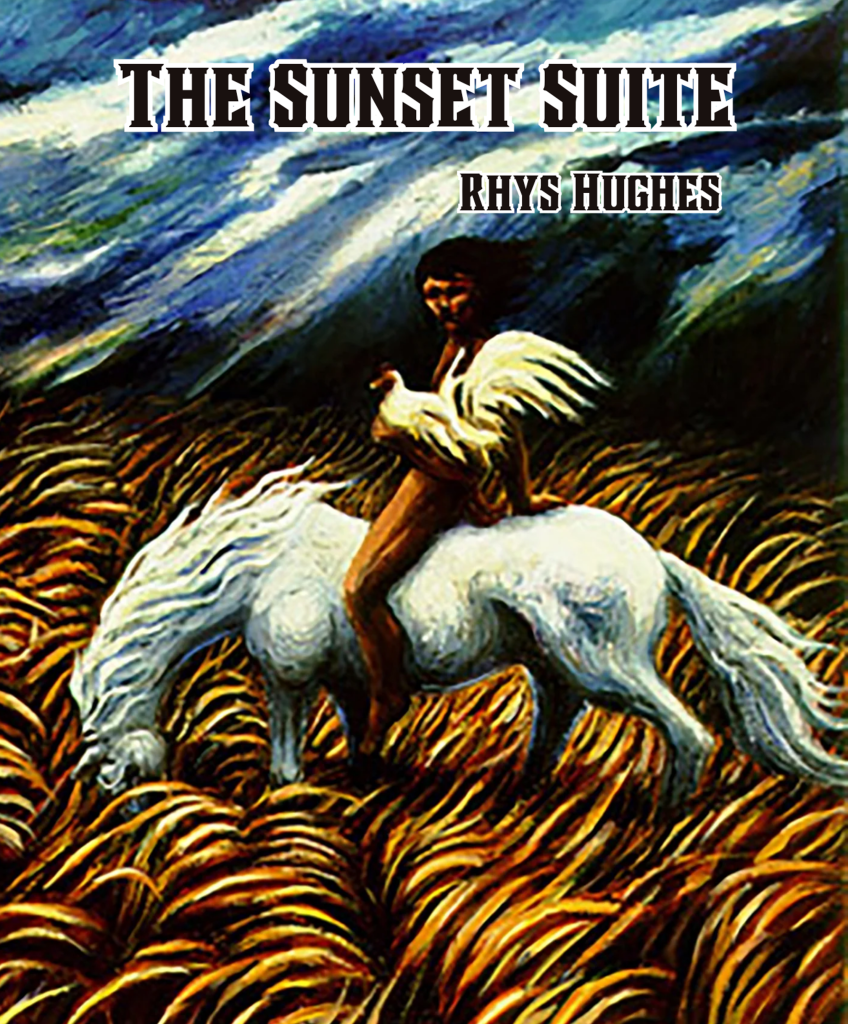
A brief introduction to Rhys Hughes’ Sunset Suite, published by Gibbon Moon Books this year, and a discussion with the author on this ‘Weird Western’ and more…
Rhys Hughes
Perhaps — that’s the wrong way to start a review or any article— but given that this is a book that offers immeasurable possibilities, like sunsets or stars, one could still start with a ‘perhaps’… You might start with another word of course!
Perhaps, Rhys Hughes’ TheSunset Suite is a novel? Or, is it not? It seems to be a group of short, tall tales tied neatly into coffee lore, coming closest structurally to The Arabian Nights — stories told by the Scheherazade, originating around Middle Ages, much after coffee was discovered in Ethiopia by a goatherd in 800 CE. The book departs in various shades from the One Thousand and One Nights, even though magic creeps in every now and then.
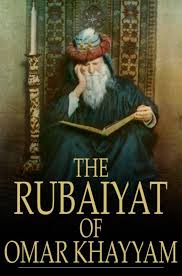
Hughes also seems to have a fascination for coffee lores for he redid TheRubaiyatof Omar Khayyam (1048-1131), translated from Persian by Edward Fitzgerald, substituting the wine with coffee a year ago. And here you have two men in the Wild West, telling tall tales, inspired by 26 mugs of coffee.
In The Empire Podcast by William Dalrymple and Anita Anand, there are a couple of episodes on coffee. Coffee houses sprouted around the fifteenth century in the Middle East and flourished during the Ottoman Empire, spreading over time to Europe, and even to America… if we are to believe Hughes! In those times, soldiers, among others, gathered in coffee houses, much to the dismay of kings. The warriors started turning to tall tales, philosophy and gossip instead of training all the time. The rulers were unhappy at the turn of events. Germany went so far as to ban coffee. An article on food history tells us: “One of the most curious of these events happened in Prussia, a precursor to modern-day Germany, where it’s leader Frederick the Great banned coffee by decree in 1777. And he did it for a reason that is almost baffling to modern notions of health and what’s good for society: He wanted people to drink more beer.” In the podcast, they do tell us Germany produced beer. In those days, coffee was seen as a suspicious drink, an aphrodisiac with magical qualities. It is these magical qualities that are invoked in TheSunset Suite.
Brand and Thorn are two coffee drinkers under the stars, sitting over a bubbling pot — and each cup from the pot has a tale in it, professes the author. That the tales are part of a dreamscape of darker hues verging on the absurd, bringing out the strangeness of the illusion we call life and its endless possibilities, comes as a surprise.
People turn into corn cobs, biscuits, musical notes, sombreros and are resurrected in paintings of nightmares at the end, tying the characters loosely into a frame. Phoenixes swim underwater and horses turn into boats and ‘a hill of beans’ becomes a ‘mountain of beans’. The transformations seem to be reminiscent of Kafka’s Metamorphosis (1915) or Pinter’s The Room (1957) … but we are left wondering, are they?
The settings are often realistic at the start but head for the absurd as they end. Each story has a punch and leaves the reader open mouthed in amazement. They are imaginative, clever — sometimes playing on words — like the story of a genie who was told by a robber to make money ‘no object’ — a turn of a phrase which should mean that money is so plentiful that anything is affordable. But the genie, trapped in time and traveling over centuries, misunderstands the grave robber. He makes money into a literal ‘no object’— ‘abstractions, vague colours, mental scents and other intangible things’.
Hughes expands the literary world to a frog, a dog and even an armadillo who are yet to publish their books. This seems almost like an inversion of Luigi Pirandello’s play Six Characters in Search of an author (1921), where the characters left incomplete by a deceased author are looking for a resolution. Hughes’ reader, who talks of these authors from the animal kingdom, waits patiently for the books to turn up. In another story, evocative of the same play by Pirandello, the characters from his earlier tales are trapped in a painting and talk to the artist, ‘the keeper of Lore’, who paints his own nightmares peopled by the creations of Hughes. One of the last narratives, this one ties the stories into a loosely structured unit.
“I am Grampsylvania. That wasn’t my original name, but it’s my name for the foreseeable future. He changed me, you see, from a man into a gigantic but sapient corncob pipe. I don’t mind.”

“And he changed me into a biscuit,” said another voice. “I was just George Lewis once but now I’m The Biscuit Kid.”

A third voice added, “Turned me into a hat, a sombrero. I was Max Grizzly originally. Not that I dislike being a hat.”

“Wonder what he’ll turn you into?” they said to Henry [the artist inside the painting].

“I don’t want to change.”

“Well, you don’t have a say in the matter.”
The idea of the writer as the ultimate creator stretches through tall tales to experimental forms. ‘The Biscuit Kid’ is a one-and-a-half-page story written in one sentence — is it an attempt at what is known as the stream of consciousness technique (as in James Joyce’s Ulysees, 1918) or just a quirky experiment? A strange tale about a man turning into a biscuit in a sulphurous pond with tea dunked into it with an allusion to the Boston Tea Party has the victim floating in infinite circles … is it a comment on history repeating itself? The narrative of ‘Reintarnation Smith’ maps the history of the world rather randomly through the many reincarnations of the protagonist, from a palaeolithic shaman (were there shamans in that time frame?) to a Napoleonic soldier and a First World War trooper to an intelligent tree in a world where humanity has become extinct! The alternatives offered and suggested are mind boggling…
Each story sees itself as a possibility expressed in a light gripping vein, characteristic of the author, who has ostensibly been seen as a cult writer… though I am not sure what that term means or how Hughes, who has authored more than fifty books and writes up storms of stories and poems, feels about it — Let’s ask him. We start with the most pressing question —
This is on something that has me perplexed after reading Sunset Suite. How do you think a frog, a dog or an armadillo would hold a pen? Can we read frog/ dog/ armadillo — or would one need to download a special app from Google to read their books? Or is it better to have a frogman/ dogman/ armadilloman translate these? Please enlighten us.
Armadillo: Image from Public Domain
I hadn’t really thought about it until you asked the question. They would have to use telekinesis to hold a pen. The power of their minds. Maybe they have bigger minds than we think. Having said that, I don’t know why we always assume that if you have a bigger mind, you will be able to move physical objects just by thinking. When I was young, I often tested my own telekinetic powers. They never worked, of course. Except for once, when I made a cardboard box cover a daisy during a storm. I was staring out the window and willing the box to fall on the daisy and protect it from the wind, and that is what actually happened! All of a sudden, the box rose in the air and came down over the flower. Certainly it was the wind that did the trick, rather than my mental powers, but at the time I wondered if perhaps I had found the secret of telekinesis. Frogs, dogs and armadillos would write books using telekinesis. The real question is how much we would understand of what they had written. I don’t suppose we have much in common with frogs or armadillos. The dog’s books might be more accessible. I guess most of the descriptive writing in a dog’s novel would be smell-based because that’s how dogs map the world. But while reading a dog’s novel, should we dog-ear the pages to keep our places? Or human-ear them?
That’s an astute observation… Maybe we can dino-ear them! Did all dinosaurs have ears…? Let’s leave that discussion for another time. Next, I need to know what is a cult writer? Are you one? Please explain.
I don’t really know, to be honest, and I’m not sure if I am one or not. Many years ago, I was told that I was one. I think it’s another way of saying, “Your books aren’t very popular,” but softening that blow by implying that, “At least some people read and enjoy them.” I embraced the definition for want of any better label. We do like labels, that’s the problem. When I write, I write just for myself. Not quite. I do try to write in a similar mode to the writers I most enjoy, and they have audiences. If they didn’t, I wouldn’t know about them. I adore the books of Italo Calvino [1923-1985], but I don’t know many other readers who read him. Does that make him a cult writer? I don’t think so. I think it’s just more likely that I am a little isolated and simply don’t know the readers who do read that kind of fiction. And yet I am in contact with some people on the internet who seem to share my taste in fiction. In fact, they give me recommendations of authors I’d never heard of, who turn out to be wonderfully in tune with my taste. Apparently, if you are a writer who is more loved by other writers than by readers who don’t write, you are a writer’s writer, and that’s a form of cult writer. Last year, I read the nine novels of the almost forgotten Henry Green [1905-1973], who was described as a writer’s writer’s writer, in other words a cult writer cubed. I suppose that to be a cult writer is simply a stage for some writers as they work their way up to greater popularity. It’s probably possible for writers who were once hugely popular but who are no longer appreciated by a sufficiently wide readership to turn into cult writers on the way down.
Why did you not write of a squonk in this book since it is your favourite fantasy animal? Will you be writing on a squonk soon?
A squonk: A mythical creature in American Folklore. Image from Public Domain.
There are no squonks in The Sunset Suite because I have written too much about them elsewhere. I don’t want to oversquonk myself. I first learned about squonks from Jorge Luis Borges’ Book of Imaginary Beings [1957] I think. And then I noticed references to the creature in all sorts of places. Years ago, I wrote a short story called ‘The Squonk Laughed’ because squonks are the saddest of all entities. I wanted to write about one that cheers up. And one of my longest ever poems is about a squonk ragtime pianist who works in a Wild West saloon, ‘Honky Tonk Squonk’. The very word is funny. It sounds round but also squelchy, rather like a cream-filled pastry. There is an excellent song by the band Genesis about squonks called simply ‘Squonk’ and it’s a song that will tell you absolutely everything you need to know about squonks if you listen carefully to the lyrics. In my book, it seemed to me that it was time to show some restraint when it came to squonks. You can have too much of a good, weepy thing.
How long did this book take to germinate into a full blown one and how did it come about?
Not long at all. Some of my projects proceed very slowly, they take years or even decades to be completed. But most of my projects are done fast. This is because if I take too much time over them, I worry that I will lose the thread or threads of the plot or plots, or that the mood and atmosphere of the work will change and be lost. That’s not always a disadvantage. I might begin work on a book thinking it is going in a certain direction. Then I put the project aside for a long time. When I return to it, I have often forgotten the direction I had intended to take the book. So I make it go in a different direction, and it seems to me that sometimes this other direction is a superior journey to the original intended direction. Who knows? But that has no relevance to The Sunset Suite because I wrote it in just a few weeks. I can’t recall exactly how long it took, but it wasn’t a drawn-out process. It happened to be one of those projects that flowed easily. Many do, and I am always grateful to them. It is almost as if I am not doing the work but simply acting as a channel for a set of stories that exist in some cosmic cloud. This is probably a fanciful delusion, but it is one that many writers have had over many centuries. We are conduits as well as creators. We are pipelines as well as pipers.
Have you actually been to the Wild West? Why have you set your book against this backdrop?
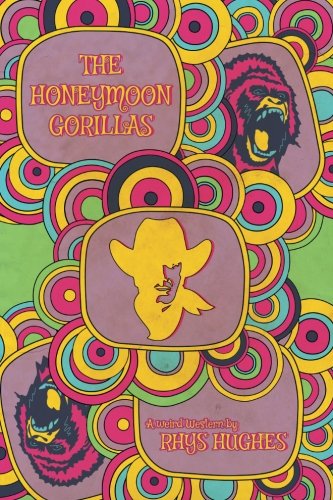
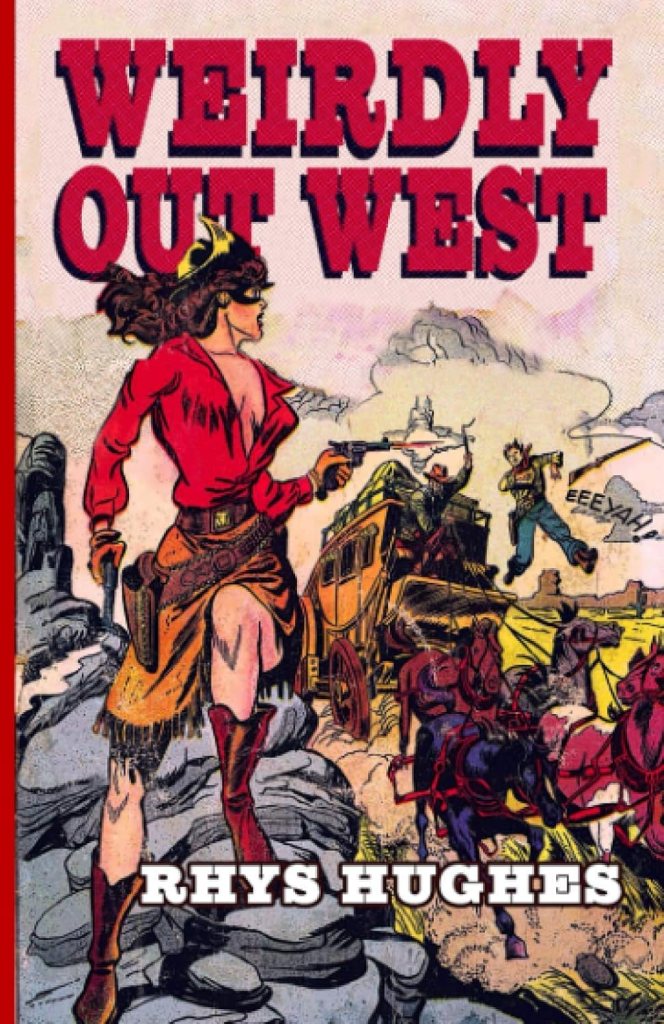
I have never been to the Wild West. I have never even been to the West. Even the most easterly part of the American continent is west to me. The furthest west I have been is Ireland. Yet I love Westerns, especially so-called ‘weird’ Westerns. Having said that, I have been to Almeria in Spain, the only desert in Europe, where many ‘Spaghetti Westerns’ were filmed. It looks the way I imagine Mexico or Arizona might look, but I can’t know that for sure because I haven’t been there. Maybe one day I will. I have written quite a few Westerns, all of them weird and unusual. The first was a novella called The Gargantuan Legion. I had the idea for that when I was very young. Much later I wrote a novel called The Honeymoon Gorillas [2018], and then a collection of stories, poems and short plays called Weirdly Out West [2021]. Shortly after finishing The Sunset Suite, I wrote a Western novel
called Growl at the Moon that has been accepted for publication. I am currently working on a novel titled The Boomerang Gang. I find writing weird Westerns to be great fun, relaxing too, yet they apply a strong stimulus to my imagination. Next year I hope to write a novel called Fists of Fleece, which will combine Welsh folklore with Wild West tall tales, creating an especially offbeat hybrid.
You have strange names given to characters peopling The Sunset Suite. Why? Please elaborate.
I enjoy giving my characters strange names. I also think it’s safer. Suppose I have a character in a story named Tim Jones and something absurdly odd happens to him. There might be a real Tim Jones out there in the world who will start thinking that I am referring to him and maybe even mocking him. It is better to give the character a name that surely no real person will ever have. Argosy Elbows, for example, or Crawly Custard. Readers can regard these as nicknames, if they wish. I often make lists of offbeat names for characters that I will use in future stories. Some of these names have been waiting decades to be used. Other names I invent on the spur of the moment while writing. Invention on the spur of the moment is an appropriate thing to do when writing a Western. But in fact the names in The Sunset Suite are still fairly conventional. Jake Bones, Shorty Potter, Killy the Bid, Grampsylvania, Max Grizzly, Cowboy Bunions, Dan Flyblown, Lanky Ranter. It’s not beyond the bounds of plausibility that real people out there do have such names.
Why do you keep obsessing over coffee? Please explain.
I hope it’s not quite an obsession. I like coffee, that’s all. I guess it’s my favourite drink. No offence to water, tea or beer! I am in the process of cutting down on my coffee consumption. I have been reducing my intake for the past twenty years, but it’s still not at zero. I am reducing it very slowly indeed, that’s why. Mind you, the reason why there is so much coffee in The Sunset Suite is simply because cowboy films always show the characters drinking coffee around a campfire. They surely told stories to each other at night while drinking the coffee. It occurred to me that I could use this as a frame for my book. A sequence of strange stories set in the Wild West linked together by the fact that each tale was generated by a cup of coffee. At the end of the book, the two tale tellers have drunk too much coffee. The book is a warning that will be heeded too late. But we are all adults. We don’t really need to be warned about such perils as coffee consumption.
Since classification is an important aspect of human existence, how would you classify your book?
It’s a ‘Weird Western’. That’s what I have been calling it. This is a real sub-genre, and I think my book can be labelled as such without any objections. I might also call it a comedy, a picaresque or portmanteau farce, a speculative whimsy. But it remains a Western, that’s undeniable. It makes substantial use of parody, pastiche, paradox and probably other things beginning with the letter ‘p’. At the same time, I don’t mind if the book is classified just as a fantasy or even only as fiction.
What have been the influences on this book? On your writing?
The main influences on this particular book of mine were other weird Westerns by writers I admire, in particular The Hawkline Monster [1974] by Richard Brautigan, which was marketed as a Gothic Western. Brautigan was especially good at writing short but thoughtful passages that are often at tangents to each other but nonetheless do combine with each other satisfyingly. Another influence was probably a collection of stories I read when I was young, The Illustrated Man [1951] by Ray Bradbury, in which a sleeping man’s tattoos come alive one at a time and tell stories as they do so. But in my book, it is the cups of coffee that come alive in a fictional sense. I also think that the pulp Western author Max Brand was an influence on my book, especially his stranger works, such as The Untamed [1918], which seem to blend echoes of ancient mythology with the more conventional cowboy motifs and clichés.
Would you call these stories humorous? They do linger with absurdity and a certain cheekiness.
I like to think they are humorous. I like to think that The Sunset Suite is a comedy among other things. Most of my fiction has some comedic elements, even if the general tone of the story is serious. Real life is a mishmash of tragedy, comedy, indifference, absurdity, beauty, and who knows what else, so it’s only right and proper for fiction to be such a mishmash too. Obviously, in a short story there’s not much room in which to throw everything, so one has to be more careful when it comes to constructing the piece. The mode of the book, which features a framing device in which is found a set of individual tales that echo each other’s themes, is one I especially enjoy using. I am planning other books that follow this structure.
What books are you whipping up now?
I always work on several projects at the same time. I am currently working on two novels. One of them is a satirical thriller called Average Assassins, and the other is another weird Western called The Boomerang Gang, which is about an Australian immigrant to the Wild West in the late 19th Century and it features an experimental aeroplane with boomerangs for wings. I am also working on a large project called Dabbler in Drabbles, which consists of four volumes of drabbles. A drabble, as I’m sure you know, is a flash fiction exactly 100 words in length. There will be one thousand drabbles in total when the project is finished. The first three volumes have already been published and I am pushing ahead with the fourth. Yet another project I’m working on is a collection of short meditations called City Life. These meditations are supposedly written by the cities themselves and there will be sixty of them in total. I am working on other projects too, but I won’t mention those yet.
Thank you Rhys for your fantastic writing and your time.
(This interview has been conducted through emails and the review written by Mitali Chakravarty.)
Shantanu Ray Chaudhari converses with writer Gajra Kottary, a well-known writer of Indian TV series, novels and stories. Clickhereto read.
A discussion on Samaresh Bose’s In Search of the Pitcher of Nectar, a book that takes us to the heart of the Kumbh Mela, a festival recognised by the UNESCO as an Intangible Cultural Heritage, with the translator, Nirmal Kanti Bhattacharjee. Clickhere to read.
Translations
Nazrul’s Why Provide Thorns has been translated by Professor Fakrul Alam. Clickhere to read.
Mercy, a story be P. F. Mathews, has been translated from Malayalam by Ram Anantharaman. Clickhere to read.
Songs of Freedom: Vikalangta or Disability is an autobiographical narrative by Kajal, translated from Hindustani by Janees. These narrations highlight the ongoing struggle against debilitating rigid boundaries drawn by societal norms, with the support from organisations like Shaktishalini and Pandies. Clickhere to read.
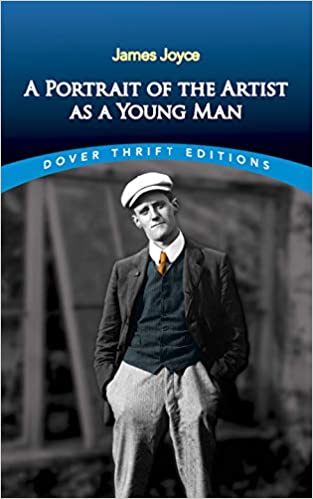
Paul Mirabile explores James Joyce’s Stephen Dedalus and his passion for words keeping in mind the hundred year old Ulysees & the even older, A Portrait of the Artists as a Young Man. Clickhere to read.
Book Excerpts
An excerpt from Radha Chakravarty’s translation of Tagore’s Farewell Song. Clickhere to read.
An excerpt or two short narratives from Rhys Hughes’ Yule Do Nicley. Clickhere to read.
The next year will do the same – we will all celebrate with Auld Lang Syneand look forward to a resolution of conflicts that reared a frightening face in 2022 and 2021. Perhaps, this time, if we have learnt from history, there will not be any annihilation but only a movement towards resolution. We have more or less tackled the pandemic and are regaining health despite the setbacks and disputes. There could be more outbreaks but unlike in the past, this time we are geared for it. That a third World War did not break out despite provocation and varied opinions, makes me feel we have really learnt from history.
That sounds almost like the voice of hope. This year was a landmark for Borderless Journal. As an online journal, we found a footing in the hardcopy world with our own anthology, Monalisa No Longer Smiles: Writings from Across the World, which had a wonderful e-launch hosted by our very well-established and supportive publisher, Om Books International. And now, it is in Om Book Shops across all of India. It will soon be on Amazon International. We also look forward to more anthologies that will create a dialogue on our values through different themes and maybe, just maybe, some more will agree with the need for a world that unites in clouds of ideas to take us forward to a future filled with love, hope and tolerance.
One of the themes of our journal has been reaching out for voices that speak for people. The eminent film critic and editor, Shantanu Ray Chaudhuri , has shared a conversation with such a person, the famed Gajra Kottary, a well-known writer of Indian TV series, novels and stories. The other conversation is with Nirmal Kanti Bhattajarchee, the translator of Samaresh Bose’s In Search of a Pitcher of Nectar, a book describing the Kumbh-mela, that in 2017 was declared to be an Intangible Cultural Heritage of Humanity by UNESCO. Bhattacharjee tells us how the festival has grown and improved in organisation from the time the author described a stampede that concluded the festivities. Life only gets better moving forward in time, despite events that terrorise with darkness. Facing fear and overcoming it does give a great sense of achievement.
In keeping with the festive season is our book excerpt from Rhys Hughes’ funny stories in his Christmas collection, Yule Do Nicely. Radha Chakravarty who brings many greats from Bengal to Anglophone readers shared an excerpt – a discussion on love — from her translation of Tagore’s novel,Farewell Song.
Love for words becomes the subject of Paul Mirabile’s essay on James Joyce’s Stephen Dedalus, where he touches on both A Portrait of the Artist as a young Man and Ulysees, a novel that completed a century this year. Love for animals, especially orangutans, colours Christina Yin’s essay on conservation efforts in Borneo while Keith Lyons finds peace and an overwhelming sense of well-being during a hike in New Zealand. Ravi Shankar takes us to the historical town of Taiping in Malaysia as Meredith Stephens shares more sailing adventures in the Southern hemisphere, where it is summer. Saeed Ibrahim instils the seasonal goodwill with native Indian lores from Canada and Suzanne Kamata tells us how the Japanese usher in the New Year with a semi-humorous undertone.
Also touching and yet almost embracing the school of Absurd is PF Mathew’s story, ‘Mercy‘, translated from Malayalam by Ram Anantharaman. Fazal Baloch has brought us a Balochi folktale and Ihlwha Choi has translated his own poem from Korean to English. One of Tagore’s last poems, Prothom Diner Shurjo, translated as ‘The Sun on the First Day’ is short but philosophical and gives us a glimpse into his inner world. Professor Fakrul Alam shares with us the lyrics of a Nazrul song which is deeply spiritual by translating it into English from Bengali.
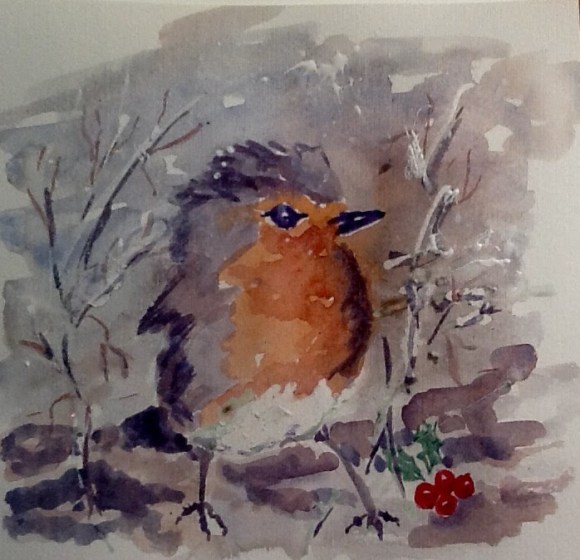
A huge thanks to all our contributors and readers, to the fabulous Borderless team without who the journal would be lost. Sohana Manzoor’s wonderful artwork continues to capture the mood of the season. Thanks to Sybil Pretious for her lovely painting. Please pause by our contents’ page to find what has not been covered in this note.
We wish you all a wonderful festive season.
Season’s Greetings from all of us at Borderless Journal.
Reflections by Paul Mirabile on James Joyce’s Stephen Dedalus who found fruition in A Portrait of the Artist as a Young Man (1916) & a key role in the 1922 classic, Ulysees
“You have a queer name, Dedalus,” says Brother Michael to Stephen Dedalus, the hero of A Portrait of anArtistas a Young Man in the first chapter. Strange perhaps, but quite significant for this tale : Daidalos in Greek means ‘architect, wiseman, artist, craftsman’[1]. He was the universal artist in Greek mythology, the ingenious Athenian architect, who exiled to Crete, designed the labyrinth within which the terrible Minotaur was kept, a complex formation which analogues Dedalus’ intricate or labyrinth-like thinking patterns. A formidable name, thus, for Joyce’s protagonist, one in fact that evokes many of the author’s own traits.
James Joyce (1882-1941) once remarked that a male artist (writer, painter, musician) generally inherits many effeminate attributes from his mother (or from other female figures of the family), and as he matures and grows conscious of them, exploits them to create. Effeminate characteristics in a male engenders a sensitivity that overshadows the ‘virility’ of the father. This is certainly the case with Stephen Dedalus in our story, and perhaps too with James Joyce.
In chapter one, Stephen’s leanings towards his mother appear to be projections of Joyce’s, although the reader should be aware that A Portrait of an Artist as a Young Man, published in 1916, is not an autobiography per se. However, Stephen’s word-associations and flashbacks dissociate, and concomitantly link the ‘masculinity’ of his boarding school surroundings with happy memories which depict his mother and her daily gestures and occupations. There is little doubt that these depictions were drawn from Joyce’s own experiences during his boarding school years.
Stephen felt lonely at the boarding school, studying and playing with boys who were tough, hardened by their fathers’ stern discipline and rough language, many of whom were footballers, pranksters or schemers. He had been brought up by his mother. She never taught him to play football, be a prankster or a schemer. Should that have been his father’s task ? His mother would never have taught him to rub rosin in his hands to harden them against flogging. Fleming, a school comrade, did, and you can be sure that his father had counselled him on that point. When Stephen was flogged along with Fleming, we are witness to the differences in their domestic upbringing : Stephen describes his flogger Father Dolan with great vividness ”looking through his glasses”, those same glasses that were seen through by his father in the first passage at the beginning of chapter one. Had Father Dolan — his ‘brotherly’ father– a ‘tough’ man indeed, misunderstood the scorn that young Stephen’s artistic propensities led him to experience?
Perhaps it is the lack of sympathy and understanding on the part of the father-figures he encounters throughout life that transports Stephen into a lonely, private world dominated by the mother-figure. When he is ill in the infirmary he is quick to address a letter to his mother ; his mother who smells ”nicer” than his father. Joyce, the narrator, also informs us that she played the piano, whereas the father did not …
The boys at the school teased him because he would kiss his mother every night before going to bed, something quite normal for him, yet ”girlish” for the boys. And even if they did kiss their mothers they would never have admitted it in front of the other boys, a habit that their fathers probably told them not to disclose when at school. Stephen had no ‘official training’ in these delicate matters by his father.
He discovered this lack of ‘manliness’ in him through his sensitive, perceptive insight into all that he felt, heard, smelt and observed. His mother’s sensitive world was an innate attribute, one that he consciously cultivated in a creative fashion, examining all that took place, criticising what he felt had been unjust or false. In fact, the opening chapter draws a suggestive parallel of Stephen’s (Joyce’s?) life as an artist and his inner relationship with his mother (and his father to a certain extent) as if she were an inseparable ally on his path to artistic glory.
”He longed to be home and lay on his mother’s lap,” grieves the narrator, defending the downcast Stephen, for indeed the boarding school proved terribly trying for him, violent in many ways, even physically violent by the flogging administered by the brothers and the fights against his comrades. Stephen would reminisce : ”She was a nice mother but she was not so nice when she cried.” Did this prevent him from crying when flogged by the brothers or humiliated by the boys ?
Stephen opens chapter one by recounting what his father had told him when he was a baby. But his father’s language is a child’s, spoken exactly as a child would. On the contrary, Stephen’s childish attempts at communication : too many pronouns, the repetition of a song sung by Betty Byrne : “O,the green wothe botheth … ,” his insight into the ages of his immediate family : “[T]hey were older than his father and mother but Uncle Charles was older than Dante,” and his eventual intellectual developments and abandonment of a Jesuit education due to a very severe and masculine environment, all bespeak a precociousness of character inherited from his mother, which did not prevent him, however, from showing great respect for his father.
At the end of chapter two, he stumbles across a prostitute. Stephen is greatly distressed. He is drawn towards this female but, ”His lips would not end to kiss her. He wanted to be held firmly in her arms, to be caressed slowly, slowly.‘‘ Like his mother would do ? This being said, the poor, lonely Stephen yielded to the prostitute’s charms …
Stephen’s love for his mother is deep: when he ‘exiles’ himself to Paris to study medicine in the first chapter of Ulysses (1922) he receives a letter that his mother has taken to bed very ill. He returns quickly, but refuses to kneel at her bedside and pray for her : ” ‘You could have knelt down, damn it, Kinch, when your dying mother asked you,’ Buck Mulligan said.”[2] Buck even accuses him of killing his mother: “He kills his mother but he can’t wear grey trousers.”[3] It goes without saying that Stephen did not kill his mother ; he deeply regretted her death. However, this disgraceful act towards her pleadings is explained by the fact that to kneel down on both knees represents a Church rite, ”the Jesuit strain in him”[4]. The tortured Stephen disavows this ‘ecclesiastical’ gesture, this gesture of absolute obedience before authority. It were as if at that difficult moment his confused state of mind confounded the love of a mother and the hate of a Jesuit institution that Stephen (and Joyce) bore. It is true that the severity and pain of his seminary years had all but deadened the youth’s love for his mother. However, if he did feel a disliking at his mother’s bedside for those few moments, they should not be interpreted as hate for her, but rather as a transient absence of love. He will be redeemed of this absence of love by the love of languages, especially his ‘mother’ tongue, in spite of the sorrow he bore within him like some original sin.
Born from the mother, the mother breathes into her child the force and the will to live. Wrought from the womb, the child bathes in the sounds, accents and musical rhythms of his or her mother: the lullabies and nursery songs, the praises and reproaches. And a day will come when he or she must be weaned, and although the umbilical cord is cut the cultural cord continues to nourish the child, of which language is the most vital nourishment.
It is the mother tongue that motivates Dedalus/Joyce to desire his language … and the Others’ languages ! The desire to possess or master English, Italian, French, German, Norwegian, Latin and Greek. A polyglot’s desire to penetrate the womb of the Other out of which all languages have been wrought.
Throughout A Portrait of an Artist as a Young Man Joyce is very methodical in developing Stephen’s acumen in word usage. The hero’s pursuit of intellectual ‘purity’ oftentimes turns him into a pedantic perfectionist correcting a word used outside its proper context with the person whom he is addressing. This preoccupation with perfection in proper word usage is only natural for someone who studies languages and realises that verbal force can be a veritable weapon. A word, above all other linguistic features, can be an instrument of puissance and persuasion when wielded with accuracy and precision. Stephen’s effort to instrumentalise English and use it to overpower his ‘opponent’ is manifest in his attempts to seek the word which best fits the circumstances of his daily human intercourse.
In chapter one, even at an early age, Stephen is asking himself ethnico-linguistic questions, making word comparisons when used in idiomatic expressions. For example, ”that was a belt round his pocket. And belt was also to give a fellow a belt.” (page 9) Stephen’s extraordinary memory focuses in and captures the moment the word or expression is used from which he could then make his point :”Go and fight your match. Give Cecil Thunder a belt.”
He knew this was not a ‘nice’ word, as his mother had told him, but one which belonged to a certain class of people. The youngster would soon come to accept these ‘not nice words’ however, comprise the very beauty of language, their social realism and above all their power to persuade! These idiomatic expressions were surely not learnt from his mother; they were acquired from his daily brushes with the many folds of social commerce.
In the same chapter he utters to himself the word ‘wine’ ; it immediately gives him the image of ”… dark purple because the grapes were dark purple that grow in Greece…” (page 43). Uttering a word and conjuring up its ‘topographic image’ also developed his intricate word-image analogies.
Stephen Dedalus hears: ” You are McGlade’s suck. Suck was a queer word,” reports the narrator. Stephen learns the meaning of this word by observing dirty water going down the drain in a wash-bowl; it made a sound like a suck, and he resumes : “The sound was ugly.” Here he devises an ‘aural relationship’ to word signification which one may define as an ‘onomatopoeic analogy’.
Similar word-image associations emerge in the boy’s mind with expressions such as ‘Tower of Ivory’ and ‘House of Gold’ spoken by his father, and whose precise significance escaped his young mind. It would take some time before he understood their semantic impact. The occasion occurred when he stole a glance at the cool, soft ‘ivory-like’ hands of a girl, and at ”her fair hair streaking behind her like gold in the sun.” And he concluded : “By thinking things you could understand them.” In other words by ‘visual analogical’ efforts Stephen could relate to and grasp the meaning of words.
The first chapter of the book represents a young boy beginning his intellectual-linguisitc voyage, and as the story unfolds and Stephen’s mental capacities become more and more meticulous and keener, his discernment into word usage becomes more demanding when speaking to his peers or to elders.
The second chapter deals with his mental and physical vicissitudes : his father sells the house. The family moves to Dublin. Stephen goes to college. These changes affect his way of thinking, for he is a boy who is already conscious of his detachment from the rest of his schoolmates. He excelled in essay writing and was good in Latin. Stephen’s remark concerning his friend Heron is worthy of mention. Stephen ruminated over the fact that Heron, like the bird, had the same bird-like features. The name Heron suited the boy’s features quite nicely : ‘‘Vincent Heron had a bird’s face as well as a bird’s name. A shock of pale hair lay on his forehead like a ruffled crest.” His forehead too was ”narrow and bony” and he possessed ”a hooked nose.” (page 70) Again, Stephen’s capacity to ‘see’ and associate, analogically, words, or as he says their ”logical parallel”, marks a perspicacious penchant for conjoining the signifier with the signified. In the case of Heron: the name fitted the face. For Heron indeed was the perfect heron.
On page 83, again, whilst attending a seminar in the anatomy theatre, Stephen found the word foetus carved into a desk. This made him suddenly concentrate deeply on the meaning of this odd word. Did it portray reality, a raw and life-like reality, beyond all formal study and ‘higher’ education ? Did this word represent mankind in both its primitive and highest stages ? Did it not evoke the image of the mother … his mother ? Indeed fœtus remained in Stephen’s thoughts for the entire day. He wrestled with it, coming to the conclusion that a word is what man is : ” in the outer world a trace of what he had deemed till then a brutish and individual malady of his own mind.” The words brutish and malady are significant inasmuch as they actually do go far beyond the formal education that Stephen was pursuing. In fact, fœtus provoked yet another urge in the need for reality in language, which his studies in Latin certainly strengthened by discovering the origins of words and their semantic impact on human communication ; they taught him to train his mind to think in terms of precision, brevity and beauty. However, Stephen’s plunge into reality was more often forged outside the sacred walls of that ‘manly’ institution, amongst his myriad frequenting with the world of words uttered by the ‘womanly’ creatures of the whore-filled Dublin streets. This remarkable double-life, in chapter three, manifests itself sharply when Stephen is torn from those ‘womanly’ streets and is plunged into a ‘manly’ Jesuit retreat, where by the force of many well-delivered Hell-fire sermons a multitude of salacious temptations put his semantic perspicacity to trial.
In the Jesuit homilies or sermons during mass, the power of word usage is fully revealed to our heroic hero. So powerful is this usage that he confesses his previous dealings with prostitutes to a father confessor after listening to the ravings of a Jesuit concerning Judgement Day, death, hell, brimstone, fire and other Catholic-contrived image-filled words. The barrage of religiously-orientated words left him reeling in disbelief, which in turn obliged him to ‘believe’ the meanings of all the words which resonated clearly in his mind: judgement, death, soul and heaven. Yet, where were their true meanings? Were they what Stephen really thought them to be, or were they the Jesuit brothers’ invention, forcing themselves upon his young mind? Indeed, the answer becomes clear at the end of the book: Stephen sought his own definitions, his own knowledge, not the knowledge delivered from the books or the sermons of erudite Jesuit priests and brothers. Every word preached were weighed carefully to suit the disposition of the students, to create an ambiance of need, of weakness; a weakness to be satisfied in the pure thought and ‘word’ of God. Every ‘priestly’ word declaimed during mass weighed heavy upon Stephen’s mind. It only lightened when our hero was able to ‘think it through’ and not fall into an abominable, guilt-riddled contempt of himself.
A decisive step in Stephen’s life occurs in chapter four. Instead of accepting a career as a novice, then as a Jesuit priest, he strides out into the world on his own, knowing well his method of attaining knowledge would never have found favour in the eyes of the Jesuit brothers. To give an example, during a long conversation with a Jesuit priest, Stephen again scrutinises word usage. The priest mentions his journey to Brussels. He remarks that the people there wear ‘jupes[5]‘, and when they ride bicycles, it makes them look ridiculous. The mention of this foreign word causes Stephen to smile : ”The vowel was so modified as to be indistinct”. Stephen’s thought was obviously an attack against the priest’s pronunciation of the French word, an attack that went far beyond this one priest to humiliate the Jesuit institution as a whole. The word ‘jupe’ also emitted an olfactory sensation ; a perfumed fragrance. Stephen says that when articles of clothing were mentioned he could actually smell perfume. Here again we read another indication of a word’s power upon Stephen’s mind, whether it be aural, visual or olfactory ; that is, the ‘femininity’ of the image-sensation overrides the ‘masculine’ pronunciation of the word. The loquacious priest’s voice faded into the background as Stephen’s innate linguistic conscious rose to the surface : ”As the priest spoke, Stephen’s mind erred : ‘The echoes of certain expressions used in Clongrowes[6] (his boarding school) sounded in remote caves of his mind. At this point he was interrupted …”’ Stephen’s linguistic prowess acts like an etymological Time Machine, now straining back in intellectual pleasure, now fixed in the present which creates a spiral movement to his thought patterns. Chapter four ends with this beautiful passage which depicts the young artist’s sagacious ability to put into motion that spiral rhythm. I shall quote the passage in full.
”He drew forth a phrase from his treasure and spoke it softly to himself.
“-A day of dappled seaborne clouds-
“The phrase and the day and the scene harmonised in a chord. Words. Was it their colours ? He allowed them to glow and fade, hue after hue ; sunrise gold, the russet and green of apple orchards, azure of waves, the grey fringed fleece of clouds. No, it was not their colours ; it was the poise and balance of the period itself. Did he then love the rhythmic rise and fall of words better than their association of legend and colour ? Or was it that being as weak of sight as he was shy of mind, he drew less pleasure from the reflection of the glowing sensible world through the prism of a language many coloured and richly storied than from the contemplation of an inner world of individual emotions mirrored perfectly in a lucid supple periodic prose ?”
Here the past has been contracted into Stephen’s present circumstances: And no doubt, Joyce’s, too.
“Bous Stephaneforos!” mock his comrades. Yet, Stephen took great pleasure in the distorted orality of his name: did not ‘Bous’ in Greek mean ‘cow’ or ‘bull’ and his first name ‘Stephen’, ‘crown’? He was indeed the ‘crowned bull’! The ‘engarlanded bull’! ”His strange name seemed to him a prophecy. […] He would forge a legend, his name a symbol of the artist forging anew in his workshop out of the sluggish matter of the earth a new soaring imperishable being?” Was Stephen not the sacred bull of distant mythological or legendary heroes? Could he also be the victorious bull in the Irish epic tale the Tain Bo Cuailngy ? Whatever bull it be, Stephen knew his Destiny would be a glorious one, bathed in golden aura. Did his comrades know it?
Chapter five opens with Stephen’s acute criticism when reading poetry; certain verses arrest his attention: “Whoever heard of ivy whining on a wall ? And what about ivory ivy ? […] The word now shone bright in his brain, clearer and brighter than any ivory sawn from the mottled tusks of elephants’‘. Perhaps this poetic oddity of ‘ivy’ reminded him of the ‘Tower of Ivory’ that his father had mentioned, and recalled, too, those of the girl’s soft hands. Could analogical processes elicit such linguistic associations ? In Stephen’s case they certainly did.
Chapter five also initiates the beginning of Stephen’s literary career, his life as an artist, dedicated to ”putting words on paper”. Although the spiral rhythm of his mind abets him in his linguistic and poetic quests, he realises, too, that words belong to the epochs in which they were couched. Whilst reading Ben Jonson: ”He thought : ‘The language in which we are speaking is his before it is mine. How different are the words home, Christ, ale, master on his lips and mine ! I cannot speak or write these words without unrest of spirit. His language, so familiar and so foreign, will always be for me an acquired speech. I have not made or accepted its words. My voice holds them at bay. My soul frets in the shadow of his language.’”
How perspicacious Stephen has become at the end of his formal education : He understands that words of past literature, however potent or poetic, are acquired speech, whereas his present tongue, his ‘mother’ tongue, is innate. It would seem that once again he refutes the authoritative voice of the past, its literary ‘fixedness’, its stringent rules which must be acquired — as if these usages were quite artificial, dead — museum pieces for show and admiration. Stephen strains towards the future … towards horizonless linguistic freedom: His own invented Discourse because now innate (his mother’s), now acquired in the daily social practice of language production or creation.
Indeed his comments on word usage reflect a growing intellectual acumen, and permits us to comprehend fully his overpowering knowledge of ‘innate’ language. Stephen defines beauty and art in this chapter, surpassing Artistotle and Thomas d’Aquinas (or so he believes!). He rebukes his father’s ”curious idea of gender‘‘ ; Mr. Dedulas calls his son ”a lazy bitch”. Stephen muses mockingly: ”he has a curious idea of gender if he thinks a bitch is masculine” (page 259). A snippy remark aimed at his father’s linguistic ignorance, which in fact represents a critique of authority : the church … the father-image … the Jesuit priest. Only art will triumph. Art as a spiral cadence of an alternating succession of static and kinetic energies that leads us ”to action, to do”. Static energy holds or arrests our attention, as do words said by others that arrest Stephen’s attention. Kinetic energy thrusts words into our present circumstances which in turn sends them hurtling into the future. For example, further on in the chapter, Stephen is speaking with a Jesuit priest about his decision to take leave of the school ; the word ‘funnel’ is brought up in their conversation pertaining to the pouring of oil into a lamp. Stephen is quick to point out that funnel is out of place here, and that the word ‘tundish’ should be employed in this function. The priest confessed that he had no idea that the word existed and promised Stephen that he would look it up. Stephen insisted on its semantic veracity as if the priest did not take him ‘on his word’.
It is at this moment in the book where Stephen’s expanding linguistic knowledge runs parallel to his diminishing reverence towards those who had educated him.
Again on page 227 we read the word tundish, only this time written in Stephen’s diary : ”… that tundish has been on my mind for a long time. I looked it up and find it English and good old blunt English too. Damn the dean of studies and his funnel! What did he come here for to teach us his own language or to learn it from us? Damn him one way or the other!”
This plain-spoken critique and rejection of authority, and Stephen’s meticulous manner, had made him a better man than even his mentors. Is our hero then a self-sufficient snob ? An overweening upstart ? A pompous prig ? No doubt he can be characterised by all three … Yet, his passion for language spurred him on to become the artist he longed to be after experimenting with the tools of empiricism, since language, being both innate (the mother) and acquired (schooling/social intercourse), can only be learnt with the tools with which it had been forged. Language is human ; it is an integral part of humanity and not the sole property of an authoritative elite.
Stephen plunged into the complex world of word usage at all levels, a sort of socio-linguistic adventure and scrutiny, and like his narrator, James Joyce, emerged from it in all his ‘graphic’ self : The young writer-artist who rebelled against ‘good grammar’, refusing to put hyphens between nouns, or nouns and qualifying adjectives to create compound words ; it was his way of rebelling against prescribed grammar ; that is, against authority. Here is a short list of the ‘rebels’ taken at random : “moocow, hornpipe, terrorstricken, softhue, priestridden, seventyseven, seventysix, whitegrey, granduncle, strangelooking, deathwound, ironingroom, slateblue, rainladen, priestlike, darkplumaged, carriagelamps, suddenwoven (anger), freshfaced, hollowsounding, curtainrings, etc.” The long ligatured or hyphen-less words contrast greatly with Joyce’s use of short, choppy, racy, sentences; sentences devoid of detail. The characters are description less. ‘Literary’ or Dickension-type interpolated clauses are rare (he ejaculated, she ruminated, etc.). Joyce oftentimes has recourse to the simple ”he/she said”.
The rhythm of writing is a flux of Stephen’s verbal consciousness or series of dialogues with brief, curt responses or questions. We are no longer reading ‘classical’ literature but not exactly something that Joyce will experiment in Ulysses or in Finnegans Wake (1939). Something perhaps unfamiliar, estranged from the reading habits of the early twentieth century reader, not the story-plot, but the form in which the story-plot has been cast. It were as if Joyce turned to the languages of the Other in order to express both his own mother tongue and a discourse of his own, embedded within that mother tongue. As if the mature writer-artist in trespassing the rules of ‘good’ English grammar, not only trespassed the authority of the ‘father-figure’, be it his father, Father Dolan or any Jesuit priest, but also instituted an invented discourse which distanced him from the mother tongue (the mother?) only tocome back to it in a creative attempt to strike out on his own.
There is no doubt that Stephen Dedalus/ James Joyce is indeed the ”prince of words” …[7]
Burgess, Anthony, Re Joyce Here comes Everyone, (W.W. Norton Company, London England) 1965.
[1] The verbal form in Greek of the proper name is ‘daidallo’ ‘to work, adorn’, the nominal form ‘daidalon‘ ‘a work of art’ and the adjectival form ‘daidalos’ ‘cunning’. These forms have given the French noun ‘dédale‘ ‘maze, labyrinth’.
[7] Anthony Burgess, Re Joyce. Here comes Everybody. Faber and Faber, 1963.
Paul Mirabile is a retired professor of philology now living in France. He has published mostly academic works centred on philology, history, pedagogy and religion. He has also published stories of his travels throughout Asia, where he spent thirty years.
.
PLEASE NOTE: ARTICLES CAN ONLY BE REPRODUCED IN OTHER SITES WITH DUE ACKNOWLEDGEMENT TO BORDERLESS JOURNAL
I visited the city in the year of the Brexit vote, conscious that I might never set foot on the mainland of my own continent again. I always give Trieste that extra lift at the end: tree-est-ee. Some say it flat: tree-est. I wondered which was right and kept my ears open. I heard both but I like to think that as you read you pronounce it Trieste.
The buildings of Trieste are massive, solid, and looked recently restored, seeming too new to be as old as they are. This was once the only port for the whole of the Austro-Hungarian Empire, and its fourth largest city. One time naval officer, Baron Von Trapp, must have known it and his first father-in-law’s British torpedoes must have been deployed here. High, squared city blocks with rows of filing cabinet windows housed thousands of administrators, civil servants and shipping agents who ran the empire’s import and export trade.
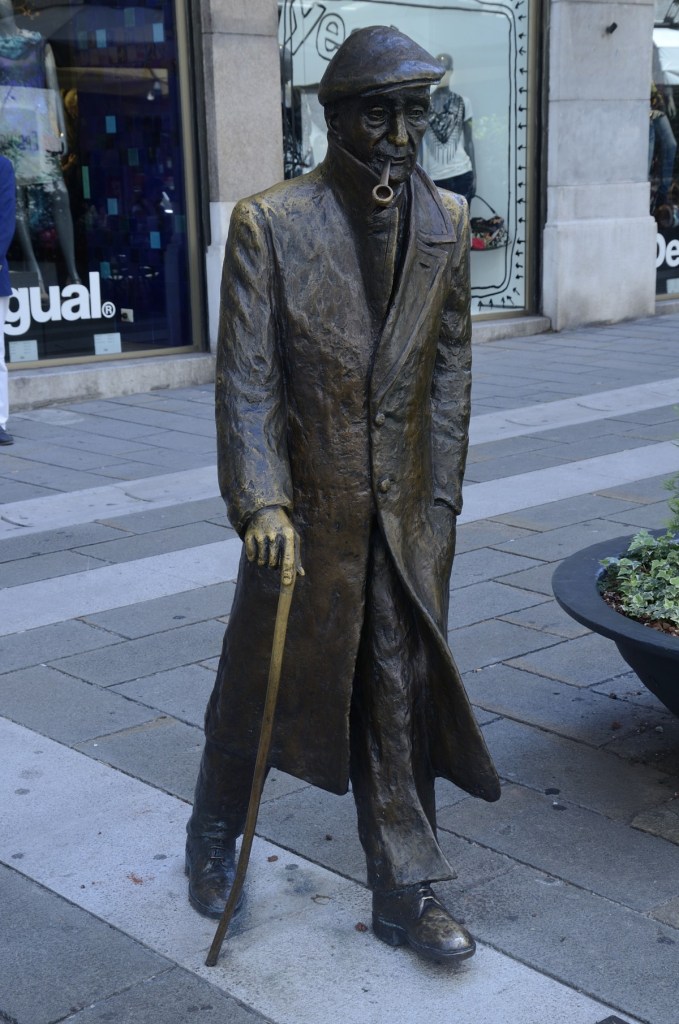
Umberto Saba’s statue at Trieste
A cold wind blew through the square the afternoon that I was there, though the sky was sheer blue and the autumn sun harsh. That wind blows often, I suspect. The statue of Italian poet, Umberto Saba, outside the bookshop he used to run shows the hem of his long coat flapping, the collar turned up. I’d never heard of Saba, but the cafes around the city centre have his photograph and information panels as well as those for James Joyce.
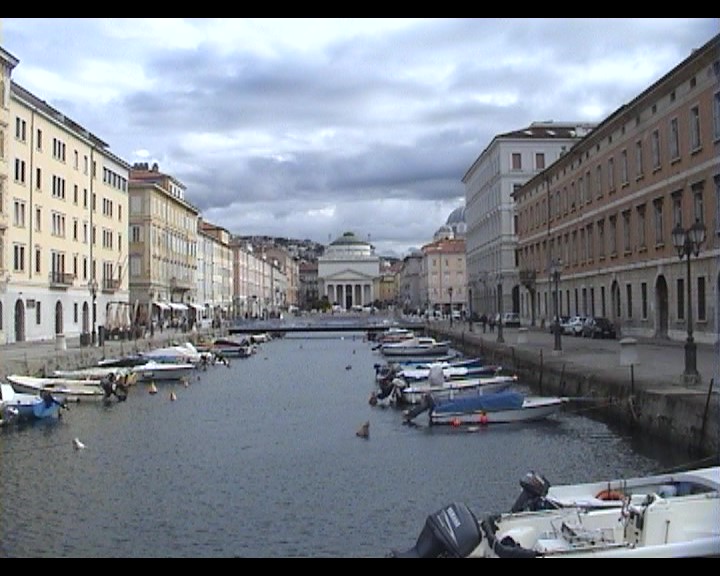
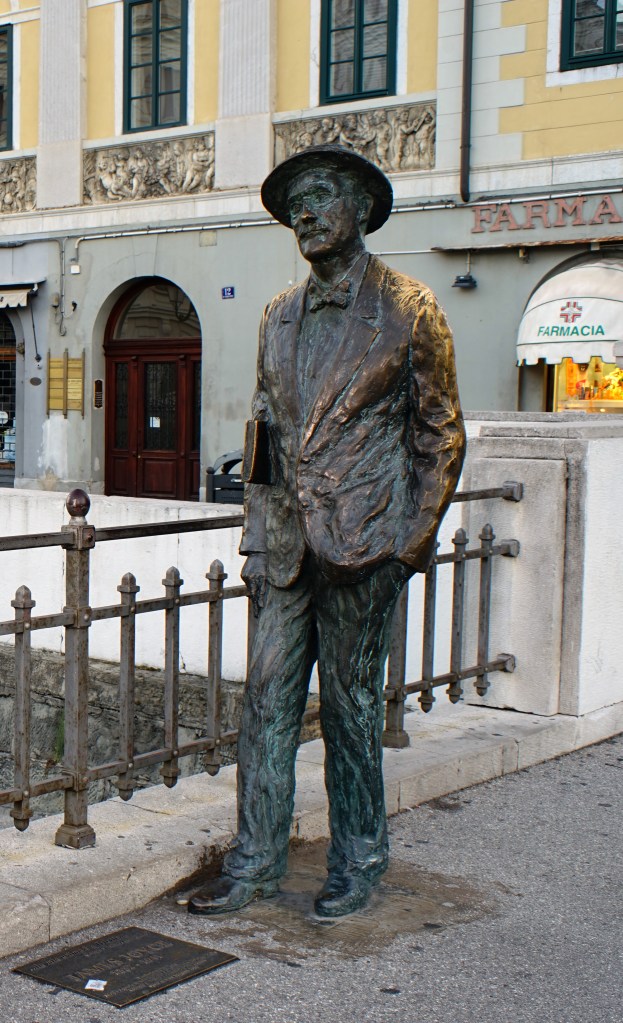
James Joyce lived here briefly, writing Ulysses, and I wonder to what extent the city reminded him of Dublin. No Liffey sticking out its tongue, but the more formal Canal Grande, straight sided and stone lined, runs down from the Piazza Saint Antonio towards the sea, crossed by the bridge on which Joyce stands — loiters, one commentator says.
The statute seemed somehow smaller than life sized. Joyce seems dazed, hand in pocket, dreaming, perhaps, of Molly Bloom’s ‘melons melonous’, or recalling the windows of high class clothes shops in the city centre, filled with ladies’ lingerie, “wondrous gowns and costliest frillies. For him!”
Could it have been the shops here, rather than Brown Thomas on Dublin’s Grafton Street, that really inspired the scene in which Bloom himself gazes on silks and satins, and ‘mutely’ craves ‘to adore’? Leaning against a wall, high up above the city I recalled the wall against which Milo O’Shea leans in Joseph Strick’s film of the Ulysees. Were it not so clean and well tended, I might think Trieste reminiscent of ‘dear, dirty, Dublin’.
A friend had driven me the two thousand kilometres to see that Joycean statue and to be seen by it — in both senses of the phrase. A pointless piece of literary homage that we’d talked about making for a decade and more.
Trieste seemed a cold city, and not just because of that wind. The people here look you in the eye and weigh you up. They don’t fawn or fall over you with welcomes, but judge, perhaps rightly, that you have done wisely to visit them. It was late October, and though unseasonably sunny the sensible tourists, and perhaps all of the English save us, had gone. A few kilometres out of the city a grid of buoys floated, bereft of their summer moorings. Beyond the flat-calm, azure Adriatic, towards the west, the buildings of — could it be? –Venice, caught the autumn sun and glistened like sugar cubes.
A broad, stone pier juts out into the water at the centre of the bay. Here large ships must once have landed their cargoes. Now the curious and the adventurous risk that biting wind and stroll out to take in, briefly, the view back across the city, which folds out on each side, and climbs in orange pan-tiles the hill behind the crust of square-set buildings to lose itself in the thick mixed woods of the hinterland.
Abandoned cranes and the shells of warehouses stand beyond the railway station to the west, and to the east a skyline of newer warehouses and cranes shows. An old stone fortress sits dead centre among the rooftops.
Between the promenade and the city, Mercedes, BMWs, and Audis fill the main road. We crossed into the Piazza del ‘Unita Italia’, and considered briefly a table at Harry’s, but settled for a local pizzeria where we dined beneath a garish painting of Westminster Bridge.
Just off that square a band of locals stood a folding table bearing leaflets of a Trieste independence party and the flags of America and the UK. We wandered over to find out more. Trieste had been ‘given’ to Italy after the First World War but after the Second it was made over to an Allied Commission. A friendly English speaker explained to us. Out-Brexiting the Brexiteers, this happy band saw themselves as citizens of a potential city state and why not, if those up-market shops were anything to go by? I can imagine London with its Home Counties going the same way one day.
There were beggars, such as we had seen all the way across Europe – our sensitivity heightened by the refugee crisis, and a post-Brexit sense that we were seeing a continent that would not be the same, for us at least, ever again. The supplicants seemed mostly of Eastern origin and in the Piazza Saint Antonio, hidden entirely beneath an orange cloak, richly embroidered, was one especially chilling. She — for some reason, though I could see no face or body, I thought of it as a woman — had placed a plastic cup on the ground, and wore a black sheep’s head, curled horns as dark as the tight curls of wool that covered it. The lower jaw, with slow, un-rhythmic persistence, made a flat, un-resonant clack, clack, clack, clack, that haunted the streets around the square.
James Joyce’s Statue Via Roma, 34122 Trieste TS, Italien. Courtesy: Wiki
To fulfil my bucket-list desire, I would not merely see, but be photographed not noticing the statue of James Joyce. I took an ancient Sony Handycam. Just get me crossing the bridge and passing him by, I told my friend. It’s easy to use, I said. Hold it like a trumpet, and you can operate all the controls with the fingers of one hand.
When I returned my friend was holding the camera like a saxophone. I think I missed you, he said. Do you want to do it again?
The sheer Joycean comic irony of the situation was too good to undo.
It’ll be fine, I said, and we drove the two thousand kilometres home.
Curthwaite- Worlington-Heidelberg-Venice-Trieste. October 2016
Mike Smith lives on the edge of England where he writes occasional plays, poetry, and essays, usually on the short story form in which he writes as Brindley Hallam Dennis. His writing has been published and performed. He blogs at www.Bhdandme.wordpress.com
.
PLEASE NOTE: ARTICLES CAN ONLY BE REPRODUCED IN OTHER SITES WITH DUE ACKNOWLEDGEMENT TO BORDERLESS JOURNAL
Dustin Pickering argues that Joyce is what we need during this pandemic
James Joyce’s oeuvre is an extravagant literary experiment in stretching the bounds of language. Ulysses, for instance, is colourful and surreal in its use of stream-of-consciousness as we walk with the central characters through an actual Ireland Joyce recreated from memory. Finnegans Wake is linguistically complex yet satisfying to read only for enjoyment. These works are often criticised as being too obscure for readers, but I will argue that such obscurity is an essential force of the novels which resonate in today’s reality as much as in the times they were written. Ambiguity grants flexible interpretations, so in the spirit of Joyce, I will define how his work could relate to contemporary conflicts. This essay will present critical ideas that balance opposing approaches. Joyce’s literature is in dialogue with works of the past which present similar conundrums.
Structuring his novel Ulysses against The Odyssey creates a full loop culturally from the ancient western literature to modernist fixtures such as T S Eliot and Samuel Beckett. The novel was put on trial in the United States in a famous case that helped liberate literature from rigid legal definitions. Ulysses also challenges old fashioned perceptions that define a human being and suggests pivotal questions that flood the reader with exciting emotion. In and of itself, the use of image, myth, and form make the novel a tricky read but challenging as well. Any reader who decides the novel is worth exploring may find that he or she is Odysseus himself in the Protean sea of literary accomplishment.
Chapter three, the Proteus chapter, can be construed as Dedaleus’ philosophical confrontation with identity. However, identity is interrogated philosophically, not politically, and the young Stephen presents the adolescent’s crisis of personal growth. He is sharp and inquisitive but not afraid of the tough questions. His perceptions suggest androgyny and continuous flux to identity as the narrative courses between thought and material reality. His interrogations are not just philosophical refutations. The use of stream-of-consciousness stylistically may serve an alternate purpose.
Nicolas Berdyaev writes in The Destiny of Man, “It is with the greatest difficulty man learns to discriminate between personal and collective responsibility.” The question of the measuring rod of reality is brought to trial—was George Berkeley correct in asserting the primacy of the ideal world thus negating the material world? Does external prodding of self-image from peers and strangers construct identity socially? In a time that has turned this question upside down, the 21st century can benefit from this healthy skepticism.
Sartre writes in the essay Existentialism, “We definitely wish to establish the human realm as an ensemble distinct from the material realm.” As moral creatures, humans establish value systems on principles of free will. Kant writes in Critique of Practical Reason, “For the moral law in fact transfers us ideally into a system in which pure reason, if it were accompanied with adequate physical power, would produce the summum bonum, and it determines our will to give the sensible world the form of a system of rational beings.” Perhaps Stephen’s own deliberations lead us to accept the premise that moral law is ultimately social. Human ability to reason and develop complicated societies is mimetic, but the final question is where do we derive our freedom—in the absence, or in the presence, of divine omnipotence? Meaning itself seems derived from moral foundation.
Kant further suggests that material principles cannot lead to the moral law, and thus places moral foundations with a transcendental order that also creates freedom. Through these constructions we are granted the “categorical imperative.” Kant recognises the division of our nature into personal and social responsibility, but also that individual choice is founded through free choice.
Stephen Dedaleus is plagued with guilt and restless yearning for truth, but that yearning is his own. The social world shapes it to a degree. However, Marx would offer that the individual is free only through the foundation of social relations, centrally the means of production. These questions are disputed fervently throughout western history. The previous century is rife with argumentation on this subject. In the world today we come in confrontation with this abstract freedom of will and are closer to renouncing it in favour of collective moral purpose. Ulysses provides a imaginative perspective for thought. Joyce’s life work is centred on language and its social reality.
In Finnegans Wake he explores the construction of language, but in Ulysses literary device does not offer conclusive formulations. The progress of the novel is embedded with this conflict. Even in Bloom’s moral crisis with his cheating wife, he appears to be alone with his emotions, yet we recognise that humanity’s struggle for freedom and happiness are universal especially when we don’t recognise the collective existence.
My own reading of Ulysses was without assistance from annotated guides. I enjoyed the language and the depth of imagination. Its impact is emotional and leads to intriguing self-discourse. In and of itself the book is worth examining for its carefully wrought structural dynamics. The Protean chapter plays interesting logical games with the reader. Perhaps the purpose of confounding so many questions into one literary space is to demonstrate their futility. The sea is described by Buck as Stephen’s “mother” although Proteus is male. Perhaps this skilful tactic of ambiguous symbolism anticipates many of the same questions asked today concerning sexuality. Gender is conceived as “fluid” rather than fixed by a growing swath of intellectuals.
Stephen Dedaleus lost his mother in Portrait of the Artist as a Young Man and is probably burdened by guilt for his defiance on his mother’s deathbed. “I will not serve” is Dedaleus’s rejection of orthodoxy; however, clearly his emotions are hither and thither. In the opening chapter, Stephen is in Martello Tower with two boarding mates. In the characterisations of these young men we observe differing understandings of time. Mulligan is insensitive and only recognises the near future while Stephen is more reflective and seemingly harmless in his introversion. We learn that Stephen is a deeply conflicted man, apparently searching for a kind of surrogate masculinity. In today’s world we are also questioning what masculinity means and how it affects men’s interpersonal behaviour.
We see that Ulysses is almost a herald of today’s confused and hostile world in transformation. Today’s sociopolitical reality is lost within violent flux. Ulysses portrays a mock-heroic venture to define one’s reality in spite of turbulence. The novel also characterises Irish history and culture. By uniting the particulars of Ireland within the general presentation of complex reality, this literature challenges the reader in philosophical, not just literary, terms.
Joyce also employs stream-of-consciousness in his most difficult work Finnegans Wake. World languages are synthesised into brilliant puns as Joyce explores Irish history with mythical grandeur. The title comes from an Irish ballad about a drunk named Finnegan who falls from a ladder and is assumed to be dead. He comes back to life when whiskey is accidentally spilled on his “corpse” at his own funeral. The cyclical structure of the book indicates a surreal resurrection. The central dreamer, HCE (Humphrey Chimpden Earwicker), is buried by sleep only to wake into the world of the damned again. A strange variety of theological, philosophical, and scientific explorations are developed within 12 years of writing. In essence the novel demonstrates the baptism of languages in their own fire. Finnegans Wake is Menippean satire and parodies much of the frailty of human incompetence or hubris. Several extenuating allusions to war and political fratricide coexist within the pages. The complexities of language are apparent as the reader experiences HCE’s dreamworld.
In Teaching and Researching Listening, Michael Rost writes, “Whenever multiple sources, or streams, of information are present, selective attention must be used. Selective attention involves a decision, a commitment of our limited capacity process to one stream of information or one bundled set of features.” Perhaps the name of the protagonist (Earwicker) signifies the nature of the unconscious as an ambiguous language, a system of thought unavailable to the conscious mind. In itself, the inner ear practices selective attention as the reader by nature also selects particulars of the created dreamworld.
William James wrote, “Everyone knows what attention is. It is taking possession of the mind, in clear and vivid form, of one out of what seems several simultaneously possible objects or trains of thought. Focalization, concentration of consciousness are of its essence. It implies a withdrawal from some things in order to deal effectively with others.” Consciousness in itself is perhaps selective hearing of the mind. The modern world is assailed with continuous information and data, most of which is useless. In reading this masterpiece of Western literature, we see our unconscious realm as thick and convoluted. This potentially admonishes the reader into carefully considering valid input from the external world. Again, we see how much of ourselves is left in the dark, yet we recognise the importance of the individual mind, and reflect on our massive blindness to how much we don’t know of what we don’t know. The conundrum is bare before our eyes through the Finnegans Wake text.
Joyce’s wife once pointed out that his writing is too obscure even for her reading. However, the obscurity is its carnal delight in facing reality and truth. Obscurity should not deter us from our own experience in reading these two masterpieces. Today’s world is more in need of obscurity in literature. Mystery encapsulates the world and literature is a powerful force to help define and interrogate it.
Joyce’s literature is certainly not the exception but rather the proof of this rule. His literature abounds in ambiguous logic and allusion, thus making it fruitful for our ripening contemporary minds. Using complex but intriguing language concealed in moral and philosophical contemplation serves as powerful incarnation of truth. For the truth itself is dialogic. As he defines the distinct characteristics of the novel, Bakhtin writes, “A crucial tension develops between the external and the internal man, and as a result the subjectivity of the individual becomes an object of experimentation and representation.” Bakhtin also elaborates on humour’s ability to bring its object closer to us so we are able to laugh and mock. In this act, we liberate ourselves from the things that we least understand and wish to confront.
These imaginative and complex novels of James Joyce present the noblest truths of human existence in a light that is not cruel or pretentious. For these reasons, they are fascinating books to read and enjoy even in the confused and hostile contemporary atmosphere. In fact, such perilous times are the greatest of times to appreciate literature.
.
Dustin Pickering is the founder of Transcendent Zero Press and editor-in-chief of Harbinger Asylum. He has authored several poetry collections, a short story collection, and a novella. He is a Pushcart nominee and was a finalist in Adelaide Literary Journal’s short story contest in 2018. He is a former contributor to Huffington Post.
.
PLEASE NOTE: ARTICLES CAN ONLY BE REPRODUCED IN OTHER SITES WITH DUE ACKNOWLEDGEMENT TO BORDERLESS JOURNAL.










 Borderless
