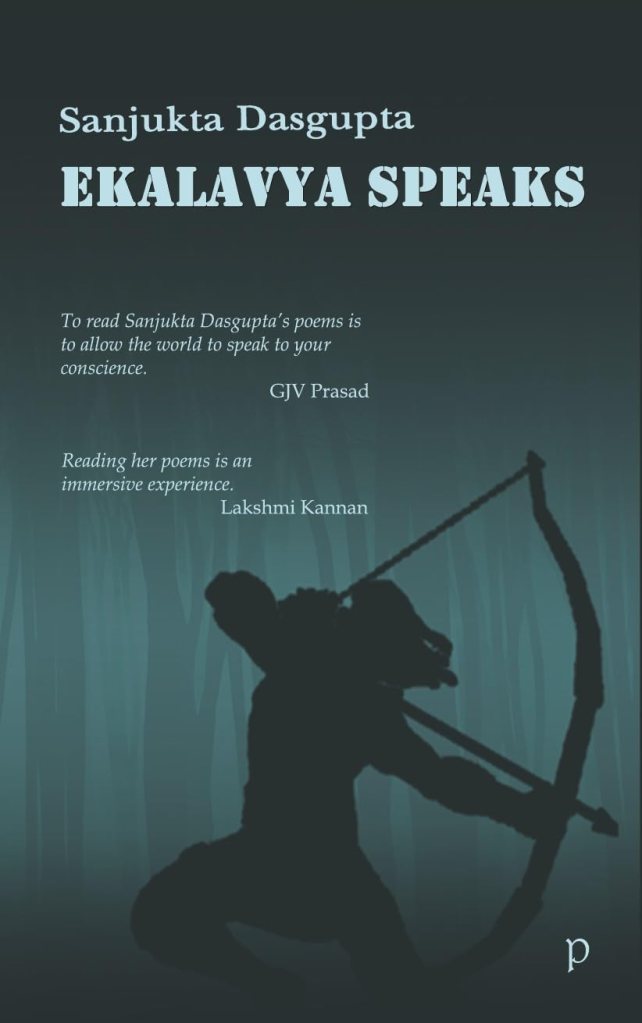
Poetry which goes beyond the boundaries of words and speaks for a greater cause calls for a captivating read. The lines become more significant when the verses address multiple socio-politico-cultural issues, aesthetically and without didacticism. Poet and academician Sanjukta Dasgupta’s latest book of poems Ekalavya Speaks is not merely a gathering of words, they rather, “[…] spread out their wings untiring/ And never rest in their flight” (Yeats) and attempt to hark at deaf ears and represent unheard voices. She is a strong voice for the otherized, marginalised sections raising issues from multiple spheres of life. Caste, gender, myth, history, pre-history, and technology all find space in her chosen selection of poems. The very last lines of the first poem, ‘Accident of Birth’ says,
“No accident could be
More catastrophic than
The accident of birth, alas.”
This sets the tone of the whole collection, bringing out the angst of not one voice or one poet but an entire nation. The poet is a strong voice, at times ironic as she says in her titular poem ‘Ekalavya Speaks’-
“The Sun also Rises for us
 I may claim your thumb some day.”
These lines are from Dronacharya, the tutor of the royal princes who asks his disciple to gift him his thumb after lopping it off as a fee to maintain his allegiance to the throne. Ekalavya, the tribal prince could not question the ‘guru’ in the Mahabharata, whereas the poet in the surreal space gives him the voice to speak for the treachery of the great guru. The guru reappears in the poem ‘Dronacharya: The Teacher of Princes’ where questions are thrown at the intentions of a biased guru who was “The glamourised bonded labour/ Leashed to the regal court.”
Her poem, ‘Kurukshetra-The Killing Field’, goes beyond the boundaries of territories and is akin to any war where lives are lost. At once Kurukshetra becomes the battleground of Ukraine or Gaza where humanity is killed every day. The crying mothers and wailing children are the same everywhere and they are representatives of the universal sorrow of pain and loss and how peace is a mere myth as “Peace was restored at the price/ of rivers of blood […]”. In fact, ‘In the Holy Land’, she talks of dying children and the toxic air of war-trodden Gaza; of the grief-ridden Bethlehem and Jerusalem.
In her greater narrative, Ekalavya and Karna unite to quest for justice, for a space in the mainstream, and for a better liberated world. In Dasgupta’s poetry, Ekalavya, Shambuka or Shikhandi are not figures from the great epics, they represent the backwards sections of society who perhaps after eons of silence they have now found the time to come out of death, saying– “ I rise from my ashes/ Resurrected!”
With Shikhandi, Draupadi’s brother in the Mahabharata, who was born a female and exchanged gender with a yaksha (nature spirit) for that of a male, Dasgupta brings in the suffering caused by gender identity. She sensitively writes about Oscar Wilde’s homosexuality in her poem ‘The Poet In Reading Gaol’. One’s sexual orientation can ironically be treated as a heinous crime. Heterogeny is also a kind of capitalism as the poet strongly urges and questions progressiveness and maligning of human rights.
In her earlier books Lakshmi Unbound, Sita’s Sisters, and Indomitable Draupadi. Dasgupta has primarily addressed the feminist question. Her latest includes poems like ‘Bapu’ and ’Manipur’. In ‘Bapu’, she talks about the rape of a 12-year-old child in the name of religion in India with sensitivity.
‘The Coffee Shop’ is an interesting and ironic poem. Dead leaders meet in a surreal space where neither murderer nor violence can touch them. They are ‘immortals’ and ‘martyrs’ and, now, are even invincible. It is utopian when Gandhi, Jesus, Martin Luther, and Julius Caesar meet each other. Religion and politics, peacemakers and warriors, all blend in a higher realm of understanding. The flavour of this poem is unique and different from the rest of the poems in the collection and yet thematically it stands out as a statement against violence and death. Death cannot bring an end to the ones whose deeds and ideals are immortal. The same can be said about another visionary poem, ‘Shakespeare and Kalidasa’.
In all the poems, the poet comes across as a strong, sensitive voice whose pen cuts across dogmas, blind faiths, violence and otherization. At the same time, she speaks for the cause of humanity. There are personal poems, like ‘I can’t breathe’; a brilliant poem describing psychological claustrophobia in a world where no peace or no prayers can end the suffering of souls. ‘The Exit’ or ‘Loss’ add richer gravity .
As a poet Dasgupta’s language is lucid and she draws her allusions and examples from the myths, from the past and the projected the future. She strongly voices her opinion. As an educator and as a responsible human being she becomes the voice of the many. Each poem unfolds a story to guides our way through obstructions, which are not physical but mental barriers from which one must liberate oneself. As I read her, I am reminded of a few lines by the great Urdu poet, Faiz Ahmad Faiz, who wrote:
Speak, your lips are free.
Speak, it is your own tongue.
Speak, it is your own body.
Speak, your life is still yours.
Swagata Chatterjee is an Assistant Professor of English at a state-aided college under Vidyasagar University. She is an academician and a keen reader.
.
PLEASE NOTE: ARTICLES CAN ONLY BE REPRODUCED IN OTHER SITES WITH DUE ACKNOWLEDGEMENT TO BORDERLESS JOURNAL
Celebrating poetry around the world, our focus this year is on refugees, immigrants or poetry by migrants… In a way, we are all migrants on this Earth and yet immigration for both climate and war has created dissatisfaction in the hearts of many. Can mankind unify under the single blue dome which covers all our home?
“The Journey” by Alwy Fadhel, an asylum seeker to Australia. The piece is included in the Exile collection of the Refugee Art Project. Art from Public Domain.
We start by welcoming migrants from Jupiter but how do we react to human migrants within Earth… ?
All the Way from Jupiter

By Rhys Hughes

All the way
from Jupiter came the refugees,
their heads
made of hydrogen,
and helium, their knees.
No one cried:
depravity!
for we were pleased
to help them
relocate to Earth: we offered
them homes
inside plastic domes
uncrowded but
full of swirling clouds
blown by the music of
fierce trombones
to mimic the crushing gravity.

All the way
from one of our homegrown
war zones
came refugees on their knees
and we said:
no, no, no, and no again!
Go back home right now,
be killed,
assaulted,
it’s all your own fault
for being born here on Earth.
The newcomers
from Jupiter are tubular
like cucumbers,
but men, women and children
like yourselves
aren’t welcome.
And what do refugees from war-torn zones on Earth have to add?These are poems by those who had to escape to safety or move homes for the sake of conflict.
I am Ukraine brought to us by Lesya Bakun, while she was on the run from her home to a place of refuge outside her homeland. Click here to read.
Immigrant’s dream brought to us by Ahmad Al-Khatat, who migrated from Iraq to the West to find sustenance. Click here to read.
In some cases, the wounds lingered and the progeny of those who escaped earlier conflicts give voice to past injuries as well as some immigrants who wandered to find a better life share their experiences.
In 1947, Masha Hassan writes of her grandmother’s plight during the Partition of the Indian Subcontinent. Click here to read.
Birth of an Ally reflects Tamoha Siddiqui’s wonder with new flavours she experiences away from her original homeland. Click here to read.
Two Languages by Luis Cuauhtémoc Berriozabal explores linguistic diversity in immigrants. Click here to read.
These could be listed as turns of history that made people relocate.
Red Shirt Hung from a Pine Treeby Ryan Quinn Flanagan takes two issues into account — violence against humanity and colonial displacement of indigenous people — is that migration? Click here to read.
Products of War by Mini Babu talks of the displacement of humanity for war. Click here to read.
Some empathise with those who had to move and write of the trauma faced by refugees.
Migrant Poems by Malachi Edwin Vethamani reflect on migrants and how accepted they feel. Click here to read.
Birds in Flight by A Jessie Michael empathises with the plight of refugees. Click here to read.
The Ceramicist by Jee Leong Koh records the story of a migrant. Click here to read.
And some wonder about the spiritual quest for a homeland… Is it a universal need to be associated with a homeland or can we find a home anywhere on Earth? If we stretch the definition of homeland to all the planet, do we remain refugees or migrants?
Anywhere Particular by Wendy Jean MacLean reflects on the universality of homes — perhaps to an extent on nomadism. Click here to read.
Where is Home? by Shivani Shrivastav meditates on the concept of home. Click here to read.
Sparrows, a poem translated from Korean by the poet — Ihlwha Choi — questions the borders drawn by human laws. Click here to read.
Journey of Hope by Tagore has been translated from Bengali by Mitali Chakravarty. It explores the spiritual quest for a home. Click here to read the poem in English and listen to Tagore’s voice recite his poem in Bengali.
Some look forward to a future — perhaps in another galaxy — post apocalypse.
In Another Galaxy by Masud Khan translated from Bengali by Fakrul Alam wonders at the future of mankind. Click here to read.
And yet others believe in the future of humankind.
We are all Human by Akabar Barakzai, translated from Balochi by Fazal Baloch, is a paean to humanity. Click here to read.
We are all Human
By Akbar Barakzai...
Russia, China and India, Arabs and the New World*, Africa and Europe, The land of the Baloch and Kurds -- Indeed, the whole world is ours. We are all human. We are all human...
Our population crossed the 8 billion mark in November, 2022. As we move towards trying to hunt for alternative domiciles for our ever-expanding population, even in outer space, we still have to take into account the increased movement of people across the Earth in search of alternative homes driven by external circumstances or by personal needs.
Some have lost their homes and lands to war, some to climate emergencies and some moved out out of choice. Here we have collected narratives of past and present migrations, emphasising the fluidity of borders, despite the lines drawn artificially by manmade constructs. In an earlier interview, Anthony Sattin talks of nomadic migrations and the concept of asabiyya, or brotherhood, which tied humans to ideas and ideals instead of a piece of land mooted in Arabia by Ibn Khaldun in the fourteenth century. Has the time come to revive this concept with conflicts and the climate crises becoming real? As weapons, fire and water affect our habitats, one wonders if reverting to the concept of nomadic existence is not becoming a necessity… This small collection of writings will hopefully highlight the concerns.
In Belacan, Farouk Gulsara shares a narrative based on the life of a migrant in 1950s Malaysia. Clickhereto read.
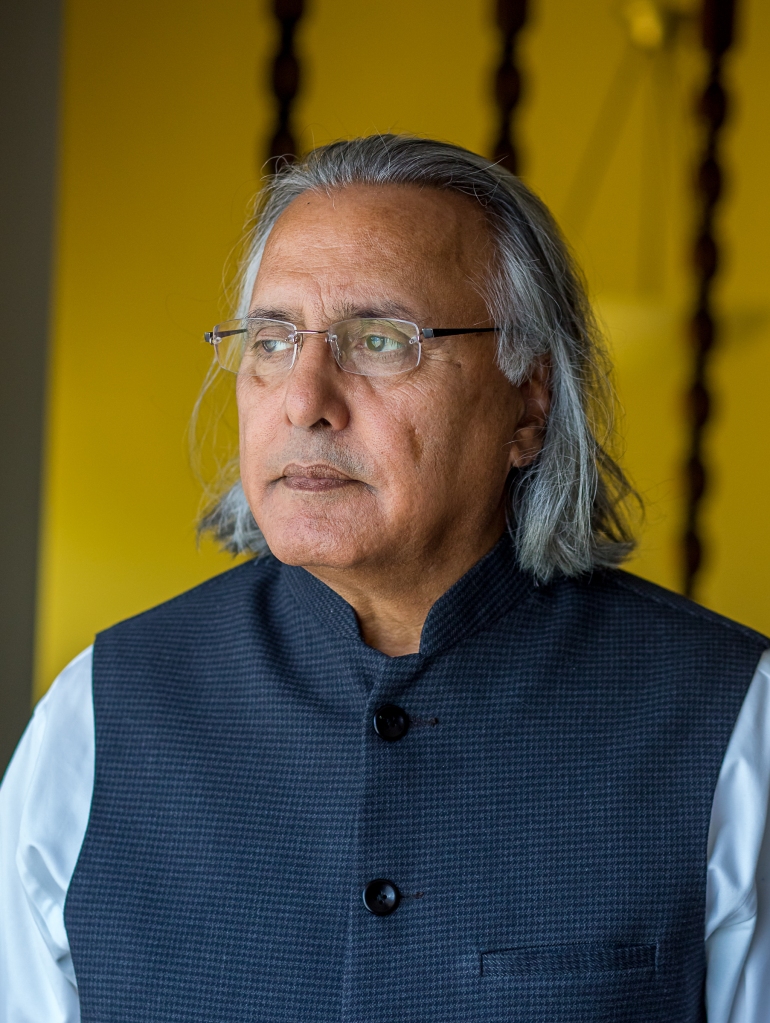
Ujjal Dosanjh, former Minister from Canada and former Premier of British Columbia, talks of his own journey and learning as he migrated out of India to Canada. Click hereto read.
In Mister, They’re Coming Anyway, Timothy Jay Smith writes on the refugee crisis in Lesbos Island, Greece, in 2016 with photographs by Michael Honegger. Click here to read.
An excerpt from Ramy Al-Asheq’sEver Since I Did Not Die, translated from Arabic by Isis Nusair, edited by Levi Thompson. The author was born in a refugee camp. Click hereto read.
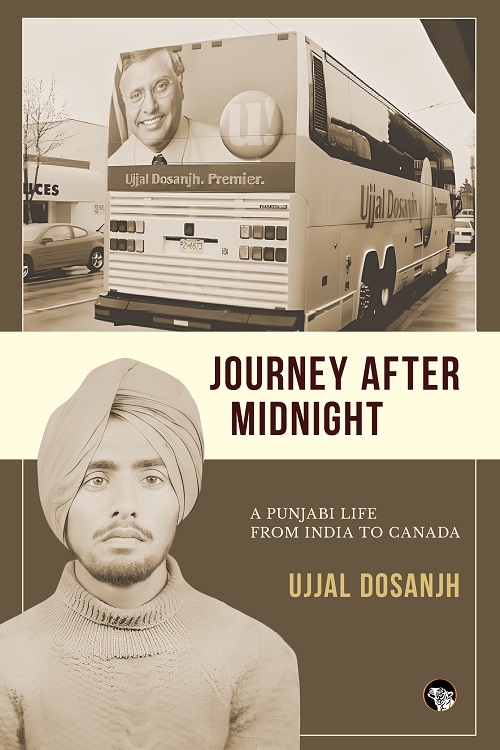
Ujjal Dosanjh left his village in Punjab in quest of a better life. He had a bare smattering of English, very less money and some family overseas when he left his home at Dosanjh Kalan at the age of seventeen. That was in 1964. He spent the first three years in Britain and then, moved to Canada to become a prominent lawyer, activist and political figure.
When he started in the 1960s, to earn a livelihood in England, he shunted trains in the British Railways. He left for Canada in hope of a better future. He had to work initially in sawmills and factories to support himself. Eventually, he could get an education and satisfy his ambitions in British Columbia, which became his home. Coming from a family which contributed to the freedom struggle of India, it was but natural that he would turn towards a public life. His uprightness, courage, tolerance, openness and commitment had roots in his background, where his parents despite different political ideologies, lived together in harmony. His family, despite their diverse beliefs, stood by him as he tried to live by his values.
Dosanjh voiced out against separatist forces that continue to demand an autonomous country for Sikhs to this day. In 1985, he was beaten almost to death by such Khalistani separatists as he boldly opposed the movement that had earlier led to the assassination of the Indian Prime Minister, Indira Gandhi (1917-1984) and to the bombing of an aircraft where all 329 people aboard died. However, undaunted by such attacks, he continues to talk unity, welfare for the underprivileged and upholds Mahatma Gandhi as his ideal. He went into Canadian politics with unfractured belief in the Mahatma. Dosanjh was the Health Minister of Canada and earlier the Premier of British Columbia. He has been honoured by both the Indian and Canadian governments. In 2003, he received the highest award for diaspora living outside India, Pravasi Bharatiya Samman, and, in 2009, he was a recipient of the Top 25 Canadian Immigrant Award.
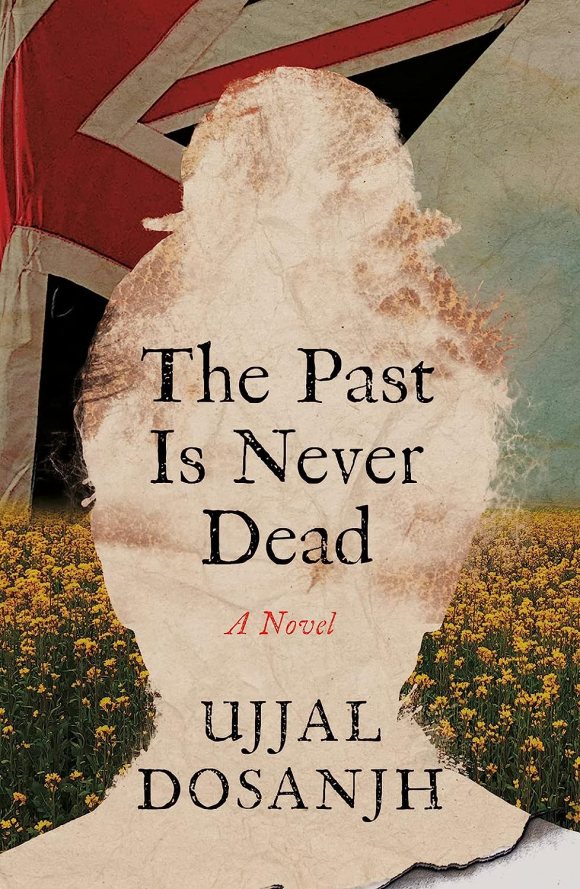
Now, sixty years from the time he left his country of birth, he shares his narratives with the world with his updated autobiography — the first edition had been published in 2016 — and also with fiction. As an immigrant with his life spread over different geographies, he tells us in his non-fiction, Journey After Midnight – A Punjabi Life: From India to Canada:“Canada has been my abode, providing me with physical comforts and the arena for being an active citizen. India has been my spiritual refuge and my sanctuary.”He writes of what he had hoped could be a better future for humankind based on the gleanings from his own experiences and contributions to the world: “If humanity isn’t going to drown in the chaos of its own creation, the leading nations of the world will have to create a new world order, which may involve fewer international boundaries.”
In this interview, he shares his journey and expands further his vision of a world with diminishing borders.
You travelled from a village in Punjab, through UK and ended up in the Canadian cabinet to make changes that impacted humanity in your various public roles as a politician. Would you have been able to make an impact in a similar public role if you had never left India? Was the journey you went through necessary to help you become who you are?
It’s almost next to impossible to imagine what actually would have happened to my life in India had I stayed there. The most complicating element would be the standards that I would apply in such reimagining, the standards I most certainly wouldn’t have known or applied to my Indian life’s journey. I do think though and I have said it often in conversations with friends that had I stayed in India I would have either turned into a saint or devil; nothing in between for one who in 1964, the year I left, already hated the beginnings of the corruption that has now almost completely enslaved the country’s polity and ensnared the society.
Even though what has guided me throughout my life were the lessons I learnt from my freedom fighter maternal grandfather, my activist father and Mahatma Gandhi’s life, I believe the ethics and mores of public life, first in Britain and then in Canada helped shape and sculpt who I became and how I conducted myself. Had I not been to Britain and not lived most of my life in Canada, it’s impossible even to imagine the ‘me’ that would now be walking upon our planet earth.
While within five years of landing in Canada, you were studying in University of British Columbia and driving an Austin, some other immigrants fifteen years down the line continued in abject poverty. What does it take to rise out of endemic poverty? Do you see that happening in the world around us today?
The way you phrased the question conceals the fact that before I resumed full time college in January 1970s and went on to complete my BA and then LL.B. in 1976, I had spent full six years of my life in UK and Canada working jobs including shunting trains with British Rail, making crayons in a factory, being a lab assistant in a secondary school and pulling lumber on the green chain in a saw mill in Canada while often attending night school.
And I must add that my extended family and my spouse were largely responsible for paying my way through my B.A. and LL.B.
While even then it wasn’t easy, I do recognise the union wage then available to students in summer employment enabled them to save enough for the school year; with most summer jobs that’s not the case now. The students now more often than not have to depend on loans or help from the parents.
A significant section of the immigrant diaspora has done reasonably well while for many it’s becoming harder and harder to just make ends meet.
And by the way the Austin, you refer to, was the used Austin 1100, Austin Mini’s sister, I had bought for the then princely sum of six hundred dollars; it took mere six dollars to fill its tank.
That’s truly interesting. At the beginning of your biography, you stated ‘politics is a noble calling’. Later you have written, “I had realized I needed to make a clean break from thepettiness of politics.” Which of these is true? And why the dichotomy — pettiness as opposed to nobleness? And what made you change your perspective?
No, I have not changed my view of politics. It is a noble calling but only if you do it for the right reasons. More and more I found that a significant number of people seeking public office did so for glory that they perceived the elected public office bestowed upon them. Shorn of any lofty ideals and the pursuit of public good politics often degenerates into petty squabbles rather than the giant battles of great and contrasting ideas.
The pettiness is the result of small minds pursuing the mirage of glory in phony battles that barely move the needle on the bar of public good. I often refer to the absence of great leaders in the political landscape of India and the world; Canada has not escaped the current curse of the dearth of great minds in the political arena. Hence my exasperation at the situation I found myself in.
The world over, politics seems to have become the refuge of intellectual dwarfs—no offence intended to our shorter brothers and sisters. The small minds tend not to see too far into the future; they are oblivious to the need to constantly challenge the world to be what it could be.
After a lifetime of activism and close to eighteen years of elected office it was only natural for me to tire of the myopia and pettiness in what otherwise remains a noble endeavour.
You met Indira Gandhi — the second woman to lead a country in a prime ministerial role — and had this to say of her “Indira Gandhi loved India immensely. One can be an imperfect leader and yet a patriot”. Do you think she was an effective leader for India?
My wife and I spent an hour speaking with Indira Gandhi on the afternoon of January 13, 1984. We spent the first few minutes comparing notes about our grandparents and parents as freedom fighters and activists before discussing the issues related to the agitation in Punjab, its growing militancy and increasing violence in and outside the Golden Temple. From what she said it was clear she was extremely troubled about the dangerous situation of the militants holed up in the Temple and the toll it was taking on the peace, politics and the economy of the state. I sensed a certain helplessness in this otherwise quite brave woman when describing the unsuccessful efforts she and her office had made to reach a peaceful settlement of the issues raised by the Sikh agitation. Because I had met both the militant Bhindranwale and the peace loving leader of the agitation, Longowal, and understood the tension between the two men and their followers, I knew she was grappling with a political minefield. All of this and much more that we discussed left me in no doubt about her love for the country and all its people.
But I do believe she allowed the situation at the Golden Temple to linger too long and deteriorate before trying to bring it under control; thus, it and the Operation Bluestar, her ultimate response to the armed militants holed up in the Temple, remains one of her great misjudgements—perhaps as grave as the declaration of the National Emergency in 1975.
Imperfection being part of the human condition, one isn’t surprised that Indira Gandhi who saw all Indians as equally Indian, too, was imperfect; a strong but imperfect leader.
“Sikri was the capital for the new world of unity that Akbar had wanted to create. Ashoka took a similarly bold leap toward peace after a bloody war. Two millennia after Ashoka and four centuries after Akbar, Mahatma Gandhi shared with India a similar vision and a path out of colonialism. India killed him.” Please explain why you feel India killed Gandhi.
One can’t and mustn’t blame an entire country for the actions of one or two persons and yet what I said of Gandhi’s assassination, at least figuratively if not literally, can be said with ample justification; not one but several attempts were made to end Gandhi the mortal. If many Indian hearts and minds—and there were many in his lifetime, perhaps not as many as there are in Modi’s India—wanted Gandhi and his philosophy of nonviolence and love for all dead, then I must say, even without resorting to the writers’ licence, India stands accused and guilty of his January 30th, 1948 assassination; India killed Gandhi.
Even before the advent of Modi on the national scene India’s politicians had substantially diminished and damaged Gandhi’s legacy of Truth, Love and Non-violence. Considering the so few prominent voices in the public domain criticising the Modi regime’s single-minded undermining of Gandhi’s legacy, almost to the point of extinction, it can be said that if it already hasn’t done so, India is close to annihilating Gandhi’s Truth, Love and Non-violence.
“To India’s shame, the rich and ruling classes of today mimic the sahibs of yore. Some of them still head to the hills with their servants, the Indian equivalent of the slaves of the United States.” As Gandhi is seen as one of the architects of modern India, what would have Gandhi’s stand been on this?
When Gandhi lived in England and South Africa, he was part of the diaspora of his time and learnt new things as such. Today with social and digital media one hopes even living in India he would have been aware of the yearning of humanity for equality and economic and social justice. The way most rich and powerful treat the poor and the weak in India is absolutely antithetical to what an egalitarian India would demand of them.
I’m aware of how Gandhi didn’t support the abolition of caste and of his position or lack thereof on the question of equality for the blacks of South Africa at the time. But different times throw up leaders with different and perhaps better approaches to the fundamental issues. Were he alive today, he would have argued for the abolition of caste, equality for all and he wouldn’t have accepted or ignored how India treats its workers, poor and the powerless.
You have told us “India leads the world in the curse of child slavery and labour. Millions of India’s children are trapped in bonded labour, sex trafficking and domestic ‘help’ servitude.” Most people plead poverty and survival when they talk of children working. Do you see a way out? Is there a solution?
Yes, like all problems, this, too, has a solution:
Legislate, legislate and legislate.
Enforce, enforce and enforce the legislation.
I know some laws do exist but we need legislation with more teeth. The laws regarding minimum wage, hours of work, overtime and holiday pay and health regulations must be strengthened and more vigorously enforced, in particular, in the so-called domestic help sector. Better wages and working conditions rigorously enforced would attract adult workers who would be able to send their children to proper schools rather than thrust them in to slavery in exploitative homes, factories and workplaces.
Not much will improve on this front though unless Indians end the endemic corruption in law enforcement. You see corruption confronts and stares us in almost all, if not all, issues Indian; it is the elephant almost in each and every room.
“Violence can never be a tool for change in a modern, democratic nation.” You tried to use Gandhian principles through your life — even in Canada. Do you think non-violence can be a way of life given the current world scenario with wars and dissensions? How do you view Gandhi sanctioning the participation of soldiers in the first and second world wars? Can wars ever be erased or made non-violent?
First let’s deal with Gandhi’s sanction of the soldiers in the two world wars. Whether or not he had sanctioned their participation, the soldiers would have gone to war; most of them fought for wages, not for the love of war or the country except those for whom the Second World War was a war against fascism and hence justified.
I don’t believe Gandhi ever stated that in fighting a violent enemy or a perceived enemy one was not allowed to use violence. All I ever remember him saying was that you throw your unarmed body wrapped in soul force in front of the enemy but if you are too chicken to do so or can’t do so for some other reason but fight an aggressor you must, violence is better than doing nothing.
As for countries fighting each other I don’t believe he ever said that, in an uncertain world where the military of another country could invade at any moment, a country must forego a military of its own.
As for nonviolence being a way of life, it can and must be for a country in its internal life. On the borders however one always has to deal with what one is presented with; you can’t ask Ukraine to not fight; in the face of a suddenly expansionist China or a belligerent Pakistan, Gandhi wouldn’t have urged the Buddha’s meditational pose for India; he didn’t do so in late 1947 when Pakistani fighters invaded Kashmir.
As for wars being non-violent, they can never be if the likes of Russia continue to invade others.
You opposed the Khalistani separatists and stood for a united India. What is your stand on Khalistan, given the recent flare up? Did you do anything this time to allay the situation in Canada?
I have always been opposed to countries being carved out on ethnic, linguistic or religious basis; I am a firm believer in multilingual, multi-ethnic, multi-religious and multi-racial populations living together in peace within the boundaries of peaceful countries; for that to happen, secularism remains a sine qua non[1]. That is why I so passionately continue to support a secular and inclusive India.
As for me doing something in the face of what is happening in Canada today vis a vis the Khalistanis, I didn’t say anything because I don’t believe it would have added to the debate; everyone already knows what I think and believe.
What does concern me though is the weak-kneed response and reaction of the public leaders of Canada; they have not unconditionally condemned the glorification of terrorists, known murderers or those who on the streets of Canada glorify and revere the killers of Air India passengers or of Mrs. Indira Gandhi. For me, someone who immigrated to Canada in 1968 when the elder Trudeau became the Prime Minister of the country, the near silence of our politicians on Khalistani violence and its glorification has been a low point; the older Trudeau knew how to deal with the terrorists; he didn’t and wouldn’t have pussy footed around terrorism or its glorification.
When your autobiography was published the first time in 2016, your column in Indian Express was cancelled. As many of us grew up in India of the past, we believed in secularism and democracy with freedom of expression. How has it changed over a period of time?
After I left India and particularly when I was introduced to the Hyde Park, I reflected on India and it seemed to be one of the freest places in the world; any intersection of a city road or a corner of the village served as a mini Hyde Park; from the millions of speeches made in such Hyde Parks all over India, millions of ideas tumbled forth from the lips of ordinary but engaged Indians.
Of course, I do realise that in the lives of the poor and the powerless, the freedom hadn’t shone as bright. The imprisoning of the Naxalites without charges and Indira Gandhi’s Emergency were the first real jolts of un-democracy and unfreedom I felt India as a whole had suffered. From there it went downhill; that sporadic communal riots continued; that Godhra was done to the Muslims as was done the post Indira assassination violence to the Sikhs; lynchings of Muslims and Dalits continue today.
India’s response to the first major unfreedom, Indira’s Emergency censorship, was encapsulated in the blank front pages of the censored Indian Express, that symbol of the Journalism of Courage. That symbol may still burn today but it is smouldering and clearly less bright enveloped as it and others are in the atmosphere of fear of the likes of ED[2] and CBI[3]; almost none amongst the traditional media homes shines much or at all; the digital media has thrown up some brave examples like The Wire. But the overall scene is dismal. India needs many revolutions; one of them is the reawakening of some semblance of fortitude in India’s Godi[4] media outlets.
Over repeated trips to India, you observed that people did not want to talk of major issues like availability of potable water but wanted to discuss issues like the eroding culture among the diaspora. Why do you think this has happened? Is there a way to change this mindset?
Human mind is an amazing thing; it seeks engagement but when the immediate is painful to observe and feel, it finds solace in contemplating the scenes afar; for sheer survival in its troubled and troubling milieu it develops numbness; such numbness shields it from the immediate while thinking about the distant problems, imagined or real, offer it a sense of engagement. Such is what I thought happened to many in Punjab.
Another troubling thing was that much beyond the essential human pride a sense of chauvinism and superiority, at least among its rich and powerful, has plagued Punjab for a long time which has blinded it to the need for change and progress—one didn’t need to improve what one believed to be perfect and hence superior.
Punjab has significantly slipped in the Human Development Index. That this humbling fact is now quite widely acknowledged in intellectual and political circles gives me some hope that things may improve.
“There are massive water shortages across the country. There’s a crisis in health care…Under the weight of crippling debts and droughts, small and marginal farmers are killing themselves. There aren’t enough jobs being created for the millions of youth joining the job market every year. The human-rights record of the Indian State inKashmir, the Northeast and other parts in the grip of insurgency is horrific and shameful. Dalits and Muslims are lynched with impunity by Hindutva-inspired mobs for skinning dead cows, or being in the vicinity of meat that may or may not be beef.” Do you see a way out? What can India do to step out of the condition you have described so accurately?
I have argued for some time that what India needs is a new freedom struggle, a Values’ Revolution, to rid itself of corruption—rishwat[5], unethicality, religious and cultural fanaticism that impinges on many Indians’ right to life, dignity and liberty. In arguing this I am aided by Gandhi’s dictum—that I have always alluded to in my own writings—that he was engaged in not creating a new India but a new Indian; my reading of what he said has led me to conclude he meant a caring, humane, compassionate, egalitarian and an ethical Indian. To create an India with 1.4 billion ethical and progressive Indians requires a mammoth revolutionary change in our values; hence a Values’ Revolution.
At the moment I see the country’s civil society under constant attack by the forces of social division whereas in fact social solidarity and cohesion are sorely needed. A Values’ Revolution will require giant leaders; I see none on the scene today but I’m not disheartened because once begun the Revolution itself may, as do all revolutions, throw up the necessary giants.
You are an immigrant who has lived out of India for almost half a century. Do you think as part of the diaspora living outside India, we could all act together to heal a region broken by its own inability to live up to the vision created by those who wrote the constitution of the country? What would be your vision of India?
The diaspora coming together to even slightly nudge India forward is an emotionally compelling and noble thought; many of us constantly dream of doing something for the country we have left behind. Some of us do so while others revel in its imaginings only.
A major stumbling block to the diasporic unity on this question has been the ideological divisions amongst the Indians abroad which usually mirror India’s domestic political fault lines and unfortunately those difference have been only rendered sharper by the way elements of the diaspora have recently been employed in aid of India’s domestic political machinations. The old diasporic divisions now seem and feel more rabid; it is as if the political battles of India now rage equally actively in the diaspora itself.
I always dream of India as a caring, compassionate, egalitarian and ethical India. One that values all its citizens equally and brims with social and economic justice.
That is such a wonderful thought with which many of us agree wholeheartedly. You have written: “If humanity isn’t going to drown in the chaos of its own creation, the leading nations of the world will have to create a new world order, which may involve fewer international boundaries.” What is the world order you suggest?
For starter no order can be imposed by the so-called leading nations, no matter how powerful. It may take a significant amount of nudging and cajoling by them to change anything.
When I wrote my autobiography, I was imagining the world moving, at least to begin with, in the direction of regional groupings like the European Union. We saw that as the number of member states of the United Nations trended upwards, Europe witnessed the opposite where many countries dared to create the EU practically erasing borders; granted Britain rebelled – but even within its borders a referendum held today would most likely approve it re-joining the EU.
As a possible beginning for the rest of the world, our best hope lies in grand imaginings such as a South Asian Common Market at once reducing the expense of standing militaries staring angrily at each other across the borders; Southeast Asia, Africa, South America could follow; North American Free Trade Agreement already exists creating at least an economic union.
If to begin with the countries regionally moved toward the free flow of human beings along with the necessary and more convenient local trading, one could foresee the international will and desire developing toward a world populated by fewer borders and more freedom. Hopefully that would move humanity toward more international egalitarianism, prosperity and fewer wars.
Hopefully, the vision materialises. Thank you very much for giving us your time and wonderful books that make us think and emote.
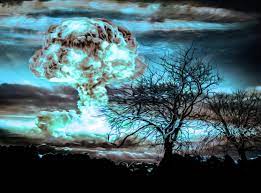
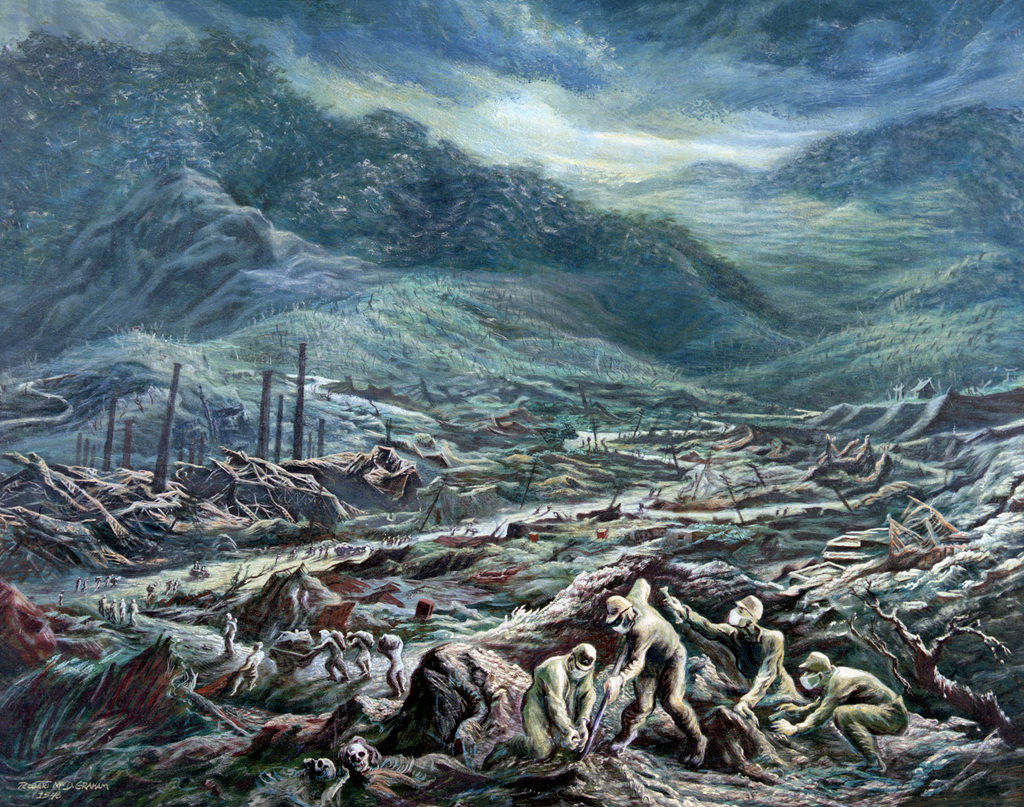
Atom Nuclear Bomb Explosion- Illustration “Atomic Landscape” Nagasaki, Japan 1946 Art by Robert Graham Courtesy: Creative Commons
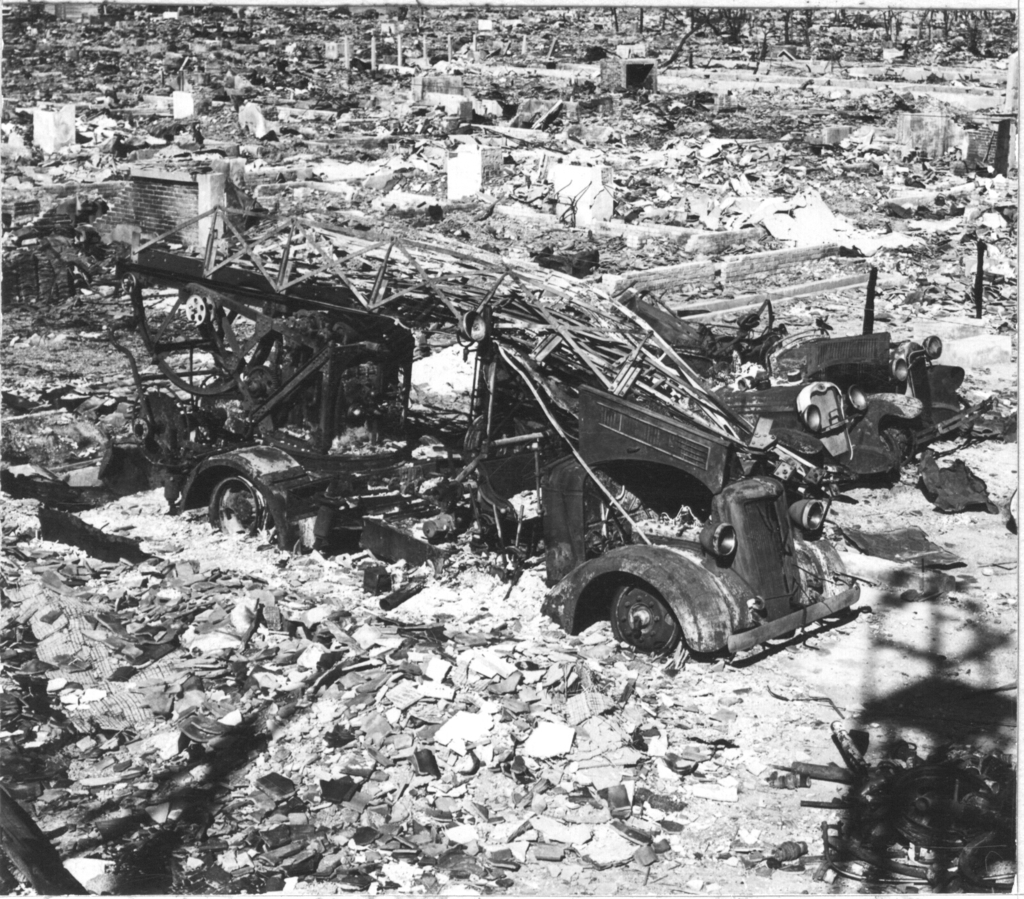
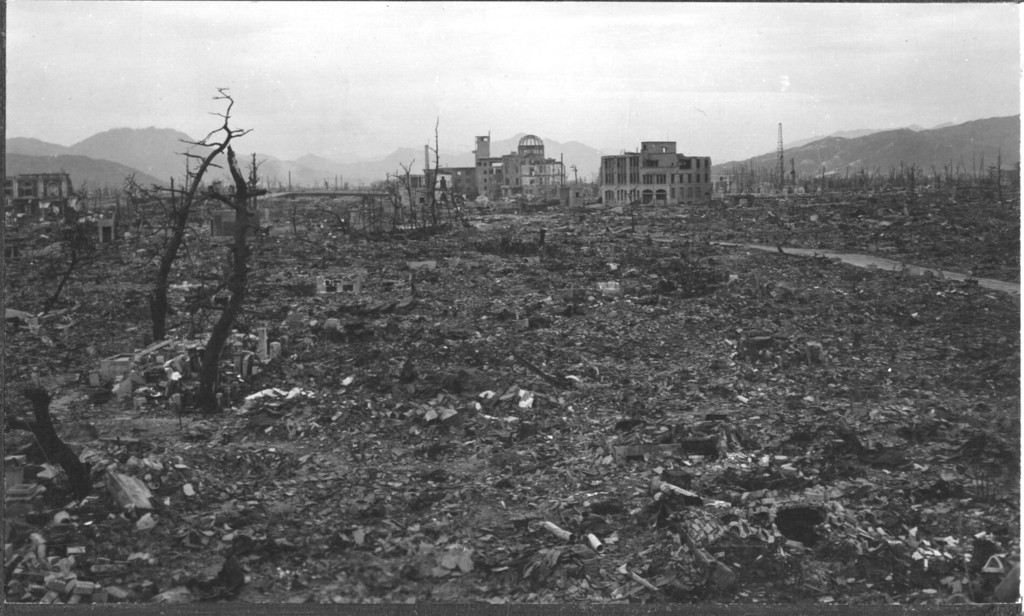
When in 1945, the Allied forces dropped atom bombs on August 6th in Hiroshima and on August 9th in Nagasaki, the Second World War drew Japanese aggression to a halt. But what was the impact on the lives of those innocents whose home, family and future changed forever? Their lives were wrecked — within a few seconds for no fault of their own. The impact clearly continues to ravage the second generation, as can be seen from the narrative of a hibakusha’s daughter who shares her travails while expressing her candid views on the recent movie, Oppenheimer, and the sale of ‘Boppenheimer’ products. She writes: “I live with it1 now having a chronic progressive nerve pain disease. My damaged immune system is attributed to my mother’s exposure to radiation from the atomic bombing.”
Are we forgetting that past, where two whole towns were decimated by atomic bombings with uncountable numbers of deaths and suffering handed down generations? Will we repeat the horrific story again to resolve issues as conflicts continue to ravage the planet with weapons, without considering their impact on the already felt climate crises? Will there be a replay of the bombing of 1945 to annihilate a people, their way of life and create suffering among all humanity? We may not be around to comment on the outcome!
Way back in 2017, climate experts contended that in case of another such bomb blast, “The effect would be similar to that of the giant meteor believed to be responsible for the extinction of the dinosaurs. This time, we would be the dinosaurs.”
With that in mind, we hope for a world without wars. In this special edition, writings look for peace by creating awareness and suggesting alternatives. Kathleen Burkinshaw writes about the 1945 bombings and her perspectives on media packaging of mushroom clouds. We have a story from a soldier’s perspective during the First World War by the eminent Bengali poet, Nazrul, who fought in it as a soldier for the British army. Current conflicts show up in the writing of Ramy-Al-Asheq, who was born in a refugee camp in the Middle East. They move to Ukraine with voices of Lesya Bakun, a refugee on the run, and Ron Pickett, a US army veteran. Poetry on Myanmar in the past by Sister Lou Ella Hickman and a story of the Rohingya’s plight by Shaheen Akhtar brings the focus into civil wars within Asia. More poems by Don Webb and Michael Burch urge for peace through poetry. Awareness about conflicts that nonetheless impact an interconnected world are brought in with interviews with journalists who were in Afghanistan (Andrew Quilty) and Myanmar (Jessica Muddit) when the takeovers by the current regimes started. We conclude with a discussion for alternatives towards a better future with Anthony Sattin.
Non-Fiction
Mushroom Clouds and Movies: Response from a Hibakusha’s Daughter:Kathleen Burkinshaw, a second generation victim who suffers nerve disorders from the atom bomb dropped on Hiroshima, where her mother watched her own father perish, responds to the recent media packaging of the event. Click here to read.
The Refugee and the Other, an excerpt from Ever Since I Did Not Die by Ramy Al-Asheq, translated by Isis Nusair. Click here to read.
Poetry
I am Ukraine by Lesya Bakun, a refugee from Ukraine. Click here to read.
Wars and Rumours of War, a response on the war in Ukraine by Ron Picket, a a retired naval aviator with over 250 combat missions and 500 carrier landings. Click here to read.
My Visit to Myanmar in 1997, a poem about peace in the land where Buddha flourished by Sister Lou Ella Hickman. Click here to read.
Henais a short story by Nazrul from the perspective of a soldier during the first world war, translated from Bengali by Sohana Manzoor. Click here to read.
The Magic Staff is a poignant short story about a Rohingya child seeking refuge by Shaheen Akhtar, translated from Bengali by Arifa Ghani Rahman. Click here to read.
Interviews
A discussion about Afghanistan, with journalist Quilty who went back to Kabul as Taliban entered the city. Click here to read.
Keith Lyons talks to Jessica Mudditt, who watched from within the country as the Myanmar Junta took over. Click here to read.
Could there be a way out of this world wide unrest? A discussion with Anthony Sattinas he explores concept of brotherhood unique to earlier times, when borders were not this well defined. Click here to read.
*
Hiroshima after August 6th, 1945Hiroshima after bombingCourtesy: Creative Commons
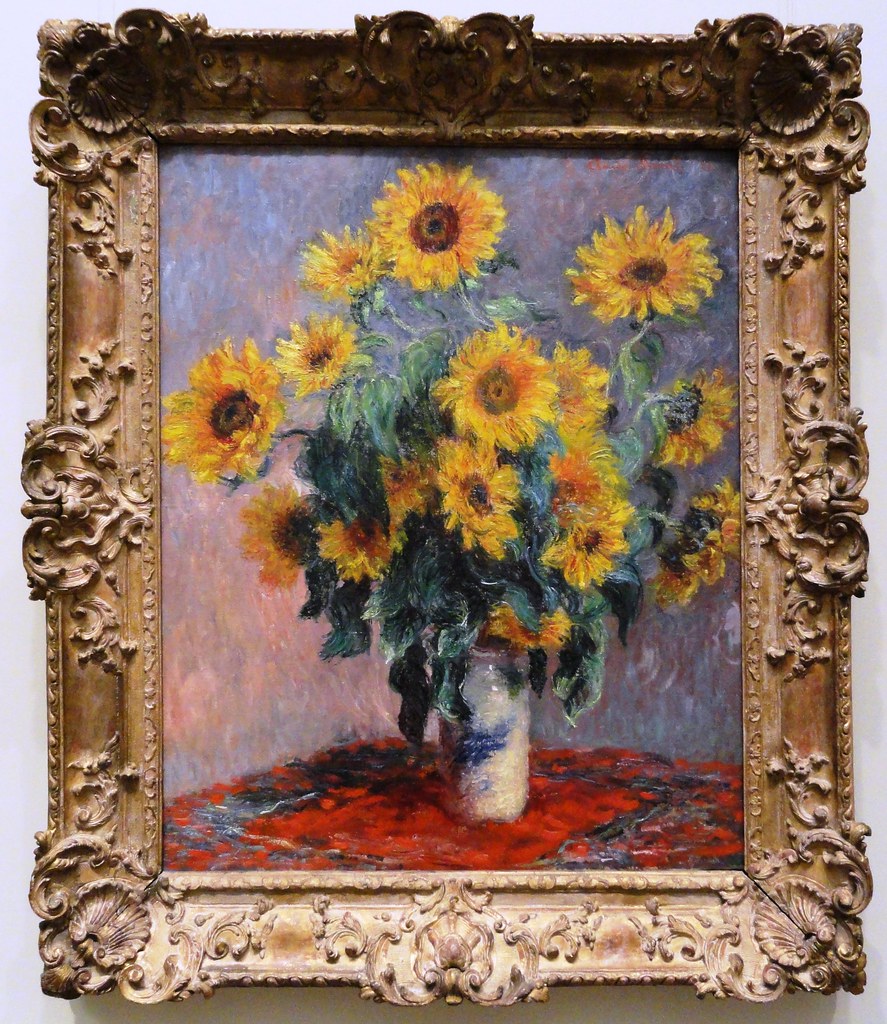
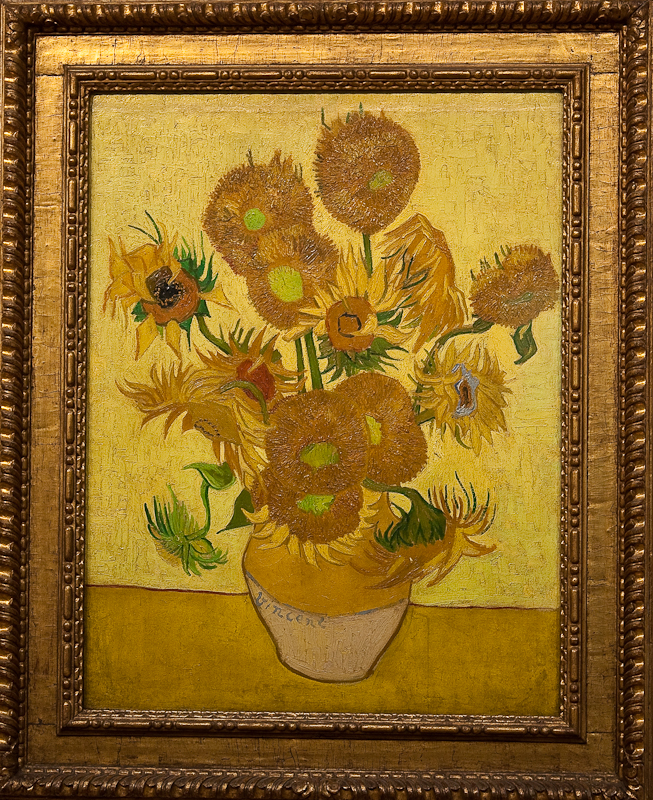
Sunflowers by Calude MonetSunflowers by Vincent VangoghCourtesy: Creative Commons
With resilience, they have withstood what could have become an international disaster for all humankind — an outbreak of a Third World War. The spirit that has resisted the ongoing invasion of Ukraine is admirable. They have stayed strong without bowing, crumbling or annihilating themselves in the wake of an onslaught that hurts humanity across all borders in different degrees and creates a huge population of refugees. We gave voice to one such refugee, Lesya Bakun — not just in our site but also in our first anthology — Monalisa No Longer Smiles: An Anthology of Writings from across the World.
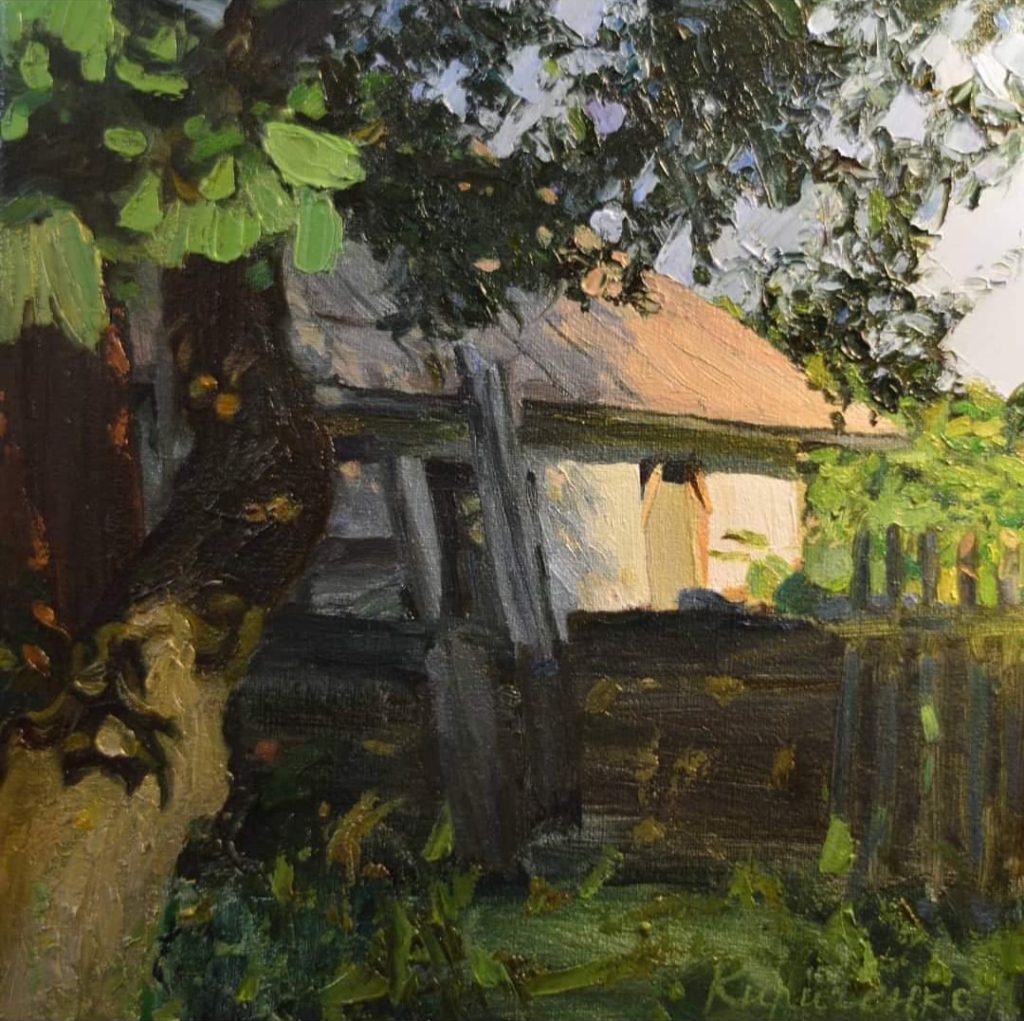
This year, we quest for hope towards peace, a better, more accepting world with poetry on Ukraine. One of the poems here is accompanied by art from Ukrainian artist, Maria Kirichenko. We feature some of the poems gathered on Ukraine over the year.
“How Many Times Must the Cannonballs Fly…?” Featuring poetry by Lesya Bakun, Rhys Hughes, Ron Pickett, Michael R Burch, Kirpal Singh, Suzanne Kamata, Mini Babu, Malachi Edwin Vethamani, Sybil Pretious and Mitali Chakravarty. Click here to read.
Painting by Ukranian artist, Maria Kirichinko, as mentioned in the poem
My friend, Maria Kirichenko, is an artist
Her paintings are so real
I love the way she captures the light
That falls on the side of a house
In the woods by the fields
There's a brilliance there
There's life in those paintings
She draws people too
Some smiling, some serious
She lives in Ukraine
She shares pictures of the war
Her country under siege
I worry
I worry about her, her art, her life
I worry about the life, lives around her
I message her to stay safe for that's all that I can do
I, like many others, am a silent witness
I do not want to know the nitty-gritty
Of what is politically right
Or left or centre
Politics of war are men's creation
My thoughts are from the human angle
All I care for is that my friend is happy and safe
I want the attacks to stop. Childish me.
Or are these just the normal thoughts of a woman?
Women go to war only if attacked.
Not for material needs. Not out of greed.
Not for power. Never out of ambition.
Maybe countries should be run by women
There would be less aggression
And as my thoughts go round in circles
I think of Maria Kirichenko
I think of her beautiful paintings
I think of the once pristine land of Ukraine
And hope that light dawns with the coming year
In the minds of men
Vineetha Mekkoth is a poet, writer, translator, editor and reviewer. She has translated for the Kerala Sahitya Akademi and has also contributed articles for the Malayalam Literary Survey, a quarterly brought out by the Akademi. Her poems and short stories have been included in various anthologies.
PLEASE NOTE: ARTICLES CAN ONLY BE REPRODUCED IN OTHER SITES WITH DUE ACKNOWLEDGEMENT TO BORDERLESS JOURNAL
The right to exist with freedom to choose is threatened when dictatorial regimes try to erase a culture or linguistic group as we can see in the current conflict that rages between Russia and Ukraine. In 1971, Bangladesh came into existence over a similar issue. The colonials had divided the Indian subcontinent on the basis of religion — not culture. Before this division, Bengal was a whole. In 1905, Tagore had marched against the British directive to divide Bengal and Lord Curzon, the Viceroy of India. In 1911, Bengal was reunited to be slashed again in 1947 and made a part of Pakistan with Urdu as its national language. Bangladesh fought a war to find the right to exist as an entity outside of Pakistan — adopting their favoured language Bangla. Throwing off the yoke of Urdu, Bangladesh came to its own. On 16th December, the battle against cultural hegemony was won with warplanes drawing to a halt.
Celebrating freedom from oppression, we have an article by Fakrul Alam giving the historical background of the struggle. A musing from across the border about the 1971 refugee exodus into India has been written by Ratnottama Sengupta. Asad Latif muses on the need to identify with a culture. We have translations of poetry by Nazrul to add a dash of seasoning.
The Birth of Bangladesh & the University of Dhaka: Professor Fakrul Alam takes us through the Partitions of Bengal which ultimately led to the creation of Bangladesh, with focus on the role of Dhaka University. Click here to read.
Joy Bangla: Memories of 1971: Ratnottama Sengupta recaptures a time when as a teenager she witnessed a war that was fought to retain a culture. Click here to read.
TEDDY BEAR ON THE WAR FRONT
(News Report from Irpin, Ukraine, 2022)

The teddy bear sits benumbed
presiding over the rubble
Of civilisation
Of compassion
Of humanity
A debris of fun and play

Teddy sits smirking over the
Skeleton of the cat, her
Bones, a curled cadaver
Her couch and cushions
in smithereens

The house shredded by the missile
Walls cracking and crumbling with the
Child’s screams as shards
From the tiny throat

Teddy bear, the dumb survivor,
No arms to melt his frozen heart
Watching the carnage with
Big round buttons
gyrated into unseeing eyes

Wrapped in grief
The gentle wool on Teddy spikes
The bristles stand stiff and sharp
Rivers of tears flow
Into the turbulent ocean

And a tsunami of teddy bears
Marches into the war zone
Looking for children to comfort


TELLING VIGNETTES

It’s dementia…

For grandmother
It’s a staccato war

Ends each day and
Starts the next morning again

            it is a re-wind
                     to World War II

        the wake of bombing
        kills people seventy years later

*

Pregnant with deadly nightmares
Moskva the missile cruiser sank

The Black Sea swallowed all her bombs
Stuffed with a thousand deaths


*

Bullet marks on the walls
        remnants of war
people in homes behind
	unhealed

*

Ghosts born of bombs
are stripped of death
        Sans the mortal attire

        They live on to haunt

*


The web of nerves on
      the inert dog’s neck
             pulsates
                     with lifelessness
It’s wartime


*

More live than the forlorn dog
are the shadows of bullets on
the walls of Irpin

Deep craters on the earth
hold silence
born of the boom

*

They are not moon craters

       These on the earth mark
       technology of warfare

       Massive progress
       in hunting and
       getting the big kill
Sukrita Paul Kumar, former Fellow of Indian Institute of Advanced Study, Shimla, held the prestigious Aruna Asaf Ali Chair at Delhi University. An honorary faculty at Corfu, Greece, she was an invited resident poet at the prestigious International Writing Programme at Iowa, USA. Her most recent collections of poems, are Vanishing Words,Country Drive and Dream Catcher. Her critical books include Narrating Partition, The New Story and Conversations on Modernism. She has co-edited many books, including Speaking for Herself: Asian Women’s Writings (Penguin). An Honorary Fellow at HK Baptist University, Hong Kong, she has published many translations and has held exhibitions of her paintings. Currently she is series co-editor of “Writer in Context” volumes being published by Routledge UK and South Asia.
PLEASE NOTE: ARTICLES CAN ONLY BE REPRODUCED IN OTHER SITES WITH DUE ACKNOWLEDGEMENT TO BORDERLESS JOURNAL
TS Eliot (1888-1965)Dust jacket of ‘The Wasteland’Courtesy: Creative Commons
One hundred years ago, T.S Eliot wrote ‘The Waste Land’ to find meaning in troubled times. As we wrestle with trouble in our own times, an examination of Eliot’s paean to chaos can prove instructive. Horrified by the return of war in Europe, disturbed by the looming threat of environmental collapse, and fatigued by over two years of a resilient pandemic, we crave relief and inklings of hope. In Eliot’s poem, relief does not come without tarrying with the darkness. In his 433-line poem, slivers of hope are crowded by the ubiquitous memento mori, the constant reminders of death. With his own hope compromised by a series of personal crises, Eliot’s fractured self mirrored a Europe fractured by the incomprehensibility of the millions sacrificed on European battlefields. To heal the fracturing, the poem represents a therapeutic exercise not only for the poet, but also a generation. After the questionably named Great War, cultural revisions produced modernism, representing a significant departure from traditional poetic sensibilities.
Before World War I, war retained a nobility exemplified in the “six hundred” of Tennyson’s ‘Light Brigade‘ (1854). After World War I, Tennyson’s sentiment of “Theirs not to reason why, / Theirs but to do and die” no longer reflected the misery and absurdity of millions sacrificed for a few acres of mud. As the world changes, so does its art. To restore both a fractured mind and a fractured generation, ‘The Waste Land’ assembles meaning from ruins and conflated mythologies to spring hope. Rife with allusions, sometimes obvious, often obscure, Eliot’s poem aligns with modernist principles as multiple narrative voices range freely across landscapes of time and memory.
In the poem’s opening section, hope does not sing forth as in a Dickinson (1830-1886) poem, but lays disassembled in the ruins of desolate imagery. A spark of hope is initiated by a female narrative voice recalling an idyllic childhood tobogganing episode: “In the mountains, there you feel free.” The pleasant recollection shifts dramatically into the middle of a land of “stony rubbish,” “broken images,” and a “dead tree (that) gives no shelter, the cricket no relief”. In a parenthetical note, a whispering narrator offers a hint to relief: “Only there is shadow under this red rock, (Come in under the shadow of this red rock).” The secret told in that shadow comes in the following four lines:
"And I will show you something different from either
Your shadow at morning striding behind you
Or your shadow at evening rising to meet you:
I will show your fear in a handful of dust."
What you leave behind is the past and what rises to meet you is the future. The “something different” is what lies between: the eternal present. In ‘The Waste Land’, our reckoning with death produces a despair that can only be relieved by moving meditatively out of time.
In 1922, the war has ended, yet trauma echoes within the workers who return to re-ignite the engine of economic growth. In the final stanza of the opening section, the poet gives us London’s financial district (The City) and a crowd flowing over London Bridge. Emotionally wrought automatons, the men carry a despair that manifests their drudgery: “Sighs, short and infrequent, were exhaled, / And each man fixed his eyes before his feet”. Within this crowd, the narrator recognises his comrade and calls to him: “Stetson! / You were with me in the ships at Mylae!” He does not recognise him from Passchendaele or the Somme, but from the first Punic War between Rome and Carthage in 330 B.C. Whether in modern Europe or ancient Rome, war is inevitable, and solace is often elusive. The dead, “planted” and sustained in our collective memory, can serve to assuage our despondency: “That corpse you planted last year in your garden, / Has it begun to sprout? Will it bloom this year?” April is indeed “the cruellest month” as the lilacs bred “out of the dead land” are fertilised by dead soldiers. Such is the dubious shape of hope in the aftermath of industrial scale war.
To conjure further hope, Eliot assembles mythologies and merges fragments with references to the Hindu Upanishads, Shakespeare, and the myth of the Fisher King. In the poem’s final section, reference to the Upanishads serves as an incantation to “controlling hands” of a governing Thunder that gives, sympathizes, and controls. Like a “broken Coriolanus”, we are compelled to surrender on the path of cruel iniquities that lead to our “obituaries”. Without surrender, we may suffer the same fate as Coriolanus, whose excess pride cost him his life. As Thunder exhorts humility, Eliot, as narrator, assumes the place of the Fisher King, the wounded sovereign who governs his barren lands: “I sat upon the shore / Fishing, with the arid plain behind me”. In ‘The Waste Land’, will a hero fulfill the myth of the Fisher King by arriving to restore both the wounded king and the “arid plain”? Eliot’s answer comes with the rhetorical question, “Shall I at least set my lands in order?” A hero will not come, and the fracturing of both Eliot and his generation endures as aridity persists. In the worst times, the only way to elicit hope comes with adjusting our expectations. For Eliot, his “fishing” is the resumption of his creative endeavours despite the prevailing aridity. To carry on, we must make peace with the circumstances of our time. Eliot invokes this in his final line with the chant that ends each Upanishad: “Shantih shantih shantih.”
In his notes on the poem, Eliot equates this final line with Philippians 4:7 and the “peace that passeth all understanding”. Sifting through the ashes of a destroyed Europe or diagnosing the causes of psychological fracture will not yield peace. Peace comes not from understanding why the trauma happened, but from reaching outside the chaos to a higher order. Eliot’s final allusion marks a harbinger to his conversion to Anglicanism in 1927, wherein he found community and peace for the rest of his life.
Westminster AbbeyTS Eliot’s memorialA memorial for TS Eliot in the Poet’s corner of the Westminster Abbey, London
As the war continues in the Ukraine, memories of the dead live on in the trauma of the living. To cope with that trauma, hope sustains those huddled in the Kyiv metro stations. Below the missile bursts above, Ukrainians singing traditional songs and the national anthem will not bring back the dead, but it will limit the fracturing: “The glory and freedom of Ukraine has not yet perished.”
.
Dan Meloche is a full-time professor at Algonquin College in Ottawa. When he isn’t teaching English, social psychology, and economics, he reads widely and writes reviews and personal account essays.




 Borderless