Look around you and expand your heart.
Petty sorrows are insignificant.
Fill your vacant life with love for humanity.
The Universe reverberates with celestial ecstasy.
— Anondodhhara Bohichche Bhubone(The Universe reverberates with celestial ecstasy), Tagore, 1894
Some of the most beautiful colours in this universe are blended shades— colours that are born out of unusual combinations. Perhaps that is why we love auroras, sunrises and sunsets. Yet, we espouse clear cut structures for comprehension. As we define constructs created by our kind, we tend to overlook the myriads of colours that hover in the gloaming, the brilliant play of lights and the vibrancy of tints that could bring joy if acknowledged. That ignoring the new-born shades or half-shades and creating absolute structures or constructs lead to wars, hatred, unhappiness and intolerance has been borne true not only historically but also by the current turn of events around the globe. While battles are never fought by the colours or beliefs themselves, they can harm — sometimes annihilate — rigid believers who are victimised for being led to accept their way as the only one and hate another. Perhaps, this has echoes of the battle between the Big Endians and Little Endians over the right way to break eggs in Jonathan Swift’s Gulliver’s Travels (1726). As the book is mere fiction, we can admire, agree and laugh at the content. However, in real life, watching newsreels has become a torture with destruction and violence being the main highlights. These detract from life as we knew it.
Writing or literary inputs seem to have become a luxury. But is it really hedonistic to play with words? Words used effectively over a period of time can impact readers to think peace, acceptance and love and also help people heal from the ensuing violence. That can be a possibility only if we self-reflect. While we look for peace, love and acceptance in others, we could start by being the change-makers and bridge builders ourselves. That is the kind of writing we have managed to gather for our November issue.
Building such bridges across humanity, we have poems on the latest Middle Eastern conflict by Stuart McFarlane and David Mellor, which explore the pain of the victims and not the politics of constructs that encourage wars, destruction of humanity, the flora, the fauna and our home, the Earth. Michael Burch writes against wars. Prithvijeet Sinha and Ahana Bhattacharjee write about refugees and the underprivileged. Reflecting colours of the world are poems from Ryan Quinn Flanagan, Suzayn AH, Radhika Soni, Ron Pickett, George Freek and many more. Rhys Hughes has brought lighter shades into his poetry by trying a new technique while reflecting on yetis and mermaids. His column tries to make a parody of a non-existing parody, using TS Eliot’s century old poem, ‘Wasteland’, with amazing results!
Our translations are all poetry too this time. Professor Fakrul Alam has translated a poem discussing human aspirations by Quazi Johirul Islam from Bengali. Another Balochi poem of hope by Bashir Baidar has been brought to us in English by Fazal Baloch bringing into play the moonlight.
For the first time, we are privileged to carry poetry from a language that has almost till now has eluded majority of Anglophone readers, Maithili. Vidyanand Jha, a Maithili poet, has translated his poetry for all of us as has Korean poet, Ihlwha Choi. Winding up translations are Tagore’s ultimate words for us to introspect and find the flame within ourselves in the darkest of times – echoing perhaps, in an uncanny way, the needs of our times.
Our conversation this month brings to us a poet who comes from a minority group in India, Banjara or gypsies, Ramesh Karthik Nayak. In his attempt to reach out to the larger world, he worries that he will lose his past. But does the past not flow into the future and is it not better for traditions to evolve? Otherwise, we could all well be living in caves… But what Nayak has done — and in a major way — is that he has brought his culture closer to our hearts. His debut poetry book in English, Chakmak (flintstones), brings to us Banjara traditions, lives and culture, which are fast getting eroded and he also visits the judgemental attitude of the majoritarian world. To give you a flavour of his poetry, we bring to you an excerpt from his book, livened beautifully with Banjara art and an essay by Surya Dhananjay that contextualises the poetry for us. Our excerpts also have a focus on poetry for we are privileged to have a few poems from Mamang Dai’s The White Shirts of Summer: New and Selected Poems. Mamang Dai is a well-known name from the North-eastern state of Arunachal Pradesh for both her journalistic and poetic prowess.
We are happy to host Ranu Uniyal’s beautiful review of I am Not the Gardener: Selected Poems by Raj Bisaria. Bisaria among other his distinctions, was named “Father of the modern theatre in North India” by the Press Trust of India. The other reviews are all of prose. Somdatta Mandal has written of Ali Akbar Natiq’s Naulakhi Kothi, a fictional saga of gigantic proportions. Anita Balakrishnan has reviewed Lakshmi Kannan’s short story collection, Guilt Trip. The book that gives hope for a green future, Akshat Rathi’s Climate Capitalism: Winning the Global Race to Zero Emissionshas been reviewed by Bhaskar Parichha. Parichha contends: “Through stories that bring people, policy and technology together, Rathi reveals how the green economy is possible, but profitable. This inspiring blend of business, science, and history provides the framework for ensuring that future generations can live in prosperity.”
The anti-thesis to the theme for a welfarist approach towards Earth can be found in Koushiki Dasgupta Chaudhari’s poignant musing titled, “The Theft of a River”. Meredith Stephen’s travel to California and Sai Abhinay Penna’s narrative about Chikmagalur have overtones of climate friendliness. Ravi Shankar writes further of his travels in Peru and Peruvian coffee. Keith Lyons takes us peeking at Beijing and the Great Wall. Gayatri Devi adds to the variety by introducing us to the starry universe of South Indian cinema while Devraj Singh Kalsi brings in the much-needed humour with his narrative about his “Crush on Bottles“. Suzanne Kamata has also given a tongue-in-cheek narrative about the mystique of addresses and finding homes in Japan. We have fiction from Paul Mirabile located in England and Kalsi’s located in India. Pause by our contents page to view more gems that have not been mentioned here.
Huge thanks to our team at Borderless Journal, especially Sohana Manzoor for her fabulous artwork. This journal would not have been as it is of now without each and every one of them and our wonderful contributors and readers. Thank you all.
Wish you all a wonderful month as we head towards the end of a rather tumultuous year.
In Conversation with Ramesh Karthik Nayak, author of Chakmak, with an afterword on Banjaras bySurya Dhananjay and art by Ramavath Sreenivas Nayak, published by Red River.
They always wish they wander
into black clouds like Banjara Tribes:
the people with no address on the earth,
gypsies in the tales of time.
Here are stories of a people who have never voiced their lores in English. The Banjaras had oral folk lore as old as the hills. They relocated to various places in the world. One group wandered down to the South, where some learnt to write their spoken language — Gor Boli — in Telugu. To this group belongs young Ramesh Karthik Nayak who has given us a wonderful book of poems describing the life of Banjaras as well as concern that in the process of integration, they seem to be losing parts of their heritage. Called Chakmak[1], the book leaves a lingering aftertaste not just with words but also with the vibrant artwork by Ramavath Sreenivas Nayak and an informative essay on Banjaras by Surya Dhananjay.
Banjara art in Chakmak by Ramavath Sreenivas Nayak
You travel with the book to a place of wonder and yet it’s not all smooth sailing as the poems introduce notes of accord and discord into the conversation. Reality and discontent creep in.The poetry is layered with images, simple and yet of a definitive flavour. There is poignancy in the poet’s lines when he says:
The ippa flowers grieve
releasing inebriety
listening to the story of our tanda*.

*tanda: settlement
And:
No ghunghtos*  were left in the tanda,
all have disappeared
along with the people
who were born
and grew
within the ghunghtos.

*ghungtos: veils
And yet the culture seems to have had an innate wisdom as the tribe harmonised with nature:
The thunders devour our huts and us.
So, to threaten thunder, we howled.
We should raise our voices whenever we need to.
Or else we die.
In the titular poem ‘Chakmak’, Nayak tells us about his life as a Banjara and then reflects:
The world is trying to heap the chakmak together,
ransack our tribe for stones
and change the tanda into a haat*
of banjara tribes.

The chakmak in the haat were ready to burst
with chronicles untold.
You gather the people.
The flute disappears.
I try fabricating the remaining tale.

*haat: market at a fair
Nayak for all his flavour and wisdom experiences a severe disconnect and finds himself in almost perhaps, an immigrant’s world, where it is hard to adjust to the reality of the ethos that connects him to the larger world and he feels an outsider in the world that he was born into. Torn between these two, the young writer is fascinated by death. He tells us –
Since my childhood
I saw death as an untouchable
In this candid conversation, Ramesh Karthik Nayakn– a young lecturer, presenter on Doordarshan[2] and an upcoming voice for a people who have remained voiceless over centuries following oral traditions — talks of this strange position he finds himself in. He tells us more about his people, his perceptions and his poetry.
Ramesh Karthik Nayak
Congratulations on being the first Banjara writer to have done a full book in English. Reading your book, one gets a whiff of Banjara life as it was in the past. Can you tell us about their life and beliefs? The creation myth seems unique… maybe you can tell us a bit about the colours you have reflected in your poetry?
Thank you. There is a vacuum in indigenous literature. Not enough indigenous literature has been produced till now. This vacuum won’t be filled until we the insiders turn outsiders. After some time, when we question our identity, we start seeking our own history and go back into the past. In this process, we practise a few things (writing, singing, painting, dancing or sculpting) which slowly turn us into an insider.
Each and every colour has a significance in our lives. All colours will be seen in our attire. If there are any colours missing, they will be reflected in the mirrors embroidered into our garments while we travel.
There are many beliefs and occupations seen among us.
If, the calf’s ceremony (Bhessi Puchre). When a buffalo gives birth to a calf, based on the calf’s gender, after 5 or 7 days, we conduct a ceremony with seven triangle-shaped stones (Shaathi Bhavani[3] :Manthrali, Kankali, Hinglaj, Mariamma, Thulja, Sheetla, and Dhavalagar) by offering lapsi (rice boiled in milk and cooked in jaggery). The Saathi Bhavani look after their children (who share their arts and crafts with nature for free) and their cattle safely and provide them with natural resources abundantly. Only after this ceremony, the milk from the lactating cow can be shared with others. Until then, no single drop could be shared outside the home. If the milk was shared with others before the ceremony, the calf’s life would be in danger. Thus, we respect animal needs too.
Another very distinctive ritual is a death ritual of a young married person. Friends or family members of the deceased pierce pins under the dead person’s feet so that the corpse is hindered from walking back without pain. They believe that the young person will have a yearning for their hamlet and children. So, the ghost might want to haunt their homes. Also, while taking the body to its final destination, the deceased’s friends throw mustard seeds along the way. While coming back home, they pluck off the pins off the feet and pick up each grain. They keep picking the grains the whole day. The cycle keeps repeating.
Did Banjaras — who at the end you call gypsies — ever grow roots and become farmers? You have a poem about a farmer. Did your ancestors give up their nomadic lifestyle to opt for farming?
Our ancestors used to sell salt by wandering from place to place. They used to thatch roofs and transport stuff from place to place. They sang songs handed down orally and embossed traditional tattoos. They would stitch clothes with infinite designs, etc. Now everything has turned upside down. Now, we are growing up eating many types of leafy and root vegetables, rice, corn and sorghum instead of our traditional foods.
In Telangana, wherever you travel by the highway, you will see Banjaras on both sides of the roads selling fruits and vegetables. Other common occupations among us are farming, driving auto rickshaws, selling crafts, making bricks in kilns, etc.
Your dialect/ language Gor Boli had no written script and I read in the afterword that the traditions were oral. So, did you learn about your culture purely from oral traditions? Are your two books written in Gor Boli written in Telugu or in just plain Telugu? Which language are you most comfortable in? Which language did you grow up speaking?
I have learnt many things by seeing and listening. Whenever I ask my parents about something they simply smiled instead of giving an answer. They did not want to share any cultural things about our community. They always asked me to concentrate on my studies. That might be one of the reasons that I always keep thinking of my people and their history.
I grew up with the Telugu language. In 1999/ 2000, I was sent to a private school for my education. From then onwards, I thought I was a Telugu. Later, I realised I’m a Gor (Banjara/ Lambadi). Now I am a hybrid Gor. I want to localise myself from hybridity. I have published two books in Telugu. One is in English. These three books are just an introduction to an existing community. To write down the sensibilities and other things, I think this life won’t be enough. There is only one book which I haven’t been able to publish yet, written in Gor Boli with Telugu script. I’m comfortable with Telugu. People tell me that I stammer when I speak Gor Boli. They also say my way of speaking is like that of a child. Nowadays, I believe I’m comfortable with Telugu, Banjara (Gor Boli) and English.
In your poem, ‘Who am I?’, you mention eviction. Did you or your tribe face displacement? Tell us your story.
Yes, it happened with my grandparents. Before that, they used to stay in abandoned lands. They would stay in one area for two to five years and then migrate to a different place to get enough grass for the cattle or herd they had. Earlier, my grandparents were settled near a hilly place, where there was a pond. Then, in 1970s, the then-state government relocated my grandparents to Jakranpally Thanda, also called VV Nagar Tanda, near to the highway road NH44 and a village Jakranpally (now known as Mandal) near to our tanda.
Still, in our state, some nomadic communities face eviction.
TheBanjaras depicted in the art in your book seem to be a musical lot. Does music impact your poetry?
Yes indeed. Women are trained to sing their plights in a song, which we call Dhavlo. This was the name of my short story collections in Telugu. The event could be happy or sad, but everything would be sung in a song. Some of the lyrics can be so heartrending that listeners could start to cry. Our people cannot survive without singing. Some people also misunderstand our Dhavlo as Rudali’s[4]song. Each and every moment is made into a song for self or for children or just to survive. I hope the flow of my blood has music, then automatically my words would atleast carry a little bit of music with it. So that could turn into a poem that you read.
You seem to be steeped in lores from the past, and yet you bring it all to us in English. How did you develop your fascination for words? Tell us how from a tanda you moved into school textbooks?
It started when I was admitted into private school. I stopped talking to others. I would stare at our school ground, where there were some other nomadic families sheltered in the tarpaulin tents. I felt like going to them. They were not Banjaras, but they had donkeys and horses. I still remember the scene. In the summer, near our school, a canal was being dug. Accidentally, a boy fell under a heavy vehicle and died. His mother picked him and kept him in her lap and wept.
I was fascinated. I thought of killing myself. And in this way, death always put herself first in my words.
Later, as I changed many schools, I grew lonelier and started drawing landscapes. I started writing to create captions for my drawings. Thus, my drawing drove me into writing. Writing turned into a habit; later it became a compulsion. When I came across Toni Morrison’s quote, “If you find a book you really want to read but it hasn’t been written yet, then you must write it”, I could connect and also to the stories of Mahasweta Devi. Because of my writing, I have developed my skill in Telugu and English — at least I can express the way I feel. Later, after getting published, with the help of my friends, Aparna Thota and Chaitanya Pingali, the Balder Bandi (Bullock Cart) attracted readers and an autonomous college prescribed a poem in the under-graduate curriculum and the book was prescribed in the post-graduate curriculum.
Why did you name your book Chakmak, a flintstone. Is the poem named as such at the centre of the story you want to share with the readers?
In our community, we bow down to the earth in front of a rock or stone to offer ourselves. We also use the rocks for other things like I have mentioned in the poem. So, in our community, things which are regarded as sacred should also be useful in other ways. They should not sit idle or be untouchable. In our daily lives, we do see many stone and pebbles, but we don’t even take a look at them, instead we kick them off. I wanted to highlight that even rocks have history.
Also, many rock were getting blasted in our areas. We are just losing our natural resources. We are losing the peacock and fox cries that echo from the top of rocks.
I sensed a sense of regret in your poems for the loss of a way of life. Do you feel that it is better to stay indigenously and not integrate with the mainstream? Do you think it helps integrate with the mainstream?
I’m afraid for my people. They are losing their sensibilities. Their fascination for modern lifestyle is making them disregard their identity as Banjaras. Sometimes, I even feel like I should go to each and every one and explain to them why we should choose ourselves as we have been. Being segregated from the mainstream is also part of our identity. So, I hope for now there will not be any integration with the mainstream population. Of course, you may be wondering that Ramesh Karthik Nayak is now living with mainstream society and telling this. Yes, I’m living with this society, where I feel suffocated with the artificial lifestyle. I know I will be just a guest to my land, where I keep cheating my people, writing their lives on paper. Mainstream society once had pity on indigenous communities, but now it has turned envious, because our people are getting benefits like reservation from the government.
In ‘A Day in the Rainy Season’, you have spoken of a rain ritual where people howl: in ‘Roseland’ you have written of how roses is not what Banjaras grow and in ‘On the Forest’, you reaffirm that the Banjaras are in harmony with the green. Given the need for a greener world, would you say that Banjaras lived in harmony with nature? If so, how?
Nomadic or Adivasi people always believed in nature. And they still insist that they are an extension of the greenery, which is a quarter part of this cosmos. And the harmony that the reader experiences in my poems cannot be explained except as part of our traditions. But I want to make a point. In tribal communities, love and hatred are two different things that resonate at different wavelengths. Their way of living reflects love always to the outsiders. Without beliefs and rituals offered to the trivial things, you cannot even imagine a single day in the life of tribals. It will be incomplete.
You have mentioned untouchability. Have you or yours ever faced it in the present day or is it something from the past? In ‘Death’, you equate death with untouchability.
I have had my education in distance mode. So, I don’t know about the discrimination that happens in schools and colleges. But I heard many things related to discrimination from friends. Now, I regularly hear that these nomads (Banjaras) migrated from somewhere and they even have reservations now. They don’t belong to this land, they say.
To support my studies, I used to distribute leaflets in bus stops. I used to work in a photocopy shop operating machines, sold books at events, did catering, and helped as an air-conditioning mechanic. While working, few people did not want me to work for them because I was a Banjara.
In the past, our people were herders. They were not allowed to touch the water that the owners’ animals drank. And they were always accused of stealing. They were always treated as thieves and murderers (Criminal Tribes Act, 1871) in some areas. In some areas of course, Banjaras were treated with due respect because of their hard work. However, there have been times when they would not be allowed to get into the bus to sit with others, especially when they were in Banjara attire.
In 2016, I visited a tanda near Medchal. On my third visit, a group of women told me their plight about selling fruits and vegetables, how people bargained with them because of their indigenous identity or because of their broken Telugu, how some people took credit and never paid. Later, an older woman, Kokhli, talked about the well. Whenever these Banjaras want to fetch water from the well, which belonged to a landlord near their tanda, the farm workers used to excrete into the water so that the Banjaras could not quench their thirst. But unfortunately, they had no other choice. So, they had to draw from the same well for drinking. The same thing also happened recently in Tamil Nadu. I’m trying to record all these in my stories and poems.
Since my childhood, I have had a great love towards death. I even dreamed of dying many times. That’s how death came and repeated more in my poems.
What are your future plans? Any other book in the offing?
In our Telugu states, we have 35 tribal communities, which includes Girijanas — nomads dwell near to the hills or abandoned lands, and Adivasis — people dwell within the forest (Gond, Koya, Nayak Pod, Gutthi Koya, Pardhan, Banjara, Matura Lambadi, etc). I want to write more about all the tribes in Telugu and in English languages. It might be in any genre. Sometimes a single topic can be expressed in multiple formats like in a poem, short story or essay.
Presently, I am co-editing (with Prof Surya Dhananjya) a compilation of Telangana Banjara stories in Telugu. I am also working on my second short story collection Banjara Hills in Telugu along with English poems (which I am rewriting from Telugu).
Thanks for giving us your time and for a brush with your people through the book.
Tomar Kachhe Shanti Chabo Na(I Will Not Pray to You for Peace) by Tagore is a part Gitimalaya (A Garland of Songs) published in 1914.
           I Will Not Pray to You for Peace

           I will not pray to you for peace.
           Let me stay with my feeling of grief.
Amidst this wave of conflict,
In the haze of the games you script,
            I will swing towards my own dream.

            Let the breeze blow off the lamplight,
            Let storms thunder in the sky —
Every moment in my heart,
I can sense your footfall.
             In darkness, I strive to find my stream.
You can listen to the song performed in Bengali by well-known artiste Swagatalakshmi here.
This poem has been translated by Mitali Chakravarty with editorial input by Sohana Manzoor on behalf of Borderless Journal
.
PLEASE NOTE: ARTICLES CAN ONLY BE REPRODUCED IN OTHER SITES WITH DUE ACKNOWLEDGEMENT TO BORDERLESS JOURNAL
Keith Lyons converses with globe trotter Tomaž Serafi, who lives in Ljubljana. Click here to read.
Translations
Barnes and Nobles by Quazi Johirul Islam has been translated from Bengali by Professor Fakrul Alam. Clickhereto read.
Cast Away the Gun by Mubarak Qazi has been translated from Balochi by Fazal Baloch. Click here to read.
One Jujubehas been written and translated from Korean by Ihlwha Choi. Clickhere to read.
A Hymnto an Autumnal Goddess by Rabindranath Tagore, AmraBeddhechhi Kaasher Guchho ( We have Tied Bunches of Kaash), has been translated by Mitali Chakravarty. Click hereto read.
Dr. KPP Nambiar takes us through his journey of making a Japanese-Malyalam dictionary, which started nearly fifty years ago, while linking ties between the cultures dating back to the sixteenth century. Click hereto read.
Translations bridge borders, bring diverse cultures to our doorstep. But here is a translation of a man, who congealed diversity into his very being — Syed Mujtaba Ali (1904-1974), a student of Tagore, who lived by his convictions and wit. Like his guru, Mujtaba Ali, was a well-travelled polyglot, who till a few years ago was popular only among Bengali readers with his wide plethora of literary gems that can never be boxed into genres precisely. People were wary of translating his witty but touching renditions of various aspects of life, including travel and history from a refreshing perspective, till Nazes Afroz, a former BBC editor, took it up. His debut translation Mujtaba Ali’s Deshe Bideshe as In a Land Far from Home: A Bengali in Afghanistan in 2015 was outstanding enough to be nominated for the Crossword Prize. Recently, he has translated another book by Mujtaba Ali, Tales of a Voyager (Joley Dangay[1]), a book that takes us back a hundred years in time — a travelogue about a sea voyage to Egypt and travel within.
This narrative almost evokes a flavour of Egypt as depicted by Agatha Christie’s Death on the Nile (1937) or The Mummy (film, set in 1932), simply because it is set around the same time period. Afroz in his introduction sets the date of Mujtaba Ali’s travels translated here between 1935 and 1939. The book was published in 1955. This book is a treasure not only because it gives a slice of historic perspective but also weaves together diverse cultures with syncretism.
Mujtaba Ali has two young travel companions, Percy and Paul, who despite being British (one of them is on the way to study in Oxford) seem to have a fair knowledge of Indian lore and there is the inimitable Abul Asfia Noor Uddin Muhammad Abdul Karim Siddiqi, who almost misses a train while trying to argue about the discrepancies shown in the time between his Swiss watch and the clock at Cairo. The description is sprinkled with tongue-in-cheek humour.
The voyage starts at Sri Lanka and sails through the Arabian Sea to Africa, where the ship pauses at Djibouti. Here, Mujtaba Ali expands his entourage with the addition of the long-named Abul Asfia, well-described in the blurb as a man who “carried toffees, a gold cigarette case, and other sundry items in his capacious overcoat pocket and who had the answer to all problems though he barely spoke a word ever.” Afroz himself has given an excellent introduction to the writer and the book — almost in the style of Mujtaba Ali himself. This is a necessary addition as it highlights Mujtaba Ali’s perspectives and gives his background to contextualise the relevance of this translation.
Mujtaba Ali’s style is poetic and humorous. It demystifies erudition and touches the heart simultaneously. His ability to laugh at himself is inimitable. He tells us a story about how the giraffe from Africa was introduced to China by a king from Bengal. At the end, he and his companions reflect about the tallness of this tale!
Mujtaba Ali contends: “‘…One of my friends is learning Chinese in order to read Buddhist scriptures in that language. Possibly you know that many of our ancient scriptures were destroyed with the decline of Buddhism in India. But they are still available in Chinese translations. My friend came across this story while searching for Buddhist scriptures. He had it translated and published in Bengali with the copy of the painting in a newspaper. Or else Bengalis would never have known of this because there is no mention of it in our history books or documents in the archives in Bengal.’”
The irony is not lost that Buddha is of Indian origin and yet an Indian has to learn Chinese to read the scriptures. The narrative continues with more dialogues:
“Percy said, ‘But sir, it didn’t sound like history. It [the giraffe’s story] exceeds fiction.’
“I [Mujtaba Ali] replied, ‘Why, brother? There is the saying in your language, ‘Truth is stranger than fiction.’
“And my personal opinion was that if the narrative of an event could not rouse interest in someone more than fiction, then that event had no historical value. Or I would say that the narrator was not a true historian. In our land, most of our historians are such dry bores.”
As Mujtaba Ali’s renditions are colourful – is he a ‘true historian’ by his own definition? Such narratives dot the travelogue, generating curiosity about major issues in a light vein and linking ancient cultures with the commonality of human needs, creating bridges, taking us to another time, finding parallels and making learned, hard concepts comprehensible by the simplicity of his observations.
Similarly, he says of the rose: “The Mughal-Pathan era of India ended a long time ago, but can we say for how long the roses brought by them will continue to give us fragrance?”
Some of his renditions are poetic and beautiful. Mujtaba Ali watches the sunrise by the pyramids and describes it: “Streaks of light were gradually lighting up the liquid darkness. The white parting in the middle of black hair was becoming visible. There was a light daubing of vermillion on that.”
Borrowing from diverse cultures, Mujtaba Ali skilfully weaves the commonality of cultures, customs and countries into his narrative under the umbrella of humanity. Afroz with his journalistic background and a traveller himself, is perhaps the best person to translate this narrative of another traveller from the past. The depth of erudition simplified with humour has been well captured in this translation too. In this interview, Afroz discusses more about the author, his new translation and the relevance of the book in the present context.
Nazes Afroz
You have translated two books by Mujtaba Ali. Is he essentially an essayist? Were there many essayists and travel writers at that point, especially from within Bengal? Where would you place him as a writer in the annals of Bengali literature?
I don’t think that ‘essentially an essayist’ is the right description of Mujtaba Ali. Of course he wrote many essays but his repertoire included novels, short stories, funny anecdotal pieces based on his experiences (in Bangla they are called romyorochona) and stories from his travels, his encounters with extremely interesting people across the globe. He was deeply interested in culinary experiences. So he wrote a lot about food habits, multitude of cuisine and also gave recipes. Hence, it is difficult to box him into one genre of writing. With the publication of his first book, Deshe Bideshe, (serialised in 1948 in Bangla literary magazine Desh and as a book in 1949) he instantly occupied a significant place in Bengali literature.
Syed Mujtaba Ali
His Bangla prose, steeped in effortless and seamless multilingual and multicultural references, swept the discerning readers of Bangla literature off their feet. It was not only the prose that he created but the breadth and depth of subjects his pen touched was unparalleled. No author in Bangla language has been able to write on such a wide range of topics till date.
Coming to the other part of the question about travel writers and essayist in Bengal in early part of the twentieth century: the short answer is, yes there were many. Travel writing has been an important genre in Bangla literature. Bengalis had been travelling – for pilgrimage, for rest and recuperation following illnesses, or just for pleasure since the middle of the nineteenth century, which was the time of Bengal renaissance. Writers who undertook such journeys, wrote about their travels too. So Mujtaba Ali is no exception in that regard. He followed in the footsteps of his predecessors and also his peers.
You have called the book ‘Tales’ of the Voyager — would you say that some of the stories are like tall tales here — perhaps tales to convey an idea or a thought which in itself would be larger than history in explaining the truth of a civilisation, like the tale of the giraffe? Would you see this as a comment on the gap between popular and documented narratives in history and on the different interpretations of history?
Ali was an excellent raconteur. He was also gifted with an almost eidetic memory. This allowed him to learn a dozen languages – some with native proficiency. He was a voracious reader too. So, not only did he read tomes on history and philosophy in many languages across cultures but also he gathered fascinating tales from many corners of the world as he loved storytelling. Whenever opportunities came, he masterfully wove those stories into his writing. Thus the tale of the giraffe’s journey from Africa to China via Bengal found its way in this book as he was narrating stories from the east coast of Africa. There is another thing that makes Ali’s writing attractive. He weaves in fascinating quirky funny stories while discussing something apparently dense and dry. I have not come across many writers who have done that. I don’t know whether to name it as his comment on bridging the gap between popular and documented history. There’s no evidence to prove that he was trying to achieve that as he never mentioned it. We could only conclude that it was a style that he invented and mastered in an effort to engage with his readers.
A writer that came to mind while reading this book of Mujtaba Ali is, one who is really more entertaining than accurate –Marco Polo. We know he lived five centuries before Mujtaba Ali. Mujtaba Ali of course is erudite, a scholar, but he seems to have a similar fire within him, a wanderlust. Do you think he would have been impacted by the writings of Marco Polo? Was wanderlust not a very typical phenomenon that was part of the culture that had evolved in Bengal post the Tagorean renaissance? Did Mujtaba Ali also travel for wanderlust?
Reading Ali’s books, one may think that he had wanderlust in the true sense. It will be correct to assume that he was fidgety; he refused to settle down; he moved jobs; he moved cities and even continents. But to be truly smitten by wanderlust, one has to enjoy the travel, which wasn’t possibly the case for Ali. His son told me that even though he travelled extensively, Ali didn’t enjoy travelling much. There had been many, of his time, who were really smitten by wanderlust — like Rahul Sankrityayan (1893-1963, walked to Tibet twice and wrote only in Hindi), Bimal Mukherjee (1903-1996, a true globetrotter who cycled to London from Kolkata), Umaprasad Mukhopadhyay (1902-1997, who crisscrossed the Himalayas from one end to another), Probodh Kumar Sanyal (1905-1983, his travelogues of the Himalayas), Premankur Atorthi (1890-1964, author of Mahasthobir Jatok) — to name a few. While these authors were inherently bohemian and were drawn towards travelling only for the sake of it, Ali was more of an unsettled soul who travelled with a particular purpose and wrote about his experiences as he had picked up fascinating stories and observed connections between cultures. Because he loved to tell stories and also because he was infused with the idea of internationalism that he inculcated from Tagore, there was no way he could escape but narrating the stories and cultural experienced from his travels.
Tales of a Voyager takes us on a sea voyage to Egypt. Did you travel to Egypt while translating the book? Would you say that the Egypt of those times still resonates in the present day — especially after the 2011 uprising?
Even before his one night stopover in Cairo that he narrated in Tales of a Voyager, Ali had previous experience of Cairo where he spent a year as a post-doctoral scholar in 1933-34 at the Al-Azhar University. So there are many short pieces on Cairo and Egypt by him in his other books. He raved about the café-culture of Cairo and came to the conclusion that Egyptians surpassed the Bengali in terms of adda—hours of the purposeless sessions of chitchat and chinwag. I have been to Cairo at least half a dozen times and realised how acute his observation was. I witnessed in person why Ali mentioned that this was a city that never slept. The cafes and shops were open all night and the streets were full of people with families including children until well past midnight.
Late night, a cafe in Cairo. Photo Courtesy: Nazes Afroz
As expected, the political landscape that you mention in the question, would be completely different between Ali’s time in the 1930s and in 2010 when I started visiting Cairo. When Ali first went to Cairo in 1933, Cairo had just gained full independence from the forty years of British occupation (not as an annexed state but more of a protectorate). So there are some references of the political figures like Sa’ad Zaghloul Pasha[2] in his various writings but the main focus was on its cultures.
When I started travelling to Cairo from 2010, I witnessed some similarities in the cultural traits as elaborated by Ali. But politically by then, Egypt had moved far from where it was in the 1930. It had become an architect of the Non-Aligned Movement in the 1950s. It was the most prosperous country in North Africa and an important leader among the Arab nations. But it was also reeling under the oppression of one party rule and the youth were bubbling to break away from that. This is something we witnessed unfolding from 2011.
What were the challenges you faced while translating this book? Was it easier to handle as it was the second book by the same author?
The main challenge of translating Mujtaba Ali is transposing his unique language steeped in multi-lingual references into English. Also to get his oblique sense of wit and puns from Bangla into another language, which at times, may not have the right words for them. Translating the second book of the same author doesn’t make it easier as the challenges I just mentioned remain for every book.
Tell us what spurs you on to continue translating Mujtaba Ali. Please elaborate.
Syed Mujtaba Ali’s writing had a huge influence on me from my young age. His writing shaped my worldview, planted the seeds of curiosity about many societies, taught me how to make friends in distant lands and start making connections between cultures. So what I’m today is largely due to his writing. As an avid reader of his texts, I felt that it was my duty to introduce him to a wider readership. That’s the motivation of my taking up the translation of Ali. It is also a tribute to a writer who had such an impact on me.
In your introduction you have written of Mujtaba Ali and his writing. What had he written to be put on the Pakistani watchlist in 1950s?
He had penned an essay opposing the imposition of Urdu as Pakistan’s national language on the Bengalis who were in majority in the newly created East Pakistan. He even predicted how the Bengalis would rebel against such a policy, which came true in 1952 in the form of the Language Movement. He wrote this when he was the principal of a government college in Bogura. So he drew wrath of the Pakistani leaders and an arrest warrant was issued against him. That was the time when he left Pakistan and returned to India in 1949.
There also the other difficult personal situation. His wife (married in 1951) who was from Dhaka and was working in the education ministry, continued to live in East Pakistan with their two sons while he lived in India working for the Indian Government. So Pakistanis always thought he was an Indian spy while he was under suspicion in India that he was on the side of Pakistan!
Did Mujtaba Ali participate in the political upheaval between Pakistan and Bangladesh? Please elaborate if possible.
Ali was hugely affected in 1971 because of his personal situation as I just mentioned. I don’t know how deeply he was involved with the liberation war in Bangladesh but he wrote a novel, Tulonaheena (his last novel), against that backdrop – based in Kolkata, Shillong and Agartala and told through the story of a lover couple – Shipra and Kirti. So it is likely that he was involved in some capacity with the war efforts.
Tulonaheen( Incomparable), Syed Mujtaba Ali’s last novel Gurudeb and Santiniketan by Syed Mujtaba AliMore books by Syed Mujtaba Ali
Mujtaba Ali studied in Santiniketan — that would have been in the early days of the university. Would he have been influenced by Tagore himself and the other luminaries who were in Santiniketan at that time? Can you tell us how? And did that impact his work and outlook?
The simple answer is: it was huge. Tagore was the polar star for Mujtaba Ali, which he acknowledged every now and then in his writing. This experience also decided his life’s journey. He imbibed humanism and internationalism as a direct student of Tagore in Santiniketan. He also developed deep apathy towards all sorts of bigotry. So it was not surprising that he would find it very difficult to accept a country that was created on the basis of religion.
Do you find him relevant in the present-day context? Is your writing influenced or inspired by his style?
I feel that his relevance will never fade. His ability to create cultural connection from different corners of the world will continue to fascinate readers for generations. Yes, in this globalised world when information from around the world are at our finger tips with the click of a button but one also needs to learn how to look at those information beyond mere facts and go deep underneath to make a sense. Apart from being fun and entertaining read, I feel his writing is one such training tool to learn how to make cultural connections. This way, if one wants, one can truly become a global citizen.
As for me, my outlook towards the world is massively influenced by Ali’s writing but not my writing style. It’s simply because I’m not a polyglot like him! I’ll not be able to come anywhere close to his style even if I try.
Well, that is for the reader to judge I guess! You have books on Afghanistan. But you do travel with your camera often. Will you write of your own travels at some point — like Mujtaba Ali but in English?
I have only one book on Afghanistan – a cultural guide book that I co-authored with an Afghan friend. I was working on my own book on Afghanistan, which would have capture one decade of Afghan history and interspersed with my own direct experiences of the country between 2002 and 2015. But the research got stalled for lack of funding. I hope to revive it at some point. And, yes I would like to do my own writing from my travels. That’s there in the wish list.
What are your future plans as a journalist, writer and photographer?
Travel more, see the world more, make more friends and photograph more!
Thanks a lot for giving us your time and the wonderful translation.
[1] Literal translation from Bengali, In Water and On Land
[2] 1857-1957, Egyptian revolutionary and statesman
We have Tied Bunches of Kaash

We have tied bunches of kaash* and strung garlands of shefali.
We have decorated the wicker tray with new-sprung paddy.
Welcome autumnal goddess on your chariot of white clouds!
Ride on angelic azure paths,
Travel through clean bright glittering forested mountains.
Come wearing a crown of white lotus, sparkling with dewdrops.
On the banks of Ganges, in a solitary bower
Carpeted with the flowers of fallen malati,
Swans flap their wings as your entourage.
When you pluck the strings of your golden bina*,
Soft sweet notes,
Usher laughter amidst transient tears.
Like the magical parasmani* emanating light,
Stroke the flames of compassion in our hearts—
Brighten our thoughts and replace darkness with light.

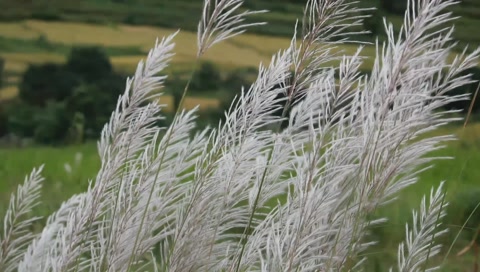
*kaash: Wild grass flowers
*Bina: Musical instrument
*Parasmani: A magical touchstone
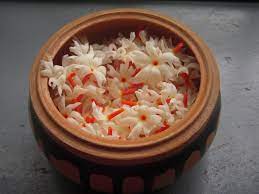
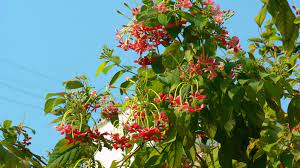
A Bengali rendition of the song performed by a contemporary artiste, Rezwana Choudhury BannyaShefali flowersMalati blooms(Rangoon creeper)Courtesy: Creative Commons
In 1913, Tagore received a Nobel Prize for his own translation, Gitanjali: Song Offerings, published in England. Only 69 of the original 157 of the Bengali Gitanjali made it into the English translation.
An essay, ‘Publication of Tagore’s song offerings, the Gitanjali : A Study’ by Partha Pratim Ray, a librarian in Vishwa Bharati, contends: “Rabindranath Tagore himself took the task of the translation of Gitanjali (Song Offerings) when he sailed for England on 27 May 1912. There he handed over the poems to William Rothenstein whom he met earlier in Calcutta in the year 1911. Moved by the poems, Rothenstein in turn gave the poems to W.B. Yeats to read. The literary and artistic circle of Yeats decided to publish the poems after Yeats made a selection of them and wished to write an introduction to it. That is how Gitanjali was first published by India Society of London on November 1912.”
The article further elucidates: “The next edition of Gitanjali was published in the next year (March 1913) by Macmillan and Company, London. The number of poems in Bengali and English Gitanjali are not the same. In Bengali there were 157 poems, but in English it was 103. The poems were first published in different Kavyagrantha. At the end of the Indian edition of India Society or Macmillan there was a statement: ‘These translations are of poems contained in three books- Naivedya, Kheya and Gitanjali…’”
Yeats wrote the introduction for Song Offerings. He wrote, “these prose translations from Rabindranath Tagore have stirred my blood as nothing has for years” and “Mr. Tagore, like the Indian civilization itself, has been content to discover the soul and surrender himself to its spontaneity.”
Gitanjali, 1910 editionGitanjali: Song Offerings by Tagore in English with a forward by W.B. Yeats
This poem has been translated by Mitali Chakravarty with editorial input from Sohana Manzoor on behalf of Borderless Journal
.
PLEASE NOTE: ARTICLES CAN ONLY BE REPRODUCED IN OTHER SITES WITH DUE ACKNOWLEDGEMENT TO BORDERLESS JOURNAL
In conversation with Isa Kamari, a celebrated writer from Singapore, with focus on his latest book, Maladies of the Soul. Click here to read.
Translations
A Hunger for Stories, a poem by Quazi Johirul Islam, has been translated by Professor Fakrul Alam. Click here to read.
A Hand Mill, a story by Ammina Srinivasaraju, has been translated from Telugu by Johny Takkedasila. Click here to read.
Kiyya and Sadu, a part of this long ballad on the legendary lovers from Balochistan, has been translated from Balochi by Fazal Baloch. Click hereto read.
In Tintin in India, Rhys Hughes traces the allusions to India in these iconic creations of Hergé while commenting on Tintin’s popularity in the subcontinent. Click hereto read.
Meredith Stephens shares the response of some of the Californian community to healing after the 2020 forest fires with a narrative and photographs. Click hereto read.
No, they whisper. You own nothing.
You were a visitor, time after time
climbing the hill, planting the flag, proclaiming.
We never belonged to you.
You never found us.
It was always the other way round.

‘Moment’ by Margaret Atwood
With an unmanned mission reaching the moon — that moon that was chipped off the Earth’s surface when Theia bashed into the newly evolving planet — many feel mankind is en route to finding alternate biomes and perhaps, a solution to its housing needs. Will we also call moon our ‘Homeland’ and plant flags on it as we do on Earth? Does the Earth — or the moon — really belong to our species. Do we have proprietary rights on these because of lines drawn by powerbrokers who say that the land belongs to them?
These are questions Margaret Atwood addresses in her writings which often fall into a genre called cli-fi. This is gaining in popularity as climate has become uncertain now with changes that are wringing fear in our hearts. Not all fear it. Some refuse to acknowledge it. While this is not a phenomenon that is fully understood by all of us, it’s impact is being experienced by majority of the world — harsh stormy weather, typhoons, warmer temperatures which scorch life and rising water levels that will eventually swallow lands that some regard as their homeland. Despite all these prognostications, wars continue to pollute the air as much as do human practices, including conflicts using weapons. Did ‘climbing a hill’ and ‘planting the flag’ as Atwood suggests, ever give us the rights over land, nature or climate? Do we have a right to pollute it with our lifestyle, trade or wars — all three being human constructs?
In a recent essay, Tom Engelhardt, a writer and an editor, contended, “Vladimir Putin’s greatest crime wasn’t simply against the Ukrainians, but against humanity. It was another way to ensure that the global war of terror would grow fiercer and that the Lahainas of the future would burn more intensely.” And that is true of any war… Chemical and biological weapons impacted the environment in Europe and parts of Afghanistan. Atom bombs polluted not only the cities they were dropped in, but they also wreaked such havoc so that the second generation’s well-being continues impacted by events that took place more than seven decades ago. Yet another nuclear war would destroy the Earth, our planet that is already reeling under the impact of human-induced climate change. Flooding, forest fires and global warming are just the first indications that tell us not only do we need to adapt to living in changed times but also, we need to change our lifestyles, perhaps even turn pacifist to survive in a world evolving into an altered one.
Critiquing the darker trends in our species which leads to disasters is a book by an eminent Singaporean writer, Isa Kamari, called Maladies of the Soul. He too looks for panacea in a world where the basic needs of humans have been satiated and they have moved on towards overindulgence that can lead to redundancy. In a conversation, he tells us how he hopes his writings can help towards making a more hopeful future.
This hope is echoed in the palliative poems of Sanket Mhatre from his book, A City full of Sirens, excerpted and reviewed by Basudhara Roy. Bhaskar Parichha’s review of Samragngi Roy’s The Wizard of Festival Lighting: The Incredible Story of Srid, is a tribute also from a granddaughter to her grandfather celebrating human achievements. Somdatta Mandal’s discussion of fiction based on history, Begum Hazrat Mahal: Warrior Queen of Awadhby Malathi Ramachandran not only reflects the tenacity of a woman’s courage but also explores the historicity of the events. Exploring bits of history and the past with a soupcon of humour is our book excerpt from Syed Mujtaba Ali’s Tales of a Voyager (Joley Dangay[1]), translated from Bengali by Nazes Afroz. Though the narrative of the translation is set about ninety years ago, a little after the times of Hazrat Mahal (1820 –1879), the excerpt is an brilliant introduction to the persona of Tagore’s student, Syed Mujtaba Ali (1904-1974), by a translator who describes him almost with the maestro’s unique style. Perhaps, Afroz’s writing bears these traces as he had earlier translated a legendary work by the same writer, In a Land Far from Home: A Bengali in Afghanistan. Afroz starts with a startling question: “What will you call someone who puts down his profession as ‘quitting job regularly’ while applying for his passport?”
In non-fiction, we have Devraj Singh Kalsi’s funny retelling of his adventures with a barber while Hughes‘ essay on the hugely popular Tintin makes us smile. The patriarchal past is reflected in an essay by G Venkatesh, whereas Suzanne Kamata from Japan talks of women attempting to move out of invisibility. Meredith Stephens and Candice Louisa Daquin both carry on the conversation on climate change. Stephens explores the impact of Californian forest fires with photographs and first-hand narrative. Vela Noble draws solace and strength from nature in Kangaroo Island and shares a beautiful painting with us. Madhulika Vajjhala and Saumya Dwivedi discuss concepts of home.
Two touching tributes along with a poem to recently deceased poet, Jayanta Mahapatra, add to the richness of our oeuvre. Dikshya Samantrai, a researcher on the poet, has bid a touching adieu to him stating, “his legacy will continue to inspire and resonate and Jayanta Mahapatra’s name will forever remain etched in the annals of literature, a testament to the enduring power of the poet’s voice.”
Our translations this time reflect a diverse collection of mainly poetry with one short story by Telugu writer, Ammina Srinivasaraju, translated by Johny Takkedasila. Professor Fakrul Alam has introduced us to an upcoming voice in Bengali poetry, Quazi Johirul Islam. Ihlwha Choi has translated his own poetry from Korean and brought to us a fragment of his own culture. Fazal Baloch has familiarised us with a Balochi ballad based on a love story that is well known in his region, Kiyya and Sadu. Our Tagore translation has attempted to bring to you the poet’s description of early autumn or Sharat in Bengal, a season that starts in September. Sohana Manzoor has painted the scene depicted by Tagore for all of us to visualise. Huge thanks to her for her wonderful artwork, which invariably livens our journal.
Profound thanks to the whole team at Borderless for their support and especially to Hughes and Parichha for helping us source wonderful writings… some of which have not been mentioned here. Pause by our content’s page to savour all of it. And we remain forever beholden to our wonderful contributors without who the journal would not exist and our loyal readers who make our existence relevant. Thank you all.
Autumn expresses itself in Bengal as Sharat (early autumn) and Hemonto (late autumn). The Tagore pantheon of literature has much of seasons in it. This poem, Sharat, was part of his poetry collection Kalpana, published in 1900.
Sharat by Sohana Manzoor.
Autumn

I see your beauteous form
        In this autumnal dawn,
Oh! Mother Bengal, your green figure
          Is resplendent with radiance.

The river cannot be contained in its bed.
         The fields are overflowing with paddy.
Robins chant and koels sing
        In your graceful gardens.
Amidst this dawn of sharat,
        O Mother, you stand poised.

Mother, the breeze chimes
       An auspicious onset —
Grains of new rice crops
        Fill homes with festivities.
You have no respite anymore.
        Sheafs of paddy move in bulk
Along rural paths wafting
          Their perfume in the draft.
Mother, the zephyr sends you
          An intimation of the seasonal onset.

The skies paint clouds
      to welcome the season.
Dewdrops have sprinkled
       Coolness on the green earth.
The flute seems to play a melody that
        Wafts through the land, water and air.
Boats come crowding to your doorway
          From all directions.
The sky is clear and blue.
          The earth, soft and cool.

The breeze starts to chill
       Refreshing tired bodies.
Every hut is filled with new hope,
         With the advent of new life.
All over, Mother, abound events
           Organised by joyous faces.
People grab fistfuls of happiness
            From your overflowing granaries.
The breeze rushes with anchals*
           Full of new life.

Come, come, wherever you are,
            Come running all of you —
Our Mother has opened her granary.
          Our grains are overflowing.
Come by boat from the other bank,
           Mothers and daughters come.
Who cries in hunger under maternal care?
           Come running all of you.
Our mother has opened her granary.
            Our grains are overflowing.

Our Mother wears a garland of shefali.
      Floral perfumes scent the earth.
White, creamy cirrus clouds
         Seem to stud her veil.
Crowned with a golden halo,
       Sweet, glorious, green and resplendent,
With feet dressed in blooms,
        My mother stands poised.
The whole world smiles at her illuminated
       With dewdrops, flowers and crops.


*Anchal is the loose end of a sari
An introduction and a conversation with Isa Kamari, a celebrated Singaporean writer
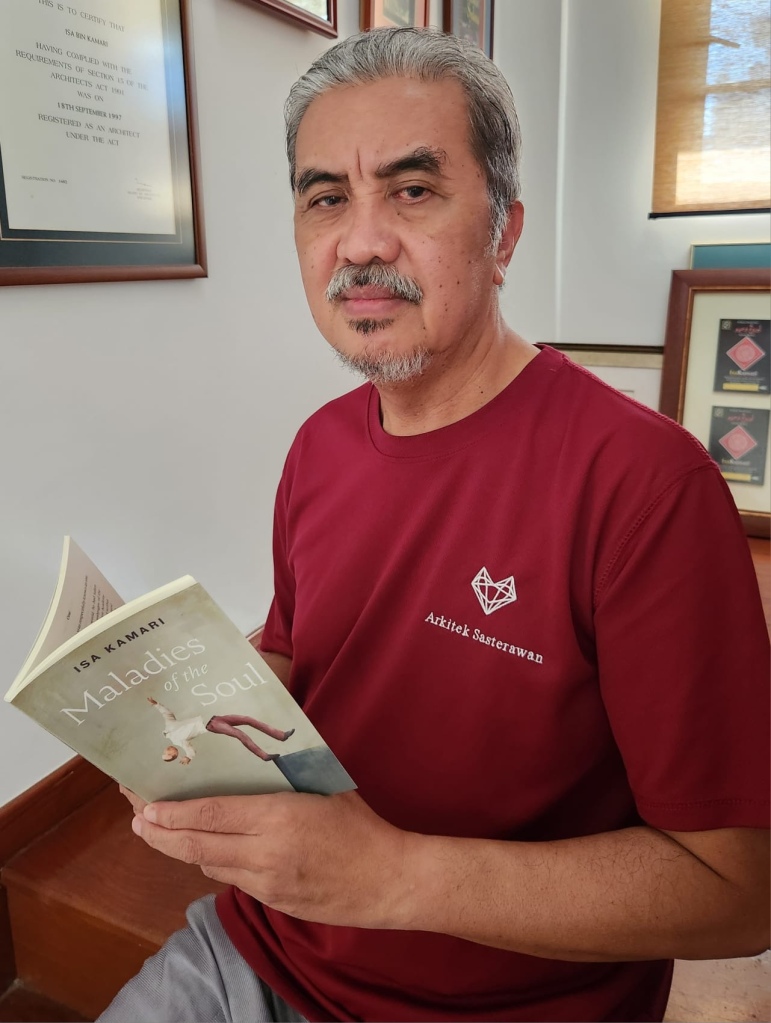
Isa Kamari
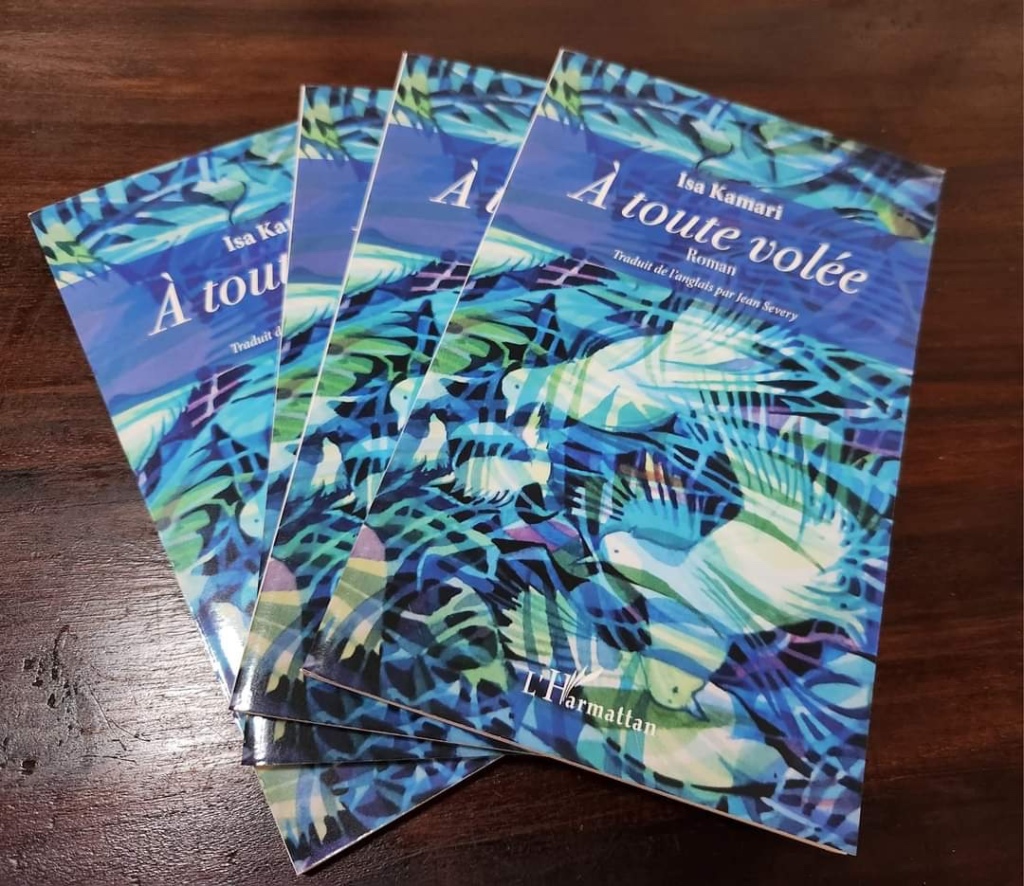
Isa Kamari is a well-known face in the Singapore literary community. He has won numerous awards — the Anugerah Sastera Mastera, the SEA Write Award and the Singapore Cultural Medallion, the Anugerah Tun Seri Lanang. He has been part of university curriculums and has written for the television. With 11 novels, nine of which have been translated from Malay to English — and some into more languages like Arabic, Mandarin, Urdu and Turkish, French, Russian Spanish — three poetry books, plays and one novella written in English by him, one can well see him as a leading voice in literature on this island that seems to have grown into a gateway for all Asia.
Kamari’s writings dip into his own culture to integrate with the larger world. The most remarkable thing about his works, for me has been the way in which he has brought the history of Singapore from the Malay perspective into novels and made it available for all readers. The most memorable of these actually gives the history of the time around which the Treaty of Singapore was signed between the British and the indigenous ruler in 1819, handing over the port to Raffles, the treaty that was crucial to the founding of modern Singapore. The novel is named after the year of the treaty.
Other novels like Song of the Wind , Rawa and Tweet — all bring into perspective how the local Orang Seletar integrated into the skyscrapers of Singapore. We can see in his writings how the indigenous moved to be integrated into a larger whole of a multi-racial, multi-religious accepting modern city. One of his novels, One Earth (1999), is like an interim almost, set during the Japanese occupation in Singapore. The narrative dwells on the intermingling of races in the island historically. Kiswah and Intercession are novels that cry out for reforms on the religious front.
He also has novels that delve into individual journeys to glance into the maladies of the modern-day world. Whether it is faith, or career, he brings into focus the need to heal. Recently, Kamari has brought out a book of short stories, Maladies of the Soul, to focus on just this. His fifteen short stories centre around the issue mentioned in the title. In the first ten stories, he writes of old age, of mental stress, of compromises made to achieve success, of anxieties just as the title suggests. These are internal conflicts of people in a country where most have enough to eat, a house to live in and access to education for their offsprings. Then in the last five stories, he moves towards not just showcasing such maladies but also resolving, using narratives that are almost surrealistic, or poetic. They are not happy but reflective with the ability to make one think, look for a resolution. They are discomfiting narratives.
One of the last stories is given from the perspective of a silkworm — a powerful comment on the need for freedom to survive. Another has the iconic Singapore Merlion emote to an extent. The writing escapes the flaw of being didactic by its sheer inventiveness. One is reminded that this is a book by an author from a city-state which has resolved problems like poverty to a large extent. That the journey was arduous and full of struggle can be seen in Kamari’s earlier novels. But now, that people have enough to eat and live by, he takes the next step that is necessary. His stories demand not just being familiar with the issues they faced in the past, but also suggest a movement towards resolving the social problems that in a developed country can warp individuals to make them non-functional and make the society lose its suppleness to adapt and progress.
One of the stories like his earlier novel, The Tower, reflects the climb of a careerist, an architect, up a tower he has built, while recalling the compromises made. The interesting thing is the conclusions have a similar impact. And then, there is yet another story that is almost Kafkaesque in its execution, where a man turns into a bull — a comment on stock trading or people’s obsession with money and to compete?
The book needs to be read sequentially to get the full impact of his message. For, he is a writer with a message, a message that hopes to heal the world by integrating the spiritual with modernisation. In this conversation, he discusses his new book and his journey as a writer.
What makes you write? What moves you to write? Why do you write?
I need to be disturbed by events, issues and thoughts before thinking of writing anything. I would then ponder and research on the topics at hand. Only when I have my own tentative resolution of the conflicting elements, I would begin to write. Most often, my views and positions will change as I write further. In that sense writing is a form of discovery and therapy for me.
Tweet in Spanish
Do you see yourself as a bi-lingual writer or a Malay writer experimenting in English? You had written your novella, Tweet, in English. Later it was translated to more languages. How many languages have you been translated into? Do you feel the translations convey your text well into the other language?
Culturally, I think in Malay. English is a language of instruction for me. When I attempt to translate my Malay works into English, the writing sounds and feels Malay. Tweet is a result of a challenge I imposed upon myself to write creatively in English. The result is not bad. Tweet has been translated into Malay, Arabic, Russian, French, Spanish, Azerbaijan and Korean. I wouldn’t know how well the novella has been translated because I do not know those languages. I trust the translators whom I choose carefully.
Throne and Tweet in RussianTweet in French
The stories of Maladies of the Soul first appeared in Malay. Now in English. Did you translate them yourself, being a bi-lingual writer? Tell us your experience as a translator of the stories. Did you come across any hurdles while switching the language? What would you say is the difference in the Malay and English renditions?
Yes, I translated all the stories in the book. I had to overcome my own fear that the stories might end up too Malay in expression and feel. But I told myself to be true to my own voice and not be inhibited by language structure and convention. I would not know exactly the difference between the two renditions. I was just interested to tell the stories.
Is this your first venture into a full-length short story book? Tell us how novels and short stories vary as a genres in your work. How do you use the different genre to convey? Is there a difference in your premise while doing either?
I have produced just one collection of short stories. In each of the short stories, I had to be focussed on expressing concepts and philosophies on a single problem of the human condition. In my novels the concepts and philosophies are varied, expanded, more complex and layered but yet interrelated and weaved around dynamic human experiences facing common predicaments or challenges of an era.
One of the things I noticed about the book was that the stories would convey your premise better if read in order. Is that intentionally done or is it a random occurrence?
The short stories can be weaved into a novel. There is a central spine, which is my observation and philosophy of life which bind them all. The intrinsic sequence or order is not intentional, but perhaps it is the psychological thread and latent articulation of the storyteller.
Some of the stories seem to have echoes in your novels, like Kiswah and Intercession, both of which deal with crises in faith. Did your earlier novels have a direct bearing on your short stories?
I used to transform my poems into short stories, and from those write novels. The genres are just tools for me to express my thoughts and feelings. I use whatever works. I have even experimented on weaving short stories and poems in a novel. I wanted to create prose that are poetic, and poems that are capable of conveying a narrative. My latest novel, The Throne, is a result of this experiment.
Some of your stories touch on the metaphorical, especially the last five. Some of the earlier ones describe unusual or even the absurd situations we face in life. As a conglomerate, they explore darker areas of the human psyche, unlike your novels which were in certain senses more hopeful, especially Tweet. What has changed to bring the darker shades into your writing? Please elaborate.
The stories in Maladies of the Soul have a common theme of alienation in various facets and dimensions of life. As such the expected feeling after reading them is that of gloom and hopelessness. That is intentional as a revelation of the deeper and hidden fallacy of modern life that appears organised and bright on the surface. I wanted my readers to be shaken or at least moved to ponder and reflect on our current, shallow and fractured human condition. There is a better life if we were to look the other way and be more mindful and caring of each other and our environment.
I still recall a phrase from your novel, The Tower, “Festivities celebrating loneliness”. Would you say your short stories have moved towards that?
Exactly.
Why did you choose short stories over giving us a longer narrative like a novel?
It is like giving my readers bite sizes of my exploration and philosophy of life. I leave it to the readers to weave the stories into a whole, and reflect upon their own experiences, thoughts and feelings, perhaps in a more integrated and holistic manner.
What are the influences on your writing?
Life itself. Like I mentioned earlier I do not write in a vacuum. I engage life in my writing as a way of validating my ever-changing existence. I want my life and writing to be authentic and significant. Hopefully, meaningful to others too.
What can your readers look forward from you next?
I have just completed a draft of a novel in Malay, Firasat. As in all my novels, I offer a window towards healing by embracing a rejuvenated Malay philosophy called firasat which is an intuitive, integrated, balanced, lucid, harmonious and holistic way of life.
Thank youfor sharing your time and your writings with us.
(The online interview has been conducted by emails by Mitali Chakravarty)
PLEASE NOTE: ARTICLES CAN ONLY BE REPRODUCED IN OTHER SITES WITH DUE ACKNOWLEDGEMENT TO BORDERLESS JOURNAL.










 Borderless