Categories
Poetry

Southern Song Poetry in Translation

Ye Shao-weng translated from Mandarin to English by Rex Tan

Hangzhou in times of Southern Song Dynasty

Ye Shao-weng (1100-1150) was a Southern Song Dynasty poet from Zhejiang. An academician, he belonged to the Jianghu (Rivers and Lakes) School of poets, known for its unadorned style of poetry. He served in the imperial archives of the capital, Hangzhou.

BEFORE THE GARDEN’S GATE 

My knocks go unanswered
Left to echo
As my clogs
Lacerate the moss covered floor

Yet I see
A spring untamed
As the red apricot
Branches out the garden’s hedge

Rex Tan is a journalist by trade and a poet at heart. As a Malaysian, he is fluent in English, Mandarin, and Malay, yet he calls none his first language.

PLEASE NOTE: ARTICLES CAN ONLY BE REPRODUCED IN OTHER SITES WITH DUE ACKNOWLEDGEMENT TO BORDERLESS JOURNAL

Click here to access the Borderless anthology, Monalisa No Longer Smiles

Click here to access Monalisa No Longer Smiles on Amazon International

Categories
Poetry

Kuala Lumpur by Rex Tan

i.
Locked jaws on the kerb
A kick at the low cranium
Incisors, breakfast

ii.
Bright sky, lonely soul
The filial son wishes for
Longer road to home

iii.
Bracing wind, sun, rain
Kapchai* weaves through the city
For sesuap nasi*

iv.
Car tyres screech, yelling
A child runs to rescue his
Flying scarlet crane

v.
Wafting smell of food
Red fu* posters, peach blossoms
Your absence, rings loud


*Kapchai: (local slang) Underbone motorbikes
*Sesuap nasi: (Malay) A spoonful of rice
*Fu: (Mandarin 福)Prosperity

Rex Tan is a journalist by trade and a poet at heart. As a Malaysian, he is fluent in English, Mandarin, and Malay, yet he calls none his first language.

PLEASE NOTE: ARTICLES CAN ONLY BE REPRODUCED IN OTHER SITES WITH DUE ACKNOWLEDGEMENT TO BORDERLESS JOURNAL

Click here to access the Borderless anthology, Monalisa No Longer Smiles

Click here to access Monalisa No Longer Smiles on Kindle Amazon International

Categories
Essay

The Magic Dragon: Cycling for Peace

It’s been five years since the American cyclist ‘Hutch’ died, yet his message of peace remains, as Keith Lyons remembers the global citizen who challenges us all to live life to its fullest

In early 2019, having not heard from an old friend ‘Hutch’ for a few weeks, I learnt that the American I’d first met in China has died of natural causes at his new humble home in the mountains of Greece. He was almost 80 years old.

There’s nothing extraordinary about living until your late 70s. Or relocating to live the last years of your life in a warmer place. But Hutch was not your ordinary septuagenarian retiree. Nor was he a typical American. Though when I first heard about him in 2009, it was when a German friend staying with me in southwest China had come across a sign on the wall of an Italian restaurant in Lijiang, Yunnan, seeking fellow cyclists for day trips around the area. The deal was, go on a ride with Hutch and other cyclists, and he would pay for lunch or dinner. “So how was he?” I asked my friend about the organiser, who had a website promoting world peace. “American, very American,” she replied. I was intrigued by this.

But it wasn’t till another month or so that our paths crossed, and I met him in a café with a gaggle of others: locals, Chinese youngsters who had moved to Yunnan province, and some foreigners.

Hutch was treating them all to drinks and pizza. I found out later, he bought bikes for some ride participants who became his friends. That’s the kind of person he was. 

Hutch was not a tall man in stature, and the cycling obviously kept him very fit, I noted on first meeting him. He wore lycra cycling gear, a neck scarf and bandana, and had a gentle face, with a bright eyes and a benign smile. He was polite, and entertaining, and clearly enjoyed the carbo-loading pizza as much as the entourage, made up of English-speaking Chinese who ranged from their 20s to 40s.

He invited me to join them, as after pizza, there was going to be cake and dessert. He got up to shake my hand, and I noticed he was wearing cycling shorts, with spindly yet muscle-toned legs.

Having set up his new China base in the mountain town where I’d been living since the mid-200s, I got to know him over drinks, meals, outings and adventures. Mr F. A. Hutchinson (I never knew what those initials stood for) acquired names in each country where he stayed – Haqi in China, Nima (meaning ‘sun’) in Tibet, Hache in Bolivia. At one stage he was signing off his emails with ’The Magic Dragon’, his serpent name. ‘Or just call me a bum on a bike’, was tagged to the end of his signature. I just knew him as Hutch. 

Generous and giving, sometimes overly generous, he also adopted adult children, accumulating a family of daughters and sons in China during his half decade living in Xining and Lijiang. While his trusted bike, Ms.Fetes, was loaded with pannier bags front and back, he didn’t carry much baggage from his past, which had seen him serve in Vietnam, work for decades in TV sports production in the US, and establish a talent development agency in China in 2007. 

Over the couple of years I knew him in Lijiang I can only recall a few occasions when he was not sporting padded cycling shorts. More often than not he turned up to cafe, meeting and events on his bicycle, sometimes not bothering to take off his cycling helmet indoors. 

That cycle helmet proved its value one day when we were out cycling in the hills to an alpine lake around 2,600 m above sea level not far from LIjiang. Hutch was a cyclist with remarkable stamina, and his slow and steady approach could burn off others 40 years his junior on hill climbs. While Hutch had cycled all over China for a number of years, without major incident or accident — a fact which impressed all who inquired about the safety and sanity of cycling in The Middle Kingdom — while out with me he broke that 100% safety record. Coming down a winding hill late one afternoon the wheels of his bike skidded on icy gravel and he ended up falling off his bike, a large truck behind him putting on its brakes just in time to avoid running him over. Worried he was requiring an ambulance or hospital treatment, I rushed over to Hutch to find him un-fazed by it all. He cycled back to where he was living, and tried to tend to his battered and bloody knees, elbows and hands himself, a wry smile over his beard-stubbled face. 

One of Hutch’s most impressive achievements in China was to cycle from Lijiang across Tibet to Lhasa and onto Mt Kailas, a feat made more incredible by the challenges and dynamics of a group ride (participants from several countries included Elvis), and then the breakaway split by some cyclists which jeopardized the whole mission. I helped with some of the logistics during the year-long adventure, but am still in awe of anyone who can cycle for weeks at altitudes over 4,000 metres across the Tibetan plateau. The tale of the 70-year-old American who cycled across China to Tibet made newspaper headlines, and he featured on the front cover of cycling and outdoor magazines. We gave him a hero’s welcome when he returned to Lijiang, his story still told by expats and locals living in north-west Yunnan. 

As well as his cycling pilgrimage to the holy mountain of Tibet, we worked on a housing project for small Tibetan-style eco-houses with wind and solar energy made for US$10,000. In Lijiang, he helped his friend Irlin set up a small eatery (possibly to ensure he had a reliable supply of Western food), and he was a regular visitor to my café, ‘Lijiang Millionaire’s Club’, and the crosstown cafe (and tango dance studio), ‘Over the Bridge’, run by fellow New Zealander, Stephen Dalley. 

After Hutch’s years in China, he was ready for a change. Increasingly worried about the Chinese government’s clampdowns on freedom of speech, his frustrations spilled over from the anonymous government to the Chinese people. He often carried a green canvas shoulder bag with the words in Mandarin of Chairman Mao ‘Serve the People’ — and found occasion to show that to shopkeepers, bank clerks, ticket sellers or government officers — anyone who was stonewalling him or telling him ‘mei you’ (don’t have). 

Perhaps inspired by the practical and easy-going nature of Kiwis, Hutch was looking forward to heading to New Zealand, where he already had a number of contacts. After Lijiang, he went to Australia, New Zealand, and then to South America, before moving to Europe a few years ago to live in Spain, Germany and Greece. 

He was on a personal crusade, to promote peace and understanding, and wanted to get more people on bicycles, by holding inclusive, inexpensive cycle tours. “One of our slogans, Burn Fat, Not Oil,” he wrote.

One of Hutch’s key talents was to enlist others to join, and get them working together, even though he admitted he didn’t like groups. However, the laziness or greediness of others sometimes meant that his efforts floundered into anarchy and stagnation.

While often on the move, Hutch wasn’t a ‘rolling stone gathering no moss’ kind of person. Instead, he acquired more friends everywhere he went. I never saw him play the age card, but enjoyed hearing his wisdom acquired from a long and interesting life. He had some strong opinions on various subjects. Once you met Hutch and he got your contact details, it was like being on an email subscription list you could not get off. A few times I got fed up with the email exchanges, not so much from Hutch, but from some of his old American friends, and despite requests to opt out, found myself back on the list a few months later.

Taoist Hutch believed we needed to change the world, and to change ourselves. He quoted Mahatma Gandhi on his site: “You must be the change you wish to see in the world.”

He rallied against capitalism, materialism, money and greed. He complained about how money was god, the world was going mad, and against the failures of democracy with widespread corruption of its leaders. One year his favourite slogan was, “We have met the enemy, and he/she is us.”

Hutch urged ‘women of the world to unite’. He was impressed by former New Zealand prime minister Jacinda Ardern, often sending me links to news articles about her, but he was not so favourable about Myanmar’s leader Aung Sun Suu Kyi and her lack of response to ethnic cleansing, telling me, “I am starting to really dislike this woman.”

He called for urgent measures to address what he saw as the biggest and most unrecognised problem facing the human race: over-population. Each day he posted comments with news articles under the title ‘Pathology in America’, or with his take on issues, written in upper case: SLEAZE-BAG TRUMP’S AMERICA. He cursed wrongdoers, and hoped they would face the consequences. ‘WOE BE UNTO TRUMP FO ALL THIS! MAY ALL THE 7 DEPREDATIONS, FULL UPON HIM AND HIS CHILDREN’S CHILDREN, FOR 7 GENERATIONS’1, he penned recently after a second child died in government custody at the US border. 

Sometimes his missives were written as poems or as cryptic riddles. Likewise, he was prepared to consider other views, new information or the different opinions of those better informed, and he would figuratively smoke the peace pipe.

Hutch did occasionally like to smoke a pipe, not with tobacco but with the ‘happy baccy’. (Indeed, today there’s an article in Scientific American suggesting THC in marijuana may boost rather than dull the elderly brain).

“As I get older, I seek peace and tranquillity,” he wrote in one of his emails to me. “What has been important to me is a different life, one seeking answers to the riddle of life.” In another he sent last year, he said he was getting closer. “Closer to what? The peace of mind of having overcome materialism.” In another email he wrote “at this age, we take life one day at a time”.

He wrote latterly that he had wanted to live in Meteora in Greece, having fantasised about it while in Germany, visiting his long-time friend and patron, Rucha. The rock formation in central Greece has a stunning hillside Eastern Orthodox monastery, second in importance only to Mount Athos. Almost prophetically, he said recently, “We never know when our time has come, so better to act Now!”

On Christmas Eve last year, after a good day out cycling around Meteora, the 78-year-old wrote a poem which started:

What a cycling day this has been,
What a rare mood I’m in
Being the Light
Screaming Delight. . . .

It was in the small town of Kalampaka near Meteora where Hutch died, around 2 January 2019 — according to his close friend Xu Tan — after coming down with a bad cold a few days before. He was cremated at the base of the Meteora rocks. 

“I’m not much big on ‘goodbyes’,” Hutch posted as he left Australia in late 2011 on his way to New Zealand. “I usually slip out the back, Jack . . . get a new plan, Stan — and basically get myself down the road.”

“There is no reason to be sad when someone dies and sheds their body,” he said. “In fact, we should celebrate such a transition.” 

After learning of his death, many candles were lit in memory of Hutch, in China, Australia, New Zealand, South America, in Europe, in the USA — all around the world, a remembrance and celebration of that cranky, freewheeling legend, as he cycled over the hill into the sunset, and into a brand new dawn.

And five years later, we still remember the man and his message.

Photo provided by Keith Lyons
  1. These are authorial comments retained for colour but do not reflect the stand of Borderless Journal ↩︎

Keith Lyons (keithlyons.net) is an award-winning writer and creative writing mentor originally from New Zealand who has spent a quarter of his existence living and working in Asia including southwest China, Myanmar and Bali. His Venn diagram of happiness features the aroma of freshly-roasted coffee, the negative ions of the natural world including moving water, and connecting with others in meaningful ways. A Contributing Editor on Borderless journal’sEditorial Board, his work has appeared in Borderless since its early days, and his writing featured in the anthology Monalisa No Longer Smiles.

.

PLEASE NOTE: ARTICLES CAN ONLY BE REPRODUCED IN OTHER SITES WITH DUE ACKNOWLEDGEMENT TO BORDERLESS JOURNAL. 

Click here to access the Borderless anthology, Monalisa No Longer Smiles

Click here to access Monalisa No Longer Smiles on Kindle Amazon International

Categories
Review

Along the Tibetan Edge in China

Book Review by Bhaskar Parichha

Title: Journey to the End of the Empire: In China Along the Edge of Tibet

Author: Scott Ezell 

Publisher: Speaking Tiger Books

This is one of the rare travelogues written by a gifted writer. The topic Scott Ezell covers is equally intriguing- China and Tibet. In about two hundred eighty pages, he takes readers on a tour of the most contentious part of China. Journey to the End of the Empire: In China Along the Edge of Tibet is an essential read.

American musician and poet Scott Ezell has a background in Asia and indigenous cultures. Between 1992 and 2004, he lived in Taiwan and traveled extensively in China, India, and Japan. He has been working on a project since 2009 that documents the impacts of centralised state power, civil conflict, and destructive resource extraction in the China-Southeast Asia border region. A Far Corner is an account of his experiences living and working with an indigenous artist community in Taiwan over a period of three years.

Says the blurb: “On foot, by rattling truck and local bus, by jeep and motorcycle, American poet and musician Scott Ezell explores the Tibetan borderlands in the twenty-first century Chinese empire. The journey starts in Dali, in the foothills of the Himalaya in southwestern China, and extends north a thousand miles through towns and villages along the edge of Tibet, finally arriving at Kekexili, the highest plateau in the world, and crossing the Kunlun Mountains. Ezell takes us through landscapes of blond and gold barley fields, alpine meadows ablaze with wildflowers, silver-blue rivers beneath ‘clouds like burning aluminium’, and snow peaks ‘cracking and shattering into jagged resplendence against the sky’.”

Along the way, Ezell speaks Mandarin with farmers, shopkeepers, lamas, nomads, and police officers. Throughout Ezell’s account, there is also outrage, as he observes the rise of militarization, surveillance, destructive resource extraction, and the destruction of entire river ecosystems by massive dams over the course of many years and numerous trips.

Writes Ezell in the introduction: “In September 2004 I set out on a journey along the edge of Tibet. Starting from the foothills of the Himalayas in southwest China, I traveled north into further, higher landscapes by local bus, hitchhiking, and a motorcycle I bought along the way. I speak Mandarin, which allowed me to communicate all down the road with villagers, Buddhist lamas, nomads with chunks of bone braided in their hair, and police at security checkpoints. After six weeks and 1,200 miles, I reached Kekexili, a wilderness reserve 17,000 feet above sea level. From there I crossed the Kunlun Mountains and descended to Golmud, a city at the crossroads of Tibet, China proper, and Xinjiang. That journey is the basis for the narrative.

“Over the next fifteen years I returned a dozen times to Tibet and southwest China. I witnessed transformations so shocking that I felt I was taking blows to my own bones. Massive dam systems killed rivers and displaced communities, mountains were raked apart to provide gravel for construction projects, and the region was increasingly militarized and surveilled as China tilted toward its grim police state superpower status.”

Ezell strikes a sympathetic note when he says : “Today China holds one million Uyghurs in concentration camps in Xinjiang, democratic freedoms have been smashed in  Hong Kong, human rights lawyers are held in black jails, and the government openly surveils its population. But the systematic oppressions of ‘empire’ are not unique to China. The seizure of land and genocide against indigenous peoples in the United States and elsewhere, the legacy of slavery and the present-day wage-slavery of the global economy, and the colonization of Tibet as a means of territorial expansion and resource extraction these are all variations of centralized authority exerting power over minority, marginalized, and disenfranchised peoples.”

The book evokes the majesty of Tibetan landscapes, the unique dignity of the Tibetan people, and the sensory extremity of navigating nearly pre-industrial communities at the edge of the map, while also encompassing the erosion of cultures and ecosystems. Journey to the End of the Empire is both a love song and a protest against environmental destruction, centralised national narratives and marginalised minorities.

.

Bhaskar Parichha is a journalist and author of UnbiasedNo Strings Attached: Writings on Odisha and Biju Patnaik – A Political Biography. He lives in Bhubaneswar and writes bilingually. Besides writing for newspapers, he also reviews books on various media platforms.

.

PLEASE NOTE: ARTICLES CAN ONLY BE REPRODUCED IN OTHER SITES WITH DUE ACKNOWLEDGEMENT TO BORDERLESS JOURNAL

Click here to access the Borderless anthology, Monalisa No Longer Smiles

Click here to access Monalisa No Longer Smiles on Kindle Amazon International

Categories
Essay

Peeking at Beijing: Fringe-dwellers and Getting Centred

How can anybody comprehend Beijing, one of the largest and most ancient cities on Earth? Its origins date back three millennia, but Keith Lyons tries to get a sense of the real Beijing in just full three days.

Day Three*

After a series of false starts on the previous day, when I’d thought I would be ticking off Beijing’s main iconic sights, for my third and final day in the city I took a different approach. Instead of heading into the heart of the capital, I sought out enclaves that were more on the periphery of the megacity, both literally and figuratively. 

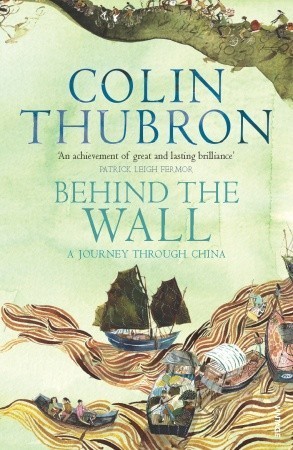
I’d been reading the accounts of Colin Thubron’s visits to China, including his 1987 book Behind the Wall which started in Beijing. Feeling displaced in the impersonal capital, his impression of Beijing was more of a building site than a city. “I tramped its streets in disorientation, looking for a core which was not there.” He found Tiananmen Square arid and couldn’t wait to get out of the city. “The fission of solitary travel — travel in a boyish euphoria of self-sufficiency — tingles in my stomach as I march across Beijing’s railway station,” he writes as he sets off on his travels around the Middle Kingdom as it emerged from decades of Mao and Cultural Revolution oppression.

Looking back on the previous day’s ‘failures’, I tried to reframe the disappointing experiences as learning, rather than ruminating on the rejection I felt after not getting inside the Forbidden City. 

One turning point in my journey was coming across a quote from Robin Sharma while thumbing through a bilingual personal growth book that sat among the artsy and anime library at my new accommodation, the hipster co-working space and ‘serviced apartment boutique hotel, ’ Stey 798. Initially when I saw the pull quote in English and Mandarin, I thought to myself, “What a douchebag; it’s fine for the business guru to say, having made millions spouting his stuff to the likes of Microsoft, IBM, General Motors and FedEx.” But then I reflected on the words and realised the truth in them: “There are no mistakes in life, only lessons. There is no such thing as a negative experience, only opportunities to grow, learn and advance along the road of self-mastery.”

I wasn’t exactly on the road to self-mastery when I found myself lost, tired, bothered and despondent on an unnamed minor road on the outskirts of Beijing. However, I realised that some of my preconceptions had been limiting. 

For example, the fixed idea that because Beijing was big and busy that it would be dangerous to hire a bike and cycle around. There were rows and rows of identical-looking bicycles for hire at every street corner, wide separate cycle lanes, and lots of visitors navigating successfully around Beijing by bike. If I’d been on a bike the previous day, I could have cycled right through Tiananmen Square rather than circle wide around the massive open space (though security personnel will still make sure you don’t stop to take photos at the best spots). 

So, note to self (and to others), try exploring Beijing on bike rather than just using the subway, taxis, or buses. To make bike hire possible, get a Chinese SIM card, install Mobike, and set up payments via WeChat and Alipay, so you can use the lockless sharing bikes provided by Meituan (yellow bikes), Didi Bike (green) and Hello Bike (blue) simply by scanning QR codes, or unlocking bikes with Bluetooth. 

I’ve since learnt some bike hire operators can loan high-quality bikes, with English-speaking staff who deliver bikes to your hotel. So even without a smartphone connected with a local SIM and data, you could arrange to discover the city formerly known as Peking by bike.

Beijing was once capital of the ‘kingdom of bicycles’, with the uptake of bikes trebling in the 1980s across China, as the rationing was cut for locally made bikes such as the prestigious Flying Pigeon brand. Cycle lanes were first incorporated into main roads throughout much of Beijing when car ownership was limited to government officials, with more than 3/4 of Beijing’s road space taken by cyclists in 1988. According to one study, some busy intersections saw 20,000 bicycles an hour, and 8 out of 10 Beijing’s used a bike as their primary transport. 

While China is the leading exporter of bicycles, bikes dropped from 62% of vehicles on the road in the late 1980s Beijing to just 16% by 2010. However, in the last decade, there has been a boom in bike use, not so much by the proletariat but by middle-class Chinese with an environmental and health consciousness embracing a post-materialist sharing society. Bike schemes featuring special locks, non-deflating tyres, rust-resistant bodies and GPS tracking have proliferated across Beijing and in most cities and towns, though following the boom there was also a bust for some players unable to cope with aggressive competition practices copied from the Uber monopoly playbook. 

In tandem with the return of the bike have been some other initiatives to address the problem Beijing was once synonymous with: air pollution. Much has been made of just how bad air pollution is in China, with 16 of the 20 worst air quality cities up to recently located in China. For the nation’s capital, vehicle emissions and burning coal to produce electricity have been the main causes of smog, but a wide range of measures have seen air pollution in Beijing decline by 50%. The air pollution in Beijing is still three times as bad as that in the US’s most polluted city Los Angeles, and some daily measures still exceed the World Health Organisation’s guidelines, but the initiatives which include better urban planning, switching away from coal, extensive public transport, and Low Emission Zones where only e-vehicles are allowed seem to be working. 

As an aside, a recent comparison of air pollution readings found Delhi was five times as polluted as Beijing, though the sources, composition and frequency of air pollutants are different for the two cities, with Delhi’s woes from biomass burning, road dust and the burning of agricultural waste. Delhi has been judged the world’s most polluted capital for four years in a row, according to IQAir. 

There’s another thing too. Much has been made about how polluted the air is in Beijing, but on the three full days I visited, only one day seemed to be overly hazy with smoggy, dirty air. Admittedly, particles in the air don’t have to be visible to be harmful, as the world is learning with more research into fine particles, but from a check of several air monitoring sites, including the US Embassy’s real-time monitoring which started in 2008, the readings were not too high. Probably no worse than smoking half a packet of cigarettes. Maybe that’s why many people in China wear face masks, not just because of illness or to stop the spread of germs. 

So next time — if there is one — I will definitely brave it on a bike. But that’s for next time. 

If Colin Thubron’s stomach was tingling with excitement in anticipation of travel, my stomach that morning was rumbling with anticipation of food to enable me to experience different parts of Beijing. Eating local is one of the best ways to experience a new place. 

I retraced my steps to the window-in-the-wall vendor I’d got a snack from the previous night, who made one of the specialties of Beijing, a thin savoury crisp-friend crepe stuffed with a selection of fillings. The man recognised me from the previous day, and we went through the process of assembling the ingredients to my liking to go on and in the pancake, which is eventually folded and wrapped like an American breakfast burrito. Unlike other jianbing I’d seen being made by small eateries, roaming food carts, or on the back of tricycles, my man’s crepes were made with buckwheat rather than wheat or mung bean flour, giving them a speckled purple appearance which I said to myself was like choosing a healthy option at McDonalds. 

To keep things fresh, jianbing are always made-to-order and cooked under the watchful attention of the mouth-drawling customer. Once the batter has formed small bubbles on the large round hotplate, a series of interventions are enacted, from cracking eggs over the pancake, to flipping it with long chopsticks. With brushes, the chef would smear on spicy and sweet fermented bean pastes (like miso), hoisin and chilli sauces, sprinkle on chopped coriander leaf, scallions and tangy pickled vegetables, and then add crunchy crispy-friend wonton dough strips and lettuce before cutting it in half and folding it into a rectangle. 

The pancake is Beijing’s favourite breakfast, but the staple food is little known outside China compared to steamed buns, dumplings and Yum cha dim sum

Also not well known outside China is the fact that Beijing has a sizeable Muslim population. At least a quarter of a million people who identify as Muslim reside in the capital, with a Muslim presence in the city dating back to the 8th century. As you may know from following the news, China has some issues in its north-western province of Xinjiang where Turkic-speaking Uyghur Muslims account for 12 million of its inhabitants, along with some ethnic Kazakhs. Less well-known and visible are the Hui Muslims, classified as an ethnic group and religious affiliation, who are found all across China. The Huis have adapted to the dominant Han Chinese culture, while maintaining their beliefs and customs.  

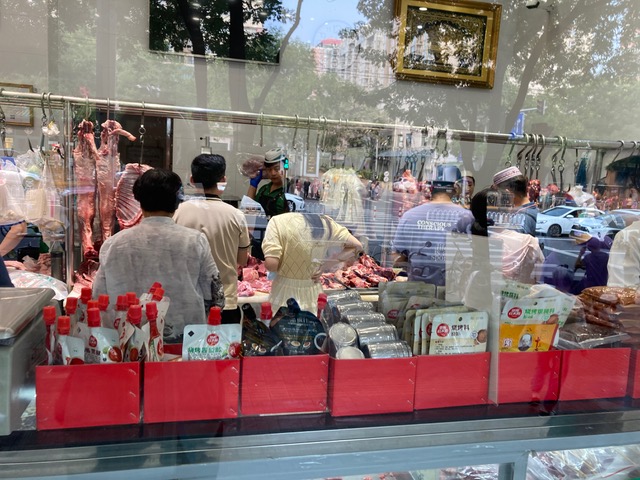
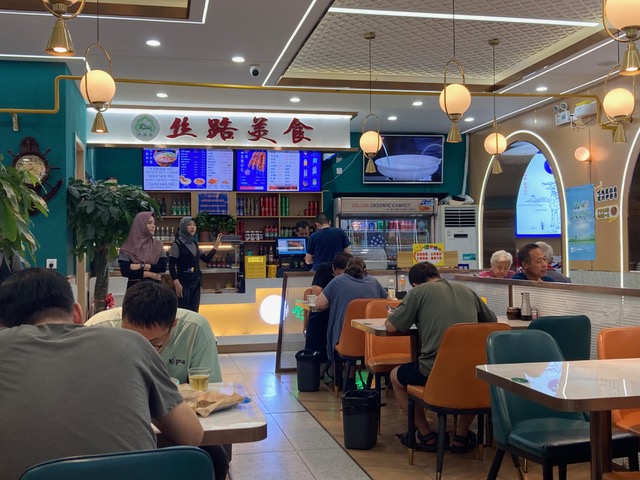
There’s one feature of Muslim life that is at odds with Chinese living, and that’s the eating of pork. Pork is China’s favourite and default meat, accounting for up to 70% of all meat eaten. With Muslims not eating pork, deemed unclean, impure and forbidden, instead the preferred Islamic meat is beef, with lamb/goat also featuring. This food divide meant that Muslims often lived together in neighbourhoods with not only a mosque, but also Muslim food processing and services. Across China, Muslim beef noodle restaurants are ubiquitous, and considered cheap and cheerful as well as clean, a godsend in a land of food hygiene concerns and stomach upsets.

In Beijing Niujie and Madian are the two main Muslim enclaves, though the latter in the north has declined. Niujie, south of the centre, even has its nearby subway station, and while there is still a mosque (with Chinese-style architectural characteristics) the main attraction for most visitors is the distinctly Muslim food available, with snacks and delicacies on offer. 

Of the quarter of a million Muslims who officially reside in Beijing, perhaps half live in the neighbourhood of Niujie. There are halal supermarkets, butchers selling mutton and beef, a Hui hospital and a kindergarten. 

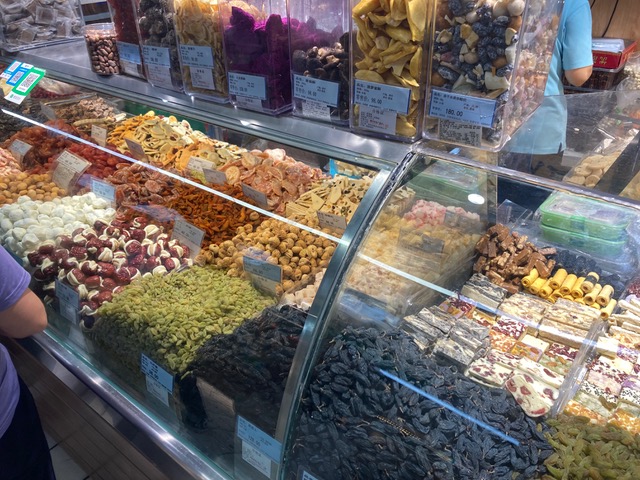
For a block, on both sides of the wide street, are stalls and restaurants, and queues. The smoke from sizzling charcoal grills serving fatty lamb skewer kebabs and the aromatic cumin-scented air probably push Niujie’s air pollution readings beyond acceptable World Health Organisation levels, but no one is complaining. Uyghur vendors, wearing round white hats, call out over the grill to whip up even more business, or shout out to younger men to fetch more of the freshly-baked sesame-studded flatbreads that are stacked high beside tandoor ovens, like round naan, but with a thick edge, like a deep dish Pizza Hut crust.

Steam rises from the large bowls of beef noodle soups slurped by families sitting on low stools around a square table, and visitors line up to order from a selection of fruit pastries. The largest amount of tripe you may ever see is cooked in a huge pot, while a rich cake made with dried fruit, nuts, seeds and sugar is sold by weight. 

One of the quests for the self-labelled traveller, as opposed to the unaware tourist, is to be less an outsider and a consumer of tourism products. But underlying all this is the enigma of travel. That we go to experience things that are different from back home. And occasionally we wish to be less visible as an outsider, and more like an insider. 

I think you can do this to a certain degree, depending on where you are and the acceptance of diversity of that place. But for me, as a visitor of European heritage, to the reasonably homogeneous and definitely differentness of China, I stand out. Not just because of my height at 6 feet. Or that my hair isn’t the standard black. 

So what I seek is more of an authentic experience. Which for me often involves shopping local, eating local, random exploration of neighbourhoods rather than ticking off sights, preferring places without tickets or queues. 

It is travel with some risks, not mentioned in the insurance fine print. It is travel which is self-deprecating, acutely aware of my ‘otherness’ and awkwardness, and of how I might connect with others. Some of that is transactional. I buy fruit from an old lady at a local market. I hop on a bus. I go to a place, but it is not the place recommended by the receptionist or concierge.

In Niujie, I am both an outsider and the ‘other’. Yet I have more empathy for and connection with the Muslim street vendors than I do with the Han Chinese who have come that afternoon to eat delicious food that is different to their normal diet. 

After rubbing shoulders with fellow diners at a cramped eatery in Niujie, having finally located the area that doesn’t feature in most Beijing guidebooks, I still had one mission to complete. 

Photo provided by Keith Lyons

So, as you are probably aware, Beijing hosted the Olympics back in 2008, with much fanfare and pomp. It was China showing off to the world just how modern and developed it was. It awed us not just with its impressive pageantry but also its buildings and facilities, many created just for the International sporting event. The Olympics provided the impetus for numerous infrastructure projects, particularly transport networks which were state-of-the-art. 

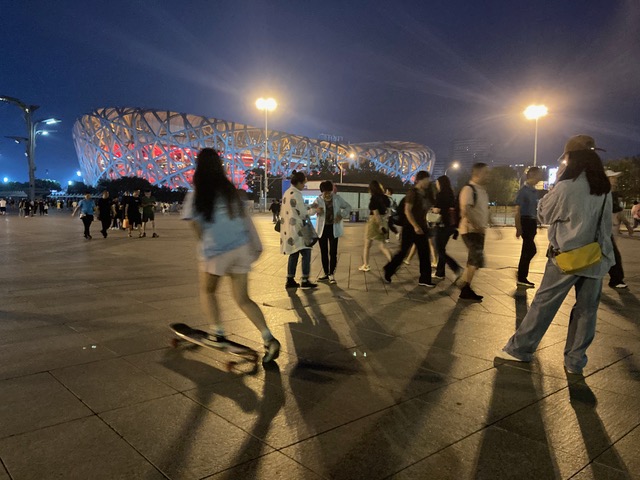
Some facilities remain, and the Bird’s Nest is still an attraction in itself, despite its lack of use following the 16 years. You probably remember the Water Cube, the swimming pool. 

Bird’s Nest: Photo provided by Keith Lyons

Often when I travel, I check to see if there are swimming pools near my accommodation, or even inside my hotel (if someone else is picking up the tab). So when I found out that Water Cube is open for casual swimming, I set my sights on swimming a lap or two in the famous pool. 

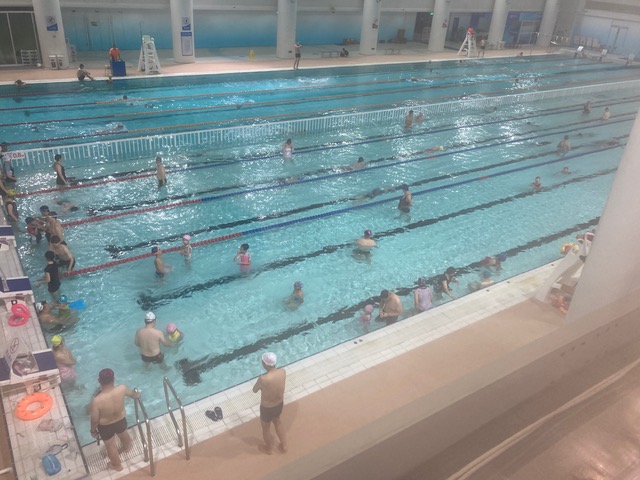
It turns out the pool for public use isn’t the actual one for Olympic races — that’s reserved for competition — but the training pool where swimmers warmed up and down has been open to anyone for more than a decade. But there’s a catch. 

First, you have to know that you can swim there. And there’s another level of safeguard. Because the pool is several metres deep, and there’s the danger of non-swimmers drowning, the pool is partitioned into two halves. The accessible half has a raised floor so it is only around a metre deep. You can stand up in it. Kids can stand up. 

But the other half, where the depth darkens the water to deep blue, is strictly controlled entry. You need a swipe card to access it. And to get that, as an American working in Beijing described to me, involved a medical test as well as completing various swimming feats, which included swimming two lengths without pausing. 

Without the time in the city to complete the rigorous entry requirements, I had to contend myself with the learner’s side, where parents walked alongside their children like chaperons, adults swam on both sides of the lanes, and there were frequent close calls or collisions. 

Inside the Water Cube: Photo provided by Keith Lyons

I’m a reasonably tolerant person, and having lived in China for more than a dozen years had got used to behaviours I initially found, to my mind and upbringing, a little disgusting. But when I swam my first length, only having to stop a couple of times to negotiate around erratic swimmers, the first sound I heard was from a fellow swimmer rising up from his lane to loudly clear his throat and spit onto the floor edge. I made a mental note not to rest my goggles up there.

While I had the passive-aggressive stance towards those spitters, during rests at the end of the lane other swimmers struck up conversations. A middle-aged women confided how she had lessons to swim in her 40s, and now tried to swim at the Water Cube a few days each week, even if she could not go a few metres without gasping for air. “Can you give me any tips to improve my swimming,” she asked as she returned to my end. I replied in Chinese the word my blind masseur used to give me when he hit a sore point on my feet. “Fang song” — relax. It was probably the worst word to say, like shouting ‘keep calm’ out repeatedly when something has gone disastrously wrong. 

I probably should have taken on board my own words, as I swam into a father shepherding his daughter along. He was blocking my way. I saw him do the same to others. Deliberately blocking the way of oncoming swimmers. You are the symbol of modern China, I thought. Selfish, entitled, arrogant. Because I am a man of peace and goodwill to all, when he next blocked my way, I just carried on swimming, exaggerating my kicking to churn up the water and splash his rotund belly and smug grin. 

I switched to another lane, and after a few more lengths, as I waited for a slow swimmer to get a head start, a boy of 12 years decided to strike up a conversation with me. “My mother says I should practice my English, so that’s why I like to come here,” he said, pointing up to the viewing window where a dragon mom waved and then proceeded to turn her phone camera towards us. After exchanging the usual questions about himself and me, he then abruptly turned the conversation around to China and the world. “China is the biggest country in the world. We are the leader.” 

Unable to find the right words to express himself, he asked another swimmer, a man who had just moved to Beijing from the north, to articulate. 

I wanted to ask him if China was such a great country, why did so many of its people want to escape to a better life in the US, Canada, Australia and New Zealand. But conscious that swimming at the Water Cube gives just two hours in the facility I escaped myself and tried to complete a length unimpeded or uninterrupted. 

When I got back, the boy, who was rather overweight, was still there, waiting with another claim about China’s might. 

Maybe I’m being nostalgic, about the good old days, but in the 1990s and 2000s, being a foreigner in China meant automatic adulation and attention from Chinese. Foreigners were feted and admired regardless of their behaviour and personality. 

Now, in the mid-2020s, things have changed. They started changing a decade ago, when China realised that foreigners were not so great after all. When stories from the government claimed that most of the foreigners were economic spies. When Chinese TV had footage of young Americans drunk and predatory on the Shanghai subway. When my friends said how they’d heard that many foreigners teaching in China were losers in their own country. The tide had turned. The golden days were over. China has regained its swagger. The sleeping giant was waking up. The dragon was turning. And I was getting tired. 

Before my number got called and I got requested to leave the pool, I got out, and used my token in the shower, wishing I’d brought my flip-flops to protect my feet from contact with the floor. 

Not just being in the water, but being underground, it always takes a little to adjust to being back above ground and at maximum gravity, weightless. One of the things I like about swimming is that afterwards, some of that fluidity, ease of movement, body perception and gentle feeling remains, like a reminder of how you could be in the world. My senses feel renewed, my mind a little lighter, my awareness more centred. 

Near the Bird’s Nest, they were having a skateboard class, with over 50 participants, many of them young women. And as I strode along the wide boulevard, groups of newly initiated skaters wove in and out of the family groups and sightseers, a sign to the world of new ways of being, new freedoms, and new leisure. Was this a victory for American culture? Or was China taking this recreation and adding Chinese characteristics to it? 

My last swim was both a relaxation exercise at the end of the day, and a future — proofing myself for a long-haul flight home. 

The faint linger of chlorine on the webbing of my hands and fingers. The sensation of lying face down and being held by the water. The realisation that the more I know the less I understand about China. These are the things I took with me as I sat in the aisle seat, stretched out my legs, and reminded myself, that I was 30,000 feet above the earth, going from the ancient capital to one of the youngest nations on earth (New Zealand). Much is lost, falling away, lost in time, the memories not so much fade as slip away imperceptibly. I scroll through the photos on my iPhone. So long Beijing.

*Read the Day two of Keith Lyon’s China trip by clicking here

Read the Day One of Keith Lyon’s China trip by clicking here

Keith Lyons (keithlyons.net) is an award-winning writer and creative writing mentor originally from New Zealand who has spent a quarter of his existence living and working in Asia including southwest China, Myanmar and Bali. His Venn diagram of happiness features the aroma of freshly-roasted coffee, the negative ions of the natural world including moving water, and connecting with others in meaningful ways. A Contributing Editor on Borderless journal’sEditorial Board, his work has appeared in Borderless since its early days, and his writing featured in the anthology Monalisa No Longer Smiles.

.

PLEASE NOTE: ARTICLES CAN ONLY BE REPRODUCED IN OTHER SITES WITH DUE ACKNOWLEDGEMENT TO BORDERLESS JOURNAL. 

Click here to access the Borderless anthology, Monalisa No Longer Smiles

Click here to access Monalisa No Longer Smiles on Kindle Amazon International

Categories
Essay

Peeking at Beijing: The Wall

How can anybody comprehend one of the largest and most ancient cities in the world? Keith Lyons goes up high, underground, underwater and down some dead-end alleyways as he tries to understand in just three days what took 3,000 years of history to create.

Day One*

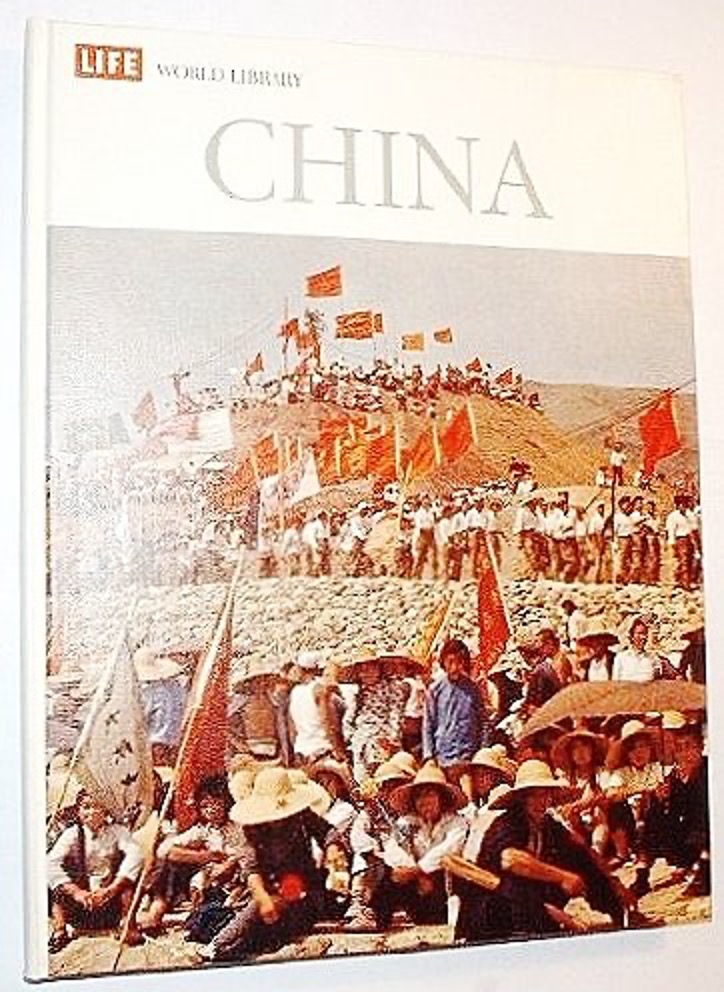
My fascination with China started at an early age. I remember as a child leaving through the Time-Life World Library series volume for China (1965); its photographs grainy black and white, and tinted colour, only serving to increase the mystique about the nation then isolated behind the Bamboo Curtain at the height of Mao’s Cultural Revolution. Back then, to be able to stand on the Great Wall of China, or to see the vastness Tiananmen Square seemed as probable as going on a school trip to the Moon.

I was in my late 20s when I first visited the Middle Kingdom, and through a series of events, choices, and decisions, later found myself living and working in the ethnic borderlands of southwest China for more than a dozen years from the mid-2000s. During that time in-country, as well as before and after during my various travels throughout China, how many times do you think I visited the capital, Beijing? Half-a-dozen times? Or at least 10 times? Sorry. I have to confess, even though I ‘knew’ Beijing through books and documentaries — and creating travel itineraries for tour groups — I never once visited in person the Chinese capital. 

Yes, that’s right. I crafted detailed, tailor-made itineraries for first-time visitors to Beijing, to give them an insider’s experience of the capital, without getting within a thousand kilometres of the great city. My excuses include:

1 – China is vast, and almost the same size as Europe;

2 – It would take 3 days by train from my courtyard house in Yunnan’s Lijiang to the Forbidden City, and I wasn’t up for such a long journey

3 – To be honest, I wasn’t as enthralled about Beijing after hearing mixed reports from other travellers, so I decided I could live (and/or die) without casting my eyes upon the sights and wonders of Beijing. 

A small window of opportunity opened to me recently when the stars aligned between jobs and other responsibilities. I had turned down the invitation to speak at a national tourism conference about the future of China’s tourism development post-pandemic, but I got to visit China for the first time since 2019, making an extended stopover in the capital. A visa-exemption initiative recently re-instated to encourage tourism without the need for pre-approved visas meant I could theoretically apply for a 144-hour transit stamp. 

So, I touched down at Beijing’s Capital International Airport (IATA code PEK) early one morning after an overnight flight from the southern hemisphere. This being my first time without a pre-approved (and expensive) visa I was a little nervous, and my fears were not allayed when no one was staffing the 144-hour visa desk. Was this the first great wall I had to overcome? I got sent from one immigration queue to another, a couple of times having to go against the flow of newly-arriving passengers and slip upstream through security. When eventually an official arrived to process the paperwork and issue the transit stamp, I had to show all my flight and accommodation bookings; not an easy task when you can’t connect to the airport wi-fi. 

I was sweating, not just because of the late summer heat, but also because I had booked a bus tour to the Great Wall that was leaving at 8 a.m. from central Beijing, a train and subway ride away. “Dear Sir, our assembly point is at Exit C of Dengshikou Subway Station on Line 5,” read my instructions. “You can see the guide wearing a blue vest. Please arrived at the assembly point 10 minutes early.”

Having a Chinese bank card, a map preloaded onto my phone, and some decent residual Mandarin skills, along with no reservations about queue-jumping as payback for being delayed, I found an ATM, and headed to the exit of the massive airport. There were only a few seconds to admire the impressive roof arching over Terminal 3, designed by Sir Norman Foster for the 2008 Beijing Olympics as I marched across the marble floors towards the Capital Airport Express. It was just after 7 a.m. but already I could see how Beijing Capital Airport is — or was — the second busiest airport in the world. 

Transferring from the airport line train downtown to the metro, the time on my phone was counting down towards the departure time. I worried that if I missed my bus, my whole trip would be ruined; and that such an inauspicious start to my Beijing exploration would cause a chain reaction of delays, missed opportunities and regret. Maybe I’d never make it to the Wall. Then I thought: take it easy, it’s not the destination, it’s the journey. I studied the Chinese characters for Dengshikou, recognising the first Sinogram as meaning light or lantern.

Arriving at the subway station, I quickened my pace up the stairs and escalators to emerge into sunlight at Exit C. It was 7:59. Fortunately, a blue-vested person was standing in the middle of the carpark. “Do I have time to grab something to eat or drink?” I asked the ZANbus guide in my slightly rusty Mandarin. “No. We’re leaving right now,” she said, ushering me onto the bus.

“But we have bottles of water on sale onboard.”

My online booked tour, a bare basics budget-friendly US$25 including admission ticket, offered three advantages: visiting a less-visited section of the Great Wall a mere 70km from Beijing, arriving before the ‘other tourists’, and being a strictly ‘no shopping’ experience (many tours visit several stores where guides and drivers make huge commissions). As the only non-Chinese person on the coach, the guide (who was supposed to speak some English) gave me a special briefing (in Mandarin), explaining the options for going up and coming down from the Mutianyu section of the wall, as we sped out of the metropolis heading towards the green rolling hills in the hazy distance. 

As we passed orchards, with growers selling freshly-picked fruits and nuts, I secretly wished we could stop for some shopping, not just to support the locals, but to ease my rumbling empty stomach. A nearby passenger, a man in his 20s visiting from a central province, whom I later dubbed ‘Running Man’, live-streamed the succession of farmer’s markets we zoomed past, in between video-chatting to his girlfriend. “There’s apples, pears, apricots, plums, grapes, persimmon, walnuts and huge peaches,” I heard him say. Since the bus driver didn’t once slow down, I justified to myself that, even though probably quite delicious, that produce would probably be exorbitantly over-priced for day-tripping Great Wallers like myself. 

By 9.30am I was striding along an arcade of mainly unopened shops past the visitor centre, stopping to buy more water, and some snacks. “How about an ice cream?”one vendor asked me after I looked into his glass-top freezer. “Later, OK?” A cafe offered a latte coffee, but the US$8.25 price tag reminded me that China gives too much status to the beverage, which is sometimes just instant coffee and creamer. A Chinese family, long-resident in the UK, gave me a fuller rundown on the logistics for sightseeing, where to meet the guide for the trip back to Beijing (the waiting hall just near Burger King), and most importantly, when the bus driver would be leaving (4pm sharp). “Also, if you tell them you are with this bus company, there’s a discount at Subway,” the teenage son chimed in as we boarded an electric vehicle for a short ride to the base station for the ascent of the crestline high above us. Looking along the line of the hills, I could just make out the crenellated up-and-down patterns of the walls, stretching off into the far distance. 

Now you’ve probably heard it many times, but let’s dispel the myth: the Great Wall of China is not visible from space. It is not visible from the Moon. It isn’t even visible to the naked eye from the low-orbit International Space Station. The popular myth goes back centuries, and more recently has been part of the propaganda of modern China to state that the wall was the only human-made structure that could be seen from space. The myth was challenged when Apollo 12 lunar module pilot Alan Bean said, “The only thing you can see from the Moon is a beautiful sphere, mostly white, some blue and patches of yellow, and every once in a while, some green vegetation. . . No man-made object is visible at this scale.”

Some artificial structures such as cities, highways and dams are visible from space, but the Great Wall is only visible from low Earth orbit with magnification or high-powered camera lenses. This was confirmed by China’s own first astronaut who went around planet Earth 14 times in 2003 on Shenzhou 5. “The Earth looked very beautiful from space, but I did not see our Great Wall.”

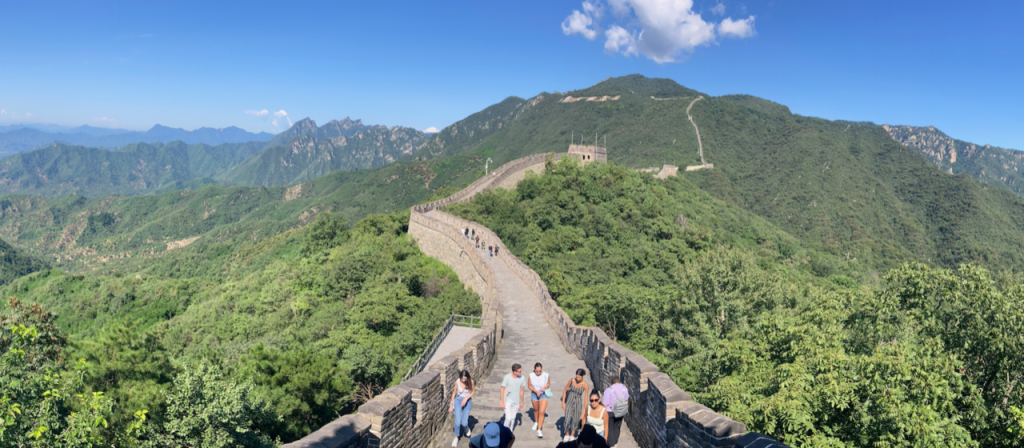
Photographs provided by Keith Lyons

To get personal and up-close with the Great Wall, other passengers decided to get a chairlift up and traipse further along between watchtowers and then take a toboggan (“speed slide”) down for 5 minutes of excitement. Rather than hike up (crazy in the heat), I opted to take the same cable car up and down (less than US$20 return).

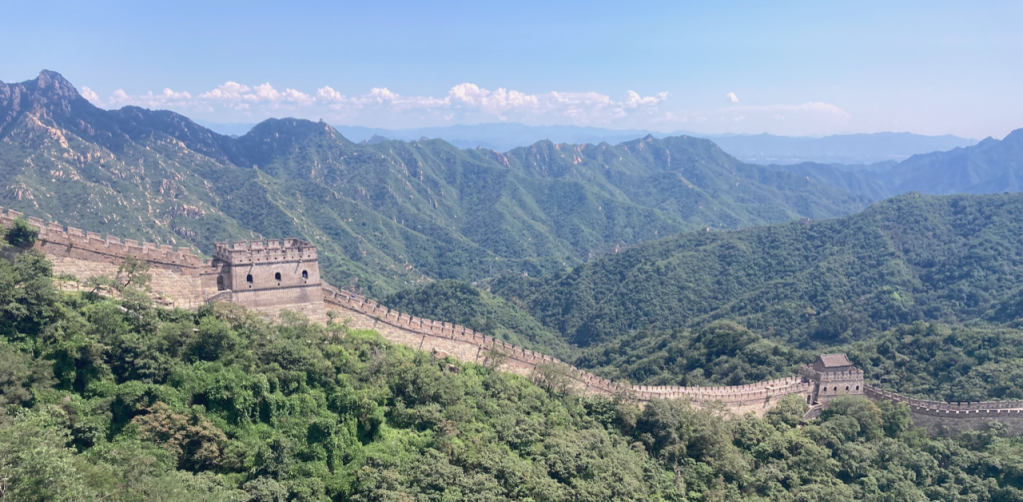
Within minutes we could look down on the graceful, curved line of each section of the wall as it gently arched from one watchtower to the next. Wow! As the cable car reached its terminus near watchtower 14, the extent of the Great Wall to the north was revealed, fading to the horizon as vegetation and battlement became indistinguishable. 

The Mutianyu section extends some 5.4km, and though work began in the 6th century, much of it was rebuilt or renovated in the 15th and 16th centuries. In the 1980s about 2.3 km of that section was restored, so over the last three decades, more and more people have been able to visit the less crowded and commercialised alternative to the more famous, most-restored, scenically magnificent Badaling section. 

At Mutianyu, constructed of granite blocks, the wall has been made pedestrian-friendly and smooth, though there were steps, some steep in parts as they climb to the series of watchtowers. My fellow passenger Running Man darted around taking selfies and videos, as if he had only 24-hours left to live. Couples set off to the best spots to take photos, while a group of three university students set their sights on the highest watchtower, No.20, which could take one or two hours return depending on speed, stops and stamina. The path climbs from the low of watchtower 17, with the steepest leg between 19 and 20. 

Being something of a mountain goat myself, you might expect me to join them purposefully climbing towards the much-talked-about ’20’, but this goat was tired, jet-lagged, and hungry. Instead, I wandered along to the next abutments and decided to just sit in the shade admiring the view. This is just what I had envisioned, I wrote in my journal. And it was. Just like in the photos. Actually, I had expected the Great Wall might be more crowded with jostling visitors, but less than half those getting off the cable car ventured beyond watchtower 16 — and it wasn’t a weekend or holiday. 

At watchtower 17, it was so quiet and still that I could hear cicadas in the pine and chestnut trees flanking the wall. A pair of sparrows darted around, a plane flew overhead, and I watched the slow progress of a centipede across the path from the inner parapet to the invader-facing crenelation, a distance of four or five metres. Surely, the centipede hadn’t climbed all the way up the seven or eight metres of the Wall’s walls, five times the height of an adult? During its construction, which went until the mid-1600s, parts of the wall were made with bricks, held together by a durable glutinous rice mortar — arsenic was used to prevent insects from eroding away the wall. 

An old man, who has been sitting nearby in the shade while his adult son and grandchildren went on further, finishes drinking from a plastic water bottle and discards it over the side. I feel like saying something, but stop myself, realising that some attitudes and behaviours are slow to change. He probably thinks the Great Wall was visible from space, I confide to myself. 

The Wall’s modest width, no bigger than a road, was probably why it couldn’t be easily spotted from above. However, it did provide a fast means of travel and transportation for troops. Officially, the Great Wall was some 21,198 km long – that’s equivalent to half the equator – but up to a third of the structure has disappeared over time. It’s not just one continuous wall either, with sidewalls, parallel walls, enclosing walls, and even sections where there are no walls, just high mountain ridges, rivers, ditches or moats as the barriers. The Wall can lay claim to being the longest man-made structure as well as the largest building construction project ever undertaken. On a blank page I start a rough sketch of the section in front of me, trying to get my head around how this is just a tiny fraction of the longer, greater wall.

As well as being for border defence, the Great Wall also served to transmit messages, using watchtowers and beacon towers. From the next watchtower, the grandson of the bottle-litter-man waves but failing to catch the attention of the old man, he runs back along the wall path yelling, “Yéye – Granddad! Did you see me waving to you at the next castle?”

There is a certain irony about this extensive bulwark constructed across northern China and southern Mongolia up to two millennia ago to keep out invaders which now every day is climbed over by tourists from Mongolia, Russia, Eurasia and beyond. This is supposed to keep us out. But here we are, on the top of the wall and fortifications, having invaded, not from beyond, but from the downtown of the capital of the nation. So much for the upright projections, resembling teeth bared at the enemies. 

Other travel experts and expats living in Beijing tell me if I visited Mutianyu a month later, I would see the surrounding maple, oak and chestnut trees in their autumn splendour. In winter, snow transforms the scene. But on this day, I am just happy to be present, to take on the literal meaning of Mutianyu — Admire Fields Valley — as I take the cable car down to the bountiful valley, snack on a corn cob sprinkled with chilli, and some fresh walnuts. As the clouds turn to a sudden rainstorm, in the comfort of the waiting hall, after savouring an ice cream, I let the day catch up on me.

Photo provided by Keith Lyons

Back on the bus at 4pm, Running Man is sunburnt red and sweaty — but still grinning as he sorts through his photos and videos. The mother hen guide gives us all a small memento of the day, a fridge magnet of the Great Wall, as a reward for all making it back on time. 

The next thing I recall is being woken by the guide. I must have drifted off to sleep. “We’ve arrived,” she says, pointing towards an entrance to the Beijing metro which seems different from the starting point. For a moment, I wonder if I have been dreaming it all: the Great Wall, the perfect day, how everything worked out in the end. Then I realised it was all true: I’ve just seen and been on the Great Wall. And I have the fridge magnet in my pocket to prove it. I turn to say goodbye to Running Man, but he’s already exited the bus, and is making for the escalator down.

*Read the Day two of Keith Lyon’s China trip by clicking here

Keith Lyons (keithlyons.net) is an award-winning writer and creative writing mentor originally from New Zealand who has spent a quarter of his existence living and working in Asia including southwest China, Myanmar and Bali. His Venn diagram of happiness features the aroma of freshly-roasted coffee, the negative ions of the natural world including moving water, and connecting with others in meaningful ways. A Contributing Editor on Borderless journal’s Editorial Board, his work has appeared in Borderless since its early days, and his writing featured in the anthology Monalisa No Longer Smiles.

.

PLEASE NOTE: ARTICLES CAN ONLY BE REPRODUCED IN OTHER SITES WITH DUE ACKNOWLEDGEMENT TO BORDERLESS JOURNAL. 

Click here to access the Borderless anthology, Monalisa No Longer Smiles

Click here to access Monalisa No Longer Smiles on Kindle Amazon International

Categories
Poetry

A Homage to Yuan Zhen’s Grief of Separation

Poetry and translation by Rex Tan

A Homage to Yuan Zhen’s Grief of Separation*

Shall I compare an ocean's vastness to 
the width of the greatest river? The 
evening sky pales to the azure of the summit. 

The time I wandered through a familiar flower field --
I can’t be bothered to look back, partly due 
to Fate’s weaving hands, partly due to you. 

Smoking under the 
bleak wintery overcast
memories of your 
bright summery laugh dissipates 
into a fleeting mist.

Forlorn, I’m a shadow by the hills 
of a spire-filled dream.
And with a gentle flick, I cast 
the hanging memories of your sojourn 
into the wind. 

*The first two paras are a liberal translation of Yuan Zhen's "Grief of Separation". 
Yuan Zhen was a Tang dynasty poet, lived from 779 to 831 in Luoyang, China

Rex Tan is a journalist by trade and a poet at heart. As a Malaysian, he is fluent in English, Mandarin, and Malay, yet he calls none his first language.

PLEASE NOTE: ARTICLES CAN ONLY BE REPRODUCED IN OTHER SITES WITH DUE ACKNOWLEDGEMENT TO BORDERLESS JOURNAL

Click here to access the Borderless anthology, Monalisa No Longer Smiles

Click here to access Monalisa No Longer Smiles on Kindle Amazon International

Categories
Interview Review

Festivities Celebrating Loneliness: The World of Isa Kamari

An introduction and a conversation with Isa Kamari, a celebrated Singaporean writer

Isa Kamari

Isa Kamari is a well-known face in the Singapore literary community. He has won numerous awards — the Anugerah Sastera Mastera, the SEA Write Award and the Singapore Cultural Medallion, the Anugerah Tun Seri Lanang. He has been part of university curriculums and has written for the television. With 11 novels, nine of which have been translated from Malay to English — and some into more languages like Arabic, Mandarin, Urdu and Turkish, French, Russian Spanish — three poetry books, plays and one novella written in English by him, one can well see him as a leading voice in literature on this island that seems to have grown into a gateway for all Asia.

Kamari’s writings dip into his own culture to integrate with the larger world. The most remarkable thing about his works, for me has been the way in which he has brought the history of Singapore from the Malay perspective into novels and made it available for all readers. The most memorable of these actually gives the history of the time around which the Treaty of Singapore was signed between the British and the indigenous ruler in 1819, handing over the port to Raffles, the treaty that was crucial to the founding of modern Singapore. The novel is named after the year of the treaty.

Other novels like Song of the Wind , Rawa and Tweet — all bring into perspective how the local Orang Seletar integrated into the skyscrapers of Singapore. We can see in his writings how the indigenous moved to be integrated into a larger whole of a multi-racial, multi-religious accepting modern city. One of his novels, One Earth (1999), is like an interim almost, set during the Japanese occupation in Singapore. The narrative dwells on the intermingling of races in the island historically. Kiswah and Intercession are novels that cry out for reforms on the religious front.

He also has novels that delve into individual journeys to glance into the maladies of the modern-day world. Whether it is faith, or career, he brings into focus the need to heal. Recently, Kamari has brought out a book of short stories, Maladies of the Soul, to focus on just this. His fifteen short stories centre around the issue mentioned in the title. In the first ten stories, he writes of old age, of mental stress, of compromises made to achieve success, of anxieties just as the title suggests. These are internal conflicts of people in a country where most have enough to eat, a house to live in and access to education for their offsprings. Then in the last five stories, he moves towards not just showcasing such maladies but also resolving, using narratives that are almost surrealistic, or poetic. They are not happy but reflective with the ability to make one think, look for a resolution. They are discomfiting narratives.

One of the last stories is given from the perspective of a silkworm — a powerful comment on the need for freedom to survive. Another has the iconic Singapore Merlion emote to an extent. The writing escapes the flaw of being didactic by its sheer inventiveness. One is reminded that this is a book by an author from a city-state which has resolved problems like poverty to a large extent. That the journey was arduous and full of struggle can be seen in Kamari’s earlier novels. But now, that people have enough to eat and live by, he takes the next step that is necessary. His stories demand not just being familiar with the issues they faced in the past, but also suggest a movement towards resolving the social problems that in a developed country can warp individuals to make them non-functional and make the society lose its suppleness to adapt and progress.

One of the stories like his earlier novel, The Tower, reflects the climb of a careerist, an architect, up a tower he has built, while recalling the compromises made. The interesting thing is the conclusions have a similar impact. And then, there is yet another story that is almost Kafkaesque in its execution, where a man turns into a bull — a comment on stock trading or people’s obsession with money and to compete?

The book needs to be read sequentially to get the full impact of his message. For, he is a writer with a message, a message that hopes to heal the world by integrating the spiritual with modernisation. In this conversation, he discusses his new book and his journey as a writer.

What makes you write? What moves you to write? Why do you write?

I need to be disturbed by events, issues and thoughts before thinking of writing anything. I would then ponder and research on the topics at hand. Only when I have my own tentative resolution of the conflicting elements, I would begin to write. Most often, my views and positions will change as I write further. In that sense writing is a form of discovery and therapy for me.

Tweet in Spanish

Do you see yourself as a bi-lingual writer or a Malay writer experimenting in English? You had written your novella, Tweet, in English. Later it was translated to more languages. How many languages have you been translated into? Do you feel the translations convey your text well into the other language?

Culturally, I think in Malay. English is a language of instruction for me. When I attempt to translate my Malay works into English, the writing sounds and feels Malay. Tweet is a result of a challenge I imposed upon myself to write creatively in English. The result is not bad. Tweet has been translated into Malay, Arabic, Russian, French, Spanish, Azerbaijan and Korean. I wouldn’t know how well the novella has been translated because I do not know those languages. I trust the translators whom I choose carefully.

The stories of Maladies of the Soul first appeared in Malay. Now in English. Did you translate them yourself, being a bi-lingual writer? Tell us your experience as a translator of the stories. Did you come across any hurdles while switching the language? What would you say is the difference in the Malay and English renditions?

Yes, I translated all the stories in the book. I had to overcome my own fear that the stories might end up too Malay in expression and feel. But I told myself to be true to my own voice and not be inhibited by language structure and convention. I would not know exactly the difference between the two renditions. I was just interested to tell the stories.

Is this your first venture into a full-length short story book? Tell us how novels and short stories vary as a genres in your work. How do you use the different genre to convey? Is there a difference in your premise while doing either?

I have produced just one collection of short stories. In each of the short stories, I had to be focussed on expressing concepts and philosophies on a single problem of the human condition. In my novels the concepts and philosophies are varied, expanded, more complex and layered but yet interrelated and weaved around dynamic human experiences facing common predicaments or challenges of an era.

One of the things I noticed about the book was that the stories would convey your premise better if read in order. Is that intentionally done or is it a random occurrence?

The short stories can be weaved into a novel. There is a central spine, which is my observation and philosophy of life which bind them all. The intrinsic sequence or order is not intentional, but perhaps it is the psychological thread and latent articulation of the storyteller.

Some of the stories seem to have echoes in your novels, like Kiswah and Intercession, both of which deal with crises in faith. Did your earlier novels have a direct bearing on your short stories?

I used to transform my poems into short stories, and from those write novels. The genres are just tools for me to express my thoughts and feelings. I use whatever works. I have even experimented on weaving short stories and poems in a novel. I wanted to create prose that are poetic, and poems that are capable of conveying a narrative. My latest novel, The Throne, is a result of this experiment.

Some of your stories touch on the metaphorical, especially the last five. Some of the earlier ones describe unusual or even the absurd situations we face in life. As a conglomerate, they explore darker areas of the human psyche, unlike your novels which were in certain senses more hopeful, especially Tweet. What has changed to bring the darker shades into your writing? Please elaborate.

The stories in Maladies of the Soul have a common theme of alienation in various facets and dimensions of life. As such the expected feeling after reading them is that of gloom and hopelessness. That is intentional as a revelation of the deeper and hidden fallacy of modern life that appears organised and bright on the surface. I wanted my readers to be shaken or at least moved to ponder and reflect on our current, shallow and fractured human condition. There is a better life if we were to look the other way and be more mindful and caring of each other and our environment.

I still recall a phrase from your novel, The Tower, “Festivities celebrating loneliness”. Would you say your short stories have moved towards that?

Exactly.

Why did you choose short stories over giving us a longer narrative like a novel?

It is like giving my readers bite sizes of my exploration and philosophy of life. I leave it to the readers to weave the stories into a whole, and reflect upon their own experiences, thoughts and feelings, perhaps in a more integrated and holistic manner.

What are the influences on your writing?

Life itself. Like I mentioned earlier I do not write in a vacuum. I engage life in my writing as a way of validating my ever-changing existence. I want my life and writing to be authentic and significant. Hopefully, meaningful to others too.

What can your readers look forward from you next?

I have just completed a draft of a novel in Malay, Firasat. As in all my novels, I offer a window towards healing by embracing a rejuvenated Malay philosophy called firasat which is an intuitive, integrated, balanced, lucid, harmonious and holistic way of life.

Thank you for sharing your time and your writings with us.

(The online interview has been conducted by emails by Mitali Chakravarty)

PLEASE NOTE: ARTICLES CAN ONLY BE REPRODUCED IN OTHER SITES WITH DUE ACKNOWLEDGEMENT TO BORDERLESS JOURNAL. 

Click here to access the Borderless anthology, Monalisa No Longer Smiles

Click here to access Monalisa No Longer Smiles on Kindle Amazon International