Categories
Review

Mapping the Mind

Book Review by Navleen Multani

Title: Mapping the Mind, Minding the Map

Editors: Basudhara Roy and Jaydeep Sarangi

Publisher: Sahitya Akademi

Mapping the Mind, Minding the Map edited by Basudhara Roy and Jaydeep Sarangi anthologises twenty contemporary poets. This book unveils a large canvas of poems penned by poets hailing from diverse locations and cultures, evoking thoughts on existential dilemmas of the contemporary world. The 391 pages of the anthology comprise poems by multiple poets: Adil Jussawalla, Arundhati Subramaniam, Ashwani Kumar, Bashabi Fraser, Bibhu Padhi, Jayant Mahapatra, K. Satchidanandan, K.Srilata, Keki N.Daruwalla, Lakshmi Kannan, Mamang Dai, Nabina Das, Robin S. Ngangom, Sanjukta Dasgupta, Tabish Khair, Usha Akella, Yogesh Patel and more

Every poem entails evocative images, visual and syntactic cues that put forth poetics of everyday life. Traversing maps and minds, this engaging collection of two hundred poems unravels different places and persons. The anthology is a poetic narrative and holistic exploration of locating oneself through language. As the book brings together experiences and knowledge of space, it pushes readers to rethink how landscape shape identity.

Memories encompassing reflections on landscapes, ancient history, myth, family, home, towns, cities, countries, music, seasons, elements of nature, disasters, wants, love and wounds of Homo Sapiens, women, mother as well as immigrants abounds the creation of every poet. Memories of special days, seasons, cities and cultures culminate in the compositions of Mamang Dai. Nabina Das’ creations talk about death and else. Sanjukta Dasgupta juxtaposes past and present to celebrate free spirit of Kali, Alakshmi and Millenial Sita.

This compilation, published by Sahitya Akademi, is an itinerary for dreamers and travellers alike. Ten poems by each poet weave a tapestry of emotions, experiences, moments and memories that define persons, places, practices and cultures. Every word, image and syntactical turn in these poems moves readers to discover poet’s emotional state. Events and myriad experiences, memorable and unpleasant, form an intricate reflection on life. The poems are also revelations about the contemporary world. The mosaic of memories present a ceaseless stream of significant moments that mould the minds and the maps. The compositions heighten consciousness, enrich the understanding of readers and deepen their humanity. The poems make the readers encounter hardships, moments of despair, compassion, empathy and resilience to extract invaluable insights. Reflections on difficult and dark times infuse renewed strength to deal with adversity.

Every poet uses different linguistic register to delve into solitude, decay, death and a new force that nurtures mind as well as takes to greater understanding about existence. “When Landscape Becomes Woman” by Arundhati Subramaniam reveals “That a chink in a wall is all you need to tumble into a parallel universe”. Whether it is Bashabi Fraser’s “Mothers All” claiming, “They are the bravest soldiers-marching on”, or Adil Jussawalla’s “Refuge” telling “Mother tells her rosary from six to seven, her one hour refuge,” each poet, irrespective of gender, envisions an independent and autonomous identity. “What’s wrong with us Kali women?”, “Maryada[1] and modern Draupadi”, “Woman in a Landscape” by Adil Jussawalla, “History”, “Draupadi”, “Partition Ghazal”, “The Tribal Goddess” and “Patna to Nalanda-1979” by Keki N.Daruwalla transport readers from past to present and illuminate multi-facets of life. “Somewhere like a shadow in the night like a black mineral in the earth, /Somewhere in a mirror where you can see your dreams a poem awaits deftly angled light,” writes Keki Daruwalla. Ashwani Kumar’s poems dwell on Alzheimer’s, lies emerging from deception, town vanished in the reservoir of waters and the strange ways of the world.

The deftly crafted poems blend imagery, thoughts and experiences. Many of the poems are centred on home, landscape and seasons. Titles of a few poems like “Mitti[2]’, “Bhakti[3]”, “Haldi[4]”, “Mahaprajapati[5]”, “O Boisakh[6]” and “Lopamudra[7]” have not been provided with a translation. Supplementing these titles are poems like “Earthrise”, “Missives of Music”, “The Same Moon from Edinburgh to Calcutta: A Refracted Lens”, “Sunrise at Puri-on-Sea”, “The River” and “Earth Day”.

The poems ranging from prose to typographic and linguistic variations, Mapping the Mind, Minding the Map speaks to larger issues of urban Indian identity, acceptance, adaptation and cultural estrangement. These map the poetics of womanhood, the body, institution, family and love. By doing so, the anthology erases traditional boundaries to develop a new poetic form. The poems are ensembles of words that unite to present verbal, vocal and visual sphere of communication.

This three-dimensional language becomes carrier of aesthetic message of the poet. The reduction of language to a word or fragments in many of the poems is similar to the reduction of landscape to map elements selectively and generally. This gives a distinct charm to the anthology. The poems explode with bird-names, names of cities and countries making these compositions a dialectical map. Very aptly the poems, as Howard McCord contends, can be comprehended as “a map on which articulation of consciousness can be charted, and the serial flow we associate with prose can be gathered into clusters and islands of words which reveal the individual’s voice and vision, even his philosophical stance, more accurately than a line broken by a general rule imposed.” Poems in Mapping the Mind, Minding the Map are maps that offer ways to know simplified, generalised and selective views on the world and human existence.

[1] Dignity

[2] Mud

[3] Devotion

[4] Turmeric

[5] The woman who raised Buddha

[6] The second month in the Bengali calendar which coincides with April-May

[7] A philosopher who lived in the Rigvedic age

Dr Navleen Multani is Associate Professor, Head, School of Languages, and Director, Public Relations at Jagat Guru Nanak Dev Punjab State Open University, Patiala (India). She is Area Editor with Oxford Online Bibliographies: Literary and Critical Theory.

.

PLEASE NOTE: ARTICLES CAN ONLY BE REPRODUCED IN OTHER SITES WITH DUE ACKNOWLEDGEMENT TO BORDERLESS JOURNAL

Click here to access the Borderless anthology, Monalisa No Longer Smiles

Click here to access Monalisa No Longer Smiles on Kindle Amazon International

Categories
Contents

Borderless, November 2023

Art by Sohana Manzoor

Editorial

Counting Colours… Click here to read.

Conversation

Banjara author Ramesh Karthik Nayak discusses his new book, Chakmak (flintsone), giving us a glimpse of his world. We also have a brief introduction to his work. Click here to read.

Translations

Demanding Longevity by Quazi Johirul Islam has been translated from Bengali by Fakrul Alam. Click here to read.

Moonlight, a poem by Bashir Baidar, has been translated from Balochi by Fazal Baloch. Click here to read.

Maithili Poetry by Vidyanand Jha has been translated from Maithili by the poet himself. Click here to read.

The Window and the Flower Vase has been written and translated from Korean by Ihlwha Choi. Click here to read.

Tagore’s Tomar Kachhe Shanti Chabo Na (I Will Not Pray to You for Peace) has been translated from Bengali by Mitali Chakravarty. Click here to read.

Poetry

Click on the names to read the poems

Michael Burch, Aineesh Dutt, Stuart McFarlane, Radhika Soni, David Mellor, Prithvijeet Sinha, John Grey, Ahana Bhattacharjee, Ron Pickett, Suzanne AH, George Freek, Arshi Mortuza, Caroline Am Bergris, Avantika Vijay Singh, Ryan Quinn Flanagan, Kisholoy Roy, Rhys Hughes

Poets, Poetry & Rhys Hughes

In A Parody of a Non-existing Parody: The Recycled Sea, Rhys Hughes uses TS Eliot’s ‘The Waste Land’ to create a new parody. Click here to read.

Musings/Slices from Life

The Theft of a River

Koushiki Dasgupta Chaudhuri tells a poignant truth about how a river is moving towards disappearance due to human intervention. Click here to read.

In Quest of Seeing the Largest Tree in the World

Meredith Stephens writes of her last day in California. Click here to read.

Beyond Horizons: A Love Story

Sai Abhinay Penna shares photographs and narrative about his trek at Chikmagalur. Click here to read.

Musings of a Copywriter

In Crush on Bottles, Devraj Singh Kalsi inebriates his piece with humour. Click here to read.

Notes from Japan

In Address Unknown, Suzanne Kamata shares a Japanese norm with a touch of humour. Click here to read.

Essays

Peeking at Beijing: The Wall

Keith Lyons travels to The Great Wall and writes of the experience. Click here to read.

Cinema, Cinema, Cinema!

Gayatri Devi writes of the translation impact of cinema, contextualising with the Tamil blockbuster, Jailer. Click here to read.

Coffee, Lima and Legends…

Ravi Shankar explores Lima, its legends and Peruvian coffee. Click here to read.

Stories

Jonathan’s Missing Wife

Paul Mirabile sets his story in a small town in England. Click here to read.

The Tender Butcher

Devraj Singh Kalsi weaves a story around a poetic butcher. Click here to read.

Book Excerpts

An excerpt of The White Shirts of Summer: New and Selected Poems by Mamang Dai. Click here to read.

An excerpt from Ramesh Karthik Nayak’s Chakmak. Click here to read.

Book Reviews

Somdatta Mandal reviews Ali Akbar Natiq’s Naulakhi Kothi, translated from Urdu by Naima Rashid. Click here to read.

Ranu Uniyal reviews I am Not the Gardener: Selected Poems by Raj Bisaria. Click here to read.

Anita Balakrishnan reviews Lakshmi Kannan’s Guilt Trip and Other Stories. Click here to read.

Bhaskar Parichha reviews Akshat Rathi’s Climate Capitalism: Winning the Global Race to Zero Emissions. Click here to read.

.

.

Click here to access the Borderless anthology, Monalisa No Longer Smiles

Click here to access Monalisa No Longer Smiles on Amazon International

Categories
Editorial

Counting Colours

Look around you and expand your heart. 
Petty sorrows are insignificant.
Fill your vacant life with love for humanity. 
The Universe reverberates with celestial ecstasy. 

— Anondodhhara Bohichche Bhubone (The Universe reverberates with celestial ecstasy), Tagore, 1894

Some of the most beautiful colours in this universe are blended shades— colours that are born out of unusual combinations. Perhaps that is why we love auroras, sunrises and sunsets. Yet, we espouse clear cut structures for comprehension. As we define constructs created by our kind, we tend to overlook the myriads of colours that hover in the gloaming, the brilliant play of lights and the vibrancy of tints that could bring joy if acknowledged. That ignoring the new-born shades or half-shades and creating absolute structures or constructs lead to wars, hatred, unhappiness and intolerance has been borne true not only historically but also by the current turn of events around the globe. While battles are never fought by the colours or beliefs themselves, they can harm — sometimes annihilate — rigid believers who are victimised for being led to accept their way as the only one and hate another. Perhaps, this has echoes of the battle between the Big Endians and Little Endians over the right way to break eggs in Jonathan Swift’s Gulliver’s Travels (1726). As the book is mere fiction, we can admire, agree and laugh at the content. However, in real life, watching newsreels has become a torture with destruction and violence being the main highlights. These detract from life as we knew it.

Writing or literary inputs seem to have become a luxury. But is it really hedonistic to play with words? Words used effectively over a period of time can impact readers to think peace, acceptance and love and also help people heal from the ensuing violence. That can be a possibility only if we self-reflect. While we look for peace, love and acceptance in others, we could start by being the change-makers and bridge builders ourselves. That is the kind of writing we have managed to gather for our November issue.

Building such bridges across humanity, we have poems on the latest Middle Eastern conflict by Stuart McFarlane and David Mellor, which explore the pain of the victims and not the politics of constructs that encourage wars, destruction of humanity, the flora, the fauna and our home, the Earth. Michael Burch writes against wars. Prithvijeet Sinha and Ahana Bhattacharjee write about refugees and the underprivileged. Reflecting colours of the world are poems from Ryan Quinn Flanagan, Suzayn AH, Radhika Soni, Ron Pickett, George Freek and many more. Rhys Hughes has brought lighter shades into his poetry by trying a new technique while reflecting on yetis and mermaids. His column tries to make a parody of a non-existing parody, using TS Eliot’s century old poem, ‘Wasteland’, with amazing results!

Our translations are all poetry too this time. Professor Fakrul Alam has translated a poem discussing human aspirations by Quazi Johirul Islam from Bengali. Another Balochi poem of hope by Bashir Baidar has been brought to us in English by Fazal Baloch bringing into play the moonlight.

For the first time, we are privileged to carry poetry from a language that has almost till now has eluded majority of Anglophone readers, Maithili. Vidyanand Jha, a Maithili poet, has translated his poetry for all of us as has Korean poet, Ihlwha Choi. Winding up translations are Tagore’s ultimate words for us to introspect and find the flame within ourselves in the darkest of times – echoing perhaps, in an uncanny way, the needs of our times.

Our conversation this month brings to us a poet who comes from a minority group in India, Banjara or gypsies, Ramesh Karthik Nayak. In his attempt to reach out to the larger world, he worries that he will lose his past. But does the past not flow into the future and is it not better for traditions to evolve? Otherwise, we could all well be living in caves… But what Nayak has done — and in a major way — is that he has brought his culture closer to our hearts. His debut poetry book in English, Chakmak (flintstones), brings to us Banjara traditions, lives and culture, which are fast getting eroded and he also visits the judgemental attitude of the majoritarian world. To give you a flavour of his poetry, we bring to you an excerpt from his book, livened beautifully with Banjara art and an essay by Surya Dhananjay that contextualises the poetry for us. Our excerpts also have a focus on poetry for we are privileged to have a few poems from Mamang Dai’s The White Shirts of Summer: New and Selected Poems. Mamang Dai is a well-known name from the North-eastern state of Arunachal Pradesh for both her journalistic and poetic prowess.

We are happy to host Ranu Uniyal’s beautiful review of I am Not the Gardener: Selected Poems by Raj Bisaria. Bisaria among other his distinctions, was named “Father of the modern theatre in North India” by the Press Trust of India. The other reviews are all of prose. Somdatta Mandal has written of Ali Akbar Natiq’s Naulakhi Kothi, a fictional saga of gigantic proportions. Anita Balakrishnan has reviewed Lakshmi Kannan’s short story collection, Guilt Trip. The book that gives hope for a green future, Akshat Rathi’s Climate Capitalism: Winning the Global Race to Zero Emissions has been reviewed by Bhaskar Parichha. Parichha contends: “Through stories that bring people, policy and technology together, Rathi reveals how the green economy is possible, but profitable. This inspiring blend of business, science, and history provides the framework for ensuring that future generations can live in prosperity.”

The anti-thesis to the theme for a welfarist approach towards Earth can be found in Koushiki Dasgupta Chaudhari’s poignant musing titled, “The Theft of a River”. Meredith Stephen’s travel to California and Sai Abhinay Penna’s narrative about Chikmagalur have overtones of climate friendliness. Ravi Shankar writes further of his travels in Peru and Peruvian coffee. Keith Lyons takes us peeking at Beijing and the Great Wall. Gayatri Devi adds to the variety by introducing us to the starry universe of South Indian cinema while Devraj Singh Kalsi brings in the much-needed humour with his narrative about his “Crush on Bottles“. Suzanne Kamata has also given a tongue-in-cheek narrative about the mystique of addresses and finding homes in Japan. We have fiction from Paul Mirabile located in England and Kalsi’s located in India. Pause by our contents page to view more gems that have not been mentioned here.

Huge thanks to our team at Borderless Journal, especially Sohana Manzoor for her fabulous artwork. This journal would not have been as it is of now without each and every one of them and our wonderful contributors and readers. Thank you all.

Wish you all a wonderful month as we head towards the end of a rather tumultuous year.

Mitali Chakravarty

borderlessjournal.com

Click here to access the contents page for the November 2023 issue

.

READ THE LATEST UPDATES ON THE FIRST BORDERLESS ANTHOLOGY, MONALISA NO LONGER SMILES, BY CLICKING ON THIS LINK.

Categories
Excerpt

Poetry by Mamang Dai

Title: The White Shirts of Summer: New and Selected Poems

Author: Mamang Dai

Publisher: Speaking Tiger Books

Hello, Mountain

Every morning when the forest wakes
The canopy goes for a walk
Hailing the sun, courting the wind
Discussing fruit and weather

The idle moss turns into velvet
Branches make signs.
Who says there is no time?
The only thing we are given is Time.

Chattering life high above,
Babel of tree dwellers.
For a seed falling so far down
To rise again, time is a given.
A foothold for the hunger of a weed,
Colour, scent, camouflage
And the grass that never sleeps

Shooting up to meet the gaze of the mountain.
How are you, mountain?
Is everything all right?
Is the earth growing old,
Birds flying away, trees falling?


After Gabo

No one can say it like you said it,
about love and magic,
solitude and growing old.

Here it’s white butterflies
whirling around in the garden
and the scent of bitter almond
is the scent of orange blossom.

You know, love is a virus too,
jumping ship,
landing up in ports and cities
so eager, enchanted
by the banks of another river
in the time of quarantine.

There are lines and lines
of communication
jostling through a virtual pandemic,
a sadness named, unnamed.

Fermina Daza, is it true:
Everything is in our hands?

Outside my window
red hibiscus, red.
If the aim is to survive,
it’s time to weigh anchor again.

For how long? Who knows.

Our old life is gone.
It’s another summer
and the pages are turning
in a chronicle of things foretold.

One battered flag in a time of lockdown.
Despite contrary winds
a battered flag is fluttering,
you’ll see it here and there
pointing in the direction of the future.
Salt water, caresses,
buoyant as the hearts of old lovers
young enough to believe
in forever.

(Extracted from The White Shirts of Summer: New and Selected Poems by Mamang Dai. Published by Speaking Tiger Books, 2023.)

About the Book:

 ‘A major voice in Indian English literature, and literature from North East India…[Her] poems are like a race of butterflies bargaining with the night.’

Keki Daruwalla

‘Dai’s poetic world is one of river, forest and mountain, a limpid and lyrical reflection of the terrain of her home state. Nature here is mysterious, verdant with myth, dense with sacred memory. There is magic to be found everywhere…But as you read closer, you [also] sense a more sinister undertow: this paradisiacal landscape is also one of “guns and gulls”, punctuated by “the footfall of soldiers”. You also realize that the simplicity of Dai’s verse is not without guile. It possesses a gentle persuasive riverine tug that can lead you to moments of heart-stopping surprise.

‘For all its simplicity, Dai’s poetry does not arrive at easy conclusions. There is no dishonest sense of anchor here, no blissful pastoral idyll. The poet describes her people as “foragers for a destiny” and her work is pervaded by a deep unease about erased histories and an uncertain future. And yet, implicit in her poetics is the refusal to divorce protest from love. This seems to translate into a commitment to a poetry of quiet surges and eddies rather than gritty textures and edges…[and] a tone that is hushed, wondering, thoughtful, reflective. The strength of this poetry is its unforced beauty and clarity, its ability to steer clear of easy flamboyance.’

Arundhathi Subramaniam

About the Author

 Mamang Dai, poet and novelist, was born in Pasighat, Arunachal Pradesh. A former journalist and a Padma Shri awardee, Dai is the author of a short story collection, The Legends of Pensam, and the novels Stupid Cupid, The Black Hill (winner of the Sahitya Akademi Award) and Escaping the Land (longlisted for the JCB Prize). Dai lives in Itanagar, Arunachal Pradesh.

.

PLEASE NOTE: ARTICLES CAN ONLY BE REPRODUCED IN OTHER SITES WITH DUE ACKNOWLEDGEMENT TO BORDERLESS JOURNAL

Categories
Contents

Borderless, August 2022

Art by Sohana Manzoor

Editorial

The Stars were Shining There for You & Me, for Liberty… Click here to read.

Conversation

The Making of Historical Fiction: A Conversation with Aruna Chakravarti unfolds the creation of her latest novel, The Mendicant Prince, based on the prince of Bhawal controversy in the first part of the last century. Click here to read.

Translations

Tagore’s humorous skit, The Treatment of an Ailment, has been translated by Somdatta Mandal. Click here to read.

Arise, Arise O Patriot! and Helmsman Attention! by Kazi Nazrul Islam have been translated from Bengali by Professor Fakrul Alam. Click here to read.

Pus Ki Raat or A Frigid Winter Night by Munshi Premchand has been translated from Hindi by C Christine Fair. Click here to read.

Tagore’s Song of Hope or ‘Hobe Joye‘ has been translated from Bengali by Mitali Chakravarty. Click here to read.

Poetry

Click on the names to read

Rhys Hughes, Ratnottama Sengupta, Mike Smith, Rituparna Mukherjee, Tony Brewer, Ahmed Rayees, Ron Pickett, Ramesh Dohan, Sister Lou Ella Hickman, Sambhu Nath Banerjee, Candice Louisa Daquin, Oindri Sengupta, Gigi Baldovino Gosnell, Ryan Quinn Flanagan, Tanvi Jeph, George Freek, Michael R Burch

Poets, Poetry & Rhys Hughes

In Mini-Sagas: A Dozen Examples, Rhys Hughes talks of a new genre with dollops of humour. Click here to read.

Musings/Slices from Life

Istanbul

G Venkatesh has a stopover in the airport to make a discovery. Click here to read.

The Loyal Dog in Loyalty Island

Meredith Stephens makes friends with a dog in the township of Wé on the Lifou island, an ‘overseas territory’ of France. Click here to read.

The ‘New Kid on the Block’ Celebrates…

Dr Kirpal Singh ruminates over what led to the making of an island state, Singapore. Click here to read.

Remnants of Time Once Spent Together

Sayali Korgaonkar ruminates over loss and grieving. Click here to read.

Moonland

Rupali Gupta Mukherjee journeys through the moonlike landscape housing a monastery with her camera and a narrative. Click here to read.

King Lear & Kathakali?

PG Thomas revisits a performance that mesmerised him in a pre-covid world. Click here to read.

Musings of a Copywriter

In A Bone in My Platter, Devraj Singh Kalsi shares a taste of running a restaurant. Click here to read.

Notes from Japan

Suzanne Kamata writes a light slice from life in The Boy & The Cats: A Love Story. Click here to read.

Stories

Does this Make Me a Psychic?

Erwin Coombs tells a suspenseful, funny, poignant and sad story, based on his real life experiences. Click here to read.

Hard Choices

Santosh Kalwar gives a glimpse of hope for an abandoned girl-child in Nepal. Click here to read.

No Rain on the Parade

Tan Kaiyi goes on a hunt for the National Day Killer. Click here to read.

Until We Meet Again

Shivani Shrivastav transports us to Manali for a misty union. Click here to read.

The Hatchet Man

Paul Mirabile tells a story of murder and horror. Click here to read.

I am Not the End

Aysha Baqir takes on the persona of a computer to unleash a poignant and chilling story. Click here to read.

Essays

How Many Ways To Love a Book

Sindhu Shivprasad describes passion for books. Click here to read.

Hiking in the Himalayas with Nabinji

Ravi Shankar explores more of Himalayas in Nepal. Click here to read.

Freedom is another word for… Zohra Sehgal

Ratnottama Sengupta gives a glimpse of the life of Zohra Sehgal, based on the book Zohra: A Biography in Four Acts by Ritu Menon, and her own personal interactions with the aging Zohra Sehgal. Click here to read.

The Observant Immigrant

In Can We Create a Better World by Just Wishing for it, Candice Louisa Daquin dwells on the question to locate answers. Click here to read.

Book Excerpts

An excerpt from The Dreams of a Mappila Girl: A Memoir by B. M. Zuhara translated by Fehmida Zakeer. Click here to read.

An excerpt from Michael R Burch’s poetry book, O, Terrible Angel. Click here to read.

Book Reviews

Meenakshi Malhotra reviews Tagore’s Four Chapters translated and introduced by Radha Chakravarty. Click here to read.

Gracy Samjatsabam visits Mamang Dai’s Escaping the Land. Click here to read.

Aditi Yadav reviews Pallavi Aiyar’s Orienting : An Indian in Japan. Click here to read.

Rakhi Dalal visits Neelum Saran Gour’s Requiem in Raga Janki. Click here to read.

Bhaskar Parichha reviews Rakesh Batabyal’s Building a Free India. Click here to read.

Categories
Editorial

The Stars were Shining There for You & Me, for Liberty…

Painting by Sohana Manzoor

“It just so happens that their[1] universes were different from ours: because why would their imaginations be constrained by a nation-state that would not exist for another thousand years?”

Anirudh Kansetti, the print.in

These lines from a recent article on conquests carried out by the Indian subcontinent in ancient times brings to focus that earlier countries or nation-states as we know of them today did not exist till the industrial revolution set the concept in motion. In the month many countries in Asia celebrate their independent existence or rather the drawing of borders based on colonial mapmakers’ whims, we should perhaps relook at the way the world stands divided.

Is this what we want as humans? Where are we headed? While conquerors write the history, we tend to gloss over what is left unsaid. The millions who died crossing borders, in race riots and of hunger, starvation and disease in refugee camps is overlooked, or worse, used to justify the divisions that still hurt the residents of the sub-continent and try to destroy any sense of oneness among the human species. We tend not to forget the atrocities of the colonials but we overlook the violence of the mobs that incensed with hatred instilled by politics annihilated and murdered. Their story is reduced to “us” and “them”. In our mood of jubilation, the recent bombings in the Middle East and the Ukraine-Russia war have already been delegated to the newsreels. But these are all people who are killed and displaced without any justification for the need to do so. One of the things that George Orwell had depicted in 1984 was an acceptance of a constant state of war. Are we stepping into that frame of mind with our cold acceptance of the situation worldwide?

In the last century, many united against the atrocities of the empire builders. They wanted to rise above the divides. At least greats like Nazrul vociferously objected to the basis of divides that were used to draw the borders. Translations brought to us by Professor Fakrul Alam showcase such poetry as does much of Tagore’s own writing and actions. Tagore organised a protest march against the colonial proposal of Partition of Bengal in 1905 by taking a procession in which he encouraged Hindu and Muslim women to tie rakhis[2] on men from the other community and make them their brothers. Tagore put the welfare of humanity above nationalism as can be seen in his writings and speeches. Reflecting on humanity, we have Munshi Premchand’s powerful story, Pus Ki Raat or A Frigid Winter’s Night, translated from Hindi by C Christine Fair, dwelling on the sad state of peasantry under the Raj. In a bid to rouse people like the protagonist of Premchand’s story, Tagore wrote inspirational songs, one of which, Hobe Joye (Victory will be Ours) has been translated on our pages. We also continue sharing Rabindranath’s humour with a skit translated by Somdatta Mandal from Bengali.

Humour is also stirred into Borderless by Rhys Hughes with a series of mini sagas in his column and a trip around the world in eighty couplets. These couplets actually are more in number — I tried counting them — and are guaranteed to make you laugh. We have travel stories in plenty too. Ravi Shankar again treks to the Himalayas and brings us wonderful photographs of his journey and G Venkatesh stops over at Istanbul airport to find a friend from across the border. Meredith Stephens travels to a French colony called Lifou Island — sounds unbelievable as in the month we celebrate the independence of so many countries across Asia, there is still a country in the Pacific that owes allegiance to a democratic European power! But other than writing about the beaches, Stephens talks of a temporary pet dog while Suzanne Kamata gives us cat talk in her notes from Japan in a lighter vein — a very pleasant glimpse of life. Devraj Singh Kalsi brings a grin when he talks of his stint at trying to run a restaurant.

Interesting non-fictions from a book lover, Sindhu Shivprasad, and from PG Thomas who talks of King Lear performed a la classical Indian dance mode, Kathakali, by an international caste add to narratives that focus on bringing the pleasanter side of life to our readers. Such stories are a welcome relief in dark times when people find themselves caught between price hikes due to the pandemic and wars. An essay by Candice Louisa Daquin looks for a way out of the stresses of these times. Erwin Coombs gives us a funny, poignant and tragic classroom encounter which reminds me of the 1967 Sidney Poiter movie, To Sir, with Love. We have darker tones brought into our journal also with Aysha Baqir’s story on child exploitation, a sad but hopeful narrative from Nepal by Santosh Kalwar about the rejection of a girl-child by her mother and a horrific murder brought to us by Paul Mirabile.

Our poetry section this time flows over with poems from Michael R Burch, Ryan Quinn Flanagan, George Freek, Mike Smith, Gigi Baldvino Gosnell and even Ratnottama Sengupta, who has also given us a powerful essay on an acclaimed dancer called Zohra Sehgal whose life was changed by the Partition of the Indian subcontinent in 1947, basing her essay on Ritu Menon’s Zohra: A Biography in Four Acts and her own personal encounters with the irrepressible artiste. Michael Burch has also shared an excerpt of his book dedicated to his wife, O, Terrible Angel.

An excerpt from B. M. Zuhara’s The Dreams of a Mappila Girl: A Memoir, translated from Malayalam by Fehmida Zakeer, brings us close to a community we know very less about in the Southern part of India. Meenakshi Malhotra has reviewed Tagore’s Four Chapters translated from Bengali and introduced by Radha Chakravarty, a book that is a powerful voice against violence in the name of nationalism touching on the independence of women, a theme that is reiterated in another book that has been visited by Rakhi Dalal. While exploring Neelum Saran Gour’s Requiem in Raga Janki, Dalal contends that the book familiarises us with a singer “who carved her own destiny and lived life on her own terms, in times when women were generally subjugated and confined to roles given by society”. Gracy Samjetsabam has visited Mamang Dai’s Escaping the Land, a novel that tries to weave issues faced in the Northeast of India and integrate it with the mainstream by stirring human emotions.  Bhaskar Parichha has reviewed Rakesh Batabyal’s Building a Free India, a collection of powerful speeches from the past.

Within the confines of the Raj, there was a long court case where a prince who had been declared dead resurfaced as a Naga sadhu[3], a claimant to the throne, this time not to abuse his power as of past but to be a sympathiser of the people in their tryst to fight the Raj. Aruna Chakravarti has woven a historical fiction around this controversy centring around the prince of Bhawal. In an exclusive interview, she tells us the story behind the making of The Mendicant Prince — her novel that was published just last month. Her responses could well teach us how to write a historical novel.

We have much more than the fare that has been mentioned here. Pause by on our contents page to take a look. My heartfelt thanks to the whole team at Borderless for helping with this issue, which we managed to get out in a shorter time than usual and Sohana Manzoor for her wonderful artwork. I am grateful to all our contributors as well as our readers. We could not have made it this far without all of you.

In the spirit of uniting under a borderless sky, let us look forward to cooler climes and happier times.

Cheers!

Mitali Chakravarty

borderlessjournal.com


[1] Guptas (4-6 century CE), Cholas (300 BCE -1279 CE) and other ancient rulers in the Indian sub-continent

[2] A festival held in August where sisters of all ages tie a talisman or amulet called the rakhi around the wrists of their brothers, who promise to protect them.

[3] Mendicant

Categories
Review

The Story of Arunachal Pradesh

Book Review by Gracy Samjetsabam

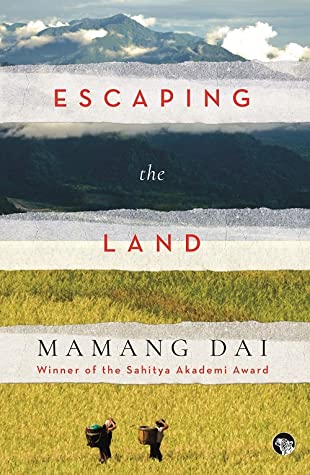
Title: Escaping the Land

Author: Mamang Dai

Publisher: Speaking Tiger

Escaping the Land (2021) by Mamang Dai is a gripping saga of turbulent times in Arunachal Pradesh from the North East Frontier Agency (NEFA) days to the present times. Padmashri and Sahitya Akademi Awardee, Mamang Dai, is an anglophone poet and novelist from Arunachal Pradesh.

In Escaping the Land, Mamang Dai weaves the history, myth and politics of Arunachal Pradesh across time. Maying, the narrator returns to her homeland from Delhi to do a project on the land of her birth and its people. Dai uses Maying to recount the story, blending fiction and history from when the state was governed as the NEFA[1] to becoming the twenty-fourth state of India as Arunachal Pradesh in 1987.

Maying meets Lutor, the ageing veteran politician and the son of a shaman, who is loved by the people and has had a long and successful career in politics since the formation of the state, to share “the story of a long ago when everything had been different and full of possibilities”. As she runs through the flow of time from the past to the present, Maying ruminates over Lutor’s idea of the “original obsession” that all of us are born with and the power of “dreams” and “instinct”. As the story begins, Maying picks up an old journal marked NEFA notebook and shuffles through the old piece of memorabilia to reflect, “The lives of people in every village and district had changed since the time this piece of fern had been so carefully pressed in between the thin pages of the book”.     

Dai divides the book into five sections. The story opens with the view of a traditional house that stands on a hill with thick bamboo thickets and mountainous region. The author talks of the essence of dates and calendars in the lives of the people of a close-knit community in a remote part of the state, where tradition and family mattered. Time is an overarching theme in the novel. “Time had a method”, where everything happened in stages and history was written as it came. Dai’s novel recounts changes in time and history in the place and culture of the people of the state with emphasis on Pasighat, which was also her hometown.

Dai’s story interestingly accommodates an avalanche of landmark incidents in the history of the north-eastern state of India including battles against oppression starting from 1911,  the Achingmori incident (1953), the India-China War (1962), the liberation of Bangladesh (1971) and its impact on the state, the passing of the infamous Bill for Control of Organised Crime Act (APOCO), and also, on migration and infiltration of outsiders. References to attending boarding school in Shillong, going to Delhi for higher education, or taking long hours of ferrying across the tumultuous tributaries of the Brahmaputra river that flow in the region for a sarkari[2] job, Dai reflects through the fiction the sea of change experienced in the lives of men and women in terms of education and perceptions of security in moving in or out of their homes.    

Experiences of the horrors and violence in the face of insurgency, militancy and atrocities in the times of war that the people faced are vividly incorporated in some sections of the story. In times of uncertainty in the story, dreams and reality collide in a delirious mix of magic and mystery. Dai fuses myth as a consolation to the harsh realities of history. A mystic rain man heralds that change and loss of solitude cannot be halted. Though it is often reiterated that “We are safe in the hills” speedy changes in time made Lutor and his close friends rethink the credibility of this remark. Dai explodes beautiful metaphors that are specific to the culture, cross-cultural references to the exchange of people and culture from outside India, other parts of India and of the neighbouring states of Assam, Nagaland, and Manipur.   

In the shifting times, money and greed have engulfed traits of love and loyalty for one’s land and people. Time moved to stages of no return from how it was in the mythical time of the ancient civilization of the Kojum-Koja [3]of the land, to when politics seemed to overtake every move in the place. The story highlights the sentiments of the people in the midst of  the politics of inclusion and exclusion in the periphery.

As candidate for the office of Chief Minister, Lutor promises of development, “caught between a feeling of great humiliation and a pitying love for his homeland” but lost to his corrupt and crooked political rival Tanik, who had more money and men.  Varied interesting characters add flavour to the story. With the non-retreating timber trade, where greedy traders, politicians, local middlemen and forest mafia no longer care to uproot the whole of the virgin forest in the state, the ecology at stake is echoed in the corruption portrayed in the story. Lutor in a dire strait between the memory of a lost time acknowledges that times have changed but continued to believe and live in anticipation of a pan-Arunachal unity and hopeful idea of home.

Dai through Lutor’s nostalgia for a peaceful land and longing for a homeland devoid of greed and corruption, implicates that love can heal and restore the state to a humane land as it had been in the past. Time brought changes and the world infringed by investing more money into the state. While business boomed, Lutor, as the title suggest, looked outward to escape from the land not as one defeated but with a hope to explore newer possibilities so that he could return with a better tomorrow. 

In the engrossing historical novel, Escaping the land (2021), Dai works on a huge canvas to lyrically voice a tale of time, geography and changes that leads to a cohesion with the larger world.


[1] The North-East Frontier Agency (NEFA), originally known as the North-East Frontier Tracts (NEFT), was one of the political divisions during the Raj

[2] government

[3]  Kojum-Koja was supposed to be an ancient civilisation that established villages, part of the ancient tribal lore.

.

Gracy Samjetsabam teaches English Literature and Communication Skills at Manipal Institute of Technology, MAHE, Manipal. She is also a freelance writer and copy editor. Her interest is in Indian English Writings, Comparative Literature, Gender Studies, Culture Studies, and World Literature. 

.

PLEASE NOTE: ARTICLES CAN ONLY BE REPRODUCED IN OTHER SITES WITH DUE ACKNOWLEDGEMENT TO BORDERLESS JOURNAL