Categories
Excerpt

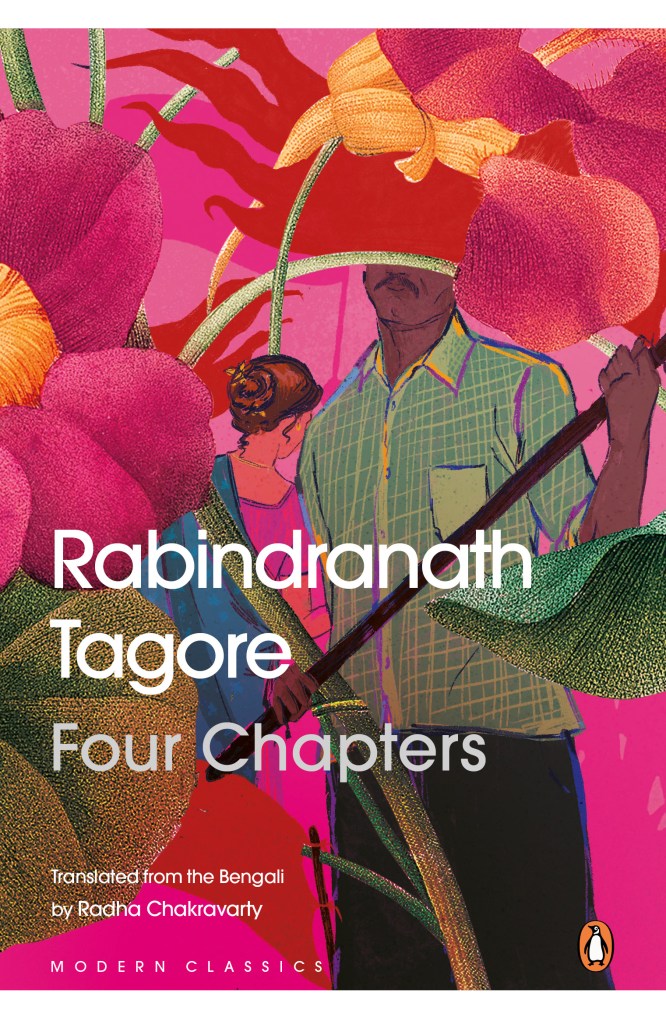
Tagore’s Four Chapters in Translation by Radha Chakravarty

Title: Rabindranath Tagore Four Chapters

Translator: Radha Chakravarty

Publisher: Penguin, May 2022

‘It’s time to utter some harsh truths,’ he declared. ‘Who are you to surrender me, to the nation or to anyone else, I ask you? You had it in your power to surrender the gift of tenderness—a possession that truly belongs to you. Whether you call it service or a boon, it doesn’t matter. If you permit arrogance, I shall be arrogant. If you demand that I come to your door in humility, I can do that too. But today you belittle your own right to offer a gift. You set aside the inner wealth you could have donated from the storehouse of a woman’s glory and say instead that you are handing over the nation to me. It is not yours to give! Not yours, not anyone else’s. The nation can’t be passed around from hand to hand.’

The colour drained from Ela’s face.

‘What do you mean? I can’t quite understand,’ she said. ‘I say that the ambit of women’s glory, even if it seems to be circumscribed, has inner depths that are limitless. It is not a cage. But the space that you had designated as my nest, by giving it the name of the nation—that nation constructed by your party, whatever it may mean to others—that space itself is a cage, at least for me. My own power, because it can’t find full expression within that space, falls sick, grows distorted, commits acts of insanity in its attempt to articulate that which is not truly its own. I feel ashamed, yet the door to escape is closed. Don’t you know my wings are tattered? My legs are tightly shackled. One had the responsibility to find one’s own place in one’s own nation on one’s own strength. I possessed that strength. Why did you make me forget that?’

‘Why did you forget it, Antu?’ asked Ela, her voice full of anguish.

‘You women have an unfailing ability to make one forget—all of you. Else, I would have been ashamed of having forgotten. I insist a thousand times over that you have the capacity to make me forget myself. If I hadn’t forgotten, I would have doubted my own manhood.’

‘If that is so, then why are you rebuking me?’

‘Why? That’s what I am trying to explain. By deluding me, you carry me to your own universe where your own rights prevail. Echoing the words of your own party, you said that you and your small group have determined the only path of duty in the world. Caught in that stone-paved, official path of duty, my life-stream spins in a whirlpool and its waters grow muddy.’

‘Official duty?’

‘Yes, that Jagannath Ratha—that grand, sacred chariot of your swadeshi duty. The one who initiated you into the sacred mantra decreed that your only duty is to hoist a heavy rope onto your shoulders and keep on tugging at it—all of you together—with your eyes closed. Thousands of young men tightened their waistbands, braced themselves and grasped the rope. So many of them fell beneath the chariot wheels; so many were crippled for life. At this juncture, the moment came for the Ratha Yatra—the ceremonial chariot procession—in reverse. The chariot turned around. Broken bones can’t be mended. The masses of crippled workers were swept aside, flung down upon the dust-heaps by the roadside. Their confidence in their own power had been so utterly demolished at the very outset that all of them agreed, with great daring, to let themselves be cast in the mould of puppets of the government. When at the pull of the puppeteer’s strings everyone began to perform the same dance moves, they thought in amazement, “This is what the dance of power is all about!” When the puppeteer loosens the strings ever so slightly, thousands and thousands of human puppets get eliminated.’

‘But Antu, that only happened because many of them began to dance wildly without keeping to the rhythm.’

‘They should have known from the start that humans can’t dance like puppets for long. You may try to reform human nature, though it takes time. But it’s a mistake to imagine that destroying human nature and turning men into puppets will make things easier. Only when one thinks of human beings in terms of their diverse forms of inner power can one understand the truth about them. Had you respected me as such a being, you would have drawn me close, not to your party, but to your heart.’

‘Antu, why didn’t you humiliate and spurn me right at the beginning? Why did you make me a culprit?’

‘That’s something I have told you time and again. Very simply, I longed to be one with you. That hunger was impossible to overcome. But the usual route was closed. In desperation, I pledged my life to a crooked path. You were captivated by it. Now I have realized that I must die on the path I have taken. Once that death happens, you will call me back with open arms—call me to your empty heart, day after day, night after night.’

About Rabindranath Tagore Four Chapters

This is a brilliant new translation of Tagore’s controversial novel. Passion and politics intertwine in Char Adhyay (1934), Rabindranath Tagore’s last and perhaps most controversial novel, set in the context of the freedom struggle in pre-Independent India. Ela, a young working woman, comes under the spell of Indranath, a charismatic political activist who advocates the path of terror. She joins his band of underground rebels, vowing never to marry, and to devote her life to the nation’s cause. But through her relationship with Atindra, a poet and romantic who grows disenchanted after joining the group, Ela realizes the hollowness of Indranath’s machinations. The lovers now face a terrible choice …

This new translation brings Tagore’s text to life in a contemporary idiom, while evoking the charged atmosphere of the story’s historical setting.

About the Author

Rabindranath Tagore, Renaissance man, reshaped Bengal’s literature and music, and became the first non-European to win the Nobel Prize in Literature in 1913. He introduced new prose and verse forms and the use of colloquial language into Bengali literature, thereby freeing it from traditional models based on classical Sanskrit. He was highly influential in introducing the best of Indian culture to the West and vice versa, and was a living institution for India, especially for Bengal.

About the Translator

Radha Chakravarty is a writer, critic, and translator. In 2004, she was nominated for the Crossword Translation Award for In the Name of the Mother by Mahasweta Devi.

PLEASE NOTE: ARTICLES CAN ONLY BE REPRODUCED IN OTHER SITES WITH DUE ACKNOWLEDGEMENT TO BORDERLESS JOURNAL. 

Categories
Editorial

Where Have All the Sunflowers Gone?

Only when the cries of the wretched of the earth will stop renting the skies,
Only when the oppressor’s bloody sword will cease smearing battlefields,
			A rebel, weary of war,
			Only then I won’t stir.
…
I’m the ever-rebellious hero--
	Soaring over the world, all alone, head forever held high!

--  Rebel or 'Bidrohi' (1922) by Nazrul, translated by Fakrul Alam
Borderless: Digital Art by Ayaan Ghoshal
These fragments I have shored against my ruins
…
Datta. Dayadhvam. Damyata.         
 Shantih shantih shantih

-- Wasteland (1922) by TS Eliot

These lines reiterate values we would do well to live by in a war-torn, dissension-worn world where the need for a rebel to recreate a humane society that lives with values such as peace, generosity, acceptance, tolerance, compassion and restraint — is a felt need. The two great poems made history by remaining as popular a hundred years after they were written — ‘The Rebel’ by Nazrul and TS Eliot’s ‘Wasteland’. Nazrul defined a rebel as an iconoclast who breaks norms to find peace, justice and love for all, to move towards the creation of an ideal world. TS Eliot quoted from the Upanishads and ended with redemption coming with giving (giver perhaps denoted generosity), compassion and restraint. Despite the wisdom of these great poets and seers, war still continues a reality. The values remain neglected not just in as we see in conflicts, like the one in Ukraine that destroys lives, property and nature with intolerance towards differences, but also in our personal lives. Tagore also reiterated the same need for stepping out of personal, social, economic and political insularity. We carry a translation of a song that echoed this need while inviting participation in his ecstasy. He wrote:

Why do you sit in isolation,
Dwelling on self-centred issues? 

Tagore had not only written of the negative impact of isolation from the world but he led by example, building institutions that could lead the world towards pacifism with acceptance of diversity and inclusiveness. Sriniketan and Santiniketan were created to move towards these ideals. Many of the people he influenced or who studied in Santiniketan made history, like Prime Minister Indira Gandhi, Satyajit Ray; many added to the sense of inclusiveness, like Mahasweta Devi, who other than her enormous work to integrate different cultures, also wrote a memoir about Santiniketan in Bengali. Radha Chakravarty, nominated for the Crossword Translation Award (2004) for In the Name of the Mother by Mahasweta Devi, has translated this memoir, a narrative which brings us close to Tagore’s ideals of the whole world being a family. How wonderful it would be if the world were open to such ideals and would behave like a global family and not go to war!  Mahasweta Devi, Our Santiniketan, which has been reviewed by Meenakshi Malhotra, reiterates Tagore’s vision of a planet living in harmony with the flora and fauna.

Bhaskar Parichha has reviewed another non-fiction by Ashok Kumar Pandey, Why They Killed Gandhi; Unmasking the Ideology and the Conspiracy. Parichha writes: “The finest point about this book is its storytelling…” The book review brings to mind in the midst of a war and violence that Gandhi had tried to erase this mindless destruction of lives, nature and cities with Ahimsa or non-violence. Will we ever rise up to it? Perhaps… We see strains of recognising the negative impact of insular outlook in writings like that of Temsula Ao, a Sahitya Akademi Award winner, according to Indrashish Banerjee who has reviewed her new book, The Tombstone in My Garden: Stories from Nagaland. Keith Lyons has reviewed Asian Anthology: New Writing Vol. 1: Stories by Writers from Around the World, edited by Ivy Ngeow, an exotic medley of Asian stories, one of which has been excerpted as well.

We are privileged to carry another excerpt from Ruskin Bond’s Friends in Wild Places: Birds, Beasts and Other Companions, a hilarious story about a pet tiger adopted by the legendary writer’s grandfather. What is amazing about Ruskin Bond’s writing is the love and compassions for all creatures great and small that colours the tongue-in-cheek humour he rolls out to his readers. If only we could think like Bond, there would be no wars. His writing, I feel, transcends political borders or ‘isms’, and laces with love and compassion tales of menageries of monkeys, snakes, mongoose, humans of different denominations. This excerpt is a treat we are giving Borderless Journal as the journal completes two years of its existence. We are truly grateful to Speaking Tiger for sharing this excerpt with us. But our celebrations this time are sombre as the war rages with incoherence accompanied by heart-breaking ravages.

The refrain from Ukraine has been taken up by Ratnottama Sengupta as she takes us through the past and present experiences of the devastated country, bringing in the views of the legendary folk singer and pacifist, Pete Seeger (1919-2014), who she had interviewed over a span of four days. The writer of ‘Where have all the Flowers Gone?’, a song based on an Ukrainian folk song, Seeger said, “The point is not to ask for yourself alone — one has to ask for everybody: Either we all are going to make it over the rainbow or nobody is going to make it.” Candice Louisa Daquin has also pondered on the justification of war, contextualising it with the current one along with her essay on the paradox of modern linguistic communication.

We have an exhaustive essay on the legendary Satyajit Ray’s creations by Anasuya Bhar. Malhotra has pondered at exclusivity reinforcing divisions, margins and borders to plague humankind, against the backdrop of the Women’s Month, March. Highlighting women in writing, we have interviewed two female writers, one from Nepal and another from Bangladesh. Sangita Swechcha lives in UK but her writing, till now largely in Nepali, often pines for her home embedded in the Himalayas whereas, an expat, Neeman Sobhan, shuttles between Bangladesh and Italy with the affluence and assurance of a privileged background.

Finding a way to override lack of privileges, deprivation and violence, are the youngsters of Nithari on the outskirts of Delhi where less than two decades ago other than poverty, savage criminality devastated the local populace. These youngsters transcended the suffering over time with help from volunteering NGOs to create narratives that amaze with their inventiveness and confidence. Tanveer Hussain from Nithari, self-motivated and self-made from a young age, asks questions that would be relevant for all humankind in a letter to God. It has been translated from Hindustani by Vritika Thareja of pandies’. This edition’s translations include Professor Fakrul Alam’s mellifluous rendition of Jibanananda Das’s poetry from Bengali to English, Ihlwha Choi’s Korean poetry and a Balochi poem by Munir Momin rendered in English by Fazal Baloch. Baloch had earlier translated poems by Akbar Barakzai, a great poet who departed on 7th March, depriving the world of yet another powerful writer who imbibed hope of a better future in his poetry. We are privileged to have hosted the translations of some of his poems and his last interview.

Another well-known poetic voice from Singapore, Kirpal Singh, has given us poignant poetry that can be applied to the situation that is leading to the wreck of Ukraine. Anasuya Bhar has  poetry, one of which despite being in the ilk of Nazrul’s great poem, ‘Rebel or Bidrohi’, questions gently mainly social constructs that obstruct the flow of harmony. Ryan Quinn Flanagan has pondered on the acceptance of a changed world. We have humour from Rhys Hughes in poetry and wonderful poems by Michael R Burch on spring. Jay Nicholls shares the last of her dozen Pirate poems as Blacktarn sails the lemon seas to fight pollution. Luis Cuauhtémoc Berriozábal, George Freek, Sutputra Radheye, Mike Smith, Shaza Khan and many more have contributed a wealth of beautiful lines. Penny Wilkes has captured storms and seas with photographs and text and Rhys has surprised us with some strange, bizarre tales in his column.

We have musings from around the world. San Lin Tun, Meredith Stephens, Erwin Coombs, G Venkatesh have all brought in flavours of multiple cultures. Devraj Singh Kalsi has spoken of a book fair he visited in a semi-sardonic tone. He has also given us a short story as has Farah Ghuznavi – a truly borderless story which takes place in an aeroplane, in the sky where all borders collapse. We have more stories from Balochistan, US and India.

Suzanne Kamata continues writing on Japan as she  introduces us to an Australian film maker who is making films in Japan and in Japanese, called Felicity Tillack. Cultures are perhaps truly crossing borders as we can see Kenny Peavy, an environmentalist who moved from US to Indonesia start a new column with us called ‘Mission Earth’. We hope, like Tagore or Rousseau, he will help to revive our felt need to live with nature, acknowledge the nurture that we get from the planet to live in harmony with it and on it.

At the end of twenty-four months of existence – that sounds better than a mere two years— we are happy to host a melange of writers from across the borders and be the meeting grounds of writers and readers from across continents. I am truly thankful to all of you for helping concretise an ideal. Huge thanks to all the writers, artists, photographers and the readers for the contribution of their time, effort and love. And thanks to our fabulous team who continue to support the journal unwaveringly. I would also like to thank Sohana for the lovely visuals she generously shares with us. A special thanks also to young Ayaan Ghoshal for his digital art where hands reach out to support a truly borderless world.

As usual, all the content has not been covered here, I invite you all to enjoy our March edition of Borderless Journal.

At the start of the third year of our existence, let us march onwards towards renewed hope – maybe the Ukraine experience will take us closer to a war-free world with an awakening of a felt need for peace and compassion in a planet without borders.

In quest of a peaceful, humane world, I invite you all to continue being part of this journey.  

Mitali Chakravarty

Borderless Journal