Categories
Excerpt

The Blue Dragonfly

Title: The Blue Dragonfly – healing through poetry

Author: Veronica Eley

Publisher: Hidden Brook Press, Ontario

grey blanket					[from Prelude]

earliest memory
driving along
a country road
in the back seat
wrapped
in a grey blanket
in the dark

separation
the side bars
on the hospital bed
two years old
pneumonia

fifteen-year-old girl
raped
police declare
emotionally disturbed
wrapped
in a grey blanket
taken home

disturbed
turbulent
the waters
the waves, the waves
are big, mommy
the cold, grey ocean
is deep
I lean against the railing
of the White Star Cunard liner
seven years old

railings
grey blanket
grey, grey 


secret monsters				[from Presentation]

when I am dog tired
deep down below
an ambiguous voice
declares itself

blasphemous language
often, with a highly sexual content
pokes out its unseemly head
to scream and thrash about

language from a deep abyss
dirty tributaries
foul-mouthed monsters
who live in my
subterranean landscapes

loud mouthed
the desire to smash and hurt
to feed the monster within
to let out a little vengeful steam
is the only way to calm the beast

in some ways
I live a life of pretence
hidden
shameful
feeding the snake within
with disgusting morsels

 
the bodhisattva				[from Altered States]

she wanders through the streets
a heart as big
as the whole outdoors
warding off criticisms
from voices long
ago dead

how do you
lose
rolling the dice of
compassion?
the fashion in the 90s
: to give
politically/correctly

the knife of deconstruction
blasts
beliefs, values, ideals
the high-rise
terminology
-laden
hierarchical
transcendent, dualistic
world
crumbles (post
-modernized)
leaving us with
No Thing, powering our appetites
to violent
pornographies

karma
equals Choice
equals Action
equals Identity

where does this yearning
come from? the bodhisattva’s loving
compassion, undifferentiated
interconnective, doing
and undoing

do we have any
other choice?
in our best dress
our Sunday best
our best frame of mind
-- compassionate be

I exist between myself
and you


mother						[from Home]

eternal mother
conniving tributary peace strategies
love and replenishment
look to the sun
the bare branches
outlining our destinies

reaching to the heavens
rooted in fertile ground
our arms reach upward
bare, rough and brown
the colour of the earth

take care, dear mother
look to the sunset
the glorious colours
I will be thinking of you

About the Book

The Blue Dragonfly: healing through poetry is a verse narrative of trauma and recovery, 120 poems organized into three acts: Secret Monsters, The Bodhisattva, and Mother. Distinguished by an intense affectivity of language, its poetry of metaphor, repetition, and internal rhyme, “rotating / like a wind chime / inside my body,” communicates a trance-like account of trauma, therapy, and personal growth. Resistance to Western rationality – camouflaging crimes of incest and rape – is a major theme. The poet’s encounter with an Indian psychiatrist heralds the discovery of “a comrade spirit / a healer” from another continent. In time, the poet becomes the bodhisattva herself, a compassionate witness to her own and the bravely lived stories of others, a “red trauma reverberating around the world.” Trauma theory links such suffering to creative language, re-invoking Aristotle’s conception of metaphor as uniquely bound to tragedy (to make the unspeakable speak). Is poetry and its poem then merely a “work of art”? Or is it a linguistic “magical toolkit,” with purpose to build a common, practical humanity free from pain?

About the Author

Born 1950, Manchester UK, Veronica Eley is an Adult literacy instructor, Toronto, 1994-2011, Master of Education, OISE-UT, Toronto, 2002. She retired inDartmouth, Nova Scotia, 2016. Her first book of poetry was published in 2021. – Poetry came to the author late in life through journaling and therapy (1998-2016), when she learned to “stream the inner spirit, the unconscious,” in a “fluid connection between my soul, brain, pen and paper.” Poems would give structure and pace to her feelings, sparking her “creative remembering” and recovery from trauma. Ideas of synchronicity and flow, an attunement to nature, and the stories of her immigrant and refugee students provided a rich support for telling her own story. The author’s family had migrated to Nova Scotia in 1952. Dislocation shock, charismatic Catholicism, and the metempsychotic memory of the cotton mills would repose themselves in the youngest child. A “trinity of traumas” personal to her would follow. Now the small-press publication of her book, aided by her acutely poetic camera, accumulates readers. The author declines interviews, as “the poems speak for themselves.”

PLEASE NOTE: ARTICLES CAN ONLY BE REPRODUCED IN OTHER SITES WITH DUE ACKNOWLEDGEMENT TO BORDERLESS JOURNAL

Click here to access the Borderless anthology, Monalisa No Longer Smiles

Click here to access Monalisa No Longer Smiles on Kindle Amazon International
Categories
Slices from Life

Awesome Arches and Acrophobia

Narrative and photographs by Meredith Stephens

My partner, Alex, has always been enthralled with the natural beauty of the west of the United States, having spent sixteen years studying and working there in his youth. He wanted to share his love of this part of the world with me, so took me on a seven-day road trip from his base in the Sierra Nevada Mountains to Fort Collins in Colorado and back.

“You must see Arches National Park in Utah!” urged Alex’ long-time friend Ryan. “Bryce National Park is worth visiting too.”

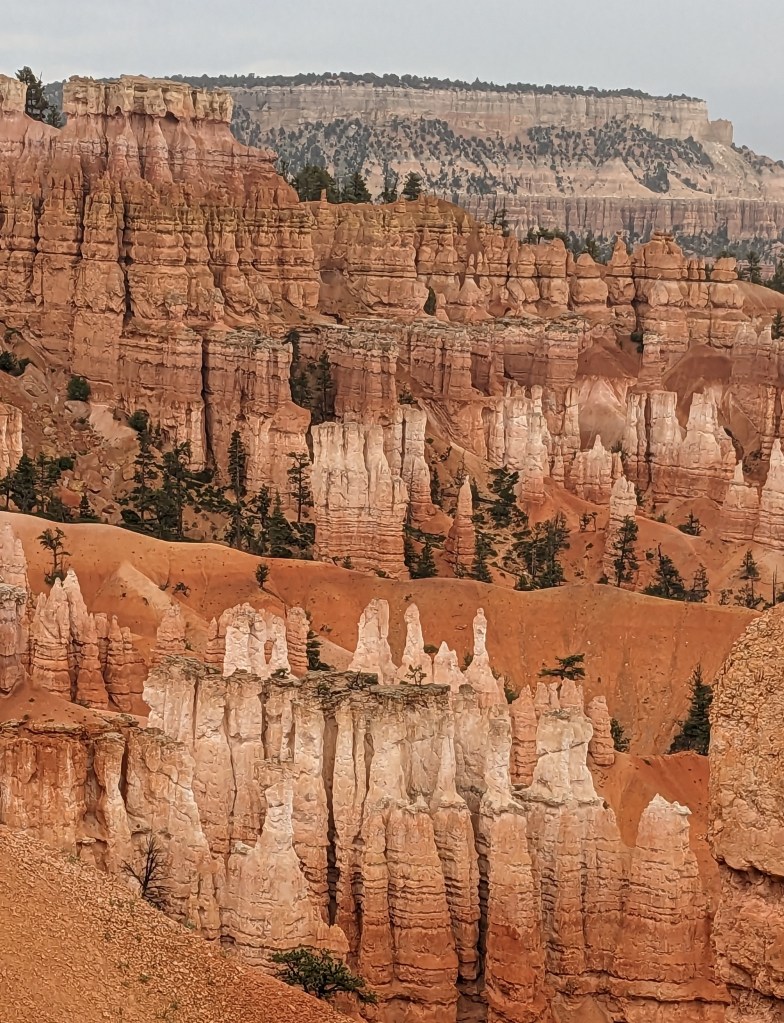
Two days later we arrived at Bryce National Park. At first, the scenery was pleasant but unremarkable. I wondered why there were so many tourists and so many cars in the carpark. We donned our raincoats and walked towards the trail to follow the other tourists. It started hailing and I pulled my hood around my face. Thunder and lightning resounded. A tall thin park ranger approached us from the other direction and looked directly at me.

“We advise you to turn around immediately and seek shelter. We have lost ten people in twenty-five years in these weather conditions.”

We looked at the brochure to confirm this and read that there had been four fatalities and six injuries. I would have been happy to follow the park ranger’s advice, but we had driven for eleven hours to get there and were too curious to turn back. We started walking towards the Navajo Loop trailhead at Sunset Point. Tourists were posing for photographs at the rim. I wondered what the attraction was and peered over the rim myself. Suddenly, I understood why the site was so crowded.

Navajo Loop

I gingerly placed one foot after another to carefully descend the steep muddy trail. Each time I planted my foot down I held it steadily to ensure I would not slide. A couple approached us from the opposite direction as they ascended the trail.

“We strongly recommend you turn around immediately!” they warned. “It’s treacherous in these muddy conditions.”

Muddy trail

We thanked them, but I continued to gingerly traipse through the mud along the downward trail for a few metres.

“You go ahead,” I urged Alex. “I can’t go any further.”

It continued to hail, and we could hear thunder. I turned around and slowly plodded back up the muddy trail back to the edge of the rim, closely followed by Alex. We contented ourselves with the less slippery 2 km walk along the rim to Sunrise Point and back. Back at the car, we scraped the mud off our shoes, fairly unsuccessfully, and continued our drive to Arches National Park.

The Arches National Park is so popular that visitors have to book through a timed entry system. At 6 pm, when the booking system opened, Alex opened the booking site and secured one of the few remaining availabilities for a 7am entry the next day. He hoped we could also enter just before sunset that day, after 6pm when entry was not timed.

Four-and-a half-hours later we arrived at Arches National Park. The drive had been uneventful along straight desert roads and it had been difficult to force myself to stay awake, as I sat in the passenger seat.

“If we are too tired, we can go straight to our accommodation,” suggested Alex.

I hoped we would do so. I needed to escape from the enclosed space of the passenger seat. Suddenly huge rock formations loomed just beyond the park gates, and we decided to enter. I was lulled from my stupor into a sense of shock from the grandeur of the giant ochre rocks emerging from the plains. I could sense the onset of palpitations.

“I think I’m going to faint, Alex,” I warned him.

“I think you’re experiencing ‘geophilia’,” he responded.

Suddenly, I realised why people found the study of geology so fascinating. Strata upon strata of ochre rocks rose before us. Their layers indicated the movement of the earth’s surface over eons of time,

Entrance to the Arches

The sunset light flattered the rock formations. Cars lined the road heading to the distant formation of Delicate Arch thirteen miles into the park, and tourists parked their vehicles at the many carparks along the wayside to walk amongst the various giant rock formations.

The next morning, we rose to meet our 7am booking to enter the park. The light portrayed the rock formations in a slightly different way from the light of the evening before. We headed to the trail leading to the Delicate Arch. Even at that early hour, the carpark was almost full, and we secured a space before following the throng of tourists walking the trail heading to the arch. We scrambled across rocks and boulders in the piercing sunshine. I glanced at the climbers ahead of me and thought it would be impossible to reach where they were climbing, but with Alex’s encouragement found myself joining them. After a series of false summits, we found ourselves within sight of the arch. I looked at the abyss below and suddenly decided I would content myself with watching others pose for photographs in the arch rather than entering myself. A photographer was set facing a couple posing in the arches perilously close to the drop-off. Couples and children walked across the rocks in front of me towards the arches.

“I feel sick, Alex! I can’t go any further.”

I wondered why the others were walking so freely along the rocks in front of me, in full view of the yawning abyss.

“I promise I’ll hold your hand.”

“I don’t want to drag you down!”

“You won’t!”

I continued to worry I would drag Alex down with me in the abyss, but as usual, succumbed to his confidence. I gripped his hand and refused to gaze below me, carefully placing one foot in front of the other. Fellow tourists were taking turns to pose under the arch. A couple noticed us heading towards the arches.

“Shall we take your photo for you?” they offered.

Alex accepted and handed them his phone.

We continued to inch towards the arch. Finally we reached it and posed beneath it. I tried to assume a confident stance that I did not feel, all the while steeling myself away from glancing down at the abyss. I was naturally inclined to hold myself steady in a tense position, but instead decided to stretch my free arm outwards and pretend to exert confidence.

Arches

After standing there for long enough for the couple to take turns photographing us, we returned to the smooth large boulders ready for our trail down the mountain. As we walked down, I started reflecting on the contrast between how brave others seemed to feel as they freely walked over the boulders facing the abyss, and how timid I had felt.

“I think I have a fear of heights!” I announced to Alex. “I don’t know how I made it to retirement age without noticing this.”

There was one more trail we wanted to pursue, namely, the Devil’s Garden. As before, there were few empty places in the carpark. We finally edged into a free space, and then headed to the trail on our way to the Landscape Arch. This time I decided to read the information posted on the sign at the entrance. It read “Drop-offs on both sides challenge those with fear of heights”. I realised that there must be at least some people who shared my fear.

Arches National Park remains the most impressive national park I have ever visited. The force of nature had never felt so overwhelming.  I felt small in this vast ancient landscape but privileged to be able to witness it.

Meredith Stephens is an applied linguist from South Australia. Her work has appeared in Transnational Literature, The Muse, The Font – A Literary Journal for Language Teachers, The Journal of Literature in Language Teaching, The Writers’ and Readers’ Magazine, Reading in a Foreign Language, and in chapters in anthologies published by Demeter Press, Canada.

PLEASE NOTE: ARTICLES CAN ONLY BE REPRODUCED IN OTHER SITES WITH DUE ACKNOWLEDGEMENT TO BORDERLESS JOURNAL

Click here to access the Borderless anthology, Monalisa No Longer Smiles

Click here to access Monalisa No Longer Smiles on Kindle Amazon International

Categories
Poetry

Masud Khan in Translation by Fakrul Alam

Homa-birds are mythical birds of Iranian origin
HOMA-BIRD 
 
Once I fall, how much must I drop down before I can rise up again? 
 
As this thought crosses my mind, I am reminded of the Homa-bird found high in the sky. It even lays its eggs there. The eggs then fall down. But because the bird lives so high in the sky its eggs take ages to fall. Its chicks hatch even as the eggs descend. And then it’s time for the chicks to fall. As they begin to fall the chicks sprout eyes and feathers and wings. And one day they discover that they are falling down and down. It is then that they begin to fly to their mothers high up in the sky. They fly so high now that they emerge as specks scattered all along the spread-out body of the sky
 
We are of the breed of these birds. We procreate, raise children; we drop down and rise up again!
 
[Homapakhi; Translated by Fakrul Alam]          

GONE WHO KNOWS WHERE 

An unending queue of children flowed forward
Going who knows where?
 
With great difficulty, I spotted my own child there.
But when I tried kissing him 
I ended up kissing someone else’s child!
 
And then I lost him— lost him forever! 
Dazed, distressed— I seem doomed to a lifetime of waiting.
 
[Aggato Uddesh; Translated by Fakrul Alam]


REJECTION
 
Abruptly today a baby is expelled from its mother’s breasts.
Though it keeps gravitating towards her— hopefully— 
It continues to be rejected. Startled, it still keeps trying.... 
   
How can the innocent baby make sense of such evictions? 
It can comprehend nothing— neither the implications 
Nor the reasons behind its mother’s bizarre actions. 
All it can do is wonder— is mother playing with it? 
Or is she just being cruel, suddenly unmotherly, 
Distracted by the sudden heat wave of the season? 
  
The baby broods, all alone, helpless. And then once again 
It turns towards its mother, only for another round of rejection... 
  
Now inconsolable, it breaks out into tears, feeling hurt     
And rejected, sobbing endlessly till sleep silences it... 
  
Only its craving for love keeps striking one’s ears 
Its magnitude scattering here, there, everywhere! 
      
[Protyakhyan; Translated by Fakrul Alam]          

Masud Khan (b. 1959) is a Bengali poet and writer. He has, authored nine volumes of poetry and three volumes of prose and fiction. His poems and fictions (in translation) have appeared in journals including Asiatic, Contemporary Literary Horizon, Six Seasons Review, Kaurab, 3c World Fiction, Ragazine.cc, Nebo: A literary Journal, Last Bench, Urhalpul, Tower Journal, Muse Poetry, Word Machine, and anthologies including Language for a New Century: Contemporary Poetry from the Middle East, Asia, and Beyond (W.W. Norton & Co., NY/London); Contemporary Literary Horizon Anthology,Bucharest; Intercontinental Anthology of Poetry on Universal Peace (Global Fraternity of Poets); and Padma Meghna Jamuna: Modern Poetry from Bangladesh(Foundation of SAARC Writers and Literature, New Delhi). Two volumes of his poems have been published as translations, Poems of Masud Khan(English), Antivirus Publications, UK, and Carnival Time and Other Poems (English and Spanish), Bibliotheca Universalis, Romania.  Born and brought up in Bangladesh, Masud Khan lives in Canada and teaches at a college in Toronto.

Fakrul Alam is an academic, translator and writer from Bangladesh. He has translated works of Jibonananda Das and Rabindranath Tagore into English and is the recipient of Bangla Academy Literary Award (2012) for translation and SAARC Literary Award (2012).

PLEASE NOTE: ARTICLES CAN ONLY BE REPRODUCED IN OTHER SITES WITH DUE ACKNOWLEDGEMENT TO BORDERLESS JOURNAL

Click here to access the Borderless anthology, Monalisa No Longer Smiles

Click here to access Monalisa No Longer Smiles on Kindle Amazon International
Categories
Poetry

Poetry by Michael Lee Johnson

SUMMER IS DYING 
 
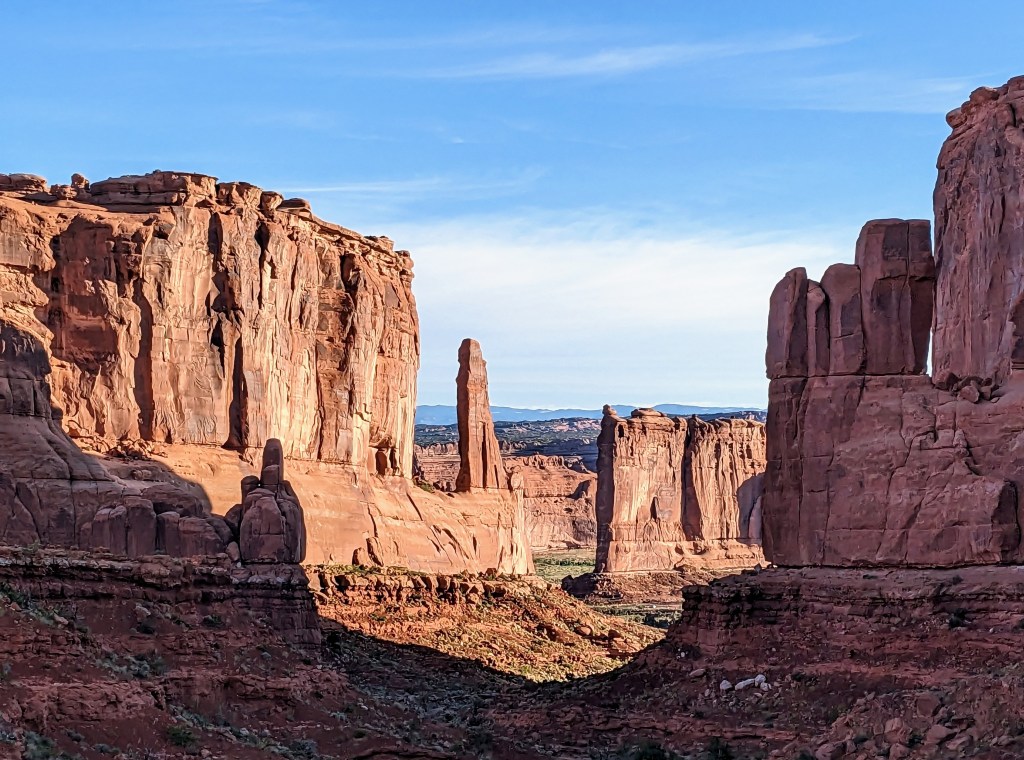
Outside, summer is dying into fall,
and blue daddy petunias sprout ears—
hear the beginning of night chills.
In their yellow window box,
they cuddle up and fear death together.
The balcony sliding door
is poorly insulated, and a cold draft
creeps into all the spare rooms. 
 
BOWL OF BLACK PETUNIAS 

If you must leave me, please
leave me for something special,
like a beautiful bowl of black petunias—
for when memories leak
and cracks appear
and old memories fade,
flowers rebuff bloom,
sidewalks fester weeds
and we both lie down
separately from each other 
for the very last time.
 
MEMORIES PAST
(Hillbilly Daddy)
 
I settle into my thoughts
zigzagging between tears
my fathers’ grave—
Tippecanoe River 
Indiana 1982.
Over now,
a hillbilly country
like the flow 
catfish memories 
raccoons in trees
coon dogs tracking
on the river bank,
the hunt.
Snapping turtles
in the boat
offline—
river flakes
to ice—
now covered
thick snow.

Michael Lee Johnson lived ten years in Canada during the Vietnam era. Today he is a poet in the greater Chicagoland area, IL.  He has 284 YouTube poetry videos. He is aa published poet in 44 countries, a song lyricist, has several published poetry books. He is editor-in-chief of 3 poetry anthologies, all available on Amazon, and has several poetry books and chapbooks. He has over 453 published poems. 

.

PLEASE NOTE: ARTICLES CAN ONLY BE REPRODUCED IN OTHER SITES WITH DUE ACKNOWLEDGEMENT TO BORDERLESS JOURNAL

Click here to access the Borderless anthology, Monalisa No Longer Smiles

Click here to access Monalisa No Longer Smiles on Kindle Amazon International

Categories
Editorial

Dancing in May?

Courtesy: Creative Commons
“May is pretty, May is mild,
Dances like a happy child…”

Annette Wynne (Early twentieth century)

Each month is expressed in a different form by nature in various parts of the world. In the tropics, May is sweltering and hot — peak summer. In the Southern hemisphere, it is cold. However, with climate change setting in, the patterns are changing, and the temperatures are swinging to extremes. Sometimes, one wonders if this is a reflection of human minds, which seem to swing like pendulums to create dissensions and conflicts in the current world. Nothing seems constant and the winds of change have taken on a menacing appearance. If we go by Nazrul’s outlook, destruction is a part of creating a new way of life as he contends in his poem, ‘Ring Bells of Victory’ — “Why fear destruction? It’s the gateway to creation!” Is this how we will move towards ‘dancing like a happy child’?

Mitra Phukan addresses this need for change in her novel, What Will People Say — not with intensity of Nazrul nor in poetry but with a light feathery wand, more in the tradition of Jane Austen. Her narrative reflects on change at various levels to explore the destruction of old customs giving way to new that are more accepting and kinder to inclusivity, addressing issues like widow remarriage in conservative Hindu frameworks, female fellowship and ageing as Phukan tells us in her interview. Upcoming voice, Prerna Gill, lauded by names like Arundhathi Subramaniam and Chitra Divakaruni, has also been in conversation with Shantanu Ray Choudhuri on her book of verses, Meanwhile. She has refreshing perspectives on life and literature.

Poetry in Borderless means variety and diaspora. Peter Cashorali’s poem addresses changes that quite literally upend the sky and the Earth! Michael Burch reflects on a change that continues to evolve – climate change. Ryan Quinn Flanagan explores societal irritants with irony. Seasons are explored by KV Raghupathi and Ashok Suri. Wilda Morris brings in humour with universal truths. William Miller explores crime and punishment. Lakshmi Kannan and Shahriyer Hossain Shetu weave words around mythical lore. We have passionate poetry from Md Mujib Ullah and Urmi Chakravorty. It is difficult to go into each poem with their diverse colours but Rhys Hughes has brought in wry humour with his long poem on eighteen goblins… or is the count nineteen? In his column, Hughes has dwelt on tall tales he heard about India during his childhood in a light tone, stories that sound truly fantastic…

Devraj Singh Kalsi has written a nostalgic piece that hovers between irony and perhaps, a reformatory urge… I am not quite sure, but it is as enjoyable and compelling as Meredith Stephen’s narrative on her conservation efforts in Kangaroo Island in the Southern hemisphere and fantastic animals she meets, livened further by her photography. Ravi Shankar talks of his night hikes in the Northern hemisphere, more accurately, in the Himalayas. While trekking at night seems a risky task, trying to recreate dishes from the past is no less daunting, as Suzanne Kamata tells us in her Notes from Japan.

May hosts the birthday of a number of greats, including Tagore and Satyajit Ray. Ratnottama Sengupta’s piece on Ray’s birth anniversary celebrations with actress Jaya Bachchan recounting her experience while working for Ray in Mahanagar (Big City), a film that has been restored and was part of celebrations for the filmmaker’s 102nd Birth anniversary captures the nostalgia of a famous actress on the greatest filmmakers of our times. She has also given us an essay on Tagore and cinema in memory of the great soul, who was just sixty years older to Ray and impacted the filmmaker too. Ray had a year-long sojourn in Santiniketan during his youth.

Eulogising Rabindrasangeet and its lyrics is an essay by Professor Fakrul Alam on Tagore. Professor Alam has translated number of his songs for the essay as he has, a powerful poem from Bengali by Masud Khan. A transcreation of Tagore’s first birthday poem , a wonderful translation of Balochi poetry by Fazal Baloch of Munir Momin’s verses, another one from Korean by Ihlwha Choi rounds up the translated poetry in this edition. Stories that reach out with their poignant telling include Nadir Ali’s narrative, translated from Punjabi by his daughter, Amna Ali, and Aruna Chakravarti’s translation of a short story by Tagore. We have more stories from around the world with Julian Gallo exploring addiction, Abdullah Rayhan with a poignant narrative from Bangladesh, Sreelekha Chatterjee with a short funny tale and Paul Mirabile exploring the supernatural and horror, a sequel to ‘The Book Hunter‘, published in the April issue.

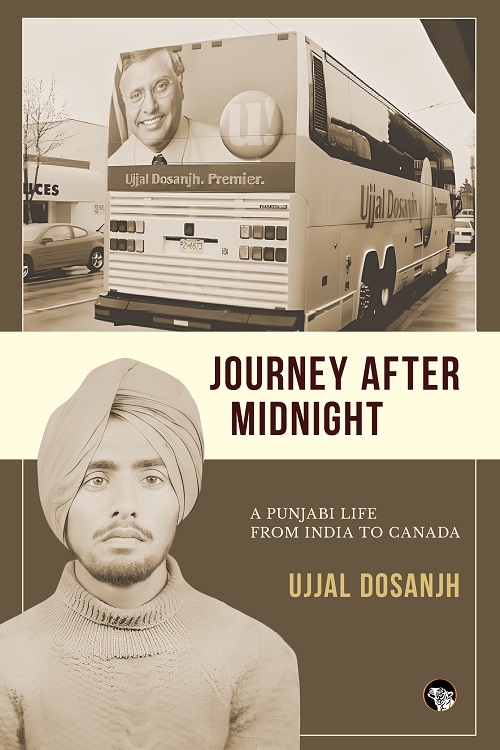
All the genres we host seem to be topped with a sprinkling of pieces on Tagore as this is his birth month. A book excerpt from Chakravarti’s Daughters of Jorasanko narrates her well-researched version of Tagore’s last birthday celebration and carries her translation of the last birthday song by the giant of Bengali literature. The other book excerpt is from Bhubaneswar@75 – Perspectives, edited by Bhaskar Parichha/ Charudutta Panigrahi. Parichha has also reviewed Journey After Midnight – A Punjabi Life: From India to Canada by Ujjal Dosanjh, a book that starts in pre-independent India and travels with the writer to Canada via UK. Again to commemorate the maestro’s birth anniversary, Meenakshi Malhotra has revisited Radha Chakravarty’s translation of Tagore’s Farewell Song. Somdatta Mandal has critiqued KR Meera’s Jezebeltranslated from Malayalam by Abhirami Girija Sriram and K. S. Bijukuma. Lakshmi Kannan has introduced to us Jaydeep Sarangi’s collection of poems, letters in lower case.

There are pieces that still reach out to be mentioned. Do visit our content page for May. I would like to thank Sohana Manzoor for her fantastic artwork and continued editorial support for the Tagore translations and the whole team for helping me put together this issue. Thank you. A huge thanks to our loyal readers and contributors who continue to bring in vibrant content, photography and artwork. Without you all, we would not be where we are today.

Wish you a lovely month.

Mitali Chakravarty

borderlessjournal.com

Categories
Review

A Journey, a Memoir and an Inspiration

Book Review by Bhaskar Parichha

Title: Journey After Midnight – A Punjabi Life: From India to Canada

Author: Ujjal Dosanjh

Publisher: Speaking Tiger Books

The Punjabi Diaspora is a global phenomenon that has grown in size and complexity in recent years. It is estimated that there are around 20 million Punjabis living outside the Punjab region in India and Pakistan. This is stretching across multiple continents and countries. Punjabis have migrated to different parts of the world since the British Raj. However, this diaspora has become more visible in recent decades due to technology and global connectivity.

Highly diverse and dynamic, with different groups of Punjabis living in different places around the world. In North America, Punjabis are concentrated in the United States and Canada. In Europe they are mainly settled in the United Kingdom, Germany, Italy, and France. In the Middle East, they are found in the United Arab Emirates, Qatar, Kuwait, and Saudi Arabia. In South East Asia, they are mainly settled in Malaysia, Singapore, and Indonesia.

Punjabis have had a significant impact on the culture and economy of the countries where they have settled. Their positive contributions were felt in multiple industries, from agriculture to tech. They have been key to spurring economic growth in the areas where they have settled. They have also had a major influence on the culture and cuisine of these countries, with Punjabi food being a popular choice in many areas.

Journey After Midnight – A Punjabi Life : From India to Canada by Ujjal Dosanjh speaks about the Punjabi diaspora in all its splendor.  Dosanjh was born in the Jalandhar district of Punjab in 1946. He emigrated to the UK in 1964 and from there to Canada in 1968. He was Premier of British Columbia from 2000 to 2001 and a Liberal Party of Canada Member of Parliament from 2004 to 2011, including a period as Minister of Health and Minister Responsible for Multiculturalism, Human Rights and Immigration. In 2003 he was awarded the Pravasi Bharatiya Samman, the highest honour conferred by the Government of India on overseas Indians.

The blurb contends: “Journey After Midnight is the compelling story of a life of rich and varied experience and rare conviction. With fascinating insight, Ujjal Dosanjh writes about life in rural Punjab in the 1950s and early ’60s; the Indian immigrant experience—from the late 19th century to the present day—in the UK and Canada; post-Independence politics in Punjab and the Punjabi diaspora— including the period of Sikh militancy—and the inner workings of the democratic process in Canada, one of the world’s more egalitarian nations.”

Dosanj states candidly: “Today’s world has few leaders brimming with great ideas. The paucity of great leaders afflicts India as well. There are no inspiring giants on the national stage tall enough to lead India out of the ethical and moral quagmire. Asked whether he was working to create a new India along with seeking its independence from Britain, Mahatma Gandhi had declared that he was trying to create a new Indian–an honest, fair and just Indian for a proud, progressive, prosperous and caring India. Since the Mahatma’s time the moral and ethical values of India have decayed. In Indian politics, civil service and public life, there is little evidence of the ideals he lived and died for.”

He continues: “A substantial portion of the Indian economy is underground; all due to the sadly enduring disease of corruption. The albatross of financial, ethical and moral corruption is strangulating and shortchanging the country. Those who say economic progress will by itself free India from corruption are just as wrong as those who in the 1950s maintained that education by itself would reduce corruption. It obviously hasn’t, and India finds itself counted among the most corrupt countries on earth. Corruption shatters human dreams and stunts ingenuity. It constrains personal and political liberties. It severely limits opportunities. The main hindrance in the path of social, political, economic and cultural progress is the disconnect between knowing what is right and doing the right thing; most know what is the right and the ethical thing to do, but they continue to do the wrong and the unethical thing; hence the ubiquitous corruption.

Calling upon the Indians for a moral revolution Dosanj writes: “The sculpting of Gandhi’s Indians, and the building of the India of the dreams of its founding fathers and mothers, requires a moral and ethical revolution-a revolution of values that are of Indians, by Indians and for Indians. No matter how bleak the political and ethical scene today, I’m certain there are great minds fearless, humane and brave among the billion plus residents of India. We may not see
them, but they exist. We may not know them, but they are among us. They must heed India’s call. They must come forward and lead. India’s destiny demands it.”

In the ‘Afterword’ he laments about the state of affairs of Punjab in recent times: “Punjab is staring at the prospect of turmoil, radicalization and violent fundamentalism, and yet many in the government and otherwise seem obsessed with presenting and treating the likes of the late singer Moosewala as modern Punjab’s heroes. That the young singer’s life was cut short by gangsters’ guns was horrible and must be condemned. Beyond that the AAP and others must be careful not to glorify violence. Unfortunately, almost the whole of Punjab seems taken with Moosewala; the young man was a talented singer but much of his poetry and music was about guns and aggressive machismo. Is that what Punjab needs and must idolize?”

Dosanjh writes candidly about his dual identity as a first-generation immigrant. And he describes how he has felt compelled to campaign against the discriminatory policies of his adopted country. He opposes regressive and extremist tendencies within the Punjabi community. His outspoken views against the Khalistan movement in the 1980s led to death threats and vicious physical assaults, and he narrowly escaped the bombing of Air India Flight 182 in 1985. Yet he has remained steadfast in his defence of democracy, human rights and effective governance in the two countries he calls home—Canada and India.  

The writing style is fluid and languid. This is not a book that can be judged on the basis of its literary merit. It isn’t just a simple memoir, but rather a record of a turbulent period in India’s history. It is a book that represents a lifetime journey, crossing oceans and cultures. As a memoir, Ujjal Dosanjh’s book is at once personal and political, but most importantly, it is inspiring.

.

Bhaskar Parichha is a journalist and author of UnbiasedNo Strings Attached: Writings on Odisha and Biju Patnaik – A Political Biography. He lives in Bhubaneswar and writes bilingually. Besides writing for newspapers, he also reviews books on various media platforms.

.

PLEASE NOTE: ARTICLES CAN ONLY BE REPRODUCED IN OTHER SITES WITH DUE ACKNOWLEDGEMENT TO BORDERLESS JOURNAL

Click here to access the Borderless anthology, Monalisa No Longer Smiles

Click here to access Monalisa No Longer Smiles on Kindle Amazon International

Categories
Poetry

Standing in a Vineyard, Souring All the Grapes

By Ryan Quinn Flanagan

Courtesy: Creative Commons
They could not stop arguing.
Lobbing the most vile of accusations at one another.

At this wine tasting in Southern Ontario.
In spite of the wonderful weather.

The host trying to ignore them as he poured.

These two vipers having escaped the pit.
Now standing in a vineyard, souring all the grapes.

So that you would taste it in the bottle
when it came time to pick the harvest.

That petty jealousy that kept them at each other’s throats.
Surrounded by all those grapes 
that could not escape that overwhelming anger.

Their rancid lives infusing everything,
you could feel it! 

A sudden heavy cloudiness of sky.
No one driving and everyone sauced.

Ryan Quinn Flanagan is a Canadian-born author residing in Elliot Lake, Ontario, Canada with his wife and many bears that rifle through his garbage.  His work can be found both in print and online in such places as: Evergreen Review, The New York Quarterly, Borderless Journal, GloMag, Red Fez, and Lothlorien Poetry Journal

.

PLEASE NOTE: ARTICLES CAN ONLY BE REPRODUCED IN OTHER SITES WITH DUE ACKNOWLEDGEMENT TO BORDERLESS JOURNAL. 

Click here to access the Borderless anthology, Monalisa No Longer Smiles

Click here to access Monalisa No Longer Smiles on Kindle Amazon International
Categories
Poetry

Carnival Time

Poetry by Masud Khan, translated from the Bengali poem, ‘Aj Ullash Diba’ by Fakrul Alam

Courtesy: Creative Commons
It’s carnival time today.
Serfs and plebeians pour into streets.
Behold the giggling, decked up undertaker’s wife, 
That man over there, completely soused, is her spouse! 
He holds his pay tight in his fists and grins grotesquely, 
See the sweeper there, lips reddened by betel leaf!

There he is— the constable— sporting a shiny wristband. 
And look at that rotund young eunuch—
All merry, like dusky Abyssinians or Afghan revellers in the rain. 

Today it’s time to collect wages and bonuses and forget files. 
Today superiors have trade place with subordinates

And mandarins have transformed themselves into mere clerks.

The roly-poly slave and Kishorimohon Das
Sleep fitfully next to each other near the town reservoir, 
Stirred again and again by the mayor’s snores,

The hapless water bearer gets completely wet. 
The woman over there is a streetwalker,
Visiting town for the first time with her snotty-nosed brother. 
That man there trades in lead, and there is the perfume seller, 
He is the accountant, and he, the treasurer,
And next to him on this day of intermittent rain 
Is the petty thief’s no-good brother.
And there— leaning, bent by the weight of his imagination, 
As if in a trance, is the poet, the king of poets!

This day all have spilled out into the streets and stroll there 
Endlessly — intransitive
Wrapped in newly spun silk.


Masud Khan (b. 1959) is a Bengali poet and writer. He has, authored nine volumes of poetry and three volumes of prose and fiction. His poems and fictions (in translation) have appeared in journals including Asiatic, Contemporary Literary Horizon, Six Seasons Review, Kaurab, 3c World Fiction, Ragazine.cc, Nebo: A literary Journal, Last Bench, Urhalpul, Tower Journal, Muse Poetry, Word Machine, and anthologies including Language for a New Century: Contemporary Poetry from the Middle East, Asia, and Beyond (W.W. Norton & Co., NY/London); Contemporary Literary Horizon Anthology,Bucharest; Intercontinental Anthology of Poetry on Universal Peace (Global Fraternity of Poets); and Padma Meghna Jamuna: Modern Poetry from Bangladesh(Foundation of SAARC Writers and Literature, New Delhi). Two volumes of his poems have been published as translations, Poems of Masud Khan(English), Antivirus Publications, UK, and Carnival Time and Other Poems (English and Spanish), Bibliotheca Universalis, Romania.  Born and brought up in Bangladesh, Masud Khan lives in Canada and teaches at a college in Toronto.

Fakrul Alam is an academic, translator and writer from Bangladesh. He has translated works of Jibonananda Das and Rabindranath Tagore into English and is the recipient of Bangla Academy Literary Award (2012) for translation and SAARC Literary Award (2012).

PLEASE NOTE: ARTICLES CAN ONLY BE REPRODUCED IN OTHER SITES WITH DUE ACKNOWLEDGEMENT TO BORDERLESS JOURNAL

Click here to access the Borderless anthology, Monalisa No Longer Smiles

Click here to access Monalisa No Longer Smiles on Kindle Amazon International

Categories
Poetry

History by Masud Khan

Translated by Professor Fakrul Alam from the Bengali poem, Itihas (History)

Masud Khan
How then can an authentic history of the world be written? The one who writes— who is he and where is he writing from? When is he writing? From which vantage point is he writing and for what reason? All these factors will decide the truth of the history. And in any case the subject itself is bound by its own conventions and is inevitably subjective.

Is it then impossible to write an authentic history of the world?

No! In the light already reflected from the surface of the world till now is impressed the history of the world— chronologically! Which is to say, the history of the world is in the light dispersed from the world. And that must be authentic version of the history of the world since it’s being written naturally. Perhaps in kingdom after kingdom of the cosmos someone or the other is sighting that history through telescopes, unknown to us all.

But will such a history be absolutely authentic? What about the chapters of history that are dark and depressing? Of episodes that have been denuded of light and have become shrouded in darkness and decadence? Of episodes that have never exuded light and will never reflect any radiance anywhere? What about them?

And what about the history of people who are dark or tan-brown?

Perhaps their evolution has become blurred in the lenses of telescopes; perhaps their histories have become obscure in the telling— since they are dark and tan-brown; perhaps because they are able to transmit only a feeble light they are deemed to be totally incapable of reflecting any light at all!

Does this mean that the history of dark and tan-brown people will remain obscure forever in the history of mankind? And in nature? Bereft of light and therefore of history too?

Masud Khan (b. 1959) is a Bengali poet and writer. He has, authored nine volumes of poetry and three volumes of prose and fiction. His poems and fictions (in translation) have appeared in journals including Asiatic, Contemporary Literary Horizon, Six Seasons Review, Kaurab, 3c World Fiction, Ragazine.cc, Nebo: A literary Journal, Last Bench, Urhalpul, Tower Journal, Muse Poetry, Word Machine, and anthologies including Language for a New Century: Contemporary Poetry from the Middle East, Asia, and Beyond (W.W. Norton & Co., NY/London); Contemporary Literary Horizon Anthology, Bucharest; Intercontinental Anthology of Poetry on Universal Peace (Global Fraternity of Poets); and Padma Meghna Jamuna: Modern Poetry from Bangladesh (Foundation of SAARC Writers and Literature, New Delhi). Two volumes of his poems have been published as translations, Poems of Masud Khan (English), Antivirus Publications, UK, and Carnival Time and Other Poems (English and Spanish), Bibliotheca Universalis, Romania.  Born and brought up in Bangladesh, Masud Khan lives in Canada and teaches at a college in Toronto.

Fakrul Alam is an academic, translator and writer from Bangladesh. He has translated works of Jibonananda Das and Rabindranath Tagore into English and is the recipient of Bangla Academy Literary Award (2012) for translation and SAARC Literary Award (2012).

PLEASE NOTE: ARTICLES CAN ONLY BE REPRODUCED IN OTHER SITES WITH DUE ACKNOWLEDGEMENT TO BORDERLESS JOURNAL

Click here to access the Borderless anthology, Monalisa No Longer Smiles

Categories
The Observant Immigrant

The Immigrant’s Dilemma

By Candice L. Daquin

Courtesy: Creative Commons

I have been an immigrant to a new country three times: from France to England, England to Canada and then, Canada to America. Being an immigrant is often a highly positive experience. We may have greater opportunities, we seek our dreams, we grow them. On the other hand, immigration for those of us who have gone through the process, is not easy. It is expensive, time-consuming, nail-biting and often lonely. It is said that those who immigrate ‘successfully’ do so because of familial support and/or because their children reap the benefits of their sacrifice.

Whilst there are too many stories to condense any one feature of immigration, we can only talk of our own experiences and somehow in understanding that, perhaps stay open enough to understand others. We can come together through that collective understanding.

As a psychotherapist, I work with many immigrants. I see clients daily who were born elsewhere and sometimes struggle to acculturate in their new-found country. Where I live, near the border between Mexico and America, we have a multitude of immigrants from Mexico, central and south America as well as from around the world, coming through the borders, seeing asylum and a better life.

Consequently, there can be a high degree of racism in rebuke for the startling numbers of immigrants passing through our city. I can drive down a road and see people lined on the street much as you would see in other countries, begging and homeless. Our resources are stretched and one option chosen by the Governor of Texas was to bus immigrants and asylum seekers to other states in the US. Initially this was considered a racist, insensitive act that treated people like cattle. When you look at it closer, you can see it was perhaps these things but also a desperate plea for other states to understand the overwhelming nature of immigration for border states and share in the expense.

It is easy for a non-border state to believe the border should be effectively kept open and all immigrants allowed in. but when it’s on your door step it can be challenging. Most people in Texas care about immigrants but also experience some of the downsides of too many immigrants at once. In El Paso, people froze to death sleeping on the streets, houses were broken into, the situation was dire and extreme and locals didn’t have enough resources to manage. Shipping immigrants who wish to go to other states, to those states, might appear cruel, but also makes sense, if it’s consensual. Whilst many of the Texan Governors decisions have been quite possibly racist and prejudicial, this choice was in part to show other states how dire the situation is.

Why are there so many asylum seekers right now? As President Biden announced the lifting of closed borders to asylum seekers, the numbers attempting to come into America increased exponentially. Under the Trump administration, the Department of Homeland Security (DHS) called the “Remain in Mexico” policy (officially, the Migrant Protection Protocols) caused immigration to be somewhat halted. The original reason countries like America accepted asylum seekers goes back to WW II where the Jews who survived ethnic cleansing had nowhere to live and were essentially stateless. The right to seek asylum was incorporated into international law following the atrocities of World War II. Congress adopted key provisions of the Geneva Refugee Convention (including the international definition of a refugee) into U.S. immigration law when it passed the Refugee Act of 1980.

The laws that exist now were enacted to protect them and ensure stateless people were never again turned away in droves. The creation of Israel was in part the consequence of WW2 and the abuse against the Jews. It could be argued any issues with Israel are directly linked to the ethnic cleansing the Jews experienced and their subsequent statelessness. Laws endeavoring to protect future people from such experiences are what we now use in our handling of asylum seekers. “When Congress finally eliminated the racial provisions in U.S. immigration and nationality law in the 1940s and 1950s, generations of federal practice and procedure did not instantly disappear without a trace. Over the years, other government agencies had developed their own racial classification systems, often partially borrowed from INS experience, and such systems could take on lives of their own.”

The downside to this is, the world has dramatically changed since the 1940s (2,307M versus over 7 million today). the population is growing at a heady rate and thus, even if a small percent of people seek asylum from any one country, it is huge in comparison to previous numbers. Department of Homeland Security  statistics show that from Biden’s Inauguration Day through May 2022—just 16 months and change—about 1.05 million migrants were apprehended on the southwestern border and then released into the US. With every year, the worlds population swells and with it, a strain on resources. ‘Affluent’ countries such as America, may literally speaking have the resources to help asylum seekers but the reality for many asylum seekers is quite different once they are in-country. According to Census Bureau statistics, immigrants’ share of the U.S. population rose more from 1990 to 2010 than during any other 20-year period since these figures were first recorded in 1850—from 7.9 percent to 12.9 percent

What constituted poverty in their country of origin may be considerably lower than what money they can earn in America, if indeed such earnings can be made at all. The social welfare system protects asylum seekers by giving them somewhere to live and a stipend until they are able to find work but what of those who do not possess the necessary skills? Not to mention the dearth of certain jobs. Immigrants wishing to live in the cities, may find work is only available in the agricultural parts of America and not earn enough to live on without language and education in a city. Likewise, they must contend with crime, safety issues and making the meager money they receive, stretch to pay for themselves and their families. What might seem initially like a lot of money, in comparison to their home-countries, is quickly devoured by the more expensive living expenses of America.

Immigrants who move to America or other developed countries, on a visa rather than asylum, may fare better. But note how many PhD’s are driving cabs or serving in restaurants. Underemployment is a phenomenon whereby those who are educated, are working at a lower level than that education would typically warrant. For their children there may be greater opportunities but for many first-generation immigrants, the adjustment and opportunities are restricted. Doctors in their own countries, they find American prohibitions on accepting foreign transcripts and learning, despite the low quality of American education in comparison to many other countries. It’s almost if you were being subjective about it, like having to pay the price for immigration.

When I immigrated to Canada, I found many who possessed PhDs and advanced education were unable to find work. There was some push back from locals who resented skilled workers and felt all immigrants should ‘know their place’ and take the dregs work. This is something you really don’t believe will happen to you when you are very educated, and get a skilled worker visa, but it’s a reality, perhaps less spoken about because it makes the host country look unkind. But go beyond the shiny posters about immigration and speak to the people and you will find it’s not uncommon.

Immigration is necessary for many reasons, not least the Western world ageing and requiring new blood because of declining birth rates. But the Western world wants immigrants to do the work they don’t want to do just as much as they may appear to want immigrants to ‘succeed’ and for every Doctor and PhD who was an immigrant, there are plenty who find themselves no better off through immigration. That’s a sacrifice worth making when you have no other choices or you hope your children will inherit the American Dream but if you have no children and you’re sold a false dream, then it can be disheartening if not crushing. There are 11 million recent immigrants in transition, best estimates predict, who labour in American fields, construction and kitchens, as well as American classrooms, detention centers and immigration courts.

What we hear less about, is how many immigrants leave. And how many suffer silently, having fallen between the gaps, into anything but the American Dream. What can be done about this? Should we impose immigration restrictions not out of cruelty but an understanding that a host country is ill equipped to deal with mass influxes and that the original reasons for the laws have evolved/changed as our population has grown? Should we insist other states take some responsibility for asylum seekers? As well as demand other countries pitch in more? And understand that what may look racist, is in fact a more realistic approach than flinging open the border and allowing everyone to come in at once?

It is an interesting dilemma and one that won’t be decided any time soon. The racists and extreme economic conservatives will battle against the diametric opposite liberals who believe all should inherit the opportunity a country like America holds. Both sides are too extreme in that they don’t consider the reality. The reality is racism should not and cannot endure in a country like America where soon ‘brown skin’ will be the majority and old racist ways are being challenged. But equally, being so ‘woke’ that you don’t see the fall out of idealistic policies, isn’t the answer either. In tandem with an identity politics that emphasises the subnational, a too progressive project may place global concerns above national interests. Hence, the oft repeated slogan “global problems require global solutions.”

Speak to the people. Many times, people criticise me for living in Texas. They assume I’m one of the ‘bad guys’ without understanding Texas is made up of a huge diverse population. Within that diversity are many Latinos who don’t want mass unchecked immigration any more than the racists, but for radically different reasons. Things aren’t as simple as they seem in a Twitter comment. There are many complex considerations that must be taken into account to ensure the best outcome not only for asylum seekers but those who already live in-country. There are answers, but they won’t come from knee jerk reactions or entrenched thinking on either side.

What we do know today, is people are literally dying to come into America and with them, perhaps some unchecked terrorists sneak in, just as they did before 9/11. In order to protect everyone and ensure things are done legally and safely, immigration must have some controls and should be funded accordingly, without any one state taking the majority of the strain. Many Texans are quite the reverse from what you’d imagine, if you subscribe to stereotypes. Maybe the problem is we should really get rid of stereotypes and try knowing who people really are before we judge en mass. Houston has one of the highest Indian communities in the world. All cities within Texas have absorbed huge numbers of immigrants from around the world. Let’s think less of ‘them and us’ and more about truly doing what will be best for those seeking to come into a country and begin a new life. Immigration is a conundrum, but if we work together, instead of apart, we can find answers.

.

Candice Louisa Daquin is a Psychotherapist and Editor, having worked in Europe, Canada and the USA. Daquins own work is also published widely, she has written five books of poetry, the last published by Finishing Line Press called Pinch the Lock. Her website is www thefeatheredsleep.com

.

PLEASE NOTE: ARTICLES CAN ONLY BE REPRODUCED IN OTHER SITES WITH DUE ACKNOWLEDGEMENT TO BORDERLESS JOURNAL.

Click here to access the Borderless anthology, Monalisa No Longer Smiles