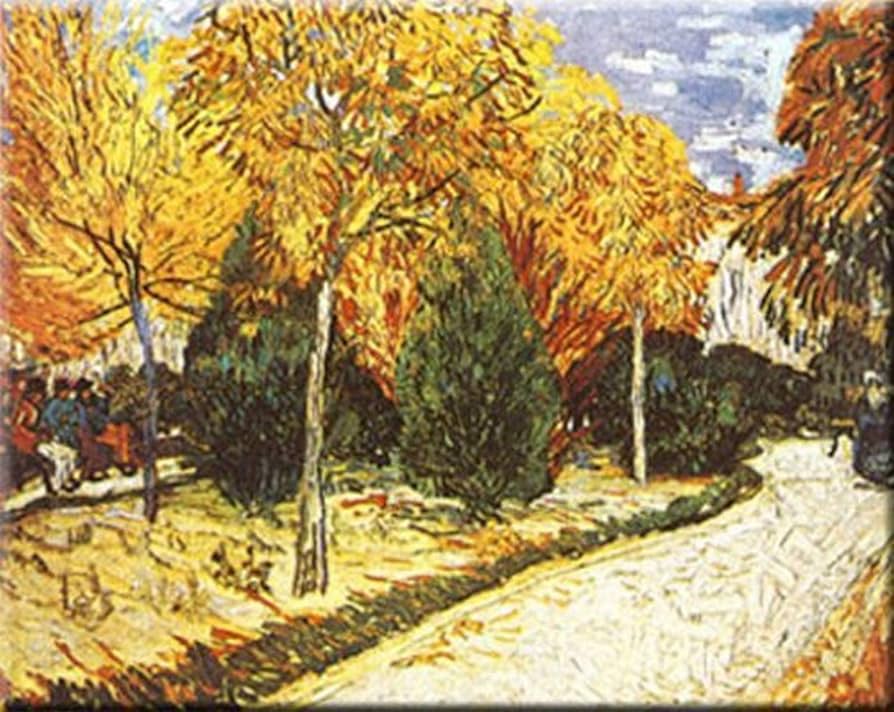
Autumn Garden by Vincent Van Gogh (1853-1890). From Public Domain
September heralds the start of year-end festivities around the world. It’s autumn in one part and spring in another – both seasons that herald change. While our planet celebrates changes, dichotomies, opposites and inclusively gazes with wonder at the endless universe in all its splendour, do we? Festivals are times of good cheer and fun with our loved ones. And yet, a large part of the world seems to be in disarray with manmade disasters wrought by our own species on its own home planet. Despite the sufferings experienced by victims of climate and war-related calamities, the majority will continue to observe rituals out of habit while subscribing to exclusivity and shun change in any form. Occasionally, there are those who break all rules to create a new norm.
One such group of people are the bauls or mendicants from Bengal. Aruna Chakravarti has shared an essay about these people who have created a syncretic lore with music and nature, defying the borders that divide humanity into exclusive groups. As if to complement this syncretic flow, we have Professor Fakrul Alam’s piece on a human construct, literary clubs spanning different cultures spread over centuries – no less an area in which we find norms redefined for, the literary, often, are the harbingers of change.
Mandal, herself, has a brilliant translation featured in this issue. We have a review of her book, an interview with her, and an excerpt from the translation of Jaladhar Sen’s The Travels of a Sadhu in the Himalayas. Written and first published in the Tagore family journal, Bharati, the narrative is an outstanding cultural bridge which even translates Bengali humour for an Anglophone readership. That Sen had a strictly secular perspective in the nineteenth century when blind devotion was often a norm is showcased in Mandal’s translation as well as the stupendous descriptions of the Himalayas that haunt with elegant simplicity.
Our fiction this month seems largely focussed on women’s stories from around the world. While Fiona Sinclair and Erin Jamieson reflect on mother-daughter relationships, Anandita Dey looks into a woman’s dilemma as she tries to adjust to the accepted norm of an ‘arranged’ marriage. Rashida Murphy explores deep rooted social biases that create issues faced by a woman with a light touch. Naramsetti Umamaheswararao brings in variety with a fable – a story that reflects human traits transcending gender disparity.
The September issue would not have been possible without contributions of words and photographs by many of you. Huge thanks to all of you, to the fabulous team and to Sohana Manzoor, whose art has become synonymous with our journal. And our heartfelt thanks to our wonderful readers, without who the effort of putting together this journal would be pointless. Thank you all.
Painting by Vincent Van Gogh (1853-1890). From Public Domain
MY DAD; HE LIKED A WHISKY

My dad; he liked a whisky.
A single malt would do.
Not too much; but sufficient.
Maybe a glass or two.

'Just ample,' he'd always say,
'to see the evening through.'
It was, he would maintain,
a nice pastime to pursue.

'Conversation freely flows
once you've had a few.'
And sometimes I'd introduce
a bottle of something new.

'It's not unappealing,' he'd opine;
as appreciation grew.
He liked a double negative;
enjoyed a double Cardhu.

A touch of water, new flavours
did magically imbue.
He was watchful of my intake.
'Do not think I don't know you!'

Right, of course, as next day
a hangover would ensue.
Finally, that knowing glance.
'Don't say I didn't warn you!'

As the drams, they added up,
so the years they did accrue.
I miss your conversation.
I miss your point of view.

I recall the pipe, of course;
the measured voice I knew.
Now only an empty glass;
an empty bottle too.
Stuart McFarlane is now semi-retired. He taught English for many years to asylum seekers in London. He has had poems published in a few online journals.
.
PLEASE NOTE: ARTICLES CAN ONLY BE REPRODUCED IN OTHER SITES WITH DUE ACKNOWLEDGEMENT TO BORDERLESS JOURNAL
The last, forlorn days of winter; still do they stubbornly cling. Idle thoughts turn to graveyards. I hear a mournful bell ring. Yet there stirs an awakening. I see a bluebird take wing. Violets bloom, and daffodils. I resist an urge to sing. My thoughts now turn to sunlight; to the new life it will bring. Farewell, the last days of winter. Behold! The first days of spring.
THE TREE MEN
I
Walking through the park, this winter morning, I saw how the Council's been at the trees. Some men, in heavy, black jackets, were throwing branches in the back of a truck. One was still sawing hard, finishing the job. The branch rolled onto the grass. The man wiped his brow with his leather glove.
II
They said the trees blocked the view; of what, exactly, it was hard to see. But trees, I suppose, you can't talk to; or urge to have smaller families. You just take an axe to them.
III
All along the avenue there are now trees marked with yellow paint. These are the next for hacking; and those, already cut, stand stark against the winter sky; their severed limbs now stacked in the back of council trucks. And, now, I wonder if, when the tree men are gone, maybe in the quiet of night, these mutilated stumps will still feel a spark crackle along a tattered nerve-way; that savage lunge, as a sharp blade splits the skin.
Stuart McFarlane is now semi-retired. He taught English for many years to asylum seekers in London. He has had poems published in a few online journals.
.
PLEASE NOTE: ARTICLES CAN ONLY BE REPRODUCED IN OTHER SITES WITH DUE ACKNOWLEDGEMENT TO BORDERLESS JOURNAL
Clouds like pillows smother the moonlight, in a false embrace. Waves beat the shore, like clenched fists beating on a door that refuses to open. My thoughts are banal, but I don’t feel capable of anything more. The stars are like fireworks, as the cosmos passes over my head like an amazing circus. But I’ve seen it all before.
AT DUSK NEAR THE LAKE
The years are piling up like snow on a roof, but my hair gets thinner. The moon seems trapped like an insect in the branches of a tree. A dove beckons to his mate. But I don’t think She wanted to wait. Birds like human can be fickle. The dove abandons his tree, and life moves on, but he leaves his message for me. The woods are deep and I’m still free. What will be, will be.
George Freek’s poetry has recently appeared in The Ottawa Arts Review, Acumen, The Lake, The Whimsical Poet, Triggerfish and Torrid Literature.
PLEASE NOTE: ARTICLES CAN ONLY BE REPRODUCED IN OTHER SITES WITH DUE ACKNOWLEDGEMENT TO BORDERLESS JOURNAL
A leaf settles slowly to the ground.
It flutters and weaves in its fall.
It lands and rolls over and over,
It stops behind a small rock.
Its productive life seems to have ended.

In March, it began as a yellow-green bump.
A bump on a limb, high up on a tree.
Then, May, and June, July and August
Those were the productive months,
Oozing sugars and other nutrients.
Removing CO2 -- exhaling Oxygen.
Doing leaf things.

Then, the colour changes back to yellow, then brown.
Its grip on the limb weakens and it slowly falls.
Now, on the ground, a new existence begins.
Its productivity is not over.
It nestles with other leaves.
Narrow, broad, round.
Turning brown and crisp, fragile.
A walker shuffles through the leaves,
They mix and disintegrate.
Pine needles add to the pile.
A bicycle rolls through the leaves.
Leaves are broken and chipped.
The pile changes as pieces are smaller and smaller.
No longer leaves.

Then dust; mixed remains from a thousand leaves.
The dry, cool air breaks down the leaves.
Matter that once produced food for the tree.
Now seemingly useless and discarded.
Then the rains come, the dust slowly dissolves,
It seeps into the ground enriches the soil.
Roots pull the material in,
It moves up the tree.
It nourishes the spring growth,
Buds form on the branches.
Yellow-green bumps.
Bumps that will become leaves.
Leaves that will give life to the tree.
Leaves that will fall.
Leaves that will turn brown, turn to dust, be dissolved by the rains.
Taken up by the roots and nourish the tree,
Emerging bumps that will become leaves.
And it repeats, and repeats, and repeats forever.
Ron Pickett is a retired naval aviator with over 250 combat missions and 500 carrier landings. His 90-plus articles have appeared in numerous publications. He enjoys writing fiction and has published five books: Perfect Crimes – I Got Away with It, Discovering Roots, Getting Published, EMPATHS, and Sixty Odd Short Stories.
.
PLEASE NOTE: ARTICLES CAN ONLY BE REPRODUCED IN OTHER SITES WITH DUE ACKNOWLEDGEMENT TO BORDERLESS JOURNAL
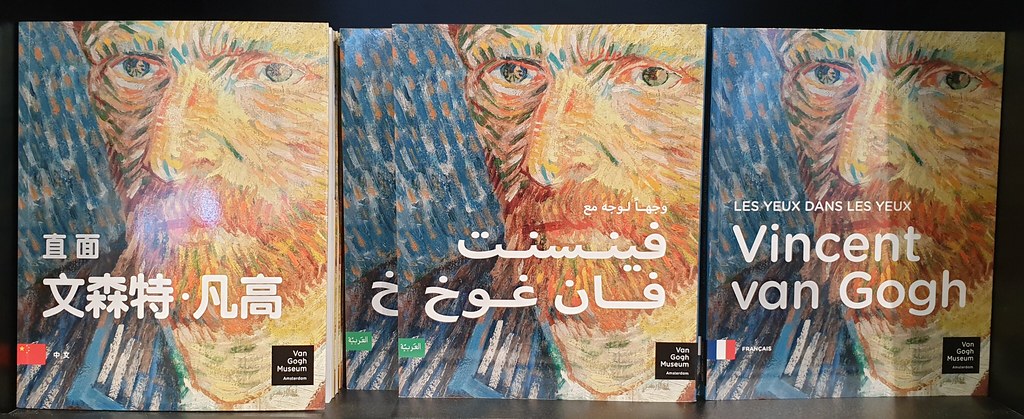
Vincent Van Gogh written is different scripts. Courtesy:Creative Commons
The whole world opens up in the realm of ideas that have existed wafting and bridging across time and space. Sometimes they find conduits to come to the fore, even though they find expression in different languages, under varied cultural milieus. One way of connecting these ideas is to translate them into a single language. And that is what many have started to do. Celebrating writers and translators who have connected us with these ideas across boundaries of time and place, we bring to you translated writings in English from twenty eight languages on the International Translation Day, from some of the most iconic thinkers as well as from contemporary voices.
Prose
Tagore’s short story, Aparichita, has been translated from Bengali as The Stranger by Aruna Chakravarti. Click hereto read.
Nadir Ali’s The Kabbadi Player has been translated from Punjabi by Amna Ali. Click here to read.
Kamaleswar Barua’s Uehara by has been translated from Assamese and introduced by Bikash K. Bhattacharya. Click here to read.
S Ramakrishnan’s Muhammad Ali’s Singnature has been S. Ramakrishnan, translated from Tamil by Dr B. Chandramouli. Click here to read.
PF Mathews’Mercy, has been translated from Malayalam by Ram Anantharaman. Click here to read.
Road to Nowhere, an unusual story about a man who heads for suicide, translated from Odiya by the author, Satya Misra. Click here to read.
An excerpt from A Handful of Sesame by Shrinivas Vaidya, translated from Kannada by Maithreyi Karnoor. Click hereto read.
Writings from Pandies’ Cornerhighlight the ongoing struggle against debilitating rigid boundaries drawn by societal norms. Each piece is written in Hindustani and then translated by a volunteer from Pandies’ in English. Clickhere to read.
Rakhamaninov’s Sonata, a short story by Sherzod Artikov, translated from Uzbeki by Nigora Mukhammad. Click hereto read.
Of Days and Seasons, a parable by the eminent Dutch writer, Louis Couperus (1863-1923), translated by Chaitali Sengupta. Click here to read.
The Faithful Wife, a folktale translated from Balochi by Fazal Baloch. Click hereto read.
An excerpt from Ramy Al-Asheq’sEver Since I Did Not Die, translated from Arabic by Isis Nusair, edited by Levi Thompson. The author was born in a refugee camp. Click here to read.
Poetry
Two songs byTagore written originally in Brajabuli, a literary language developed essentially for poetry in the sixteenth century, has been translated by Radha Chakravarty. Click here to read.
Rebel or ‘Bidrohi’, Nazrul’s signature poem, ‘Bidrohi‘, translated from Bengali by Professor Fakrul Alam. Click here to read.
Banlata Sen, Jibananada Das’s iconic poem, translated from Bengali by Professor Fakrul Alam. Click here to read.
W. H. Auden’s poem “In Memory of W. B. Yeats” is often quoted to dismiss the importance of poetry as a form of social justice. The current fashion among poets is that poetry can revolutionize social inequalities, make positive changes, build empathy for marginalized groups, and convey information about causes important to the poet. For example, Robert Huddleston writes in Boston Review, “In its day, W. H. Auden’s claim that ‘poetry makes nothing happen’ was a necessary reproof to an ideologically mandated culture of protest that had a chokehold on the literary left in the 1930s, an example it remains important to consider today. Clashes over the political rights and wrongs of poetry, then as now, are often disguised contests over cultural and academic turf, ideological purity, and even the relative priority of criticism versus artistic practice.” He is correct concerning the cultural war that cloaks literary discussion. Literary figures and public intellectuals are often chided for their implicit biases. However, I conceive of the poem as saying something drastically different; I do not see it as being a political rebuttal at all, but rather serving as one within a larger context.
Auden’s poem contains these lines:
…For poetry makes nothing happen: it survives
In the valley of its making where executives
Would never want to tamper, flows on south
From ranches of isolation and the busy griefs,
Raw towns that we believe and die in; it survives,
A way of happening, a mouth.
The poem carefully navigates the terrain of the unchangeable dimensions of political life. However, it clears a safe space for the poem as a thing of its own. Poetry does not instigate events; rather, it is an event itself. The day remains cold for Yeats’s death, and his poetry lives beyond him through the many misinterpretations it will face. “In Memory of W. B. Yeats” defies the culture war to uphold the dignity of the human spirit to which poetry testifies. Auden once defended Pound from censorship by his publisher. He said anti-fascism will become the new fascism. The publisher relented and granted Pound a space in the anthology. In this course, Auden defends the integrity of the poet as a person whose work dignifies the ideal humanity. In this respect he clears a space for poetic license because a poet must spend their life empting themselves.
No, poetry makes nothing happen. It is an event itself. It is the fire of intellect applied to the cold apathy and spiritual destitution we suffer. As protest against the human condition, it becomes universal in its design.
Hence poetry is spiritual warfare. The poet is a paradigm for virtue. The contemporary world now challenges the absolute freedom of the visionary. It is historically stated that the visionary should be exempt from moral considerations. Recent shifts in consciousness concerning this attitude are becoming mainstream. The UK Telegraph reports, “Janet Marstine, Honorary (Retired) Associate Professor, School of Museum Studies, University of Leicester, added: ‘The National Gallery has taken an important step in acknowledging that it is no longer ethically tenable to interpret in an aesthetic vacuum. An artist’s position in the Western canon does not make them immune from accountability.’” The visionary in question at the National Gallery is Paul Gauguin. He is under question for exploiting the myth of the noble savage for his sexual and financial gain. The moral dilemma posed by such considerations does not discount the artistry or accomplishments of individual artists. Its intent is to hold artists accountable for immoral behaviour. The hope in the #metoo era is these considerations will keep living artists accountable rather than giving them license to act uninhibited, and influence the broader society.
Vincent van Gogh, a friend of Gauguin who he accused of insanity, wrote, “The way to know life is to love many things.” Van Gogh is historically considered a misunderstood visionary who underwent severe lifetime disappoint and failure. His legacy is a myth of its own. He was expelled from his church where he was minister. His father thought of him as a lunatic with stupid ideas. However, he is also considered a beautiful person who showed the world a light it misses in so much conflict. Don McClean wrote of van Gogh, “The world was never meant for one as beautiful as you.”
These two towering figures in art leave us with widely divergent displays of personal conduct. Van Gogh’s misconduct is chalked up to a serious mental health issue, but Gauguin is a sexual deviant who exploited the European assumption of the noble savage. What can be learned from these patterns? Emerging views of artists’ conduct have more at stake than aesthetic considerations. They are the battleground of the purpose of ideas. Gauguin’s art and moral conduct are under question not because his art is unpleasing, but because ideas hold power: we must take into account how ideas can effect culture and the treatment of others. Misconceptions of indigenous people have serious repercussions historically. Our worldview must consider that others are right to their cultural experience without infringement. This is where the culture war stems.
If we conceive a race as inferior, does our conduct toward them change? Gauguin is not being questioned as much as an entire colonialist legacy and how it shapes the behaviour within the culture that adopts it. Human dignity is universal; a person should never be treated as inferior. Perhaps we are right to question history so vapidly, and demand the culture at large change. The most important thing may be a humanist conception of world culture. Those who deny it are perhaps harming not only others, but also degrading themselves.
The culture war is the domain of values and whose values develop dignity in the human heart. Art is one of the most developed and poignant tools to communicate values. The Marshall Plan advanced capitalism throughout Europe using art to influence people. Culture is what stands as testimony to prevalent attitudes, reactions to those attitudes, and the historical presence of a people. We are right to subject it to deeper inquiry.
In fact, I would consider a moral duty to question historical circumstance through art. Duty is defined in the Bhagavad Gita, “It is better to do one’s own duty, however defective it may be, than to follow the duty of another, however well one may perform it. He who does his duty as his own nature reveals it, never sins.” This offers a subtext for individuality. Art is the historical realm of the individual—they who create art are the most developed in ideas. One’s heart will reveal one’s purpose. St. Paul writes in Romans 12:2 (KJV), “And be not conformed to this world: but be ye transformed by the renewing of your mind, that ye may prove what is that good, and acceptable, and perfect, will of God.” The world’s major faiths are abundant in praises of nonconformity. As St. Paul carefully describes, interpreting the will of God is a struggle. One must resist pressures external to oneself. Sometimes one must question oneself deeply to find the moral current within. Jihad, or “struggle”, is spiritual warfare in three senses: against one’s own temptations, against one’s peers, and in defense of one’s territory. Aristotle wrote, “Wicked men obey from fear; good men, from love.” The perennial wisdom seems to be of the consensus that morality is deeply personal, and one’s character is deeply revelatory. Art is where the person speaks honestly with high eloquence. Art itself is action. How much of artistic achievement depends on cultural consensus? Is art rather a defiance of consensus, bearing more of the soul of the artist than their times? A moral purpose should derive from the inner life, and counter the wheel of consensus in bare revolt. John Milton writes in Paradise Lost:
“A mind not to be changed by place or time. The mind is its own place, and in itself Can make a heav’n of hell, a hell of heav’n.”
Vatsala Radhakeesoon, contemporary poet of Mauritius, grants insight into the nature of freedom, character, and morality of being in her poem “Unconditional Thread”:
Born from the Divine’s golden thread Molded with perfection, purity and grace I’m the invisible heart – the unconditional thread ruling the universe
I’m soft I’m generous I’m not from the Mundane the materialistic world the uncanny competitive rules
I’m omnipresent but recognized, seen only by the unadulterated
I, Unconditional Thread survive in immortal realms and go on whispering in every ear “ Love, love and love discarding mental blocks and embracing spontaneity.”
A poet warrior embraces compassion, action, duty, and dream. Henry Miller writes, “All growth is a leap in the dark, a spontaneous unpremeditated act without benefit of experience.” One’s leap becomes one’s light. The darkness illumined is one’s spiritual landmark. To seek beyond one’s perilous comfort is an act of defiance in a world where complacency is sanctified. The artist’s presence stirs the world from sleep if they are securing their foundations. Ultimately, we are clueless about life: where it takes us, what it means, how we cope with it. We engage in symbolic acts of protest and incite civil discussion on important issues. Papers are published on every subject; scholars shake their fists at apathy and ignorance. Theories emerge from data and trends. Life’s most recent turn provides us with newfound perspectives. Once the trend is fulfilled, new storms rage on the horizon. Science is continuously revising and incorporating new facts and figures. There is nothing steady in the order we endure; in fact, to call it order defies its purpose.
In such a world of flux, kindness is even spirited defiance. In “Kindness”, Naomi Shihab Nye carefully constructs the meaning of kindness in counterintuitive language:
Before you know what kindness really is
you must lose things, feel the future dissolve in a moment
like salt weakened in a broth.
What you held in your hand,
What you counted and carefully saved,
all this must go so you know
how desolate the landscape can be
between the regions of kindness.
How you ride and ride
thinking the bus will never stop,
the passengers eating maize and chicken
will stare out the window forever.
Walter Pater writes in The Conclusion to The Renaissance: Studies in Art and Ideas, “Great passions may give us this quickened sense of life, ecstasy and sorrow of love, the various forms of enthusiastic activity, disinterested or otherwise, which comes naturally to many of us. Only be sure it is passion—that it does yield you this fruit of a quickened, multiplied consciousness.” Kindness is passion. Etymologically speaking, “passion” reflects suffering, endurance, and loss. Compassion means to “suffer with”; hence, Nye’s poetic rendering of kindness defines it as passion.
St. Francis of Assisi writes in “Praises of the Christian Virtues” of the three virtues of Wisdom, Poverty, and Charity that “Whoever possesses one virtue without offending the others, possesses them all.” Guatama Buddha is recorded as saying something profoundly similar, “We will develop and cultivate the liberation of mind by loving kindness, make it our vehicle, make it our basis, stabilize it, exercise ourselves in it, and fully perfect it.” In the doctrines of Buddhism, the problem of suffering is rooted in attachment. Attachment pertains to physical things, mental habits, and stubborn attitudes. When one is attached, the object of attachment invokes fear of its loss, and can trap the mind in unhealthy suffering. In Sanskrit, the word samsara translates “it flows together.” In Hinduism and Buddhism, the concept signifies worldliness, attachment, and the cycle of rebirth and suffering. To be released from this cycle one must be released of oneself and desire. This state of enlightenment is called Nirvana.
Octavio Paz, poet and ambassador of Mexico to India, writes in “Perpetua Incarnada”:
Hour by hour I saw him slide
wide and happy like a river
shadow and light linked its shores
and a yellow swirl
single monotonous intensity
the sun set in its center
Then he writes:
I ask for strength I ask for detachment
open the eyes
unharmed evidence
between the clarities that are canceled
Not the abolition of images
the incarnation of pronouns
the world that we all invented
sign town
and in its center
Solitary
Perpetual incarnate
one half woman
peña manantial the other
Word of all with whom we speak alone
I ask that you always accompany me
man reason
This poem reflects an existential loneliness but it extends into territories much broader. He asks prayerfully that the world be returned to the state of the ‘Word’ from its embodiment of images. Once again, we return to Pater in his essay on Leonardo da Vinci. “We recognise one of those symbolical inventions in which the ostensible subject is used, not as a matter for definite pictorial realisation, but as the starting point of a train of sentiment, subtle and vague as a piece of music.”
In “Flux and Movement in Walter Pater’s Leonardo Essay” critic Lene Østermark-Johansen writes, “The body which twists around its own spine creates the illusion of moving from one extreme to another thus resulting in a kind of harmony of opposites, a concordia discours.” This statement not only describes drawings and sculpture, but applies to rhetoric also. The concept of Self is illusion because all things contain their opposites. One cannot step in the same river twice. We are the river, and our Self is a form within the flux of promissory existence. We are granted time within this cycle of birth, death, and rebirth. As the Cross represents redemption, one reaches Nirvana by letting go. Christ is reborn to demonstrate he can conquer the forces of death.
Chögyam Trungpa Rinpoche writes, “The Shambhala teachings are founded on the premise that there is basic human wisdom that can help solve the world’s problems… Shambhala vision teaches that, in the face of the world’s problems, we can be heroic and kind at the same time.” A warrior poet sets the world aright through their heroism, but what does setting the world aright mean exactly? According to Shambhala: the sacred path of the warrior, the world must restore its focus to human dignity.
Mirabai writes:
O friend, I sit alone while the world sleeps. In the palace that held love’s pleasure the abandoned one sits. She who once threaded a necklace of pearls is now stringing tears. He has left me. The night passes while I count stars. When will the Hour arrive? This sorrow must end. Mira says: Lifter of Mountains, return.
– “The Necklace”
We cannot restore dignity alone. Existential dread implies that as individuals we are alone to choose and must live with that responsibility. In her abandonment, Mirabai still affirms her dignity as God’s beloved. She calls to God to return. This reflects the cycle of birth, death, and rebirth as eternal flux which harmonises with our physical existence. God is with us. Christ is ever present in our domain of suffering.
It is no coincidence that Paz concludes his poem with the words “I ask to be obedient to this day and tonight.”
U.S. Poet Laureate Joy Harjo writes in “The Myth of Blackbirds”:
“Justice is a story by heart in the beloved country where imagination weeps. The sacred mountains only appear to be asleep…We cannot be separated in the loop of mystery between blackbirds and the memory of blackbirds.”
Myth is a cultural awakening. Being “alone to choose” does not defer human dignity or one’s relationship to the divine because we are creatures of memory. As Plato reflected, learning is remembering what one already knows. Such a cycle is not promising. It is eternal.
We are ripe with questioning historical errors in this period of history. “The emergence of pessimistic philosophies is by no means a sign of some great and terrible distress; rather, these question marks regarding the worth of life arise when the human condition has been so improved and ameliorated that the mosquito bites of the body and soul are found too altogether gruesome and gory, and in their poverty of experience of actual pain, people will even take being troubled by ideas to be suffering of the highest order,” writes Nietzsche in The Joyous Science. Is our ability and right to assess history as such a privilege offered by our affluence and security? It was the intellectual who once hid in ivory towers. Now, do we all live in ivory towers with epigenetic fears and concerns?
Such a question does not demean our relative poverty, private traumas, failures and shortcomings, or deprivation. What it suggests is we have plateaued to become so complacent and unconcerned that it requires serious tragic thinking to stir our imaginations. We may long for suffering; yes, we may hunger for the cross. As they say, comedy is born of tragedy. Is the opposite also true?
Wendy Chen-Tanner describes Kai Coggin’s collection Wingspan in the following words: “Wingspan is a book about becoming, transforming, and unfurling into the fullness of selfhood in all its disparate parts.” The human soul fluxes and fades with the human condition. Being is Becoming. This discovery of the fullness of being is impressively expressed in “Everything Silver/Artemis and Her Lover.” Students of Greek myth know the story of Actaeon and his tutelage under Chiron. When he witnesses Artemis bathing, she turns him from hunter to the hunted. Coggin’s poem is deeply personal. She observes the two as lovers experiencing oneness together. She writes:
“I will watch them,
the hunter and the hunted,
these lovers mounted in the stars,
I will watch them,
and wish for an arrow to fall from the sky into my open heart.”
Aside from the sheer beauty of these lines, the poet transforms herself into hunted for the sake of the poem. Perhaps it is self-voyeurism—the poem is solitary in tone. Gazing into the attic of her heart, Coggin sees the night sky and the eternal myth of huntress and hunted. The ebb and flow of life enchants the poet deeply and she wishes to be one with it. The opening phrase “attic of my heart” parallels the night sky and symbolically suggests yearning for oneness. Chen-Tanner’s description is impressively accurate. Jeremy Taylor writes in Psychology Today, “The universally experienced world of dreams and dreaming has always been a deep mystery, ever since the first confusing hints of self-awareness arose in our instinctively nervous, curious mammalian ancestors. Awakening and remembering that we were dreaming just a moment ago always suggests that we live in two successively alternating worlds – one of made of dreams, and the other composed of our waking experiences.” The article (“The Expanse of Our Unconscious is as Immense as the Night Sky”) combines psychology with evolutionary principles to explain the interconnectedness of the dream and waking worlds. Poetically rendered, Taylor incidentally offers insight into the importance of myth. Our minds are myth-makers in their own right. The bridge between self-awareness and yearning, our ancestral past and myth, is accentuated in the story of Actaeon and Artemis. Coggin immortalises them in the starry fixtures of night. The hunter and hunted are not only archetypes, but also offer a dialectical conversation with oneself. Akin to Hegel’s master and servant dialectic, the need for truth anticipates struggle and dissipation.
Coggin’s poems are rich in spiritedness, thoughtfulness, and hope. Hope strives for unity of self, toward knowledge of one’s desires, and deeper into the wilderness of dream. The dialectic flips on itself as the wise hunter becomes the hunted—his desires are too stubborn to resist, and he is transfixed by the translucent beauty of the immortal. He ascends into fatherhood by transfiguration into his master’s image. The transfiguration is an exact mirror-image of his role as hunter. This reversal is symbolically important because it reflects a registry of Becoming. Revolutionary ideas shrivel into double standards, mimicry of their exactness, and memory. Hope is a struggle against the unfathomable and inevitable decline of meaning. It is assertive. Like energy within neurological structures, it dissipates and connects. The mind is forever incorporating the ancient and traumatic into meaning.
Andrea Gibson writes of Coggin’s Periscope Heart, “Kai Coggin’s Periscope Heart is beauty mapping the dark, a canyon of becoming and letting go.”
I want to learn you like a language,
speak you on my tongue until I am
no longer foreign to your body…
Periscope Heart feels more personal. In “Language”, loving is compared to constructing a language. In a real sense, myth-making is language. Language is universal mapping, constructing roads through the caverns of being, and developing a common language. Powerful insight serves as the poet’s resolution.
Dorothy Day writes, “To offer the suffering of celibacy, temporary or permanent, to the Lord is to make use, in the best possible way, of man’s greatest joy.” Such is the world we live in, Day writes, that “The lack of tenderness in people’s relations with each other, tenderness expressed by warmth of voice and speech, handclasp and embrace–in other words, the warmth of friendship–lack of these things too means a concentration on sex, and the physical aspects, the animal aspects of sex.” Poet and reviewer Jagari Mukhergee writes in “Metapoem”:
“My poems are vinyl dolls that I make for you sketching in eyes and nose and lips with watercolor ink. My poems are glass lanterns — every time one is lit on nights when the soul has no electricity from within… My poems are a dusty tempest seething. Each a life.”
The warrior poet brings light to the world. Her tenderness is chastity and her self-love is universal nature. Her tears water the foundations of our aching existence. Our longings are satisfied in her dissolutions and dreams. The warrior poet is the self within each person.
Dustin Pickering is the founder of Transcendent Zero Press and editor-in-chief of Harbinger Asylum. He has authored several poetry collections, a short story collection, and a novella. He is a Pushcart nominee and was a finalist in Adelaide Literary Journal’s short story contest in 2018. He is a former contributor to Huffington Post.
Disclaimer: The opinions expressed are solely that of the author.




 Borderless