Categories
Slices from Life

From Cape Canaveral to Carnarvon

Narrative by Meredith Stephens & photographs by Alan Noble

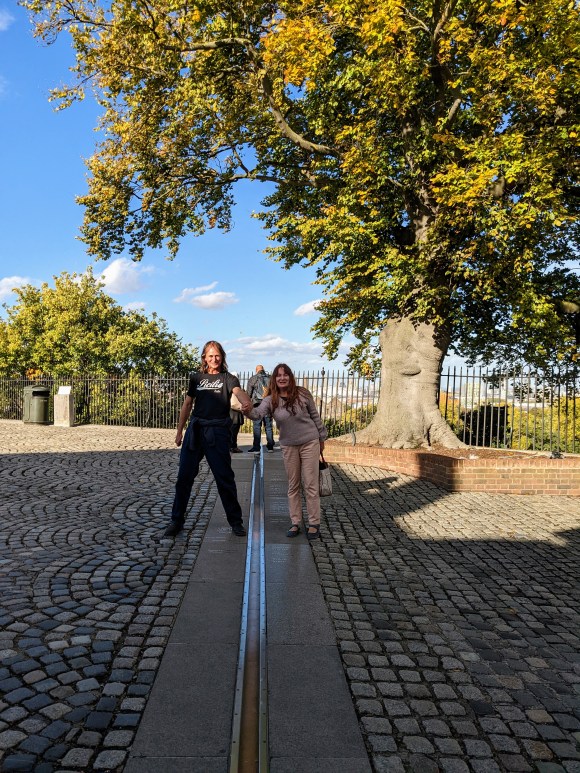
The Prime Meridian Line.

Whenever we visit another city, Alex and I always head straight for a science or maritime museum. When we spent a day in London several years ago, Alex insisted that we visit the National Maritime Museum in Greenwich, and then the Royal Observatory. The highlight of the latter was John Harrison’s marine timekeepers, which made the calculation of longitude at sea possible, therefore making navigation safer. A fun part of visiting the Observatory was standing on either side of the Prime Meridian Line, which defines zero longitude and divides the eastern and western hemispheres of the earth. If you are facing north, the person on the left is in the western hemisphere, and the person to the right is in the eastern hemisphere. We had to queue behind other couples to stand either side of the line. The couple in front of us were taking an inordinate amount of time to have their photo taken here, from which global time is calculated.

“Time’s up!” quipped someone behind us.

“What’s time?” came a philosophical comment from someone else.

The quick banter between strangers is one of the many reasons why I love visiting London.

During our short stay we devoted hardly any time to visiting any other tourist sites. The changing of the guard at Buckingham Palace held little allure. After visiting the Royal Observatory, we strolled past the historic British clipper ship “Cutty Sark” and then caught a ferry back from Greenwich to Central London. We briefly hopped off to see the Houses of Parliament, but after having visited the Royal Observatory Alex’s curiosity was sated.

Fast forward to March 2025 and we found ourselves in a remote town in Western Australia called Carnarvon. The first attraction Alex wanted to visit was the Carnarvon Space and Technology Museum. Carnarvon has a little-known relationship to Cape Canaveral in Florida. Many people have heard of Cape Canaveral and its rocket launching site, but who has heard of the not dissimilar-sounding town of Carnarvon?

Unlike the grand public museums in Western Australia, this one is self-funded and run by volunteers. NASA established a tracking station at Carnarvon in 1964, which played a critical role for both the Gemini and Apollo programs. Carnarvon was strategically located as the most distantly located site on the earth diametrically opposite from Cape Canaveral, providing the ability to track spacecraft over the Indian Ocean that were out of range from Cape Canaveral. The most famous launch was Apollo 11 in July 1969, which achieved humanity’s dream of landing humans on the Moon and safely returning them to Earth.

This museum was different from public museums in that when we visited it was managed by a grey nomad couple from the east coast. (“grey nomad” is an Aussie term for retirees who embark on an extended period of travel around the country, usually in a caravan.) A resident cat curled himself into a ball proudly on the reception desk. It was the only museum we visited in Western Australia that required a fee to enter. The first experience we sought was to hop in the replica of the Apollo capsule to get a feel for the astronauts during the July 1969 launch. I was worried about a panic attack coming on in a confined space but the manager assured me that he would open the door to let me out at any time if I felt uncomfortable. We lay down with the lower half of our bodies propped up on a platform in what we hoped was an astronaut launching posture, while footage from the 1969 launch played out on the screen in front of us. Countdown on the screen was followed by lift-off. Not only did I not have a panic attack, it felt exhilarating to be transported to Cape Canaveral in 1969. Having watched this on black and white television when we were in primary school, it was all the more meaningful to watch it as adults. After touring the rest of the museum, we returned to the Apollo capsule to experience it a second time, like the space nerds we were.

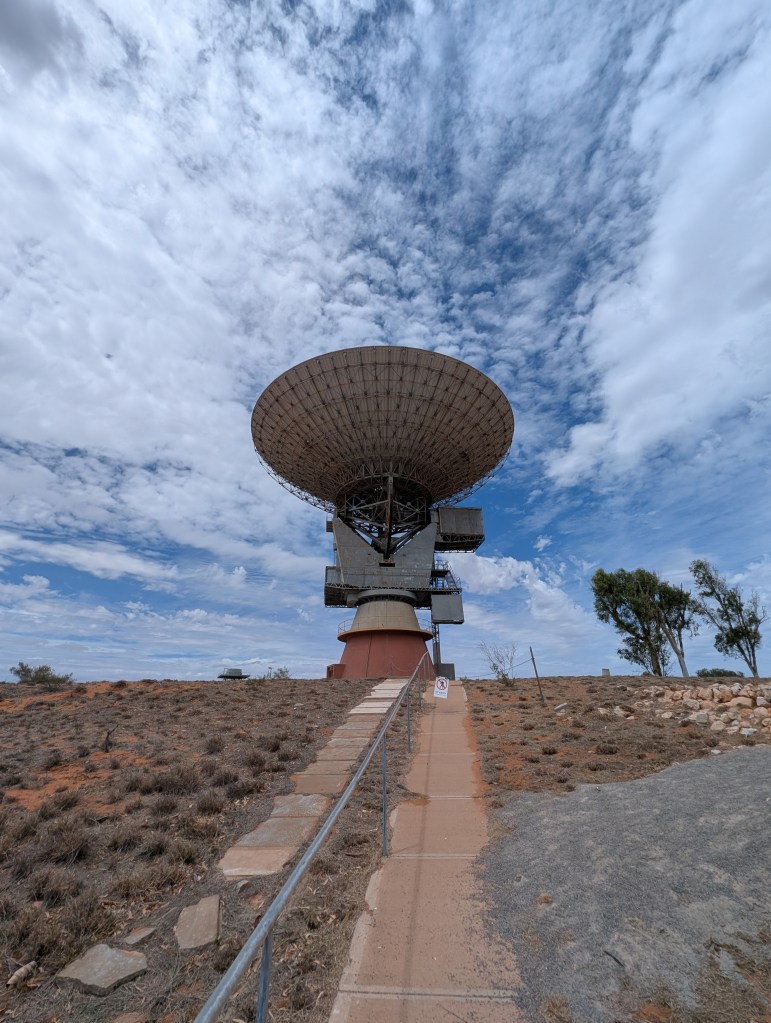
We braced ourselves to face the oppressive heat as we headed outside to view the original satellite dish. Rather than languishing as ancient technology the dish has been leased to an overseas company who were upgrading it to track satellites orbiting Earth.

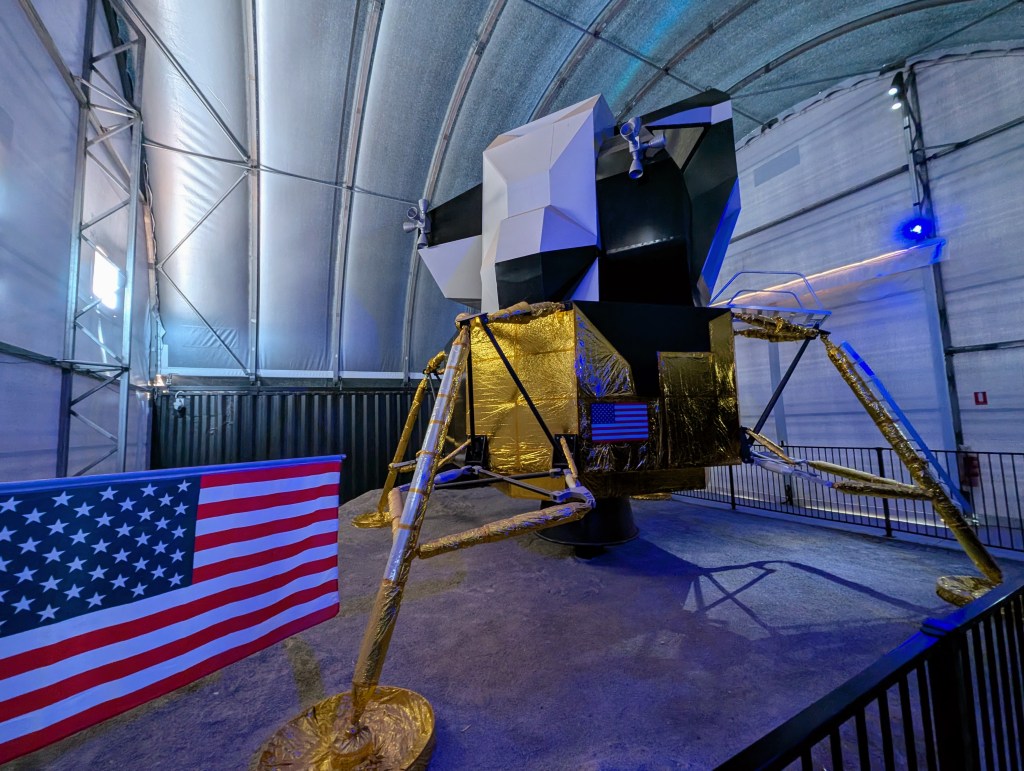
After viewing numerous 1960s space memorabilia, such as a replica of a Gemini capsule, which had preceded the Apollo series of capsules, and a life-sized replica of the lunar lander module, we bought some tourist T-shirts, chatted with the manager couple, and bade farewell to the resident cat. This was the most thrilling of the magnificent museums we visited in Western Australia. Thanks to Alex, we had a bias to visit maritime museums, including The WA Maritime Museum in Fremantle, The Museum of Geraldton, and The WA Shipwrecks Museum. They provided rich accounts of the many arrivals from distant lands to the west Australian shores since Dutchman Dirk Hartog’s nearby landing at Shark Bay in 1616. All visits were immensely educational and informative, but somehow the less glamorous Carnarvon Space and Technology Museum stood out. Unlike the public museums, it was somewhat ramshackle, but this was more than made up for in terms of authenticity and charm. Who would have thought that this outpost in regional Western Australia that even many Australians have not heard of, could have played such a pivotal role in the tracking of Apollo 11? This museum enjoys none of the fame of the Royal Observatory in Greenwich, but the role it played in history is just as moving.

.

Meredith Stephens is an applied linguist from South Australia. Her recent work has appeared in Syncopation Literary Journal, Continue the Voice, Micking Owl Roost blog, The Font – A Literary Journal for Language Teachers, and Mind, Brain & Education Think Tank. In 2024, her story Safari was chosen as the Editor’s Choice for the June edition of All Your Stories.

PLEASE NOTE: ARTICLES CAN ONLY BE REPRODUCED IN OTHER SITES WITH DUE ACKNOWLEDGEMENT TO BORDERLESS JOURNAL

Click here to access the Borderless anthology, Monalisa No Longer Smiles

Click here to access Monalisa No Longer Smiles on Kindle Amazon International

Categories
Musings

Nobody Knows…

By Farouk Gulsara

It was a moment reminiscent of Eleanor Rigby[1].

A lady who had spent over half her life serving at the temple passed away unexpectedly. She had remained unmarried, having lost her family quite early on. In search of solace, she dedicated all her spare time to various activities to ensure the temple ran smoothly. She ensured that even the most minor details were attended to. 

One day, she passed away in her sleep. Nobody realised. The daily operations continued as usual. Nobody missed her. There wasn’t even a mention of her death in any of the temple communications. Only the local gossipy housewives had something to discuss during their daily tête-à-tête. They believed she was in a better place and held a higher status in the karmic cycle. But nobody knows…

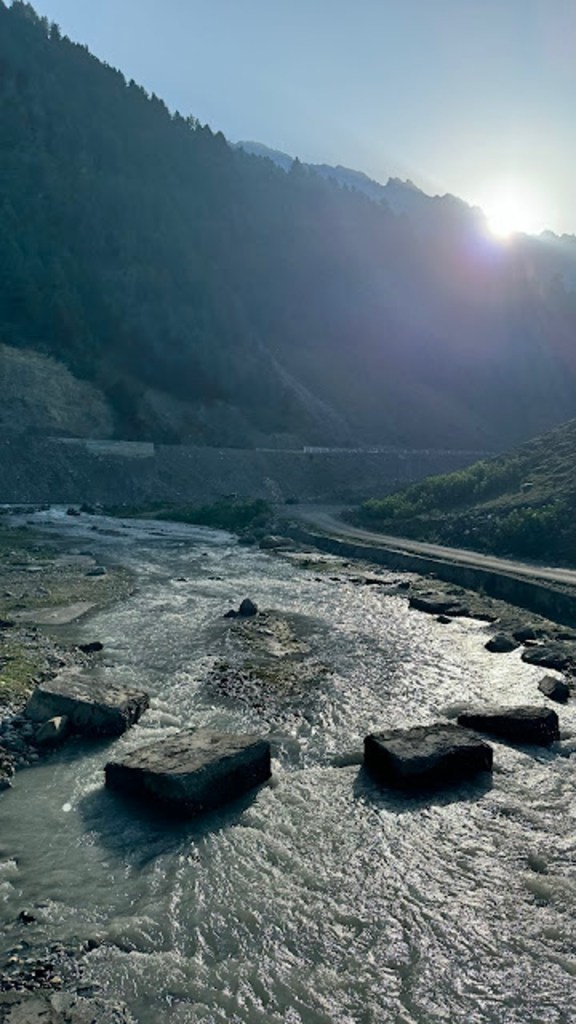
During one of my weekly cycling routines, I chanced upon a lady who had pulled over her SUV by the road. She gave a gentle honk. As if responding to some intergalactic mothership, I noticed a pack of stray dogs and a troop of wild monkeys hurrying towards the SUV. They gathered around the vehicle patiently as the lady began rummaging through the backseat and distributing food. 

I believed this to be the finest form of non-verbal interspecies communication I have ever witnessed. The cynic within me proposed that her actions were not in the best interest of the natural order. Wild animals are meant to hunt for their daily sustenance. By feeding them, they become overweight and less agile, ultimately diminishing their mobility. What will occur when the gravy train halts? Will they resort to attacking passersby for free meals? Nobody knows…

Here I am, cycling and running, hoping it will help me live longer or make me less of a bother to those around me in my twilight years. On the other hand, could exposure to the elements and the dangers associated with the outdoors be the actual cause of my malady? Nobody knows…

The individuals gathered in Prayagraj, India, for the Kumbh Mela share a common belief. The alignment of the Sun, Moon, and Jupiter in a straight line is thought to hold cosmic significance. The Kumbh occurs every 12 years in four locations across India—Prayagraj, Nashik, Haridwar, and Ujjain. This year, in 2025, a rare celestial alignment that occurs once every 144 years[2], offers a unique spiritual renewal and liberation opportunity. 

Can a lifetime of wrongdoing and accumulated karma debts be washed away in a single dip at Triveni Sangam[3]? Can one attain moksha so easily? Yet, nobody knows… none who have been there and returned to provide a field report.

The take-home message is that just because no reproducible and tangible proof can be provided does not mean it does not exist. To each their own. Rather than attempting to undermine their beliefs or corner them into adopting our views, we should simply leave them be. Let everyone believe they are making a difference in the world they inhabit during their lifetime.

Photo Courtesy: Farouk Gulsara

[1] Eleanor Rigby is a Beatles song from 1966 about a lonely woman who found solace in the church.

[2] https://www.moneycontrol.com/religion/maha-kumbh-mela-2025/maha-kumbh-mela-2025-astrological-significance-and-zodiac-impact-of-this-once-in-144-years-event-article-12918706.html

[3] The Triveni Sangam in Prayagraj (formerly known as Allahabad) is the confluence of three rivers: Ganga, Yamuna, and the displaced Saraswati.

Farouk Gulsara is a daytime healer and a writer by night. After developing his left side of his brain almost half his lifetime, this johnny-come-lately decided to stimulate the non-dominant part of his remaining half. An author of two non-fiction books, Inside the twisted mind of Rifle Range Boy and Real Lessons from Reel Life, he writes regularly in his blog, Rifle Range Boy.

.

PLEASE NOTE: ARTICLES CAN ONLY BE REPRODUCED IN OTHER SITES WITH DUE ACKNOWLEDGEMENT TO BORDERLESS JOURNAL

Click here to access the Borderless anthology, Monalisa No Longer Smiles

Click here to access Monalisa No Longer Smiles on Kindle Amazon International

Categories
Poetry

           Lunar Talk   

By Craig Kirchner

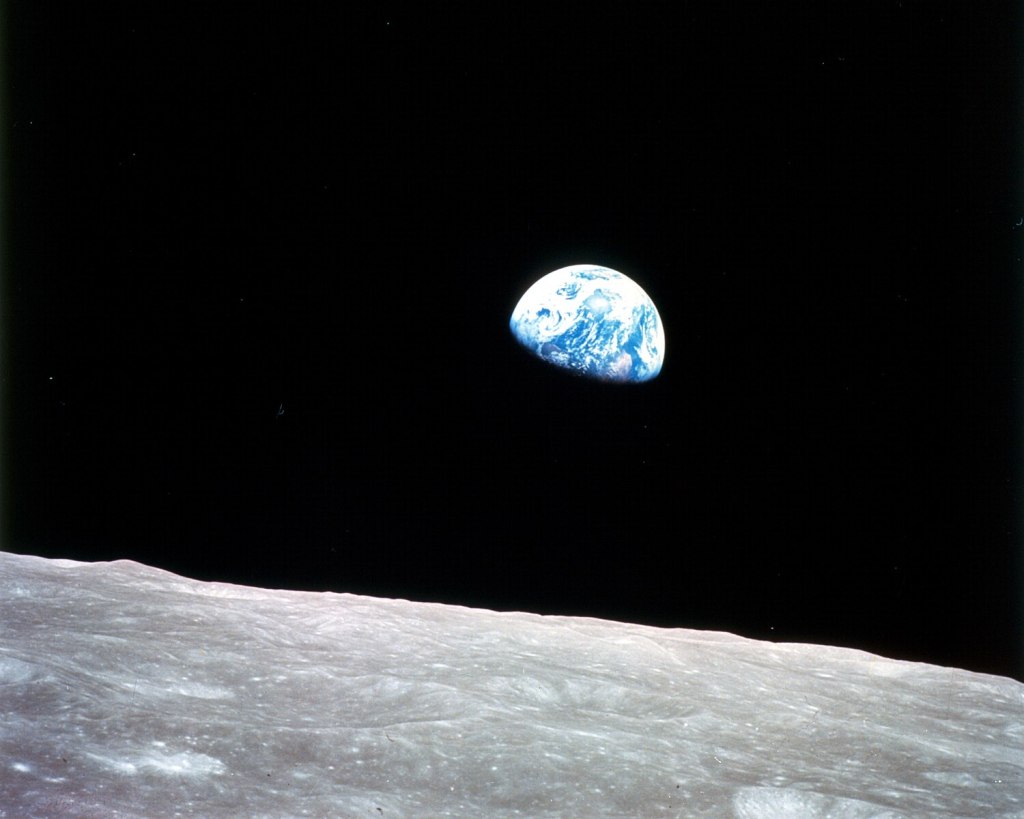
The Moon from Earth 1968. From Public Domain.
I have lived with over 27,550 moons.
Weather permitting, I speak to them.
Occasionally, one speaks back
depending on my schedule and needs.

Tonight, he’s full, starts the conversation.
This is new and exhilarating,
he describes quite poetically that he
sees himself as an island of truth.

I am responsible for tides, time and light,
my phases affect your sleep, he smiles.
I help birds migrate, navigate, and now
I need to get involved; it is true that

truth is subjective, depending on the tides,
two people will see the same event and have
different recollections, descriptions, analysis -
a third comes along and says it didn’t happen.


He says earth’s aura is turning murky grey,
indicating that its credibility is burning out,
that the lying and hate have become normal,
and the universe, the galaxies are watching,

They always have, thinking man humorous until
the last hundred years, caging, killing your young
isn’t acceptable. I see karma in man’s horoscope,
the planets aligning. You should leave, find an island.


Craig Kirchner thinks of poetry as hobo art, loves storytelling. He has had two poems nominated for the Pushcart, and has a book of poetry, Roomful of Navels.

PLEASE NOTE: ARTICLES CAN ONLY BE REPRODUCED IN OTHER SITES WITH DUE ACKNOWLEDGEMENT TO BORDERLESS JOURNAL

Click here to access the Borderless anthology, Monalisa No Longer Smiles

Click here to access Monalisa No Longer Smiles on Amazon International

Categories
Poets, Poetry & Rhys Hughes

Do It Yourself Nonsense Poem

Nonsense poems consist of nonsense without choice. You may choose to read or not read them, true enough, but once you have embarked on the journey you are helpless in the rushing of the raging word-torrent. Your reading mind becomes a canoe, sturdy enough but lacking a rudder or paddle. There are no alternatives to the direction in which you are rushing. You are committed, at least as much as the writer of the poem was, and the act of abandoning the work is equivalent to throwing yourself out of the canoe, immersing yourself in the foaming liquid, scraping your soul on the submerged rocks of the dangerous passage. Your inner being will experience this, even if it appears on the surface that you have simply ceased reading a few bewildering verses.

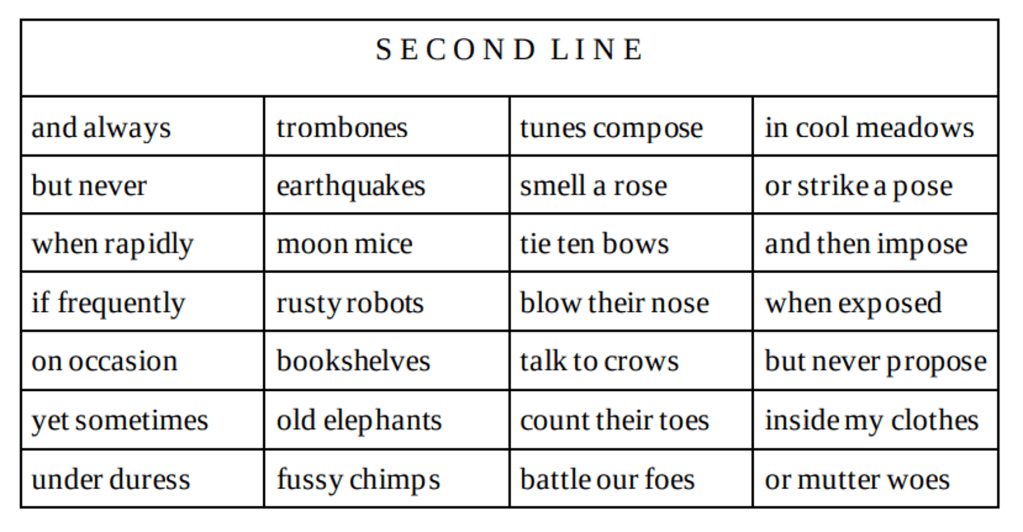
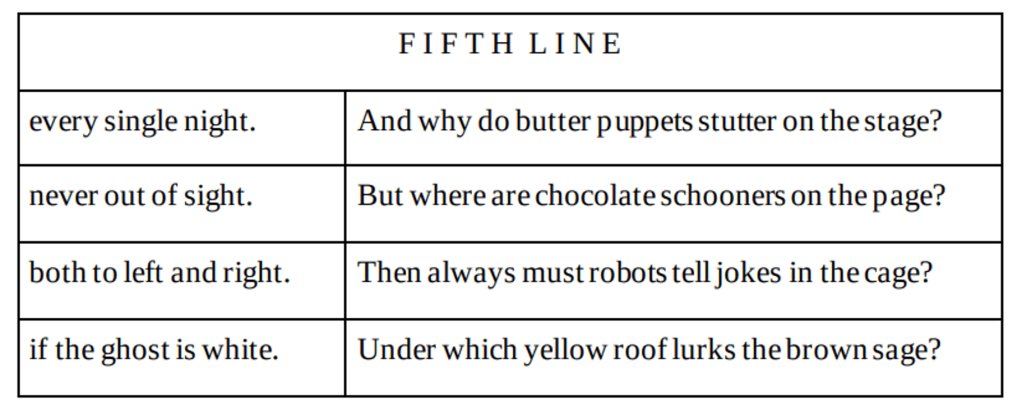
Therefore, I have decided, with some rhymes and a little reason, to create a nonsense poem that gives the reader rather more latitude in the way it develops. As an absurdist piece, the freedom of choice is limited to different meaningless outcomes, but my hope is that some of the permutations will be musical enough and sufficiently evocative to make the procedure worthwhile. The total number of combinations of lines is astronomical. This means that a reader who chooses a particular path through the poem will probably be the first to have done so. It is also likely he or she will be the last. The chances of someone else choosing the same route are vanishingly small. It can therefore be said that the poem was written entirely for you and nobody else. To navigate this ‘Do It Yourself Nonsense Poem’ simply choose a first line from the first grid, followed by a second line from the second grid, then a third line from the third grid, a fourth line from the fourth grid, and so on. There are twelve grids. The end result, if you persist, will be a twelve-line nonsense poem. It might be the case that a poem produced using this method makes some sort of sense. If this happens, I will be happy to offer you my condolences. But I think it is very unlikely a sensible poem will be found from this exercise, even if one really is hiding within the combined grids.

Among the multitude of poems that can be generated using these grids, one of them will be the best of all, and another one must be the worst, but it is simply unfeasible to work out which those are. The number of combinations is so high that the best will surely remain secret forever, and the same is true of the worst. This does not logically mean that the best is magnificent and the worst terrible. The difference between the best and worst might be very minor. But the grids are finished and I am the first reader of the work as well as its writer, so I felt entitled to find my own way through the grids. My random path led me to the following. After reading it through, my mind wanted to add the words ‘Well, wouldn’t you?’ to the end of the poem, but that is cheating. Attempts to twist nonsense into sense must be discouraged.

After cooking beans on the green platform the yeti mends a net
but never moon mice smell a rose inside my clothes
if singing a duet. The fanciest dress was bought new
thanks to rubber bones yet bedsteads gleam in smug dry streams
both to left and right. And why do butter puppets stutter on the stage?
The tangent was once unexplained, I guess, in situational anxiety
and so, aghast, four wise moons break a chair cogitating fruit.
The scholarly fruit trees rhyme badly, every day, or chatter with bees
greedily, noisily, sadly. And what of the butler? He loves all the clutter
under duress, he wonders while hissing, beautifully nonetheless.
And so the man blundered badly near a cockatoo but crystallised
and broke the cloud in the dusk to shun the vanilla fruit flies.

Rhys Hughes has lived in many countries. He graduated as an engineer but currently works as a tutor of mathematics. Since his first book was published in 1995 he has had fifty other books published and his work has been translated into ten languages.

.

PLEASE NOTE: ARTICLES CAN ONLY BE REPRODUCED IN OTHER SITES WITH DUE ACKNOWLEDGEMENT TO BORDERLESS JOURNAL

Click here to access the Borderless anthology, Monalisa No Longer Smiles

Click here to access Monalisa No Longer Smiles on Kindle Amazon International

Categories
Editorial

What do they Whisper?

No, they whisper. You own nothing.
You were a visitor, time after time
climbing the hill, planting the flag, proclaiming.
We never belonged to you.
You never found us.
It was always the other way round.

‘Moment’ by Margaret Atwood

With an unmanned mission reaching the moon — that moon that was chipped off the Earth’s surface when Theia bashed into the newly evolving planet — many feel mankind is en route to finding alternate biomes and perhaps, a solution to its housing needs. Will we also call moon our ‘Homeland’ and plant flags on it as we do on Earth?  Does the Earth — or the moon — really belong to our species. Do we have proprietary rights on these because of lines drawn by powerbrokers who say that the land belongs to them?

These are questions Margaret Atwood addresses in her writings which often fall into a genre called cli-fi. This is gaining in popularity as climate has become uncertain now with changes that are wringing fear in our hearts. Not all fear it. Some refuse to acknowledge it. While this is not a phenomenon that is fully understood by all of us, it’s impact is being experienced by majority of the world — harsh stormy weather, typhoons, warmer temperatures which scorch life and rising water levels that will eventually swallow lands that some regard as their homeland. Despite all these prognostications, wars continue to pollute the air as much as do human practices, including conflicts using weapons. Did ‘climbing a hill’ and ‘planting the flag’ as Atwood suggests, ever give us the rights over land, nature or climate? Do we have a right to pollute it with our lifestyle, trade or wars — all three being human constructs?

In a recent essay Tom Engelhardt, a writer and an editor, contended, “Vladimir Putin’s greatest crime wasn’t simply against the Ukrainians, but against humanity. It was another way to ensure that the global war of terror would grow fiercer and that the Lahainas of the future would burn more intensely.” And that is true of any war… Chemical and biological weapons impacted the environment in Europe and parts of Afghanistan. Atom bombs polluted not only the cities they were dropped in, but they also wreaked such havoc so that the second generation’s well-being continues impacted by events that took place more than seven decades ago. Yet another nuclear war would destroy the Earth, our planet that is already reeling under the impact of human-induced climate change. Flooding, forest fires and global warming are just the first indications that tell us not only do we need to adapt to living in changed times but also, we need to change our lifestyles, perhaps even turn pacifist to survive in a world evolving into an altered one.

This month some of our content showcase how to survive despite changes in norms. Suggesting how to retain our flora in a warming world is a book, Roses in the Fire of Spring: Better Roses for a Warming World and Other Garden Adventures, by M.S. Viraraghavanand Girija Viraraghavan, the grandson-in-law and granddaughter of the second President of India, Sarvepalli Radhakrishnan (1888-1975). They have been in conversation with Shantanu Ray Chaudhuri to explain how they have adapted plants to create hybrids that survive changing climes. Would it be wishful to think that we can find solutions for our own survival as was done for the flora?

Critiquing the darker trends in our species which leads to disasters is a book by an eminent Singaporean writer, Isa Kamari, called Maladies of the Soul. He too looks for panacea in a world where the basic needs of humans have been satiated and they have moved on towards overindulgence that can lead to redundancy. In a conversation, he tells us how he hopes his writings can help towards making a more hopeful future.

This hope is echoed in the palliative poems of Sanket Mhatre from his book, A City full of Sirens, excerpted and reviewed by Basudhara Roy. Bhaskar Parichha’s review of Samragngi Roy’s The Wizard of Festival Lighting: The Incredible Story of Srid, is a tribute also from a granddaughter to her grandfather celebrating human achievements. Somdatta Mandal’s discussion of fiction based on history, Begum Hazrat Mahal: Warrior Queen of Awadh by Malathi Ramachandran not only reflects the tenacity of a woman’s courage but also explores the historicity of the events. Exploring bits of history and the past with a soupcon of humour is our book excerpt from Syed Mujtaba Ali’s Tales of a Voyager (Joley Dangay[1]), translated from Bengali by Nazes Afroz. Though the narrative of the translation is set about ninety years ago, a little after the times of Hazrat Mahal (1820 –1879), the excerpt is an brilliant introduction to the persona of Tagore’s student, Syed Mujtaba Ali (1904-1974), by a translator who describes him almost with the maestro’s unique style. Perhaps, Afroz’s writing bears these traces as he had earlier translated a legendary work by the same writer, In a Land Far from Home: A Bengali in Afghanistan. Afroz starts with a startling question: “What will you call someone who puts down his profession as ‘quitting job regularly’ while applying for his passport?”

Other than a semi-humorous take on Mujtaba Ali, we have Rhys Hughes writing poetry in a funny vein and Santosh Bakaya giving us verses that makes us laugh. Michael Burch brings in strands of climate change with his poems as Jared Carter weaves in nature as we know it. George Freek reflects on autumn. We have more poetry by Luis Cuauhtémoc Berriozábal, Pramod Rastogi, Peter Devonald, Afshan Aqil, Hela Tekali and many more, adding to the variety of colours that enhance the vivacity of conversations that run through the journal. Adding more vibrancy to this assortment, we have fiction by Paul Mirabile, Saranyan BV and Prakriti Bandhan.

In non-fiction, we have Devraj Singh Kalsi’s funny retelling of his adventures with a barber while Hughes‘ essay on the hugely popular Tintin makes us smile. The patriarchal past is reflected in an essay by G Venkatesh, whereas Suzanne Kamata from Japan talks of women attempting to move out of invisibility. Meredith Stephens and Candice Louisa Daquin both carry on the conversation on climate change. Stephens explores the impact of Californian forest fires with photographs and first-hand narrative. Vela Noble draws solace and strength from nature in Kangaroo Island and shares a beautiful painting with us. Madhulika Vajjhala and Saumya Dwivedi discuss concepts of home.

Two touching tributes along with a poem to recently deceased poet, Jayanta Mahapatra, add to the richness of our oeuvre. Dikshya Samantrai, a researcher on the poet, has bid a touching adieu to him stating, “his legacy will continue to inspire and resonate and Jayanta Mahapatra’s name will forever remain etched in the annals of literature, a testament to the enduring power of the poet’s voice.”

Our translations this time reflect a diverse collection of mainly poetry with one short story by Telugu writer, Ammina Srinivasaraju, translated by Johny Takkedasila. Professor Fakrul Alam has introduced us to an upcoming voice in Bengali poetry, Quazi Johirul Islam. Ihlwha Choi has translated his own poetry from Korean and brought to us a fragment of his own culture. Fazal Baloch has familiarised us with a Balochi ballad based on a love story that is well known in his region, Kiyya and Sadu. Our Tagore translation has attempted to bring to you the poet’s description of early autumn or Sharat in Bengal, a season that starts in September. Sohana Manzoor has painted the scene depicted by Tagore for all of us to visualise. Huge thanks to her for her wonderful artwork, which invariably livens our journal.

Profound thanks to the whole team at Borderless for their support and especially to Hughes and Parichha for helping us source wonderful writings… some of which have not been mentioned here. Pause by our content’s page to savour all of it. And we remain forever beholden to our wonderful contributors without who the journal would not exist and our loyal readers who make our existence relevant. Thank you all.

Wish you all a wonderful month.

Mitali Chakravarty

borderlessjournal.com

[1] Translated literally, it means Water & Land

.

.

Visit the September edition’s content page by clicking here

READ THE LATEST UPDATES ON THE FIRST BORDERLESS ANTHOLOGY, MONALISA NO LONGER SMILES, BY CLICKING ON THIS LINK.

Categories
Editorial

Catch a Falling Star…

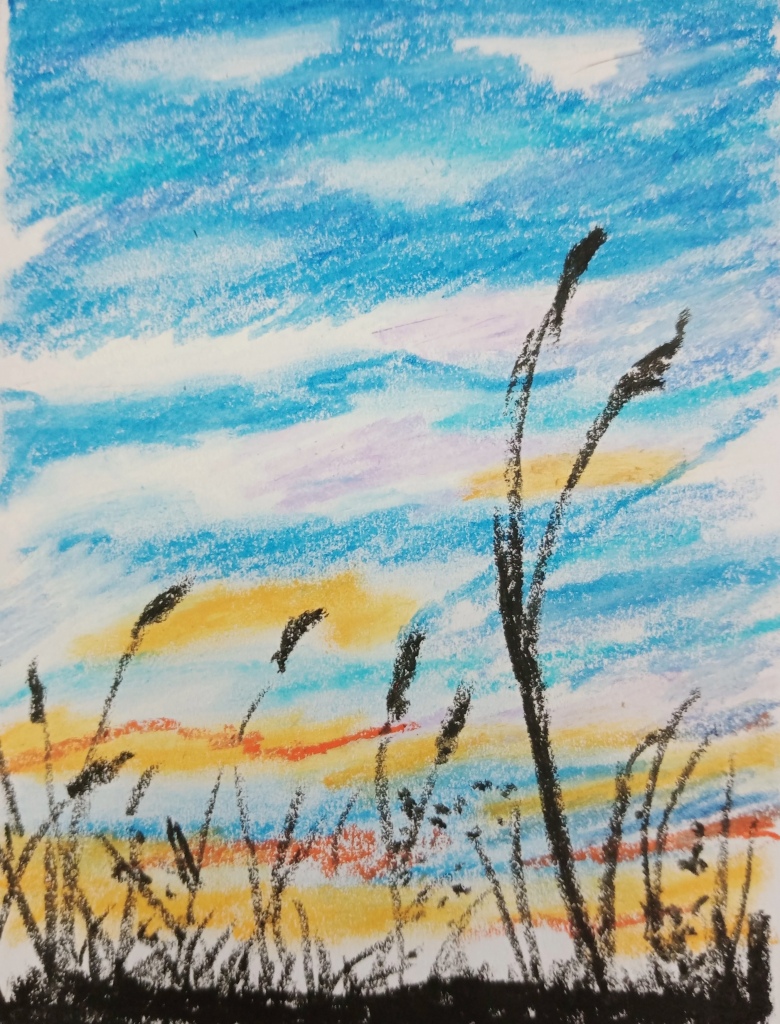
Art by Sohana Manzoor
For when your troubles starting multiplying
And they just might
It's easy to forget them without trying
With just a pocketful of starlight

Catch a falling star and put it in your pocket
Never let it fade away (never let it fade away)
Catch a falling star and put it in your pocket
Save it for a rainy day

'Catch a Falling Star' by Paul Vance and Lee Pockriss

Perhaps, it is time to find that fallen star popularised by pop singer Perry Como is 1957. Optimism glimmers faintly, sometimes even conceals itself, in a world passing through a dark phase in history. For instance, few of us would know that we might find more answers to tackle  climate change as dinosaur fossils (from the time an asteroid hit the planet) have been unearthed recently. That sounds like solutions can be had to what was perceived as inevitable doom.

Another bit of news that perhaps will cheer some is the first anthology of Borderless Journal will soon be available in market. It has been accepted by a publisher, an old, trusted and reputed name from India, Om Books International. They have bookshops splattered all over — should make it easy for buyers to access the book. Hopefully, you can target the anthology for your Diwali or Christmas gift hampers. Om Books has one of the most iconic editors-in chief, Shantanu Ray Chaudhuri. A multiple award-winning editor, he has worked in Penguin and Harper Collins and is currently churning out wonderful books from Om with a fabulous production team, working with whom has been a pleasure. Ray Chaudhuri is an outstanding film writer and poet. He is part of a group that is creating a film archive online. To know more about him or his views on publishing, you can read our online conversation with him.

The energy one gets from optimism like starlight from a fallen star, lightens the darker shadows that create gloom with the war leading to rise in prices and threats of recession in a post pandemic scenario. Lesya Bakun, the refugee from Ukraine whose story we carried last month, finds her starlight by sharing updates of her story.  She added to her narrative with the news that her cousin has been taken as a prisoner of war by Russia from the besieged factory in Ukraine. Though sharing does not alleviate suffering, Bakun’s ability to cling to hope and imagine a future where she gets her dream highlights the strength of her convictions. The other thing that is revealed by her narrative and media coverage is exclusivity and boxes of ideology split humankind, erase families, cities, countries, lives and sanity. The war can appease only the lust of warlords. Against this desolation caused by the devastation, what could be the starlight that would lead to a happier future?

Laughter. Unleashing the ability to laugh at oneself is as potent as laughter that generates relief and lightens our mood, so that we can view differences as whimsical, treat them with tolerance and compassion and not destroy the diversities that add colours to the world. Perhaps, that is why Tagore took to humour too. Somdatta Mandal has translated a series of humorous skits by Tagore. We are featuring one of these called the ‘Ordeal of Fame’. Yet another translation or transcreation of a poem called ‘Lukochuri’ or ‘Hide and Seek’ reflects the playful in Tagore’s oeuvre. These, along with Rhys Hughes humour on the pandemic in poetry and prose, bring good cheer into our journal. Hughes has also used his column to tell us why he curated a new humorous anthology of verses by seventeen poets called Wuxing Lyrical. I wonder if he is serious or joking!

We were fortunate to have a tongue-in-cheek online discussion with an academic with a witty sense of humour who started a book based on his PhD research with a limerick, Amit Ranjan, author of John Lang the Wanderer of Hindoostan, Slanderer in Hindoostan, Lawyer for the Ranee. While Ranjan brought to us a narrative of an Australian who challenged the colonial mindset, went to court representing the Rani of Jhansi, wrote for Charles Dickens in Household Words and moved around the world just like one of us, hopping jobs and looking for a life, we have diverse cultural streams woven into the journal with translations of a Balochi folktale from Fazal Baloch, a Korean poem by Ihlwha Choi and Professor Fakrul Alam’s translation of Jibananda’s poetry, an ongoing project in Borderless.

The Nithari column has yielded us a story that was written in a mix of Hindi and English by Yogesh Uniyal and translated fully to English by Nirbhay Bhogal. We have strange stories this time. Nileena Sunil’s short narrative and Paul Mirabile’s longer one set in Madrid explore the unusual. More stories delve into the intricacies of the human mind.

As we trot around the globe, Suzanne Kamata tells us about a Monet museum in Japan where she ate madeleines made with the artist’s recipe! Meredith Stephens sails to Tasmania with her camera and gives us a glimpse of nature’s plenty. Ravi Shankar relates his trekking adventures among the Himalayas in Nepal, with awesome photographs of these mountains, while Kenny Peavy who lives in Indonesia dwells on the value of falling down and getting up in a light humorous vein against the backdrop of nature – though metaphorically perhaps the world needs to do that. We have G Venkatesh’s story about his stay in Johannesburg where he discovers that skin tones do not matter.

Ratnottama Sengupta makes the whole world look like a home with the story of a legendary screenwriter, Jean Claude Carriere, who wrote the script of Mahabharata for Peter Brook’s play (1985) of the same name and the subsequent film (1989) — with characters drawn from all over the world. Candice gives us an overview of the pandemic, with more focus on US where she lives.

Mike Smith travels back to another time when an ailment called World War II raged and has revived a writer from the past, HE Bates (1905-1974). We have another essay by Dan Meloche on a legendary book which turned 100 this year — Herman Hesse’s Siddhartha. Rakhi Dalal revisits more than a century old translation by Devabrata Mukherjee of Tagore’s The Post Office which bears relevance to the present day as it shows how the human spirit endures over even the darkness of death.

Bhaskar Parichha has reviewed Radhika Gupta’s Limitless: The Power of Unlocking Your True Potential, by his assessment a book that inspires youngsters to take charge of their future. On the other hand, there are books that explore the darkest in humans. Basudhara Roy has reviewed a collection short stories by Sunil Sharma called Burn the Library & Other Fiction. Indrashish Banerjee reviews Upamanyu Chatterjee’s latest novel based on modern day crimes, Villainy, from which we are carrying a book excerpt too. The other excerpt is from a narrative written from a refugee’s perspective, Ramy Al-Asheq’s Ever Since I Did Not Die, translated by Isis Nusair from Arabic. Born in a refugee camp in Damascus, this Syrian-Palestinian poet defies all genres to touch hearts with brutal honesty. No less sincere is Michael Burch’s poetry on summer that ushers in the season as much as Sohana’s beautiful painting that we are using as our cover photo. We have poetry from not just Shantanu Ray Chaudhuri but also by George Freek, S. Srinivas, Tohm Bakelas, Abin Chakraborty, Marianne Tefft and many more. As usual, I have not mentioned all the treats in store for you. Delve into our contents page and browse to find out more.

Before winding up, I would want to extend my thanks not only to our team and contributors, but also to our publisher who is willing to republish our content with some tweaking. Thanks to our readers who, I hope, will be excited to have selected content between their palms as a hardcopy anthology with 49 of our most iconic pieces. We have more than a thousand published works. This anthology will be an iconic sample that you can carry anywhere with you even if there is no internet – that would include Mars and Moon!

I wish you happy reading, happy dreaming and hope… plenty of it.

Best wishes,

Mitali Chakravarty

borderlessjournal.com

Categories
Musings

To Infinity & Beyond!

By Candice Louisa Daquin

Inclusiveness seeks to bridge gaps between peoples and places. Too often our parochial approach in life, leaves us alienated and estranged. But speaking of aliens … in the 2000’s it seems we are at last coming to the point in time where humans will begin to, if not live off world, then visit in greater numbers. Space travel? That’s truly borderless. How exciting to imagine traveling the universe and having our eyes opened to the immense possibilities of space!

Though the elites enjoy space travel, the question remains, will the human race en mass ever truly reach the stars and expand beyond Earth? With this in mind, I posit the following questions;

Is it viable?

Back in the 1950s there was a contagious worldwide fervour to go to space, fuelled by the fantasy of sci-fi writers and films that made this achievement seem imminent. Maybe after the two world wars and the fatigue of poverty contrasted with the hopefulness of better days ahead, we were finally able to dream. In a way, space travel has always been the purview of the dreamer. The Soviets launched the world’s first satellite, Sputnik I, in October 1957. The competition and fear between America and the Soviet Union no doubt accelerated the development of space exploration during this time. Additionally, the cessation of world wars made this logistically more possible, and the knowledge gained from those wars was utilised to create space worthy ships. The race to get to space was a Cold War competition between the United States and the Soviet Union to develop their respective aerospace abilities and send satellites, space probes, and humans up into space. But the whole world was involved, with astronauts, scientists and researchers working together as much as they competed with each other.

In April 1961, Soviet cosmonaut Yuri Gagarin entered Earth’s orbit, in Vostok I, a space craft for one person, becoming the first man ‘in space’. In the 1960s, the US reached the moon (unless you believe that this was faked, in which case, film maker Stanley Kubrick made a faux film of reaching the moon, information on this can be found in the revealing documentary Room 237, by Rodney Ascher made in 2012!). If indeed the moon was reached, it seemed back then, this was just the beginning. There was a palpable obsession with the future. Technology that would get us to space gripped the United States and deeply influenced the cultural artefacts of the time. In 1955, Walt Disney paid consultants who worked on space-related projects to help him design the rocket ship rides of Disney’s Tomorrowland. Songs about space, art and fashion relating to space were all fascinations that beget the drive forward. Stanley Kubrick‘s film The Shining (1980) is supposed to have secret references to the faking of the lunar landing. Whether faked or real, the world believed humans landed on the moon and in a way that’s what counts most — perception.

Then wham! Our predictions of where we’d be by the 2000’s seemed vastly optimistic. For a plethora of reasons, not least, the sheer magnitude and cost of space travel. We were not riding on space elevators or darting around the universe by the 2000’s – so all those old shows predicting we’d be there by now, seemed to be just fantasy. Some people point to the Challenger explosion as the beginning of the end of American at least, space adventure. Cost, danger, the environment, many reasons can be ascribed but do not explain the extreme and total diminishment of interest. Once upon a time people pressed themselves to store fronts to watch old TV’s displaying live rocket takeoffs and now nobody seemed to care if America has abandoned her search for the stars. Was the interest just an epoch in time that has been replaced with other technologies and obsessions? How does this explain other countries who continue to fund and grow their space programmes? How can something as crucial as endeavouring to reach another world, be shelved in favour of the latest iPhone?

Astronauts have spoken out claiming the reason humans have only just returned to the lunar surface since 1973 (China just landed in 2020) isn’t based on science or technical challenges, but budget and political hurdles. This is easy to believe if you consider the American technology that landed them on the moon had less ‘tech’ than a modern-day scientific calculator. I remember going to Houston and seeing the original ‘space control’ and how tiny everything was and wondering how on earth they landed men on the moon and returned them safely. To advance that technology for further space exploration is both expensive, daunting and involves consistent agreement among politicians. Makes you wonder how it was ever made possible! The reason America funded the space race initially was because it was a point of pride (beating the Soviet Union) which as pathetic as that seems, seemed to gear up enough people to make it happen. Without that impetus, politics drowns the scientist and astronauts wish to advance space exploration.

The mother of invention isn’t just necessity, it’s also fantasy. Artists have long influenced inventors – think Star Trek and the low-tech ideas they had, which have been replicated more recently in flip-phones and video-chat. Sci-Fi writers and thinkers have influenced those who seek to go to space as much as anyone else. It could be argued there is no real delineation between fiction and reality in this case, owing to their mutual influence. If we could create a lunar base, scientists believe this base could evolve into a fuelling point for future further-flung missions into deep space. It could also lead to the creation of improved space telescopes and eventually enable us to live on Mars. We need to push ourselves to the next level of exploration – having relied upon ageing technologies that we have not funded sufficiently to advance. Now, billionaires like Elon Musk push for space tourism, rather than chronically underfunded agencies.

One of the biggest impediments, is how to pay and guarantee safety. NASA is under-funded and receives a tiny percentage of the overall US budget. Priorities go to the military and other immediate programs that are deemed more essential. Since this is political, it’s up to the public to generate an interest in space travel. Sadly, even when the Apollo program was at its greatest; after Aldrin and Neil Armstrong stepped onto the lunar surface, only 53% of Americans said they thought the programme was worth the cost, according to a report in the Insider.With politicians changing too frequently to see through long-term investment space projects, this stymies those who believe space exploration should be prioritised. Buzz Aldrin has been strategising to get to Mars for over 30 years, as he lamented the lack of support space exploration receives. Aldrin and other experts agreed it must involve international cooperation: “A US-led coalition would include Europe, Russia, India, Japan and China, as well as emerging space nations the United Arab Emirates, South Korea and Saudi Arabia,” Aldrin said in an article in The Gaurdian. “We can afford to go to Mars but we must have fiscal discipline. We must focus our limited resources on only those things that are really necessary to get to Mars. In my view, we are currently spending over $6bn on programs we do not need to get to Mars. We need reusability, every element of the system.”

It’s nearly 2022 and we’re still not there en mass or reaching further. We’re told it’s possible but technologically there are hurdles to overcome, not least the effect of long-term space travel on the human body, or the effects of uncontrolled radiation from the (belt) or the methods by which we fuel vessels for such long-haul trips. Space radiation is one of the greatest risks for astronauts. “Determining astronaut health consequences following radiation exposure involve very complex processes,” stated Tony Slaba, Ph.D., NASA research physicist in a government website. “It’s difficult to quantify exactly how radiation is interacting with tissues and cells – and more complicated to quantify and determine what long-term outcomes are going to be in terms of the potential diseases and biological system effects.”

And that’s without touching on putting people into statis or some kind of sleep. We have great ideas and history tells us great ideas eventually become reality, but it’s taken us longer than we anticipated back then. Technologies like magnetic and water shielding have only gone so far and need to be prioritised if we’re to live off-planet. Another real threat, alien microorganisms, prions or diseases humans have zero exposure or immunity to. If we imagine what Covid-19 has wrought, it’s easy to see why bringing ‘space-bugs’ back to earth or exposing astronauts to unknown elements, could be fatal. Finding unbreakable ways of protecting everyone will prevent the science fiction horror stories from coming true. But what’s more likely? Thinking about potential dangers being brought back to Earth, or the excitement of exploration?

What does it bring us if we achieve it?

The people who will benefit from space travel won’t be you and I. It will be the trillionaires who can fund projects and much like early explorers they will exploit natural resources and profit from them. Whether they find planets made of diamonds or copper or other expensive minerals it will be they with their reach, who like plantation and slave owners will come out on top. One can argue this is a replication of the exploitation of the Earth, and those people working for the giant industries. I would agree. Does this mean all space exploration is without value? There is always value to reaching further, but it generally comes at a cost and requires exploiting the masses by the few. Pluses could include sending people off world to ease the burden on the planet as we become overpopulated. We might be able to terra form, and create liveable planets that can sustain life, although predictions suggest this would take lifetimes. One idea has been generation ships; where ships are able to manufacture a way to self-generate power and travel for long distances and time. Those in the ship may live their entire lives onboard and it may be their children or grandchildren who reach the final destination. The idea of sacrifice always exists when considering far-flung exploration, and this was often the case when people got into little wooden boats centuries ago in quest of unknown continents.

Can we learn from the mistakes made by early explorers? Or will we repeat history because it’s our nature? If we cannot create planets that are self-sustaining then we rely upon earth to supply those planets with food and water etc. and that’s less sustainable than not going off world. Potentially if we could make this work, it would be years in the future, but might give the human race the opportunity to significantly grow due to increased resources. Without this, we are stymied by the resources of one planet, which we are using up rapidly. Whether it’s a good thing to increase the human race throughout a galaxy or universe, remains unknown. We could be viewed as cockroaches or explorers, that’s up to the interpreter and our choices should we become a race of space farers.

A 2018 Pew Research Center poll showed the tide is turning, with the majority of voters saying NASA space exploration is necessary but majority want the skies scanned for killer asteroids. Maybe the way we get to space will change, in that we have to think of modern day, pragmatic methods of funding space travel, even if its in the guise of space tourism or tagging on the back of projects to protect the planet against killer asteroids. Maybe it will take another tragedy like an asteroid hitting the Earth to advance our current knowledge, as this seems to be the only way humans operate. We are less inclined to prevent disaster as to respond to it. Sadly, if the environment continues to be eroded, we may have no choice but to seek off-world options, and we don’t want to leave that option till it is too late to act. With dramatic weather pattern changes throughout the world, it’s never been more essential to protect Earth but we’ve not doing a very good job if the oceans and air pollution are anything to go by.

What are the potential down-sides?

It isn’t possible to talk about this without considering the many side-effects of space travel. Many I’ve already touched on but it’s worth really to reconsider history which has shown the penchant of humans to dominate and disrespect other cultures. Humans often consider themselves the ultimate alpha, the top dog, but in truth they could be replaced tomorrow depending on weather and climate and natural disasters, just as the dinosaurs were. We shouldn’t let our hubris make us forget our responsibility to our planet. Some argue space travel is a waste of resources and money because it’s looking beyond us rather than at what we already have. Shouldn’t we be fixing our home-grown problems before we focus on the skies? Others say we should look at the ocean before we consider space. Home grown issues include the devastation human beings have wrought on Earth, which most of us are familiar with.

Given we are reckless with our inventions. They benefit us but not necessarily the natural world around us. Is it any wonder to guess why expanding the human race can be a matter of concern? I’m not one who believes humans are the apex and that we are entitled to be. I predict one day we’ll give up our throne. But there’s the other side of me filled with the wonder of imagining what is out there. I mean, if space is infinite, which they have agreed upon, that means it never ends, a concept few of us can even understand or relate to. Imagine? Infinity. What does that even mean? When we humans begin-middle-end and everything around us does the same. It’s the true sense of forever, something larger than we will ever be. I’m filled with a fascination for a universe that doesn’t end, how do I wrap my head around that and comprehend the myriad possibilities this entails!

What I do know is if something never ends there literally are eternal possibilities meaning every possible eventuality must occur, because of the law of replication. There are only a certain number of creations that come from a universe containing certain components and those creations if given affinity, will reproduce in varied forms, but also replicate. I think this is where the concept of parallel universes comes from. Rather than a literal slice in time dividing one notion of reality from another similar but not the same version of reality. A universe that has no end, will eventually ‘play out’ every scenario, a little like you could crack any code if you had long enough to go through the permeations – but we don’t have time, so we don’t do that. The universe, however, does have time, infinite, so all that can be created will be, and all that has been created (including us) will be created (again) in shades of similarity. This I believe is where we get the concept of a parallel universe, although that’s not quite what it is.

If we add to this the concept of space and time, how time is not a set notion but rather, a perception based on humanity, the same goes for our understanding of the material world. In other words, we’re limited by our own physical presence and lifespan in our understanding of what is beyond us. For those like Steven Hawkins or Ashwin Vasavada (Project Scientist for NASA’s Mars Rover Curiosity, in charge of a team of 500 researchers), they can see beyond what is literal and imagine like any great thinker, beyond what we know and assume, and extrapolate. This extrapolation includes quantum physics and the breaking away from normal modes of thinking to include things we’re only beginning to understand.

If time is not mutable, if concepts of reality really don’t exist as we assumed they did, then it throws everything into question. Is what we perceive as reality even remotely real? Or just a flawed, human-centric bias? And if the latter, the universe’s secrets are closed to the limitations of our minds? This is why some who have taken psychedelic drugs have said, sometimes the doorways of perception (Aldous Huxley’s The Doors of Perception, written about his experiences with mescaline in May 1953) must be opened differently. Huxley was in turn influenced by the poet William Blake who wrote: “If the doors of perception were cleansed then everything would appear to man as it is, Infinite. For man has closed himself up, till he sees all things through narrow chinks of his cavern.”

Science, logic, mathematics, will probably provide us with many answers but in order for us, as sentient but limited-sentient beings, to evolve perceptively, we may need a further key to elucidate things beyond subjective perception. Some evaluation of psychedelic drugs as facilitators of mystical insight with great potential benefits for science could be that missing link.

Having read a great deal of science fiction, I wonder if I would think like this had the ideas not been implanted by some of those great science fiction tomes and operas. I suspect we build on what we learn, so nothing is entirely original, but in building on others, we may come closer to answers than if we operated in a vacuum. This is also true with making science fiction a reality. But just as our urge is to explore, we should be mindful of past mistakes as a race (human) and not repeat the colonialist model that only caused pain. Otherwise, life could be no more than a petri dish with us experimenter or experimented upon. There is more to life than conquer or absolute knowledge. There is the humility of experience and growing from it, which is something we often diminish. Perhaps spirituality and hard science are not after all, so incompatible.

Will it actually happen?

The development of nuclear-thermic powered propulsion systems to enable long-haul space-flight is essential to reduce crews journey time and make travel to Mars and beyond realistic. Heat shields to ensure landing is safer on unknown planets, would cut down on landing fatalities. Next generation space suits that are flexible and livable would allow explorers to spend more time in their suits than the suits of old that were not invented for long term use. There would also need to be a nuclear fusion style power system that enabled those landing on planets, to tap into power whilst on planet, and not fear running out. Radio systems used currently, can take up to nine years to send transmissions from say, Mars to Earth, so the development of technology like lasers to send information and communications rapidly would be essential. Scientists like Sharmila Bhattacharya (Director of Research in the Biomodel Performance Laboratory of the Space Bio-sciences Division, NASA) are spending decades researching the effects of the human body in space to understand how to survive, even thrive in space.

I’d love to think our progeny will reach space in a way we have yet to. Why? Because there is something fantastic about imagining us getting off-world and exploring. I think human beings are innately curious but like cats, their curiosity can be destructive. I would like a more utopian future, where we learn from prior mistakes and if we do reach space, we do so ethically. I don’t know if that’s possible, but anything less will be just another belching coal mine, suffocating those who work in it and those who live around it and that is not a dream I share.

Why is going to space so bewitching when we have unexplored oceans that we’re contaminating rather than exploring (Eight million metric tons: That’s how much plastic we dump into the oceans each year. That’s about 17.6 billion pounds — or the equivalent of nearly 57,000 blue whales — every single year. By 2050, ocean plastic will outweigh all of the ocean’s fish.). Without the ocean, the planet dies Is space travel selfish when starving people here on Earth need immediate help rather than pouring money into space flights that are at this time, only for the privileged? I think we all share a bigger dream of being ‘more’ than simply Earthlings. If a God exists maybe they don’t want us to go beyond these confines, or maybe they do. If a God doesn’t exist, then it seems obvious we’d want to go as far as we could, because again, this is our nature. It’s how we do it. And if we do it because we’ve ruined this planet, that’s a pretty good determinant that we’re going to make the same mistakes in space.  

Finally, is it necessary?

This is perhaps the most important question because we do a lot of things that are not strictly speaking necessary. Ever noticed how when someone gets money, they spend a lot of it on ‘unnecessary’ things? Why don’t some of these uber-rich people put money into worthy causes with the same intensity as frivolous? Why do those with money often need more? Why is the accumulation of material gain, so addictive? All this relates to a bigger question, a moral question. What is necessary versus what is not? For a rich person they go well beyond what is necessary in an ordinary sense because their wealth gives them more opportunity. Interestingly those who win the lottery are often said to be less happy after winning than before. Perhaps money is a double-edged sword. There is something to be said for adversity and earning our own way in the world, and a realistic measure. A bit like when you spoil and ruin a child because you indulged them and they no longer have a sense of the true worth of things.

We are very entitled when we get into those vaunted positions and perhaps things we think are necessary, are not. So how do we decide? Is it right for us to be a moral judge and tell others their dreams and excesses are not allowed? Realistically we could never control excess, so it’s not an option. There will always be people who live on different levels and have excesses the ordinary person cannot imagine. Those people may use up the resources we have to share, in greater quantity, which is bad. Or they may inadvertently propel our collective aspirations further. By having some of us who are capable of making dreams come true, the rest of us are swept along by the excess and the dream. In this sense, dreams are necessary, as they give us all something to aspire to, even if we may not literally be the one possessing the outcome of the dream.

I think it is necessary to have aspiration and fanciful dreams that aren’t strictly speaking practical or entirely pragmatic. Sometimes we just want to dream bigger than we are, because we know we are all going to die eventually, and we want something astounding. For some of us this may be God, for others it may be space (or it may be both). Without this, we revert back to the star gazers of the past, who probably also hoped their progeny would reach those stars but didn’t have the means to make it come true themselves. If you have the means, maybe you should use them, just as if you have the ability to invent and conceptualise, you do so. Maybe it’s an intrinsic collective wish that we should not neglect, by being entirely sensible. Maybe we won’t save the planet by aiming for the stars, but we might find a little magic.

Candice Louisa Daquin is a Psychotherapist and Editor, having worked in Europe, Canada and the USA. Daquins own work is also published widely, she has written five books of poetry, the last published by Finishing Line Press called Pinch the Lock. Her website is www thefeatheredsleep.com

.

PLEASE NOTE: ARTICLES CAN ONLY BE REPRODUCED IN OTHER SITES WITH DUE ACKNOWLEDGEMENT TO BORDERLESS JOURNAL.