I felt some trepidation as I prepared to enter the United States from Japan. It would be my first time to return to my native country since the new administration took office. Rumour had it that immigration officials would check my phone for leftist activity on social networks (they didn’t). I’d heard about books being banned, libraries and museums being closed, and the words “diversity,” “equity,” and “inclusion” being suddenly prohibited in government documents.
My parents, originally from Michigan, in the North, live in South Carolina. This is where the Civil War began in 1861 when state legislators voted to secede from the union. They wanted to preserve slavery and allow its expansion into western territories. South Carolina and six other Southern states formed what was called the Confederacy.
The Confederate flag, a symbol, for many, of an ugly past, was first flown from a flagpole in front of the capitol building in 1961, in commemoration of the hundredth anniversary of the Civil War. It remained flying in protest of the Civil Rights movement, and was only taken down in 2017, after a twenty-one-year-old white supremacist entered a historically black church in Charleston and opened fire on a prayer group. He killed nine people and injured one. Now the flag is on display in a special room at the State Museum.
My visit to South Carolina coincided with a visit from my son, a student of history with a keen interest in politics. My dad thought it might be fun to take his grandson to the Statehouse for a tour. My son was enthusiastic about this idea. I went along, too, with some reservations.
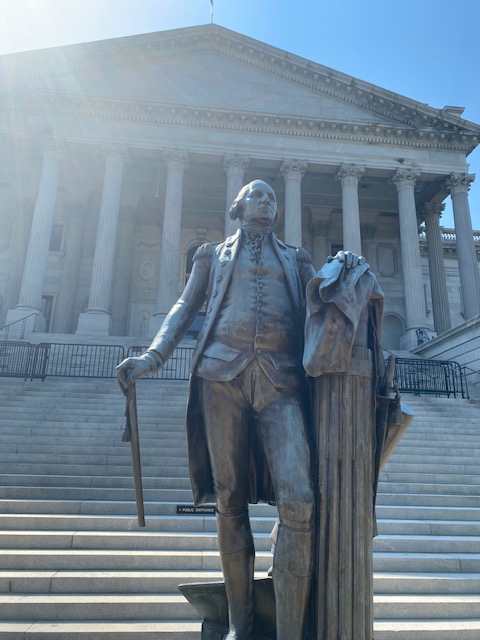
We drove into the city of Columbia and parked in a public lot at the back of the Statehouse. As we entered the grounds, we came upon a statue of Strom Thurmond. He was a teacher, a lawyer, and a highly decorated soldier. He served as governor of South Carolina from 1947-1951, and as senator for 47 years after that, right up until his death at the age of 100. Until very recently, he held the record for the longest filibuster, which is a tactic used to delay voting upon a contentious bill. Basically, a senator takes the floor and keeps talking for as long as he possibly can. In August of 1957, Strom Thurmond gave a speech lasting 24 hours and 18 minutes in opposition to a law promoting civil rights. After his death, it was revealed that he had fathered a child with his family’s 16-year-old African American maid. Of course, that is not inscribed on the plaque at the base of the statue.
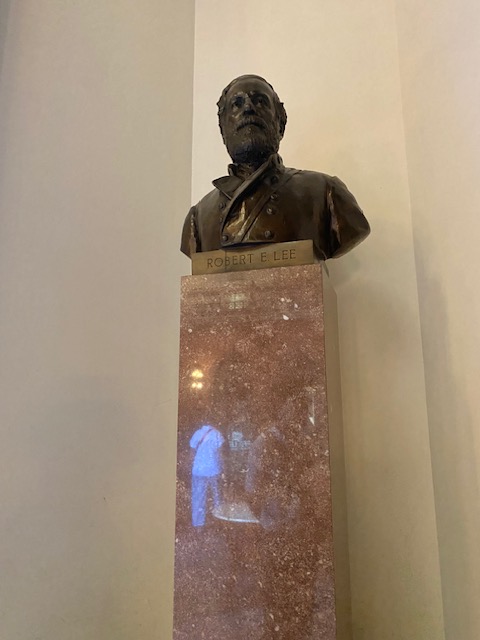
To be honest, I had expected to see this statue, as well as other monuments devoted to Confederate generals and segregationists. But I was pleasantly surprised to find a new monument commemorating the accomplishments of South Carolinian African Americans.
We went inside the building and were ushered to a room off to the side for a short film before the tour began. I noted that the film was narrated by a young African American man, which seemed like a nod to diversity, equity and inclusion. He mentioned, perhaps with false pride, that Strom Thurmond held the record for longest filibuster in the history of the United States. Nevertheless, I was glad to see that the film highlighted the achievements of women and minorities, such as South Carolina’s first – and so far, only – female governor, Nikki Haley, the one who ordered that the Confederate flag be removed from state grounds.
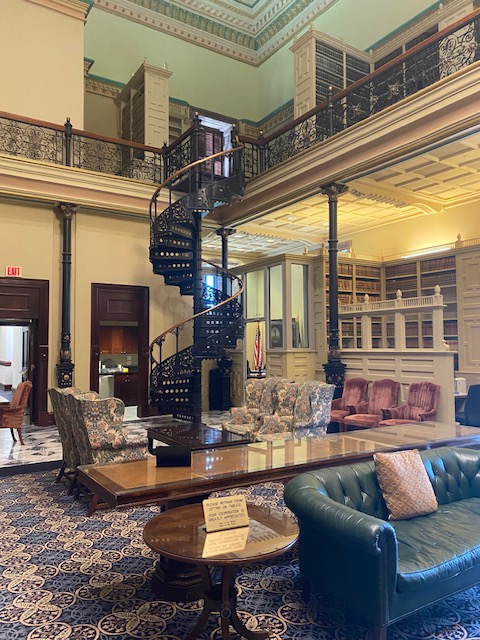
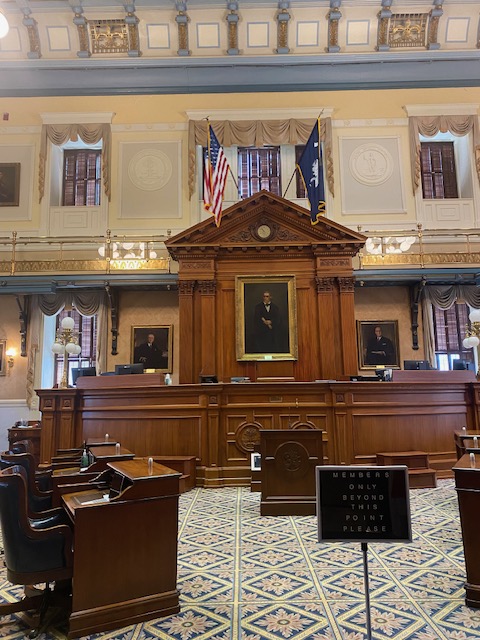
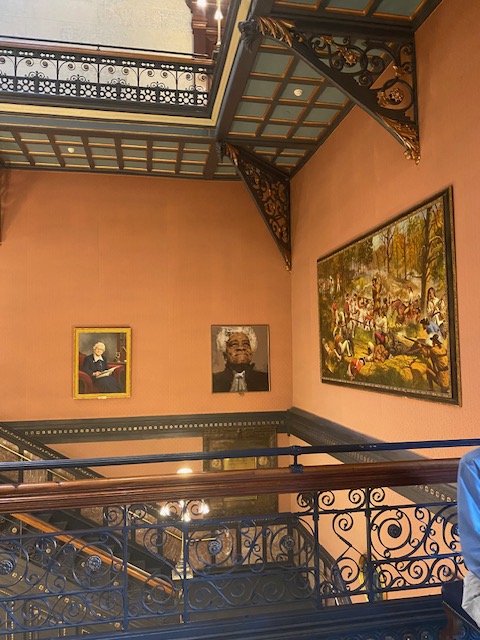
During the rest of the tour, I breathed a bit easier, admiring the intricate ironwork on the stair railings, and the stained glass above the chambers. I enjoyed hearing that Magdalen Feline, a woman goldsmith had crafted the symbolic mace, which is placed in a rack at the front of the Speaker’s podium when the House of Representatives is in session. And I was pleased to see a portrait of African American educator, philanthropist, and civil rights activist Mary McLeod Bethune (1875-1955) prominently displayed.
South Carolina is a complicated state, and this is an increasingly complicated world. However, going on this tour gave me hope that my fellow Americans might get back to celebrating diversity, equity, and inclusion, and all of the best parts of human nature.
Suzanne Kamatawas born and raised in Grand Haven, Michigan. She now lives in Japan with her husband and two children. Her short stories, essays, articles and book reviews have appeared in over 100 publications. Her work has been nominated for the Pushcart Prize five times, and received a Special Mention in 2006. She is also a two-time winner of the All Nippon Airways/Wingspan Fiction Contest, winner of the Paris Book Festival, and winner of a SCBWI Magazine Merit Award.
PLEASE NOTE: ARTICLES CAN ONLY BE REPRODUCED IN OTHER SITES WITH DUE ACKNOWLEDGEMENT TO BORDERLESS JOURNAL
Nazrul’s Jonomo, Jonomo Gelo(Generations passed) has been translated from Bengali by Professor Fakrul Alam. Click here to read and listen to a rendition by the famed Feroza Begum.
Ajit Cour‘s short story, Nandu, has been translated from Punjabi by C Christine Fair. Click here to read.
The Scarecrowby Anwar Sahib Khan has been translated from Balochi by Fazal Baloch. Click here to read.
Naramsetti Umamaheswararao moulds children’s perspectives. Click here to read.
Notes from Japan
In American Wife,Suzanne Kamata gives a short story set set in the Obon festival in Japan. Click here to read.
Conversation
Neeman Sobhan, author of Abiding City: Ruminations from Rome, discusses shuttling between multiple cultures and finding her identity in words. Click here to road.
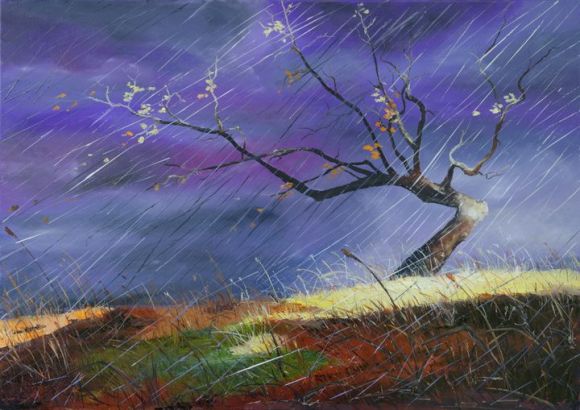
Storm in purple by Arina Tcherem. From Public Domain
If we take a look at our civilisation, there are multiple kinds of storms that threaten to annihilate our way of life and our own existence as we know it. The Earth and the human world face twin threats presented by climate change and wars. While on screen, we watch Gaza and Ukraine being sharded out of life by human-made conflicts over constructs made by our own ‘civilisations’, we also see many of the cities and humankind ravaged by floods, fires, rising sea levels and global warming. Along with that come divides created by economics and technology. Many of these themes reverberate in this month’s issue.
From South Australia, Meredith Stephens writes of marine life dying due to algal growth caused by rising water temperatures in the oceans — impact of global warming. She has even seen a dead dolphin and a variety of fishes swept up on the beach, victims of the toxins that make the ocean unfriendly for current marine life. One wonders how much we will be impacted by such changes! And then there is technology and the chatbot taking over normal human interactions as described by Farouk Gulsara. Is that good for us? If we perhaps stop letting technology take over lives as Gulsara and Jun A. Alindogan have contended, it might help us interact to find indigenous solutions, which could impact the larger framework of our planet. Alindogan has also pointed out the technological divide in Philippines, where some areas get intermittent or no electricity. And that is a truth worldwide — lack of basic resources and this technological divide.
On the affluent side of such divides are moving to a new planet, discussions on immortality — Amortals[1] by Harari’s definition, life and death by euthanasia. Ratnottama Sengupta brings to us a discussion on death by choice — a privilege of the wealthy who pay to die painlessly. The discussion on whether people can afford to live or die by choice lies on the side of the divide where basic needs are not an issue, where homes have not been destroyed by bombs and where starvation is a myth, where climate change is not wrecking villages with cloudbursts. In Kashmir, we can find a world where many issues exist and violences are a way of life. In the midst of such darkness, a bit of kindness and more human interactions as described by Gower Bhat in ‘The Man from Pulwama’ goes some way in alleviating suffering. Perhaps, we can take a page of the life of such a man. In the middle of all the raging storms, Devraj Singh Kalsi brings in a bit of humour or rather irony with his strange piece on his penchant for syrups, a little island removed from conflicts which seem to rage through this edition though it does raise concerns that affect our well-being.
Parichha has also reviewed a book by another contemporary Odia woman author, Snehaprava Das. The collection of short stories is called Keep it Secret. Madhuri Kankipati has discussed O Jungio’s The Kite of Farewells: Stories from Nagaland and Somdatta Mandal has written about Chhimi Tenduf-La’s A Hiding to Nothing, a novel by a global Tibetan living in Sri Lanka with the narrative between various countries. We have an interview with a global nomad too, Neeman Sobhan, who finds words help her override borders. In her musing on Ostia Antica, a historic seaside outside Rome, Sobhan mentions how the town was abandoned because of the onset of anopheles mosquitos. Will our cities also get impacted in similar ways because of the onset of global ravages induced by climate change? This musing can be found as a book excerpt from Abiding City: Ruminations from Rome, her book on her life as a global nomad. The other book excerpt is by a well-known writer who has also lived far from where he was born, MA Aldrich. His book,From Rasa to Lhasa: The Sacred Center of the Mandala is said to be “A sweeping, magnificent biography—which combines historical research, travel-writing and discussion of religion and everyday culture—Old Lhasa is the most comprehensive account of the fabled city ever written in English.”
With that, we come to our fiction section. This time we truly have stories from around the globe with Suzanne Kamata sending a story set in the Bon festival that’s being celebrated in Japan this week for her column. From there, we move to Taiwan with C. J. Anderson-Wu’s narrative reflecting disappearances during the White Terror (1947-1987), a frightening period for people stretched across almost four decades. Gigi Gosnell writes of the horrific abuse faced by a young Filipino girl as the mother works as a domestic helper in Dubai. Paul Mirabile gives us a cross-cultural narrative about a British who opts to become a dervish. While Hema R touches on women’s issues from within India, Sahitya Akademi Award Winner, Naramsetti Umamaheshwararao, writes a story about children.
With such hope growing out of a neolithic burial chamber, maybe there is hope for life to survive despite all the bleakness we see around us. Maybe, with a touch of magic and a sprinkle of realism – our sense of hope, faith and our ability to adapt to changes, we will survive for yet another millennia.
We wind up our content for the August issue with the eternal bait for our species — hope. Huge thanks to the fantastic team at Borderless and to all our wonderful writers. Truly grateful to Sohana Manzoor for her artwork and many thanks to all our wonderful readers for their time…
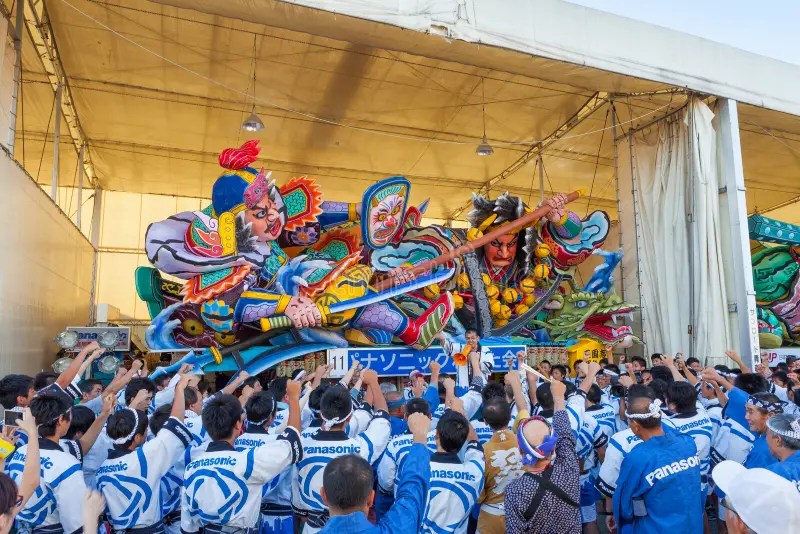
Suzanne Kamata shares a story from 1999, set during Obon or the Festival of Bon, a Japanese Buddhist custom that honors the spirits of one’s ancestors.
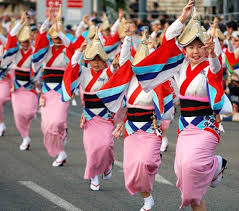
Obon Festival. From Public Domain
My husband is dancing.
The name of the dance is “Awa Odori,” “Awa” being the ancient name for Tokushima, where we live now, and “odori” being Japanese for “dance.” Its origins are unclear. Some say fertility rites, others claim it is a celebration of a good harvest.
My husband is thinking about none of these things as he dances with his friends of fifteen years. No doubt he is drunk on beer and fellow feeling, absorbed in the revelry of this annual festival.
I am at home alone in our apartment.
I could have gone, too, but I declined by way of protest. I’m demonstrating because while I am welcome to, indeed expected to, celebrate Japanese holidays, my own country’s holidays go ignored. When I’d wanted to do something special a month ago in observance of the Fourth of July, Jun had refused. “This is Japan,” he’d said, as if that would explain everything.
When I married Jun, I’d had a concept of international marriage as the combining of two cultures, not the elimination of one. True, I’d expected compromises, but on both sides, not just mine.
This time, however, I’m not giving in. I’m not going to budge. I didn’t go with him to visit his ancestors’ graves, and I am not going to don a cotton yukata[1] and dance in the streets to flute and drum. If he won’t see me halfway on Thanksgiving, Christmas, and Independence Day, then I’ll just sit this one out.
.
During Obon, the whole family usually gathers at some point. I’ll admit that I did go along with Jun to his parents’ house where his sister Yukiko and her family, his aunts and uncles and cousins, and his grandmother were assembled.
Uncle Takahiro said, “Hello. How are you?” in English, and everyone laughed as if he’d just told a joke.
I answered politely in Japanese, then my husband’s sister pushed her three-year-old toward me. “Go ahead. Say it, Mari-chan,” she said, beaming with motherly pride.
Dutifully, Mari recited the litany of English words that she had learned since I last saw her: “Horse. Cow. Pig.”
Yukiko looked to me expectantly, and I indulged her with words of praise for her daughter.
I can see it now. Yukiko will be the worst kind of “education mama,” as they call mothers who obsess over their children’s school performances.
“They’re teaching English at Mari-chan’s nursery school now,” Yukiko told me. “A foreigner comes once a week.”
Then, unbidden, Mari launched into a song. It was “Eensy Weensy Spider,” complete with gestures. Though she garbled some of the words, she earned a hearty round of applause from the adults.
.
Even after all this time, Jun’s relatives still don’t know how to talk to me. I make them uncomfortable, and sometimes I feel that I should apologise for being there, or better yet, just disappear. They have never tried to talk to me about everyday things like popular TV shows, bargain sales at Sogo, the big department store in town, or new recipes. When conversation is flagging, someone usually says to me, “Don’t you miss your home? Isn’t it hard being so far away?”
“It’ll be different after you have children,” my friend Maki said. “They’ll accept you then.”
Maybe so, but it looks like children are a long way off for Jun and me. Although we have been married for seven years, we have no kids. Mari was born just nine months after Yukiko and her husband were married. Their second baby – a boy – came along a year later.
We want children. We have even tried. I know that there’s nothing wrong with my body because I’ve been to specialists all over town, but Jun doesn’t seem interested in getting checked himself.
His mother would never believe there was a problem with her son. I’ve heard her whispering with Jun’s grandmother. “It’s because she’s American.”
Jun’s grandmother, who doesn’t know any better, nodded her head and said, “Ahh, yes. I’ve heard that gaijin don’t keep the baby in the womb as long as we Japanese do. Gaijin and Japanese can’t make babies together.”
And Jun’s mother, who should know better, nodded her head and said, “Yes, yes. You may be right.”
My mother-in-law also tells Jun’s grandmother that I’m a lazy wife. She tells the story in a whisper loud enough for me to hear that sometimes when she drops by our apartment, Jun is loading the clothes into the washing machine! Another time, he was standing at the stove with an apron on, cooking dinner!
“He should have married a Japanese woman,” Jun’s grandmother says. “A Japanese woman would take care of him.”
.
Jun and I sleep together in the same bed. His sister sleeps apart from her husband, in another room entirely, with her two children. His parents sleep in the same room, but one of them sleeps in a bed, the other in a futon spread on the floor.
Just before we got married, we bought furniture for our apartment. At that time, Jun suggested getting separate beds. He said that it was practical. With two beds, there would be no tussling over sheets, no accidental kicking in the night. I cried because whenever I had thought about marriage, I’d had an image of us sleeping in each other’s arms, breathing in unison.
Finally, we got one bed, a “wide double” that we cover with a double wedding ring quilt. It’s true that sometimes one of us winds up wrapped in all the sheets while the other one nearly freezes, and sometimes I find myself pinned into an uncomfortable position by Jun’s heavy limbs, but I don’t care. For me, one of the great joys of this life is waking up close to him, close enough to kiss him and run my hand over his bare chest.
.
Jun likes carpet and sofas and colonial style houses. I have always admired the simplicity of tatami mats and just a few cushions to sit on, rooms enclosed by sliding paper doors. My ideal room is an empty one, totally void of any unnecessary object. From studying home decorating magazines while in the US, I’d come to believe that in Japan this minimalism was typical. When I got here, I found that that wasn’t true at all. Tiny spaces were crammed with every imaginable appliance, Western furniture, and tacky knickknacks from other people’s vacations.
Jun likes to live in the Western mode. Like most people of his generation, he rejects tradition, or says he does. He sometimes rejects Japan, but he will never leave this place.
He watches CNN via satellite, eats popcorn and s’mores and coleslaw. He sleeps in a bed and sits on a sofa and he’s married to me, an American.
Sometimes, when he’s tired or angry, he forgets that this is an international marriage. He says, “Why can’t you be more Japanese?”
I look at myself in the mirror and see what others see: my blonde hair, blue eyes, and white skin. I can’t help but laugh. “Because I’m not Japanese,” I say. Even if I changed my citizenship, changed my name, and acted exactly like a Japanese woman, people would still look at me and say “foreigner.” Even if I dyed my hair black, got a tan, wore contact lenses, and had plastic surgery, they would still be able to tell the difference.
At times like these, I look at Jun and say, “If you wanted a Japanese wife, then why did you marry me?”
And he always replies in the same way. “Because I love you.”
.
My friends Maki didn’t marry for love. She chose her husband in the same way that I chose a college, poring over applications and photos. She invited me to help her pick one out. I was puzzled by this process. I watched the reject pile become higher and higher and I felt sorry for all those men whom Maki didn’t want to meet.
“This one’s too short,” she said, tossing an application aside.
The next one she picked up went into the “no” stack as well. “He’s handsome, but I don’t want to marry a farmer. Farmers’ wives have to work in the field all the time.” She wrinkled her nose and studied her manicured fingernails. Her hand had never known hard work.
The few who went into the other pile had good jobs with decent salaries, respectable families, and compatible hobbies.
At first, I imagined that all of those men were clamouring to marry Maki, but then she told me she’d never met any of them. The profiles had been passed along by a matchmaker. Those men were probably going through pictures of women, too, picking and choosing, making little stacks.
I thought about all the things that had made me fall in love with Jun – things that you can’t tell from a photo or a piece of paper, like the sound of his voice and the sweet strawberry taste of his mouth. I asked her if any of that mattered.
“You fall in love after you get married,” Maki said. “You Americans think that life is like a fairy tale, and then you get a divorce when you find out you were wrong.”
Maki has been married for two years and has one child. She is still waiting to fall in love with her salaryman husband. She doesn’t complain, though. He works for a good company, and she can stay home with their baby or go shopping whenever she feels like it. Sometimes she whispers to me about the possibility of having an affair with an American man.
I have known Maki for four years. When I met her, she was working for a travel agency and struggling to master English. I gave her private lessons which eventually metamorphosed into coffee klatches and late nights in discos. She is sometimes irreverent and wild and I can’t help but like her.
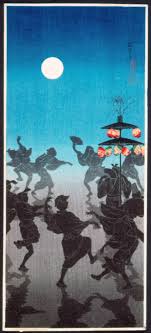
I can hear the chang-cha-chang-cha-chang of the festival music, a rhythm that never ceases or alters during the dance. I can picture the scene in my mind. The women are in yukata with hats that look like straw paper-plate holders folded over their heads. They wear white socks with the big toe separate, and geta, those wooden sandals. The men don’t wear any kind of shoes, just the tabi – the white socks, that will become soiled from the streets. They wear white shorts and the happi coats that brush over their hips. They tie bands of cloth called hachimaki around their foreheads.
The women dance upright, their hands grasping at the air above their heads as if they are picking invisible fruit. With each step, they bend a knee and touch a toe to the pavement, the thong driving between the toes and causing pain.
The men’s dance is freer and sometimes women deflect and join them. They dance bent over, arms and legs flailing. Their movements become wilder as the evening wears on. The dancers become more drunk, the music continues as before. Chang-cha-chang-cha-chang.
.
When I was a kid, we used to have big family picnics on the Fourth of July. My uncles and father and older male cousins played horseshoes, then later everyone would join in a game of volleyball. There was always too much food, and after gorging on fried chicken, potato salad, chocolate cake, and watermelon, we would hold our bulging bellies in agony. Then some of the adults would lie down and take naps while my cousins and I poked around in the creek, catching frogs and other slimy creatures.
As soon as dusk fell, and sometimes before, we would light sparklers under the close supervision of an adult. We waved them in the air, describing circles with crackling sparks, our faces full of glee.
Later, we’d all climb into my uncle’s station wagon and drive to the riverside to watch the real fireworks. Before the display began, the American flag was raised in a glaring spotlight and “The Star Spangled Banner” blasted out of loudspeakers. We all sang along, impatient for the show to begin. It always started out with small single-coloured bursts, like chrysanthemums or weeping willows in the sky. Then the fireworks got bigger, turning to rainbow blossoms worthy of our wonder. The adults oohed and ahhed and we said, “Wow! Look that that!” The very last was red, white and blue, and image of the flag we’d sung to earlier. Its shape hung in the sky for just a moment before falling like fairy raindrops.
During Obon, there are fireworks, too, but when I see them it’s not the same. I feel a tightening in my chest and the tears well up behind my eyes.
I go to a store nearby, one of the few businesses open during the holidays. The woman at the cash register greets me and smiles when I walk in the door. I wonder if she’d rather be dancing, and if she has been left behind while her husband parades in the streets.
.
I pick up a set of sparklers which are on sale and put them in a basket. I add a cellophane-wrapped wedge of watermelon. This one-piece costs more than the huge oval melons you can buy roadside where I come from. Into the basket also goes a package of frozen microwavable fried chicken and canned potato salad.
I pay for everything and go back to the apartment to prepare my feast. Night has already fallen. By the light of the overhanging kitchen lamp, I eat my chicken and potato salad. It’s the best meal I’ve had in a long time.
Later, when the dishes are done and drying on the rack, I take the package of sparklers and a box of matches onto the balcony. I light them one by one and watch them burn brightly in the darkness. I draw figure eights in the night air, write my name, etch zigzags of light.
When I’m finished, I lean over the railing and start to sing. I belt out “The Star Spangled Banner,” “America, the Beautiful,” and “I’m a Yankee Doodle Dandy.” My voice is so loud that a dog starts to howl.
I feel better. I go back into the apartment and push the kitchen table to one side. With my back straight and my elbows bent, I reach up as if I am about to pick an apple from a tree. There is a smile on my face as I start to dance. Chang-cha-chang-cha-chang.
Dance for Obon Festival by Takahashi Hiroaki (Japan, 1871-1945). From Public Domain
Suzanne Kamatawas born and raised in Grand Haven, Michigan. She now lives in Japan with her husband and two children. Her short stories, essays, articles and book reviews have appeared in over 100 publications. Her work has been nominated for the Pushcart Prize five times, and received a Special Mention in 2006. She is also a two-time winner of the All Nippon Airways/Wingspan Fiction Contest, winner of the Paris Book Festival, and winner of a SCBWI Magazine Merit Award.
PLEASE NOTE: ARTICLES CAN ONLY BE REPRODUCED IN OTHER SITES WITH DUE ACKNOWLEDGEMENT TO BORDERLESS JOURNAL
Ratnottama Sengupta muses on her encounter with the writings of eminent artist and writer, Dhruba Esh, and translates one his many stories, Amiyashankar Go Back Home from Bengali. Click here to read.
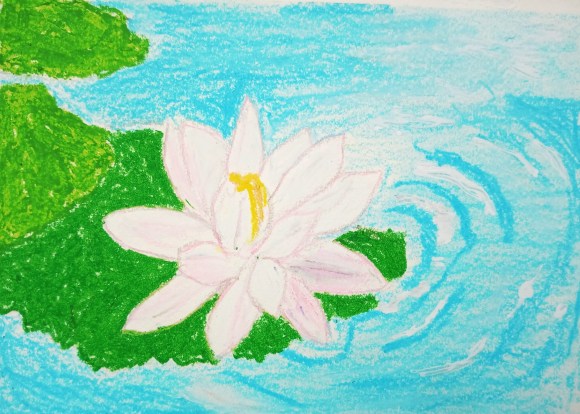
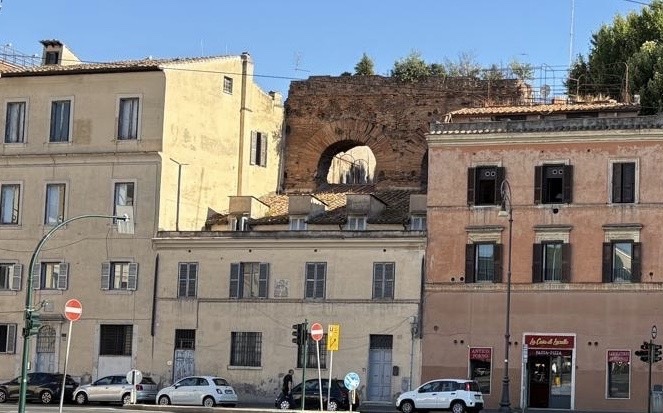
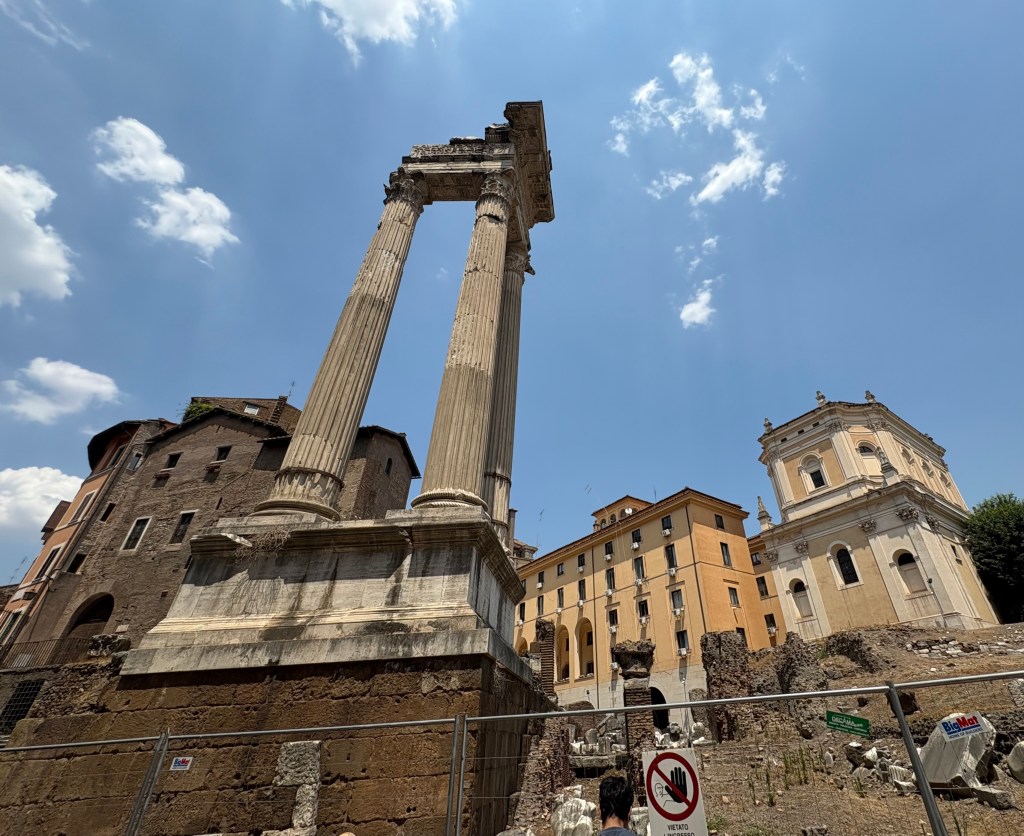
All around us, we hear of disasters. Often, we try to write of these as Tagore seems to do in the above lines. However, these lines follow after he says he draws solace and inspiration from a ‘serene lotus’, pristine and shining with vibrancy. He gazes at it while looking for that still point which helps him create an impact with words. That is perhaps what we can hope to do too — wait for a morning where clarity will show us the path to express not just what we see, but to find a way to heal and help. Finding parallels in great writings of yore to our own attempts at recreating the present makes us realise that perhaps history is cyclical. In Rome, new structures rear up against thousand-year walls, reflecting how the past congeals into the present.
Congealing the past into our present in this July’s issue are stories of American migrants — like Tom Alter’s family who made India their home — by Anuradha Kumar in her new non-fiction Wanderers, Adventurers, Missionaries: Early Americans in India. We feature this book with a review and an interview with the author where she tells us how and why she chose to write on these people. We have more people writing of their own wanderings. Mohul Bhowmick wanders into Cambodia and makes friends over a local sport while Prithvijeet Sinha strolls by the banks of the River Gomti in Lucknow. Meredith Stephens not only takes us to the Prime Meridien in Greenwich but also to Carnarvon which houses a science and technology centre in Australia. Devraj Singh Kalsi wanders with humour to discover gastronomical inspiration and hopes for sweeter recompense.
Taking up the theme of cli-fi, Rajat Chaudhuri’s Wonder Tales for a Warming Planetseems to bring hope by suggesting adapting to changing climes. Rakhi Dalal tells us in her review: “It dares to approach the climate crisis through the lens of empathy and imagination rather than panic or guilt. In doing so, Rajat Chaudhuri gives us what many adult climate narratives fail to deliver—a reason to believe that another world is not only possible but already being imagined by the young. All we need to do is listen.” Bhaskar Parichha has discussed the autobiography of a meteorologist and Distinguished University Professor at George Mason University, Jagadish Shukla. In A Billion Butterflies: A Life in Climate and Chaos Theory, he claims Shukla has “revolutionised monsoon forecasting.” Somdatta Mandal has written about Dilip K Das’s Epidemic Narratives: The Cultural Construction of Infectious Disease Outbreaks in India. And Gower Bhat reviews Neha Bansal’s best-selling poetry collection, Six of Cups.
With that, we wind up the contents of this month’s issue. Do pause by our content’s page to check it out in more details.
This month’s edition would not have been possible without all our contributors, our fabulous team and especially Sohana Manzoor’s artwork. Huge thanks to all of them and to our wonderful readers who make it worthwhile for us to write and publish. Do write in to us if you have any feedback. Five years ago, we chose to become a monthly from a daily… We have come a long way from then and grown to host writers from more than forty countries and readers from almost all over the world. For this, we owe you all – for being with us and encouraging us to find fresh pastures.
Growing up as an American, school vacations were a time of freedom. I could play or watch TV or do nothing as much as I wanted. In fact, my brother and I had so many idle hours, we sometimes got bored and looked forward to going back to school.
Here in Japan, the breaks between semesters are busy. My kids were sent home for the school holidays with reams of worksheets, charts for keeping track of toothbrushing and chores, and a calligraphy assignment. Sometimes they would have to take care of the class pet for a week or so.
When my daughter was in kindergarten, she volunteered to take care of the class stag beetle during the first few weeks of summer vacation. She was supposed to feed it and moisten the soil with water from time to time. I guess we were supposed to change the soil, but no one said anything about that, and I didn’t get around to buying any.
My daughter was quite enthusiastic for the first few days, remembering to feed it the smelly jelly even when I forgot. But then, it crawled out of the plastic box once and she was freaked out. She said she wanted to give it to her grandmother. Since then, she had fallen in love with the kindergarten’s hamsters and had decided that she wanted one of those.
I’d been feeding the beetle and sprinkling water on the soil. Up until the last night, I heard it scrabbling around. But one morning, when I checked on it, the jelly was uneaten, and the beetle was belly up in the box. Nothing happened when I tapped the box. I was pretty sure it was dead.
My daughter was supposed to take it back to school the following day for the hand-off to her classmate. I figured they’d be having a beetle burial instead. But we went out for a while, and when we came back, the beetle had moved! Phew! I reached in and turned it over so it could burrow into the dirt. We never kept a beetle as a pet again.
In addition to pet care, there was also, typically, a craft assignment. For instance, every summer, as part of her elementary school homework, my daughter was required to make a bank. I wondered why she had to make the same thing, year after year? What were we supposed to do with all of those banks? Was some sort of lesson in money management embedded in the task? She was supposed to come up with an original design, and the result was entered in a contest. Of course, as the head teacher reminded us parents, the kids needed help.
At the beginning of summer, I would try to think of ideas. Maybe a papier mache rabbit? Or some kind of house constructed from all of the popsicle sticks we’d accumulated over the past couple of months? At the end of the vacation, with only a few days left to go, I would be casting about for something quick and easy that we hadn’t done before.
We’d stop by the bookstore to look for a craft book. At the beginning of school breaks, there were oodles of such books on display – books intended to give parents and kids inspiration for how to while the days away. Just before school started, they would be gone. In Japan, everything has its season.
My son went to a different school which had different requirements. The kids made banks only once, in first grade, many of them using ready-made kits. One summer, my son was supposed to paint a picture on the theme of “freedom.” I was thinking doves, or maybe of people of many colors holding hands, but he needs to come up with the idea on his own. I tried to help him out a bit. “What do you think of when you hear the word ‘freedom’?” I asked. My son said, “Getting out of jail.”
Now that my kids are out of school, my idea of freedom is not having to nag them to finish their homework, or fill out their charts, or feed the class beetle – or, especially, to come up with an idea for their summer crafts.
From Public Domain
Suzanne Kamatawas born and raised in Grand Haven, Michigan. She now lives in Japan with her husband and two children. Her short stories, essays, articles and book reviews have appeared in over 100 publications. Her work has been nominated for the Pushcart Prize five times, and received a Special Mention in 2006. She is also a two-time winner of the All Nippon Airways/Wingspan Fiction Contest, winner of the Paris Book Festival, and winner of a SCBWI Magazine Merit Award.
PLEASE NOTE: ARTICLES CAN ONLY BE REPRODUCED IN OTHER SITES WITH DUE ACKNOWLEDGEMENT TO BORDERLESS JOURNAL
Before I ever stepped into a classroom, I had already learned to read and write. Over twenty years ago in Mongolia, children typically started school at the age of eight. But I began a year earlier—at seven—already recognising the letters and words on the page.
I don’t remember exactly how I learned, but I do recall asking my mother, who worked at a school dormitory, to bring me a copy of the Tsagaan Tolgoi (Alphabet Book) from the school library. With the help of my grandparents, I memorized all 35 letters and began reading. Because my mother worked at a school, we often visited the homes of her coworkers. On one such visit, we stopped by the home of the school librarian, Mr. Bayaraa. I remember flipping through one of the literature books for older students and seeing a drawing of a giant with one eye standing before frightened people in a cave. Later, I realised it must have been The Odyssey. From that moment on, I was fascinated. I longed to read every book I could find—especially those with pictures and stories.
When I finally started school, I couldn’t wait to dive into books. But the first-grade routine quickly wore me down: we spent most of our time copying words neatly into our notebooks. Then our family moved from the countryside to the city, and I transferred to a new school. By fourth grade, I was enrolled in a class called Reading and Writing, which would later become Literature. It was my favorite subject. Our teacher encouraged us to borrow books from the school library and read outside of class. That was, without a doubt, the most exciting homework I’d ever been given.
Still, getting into the school library wasn’t easy. Our school operated in two shifts, and my classes were in the morning—from 8:00 to 11:00. I lived nearby and could be home in under five minutes. My grandmother always had lunch ready, usually a warm bowl of bantan. Those were some of my happiest moments.
In the afternoons, I would walk back to school and try to visit the library. But the teacher on duty at the entrance always interrogated me: “Where are you going? Who are you meeting?” I explained that I just wanted to visit the library. Even after getting permission, I often found a sign on the door that read: “Closed for internal work.” Many times, I left disappointed. The librarian never opened the door.
Everything changed when I entered junior high school and gained the independence to ride buses. I started visiting the National Public Library named after D. Natsagdorj. It took about thirty minutes by bus, and I could only afford to go once or twice a week. The library was mostly empty, except for a few elderly men reading newspapers. It used the old Soviet-era catalog system, which was difficult to navigate. Instead, I approached the librarian directly and told her the kinds of books I liked. She always picked something out for me, and even though I never knew what it would be, the anticipation became one of my favorite parts of the week. I spent many summer days in the tiny reading room, lost in stories. When the fall semester began and university students returned, seats became scarce. They, too, relied on public libraries for study space.
By the time I entered high school, our school librarian had changed. Finally, we were allowed to use the library after classes. It had a wide range of books—both Mongolian and international literature. It felt like a dream come true.
Years later, in 2020, my daughter started school. In Mongolia, we celebrate the moment children finish learning their 35 letters with a Tsagaan Tolgoi celebration—a joyful milestone that marks the beginning of reading and writing. Sadly, due to COVID, my daughter never got to experience that celebration. More than that, she never even had a chance to experience a library. Unlike my school, hers didn’t even have a library corner. Due to overcrowding, the library space had been converted into a classroom. After textbooks were distributed during the first few weeks of the school year, the “library” served no other purpose.
As a mother and a former student, I couldn’t help but feel heartbroken by this quiet loss.
Now, as I study in Japan, I’ve started volunteering as an English teacher for first- to fourth-grade students at a local elementary school. It was my first time being at a Japanese school not as a visitor, but as a teacher. Two retired female teachers welcomed me warmly and introduced me to the principal. I would start teaching on May 1st. Even though my Japanese was limited, I felt their kindness beyond words.
We visited the classroom—a spacious room, half of it open for movement and activities. I was shown the storage room where they kept teaching materials, including flashcards. I was given two weeks to prepare. I was thrilled—not just to be working, but to finally be using my professional skills.
I reviewed every flashcard, thinking carefully about how to incorporate them into my lessons. I created a 12-week lesson plan and excitedly prepared for my first class.
But the first class didn’t go as I imagined. Sixteen students joined the English club, and as soon as I started speaking in English, some children looked surprised. Because I am Mongolian and physically resemble Japanese people, many often assume I am Japanese. The students seemed confused—some even asked if I was pretending or acting, wondering why a “Japanese-looking” person was speaking to them in English. I had prepared fun activities like Simon Says and The Alphabet Song, hoping to create a lively atmosphere, but without help from the two retired teachers, it was hard to hold their attention. Somehow, I made it through the class, but I left feeling defeated.
Thankfully, the teachers encouraged me: “Don’t be discouraged,” they said. “Especially with first graders—it’s only been a month since they started school.”
I spent the following week stressed and unsure. How could I communicate with children from another culture? How could I teach kids of different ages and learning levels?
There’s a Mongolian saying: “If God doesn’t know, ask a book.” I realised books were my only hope.
Just like the times I hesitated to enter unfamiliar spaces in Japan, I found myself nervous about entering the university’s children’s library. But I gathered courage, walked in, and soon found myself surrounded by picture books in English.
There were so many beautiful titles—more than I had ever imagined. I felt I was more excited than the children. Since then, finding the right book for my students has become my favourite part of lesson planning. I spend hours reading reviews, flipping through pages, and selecting stories that are both accessible and engaging.
At the same time, I couldn’t help but reflect on how lucky Japanese children are. Back in Mongolia, many children grow up without ever experiencing a library. And here I am, surrounded by cozy furniture and shelves filled with books, just a few steps away from the classroom.
Every week, I arrive an hour early to prepare for class. Right next to my classroom is the school’s library—bright, welcoming, and full of choices. Sometimes I see the first graders visiting with their teacher, eagerly choosing books and settling into child-sized chairs to read. And I think of my daughter. I feel sad—not only because I miss her, but because I know she doesn’t have access to a space like this. At her school in Mongolia, there is no library—not even a reading corner. Watching these children enjoy books so freely makes me wish my daughter could experience the same joy and comfort that comes from being surrounded by stories.
I remember my childhood dream: to one day have a small children’s library of my own. A place where I could read aloud to children, draw with them, fold origami, and spend quality time. That dream has only grown stronger.
In Mongolia, there are very few children’s book authors. Most publishers produce simplified versions of Disney movies or classic tales, often filled with too much text to engage young readers. Finding the right book for my daughter has always been a challenge. That’s when I began to dream—not just of reading books, but of writing one myself. After all, books hold countless lives, stories, and dreams. They are entire worlds we can live in.
I miss my daughter very much. I often make a list of things we could do together—places I want to show her if she ever comes here, places I want to go with her. I especially dream of going to the library with her, choosing and reading books together. I want to read aloud to her the book I think is the most beautiful, and then watch what she imagines, what she draws, and what she creates after reading it.
Sitting here in my university’s children’s library, I felt like I became a child again, and I found myself wishing that children everywhere in the world could have access to a library like this—one that sparks their imagination. That’s when I began writing this essay.
Because libraries are not just buildings filled with books—they are spaces where children begin to dream. I hope that one day, more schools in Mongolia will make room for those dreams. And until then, I’ll keep turning pages, teaching stories, and imagining that little library I still dream of—for my daughter, and for so many others like her.
Odbayar Dorj is an international student from Mongolia currently studying in Japan. Her writing reflects on cultural identity, personal memory, and the power of connection across borders and generations.
.
PLEASE NOTE: ARTICLES CAN ONLY BE REPRODUCED IN OTHER SITES WITH DUE ACKNOWLEDGEMENT TO BORDERLESS JOURNAL
The story of Hawakal Publishers, based on a face-to-face tête-à-tête, and an online conversation with founder Bitan Chakrabortywith his responses in Bengali translated by Kiriti Sengupta. Clickhere to read.
Japan is generally considered a safe country with a low crime rate. I feel comfortable walking around our neighbourhood alone, in the dark. In fact, I usually go for a walk in the evening after dinner, when night has already fallen. My walking course is mostly along sidewalks, generally well-lit, and the roads are well-traveled. Part of my usual course goes through a tunnel which is across the street from a large shopping mall.
I’d never had any concerns until a couple of months ago when I discovered a tent in the corner of the tunnel. How odd! Once or twice, I’d come across skateboarding teens, but never anyone who seemed to be living there. I couldn’t tell if anyone was inside, cuddled up within canvas. It was zipped shut, and malodourous. I hurried past, hoping it would be gone the next day, but it was still there.
While Japan is a very safe country, bad things sometimes do happen here. There was the guy who dressed up like the Joker and lit a fire on a Tokyo subway on Halloween. There was the woman who killed her neighbors by poisoned curry. Every now and then, some knife-wielding psycho starts slashing strangers in a crowd.
I mentioned the tent to my husband. He thought it was strange, too.
“But there is a camera in the tunnel,” I said.
‘It’s just for show,” he countered. “It’s probably not activated.”
“Maybe I should tell the police,” I said. After I had thought about it, though, I changed my mind. Maybe someone was fleeing an abusive home. Maybe an elderly person who couldn’t make rent was holed up inside. Even though I suspected the worst — some crazed criminal lying in wait — it was possible that there was a perfectly good explanation.
Nevertheless, I avoided going for a walk for the rest of the week. A few days later, I decided that it would probably be safe if I crossed the road instead of going through the tunnel. I set out after dark, as usual, but when I got to the crosswalk before the tunnel, I waited for the light. I saw a patrol car parked on the other side of the road, and two policemen waiting to cross. Maybe I should tell them about the tent, I thought. But I said nothing. We crossed paths without a word.
As I watched them, I realised that they already knew about the situation in the tunnel. That’s where they were headed. I observed as they made their way to the tent and peered at it. I felt sure that everything would be back to normal the next day.
But it wasn’t.
The next time I drove by, I noticed that the tent was still standing. Maybe no one had been inside of it when the police officers dropped by to check it out. Maybe they had left it standing out of consideration for the person who was using it for shelter. Or maybe it was more of a trap, so that they could catch the person when they came back.
At any rate, I was relieved that the police were aware of the tent, and that I no longer had to feel conflicted about whether or not I called them. I continued to cross the road instead of going through the tunnel.
A couple of weeks later, my husband and I had dinner with a friend who often went jogging. She knew about the tent, too, and remarked on how odd it was. No one seemed to know what was going on. I’d heard of out-of-work men sleeping on scraps of cardboard in a Tokyo park, but there were no homeless people in our small town. Not that I knew of, anyway.
Finally, my husband came back from a visit to the shopping mall one evening. He told me that he’d seen a police car and an ambulance near the tent. After that, it was gone. I scanned the local newspaper the next day and watched the evening news, but no one mentioned the tent in the tunnel. Maybe I would never find out what had happened.
I thought of other potentially scandalous events that had never been reported — a preschool teacher knifed by her ex-boyfriend on school grounds, a principal who’d hung himself in his office — and I realised that many things were kept under wraps.
I was reminded not to take my personal safety for granted. It also occurred to me that while people in small towns often complain that everyone knows everyone else’s business, the folks in the small town where I lived were good at keeping each other’s secrets, too.
.
Suzanne Kamatawas born and raised in Grand Haven, Michigan. She now lives in Japan with her husband and two children. Her short stories, essays, articles and book reviews have appeared in over 100 publications. Her work has been nominated for the Pushcart Prize five times, and received a Special Mention in 2006. She is also a two-time winner of the All Nippon Airways/Wingspan Fiction Contest, winner of the Paris Book Festival, and winner of a SCBWI Magazine Merit Award.
PLEASE NOTE: ARTICLES CAN ONLY BE REPRODUCED IN OTHER SITES WITH DUE ACKNOWLEDGEMENT TO BORDERLESS JOURNAL




 Borderless