Categories
Conversation

Peregrinations of a Diplomat’s Wife

Ratnottama Sengupta converses with Reba Som

Reba Som

“If Washington goes to Dhaka, there’s a chance that Paris might make it to Stockholm. And of course Moscow would be moved to Geneva!?”

Sounds like gibberish? But this is a piece of the speculative conversation on transfers and postings that is regular in the drawing rooms of embassies and consulates, Dr Reba Som found out on her very first posting after her marriage with Himachal Som.

Both were Presidency graduates pursuing higher careers — he in Foreign Service, she on the threshold of a doctorate. But life as the wife of an ambassador wasn’t only about glamour postings, fancy holidays and brush with celebrities. It was a mixed bag of blessings, as the woman who had grown up in Kolkata with a grounding in Tagore’s music would soon conclude. For, there were the dark clouds of life away from ageing parents and school going children; from the comfort of familiar food and mastered language; from developing your potential and crafting your own identity in the world out there.

In recent years we have read accounts of retired ambassadors and career diplomats’ experiences in diplomatic life. In her memoirs, Hop, Skip and Jump; Peregrinations of a Diplomat’s Wife, Dr Som’s is a woman’s voice, abounding in stories and observations about how the spouses keep a brave front in alien surroundings to hold up the best image of her country. In this conversation, she voices outmore about her encounters with racism, with political emergencies and exigencies. In short, about her lessons in a borderless world of multicoloured humanity.

You went to Brazil (1972), then to Denmark (1974), then Delhi (1976), Pakistan (1978), New York (1981), Dhaka (1984), then Ottawa (1991), Laos (1994), Italy (2002). Please share your gleanings from these lands.

The roller coaster ride was a saga of discovery. Travelling across expanses of the planet earth that we had seen only on the pages of geography books and atlases was a great learning experience. I gained an understanding of diverse cultures, imbibed social customs, became proficient in languages, and was exposed to exotic cuisines. At the same time I faced homesickness. Each posting entailed the challenge of uprooting oneself, finding schools for children, and reinventing oneself every time.

A large part of this life was in the years that had no mobile phones, no video calls, no social media, no internet communication. What did you thrive on?

Continents and hemispheres away from home, the only link with family and friends then was the diplomatic bag. The weekly mail service ferried across oceans by the ministry in Delhi contained letters and parcels from home. We were asked to judiciously use the weight allowed to bring spices, tea, condiments, clothing and other necessities. It became a ritual to write long letters and send them weekly by the diplomatic bag to Delhi from where they would be posted to respective destinations throughout India.

Along with letters would come bundles of magazines and newspapers. These brought us news of home from which we were truly cut off. With no television or internet or phone calls, we were in the dark about all news, be it political, social or entertainment. Every week on the bag day we waited anxiously to receive the newspapers – and the letters, which had instructions, news, recipes, advice, gossip. All of these were crucial for nurturing our souls.

One telegram from my father in 1973 carried the cryptic message: ‘Reba, solitary First class.’ These were the MA results of Calcutta University which were out after a delay of two years.

I was most taken up by the understated humour of some of your encounters in your memoir. Please recount some of them.

On our very first posting, to Brazil, not only our unaccompanied baggage but also our accompanied baggage did not arrive. Eventually when the lost luggage showed up, Himachal’s ceremonial bandhgala[1]was steeped brown — in the colour of the gur[2] my mother had lovingly packed in!

In Brazil, we found the people to be fun loving but too flamboyant. They made tall claims that their institutions were the biggest in the world. But reality often proved the claims to be hollow. Such was the Presidential bid to make the tallest flag pole in the world in Brazil’s new capital, Brasilia. A very tall flag mast was indeed built but the huge flag atop it was torn to shreds since the engineers had not factored in the wind speed at that height. Brazilians mirthfully called it the President’s erection!

And at Denmark. we were surprised by a sudden news of our posting to Mozambique. We had long realised that we were mere players on the chessboard of postings – we could be shunted off across continents at the whims of the powers that be. By the same token, a couple of phone calls by the newly arrived ambassador undid the mischief. We were happy to unpack and settle down again. The only guilt I felt was when I met the owner of Anthony Berg chocolates: I had in no time demolished the entire carton of chocolates he had sent as farewell gift!

You are among the few I know who have mothered in different continents. So how different is it to become a mother away from India?

I always felt that the best way to get to know certain nuances of a country’s cultural tradition was to have babies in them. My elder son, Vishnu was born in Copenhagen and Abhishek, the younger one, in New York — and my experiences each time couldn’t be more different.

In Copenhagen, a social democrat country, hospital visits for full term pregnant women were fixed on a certain day of the week. On the preceding day they had to collect their urine in a jerry can and present it for lab examination. I was confounded and not a little embarrassed to meet other mothers-to-be, swinging their jerry cans like designer bags without fail on the appointed day. I learnt only later that, from the urine examination doctors would note the condition of the placenta and not unnecessarily rush patients into childbirth with caesarean and surgical intervention!

In NY, on the day of my discharge, the hospital staff were highly excited because Elizabeth Taylor had come in for one of her facelifts. I could not forgive them their magnificent obsession when, along with a goodbye hamper, they wheeled in a bassinet with a different baby. On my protestation the nurse rudely shouted, “Can’t you read… the tag says Som Junior?” Shocked by the implication I said, I could not only read but also see! And it was not my child. While everyone was looking on in disbelief another nurse wheeled in my little one. The babies had their diapers changed and were put back in the wrong bassinet.

Years later, we discovered in an informal meeting with an American ambassador that Abhishek was indeed an American citizen. Because, at the time of the child’s birth Himachal was posted not to the embassy in Washington but to the consulate in New York. Only consulate children were given the privilege. This discovery, rechecked by State Department Records, gave our son the US passport. It was a windfall as Abhishek went on to graduate summa cum laude from a prestigious management school in the US and enter Wall Street as an investment banker.

I must also share another truth about birthing away from India. Before Vishnu’s birth, my parents had come to Copenhagen. When I was discharged from the hospital I received their care and being fed Ma’s cuisine was the best gift I could have. So, when phone calls came from hospital, followed by visits enquiring about my state of depression, I was totally confused. I realised how many mothers suffered from postpartum depression in a society bereft of nurturing family care.

How could you master languages as removed as Portuguese from Lao and Italian from Urdu? Is a flair for languages the key to this proficiency or the training imparted before each posting?

 I enjoy learning languages. My stint at learning French at Ramakrishna Mission Golpark stood me in good stead in grasping Portuguese in Brazil, French in Ottawa and Italian in Rome — all Latin languages. But there was also the hazard of mixing up some phrases and words, so similar yet so different! Like Bon Appetit in French and Bueno Appetito in Italian. Or Amor in Portuguese; amore in Italian and amour in French.

Sometimes though, I accidentally learnt how language travels. My mother had packed in many petticoats to match with my saris but without their cord. We went to a store that promised to hold all we need but all my sign language did not bring what I needed. “Phita is obviously not available here,” I told Himachal, preparing to leave. Suddenly the storekeeper perked up. ‘Fita, si senhora!” he said and produced bundles of cord.

In due time I found out that janala, kedara and chabi – Bengali for window, chair and keys – had travelled from India to become janela, cadeira and chavi.

What did Dhaka mean to one raised in West Bengal – per se the Ghoti-Bangal[3]divide, your roots  or the cultural side with Firoza Begum and Nazrul Geeti?

Dhaka was a great posting in so many ways. It was a hop, skip and jump away from my home town Kolkata, with the same language and culture and yet was a foreign posting with foreign allowances!

As you know, there’s a subtle cultural difference in East and West Bengal. Both speak Bengali but in East Bengal, it’s a colloquial rustic dialect while West Bengal speaks its refined cultural form. This formed the infamous ‘Ghoti-Bangal’ divide: Urban Calcuttans looked askance at their country cousins from the East.

The difference extended to the palate. East Bengalis flavoured their dishes with more chillies and West Bengalis, with a pinch of sugar. For the fish loving people, the two iconic symbols are Hilsa and Prawns, for East and West. Emotions soared high in Kolkata when the supporters of the football teams, East Bengal and Mohun Bagan, clashed, after intensely fought matches that spurred deadly arguments and bets.

Given this background, Himachal created a minor storm by announcing to his parents from Chinsurah, Hooghly in West Bengal that he would marry a girl whose parents were from Dhaka and Faridpur in East Bengal.  Ghoti-Bangal feud remained the subject of much friendly banter between Himachal and me until we were posted in Dhaka. There, in a diplomatic turnaround, Himachal played down his Ghoti background to announce that his mother’s family was from Chittagong and he was born in the principal’s bungalow in Daulatpur, Khulna, where his grandfather was posted.

To give a bit of Himachal’s family background: Dr Pramod Kumar Biswas, the first Indian doctorate in Agricultural Sciences from Hokkaido University in Japan, had settled in Dhaka as principal of the Agricultural College. His charming daughter Kana won the heart of Dr Rabindranath Som, a veterinarian who weathered the predictable Ghoti Bangal storm to win her hand in marriage. 

When my parents Jyotsnamay and Manashi Ray visited us, we couldn’t visit Patishwar in Rajshahi district, where my maternal grandfather Atul Sen had worked with Rabindranath Tagore before he was arrested for revolutionary activities with Anushilan Samiti, and exiled to Kutubdia, an isolated island in the Bay of Bengal. As a headmaster, he had given shelter to Jatirindranath Mukherji, popularly known as Bagha Jatin[4].

It was a breezy day when my octogenarian father revisited Faridpur Zilla School. The colonial bungalow had acquired a fresh coat of terracotta paint. Finding his way to the headmaster’s room, he announced with a lump in his throat that history had been rewritten, boundaries redefined and new national identities forged since 1923, the year he had matriculated.

The headmaster, delving through yellowing files, fished out the matriculation results for that year. My father’s face was that of an excited school boy impatient to show off his prowess: “Look at my maths marks! Oh yes, my English scores were a trifle lower than expected because I had a touch of fever, but look at Jasimuddin’s marks in English! Thank God, he passed it.” We looked around in hushed surprise. This isn’t The Jasimuddin, the beloved poet of Bangladesh? “But of course,” my father responded. “Jasim’s weakness in English was my strength!”

Dhaka was also personally fulfilling as my doctoral studies, which I had carried across three continents, found fruition at last! On another front, I met with success in gaining the confidence and blessings of Firoza Begum, the legendary exponent of Nazrul Geeti.

The songs of Kazi Nazrul Islam were a great favourite of my father. He often hummed those made famous by Firoza Begum. Since I had trained in Tagore songs from age five, I never aspired to master the distinctly different style of rendition. A chance encounter with the golden voice revived this desire. Firoza Begum bluntly refused. When I persisted, she wanted to hear me sing a few Tagore songs.

One morning I mounted three flights of steps, harmonium on my driver’s shoulder, to enter her flat with apprehension. At her bidding, I sang four songs of Tagore. She heard me without any comment, then she asked why I hadn’t been singing for Bangladesh television. My relief was palpable! I had passed her test.

Over the next two years, my weekly classes with her extended well beyond the music lessons to serious discussions on life itself and the meaning of religion. What began as a guru-shishya[5]relationship, transcended to deep friendship. She declined any remuneration and dearly wished that I should cut a disc. This wish of hers came true only when Debojyoti Mishra heard me and decided to record my Nazrul-songs for Times Music in 2016.

Food is perhaps the first face of culture. So please share with us some of your culinary adventures. Or should I say ‘fishy’ stories?

Adventures? I could talk about the chapli kebabs in Pakistan, or about putting samosas in Bake Sales. I could tell you about making rasgullas from powder milk. I could even tell you about our gardener in Laos who merrily collected every scorpion and caterpillar that came his way, “for snacks,” he told me. But let me focus on fish.

The very first party I hosted at home in Brazil led me to seek substitutes for Indian ingredients. Fish of course had to be on the menu, mustard fish at that. I had already learnt from the Brazilian ambassador in Delhi that surubim, being boneless, was the most suited for curries. So surubim it was for months until the day I had to go to the fishmongers – and found it was a monster of a whale!

In Pakistan, traversing the arid countryside of Sind, the train would stop at stations where fillets of pala were being shallow fried on large skillets. Savouring its delicate flavour we went into a discussion on the merits of pala versus hilsa. Both have a shiny silver body with thin bones, both swim upstream against current. The taste of hilsa steam-cooked in mustard sauce is a super delight in both Dhaka and Kolkata. There of course the discussions are on the merits of the hilsa from Padma and Ganga respectively.

In Laos I once called the plumber to ease the draining of the bathtub since the pipe had got clogged. He arrived with a live fish in a plastic bag and promptly emptied it into the pipe. It would eat through the slush as it travelled through the pipe, he assured me!

Post retirement, Himachal settled to honing his culinary skills. Cooking, which he had started in Ottawa, became his lasting hobby. He would shop for fish in C R Park or INA Market[6]. He would pore over cookbooks and plot innovative recipes. “Cooking,” he was quoted in Outlook magazine, “is art thought out with palate.” And his piece de resistance was the salmon baked whole.

Which was your most cherished, or striking, brush with celebrities in world history?

At one of the finest dinners in Copenhagen I found myself seated next to a countess. She invited me to visit her since she lived in the neighbourhood. The next day a liveried man arrived to escort us to an imposing manor house. We were welcomed with sherry and we had to select a card from a silver salver with the name of our partner for the dinner. I was escorted by a handsome young man who floored me when we exchanged names. He was the descendent of Count Leo Tolstoy!

Another memorable encounter was with a person straight out of the history books. I was strolling in a forested park outside Copenhagen. I noticed with a shock that I was looking into a glass topped coffin. The aristocratic face inside had an aquiline nose and a goatee that lent a refinement to the visage that still sported a faint smile. The starched lace collar was held in place by a jewelled button that showed impeccable taste. But the elegant hands tapered off to skeletal fingers, and the feet too had become skeletal.

The plaque at the bottom of the coffin informed us that this was James Hepburn, the Earl of Bothwell, with whom Mary, Queen of Scots had fallen in love. It was a fatal attraction since both were married. But soon her husband, Lord Darnley, the father of her son James, the future king of Scotland and England, was mysteriously burnt down in a manor, and Bothwell was granted a divorce. However, their marriage incensed Catholic Europe, so Mary gave herself up to buy the release of Bothwell, who fled to Denmark.

‘Whoever marries your mother is your father’: this dictum defines the acceptance of whatever political dispensation you are forced to live with, at home or abroad. So how did you cope with a turmoil like Emergency or antagonism in Islamabad? 

We had returned to Delhi in the midst of Emergency. We felt some relief to see trains running on time and punctuality being maintained in government offices. Corrupt officers were being hauled up and over-population being addressed. But the atmosphere was sombre and conversations hushed. The deep scar left by the Emergency saw Indira Gandhi being swept out of power the following year.

In Islamabad tension had mounted when I arrived over the imminent execution of Zulfiqar Ali Bhutto[7]. Our residence had become the favourite watering hole for Indian and international journalists who knew Himachal from his Delhi days. Animated discussions over drinks were followed by quick despatches typed out on my rickety typewriter. Unending speculations on the unfolding drama had kept us on tenterhooks. Then one morning in April 1979, the phone rang to say, “It’s done.” [8]

How did Italy change your life?

Italy was easily the best posting of my life in embassies, not only because of its rich history. There I found Italian artists painting inspired by Tagore’s lyrics, and singers like Francesca Cassio singing Alain Danielou’s translations. What made them take it on? The question led me to rediscover Tagore.

My singing of Rabindra Sangeet also found recognition in Rome. My first CD album was released there. I was in many concerts. It was so fulfilling when my translation of Tagore’s lyrics into English found appreciation. Tagore himself believed that his songs were ‘real songs’ with emotions that speak to all people. I began translation in earnest. And that led me to write Rabindranath Tagore: The Singer and his Song (Penguin 2009). The book, with my translation of 50 Tagore songs, was considered very useful to many performing artistes who could understand and represent Tagore better in their art forms.

Please tell us about growing up with Tagore.

Like many girls in Kolkata I began learning Rabindra Sangeet from the age of five. Over the years the songs grew on me. The unique lyrics conveying a gamut of emotions spoke to me when I was far away on postings abroad. I continued my practice of the music through the years and felt vindicated when I got the opportunity to perform to appreciative audiences abroad and back in India.

Why did you work on his songs rather than his poems or stories?

There’s something compelling about Tagore songs. Remember that Gitanjali, which won him the Nobel, was a collection of ‘Song Offerings.’ Songs had given Tagore the strength to ride over the tragedies that had beset his life. They not only helped him express his grief over the deaths and suicides in his family, they were also his mode of expressing his frustration over the political situation that obtained then. And he felt his songs would help others too. “You can forget me but not my songs,” he had written.

Did you ever feel the need to jazz up the songs for Western audiences?

Tagore’s songs are like the Ardhanariswar[9] – the lyrics and the music are inseparable. The copyright restrictions that prevailed after this death did not allow translations. And that was a handicap since his music cannot be appreciated without comprehending his lyrics which are an expression of his creative thoughts.

I would say his songs have near-perfect balance between evocative lyrics, matching melody and rhythmic structure. And the incredible variety of his musical oeuvre touches every emotion felt by any human soul, without jazzing up.

Tagore’s songs are the national anthem of India and Bangladesh, and have also inspired that of Sri Lanka. But will his internationalism hold up with the change of order indicated by the recent developments on the subcontinent?

Tagore was known to be anti-nationalistic. He believed no man-made divisions can keep people segregated. He did not agree with the Western concept of ‘nation,’ he was an internationalist who accepted the ideals of democracy – ‘aamra sabai raja[10], of gender equality – ‘aami naari, aami mohiyoshi[11]; indeed, in equality of humans. What he wrote in lucid Bengali suited every mood. Georges Clemenceau, who was the Prime Minister of France for a second time from 1917 to 1920, had turned to Gitanjali when he heard that World War I had broken out. Even today people can relate to what he wrote.

How did all the hop skip and jump shape the feminist within Reba Som?

The wives of Foreign Service officers are often seen as decorative extensions of their spouses. People only saw the glamour we enjoyed on postings abroad, not the heartbreaks and disappointments we battled. Despite their qualifications the wives were not allowed to work abroad. Instead they had to be perfect hostesses: clad in colourful Kanjeevarams they had to prepare mounds of samosas and gulab jamuns.

But there was little recognition, appreciation or compensation by the Ministry of External Affairs of all the hard work and struggle they put in. To settle down in different postings in rapid succession. To host representational parties where they had to conjure Indian delicacies with improvised ingredients. To raise disgruntled children on paltry allowances.

Once, as the Editor of our in-house magazine, I had floated a questionnaire to all the missions abroad asking about the changing perceptions of the Foreign Service wives. That had opened a Pandora’s Box. Eventually in response to our requests the Ministry relaxed service conditions and allowed the wives to work abroad if they had the professional qualifications and received the host country’s permission. This was a veritable coup!

My own act of rebellion was accepting the Directorship of the Tagore Centre ICCR Kolkata (2008-13) after we returned to Delhi on Himachal’s retirement. It became a challenge for me to try and get the Tagore Centre on the cultural map of Kolkata, proving to myself and my disbelieving family in Delhi that it was possible!

[1] Somewhat like a Chinese collared coat

[2] Molasses

[3] Ghoti – People from West Bengal state in India
Bangal – People from Bangladesh

[4] Bagha Jatin or Joyotinadranth Mukherjee (1879-1915) was a famous name in the Indian Independence struggle

[5] Teacher-student

[6] Markets in Delhi

[7] Zulfikar Ali Bhutto(1928-1979) was the fourth president of Pakistan and later he served as the Prime Minister too.

[8] Bhutto was executed on 4th April 1979

[9] Half man half woman

[10] We are all kings

[11] I am a woman, noble and great

Ratnottama Sengupta, formerly Arts Editor of  The Times of India, teaches mass communication and film appreciation, curates film festivals and art exhibitions, and translates and write books. She has been a member of CBFC, served on the National Film Awards jury and has herself won a National Award. 

.

PLEASE NOTE: ARTICLES CAN ONLY BE REPRODUCED IN OTHER SITES WITH DUE ACKNOWLEDGEMENT TO BORDERLESS JOURNAL

Click here to access the Borderless anthology, Monalisa No Longer Smiles

Click here to access Monalisa No Longer Smiles on Amazon International

Categories
Editorial

April Showers

Whan that Aprill with his shoures soote
The droghte of March hath perced to the roote,
….
Thanne longen folk to goon on pilgrimages.

— Prologue, The Canterbury Tales, Geoffrey Chaucer (1342-1400)

Centuries ago, April was associated with spring induced travel… just as pilgrims set out on a journey in Chaucer’s Canterbury Tales. Some of the journeys, like to Mecca, become a part of religious lore. And some just add to the joie de vivre of festivities during different festivals that punctuate much of Asia during this time — Pohela Boisakh (Bengali), Songkran (Thai), Navavarsha (Nepali), Ugadi (Indian), Vaisakhi (Indian), Aluth Avurudda (Sri Lankan) and many more.

A hundred years ago, in April 1924, Tagore had also set out to journey across the oceans to China — a trip which, perhaps, led to the setting up of Cheena Bhavan in Vishwa Bharati. Recently, Professor Uma Dasgupta in a presentation stated that Tagore’s Nobel prize winning Gitanjali, and also a collection called The Crescent Moon (1913), had been translated to Chinese in 1923 itself… He was renowned within China even before he ventured there. His work had been critically acclaimed in literary journals within the country. That arts connect in an attempt to override divides drawn by politics is well embodied in Tagore’s work as an NGO and as a writer. He drew from all cultures, Western and Eastern, to try and get the best together to serve humankind, closing gaps borne of human constructs. This spirit throbbed in his work and his words. Both towered beyond politics or any divisive constructs and wept with the pain of human suffering.

This issue features translations of Tagore’s writings from his childhood — both done by professor Somdatta Mandal — his first trip with his father to the Himalayas and his first experience of snow in Brighton. We have a transcreation of some of his lyrics by Ratnottama Sengupta. The translation of his birthday poem to himself — Pochishe Boisakh (his date of birth in the Bengali calendar) along with more renditions in English of Korean poetry by Ihlwha Choi and Manzur Bismil’s powerful poetry from Balochi by Fazal Baloch, add richness to our oeuvre. Bismil’s poetry is an ode to the people — a paean to their struggle. It would seem from all the translations that if poets and writers had their way, the world would be filled with love and kindness.

Yet, the world still thunders with wars, with divides — perhaps, there will come a time when soldiers will down their weapons and embrace with love for, they do not fight for themselves but for causes borne of artificial human divides. It is difficult to greet people on any festival or new year, knowing there are parts  of the world where people cannot celebrate for they have no food, no water, no electricity, no homes and no lives… for many have died for a cause that has been created not by them as individuals but by those who are guided solely by their hankering for power and money, which are again human constructs. Beyond these constructs there is a reality that grows out of acceptance and love, the power that creates humanity, the Earth and the skies…

Exploring the world beyond these constructs are poems by Scott Thomas Outlar, Nusrat Jahan Esa and Shamik Banerjee, who spins out an aubade to Kanchenjunga extolling the magnificence of a construct that is beyond the human domain.  Michael Burch brings in the theme of evolution and adaptation — the survival of the fittest. We have colours of life woven into our issue with poetry from Ryan Quinn Flangan, Kirpal Singh, George Freek, Stuart McFarlane, Lisa Sultani, Jenny Middleton, Phil Wood, Kumar Bhatt, Snigdha Agrawal and more. Rhys Hughes adds a zest of humour as he continues to explore signs and names with poetry and, in his column, he has written to extoll the virtues of a writing desk!

Humour is brought into non-fiction by Devraj Singh Kalsi’s narrative about being haunted by an ancient British ghost in Kolkata! Suzanne Kamata adds to the lightness while dwelling on modelling for photographs in the Japanese way. Ravi Shankar plunges into the history of photography while musing on black and white photographs from the past.

Tagore again seeps into non-fiction with Professor Fakrul Alam and Asad Latif telling us what the visionary means to the Bengali psyche. Starting with precursors of Tagore, like Michael Madhusudan Dutt, and post-him, Sarojini Naidu, Mandal has shared an essay on Bengaliness in contemporary poetry written by those born to the culture. Jared Carter has given discussed ‘the lyric temper’ in poetry — a wonderful empathetic recap of what it takes to write poetry. Exploring perspectives of multiple greats, like Yeats, Keats, George Santyana, Fitzgerald, Carter states, “Genuine lyricism comes only after the self has been quieted.”

Sengupta has conversed with a dance choreographer, Sudershan Chakravorty, who has been composing to create an awareness about the dilemmas faced by migrants. An autobiographical narrative in Hindustani from Ilma Khan, translated by Janees, shows the resilience of the human spirit against oppressive social norms. Our fiction has stories from Lakshmi Kannan and Shevlin Sebastian urging us to take a relook at social norms that install biases and hatred, while Paul Mirabile journeys into the realm of fantasy with his strange story about a boy obsessed with pyromania.

We carry excerpts from journalistic books by Jessica Muddit, Once Around the Sun: From Cambodia to Tibet, and by Bhaskar Parichha, Biju Patnaik: The Rainmaker of Opposition Politics.  Parichha has also reviewed for us an interesting book by Akshaya Bahibala, called Bhang Journeys: Stories, Histories, Trips and Travels. Basudhara Roy has explored migrant poetry in Out of Sri Lanka: Tamil, Sinhala and English Poetry from Sri Lanka and its Diasporas, edited by Vidyan Ravinthiran, Seni Seneviratne, Shash Trevett. Meenakshi Malhotra has discussed the volume brought out by Radha Chakravarty on the legendary Mahasweta Devi — Mahasweta Devi: Writer, Activist, Visionary. Meenakshi concludes her review contending:

“It is an ironical reflection on our times that a prolific and much awarded Indian writer– perhaps deserving of the Nobel prize — should be excised from the university syllabus of a central university. This move has, perhaps paradoxically, elicited even more interest in Mahasweta Devi’s work and has also consolidated her reputation as a mascot, a symbol of resistance to state violence. A timely intervention, this volume proves yet again that a great writer, in responding to local, regional, environmental ethical concerns sensitively, transcends his/her immediate context to acquire global and universal significance.”

There is more content than I mention here. Do pause by our current issue to take a look.

I would hugely like to thank the Borderless team for their unceasing support, and especially Sohana Manzoor, also for her fantastic art. Heartfelt thanks to all our wonderful writers and our readers. We exist because you all are — ubuntu.

Hope you have a wonderful month. Here’s wishing you all wonderful new years and festivals in March-April — Easter, Eid and the new years that stretch across Asian cultures.

Looking forward and hoping for peace and goodwill.

Mitali Chakravarty

borderlessjournal.com

.

Click here to access the content page for the April 2024 Issue.

.

READ THE LATEST UPDATES ON THE FIRST BORDERLESS ANTHOLOGY, MONALISA NO LONGER SMILES, BY CLICKING ON THIS LINK.

Categories
Tagore Translations

Rabindranath’s Hymn to an Autumnal Goddess

Written in 1908, Amra Bedhechhi Kasher Guchho (We have Tied Bunches of Kash) was published as a part of Gitanjali in Bengali in 1910.

Kaash. Courtesy: Creative Commons
We have Tied Bunches of Kaash

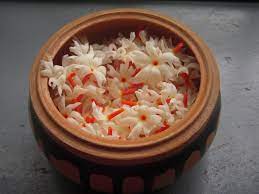
We have tied bunches of kaash* and strung garlands of shefali.
We have decorated the wicker tray with new-sprung paddy. 
Welcome autumnal goddess on your chariot of white clouds! 
Ride on angelic azure paths,
Travel through clean bright glittering forested mountains.
Come wearing a crown of white lotus, sparkling with dewdrops. 
On the banks of Ganges, in a solitary bower
Carpeted with the flowers of fallen malati,
Swans flap their wings as your entourage. 
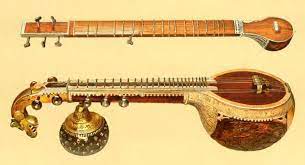
When you pluck the strings of your golden bina*,
Soft sweet notes, 
Usher laughter amidst transient tears. 
Like the magical parasmani* emanating light,
Stroke the flames of compassion in our hearts—
Brighten our thoughts and replace darkness with light. 

*kaash: Wild grass flowers
*Bina: Musical instrument 
*Parasmani: A magical touchstone

Bina. Courtesy: Creative Commons
A Bengali rendition of the song performed by a contemporary artiste, Rezwana Choudhury Bannya

In 1913, Tagore received a Nobel Prize for his own translation, Gitanjali: Song Offerings, published in England. Only 69 of the original 157 of the Bengali Gitanjali made it into the English translation.

An essay, ‘Publication of Tagore’s song offerings, the Gitanjali : A Study’ by Partha Pratim Ray, a librarian in Vishwa Bharati, contends: “Rabindranath Tagore himself took the task of the translation of Gitanjali (Song Offerings) when he sailed for England on 27 May 1912. There he handed over the poems to William Rothenstein whom he met earlier in Calcutta in the year 1911. Moved by the poems, Rothenstein in turn gave the poems to W.B. Yeats to read. The literary and artistic circle of Yeats decided to publish the poems after Yeats made a selection of them and wished to write an introduction to it. That is how Gitanjali was first published by India Society of London on November 1912.”

The article further elucidates: “The next edition of Gitanjali was published in the next year (March 1913) by Macmillan and Company, London. The number of poems in Bengali and English Gitanjali are not the same. In Bengali there were 157 poems, but in English it was 103. The poems were first published in different Kavyagrantha. At the end of the Indian edition of India Society or Macmillan there was a statement: ‘These translations are of poems contained in three books- Naivedya, Kheya and Gitanjali…’”

Yeats wrote the introduction for Song Offerings.  He wrote, “these prose translations from Rabindranath Tagore have stirred my blood as nothing has for years” and “Mr. Tagore, like the Indian civilization itself, has been content to discover the soul and surrender himself to its spontaneity.”

This poem has been translated by Mitali Chakravarty with editorial input from Sohana Manzoor on behalf of Borderless Journal

.

PLEASE NOTE: ARTICLES CAN ONLY BE REPRODUCED IN OTHER SITES WITH DUE ACKNOWLEDGEMENT TO BORDERLESS JOURNAL

Click here to access the Borderless anthology, Monalisa No Longer Smiles

Click here to access Monalisa No Longer Smiles on Kindle Amazon International

Categories
Excerpt

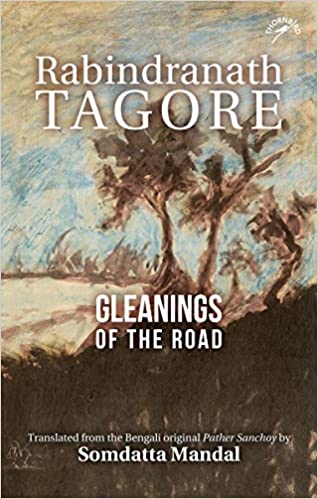
Tagore’s Gleanings of the Road

Author: Rabindranath Tagore 

Translator: Somdatta Mandal 

Publisher: Niyogi Books

Chapter 1 – Prelude to the Journey

Our ashrama school is situated in the midst of a meadow, a place where both the old and the young, students and teachers all reside in the same room. We also have other playmates; we do not have a concealed relationship with the blue sky, the light and the breeze. Here the early morning rays of the sun fall directly upon our eyelids, the evening stars in the sky directly stare at our faces. When the storm comes, its dusty stole warns us from a very long distance. The arrival of a new season is first heralded through the new leaves on our trees. It is as if Nature does not have to wait for a moment outside our doors. Our desire is to share this kind of a relationship with the people of the world as well. The desire of our heart is to see clearly all the seasons that come and go in the history of mankind, the rising and setting of the sun or the tumult that storm and rain create. This is possible for us because we stay far away from human habitation. Here all the information of the world is not received in a particular cookie-cutter mould; if we want we can receive them in an unadulterated form.

In order to make the relationship of our institution to the rest of the human world an open one, I feel it necessary to explore the world. We have received the invitation of that larger world. As it is not possible for all the 200 students of this school to accompany me in this grand tour, so I have decided that I shall alone attend the invitation on your behalf. Through me I shall complete all of yours travel. When I will again return to your ashrama I will be able to capture a lot of the external world in my life and bring it for you. Once I come back I will share my experiences at leisure, but now, before departing, I want to clearly explain some of my thoughts to you. Many people ask me why are you going for an Europe travel? I cannot find an answer to this question. If I give a simple answer that I am going because I simply want to travel, then people will think that I am dismissing the fact lightheartedly. Man is not at peace until a result is declared and an assessment made of the profit and loss involved. Why should man venture out of home without any need is a question that can be raised in our country only. We are oblivious of the fact that the wish to venture outside is a natural instinct in man. Home has bound us up in such a manner that we are tied by many superstitions and tears once we decide to set our feet across the threshold. Thus the outside is totally beyond us while its connection with home has been completely severed. Our friends and relatives enmesh us so closely that outsiders are outsiders in the true sense of the word.

ABOUT THE BOOK

Travels formed an integral part of the personae and creative artist that was Rabindranath Tagore. During his travels to England and the USA (1912-13 and 1920) Tagore wrote essays for publication in various Bengali journals. In 1939, Tagore selected fourteen of these essays and an appendix containing seven letters he had written to some of the teachers in the Shantiniketan ashram while he was on these trips, for publication as a volume. Tagore rewrote the original essays then using the colloquial instead of the formal language; he also revised the texts substantially. Later editions altered the number of essays, sometimes digressing from Tagore’s own selection, sometimes going back to Tagore’s original formal language. The travelogue provides an insight into Tagore’s perception of the different facets of western life and the diverse philosophical issues that cross his mind as he journeys from one continent to another. Translated from Bengali for the first time, Pather Sanchoy would be of interest to all those who enjoy exploring unknown territories geographically and psychologically.

ABOUT THE AUTHOR

Rabindranath Tagore, sobriquet Gurudev, was a Bengali polymath who reshaped Bengali literature and music, as well as Indian art with Contextual Modernism in the late 19th and early 20th centuries. Author of Gitanjali and its “profoundly sensitive, fresh and beautiful verse”, he became the first non-European to win the Nobel Prize in Literature in 1913.He is sometimes referred to as “The Bard of Bengal”.

ABOUT THE TRANSLATOR

Somdatta Mandal is a former Professor of English and ex-Chairperson, Department of English, Visva-Bharati, Santiniketan, India. A recipient of several prestigious fellowships like the Fulbright Research and Teaching Fellowships, British Council Charles Wallace Trust Fellowship, Rockefeller Residency at Bellagio, Italy, Salzburg Seminar and Shastri Indo-Canadian Faculty Enrichment Fellowship, she has been published widely both nationally and internationally. She has also an award from Sahitya Akademi for the All India Indian Literature Golden Jubilee (1957-2007) Literary Translation Competition in the Fiction category for translating short stories series ‘Lalu’ by Sarat Chandra Chattopadhyaya.

Click here to read the review

PLEASE NOTE: ARTICLES CAN ONLY BE REPRODUCED IN OTHER SITES WITH DUE ACKNOWLEDGEMENT TO BORDERLESS JOURNAL

Categories
Essay

The Kaleidoscopic World of Satyajit Ray

By Anasuya Bhar

Satyajit Ray in New York. Courtesy: Creative Commons

The last year and a half has seen exhaustive commemoration of the works Satyajit Ray (1921 – 92) as it marked his birth centenary. To us in India and to the world in general, Satyajit is now revered as a filmmaker, primarily. He has become a myth and a legend in the art of filmmaking, so much so that Akira Kurosawa has pleaded that the ignorance of the former’s art is comparable to not having seen the sun or the moon. Nevertheless, it would be highly unjust to his artistic persona if we study him merely as a film maker. He was a polymath intellectual who was versatile in several arts, where literature, visual art and music were only among a few of his talents apart from cinema. Satyajit had re-invented himself severally, in various times of his life and career.

The Beginnings

Born to the illustrious and talented family of the Rays of Gorpar in north Kolkata, Satyajit was grandson to Upendrakishore Ray Chowdhury (1863 – 1915) and the only son of Sukumar Ray (1887 – 1923), whom unfortunately Satyajit lost, when he was merely two and a half years old. The vein of versatility ran high in the family. Upendrakishore distinguished himself as a pioneer in the art of photography and later also in printing technology. In fact, to him we owe the science of half-tone printing and photography. His research papers were published in the prestigious Penrose journals of England. Upendrakishore also distinguished himself as a writer of children’s literature and published not only in Bengali journals like Mukul, Sakha and Sathi (in the nineteenth century), but also founded his own magazine for children in 1913, by the name Sandesh – a name indicative, not only, for a Bengali sweet meat, but also for information and news. Sukumar Ray was primarily a student of science, with a double B.A in Chemistry and Physics honours from Presidency College Kolkata. He, however, went to England to study Printing Technology with the long term goal that he would assist his father in their own press, U. Ray and Sons. Sukumar too, got his research papers published in prestigious scientific journals. He was in England at a time when Rabindranath Tagore, too, had made his visit in 1912 and was a witness to some of the poet’s reading of his poems from Gitanjali (1912) in the company of many influential people in that country. Sukumar returned to Kolkata and was compelled to take up the editorship of Sandesh from 1915, after the death of his father. Sukumar had already started the ‘Nonsense Club’ and his hand written journal Share Batrish Bhaja (Thirty-two and a half Fried Savories) even before he went to England. The vein of the ‘nonsense’ tradition only perfected itself after his return; his own poetry and prose began to see the light of day from the time he began to edit Sandesh. However, and rather unfortunately, his life and career too, came to an abrupt end in 1923. It was only a few years after this that the magazine Sandesh closed down.

Satyajit Ray was largely brought up in his maternal uncle’s home in Ballygunge, from where he completed his schooling at Ballygunge Government School and attained his B.A in Economics (Honours) from Presidency College Kolkata. His mother Suprabha Devi, preferred that Satyajit follow up his education under the guidance of ‘gurudev’ Tagore and hence cajoled him to join Kala Bhavana in Santiniketan in the year 1940. The reluctant Satyajit actually wanted to study ‘commercial art’, but was denied that opportunity in Santiniketan. Nevertheless, he was struck with the brilliance of Nandalal Bose and Binodebehari Mukhopadhyay, whom he got as his mentors in Kala Bhavana. Satyajit was steeped in the nuances of western art, music, films and books; ever since his childhood he was an avid listener of western classical music and a keen viewer of foreign films as they appeared in erstwhile Calcutta.

Santiniketan, for the first time, afforded a glimpse of the beauty of rural Bengal, a gift that he would utilise later when he would make films. While here, Satyajit still felt restless and left after completing only over two years of the course. He returned to Kolkata and joined the advertising firm of D. J Keymar in 1942 as Junior Visualizer, where D.K. Gupta was then Assistant Manager. Among his colleagues were the talented artist Annada Munshi and the younger O.C. Ganguli and Makhan Dutta Gupta. It may be mentioned here that Satyajit, at that point, was rather keen on getting a job and procuring an independent residence for himself and his mother. The scourge of having to labour without a father was quite evident. In 1943, the Signet Press was founded by D. K. Gupta and Satyajit was assigned several books to design. Thus began a career in book designing, which marks an interesting chapter in his artistic career.

The Composite Artist

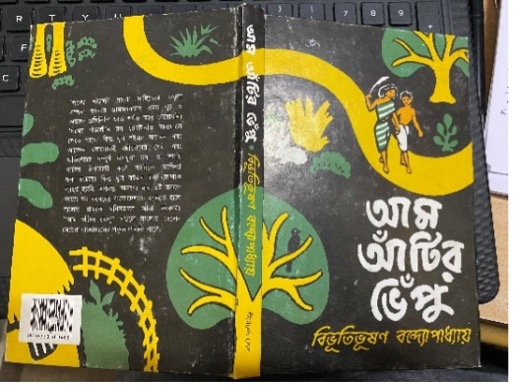
Satyajit Ray has designed as many as over 300 book covers. The repertoire of Ray book covers is extensive and varied; he continued to remain a composite and wholistic artist throughout the span of his career when he evolved as a writer, mainly for children, even while continuing to make films. He designed books for a host of writers beginning with Sukumar Ray to Bibhutibhusan Bandyopadhyay, to Premendra Mitra, Jibanananda Das, to Lila Majumdar, while he worked for Signet, and later even for other publishers. Each of these covers were aesthetic statements linking themselves to the themes and the content within. The frontispiece as well as the illustrations inside, ranged from the linocut / woodcut designs to fine lines and geometric solid shapes. Each one of these designs proved beyond doubt his versatility, talent and uniqueness of vision. Some of Ray’s book covers found pride of place in internationally reputed journals like the Graphis (in 1950).

Book cover by Satyajit Ray from personal collection

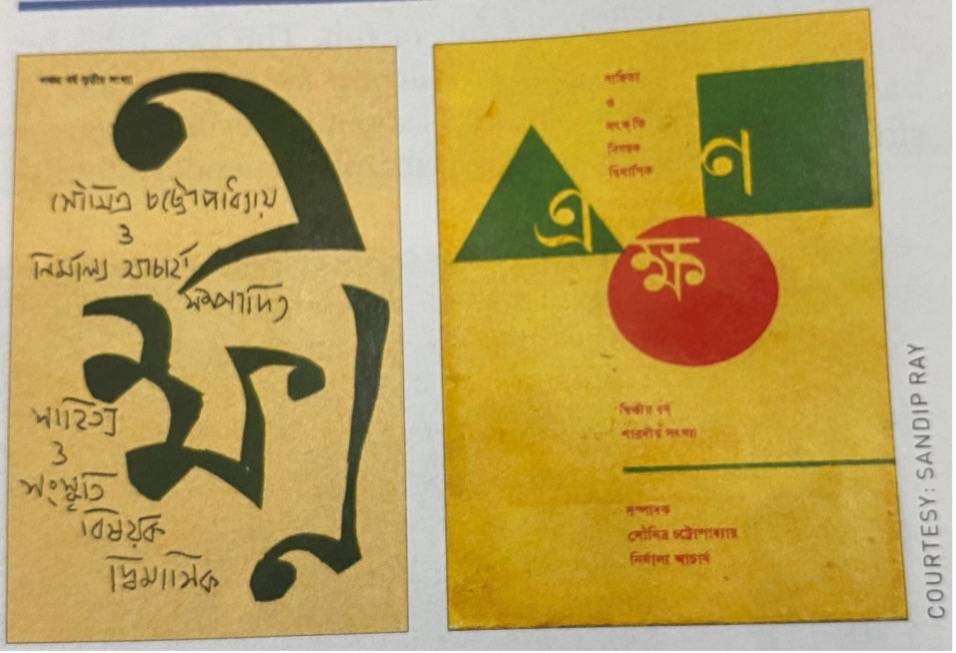
Ray’s artistry found new space in the covers of Ekshan, a Bengali bi-monthly periodical edited by Nirmalya Acharya and actor Soumitra Chattopadhyay between 1961 and 1995. The periodical died an untimely death after the demise of Nirmalya Acharya. Satyajit designed several of its covers and each one of them is a masterpiece of visual jugglery. There are three letters in the title and Ray seems to act as a visual conjuror of these three letters using various planes, letterings, geometry and even characteristics of various art forms.

Ekshan journal, Photograph from Frontline Ray Commemorative Issue, November 2021

The 1950s saw Ray totally emerged in films and his own maiden attempt at a directorial venture took shape in 1955, with Pather Panchali (Song of the Little Road) Ray also designed his film posters, title cards and even fliers, apart from writing the screenplay himself. Later, he also graduated to composing his own music and writing his own stories; seldom do we see such a versatile artist.

It may be pointed out here that while we keenly study the various facets of Satyajit Ray, he was not alone in diversifying the art of design and illustration in books. One may mention here the works of Purnendu Patri, Pranabesh Maity and several others whose works are significantly remarkable in the history of book making. As mentioned earlier, Satyajit has constantly re-invented and adapted himself to the changing face of time. This has allowed him to survive several cultural and historical changes.

The Writer

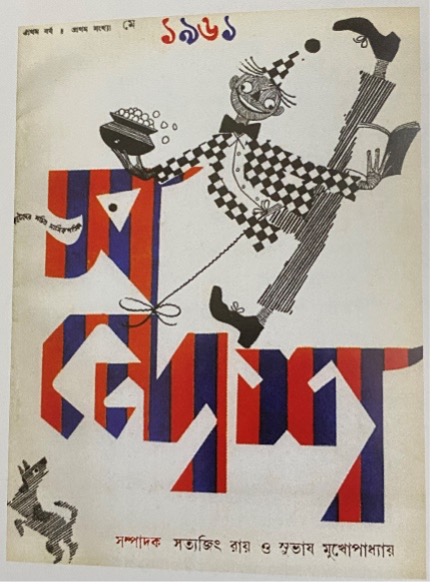
Satyajit began writing consistently from his fortieth year, somewhat out of necessity. Before that he wrote sporadically. That year, 1961, saw the revival of the children’s magazine Sandesh under the entrepreneurship of Ray and his poet-friend Subhas Mukhopadhyay. The magazine, inactive since the thirties, saw a new lease of life when Ray and Mukhopadhyay decided to revive it in 1961. They were also the editors of the new Sandesh. Ray designed most of its covers and like the various letterings of Ekshan, he juggled with the masthead of Sandesh as well.

The magazine continues to be among the leading children’s magazines till date and is currently being edited by Sandip Ray, Satyajit’s son. In the first issue of the new Sandesh, published in May 1961, Satyajit decided to translate some of Edward Lear’s The Jumblies into Bengali, simply as a gesture of participation. The second issue of the magazine carried his first short story in Bengali along with his own illustration. That marked the beginning of a series intriguing literature primarily published in the pages of Sandesh in a Bengali that is modern, contemporary, smart, and attractive to the young and inquiring minds of children. Some of his works were also published in Anandamela, another children’s magazine in Bengali and Target, a children’s magazine in English, which was quite popular in the 1980s. The latter mostly published Ray in English translation, mostly made by himself. Some of his English translations were anthologised in Stories, published by Secker and Warburg in 1987. There are many more translations of Satyajit now available in English; those of the adventures of Feluda and Professor Shonku, and Fotikchand and many others are also published by Penguin.    

Satyajit Ray’s books were a staple to the children of the eighties in the last century. Most of us then, welcomed our teenage with the scientific adventures of Professor Shonku and those of the private investigator Prodosh Mitter alias Feluda. These books were the repository of a variety of knowledge – one emerged cleverer and better enriched after regaling oneself with the exhilarating laboratory experiments of Shonku, while on the other hand, one cajoled one’s brains with the cerebral magic of Feluda. For children like us, Ray’s identity as a filmmaker came second to his writing, as we understood less of that art in that age. In fact, his stories were a rage among our contemporaries then, and we marvelled at his plots, along with his accurate illustrations and cover designs, all of which made him a supreme artist-figure in our childhood. There were also occasions when we connected his films on children with respect to his books. Hence, the adventure tales around the ‘golden castle’ (Sonar Kella, 1974) or those around in Benaras (Joy Baba Felunath, 1978), were only a derivative of what we perused in the books of the same names.

The Ray Generation

It would, perhaps, not be wrong to say that Ray’s writing created a brand in the genre of children’s literature. As contemporary and the immediate consumers of his books, some of us identify a part of our childhood with the Ray literature. He was a master in the handling of the bizarre and the fantastic, the investigative crime thrillers and also the evolution of the science fiction. Again, Ray may not be said to be a pioneer in any of these genres, but he made them highly palatable and attractive to the young minds. One would be guilty of falsification if one does not mention Sukumar Ray himself, or Hemendrakumar Ray and Premendra Mitra, who made, perhaps, the earliest forages into the art of the bizarre, the supernatural or the sci-fi in their own times and generations.

Satyajit Ray’s repertoire as a writer for children is extensive. He is credited to have composed thirty-eight adventures of Professor Trilokeshwar Shonku. In him, Ray creates a familiar Bengali with extraordinary scholarliness who was once a teacher in Scottish Church College Kolkata, but now resides in Giridi. Although his only companions are now his valet Prahlad and pet cat Newton, he has an elaborate family history which the author creates as a back drop for his readers. Professor Shonku’s various travel destinations offer extensive scope for young minds to travel within the safety of their homes. In creating the several marvels of science Satyajit must have surely drawn extensively from the works of Jules Verne, H.G. Wells as well as The Chariot of the Gods (1968) by Erich von Dӓniken – works with which he must have been familiar ever since his childhood. Scholars also propound similarities between Professor Challenger of Arthur Conan Doyle (The Lost World) and Professor Shonku. However, there is also reason to believe that Professor Shonku has a distant antecedent in the character of Professor Hushiyar (Heshoram Hushiyerer Diary) created by Sukumar Ray. With time, of course, Shonku evolves as a more serious and responsible, internationally acclaimed scientist. Ray had also wanted to make a film on aliens, with a sound background on science fiction, but this dream remained unexecuted. The first ever film on Professor Shonku was made by his son in 2019.

The Private Investigator Mr. Prodosh C Mitter first made his appearance in the arena of Bengali detective fiction in the year 1965. The Bengali readership was already accustomed to private detectives created by Niharranjan Ray (Kiriti Ray) and Sharadindu Bandyopadhyay (Byomkesh Bakshi) before Ray launched the career of Feluda, who emerged as a highly identifiable neighbourhood man with his nephew and assistant Topshe and their elderly writer-friend Jatayu. One may again mark the presence of other detectives in contemporary literature like Kakababu (Sunil Gangopadhyay), Gogol (Samaresh Basu) and the boy group of Pandava Goyenda (created by Sasthipada Chattopadhyay), which were also available to the young readers along with the adventures of Feluda. All of them were simultaneously popular among contemporary children, although Ray scored higher because of his razor sharp intelligence and complete artistic and aesthetic package that his books offered. Some, made into films, made him the most popular among children and adults alike. Apart from his series characters like Shonku or Feluda, Ray has created a host of other characters in numerous short stories and novellas, over a period of thirty years or more. There is, quite interestingly, very little adult fiction written by Satyajit, with the exceptions of Nayak (The Hero, 1966), Kanchenjunga (1962) and Pikoo’s Diary (1980), all of which have been made into films.

Ray as Translator and maker of Children’s Films

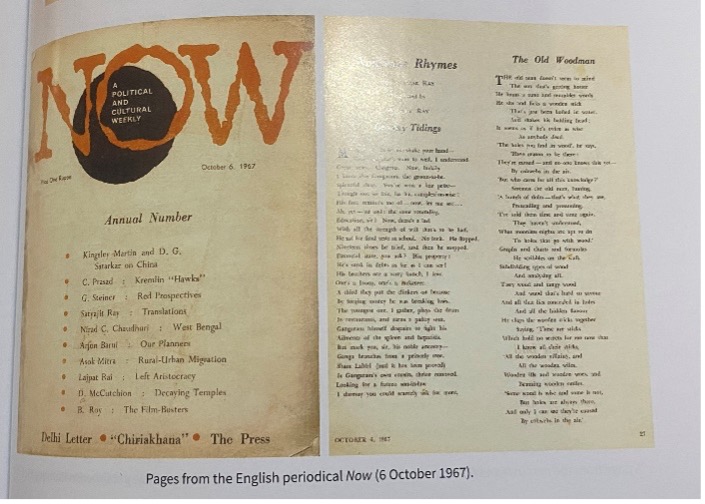
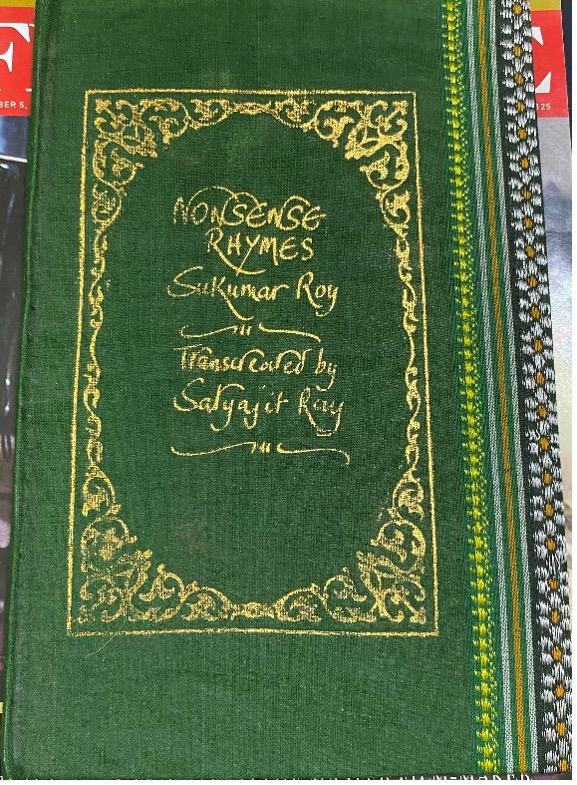
Ray distinguished himself as a translator as well. The first major translation done by Satyajit Ray was, perhaps, those of a selection of Sukumar Ray’s Aabol Taabol (‘Nonsense Verse’, 1923). About ten such poems were translated / trans-created in the pages of a radical weekly called Now, edited by Samar Sen during 1967-69. These poems were then noticed by P. Lal of Writers Workshop, a pioneering publishing enterprise which patronised (and still does), Indian writing in English, since 1958. They were brought forth as an independent collection by this house in much admiration for Satyajit’s skill in rhyme and meter, in 1970. The edition has remained a popular one and has recently suffered alterations in the fourth corrected and expanded edition in 2019. The text is also prescribed for study in a course on Popular Literature in the undergraduate syllabus of the University of Calcutta, since 2018.

Satyajit also translated some works of Upendrakishore along with other works of Sukumar into English in various times of his career. These are now available with the translations of his own works, in a compendious edition titled 3 Rays (Penguin Books, 2021) and edited by Sandip Ray.According to Sandip Ray, these were mostly done with a view to popularise the works outside Bengal and to a larger audience, mostly as recreational activities, which Satyajit undertook between the shooting of his films.

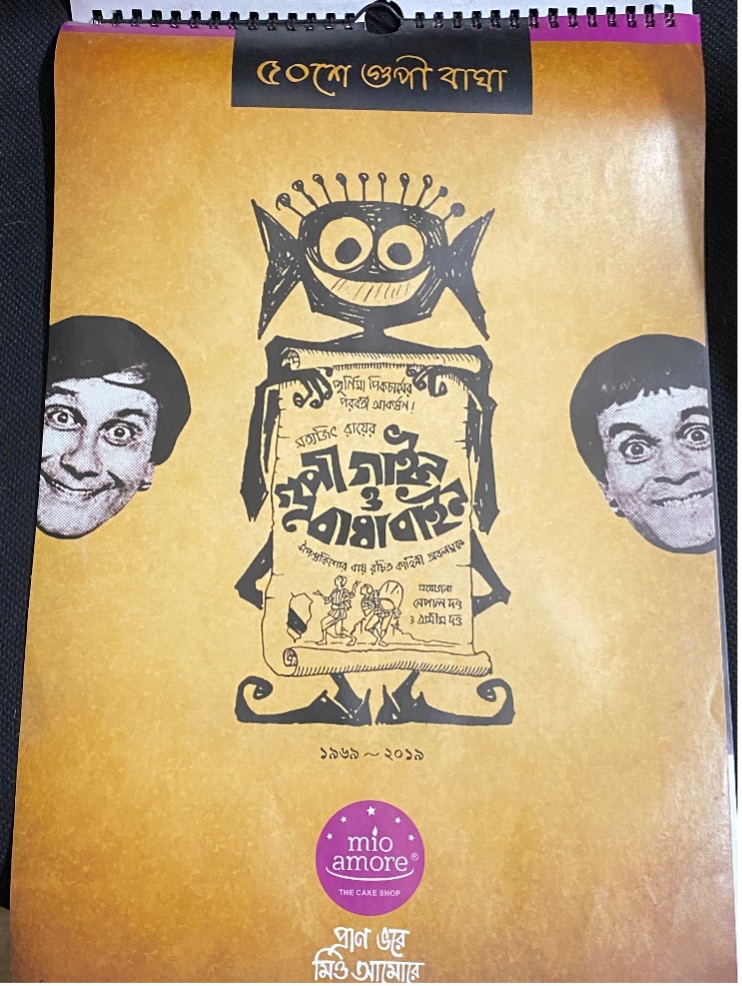
In 1969, Satyajit Ray directed Goopy Gyne Bagha Byne, a novella originally written by Upendrakishore Ray Chowdhury about two rustic simpletons Goopy and Bagha and their careers in music. The occasion was the birth centenary of Upendrakishore and was a result of requests from his teenaged son Sandip, to create something for children. The film was an improvement on the literary text, and continues to be a marvel in the study of the fantastic, given the limited means with which it was produced. Satyajit introduced in the film a dance – the sequence of the ghosts’ dancing – which remains a marvel of cinematography and an example of ingenuous thinking, intelligent editing and deft execution within a limited budget. As always, Satyajit creates a family pattern for Goopy and Bagha, too. They re-appear after a hiatus of ten years in Hirok Rajar Deshe (1980). By this time, the duo has earned fame as extraordinary performers, with magical powers to transfix their listeners and with uncanny powers to unravel the mysteries of state politics. On the domestic front, they are also married to princesses as well as proud fathers.  Hirok Rajar Deshe or ‘The Land of the Diamond King’ is a study on an ugly regime of totalitarianism, where almost all are being brainwashed to worship a power hungry king. The film may be identified as a political satire under the garb of entertainment for children, where good eventually overcomes evil. Satyajit makes extensive use of fantasy and magic as well as creates a world where science is being used to destroy the good sense of people. It is the musical duo of Goopy and Bagha who re-affirm good sense and sanity in an anarchic and dystopian state. The duo returns in Goopy Bagha Phire Elo (Return of Goopy Bagha, 1991) and the setting now is influenced more by a sense of science fiction and fantasy. The last film of the trilogy was directed by Sandip Ray, who re-affirms his presence in a cyclical and metaphorical ‘coming of age’ marking himself as a filmmaker.

The cover page of the Commemorative Calendar celebrating 50 years of Goopy Gyne Bagha Byne

The enormity of the Satyajit Ray papers, letters, manuscripts, posters, notebooks, sketches, as well as his film prints are now being collectively maintained and conserved by the Society for the Preservation of Satyajit Ray Archives. The Society also organises regular lectures and exhibitions and looks to the publication of books on the maestro. It is significant that Penguin India has decided to dedicate a whole collection of books on Ray as ‘The Penguin Ray Library’. One must not fail to acknowledge the scholarship and hard work of his son Sandip Ray and Satyajit-scholars like Debashis Mukhopadhyay and Pinaki De, who mesmerise with their encyclopaedic knowledge on the master. The past year and half have seen innumerable lectures and scholarly interactions on Ray where the two have shone independently. The present author stands in awe of their scholarship.

( Note: All the photographs used in this article are taken by the author, except the one licensed under creative commons.)

References

  1. Frontline – ‘The World of Ray: A Commemorative Issue’, November 5, 2021
  2. Ray, Sandip (ed.). 3 Rays: Stories from Satyajit Ray. New Delhi: The Penguin Ray Library, 2021.
  3. Ray, Sandip (ed.). Sandesh. Festival Numbers 2020 and 2021. Commemorative issues on Satyajit Ray entitled ‘Satyajit 100’. Kolkata.
  4. Ray, Satyajit (trans.). Nonsense Rhymes – Sukumar Ray. Kolkata: Writers Worshop, 2019.
  5. Ray, Satyajit. Shera Satyajit. Kolkata: Ananda Publisher’s Private Limited, 1991.
  6. Robinson, Andrew. Satyajit Ray: The Inner Eye – The Biography of a Master Film-Maker. London and New York: I. B. Tauris, 1989.

Dr. Anasuya Bhar teaches English at St. Paul’s Cathedral Mission College Kolkata.

.

PLEASE NOTE: ARTICLES CAN ONLY BE REPRODUCED IN OTHER SITES WITH DUE ACKNOWLEDGEMENT TO BORDERLESS JOURNAL

Categories
Tagore Translations

Abhisar by Rabindranath Tagore

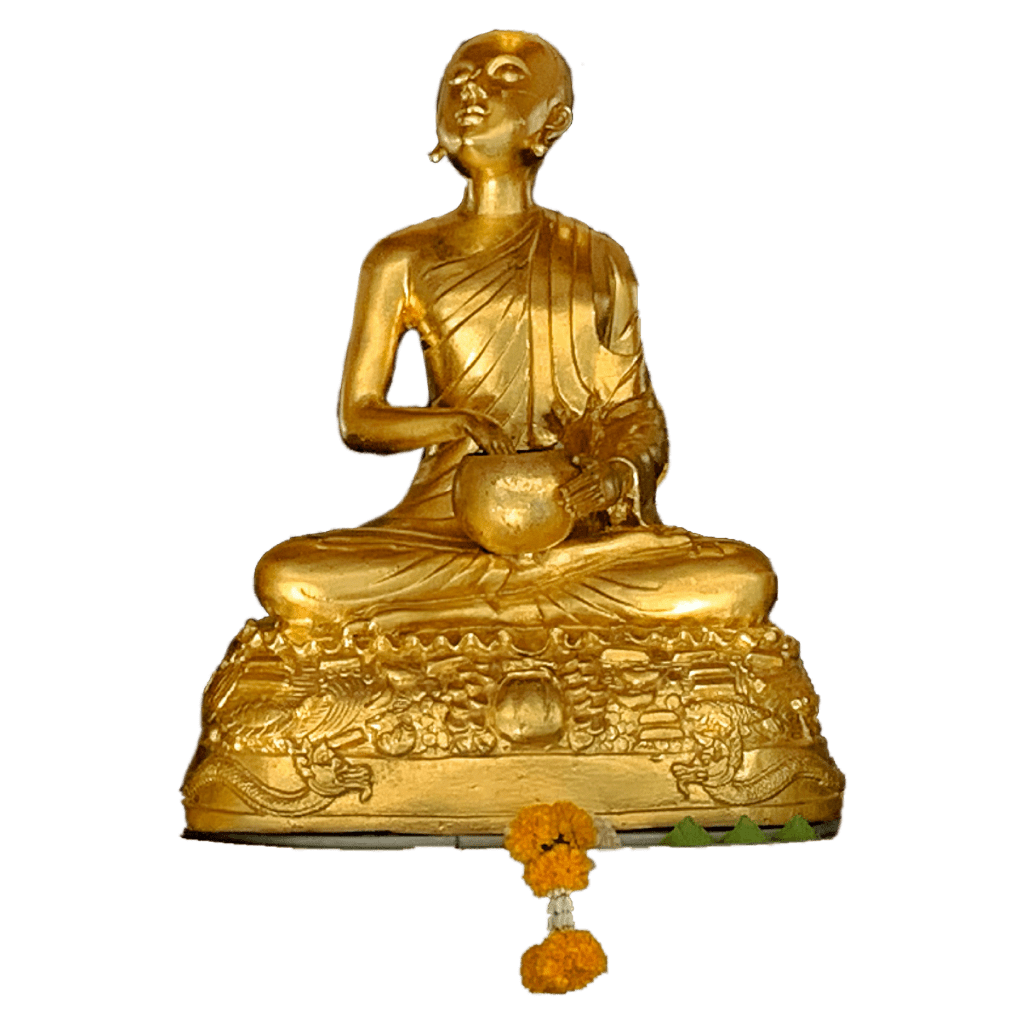
Abhisar, translated as ‘The Tryst’, was written by Rabindranath in 1899. It is a story poem based on Upagupta, a Buddhist monk who lived in the 300 BCE and was revered by Emperor Ashoka and is still said to have a following in Myanmar.

THE Tryst

Sanyasi Upagupta
Was asleep under the shade of 
       The city ramparts of Mathura —
A breeze had blown off the lamps and flares.
The palace doors were shut. 
The stars of the night 
          Had disappeared behind clouds.

Whose foot adorned with anklets
          Suddenly rang on his chest? 
Startled, the sanyasi woke up.
His dreams fled. 
A dim light shone 
       on his forgiving eyes. 

The court dancer was going for a tryst with her lover,
        Intoxicated with her own vernal bloom. 
Dressed in a deep blue saree,
Her ornaments tinkled — 
As her foot fell on the monk, 
         Basabdatta halted.

With her lantern, she examined 
      his young radiant form —
A calm enduring tender face, 
A glance gleaming with compassion,
A white moon-like forehead 
       aglow with gracious peace.

The woman spoke in a gentle voice,
        Her eyes drooping with embarrassment, 
“Pardon me, O youthful one, 
I will be grateful if you come to my home. 
The ground here is hard and rough.
        This is not the right place to sleep.”

The sanyasi responded with kind words,
           “It is not yet time for me 
To visit O graceful one, 
Please go your way in prosperity. 
When the time is right, I will myself
            Come to your bower.”
                      
Eventually, a fiery spark thundered,
          Opened a monstrous mouth.
The young woman shivered with alarm.
As a terrifying destructive wind howled,
A lightning ripped a cruel smile
            Across the sky.

                 *

The year was not out. 
     It was an evening in Chaitra. 
The breeze fluttered with restlessness
The trees along the path were laden with buds. 
The King’s garden was flush with blooms of bakul,
       Parul and rajanigandha. 

From afar, wafting with the draft
      Was the mesmerising timbre of a flute.
The city was empty as everyone had left for
The festival of flowers in the honeyed woods. 
The full moon smiled at the town
      Emptied of people and protectors. 

On the lonely moonlit path, 
        The sanyasi walked alone
Under leafy branches, from where
Cuckoos cooed repeatedly —
After so many days, was it time for him
      To fulfil his tryst with the beloved? 

Crossing the town, the wise one 
        Went beyond the city walls. 
He stood beside the moat —
In the shade of the mango grove,
Who was that young woman 
         Lying near his foot? 

Her body was blistered with sores
         From a deadly disease —
As she darkened with the blight,
The citizens threw her out 
Beyond the city moat, fearing the
             Poison within her.

The sanyasi sat down by her. 
        And put her stiff head on his lap —
He poured water into her chapped lips,
He chanted a mantra on her head,
Covered her body with a soothing
       Cool sandal paste. 

Bakul blooms were falling, the cuckoos were calling, 
       The night was filled with moonlight. 
“Who are you, o compassionate soul?”
The woman asked. The sanyasi replied,
“Tonight is that time. O Basabdatta,
         I have come for our tryst.”


Sanyasi-- a monk or mendicant, in this case a Buddhist Bhikshu

Chaitra -- spring when the old year ends and new starts in the Bengali Calendar. 

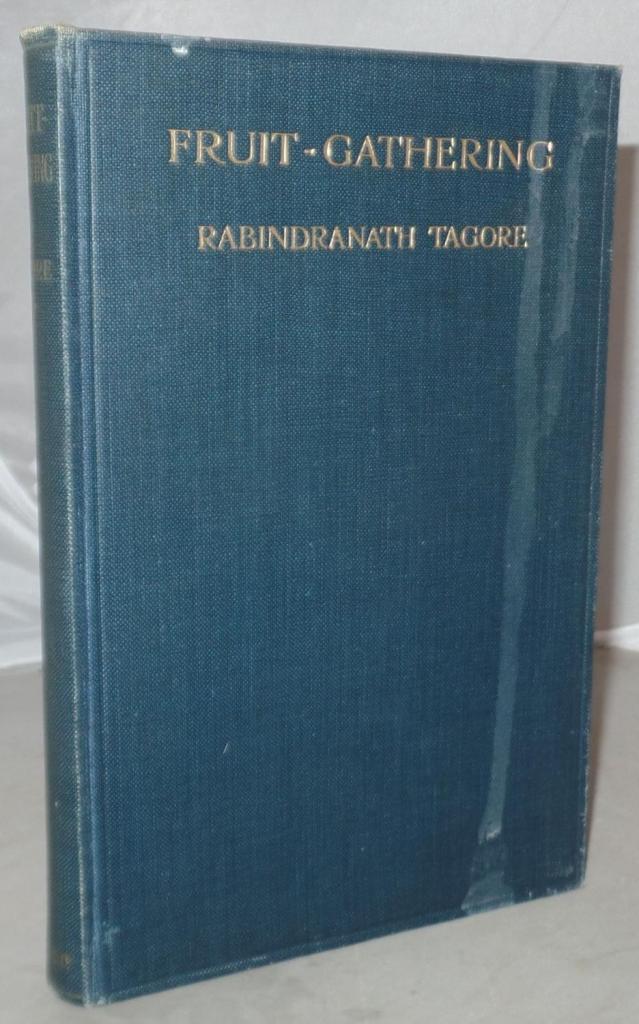
Tagore had translated this poem in English for a collection called Fruit-Gathering, brought out in 1916 by Macmillan. The eighty-six translated poems by Tagore in this edition were from a few selected collections in Bengali: Gitimala, Gitali, Utsarga, Kheya, Naivedya, Gitanjali, Katha and Balaka.

1916 edition of Macmillans’ Fruit-Gathering

(This poem has been translated for Borderless Journal by Mitali Chakravarty and edited by Sohana Manzoor and Anasuya Bhar.)

.

PLEASE NOTE: ARTICLES CAN ONLY BE REPRODUCED IN OTHER SITES WITH DUE ACKNOWLEDGEMENT TO BORDERLESS JOURNAL

Categories
Essay

The Idea of India

Anasuya Bhar explores the history of the National Anthem of India, composed by Tagore in Bengali and translated only by the poet himself and by Aruna Chakravarti. Both the translations are featured here.

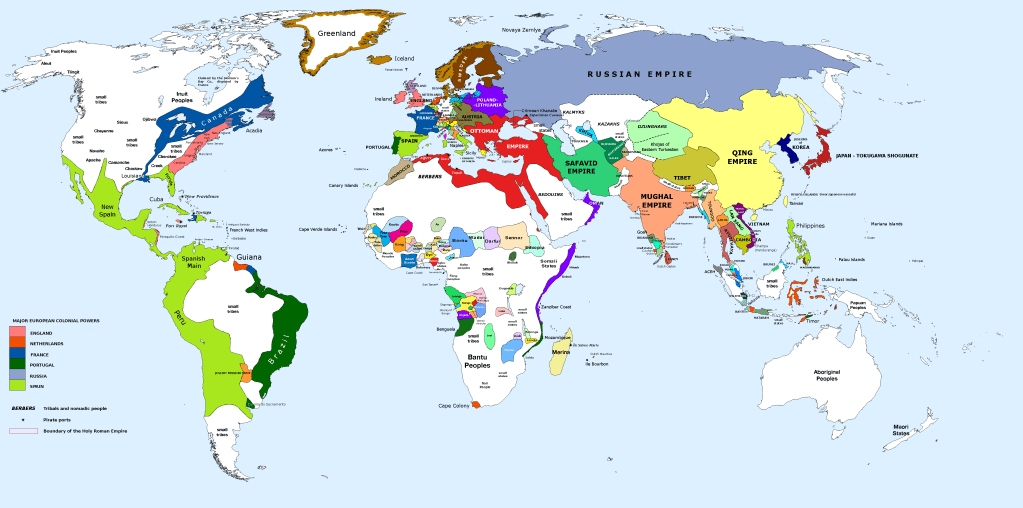
1700 AD: An illustrative map of the world in the early colonial period. The Mughal Empire in India was at its greatest territorial extent. Courtesy: Creative Commons

The national anthem and the national song of India are both parts of a post-colonial narrative and did not originate prior to the British colonisation of the country, which happened effectively, from the middle of the eighteenth century. India has been broadly classified as a civilisation and a cultural phenomenon, rather than a race or a territorial presence prior to the British colonisation.

India has remained an idea ever since the ancient times, perhaps even prior to the advent of the Classical Graeco-Roman civilisation of the west. The historicisation of India’s past has been a much debatable issue, with European historians representing India from their perspective. Much damage was done, for instance, by James Mill’s The History of British India (1817), which rubbished the country as thoroughly debased and wanting the civilisational touch of the European west. The reality of India, or more correctly Bharat, inhered in the local and regional historical specificities, its literature, culture, myths and legends. The historical perspective of our inhabitants was that of the Puranic history whose chronology, order and narrativity depended on a time scale different from the idea of time in the western rationale for chronology. In other words, the European west’s rationale consequent of the enlightenment, and the enlightened concept of history, was a later addition to the Indian consciousness.

The concept of a distinct nation, and as an individual entity in the consciousness of a socio-political presence in the history of the world, was also, a comparatively belated concept in our country. In fact, it was not earlier than the Mughals that the country was conceptualised as a unified entity from the North to the South, from the East to the West. The Indian sub-continent is strategically guarded by the geographical presence of the Himalayan range, the Indian ocean, the Bay of Bengal and the Arabian Sea. Hence, the territorial boundaries which become crucial in determining the political borders of the European or the American west are not of much consequence over here. The borders that are present in the former continents are a result of political aggression and imperialism. The borders that ensued in the Indian subcontinent and eventually created Afghanistan, Pakistan, India, Nepal, Burma, Bangladesh and also Sri Lanka, are, however, a result of the European and, particularly, British intervention.

The consciousness of India’s nationalism was, as mentioned in the beginning, a later one and quite clearly a colonial aftermath. Among the first to mention the lack of an indigenous history was Bankimchandra Chattopadhyay (1838 – 94), the celebrated novelist and intellectual of nineteenth century Bengal, who himself attempted to write, through his various essays, a historical consciousness for his country. The writer of our national song ‘Bande Mataram’ (in Anandamath, 1882), Bankimchandra was also the first to think of a ‘jatiyo’ or a nationalist consciousness, and attempted to take a fresh look at the puranic history based on myths and legends. He rewrote the narrative of Krishna, and also looked afresh at the fundamentals of the Hindu religion.

The nationalist consciousness was given a fresh lease through the several attempts for promoting indigenous products and enterprises by the Tagores of Jorasanko in Kolkata. The Hindu Mela (Hindu fair), begun since the mid-1860s by Dwijendranath Tagore (1840 – 1926) was among the first to strike concepts of an indigenous nationhood, by giving impetus through homespun fabrics, cultivation of rural handicrafts and traditional food items like pickles or ‘bori’, such that a space could be created independent of the parameters used by the colonial masters. Rabindranath (1861 – 1941) also refers to several attempts of his elder brother Jyotirindranath (1849 – 1925), in creating the matchstick factory or even striking a competition in the ship trade with their English counterparts in the waters of Bengal in his autobiographical Jibansmriti (My Reminiscences, 1911). He also mentions the latter’s attempt at designing a national dress for the country, trying to fuse various drapes of traditional clothing. This is again very interesting because, a distinctive sartorial appearance would help in identifying the Indian from the European, even externally. The sari  as we wear it now, was first conceptualised by Jnanadanandini Devi (1850 – 1941) of the Tagore household. She gave the Indian women a dignified attire by fusing the styles of Parsis and Gujaratis, and also by improvising on the styles of the European gown to give us the blouse-jacket. The unification of various styles automatically veered towards a oneness in the same territorial boundaries and the nationalistic consciousness came first through cultural means.

The Tagores of Bengal were also among the first, after Rammohan Roy (1772 – 1833), to venture beyond their homes. Dwarakanath (1794 -1846), grandfather of Rabindranath, not only stayed in England for a substantial period of time, but also endeared himself to Queen Victoria as the ‘Prince’. Debendranath (1817 – 1905), his son, was in the habit of touring the Himalayas extensively, and even took his youngest son Rabi along with him. Satyendranath (1842 – 1923), another of his sons, was the first Indian to qualify in the Indian Civil Service; he too, extensively toured several parts of India and abroad. Rabindranath was a frequent traveller from a very early age. The women of the Tagore household, beginning with Jnanadanandini Devi also moved out of their antarmahal  (inner quarters) and into the other parts of their country and even the world. Indira, Mrinalini, Sarala, Pratima along with Jnanada were frequent travellers both within and outside the country. Hence, the country and the ideology of India as a nation were familiar concepts to the members of this remarkable family from Bengal. Of course, there were other influential households in nineteenth century Bengal, but none so extensively influential.

The formation of the Indian National Congress (INC) in 1885, marked the culmination of several isolated and scattered attempts at nurturing a nationalist consciousness. I have, however, given a few instances from Bengal. I am sure similar attempts were made in other states as well. Even in the formation of the INC, we see the pivotal role played by Janakinath Ghosal (1840 – 1913), husband of the well-known litterateur Swarnakumari Devi (1855 – 1932), elder sister of Rabindranath. According to the memoirs of his elder daughter Hiranmayee, Janakinath was a key presence at the time of the formation of the Congress. Later, Sarala (1872 – 1945), their younger daughter, not only became a part of the Congress, but was also among the foremost figures in Bengal to enthuse young men into the national struggle through cultivation of physical fitness programs. Sarala also worked closely with Swami Vivekananda and Sister Nivedita in some of their philanthropic programs.

Jana Gana Mana, now venerated as our National Anthem, was most possibly first composed as a hymn, by Rabindranath Tagore. This hymn was first recited on the second day of the annual session of the Indian National Congress on 27th December 1911, by none other than Rabindranath himself. This was followed by a second performance of it in January 1912, in the annual event of the ‘Adi Brahmo Samaj’ or the Brahmo Congregation, and then it was published, for the first time in the January edition of the Tattwabodhini Patrika, which was the official journal of the ‘Adi Brahmo Samaj’, with the title ‘Bharata Bhagya Bidhata’ or ‘the determinant of Bharat’s destiny’. The journal was, at that time, edited by Rabindranath himself. The original song, composed in Bengali, has five stanzas. The Anthem makes use of only the first of the five and usually covers an average time of 52 seconds when sung. The original language has been retained, although its intonation is Devanagiri.

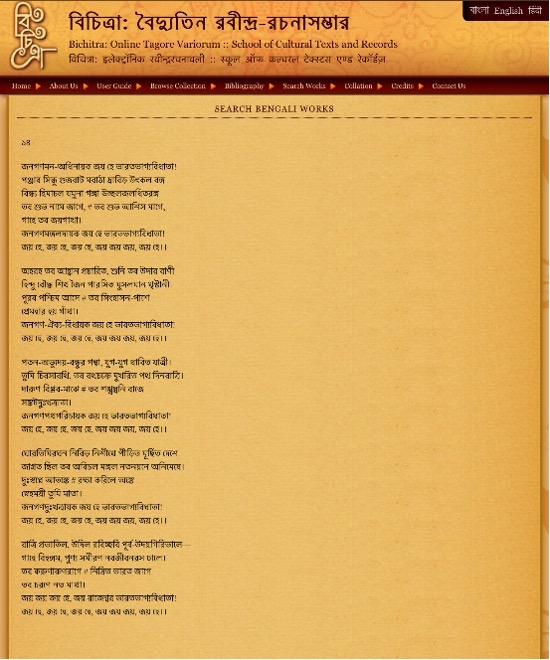
The Song in Bengali. Photo courtesy: Anasuya Bhar

The song is a hymn to the all-pervasive, almighty, and the maker of the country’s destiny, the power of whom presides over her natural boundaries of the Himalayas and other mountains and the rivers, and where resides individuals of all races, cultures and religions. It has been the benefactor, through thick and thin, assimilating the good with the bad, and when the country has been lying destitute in trouble and pain, has extended its hand in empathetic wonder. The sun of Bharat’s destiny will rise again and the pall of darkness shall be drowned in the light of a new dawn – a new beginning and a new hope. Rabindranath did not live to see this dawn, but his visions were realised and honoured by the makers of the Constitution of the Republic of India.

The hymn that originated in the poet’s fiftieth year, perhaps had its germs planted in him through his entire life as the beginning of this essay tries to elaborate. It was only time and the political needs of the country that expedited its utterance in the year 1911. The poet’s vision found embodiment in other and similar creations as well. His Gitanjali (1912) contains the well-known poem, ‘Where the mind is without fear’  (XXXV) –

Where the mind is without fear and the head is held high
Where knowledge is free
Where the world has not been broken up into fragments by narrow domestic walls
Where words come out from the depth of truth
Where tireless striving stretches its arms towards perfection
Where the clear stream of reason has not lost its way into the dreary desert sand of dead habit
Where the mind is led forward by thee into ever-widening thought and action —
Into that heaven of freedom, my Father let my country awake.

The year in which he composed and first presented Jana Gana Mana, that is 1911, was in many ways a very crucial year in his personal history. As mentioned earlier it was his fiftieth birth-year, and he was gradually beginning to be acknowledged for his poetic greatness in his own land. The following year, that is 1912, he would go to England, with some of his own translations into English, and which would, introduce him to the world as a major poet, among other poets. 1911, was also the year which marked the coronation of King George V and the transfer of the British capital from Calcutta to Delhi. In fact, Rabindranath’s hymn was initially mistaken to be sung in honour of the new Emperor of the British dominions, but was later clarified to be otherwise, and was acknowledged to be a ‘prayer’ for his own native land and independent of such intentions.

The period that we are considering is also a very significant one in Rabindranath’s own consciousness of the nation and his concept of nationalism. In 1910, he published his novel Gora where he underlined the irony inherent in religious exclusivity and bigotry. His protagonist, a staunch votary of Hindu values and virtues, ironically emerges to be an Irish foundling reared in a Hindu home. Through him Rabindranath proves the efficacy of such conservative religious bigotry. His song ‘Bharata Bhagya Bidhata’ pledges to go beyond external divisions of religion and politics, and endorses the value of humanity; nor does it discount the importance of the west, but believes in the fruitful coming together of the best of all worlds. His school at Santiniketan, later to be identified as Visva-Bharati, exemplifies this coming together of the best of all the worlds. In 1919, he delivered a series of lectures on nationalism, which came together in a single volume called Nationalism, and further endorsed his beliefs in finding the nation through culture, history and habits rather than through and in territorial, narrow parochial walls.  In Ghare Baire (The Home and the World, 1916), published around the same time, he offers us a critique of the Swadeshi Movement that dominated colonial politics in the first decade of the twentieth century in Bengal. He subtly interweaves a tale of the ‘personal’ with the ‘political’ in the triangular narrative structure of Bimala, Nikhil and Sandip, only to expose the petty hypocrisies that inhere within the grand narratives of ‘nationalism’, ‘patriotism’ and even ‘swadeshi’ at the cost of the common good and humanity at large.  

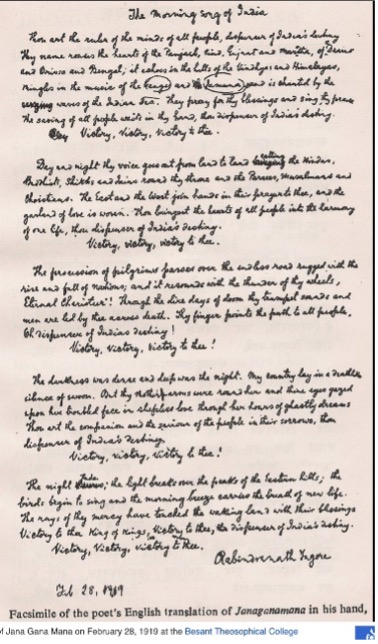
Jana Gana Mana was sung by Sarala Devi Chaudhuri, Rabindranath’s niece and daughter of Janakinath, in 1912, and who had distinguished herself as one of the earliest women nationalists of the country. The song was, then, performed in front of veteran Congress leaders. Outside Bengal, the song was perhaps performed for the first time by Rabindranath in the annual session of Besant Theosophical College in Madanapalle, Andhra Pradesh, on 28th February 1919. The Vice-Principal of the college, Margaret Cousins, was so enthralled by the song that she asked the poet to translate it for her. This Tagore did, and the translation is called ‘The Morning Song of India’. A facsimile image of the same is shown here.

The Morning Song of India in Rabindranath’s handwriting. Photo courtesy: Anasuya Bhar

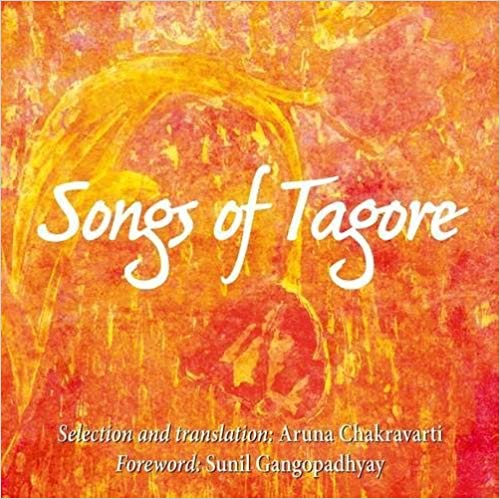
‘Jana Gana Mana’ has been translated into English by noted writer, academic and translator, Aruna Chakravarti. She is perhaps the only person to accomplish this beside the poet himself. The following is the translation made by her, along with the English transliteration of the Bengali original (Songs of Tagore, Niyogi Books):

Leader of the masses.
Lord of the minds of men. 
Arbiter of India’s destiny.
Hail to you! All hail!

Your name resounds through her sea and land 
waking countless sleeping souls
from Punjab, Sindh, Gurarat, Maratha
to Dravid, Utkal, Banga.
Her mighty mountains—Himachal, Vindhya, 
her rivers—Yamuna, Ganga,
the blue green sea with which she is girdled; 
her waves, her peaks, her rippling air
seek your blessing, carry your echoes. 
Oh boundless good! Oh merciful! 
Hail to you! All hail!

At the sound of your call the people assemble 
from myriad streams of life.
Hindu, Muslim, Buddhist, Jain.
Christian, Parsee and Sikh.
East and West stand by your throne 
hands held in amity,
weaving a wreath of fraternal love; 
of empathy, unity.
Oh you who bring us all together! 
Hail to you! All hail!

Nations rise and nations fall
on the perilous path of history.
And you Eternal Charioteer
guide the world’s destiny.
Through day, through night, your wheels are heard 
renting the air with sound,
dispelling terror, banishing pain;
blowing the conch of peace.
Oh true arbiter of India’s fate!
Hail to you! All hail!

In the deep dark of a turbulent night, 
when our swooning, suffering land 
lifted her eyes to your face in hope, 
she saw your unwavering gaze
raining blessings, alight with love,
banishing evil dreams.
Like a loving mother you held out your arms 
and changed her destiny.
Oh you who wipe out the pain of the masses! 
Hail to you! All hail!

A new day dawns; a new sun rises
from the mountains of the east.
Song birds trill; new sap of life
is borne on the holy breeze.
India awakes from aeons of slumber
to the strains of your lofty song.
Head bowed to your feet oh King of kings! 
Hail to you! All hail!

(Republished with permission from Songs of Tagore, Niyogi Books)

Outside of the country, the song was also performed as the ‘national anthem’ of independent India, under the leadership of Subhas Chandra Bose on the occasion of the founding meeting of the German Indian Society on the 11th of September 1942, in Hamburg, Germany. The Indian Constituent Assembly allowed the performance of Jana Gana Mana on the midnight of 14th August 1947, marking the close of the historical session in the Parliament. It was on the 24th of January, 1950 that only the first stanza of the song was accepted as the National Anthem of independent India. The paeans of a land millennia old, perhaps heading the dawn of all human civilisation alone, is sung through glory to the world over, till date, bearing the torch of an all tolerant, enduring land, by the name of Bharat. Perhaps we still need to be in quest of its  philosophy of oneness.

A full rendition of Jana Gana Mana by Swagatalakshmi Dasgupta

Dr. Anasuya Bhar is Associate Professor of English and Dean of Postgraduate Studies, at St. Paul’s Cathedral Mission College Kolkata, India. She has many publications, both academic and creative, to her credit.

.

PLEASE NOTE: ARTICLES CAN ONLY BE REPRODUCED IN OTHER SITES WITH DUE ACKNOWLEDGEMENT TO BORDERLESS JOURNAL

Categories
Essay

Rabindranath and the Etchings of His Mind

Anasuya Bhar explores the various lives given to a publication through the different edited versions, translations and films, using Tagore as a case study and the work done to provide these online .

Rabindranath’s first efforts at writing poetry, what he refers to as padya or rhymes, were made when he was merely a boy of seven or eight years. This is what he has to say about his maiden experience, the magic and the awe with which it surprised him –

“I had, until then, only witnessed rhymes in printed books. Without any scratches, mistakes, nor any signs of thought even – there seemed to be no sign of any of the earthy weaknesses either. I dared not imagine that these rhymes could be produced by one’s own efforts. … But when the skilful mixing of a few words gave rise to the rhythm of the ‘payar’, the magic of making rhymes remained no longer an illusion. “(My translation from Jibansmriti ‘The Poetry Beginnings’, VB, 27)

The above excerpt from Jibansmriti is significant in many ways. The memoir was written when Rabindranath was in his fiftieth year, in 1911. A careful study reveals that there are three manuscript versions to the text of Jibansmriti and the one available on print (and published by Visva Bharati), is the third and the latest version. Jibansmriti (My Reminiscences) is a piece of Rabindranath’s own life writing, along with two other pieces in book form: Chelebela (My Boyhood Days, 1940) and Atmaparichay (The Self Revealed, 1943).  

Rabindranath was a reluctant biographer of himself. Perhaps his first conscious efforts at autobiography is to be found in an essay called Atmaparichay that was first published in 1904, wherein he had consistently defended his wishes to not fuss over his life. In fact, he had wanted to keep separate his jiban and brittanto, that is the biological nitty-gritty of his life and the descriptive and analytical of his creative life. He believed that a poet’s life inheres in his poetry; that there is no need to separately concern oneself about his life details. This was re-iterated in more than one places. Nevertheless, although Rabindranath was reluctant of a conscious autobiography, he has revealed much of himself in his letters, and other non-fiction and travel essays. He was a self-conscious writer with a great emphasis put towards self-expression as well as expression of the self.  To know about him one needs to scour through these writings.

My intention in this essay, however, lies not in the history of Rabindranath’s life writing. I would, instead, like to dwell on those scratchings, mistakes and etchings of the poet’s mind that made Rabindranath ponder about the final version of any of his manuscripts. He was a relentless revisionist of his own writings. My interest lies in that branch of study, quite recent in academic scholarship, which tries to examine the various changes that each text suffers before being available for the final print. The changes might take place in the manuscript or during the correction of proofs. The successive texts, the manuscripts, the proofs, and finally the printed text all seem to have their own dynamics and seem to possess an autonomy and character of their own. This seems true of all texts of all writers and those of Rabindranath are no exception. Between the ideas and their writing, between the manuscript and the print, between the printed text and its translation into other language(s), a particular text seems to have many distinct lives. Until a short time ago, these fell within the purview of textual criticism and editorial scholarship of a text. Now, they may be considered under the rubric of ‘alternative readings of a single text’. Walter Benjamin (1892 – 1940), the German Jewish philosopher, talks about the ‘afterlife’ of a text in his essay ‘The Task of the Translator’ when it is translated, that is to say, a text assumes a different and separate life, with its own dynamics and dimensions when it is translated, from the original. The lives of a text then, multiply when multiple translations take place.

If one studies the three manuscripts of Jibansmriti, one notices three separate beginnings: the first two distinctly pointing to his life proper and his unwillingness to share details of it, while the third and the printed version has a more abstract vision of a painter-like selection of memorable incidents from his life.  The text as it exists in Bangla now, begins in medias res, as it were, with the recollections of his early childhood, as becomes permissibly natural for the memory of a fifty-year-old person. What is interesting are the insights that time and aesthetic distance have provided. Editorial and textual scholarship of Jibansmriti as revealed in Rabindra Rachanabali (Volume 17, Visva Bharati), ‘Grantha parichay’ (introducing the text) cites the minute changes and differences in the three versions of the text. I enclose photographs of all the three versions of the text:

The first manuscript of Jibansmriti. Source: Bichitra

The second manuscript of Jibansmriti. Source: Bichitra

The third and final manuscript of Jibansmriti. Source: Bichitra

The different variations and all the manuscripts of not only ‘Jibansmriti’, but the entire Rabindranath Thakur corpus, including his plays, fiction, non-fiction, drama and poetry in English as well as in Bangla, are now available in the Online Tagore Variorum, Bichitra, which was inaugurated by the then President of India, (Late) Shri Pranab Mukhopadhyay, as a part of the Sesquicentenary (150 years) celebrations of Rabindranath Thakur’s birth, in the year 2011. The programme of the digital archives for Rabindranath was co-ordinated by Sukanta Chaudhuri, Professor Emeritus of English, Jadavpur University, and prepared by the School of Cultural Texts and Records, Jadavpur University. The digital archives bring together all the available versions of all his works and makes provision for their collation, thus allowing the researcher or anyone interested in the world-poet to look through the vast stretch and range of his works. Hence the aptness of its name ‘Bichitra’, meaning ‘various’. It is a unique venture of literary scholarship as well as of software engineering and has been put together by young members all below the age of 35, and academic degree holders mostly from Jadavpur University. It is a rare and pioneering achievement in the field of Digital Humanities in this part of the world.

Any given text may have three or four kinds of an ‘afterlife’. They may be interpretative or of the hermeneutic kind, for instance, those spelt by Rabindranath’s manuscript versions. Another may be achieved through translation, as mentioned earlier. The next may be when a text is being performed. The performance text, the play text, or even the screen play of any text, are effectively different texts in the new scheme of textual afterlives. Each of Rabindranath’s texts then, automatically have different autonomous afterlives as practically all of them have been translated and have several versions as well. Along with these familiar afterlives, the hypertext now, also adds a yet newer dimension. The study of afterlives of a text gains in an all-new dimension when a new text is created based on an older text, by retaining its title or its literary essence. For instance, Aparna Sen’s film Ghare Baire Aaj (2019), is not only an afterlife of Rabindranath’s text of the novel Ghare Baire (The Home and the World, 1916), but also one on Satyajit Ray’s 1984 film Ghare Baire. The study of the afterlives of a text is a never ending and rich treasure trove and affords endless intellectual curiosity and study. The English Gitanjali (1912), too, is a unique example of a text with many afterlives, even after a hundred years of its literary history. I have written about its complicated trajectory, elsewhere.*  

Sukanta Chaudhuri’s book The Metaphysics of Text (Cambridge University Press, 2010) provides significant and perhaps, pioneering insights on this newest aspect of textual scholarship.  Among other aspects of a text, Chaudhuri dedicates one whole chapter on Rabindranath’s ‘katakuti’ (pen scratches and crossings) which invariably were shaped into diagrammatical forms, which Chaudhuri identifies by the name of ‘doodles’. The printed texts do not showcase these pictorial designs or doodles.

A description of Rabindranath’s doodles in one of his manuscripts. Source: Bichitra

The visual aspect of these manuscript pages afford yet another dimension to the working of the poet’s mind while he was working on a poem or a song. They are creative outputs of a different kind, which remain hidden from the printed version of the text, thus disallowing the reader the privilege to dwell with the thoughts of the poet, his seemly and unseemly corrections, as it were. The digital archive Bichitra make all these easily available to us. Understanding, teaching and enjoying Rabindranath’s works become a more gratuitous experience for all of us. If translation is one way of making Rabindranath easily available to most corners of the world, this is yet another move to make his works and all his manuscripts available in every home of all corners of the world. A hundred and sixty years have passed and the magic of Rabindranath or his works remain undiminished and ever contemporary.

.

*Bhar, Anasuya. ‘The Many Lives of Gitanjali’ in Evolving Horizons, Volume 5, November 2016, pp. 20-27, ISSN 2319-6521

.

Dr. Anasuya Bhar is Associate Professor of English and Dean of Postgraduate Studies, at St. Paul’s Cathedral Mission College Kolkata, India. She has many publications, both academic and creative, to her credit.

.

PLEASE NOTE: ARTICLES CAN ONLY BE REPRODUCED IN OTHER SITES WITH DUE ACKNOWLEDGEMENT TO BORDERLESS JOURNAL. 

Categories
Essay

In Praise Of Translations

Ratnottama Sengupta, eminent journalist and daughter of Bengali writer Nabendu Ghosh, has been a force behind translating Bengali literature and bringing it to the doorstep of those who do not know the language. In this exclusive, she discusses how translations impact the world of literature.

I have often been asked, “Nabendu Ghosh was a literary figure and a screenwriter. How much importance did he place on translation?” Truthfully, because he was a literary person, my father placed a lot of importance on translations which, as he once pointed out, has given us access to almost all the first books in a bevy of Indian languages.

Let me elaborate. Adi Kavi Valmiki, the harbinger poet in Sanskrit literature, composed the original – ‘mool’ – Ramayan long before the first century BC. But Krittibas Ojha’s 15th century rendition in Bengali ‘Panchali’ style is not merely a rewording of the original epic, it gives a description of Bengal’s society and culture in the Middle Ages. It also explores the concept of Bhakti which later contributed to the emergence of Vaishnavism in the Gangetic belt.

This is said to have had a profound impact on the literature of the surrounding region. In Bihar of 16th century Goswami Tulsidas heightened the Bhakti quotient as he retold Ramayan in Hindi, as Ramcharit Manas. The same happened in Orissa. Earlier it had been adapted, with plot twists and thematic adaptations, in the 12th century Tamil Ramavataram; 14th century Telugu Sri Ranganatha Ramayanam; several Kannada versions, starting in 12th century; Ramacharitam in Malayalam; into Marathi also around this time.

My father had inculcated in us this love for multiple languages when I was about ten. As we all sat around after dinner, he would read from these texts – Valmiki’s Ramayan, Tulsi’s Ramcharit Manas, The Old Testament from the Bible, Buddhist Jataka Tales, and Sri Sri Ramakrishna Kathamrita wherein Mahendra Nath Gupta recounts, word for Bengali word, the conversations and activities of the 19th century Indian mystic. Published in five volumes between 1902 and 1910, this work summing up the life philosophy of Ramkrishna Paramahans through simple anecdotes and parables, has been translated into English and Hindi.

Before that, at the young age of nine, I was also initiated into the crème de la crème of world literature – Tolstoy, Gorky, Mark Twain, and Shakespeare too – through translations into Bengali. Abridged versions of Crime and Punishment, Mother, Adventures of Tom Sawyer, Blue Bird, and Hamlet, Lear, Othello, Romeo and Juliet were published by Deb Sahitya Kutir — among other Bengali publishers — for young readers. Later in life, as a student of English Literature, I realized that our understanding of the ways and woes of our world would be so much poorer if Iliad and Odyssey had remained confined to Greek readers; if Henrik Ibsen’s A Doll’s House had not crossed the frontiers of Norway; if Don Quixote were to be read only in the Spanish that Miguel Cervantes wrote in; if The Hunchback of Notre Dame was meant only for those raised in French, or if Faust were to be played only to German viewers.

And, talking of viewers: how would the world have known about the Russian Sergei Eisenstein, the Japanese Akira Kurosawa, the Greek Theo Angelopoulos, the Italian Michelangelo Antonioni and Federico Fellini, the French Jean Luc Godard and Francois Truffaut, the Swedish Ingmar Bergman, the Polish Andrzej Wajda, the Czech Jiri Menzel, the Argentinian Fernando Solanas, the Turkish Yilmaz Guney, the Chinese Zhang Yimou, the Iranian Abbas Kiarostami, or our very own Satyajit Ray? Unthinkable, the world of cinema without subtitles in this day and age when Hollywood films come with subtitles in not just English and Hindi – the two official languages of India – but also in its umpteen regional languages to reach viewers in pockets that speak only Tamil, Telugu, Malayalam, Marathi, Bengali…

The importance of translation is best exemplified by the Song Offerings. If Rabindranath Tagore had not translated the poems of Gitanjali, Asia would have had to wait longer for its first Nobel Prize. Incidentally the central theme of this work too is devotion – and it is part of UNESCO’s collection of Representative Works. And it is my belief that no other Nobel for literature has come to India because we have not come up with any worthy translation – say, of Bibhuti Bhushan Bandopadhyay? At least, not until recent years, nor in a big way.

Also, it is my own experience that only after Me and I — translated from the Bengali original, Aami O Aami by Devottam Sengupta — was published by Hachette India that a major international publishing house got interested in translating Nabendu Ghosh into French.
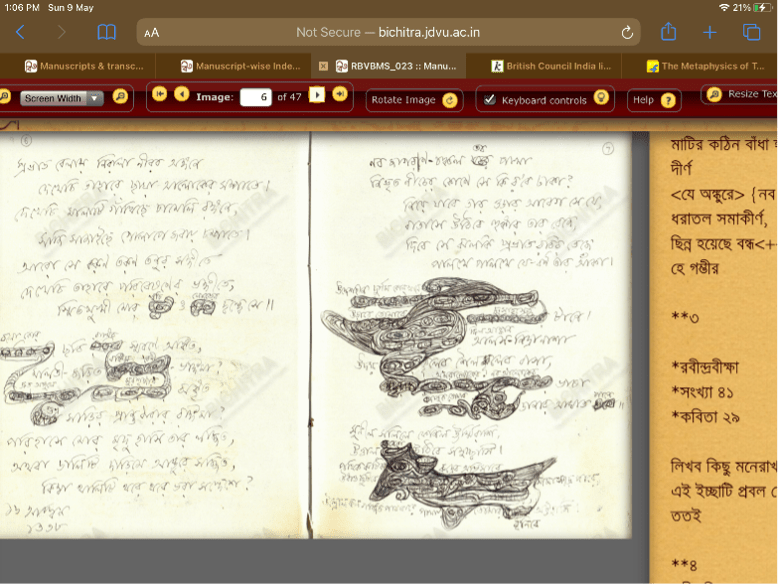
*

That brings me to the frequently asked question: “Why are you translating Nabendu Ghosh rather than publishing his Bengali originals?” The answer takes me back to 1940s when Baba’s Phears Lane was translated into Urdu and published in Lahore. Clearly Nabendu Ghosh was a ‘star’ in Bengali literature then. Allow me to quote Soumitra Chatterjee, the thespian who we lost so recently and was a Master in Bengali: “I had known about Nabendu Ghosh even before I took to studying Bengali literature, since Daak Diye Jaai (The Clarion Call) was a sensation even when I was in school. His writing was not confined to urban setting and city life. He went to the villages and wrote about the man of the soil too. His characters were always flesh and blood humans.”

But the Partition of India had halved the market for books and films in Bengali, dimming the prospects of even established directors and writers who sought a new opening on the shores of the Arabian Sea. Thus, when Bimal Roy – a celluloid star after his meteoric debut with Udayer Pathey ( In the Path of Sunrise, 1943) — left for Bombay in 1950 to make a film for Bombay talkies, Nabendu Ghosh joined his unit. However, in Bombay he found that his kind of writing did not have as much of a prospect in films which were made primarily for the entertainment of an amorphous mass. So, he decided to write scripts based on other people’s stories, and his own thought-provoking stories — which he described as ‘fingers pointing at what ails society’ — he continued to write as pure literature, in Bengali, and send to publishers in Kolkata.

This oeuvre bears the distinct stamp of his outlook towards life, society, or state. As a critic wrote, “There is deep empathy for human emotions, layers of meaning that add to the depth of the spoken words, subtle symbolism, description of unbearable life paired with flight in the open sky of imagination.” But this aspect of the writer got buried under the glamour of screen writing, and even in Bengal people thought of him only as the screen writer of successful films. Small wonder, since he wrote more than eighty scripts, for directors like Bimal Roy, Guru Dutt, Hrishikesh Mukherjee, Basu Bhattacharya, Vijay Bhatt, Sultan Ahmed, Dulal Guha, Lekh Tandon, Phani Majumdar, Satyen Bose, Shakti Samanta, Sushil Mazumdar, among others. Most of them are considered classics of the Indian screen: Sujata, Bandini, Devdas, Parineeta, Aar Paar, Majhli Didi, Teesri Kasam, Chaitanya Mahaprabhu, Ganga Ki Saugandh, Khan Dost, Baadbaan, Insaan Jaag Utha, Lal Patthar …

But Baba was saddened that even his colleagues in the filmdom did not know his literary pouring as only a handful were translated into Hindi and none into English. This is what I have tried to rectify through Chuninda Kahaniyaan (2009), Me and I (2017), and That Bird Called Happiness (2017). Mistress of Melodies (2020) you could say is a part of a continuum that started with River of Flesh (2016) and comes after That Bird Called Happiness. Nabendu Ghosh would read up volumes — books, news items, dictionaries and encyclopedia — when he fleshed out his characters. Perhaps that is why they play out their lives before you, like moving images. It was no different when he was writing Song of a Sarangi/ Ekti Sarengir Sur, included in Chaand Dekhechhilo that won him the Bankim Puraskar.

But above all, the reason for putting my energy in this art is to take a part of my heritage to the world. Because, as the celebrated Bengali writer Shirshendu Mukherjee said about Nabendu Ghosh, he is a writer who deserves to be read. Allow me to finish with a quote from him as he talked about his senior’s continuing relevance, to readers of Bengali literature and outside.

“Nabendu Da’s use of language was remarkable. He starts one of his stories with the word ‘Bhabchhi / (I’m) Thinking.’ It is a single word, that is also a complete sentence, and it has been used as a para in itself. One of his stories, Khumuchis, explores the secret language used by pickpockets. Bichitra Ek Prem Gatha (A Wondrous Love) – published to mark 2550th year of the Buddha — uses a vocabulary that is devoid of any word that would not have existed before the advent of Islam.

“He had an amazing sense of the optimum in this matter — he never overdid it. Not many writers of his time were into such experiments. Nabendu Ghosh did. He stood apart from his contemporaries in this respect. A part of his mind always ticked away, thinking of how his characters would speak. This added to the readability of his novels and stories. It quickened the pace of unfolding the narrative. They were all so racy! So fast paced, so real, so full of conflict and its resolution… Exceptional is the only word to describe it.

“And this was because of his language/ vocabulary. He was always pushing the boundaries of the language. His ‘throw’ was such that it turns into an eternal emotion which continues to cast its spell.

The same focused development of a plot shorn of every trivial and expendable branch, razor sharp emotions, whirlwind passion — I feel writing itself was a passion for him. He did not write with his head alone, his heart bled for the human condition.

“And this is why he never dated. His writing is the stuff that makes a story universal, eternal. For today’s readers he is a lesson in how to write — they can master how to write a narrative that flows like a boat down a rapid stream. In terms of language, structure, characters and situation, he is a writer who would be relevant to the young readers of not only Bengal but worldwide.”

Ratnottama Senguptaformerly Arts Editor of The Times of India, teaches mass communication and film appreciation, curates film festivals and art exhibitions, and translates and write books. She has been a member of CBFC, served on the National Film Awards jury and has herself won a National Award. 
.

PLEASE NOTE: ARTICLES CAN ONLY BE REPRODUCED IN OTHER SITES WITH DUE ACKNOWLEDGEMENT TO BORDERLESS JOURNAL