Jibananada Das’s poems translated from Bengali by Professor Fakrul Alam
THE GREAT WAR IS OVER
The Great War is over And yet there is left its vast gloom Our skies, light and society’s soul have been overcast One has to intuit whatever light there is every day The sky is dark; society vacuous; Existence Disgraced; love dead; blood flowing fountain-like; Knowledge becoming the bearer of an immense load of corpses And of its own self as well!
A NOBODY A nobody wanted to walk down the path as always. How then could those closest to him get lost forever, And disappear in some underground world?
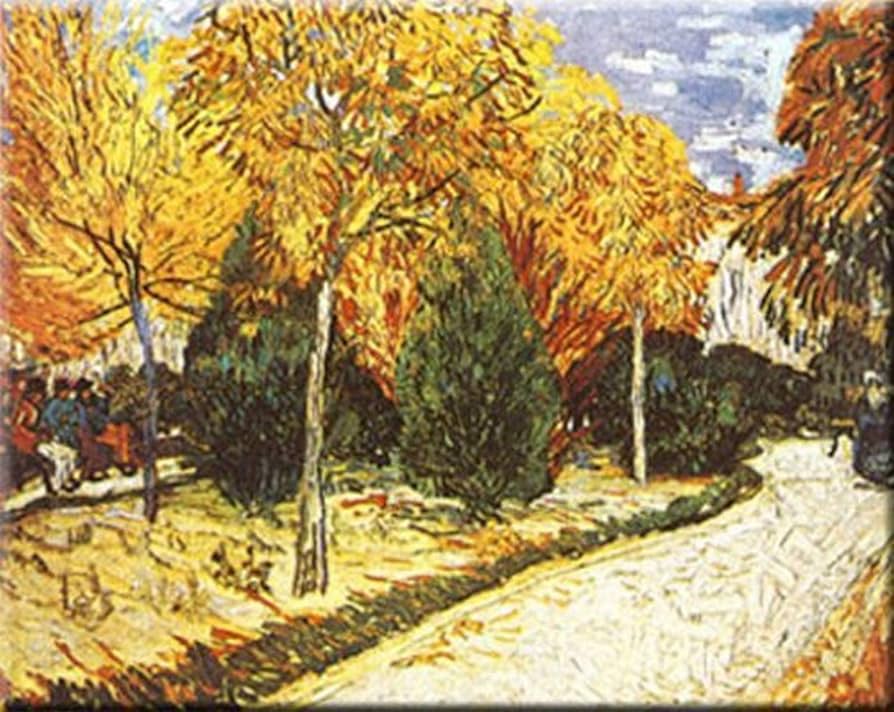
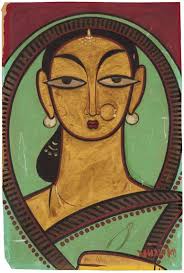
Painting By Jamini Ray (1887-1972)
Jibanananda Das (1899-1954) was a Bengali writer, who now is named as one of the greats. In his lifetime, he wrote beautiful poetry, novels, essays and more. He believed: “Poetry and life are two different outpouring of the same thing; life as we usually conceive it contains what we normally accept as reality, but the spectacle of this incoherent and disorderly life can satisfy neither the poet’s talent nor the reader’s imagination … poetry does not contain a complete reconstruction of what we call reality; we have entered a new world.”
Kazi Nazrul Islam was born in Churulia in India on 24th May, and he died a Bidrohipoet in Bangladesh. When he was born in 1899, it was before the McMahon Line of Partition had been drawn. He looked up to Rabindranath Tagore as his mentor but his form of poetry was more rebellious and his lyrics, different, though no less beautiful. His heart belonged to a united Bengal as can be seen from much of his works. He started magazines, supported feminism, brought out Begum Rokeya’s work in his journal, spoke of rising beyond borders and he has even written of climate change more than a hundred years ago…
His essay on melting icebergs has been translated by Radha Chakravarty. Today, we celebrate Nazrul’s birth anniversary with translations of his works from Bengali. These showcase the diversity in his writings, broadness of his thought and his concern for global issues that remain unresolved to date: his essay on climate change, a story grown out of his experiences as a soldier translated by Sohana Manzoor, a poem on poverty and lyrics on women and living in a world that transcends human constructs rendered in English by Fakrul Alam and more. Welcome to Nazrul’s world!
In Did He Ever?,Rhys Hughes gives fun-filled verses on Lafcadio Hearn, a bridge between the East and West from more than a hundred years ago. Clickhere to read.
Dolly Narang muses on Satyajit Ray’s world beyond films and shares a note by the maestro and an essay on his art by the eminent artist, Paritosh Sen. Clickhere to read.
Professor Fakrul Alam translates two songs by Nazrul on social isssues from Bengali
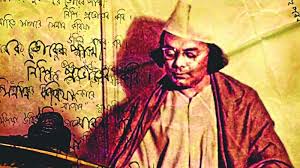
Kazi Nazrul Islam (1899-1976)
Born in united Bengal, long before the Partition, Kazi Nazrul Islam(1899-1976) was known as the Bidrohi Kobi, or “rebel poet”. Nazrul is now regarded as the national poet of Bangladesh though he continues a revered name in the Indian subcontinent. In addition to his prose and poetry, Nazrul wrote about 4000 songs.
Arise O Woman
Arise, o woman, arise flaming! Arise, daubing your forehead blood-red, Everywhere unfold your flaming tongue. Dance wildly—excited, inspired. Arise, hapless, maligned snake, Awake, kindling the world aflame! Burn briskly, o fume-filled smoky one, Arise, mothers, daughters, brides, wives, nieces. Arise prostitutes, cast out, exiled ones With the tidal force of the Ganges, arise, Down-trodden ones. Streaking clouds with lightning Arise, aroused by Durga, the ever-triumphant one.
‘Arise O Woman’ performed in Bengali
Two Flowers on One Leafstalk
Hindu and Muslim -- two flowers on one leafstalk -- Muslim its jewelled eyes, Hindu its heart and soul! In the lap of their mother, the same sky is reflected, Where sunlight and moonlight alternately sway. Within their bosoms the same blood courses While the same navel string binds the twain. We breathe the same earth mother’s air And drink the same earth mother’s water. In her bosom, the same fruits and flowers grow. In the soil of the land are burial sites quite akin -- Doesn’t matter if one is called Gore -- the other Shoshan! We call out to our mothers in the same language. We sing for them songs strung in similar tunes!
Poems of Longing by Jibananada Das homes two of his poems translated from Bengali by Professor Fakrul Alam. Clickhereto read.
Four cantos from Ramakanta Rath’sSri Radha, translated from Odiya by the late poet himself, have been excerpted from his full length translation. Clickhere to read.
Naramsetti Umamaheswararao takes us back to school. Click here to read.
Conversation
Ratnottama Sengupta talks to filmmaker and author Leslie Carvalhoabout his old film, The Outhouse, that will be screened this month and his new book, Smoke on the Backwaters. Clickhere to read.
Offerings during Qing Ming Jie, a festival honouring ancestorsSongkran(Thai New Year) CelebrationsFestivals in April: From Public Domain
April is a month full of celebrations around the world. Asia hosts a spray of New Year festivities. Then there are festivals like Qing Ming Jie, Good Friday and Easter. All these are in a way reminders of our past. And yet, we critique things as old fashioned! So, where does tradition end and ‘outdated’ or ‘outmoded’ start? Meanwhile we continue to celebrate these festivals with joy but what happens to those who have lost their home, family and their living due to war or climate disasters? Can they too join in with the joie de vivre? Can we take our celebrations to them to give solace in some way?
In our April issue, we have stories from climate and conflict-ridden parts of the world. From Bangkok, Amy Sawitta Lefevre gives an eyewitness account of the March 28th Earthquake that originated in Myanmar. While in her city, the disaster was managed, she writes: “I’m also thinking of all the children in Myanmar who are sleeping in the open, who lost loved ones, who are feeling scared and alone, with no one to reassure them.” As news reels tell us, in Myanmar there have been thousands of casualties from the earthquake as well as shootings by the army.
From another troubled region, Pakistan, Zeeshan Nasir gives a heartrending narrative about climate change, which also dwells on the human suffering, including increase in underage marriages.
Human suffering can be generated by rituals and customs too. For instance, if festivals dwell on exclusivity, they can hurt those who are left out of the celebrations. Odbayar Dorje muses along those lines on Mongolian traditions and calls for inclusivity and the need to change norms. On the other hand, Devraj Singh Kalsi hums with humour as he reflects on social norms and niceties and hints at the need for change in a light-hearted manner. Farouk Gulsara makes us laugh with the antics of his spoilt pet cat. And Suzanne Kamata dwells on her animal sightings in Kruger National Park with her words and camera while Meredith Stephens takes us sailing on stormy seas… that too at night.
Art is brought into focus by Ratnottama Sengupta who introduces artist Haren Thakur with his adaptation of tribal styles that has been compared to that of Paul Klee (1879-1940). She also converses with filmmaker Leslie Carvalho, known for his film The Outhouse, and his new novel, Smoke on the Backwaters. Both of these have a focus on the Anglo-Indian community in India. Also writing on Indian film trends of the 1970s is Tamara Raza. Bhaskar Parichha pays tribute to the late Ramakanta Rath (1934-2025), whose powerful and touching poetry, translated from Odia by the poet himself, can be found in our translations section.
We have an excerpt from Professor Fakrul Alam’s unpublished translation of Tagore’sRed Oleanders. It’s a long play and truly relevant for our times. Somdatta Mandal shares with us her translation of Tagore’s essay called ‘The Classification in Society’, an essay where the writer dwells on the need for change in mindsets of individuals that make up a community to move forward. A transcreation of a poem by Tagore for his birthday in 1935 reflects the darkness he overcame in his own life. Two poems expressive of longings by Jibananada Das have been translated from Bengali by Professor Alam aswell. From Balochistan, we have an excerpt from the first Balochi novel, Nazuk, written by the late Syad Zahoor Shah Hashmi and rendered into English by Fazal Baloch. Among contemporaries, we have a short story by Bitan Chakraborty translated from Bengali by Kiriti Sengupta, a poignant story that reflects on gaps in our society. And a Korean poem by Ihlwha Choi rendered to English by the poet himself.
This issue has been made possible because of support from all of you. Huge thanks to the team, all our contributors and readers. Thanks to Sohana Manzoor for her fabulous artwork. Do pause by our contents page as all the content could not be covered here.
Perhaps, world events leave a sense of pensiveness in all of us and an aura of insecurity. But, as Scarlett O’ Hara of Gone with the Wind[2] fame says, “After all, tomorrow is another day.”
Looking forward to a new day with hope, let’s dream of happier times filled with sunshine and change.
An excerpt from Professor Fakrul Alam’s unpublished translation of Rabindranath Tagore’s Raktakarabi or Red Oleanders (1924) from Bengali: It was first published in Prabasimagazine. This play rebels against totalitarianism.
Roktokorobi (Red Oeander) by TagoreRed Oleanders. From Public Domain
Introduction
This play is based on truth. However, any reader who turns only to historians to ascertain the authenticity of events is bound to be left unfulfilled by it. Let this suffice then as an explanation: as far as this poet is concerned, they are based fully on truth.
It is possible also that geographers will differ on the play’s actual setting. But everyone knows that the setting is informally known as Lucre Land. Scholars say that the mythical Lucre Land was the site of the gilded throne of Mammon, the God of Wealth. But it will not be right to see this play as one set entirely in a mythical period; it should not be classified as a fable either. The land that it deals with it has in its mines the most precious of minerals. Its discovery led to tunnel-digging. This is why people fondly calls it Lucre Land. We will get acquainted with some of the diggers involved in due course.
No one can expect historians to agree on the real name of the monarch of Lucre Land either. The one thing that I know is that the moniker used for him is “The Dreaded”. In due course it will be clear why this is the name by which he is called.
Outside the king’s palace walls are latticed windows. It is from a room with such windows that The Dreaded One chooses to meet any number of people he wants to talk to. Why he acts so bizarrely is something that we know nothing more about than what becomes apparent from the exchanges taking place between the main characters of this play.
The chieftains who run the kingdom on the king’s behalf are well-suited to carry out their work. They are also supposed to be far-seeing—all of them are members of the King’s inner council. Their carefully taken measures ensure that there are no lapses in the work being done by the diggers. And so this is how Lucre Land has developed steadily. The supervisors, once diggers themselves, have earned on their own merit the titles they now have. Indeed, in efficiency they often surpass the chieftains they once worked for. If the laws governing Lucre Land can be called euphemistically “The Full Moon’s Beams”, the responsibility of enforcing them are entrusted to the supervisors manning what can be called its Department of Disgrace.
In addition, there is the “Holy One”. He always swears by God but lives off what is allotted to him by the chieftains. He is believed to be responsible for a lot of the “good things” that are benefitting Lucre Land.
From time to time, inedible marine animals get stuck in the net of the fishermen casting their nets here. They are of no value though—either as edible creatures or as ones that can be traded for cash. On the contrary, every now and then they leave behind holes in the nets they get entangled in. In a net flung in the course of the plot of the play, however, a girl called Nandini shows up—a girl seemingly destined to tear apart the intricate net that separates the King of Lucre Land from the rest of the world.
As far as we can see at the start of the play, the events it dramatizes take place outside the room with the latticed windows where the king lives. We get to know very little of what is happening inside the palace though.
This play is set in the country called Lucre Land. The workers here are employed to dig gold. Its king remains hidden behind a thick screen. Only one scene of the play, however, is set behind the screen. The remaining scenes all take place outside.
From Public Domain
Enter Nandini and Kishore—a young man employed in digging mines
Kishore: Nandini! Nandini! Nandini!
Nandini: Why keep calling my name again and again young man? Do you think I have a hearing problem?
Kishore: I know you have no hearing problem. I keep calling you by your name because I like doing so. Do you need more flowers? If you do, let me go and get some.
Nandini: Go, go back to work. Don’t waste any more time here.
Kishore: What I do all day long is dig for gold. Whenever I can steal some time away from such digging to search for flowers for you. That makes me feel alive.
Nandini: Young man—don’t you know they’ll punish you if they find you not at work?
Kishore: But didn’t you say you really, really want the red oleanders? What delights me is that you can’t find them easily anywhere nearby. I found only one red oleander tree behind the rubbish dumped all over the place and that too after searching hard for it.
Nandini: Show me the place and I’ll go pluck the flowers myself.
Kishore: Please don’t say such a thing again. Don’t be so cruel Nandini! Let the tree remain as my one secret. Bishu sings for you songs he composed himself. From now on, I’ll get you the flowers you want and flowers that I can call my own.
Nandini: But the beastly people of this place keep punishing you. My heart breaks whenever they do so.
Kishore: The pain I endure makes the flowers that blossom even more dearly mine. They are the harvests of my sorrow!
Nandini: But how will I endure the pain and the suffering you have to endure on my account?
Kishore: What pain? That there will come a day when I’ll sacrifice myself fully for you is the thought that comes to my mind again and again.
Nandini: You keep giving me so much. Tell me, what can I give you in return?
Kishore: Make this pledge to me—every morning you’ll take the flowers from me.
Nandini: Fine, I’ll do that. But careful….
Kishore: No way I’m going to restrain myself! No way! I’ll bring you flowers even if I have to face their lashes every day!
Exit Kishore
The Professor Enters
Professor: Nandini! Don’t go; look at me!
Nandini: What for Professor?
Professor: Why do you keep surprising me again and again only to disappear afterwards? Since you succeed in stirring my mind, why don’t you then stir it up fully? Just stay for a minute and let me say a few things to you.
Nandini: Why do you need to talk to me?
Professor: If I’m to talk about what is of importance, just take a look! Our diggers climb up to the top from the tunnel with what they have mined from the heart of the earth and then carry burdens on their head like termites do. All the wealth of Lucre Land comes from that dust-mixed source—gold is the outcome! But beautiful one, you are golden not because of such dust but because of the light you emit. How can only the need for wealth detain you?
Nandini: You keep saying the same thing again and again. What amazes you so whenever you look at me Professor?
Professor: There is nothing surprising about the light that brightens the flower gardens in the morning. The light that comes through cracks in the wall are something else though. In Lucre Land you are that kind of unexpected light! Tell me—what could you for be possibly thinking about as far as this place is concerned?
Nandini: I am amazed to see the whole city’s focus to explore what is underground and all the groping in the dark that goes on. They keep digging in these underground tunnels for treasures that have been fossilising there for ages. These are treasures earth buried there.
Professor: What we do is exhume the corpses of such resources devotedly. We want to tame the ghosts within them. If we can tie the golden lumps up and retain them so that they don’t seem strange, we’ll have the world in our grasp.
Nandini: What is more shocking is that you have your king covered up in a wall made up of weird nets. It is as if you wouldn’t like people to find out that he is human. I feel like either opening the cover of that dark tunnel or flooding it with light. I feel like tearing up such a weird net and rescuing the man trapped inside.
Professor: Just as the ghost of fossilised wealth can be scary, the king we have can terrify us because of the power he has to scare his subjects.
Nandini: Everything you keep saying is so concocted.
Professor: Yes, I’ve made them up for sure. A nude need not be identified; only his tailored clothes will mark him as a king or a beggar! Come to my house—I’ll be delighted to make you wise with words of wisdom.
Nandini: Just as your diggers bury themselves when digging the soil, you seem to be digging deeper and deeper into your books. Why would you waste time on someone like me?
Professor: We are dense, thick-headed creatures, submerged in opaque scholarly work. You are the evening star we see when we have nothing else to do; seeing you makes our wings restless. Come home with me; let me spoil myself for a change.
Nandini: No, not now—I’ve come to see your king seated in his chamber.
Professor: He stays within his latticed wall; he won’t let you in for sure.
Nandini: No wall can block me; I’m here to spend time with your king in his chamber.
Professor: You know what Nandini—I too live inside a wall. I’ve sacrificed a lot of my human side; only my scholarship stirs in me. Just as our king is awesome, I’m an awe-inspiring scholar.
Nandini: You must be joking! You don’t seem frightening at all. Let me ask you this question: If they could bring me here, why didn’t they bring Ranjan to this place as well?
Professor: Their strategy is to tear up everything. In any case, let me say this: why bring your precious soul to a place so full of lifeless treasures?
Nandini: If Ranjan is brought here, their dead hearts will stir again.
Professor: Nandini alone has been enough to strike the chiefs of Lucre Land dumb; imagine what will happen if Ranjan is brought here as well.
Nandini: They have no idea how strange they can be. If God could make them smile, the spell they are in would be broken. Ranjan’s smile is God’s smile!
Professor: The smile of God is like sunlight—it melts ice but doesn’t move boulders. If you want to stir our chieftains, you need to be forceful.
Nandini: Ranjan’s strength is like your Shankhini River. Just like that river, he’ll be all smiles at one moment and a destructive force in another. Professor, let me tell you what has been a secret till now. I’ll be meeting Ranjan later today!
Professor: How do you know this?
Nandini: We’ll meet, for sure we will. The news has come that we’ll be united soon.
Professor: How can such news travel without attracting the attention of the chiefs?
Nandini: They’ll come through the same route that ushers news about spring. It’s touched with the colour of the sky and the lilt of the wind.
Professor: In other words, the colours of the sky lilt the breeze that ushers in spring.
Nandini: When Ranjan comes, I’ll be able to show you how news that has been flying can land on earth.
Professor: Once the subject of conversation turns to Ranjan, there is no stopping Nandini from talking. Never mind! Since I’ve mastered real knowledge, let me enter its depths; I myself don’t dare do anything now.
He comes back after advancing a little.
Nandini, aren’t you frightened at the thought of being in Lucre Land?
Nandini: Why should I be?
Professor: Animals fear solar eclipses but not the round sun. Lucre Land is a place where an eclipse of sorts has taken place. The sun was bitten when it got into a gilded crater during an eclipse. Since it itself wasn’t full, it didn’t want anything else to be fully developed. Let me advise you—don’t hang around this place. When you leave these craters, they will be yawning before us—but I’ll keep insisting—flee! Be happy with Ranjan anywhere else where people don’t shred the borders of Mother Earth’s sari into bits!
He goes some distance and then returns
Professor: Nandini, won’t you give me one of the red oleander flowers you are carrying in your right hand?
Nandini: Why? What do you want to do with it?
Professor: On many occasions it occurred to me that the red oleanders you wear have some significance for you.
Nandini: I have no idea what they could possibly mean.
Professor: Perhaps the Divine Dispenser of your fate does. The red color emits mysterious negative vibes and not only ones that delight.
Nandini: Things that can frighten me?
Professor: God has in this case painted beauty with a brush dipped in blood! I have no clue to what you were scribbling in red as you came. There are malati, mallika, chameli flowers aplenty that you overlooked. What made you pluck flowers only from this particular flowering tree? Know that people only do unthinkingly what they are fated to do.
Nandini: Every now and then Ranjan will fondly call me “Red Oleander”. I don’t know why the thought occurs to me that my Ranjan’s love is of that colour. It’s the colour I wear on my neck, my bosom and my hand.
Professor: So why not offer me a flower only for a while so that I can figure out the essence of that flower?
Nandini: Here, take this one. Ranjan will be here today. I’m so happy that I’ve decided to gift you this red oleander.
The Professor departs.
Gokul, a Tunnel Digger, Enters
Gokul: Turn your face this way for once. I can’t seem to figure you out! Who could you be?
Nandini: I’m exactly what you see. Nothing else! Why do you need to know anything more?
Gokul: Not a good idea to not know. Has the King of this realm summoned you here for any reason?
Nandini: For no good reason!
Gokul: What a thing to say! He is trapping us all. You are the cause of the danger we all are in.
Anyone bewitched by your beautiful face is doomed. Let’s take a look—what is that swinging there where you hair is parting?
Nandini: Red Oleander flowers!
Gokul: What do they signify?
Nandini: Nothing!
Gokul: I don’t believe you at all. You must be up to something. There is bound to be trouble before the day is over. That is why you decked yourself so. What a dreadful trick!
Nandini: What makes you think I’m so terrifying just by looking at me?
Gokul: You remind me of a torch lighted up in many colors. Go and fool innocent ones by telling them— “Take care! Beware!”
Gokul Exits
Nandini is now outside a latticed window
Nandini (Striking the latticed window): Can you hear me?
Voice: I hear you Nanda! But don’t keep calling me again and again; I have no time left, not a bit.
Nandini: I feel very happy today! So happy that I’d like to enter your room.
Voice: No need to come in. If you have anything to say, do so from outside the room.
Nandini: I’ve brought you a garland made of jasmine flowers. It’s covered with lotus leaves.
Voice: Wear it yourself!
Nandini: It doesn’t suit me. I wear red oleander garlands
Voice: I am like a mountain peak. I look best unadorned.
Nandini: From such peaks waterfall stream. A garland will sway in your neck as well. Open the net—I’d like to go in.
Voice: I won’t let you in. Say what you want to now. I don’t have any time to lose.
Nandini: Can you hear any song from where you are?
Voice: What song?
Nandini: A song about the winter month of Poush[1]! A song calling all to harvesting!
Poush calls us all Come, come away Its tray is full this day With harvested crops galore Come, come away
Don’t you see how the harvested rice’s loveliness mingles with the wintry sky?
In the heady wind Goddesses work Across rice fields All over the land A golden hue spreads So good to see. Ah me!
Come outside King! Let me take you to the field.
The sky is happy to hear in fields flutes play. Who’d want to stay indoors any longer today? Open, open all doors
Voice: I go to work? What work am I good for?
Nandini: Harvesting is much easier than the kind of work you do for Lucre Land.
Voice: The work which seems easy to you is actually hard for me to do. Can a lake dance like the foams of a waterfall?
Nandini: Your strength is truly amazing. The day you let me enter your treasury, I wasn’t a bit startled by your gold piles. What truly fascinated me then is the way you managed to put things into an orderly heap effortlessly despite your immense strength. Nevertheless, I’ll have to say this: can lumped up golden balls respond to the amazing rhythms of your hands as well as a rice field? Tell me O King, aren’t you at all afraid to handle the fossilised resources of the world day after day?
Voice: Why, what is there to fear?
Nandini: The earth bestows on us joyfully things it holds dear. But when even dead bones are snatched away by those who value them merely as precious things what they really do is dig up from the dark depths things a blind giant had cursed. Don’t you see that everyone here is edgy? Either that or they are scared.
Voice: Scared of what?
Nandini: The fear that things will be snatched away and of the killings that might follow.
Voice: I don’t know of any curse involved. What I know is about the power we can evoke. Does my immense strength make you happy Nandini?
Nandini: Very happy indeed. That is why I’ll insist: come out into the light; put your feet on the soil; let earth rejoice.
The light joy brings Daubs ears of corn with dew Why not feel the joy of touch? Nature’s joy knows no bounds A sight so good to see —ah me!
[1] Ninth month of the Bengali calendar coincides with December-January of the Gregorian calendar.
If I get to live forever — then forever, I’ll be all alone — If I return to the paths of the world, I’ll see green grass Sprouting — will see yellow grass scattering — the sky Whitening in the morning — like a tattered munia bird, Breast blood - stained in the evening — again and again I’ll see stars And view a strange woman untying braided hair and leaving Alas, her face devoid of traces of the setting sun’s soft glow
If I get to live forever — forever, I’ll walk the ways of the world All alone. If I ever return to the world’s pathways, I’ll see Trams, buses, dust. Innumerable slums and, broken bowls too — Dark and dirty lanes; fights, people swearing; squinted eyes Rotten prawns; I’ll see a whole lot of things interminably And yet all this time I won’t get to meet you again — for eternity!
If I have eternal Life ( Anante Jebon Jodi)
Given the boon of eternity, I would walk the ways of the world eternally. All, all alone — what if I would see lush green grass in full bloom then? And what if I beheld the yellowing grass withering away — And view The sky full of wan white clouds at dawn? Like a tattered munia bird Blood reddened breast in the evening — I would see the stars repeatedly; I would see an unknown woman’s hair drifting away from a loosened bun; A woman who would leave — with a face bereft of the evening sun’s glow.
Munia birds. From Public Domain
Jibanananda Das (1899-1954) was a Bengali writer, who now is named as one of the greats. In his lifetime, he wrote beautiful poetry, novels, essays and more. He believed: “Poetry and life are two different outpouring of the same thing; life as we usually conceive it contains what we normally accept as reality, but the spectacle of this incoherent and disorderly life can satisfy neither the poet’s talent nor the reader’s imagination … poetry does not contain a complete reconstruction of what we call reality; we have entered a new world.”
Jibanananda Das’ poems on war and for the common masses have been translated from Bengali by Professor Fakrul Alam. Click here to read.
A Scene with an Aged Queen, a poem by Ihlwha Choi has been translated from Korean by the poet himself. Clickhere to read.
Tagore’sEsho Bosonto, Esho Aj Tumi(Come Spring, Come Today) has been translated from Bengali by Mitali Chakravarty. Click here to read.
Pandies’ Corner
For Sanjay Kumar: To Sir — with Love has been written for the founder of pandies’ theatre by Tanvir, a youngster from the Nithari village where pandies’ worked with traumatised victims. Over time, these kids have transcended the trauma to lead fulfilling lives. The late Sanjay Kumar passed on this January. This is a tribute to him by one of his students. It has been translated from the Hindustani original by Lourdes M Surpiya. Click here to read.
Drops of water gather to make a wave. The waves make oceans that reshape land masses over time…
Five years ago, on March 14th, in the middle of the pandemic, five or six of us got together to start an online forum called Borderless Journal. The idea was to have a space that revelled with the commonality of felt emotions. Borderless was an attempt to override divisive human constructs and bring together writers and ideators from all over the Earth to have a forum open to all people — a forum which would be inclusive, tolerant, would see every individual as a part of the fauna of this beautiful planet. We would be up in the clouds — afloat in an unbordered stratosphere— to meet and greet with thoughts that are common to all humans, to dream of a world we can have if we choose to explore our home planet with imagination, kindness and love. It has grown to encompass contributors from more than forty countries, and readers from all over the world — people who have the same need to reach out to others with felt emotions and common concerns.
Borderless not only celebrates the human spirit but also hopes to create over time a vibrant section with writings on the environment and climate change. We launch the new section today on our fifth anniversary.
Devraj Singh Kalsi with a soupçon of ironic amusement muses on humans’ attitude to the fauna around him and Farouk Gulsara lays on a coating of sarcasm while addressing societal norms. Meredith Stephens brings us concerns for a green Earth when she beachcombs in a remote Australian island. Prithvijeet Sinha continues to familiarise us with his city, Lucknow. Suzanne Kamata, on the other hand travels to Rwanda to teach youngsters how to write a haiku!
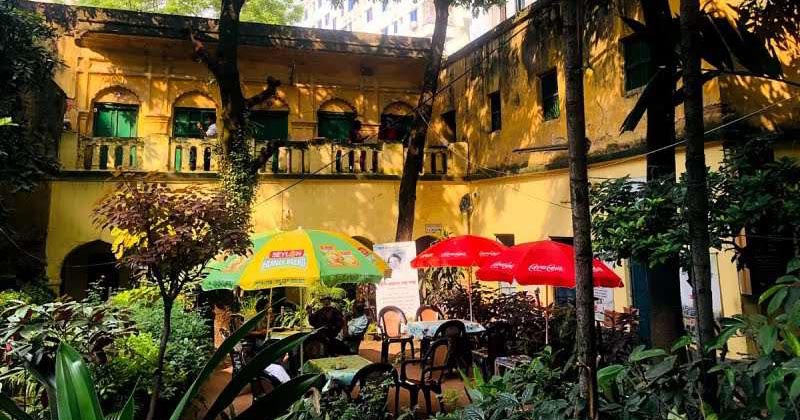
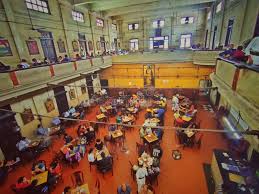
Professor Fakrul Alam takes us to libraries in Dhaka with the hope that more will start writing about the waning of such paradises for book lovers. Other than being the month that hosts World Environment Day, March also homes, International Women’s Day. Commemorating the occasion, we have essays from Meenakshi Malhotra on the past poetry of women and from Ratnottama Sengupta on women in Bengali Cinema. Sengupta has also interviewed Poulami Bose Chatterjee, the daughter of the iconic actor Soumitra Chatterjee to share with us less-known vignettes from the actor’s life. Keith Lyons has interviewed Malaysian writer-editor Daphne Lee to bring to us writerly advice and local lores on ghosts and hauntings.
We also have a translation by Lourdes M Supriya from Hindustani of a student’s heartrending cry to heal from grief for a teacher who faced an untimely end — a small dirge from Tanvir, a youngster with his roots in Nithari violence who transcended his trauma to teach like his idol and tutor, the late Sanjay Kumar. With this, we hope to continue with the pandies corner, with support from Lourdes and Anuradha Marwah, Kumar’s partner.
Borderless has grown in readership by leaps and bounds. There have been requests for books with writings from our site. On our fifth anniversary, we plan to start bringing out the creative writing housed in Borderless Journal in different volumes. We had brought out an anthology in 2022. It was well received with many reviews. But we have many gems, and each writer is valued here. Therefore, Rhys Hughes, one of our editorial board members, has kindly consented to create a new imprint to bring out books from the Borderless Journal. We are very grateful to him.
We are grateful to the whole team, our contributors and readers for being with us through our journey. We would not have made it this far without each one of you. Special thanks to Sohana Manzoor for her artwork too, something that has almost become synonymous with the cover page of our journal. Thank you all from the bottom of my heart.
Wish you all happy reading! Do pause by our content’s page and take a look at all the wonderful writers.