Categories
Slices from Life

Sleepless in the High Desert, Slumber in the Sierra

Narrative and photographs by Meredith Stephens

Alex and I had completed our road trip from California to Colorado and now it was time to make the two-day drive back along the interminable desert roads.

Every time we stopped, I would try to get into the driver’s side of the vehicle, thinking it was the passenger side. My brain would not adapt to a car with the steering wheel on the left. Once back in the passenger seat, the sun blazed on my temple, so I manoeuvred my visor to cover the right window to block it from penetrating my eyes. It was hard sitting still, so I stretched my legs before me, then slid them beneath me to elevate my height.

“As soon as we hit the Nevada border you will see a casino town,” Alex informed me.

Sure enough, we crossed the border into Nevada from Utah and a town immediately arose from the desert. Alex made a detour into the town to get some fuel.

“Can we drive down the strip?” I asked.

“Sure,” he replied. “Are you hoping to find a hotel here?”

Yes, I thought, but kept my silence. I was too proud to confess that I wanted to stay anywhere near a casino, but I would have welcomed clean sheets and hot water.

I took hold of Alex’s phone and searched for campsites en route, but they all involved deviations that would rob us of precious time.

“We can always stop at a rest area,” suggested Alex.

He searched his phone and found a rest area nestled into a hill, with outdoor tables surrounded by trees. We arrived at sunset and parked the car at the far end, away from other vehicles. We gratefully hopped out, picked up the ice box, and headed for the picnic tables, which we had to ourselves. No sooner had we started anticipating our picnic than we heard the murmur of a refrigerated truck.

“He probably has to keep his engine on to keep the food cool,” observed Alex.

The din was inescapable, so we decided to park back near the entrance to the rest area. I noticed a car parked with sheets draping the windows. Clearly, we were not the only ones seeking sleep in the rest area. Alex parked the car at an angle contrary to the parking lines so that nobody would be tempted to park right next to us. We hauled the icebox to a nearby picnic table to consume our leftovers. Alex proceeded to pour us a glass of wine, and we snacked on sourdough, cheese, avocado, deli meats, and corn chips.

I ate a little too quickly because it was getting late, and I was hungry. It was high desert, so the air was cool, even though it was mid-June. We packed up our picnic and headed for the car, where Alex moved all of our goods to the front seat and made up our bed in the back.

It was nearly 9 pm and we went to bed in the twilight. I revelled in the sensation of the thick flannelette cotton sheets, but I could not slip into a deep sleep. The overhead lights snuck through cracks in the fabric I had put up to cover the window, and the traffic rumbled on the adjoining freeway. Then, a few hours into the night, I heard a clanging outside the car. I peered myopically outside.

“That’s just a dumpster diver,” explained Alex, who turned back to sleep, obviously not too alarmed.

I had never heard that expression before, but I realised that some poor soul was working their way through the bins in the rest area in the wee hours when nobody could see them. I reflected on what I had thrown out after dinner, which had included a nectarine seed, and hoped their fingers did not come into contact with its slime. Then I started worrying whether the dumpster diver would come after us in the night. The next morning Alex explained to me that they were probably collecting cans to sell to a recycling centre. That, at least, was preferable to scrounging around in the bins for food.

We left early the next morning because Alex wanted to show me Lake Tahoe en route to California.

“That reminds me of Lac Leman in Switzerland,” I told him.

“Yes, there’s California on one side, and Nevada on the other. They share the lake.”

We stopped for photos, then resumed our way, winding through snowy mountains, and passing cattle, horses and foals down below. It was a huge relief after the deserts of Utah and Nevada. Then we wound our way through a canyon, following a rushing river, passing through picturesque towns adjoining Yosemite National Park.

“I need a coffee,” lamented Alex, typing ‘coffee shop’ into Google Maps. We entered the town of Columbia, heeding Google’s directions. We were directed down a narrow road through wooded hills. We passed a large car park the size of an oval, much too large for this rolling wooded area. Then Google Maps told us we had arrived. We parked under some shady trees to arrive at a tea shop from another place and time.

We wandered inside. They had a wide range of teas but no coffee, so we took our leave. The voice on Google Maps kept insisting we take a detour, so we followed her urgings past what seemed to be a historical town.

We turned the corner to find the coffee shop Google Maps had been directing us to. We entered and ordered Americano coffee, which despite the 19th-century decor was served in 21st-century paper cups.

We then realised in our quest to find a roadside coffee shop we had stumbled on Columbia Historic Park. The buildings which had been used in the town in the gold rush had been restored and made available to tourists. I wanted to linger in this authentic setting. Unlike a theme park, this was not a re-creation. Alex was worried that we still had several hours driving to go, so we had to resume our journey.

We wound back home through gentle valleys, passing cattle and horses. The sun in my eyes gave me an aura; a circle of lights started appearing in my vision. After 25 hours of driving, we arrived at our cabin at Shaver Lake. I crashed on the sofa, while Alex made a fire. He made up a bed in cotton flannelette sheets in front of the fire, and I rolled onto it from the sofa. What a relief it was to sleep in comfort, in contrast to the person in the rest area scrounging for cans in the wee hours. For us, sleeping in a rest area was a novelty, but for others, it was a way of life.

Meredith Stephens is an applied linguist from South Australia. Her work has appeared in Transnational Literature, The Muse, The Font – A Literary Journal for Language Teachers, The Journal of Literature in Language Teaching, The Writers’ and Readers’ Magazine, Reading in a Foreign Language, and in chapters in anthologies published by Demeter Press, Canada.

PLEASE NOTE: ARTICLES CAN ONLY BE REPRODUCED IN OTHER SITES WITH DUE ACKNOWLEDGEMENT TO BORDERLESS JOURNAL

Click here to access the Borderless anthology, Monalisa No Longer Smiles

Click here to access Monalisa No Longer Smiles on Kindle Amazon International
Categories
Poetry

Poetry on Rain by Masud Khan

Translated from Bengali by Professor Fakrul Alam

Courtesy: Creative Commons
RAIN - 1 

It’s raining abroad now, in countries close by or far away. 
Occasionally a cold wind from some other land blows this way 
This summer evening brings with it sadness and beauty 
Blowing this way from some distant land!
 
A cold, cold wind keeps blowing
Slowly stirring desire, fomenting longing
For alien rituals on such an evening.
 
In the distance, in a riverbank ruled by beauty
In another land, wonderfully wet in the rain,
Lightning flashes time and again
Stirring desire for one’s lover steadily
Inevitably, on such an evening!
 
Towards my homeland
The cold wind keeps blowing
O my alien lover
Where could you be staying?

RAIN - 2
 
It’s raining
Over distant lands
Over Brahma’s world,
Over Rangpur and Bogra’s vast expanse
In alluvial plains,
The rain veils Burma’s evening fields
And keeps streaming down.
 
And below these lightning flashes,
At the rain-formed night’s third quarter
Radiant races
Spring up at home or abroad
Like hyperactive frogs leaping
Into the unknown.
 
Provoked by thunder and lightning’s violent outbursts, 
Allured by their promises,
In the thick veil 
And swirling stream,
In the darkness of the wet wind, 
In the eastern expanse, 
Underneath the sky
In vast and empty fields
Under the vast spread-out arum fields of the east, 
Incredibly, unformed new nations emerge --
Innumerable unsteady chaotic nations,
Restless, perturbed, incapable of standing up, 
Lending themselves to grotesque maps,
Forming unstable, quivering, permeable boundaries
Governed by ill-defined laws and dwarf impotent ombudsmen 
And armies marching past unimpressively,
They spring for no good reason
And seem destined to be doomed.
 
The night draws to a close. The rain too appears spent. 
When day’s first light breaks out,
Those nations that would thrive and grow
And glow with innumerable rituals and fast-spreading religions 
Feel their bodies disintegrating and disappearing
Under the vast spread-out arum fields of the east.
 
*Rangpur, Bogra— Two small cities in the northern part of Bangladesh

Masud Khan (b. 1959) is a Bengali poet and writer. He has, authored nine volumes of poetry and three volumes of prose and fiction. His poems and fictions (in translation) have appeared in journals including Asiatic, Contemporary Literary Horizon, Six Seasons Review, Kaurab, 3c World Fiction, Ragazine.cc, Nebo: A literary Journal, Last Bench, Urhalpul, Tower Journal, Muse Poetry, Word Machine, and anthologies including Language for a New Century: Contemporary Poetry from the Middle East, Asia, and Beyond (W.W. Norton & Co., NY/London); Contemporary Literary Horizon Anthology,Bucharest; Intercontinental Anthology of Poetry on Universal Peace (Global Fraternity of Poets); and Padma Meghna Jamuna: Modern Poetry from Bangladesh(Foundation of SAARC Writers and Literature, New Delhi). Two volumes of his poems have been published as translations, Poems of Masud Khan(English), Antivirus Publications, UK, and Carnival Time and Other Poems (English and Spanish), Bibliotheca Universalis, Romania.  Born and brought up in Bangladesh, Masud Khan lives in Canada and teaches at a college in Toronto.

Fakrul Alam is an academic, translator and writer from Bangladesh. He has translated works of Jibonananda Das and Rabindranath Tagore into English and is the recipient of Bangla Academy Literary Award (2012) for translation and SAARC Literary Award (2012).

PLEASE NOTE: ARTICLES CAN ONLY BE REPRODUCED IN OTHER SITES WITH DUE ACKNOWLEDGEMENT TO BORDERLESS JOURNAL

Click here to access the Borderless anthology, Monalisa No Longer Smiles

Click here to access Monalisa No Longer Smiles on Kindle Amazon International

Categories
Poetry

Pinnacle by Ryan Quinn Flanagan

Courtesy: Creative Commons
Crest not bade me soul – not a more perfect sentence in the  
language. Tops! The pinnacle! I wasn't there yet, for the crest had  
not bade me. The shoulders of my shirt cinched down between  
drowsy hanging arms, revealing a scraggly dark patch of chest hair.  
If there were gifts left to give, they would come by those splintered  
brazen workbench hands. Unshuttered windows, that briny  
squawking clime of distant sea air. Great parapets of lost concealments.  
Bilging heels gong-rung together in startled splay.  
Suddenly, like banshees wailing across the moors – it came!  
"Christ hath bathed my soul," the beautiful voice sparkled. I looked  
up from the pew to find a priest standing over me. Cherub-faced  
and nipper drunk. A smile like fresh linens. A great light! – "Crest  
not bade me soul," I muttered inaudibly. His way was fine too

Ryan Quinn Flanagan is a Canadian-born author residing in Elliot Lake, Ontario, Canada with his wife and many bears that rifle through his garbage.  His work can be found both in print and online in such places as: Evergreen Review, The New York Quarterly, Borderless Journal, GloMag, Red Fez, and Lothlorien Poetry Journal

.

.

PLEASE NOTE: ARTICLES CAN ONLY BE REPRODUCED IN OTHER SITES WITH DUE ACKNOWLEDGEMENT TO BORDERLESS JOURNAL

Click here to access the Borderless anthology, Monalisa No Longer Smiles

Click here to access Monalisa No Longer Smiles on Kindle Amazon International

Categories
Excerpt

The Blue Dragonfly

Title: The Blue Dragonfly – healing through poetry

Author: Veronica Eley

Publisher: Hidden Brook Press, Ontario

grey blanket					[from Prelude]

earliest memory
driving along
a country road
in the back seat
wrapped
in a grey blanket
in the dark

separation
the side bars
on the hospital bed
two years old
pneumonia

fifteen-year-old girl
raped
police declare
emotionally disturbed
wrapped
in a grey blanket
taken home

disturbed
turbulent
the waters
the waves, the waves
are big, mommy
the cold, grey ocean
is deep
I lean against the railing
of the White Star Cunard liner
seven years old

railings
grey blanket
grey, grey 


secret monsters				[from Presentation]

when I am dog tired
deep down below
an ambiguous voice
declares itself

blasphemous language
often, with a highly sexual content
pokes out its unseemly head
to scream and thrash about

language from a deep abyss
dirty tributaries
foul-mouthed monsters
who live in my
subterranean landscapes

loud mouthed
the desire to smash and hurt
to feed the monster within
to let out a little vengeful steam
is the only way to calm the beast

in some ways
I live a life of pretence
hidden
shameful
feeding the snake within
with disgusting morsels

 
the bodhisattva				[from Altered States]

she wanders through the streets
a heart as big
as the whole outdoors
warding off criticisms
from voices long
ago dead

how do you
lose
rolling the dice of
compassion?
the fashion in the 90s
: to give
politically/correctly

the knife of deconstruction
blasts
beliefs, values, ideals
the high-rise
terminology
-laden
hierarchical
transcendent, dualistic
world
crumbles (post
-modernized)
leaving us with
No Thing, powering our appetites
to violent
pornographies

karma
equals Choice
equals Action
equals Identity

where does this yearning
come from? the bodhisattva’s loving
compassion, undifferentiated
interconnective, doing
and undoing

do we have any
other choice?
in our best dress
our Sunday best
our best frame of mind
-- compassionate be

I exist between myself
and you


mother						[from Home]

eternal mother
conniving tributary peace strategies
love and replenishment
look to the sun
the bare branches
outlining our destinies

reaching to the heavens
rooted in fertile ground
our arms reach upward
bare, rough and brown
the colour of the earth

take care, dear mother
look to the sunset
the glorious colours
I will be thinking of you

About the Book

The Blue Dragonfly: healing through poetry is a verse narrative of trauma and recovery, 120 poems organized into three acts: Secret Monsters, The Bodhisattva, and Mother. Distinguished by an intense affectivity of language, its poetry of metaphor, repetition, and internal rhyme, “rotating / like a wind chime / inside my body,” communicates a trance-like account of trauma, therapy, and personal growth. Resistance to Western rationality – camouflaging crimes of incest and rape – is a major theme. The poet’s encounter with an Indian psychiatrist heralds the discovery of “a comrade spirit / a healer” from another continent. In time, the poet becomes the bodhisattva herself, a compassionate witness to her own and the bravely lived stories of others, a “red trauma reverberating around the world.” Trauma theory links such suffering to creative language, re-invoking Aristotle’s conception of metaphor as uniquely bound to tragedy (to make the unspeakable speak). Is poetry and its poem then merely a “work of art”? Or is it a linguistic “magical toolkit,” with purpose to build a common, practical humanity free from pain?

About the Author

Born 1950, Manchester UK, Veronica Eley is an Adult literacy instructor, Toronto, 1994-2011, Master of Education, OISE-UT, Toronto, 2002. She retired inDartmouth, Nova Scotia, 2016. Her first book of poetry was published in 2021. – Poetry came to the author late in life through journaling and therapy (1998-2016), when she learned to “stream the inner spirit, the unconscious,” in a “fluid connection between my soul, brain, pen and paper.” Poems would give structure and pace to her feelings, sparking her “creative remembering” and recovery from trauma. Ideas of synchronicity and flow, an attunement to nature, and the stories of her immigrant and refugee students provided a rich support for telling her own story. The author’s family had migrated to Nova Scotia in 1952. Dislocation shock, charismatic Catholicism, and the metempsychotic memory of the cotton mills would repose themselves in the youngest child. A “trinity of traumas” personal to her would follow. Now the small-press publication of her book, aided by her acutely poetic camera, accumulates readers. The author declines interviews, as “the poems speak for themselves.”

PLEASE NOTE: ARTICLES CAN ONLY BE REPRODUCED IN OTHER SITES WITH DUE ACKNOWLEDGEMENT TO BORDERLESS JOURNAL

Click here to access the Borderless anthology, Monalisa No Longer Smiles

Click here to access Monalisa No Longer Smiles on Kindle Amazon International

Categories
Slices from Life

Awesome Arches and Acrophobia

Narrative and photographs by Meredith Stephens

My partner, Alex, has always been enthralled with the natural beauty of the west of the United States, having spent sixteen years studying and working there in his youth. He wanted to share his love of this part of the world with me, so took me on a seven-day road trip from his base in the Sierra Nevada Mountains to Fort Collins in Colorado and back.

“You must see Arches National Park in Utah!” urged Alex’ long-time friend Ryan. “Bryce National Park is worth visiting too.”

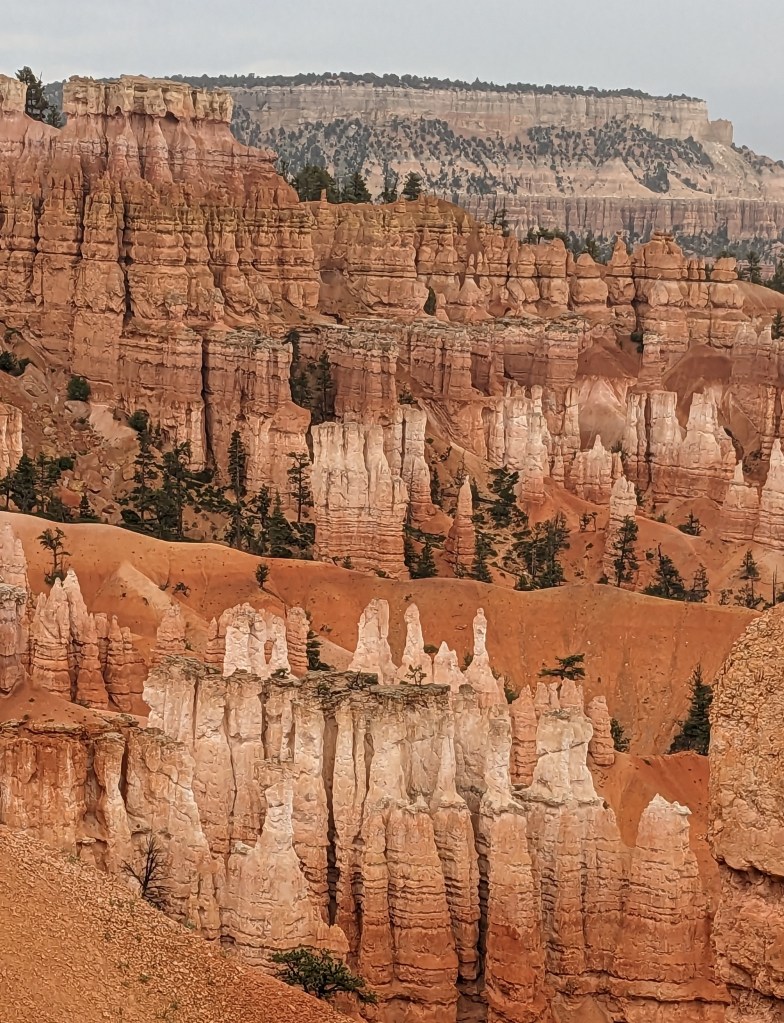
Two days later we arrived at Bryce National Park. At first, the scenery was pleasant but unremarkable. I wondered why there were so many tourists and so many cars in the carpark. We donned our raincoats and walked towards the trail to follow the other tourists. It started hailing and I pulled my hood around my face. Thunder and lightning resounded. A tall thin park ranger approached us from the other direction and looked directly at me.

“We advise you to turn around immediately and seek shelter. We have lost ten people in twenty-five years in these weather conditions.”

We looked at the brochure to confirm this and read that there had been four fatalities and six injuries. I would have been happy to follow the park ranger’s advice, but we had driven for eleven hours to get there and were too curious to turn back. We started walking towards the Navajo Loop trailhead at Sunset Point. Tourists were posing for photographs at the rim. I wondered what the attraction was and peered over the rim myself. Suddenly, I understood why the site was so crowded.

Navajo Loop

I gingerly placed one foot after another to carefully descend the steep muddy trail. Each time I planted my foot down I held it steadily to ensure I would not slide. A couple approached us from the opposite direction as they ascended the trail.

“We strongly recommend you turn around immediately!” they warned. “It’s treacherous in these muddy conditions.”

Muddy trail

We thanked them, but I continued to gingerly traipse through the mud along the downward trail for a few metres.

“You go ahead,” I urged Alex. “I can’t go any further.”

It continued to hail, and we could hear thunder. I turned around and slowly plodded back up the muddy trail back to the edge of the rim, closely followed by Alex. We contented ourselves with the less slippery 2 km walk along the rim to Sunrise Point and back. Back at the car, we scraped the mud off our shoes, fairly unsuccessfully, and continued our drive to Arches National Park.

The Arches National Park is so popular that visitors have to book through a timed entry system. At 6 pm, when the booking system opened, Alex opened the booking site and secured one of the few remaining availabilities for a 7am entry the next day. He hoped we could also enter just before sunset that day, after 6pm when entry was not timed.

Four-and-a half-hours later we arrived at Arches National Park. The drive had been uneventful along straight desert roads and it had been difficult to force myself to stay awake, as I sat in the passenger seat.

“If we are too tired, we can go straight to our accommodation,” suggested Alex.

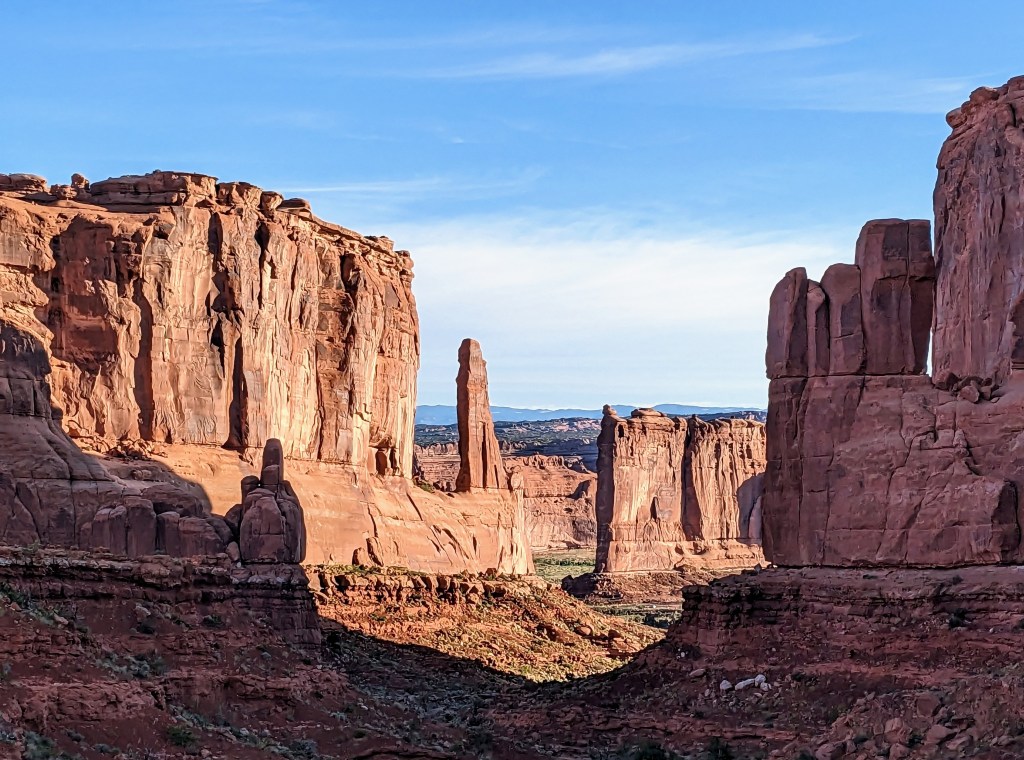
I hoped we would do so. I needed to escape from the enclosed space of the passenger seat. Suddenly huge rock formations loomed just beyond the park gates, and we decided to enter. I was lulled from my stupor into a sense of shock from the grandeur of the giant ochre rocks emerging from the plains. I could sense the onset of palpitations.

“I think I’m going to faint, Alex,” I warned him.

“I think you’re experiencing ‘geophilia’,” he responded.

Suddenly, I realised why people found the study of geology so fascinating. Strata upon strata of ochre rocks rose before us. Their layers indicated the movement of the earth’s surface over eons of time,

Entrance to the Arches

The sunset light flattered the rock formations. Cars lined the road heading to the distant formation of Delicate Arch thirteen miles into the park, and tourists parked their vehicles at the many carparks along the wayside to walk amongst the various giant rock formations.

The next morning, we rose to meet our 7am booking to enter the park. The light portrayed the rock formations in a slightly different way from the light of the evening before. We headed to the trail leading to the Delicate Arch. Even at that early hour, the carpark was almost full, and we secured a space before following the throng of tourists walking the trail heading to the arch. We scrambled across rocks and boulders in the piercing sunshine. I glanced at the climbers ahead of me and thought it would be impossible to reach where they were climbing, but with Alex’s encouragement found myself joining them. After a series of false summits, we found ourselves within sight of the arch. I looked at the abyss below and suddenly decided I would content myself with watching others pose for photographs in the arch rather than entering myself. A photographer was set facing a couple posing in the arches perilously close to the drop-off. Couples and children walked across the rocks in front of me towards the arches.

“I feel sick, Alex! I can’t go any further.”

I wondered why the others were walking so freely along the rocks in front of me, in full view of the yawning abyss.

“I promise I’ll hold your hand.”

“I don’t want to drag you down!”

“You won’t!”

I continued to worry I would drag Alex down with me in the abyss, but as usual, succumbed to his confidence. I gripped his hand and refused to gaze below me, carefully placing one foot in front of the other. Fellow tourists were taking turns to pose under the arch. A couple noticed us heading towards the arches.

“Shall we take your photo for you?” they offered.

Alex accepted and handed them his phone.

We continued to inch towards the arch. Finally we reached it and posed beneath it. I tried to assume a confident stance that I did not feel, all the while steeling myself away from glancing down at the abyss. I was naturally inclined to hold myself steady in a tense position, but instead decided to stretch my free arm outwards and pretend to exert confidence.

Arches

After standing there for long enough for the couple to take turns photographing us, we returned to the smooth large boulders ready for our trail down the mountain. As we walked down, I started reflecting on the contrast between how brave others seemed to feel as they freely walked over the boulders facing the abyss, and how timid I had felt.

“I think I have a fear of heights!” I announced to Alex. “I don’t know how I made it to retirement age without noticing this.”

There was one more trail we wanted to pursue, namely, the Devil’s Garden. As before, there were few empty places in the carpark. We finally edged into a free space, and then headed to the trail on our way to the Landscape Arch. This time I decided to read the information posted on the sign at the entrance. It read “Drop-offs on both sides challenge those with fear of heights”. I realised that there must be at least some people who shared my fear.

Arches National Park remains the most impressive national park I have ever visited. The force of nature had never felt so overwhelming.  I felt small in this vast ancient landscape but privileged to be able to witness it.

Meredith Stephens is an applied linguist from South Australia. Her work has appeared in Transnational Literature, The Muse, The Font – A Literary Journal for Language Teachers, The Journal of Literature in Language Teaching, The Writers’ and Readers’ Magazine, Reading in a Foreign Language, and in chapters in anthologies published by Demeter Press, Canada.

PLEASE NOTE: ARTICLES CAN ONLY BE REPRODUCED IN OTHER SITES WITH DUE ACKNOWLEDGEMENT TO BORDERLESS JOURNAL

Click here to access the Borderless anthology, Monalisa No Longer Smiles

Click here to access Monalisa No Longer Smiles on Kindle Amazon International

Categories
Poetry

Masud Khan in Translation by Fakrul Alam

Homa-birds are mythical birds of Iranian origin
HOMA-BIRD 
 
Once I fall, how much must I drop down before I can rise up again? 
 
As this thought crosses my mind, I am reminded of the Homa-bird found high in the sky. It even lays its eggs there. The eggs then fall down. But because the bird lives so high in the sky its eggs take ages to fall. Its chicks hatch even as the eggs descend. And then it’s time for the chicks to fall. As they begin to fall the chicks sprout eyes and feathers and wings. And one day they discover that they are falling down and down. It is then that they begin to fly to their mothers high up in the sky. They fly so high now that they emerge as specks scattered all along the spread-out body of the sky
 
We are of the breed of these birds. We procreate, raise children; we drop down and rise up again!
 
[Homapakhi; Translated by Fakrul Alam]          

GONE WHO KNOWS WHERE 

An unending queue of children flowed forward
Going who knows where?
 
With great difficulty, I spotted my own child there.
But when I tried kissing him 
I ended up kissing someone else’s child!
 
And then I lost him— lost him forever! 
Dazed, distressed— I seem doomed to a lifetime of waiting.
 
[Aggato Uddesh; Translated by Fakrul Alam]


REJECTION
 
Abruptly today a baby is expelled from its mother’s breasts.
Though it keeps gravitating towards her— hopefully— 
It continues to be rejected. Startled, it still keeps trying.... 
   
How can the innocent baby make sense of such evictions? 
It can comprehend nothing— neither the implications 
Nor the reasons behind its mother’s bizarre actions. 
All it can do is wonder— is mother playing with it? 
Or is she just being cruel, suddenly unmotherly, 
Distracted by the sudden heat wave of the season? 
  
The baby broods, all alone, helpless. And then once again 
It turns towards its mother, only for another round of rejection... 
  
Now inconsolable, it breaks out into tears, feeling hurt     
And rejected, sobbing endlessly till sleep silences it... 
  
Only its craving for love keeps striking one’s ears 
Its magnitude scattering here, there, everywhere! 
      
[Protyakhyan; Translated by Fakrul Alam]          

Masud Khan (b. 1959) is a Bengali poet and writer. He has, authored nine volumes of poetry and three volumes of prose and fiction. His poems and fictions (in translation) have appeared in journals including Asiatic, Contemporary Literary Horizon, Six Seasons Review, Kaurab, 3c World Fiction, Ragazine.cc, Nebo: A literary Journal, Last Bench, Urhalpul, Tower Journal, Muse Poetry, Word Machine, and anthologies including Language for a New Century: Contemporary Poetry from the Middle East, Asia, and Beyond (W.W. Norton & Co., NY/London); Contemporary Literary Horizon Anthology,Bucharest; Intercontinental Anthology of Poetry on Universal Peace (Global Fraternity of Poets); and Padma Meghna Jamuna: Modern Poetry from Bangladesh(Foundation of SAARC Writers and Literature, New Delhi). Two volumes of his poems have been published as translations, Poems of Masud Khan(English), Antivirus Publications, UK, and Carnival Time and Other Poems (English and Spanish), Bibliotheca Universalis, Romania.  Born and brought up in Bangladesh, Masud Khan lives in Canada and teaches at a college in Toronto.

Fakrul Alam is an academic, translator and writer from Bangladesh. He has translated works of Jibonananda Das and Rabindranath Tagore into English and is the recipient of Bangla Academy Literary Award (2012) for translation and SAARC Literary Award (2012).

PLEASE NOTE: ARTICLES CAN ONLY BE REPRODUCED IN OTHER SITES WITH DUE ACKNOWLEDGEMENT TO BORDERLESS JOURNAL

Click here to access the Borderless anthology, Monalisa No Longer Smiles

Click here to access Monalisa No Longer Smiles on Kindle Amazon International

Categories
Poetry

Poetry by Michael Lee Johnson

SUMMER IS DYING 
 
Outside, summer is dying into fall,
and blue daddy petunias sprout ears—
hear the beginning of night chills.
In their yellow window box,
they cuddle up and fear death together.
The balcony sliding door
is poorly insulated, and a cold draft
creeps into all the spare rooms. 
 
BOWL OF BLACK PETUNIAS 

If you must leave me, please
leave me for something special,
like a beautiful bowl of black petunias—
for when memories leak
and cracks appear
and old memories fade,
flowers rebuff bloom,
sidewalks fester weeds
and we both lie down
separately from each other 
for the very last time.
 
MEMORIES PAST
(Hillbilly Daddy)
 
I settle into my thoughts
zigzagging between tears
my fathers’ grave—
Tippecanoe River 
Indiana 1982.
Over now,
a hillbilly country
like the flow 
catfish memories 
raccoons in trees
coon dogs tracking
on the river bank,
the hunt.
Snapping turtles
in the boat
offline—
river flakes
to ice—
now covered
thick snow.

Michael Lee Johnson lived ten years in Canada during the Vietnam era. Today he is a poet in the greater Chicagoland area, IL.  He has 284 YouTube poetry videos. He is aa published poet in 44 countries, a song lyricist, has several published poetry books. He is editor-in-chief of 3 poetry anthologies, all available on Amazon, and has several poetry books and chapbooks. He has over 453 published poems. 

.

PLEASE NOTE: ARTICLES CAN ONLY BE REPRODUCED IN OTHER SITES WITH DUE ACKNOWLEDGEMENT TO BORDERLESS JOURNAL

Click here to access the Borderless anthology, Monalisa No Longer Smiles

Click here to access Monalisa No Longer Smiles on Kindle Amazon International

Categories
Editorial

Dancing in May?

Courtesy: Creative Commons
“May is pretty, May is mild,
Dances like a happy child…”

Annette Wynne (Early twentieth century)

Each month is expressed in a different form by nature in various parts of the world. In the tropics, May is sweltering and hot — peak summer. In the Southern hemisphere, it is cold. However, with climate change setting in, the patterns are changing, and the temperatures are swinging to extremes. Sometimes, one wonders if this is a reflection of human minds, which seem to swing like pendulums to create dissensions and conflicts in the current world. Nothing seems constant and the winds of change have taken on a menacing appearance. If we go by Nazrul’s outlook, destruction is a part of creating a new way of life as he contends in his poem, ‘Ring Bells of Victory’ — “Why fear destruction? It’s the gateway to creation!” Is this how we will move towards ‘dancing like a happy child’?

Mitra Phukan addresses this need for change in her novel, What Will People Say — not with intensity of Nazrul nor in poetry but with a light feathery wand, more in the tradition of Jane Austen. Her narrative reflects on change at various levels to explore the destruction of old customs giving way to new that are more accepting and kinder to inclusivity, addressing issues like widow remarriage in conservative Hindu frameworks, female fellowship and ageing as Phukan tells us in her interview. Upcoming voice, Prerna Gill, lauded by names like Arundhathi Subramaniam and Chitra Divakaruni, has also been in conversation with Shantanu Ray Choudhuri on her book of verses, Meanwhile. She has refreshing perspectives on life and literature.

Poetry in Borderless means variety and diaspora. Peter Cashorali’s poem addresses changes that quite literally upend the sky and the Earth! Michael Burch reflects on a change that continues to evolve – climate change. Ryan Quinn Flanagan explores societal irritants with irony. Seasons are explored by KV Raghupathi and Ashok Suri. Wilda Morris brings in humour with universal truths. William Miller explores crime and punishment. Lakshmi Kannan and Shahriyer Hossain Shetu weave words around mythical lore. We have passionate poetry from Md Mujib Ullah and Urmi Chakravorty. It is difficult to go into each poem with their diverse colours but Rhys Hughes has brought in wry humour with his long poem on eighteen goblins… or is the count nineteen? In his column, Hughes has dwelt on tall tales he heard about India during his childhood in a light tone, stories that sound truly fantastic…

Devraj Singh Kalsi has written a nostalgic piece that hovers between irony and perhaps, a reformatory urge… I am not quite sure, but it is as enjoyable and compelling as Meredith Stephen’s narrative on her conservation efforts in Kangaroo Island in the Southern hemisphere and fantastic animals she meets, livened further by her photography. Ravi Shankar talks of his night hikes in the Northern hemisphere, more accurately, in the Himalayas. While trekking at night seems a risky task, trying to recreate dishes from the past is no less daunting, as Suzanne Kamata tells us in her Notes from Japan.

May hosts the birthday of a number of greats, including Tagore and Satyajit Ray. Ratnottama Sengupta’s piece on Ray’s birth anniversary celebrations with actress Jaya Bachchan recounting her experience while working for Ray in Mahanagar (Big City), a film that has been restored and was part of celebrations for the filmmaker’s 102nd Birth anniversary captures the nostalgia of a famous actress on the greatest filmmakers of our times. She has also given us an essay on Tagore and cinema in memory of the great soul, who was just sixty years older to Ray and impacted the filmmaker too. Ray had a year-long sojourn in Santiniketan during his youth.

Eulogising Rabindrasangeet and its lyrics is an essay by Professor Fakrul Alam on Tagore. Professor Alam has translated number of his songs for the essay as he has, a powerful poem from Bengali by Masud Khan. A transcreation of Tagore’s first birthday poem , a wonderful translation of Balochi poetry by Fazal Baloch of Munir Momin’s verses, another one from Korean by Ihlwha Choi rounds up the translated poetry in this edition. Stories that reach out with their poignant telling include Nadir Ali’s narrative, translated from Punjabi by his daughter, Amna Ali, and Aruna Chakravarti’s translation of a short story by Tagore. We have more stories from around the world with Julian Gallo exploring addiction, Abdullah Rayhan with a poignant narrative from Bangladesh, Sreelekha Chatterjee with a short funny tale and Paul Mirabile exploring the supernatural and horror, a sequel to ‘The Book Hunter‘, published in the April issue.

All the genres we host seem to be topped with a sprinkling of pieces on Tagore as this is his birth month. A book excerpt from Chakravarti’s Daughters of Jorasanko narrates her well-researched version of Tagore’s last birthday celebration and carries her translation of the last birthday song by the giant of Bengali literature. The other book excerpt is from Bhubaneswar@75 – Perspectives, edited by Bhaskar Parichha/ Charudutta Panigrahi. Parichha has also reviewed Journey After Midnight – A Punjabi Life: From India to Canada by Ujjal Dosanjh, a book that starts in pre-independent India and travels with the writer to Canada via UK. Again to commemorate the maestro’s birth anniversary, Meenakshi Malhotra has revisited Radha Chakravarty’s translation of Tagore’s Farewell Song. Somdatta Mandal has critiqued KR Meera’s Jezebeltranslated from Malayalam by Abhirami Girija Sriram and K. S. Bijukuma. Lakshmi Kannan has introduced to us Jaydeep Sarangi’s collection of poems, letters in lower case.

There are pieces that still reach out to be mentioned. Do visit our content page for May. I would like to thank Sohana Manzoor for her fantastic artwork and continued editorial support for the Tagore translations and the whole team for helping me put together this issue. Thank you. A huge thanks to our loyal readers and contributors who continue to bring in vibrant content, photography and artwork. Without you all, we would not be where we are today.

Wish you a lovely month.

Mitali Chakravarty

borderlessjournal.com

Categories
Review

A Journey, a Memoir and an Inspiration

Book Review by Bhaskar Parichha

Title: Journey After Midnight – A Punjabi Life: From India to Canada

Author: Ujjal Dosanjh

Publisher: Speaking Tiger Books

The Punjabi Diaspora is a global phenomenon that has grown in size and complexity in recent years. It is estimated that there are around 20 million Punjabis living outside the Punjab region in India and Pakistan. This is stretching across multiple continents and countries. Punjabis have migrated to different parts of the world since the British Raj. However, this diaspora has become more visible in recent decades due to technology and global connectivity.

Highly diverse and dynamic, with different groups of Punjabis living in different places around the world. In North America, Punjabis are concentrated in the United States and Canada. In Europe they are mainly settled in the United Kingdom, Germany, Italy, and France. In the Middle East, they are found in the United Arab Emirates, Qatar, Kuwait, and Saudi Arabia. In South East Asia, they are mainly settled in Malaysia, Singapore, and Indonesia.

Punjabis have had a significant impact on the culture and economy of the countries where they have settled. Their positive contributions were felt in multiple industries, from agriculture to tech. They have been key to spurring economic growth in the areas where they have settled. They have also had a major influence on the culture and cuisine of these countries, with Punjabi food being a popular choice in many areas.

Journey After Midnight – A Punjabi Life : From India to Canada by Ujjal Dosanjh speaks about the Punjabi diaspora in all its splendor.  Dosanjh was born in the Jalandhar district of Punjab in 1946. He emigrated to the UK in 1964 and from there to Canada in 1968. He was Premier of British Columbia from 2000 to 2001 and a Liberal Party of Canada Member of Parliament from 2004 to 2011, including a period as Minister of Health and Minister Responsible for Multiculturalism, Human Rights and Immigration. In 2003 he was awarded the Pravasi Bharatiya Samman, the highest honour conferred by the Government of India on overseas Indians.

The blurb contends: “Journey After Midnight is the compelling story of a life of rich and varied experience and rare conviction. With fascinating insight, Ujjal Dosanjh writes about life in rural Punjab in the 1950s and early ’60s; the Indian immigrant experience—from the late 19th century to the present day—in the UK and Canada; post-Independence politics in Punjab and the Punjabi diaspora— including the period of Sikh militancy—and the inner workings of the democratic process in Canada, one of the world’s more egalitarian nations.”

Dosanj states candidly: “Today’s world has few leaders brimming with great ideas. The paucity of great leaders afflicts India as well. There are no inspiring giants on the national stage tall enough to lead India out of the ethical and moral quagmire. Asked whether he was working to create a new India along with seeking its independence from Britain, Mahatma Gandhi had declared that he was trying to create a new Indian–an honest, fair and just Indian for a proud, progressive, prosperous and caring India. Since the Mahatma’s time the moral and ethical values of India have decayed. In Indian politics, civil service and public life, there is little evidence of the ideals he lived and died for.”

He continues: “A substantial portion of the Indian economy is underground; all due to the sadly enduring disease of corruption. The albatross of financial, ethical and moral corruption is strangulating and shortchanging the country. Those who say economic progress will by itself free India from corruption are just as wrong as those who in the 1950s maintained that education by itself would reduce corruption. It obviously hasn’t, and India finds itself counted among the most corrupt countries on earth. Corruption shatters human dreams and stunts ingenuity. It constrains personal and political liberties. It severely limits opportunities. The main hindrance in the path of social, political, economic and cultural progress is the disconnect between knowing what is right and doing the right thing; most know what is the right and the ethical thing to do, but they continue to do the wrong and the unethical thing; hence the ubiquitous corruption.

Calling upon the Indians for a moral revolution Dosanj writes: “The sculpting of Gandhi’s Indians, and the building of the India of the dreams of its founding fathers and mothers, requires a moral and ethical revolution-a revolution of values that are of Indians, by Indians and for Indians. No matter how bleak the political and ethical scene today, I’m certain there are great minds fearless, humane and brave among the billion plus residents of India. We may not see
them, but they exist. We may not know them, but they are among us. They must heed India’s call. They must come forward and lead. India’s destiny demands it.”

In the ‘Afterword’ he laments about the state of affairs of Punjab in recent times: “Punjab is staring at the prospect of turmoil, radicalization and violent fundamentalism, and yet many in the government and otherwise seem obsessed with presenting and treating the likes of the late singer Moosewala as modern Punjab’s heroes. That the young singer’s life was cut short by gangsters’ guns was horrible and must be condemned. Beyond that the AAP and others must be careful not to glorify violence. Unfortunately, almost the whole of Punjab seems taken with Moosewala; the young man was a talented singer but much of his poetry and music was about guns and aggressive machismo. Is that what Punjab needs and must idolize?”

Dosanjh writes candidly about his dual identity as a first-generation immigrant. And he describes how he has felt compelled to campaign against the discriminatory policies of his adopted country. He opposes regressive and extremist tendencies within the Punjabi community. His outspoken views against the Khalistan movement in the 1980s led to death threats and vicious physical assaults, and he narrowly escaped the bombing of Air India Flight 182 in 1985. Yet he has remained steadfast in his defence of democracy, human rights and effective governance in the two countries he calls home—Canada and India.  

The writing style is fluid and languid. This is not a book that can be judged on the basis of its literary merit. It isn’t just a simple memoir, but rather a record of a turbulent period in India’s history. It is a book that represents a lifetime journey, crossing oceans and cultures. As a memoir, Ujjal Dosanjh’s book is at once personal and political, but most importantly, it is inspiring.

.

Bhaskar Parichha is a journalist and author of UnbiasedNo Strings Attached: Writings on Odisha and Biju Patnaik – A Political Biography. He lives in Bhubaneswar and writes bilingually. Besides writing for newspapers, he also reviews books on various media platforms.

.

PLEASE NOTE: ARTICLES CAN ONLY BE REPRODUCED IN OTHER SITES WITH DUE ACKNOWLEDGEMENT TO BORDERLESS JOURNAL

Click here to access the Borderless anthology, Monalisa No Longer Smiles

Click here to access Monalisa No Longer Smiles on Kindle Amazon International

Categories
Poetry

Standing in a Vineyard, Souring All the Grapes

By Ryan Quinn Flanagan

Courtesy: Creative Commons
They could not stop arguing.
Lobbing the most vile of accusations at one another.

At this wine tasting in Southern Ontario.
In spite of the wonderful weather.

The host trying to ignore them as he poured.

These two vipers having escaped the pit.
Now standing in a vineyard, souring all the grapes.

So that you would taste it in the bottle
when it came time to pick the harvest.

That petty jealousy that kept them at each other’s throats.
Surrounded by all those grapes 
that could not escape that overwhelming anger.

Their rancid lives infusing everything,
you could feel it! 

A sudden heavy cloudiness of sky.
No one driving and everyone sauced.

Ryan Quinn Flanagan is a Canadian-born author residing in Elliot Lake, Ontario, Canada with his wife and many bears that rifle through his garbage.  His work can be found both in print and online in such places as: Evergreen Review, The New York Quarterly, Borderless Journal, GloMag, Red Fez, and Lothlorien Poetry Journal

.

PLEASE NOTE: ARTICLES CAN ONLY BE REPRODUCED IN OTHER SITES WITH DUE ACKNOWLEDGEMENT TO BORDERLESS JOURNAL. 

Click here to access the Borderless anthology, Monalisa No Longer Smiles

Click here to access Monalisa No Longer Smiles on Kindle Amazon International