Categories
Interview Review

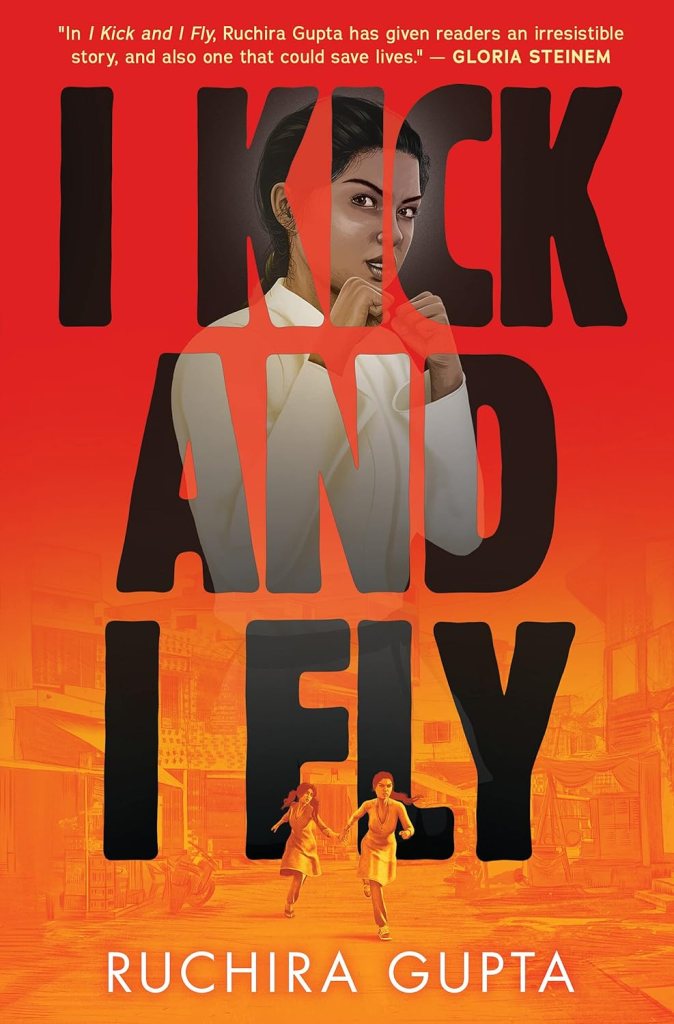
I Kick and I Fly: Ratnottama Sengupta Converses with Ruchira Gupta

Ratnottama Sengupta has known Ruchira Gupta for more than 40 years. But reading I Kick and I Fly has made her see in a new light the young journalist who has become a force of change in the global fight against human trafficking.

Kiddy. Ruchi. Journalist. Documentary filmmaker. Emmy Award winner. Founder President, Apne Aap[1]Women Worldwide. Social activist. Agent of changes to international laws. Sera Bangali[2]. Ekta[3] Award winner. Professor, NYU. Cancer survivor. Essayist. Exhibited artist. Published novelist…

“What next?” I could have asked Ruchira Gupta. And without waiting for her to reply I could add, “Member of Rajya Sabha? The first step to even higher offices on the world stage.” Because? This kid born to Rajni and Vidya Sagar Gupta has dedicated her life-breath to ensure that not a single child is either sold or bought for sexual gratification in exchange of a few rupees.

Hardly surprising that when she picked up her pen while recovering from Covid in her family home in Forbesganj, she penned a novel like I Kick and I Fly. “A book that is a MUST READ for one and all who are interested in fighting, tackling, and – not or – ending sex trafficking,” as Anjani Kumar Singh, Director, Bihar Museum said at the launch in Patna. Because? It is a story of optimism as Heera the protagonist, overcomes unimaginable obstacles to emerge a path breaker in the Nat community who believed it was the fate of its girls to sell their body at puberty, or even earlier, for the welfare of their family.

Inspirational. And in the most absorbing way. Read this excerpt from the novel to understand how a message becomes engrossing read.

"My name is Heera. I am from a town named Forbesganj, in a state called Bihar, in northern India, very close to Nepal,” I begin. My voice is shaking along with the rest of me. But I go on. “My brother and I are the first people in our family to ever go to school, and I have grown up believing that being sold for prostitution is my Destiny. That there are few doors open to me as a child of an oppressed-caste family. Our people used to be wrestlers and performers. But overnight we were told we could not do those things anymore, that our entire way of life was illegal.”

My voice is shaking less now and I manage to look at people in front of me. “How do people survive when they are not allowed to do the work they know and love? For my family of nomads, it meant asking people for a place to live, and then doing just about any job they told us we could do. One of these jobs was having sex with people for money.

“These children and women had no choice but to sell their bodies in exchange for a place to live. For food to eat. And for their husbands to be given work. And though people say that times have changed, they must not have changed everywhere, because I have been told since I was a little girl that selling my body was what I had to do to support myself and my family. And I believed it. Many in my family believed it too.

“Finally early this year it was my turn to be put up for sale. My family was in a tight spot, in debt to the wrong man. I grew up in a red-light area, so I knew what it involved. There are no secrets kept from kids where I come from. So, I said No, and we tried to get around it.

“My mother paid back our loan, but the traffickers came for me anyhow. The first time I got away. The second time they got me, but I was rescued by my brother and teacher.

“When I was stuck in a tiny room with my traffickers outside the door, I asked myself why had they kept coming for me even when they had no claim, no right? And that’s when I fully realized that they believed my body belonged to them, and I knew for certain it did not. It was kung fu that helped me understand this. Because it is through kung fu that I learnt, my body would do what I told it to. That my body listened to me – and only me.”

I take a breath. “There is power in my body. My body connects me to my cousin, my aunt, my grandmother who were all sold for prostitution. But kung fu also connects my body to my ancestors, who were champion wrestlers. If both these things lived within me, could I choose which course I wanted to take?”

I look up now, realizing that I have memorized the final words on the page. “For most of my life, the answer to that was NO. But suddenly I felt that maybe there was another possibility. I didn't do it on my own: I needed my family to stand with me, and most importantly, a cheerleader who made me believe that safety could be mine. Rini Di taught me kung fu and opened the doors of the world to me. And that is how I have come to stand before you now.”

Heera stands before her teachers and her friends, other survivors of trafficking as an example who not only fights, successfully, the might of traffickers but who actually saves another trafficked girl.  Who, even more importantly, instils faith, and courage, and dream… In her brother, her mother, and her father. Her brother Salman who always stood by her even as he studied for a better future. Her Mai who broke stones for a livelihood and gathered enough courage to take a loan to put in place a roof over their head. Her Baba who stands as a loser but accepts change and even starts to nurse a dream — for his daughter as much as for his son.

And so, when the Martial Arts Foundation awards Heera and her co-fighter friend, Connie, a scholarship to train for one full year in New York, along with admission to a local school, Heera too starts dreaming. Of a future, perhaps only twelve months down, when her family would be dwelling in a pink-bricked three roomed house. When Salman would study in a residential school in Siliguri. When Mai would have a betel shop. When Baba would be a porter at the railway platform. When her cousin Mira Di would be a seamstress with a tailoring shop of her own in the very backroom where she was forced to service men. When the corrupt policeman, Suraj Sharma, and the trafficker, Ravi Lala, would be in jail, no longer on the prowl in Girls Bazaar.

“It’s not a dream,” says Ruchira , reiterating the clinching line of I Kick and I Fly. “I have seen this transformation actually take place in Forbesganj. “There were 72 home-based brothels in the lane when Apne Aap started. Today there are two. Girls no longer sit outside waiting for customers. The two sisters who were locked up in the hut have finished school. One is a chef, the other is a teacher. The girl who was kidnapped is a karate trainer. Someone like Mai really has a betel paan leaf shop and someone like Mira Di is a seamstress. The cattle fair is no longer allowed to bring dance or orchestra groups.”

This was the perfect time to strike a conversation with Ruchira Gupta, I reckoned. And so I decided to shoot…

Me: How – rather, why – did you start writing I Kick and I Fly?

Ruchi: I started writing this story when a fourteen-year-old girl just like Heera won a gold medal in a karate championship in Forbesganj. She was being groomed for prostitution with other girls in her lane. A lane just like Girls Bazaar.

Her journey was not easy, it was heroic. I saw how she and her friends overcame hunger, fought off their fear and stood up to traffickers with grace and gusto. An annual cattle fair used to claim girls from that lane every year. When my NGO, Apne Aap, opened a community centre and a hostel there, we were constantly attacked by men like Gainul and Ravi Lala. They would stalk the mothers, the daughters, and me. They hurled abuses, threw stones, stole from our office and even kidnapped girls. We built higher walls around the hostel to prevent traffickers from jumping over. I posted guards outside my home, hired lawyers, filed police complaints and cases in court. Just like Mai, some mothers in the lane disobeyed their husbands even though they were beaten up. Their daughters were the first batch of girls in our hostel.

Me: Are all the characters real? Is the hope real? Do people in real life change the way Baba does?

Ruchi: Most of the events in the book are inspired by real people, places, events. To give you one example: A trafficking survivor from Indonesia told me how she was locked up and how she escaped from a brothel in Queens, New York, by disguising herself in a burqa. She is now a global leader in the struggle against trafficking. In my novel, Heera uses the same device to rescue Rosy.

Baba, Heera’s father, is also based on real-life fathers in the Nat community of Forbesganj. They would actually auction off their daughters to the highest bidder when the mela came to town! But as I began working in the red-light area I saw that they were not black and white criminals but human beings desensitised through decades and generations of oppression. Of course, there was no excuse that they did not try to fight back. I did see some fathers change when they saw their daughters succeed. Until then the possibility of a different future had not even occurred to them.

When hope unfurls in a downtrodden human being, it is like a tendril. I saw it in the eyes and actions of some fathers in the red-light area of Forbesganj when their daughters won gold medals in karate.

Me: You have not learnt kung fu. Why did you project Rini Di – clearly your alter ego – as a kung fu teacher? It is a physical art of self-defence. How precisely does that connect with, or help, girls who are in the river of flesh?

Ruchi: I still remember, it was early morning when a boy came to my home with his mother to seek help. His sister and cousin were locked up by traffickers to stop them from coming to the hostel. We had to mobilise the police to get them out. I noticed then that the girls were badly bruised while the traffickers were unscathed. I wished that the girls were able to fight back.

Our Apne Aap women’s group met that afternoon at the centre. Everyone was afraid that we would be beaten in retaliation for the police raid. That’s when I suggested martial arts classes. The women loved the idea. I used to see a couple teach karate teacher near the rice fields to boys in a private school. We hired them and the classes began. Soon the bullying in schools stopped.

As the girls started to win competitions, something changed. The very townspeople who had agitated to urge the principal to expel our red light children began to respect them. And the fathers in the community began to see value in their daughters. The biggest change was in the girls themselves. They began to own their bodies and value themselves. As they gained self-esteem, they began to do better in class. Soon more mothers began to stand up to the traffickers and even to their husbands in the lane, saying they would send their daughters to school.

Me: How did Apne Aap help change the picture at the ground level?

Ruchi: Today Apne Aap has educated more than 3,000 girls from red-light areas through school and college and is still continuing to do so. They are in jobs as animation artists, teachers, doctors, lawyers, chefs, managers of pizza parlours and of gas stations too.

Our NGO’s community has become a safe space to hold meetings, share stories, get food, do homework, and plot against traffickers. Women, very much like Mai and Mira Di, meet regularly in the centre to solve their problems. They fill out forms with the help of Apne Aap workers to access government entitlements like low cost housing, ration and loans. They go collectively to talk to the authorities when there are delays.

The Apne Aap legal team helps victims to file police complaints, testify in court and get traffickers convicted. The real Gainul and the real Ravi Lala are in jail. In 2013, Apne Aap survivor leaders and I testified in Parliament for the passage of section 370 IPC, a law that punishes traffickers and allocates budgets for services to the prostituted and the vulnerable.

Before these could happen, I had shown my documentary and testified to the UN and to the US senate for laws that would decriminalise the victims; increase choices for vulnerable and trafficked girls and women; and punish the traffickers and sex buyers. I can proudly say that my testimony and inputs contributed in the passage of the UN Protocol to end Trafficking in Persons and the UN Trafficking Fund for survivors as well as the passage of US Trafficking Victim Protection Act.

Me: Ruchi you come from an established, politically aware, well connected and much respected family. You grew up in the metros and now live an international life, mostly abroad. You won a coveted award for The Selling of Innocents. You helped in the making of Love, Sonia. Why did you not continue to make films? In short, what compelled you to start Apne Aap Women Worldwide?

Ruchi: As you know, I started as a journalist right after graduation. I learnt to ask questions, and I listened. The question that changed my life was: Where are the girls?

I was researching a story in the hills of Nepal when I came across rows of villages with missing girls. I had asked this to the men playing cards in the villages in Nepal. I followed the trail and found that a smooth supply chain existed from these remote hamlets to the brothels of India. Little girls, perhaps only twelve, were locked up in cages in Kolkata, Delhi and Mumbai for years and sold for a few cents night after night.

All the girls were from poor farming families. Many, like Heera, were from nomadic indigenous communities or marginalised castes. Like her, they were either not sent to school, or bullied until they dropped out, or pulled out by their fathers and sold into prostitution.

I was sad, then angry, and finally determined to do something about it. That’s how I ended up exposing the horror in my documentary. When I was on the stage in Broadway receiving the Emmy in 2013, all I could see beyond the glittering lights were the eyes of the mothers who had broken their silence to save their daughters. I decided in that instant to use my Emmy not to build a career in journalism but to make a difference.

I did two things. I dubbed it in six languages and I travelled across the world with it. I screened it in villages to show parents what the brothels were like. I showed it to the UN and the US Senate when I testified against the crime that is human trafficking. It contributed to a global push by activists that led to a new UN protocol to end trafficking and the first US anti-trafficking law, the Trafficking Victims Protection Act (TVPA).

Me: What was your magic wand?

Ruchi: I had no magic wand. I didn’t even have experience to stop the kidnapping of girls, or knowledge about how to put traffickers in jail. I was an English literature student from Kolkata’s Loreto College who joined The Telegraph while pursuing my honours degree graduation. But as a journalist, I saw the reality and invented ways to move forward.

Something had happened while I was filming the documentary. A pimp had stuck a knife to my throat. I was in a small room. There was nowhere to run. Suddenly, I was encircled by the 22 women I was interviewing. They told the pimp that he would have to kill them first. He knew it would be too much trouble to kill so many women, so he slunk away. I was saved. That moment changed my life.

The Emmy award money helped me start Apne Aap Women Worldwide with the women who had bravely spoken up in my film. I listened to the women who said they had four dreams: Education for their children; a room of their own; an office job; and punishment for those who bought and sold them. That became my NGO’s business plan.

I learnt that the best solutions came from those who experience the problem. The idea of the hostel, the idea of food in the community centre, and even the idea of karate came when we sat in a circle in the mud hut that is our community centre. It evolved into a grassroots approach which we call asset-based community development – ABCD or the 10 Asset model. Every woman or girl who becomes an Apne Aap member gains ten assets – both tangible and intangible. These are: a safe space, education, self-confidence, the ability to speak to authorities, government IDs and documents, low-cost food and housing, savings and loans, livelihood linkages, legal knowledge and support, and a circle of at least nine friends.

Each of these assets is a building block in an unfolding story of personal and community change. I wrote this novel to share with you that change is possible.

Me: Ruchi you had come up with the art-documentation, The Place Where I Live is Called Red Light Area. You got the girls to make a series of videos about different aspects of their life. You supported a documentary on the scheduled tribes. What inspired you to shun Art For Art’s Sake and pursue Art as Activism?

Ruchi: I learned in a very practical way the power of women’s collective action and the importance of sticking by one another. I promised myself I would never give up on those women’s dream. As a result, today thousands of girls have exited the prostitution systems from brothels across the country. There is more awareness about sex trafficking globally. And there are better laws and services for victims like Mira Di in over 160 countries.

Me: But we still have miles to go before we sleep…? 

Ruchi: Yes, because the truth is that there isn’t one but many, many more Heeras. Girls Bazaar still exists in many parts of the world, including the USA. The brothel in Queens is real. The International Labour Organisation estimates there are more than 40 million victims of human trafficking globally with hundreds of thousands of victims in the US alone. Human trafficking is the second largest organised crime in the world, involving billions of dollars, according to the United Nations Office for Drugs and Crime (UNODC).

Me: So, what more actions would you suggest to tackle the issue? Through IKAIF, an upbeat tale of an underdog’s rise to victory, you have shown that ‘lost girls’ earmarked for ‘the oldest profession’ can erase their ‘destiny’ through education, and reliance on their own inner strength. What other positive actions would you suggest?

Ruchi: Heera’s is a story of hope in spite of great odds. It’s about our bodies — who they belong to, the command they can give us. It is about friends who make changes you want in your life. It is about a community that resolves to make change contagious, and succeeds.

You too can ‘Join The Movement’ to create a world in which no child is bought or sold. You can do that in so many ways. You can 1) Sign the freedom pledge on my website Ruchiragupta.com. 

2) Learn more about the issue by reading I Kick and I Fly, and by watching The Selling of Innocents on my website.

3) Create further awareness by sharing the book, the movie and the pledge on your social media handles.

4) Volunteer and intern with Apne Aap or a local NGO in your town.

And you can Sponsor a girl like Heera on apneaap.org!

.

[1] Oneself

[2] The Best Bengali – An award given by the Ananda Bazaar Patrika group

[3] Unity: The Ekta Award is a National Award from India

Ratnottama Sengupta, formerly Arts Editor of The Times of India, teaches mass communication and film appreciation, curates film festivals and art exhibitions, and translates and write books. She has been a member of CBFC, served on the National Film Awards jury and has herself won a National Award. 

.

PLEASE NOTE: ARTICLES CAN ONLY BE REPRODUCED IN OTHER SITES WITH DUE ACKNOWLEDGEMENT TO BORDERLESS JOURNAL

Click here to access the Borderless anthology, Monalisa No Longer Smiles

Click here to access Monalisa No Longer Smiles on Amazon International

Categories
Essay

The Magic Dragon: Cycling for Peace

It’s been five years since the American cyclist ‘Hutch’ died, yet his message of peace remains, as Keith Lyons remembers the global citizen who challenges us all to live life to its fullest

In early 2019, having not heard from an old friend ‘Hutch’ for a few weeks, I learnt that the American I’d first met in China has died of natural causes at his new humble home in the mountains of Greece. He was almost 80 years old.

There’s nothing extraordinary about living until your late 70s. Or relocating to live the last years of your life in a warmer place. But Hutch was not your ordinary septuagenarian retiree. Nor was he a typical American. Though when I first heard about him in 2009, it was when a German friend staying with me in southwest China had come across a sign on the wall of an Italian restaurant in Lijiang, Yunnan, seeking fellow cyclists for day trips around the area. The deal was, go on a ride with Hutch and other cyclists, and he would pay for lunch or dinner. “So how was he?” I asked my friend about the organiser, who had a website promoting world peace. “American, very American,” she replied. I was intrigued by this.

But it wasn’t till another month or so that our paths crossed, and I met him in a café with a gaggle of others: locals, Chinese youngsters who had moved to Yunnan province, and some foreigners.

Hutch was treating them all to drinks and pizza. I found out later, he bought bikes for some ride participants who became his friends. That’s the kind of person he was. 

Hutch was not a tall man in stature, and the cycling obviously kept him very fit, I noted on first meeting him. He wore lycra cycling gear, a neck scarf and bandana, and had a gentle face, with a bright eyes and a benign smile. He was polite, and entertaining, and clearly enjoyed the carbo-loading pizza as much as the entourage, made up of English-speaking Chinese who ranged from their 20s to 40s.

He invited me to join them, as after pizza, there was going to be cake and dessert. He got up to shake my hand, and I noticed he was wearing cycling shorts, with spindly yet muscle-toned legs.

Having set up his new China base in the mountain town where I’d been living since the mid-200s, I got to know him over drinks, meals, outings and adventures. Mr F. A. Hutchinson (I never knew what those initials stood for) acquired names in each country where he stayed – Haqi in China, Nima (meaning ‘sun’) in Tibet, Hache in Bolivia. At one stage he was signing off his emails with ’The Magic Dragon’, his serpent name. ‘Or just call me a bum on a bike’, was tagged to the end of his signature. I just knew him as Hutch. 

Generous and giving, sometimes overly generous, he also adopted adult children, accumulating a family of daughters and sons in China during his half decade living in Xining and Lijiang. While his trusted bike, Ms.Fetes, was loaded with pannier bags front and back, he didn’t carry much baggage from his past, which had seen him serve in Vietnam, work for decades in TV sports production in the US, and establish a talent development agency in China in 2007. 

Over the couple of years I knew him in Lijiang I can only recall a few occasions when he was not sporting padded cycling shorts. More often than not he turned up to cafe, meeting and events on his bicycle, sometimes not bothering to take off his cycling helmet indoors. 

That cycle helmet proved its value one day when we were out cycling in the hills to an alpine lake around 2,600 m above sea level not far from LIjiang. Hutch was a cyclist with remarkable stamina, and his slow and steady approach could burn off others 40 years his junior on hill climbs. While Hutch had cycled all over China for a number of years, without major incident or accident — a fact which impressed all who inquired about the safety and sanity of cycling in The Middle Kingdom — while out with me he broke that 100% safety record. Coming down a winding hill late one afternoon the wheels of his bike skidded on icy gravel and he ended up falling off his bike, a large truck behind him putting on its brakes just in time to avoid running him over. Worried he was requiring an ambulance or hospital treatment, I rushed over to Hutch to find him un-fazed by it all. He cycled back to where he was living, and tried to tend to his battered and bloody knees, elbows and hands himself, a wry smile over his beard-stubbled face. 

One of Hutch’s most impressive achievements in China was to cycle from Lijiang across Tibet to Lhasa and onto Mt Kailas, a feat made more incredible by the challenges and dynamics of a group ride (participants from several countries included Elvis), and then the breakaway split by some cyclists which jeopardized the whole mission. I helped with some of the logistics during the year-long adventure, but am still in awe of anyone who can cycle for weeks at altitudes over 4,000 metres across the Tibetan plateau. The tale of the 70-year-old American who cycled across China to Tibet made newspaper headlines, and he featured on the front cover of cycling and outdoor magazines. We gave him a hero’s welcome when he returned to Lijiang, his story still told by expats and locals living in north-west Yunnan. 

As well as his cycling pilgrimage to the holy mountain of Tibet, we worked on a housing project for small Tibetan-style eco-houses with wind and solar energy made for US$10,000. In Lijiang, he helped his friend Irlin set up a small eatery (possibly to ensure he had a reliable supply of Western food), and he was a regular visitor to my café, ‘Lijiang Millionaire’s Club’, and the crosstown cafe (and tango dance studio), ‘Over the Bridge’, run by fellow New Zealander, Stephen Dalley. 

After Hutch’s years in China, he was ready for a change. Increasingly worried about the Chinese government’s clampdowns on freedom of speech, his frustrations spilled over from the anonymous government to the Chinese people. He often carried a green canvas shoulder bag with the words in Mandarin of Chairman Mao ‘Serve the People’ — and found occasion to show that to shopkeepers, bank clerks, ticket sellers or government officers — anyone who was stonewalling him or telling him ‘mei you’ (don’t have). 

Perhaps inspired by the practical and easy-going nature of Kiwis, Hutch was looking forward to heading to New Zealand, where he already had a number of contacts. After Lijiang, he went to Australia, New Zealand, and then to South America, before moving to Europe a few years ago to live in Spain, Germany and Greece. 

He was on a personal crusade, to promote peace and understanding, and wanted to get more people on bicycles, by holding inclusive, inexpensive cycle tours. “One of our slogans, Burn Fat, Not Oil,” he wrote.

One of Hutch’s key talents was to enlist others to join, and get them working together, even though he admitted he didn’t like groups. However, the laziness or greediness of others sometimes meant that his efforts floundered into anarchy and stagnation.

While often on the move, Hutch wasn’t a ‘rolling stone gathering no moss’ kind of person. Instead, he acquired more friends everywhere he went. I never saw him play the age card, but enjoyed hearing his wisdom acquired from a long and interesting life. He had some strong opinions on various subjects. Once you met Hutch and he got your contact details, it was like being on an email subscription list you could not get off. A few times I got fed up with the email exchanges, not so much from Hutch, but from some of his old American friends, and despite requests to opt out, found myself back on the list a few months later.

Taoist Hutch believed we needed to change the world, and to change ourselves. He quoted Mahatma Gandhi on his site: “You must be the change you wish to see in the world.”

He rallied against capitalism, materialism, money and greed. He complained about how money was god, the world was going mad, and against the failures of democracy with widespread corruption of its leaders. One year his favourite slogan was, “We have met the enemy, and he/she is us.”

Hutch urged ‘women of the world to unite’. He was impressed by former New Zealand prime minister Jacinda Ardern, often sending me links to news articles about her, but he was not so favourable about Myanmar’s leader Aung Sun Suu Kyi and her lack of response to ethnic cleansing, telling me, “I am starting to really dislike this woman.”

He called for urgent measures to address what he saw as the biggest and most unrecognised problem facing the human race: over-population. Each day he posted comments with news articles under the title ‘Pathology in America’, or with his take on issues, written in upper case: SLEAZE-BAG TRUMP’S AMERICA. He cursed wrongdoers, and hoped they would face the consequences. ‘WOE BE UNTO TRUMP FO ALL THIS! MAY ALL THE 7 DEPREDATIONS, FULL UPON HIM AND HIS CHILDREN’S CHILDREN, FOR 7 GENERATIONS’1, he penned recently after a second child died in government custody at the US border. 

Sometimes his missives were written as poems or as cryptic riddles. Likewise, he was prepared to consider other views, new information or the different opinions of those better informed, and he would figuratively smoke the peace pipe.

Hutch did occasionally like to smoke a pipe, not with tobacco but with the ‘happy baccy’. (Indeed, today there’s an article in Scientific American suggesting THC in marijuana may boost rather than dull the elderly brain).

“As I get older, I seek peace and tranquillity,” he wrote in one of his emails to me. “What has been important to me is a different life, one seeking answers to the riddle of life.” In another he sent last year, he said he was getting closer. “Closer to what? The peace of mind of having overcome materialism.” In another email he wrote “at this age, we take life one day at a time”.

He wrote latterly that he had wanted to live in Meteora in Greece, having fantasised about it while in Germany, visiting his long-time friend and patron, Rucha. The rock formation in central Greece has a stunning hillside Eastern Orthodox monastery, second in importance only to Mount Athos. Almost prophetically, he said recently, “We never know when our time has come, so better to act Now!”

On Christmas Eve last year, after a good day out cycling around Meteora, the 78-year-old wrote a poem which started:

What a cycling day this has been,
What a rare mood I’m in
Being the Light
Screaming Delight. . . .

It was in the small town of Kalampaka near Meteora where Hutch died, around 2 January 2019 — according to his close friend Xu Tan — after coming down with a bad cold a few days before. He was cremated at the base of the Meteora rocks. 

“I’m not much big on ‘goodbyes’,” Hutch posted as he left Australia in late 2011 on his way to New Zealand. “I usually slip out the back, Jack . . . get a new plan, Stan — and basically get myself down the road.”

“There is no reason to be sad when someone dies and sheds their body,” he said. “In fact, we should celebrate such a transition.” 

After learning of his death, many candles were lit in memory of Hutch, in China, Australia, New Zealand, South America, in Europe, in the USA — all around the world, a remembrance and celebration of that cranky, freewheeling legend, as he cycled over the hill into the sunset, and into a brand new dawn.

And five years later, we still remember the man and his message.

Photo provided by Keith Lyons
  1. These are authorial comments retained for colour but do not reflect the stand of Borderless Journal ↩︎

Keith Lyons (keithlyons.net) is an award-winning writer and creative writing mentor originally from New Zealand who has spent a quarter of his existence living and working in Asia including southwest China, Myanmar and Bali. His Venn diagram of happiness features the aroma of freshly-roasted coffee, the negative ions of the natural world including moving water, and connecting with others in meaningful ways. A Contributing Editor on Borderless journal’sEditorial Board, his work has appeared in Borderless since its early days, and his writing featured in the anthology Monalisa No Longer Smiles.

.

PLEASE NOTE: ARTICLES CAN ONLY BE REPRODUCED IN OTHER SITES WITH DUE ACKNOWLEDGEMENT TO BORDERLESS JOURNAL. 

Click here to access the Borderless anthology, Monalisa No Longer Smiles

Click here to access Monalisa No Longer Smiles on Kindle Amazon International

Categories
Nazrul Translations

Nazrul Translated by Niaz Zaman

Say Your Prayers in My House Today


O faithful one, say your prayers in my house today;

Below your feet I spread the jainamaz* of my heart.

I am a careless sinner,

Find no time to pray;

Touching your feet, may my sinful head be raised.

Wipe your ablution water with my garments,

Turn my house into a mosque by your touch today.

The Devil, through whose wiles

I do not find time to call upon God,

Will flee, hearing your call to pray.


*Jainamaz: A Prayer rug


The Passing of the Prophet


What an amazing scene is this! Even Azrael’s eyes well with tears.

His merciless heart trembles as at the onset of fever.

His stony fist, quick to kill, is still today.

His grasp is weak, his heart pierced,

His blue crown kisses the dust.

Gabriel’s fiery wings have shattered to pieces.

The world’s debt has been paid, but the heart is still in pain.

Mikhail ceaselessly pours

The salt water of the rivers

On all the lands; in the dark night, the pines sway.

Is this the same moon of the twelfth night?

The same Rabiul Awwal*?


In the north-east a dark flag flutters.

Israfil’s trumpet of destruction

Also sounds feeble today. The breast-shattering lightning weeps inconsolably.

Why does the devil Azazel stand at the Prophet’s door?

From his breast too tears flow, flooding the plains of Madina.

Borak raises his hooves above his head,

Tears through heaven and earth.

He weeps aloud, and, looking up towards

Heaven, neighs loudly.

Houris and fairies grieve,

Their eyes sparkling with tears.

Today the flaming rivers of hell have turned to water;

The narcissus and poppies of Paradise shed countless tears.


Mother Earth weeps, clasping the corpse of her son to her breast.

She carries the bier of her son, her body racked with sighs.

In the cave of hell, the jinns weep.

Will Solomon die a second death?

The doe forgets to nurse her young;

The sorrowful bird forgets to sing.

Flowers and leaves fall, a cold north wind blows.

The life of the earth is ebbing, her veins and arteries rent.

There is no end to mourning

In Makkah and Madina

It is the field of the Day of Judgement;

Everyone rushes about madly.

The Ka’aba trembles, and all Creation seems to gasp its last breath.


The herald’s bugle sounds sadly today.

Whose sharp sword slashes again and again at the distant moon?

Abu Bakr’s tears flow in an endless stream,

Mother Ayesha’s cries cause the heavenly stars to grow faint.

Maddened with grief, Omar violently twirls his dagger,

“I shall beat the life out of God,

I shall not spare Him today.”

The hero roars again and again,

“I will slash off the head of any one who dares to say

That the Prophet is no more – of anyone who tries to take him to the graveyard.”

In his mighty hand, his sword he whirls.


Who is that weeping inconsolably in every mosque today?

The grief-stricken muezzin’s call is faint;

There is no strength in him, in his empty heart.

Bilal’s voice breaks and falters as he calls the azan.

Who recites the heart-wrenching call for the funeral prayer?

Osman swoons, racked with pain, foam on his lips;

The brave Ali Haider has been subjugated by his grief;

His double-edged Zulfiqar

Is blunt with sorrow.

Alas, the Prophet’s beloved daughter Fatima weeps.


“Where are you, father,” she cries, her hair dishevelled and unbound.

Hasan and Husain writhe on the ground like slaughtered doves.

“Where are you, Nana?” they call and search for him everywhere.

The light of the day has gone out,

The moon and stars have faded.

The world has grown dark,

Every eye sheds drops of blood.

The seas crest and foam to drown the skies above,

Except for their salty tears, they will leave nothing behind on earth.

God Himself is helpless,

His seat itself has shattered.

He wishes to clasp His friend to His bosom,

But how can He wrench away the one for whom all creation weeps?


There is great festivity in Paradise today, great rejoicing.

The houris and angels sing in unison, “Sallallaho aleihe sallam*”.

Standing in rows, they sing praises of the Prophet.

Mother Earth weeps, unable to keep her son.

“Have Amina and Abdullah come? Is the virtuous Khadija here?”

Seeing the joy on the mother’s face as she sees her long-lost son,

The Lord of the Universe laughs.

“God, what injustice is this?”

Cry the children of the earth.

Today the bright lights of heaven grow brighter still;

There is increasing happy laughter there.

Only the light of Mother Earth is dimmed and darkness reigns.

The laughter of the heavens rings out above the tears of earth,

And from everywhere echoes the cry “Sallallaho aleihe sallam".


* Rabiul Awwal : The third month of the Islamic calendar
* Sallallaho aleihe sallam : May Allah honour him and grant him peace


Born in united Bengal, long before the Partition, Kazi Nazrul Islam (1899-1976) was known as the  Bidrohi Kobi, or “rebel poet”. Nazrul is now regarded as the national poet of Bangladesh though he continues a revered name in the Indian subcontinent. In addition to his prose and poetry, Nazrul wrote about 4000 songs.

Niaz Zaman is an academic, writer and translator from Bangladesh. She has published a selection of Kazi Nazrul Islam’s work in the two-volume Kazi Nazrul Islam: Selections. In 2016, she received the Bangla Academy Award for Translation. This translation was first published in Kazi Nazrul Islam Selections 1, edited by the translator and published by writers.ink in 2020.

.

PLEASE NOTE: ARTICLES CAN ONLY BE REPRODUCED IN OTHER SITES WITH DUE ACKNOWLEDGEMENT TO BORDERLESS JOURNAL

Click here to access the Borderless anthology, Monalisa No Longer Smiles

Click here to access Monalisa No Longer Smiles on Kindle Amazon International

Categories
Essay

Walking about London Town

By Sohana Manzoor

The first thing I realised while walking around London is that not a single one of all the people I had known who had been to England, told me how charming the city is. The buses with open tops, the red telephone booths, Big Ben, the London Bridge and all those pretty buildings simply fascinated us. So, before heading out for Haworth, we walked around in London and took Duck’s tour and saw some really enchanting stuff.

Sohana at the Tower of London

We spent a large part of a day at the famed Tower of London, which is literally a thousand years old, first built by William the Conqueror in the 11th century. Our visit began with a tour by a Beefeater (also known as a Yeoman Warder), who gave us a general overview of the Tower’s history. He had a wicked sense of humor and kept making puns like “Let’s be heading this way.” We saw Tower Hill, the site of public executions on the scaffold, and also Tower Green, where Anne Boleyn and Lady Jane Grey were executed – the spot is now commemorated by a glass sculpture with a pillow on top. The tour ended at the Chapel Royal of St Peter ad Vincula where those executed on Tower Green (including Boleyn and Jane Grey) are buried. Afterwards, we took a picture with the Beefeater outside the chapel.

Next, we went to the building that houses the Crown Jewels. Our eyes were dazzled by the rich display of crowns, scepters, and orbs bejeweled with diamonds, rubies, sapphires, and every kind of precious stone possible in the vault. We also saw the famed Kohinoor diamond, set in the Queen Mother’s crown, as well as the crown worn by the late Queen Elizabeth II. After the crown jewels, there was also a section of gold plates, serving dishes, goblets, wine jugs, etc. that were used for ceremonial occasions by various monarchs. We will probably never again see such a display of wealth, and perhaps there is no other place with so much wealth on display in one place. However, all the gold and perhaps some of the obnoxious histories attached with the splendour on display started to make me feel nauseous, so I was glad to get out into the open air.

We looked around in the White Tower, which stands in the center with a display of military equipment and history. Then we went to the Beauchamp Tower, which is known for the graffiti on the walls left by various prisoners, including some very high-profile ones. At one point, when I saw the graffiti attributed to Robert Dudley, Earl of Leicester, I stood rooted to the spot. It was incredible to think we were standing in the same room where such illustrious prisoners once lived, carving their convictions into the walls.

We walked around the grounds, taking pictures, and then came across some costumed characters, including James Scott, Duke of Monmouth, who posed with me graciously for a picture. The costumed characters put on a dramatic reenactment of James trying to claim the throne. James Scott is the fellow who required several blows of the axe, followed by a butcher knife, during his beheading on Tower Hill by the half-drunk Jack Ketch. The Beefeater told us the story in all its gory detail, though the reenactment, thankfully, included the trial but not the execution.

We took pictures, including one of Nausheen posing with a raven. These birdsare kept and bred on the grounds of the Tower. Apparently, they have kept at least half a dozen ravens since the time of Charles II, who thought the Tower would fall and the empire disintegrate if he did not always keep ravens there. There is even one beefeater whose job it is to feed and take care of the ravens! Finally, we also saw the room where Sir Walter Raleigh was imprisoned for many years, and the place where he used to walk back and forth (now called Raleigh’s Walk), and I got goose bumps.

Our day ended with a brief stop at Tate Modern, which is just across the river from the Tower. I’m not really into modern art, and as I paused in front of a famous painting by Picasso, I had to admit that I understood nothing about its greatness. To me it looked like a misshapen human figure lying on its side. Nausheen kept on dancing around the pieces and went on explaining what she had learnt in conjunction with modern poetry.

The Parliament & Big Ben

Next morning, we passed Big Ben and the Houses of Parliament on our way to Westminster Abbey where kings and queens are still coronated, and where many notable historical, political, and literary figures are buried. It was very crowded, but also a very solemn kind of place – kind of dark and gloomy, with tombs and effigies all around, and Latin epitaphs everywhere. Many of England’s kings and queens are buried here, and we saw the tombs of Henry VII, Elizabeth I, Bloody Mary, and Mary Queen of Scots. The tomb of Queen Elizabeth felt unreal – almost as if it was part of a dream I had nurtured for long.

Eventually, we made our way to the Poets’ Corner, which Nausheen was especially eager to see. She got excited seeing the tomb of Chaucer, who was the first to be buried in the Poets’ Corner. We both patted the tomb in homage to the great man. We also saw tombs of various other poets and writers, such as Austen and Dickens, and memorials to writers who are buried elsewhere, but commemorated here nonetheless, such as Shakespeare and the Brontës. Finally, we stopped at the museum shop to buy some souvenirs.

The afternoon saw us at the Tate Britain. We took a tour with one of the museum guides, who took us through the Turner wing. It was really great that they have an entire wing devoted to Turner, since his work is familiar to me from my dissertation supervisor, Dr. Collins’s course. There were also paintings by Constable and Gainsborough, but of course, Turner’s are the most dramatic and majestic. There was also a smaller wing dedicated to Blake’s prints, paintings, and engravings. However, the ones that are most familiar to us, from Songs of Innocence and Experience, are mostly elsewhere, such as in the British Museum, so there were only a handful of those.

The next day was cold and gloomy and we decided to stay in. We made plans of visiting Hampstead, the home of the young Romantic poet John Keats the day after. I knew days would be bad as I was developing a fever. But I could surely rest for one day.

Sohana Manzoor is an Associate Professor at the Department of English and Humanities at ULAB, a short story writer, a translator, an essayist and an artist. This essay was previously published in The Daily Star in January 2019.

PLEASE NOTE: ARTICLES CAN ONLY BE REPRODUCED IN OTHER SITES WITH DUE ACKNOWLEDGEMENT TO BORDERLESS JOURNAL

Click here to access the Borderless anthology, Monalisa No Longer Smiles

Click here to access Monalisa No Longer Smiles on Kindle Amazon International

Categories
Poetry

Exaltation in D. Minor (I’ll Be Around)

By Ryan Quinn Flanagan

EXALTATION IN D. MINOR (I’LL BE AROUND)


I had died seven years earlier,
and she played Chopin's Nocturnes each night,
danced under that great gushing Monet,
so that I was with her and not without,
the pulling Joy behind that sudden knowing smile
bathed in candlelight.

Ryan Quinn Flanagan is a Canadian-born author residing in Elliot Lake, Ontario, Canada with his wife and many bears that rifle through his garbage.  His work can be found both in print and online in such places as: Evergreen Review, The New York Quarterly, Borderless Journal, GloMag, Red Fez, and Lothlorien Poetry Journal.

PLEASE NOTE: ARTICLES CAN ONLY BE REPRODUCED IN OTHER SITES WITH DUE ACKNOWLEDGEMENT TO BORDERLESS JOURNAL

Click here to access the Borderless anthology, Monalisa No Longer Smiles

Click here to access Monalisa No Longer Smiles on Amazon International

Categories
Stories

A Night at the Circus

By Paul Mirabile

The good folk of Black Rock, Montana, USA, were not overly enthusiastic that a small, travelling circus would be coming to their peaceful town to make a one-night performance. They had heard disturbing stories about this circus from people out of state who had seen it or pretended to have seen it. Rip Branco, the mayor of Black Rock, felt a bit reluctant about authorising the performance, but the owners’ arguments won him over, half-heartedly. Besides, the children of Black Rock had never had the pleasure of seeing a circus, nor their parents for that matter.

So, many posters of the coming circus were nailed or pasted on the outer walls of the townhall, the school and at the farmers’ and factory workers’ cooperatives.

Strange tales circulated throughout the region: the performers originated from the Old World speaking alien tongues. Hearsay spread that many of the performers were abnormal individuals, freaks of nature, they said; and that the whole show was a razzle-dazzle of shamelessness, cynicism. What if this hearsay was the truth! The majority of the folks of Black Rock were convinced of its veracity.

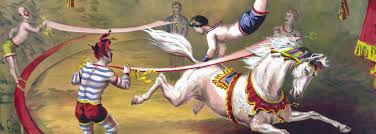
In spite of all this hullabaloo the circus rumbled into town. Through the narrow, main avenue of Black Rock, lined with shops, banks, the townhall, the police-station and the Wednesday open-air market, crawled ten or eleven caravans painted in colourful figures of clowns, mountebanks, lions and elephants, and odd looking creatures whose appearances the townspeople, gaped at wide-eyed. They watched this slow-moving spectacle as they stood on each side of the avenue like rows of sentinels or pine-trees. The rear-guard of the caravan was composed of a cage with two dozing lions, behind whom plodded two baby elephants, lethargically swaying their trunks, every now and then emitting a trumpeting cry as if they were announcing the arrival of the courtly cortege …

No one uttered a word as the caravan disappeared into the weedy fields outside the town, designated by the mayor for their one-night performance.

Before the astonished eyes of the townsfolk, many of whom had rushed out to the field leaving their shops unoccupied, men, women and other ‘odd’ individuals scrambled to and thro, pitching, erecting, raising, until the top-tent loomed large and welcoming before them. Admission was a mere two dollars, a comfortable fee for the good people of Black Rock, a fee, too, considered a largesse on the part of the owners given the fact that the performers had no peer on earth … Or so they said.

At eight o’clock sharp the flaps of the big-top were flung open to the mistrustful but curious folks of Black Rock. Mayor Rip Branco, with his wife and two young boys, was the first to be admitted, then the town’s children, all to be seated in the first six or seven rows of the grandstand. Next to shuffle in were the farmers, factory workers, bankers and shopkeepers with or without their wives, conducted to the stalls flanking the grandstand. No animals were permitted. Many of the men grumbled protestations or sardonic remarks, but the ticket seller, a smiling dwarf sporting a torero costume, took no heed.

When the spectators had settled in comfortably the lights went out. A blast of music boomed out of the pitch black. Trombones, trumpets, hand-drums and tambourines filling the big-top with rhythms and melodies very foreign to the ears of the spectators. A huge spotlight fell on five or six colourfully-dressed individuals in the ring masquerading as some sort of rag-time band, blowing or banging their instruments as they danced about in happy-go-lucky abandon. The ring-master stepped out of this motley crew, pushing and shoving them aside, lashing out with his whip towards the more recalcitrant ones, who, in defiance of the snapping whip, blew out scales of disobedience. He bowed to the spectators in the most obsequious manner, doffing his black top hat. One of the musicians handed him a huge megaphone and he bellowed :

“Ladies and gents … and children too, tonight is the night of all nights, one you will never forget. All of you will witness the most rollicking merry-makers that have stalked our good earth; the most incorrigible buffoons who have ever lived. Your eyes will feast upon a jamboree of dancing, jestering and cavorting oddities whose dazzling shenanigans have always made children shriek, women scream, men doubt their senses. But I can assure you every stunt, every act, every gesture, however burlesque, is of the utmost authenticity.” Whether all the spectators were able to decipherthe ring-master’s opening tirade is difficult toassess. In any case, he went on: “ Now, let me present the strongest man on Earth, the nameless giant of Central Asia.” And as he cracked his whip the musicians fled into the darkness behind him. Out of that mysterious dark, the nameless giant charged into the middle of the arena like a raging bull. The master of ceremonies fled as if for his life. Snorting and grunting, the colossus, clad only in a tiger-skin loin-cloth, flexed his biceps, threw out his mighty chest, tightened his thigh muscles. He was indeed a mountain of muscle. Meanwhile popcorn and cotton candy were being distributed to the children, free of charge. Mayor Branco and his family also benefitted from this boon …

The strongman made horrible grimaces at the children who shrank back in their seats, squealing. He stomped about snarling and growling, flaunting his muscle-laden body until out rushed seven little dwarves dressed as toreros, all of them brandishing a bullfighter’s cape. They swarmed about the now enraged strongman, waving their capes and taunting him with obscene gestures and cuss words. The strongman charged into them head down like a bull, snorting and panting, swinging his bull-like neck from left to right, knocking a few dwarves to the sandy soil of the arena. Just as the crowd began to display overt displeasure at this unseemly spectacle with hoots and hollers (except the children who were cheering on both), two dwarves jumped up on to the strongman’s massive shoulders, followed promptly by all the rest, where gradually they formed a little pyramid atop this mountain of a man, who presently much appeased, pranced about in the spotlight with his ‘captured’ dwarves’, singing a song in some alien tongue. The dwarves hectored the dwarf-bearer, chaffing him with the crudest of names, smacking his massive face or slapping the top of his bald head with pudgy hands. With one mighty shake of the head, the strongman shook them all off into the air like so many swarms of flies, they, tumbling and rolling away, far enough from him where they continued to gesture indecorously.

Many spectators began to boo and hoot. Others laughed and cheered, especially the children, who munched happily on their cotton-candy and popcorn. “Shame! Shame!” cried out several women from the stalls. But their rebukes were drowned out by two or three applauding groups of farmers who apparently had been drinking before the performance. In fact many men were drunk, and the majority were taking much delight in this unusual spectacle …

Just then, at the crack of the ring-master’s whip, the dwarves rolled out of the arena and the strongman stomped away, bowing to the crowd. Into the ring now appeared five very weird-looking creatures, and behind them, as if by magic, a long, high tightrope that had been erected, held up by two very high wooden ladders. The spectators were baffled: humans or animals? Three, perhaps women, had faces of lions, whose ‘manes’ grew out of their cheeks, rolling in thick strands down to their feet. It was a horrible sight! But more horrible still were the two-headed and the mule-faced women, dark faces drooping down to their necks. Gasps rose from the crowd. Cries of indignation followed.

“Freaks ! Monsters!” they rasped and raged at the smiling ring-master who introduced his acrobats and trapeze performers, one by one, as the finest in the land whilst they speedily climbed up the ladders, three to the left, two to the right. At the top, they tip-toed out on to the thin wire where in burlesque abandon they danced and pranced and sang, the wire swaying to and fro. One or two juggled little red balls, tossing them over the heads of the others who attempted to catch them. Far below, the master of ceremonies whipped his whip and the merry acrobats danced and pranced all the more ardently, one or two on one foot, as the wire rocked, rolled and pitched like a boat. Terrified shrieks rose from the now standing crowd. Farmers and factory workers showed their fists. Women shouted abuse. As to the children and Mayor Branco, they clapped in rhythm to the singing quintet rocking and rolling on that tightrope.

At that point Mayor Branco turned towards the displeased crowd behind him, confused about what attitude to adopt. There was no doubt that the acrobats and trapeze performers were genuine artists ; their antics on that high wire brooked no belief of beguilement. And however ‘freakish’ they appeared to be, this awful birth-born deformity should welcome a hearty appraisal. Which the good mayor did from the bottom of his heart when the five performers had slid down the ladders, taken their bows in the middle of the ring and disappeared behind the rear flaps of the top-tent.

Much of the crowd were on its feet, red-faced (due to their drinking ?), shouting down to the ring-master as he cracked his whip violently: once … twice … thrice, signal which brought out two ferocious, roaring lions[1] shaking their manes. The spotlights followed their proud steps as they neared the front rows of the grandstands. There they sniffed the cotton candy of the now terrified children who recoiled in their seats. Their parents rushed to their rescue, but this was unnecessary, for another crack of the whip — and the accompanying spotlight — brought out a three-legged man and a pin-headed man. They strolled towards the sniffing lions, calling them by their names. One of the lions began lapping the popcorn out of the outstretched hands of several children who squealed in wary delight. Then the lion licked those charitable hands in grunting gratitude.

The pin-headed man whistled. The huge beast turned and trotted to him. He waved to the crowd then opened the lion’s mouth, pushing his pin head into it. As to the three-legged man, he had hopped on to the other lion’s back, two legs at its flanks and one lying over its fluffy mane. With a deafening yelp and roar, they galloped around the ring as if they were at a rodeo show, rushing around the pin-headed man whose whole tiny body had by now completely disappeared in that lion’s open mouth. The crowd held their breaths uncertain of the stance they should take on this stunt. Could a man possibly crawl into a lion’s massive maw ? The drunken farmers laughed grossly. Their wives sneered in contempt. The children sat in excited expectation.

Meanwhile another spotlight had fallen on a beautiful milky-white woman clad in a silken gown, standing upright against a large board placed behind her. Another spotlight swung to the left where a legless man, using his arms like a pair of crutches, had positioned himself ten or fifteen feet from the upright woman, a huge leather belt girding his chest from which hung dozens of kitchen knives. Between this scene and the lion-tamers’ antics, the spectators remained nonplussed, no longer hooting or hectoring.

The legless man swiftly took a knife and threw it at the lovely girl; it drove into the back board a quarter of an inch from the crown of her head. Here the crowd puffed in awe. Many women covered their eyes whilst the children were all eyes! He threw another and another. After each knife thrown, the crowd gasped a huge gasp! The legless man continued his act, each knife working rapidly downwards from the woman’s head, around her exquisite shoulders, along her slim, graceful hips, lengthwise her bare, slender legs until reaching those minute feet of hers. When he had finished his knife-throwing performance, the beaming, long-haired woman stepped out from the contour of the knives, the spotlight proudly exhibiting her ravishing silhouette configured on the board. With a gesture of triumph, she pointed to that silhouette, then glided over to the legless man, took him by the arm and both bowed reverently to the crowd. The men jumped up cheering wildly, either out of respect for the knife-throwing performer or for the ravishing beauty of the woman. As to their wives, they remained seated, smugly looking towards the ring, disregarding their drunken husbands’ sonorous applause. Mayor Branco was on his feet applauding along with his two boys, his wife tugging at his sleeve to sit so as not to make a spectacle of himself.

All of a sudden two spotlights swept over the galloping lion and the one that, it would seem, had all but swallowed the pin-headed man. But no ! Look … there … The lion yawned a wide yawn and out of that yawn the pin-headed man leapt, running about the ring crying out: “I’ve lost me head ! I’ve lost me head!” The crowd, stunned by these uncouth shenanigans, again began yelling insults. As to the galloping lion and its whooping cavalier, they darted to the right, where in front of them a huge hoop had been magically placed; a fiery hoop whose leaping flames hissed and sizzled. Through the hoop they jumped followed by the other lion, tailed by the waddling pin-headed man who dived through the hoop, tumbled over on the other side, got up, dusted himself off, then bowed to the hypnotised spectators. The children at once howled with joy. The adults, hesitant as to the ‘quality’ of this extravagant act, remained stoic, frowning.

The band struck up a local tune, horns and drums ushering in a motley gaggle of clowns rushing about the ring like escaped madmen from an asylum. In their frantic scuffle, two or three of them were tossing about a strange object, flinging it about like a football. A sudden shiver of horror swept through the crowd: those merry-making buffoons were passing a living torso to one another! A man without arms or legs! He had a huge smile on his face as he sailed in the air from one pair of arms to another. Then the clowns broke into a song: “ Zozo the clown and his funny hat, patches on his pants and he’s big and fat, long flappy shoes and a round, red nose, makes people laugh wherever he may go!” These lyrics were repeated without respite as they played football with the torso, who, and it must be stated here, was crying out for joy!

Enough was enough! “ Monsters! Monsters!” cried out groups of red-faced, infuriated men from the back of the stalls, screwing up their eyes. Rotten tomatoes were thrown at the shameless buffoons by the farmers who had brought them along for the occasion. Ladies screamed. The children sat in dazed awe, following each pass of the laughing torso as if they were following a football match. The frolicking clowns, undismayed by the tomatoes, performed cartwheels and somersaults from one end of the ring to the other.

But it was the following scene that left the crowd dumbfounded. As the laughing torso was thrown from clown to clown, spurts of orange flames spouted from his mouth! Long fiery flames that carved out tunnels of blazing light as he arched high in the air. This surreal scene rendered the crowd, momentarily, mute with puzzled, ambiguous emotions. They soon, however, regained their initial, infuriated state. 

In the last rows of the stalls, rowdies were making a tremendous row, brawling with the bankers and notaries who had shown, up till then, an impassioned interest in these performances. Fisticuffs broke out. Faces were slapped or punched. Hair and beards were pulled. Clothes torn. Ladies knocked over. Things were indeed getting out of hand. Whistles blew. The local security guards rushed into the upper stalls roughly handling the more pugnacious men, untangling the tangles of rioters one by one, unknotting the knots of brawlers that rocked the stalls.

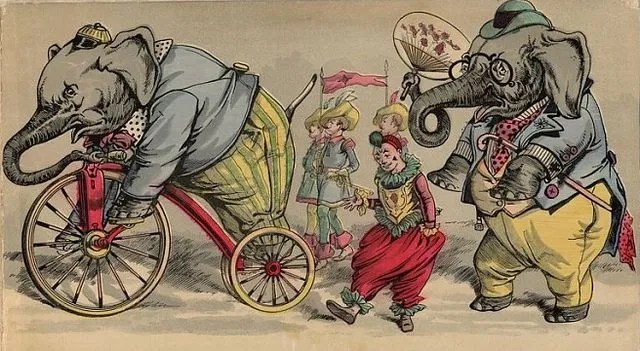
At that stormy moment, trumpets, trombones, drums and cymbals sounded below, silencing the brawlers for a brief moment. Then from out the side flaps two baby elephants charged, trunks held high, trumpeting louder than the fanfare! Atop them, seated in howdahs apparelled in the most royal regalia were yelping mahouts fitted out in cowboy costumes, waving their huge cowboy hats at the now stupefied spectators. The elephants chased the clowns around the ring, grabbing a few with their trunks, rolling them up then flinging them into the air. The elephants had gone amok, lifting their trunks for all to see their huge flabby smiles. The living torso was passed high over the mahouts’ reach, mouthing furious flames galore, landing with a thud in the arms of a receiving clown on the other side. The children in the front rows were on their feet howling with merriment, laughing along with the clowns and elephants as the chase continued on its merry-go-round way. And here the band struck up a favourite tune to which all the clowns sang: “Zozo the clown and his funny hat, patches on his pants and he’s big and fat, long flappy shoes and a round, red nose, makes people laugh wherever he may go.”

This boisterous chorus was joined by children, some of whom had internalised the tune. Their voices rose in unison, rising far above the brawling, bickering and rioting behind them in the upper stalls. To tell the truth, some of the farmers, factory workers and bankers had also joined in the singing. How they enjoyed those yelping ‘cowboys’ whooping it up atop the baby elephants.

Mayor Branco sized up the maddening bedlam, reluctant to decide who were the madder: the performers or the crowds! Yet, deep down, oh how he was enjoying himself that evening. For him, it would be the most memorable night of his life. And I will add here, for most of the other good folk of Black Rock, be they the howling children, the appalled women or the obdurate men …The madness grew even madder when from out of the side flaps the seven little dwarves scrambled, dashing up to the elephants, waving their capes. One or two of these mischievous acrobats had been on stilts and were trying to distract the rampaging mahouts with their capes. The mahout-cowboys riposted by letting fly their lassoes, the nooses catching one or two of the rascally dwarves who were toppled from the stilts and dragged mercilessly in the wake of the plodding elephants. The ring had become a veritable pandemonium of lunacy and delirium …

Suddenly all the spotlights went out. A sudden lull crept over the ring, creeping stealthily up into the stands. A deep lull during which time not one drunken cry from the adults, not one choking laughter from the children, not one trumpet from the elephants nor yelp from either the cowboy-mahouts or  clowns or dwarves were heard. The lull must have lasted a minute or two …

The lights suddenly flooded the ring where all the performers and animals had mustered in humble expectancy. Silently they stood (or were held!) searching out the crowd for compassion, understanding, appraisal. The master of ceremonies stepped out from amongst them. He doffed his top hat :

“Ladies, gents and children. The performances that you have experienced tonight will not go unnoted in the chronicles of Black Rock.” (Whether this opening remark meant to be ironic is not for your narrator to say. In any case, it provoked a few snickers from the upper stalls.) “Yes, many of you have exhibited displeasure and resentment. Monsters you cry out? Freaks you bellow in bitter tones! Well, yes, if by monsters you mean these humble unfortunates who have had the courage to show themselves, to exhibit themselves to the public as true artists, and not sulk in self-pity or hide out like criminals or unwanted wretches out of the righteous eye of the public. But why display such ill-feelings towards them, may I ask? Because many of my performers suffer from birth deformities? Because they are physically unlike normal people? No! Their terrible deformities do not, and will never deprive the public the goodness and nobleness of their hearts of gold … their feelings of sincerity when performing for you. But this sincerity must be reciprocal. If not, their disfigurement will be interpreted as a ticket to the streets, a paid fare for lethal medical experiments in clinics, tearful departures for the zoos where they will be put into cages like savage animals … We are a grand and hard-working family whose every member holds equal status. But their livelihood, ladies and gents, depends on your good will, your protection against dangerous individuals whose illicit, murderous intentions would have killed them off long ago or maimed them even more. Here, within the sanctuary of this vast tent, look not at those deplorable disfigurements, but consider fairly and honourably their long, long hours of labour, their unquestionable talent, their dauntless courage and human dignity.”

The fanfare struck up one of rag-time tunes to whose familiar melodies all the children stamped and clapped. Their mothers and fathers also clapped. Farmers, shop-keepers, bankers and factory workers alike imitated the gaiety of the children. Even the security guards joined in the revelry. As to those adamant hooters and rioters, they stalked out of the top-tent, raising their fists, spitting out drunken obscenities … Which were drowned out by the general mirth and merriment.

All the performers bowed. The baby elephants held their trunks high, the lions shook their proud, bushy manes.  With the crack of the whip the lights went out.

The good folk of Black Rock Montana filed out of the top-tent singing the Zozo tune. Mayor Rip Branco was the last to leave, a bright, beaming smile on his round face.

And as Shakespeare once had occasion to record: All’s well that ends well.

[1] The story is set in indeterminate times (the author claims around 1970s) before animals were banned from performing in circuses.

https://www.fourpawsusa.org/campaigns-topics/topics/wild-animals/worldwide-circus-bans

https://www.four-paws.org/our-stories/press-releases/october-2021/one-million-signatures-supporting-the-end-of-the-use-of-circus-animals

.

Paul Mirabile is a retired professor of philology now living in France. He has published mostly academic works centred on philology, history, pedagogy and religion. He has also published stories of his travels throughout Asia, where he spent thirty years.

.

PLEASE NOTE: ARTICLES CAN ONLY BE REPRODUCED IN OTHER SITES WITH DUE ACKNOWLEDGEMENT TO BORDERLESS JOURNAL

Click here to access the Borderless anthology, Monalisa No Longer Smiles

Click here to access Monalisa No Longer Smiles on Kindle Amazon International

Categories
Poetry

Bermuda Love Triangle & the Frothiest Coffee

Poems by Rhys Hughes

BERMUDA LOVE TRIANGLE 


Our aeroplane
vanished one day into the void
without an explanation.
We were flying towards Bermuda
to attend a birthday celebration
but we never arrived.

Your ship disappeared
one afternoon while sailing slowly
north of Puerto Rico.
You were afeared it had sunk
to the bottom of the sea
in some unholy catastrophe
but it hadn’t.

And as for the submarine
cruising east from the Bahamas:
the crew were wearing pyjamas
when it mysteriously
passed out of this world
and entered a realm like a dream.

In a higher dimension
these three vehicles materialised.
Without our consent
they fell in love and began an affair:
an aeroplane snatched from the air
in a relationship
with a sailing ship
and a submarine involved with both.

What a complicated situation!
So many emotions entangled…
I almost feel strangled
by the melodrama
of the Bermuda love triangle.


THE FROTHIEST COFFEE

The frothiest coffee that ever there was
swung from a tether, for certain
because
it was the frothiest coffee
that ever could be
in history
apart from the brew
made frothy by you
for the numberless Counts of Ballyhoo,
all of whom despise tea.

But why did it swing from a tether?
I sigh when I’m asked
that question
and not for the reason
that it’s the
wrong season for asking it. Oh no!
I sigh because
sighs are wise and I’m
a kind of owl
with a reputation to uphold.

What kind of owl exactly?
A coffee loving owl.
I spoon the ground beans into a barrel
with a trowel
and then I add the boiling milk
and I whisk it
vigorously until my soul seems to sink
and cavort among
the bubbles of the wondrous foam
that turns this hovel
into a proper home, as only the frothiest
coffee can.
I hope you understand?

And now I ought
to say something more about
the Counts of Ballyhoo, who as you know
were enemies of tea,
and the youngest scion of that House
was Freddy Fiddledee
and he once decided to embark
on an epic journey in a wooden ark
because ‘motorcycle’
doesn’t rhyme with ‘embark’
at least not at this particular time.

And his mission was
to find out for certain if there really was no
blend of tea he might enjoy,
black or milky or lemony,
in cups or mugs on the decks of tugs despite
his renowned family’s
aversion to that brew: he wondered if there
might be something new
that the world could offer him:
a change from the inevitable coffees he knew
too well, hot as hell,
but there wasn’t.
Too bad! His voyage was a waste.

Let’s not be hasty
and think the poem is at an end.
There are two more lines to go:
this one and
the next one.

Rhys Hughes has lived in many countries. He graduated as an engineer but currently works as a tutor of mathematics. Since his first book was published in 1995 he has had fifty other books published and his work has been translated into ten languages.

.

PLEASE NOTE: ARTICLES CAN ONLY BE REPRODUCED IN OTHER SITES WITH DUE ACKNOWLEDGEMENT TO BORDERLESS JOURNAL

Click here to access the Borderless anthology, Monalisa No Longer Smiles

Click here to access Monalisa No Longer Smiles on Kindle Amazon International

Categories
Musings of a Copywriter

Hobbies of Choice

By Devraj Singh Kalsi

In the public park near my residence, a motley group of kids and teenagers gather after dusk to learn karate from a trainer who does not generate the impression of being an agile practitioner of the art of self-defence. He barely makes a move as he struggles to raise a leg or strike an aggressive pose in his demo lesson. Although his body seems to have lost visible signs of fitness, his body of experience helps him grow his client base. He depends on his stentorian voice to cast a grand impression and throw his weight around as the most experienced trainer in the town.  

In the presence of guardians, mostly mothers, the instructor tries his best to sound confident and look smart, ready to provide feedback regarding the progress of young learners who grasp the moves and go home to try it out on their tired fathers unwilling to sponsor a weekend treat or buy them a fancy gift. Cowed down with threats of jabbing their delicate organs with trained fingers during sleep, they cave into submission. This is the most evident sign of triumph cheered by mothers, making one wonder if the ulterior motive to train in this martial art form is to teach stubborn dads a befitting lesson. 

The lure of acquiring a black belt does not make kids eager to learn karate but the assurance that they can defend themselves in case of a kidnapping attempt or sexual assault acts as a trigger for them to indulge in the practice sessions. Only a few kids, mainly girls, look genuinely interested in learning the skill whereas the rest of them perform under compulsion, to find inclusion in their peer group and amplify the status of their mothers who post pictures of karate-learning kids on their social media handles. Even though they do not expect them to become famous like Bruce Lee, they need the satisfaction of providing their kids the best opportunity to hone their defence skills. Nobody bothers to ask kids whether they asked for this opportunity. Just because they keep fighting at home, it is not right to infer that they are going to be big fighters. 

The trainer appears to be a good conversationalist as he takes small breaks to narrate anecdotes of his martial arts journey over the decades and infuses humour in his tales of dare-devilry to justify the steep fee he charges for his tutelage. Holding open-air classes three days a week, the instructor regales them with heart-warming, humorous tales that bring out the chronicler in him, fetching instant praise from the mixed crowd and free advice to compile them in the form of a book. Story-telling acumen ramps up his popularity as a karate teacher in the locality as he rides a heavy motorbike despite a problematic knee after surviving a life-threatening accident. Sympathy drips for him when he explains how he risked his life to save the life of a stray dog one night. 

Many women admirers predict a better future for him as a successful writer without knowing the long, harrowing struggle behind it. He spends more time in the park and allows kids to practice a lot without interference while he engages in discussion with mothers who appear sympathetic to his sacrifices and dedication. When some of his students excel in the district-level championships, the credit goes to him for being an excellent mentor. 

Almost a similar scene pans out in the housing society where the builder has constructed an indoor swimming pool as the chief attraction to sell the apartments. Considered a good exercise and a necessity to stay safe from drowning, parents and kids line up to learn to swim every evening. With mothers tagging along, kids in swimwear brace up to master new strokes. Men sit and dangle their legs by the poolside, sometimes taking a half dip as if bathing in a holy river, holding the rod for support. It gives a feeling of consolation that they use their time for exercise and also to showcase their responsibility towards young ones by teaching them swimming. 

Talking about popular hobbies, the craze to attend a music school remains all-time high as there are multiple options to take up singing as a career. Kids learn Sa-Re-Ga-Ma[1] along with ABCD these days. When they trudge to the music academy to learn how to sing or dance, it reminds me of what I had been through during my childhood days. The shrill-voiced music teacher was so scary that I could not play the harmonium in her presence. Hitting the right notes always became a challenge. After a few months, she gave her verdict that my voice was good, but my singing was bad. The day I broke the reeds of her favourite harmonium, her patience also broke. She imposed a fine to compensate for the damaged instrument and asked me to leave. 

Some years later, I got a chance to sing in front of my class on Teachers’ Day. The few lines I sang were liked but they added it was too fast paced, as if I was in a hurry to complete the song. I couldn’t say I tried to be peppy, but the truth is that in the presence of a teacher, you are reminded of alerts like quick or hurry. The lack of stillness and relaxation was palpable in the voice to suggest the singer was rushing through the singing exercise.

My maiden performance in front of the audience was lauded, and I was encouraged to practice more to get the chance to sing on Parents’ Day. Imagine singing a ghazal by Ghulam Ali or Mehndi Hasan[2] in front of a thousand people, and not being able to do justice to it. I chickened out as the pressure took a toll on my confidence to deliver. Even though some teachers encouraged me to take it up, I stayed out of it as the words of my music teacher kept haunting me. My tryst with singing began and ended with a film song from a Bollywood flick, Saagar[3]. Sometimes the wrong guide derails your interest. You develop a fear of the subject based on expert assessment by a person who is no expert of the subject. A fast paced ghazal performance would have been a hilarious idea as would be a new take on the ghazal format. It would have also become the iconic highlight and a major embarrassment in front of purists who would abhor the idea of a pop ghazal as a deliberate attempt to mar its purity. 

There is a new visitor – a guitarist – who comes to the park with his son. He sits on a bench and practices Western numbers while his son goes playing with friends. Park joggers stop in their tracks and listen to his soulful singing. Recently, a senior uncle assured him of an audience during the cultural program in the festive season and he agreed to sing Bengali numbers before a few hundred people without charging a penny. It was a dream come true for an upcoming musician and he thanked the committee members. 

The son started dancing right away, feeling happy for his father who was struggling to get a chance all these years. Most of the kids in school perform in front of their parents but it is a surprise when fathers perform on stage in front of their children. The joy parents get by encouraging kids to pursue a hobby is sometimes guided by their residual desire to see their kids learn what they couldn’t during their prime years. When kids see their parents fulfill their dreams, they also feel happy that they are not forced to realise the unfulfilled aspirations of their parents. While it is good to give kids the chance to pursue a hobby, it should be of their choice and not thrust upon them as a compulsion just because some kids in the locality or peer group are doing it. A hobby cannot become a passion if one is not obsessed with it. 

[1] Indian notes for music

[2] Well known Indian singers

[3] Translates as Ocean, a 1985 Bollywood film

Devraj Singh Kalsi works as a senior copywriter in Kolkata. His short stories and essays have been published in Deccan Herald, Tehelka, Kitaab, Earthen Lamp Journal, Assam Tribune, and The Statesman. Pal Motors is his first novel.  


PLEASE NOTE: ARTICLES CAN ONLY BE REPRODUCED IN OTHER SITES WITH DUE ACKNOWLEDGEMENT TO BORDERLESS JOURNAL

Click here to access the Borderless anthology, Monalisa No Longer Smiles

Click here to access Monalisa No Longer Smiles on Kindle Amazon International

Categories
Poetry

Poetry by Saranyan BV

Not Knowing What to do with What is Left


I sat in the railway station leaning on a chair.
The evening was pleasant with orange-violet cotton clouds.
The chairs were meant for the passengers waiting for the 5.45 pm shuttle.
The passengers carried veggies and sweetmeats in yellow bags to take home.

Most of the passengers were old and capable of coughing the phlegm of life.
One or two well-to-do walked up the refreshment stall and slurped the hot brew.
I never went to that side because it reeked of sour milk.
Aroma of guavas rented the air where I was seated. It is the season, though late.

The bill advertising the tabloid press said,
‘An engineer from the public works department was found dead in the reservoir.’
I have seen only fishes in those turbid waters, big and small ones snapping their tails.
Sometimes pachyderms appeared from the thick groove on the banks for a drink.

Doubts were raised if the engineer committed suicide, or was it a murder?
A crow wearing a grey collar flew under the roof. It pecked at crumbs fallen off
The potato wafers people bought, ate from polythene bags to kill hunger
While the wait pounded blue vessels and produced dreariness.

The fritters would be swept away before sunset
By the station cleaning staff enveloped in bellow-like overalls.
These particles would soon be part and parcel of the purple carboys in which garbage collects.
The crow has to make a quick dash for its supper. It did not pause to read the bill.


The news of the engineer’s death did worry the crow or anyone. We were not like the crow with the grey collar.
We sat craning our necks and knitting brows, not knowing what to do with what is left.
One of us returned and said the post-mortem is done. The pyre is lit without a trace.

Saranyan BV is poet and short-story writer, now based out of Bangalore. He came into the realm of literature by mistake, but he loves being there. His works have been published in many Indian and Asian journals. He loves the works of Raymond Carver.

.

PLEASE NOTE: ARTICLES CAN ONLY BE REPRODUCED IN OTHER SITES WITH DUE ACKNOWLEDGEMENT TO BORDERLESS JOURNAL

Click here to access the Borderless anthology, Monalisa No Longer Smiles

Click here to access Monalisa No Longer Smiles on Kindle Amazon International

Categories
Review

The History Teacher of Lahore by Tahira Naqvi

Book Review by Somdatta Mandal

Title: The History Teacher of Lahore: A Novel

Author: Tahira Naqvi

Publisher: Speaking Tiger Books

Tahira Naqvi, the Pakistani American writer, has extensively translated the works of Saadat Hasan Manto, Khadija Mastur, Hajra Masroor, and the majority of works by Ismat Chughtai from Urdu into English. As a teacher/professor of Urdu language and literature at New York University, she has regaled us with several short stories that speak of cross-cultural encounters of immigrant Pakistanis in America, especially about how women experience acculturation in the New World. The History Teacher of Lahore is her first novel where she recollects the sights, sounds, and ambience of growing up in Lahore in intimate details. The setting of this novel is the nineteen eighties, which was particularly a time of unrest in Lahore. In this debut political novel, Naqvi eloquently portrays the struggle between a besieged democracy and the rise of Islamic fundamentalism on the one hand, and the thriving cultural traditions of Urdu poetry on the other.

The story begins with the young protagonist Arif Ali who moves from his hometown of Sialkot to Lahore with a dream of being a history teacher and a poet. A ‘tall, slight man in his late twenties,’ we find him relaxing on a bench in Jinnah Park — a place that has become haven for him to spend his time reading, far away from the ferocity of traffic and street crowds. In the days that followed, Arif realised that in the Government Model School for Boys where he taught, he was forced to teach the boys another kind of history for his sake as much as theirs. But that required deep thought, time, and enthusiasm. He befriended Salman Shah, another teacher in his school, and his rapport with him grew stronger by the day. But once again, Arif found the atmosphere in the school was becoming increasingly confining. He would often engage in animated chatter with the high school Islamiyat teacher Samiullah Sheikh, whom he found disagreeable. Not only dressed in Shariyah compliant clothes, but this man was also waiting for his opportunity to teach at a madrassah[1]. This was the period when bans were being imposed on popular music of the kind Nazia Hasan and her brother sang for the younger generation, and even though ‘Disco Deewane’ and ‘Dreamer Deewane’ were sung loud, fear had become an elixir for rebellion. Arif was forced to resign from the school and along with his friend Salman. he ultimately got another position as a history teacher in another private school, Lahore Grammar Institute, where there was more freedom to teach than in the earlier one. The free socializing among the sexes here was new and noteworthy for Arif.

As Arif’s impotent rage towards the increasing religious intolerance grew, he joined his friend’s uncle Kamal and his partner Nadira to secretly help them rescue underprivileged children in clandestine ways. In the meantime, his poetic creations found great impetus when he found a secret admirer in Roohi, Salman’s sister, and started sending her his poems regularly. Though they never met, Roohi would write letters to him every week, and gradually, the more letters Arif received from her, the more his feelings for her grew. The secrecy of their epistolary courtship continued for quite some time till things were disclosed and after a lot of twists and turns in the story, they were finally engaged to get married.

In the meantime, his friend Salman got engaged to a colleague Zehra Raza, and despite the Shia-Sunni clashes that prevailed in society all around, they were unaffected by such ideology. The three of them developed a close camaraderie among themselves, but soon after, the General’s death brought in a lot of political turmoil in the city. The mentality of the public also changed, people went en-masse to watch public flogging, and trouble loomed ahead when Sunni Shia, Ahmadi non-Ahmadi, Punjabi Urdu-speaking, Protestant-Catholic, divisions and sub-divisions, inter-faith, inter-class and inter-religion issues became more and more marked in all spheres of society. The warp and weft of faith produced such tangled intricacies as could only be imagined in nightmares.

As the nation was caught in the vortex of religious extremism, Arif’s position also underwent a great change in the school when he wanted to teach ‘true’ history to his students. He was caught in a dilemma when he found he was forced to teach false historical information in the doctored textbook that Aurangzeb with his hatred of other religions was adored whereas Akbar with more religious tolerance was totally sidelined. He tried to rectify the errors by providing supplementary notes to his students, but that landed him in more trouble. Apart from differences of opinion with the other teachers in school, Arif’s was gripped with a kind of fear and frustration when some unidentified goons threatened him to stay away from issues that did not concern him. Things got worse when a Christian student in his class was falsely accused of blasphemy and Arif decided to save him from being arrested. He embarked on a dangerous mission to resolve this Christian-Muslim conflict that landed him in the middle of sectarian clashes and without giving out all the details, one just mentions that the novel ends at a tragic moment.

In the acknowledgement section Naqvi states that she is grateful to her father for many things but especially for his Urdu poetry which she has used freely in translation. These poems, ghazals and nazms, help to explain the different moods of the protagonist and his mental situation very clearly. One interesting aspect of the novel is that each of the twenty-two chapters is prefaced by a small quote that in a way summarizes the mood and content of that chapter. Most of these quotes are from Jean-Paul Sartre, while others are from Spinoza, Ghalib, Shakespeare’s Sonnet 116, H.W. Longfellow, Jacques Derrida, Tertullian, Thomas Mann, and four entries particularly from The Lahore Observer dated 15 September 1990, December 1990, January 1997, and January 1998 respectively. These wide-ranging quotes not only increase the story-telling impact, but also endorse the erudition of the novelist herself.

To conclude we can say that Bapsi Sidhwa’s The Ice-Candy Man gave us the sights, sounds and details of Lahore during the Partition in 1947, and the same city becomes wonderfully alive again through the pen of another woman writer from Pakistan who had spent her growing years there, and who gives us details about it from the 1980’s onwards when  the political situation of the country was once again very murky. The novel wonderfully portrays the radical Islamisation of the country that included murder, mayhem, and public flogging and more that was visible in Lahore, as this process resulted in terrible uncertainty in the lives of the city’s residents from all walks of life. Strongly recommended for all readers, we eagerly wait for more novels by Tahira Naqvi in the future. The insider-outsider’s point of view offered by her is remarkable and this debut novel can be counted as a collector’s item.

[1] Muslim religious school

Somdatta Mandal, critic and translator, is a former Professor of English from Visva-Bharati University, Santiniketan, India.

.

PLEASE NOTE: ARTICLES CAN ONLY BE REPRODUCED IN OTHER SITES WITH DUE ACKNOWLEDGEMENT TO BORDERLESS JOURNAL

Click here to access the Borderless anthology, Monalisa No Longer Smiles

Click here to access Monalisa No Longer Smiles on Kindle Amazon International