Categories
Stories

Chadar

By Ravi Prakash

                                                           (1)

“Kaki[1]do not worry. Will you not go to Ajmer Sharif just because you do not have money? No, no. As long as I am to support you, you are going to Khwaja’s Dargah[2]. I will give you the money. Lose not this chance. When the Khwaja has summoned you, how can you deny? And, that too, because of money! No, no – never. Tomorrow is the final hearing of a case, and I will get a good sum. Pack up your luggage and be ready. I will arrange for the expenses. Take no stress. You are going to Ajmer Sharif, okay?” Mishraji said to his neighbour, an old Mohammedan widow.

Mishraji was an advocate by profession. His law practice in the district court paid well, but to assume him rich would be an exaggeration. He was not poor either; his wife wore jewellery and he had a 110-cc Honda bike.

The old widow lived alone. Her husband had died two years ago, and her two sons, too, had gone to Saudi Arabia for earning a better livelihood. Such migrations for getting a better pay were not new in the village. One or two from every family had migrated elsewhere to overcome the persecutions of poverty.

The widow, Saliman, had taken a vow that if her sons started to earn there, she would offer a Chadar [3] at the shrine of Khwaja Moinuddin Chishti in Ajmer. Apparently, she needed the money for the pious journey. Her sons had promised to send as soon as they got their first pay, but even after three months, she had not received a dime.

Maybe her sons had squandered the money away, or it might also be that they had not got it themselves yet. The widow subsisted on the rations she got from the PDS (Public Distribution System) and the vegetables in her kitchen garden. As for cash, she had little money she used to get as rent for her fertile land, less than an acre. The rent she got was just enough for the daily expenses, not for the pilgrimage she had taken upon herself.

 Now, when the time to go had come closer, she had almost nothing except two hundred rupees she had saved somehow. She knew it would not be sufficient even for the bus fare to the dargah.

Since many of her acquaintances were going, whenever someone asked, “Kaki, have you done your packing for Ajmer Sharif?” She would humbly reply, “Not this time. I will go next year.”

When Ramakant Mishra, the advocate known as Mishraji among the villagers, got this news from his wife, who must have heard this at Kaffu’s confectionery – the one and only one in the village, he offered to help Saliman kaki. In good will, of course.

                                                        (2)

The next day was Monday. The court was in session. He pleaded his client’s case. After the closing argumenthe was waiting for the decision. The decision was in his favour. The client, who had just been cleared of robbery charges, handed him a bundle of cash amounting to ten thousand rupees. Mishraji’s eyes smiled; the crispy notes had tickled his senses.

To keep his promise, Mishraji left the court early and started on his bike towards the village. He wanted to give the money to kaki in time for her to catch the bus.

Sixteen kilometres separated the town from his village. A dilapidated zigzag road, full of potholes and hairpin bends connected both. It ran between paddy fields, hamlets, shops, temples, and mosques. Had a photographer taken an aerial shot from a minaret, the photo would have looked like a reticulated python coiled between green and grey spots.

Mishraji set out for the village at three in the afternoon. He had to reach kaki before a quarter to four because the bus was scheduled to leave at four. He was in a hurry to get to her in time.

                                                        (3)

By quarter past three, Mishraji had covered almost half of the distance; the old peepal tree, taken as the abode of a Brahmarakshasa[4] by the villagers, the brick kiln which provided work to destitute men and women and school dropouts, and the chai tapri[5]also used as a gambling den by the idlers, all these landmarks were left behind as the bike sped past. Now, Mishraji was passing by a temple, situated near a well on his left side; but right then, a truck overloaded with cement sacks came from the opposite direction. He had to stop to let it pass. It went on rambling and trembling and leaving a cloud of dust thick enough to make him cough. These were the day-to-day realities of his life. He had forgotten that these were the problems to think about, complain about, and raise questions about.

When the truck went away, Mishraji sped off on the bike again. He could see the next hairpin turn in a distance of a few hundred meters and a boy of fourteen or fifteen riding a mule cart loaded with sun-baked bricks. The boy must have been a daily wage labourer from the nearby kiln, Mishraji thought, and he was probably going to deliver the bricks there. The boy and the mule cart were the only objects of his undivided attention then, for the boy’s focus wasn’t on the road but on the mule. He was in a hurry. He was using the whip as an accelerator on the poor mule. As the boy whipped, the mule would start braying and tried to drag the cart with greater force. The mule slobbered and writhed in pain. Mishraji wanted to stop the boy and slap him for this cruelty. But fate had some other plans.

At the turn lay a deep pothole in the middle of the rutted road. No sooner did Mishraji turn his bike than the mule cart arrived close to him, and before he could pass, the right wheel went into that pothole. The mule, already exasperated, came down on its knees. The brick stacks, at rest earlier on the plain surface of the cart, plunged with a fierce thud on the right where Mishraji was. A few bricks fell on his thigh. And a few on the wheel guard, petrol tank, and windscreen, too. The result was an instant damage. The bike skidded off, and Mishraji fell before he could control himself. His left leg rasped against the loose gravel of the road. It tore off his pants, and the abrasion against the gravel made him bleed. He also got scratches on his elbow and knee. However, his head was safe because of the helmet.

The lad, no less responsible than the road and the turn, stood on the other side of the road with a flabbergasted face. Scared to death.

 The villagers working in the nearby fields ran for help when they saw the mule cart collapsing. At first, they supported Mishraji, and then, one of them straightened the bike and put it on the stand. Misraji was 46, but he had maintained his body through yoga. He stood up and walked a few steps just to check for any fractures. He was fortunate, there were none.

 A searing pain tormented him, but an abrupt rage had halted on his face. He pointed the people towards the mule – still kneeling under the weight of the cart. While they ran to balance it, his eyes looked for the real culprit.

He saw the boy standing on the other side of the road and beckoned him with a wave to come to him. The boy was shivering with fear; he had not imagined that something like this could happen. He started slowly and, with measured steps, came near. When he came close enough, without asking or saying a word, Mishraji held his hand and hit a hard slap on his face. Tadaak! It at once reddened his grimy cheek; a five-fingers-mark emerged on it as if the lightning flash were imprinted on the cloud; then another slap with the same force, and then again, a third one. The boy bellowed and cried for help. Mishraji growled, “Bastard, you almost killed me! Guttersnipes like you have oppressed the whole country.” He went on abusing with the same rage. And the boy kept crying.

Someone in the crowd ran towards him, and said, “Sahib, this boy is unfortunate. Mustaqim, his alcoholic father, beats him and his mother daily; his master, Chobe Singh, at the kiln, beats and abuses him if he arrives late. The master does not tolerate a late delivery. Forgive him, please. Who knows, but maybe God saved you from a greater danger.”

The rage Mishraji felt did not calm. Though he wanted to keep slapping the boy, since he had to reach the village on time, he jerked the hand of the boy and said, “Get last, and never show me your face again. Otherwise, I’ll wring your neck off. Buzz off!”

The boy, sobbing and wiping tears on his dirty sleeve, went to collect the scattered broken bricks. Apart from the recent slapping, he was much more afraid of the upcoming insults and scurrilities from the master waiting at the kiln. He gathered and stacked the bricks and started the cart. The mule limped at first but picked up pace after a slash of the whip.

For a few minutes, Mishraji watched the boy and said nothing. The crowd had already started to disperse. Since he had to reach on time; without giving much thought, he moved towards the bike. The accident had damaged it enough. The indicator, the headlight, and the visor were broken. The wheel guard had a crack; the petrol tank, an ugly scratch; and the front number plate had twisted off in such a way that it was hard to read the numbers from afar. Nonetheless, the bike started on the second attempt and carried the angry and injured advocate to his destination.

                                                        (4)

Seeing Mishraji’s condition, Saliman Kaki guessed at once that he must have had a narrow escape from an accident. As he came near, she hugged him and started weeping. Tears rolled down her cheek, and between the sobs, she said, “For me, you had to go through this. Allah, why did You punish this kind-hearted man for my sins? How unfair it is that You always test good men!”

Mishraji tried to console her, but she kept on crying and sobbing. Tears choked her. People on the crossroad, where the driver had parked the bus, watched the emotional scene in amazement. When the driver honked a fourth time, Mishraji realised the urgency of the situation, and taking out five thousand rupees from the bundle, handed them to the widowsaying, “Kaki, do not worry about me. I just got some scratches; they will heal in a day or two. Take care of yourself and eat well. Relax. Relax and call me when you reach Ajmer.”

She was just speechless. She said, in the end, while parting from him and stepping on the bus, “I will offer a Chadar for you, too. I will also pray for you. You are also like my son.”

The bus started, and Kaki stood at the entrance doorway looking at Mishraji until he was out of sight. He stood there, oscillating between joy and joint pains. He felt happy; he had forgotten about the boy.

He came home. His wife was sad and angry and cursed the boy who caused the accident. She also cursed Saliman Kaki. Mishraji bathed, put some bandages on the scratches, and gulped a few painkillers. After dinner, he fell asleep soon.

                                                     (5)

The next day, at the breakfast table, he saw the newspaper. He was dumbstruck after reading a short report in the corner of My City page. The headline read, ‘Man Beaten to Death. Accused is Absconding’. The report read thus:

‘Shravasti: A 50-year-old brick-kiln manager was allegedly beaten to death by a teenage daily wage labourer in Angadpur village of Ranipur block on Monday. The police said that the incident took place at four in the evening when the labourer arrived at the brick kiln with his mule cart to deliver the sun-baked bricks. The manager was angry due to the late delivery and tried to hit the alleged teenager by throwing a rosewood baton at him. When the baton missed the aim, the manager ran and caught the labourer and beat him black and blue. When the labourer fell, the manager moved back and went to his shanty chamber. While the manager was busy with his notebook, the labourer came into the chamber with the baton in hand and hit him on the head. He kept hitting until the manager was unconscious. Within an hour, the manager was taken to the District Hospital by people working around, where the doctors declared him dead. The primary cause of the death happened to be the skull fracture and severe brain haemorrhage, as told by the doctors. The accused teenager is absconding. According to the police, he must have crossed the border by now.’

[1] Aunt

[2] Sufi teacher’s shrine

[3] A decorative cloth that is offered at the shrines of Sufi Saints

[4] Demon

[5] A thatched teashop or stall

Ravi Prakash has spent thirty years of his life in a small town near the Indo-Nepal border in the district Shravasti. He now lives in Meerut and teaches English in a Government Inter College. Although, he has left the place, it has not left him yet; and possibly, will never leave him. Ravi tries to narrate the stories that haunt him day and night. A few of his stories and poems have been published in several online journals.

.

PLEASE NOTE: ARTICLES CAN ONLY BE REPRODUCED IN OTHER SITES WITH DUE ACKNOWLEDGEMENT TO BORDERLESS JOURNAL

Click here to access the Borderless anthology, Monalisa No Longer Smiles

Click here to access Monalisa No Longer Smiles on Kindle Amazon International

Categories
Poetry

Sparrows

Poetry and translation from Korean by Ihlwha Choi

The sparrow I saw under the roof of a border checkpoint

crossing from the USA to Canada,
heading to the Mahatma Gandhi Memorial in New Delhi,
coming out with a bottle of drink from an alleyway
encountered a sparrow in front of a small shop.

Both the sparrows – the one seen at the border checkpoint
and the other in front of the small shop,
belong to the same species as those
that live under the eaves of my hometown houses.
Next to the KBS* New York correspondent’s mike,
the sparrow hopping on the street, nibbling on crumbs,
and the sparrow living in a salt warehouse in Sorae*, Incheon,
are both sparrows from the same species.

Like a quiet Korean restaurant sign by the road on the way to Las Vegas,
or like the little six-year-old Korean-American kid I met
at a small snack bar in an LA alleyway,
lonely yet welcoming fellow countrymen sparrows from afar.

*KBS: Korea Broadcasting System
*Sorae: small creek in Incheon City, Korea

Ihlwha Choi is a South Korean poet. He has published multiple poetry collections, such as Until the Time When Our Love will Flourish, The Color of Time, His Song and The Last Rehearsal.

.

PLEASE NOTE: ARTICLES CAN ONLY BE REPRODUCED IN OTHER SITES WITH DUE ACKNOWLEDGEMENT TO BORDERLESS JOURNAL. 

Click here to access the Borderless anthology, Monalisa No Longer Smiles

Click here to access Monalisa No Longer Smiles on Kindle Amazon International

Categories
Review

A Lyrical Love Song for Milkwood Trees

Book Review by Basudhara Roy

Title: A House of Rain and Snow

Author: Srijato, translated from the Bengali by Maharghya Chakraborty

Publisher: Penguin Random House

“I believe I would want nothing else if I am allowed to just think. If it were a real job, I would be the first to get it. The only problem then would be that I would have to think on someone else’s command. Now I am free to think whatever I want.”

A quiet tenderness beckons the reader to A House of Rain and Snow. The title suggests everything generous and hospitable. Once inside the cosy house of this novel set in days before the internet revolution, there is, indeed, no disappointment. A translation of Srijato’s[1] Prothom Mudran, Bhalobasha [2]from the original Bengali into English by Maharghya Chakraborty[3], the novel offers, on the face of it, a simple coming-of-age story but such simplicity is only deceptive. Churning within the novel’s agonised romantic spirit are vital interrogations of the relationship between life, living, and livelihood, art and the market, the value and significance of art to life, and the question of integrity in both.

A Künstlerroman[4] that primarily focuses on Pushkar’s journey from an aspiring poet to a published artist, the novel frames more narratives than one. There is the story of Pushkar’s parents – Abanish and Ishita, of his friends, Abhijit and Asmita, and that of his mentor, Gunjan (and Parama), each constituting a mirror of the narrative prism in which Pushkar, the reflected subject, kaleidoscopically understands himself and his journey better. But Pushkar is not alone. Journeying with him in spirit are Nirban and his circle of poet-friends, the girl he is in love with – Saheli, and his most cherished friend and ‘confession box’, the milkwood tree.

Where does art come from? For Srijato, art is not extraneous to life but intrinsic to the very fabric of living. Every character in the world of the novel needs art, in one form or another, to survive. Not everyone, however, can become an artist. This privilege and responsibility is offered to the chosen few — those who can step out of their self-obsessed private worlds to establish a sincere relationship with the wider currents of life. Pushkar, for instance, tells the milkwood tree:

“…solitude is entirely a relative thing, silence too. I cannot understand myself without the immense tumult of this city, that’s where my silence lies. Unless I am standing in this swiftly moving crowd, I cannot find any solitude.”

Art, as the novel seems to assert, cannot be born except within life’s chaotic womb. A house of rain and snow can only be a nursery, a protected locale to nurture vision and aspiration. For the artist to grow, an engagement with the wider world would be mandatory.

But how does one engage with the world? Would the world even be worth engaging with? Is art a means of engagement or retreat, activism or escapism? No clear-cut answers to these questions are possible but A House of Rain and Snow attempts, as all worthy stories do, to shine its own light upon them. The novel’s world is divided into two kinds of people — those who view art as an existential end and those who, like Parama or Sumit Dastidar, view it only as a means or an avenue to something else. Those who see art as an end in itself understand that commitment in art does not necessarily guarantee accomplishment. Neither does accomplishment guarantee material success. As an aspiring artist, one can only bring all of one’s life and living to art without expecting anything in return, the fact of journeying being the artist’s only receipt.

There is very little physical action here. The journeys in A House of Rain and Snow, as the reader will observe, are all psychological. Place and time are important coordinates in this movement. The city of Kolkata emerges evocatively as inspiration and muse, its descriptions exuding a clear eye for detail, a deep sense of cultural nostalgia, a delineation of not just place but of spirit, and a documentation of the city’s multifarious, shapeshifting life — its strength, tenacity, and bustling beauty. Concrete yet shapeless, definite yet blurred, prosaic yet poetic, the city firmly anchors this novel as both stage and ship, contouring its artists’ perspectives on life and art.

The idea of time, in the novel, is as fluid as that of space. There is the constant sense, awareness, and reminder of its passage and yet, in Srijato’s fictional world, time refuses to be linear with the past, present, and future merging frequently through hallucination, dream and memory:

“Today, Gunjan notices the newspaper, he has never seen one in the moonlight. He bends over to pick it up from the mosaic floor gleaming under the light of the moon and, instead of the paper, comes back up with a tiny doll that had fallen on the ground a little while ago. A little more than seven years, to be precise.”

There is a strong visual quality about Srijato’s writing, intricately woven cinematographic effects which, had they been of any significance to the plot, might have amounted to magic realism. But being strictly organisational and descriptive in function, this cinematic quality is instrumental to the novel in other ways — it insulates the narrative from realism, liberates it from answerability to everyday logic, defamiliarises the familiar, and renders the strange intimate. Most importantly, it creates a surrealist impression, reminding us of all that remains constant in our consciousness in the most bizarre of circumstances, and manifests itself in the novel as an artist’s specialised and idiosyncratic way of relating to the world. Examine the windows of rain and snow, for instance:

“No one other than Pushkar knows about this, neither does he wish to tell anyone. There are two windows in his room, side by side, one almost touching the other. Outside one of them it rains the entire day and snows throughout outside the other. On the days this happens, Pushkar finds himself unable to leave the house.”

It is worth noting that it is not Pushkar alone who has such experiences. Other characters like Abanish and Gunjan also experience such strange reconfigurations of time and space — expansion, compression, repetition, alternation, all of which can be interpreted at a symbolic level.

Surcharged with intense lyrical passages, A House of Rain and Snow is quintessentially an exploration of the aching need for art in life. Life, in the pages of the novel, is almost unliveable without the solace of art. Art, in turn, can be born only out of love, the kind of love that Pushkar can extend to the milkwood tree and the world around him:

“He, Pushkar, is in love. A little too much, with everything. …Why, he is not sure. How, he is not sure either. All he knows is that at this very moment, it is love that is becoming his language, his constant recourse. Love. Not just for the people close to him or his writings or his own life. Love for everything. Everything happening around him at this moment, the moving earth, every incident everywhere in the world, the forests, the oceans, the mountains, the plains, the cities, the sky, even the vast outer space beyond earth.”

The translation wonderfully captures the linguistic nuances of Bengali in the English language, its semantic eccentricities, syntactic pace, and its lush images, making the novel a rich and rewarding read. A number of images linger steadily in the reader’s mind long after the book has been read – a tall, wet milkwood tree, an idol-maker shaping a goddess out of clay, and a young boy lifting his exhausted father on his palm.

.

Click here to read an excerpt.

[1] Srijato, one of the most celebrated Bengali poet-lyricists of our times, is the recipient of Ananda Puroskar in 2004 for his book Udanta Sawb Joker (All Those Flying Jokers).

[2] Literal translation from Bengali: First Gesture of Love

[3] Maharghya Chakraborty is a well-known translator. He teaches at St Xavier’s College in Kolkata.

[4] A coming-of-age novel about an artists

Basudhara Roy teaches English at Karim City College affiliated to Kolhan University, Chaibasa. Author of three collections of poems, her latest work has been featured in EPW, The Pine Cone Review, Live Wire, Lucy Writers Platform, Setu and The Aleph Review among others. 

.

PLEASE NOTE: ARTICLES CAN ONLY BE REPRODUCED IN OTHER SITES WITH DUE ACKNOWLEDGEMENT TO BORDERLESS JOURNAL

Click here to access the Borderless anthology, Monalisa No Longer Smiles

Click here to access Monalisa No Longer Smiles on Kindle Amazon International

Categories
Poetry

Morning Sermons

By Pramod Rastogi

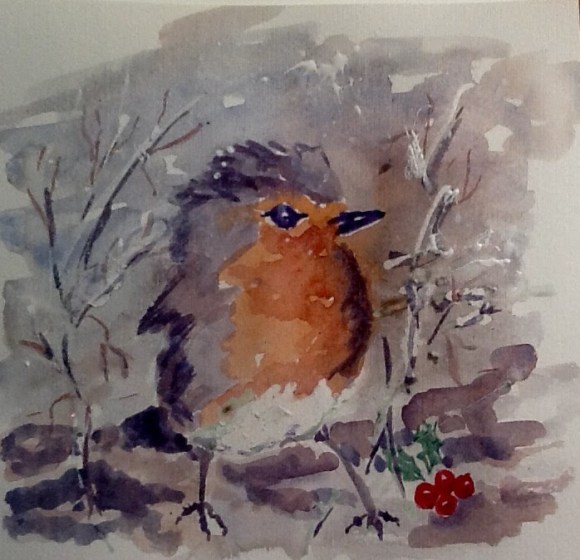
Painting by Sybil Pretious
Ecstasy fills your morning sermons,

And words flow from your beak
Like bullets from a machine gun
At a frightful cadence that belies
Your tiny size with two tender eyes.

Your freewheeling words tear asunder
My early morning sleep ritual
That allows me to soak in the miseries
Of our planet and its inhabitants,
Elevating me like an icon.

Yet I dream to see the world
From your perspective by undoing
Your uncombed melodious flow
To understand why you speed up,
Alas, to slow down all too hastily.

Your escapades are legendary.
You fly from one end of the globe
To the other, noting in detail
Different colours of human misery
Which you store in your memory.

Even if I do not understand your sermons,
There is no divergence in our positions,
And that's such an enlightened feeling.
Coming from the tree next to my house
The tonalities in your chirps heal me.

Pramod Rastogi is an Emeritus Professor at the EPFL, Switzerland. He is a poet, academician, researcher, author of nine scientific books, and a former Editor-in-chief (1999-2019) of the international scientific journal Optics and Lasers in Engineering. He has published over ninety poems in international literary journals.

PLEASE NOTE: ARTICLES CAN ONLY BE REPRODUCED IN OTHER SITES WITH DUE ACKNOWLEDGEMENT TO BORDERLESS JOURNAL

Click here to access the Borderless anthology, Monalisa No Longer Smiles

Click here to access Monalisa No Longer Smiles on Amazon International

Categories
Essay

How Do You Live?

By Aditi Yadav

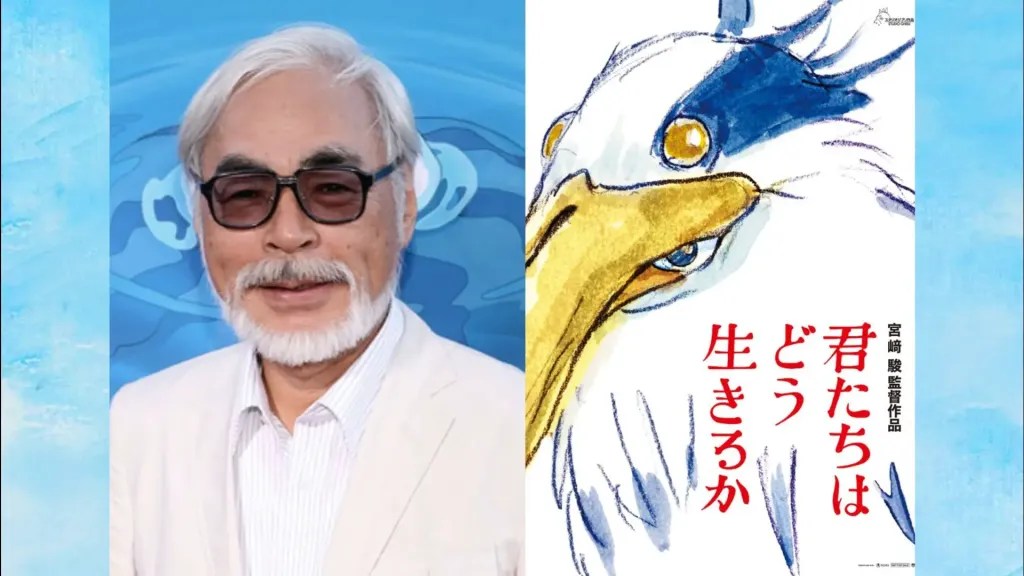
Hayao Miyazaki and the poster of The Boy and the Heron in Japanese

In January 2024, The Boy and the Heron became the first Japanese movie to win the Golden Globe Award for the Best Animated Feature Film. However, when the original movie was released by Studio Ghibli in the summer of 2023 in Japan, it was marketed with ‘no marketing at all’-without any trailers, TV commercials or newspaper advertisements. A minimalist movie poster carrying the sketch of a heron and the Japanese title Kimitachi wa Dō Ikiru ka, was all it took the movie to record the biggest box office opening in Studio Ghibli’s history.

Hayao Miyazaki, the godfather of Japanese animation who celebrated his 83rd birthday in January, 2024, broke a decade long hiatus to give his directorial swansong to the world. The movie is inspired by Miyazaki’s favourite book Kimitachi wa Dō Ikiru ka, written by Genzaburo Yoshino in 1937. This coming-of-age Japanese classic had been tenderly translated into English under the title How Do You Live? by Bruno Navasky and brought out by Penguin in 2021 with a foreword by a writer no less than Neil Gaiman.   

The protagonist of the story is Honda Junichi, a fifteen-year-old boy nicknamed ‘Copper’ after Copernicus, by his uncle.  He has a diminutive frame, but his intelligence, bright personality and athletic skills, make him a popular kid at school. As Copper has been raised by a single mother, his uncle, who is a fresh law graduate, is the only male guardian around him. Their bond is an interesting one: not only do they share a warm friendship, but also discuss about the world at large, its history, philosophy, human relationships, so on and so forth. 

 The book chronicles Copper’s world, his thoughts and day-to-day incidents, in a format that alternates between a third person narrative and notes from the diary Copper’s uncle. Copper’s everyday experiences are similar to those of any other school going child — peers bullying, fighting, discovering class differences, bonding over games, pranking one another, and so on. The book delves into the mind of the adolescent boy, trying to make sense of the world to understand how he’d transition to an adult. He approaches the world with an innocent curiosity, musing how people are ‘a little like water molecules’ in the vast ocean of human society.

His uncle deeply moved by these observations and expressions, begins to pen down about these interesting episodes in his notebook. He also adds facts and references associated with them, that encompass wide range of topics including art, science, economics, history, politics, philosophy and language. He probably thinks that when Copper reads the notebook later on, it would help him see the world better alongside his personal mental and moral evolution. These notebook entries bear sagacious titles like- ‘on ways of looking at things’, ‘on human troubles, mistakes and greatness’, ‘on human relationships’, ‘on poverty and humanity’, etc. However, the words do not intend to preach. They brim with warmth of empathy, and capture the strengths and vulnerabilities of being human: “If it means anything at all to live in this world, it’s that you must live your life like a true human being and feel just what you feel. This is not something that anyone can teach from the sidelines, no matter how great a person becomes.”

Yoshino wrote the book as a part of the “Nihon Shoukokumin Bunko” (Library of books for the Younger Generation) that aimed at disseminating progressive knowledge and ideas to Japanese young adults. The work is a precious one – a classic example of how thoughtful adults can help young children to have a healthy mind and human heart.

Published in 1937, this masterpiece itself is an act of resistance against all regressive beliefs and authoritarianism, as Navasky pens in his Translator’s note, the book is “…particularly valuable to us now, when violence against citizens is on the rise, and independent thinkers are being attacked by their governments”. The book itself was censured several times, before it could be printed in its originally intended form. It’s important to mention here that from 1911 to 1945, Tokubetsu Kōtō Keisatsu (or Tokko), the Special Higher Police, heavily monitored political groups and ideologies that posed a threat to the Empire of Japan.  The Peace Preservation Law passed in 1925, expanded the powers of Tokko to suppress all socialist and communist idea in Japan. The heavy-handed ‘thought policing, only ended in 1945 with Japan’s surrender in World War II.

How we live, invariably depends on how we think. The universality of the book lies in how it links thought processes across borders — individual and collective — will have decisive roles in the ideals we follow and the society we construct. Our journey from the primitive caves to modern skyscrapers has been a long and tumultuous one. The prowess of human mind and the resilience of human spirit has brought of this far, but a peaceful society demands empathy and honesty of the human heart. Copper is sensitive enough to realise this, when he jots down–

“I think there has to come a time when everyone-one in the world treats each other as if they were good friends. Since humanity has come so far, I think now we will definitely be able to make it to such a place.

So, I think I want to become a person who can help that happen.”

Charting the ups and downs in the life of young Copper, the book closes on a sunny fulfilling note where our protagonist sees the world with an open heart as his extended family. And so, this timeless classic that touches the heart ends with a deep question for all of us – “How will you live?”

.

Aditi Yadav is a public servant from India. As and when time permits she engages in creative pursuits and catches up her never-ending to-read list. Her works appear in Rain Taxi Review of books, EKL review, Usawa Literary Review, Gulmohur Quarterly, Narrow Road Journal and the Remnant Archive.

PLEASE NOTE: ARTICLES CAN ONLY BE REPRODUCED IN OTHER SITES WITH DUE ACKNOWLEDGEMENT TO BORDERLESS JOURNAL

Click here to access the Borderless anthology, Monalisa No Longer Smiles

Click here to access Monalisa No Longer Smiles on Amazon International

Categories
Poetry

Love Poems

By Michael R Burch

Chez le Père Lathuille (1879) by Édouard Manet (1832-1883)
BECKONING


Yesterday
the wind whispered my name
while the blazing locks
of her rampant mane
lay heavy on mine.

And yesterday
I saw the way
the wind caressed tall pines
in forests laced by glinting streams
and thick with tangled vines.

And though she reached
for me in her sleep,
the touch I felt was Time’s.

CAMEO

Breathe upon me the breath of life;
gaze upon me with sardonyx eyes.
Here, where times flies
in the absence of light,
all ecstasies are intimations of night.

Hold me tonight in the spell I have cast;
promise what cannot be given.
Show me the stairway to heaven.
Jacob’s ladder grows all around us;
Jacob’s ladder was fashioned of onyx.

So breathe upon me the breath of life;
gaze upon me with sardonic eyes . . .
and, if in the morning I am not wise,
at least then I’ll know if this dream we call life
was worth the surmise.


Michael R. Burch’s poems have been published by hundreds of literary journals, taught in high schools and colleges, translated into fourteen languages, incorporated into three plays and two operas, and set to music by seventeen composers.

PLEASE NOTE: ARTICLES CAN ONLY BE REPRODUCED IN OTHER SITES WITH DUE ACKNOWLEDGEMENT TO BORDERLESS JOURNAL

Click here to access the Borderless anthology, Monalisa No Longer Smiles

Click here to access Monalisa No Longer Smiles on Kindle Amazon International
Categories
Notes from Japan

Becoming a Swiftie in my Fifties

Narrative and Photographs by Suzanne Kamata

I was already living in Japan when Taylor Swift was born, so she was never part of my American cultural experience. I didn’t hear her songs on the radio, didn’t see her face on the cover of magazines, and because I never clicked on links about her, she never entered my online bubble.

I had a vague awareness that she was a Country and Western singer, but I’d always been more inclined to listen to “alternative” music (Kate Bush, Siouxsie Sioux, Sinead O’Connor, Bjork, and so on).

At some point, my students at a small teacher’s college in Western Japan began to mention her as their favourite singer in their self-introductions. When they asked me what musicians I liked, I struggled to come up with someone they had heard of. Finding a favorite Taylor Swift song seemed like a good way to connect.

I learned a little bit more about her: she enjoys baking and knitting; she loves cats. Every time she visits a city, its economy improves. She gives generous bonuses to the people who work for her and supports LGBTQI rights. She has inspired girls all over the world. She seems like a genuinely nice person.

My son listened to her music, and after he shared one of his playlists with me, I had “We Are Never Ever Getting Back Together” on my phone. I liked it. It was catchy and relatable, easy to sing along to. But I didn’t really become a fan until she released Folklore during the pandemic. A friend whose musical taste I trusted raved about it on Facebook, so I downloaded the album. I listened to it as I drove to my office where I sat alone at my desk all day, uploading material for virtual classes. I became enamored with her storytelling, evident in songs such as “Betty,” about a teenage love triangle, and “The Last Great American Dynasty,” which exudes Great Gatsby vibes.

Last July, I learned that Taylor Swift would be performing four shows in Tokyo. A lottery would determine who would get tickets. I had never been to a big concert in an arena—well, not since I saw the Bee Gees in Detroit, when I was in junior high school, and that was before artists began incorporating mapping and other bells and whistles. I thought it would be fun. An extravaganza. I asked my husband if he wanted to go to a Taylor Swift concert with me.

“There’s no way you’ll be able to get tickets,” he said.

I entered the lottery anyway. Lo and behold, I “won” two tickets for Thursday, February 8, the second of four shows. As the date was months away, I didn’t count on anything. A lot could happen. And it did!

A week before the concert, I got an emergency text from my sister-in-law telling me that my elderly mother had fallen down and broken her hip. She was in the hospital, about to have surgery. The last time something like that had happened (to my father), I had rushed back to America. But my dad told me that everything was under control, and my mother made it through surgery without any complications, so I decided to put off my return home.

Then, three days before the start of the concerts, a rare snowstorm hit Tokyo, shutting down transportation. Since my husband and I live in distant Shikoku, we were planning to take a plane on the day of the show, arriving just a few hours in advance. If the snow continued, we wouldn’t make it.

“It’ll melt,” my husband assured me.

He was right. By Thursday, most of the snow was gone.

We made it to Haneda Airport, checked into our hotel in Ueno, had some sushi, and took the train to Tokyo Dome. Two hours before start time, a crowd had already gathered. Young women in spangled dresses, tiaras, and cowgirl hats, speaking various languages, posed for photos and exchanged friendship bracelets. Hundreds of people were queued up to buy merchandise related to the Eras Tour. Although my husband and I waited in line for almost an hour, when it became clear that we risked missing the beginning of the performance, we left and went to find our seats, which were high up in the rafters.

Slowly, the seats began to fill. By the time the lights dimmed, the place was packed. The music began, and dancers came onto the stage holding what looked like Japanese fans. Cheers surged. To my left, an earnest young woman, who was apparently attending alone, recorded nearly the entire show on her phone. A white-haired Japanese man, also on his own, sat just in front of me. Several young women in short dresses stood behind us, singing and dancing along to the songs that they knew. Whenever Taylor disappeared for a set or costume change, they would squeal in delight at her reappearance on stage: “Yabai, yabai, yabai[1]!”

For three hours and twenty minutes, as Taylor went through her set of 47 songs, ranging across her career, the arena was filled with joy.

Occasionally, my husband would lean over and ask, “Do you know this one?”

I confess that I didn’t know all of the songs—especially those from her early albums. I danced along anyway.

After the concert, my social media feeds were abuzz with reactions from other friends who had been there, or who’d attended the performance the night before. It felt as we had been part of something huge—and happy.

Meanwhile, back in the United States, rumors were circulating that Taylor Swift was part of some Deep State government plot to re-elect President Joe Biden in November. NFL fans were complaining that she got too much onscreen attention when she attended her boyfriend’s games (to cheer him on). Others slut-shamed her for having had too many boyfriends or attacked her for polluting with her private plane.

I was glad that none of that vitriol had reached Japan.

My husband and I went back to Tokyo Dome the next evening, during the concert, to buy T-shirts. At that time, the line for merchandise was blessedly short. We saw people sitting on benches outside the arena, or with their ears pressed to the walls, taking in as much as they could. It was strangely moving.

When I got back home, I downloaded two more of her albums. I’ve been listening to them non-stop ever since.

.

[1] Great, great, great!

Suzanne Kamata was born and raised in Grand Haven, Michigan. She now lives in Japan with her husband and two children. Her short stories, essays, articles and book reviews have appeared in over 100 publications. Her work has been nominated for the Pushcart Prize five times, and received a Special Mention in 2006. She is also a two-time winner of the All Nippon Airways/Wingspan Fiction Contest, winner of the Paris Book Festival, and winner of a SCBWI Magazine Merit Award.

PLEASE NOTE: ARTICLES CAN ONLY BE REPRODUCED IN OTHER SITES WITH DUE ACKNOWLEDGEMENT TO BORDERLESS JOURNAL

Click here to access the Borderless anthology, Monalisa No Longer Smiles

Click here to access Monalisa No Longer Smiles on Amazon International

Categories
Poetry

Who Moves Time and Other Poems

By Luis Cuauhtémoc Berriozábal

Antonia Pozzi (1912-1938), Italian Poet
ONE HUNDRED AND FOUR YEARS 


After Antonia Pozzi

One hundred and four years ago you were
composing your words like a violinist was
composing musical sounds. Your words are
alive still, quivering with beauty, delirium,
and the sobs of time, as the violin strings
reach a crescendo of the loudest order.
I see your words on the page bleeding. I
feel the sharp sea breeze as if I was out
at shore. I look up at the cluster of stars,
which are your words, soft and compact
one moment, and loud and exploding
the next. Your instrument cries out loud
as if death is on your trail. You lived only
for twenty-six years. Yet, you are still alive
with these words I am reading now. Perhaps
in a hundred and four years I should be
so lucky, for someone to find mine.

WHO MOVES TIME

Who or what moves
time like the sky
moves clouds? We
cannot move time
as it inhales and
exhales its evil.
Time has no heart
or arms to lift
our burdens. Mute as
a field of weeds,
time is hard to gauge.
Like air it will not
stay in one place.
It follows its own
rules -- slow when
you are rushed, fast
when you need it
to last longer.

THIS HOUSE

This house I live in
is made of air.
If you look up at
any time of day
you will see stars,
the moon, the sun,
and clouds. It is
all windows all
around and no
walls. If you look
down, there is grass,
dirt, and cement.
I do not need doors,
plumbing, or a stove.
I keep it real
simple with a soft
pillow and thick
blankets. People
give me stuff like
food and water, a
dollar or enough
change for a hot
meal. I do not pay
rent or utility bills.
I move a lot, not
always willingly.
You know the grass
could be greener,
but I settle for
what I can get.

NOTHING BUT EMPTINESS

I left nothing
but emptiness
and useless
meanderings
for you to digest,
sparse ideas
and drunken
diatribes to
moist your
appetite.
There is more
of nothingness
I could offer,
but I do not
have the heart
to do that.

Born in Mexico, Luis Cuauhtémoc Berriozábal lives in California and works in the mental health field in Los Angeles, CA.His poetry has been published by Blue Collar Review, Borderless Journal, Escape Into Life, Kendra Steiner Editions, Mad Swirl, SETU, and Unlikely Stories.

PLEASE NOTE: ARTICLES CAN ONLY BE REPRODUCED IN OTHER SITES WITH DUE ACKNOWLEDGEMENT TO BORDERLESS JOURNAL

Click here to access the Borderless anthology, Monalisa No Longer Smiles

Click here to access Monalisa No Longer Smiles on Amazon International

Categories
Poetry

The White Lady by Atta Shad

Translated from Balochi by Fazal Baloch

O, White Lady!

Your alluring figure,
With seductive gestures
And sway of your gentle gait,
Sets lamps aquiver
In shame and discomfiture.

O, White Lady!
Your flower-adorned hair,
At times, gleams red,
At times, shines black,
At times, turns grey.
The morning and evening breeze
Tousle them in shameful disarray.
Women, sneer at you
As with comely grace
Their exquisite clothes they array.

Atta Shad (1939-1997) is the most revered and cherished modern Balochi poet. He instilled a new spirit in the moribund body of modern Balochi poetry in the early 1950s when the latter was drastically paralysed by the influence of Persian and Urdu poetry. Atta Shad gave a new orientation to modern Balochi poetry by giving a formidable ground to the free verse, which also brought in its wake a chain of new themes and mode of expression hitherto untouched by Balochi poets. Apart from the popular motifs of love and romance, subjugation and suffering, freedom and liberty, life and its absurdities are a few recurrent themes which appear in Shad’s poetry. What sets Shad apart from the rest of Balochi poets is his subtle, metaphoric and symbolic approach while versifying socio-political themes. He seemed more concerned about the aesthetic sense of art than anything else.

Shad’s poetry anthologies include Roch Ger and Shap Sahaar Andem, which were later collected in a single anthology under the title Gulzameen, posthumously published by the Balochi Academy Quetta in 2015.

Fazal Baloch is a Balochi writer and translator. He has translated many Balochi poems and short stories into English. His translations have been featured in Pakistani Literature published by Pakistan Academy of Letters and in the form of books and anthologies. Fazal Baloch has the translation rights of Atta Shad from the publisher.

PLEASE NOTE: ARTICLES CAN ONLY BE REPRODUCED IN OTHER SITES WITH DUE ACKNOWLEDGEMENT TO BORDERLESS JOURNAL

Click here to access the Borderless anthology, Monalisa No Longer Smiles

Click here to access Monalisa No Longer Smiles on Amazon International

Categories
Slices from Life

Suga Didi

By Snigdha Agrawal

A Santhali woman

She stood somewhere at 5 feet 8 inches.  Of athletic build.  Swarthy skin. A face full of punch holes; ravages of smallpox during childhood.  Her disarming smile more than made up for the lack of a flawless complexion.  The girls were told she was being employed as their Ayah, with strict instructions to address her as ‘Didi[1]’.  The Ayah affix after her name, was a ‘no’, ‘no’ in a Bengali household.  So, it was Suga Didi right from day one. The rest of the elite living in the cosmopolitan community frowned upon such bourgeois sentiments.

Suga lived in a Santhal village, on a river bluff, surrounded by dense Sal Forest. Inaccessible by road and cut off from civilisation. The only Santhal village in the area, close to the gated community, offering employment opportunities to the tribals. Not that they were keen on leaving the village to work in the steel and brick factories. Suga was the one-off amongst them venturing out from her cloistered society.  She arrived for the interview, hair oiled, drawn back from her face tied into a chignon, and dressed in a cotton saree with a red border, way above her ankles. The blouse was missing. Her attire would surely be viewed as improper in the elitist community.    She spoke in the Santhal dialect, with words common to Bengali and Hindi.  Amenable to change, she did not resist the suggestion of wearing a blouse, nor letting down the saree border to her ankles, when reporting for work.  Agreed happily to the working hours from 6.30 am to 4.30 pm, five days a week.  During school vacations, morning reporting was pushed back to 8.30 am. 

The decision to employ Suga was borne out of necessity. With four growing girls, aged between fourteen and four, or thereabouts, it was becoming increasingly difficult for their mother to handle all the chores.  Plaiting their hair, getting them dressed for school, ironing uniforms, and accompanying them to the school Bus stand, were some of the many activities entrusted to her.  Add to that, the role of a luggage carrier.  With four school bags, piled on her head, and four tiffin baskets weighed down with filled water bottles, hand-held, she shepherded the girls safely, morning and evening.  It wasn’t an easy walk. There were open drains to cross.  Heavily loaded truck movement posed a serious problem as well. She guarded them like her own. Taking care of the girls when they got home from school was also included. Occasionally, when the mood was right, she shared ancient tribal folklore, sometimes breaking into a song. 

The eldest of the four had read stories of tribal practices.  Witchcraft.  Human sacrifice.  Eating wild animals.  Men and women drinking ‘mahua’ toddy. Suga was questioned on the validity of all this to which, she neither denied nor confirmed.  Tribal secrets were not for the ears of the civilized. But she couldn’t ward off the pestering from the girls for long.  And went on to narrate the story of the Santhal deity, Bonga, visiting their village on a moonless night, in the guise of a king cobra to drive away the bad spirits living on the edge of the forest, responsible for killing the cattle.  Quietly slithering on the muddy terrain, the twelve-feet reptile, held the spirits captive, performing a wild dance with its raised hood.  And then struck.  The spirits screamed and fled, never to return. The village headsman invited the cobra for dinner, sharing toddy and barbequed lizards.  That was not the end of the story.  Suga concluded that the snake dissatisfied with the host, gobbled his head from neck upwards.  The girls held onto each other shocked out of their wits.  A bizarre ending.  Doubts were raised as to whether the story was real or imaginary, made up by Suga Didi.  Many such stories found their way into the older one’s scrapbook.  Later found in the steel trunk, along with old photos, discovered by the younger two. 

When Birbhadra the cook took leave to visit home, Suga filled in, helping out with cutting, and clipping the meat and fish.  All the preparatory work for cooking the meals.  Prepared by the lady of the house.  The girls were curious to know what Suga cooked at home. Her stock answer was hot, spicy, and unpalatable.  Their persistent pleading to cook a tribal dish at some point bore fruit. Reluctantly, she agreed to treat the household with a recipe, made from goat innards. The butcher supplying meat was duly informed to send the liver, fat, spleen, heart and intestines.  “Eww, gross!”  But not so, when the dish arrived on the dining table.  Blood red with a film of fat floating on the top, garnished with freshly chopped coriander leaves.  In no time it was polished off.  Delicious!  Delicious! All exclaimed.  Suga was on cloud nine that day.  They named the dish “Chagol Pagol Curry[2]”.  Suga’s signature dish.

It was the spring of 1959.  By then, the older girls had left for boarding school.  Younger ones then six, were pretty much able to ready themselves for school on their own. Suga’s workload had halved.  For most of her free time, she took upon herself the role of gardener, attending to the vegetable garden, and advising the gardener on how best to get good yields from her experience of growing vegetables in the village.  The smell of ‘bidi[3]’ wafting into the porch, meant the two were sharing a smoke.    

And then for over a week during that summer, she had not reported for work. Alarm bells rang in the household.  Had she fallen ill?  Had she died of cobra poisoning?  Had she been thrown out from the village for violating the rules?  Worst still, was she a victim of human sacrifice?  Concerns that kept the family awake.  No one knew her address, except that she belonged to the Santhal village on the river bluff, inaccessible to non-tribals.  A security guard from the factory was sent to find out if the headsman could be summoned to the river, under the ruse of gifting him Scotch whiskey.  Didn’t work.   No one responded to the call, announced with a handheld loudspeaker.  Several attempts were made to no avail.  Rumours mills were churning out stories of her having eloped with the cook, Birbhadra, though it made no logical sense.  Happily married with a dozen or so kids living in Begusarai, he could least afford a second wife.  Though coincidentally, Birbhadra left employment around the time Suga was out of the radar.     

It was decided there was no further need to employ a nanny aka ‘didi’ for the girls. Suga was the first and the last.  Irreplaceable.   She remains an enigma to date.

.

[1] Elder sister

[2] Crazy goat curry

[3] A type of cheap cigarette made of unprocessed tobacco wrapped in leaves

Snigdha Agrawal (nee Banerjee) is a published author of four books and a regular contributor to anthologies.  A septuagenarian, she writes in all genres of poetry, prose, short stories and travelogues.

PLEASE NOTE: ARTICLES CAN ONLY BE REPRODUCED IN OTHER SITES WITH DUE ACKNOWLEDGEMENT TO BORDERLESS JOURNAL

Click here to access the Borderless anthology, Monalisa No Longer Smiles

Click here to access Monalisa No Longer Smiles on Kindle Amazon International