Categories
Stories

The Temple-going Snake

By Devraj Singh Kalsi

Every morning, around 9 a.m., the brown snake emerged from its cosy pit, slithered across the lush green grass, and found its way out of the bungalow through the lower rungs of the iron-grille door. Every evening, before sunset, around 6 p.m., the snake took the same path to return to its pit.

Adarsh followed the same routine without knowing that the resident snake was a keen follower of his schedule. One day, while taking the car out of the garage, he noticed the snake as it was moving out of the gate. He took his car out of the gate and looked around to trace the snake. But it was impossible to locate where it had gone. 

While driving his car, Adarsh was worried that the snake would bite several people, regretting that he should have made some more efforts to find out where it had vanished. When he reached his office and took the elevator, he shed his skin and transformed into a toxic agency head smitten by the urge to lord over the subordinates. Despite the heavy workload, he could not clear his mind as the snake kept his slithering into his thoughts. He decided to find out whether it was just a one-off incident or whether the presence of the snake in his compound signified the growth of enemies and unrecognised threats. 

Being curious to know more about the snake, he was ready to leave the house around the same time. The snake was also punctual and gave Adarsh had another encounter. This time, he was ready with the motorbike as he was prepared to follow the snake more closely and avoid getting stuck in a traffic jam. 

As the snake slipped out of the premises and took the main road, Adarsh geared up his bike and tracked the snake moving at its leisurely pace. When he came close to the canal bridge, he saw the snake crossing it along with pedestrians, keeping to the concrete edge. So many people were walking but they were unaware of the snake taking the same route.

When he crossed the bridge, he looked around for a while, unable to see where it had slipped. Then he stood near the milk booth and asked the shopkeeper whether he had seen a snake. Before he could get any response, Adarsh spotted the snake moving up the stairs of the temple across the road. His curiosity doubled up now and he parked his bike right in front of the milk booth and rushed to the temple. 

It had been several years since he had entered a temple. The pursuit of a snake had brought him close to the divine abode. He was eager to know why the snake frequented the temple – almost taking it up as an assignment to get to the bottom of the mystery. He hastened up the stairs to ensure he did not lose sight of the snake. For a few minutes, he pondered whether it was right for him to enter the temple atall as he was a man who, he felt, due to his profession had become poisonous, negative, and toxic. He wondered whether it was befitting for an evil guy to enter the pure, sublime space. Drawing solace from the fact that if a snake could enter the temple despite carrying venom in its body, he could also do the same without harbouring any guilt as the sac of poison resided in his mind.

Instead of folding his hands for prayer, he rang the bell and looked around for the snake. Considering it prudent to alert the priest, he said, “Pandit ji, I saw one long snake entering the temple so I came inside to inform you of the danger.”

“Oh! A snake has brought you here, Shriman[1],” the priest sprinkled holy water on his bald head and offered him flowers. He cupped those flowers in his palms, went ahead to bow down before the deity and offered the floral obeisance. Although he felt awkward doing this exercise, he did not know that this would bring him closer to the snake relaxing inside the sanctum area. Scared to find himself so close to the snake for the first time in his entire life, he gave a loud cry and made a quick attempt to rush out of its reach.

The priest was observing his nervous reaction. When he came out and stood in front of him, he was able to gather his composure. 

“So, you finally met the snake you came looking for after a long search?” the priest poked him.

Adarsh did not know how to respond to this question. This question raised many other questions. But he touched the feet of the priest and sought his blessings. This act of surrender made the priest answer the most probable questions in his mind. 

 “You wanted to know what the poisonous snake was here for. Before I answer that for you, can you answer what you do the whole day? Hiss, sting, bite, bare fangs, to get work done or worse perhaps…” 

Adarsh was silent for a while. His silence confirmed that the guess was correct. His job profile listed such toxic activities daily and there was nothing noble to mention with a glint of pride. It appeared that the priest was reading his dark mind and focusing on what had died within him over the years. He felt like running away to escape this examination. It would be equivalent to running away from the truth. His curiosity made him look for the snake, but the priest said it was the wish of the Lord that he came after a snake because the Lord wanted him to reform. Such a hard-hitting interpretation of a simple act of curiosity was as unacceptable to Adarsh as the will of God. 

The priest continued despite Adarsh showing no interest, hoping that this information would make him rethink. “You wanted to save people from a poisonous snake and you wanted to know where it goes. You are not a bad human being at all, only driven by circumstances and environment to commit sins. Look at this truth now. The snake sits inside the whole day and when the temple doors close, it goes to the place where it comes from, without disturbing a single person along the way, without biting a single person despite carrying so much poison. Take it as an inspiring lesson that though there is poison in the mind, one can still keep it under control and ensure no harm is caused to fellow human beings. Perhaps the snake is in good company and has reformed its nature. Read it from this angle. You should also come to the temple every day and spend time here. The Lord will be happy to see you. He gives more blessings to those who are most unlikely to come.” 

Without answering the priest, without promising anything to the priest, Adarsh turned around with folded hands and retraced his steps. While coming down the stairs, he remembered his recent misdeeds. He went home and dwelled on the priest’s words in his mind. The next evening, he left his office early and visited the temple. He met the priest, and the snake. There were many devotees singing bhajans and taking prasad. He sat alone in a corner for some time. The ambience seemed to have a transformative impact on him. For an hour, he discovered a new self – shed his old skin and found himself in a happy frame. 

Inside the office, Adarsh was a reformed person as he became polite and respectful. His juniors and peers were surprised to find a new boss in just a week. Adarsh continued with his daily trips to the temple and he was close to achieving a month of decent behaviour at the workplace. He followed the path shown by the snake and felt lighter inside. However, he did not know whether he could retain this new avatar without divine intervention daily, fearing he would return to his previous self if he stopped visiting the temple. He imitated the habit of the temple-going snake. 

After a few months, he asked the priest some hard-hitting questions during one such visit: “I did nothing wrong since I started coming here. But how long does it take to change one’s nature? I am a practical-minded person, and today, despite coming to the temple, I ended up sacking an employee I did not like to work with, on a very flimsy ground. I knew I was doing it wrong, but I could not stop myself from doing it. The evil had returned to me. I don’t want to nurture guilt, but I think I have failed the test I don’t know why the stupid snake keeps coming here. It should go and bite people, enjoy its toxic life, and keep sending people to hell instead of trying to change its basic character. I’m sure we all are not here to do good. Being good is so boring.”

Without waiting for the priest to answer, he stepped out of the temple premises. As he was coming down the stairs, he received a phone call from his office, and he was shocked to hear the urgent message. He slipped and fell, rolled down the stairs, landing in the hospital bed where he was declared to have suffered a severe spinal injury. Being wheelchair-bound, he sat in the blooming garden and observed the snake slithering out of the lush green cover to visit the temple, envying its luck every day. A poisonous life had turned pious whereas a life supposed to be pious had turned poisonous. The steps of the temple Adarsh was eager to climb down now became the steps he was eager to climb up once he got back on his feet again.  

[1] Mister

Devraj Singh Kalsi works as a senior copywriter in Kolkata. His short stories and essays have been published in Deccan Herald, Tehelka, Kitaab, Earthen Lamp Journal, Assam Tribune, and The Statesman. Pal Motors is his first novel.  


PLEASE NOTE: ARTICLES CAN ONLY BE REPRODUCED IN OTHER SITES WITH DUE ACKNOWLEDGEMENT TO BORDERLESS JOURNAL

Click here to access the Borderless anthology, Monalisa No Longer Smiles

Click here to access Monalisa No Longer Smiles on Kindle Amazon International

Categories
Stories

The Yellow Flower

By Haneef Sharif, translated from Balochi by Fazal Baloch

He had only two dreams in his life: first, to plant a yellow flower in the courtyard, and second, to die before the flower could bloom.

He wandered aimlessly through the streets. Just as he was about to turn the corner near the supermarket, he spotted a short-statured man with a bald head, wearing mismatched shoes, and carrying a briefcase. Memories of Mr. Hunchback flooded his mind, and he was nearly hit by a bus as he stood in the road absentmindedly. The driver slammed on the brakes abruptly, jolting all the passengers from their seats. Thus, he was saved. For weeks, he avoided going back, overwhelmed by fear. He dreaded the thought of venturing to the corner of the supermarket, fearing that he might meet with an accident and eventually die, unable to fulfill his desire of planting a yellow flower in the courtyard.

One day, however, he found himself wandering through those streets again. Whether it was a stroke of fate or a design of God, he spotted the same short-statured man who resembled Mr. Hunchback. The man was carrying the same briefcase he would take to the classroom. All the curious children wished that someone would open the briefcase so they could see its contents, but the fear of Mr. Hunchback kept them from getting close to him. Thus, nobody could ever discovered the secret hidden within the briefcase.

Out of the blue, he was startled by a loud honking horn. He faltered and almost fell down. A bus had stopped just before him. It seemed like divine intervention that he wasn’t run over. The driver looked at him with what appeared to be pity. He wondered why he wanted to die; what made him attempt suicide because the moment the bus took a turn he leapt in its path. If it was not for the bend in the road, causing the bus to slow down, he would have not narrowly escaped a second brush with death.

He moved away from the path of the bus, concealing his fear of death, holding his heartbeat, and resumed walking. As he distanced himself, his gaze fell upon a young girl standing on the balcony of her apartment. Her head was bowed, engrossed in something on her mobile screen. She wore blue jeans and a grey shirt, standing with one foot gracefully placed over the other.

He stood there for a while, captivated by the sight of the girl, who remained oblivious to his presence. Moments later, a young man of her age came in and wrapped his arm around her waist, startling her for a moment. Soon after, she leaned her head on his shoulder and their lips met for a fleeting moment him before they disappeared into the apartment.

He lingered there, waiting for someone to appear, but no one did. He remained fixated on the balcony, indifferent to the passing buses and pedestrians carrying briefcases. His attention was drawn to a vase on the balcony with a yellow flower. Yellow was a colour he associated with death. Whenever he spotted the colour, he would pressume someone must have died or was about to die somewhere. He avoided yellow taxis or buses and refrained from downloading anything of that hue. He was puzzled by those who chose to paint their houses yellow.

On that particular day, the balcony he had been observing was painted entirely in yellow, including the door and the entire building. He couldn’t explain why he hadn’t noticed this before, even the girl had worn yellow earrings. Despite regularly visiting the street after his initial encounter with the girl, she never appeared on the balcony again. He began to suspect that the girl had died, but he couldn’t fathom how it had happened. Then, that day, as he gazed at the balcony, contemplating death, the door suddenly swung open, revealing the very girl he had been musing about for several days. She stood there, surveying the street below.

“Did she see me or not?” He wondered without any reason.

As she glanced downward, a bus sped by, stirring in him a disdain for buses. He quickly redirected his attention to the girl, who then approached the yellow flower, gazing at it with sorrowful eyes. As she began to caress its petals, her eyes welled up with tears. And as she sobbed, her tears fell onto the yellow petals. In that moment, he thought someday, he would plant a yellow flower and before the flower could bloom, he would commit suicide.

(An Excerpt from Hanif Sharif’s recent novel “Afsanah” brought out be Adab Publisher in Balochi, translated by Fazal Baloch)

Dr. Haneef Shareef, a trained medical professional, is one of the most cherished contemporary Balochi fiction writers and film directors. So far, he has published two collections of short stories and one novel. His peculiar mode of narration has rendered him a distinguished place among the Balochi fiction writers. He has also directed four Balochi movies.

Fazal Baloch is a Balochi writer and translator. He has translated many Balochi poems and short stories into English. His translations have been featured in Pakistani Literature published by Pakistan Academy of Letters and in the form of books and anthologies. He has the translation rights to Haneef Shareef’s works. 

.

PLEASE NOTE: ARTICLES CAN ONLY BE REPRODUCED IN OTHER SITES WITH DUE ACKNOWLEDGEMENT TO BORDERLESS JOURNAL

Click here to access the Borderless anthology, Monalisa No Longer Smiles

Click here to access Monalisa No Longer Smiles on Amazon International

Categories
Poetry

Meeting  Poets Outside their Poems

By Alpana

Meeting poets outside their poems is like catching hold of a dandelion
always fleeting and flying.
fanning our desires to be light and liberated.

I met a poet in the wee hours of spring yesterday,
wrapped in thoughts,
inhaling more matter,
processing many ideas,
looked much like her poems,
blooming and how!

I met a poet in the early hours of baisakh*,
smelling like toil,
sprinkled with joy
of harvesting goodness,
just like his poems,
emanating courage and thick-skinned demeanour.

I met a poet walking briskly early morning,
panting and perspiring
due to swift movement
but also, gasping to let the poetry ooze out.
Her poetry is quick
Because the pace of her steps mirrors the pace of the gazillion words
plodding in her mind.

I met a poet chewing a gummy one day,
lost in her own reverie
absolutely chill,
rummaging her bag for more such gummyfying trysts,
sitting in a bean sofa with pen and paper
scribbling and doodling away her worries
just like that!

I met a poet engrossed in thrift shopping the other day
clad in comfort, spotting the comfort
not to discomfort his hard-earned moolah
but the words in his poems are priceless.
Because they reveal what being a parent is like.
The experience is valuable and so is his poetry,
causing ripples here and there,
echoing babbles now and then.

So, now you know where to spot poets.
When not absorbed in writing,
spot the happy souls or the dejected ones
in spring,
in the by-lanes of your colony,
or a high-end bar busy chewing a gummy.
Poets are fascinating.
Poets are otherworldly.
But how do you match the poets with their poetry?
How to remove the veil?
The make-believe.
The façade.
The art.
Please, tell me.
Because poets outside their poems
might be catching butterflies
or responding to a cooing baby.
But exactly how do you match the poets with their poetry?


*April-May

Alpana teaches in a government college of Gurugram, Haryana. If not responding to her babbling toddler and her curious gestures, she finds herself occupied with reading haikus and listening to Jagjit Singh ghazals.

.

PLEASE NOTE: ARTICLES CAN ONLY BE REPRODUCED IN OTHER SITES WITH DUE ACKNOWLEDGEMENT TO BORDERLESS JOURNAL

Click here to access the Borderless anthology, Monalisa No Longer Smiles

Click here to access Monalisa No Longer Smiles on Amazon International

Categories
Review

Camel Karma

Book Review by Somdatta Mandal

Title: Camel Karma: Twenty Years Among India’s Camel Nomads

Author: Ilse Kohler-Rollefson

Publisher: Speaking Tiger Books

Whenever we read about travel narratives by foreigners in India, especially Westerners, we assume it to be primarily superficial, skin-deep, and without much contact with ground reality. This non-fiction book, that can also be read as a sort of travelogue, busts that myth. It begins with a German veterinarian, Ilse Kohler-Rollefson’s arrival in Rajasthan in 1991 and almost twenty-five years of association with the same. On a field trip to Jordan in 1979, she first became fascinated by the relationship between pastoral peoples and the camels they shared their lives with. After a brief stint of camel field research in Sudan’s eastern desert, her choice to continue her research on camel husbandry led her naturally to India, the country with the third-largest camel population in the world, and she arrived at the National Research Centre on Camel (NRCC) in Bikaner, Rajasthan. Wanting to know more about the practical aspects of camel-keeping or its cultural foundation, she encountered the Rebaris, also called Raikas in Marwar, who are proper breeders of camels and whose whole lifestyle centred around it. She writes, “To me it seemed that the Raikas’ relationship with their animals was equally worthy of conservation as a uniquely human heritage.”

Historically, the Raika of Rajasthan have had a unique and enduring relationship with camels. They offer a compassionate alternative by keeping farm animals as part of nature, allowing them to move and do so in herds. Farm animals can thus extend their potential as humanity’s greatest asset. Their entire existence revolves around looking after the needs of these animals which, in turn, provide them with sustenance, wealth and companionship. Ilse is immediately enthralled by Raika’s intimate relationship with their animals, but she is also confronted with their existential problems.

For her, her research among them gave her not just a glimpse of the history and culture of Rajasthan, but also a way forward in her personal journey. Denying all kinds of creature comforts, the hope of saving both the camel and the Raika way of life took her and her spirited ally, Hanwant Singh Rathore, from vet labs in the city, to Raika settlements in the remotest corners of the Thar Desert, and everywhere in between. The intractable dilemmas— both bureaucratic and cultural—they were often confronted with required creative solutions. As they adapted to their circumstances, they found their orthodox Raika friends adapting with them. Kohler-Rollefson’s is a journey that is often exasperating, sometimes funny, but keeps revealing unexpected layers of rural Rajasthani mores and diverse cultures that make it such a fascinating place.

Spending her own research grants on a shoe-string budget, Kohler-Rollefson set up a base office in Sadri, close to the Kumbhalgarh Wildlife Sanctuary at the foothills of the Aravalli mountains, where she employs several Indians as research assistants (none of whom stay for long), veterinarians who help in administering the teeka, the vaccines to eradicate common camel diseases. With her trusted driver cum translator, her ally, she interacts with several nomadic tribes who rear camels, but whose caste and culture are radically different from one another as chalk and cheese. The narrative also gives details about her interactions with the local people — some of whom had earlier eyed her with suspicion of being an outsider, but later accepted her whole-heartedly.

She describes the sign-language with which she interacts with the womenfolk in the Raika households, her regular visits to the annual animal fair at Puskar, where she even bought a young female camel and named her Mira, leaving her to grow up and breed with the other camels of the Raika. Kohler-Rollefson learned that the Raika did not sell camel milk or eat camel meat. They used other camel by-products, but clearly the economic returns from a camel did not seem optimal. Mostly, they bred female camels to give birth to male camels that could be sold to other caste for work. She was surprised to find that “these camels resembled family members and were treated almost as intimately; nobody was afraid of them.”

Despite repeated setbacks, both from government apathy as well as social taboos, Kohler-Rollefson’s dedication to the cause was so sincere that she was able to found many organisations like the Lokhit Pashu-Palak Sansthan (LPPS), including the Camel Husbandry Improvement Project (CHIP), promote the study and documentation of ethno-veterinarian practices (the melding of traditional and modern approaches to treating camel diseases), highlighting the Raika’s grazing needs at the World Parks Conference (2003), and along with Rathore and a Raika team, even embarking on an arduous 800 km long yatra  on camelback throughout Rajasthan to raise awareness and draw attention to the dwindling camel numbers.

She successfully organised a meeting where apart from the traditional Raika constituency, she could include members from a range of castes spanning the whole social spectrum of Rajasthan – Rajputs from Jaisalmer, Bishnois from Barmer, Jats from Bikaner, Gujjars from Nagaur and Sindhi Muslims from deep in the Thar. She even escorted a group of Raika, including a colourful Bhopa (a wandering minstrel who sings and narrates the story of various episodes of the mythical Pabuji’s life through unfolding of cloth scrolls) to Germany and then to Interlaken, Switzerland for an FAO (Food and Agriculture Organisation of the United Nations) conference. She set up the League for Pastoral Peoples and Endogeneous Livestock Development (LPP) in Germany. In other words, Kohler-Rollefson has been successful in drawing attention to the problems of camels rearing at an international level.

The first edition of this book came out in 2014. Since then, they have had a daunting roller-coaster ride, shuttling back and forth between the depths of despair where they thought all was lost to exhilarating heights from which they fleetingly espied camel nirvana: a scenario where camels, people, and the environment live together in harmony and mutually support each other. Interestingly, the second revised edition of Camel Karma was published in 2023 and the other good news is that 2024 has been declared the International Year of Camelids by the United Nations General Assembly, with the stated goal of raising awareness of the contribution of camelids to livelihoods, food security and nutrition. It also aims at encouraging all stakeholders, including national governments, to work towards recognising and valuing the economic, social, and cultural importance of camelids in the lives of communities, especially those that are highly vulnerable to extreme poverty.

In combination with the India government’s recent discovery and appreciation of the country’s pastoralist cultures, this may be just the constellation that successfully revives India’s camel sector. In a scenario where companies and countries are competing for shares in the globalised market, the unique selling point of Rajasthan’s camel milk is the Raika’s heritage of producing milk humanely and with compassion. The biodiverse diet of the state’s camels is composed of ayurvedic plants that add another unique quality.

Thus, it seems appropriate that we all read Camel Karma now and let the world know about the unique Raika heritage and to serve as a baseline to look back on ten or twenty years from now. Despite the rapid technological development in all spheres of life, the author sees a future, and even an urgent need, for both the camel and for the Raika and other nomadic livestock keepers. She is optimistic for several reasons as everything in India is cyclical. The camel is a versatile and multipurpose animal that can fulfil many basic needs of humans. Its role as transport and farm animal is certainly on the retreat, so long as oil is available and affordable. Yet its potential as a dairy animal remains huge. Apart from that, there is a range of other eco-friendly products that can be made from happy living camels and that may just satisfy that budding urge of urbanites – in India and abroad – to re-connect with nature.

Apart from wholeheartedly praising the endeavour of Kohler-Rollefson in spending twenty years of her life among India’s camel nomads, in sacrificing her personal and family life for the welfare of the camels, and in drawing the attention to their problems in various fora in the international context, Camel Karma is a must read for everyone who is interested in learning about the socio-economic lifestyle of several castes and tribes of rural people in Rajasthan. We are looking forward to reading the sequel to this book which the author is planning to write, and which she tentatively calls “Camel Dharma” – a book about finding the right way of living with camels!

.

Somdatta Mandal, critic, and translator, is former Professor of English at Visva-Bharati, Santiniketan, India

.

PLEASE NOTE: ARTICLES CAN ONLY BE REPRODUCED IN OTHER SITES WITH DUE ACKNOWLEDGEMENT TO BORDERLESS JOURNAL

Click here to access the Borderless anthology, Monalisa No Longer Smiles

Click here to access Monalisa No Longer Smiles on Kindle Amazon International
Categories
Poetry

Rumbling Echoes

By Samina Tahreem

I found a clock in the creek. It’s broken with all its hands missing. It was ghastly. I loved it the moment I saw it.

I found other things in the creek too. There was a prink pride cap, a broken nail paint bottle, a backpack, some utensils and a ruddy old tire. I heard an echoing rumble while skipping back home. I have been hearing echoing rumbles all the time these days, I wonder why. My Aunt said that the water rumbles before it fills the creek. Is the water coming?

I wonder why it rumbles.

Is it hungry?

My Uncle says that the Water is hungry all the time. He told me She ate the whole earth once when people lived on boats. That sounds desperate and sickly, doesn’t it?

I don’t get along with Water too well. I don’t like boats either; they make me seasick. I don’t think I’ll survive if the water gets very hungry again.

What does she do with so much hunger? It must be so scary being driven by one emotion, one desire...

My mother says that if we do not feed the hungry, they steal and that’s sad because hunger is not greed, it is our right.

Maybe the Water believes we are stealing from her and that’s why she gets so ragefull.

“Why are we taking away what’s rightfully hers, Mother?”

Does the Water feel the silence, too? I wonder if silence makes her angry, the way it makes me angry.

My Dad says I wonder too much. He was feeding me cake as he said that; it left me confused.

I have never told anyone this; I am telling you now, please keep it a secret, can you?

I have heard the broken clock whisper to the tune of the Banjo, the water in the creek ripples when it begins to whisper.

Is it whispering the tune of the Water? Is She coming?

But the Water dances when the Banjo plays and the air and the earth stops trembling. Maybe it calms the Water’s nerves. Maybe it puts her to sleep or maybe the clock is convincing the Water to give us more time.

The Water listens to the clock. Maybe they are friends.

They Water rumbles; The clock sings; It’s a nice harmony.

Samina Tahreem is a young poet from Kolkata. 

PLEASE NOTE: ARTICLES CAN ONLY BE REPRODUCED IN OTHER SITES WITH DUE ACKNOWLEDGEMENT TO BORDERLESS JOURNAL

Click here to access the Borderless anthology, Monalisa No Longer Smiles

Click here to access Monalisa No Longer Smiles on Amazon International

Categories
Essay

Where the Rice is Blue and Dinosaurs Roar…

By Ravi Shankar

The Kuala Terengganu Skyline. Photo courtesy: Ravi Shankar

The lighting was subtle but magnificent. The transparent minarets glowed red, green, pink, and blue in turn. We were at the Masjid Kristal on the island of Wan Man at Kuala Terengganu in the state of the same name in northern Malaysia.

The mosque is among the most photographed monuments in the Islamic Heritage Park, and we could easily guess why. This is the first intelligent mosque in the country with an IT infrastructure and wi-fi connection. We were glad we came. The reflection of the mosque lights on water was enchanting. Getting around KT — as Kuala Terengganu is lovingly called by the locals — could sometimes be tricky without your own vehicle. Ride hailing services may not work optimally in the peak hours of the evening. We were informed by one of the cab drivers that Maxim is the most popular e-hailing app in the city.  

The population in KT loves to eat out and in the evenings the restaurants are usually crowded. We were staying at the Intan Beach Resort at Pantai Batu Burok and the eating places by the beach were always crowded. The beach is popular with locals with several attractions and rides during the evenings. There is a three-kilometre walking path by the side of the beach. As we stayed right by the beach, we could enjoy early morning strolls on the soft sand.

Panti Batu Burok: Photo Courtesy: Ravi Shankar

The Kuala Terengganu state museum was huge and is located on over 23 acres of land. The museum was officially opened in 1996 and was designed by a well-known Malaysian architect, YM Raja Dato’ Kamarul Bahrin Shah, who also happens to be related to the royal family of Terengganu. The building is designed in traditionally Malay style and the outer façade was left undecorated. There are nine different galleries, and these include the Royal gallery, the historical gallery, the textiles gallery, the Islamic gallery, the handicrafts, the natural resources, the shipping and trading and the marine resources galleries.

Tha Batu Bersurat. Photo Courtesy: Ravi Shankar

The ‘Batu Bersurat’ (lettered stone) is the museum centrepiece and of great significance to the state. The stone is estimated to be 700 years old and mentions the position of Islam and the application of Islamic laws in the state. The stone is written in the Jawi script using Arabic characters. Jawi script is still used in Terengganu though in many areas Malay is written mostly in the Roman script. In the museum grounds, there is a good collection of different old cars and other vehicles used by the King and Chief Ministers of the state.  

The Islamic Heritage Park is a major attraction located on the island of Wan Man. The park has small scale replicas of famous global Islamic monuments. Among the monuments represented are the mosques at Medina and Mecca in Saudi Arabia, Dome of the rock in Jerusalem, the Taj Mahal in India, and a mosque in Aleppo, Syria. The national mosque of Malaysia and mosques in Singapore, Indonesia, Pakistan, Iran, China, Tatarstan, Uzbekistan, and Iraq are also on display. Replicas of these famous monuments were displayed in the vast gardens of the monument. I liked this concept, and the monuments were well maintained except one or two that may require more attention.

The sun was hot, and I had to drink copious amounts of water.  In the evening, my friend, Binaya, and I went to the floating mosque situated in Kuala Ibai Lagoon near the estuary of Kuala Ibai River, 4 km from Kuala Terengganu Town. The mosque combines modern and Moorish architecture, and is a white structure situated in five acres of land. There is also a floating mosque in Penang.

The next morning, we went to the Science and Creativity Centre. The centre is housed in a huge, modern building. There are multiple galleries to explore. I was fascinated by the stainless-steel exhibit showing the structure of DNA, the blueprint of life. The encounter with the dinosaurs was the highlight of the trip. The dinosaurs were colour coded in red (dangerous), yellow (exercise caution) and green (safe). Tyrannosaurus Rex was the highlight. Raptors, allosaurus and other dinos filled the hall with their cries and screams. The Stegosaurus had scales on the back. When I was young, I was a big fan of Phantom comics created by Lee Falk and Phantom had a stegosaurus as a pet. The inflatable dome on the top floor had a delightful cosmic show and you can see the universe projected above your head. The museum had plenty of things to see and do and is a big hit with children.

The Masjid Sultan Ismail Chendering has delicate artwork and is built entirely in white. The simple design and the beautiful artwork had me mesmerised. The mosque has a long history. The small Lebai Zainal Mosque which could accomodate150 people was first built near the current location of the mosque before being replaced by the Raja Chendering Mosque and then replaced again by a new mosque which is the Sultan Ismail Mosque.

Soon it was time for lunch. There are plenty of food options near our hotel. I enjoyed nasi kerabu, a Malaysian rice dish, in which blue-coloured rice is eaten with dried fish or fried chicken, crackers, pickles and other salads. The blue colour of the rice comes from the petals of Clitoria ternatea flowers, which are used as a natural food colouring.

In the evening, we went to see the Abidin Mosque which is Terengganu’s old state royal mosque built by Sultan Zainal Abidin II between 1793 and 1808. The Royal mausoleum is located next to the mosque. Istana Maziah, the official palace of the Sultan of Terengganu is located close to the mosque at the foot of the mountain, Bukit Puteri. The palace is the official venue for important functions such as royal birthdays, weddings, conferment of titles and receptions for local and foreign dignitaries. We wanted to climb Bukit Puteri, but the place was under renovation and closed.

We continued along the waterfront to the Shah Bandar jetty. A cool breeze was blowing, and many people were strolling along the promenade. We were moving toward the Kuala Terengganu drawbridge constructed in 2019 inspired by the London drawbridge. We waited for the sky to darken so that we could see the lights on the bridge.

Photo Courtesy: Ravi Shankar

Buses from KL take the highway to Kuantan and then bypass the town. The journey continues to the town of Paka and then takes the coastal highway through Dungun. Some parts of this state reminded me of my home state of Kerala in South India. Plenty of coconut trees were seen. Coconut trees grow so well in Kerala and in many areas along the west coast of India.

The expressways in Malaysia are well-designed and maintained. Traveling on these are usually a smooth experience though they get very crowded during major holidays when people leave Kuala Lumpur for their hometowns and villages. KT is about 400 km from KL and takes around eight hours by bus. Malaysia’s northern state on the East Coast can be a good getaway. The town and the state has culture, history, natural beauty, delicious food, and serene beaches. The islands off the coast were still closed. Redang island was mentioned to be one of the most beautiful islands in the world. Hopefully, we will visit these during our next trip. God willing, we shall!  

.

Dr. P Ravi Shankar is a faculty member at the IMU Centre for Education (ICE), International Medical University, Kuala Lumpur, Malaysia. He enjoys traveling and is a creative writer and photographer.

.

PLEASE NOTE: ARTICLES CAN ONLY BE REPRODUCED IN OTHER SITES WITH DUE ACKNOWLEDGEMENT TO BORDERLESS JOURNAL

Click here to access the Borderless anthology, Monalisa No Longer Smiles

Click here to access Monalisa No Longer Smiles on Kindle Amazon International

Categories
Interview

Checklist Anomaly: A Wiccan’s Journey of Exploration

Jagari Mukherjee in conversation with Rajorshi Patranabis

It was an exquisite late spring morning when the poet, Rajorshi Patranabis, and I met up for this interview at 8th Day Cafe and Bakery in Salt Lake. Over two pots of dark golden Earl Grey tea, Rajorshi answered my questions in his charmingly candid fashion, elaborating on our favourite subject, poetry; in particular, his book published by Hawakal in September 2023. We read aloud from the book, Checklist Anomaly, in between our conversation, and altogether spend a delightful hour-and-a-half figuratively floating on the gossamer wings of poesy.

Jagari: Congratulations, Rajorshi, for bringing out the first-ever individual collection of gogyoshi 1 in India. Checklist Anomaly, like your previous book, The Last Drop of Your Tears, is a seminal volume replete with love poems. Can you tell us a bit about the form and why you chose to express yourself in it?

Rajorshi: Last Drop of Your Tears was my first foray into five-line poetry, but I had previously done Japanese poetic forms like haiku and haibun. Gogyohka2 gave me some more lines to express myself albeit with some conditions of phrase and metaphor in every line. Gogyoshi was a natural transition from gogyohka wherein it is the freest form of five-line Japanese poetry. Gogyoshi should have a title and every line starts with a capital letter. When I started writing these forms, I had no idea that both Tears and Checklist Anomaly would be seminal collections. I’m personally extremely grateful to Hawakal Publishers for having the gumption to publish something to which they didn’t have any past reference points.

Jagari: Going through Checklist Anomaly, I was struck by your depiction of the beloved in your love poems. For instance, on page 16, I found the following poem:

She embraced to feel
Doused to drown
She kissed deep
Bitten lips strip
She seduced to engulf

Unlike the western courtly poetry tradition, your beloved is not a passive figure perceived through male gaze, but a powerful woman who defies the virgin/whore dichotomy. Could you tell me how did you create such an empowered feminine figure?

Rajorshi: A very few people know that I’m a Wiccan by philosophy and practice and Wicca is perhaps the first ever feminist movement. We look up to strong women like Luciana and Joan of Arc, amongst others for inspiration. Having been taught Wicca by my teacher in India, the reference to the 64 yoginis of Hirapur cannot be avoided. Yoginis are nothing but witches and the epitome of ‘Shakti (strength)’. As a direct consequence, love poems from my pen cannot possibly have a beloved who leans upon me for support. The other way round is the truth and it is time that poets realise that a beloved actually is the Shakti and love is the force.

Jagari: Your poems are lacquered with colours. I know that for a certainty that you are diagnosed as colour-blind. So, how does a colour-blind poet perceive hues and tints?

Rajorshi: Oh no, not again! Being colour-blind doesn’t mean I don’t decipher colours at all. I understand all the primary colours. Colours for me are emotions. In the poem ‘Lone Red Venom’ from Checklist Anomaly, I say, “Night of the flipped moon/I sit on your lone red venom.” Here, red is a metaphor—a colour normally not associated with poison. Here, it is more of an emotion. I leave it to the reader to decipher it through their own perspective, through their own eyes.

Jagari: Your answer brings to my mind another gogyoshi, titled ‘Incomplete Refrain’ on page 110.

My night shrouded in violet
Your dawn smelling in springtime lavender
Your flight took you to life
My fall broke my splinters of roving greed
Twilight murmurs about our incomplete refrain

Tell me, does the ‘fall’ in this poem refer to a post-lapsasarian world? Would you say that religion/spirituality is deeply infused into your poetry?

Rajorshi: First things first. The version of Wicca that I’ve been initiated into by my teacher (Wiccan High Priestess Ipsita Roy Chakraverti), encompasses every faith, every culture and every philosophy. So, you won’t actually find anything overtly or covertly pointing at any particular religion whatsoever. By the way, this ‘fall’ is actually autumnal fall for me; having said that, I’m happy that you have perceived it differently. This is perhaps where poetry wins.

Jagari: So, what’s next on the creative cards, Rajorshi?

Rajorshi: Something on the lines from the diary of Osiris which are Wiccan prose poems and I am also working on my second collection of gogyohka.

Jagari: That’s wonderful! We will wait for you to contribute new gems and ornaments to the poetic world.

  1. Gogyoshi is a form of Japanese poetry. It is the simplest as it has just five lines. ↩︎
  2. Gogyokha five line form of Japanese poetry but different from gogyoshi. Gogyoshi is considered the freest of Japanese poetic forms, as the poems do not have syllabic restrictions, specific line breaks, or a rhyme scheme. However, the style differs from other five-line forms, such as tanka and gogyohka, by the titling of its poems. ↩︎

Jagari Mukherjee is the Editor-in-chief of Narrow Road Literary Journal and the Chief Executive Editor of EKL Review. She is the winner of Women Empowered Gifted Poet Award, the Reuel International Prize For Poetry, the Bharat Award for Short Story, and the Rabindranath Tagore Literary Prize for Book Review. Jagari has three full-length poetry collections and two chapbooks and a bestselling ebook to her credit.

PLEASE NOTE: ARTICLES CAN ONLY BE REPRODUCED IN OTHER SITES WITH DUE ACKNOWLEDGEMENT TO BORDERLESS JOURNAL

Click here to access the Borderless anthology, Monalisa No Longer Smiles

Click here to access Monalisa No Longer Smiles on Amazon International
Categories
Contents

Borderless, February 2024

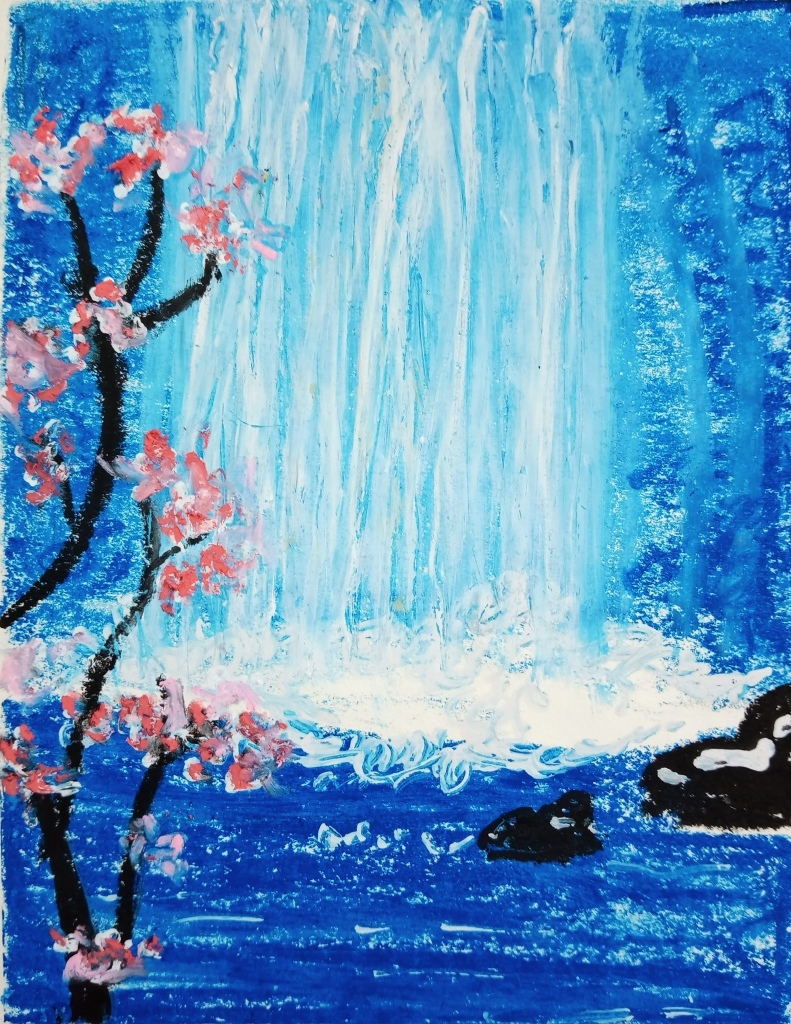
Art by Sohana Manzoor

Editorial

Finding Godot?… Click here to read.

Conversations

Ratnottama Sengupta talks to Ruchira Gupta, activist for global fight against human trafficking, about her work and introduces her novel, I Kick and I Fly. Click here to read.

A conversation with Ratna Magotra, a doctor who took cardiac care to the underprivileged and an introduction to her autobiography, Whispers of the Heart: Not Just a Surgeon. Click here to read.

Translations

Two poems by Nazrul have been translated from Bengali by Niaz Zaman. Click here to read.

Masud Khan’s poetry has been translated by Fakrul Alam. Click here to read.

The White Lady by Atta Shad has been translated from Balochi by Fazal Baloch. Click here to read.

Sparrows by Ihlwha Choi has been translated from Korean by the poet himself. Click here to read.

Tagore’s Dhoola Mandir or Temple of Dust has been translated from Bengali by Mitali Chakravarty. Click here to read.

Pandies Corner

Songs of Freedom: What are the Options? is an autobiographical narrative by Jyoti Kaur, translated from Hindustani by Lourdes M Supriya. These narrations highlight the ongoing struggle against debilitating rigid boundaries drawn by societal norms, with the support from organisations like Shaktishalini and pandies’. Click here to read.

Poetry

Click on the names to read the poems

Rhys Hughes, Maithreyi Karnoor, Luis Cuauhtémoc Berriozábal, Sivakami Velliangiri, Wendy Jean MacLean, Pramod Rastogi, Stuart McFarlean, Afrida Lubaba Khan, George Freek, Saranyan BV, Ryan Quinn Flanagan, Sanjay C Kuttan, Peter Magliocco, Sushant Thapa, Michael R Burch

Poets, Poetry & Rhys Hughes

In City Life: Samples, Rhys Hughes takes on the voice of cities. Click here to read.

Musings/Slices from Life

Ratnottama Sengupta Reminisces on Filmmaker Mrinal Sen

Ratnottama Sengupta travels back to her childhood wonderland where she witnessed what we regard as Indian film history being created. Click here to read.

Suga Didi

Snigdha Agrawal gives us a slice of nostalgia. Click here to read.

Healing Intellectual Disabilities

Meenakshi Pawha browses on a book that deals with lived experiences of dealing with intellectual disabilities. Click here to read.

Musings of a Copywriter

In Hobbies of Choice, Devraj Singh Kalsi explores a variety of extra curriculums. Click here to read.

Notes from Japan

In Becoming a Swiftie in my Fifties, Suzanne Kamata takes us to a Taylor Swift concert in Tokyo. Click here to read.

Essays

Walking about London Town

Sohana Manzoor takes us around the historic town. Click here to read.

How Do You Live?

Aditi Yadav explores the universal appeal of the translation of a 1937 Japanese novel that recently came to limelight as it’s rendition on the screen won the Golden Globe Best Animated Feature Film award (2024). Click here to read.

The Magic Dragon: Cycling for Peace

Keith Lyons writes of a man who cycled for peace in a conflict ridden world. Click here to read.

Stories

A Night at the Circus

Paul Mirabile tells a strange tale set in Montana. Click here to read.

Echoes in the Digital Expanse

Apurba Biswas explores a futuristic scenario. Click here to read.

Two Countries

Ravi Shankar gives a story about immigrants. Click here to read.

Chadar

Ravi Prakash writes about life in an Indo-Nepal border village. Click here to read.

Just Another Day

Neeman Sobhan gives a story exploring the impact of the politics of national language on common people. Click here to read.

Book Excerpts

An excerpt from Nabendu Ghosh’s Journey of a Lonesome Boat( Eka Naukar Jatri), translated from Bengali by Ratnottama Sengupta. Click here to read.

An excerpt from Upamanyu Chatterjee’s Lorenzo Searches for the Meaning of Life. Click here to read.

Book Reviews

Somdatta Mandal reviews The History Teacher of Lahore: A Novel by Tahira Naqvi. Click here to review.

Basudhara Roy reviews Srijato’s A House of Rain and Snow, translated from Bengali by Maharghya Chakraborty. Click here to read.

Bhaskar Parichha reviews Toby Walsh’s Faking It : Artificial Intelligence In a Human World. Click here to read.

.

Click here to access the Borderless anthology, Monalisa No Longer Smiles

Click here to access Monalisa No Longer Smiles on Amazon International

Categories
Editorial

Finding Godot?

Discard all prayers,
Meditation, hymns and rituals.
Why do you hide behind
Closed doors of temples?
....
There is no God in this house.

He has gone to visit the
Farmers who plough the hard ground,
The workers who break rocks ...


— Tagore, Dhoola Mandir or Temple of Dust (1910)

Love is a many splendoured thing and takes many forms — that stretches beyond bodily chemistry to a need to love all humankind. There is the love for one’s parents, family, practices one believes in and most of all nurtured among those who write, a love for words. For some, like Tagore, words became akin to breathing. He wrote from a young age. Eventually, an urge to bridge social gaps led him to write poetry that bleeds from the heart for the wellbeing of all humanity.  Tagore told a group of writers, musicians, and artists, who were visiting Sriniketan in 1936: “The picture of the helpless village which I saw each day as I sailed past on the river has remained with me and so I have come to make the great initiation here. It is not the work for one, it must involve all. I have invited you today not to discuss my literature nor listen to my poetry. I want you to see for yourself where our society’s real work lies. That is the reason why I am pointing to it over and over again. My reward will be if you can feel for yourself the value of this work.”

And it was perhaps to express this great love of humanity that he had written earlier in his life a poem called Dhoola Mandir that urges us to rise beyond our differences of faith and find love in serving humankind. In this month, which celebrates love with Valentine’s Day, we have a translation of this poem that is born of his love for all people, Dhoola Mandir.  Another poet who writes of his love for humanity and questions religion is Nazrul, two of whose poems have been translated by Niaz Zaman. Exploring love between a parent and children is poetry by Masood Khan translated from Bengali by Fakrul Alam. From the distant frontiers of Balochistan, we have a poem by Atta Shad, translated from Balochi by Fazal Baloch, for a fair lady — this time it is admiration. Ihlwha Choi translates poetry from Korean to express his love for a borderless world through the flight of sparrows.

Love has been taken up in poetry by Michael Burch. Borne of love is a concern for the world around us. We have powerful poetry by Maithreyi Karnoor that expresses her concern for humanity with a dash of irony or is it sarcasm? Luis Cuauhtémoc Berriozábal expresses his admiration for the poetry of Italian Poet Antonia Pozzi (1912-1938) in poetry. We have poems by Stuart McFarlane, Pramod Rastogi, Afrida Lubaba Khan, George Freek, Saranyan BV, Ryan Quinn Flanagan and many more. Rhys Hughes brings humour into poetry and voices out in his column taking on the persona of two cities he had lived in recently. There is truth and poignancy in the voices of the cities.

Suzanne Kamata writes a light-hearted yet meaningful column on the recent Taylor Swift concert in Tokyo.  Aditi Yadav takes up the Japanese book on which was based a movie that won the 2024 Golden Globe Best Animated Feature Film Award. Sohana Manzoor journeys to London as Devraj Singh Kalsi with tongue in cheek humour comments on extracurriculars that have so become a necessity for youngsters to get to the right schools. Snigdha Agrawal gives us a slice of nostalgia while recounting the story of a Santhali lady and Keith Lyons expresses his love for peace as he writes in memory of a man who cycled for peace.

Ratnottama Sengupta also travels down the memory lane to recall her encounters with film maker Mrinal Sen as he interacted with her father, Nabendu Ghosh. She has translated an excerpt from his autobiography to highlight his interactions with Ghosh. The other excerpt is from Upamanyu Chatterjee’s latest novel, Lorenzo Searches for the Meaning of Life.

In reviews, Somdatta Mandal has explored Tahira Naqvi’s The History Teacher of Lahore: A Novel. Srijato’s A House of Rain and Snow, translated from Bengali by Maharghya Chakraborty, has been discussed by Basudhara Roy and Bhaskar Parichha has reviewed Toby Walsh’s Faking It: Artificial Intelligence in a Human World. News and Documentary Emmy Award winner (1996) Ruchira Gupta’s daring novel born of her work among human traffickers, I Kick and I Fly, has been brought to our notice by Sengupta and she converses about the book and beyond with this socially conscious activist, filmmaker and writer. Another humanist, a doctor who served by bridging gaps between patients from underprivileged backgrounds, Dr Ratna Magotra, also conversed about her autobiography, Whispers of the HeartNot Just a Surgeon: An Autobiography , where she charts her journey which led her to find solutions to take cardiac care to those who did not have the money to afford it,

We have fiction this time from Neeman Sobhan reflecting on how far people will go for the love of their mother tongue to highlight the movement that started on 21st February in 1952 and created Bangladesh in 1971. Our stories are from around the world — Paul Mirabile from France, Ravi Shankar from Malaysia, Sobhan from Bangladesh and Ravi Prakash and Apurba Biswas from India — weaving local flavours and immigrant narratives. Most poignant of all the stories is a real-life narrative under the ‘Songs of Freedom’ series by a young girl, Jyoti Kaur, translated from Hindustani by Lourdes M Supriya. These stories are brought to us in coordination with pandies’ and Shaktishalini, a women’s organisation to enable the abused. Sanjay Kumar, the founder of pandies’ and the author of a most poignant book about healing suffering of children through theatre, Performing, Teaching and Writing Theatre: Exploring Play, writes, “‘Songs of Freedom’ bring stories from women — certainly not victims, not even survivors but fighters against the patriarchal status quo with support from the organisation Shaktishalini.”

While looking forward in hope of finding a world coloured with love and kindness under the blue dome, I would like to thank our fabulous team who always support Borderless Journal with their wonderful work. A huge thanks to all of you from the bottom of my heart. I thank all the writers who make our issues come alive with their creations and readers who savour it to make it worth our while to bring out more issues. I would urge our readers to visit our contents’ page as we have more than mentioned here.

Enjoy our February fare.

Mitali Chakravarty

borderlessjournal.com

Click here to access the content’s page for the February 2024 Issue.

.

READ THE LATEST UPDATES ON THE FIRST BORDERLESS ANTHOLOGY, MONALISA NO LONGER SMILES, BY CLICKING ON THIS LINK.

Categories
Tagore Translations

Temple of Dust by Rabindranath Tagore

Dhoola Mandir (The Temple of Dust) was written by Tagore in 1910 and can be found in his collection, Sanchayita1. It is a poem that seeks to bridge social gaps.

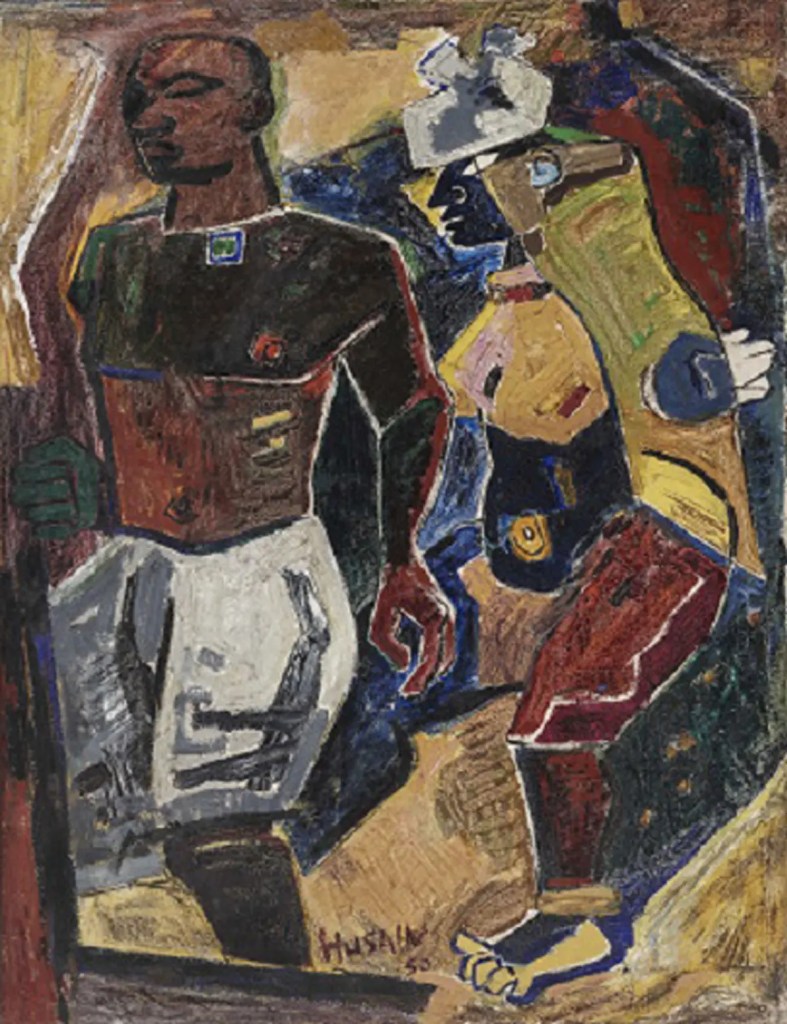
Peasant Couple (1950), painting by MF Husain (1915-2011)
Discard all prayers,
Meditation, hymns and rituals.
Why do you hide behind
Closed doors of temples?
In the darkness of the sanctum,
Who do you worship in secrecy?
Open your eyes and look,
There is no God in this house.

He has gone to visit the
Farmers who plough the hard ground,
The workers who break rocks for paths,
People who slog round the year.
He is there with them under the hot sun,
With dust-smeared hands;
Take off your garb of purity,
Join him in his dusty domain.

Nirvana? Oh! Where will you get it,
Where can you find freedom?
After Creation, our God,
Found himself bound to all of us.
Discard meditation, relinquish floral offerings.
Let your garments tear, your hands get dusty,
Join Him in His endeavours --
Free yourself of the rituals of religions.
  1. Sanchayita (literal meaning: collection) was published by Visva Bharati in 1931 to commemorate Tagore’s seventieth birthday. ↩︎

This poem has been translated by Mitali Chakravarty with editorial input by Sohana Manzoor 

.

PLEASE NOTE: ARTICLES CAN ONLY BE REPRODUCED IN OTHER SITES WITH DUE ACKNOWLEDGEMENT TO BORDERLESS JOURNAL

Click here to access the Borderless anthology, Monalisa No Longer Smiles

Click here to access Monalisa No Longer Smiles on Kindle Amazon International