Categories
Musings Stories

Dhruba Esh & Amiyashankar

Ratnottama Sengupta introduces a prolific, popular and celebrated Bengali writer and an artist
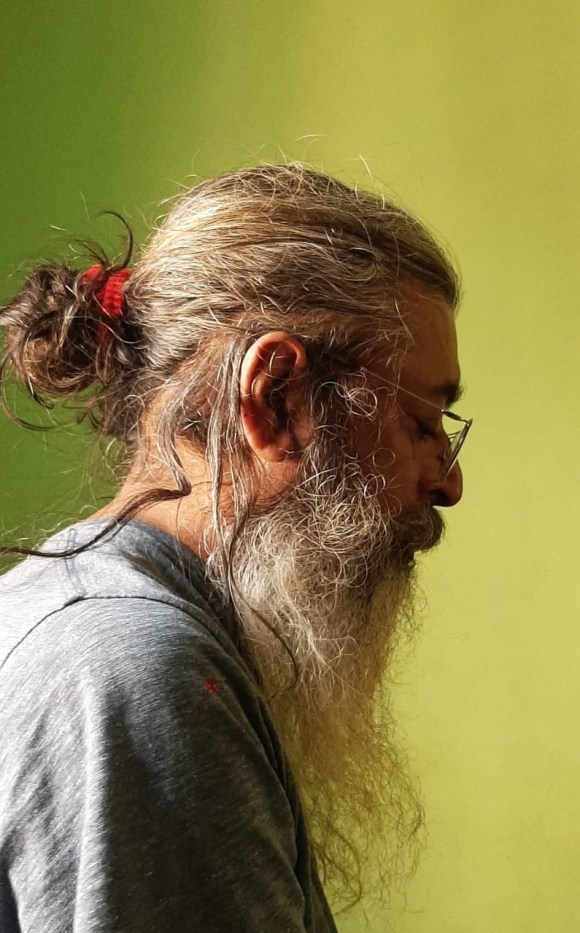
Dhruba Esh; Courtesy: Kamrul Hasan Mithon


Dhruba Esh, born 1967, is a full time cover designer – and a part time writer. He has authored stories for children and thrillers for grown-ups. A total of 40 books — or maybe more.”

This is from the cover flap of one of the artist’s published works. Cryptic? Yes. But it does not fail to convey the whimsy every Dhaka-based publisher and poet identifies with the name, Dhruba Esh. Read what Humayun Ahmed (1948-2012), a prolific author, dramatist and director of unforgettable films like Ghetuputra Kamola[1], saysabout the designer in Chaley Jaay Basanta Din[2]. “Must get hold of Dhruba Esh. For some unknown reason he’s been out of reach. Pasted on the front door of the flat he lives in is an A4 sized paper. It is adorned with the sketch of a crow in flight and is signed off with these words in Dhruba’s handwriting: ‘The Bird has Flown the Nest.’

“What I need to do is this: Throw away that A4 sheet and replace it with another, inscribed by these words: ‘Come back, Birdie!’

“Dhruba Esh might not know, but a bird that takes to its wings always returns to its nest. Only the caged bird has nowhere to fly off to. Its only reality is to stay put in one location…” 

Why am I taking a serious note of what Humayun Ahmed wrote? Not only because Dhruba Esh has penned the biography, Tumi Achho Kemon, Humayun Ahmed? More so because this custodian of Bangladesh literary culture, who continues to be a top seller at Ekushe Book Fair[3], is one of the cornerstones of modern Bengali literature on either side of the barbed wires.

Dhruba Esh is himself a legend in the Bangla literary firmament, I learn from Kamrul Hasan Mithon, a photographer turned publisher cum writer has been instrumental in reconnecting me with my father, Nabendu Ghosh’s roots in Kalatiya, once a village in Dhaka district that is now a suburb of the capital city. Bhaiti, as I affectionately address him, has been writing a column, Dyasher Bari (Ancestral Home), in Robbar (Sunday) magazine published online from Kolkata. Featured in it are all the major names of Bengali art, literary and cinema world — from Suchitra Sen, Mrinal Sen, Paritosh Sen to Ganesh Haloi, Miss Shefali, Sabitri Chatterjee and not forgetting Baba.

“Dhruba Esh is just one of his kind. He does not have a wife, no mobile, nor a Facebook page. He does not even ride a bus or train. If a destination is too long to walk, he travels only by rickshaw. He is most indifferent to money matters. But he is most enthusiastic about painting and designing. 

“Starting in 1989, when he was still a second year student at the Dhaka University, he has designed nearly 25,000 book covers. In addition he has designed music albums – and T’s too! Three years ago he was bestowed with the Bangla Academy Literary Award for his contribution to Children’s Literature – with titles such as Ayng Byang Chang [4] and Ami Ekta Bhoot[5].”

I fell for ‘Amiyashankar…’ at the very first reading. How effortlessly the surreal narrative etches a contemporary reality obtaining in the land of my forefathers!

Amiyashankar Go Back Home

Story by Dhruba Esh, translated from Bengali by Ratnottama Sengupta
Subachani or Bar footed Geese flying over Himalayas: From Public Domain

Amiyashankar Go Back Home!”

“That’s the title of the book?”

 “Yes Sir.”

“Is there a poem by this name?”

“No Sir. There’s no mention of Amiyashankar in my poetry.”

“No mention at all? Oh!”

“Can I send you some of my poems?”

“You may send.”

“Can you do the cover within this month?”

“Not this month. You’ll get it on the 12th of the next month. Only sixteen days to go now.”

He started laughing.

He’s a small town poet. A young professor. I have been to the town where he teaches in a girls’ College. It’s like a watercolour painting. There’s a river to the north of the town. Blue mountains in the distance complete the view.

The geese of Subachani had flown over this town on their journey towards the Manasarovar to restore Ridoy to his human size. The poet was unaware of this. He has not read Buro Angla[6].

“What is the book about? Birds?”

“You can find the PDF on Google.”

“Thanks. I will read it.”

Two days later he called. “Reading Buro Angla has sparked some fireflies in my mind. I’d not read the book until now.”

He was given my number by Rasul Bhai, a poet and a cricketer from the same town. He just about looks after the family publishing business. A good person. Last year I had done the cover for his book of poems, Lake Mirror of the Full Moon.

The poet had emailed his poems. He had said he’d send some poems, instead he had sent the PDF of the complete book. On the basis of Divine Selection I read 13 poems. He cannot be faulted for not reading Buro Angla. This poet writes good poetry. In two days I readied the cover for his book.

*

“Is Amiyashankar a friend of yours?”

“No.”

“Why are you telling him to go back home?”

“Because he is Amiyashankar.”

“What?”

“His wife waits for him.”

“He has no one of his own but his wife?”

“He has kids. One son, one daughter.”

“What does he do?”

“He’s a teacher in a government primary school.”

I was startled. Subhankar, Tushar, Amiyashankar, me — we are childhood friends. Our Amiyashankar is a teacher in a government primary school. He has a son and a daughter. The poet who lives in another town has never been to our town. He is not likely to have set his eyes on or made an acquaintance of Amiyashankar. Or, is a person likely to know another person through social media?

“I am not on social media,” said the poet.

“Why?”

“I get disoriented. Confused.”

“Oh. Your Amiyashankar’s wife is named Mitra?”

“Mitra. Yes, I did not tell you, sorry. Amiyashankar’s son is called Arnab, his daughter is Paramita.”

“Why are you creating Amiyashankar?”

“I have no friend.”

Our Amiyashankar’s wedded wife is Mitra. His son is Anu, Miti his daughter.

I call him.

“Hey, what’s the proper name of Anu and Miti?”

“Here — Anu is Arnab…”

“And Miti is Paramita?”

“Yes. You know it already.”

Really tough to suffer this.

I mentioned the poet. Amiyashankar did not read or write poetry. He had never heard of the poet.

“A modern poet?” he was curious.

“A post-modern modern poet.”

“Now what is THAT? Good to eat or wear?”

“Eat. Wear.”

“Does it hide your shame?”

“It covers your shame.”

“Good if it hides all.”

“Yes. Right. Where are you now?”

“I’m here, at Moyna and Dulal’s stall, sipping tea.”

“Aren’t you cold? Go back home.”

Amiyashankar, go back home.

*

On the 12th I sent the EPS file of the cover to the poet.

“If you don’t like it you may discard it,” I messaged.

Reply: “Will you design another cover then?”

Reply: “No.”

Reply: “This will do. I like it. There’s no Amiyashankar but one can visualise him. Thanks. Do I pay you online through bKash?”

I sent my bKash number. He sent the money.

End of give-and-take.

*

I blocked the poet’s number. I deleted every bit of communication in the mail. We had an Amiyashankar in flesh and blood. The poet had concocted an identical Amiyashankar. That Amiyashankar did not live and breathe – how’s that? Such convolution and complication! I was fed up of continuously, endlessly, unendingly living in complexity.

Better to shut my eyes and think of uncomplicated glow worms in my mind.

.

[1] A 2012 film by Humayun Ahmed centring around the exploitation of ghetupatras – young boy performers, Komala being a ghetupatra.

[2] The spring day passes

[3] Known as Eternal Twenty-first Book Fair is the largest organised by the government in Bangladesh.

[4] Bang is frog in Bengali. The rest are fun rhyming words.

[5] I am a ghost

[6] Book by Abanindranath Tagore (1871-1951, nephew of Rabindranath Tagore) published in 1953. Buro Angul is Thumb in Bengali. This is the humorous story about a mischievous boy, Ridoy, who was shrunk to the size of a thumb. He had to journey to the Mansarovar in Himalayas to regain his original size and meets various creatures, including the geese referred to here.

Dhruba Esh, born 1967, is a full time cover designer — and a part time writer. He has authored stories for children and thrillers for grown-ups. A total of 40 books — or maybe more. This story was first published in Bengali in a hardcopy journal called Easel.

Ratnottama Sengupta, formerly Arts Editor of  The Times of India, teaches mass communication and film appreciation, curates film festivals and art exhibitions, and translates and writes books. She has been a member of CBFC, served on the National Film Awards jury and has herself won a National Award. 

.

PLEASE NOTE: ARTICLES CAN ONLY BE REPRODUCED IN OTHER SITES WITH DUE ACKNOWLEDGEMENT TO BORDERLESS JOURNAL

Click here to access the Borderless anthology, Monalisa No Longer Smiles

Click here to access Monalisa No Longer Smiles on Amazon International
Categories
Poetry

Race Against Time

By Tracy Lee Duffy

If I am you and you are me,
Something Seuss may have rhymed, and Rogers
tried to share in time,
the grass is never greener. The right shoe
doesn’t fit the left foot. Distressed,
non-blessed, oppressed.
If you are me, I am you.
That I was shot down in Kharkiv,
that person was you sitting here free, or reverse
wading in an ocean on fire
in Hawaii. Then that person was here
warm, sipping tea. Pleased. Appeased.
If I am you and you are me.
If my house stays, your house goes; if your house stays,
my house goes. My cancer grows, your cancer remits;
my cancer rescinds your cancer relit. Your child is well,
my child is lost; your child falls down my child is found.
A circle profound. My money causes you harm, your
harm cost me money; your money buys me time, my time
causes you loss. Your indignation steals my value, my
value shames your worth. I curse. You swear. I dare you
you dare me. It’s not turning out to be -- We. Us.
I am not you. You are not me. A common ground then.
Jesus. Democracy. Then who made all those damn guns
and bombs and Anthrax and coronavirus? And egos
that ban books, hide history and rule others’ bodies. You
were never me. I was never you, or she/her, they/them.
And on and on and on it goes. It must stop
on common ground, for you, for me. Peacefully.

Tracy Lee Duffy’s poetry expresses emotion from life experience and observation through career, marriage and motherhood. She has been published in journals, online and recently in the Poets for Peace Anthology.

.

PLEASE NOTE: ARTICLES CAN ONLY BE REPRODUCED IN OTHER SITES WITH DUE ACKNOWLEDGEMENT TO BORDERLESS JOURNAL

Click here to access the Borderless anthology, Monalisa No Longer Smiles

Click here to access Monalisa No Longer Smiles on Amazon International
Categories
Essay

Haunted by Resemblances: Hunted by Chance

By Aparajita De

I first encountered the word in a B-grade flick of the same name. Ever since then, the word has struck my fantasy. Serendipity. My birth: serendipitously born after a son’s birth and death; coincidentally, even if a consolation prize, I am a cisgender[1] female. A girl child! What a joke. A substitute, but a girl version. I have often laughed, perhaps, loudly in my head at the joke that serendipitously played on my mother’s body. At the same time, another part of me wondered if that birth was serendipitous or the result of a deliberate quest that emerged from the nebulous grief of my mother. Was I a loss, a replenishment, or just serendipitous—just there? That is a conversation I have chosen not to have with the person who holds the secret of my birth. My birth mother. Some things are best left serendipitous.

Then came the best part of being in places I was never supposed to be found in. In family lore, always the darker-skinned, the book bug, the quieter child, who lacked the tall gait and the elegance of looks that one associates with class-caste. I was never that child. The second best and the serendipitous.

At best. I looked like my paternal grandmother; her broad forehead, dusky complexion, laborious quiet life, and ever-brooding absence in our growing up sealed her in my memory—a shadow without form. The faded yellow print of her pictures rotting in the corner frame above the walls in the rooms of my childhood held her in a stony gaze, looking over us. I looked like her, everyone said. Every mirror time, I tried to notice the resemblance and failed. Serendipitous. And so, I heard that she had died cooking for a family of 14 during the 1950s, in the heat and the labours of the kitchen and the birthing and rearing of children; she had gone just like that. Unnoticed. Serendipitously. At that reckoning, I had no idea what she might have thought of her life or its worth or if those thoughts were relevant and meaningful.

Yet, I looked like her, and by some strange rationale, I felt that I might start and end like her, except that I had to blot out that fatal certainty of her being absent. Her life’s work remained unmentionable, making her especially precarious and serendipitous among us siblings. But I had to do the erasing without any radical shifts. A bloodless coup over destiny. To live looking like her and yet living, unlike any of her days. It was as if my war with serendipity would have to be conducted serendipitously. Unseen. It was behind the covers of the book I was authoring—my life. Or so I felt at the time.

Our resemblances in looks took me to places far away in the books I preyed on. Sometimes, she became Bertha Mason[2], hovering over me, around me, hunting me down to consume my Self; some other times, I thought of the chances I could explore to blot her out and start owning me. I also wondered, somewhat fantastically, about who’d witness our meeting, our two entities fusing in a symphony unheard of. Sometimes, her emergence and eclipsing me seemed possible since I was not supposed to own any articulative space. At all. I was to gradually become the lady in the photo who was my father’s mother. I looked like her. And as my looks distanced me from my mother, I had to stay aloof, forever stuck in the picture, when the individual, my grandmother, was never a real presence in our lives growing up. She was gone before my parents were married. Gone before the serendipitous connection between the daughter of her sixth child could be made, and what would decide my fantasy with her.

Early on, like a gothic heroine coming to claim her rightful place after her travails were written by other men who decided for her, I figured I had to let her go out of that picture and claim space for her while allowing me the freedom where I was not the second best, the substitute child, the replacement, the accidental error. But the person who mattered. My paternal grandmother had not counted, and I did not either. But somehow, she had to come out of the picture so I could. Too. In my adolescence, there was this constant war against the serendipity of the accident of my birth, and it was shaping me from unnoticeable presences that shaped my sense of self at the time. A continual tug of war with the self.

In picture after picture, after adolescent year after year, the resemblances kept piling up. Anyone meeting me from my mother’s side noticed how I did not quite look like anyone they knew on their side. The voices noticing that I did look like someone long since passed crept up, ambushing me serendipitously. “You look just like her. Her forehead and complexion look just like hers.” I was aghast. What did she sound like? Are there stories I could find about her? Things she liked? Books she may have read? Stories of her girlhood she may have shared? Anything that took me back in time and let me feel her for real, like the person I looked like, but had never seen or felt a presence of. How can I think of her and me in me simultaneously? My thakurma[3] haunted me. And so did the fact that her granddaughter from her sixth child, whom she could not have foreseen, would become obsessed with her. She haunted me with her absence.

The lost child, the one lost in time, haunted my parents in his way. He came to live between us. Every time, a caress on a birthday, a milestone in life, or a decade past, I have been reminded that if he were here, we would be two years apart and that the gathering would only enrich itself if he were here. I was never enough. My decades, milestones, and being me were never enough. Either as the serendipitous birth or the look that outed me every time I stood before the parents or their side of the family, I became more and more distant from the people I came home to. Or I thought I had. While the people in the pictures, a dead person who birthed my father, who birthed me, became more defined in my life, and another dead person, a dead son, replaced me every time I tried being me.

A strange dilemma crept on me over time. The fantasy with the mingling of the pictures had disappeared, just like the stories that I had suddenly grown out of. A maturer self-reflected on the depression that came serendipitously to inhabit the space between my mother and me. My heart rumbled, and my eyes cried at the helplessness of that disorder. Was the boy child ever going to stop haunting my mom? If my thakurma were alive, could she steer my mother back to the present moment where she had her own children? Me? I reflected deeply as I entered my 30s at the time, torn apart by a conflict I could never quite diagnose myself, and a voice I could never hear, yet a presence that kept haunting us.

Both dead voices. Dead people. They were long gone in time. Yet never absent. Serendipitously creeping up on me. Ambushing me every time I peeked out.

[1] A person whose gender identity corresponds with the sex registered for them at birth

[2] Bertha Mason was the first wife (afflicted severely mentally)  of Edward Rochester, the hero of Jane Eyre, Charlotte Bronte’s novel published first in 1847.

[3] Paternal grandmother

Aparajita De is a mid-career academic, trying her hand at creative writing. this short piece represents her efforts juggling to find a voice between academic writing and more accessible creative writing. Aparajita has been published in venues such as Kitaab.orgTin LunchBox Minimag, and The Journal of Epxressive Writing. Aparajita also plants, walks, and organises.

PLEASE NOTE: ARTICLES CAN ONLY BE REPRODUCED IN OTHER SITES WITH DUE ACKNOWLEDGEMENT TO BORDERLESS JOURNAL

Click here to access the Borderless anthology, Monalisa No Longer Smiles

Click here to access Monalisa No Longer Smiles on Amazon International
Categories
Contents

Borderless, June 2025

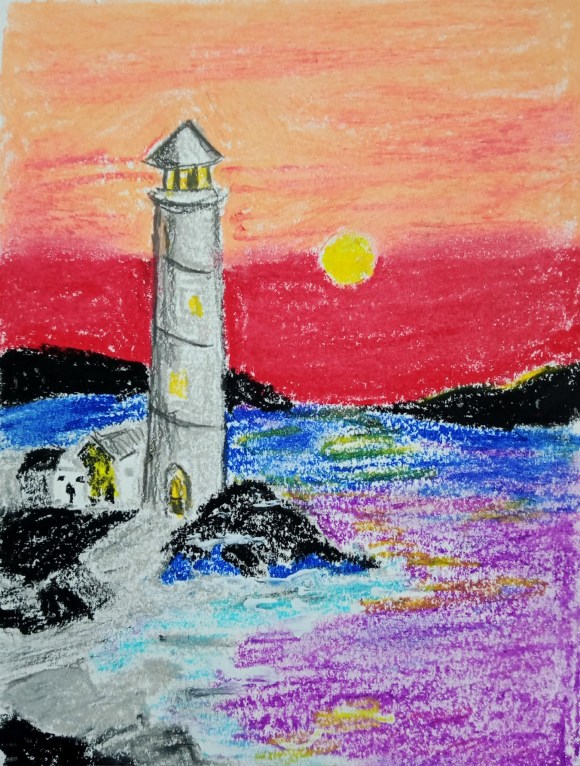
Art by Sohana Manzoor

Editorial

‘How do you rebuild a life when all that remains is dust?’… Click here to read.

Translations

The Great War is Over and A Nobody by Jibanananda Das have been translated from Bengali by Professor Fakrul Alam. Click here to read.

Sukanta Bhattacharya’s poem, Therefore, has been translated from Bengali by Kiriti Sengupta. Click here to read.

 Five poems by Soubhagyabanta Maharana  have been translated from Odia by Snehaprava Das. Click here to read.

Animate Debris, a poem by Sangita Swechcha has been translated from Nepali by Saudamini Chalise. Click here to read.

Lost Poem, a poem by Ihlwha Choi  has been translated from Korean by the poet himself. Click here to read.

Sonar Tori (Golden Boat), a poem by Tagore, has been translated from Bengali by Mitali Chakravarty. Click here to read.

Poetry

Click on the names to read the poems

Allan Lake, Shobha Tharoor Srinivasan, Ron Pickett, Ananya Sarkar, George Freek, Bibhuti Narayan Biswal, Jim Bellamy, Pramod Rastogi, Vern Fein, Saranyan BV, Ryan Quinn Flanagan, Juairia Hossain, Gautham Pradeep, Jenny Middleton, Mandavi Choudhary, Rhys Hughes

Musings/Slices from Life

Where Should We Go After the Last Frontiers?

Ahamad Rayees writes from a village in Kashmir which homed refugees and still faced bombing. Click here to read.

The Jetty Chihuahuas

Vela Noble takes us for a stroll to the seaside at Adelaide. Click here to read.

Hope Lies Buried in Eternity

Farouk Gulsara muses on hope. Click here to read.

Undertourism in the Outback

Merdith Stephens writes from the Australian Outback with photographs from Alan Nobel. Click here to read.

Musings of a Copywriter

In Driving with Devraj, Devraj Singh Kalsi writes of his driving lessons. Click here to read.

Notes from Japan

In The Tent, Suzanne Kamata visits crimes and safety. Click here to read.

Essays

Public Intellectuals Walked, So Influencers Could Run

Lopamudra Nayak explores changing trends. Click here to read.

Where No One Wins or Loses a War…From Lucknow with Love

Prithvijeet Sinha takes us to a palace of a European begum in Lucknow. Click here to read.

Bhaskar’s Corner

In Can Odia Literature Connect Traditional Narratives with Contemporary Ones, Bhaskar Parichha discusses the said issue. Click here to read.

Feature

The story of Hawakal Publishers, based on a face-to-face tête-à-tête, and an online conversation with founder Bitan Chakraborty with his responses in Bengali translated by Kiriti Sengupta. Click here to read.

Stories

The Year the Fireflies Didn’t Come Back

Leishilembi Terem gives a poignant story set in conflict-ridden Manipur. Click here to read.

The Stranger

Jeena R. Papaadi writes of the vagaries of human relationships. Click here to read.

The Opening

Naramsetti Umamaheswararao relates a value based story in a small hamlet of southern India. Click here to read.

Book Excerpts

An excerpt from Wendy Doniger’s The Cave of Echoes: Stories about Gods, Animals and Other Strangers. Click here to read.

An excerpt from Mohua Chinappa’s Thorns in My Quilt: Letters from a Daughter to Her Father. Click here to read.

Book Reviews

Somdatta Mandal reviews Madhurima Vidyarthi’s Job Charnock and the Potter’s Boy. Click here to read.

Rakhi Dalal reviews Dhruba Hazarika’s The Shoot: Stories. Click here to read.

Satya Narayan Misra reviews Bakhtiyar K Dadabhoy’s Honest John – A Life of John Matthai. Click here to read.

Bhaskar Parichha reviews David C Engerman’s Apostles of Development: Six Economists and the World They Made. Click here to read.

.


Click here to access the Borderless anthology, Monalisa No Longer Smiles

Click here to access Monalisa No Longer Smiles on Amazon International

Categories
Editorial

‘How do you rebuild a life when all that remains is dust?’

The Great War is over
And yet there is left its vast gloom.
Our skies, light and society’s soul have been overcast…

'The Great War is Over' by Jibanananda Das (1899-1954), translated from Bengali by Professor Fakrul Alam.

Jibanananda Das wrote the above lines in the last century and yet great wars rage even now. As the world struggles to breathe looking for a beam of hope to drag itself out of the darkness induced by natural calamities, accidents, terror attacks and wars that seem to rage endlessly, are we moving towards the dystopian scenario created by George Orwell in 1984, which would be around the same time as Jibanananda Das’s ‘The Great War is Over’?

Describing such a scenario, Ahmed Rayees writes a moving piece from the Kashmiri village of Sheeri, the last refuge of the displaced refugees who were bombarded after peace was declared in their refuge during the clash across Indo-Pak borders. He contends: “People walked back not to homes, but to ruins. Entire communities had been reduced to ash and rubble. Crops were destroyed, livestock gone, schools turned into shelters or craters. How do you rebuild a life when all that remains is dust?”

People could be asking the same questions without finding answers in Gaza or Ukraine, where the cities are reduced to rubble. While we look for a ray of sunshine, amidst the rubble, Farouk Gulsara muses on hope that has its roots in eternity. Vela Noble wanders on nostalgic beaches in Adelaide. And Meredith Stephens travels to the Australian outback. Devraj Singh Kalsi brings in lighter notes writing of driving lessons while Suzanne Kamata creeps back to darker recesses musing on likely ‘criminals’ and crimes in her neighbourhood.

Lopamudra Nayak writes on social media and its impact while Bhaskar Parichha writes of trends that could be brought into Odia literature.  What he writes could apply well to all regional literature, where they lose their individual colouring to paint dystopian realities of the present world. Does modernising make us lose our ethnic identity and how important is that? These are questions that sprung to the mind reading his essay. As if in an attempt to hold on to the past ethos, Prithvijeet Sinha wafts around old ruins in Lucknow and sees a cemetery for colonial soldiers and concludes: “Everybody has formidable stakes, and the dead don’t preach the gospel of victory or sombre defeat.”

Taking up a similar theme of death and war is a poem from Saranyan BV. In poetry, we have colours from around the world with poems from Allan Lake, Ron Pickett, Ananya Sarkar, George Freek, Jim Bellamy, Ryan Quinn Flanagan, Juairia Hossain, Gautham Pradeep, Jenny Middleton, Mandavi Choudhary and many more. Multiple themes are woven into a variety of perspectives, including nature and environment, with June hosting the World Environment Day. Rhys Hughes gives a funny poem on the Welsh outlaw, Twm Siôn Cati.

We have mainly poetry in translation this time. Snehaprava Das has brought to us Soubhagyabanta Maharana’s poems from Odia and Ihlwha Choi has translated his own poem from Korean. Sangita Swechcha’s poem in Nepali has been rendered to English by Saudamini Chalise. From Bengali, other that Jibanananda Das’s poems translated by Professor Fakrul Alam, we have Tagore’s pensive and beautiful poem, Sonar Tori (the golden boat). Yet another Bengali poet, one who died young and yet left his mark, Sukanta Bhattacharya (1926-1947), has been translated by Kiriti Sengupta. Sengupta has also translated the responses of Bitan Chakravarty in a candid conversation about his dream child — the Hawakal Publishers. We also have a feature on this based on a face-to-face conversation, giving the story of how this publishing house grew out of an idea. Now, they publish poetry traditionally, without costs to the poet. Their range of authors are spread across continents.

Our fiction again returns to the darkness of war. Young Leishilembi Terem has given a story set in conflict-ridden Manipur from where she has emerged safely — a story that reiterates the senselessness of violence and politics. While Jeena R. Papaadi writes of modern human relationships that end without commitment, Naramsetti Umamaheswararao relates a value-based story in a small hamlet of southern India. 

From stories, our book excerpts return to the real world, where a daughter grieves her father in Mohua Chinappa’s Thorns in My Quilt: Letters from a Daughter to Her Father while Wendy Doniger’s The Cave of Echoes: Stories about Gods, Animals and Other Strangers, dwells on demystifying structures that create borders. We have two non-fiction reviews. Parichha writes about David C Engerman’s Apostles of Development: Six Economists and the World They Made. And Satya Narayan Misra discusses Bakhtiyar K Dadabhoy’s Honest John – A Life of John Matthai. Somdatta Mandal this time explores a historical fiction based around the founding of Calcutta, Madhurima Vidyarthi’s Job Charnock and the Potter’s Boy while Rakhi Dalal looks at fiction born of environmental awareness, Dhruba Hazarika’s The Shoot: Stories.

We have more content. Do pause by our contents page and take a look.

Huge thanks to all our contributors without who this issue would not have materialised. Heartfelt thanks to the team at Borderless for their support, especially Sohana Manzoor for her iconic artwork that has almost become a signature statement for Borderless.

Let’s hope that next month brings better news for the whole world.

Best wishes,

Mitali Chakravarty

borderlessjournal.com

Click here to access the contents for thJune 2025 Issue

READ THE LATEST UPDATES ON THE FIRST BORDERLESS ANTHOLOGY, MONALISA NO LONGER SMILES, BY CLICKING ON THIS LINK.

Categories
Tagore Translations

The Golden Boat or Sonar Tori by Rabindranath Tagore

Sonar Tori (Golden Boat) is the titular poem of Tagore’s book of the same name. This celebrated collection was first published in 1894.

Art by Rabindranath Tagore. From Public domain
Amidst dense clouds and heavy downpour,
Without any hope of respite, I sit on the shore.
Many sheaves of rice are piled in droves,
Housed in straw-built stores.
The river's edge is like a razor as the water flows,
Torrential and ferocious.
While the rice was being cut, it started to pour.

I have a small field, and I work alone.
The water sways on all sides and overflows.
On the other shore’s horizon,
I see etched
A village under the shadow of trees
Covered in misty morning clouds.
On this shore, I am alone in this small field.

Someone is singing and rowing to this side.
Looks like, I might know her.
Without glancing around,
She rows past in full sail.
The waves helplessly
Part to give way—
Looks like, I might know her.

Oh where do you row, to which foreign land?
Come to me in your boat.
Go wherever you want,
Give to whoever you desire,
Only, do take
With a smile,
My golden crop from this shore.

Take as much as you wish into your boat.
Is there anymore? — There’s none left.
By the river,
I stashed into the boat
All that I had done in my life
In bundles —
Now, please be merciful and take me along.

I have no place. The boat is too small.
It is filled with my crop of golden paddy.
Surrounded by heavy
Monsoon clouds,
I stayed by the
Lonely shore —
Whatever I had was taken away by the golden boat.
Art by Sohana

This poem has been translated from Bengali by Mitali Chakravarty with editorial input from Sohana Manzoor.

.

PLEASE NOTE: ARTICLES CAN ONLY BE REPRODUCED IN OTHER SITES WITH DUE ACKNOWLEDGEMENT TO BORDERLESS JOURNAL

Click here to access the Borderless anthology, Monalisa No Longer Smiles

Click here to access Monalisa No Longer Smiles on Kindle Amazon International

Categories
poetry of Jibanananda Das

‘The Great War is over/And yet there is left its vast gloom…’

Jibananada Das’s poems translated from Bengali by Professor Fakrul Alam

THE GREAT WAR IS OVER 

The Great War is over
And yet there is left its vast gloom
Our skies, light and society’s soul have been overcast
One has to intuit whatever light there is every day
The sky is dark; society vacuous; Existence
Disgraced; love dead; blood flowing fountain-like;
Knowledge becoming the bearer of an immense load of corpses
And of its own self as well!

A NOBODY
A nobody wanted to walk down the path as always.
How then could those closest to him get lost forever,
And disappear in some underground world?

Painting By Jamini Ray (1887-1972)

Jibanananda Das (1899-1954) was a Bengali writer, who now is named as one of the greats. In his lifetime, he wrote beautiful poetry, novels, essays and more. He believed: “Poetry and life are two different outpouring of the same thing; life as we usually conceive it contains what we normally accept as reality, but the spectacle of this incoherent and disorderly life can satisfy neither the poet’s talent nor the reader’s imagination … poetry does not contain a complete reconstruction of what we call reality; we have entered a new world.”

.

Fakrul Alam is an academic, translator and writer from Bangladesh. He has translated works of Jibanananda Das and Rabindranath Tagore into English and is the recipient of Bangla Academy Literary Award (2012) for translation and SAARC Literary Award (2012).

.

PLEASE NOTE: ARTICLES CAN ONLY BE REPRODUCED IN OTHER SITES WITH DUE ACKNOWLEDGEMENT TO BORDERLESS JOURNAL

Click here to access the Borderless anthology, Monalisa No Longer Smiles

Click here to access Monalisa No Longer Smiles on Amazon International

Categories
Slices from Life

Where Should We Go After the Last Frontiers?

By Ahmad Rayees

It was late evening in the Valley—the kind of dusky calm that usually tucks our village into a blanket of silence before nightfall. But that night, the situation wasn’t peaceful. It was tense, suffocating. A silence not of rest, but of retreat. A silence that echoed with the footsteps of the displaced, the sobs of children, and the distant rumble of a war edging ever closer.

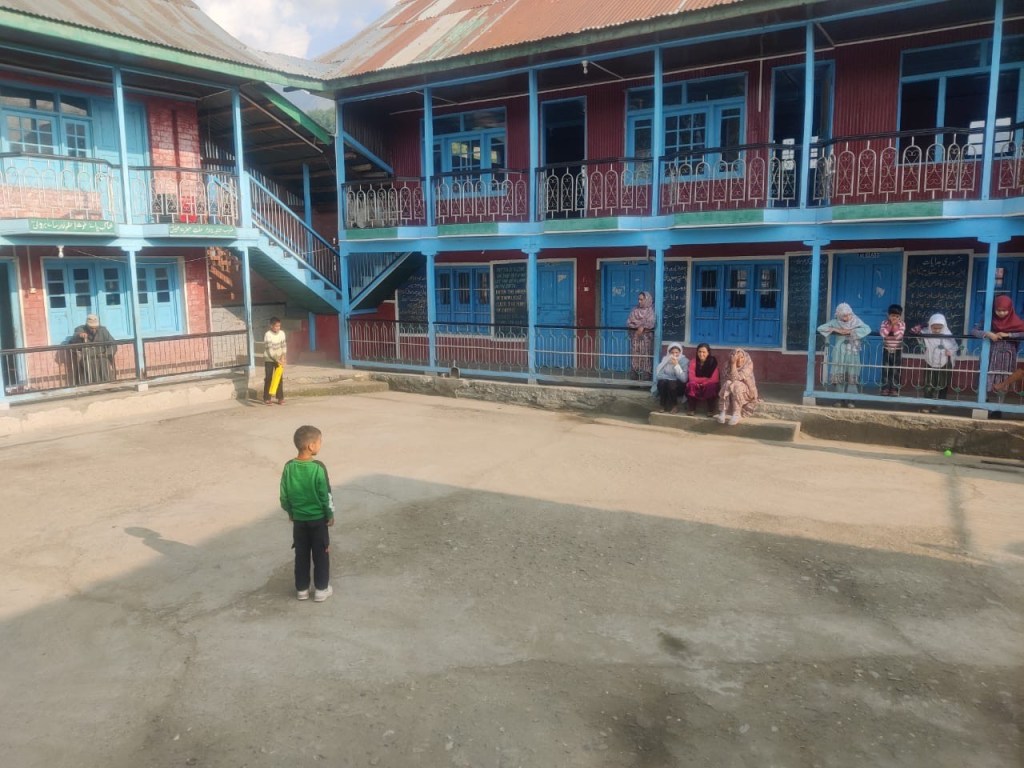
Nestled along the Srinagar-Muzaffarabad Highway, my village (Sheeri) had never imagined becoming a place of refuge. But over the past few days, it had slowly transformed into a shelter—not by design, but out of sheer necessity. It wasn’t a government-built camp or an official safe zone. It was a modest private school—its classrooms stripped of desks, Its walls were painted green, and its floors were covered with modest mats. The blackboard still bore lessons from a world that now felt impossibly far away.

They came by the dozens—families from the frontier town of Uri and other nearby hamlets, fleeing the deadly storm that had erupted along the Line of Control. The shells and gunfire hadn’t spared anyone. Mothers clutching newborns, elderly men barely able to walk, children with dust in their hair and tears in their eyes—each carried with them a fear that couldn’t be packed away. Their homes? Gone or abandoned. Their cattle? Lost. Their belongings? Scattered to the wind. All they had brought with them was survival.

We did what little we could, each small act stitched together into a fragile lifeline—volunteers arriving with rations and essential supplies, neighbours wrapping strangers in donated blankets, and someone rigging a single battery-powered generator in the school courtyard to pierce the darkness—just enough light to charge phones and confirm what we already feared through shaky mobile updates: India and Pakistan were at war again.

Just as we began preparing food that night, the sky above us erupted into unnatural color—bursts of red and orange, glowing like fireworks. For a breathless second, we hoped it was a celebration somewhere far away. But the thunderous roar that followed shattered that hope. These were no celebrations. They were drones. Missiles. Rockets. Tools of destruction lighting up the sky like angry constellations.

Panic was instant. Some people ran instinctively, nowhere in particular. Others froze. Mothers clutched children closer. Prayers spilled into the night air like smoke. The school—our fragile sanctuary—quaked with fear. And so did we.

I had heard stories of war. I had seen its images in books and on screens. But that night, war had a smell. A taste. A sound. That night, war breathed down our necks.

We stayed awake through the dark hours, huddled close under a full moon that bore witness to everything. The distant mountains glowed—not from moonlight, but from mortar fire.

The explosions echoed back and forth across the valley like angry giants arguing. Sleep was impossible. For many, so was hope.

For four harrowing days, the shelling continued. Relentless. Unforgiving. As India and Pakistan traded fire, villages on both sides were emptied. The front-lines moved like ghosts—never visible, always fatal. Each explosion wasn’t just an act of violence; it was a theft. It stole security, trust, homes, futures.

The ones who suffered weren’t the architects of war. They weren’t the men in polished suits or behind mahogany desks. They were farmers, schoolteachers, shopkeepers, daily wage earners. The ones who raised goats and crops, not guns. The ones who wanted nothing more than to be left alone.

And yet, here they were—broken by a war they didn’t start, begging for a peace that never came.

The soldiers too—barely out of their teens—were casualties in a different way. Sent to defend lines drawn generations ago, they carried weapons they barely understood, defending ideologies they didn’t create. On both sides, the blood spilled looked the same. The mothers’ grief sounded the same.

And as the bombs fell, something else collapsed quietly: Faith. Faith in leaders who promise peace and deliver bullets. Faith in ceasefires that last only until the next provocation. Faith that tomorrow would be better.

When the ceasefire was finally announced, there was no celebration. There were no cheers. Just silence—and not the comforting kind. It was the silence of disbelief, of loss too deep for words. People walked back not to homes, but to ruins. Entire communities had been reduced to ash and rubble. Crops were destroyed, livestock gone, schools turned into shelters or craters.

How do you rebuild a life when all that remains is dust?

These are the questions that haunt the air like the smoke refusing to clear —

Where should the birds fly after the last sky?
Where should we go after the last frontiers?
Where should the plants sleep after the last breathe of air? – Mahmoud Darwish

Ahmad Rayees is a freelance journalist and a fellow at Al-Sharq Youth fellow program. 

.

PLEASE NOTE: ARTICLES CAN ONLY BE REPRODUCED IN OTHER SITES WITH DUE ACKNOWLEDGEMENT TO BORDERLESS JOURNAL

Click here to access the Borderless anthology, Monalisa No Longer Smiles

Click here to access Monalisa No Longer Smiles on Kindle Amazon International

Categories
Feature

In Translation: Bitan Chakraborty

The story of Hawakal and a conversation with the founder, Bitan Chakraborty, whose responses have been translated from Bengali by Kiriti Sengupta.

Hawakal Publishers grew out of the compulsive need young Bitan Chakraborty had to express and connect. This was a young man who was willing to labour at pasting film hoardings to fund his dreams. An Information Technology professional by training, Chakraborty realised early he did not want to tread on trodden paths and started his journey as a creative individual. Now, he not only writes and publishes but also designs the most fabulous covers and supports local craftsmen.

Over the last nearly two decades, the brand Hawakal has become synonymous with traditional poetry publication from India. They do not offer buy back deals or ask to be paid like most publishers but pick selectively. No one seems to know what it is they look for. All Chakraborty says is – “We aimed to introduce a fresh wave in publishing.”

Chakraborty writes fully in Bengali which is why the dentist-turned-writer-turned-publisher, Kiriti Sengupta, had to chip in with the translation of his responses in Bengali. Their friendship matured over the last decade when Sengupta approached Chakraborty to publish a book of critical essays, which along with essays on Sharmila Ray’s poetry homed critical writing on his too. This was the first English publication of Hawakal.

Sengupta had given up dentistry by then and was living in a hostel on a packet of Maggi a day to indulge his creative passions.  A skilled poet with a number of books under his belt, he eventually joined Chakraborty to run the English section of Hawakal.  He also translates from Bengali to English. We have one of his translations of Chakraborty’s short story, Disappearance. A powerful reminder of social gaps that exist in the Subcontinent, it’s a poignant and frightening narrative, the kind someone writes and imagines out of a passion to reform.

Some of Bitan’s works are available in English. His style — by the translations — seems graphic. The deft strokes make the landscape and the stories almost visual, like films. 

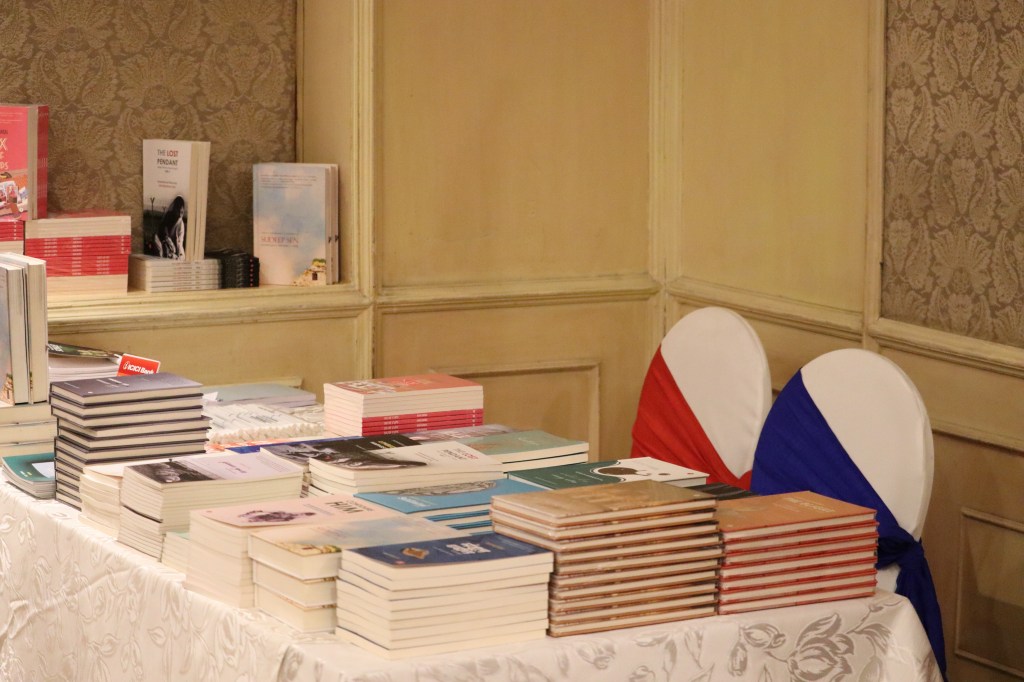
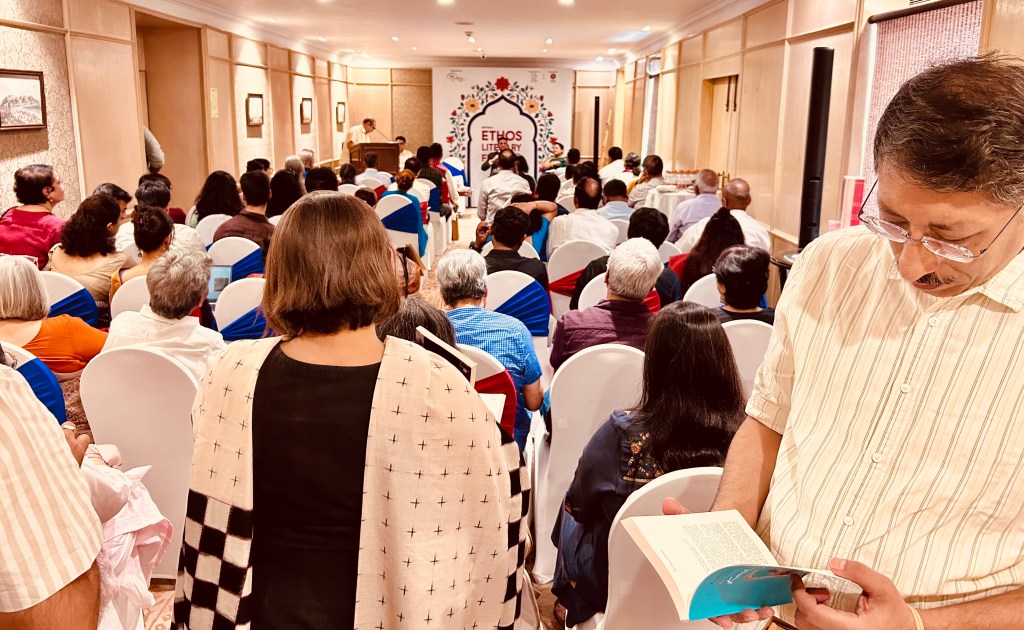
Chakraborty worked with ‘Little Magazines’ for some time. Then he made his way into publishing full time. Though he found it hard to make ends meet, he started his adventure without compromising his beliefs. He wanted to take books to readers and, with that spirit, they started the Ethos Literary Festival, where they host writers published by them. In fact, in the 2025 festival, Hawakal sold more than 400 books in seven hours! Who said poetry doesn’t sell?

Chakraborty and Sengupta have yet another hallmark. They wear matching clothes. These are tailored with material sourced from handloom weavers. They resorted to this when they found that commercialisation was killing the traditional homeborn handlooms. In that spirit, they started a clothes venture too, Mrinalika Weaves. 

Chakraborty is an unusual person – as the interview will reveal – humble, stubborn with aims like no other publisher or writer in this day and age! He doesn’t talk of money, survival, politics, awards or glamour, but what matters to him. He is direct and straightforward and perhaps, his directness is what makes his outlook appealing. He translates a few to Bengali for his own growth. But these are poets who are known for their terse writing. Maybe, that is what he looks for… Let’s find out!

Conversation
Bitan Chakraborty. Photo Courtesy: Kiriti Sengupta

Bitan, you are a multifaceted person: a writer, an artist, a photographer, and, most importantly, a publisher for all writers. What is it you most love to do and why?

I need to talk. What I observe or learn from my experiences compels me to express myself. Therefore, regardless of the medium I use, I strive to convey meaningful messages. Nevertheless, the range I enjoy in weaving words is unparalleled.

What sparked your interest in writing? Please elaborate. Do you only use Bengali to communicate with others? Do you translate from other languages to Bengali?

I felt emotionally down when I began writing. What a dreadful time it was! I believe it must be the emotional turmoil of my youth. However, writing has never left me since then. It’s more accurate to say that I have never managed to rid myself of my urge to write. During the early period, my writings contained more emotion than substance. In my college years, I was engaged in student movements that helped me discover the purpose of words. Society, socio-economic status, politics, and human dissatisfaction are the themes that run through my stories. Bengali is my mother tongue: I think, speak, dream, and curse in Bengali. I find it challenging to derive the same pleasure from using another language; it is my shortcoming.

Nevertheless, when I meet outstanding works in English, I attempt to translate them into Bengali. Not everything I read, but I have translated poems by Sanjeev Sethi and Kiriti Sengupta. I have consistently translated Gulzar into Bengali, but it has yet to be published in book format. Translation is a mental exercise; it particularly helps when I am experiencing writer’s block. I read poetry when I wish to untangle my thoughts, and when I come across fine poems in another language, I try to make them my own — bring them into my culture through translation.

Do you write only prose or poetry too?

I have been writing stories and essays for the past fifteen years. Interestingly, I began with poems, but they turned out to be junk. Therefore, I focussed on writing fiction.

Many of your stories focus on the Bengali middle class. What inspires your muse the most? People, art, nature, or is it something else?

I grew up in a lower-middle-class environment. Poverty, unemployment, and debt were parts of my formative years. I witnessed how this economic disparity allowed a particular segment of society to insult and humiliate others. Consequently, I have developed a strong affinity for those who are underprivileged. Later, when I began writing fiction, my political awareness enhanced my observations — I was able to merge the existing economic inequality with the nation’s political perspectives. The lessons I have learned over the years motivate me to write.

You design fabulous book covers. Do you have any formal training, or is it a natural flair?

When I entered the publishing industry, I had no funds to commission professionals for book covers or layouts. I had been involved with Little Magazines since my college days. I used to spend hours with the printers, meticulously observing how they designed cover spreads and interior text files. This experience proved useful when I began producing books. For the past several years, I have frequented bookstores, picking up a book or two — I also purchase books online, especially those that help me stay abreast of recent developments in book architecture. In my early years, I was unable to learn design formally due to financial constraints.

When and why did you decide to go into publishing? Could you tell us the story of Hawakal?

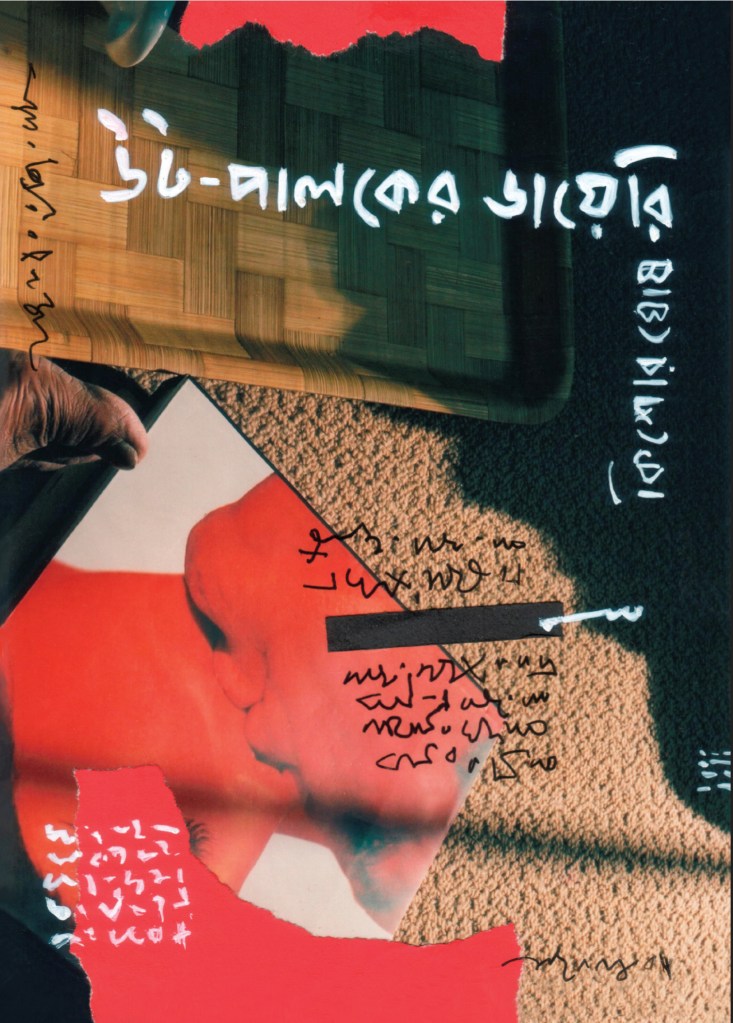
From 2003 to 2008, I was involved with four Little Magazines. Bengali Little Magazines thrive on minimal funds. Therefore, we (the team) managed everything necessary to publish a little magazine. We oversaw printing, distribution, book fairs, and other activities. By the middle of 2007, I realised I wasn’t suited for a day job. I understood that I would struggle to survive the conventional 10 am to 5 pm career. During that time, my family was in financial difficulties. Suddenly, we had the opportunity to publish Kishore Ghosh’s debut collection of poems, Ut Palaker Diary. It was published under the banner of the little magazine I was actively working with. As we worked on the book, I learned that publishing a magazine and publishing a book were entirely different endeavours. A little magazine is primarily sold through the efforts of its contributing writers and poets, while a book is sold through the combined efforts of the author and the publisher. I decided to pursue publishing as my career after we successfully sold 300 copies of Ghosh’s book in 10 months. That was the beginning.

Why did you opt to name your firm after a windmill — Hawakal in Bengali? Please elaborate.

We spent days selecting a name for our publishing concern. Finally, we chose the title of one of Kishore Ghosh’s poems as our company name. Hawakal, in English, means windmill. It signifies an alternative source of energy. We aimed to introduce a fresh wave in publishing. As an independent press, we have consistently operated ahead of our time. From developing a fully-fledged e-commerce hub (hawakal.com) in 2016 to producing the highest number of books during the pandemic (2020-2021), Hawakal has accomplished it all.

The first logo of Hawakal designed by contemporary artist, Hiran Mitra and then modified over time by Bitan Chakraborty.

You have boutique bookshops in Kolkata, Delhi — any other places? I believe you started a collaboration to get your books into the USA? Could you tell us a bit about your outlets and how you connect writers with the people? Are your boutique shops different from other bookshops? Do they only stock Hawakal books?

As you know, Hawakal has two functional ateliers in Delhi and Kolkata, while our registered office is located in New Delhi. We do not have any plans for an additional studio in India. We also have a bookstore in Gurgaon called Bookalign. There is a small outlet in Nokomis, Florida. It is a new unit in the United States. We primarily stock books published by Hawakal and its imprints (Shambhabi, CLASSIX, Vinyasa). However, we carefully select titles from other publishers for our store. We have sufficient seating in the store, allowing readers to browse the books before making a purchase. Since we publish non-mainstream authors, readers need to make a conscious choice. This not only benefits the authors we publish, but it also helps us evaluate the effectiveness of our selection process.

You started as a Bengali publisher, if I am not mistaken, and then forayed into English; now you are bringing out a translation in Hindi? How many languages do you cover? Do you plan to go into publishing in other languages?

We initially focused on Bengali books. Our venture into English titles began when Kiriti Sengupta joined Hawakal as its Director. Publishing a Hindi book was unexpected. However, we will not release books in other languages that we cannot read or speak. It is essential, as a publisher, to be well-versed in the language of the books we publish.

What kind of writers do you look for in Hawakal?

Would you like me to reveal the truth? We expect more than just satisfactory work from our writers: we want writers who will value their work passionately and take the necessary steps to reach a wider readership. Please don’t assume that what we expect from our authors is not something we adhere to ourselves. We expect this because we understand what it means to be truly passionate about one’s writing.

I heard that Hawakal was diversifying into textiles. How does that align with your writerly and publishing journey?

We opened our first kiosk in Mathabhanga, North Bengal, back in 2016. We simultaneously sold books and sarees from that small outlet. We had to close the shop due to a lack of staff. Kiriti Sengupta has long cherished the dream of representing the fine textiles of Bengal. Our family has grown larger. Bhaswati Sengupta and Lima Nayak have joined the team; they are the ones who established Mrinalika, collaborating with artisans from remote regions of India to showcase their creations to a wider audience.

Where do you envision yourself and Hawakal, your most extraordinary creation, ten years from now?

We aim to publish fifty timeless books over the next decade.

Thanks for your time and for the service you render to readers and writers.

[1] Ut Palaker Diary – Diary of a Camel Herder

Click here to read Disappearance, a story by Bitan translated from Bengali by Kiriti Sengupta.

(This feature — based on a face to face conversation — and online interview is by Mitali Chakravarty)

PLEASE NOTE: ARTICLES CAN ONLY BE REPRODUCED IN OTHER SITES WITH DUE ACKNOWLEDGEMENT TO BORDERLESS JOURNAL. 

Click here to access the Borderless anthology, Monalisa No Longer Smiles

Click here to access Monalisa No Longer Smiles on Kindle Amazon International

Categories
Poetry

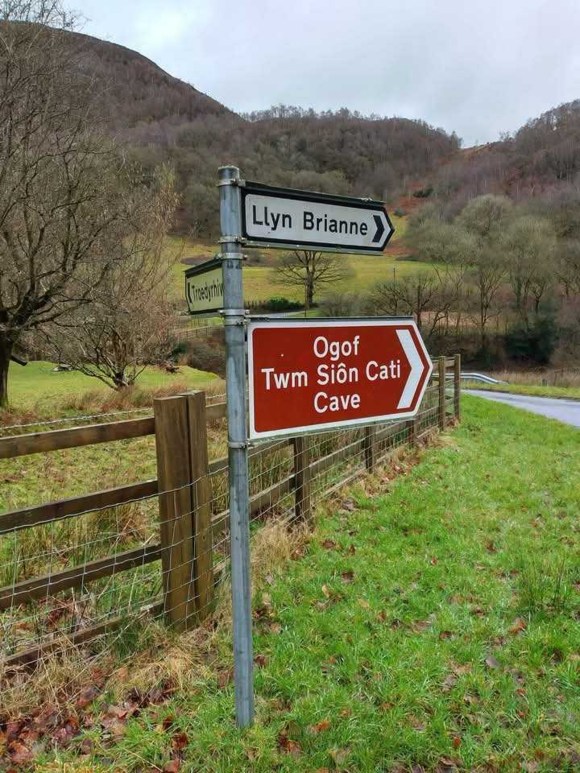
Twm Siôn Cati Cave by Rhys Hughes

Photo Courtesy: Rhys Hughes
Ogof
Twm Siôn Cati
Cave
is the place
the outlaw graced
with his face
and the remainder of
his ruffianly presence when
he was hiding
from the drab forces of Law
and Order.

Ogof is the Welsh word for Cave,
a word never heard
over the border in England,
and Twm Siôn Cati
is hardly known outside his native
land. I understand
why: he is obscure and there’s no
use being in great
haste to fashion poems about him.

He was a Robin Hood character, I
guess you can say.
If you trudge the wrong way on the
road between
Rhandirmwyn and Soar y Mynydd
you might even
end up as his involuntary guest and
be forced to relax on his stone sofa
while staring down
the barrel of his old flintlock pistol.

He might whistle
through his teeth a merry tune,
but no melodies later
than the 17th Century.
Twm Siôn Cati
never listened to the music
of Erik Satie
or Debussy or Shostakovich.
How could he?
and how can you expect him to
be familiar with their melodies
if it’s true he lived
so long ago in a damp cave?

You have slipped
back through time
and that’s the reason
if not the rhyme
for the mess you find yourself in
now: wave farewell
to modern comforts,
be resigned to a tougher life and
I think you’ll find
solace in the challenge.

Unlike Robin Hood,
Twm Siôn Cati never did
and never would
rob the rich to give to the poor.
He robbed the rich
and the poor as well to give
to himself,
but needless to say,
on any given day he preferred
wealthy victims.

Enjoy
your stay in
Ogof
Twm Siôn Cati
Cave.
Be brave: the scenery is
wonderful,
there are blackberries in
early autumn,
the colourful rocks,
odd as socks
glisten in the rain.

You ought to remain sane
if you accept
your fate: no pain, no gain:
no coin to toss,
no loss.
Twm Siôn Cati has adopted
you as his heir,
you must prepare to follow
in his footsteps
and become a troglodyte,
a night bandit plaguing
the heights of
the region: he planned it this
way all along.

Rhys Hughes has lived in many countries. He graduated as an engineer but currently works as a tutor of mathematics. Since his first book was published in 1995 he has had fifty other books published and his work has been translated into ten languages.

.

PLEASE NOTE: ARTICLES CAN ONLY BE REPRODUCED IN OTHER SITES WITH DUE ACKNOWLEDGEMENT TO BORDERLESS JOURNAL

Click here to access the Borderless anthology, Monalisa No Longer Smiles

Click here to access Monalisa No Longer Smiles on Kindle Amazon International