Categories
Poetry

When You Are Loudest

By Juliet F Lalzarzoliani

Yes.

I pause and smile
as you cross my mind
while I sit with friends,
talking about politics,
pop culture,
and the lives of people
who think they are
kings and queens.

But when the noise fades,
when everyone goes quiet,
that is when you are loudest.

I miss that version of myself,
the one who laughed without trying,
who felt light and alive.

I miss the sound of your voice,
calm and kind,
the kind that could quiet
a storm inside someone.

Yes, I remember that day.
I saw you sitting with your friends
at a table.
You took off your glasses,
and you looked like my childhood crush
from when I was eleven,
when life was all mixtapes
and slow songs on the radio.

And that was enough
to miss you,
quietly,
sweetly,
all the same.

Yes.

Juliet F Lalzarzoliani is an Assistant Professor in the Department of Economics at ICFAI University, Mizoram. She writes about nostalgia, relationships, and self-reflection. She lives in Mizoram and is passionate about exploring life’s quiet moments through words.

.

PLEASE NOTE: ARTICLES CAN ONLY BE REPRODUCED IN OTHER SITES WITH DUE ACKNOWLEDGEMENT TO BORDERLESS JOURNAL

Click here to access the Borderless anthology, Monalisa No Longer Smiles

Click here to access Monalisa No Longer Smiles on Kindle Amazon International

Categories
Stories

Exorcising Mother

By Fiona Sinclair

In the taxi from the station, Emily hugged her freedom as if it was an expensive handbag. At twenty-nine, she was returning from her first ever weekend away from home.

London had meant an orgy of sightseeing that her old friend Hannah was happy to accommodate. Like a time poor tourist, Emily had galloped through St Pauls, The Tower of London and Westminster Abbey until her friend had begged for a sit down and some food. “These buildings have been here hundreds of years,” she panted, not understanding that Emily’s default setting was playing catch up.

Now Emily trotted up the bungalow’s short driveway, a suitcase in one hand and, in the other, shopping bags ripe with new clothes. ‘No more hand me downs’ she thought with a smile.

It was an exceptionally warm spring that year, as if the weather, too, was in cahoots with her. Inserting the key into the front door, Emily knew from experience that the pokey bungalow trapped extremes of weather. So, with windows and doors shut up for four days, she knew it would be like entering a forge.

But, stepping into the hall, she was struck by an uncanny chill, as if an air conditioner had been switched to its maximum setting and left unchecked for many hours. It did not provide a welcome contrast to the unseasonable spring weather outside. Instead, she began to shiver, the hairs on her arms raised like hackles and a rash of tiny goose pimples spread across her skin.

Emily instinctively pulled on a cardigan and wrapped it around her. She waited for the chill to dial down. It did not. In fact, if anything, it intensified. Her next response was to move into the small kitchen to see if the freezer door had swung open, reasoning that in a place little more than a bedsit, the chill from the freezer might well have filled the place with cold air. But the door was secure. She then went methodically room by room, trying to find some other source for the cold. She found no answers, but the bedrooms, bathroom and sitting room, were all equally as chilled as meat lockers.

This frosty atmosphere did not frighten her. Emily was accustomed to weird and little phased her now. Standing with her hands on her hips in the sitting room she suddenly recognised the atmosphere as the brooding anger that was her late mother’s trademark. Since childhood, she had been familiar with this withdrawal of affection for some minor misdemeanour, anything from ripping her jeans in some Tom boy escapade to playing out with friends, ignoring her parent’s curfew. At these times, her mother’s beautiful features became an ice queen mask as maternal love was switched off, a punishment that stung far more than a slap or being confined to her bedroom.

Now the adult Emily, suspecting that death did not dissolve a person’s worst traits, knew that the house was overwhelmed by her mother’s disapproval of her daughter’s behaviour in the aftermath of her death. From her mum’s perspective, she had betrayed her on many counts. So, this was, Emily suspected, a sort of supernatural sulk.

Decades before, her mother’s life of delicious domesticity was ruptured by dad’s sudden death at 40. Now there were bills to settle, a living to be earned and a daughter to raise. But mum was unable to face the challenges. She was proactive only in seeking a replacement for dad, a knight on a charger who would solve her troubles. However, she soon found that she was considered more mistress material than wife. Her beauty was too showy for a rural backwater and millionaires with money to purchase shiny things were in short supply.

She had begun drinking just to take the edge off her problems, in the days following her husband’s death. Failure to find a new man sent her mother’s moral compass spinning off its course. Liaisons with a series of rogues paid the bills. Sex was anaesthetised by copious amounts of booze then. It also helped to blur the truth of herself in the dressing table mirror.

For Emily, her dad’s death was the death of her childhood. As family and friends peeled off with mother’s plunging reputation, at eleven she was promoted to confidante. By eighteen, when her own life was becoming fecund with opportunity, her mother’s needy ‘You won’t leave me too’ tethered Emily to her and the bungalow. She procured her wine in the morning and put her to bed when it finally overwhelmed her.

Emily did this because she adored her mother. She was absolutely partisan, saw her as a beautiful victim relentlessly kicked by fate. Decades passed in this dreary routine. Mother and daughter’s lives contracted to the parameters of the tiny bungalow. Even the rogues fell away, except one who visited weekly, left money discreetly on the sideboard, claiming he expected nothing in return. However, his eyes constantly alighted on Emily like a fly, suggesting he was, in fact, watching an investment develop.

Then, in her mid-fifties, the knight she had always sought rode in to save mother. Sadly, it was more black than white and arrived in the guise of a tumour. Turning her back on treatment and determined that cancer would not run riot in her body as it done with her husband, she decided that suicide would be the cleanest exit.

The finding of the lump winded Emily. She crawled like an invalid through those early days of diagnosis. All the while mother insisted there would be no discussion and life would default to their version of normal. Emily’s shock was compounded when she understood that her mother expected her to facilitate death. Sick to her stomach, she nevertheless agreed, thereby giving her mother peace of mind. But she secretly offered up desperate prayers that it would not come to it.

The origins of the suicide pact were hazy. Looking back, it was like trying to accurately recall a nightmare. Had her mum suggested it? Or had Emily been unable to contemplate life without her? Either way, mother’s relief was evident. In her addled mind, it was an elegant solution to an ugly problem.

From her contracted perspective Emily could not envisage a future for herself. She was isolated as a heroine in a Victorian novel, having had no contact with her family since she was eleven. In a sense she had grown up supernumerary to her mother who took precedence even in something as basic as clothes. Emily had not had her own new garments since childhood. As she grew into a young woman, mother would rummage in her own chest of drawers to provide underwear, jeans, and tops. Largely because all surplus money must go on alcohol.

Mother had also guessed that the one remaining rogue who kept a seemingly friendly eye on them, in fact had an agenda. Whilst Emily lacked her mother’s beauty she had the asset of youth. Some residual maternal instinct must have kicked in here. She knew that her protection was finite now. The rogue was playing a not so long game for the prize of a vulnerable young woman. In retrospect, Emily thought mother’s advocacy for the suicide pact was a blur of all these factors, with perhaps a jigger of jealousy as well for her daughter’s youth and health.

In the months before the cancer overwhelmed, Emily basked in her mother’s praise, “You are so brave.” Even at 28, she still craved the approval that was dealt out so meagrely. Of course, mother had no idea that it was all bravado, but it helped ameliorate the prospect of the pact and almost made her decision worth it.

But in truth Emily was horrified. It was as if the cancer had invaded both their bodies, decided both their fates. At times she was able to park her terror by bingeing on classic literature and junk food. Other times, at night, she lay awake, horrifying images running riot in her mind, silently screaming, “I don’t want to.” At these times, her love of life fought with love for her mother.

Mum sensed when the cancer was making its final move. Laying claim to her brain, it was gradually stealing her mobility and reducing her voice to a whisper. That day, Emily downed a bottle of wine herself to take the edge off proceedings. Unaccustomed to alcohol, she worked in a haze. The afternoon took on a ‘down the rabbit hole’ unreality. She talked her way through the preparations. This served to focus her mind and subdue fear. But there were still moments when she felt like a prison warder forcing her petrified body towards the noose.

A lack of basic physics saved her. The flex caused the water in the bath to merely ripple like a mini tide. There was an element of dark humour about the botched attempt, but neither laughed. Emily took the failure as an intervention by fate. As she clambered from the bath the truth tumbled from her mouth. “No, I don’t want to.”

In contrast, her mother sobbed at the abortion. Having lost all agency to cancer, she could not now determine her own death. Her daughter, with strength gained from years of practice, now supported mum back to bed.

And then her mum performed the only selfless act of the past twenty years. She instructed Emily to phone her estranged grandmother. As is often the case, the two hit it off. Whilst Emily had never resembled her mother, she now saw her genes were gifted from this woman. They shared the same brown hair and eyes. Their temperament was similar, too. The granddaughter inheriting her indomitable spirit.

Of course, Emily knew there would be a reckoning in the future. At some stage she would have to make peace with the guilt she had stashed away in a corner of her mind; the broken promise of living on after her mother, the disloyalty of accepting her grandmother’s protection, the process of carving out a future for herself. But, at the moment, Emily was distracted by the sheer novelty of living.

And now, suddenly, she began to throw open all the windows and doors. The heat waiting outside burst into the bungalow, seeing off the cold from every corner, melting the ice of her mother’s anger until, standing bathed in sunlight, Emily smiled, knowing that, for now, her mum was routed.

.

 Fiona Sinclair lives in a village in the UK. She is a poet with several collections published by small presses. Fiona has just begun writing short stories especially about subjects that cannot be covered by poetry. 

.

PLEASE NOTE: ARTICLES CAN ONLY BE REPRODUCED IN OTHER SITES WITH DUE ACKNOWLEDGEMENT TO BORDERLESS JOURNAL

Click here to access the Borderless anthology, Monalisa No Longer Smiles

Click here to access Monalisa No Longer Smiles on Kindle Amazon International
Categories
Poets, Poetry & Rhys Hughes

Soaring with Icarus

The Fall of Icarus by Peter Paul Rubens (1577–1640). From Public Domain
ICARUS

Your wings soared
to foolish heights
once only;
the wax slipped away
from an angry sun,
sealing your fate
on the waters below
with your own
mortal stamp.

Few feathers
remained to fall
in your wake;
most, caught by currents
of air, circle the globe
and fall over
our cities even now.
I found one
in my gutter.


COUNTY HALL VISTA

The fountains are silent
the fishermen hunch
in the rain
After lunch, the workers
greet the day again
mayonnaise on their lips
stretching weary limbs
while the aged heron
skims low with
ponderous dignity
across the bay
beak soured in oil.

Senile Pagoda
lonely as the fishermen
who line the wharf
stuffed full with
intentions pending
never ending bureaucratic
mockeries of a system
At lunchtime the
workers feed;
I watch them through the
canteen window.

Rhys Hughes has lived in many countries. He graduated as an engineer but currently works as a tutor of mathematics. Since his first book was published in 1995 he has had fifty other books published and his work has been translated into ten languages.

.

PLEASE NOTE: ARTICLES CAN ONLY BE REPRODUCED IN OTHER SITES WITH DUE ACKNOWLEDGEMENT TO BORDERLESS JOURNAL

Click here to access the Borderless anthology, Monalisa No Longer Smiles

Click here to access Monalisa No Longer Smiles on Kindle Amazon International

Categories
Musings

Bibapur Mansion: A Vintage Charmer

By Prithvijeet Sinha

Writing about Lucknow’s fabled monuments has set me free to regurgitate images and feelings (‘ehsaas‘ as the Urdu equivalent goes) that call for effusive recollections. When the praxis of location and travel stand side by side, words flow out of the material foundations of structures that court our instant awe. Another fabled monument that rewrites the architectural-historical continuum of Awadh in that admirable vein is Bibiapur Kothi (Mansion); there’s just something sturdy about its presence in one of the most beautifully quiet corners of the cityscape.

Blessed by the legendary aesthetic choices of Nawab Asaf-ud-Daula, one of the most prominent architects of Lucknow, and built by architect Antoine Polier and his dedicated team in the latter part of the 18th Century, Bibiapur Kothi is a vision of grandeur. Legend has it that it was a favourite country retreat for the Nawabs as well as a centre for another arcane ritual from the past — hunting.

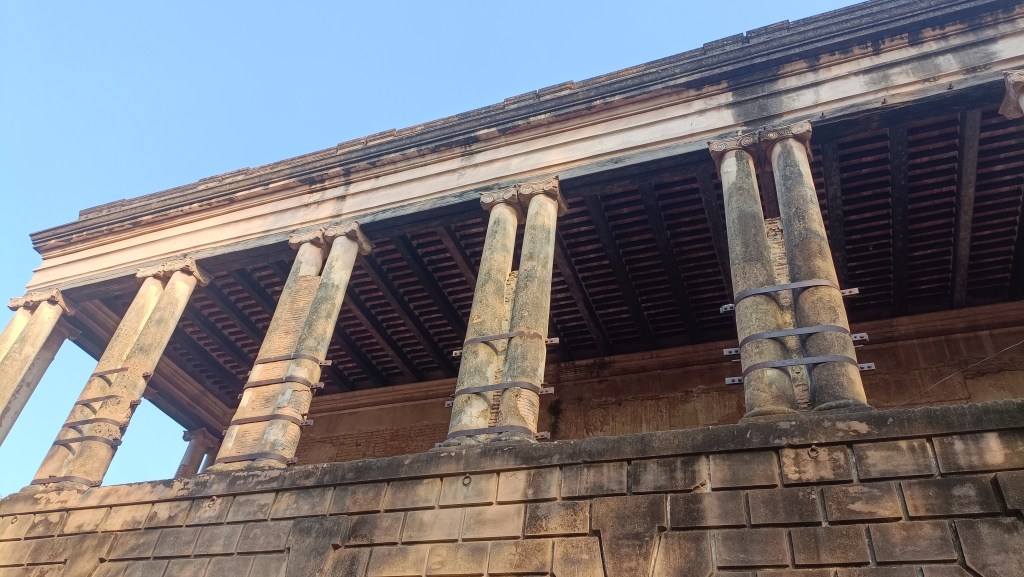
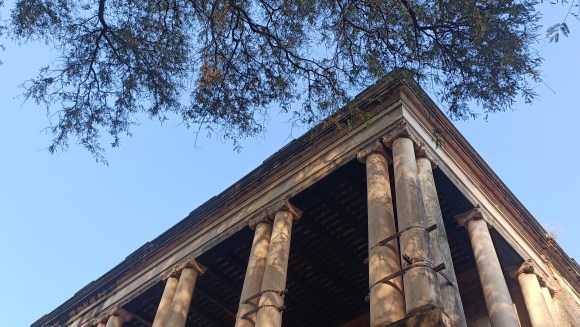
Like it always happens, visiting this site is like opening a door and entering the mystifying corridors of a past that can never be replicated. The neo-classical architectural style itself is easy on the eyes as spacious arches, halls, high roofs and round pillars — hypnotic ballasts of extreme strength – mesmerize the visitor. An enchanting spiral staircase divides this space into two storeys while the halls and Greek columns, beautifying its iconic exteriors, make us hark back to the glory days of interracial socialization that prevailed here. Lakhauri[1]betweenbricks and majestic stones’ sturdy network further arrests our undivided attention.

Imagine the masked balls, coronations (such as that of Saadat Ali Khan as the legend goes) and exquisite mehfils (musical/ poetic congregations) marked this mansion and its prominence for both for the native and colonial understanding of Awadh’s sensibilities, particularly Lucknow as the harbinger of urban sophistication.

.

Even for a modern traveller who can visualise yesteryears’ customs and etiquettes, the place is like a replica for the way the people lived and loved the essence of Lucknow. One can hear the hooves of equestrian sentinels guiding elaborate carriages, imagine a nawab reminiscing of a beloved while beholding the moon from the second floor and guests spread out under these roofs and occupying the hall, deep in conversations that could make or break the cultural sphere of influence tied intimately to regional politics. So, it’s natural that the more credulous storytellers still believe in this space holding fort for ghostly travellers who, it seems, just can’t escape the thrilling sensibilities of this particular realm.

.

Bibiapur Mansion is a visual delight. Its current locational axis generates awe for discerning visitors. Today, one has to take a straight drive from the Dilkusha corridor and nestled within the cantonment area beyond an old railway line is this architectural wonder. An army sentry guides us further as we enter the gateway and a world of trees, vegetation, cricket’s unified whispers, quarters and a granary beholden to the cantonment board fall in the pathway. Everything has old-world charm. The passage invites to the visitor like a transcendent experience. Surrounded by ancient trees, some with beautiful forms and thickets relaying the permanence of this area’s timelessness, is this fabled monument.

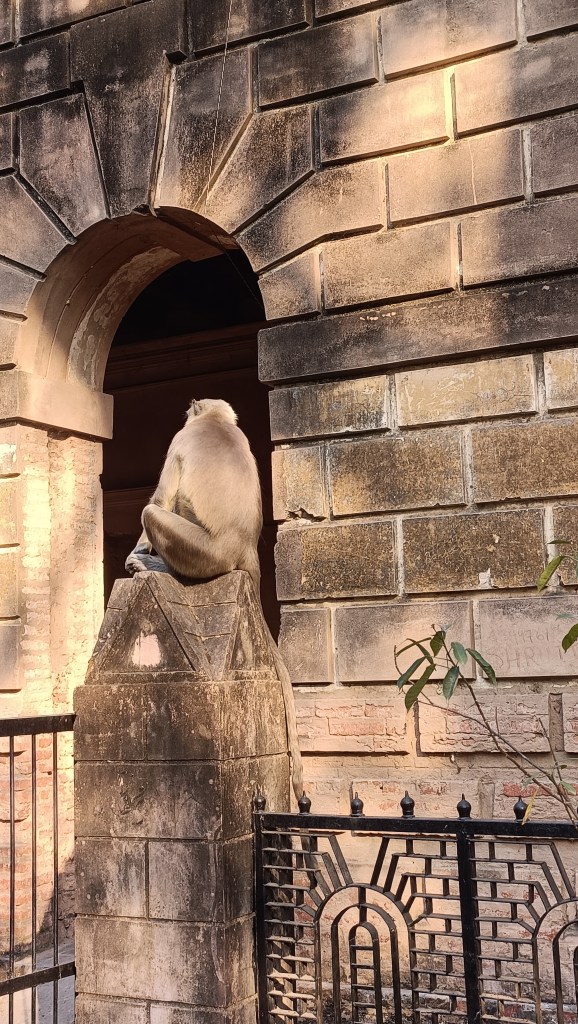
Sunlight lights up its walls and every now and then a langur(monkey) sprawling his long tail stands guard over the gates. The staircases, spacious compound, arched entryway and the glory of the Greek columns touched by the inimitable mix of lakhauri and current-day refurbishments awe us.

Here at Bibiapur Mansion, everything has a presence. Everything is accessible and iconic. In the absence of noise and marked by surfeits of wonder, we travel to the past while celebrating the immediate moments that brought us to this place.

Here, History and Wonder never sleep for long. Rather they awaken a new sentience.

Photograph by Prithvijeet Sinha

[1]Lime paint and plaster

Prithvijeet Sinha  is an MPhil from the University of Lucknow, having launched his prolific writing career by self-publishing on the worldwide community Wattpad since 2015 and on his WordPress blog An Awadh Boy’s Panorama. Besides that, his works have been published in several journals and anthologies. 

PLEASE NOTE: ARTICLES CAN ONLY BE REPRODUCED IN OTHER SITES WITH DUE ACKNOWLEDGEMENT TO BORDERLESS JOURNAL

Click here to access the Borderless anthology, Monalisa No Longer Smiles

Click here to access Monalisa No Longer Smiles on Kindle Amazon International
Categories
Poetry

Hello

By Soumyadwip Chakraborty

HELLO

And yes, this is a city, a city, a city.
And words repeat as they learn from sound --
shape-shifters, taking moulds, forming legion.
And I see cacophony knocking on my windowpane
In the dead of night,
In the tender morning light.

Yet escape comes from hindsight.
I drown and drown myself in your voice --
pebble in a pond,
milk in coffee,
sweat in the ocean,
And as I sink to lower depths,
I try to avoid the unavoidable,
writing my name on a single blade of grass.

Cacophony stares back as I finish this line
only to pick up the phone and say, "Hello...”

 Soumyadwip Chakraborty, born and brought up in Sodepur, currently residing in Hyderabad, works in a multinational. Since the body can run on food, water and oxygen, he chooses to have literature, music and cinema run his soul. His poetry is nothing but a by-product of his living.

.

PLEASE NOTE: ARTICLES CAN ONLY BE REPRODUCED IN OTHER SITES WITH DUE ACKNOWLEDGEMENT TO BORDERLESS JOURNAL

Click here to access the Borderless anthology, Monalisa No Longer Smiles

Click here to access Monalisa No Longer Smiles on Kindle Amazon International
Categories
Musings

What’s in a Name?

By Jun A. Alindogan… also known as Manuel A, Alindogan

Lines from Romeo and Juliet by William Shakespeare(1564-1616) From Public Domain

When I was in kindergarten, the only name I knew was Jun. So when my teacher called me by my full name, I didn’t respond at all.

Obviously, I was named after my father and am the second child in a brood of four. Many acquaintances actually mistake my name for Emmanuel. I don’t know why my grandparents named my father Manuel, but it might be attributed to common influences in the community, not necessarily based on a desired dream or a definite meaning. My grandfather was from Fujian, China, as were many other Chinese migrants to the Philippines. It is presently common for Filipino Chinese to have Filipino surnames, which could be traced back to the Spanish regime in the Philippines when conversion to Catholicism entailed getting a godparent to sponsor one’s last name.

Although my surname has its Tagalog root, which means alluring or captivating, my facial features are predominantly Chinese despite being just a quarter Chinese. According to my mom, I got my habit of heavy toothbrushing from my father. My dentist told me that I inherited my yellowish and strong teeth from my dad. According to stories, my grandmother, Isadora, was from Tondo, Manila, who I presume, had some Chinese roots too as her maiden name was Gubangco.

While teaching at a special speech school in Manila, I met a student from Capiz province whom I got to know better through some conversations on a bus heading to a southern suburb. She asked me about my middle name, which is Arnaldo, and mentioned that my roots might have a tendril from her province. She also noted that in addition to Roxas City, there is an Arnaldo City in the province. Similarly, there is a highway named Arnaldo in General Trias, Cavite province. However, our Arnaldo clan is from Bulacan province, so I am not sure if we have relatives who migrated to Capiz or if it is the other way around.

It is interesting to note that my grandfather had only one sibling. They shared two last names, which were Arnaldo Cruz. These names were not to be mistaken for middle and last names, as is the legal order of our names. From some information I received from my cousins, I discovered that my grandfather decided to only have one last name, so he adopted Arnaldo, while his brother took on Cruz. In Spanish, arnaldo means powerful as an eagle.

Our Arnaldo clan is large, as my mother had twelve siblings, with one dying shortly after birth. All of my uncles’ first names ended with the letter O, while two of my aunts shared the same last letter, A, in their first names as my mom. I do not have information about my grandfather’s brother and whether he had a large family as well. However, I do know that my mom and her siblings were close to their first cousins, who mostly lived in a village in Tondo, Manila.

One of their cousins worked in theatre, sharing the last name Arnaldo, for many years until his passing. My second cousin, whose maiden name is also Arnaldo, is a seasoned actress for television and movies. Another nephew who shares the same last name, Arnaldo, owns a boutique in Makati and is a fashion designer. His father was a village captain (Barangay Chairman) in Tondo. I am a freelance writer with a creative non-fiction portfolio. I do not know if talent is innate, but I believe it is a gift that needs to be consistently nourished and shared. Each family has its own unique talent, origin, and destination.

A former movie actress, who used to be known by her maiden name Arnaldo, has now become a nun and has turned her back on films. However, we are not related. She was also an environmentalist. Perhaps we are all connected in some way, but as time and tradition fade away, we cannot definitively identify these physiological and social elements.

When I moved to a residence uphill a few decades ago, the municipal mayor’s last name was Cuerpo. Residents claimed he was originally from Nueva Ecija, the province next to Bulacan. Recently, I discovered that two last names were common during our grandparents’ time. I learned about this during annual visits to our family tomb in Obando, my hometown. My grandmother had a brother whom we fondly called Lolo (grandfather) and was a good painter. I remember a porch at their house with a concrete wall painted with fish, shells, and other marine life. His name was Eliseo, but we knew him by his nickname Sayong. On our family tomb, his death marker shows his full name as Eliseo Cuerpo Cruz Enriquez. Does this mean that we are remotely related to the previous town mayor of my current residence? Her daughter recently started a political career and won as the number one councilor in our just-concluded national and local government elections. It would be great to have a conversation with her about her family origins. Cuerpo means body in Spanish.

In my first teaching job at a high school in my province in the late 80s, I had the opportunity, along with my colleagues, to visit the ancestral house of the then-municipal mayor, former mayor Tito Enriquez of Bulakan, Bulacan, on his birthday. His house reminded me of the Alindogan ancestral house, also known as Bahay na Bato (stone house), where the ground floor was used for firewood storage, free-range chicken, and other household items. I suspect that we may be related, as my grandmother was also from Bulacan, but from a different municipality, Baliwag. I recall attending a large family reunion of the Arnaldo-Enriquez clan in the same town during my childhood, which rarely occurs now since all of my mom’s siblings have passed away. In my first year of teaching, I was too timid to inquire or discuss my ancestry with the mayor. “Enriquez” means “son of Enrique” in Spanish. According to history, the Enriquez family of Bulakan, Bulacan, were prominent heroes in the Battle of San Rafael[1].

Not everyone has the opportunity to observe, identify, and understand family connections from the past and present, but it is always a good idea to remember where we come from. This can perhaps help us navigate our present and future destinations more clearly.

[1] Fought between the Spanish and the Filipinos in 1896

.

Manuel A. Alindogan, Jr. or Jun A. Alindogan is the Academic Director of the Expanded Alternative Learning Program of Empowered East, a Rizal-province based NGO in the Philippines and is also the founder of Speechsmart Online that specializes in English test preparation courses. He is a freelance writer and a member of the Freelance Writers’ Guild of the Philippines (FWGP).

.

PLEASE NOTE: ARTICLES CAN ONLY BE REPRODUCED IN OTHER SITES WITH DUE ACKNOWLEDGEMENT TO BORDERLESS JOURNAL

Click here to access the Borderless anthology, Monalisa No Longer Smiles

Click here to access Monalisa No Longer Smiles on Kindle Amazon International
Categories
Poetry

Thirty Days Left

By Sanzida Alam

My days have blurred 
like the wet henna stains on my fingertips.
Each fading line,
a day close to elsewhere.

Thirty days left.
Each one peels away
a face, a corner of home
a street I walked a thousand times.

I wanted this –
the scholarship letter,
a dream stamped by a foreign visa.
But want and farewell
speak two different languages.

Even joy comes with mourning.
How does one carry
both a suitcase and
the weight of leaving?

I eat mango slices more slowly now,
as if sweetness could hold me back.
I take the long way home now,
even when I don’t have to.

I linger in my mother’s room
fold her scarf a little tighter–
Then unfold it again.

My room is already a museum
of the things that I can’t pack.

The city has begun to look like a goodbye.
I walk slower now,
as if I could memorise the dust
before the plane lifts it from me.

Sanzida Alam is a Bangladeshi writer and researcher passionate about exploring social issues through her work.

.

PLEASE NOTE: ARTICLES CAN ONLY BE REPRODUCED IN OTHER SITES WITH DUE ACKNOWLEDGEMENT TO BORDERLESS JOURNAL

Click here to access the Borderless anthology, Monalisa No Longer Smiles

Click here to access Monalisa No Longer Smiles on Amazon International

Categories
Stories

The Fog of Forgotten Gardens

By Erin Jamieson

It’s always the same: rose petals, plucked from our apartment’s community garden.

Gray, misty day. The kind of day that Mom will spend asleep in her bed, curled up like a cat who doesn’t care about anyone or anything else.

Not quite raining. Just threatening rain. That heavy feeling in the sky, that tension that I feel now as I arrange each petal.

There’s a rumble of thunder just as I lay the last petal on Dad’s grave.

But the rain won’t come.

It never does.

I toast two slices of sourdough bread and slather butter on one and peanut butter on the other. I’ve tracked mud into our kitchen, but I don’t have time to worry about that right now. It’s already way later than it should be, and if I’m too late…

I actually don’t know what happens if I’m too late, or what too late even means. Dr. Hansen never really explained that. Probably on purpose.

What Dr. Hansen doesn’t get is that I’m the one taking care of her, not the other way around. Mom is a great actress: last appointment, she even put on makeup and ironed the pants she used to wear to work.

I fill a glass with soy milk and then take out her pills.

One purple one, one blue one. I set them beside the piece of sourdough with butter, then set the soy milk on the plate too. It makes it easier to cram everything on one plate like this. I learned the hard way, when this started. Ended up cleaning shards all over our apartment for the next half hour. And even then, I found some later — by slicing my foot open.

“Mariella?”

I nearly drop the plate I’m carrying. I can count on my hands the number of times she’s been awake this early — usually I just place her breakfast on her dresser. The same dresser they were going to sell in a garage sale before everything went to hell.

I race to Mom’s room– which, with a teeny two-bedroom apartment, it doesn’t take long. When I swing the door open, she’s sitting upright in bed. Her hair is damp, and even though there are still shampoo suds, it makes me feel something I can’t describe.

“Hey, I have breakfast for you.”

She watches me like I’m a stranger, or someone from another life. Her light brown hair is curly from the humidity– the only way we resemble each other. Her once full cheekbones (your Mom could be a model, seriously, Luis used to insist) are sunken. Even though she’s still several inches taller than I will ever be, she feels smaller than I am, her lanky arms and legs covered with not one but two bedspreads.

“It’s sourdough,” I say, and I’m annoyed that my voice shakes. This is my Mom after all. The same person who used to braid my hair before soccer games.

Who made me Jello Jigglers in heart shapes when I was sick on Valentine’s Day. (Valentine’s Day is 100 percent cursed for me, and no one can convince me otherwise. I get sick almost every single year — and now that most people I know are dating, it’s all the more sickening).

“Leave it on the dresser, Mariella.”

“I always do,” I mutter. For a Moment, I have a weird urge to throw off all those bedspreads and blankets. Shake her awake. Don’t you realize you’re supposed to be taking care of me, instead of the other way around? Don’t you even remember how to wash your own hair?

I turn to leave.

She grabs my hand. “Wait.”

I turn to face her, but I can’t look her in the eye. I’m scared of what I’ll see. No, I’m scared of what I won’t see. I’m scared I’ll see that glossy look the day he left us, like there was nothing left of her. Like whoever this was, was just inhabiting her body.

Luis would love that theory — love as in want to investigate it. He’s really into that kind of thing: the idea that we can exist in many ways at once, or live different lives. Even though he’s Catholic.

His parents absolutely love that.

But I’ve never told him. I haven’t talked to him, period, since everything happened.

“Are you going to prom?” she asks.

The question is so unexpected that I don’t speak for a moment. I stare at the dark bed board: this ugly tawny brown I’ve always hated. The apartment walls we’re not allowed to paint, so they’re this insipid beige-grey color that no one wants and no one asked for.

“Prom isn’t for a month,” I say, because it’s the easiest answer.

“Well, you need a dress.”

She studies my clothes: beige cardigan, ripped low rise jeans, both splattered with mud. In my defense, I left my rain boots in the kitchen. After tracking mud all over the tiles.

“I’m probably not going,” I say.

She sinks back in bed. “I need to call our landlord. The sink is leaking again. Could you get me his number?”

The leaking sink from the house we used to rent — before we couldn’t afford it anymore and had to downgrade.

“The sink is fine,” I say.

“Oh? I didn’t know they came.”

I bite my lip. “Hey, did you know you still have shampoo in your hair?”

She reaches to touch her hair. “I should probably take a shower,” she says. “You’re right. Well, you better get ready for school. Don’t want to be late.”

My eyes mist with tears, but I turn my back before she can see. “Yeah, I wouldn’t want to be late.”

.

Erin Jamieson’s writing has been published in over 100 literary magazines, including two Pushcart Prize nominations. She is the author of four poetry chapbooks, including Fairytales (Bottle Cap Press) and a forthcoming poetry collection. Her debut novel (Sky of Ashes, Land of Dreams) was published by Type Eighteen Books.  X/Twitter: @erin_simmer.

.

PLEASE NOTE: ARTICLES CAN ONLY BE REPRODUCED IN OTHER SITES WITH DUE ACKNOWLEDGEMENT TO BORDERLESS JOURNAL

Click here to access the Borderless anthology, Monalisa No Longer Smiles

Click here to access Monalisa No Longer Smiles on Kindle Amazon International

Categories
Poetry

Unspoken Promise by Shamim Akhtar

A Quiet Sunrise. Photo Courtesy: Shamim Akhtar.
UNSPOKEN PROMISE 

If you can,
look for a few words
scattered somewhere
across the vast distance
between two untimely wishes.

Upon tall pillars
of silent moments,
someone may have tried
to build a bridge —
a bridge adorned
with unspoken words of promise.

Dr. Shamim Akhtar is an Assistant Professor in the Department of Management at ICFAI University Mizoram. A researcher, writer, and a passionate poet explores themes of memory, longing, and the human condition. His work reflects a blend of lyrical sensitivity and deep introspection.

.

PLEASE NOTE: ARTICLES CAN ONLY BE REPRODUCED IN OTHER SITES WITH DUE ACKNOWLEDGEMENT TO BORDERLESS JOURNAL. 

Click here to access the Borderless anthology, Monalisa No Longer Smiles

Click here to access Monalisa No Longer Smiles on Kindle Amazon International

Categories
Stories

The Anger of a Good Man

By Naramsetti Umamaheswararao

A wealthy man named Dharmayya hired a carpenter to do the woodwork for his newly constructed house. He handed over the timber required for doors and windows and asked him to begin the work.

The carpenter brought his tools and started working. By the end of the week, the doors and windows were nearly ready. He used nails extensively to join and shape the wooden pieces.

One day, when the carpenter said he ran out of nails, Dharmayya immediately went to the market and bought some more. Showing them to the carpenter, he said, “The price of iron has gone up, so nails are expensive now. Still, I didn’t compromise on quality. Strong nails ensure durability. One shouldn’t hesitate to spend for lasting quality.”

One of the nails overheard these words — a particularly arrogant one — and it swelled with pride. It already had a haughty nature, and now hearing the owner’s praise, it became even more boastful.

Using every opportunity, it began to taunt the wood: “You’re nothing without us! Your strength and durability come only because of us. If you’ve earned any reputation, it’s because of the nails like me!”

But the wood didn’t mind. It calmly replied, “No one can survive alone. If I stand strong today because of you, I’m grateful.”

The nail didn’t like this response. The other nails and tools added, “Don’t say that. In a way, it’s because of you that we have any purpose.”

The arrogant nail was not pleased to hear even the other nails side with the wood. It glared at the wood and muttered, “Just wait. The moment I get a chance to tear through you, I’ll make you cry!”

Two days later, the carpenter happened to pick up that same nail. He placed it on the wood and struck it with a hammer. But the nail refused to go in. Seeing this, the carpenter struck it harder on the head with the hammer. The nail bent sideways. Trying to straighten it, he placed it on a stone and hit it again. This time, the blow landed badly and broke the nail’s head off.

Now useless, the carpenter tossed it into a corner and continued his work with a new nail.

The arrogant nail was shaken by the incident. It had never imagined such an end. Not knowing what to do, it sat there, broken, and wept.

As dusk fell, the carpenter packed up and left, leaving behind the wood, tools, and materials.

Seeing the nail lying sadly in a corner, the saw said, “So, miss high-and-mighty, look what happened to you! You thought the wood’s strength came from you? You mocked the very material that patiently endures our harsh cuts, believing that we are helping it become stronger. You couldn’t recognize its silent strength and goodness.

“When the carpenter hurts the wood while crafting a beautiful home, the wood endures it in silence. We are only tools used temporarily. But the wood is not weak. After being used once, who thinks about nails like you again? You wanted to hurt the wood but ended up ruining yourself. By morning, you’ll be swept away and tossed in the trash. Your life now has no purpose.”

The nail was finally enlightened. “I misunderstood the wood’s kindness as weakness and spoke arrogantly. It’s true — when good people get angry, they leave no trace of those who cross them.”

The truth is, the wood refused to let that nail in — not because it was weak, but to teach a lesson to that arrogant nail. Its resistance came from strength. It proved that the truly strong remain silent and fulfill their purpose without pride.

From Public Domain

.

Naramsetti Umamaheswararao has written more than a thousand stories, songs, and novels for children over 42 years. he has published 32 books. His novel, Anandalokam, received the Central Sahitya Akademi Award for children’s literature. He has received numerous awards and honours, including the Andhra Pradesh Government’s Distinguished Telugu Language Award and the Pratibha Award from Potti Sreeramulu Telugu University. He established the Naramshetty Children’s Literature Foundation and has been actively promoting children’s literature as its president.

.

PLEASE NOTE: ARTICLES CAN ONLY BE REPRODUCED IN OTHER SITES WITH DUE ACKNOWLEDGEMENT TO BORDERLESS JOURNAL

Click here to access the Borderless anthology, Monalisa No Longer Smiles

Click here to access Monalisa No Longer Smiles on Amazon International