Everything is different today. Everything is the same. She walks a little slower, Her head a little lower. Her smile is gone Her smile might never have been. Her dog knows; they have a way of knowing. Only three of us know, We know what the doctor said. The diagnosis. Everything is different today.
CARE FOR YOURSELF FIRST
Care for yourself first. Like loss of pressurisation in a jet. It wasn’t a surprise, not really. Are there any surprises left? Still, I wasn’t ready for it. The name sounded so final, so fixed. But isn’t life final, certain? After the hospital stay, I focused on myself, my body, my mind. I thought I would have lots of time. Time to write, time to paint, time to connect. Recovery takes a lot out of you. Physical, psychological, spiritual. Care for yourself first. Slowly, I discovered what was missing! Creativity and humour! Where had they gone? Will they return? I used to find beauty wherever I looked. I used to find humour all around me I used to have leftover energy to convert. They’re back now and welcome home! Laughter, Jokes, Observations, Insights. Excess energy to convert. It won’t last forever, sadly. So I’m revelling in my creativity while I can. Care for yourself first! Then care for others.
Ron Pickett is a retired naval aviator. His 90-plus articles have appeared in various publications. He has published five books: Perfect Crimes – I Got Away With It, Discovering Roots, Getting Published, 60 Odd Short Stories, and Empaths. Ron has had his poems published in Scarlet Leaf, Borderless Journal, and other periodicals.
PLEASE NOTE: ARTICLES CAN ONLY BE REPRODUCED IN OTHER SITES WITH DUE ACKNOWLEDGEMENT TO BORDERLESS JOURNAL
Here, this morning, where faces are aglow like soft sun-rays, sit beside me, for an eternity, or so.
Musings twirl like autumn winds.
Tell me, of stories, in which strong girls strive, of cities, where love deafens hate of battles, that are won vows that were never torn. Tell me, the storm will pass and we will survive, sunflowers will bloom out of our bosom.
Arshi writes poetry on themes of love, longing, and emotional resilience. Her poems have appeared in both Indian and international journals, including The Blue Minaret, Bosphorus Review of Books, Tap Into Poetry, Heduan Review, and others. Through her words, she seeks to find light in the dark, and a voice for tenderness in a loud world.
PLEASE NOTE: ARTICLES CAN ONLY BE REPRODUCED IN OTHER SITES WITH DUE ACKNOWLEDGEMENT TO BORDERLESS JOURNAL
The question is, why are we here? What are we doing, and what is expected of us? Is the purpose of our existence merely to continue the propagation of the species? Is there a higher calling to elevate our souls? Can we correct our karmic order to a better footing? Unfortunately, if only we knew where we went wrong last time, we could fix our past mistakes. Sadly, we do not. Is our presence on Earth to raise our species a level higher, whether intellectually or technologically, than a generation before? Is there a greater plan in the pipeline, to consume more and more, heading towards entropy? The less wise among us will be sure of their existence, convinced that this is a testing ground for more magnificent things to come.
Among the lower orders of species, it is a given that the biological reason for their existence is the perpetuation of DNA and the selection of the fittest. Most animals die shortly after laying eggs. Some, like praying mantises and black widow spiders, kill their mates after sex. Salmons lay eggs once in their lifetime, after enduring life-changing experiences to swim upstream, conserving all their energy for their one final trip to lay eggs and then die[1]. At this level, it seems that their raison d’être is to procreate. That is all.
As we climb the pecking order, women evolve to live longer. Some even reach a phase of life way past the cessation of ovarian follicles, a period called menopause. Only in a few species do the females have the luxury of relieving themselves of childbirth and caring for the young towards the latter part of their lives. Formerly, it was thought that only humans go through menopause. Now, we know that besides humans, whales, orcas, and chimpanzees also spend a significant part of their lives in the postmenopausal period[2]. Thinking about it, if the main purpose of life is to pass on DNA and then move on, why do they stay so long without trying to improve or spread the gene pool? It seems like a waste of resources. If it were only for procreation, it would clash with the purpose of existence. They might have to compete for limited resources.
Behavioural scientists who have studied orcas and whales suggest that their pod structure is matrilineal[3]. The older members care for the ‘grandchildren’ to promote survival. Indirectly, they help ensure the continuation of the species. This is known as the ‘grandmother hypothesis’. Their presence leads to healthier and stronger calves for future generations. These older postmenopausal orcas possess a wealth of knowledge to guide the pod in making life-changing decisions such as where to hunt juicy salmon and where to relax in peace.
Elephants that live for a long time, up to around 80 years, can still reproduce quite late, even as late as a 65-year-old female. One may wonder whether inbreeding is a possibility since they live in communities. Fortunately, nature provides a solution for them. Bull elephants, after reaching adulthood, leave their community tribe — a practice called dispersal. They then join their bachelor friends and roam around sowing their seeds. Female elephants remain with their birth herd for their entire lives and do not go through menopause[4]. In the chimpanzee community, dispersal is carried out by the females. They leave their troop when their hormones surge to avoid inbreeding.
So, where does that leave us as humans? Are we evolutionarily programmed to spend a long time in the postmenopausal state? After all, our ancestors rarely reached menopause. Even as late as the 18th century, the life expectancy of a woman was between 35 to 40. Advances in medical care and safe childbirth have extended our lifespan beyond the expectations of our ancestors. It might be an evolutionary accident, but we have adapted to it. It also prevents intergenerational reproductive conflict, as we avoid competing with our daughters for limited resources and reproductive opportunities.[5]
If the continuity of a species is the primary goal of life, then postmenopausal women have fulfilled their mission early in life. Life in old age should be regarded as a bonus. Without a role in transmitting genetic material, they may indulge in pursuits that bring them happiness. They might be catching up on activities they could not pursue during the demanding years of motherhood. The vast wealth of life experiences and street-smart wisdom can be passed on to their children, if the young are willing to listen. They could also revisit their carefree teenage years, which were cut short by hormonal surges during youth and the burdens they carried.
Recently, it has been suggested that living in an extended family can help ease the burden of caring for children with neurodevelopmental conditions. While it does not prevent ADHD or autism, grandparents can be valuable for providing emotional support and practical assistance.[6] They can offer a listening ear to understand the child’s unique needs. Better outcomes have been observed when grandparents live with their grandchildren.[7]
On a philosophical and existential level, it is difficult to precisely define what life is all about. We can discuss endlessly, like a philosopher, until the cows come home and then go grazing again. From a biological perspective, there is no doubt that it is not merely about the propagation of chromosomes. There is also room for acquiring knowledge, disseminating it broadly, and offering a helping hand to make the world a better place.
An orcas: Sourced by Farouk Gulsara from Public Domain
Farouk Gulsara is a daytime healer and a writer by night. After developing his left side of his brain almost half his lifetime, this johnny-come-lately decided to stimulate the non-dominant part of his remaining half. An author of two non-fiction books, Inside the twisted mind of Rifle Range Boy and Real Lessons from Reel Life, he writes regularly in his blog, Rifle Range Boy.
PLEASE NOTE: ARTICLES CAN ONLY BE REPRODUCED IN OTHER SITES WITH DUE ACKNOWLEDGEMENT TO BORDERLESS JOURNAL
Grudges are like hedgehogs. Be careful how you hold them. And never juggle with them.
Seriously, don’t.
Hide and Seek
[I]t’s harder for him to mean something than say – A.R. Ammons
Meaning hid in the words. The last place anyone would look. These days anyways.
And no one looked. No one looked. No one ever looked.
And that… hurt.
Tuesday (or in might’ve been a Friday)
Wrote a little poetry. Made no difference. Same ol’ same ol’.
Actually, I think it was Sunday,
Quotidian
Every day I forget a little. I eat a little, sleep a little, forget a little…
actually, sometimes I do forget to eat but
I never forget to forget. Either way it gets a little easier every day.
Jim Murdoch has been writing poetry for fifty years for which he blames Larkin, who probably blamed Hardy. He has published two books of poetry, a short story collection and four novels.
.
PLEASE NOTE: ARTICLES CAN ONLY BE REPRODUCED IN OTHER SITES WITH DUE ACKNOWLEDGEMENT TO BORDERLESS JOURNAL
The dragonfly, it seems, wishes to be my companion.
Even when October comes, it still hovers close by my side.
On a late autumn morning, cloaked in white frost,
clinging to a withered blade of grass until its life is spent,
the dragonfly loves the fields, loves the sunlight.

As swallows line up in long ranks,
packing their final bundles for a faraway journey,
news may come from the city of someone’s suicide,
yet the dragonfly listens half-heartedly, caring little.
Beside the fisherman, beside the farmer gathering beans,
following the way of life of distant ancestors,
the dragonfly flits about, plays with innocence.
And then, from a withered blade of grass,
it departs the world as lightly as taking flight—
on a morning when leaves and blossoms alike have faded.
From Public Domain
Ihlwha Choi is a South Korean poet. He has published multiple poetry collections, such as Until the Time When Our Love will Flourish, The Color of Time, His Song and The Last Rehearsal.
.
PLEASE NOTE: ARTICLES CAN ONLY BE REPRODUCED IN OTHER SITES WITH DUE ACKNOWLEDGEMENT TO BORDERLESS JOURNAL.
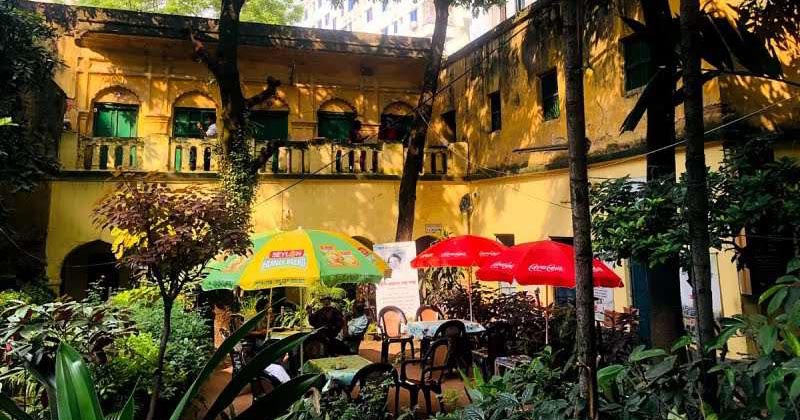
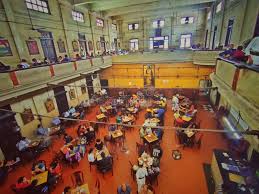
Beauty Boarding at DhakaIndian Coffee House at Kolkata Literary hubs or clubs? From Public Domain
We Bengalis think that no one can match us for our addas[1]. If you were growing up in Dhaka in the 1950s or the 1960s and happened to be literary in your inclinations, chances are you would end up on some evenings in Old Dhaka’s hotel-cum-restaurant Beauty Boarding. You would do so not mainly for the good food sold there at modest prices, but chiefly because you intended to see and hear poet Shahid Quadri regaling everyone in a table that probably included budding poets such as Shamsur Rahman and Syed Shamsul Huq, a promising film maker like Abdul Jabbar Khan, or a gifted painter like Debdas Chakraborty.
Over seemingly endless cups of tea, Quadri and his fellow poets and artists and friends and many other enchanted hangers-on would be entertaining each other late into the evening. Everyone present would in all probability say to each other or to others later: “Was there anywhere any adda as good as the one that took place in Beauty Boarding that evening?”
And, of course, Bengalis of Kolkata will claim that there was never ever any place for chatting and no addas held anywhere that have been able to match the ones at the city’s College Street Coffee House. Who hasn’t heard the song by Manna Dey[2] that has immortalised the conversation and the characters there—poets, journalists, actors, artists—all engaged in intellectual chitchat over nonstop cups of coffee? And though the song laments the passing away of a generation, one can find Kolkata’s Coffee House, like Dhaka’s Beauty Boarding, still very busy and very full of addas even now. But surely among the most famous addas of all times were the ones that took place in 18th century London’s “The Club,” aka “Literary Club”. This was the archetypal club for flowing conversation conducted over good food, great coffee, and suitably stimulating drinks (this last bit is conjectural!). Without a doubt, it is the most famous British literary club in history, and here outstanding intellectuals would engage in always entertaining and often scintillating conversation.
Just consider the luminaries in attendance at the Club on a typical London evening. At the centre of the conversation would be the physically huge figure of Dr Johnson—he of the towering intellect, he who was also known as “Dictionary Johnson” for his incredible feat of penning the first substantial dictionary of the English language almost single-handedly. Listening to him would be his devoted biographer, James Boswell; the greatest painter of the period and the founder of the Club, Sir Joshua Reynolds; Burke, the brilliant orator, passionate parliamentarian and indefatigable critic of the East India Company; Oliver Goldsmith, the renowned author and playwright, and Dr Christopher Nugent, the successful physician. As they conversed, sparks surely must have flown all around the table and Boswell must have been taking notes all the time of the pearl s dropping from Dr Johnson’s lips!
It was Reynolds who had proposed the toast associated with the Club— “Esto perpetua,” Latin for “Let it be perpetual.” Club membership was restricted—at first there were nine members, but soon some more were inducted. They included cultural luminaries such as the greatest actor of the time, David Garrick; the great parliamentarian and minister of the British Government for a while, Charles James Fox; the luminous economist Adam Smith and arguably one of the greatest of British historians, Edward Gibbon. According to the author and member of the Club, Bishop Thomas Percy, as far as Johnson was concerned, the thing that all members were to keep in mind was that the Club “was intended” to “consist of such men, as that if only two of them chanced to meet, they should be able to entertain each other without wanting the addition of more Company to pass the evening agreeably”. Or, to use the word coined by the great Dr Johnson himself, Club members had to be “clubbable!”
As one can imagine, with such amazing minds and larger than life characters, the reputation of the Club spread far and wide—in London and beyond. For sure, there were other clubs in swelling and increasingly prosperous London (as is the case with Dhaka now!), and Johnson himself was associated with quite a few of them, but who could compete with the members of The Club?
Initially, Tuesday was set aside as the meeting day, then Friday; eventually other days were considered good for clubbing as well. According to one member, the writer and lawyer John Hawkins, The Literary Club soon proved to be “the great delight of Johnson’s life, a centre of conversation and mental intercourse.” As the century progressed and more and more, people vied with each other to become a member of The Club, strict rules were initiated to keep up its reputation.
Eventually, elections and “blackballing” were procedures chosen to control the number of members as well as to ensure that only “quality” people became members. Hawkins, unfortunately, was deemed to be “unclubbable” by Johnson himself and therefore was soon expelled from the Club! But Club members could be of varying political beliefs—Burke, for example, was passionate about the rights of the American colonists but Johnson critical of them. Burning political issues such as the right of the American colonists came up for discussion and debate but tempers were kept under control and wit-combats proved to be the rule and not scuffles. On most days, conversation flowed freely.
On April 3, 1778, Boswell records in his biography of Johnson, for example, “The conversation began with sculpture” and then “the subject is dropped for emigration; it then moved on to “population increase” and “density”; next to parliamentary oratory, then to philology; afterwards to travelling abroad and thence to “human nature generally”!
Johnson died in 1784, and The Club eventually disappeared from recorded history, but it had survived long enough to become a model of clubs where great minds could come together for a convivial atmosphere, free and witty exchange of ideas, and company worth seeking every evening. It became the inspiration of many such institutions all over the world. Dhaka Club, thus, can claim that any recorder of its primordial history would find The Club as one of its ancestors. For sure, for our club members, or literary minded people wanting to elevate their addas a lot, the London Club can be a source of inspiration and the conduct of its members well worth emulating during addas for fantastic clubbing!
The Literary Club met on Friday evenings until midnight in London. The club gatherings with all the luminaries spanned a period of 20 years. From Public Domain
[1] Could be a tête-à-tête or just a chat with multiple people.
[2] Manna Dey (1919-2013) sang about adda in the legendary Coffee House of Calcutta.
(First published on August 20, 2018 in Daily Star, Bangladesh)
This spring dawn, birds begin their cacophony of chants, all sex and violence, imprints of who will rule the yard, whose offspring’s offspring will populate this patch of earth.
The morning traffic, too, has its cries, trills, alarms, greetings, rich or thin, metallic, harsh, calls for submission, and dominance over the interwoven nest of roads, ways, signals, and signs.
Richard Stimac has published a poetry book Bricolage (Spartan Press), two poetry chapbooks, and one flash fiction chapbook. In his work, Richard explores time and memory through the landscape and humanscape of the St. Louis region. He invites you to follow his poetry Facebook page: “Richard Stimac poet”.
.
PLEASE NOTE: ARTICLES CAN ONLY BE REPRODUCED IN OTHER SITES WITH DUE ACKNOWLEDGEMENT TO BORDERLESS JOURNAL
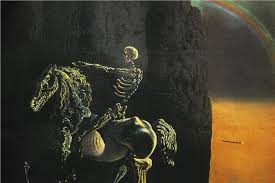
Horseman of Death by Salvador Dali (1904-1989). From Public Domain
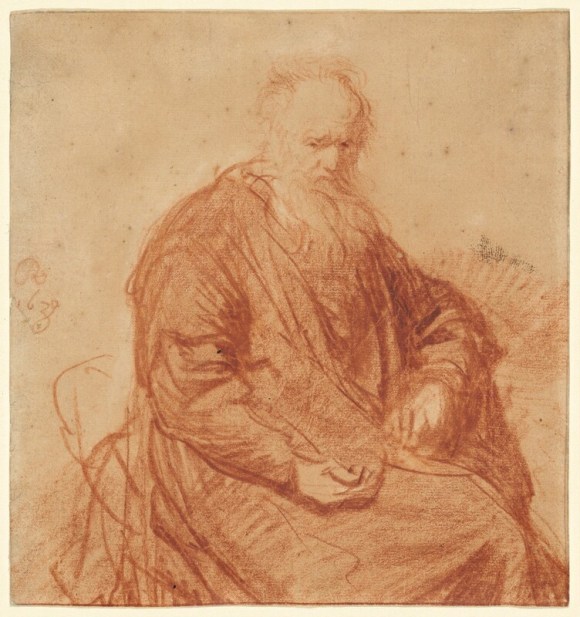
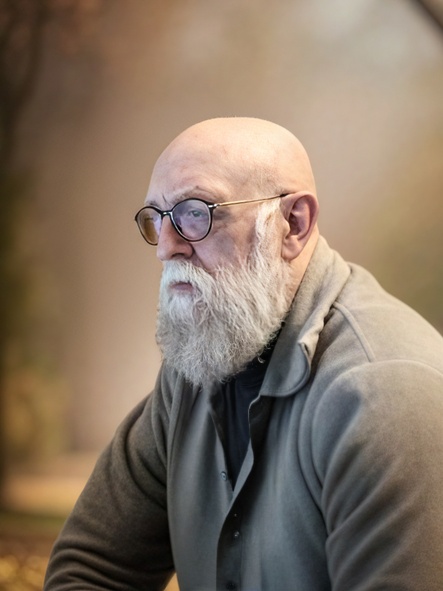
DO NOT SPEAK FOR OLD STAVED MEN

Do not speak for old staved men whose faces glint like tyres,
In the twilight of their years, they hum a tune so grim.
Their stories told in whispers, kindling ancient fires.

Beneath the moon, their silhouettes like church spires,
Stand testament to lives lived on the brim.
Do not speak for old staved men whose faces glint like tyres.

With every wrinkle, a saga that never tires,
Eyes that sparkle with memories, vivid and dim.
Their stories told in whispers, kindling ancient fires.

They laugh with the madness that freedom acquires,
Dancing to the wind's capricious whim.
Do not speak for old staved men whose faces glint like tyres.

In the hush of night, their spirit aspires,
To cast off the shadows, stark and slim.
Their stories told in whispers, kindling ancient fires.

So let them be, these merry old sires,
As they sip the stars, on the world's rim.
Do not speak for old staved men whose faces glint like tyres,
Their stories told in whispers, kindling ancient fires.


IF AT FIRST DEATH'S WORLD IS ROUND

If at first death's world is round, take heed,
Where shadows dance and silent whispers play,
A routed cock will sing for prayer indeed.

In twilight's grasp, where heartbeats intercede,
And stars above in quiet judgment sway,
If at first death's world is round, take heed.

The moon's pale light, on which dark dreams will feed,
A canvas vast, where lost souls might stray,
A routed cock will sing for prayer indeed.

Through time's thin veil, where ancient fates are freed,
The echoes of the past are not held at bay,
If at first death's world is round, take heed.

In madness' grip, where sanity will bleed,
And reason's voice is oft led far astray,
A routed cock will sing for prayer indeed.

So listen close, for it's the earth's own creed,
In life's grand play, we all must find our way,
If at first death's world is round, take heed,
A routed cock will sing for prayer indeed.


OH, WHAT NOW FOR THE FORGETMENOT MEN

Oh, what now for the forgetmenot men,
In a world where fathers jack all pleasure?
Their laughs echo, "Ha ha," and then?

They dance in boots of heavy leaden,
Stomping on dreams with no measure.
Oh, what now for the forgetmenot men?

With every chortle, they count to ten,
A madcap rhythm to their leisure.
Their laughs echo, "Ha ha," and then?

They sip on the nectar of a pen,
Ink-stained lips betray their treasure.
Oh, what now for the forgetmenot men?

In absurdity's grip, beyond our ken,
They find in oddity their true pleasure.
Their laughs echo, "Ha ha," and then?

So raise your glass to the when,
To the forgetmenots, in all their splendour.
Oh, what now for the forgetmenot men,
Their laughs echo, "Ha ha," and then?


O, WHENCE VENAL BODIES BREAK AND SPURN

O, whence venal bodies break and spurn,
In twilight's sickly, dolorous embrace,
What now for death but a new day made up from sickness?

The stars above in cold judgement turn,
As shadows cast by the moon's pale face,
O, whence venal bodies break and spurn.

The raven's call, a direful mourn,
Echoes through the void of this haunted place,
What now for death but a new day made up from sickness?

Beneath the earth, where the lost sojourn,
Lies the heart's desire without a trace,
O, whence venal bodies break and spurn.

A dance macabre, the world does churn,
Absurd the stage, life's fleeting race,
What now for death but a new day made up from sickness?

So sing the dirge, as the candle burns,
And time erodes all but disgrace,
O, whence venal bodies break and spurn,
What now for death but a new day made up from sickness
Jim Bellamy was born in a storm in 1972. He studied hard and sat entrance exams for Oxford University. Jim has a fine frenzy for poetry and has written in excess of 22,000 poems. Jim adores the art of poetry. He lives for prosody.
.
PLEASE NOTE: ARTICLES CAN ONLY BE REPRODUCED IN OTHER SITES WITH DUE ACKNOWLEDGEMENT TO BORDERLESS JOURNAL
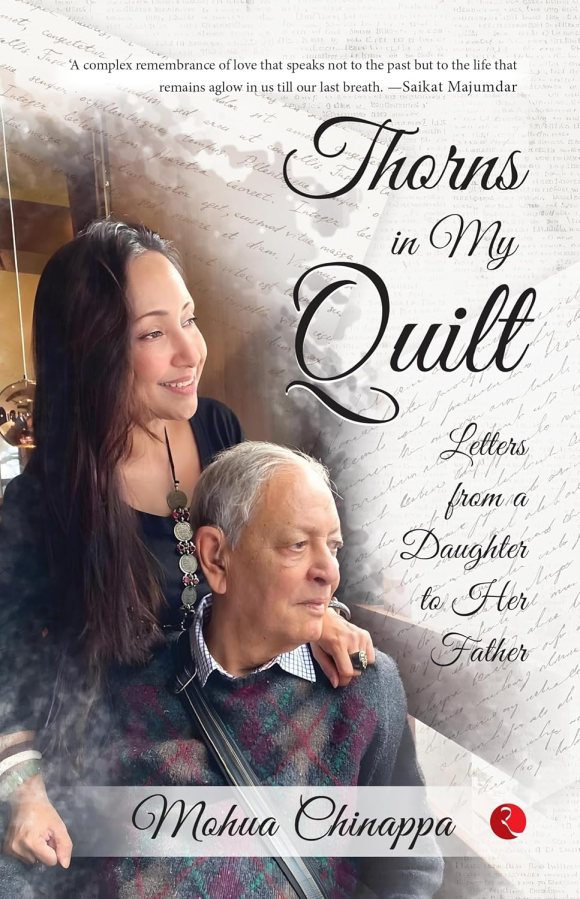
Title: Thorns in My Quilt: Letters from a Daughter to her Father
Author: Mohua Chinappa
Publisher: Rupa Publications
Mohua Chinappa’s Thorns in My Quilt: Letters from a Daughter to Her Father is a quiet and visceral exploration of memory, grief, and the often-fraught space between love and silence. Drafted in the form of a collection of letters to her late father, the book is less about resolution than about reckoning – more an attempt to articulate what remained unsaid while he was alive. Chinappa, through this profoundly personal lens, not only offers a portrait of a relationship but also a reflection on absence, yearning, and the emotional inheritance that we all carry forward sometimes.
Mohua Chinappa is an author, a columnist, a renowned podcaster in India, a TEDx speaker, a former journalist and a corporate communications specialist. Her other initiative—NARI: The Homemakers Community—provides a platform for homemakers to voice their everyday challenges.
The letters in this book, seamlessly weave together fragments of childhood and adulthood, moving fluidly between time and place. One moment, Manu the daughter, beckons the warmth of her early years in Shillong — vanilla flavoured butter cookies and the hush of rain-soaked afternoons, then the shelter of a harsingar[1] tree in their government house in Delhi, while in the next, she confronts the frailty of her marriage, the weight of her Baba’s illness, or the sting of words that sometimes remained unsaid. The form of writing echoes the workings of memory. Not linear, but recursive, continually turning back to moments that remain unresolved. Each letter seems like an appliqué sewn into the fabric of remembrance, creating a quilt with seams held together by both tenderness and pain.
At the centre of the book is the paradoxical figure of her Baba, portrayed with candour as a man who is loving yet aloof, erudite yet impractical and admired yet sometimes resented. Manu longs for his approval but also grapples with the ways his criticism and aloofness diminishes her. The letters vacillate from affection to accusation and from gratitude to grievance. In the acceptance of these contradictions, there seems a resistance to recall the memory of a father in an idealised tone. Instead, Chinappa manages to present a figure whose complexity remains inseparable from her own. The portrait revealed, thus, appears all the more moving.
The narrative also reverberates with a strong theme of displacement. The family’s history of migration, the shifts between Shillong, Delhi, and Bengaluru, create a sense of being both rooted and uprooted at once. Places do not act merely as backdrops but are living repositories of memory, holding within them the sweetness of belonging and the ache of estrangement. This sense of dislocation extends inward in the narrative. Chinappa captures not only her alienation from her father but also the broader struggle of carving an identity in a world shaped by expectation and silence.
The language of the narrative is lucid, and doesn’t tip into ornamentation. Everyday details—trees, rain, food, household objects—become charged with metaphorical weight, carrying emotional resonance far beyond their surface. The letters are suffused with sensory detail, grounding the reader in the textures of lived experience while also opening space for reflection. The writing exercises restraint. Even at its most poignant, it doesn’t spill into melodrama.
The emotional honesty of the book is equally striking. Manu does not shy away from confessing anger or disappointment; nor does she smooth over her father’s failings in the name of filial devotion. She admits to her vulnerabilities—the yearning for acceptance, the bitterness of abandonment, the pain of reinvention when life’s foundations collapse. These allow the readers to relate with the story. Though the particulars may differ, but the longing for parental approval, the hurt of unspoken words, and the struggle to reconcile love with resentment are universal.
However, some constraints in the narrative cannot be overlooked. The epistolary form, while effective in evoking intimacy, also narrows the perspective. Baba appears only through Manu’s voice, his presence mediated entirely by her memories and emotions. At some places, the narrative shifts abruptly, from addressing second person (father) to third which makes the reading a bit disconcerting. At times, the absence of other perspectives leaves the figure of father more shadow than substance, defined by what he was to her rather than who he was in himself. The letters also occasionally return to the same emotional terrain, circling around familiar grievances and sorrows. While this mirrors the looping nature of grief, the repetition creates a sense of exhaustion.
These reservations, however, do not diminish the book’s overall appeal. Its power lies not in neatness but in its willingness to dwell in ambiguity. It does not offer easy closure, nor does it attempt to tidy grief into a narrative of redemption. Instead, it embraces complexity, acknowledging that love is rarely unblemished, that absence can wound as much as presence, and that the act of writing itself can become a form of survival.
Thorns in My Quilt resonates because it is both deeply particular and quietly universal. While grounded in Chinappa’s personal history, it speaks to the wider human experience of fractured relationships, cultural displacement, and the longing to be heard. In cataloguing both the thorns and the blossoms of her bond with her Baba, Chinappa creates a testament that is as much about resilience as it is about grief.
Rakhi Dalal is an educator by profession. When not working, she can usually be found reading books or writing about reading them. She writes at https://rakhidalal.blogspot.com/ .
.
PLEASE NOTE: ARTICLES CAN ONLY BE REPRODUCED IN OTHER SITES WITH DUE ACKNOWLEDGEMENT TO BORDERLESS JOURNAL
it’s enough to make me cry twice that bad news bang but we still laugh you and me in the mornings and beyond
please stay as you are always you know i know your all like the sky see magic of pure good in you
we didn’t accept others walked as just us through it day after day into years decades with you ‘my nice’
so much sharing is ours we see trees and flowers alive tiny seabirds running and our dreams beautiful in real
a dog barks in the distance we listen and smile as the sun joins in with us and ours
your face is so kind to me in life i always call you ‘my nice’ it’s your true name to me
Stephen House has won awards and nominations as poet, playwright and actor. He’s received several international literature residencies. He is published often and performs his acclaimed monologues widely.
.
PLEASE NOTE: ARTICLES CAN ONLY BE REPRODUCED IN OTHER SITES WITH DUE ACKNOWLEDGEMENT TO BORDERLESS JOURNAL



 Borderless