Perhaps, most sceptics will say it is against human nature to stop fighting and fanning differences. The first recorded war was fought more than 13,000 years ago in what is now a desert but was green long ago. Nature changed its face. Continents altered over time. And now again, we are faced with strange shifts in climate that could redefine not just the dimensions of the surface area available to humankind but also our very physical existence. Can we absorb these changes as a species when we cannot change our nature to self-destruct for concepts that with a little redefining could move towards a world without wars leading to famines, starvation, destruction of beautiful edifices of nature and those built by humankind? That we could feed all of humans — a theory that won economist Abhijit Banerjee his Nobel Prize in 2019 so coveted by all humanity — almost seems to have taken a backseat. This confuses — as lemmings self-destruct…do humans too? I would have thought that all humanity would have moved towards resolving hunger and facing the climate crises post-2019 and post-pandemic, instead of killing each other for retaining constructs created by powerbrokers.
In the timeless lyrics of ‘Imagine’, John Lennon found peace by suggesting we do away with manmade constructs which breed war, anger and divisions and share the world as one. Wilfred Owen and many writers involved in the World Wars wrote to showcase the desolation and the heartfelt darkness that is brought on by such acts. Nazrul also created a story based on his experience in the First World War, ‘Hena’, translated for us by Sohana Manzoor. Showcasing the downside of another kind of conflict, a struggle to survive, is a story with a distinctive and yet light touch from S Ramakrishnan translated from Tamil by B Chandramouli. And yet in a conflict-ridden world, humans still yearn to survive, as is evident from Tagore’s poem Pran or ‘Life’. Reflecting it is the conditioning that we go through from our birth that makes us act as we do are translations by Professor Fakrul Alam of Masud Khan’s poetry and from Korean by Ihlwha Choi.
A figure who questioned his own conditioning and founded a new path towards survival; propounded living by need, and not greed; renounced violence and founded a creed that has survived more than 2500 years, is the man who rose to be the Buddha. Born as Prince Siddhartha, he redefined the norms with messages of love and peace. Reiterating the story of this legendary human is debutante author, Advait Kottary with his compelling Siddhartha:The Boy Who Became the Buddha, a book that has been featured in our excerpts too. In an interview, Kottary tells us more of what went into the making of the book which perhaps is the best survivor’s guide for humanity — not that we need to all become Buddhas but more that we need to relook at our own beliefs, choices and ways of life.
Another thinker-cum-film maker interviewed in this edition is Vinta Nanda for her film Shout, which highlights and seeks resolutions for another kind of crisis faced by one half of the world population today. She has been interviewed and her documentary reviewed by Shantanu Ray Chaudhuri. Chaudhuri has also given us an essay on a bookshop called Kunzum which continues to expand and go against the belief we have of shrinking hardcopy markets.
Gastronomical adventures seem to be another concurrent theme in this edition. Rhys Hughes has written of the Indian sweets with gulab jamun as the ultimate life saver from Yetis while trekking in the Himalayas! A musing on lemon pickle by Raka Banerjee and Ravi Shankar’s quest for the ultimate dosaaround the world — from India, to Malaysia, to Aruba, Nepal and more… tickle our palate and make us wonder at the role of food in our lives as does the story about biryani battles by Anagaha Narasimha.
Talk of war, perhaps, conjures up gastronomic dreams as often scarcity of food and resources, even potable water and electricity is a reality of war or conflict. Michael Burch brings to us poignant poetry about war as Ramesh Karthik Nayak has a poem on a weapon used in wars. Ryan Quinn Flanagan has brought another kind of ongoing conflict to our focus with his poetry centring on the National Day (May 5th) in Canada for Vigils for Missing and Murdered Indigenous Women by hanging red clothes from trees, an issue that perhaps has echoes of Vinta Nanda’s Shout and Suzanne Kamata’s poetry for her friend who went missing decades ago as opposed to Rachel Jayen’s defiant poetry where she asserts her womanhood. Ron Pickett, George Freek and Sayantan Sur have given us introspective perspectives in verse. We have more poetry asking for a relook at societal norms with tongue-in -cheek humour by Jason Ryberg and of course, Rhys Hughes with his heartfelt poem on raiders in deserts.
The piece that really brought a smile to the lips this time was Farouk Gulsara’s ‘Humbled by a Pig’, a humorous recount of man’s struggles with nature after he has disrupted it. Keith Lyons has taken a look at the concept of bucket lists, another strange construct, in a light vein. Devraj Singh Kalsi has given a poignant and empathetic piece about trees with a self-reflective and ironic twist. We have narratives from around the world with Suzanne Kamata taking us to Osaka Comic Convention, Meredith Stephens to Sierra Nevada and Shivani Shrivastav to Ladakh. Paul Mirabile has travelled to the subterranean world with his fiction, in the footsteps perhaps of Jules Verne but not quite.
We are grateful to all our wonderful contributors some of whom have not been mentioned here but their works were selected because they truly enriched our June edition. Do visit our contents page to meet and greet all our wonderful authors. I would like to thank the team at Borderless without whose efforts and encouragement our journal would not exist and Sohana Manzoor especially for her fantastic artwork as well. Thank you all.
Wish you another lovely month of interesting reads!
In Conversation with Advait Kottary about his debut historical fiction, Siddhartha: The Boy Who Became the Buddha, published by Hachette, May 2023.
At a time, when the world looks for compassion, acceptance, love, kindness, relief from wars, economic downturns, divides drawn by multiple human-made constructs, what kind of a book could provide entertainment, solace and also suggest solutions to human crises?
Perhaps, Advait Kottary’s Siddhartha: The Boy Who Became the Buddha, comes closest to the kind of book that would encompass all these demands. Many people have written about Buddha and Buddhism, but few have attempted to recreate vividly the life of a prince who rebelled against social norms to uncover a path that more than 2,500 years later continues to be seen as a refuge from violence and hatred. For those who misconstrue Buddhism in the modern political ambience, this book could well be a reminder of what Buddhism is all about.
The writer, Advait Kottary, is an engineer turned actor. Perhaps that is why the visual vividness of the narrative is almost cinematic. The story flows like a stream taking the reader back in time to a period we know very less about. What is amazing is the way in which the author has unfolded the story beginning with Siddhartha’s enlightenment and his journey back through his life in that state. This unique situation gives the Buddha the advantage of not just revisiting scenes but also to visit those aspects of his life and that of others which he could not possibly have witnessed in reality. The Enlightened One witnesses his own birth, his mother’s demise, many battles and courts that he had never ventured into. At a point in his journey, Buddha brings to readers Prince Siddhartha’s dejection despite winning a war. Kottary narrates: “Siddhartha burst into tears. The man was right and all his anger was for the war itself, not directed towards the soldier in front of him… They had won the war, but at what cost?” These are pertinent questions that perhaps, if world leaders asked themselves, we would not have had Bakhmut (Ukraine) or the World Wars.
As Siddhartha finds his peace leaving his palatial home, he realises that he is fortunate to have a family that gives him the freedom to complete his quest (though initially with reluctance). He reflects on why he needs to go on this journey, upending the lives of his family, traditions and even his kingdom. He tells his first teacher, Alara Kalama, “At the root of all the customs and the things we consider to be tradition, I could find no answers, other than the ones that said we live in one way, simply because that is what we are accustomed to; whether it is by virtue of following the habits of one’s parents, or the habits of those in the world around us.”
While raising pertinent issues that need to be brought to the fore in the present context through Buddha’s journey, the detailed research that Kottary has put in is evident. People get drunk on Tongba, a pre-historic recipe for an alcoholic brew of millet which is still in use. Authenticity is enhanced by an interplay of historic incidents, including acceptance of Buddha’s beliefs by one of the bloodiest kings of Indian history, Ajaatshatru, who killed his own father, Bimbisara, drove his mother to death, fell in love with his father’s concubine and razed a city down to find her. Reading of the change wrought by Buddhism in such a ruthless man, one can find hope in the darkest of times. Maybe, like Ajaatshatru, mindless, warmongering political overlords will have a change of heart at some point.
The book is racy despite the factual content. It reads like a well-written fiction. Perhaps it is a bit of that for after all, could we really know what Buddha said to his wife? But what we do know is his wife supported him and became a bhikshuni at the end. The narrative flows — sometimes, calm and reflective while Buddha talks, and sometimes, moving through turbulence, war, intrigue and violence providing a counterfoil to Buddha’s own quest. At the end of every episode, there is that moment of stillness induced by the enlightened one’s comment as he moves towards a new scene from his past.
Each scene brings us closer to the resolution of how the personal and the larger-than-life quest combine to create a sense of harmony at the end. The narrative has the ageless innocence, elegance and wisdom of Oscar Wilde’s stories like “The Happy Prince”. Kottary, a debuting author with the ability to create a compelling tale, explains what went into the making of this remarkable book in this interview.
Buddha is a subject much written about. And yet, you have given this book a unique twist. What made you select the life of Buddha as your debut venture into the arena of historical fiction?
I think I’ve always been fascinated with history and stories from the past, wondering how much of it happened the way we imagine it, and constantly imagining what life was like in any age of the past.
The story of Siddhartha, or the Buddha, came to me at a very interesting time in my life. I had just quit my engineering job, and though I vaguely knew I wanted to act and write, I had no real clue what lay ahead. It was at this time that I found a copy of Old Path, White Clouds by the revered Buddhist monk, Thich Nhat Hath, at home. At the time, Mom (Gajra Kottary) was reading it for research for a television show she was scripting, and I began to read it, often just opening up to a different random page every time and reading about a fascinating story from Siddhartha’s life. Over the years, I began to read more and more about the life of Siddhartha, beyond the basic facts I had learned in school, and found it so striking that a lot of questions that Siddhartha had from his life and his world, were the same questions that we have from life today. At a stage I was trying to find my feet in life, something resonated within me, and I found so many facets of his life that barely anyone knew about… I felt compelled to tell the story, and it seemed only natural to tell it through his eyes.
What kind of research went into your book? How many years did it take you to create the final product?
If I’m honest I can’t really quantify the amount of research that went into it, I can just sum it up and say, A LOT! Through each and every draft of the book, I’d read more and more about the subject, and there were so many beautiful tales that couldn’t make it to the final manuscript too! But it took more than five years of writing, rewriting, and rethinking. Several drafts were involved. Of course, there were other things I was doing, but putting the book aside for a few months, and revisiting it made me come back with a fresh perspective too, which really helped the process.
How much is fact and how much fiction? Tell us about the journey of the book.
History is certainly the greatest storyteller, and most of what you read in the book is fact. The places, the people, and most of the incidents are all part of recorded history. I had to imagine a lot of the interpersonal relationships involved in the story while weaving the narrative, especially since I was telling the tale from Siddhartha’s point of view. It was therefore critical to understand where he was in his spiritual journey at the time those things happened.
And to be honest that is what fascinated me the most, the lesser-known parts surrounding the known facts and bullet points of history. I couldn’t find Siddhartha’s angst really being dissected before, or his pain being talked about, because history often makes us think of him as a sea of calm, a stoic man. As I went through the drafts, I understood that in this layer of emotions lay something that perhaps we hadn’t thought of before. And of course, we know now that Siddhartha found the answers he was looking for, but back when he left the palace and renounced his life, he had no idea if he would ever find what he was looking for. Can you imagine the turmoil of someone who can surrender the rest of their time to finding an answer they may never actually find? There was a great human tale there, and I wanted to delve into the things in his life that built up to that journey, while learning more about it myself.
You have unfolded the Eightfold Path through Buddha’s personal journey, bringing in his own life experiences into play. Is that something you found in the course of your research or was it your own conclusion? Please elaborate.
A lot of it was down to research, and documented incidents in the life of Siddhartha, but I feel like especially when telling the story of Siddhartha’s life from his own point of view, it was essential to bring his own life experiences into play. Siddhartha’s learnings were often through practice and self-experimentation, a theme that is echoed throughout the book.
There are many personalised details which recreate a distant time period that is unknown to us. What went into giving authenticity to these unknown persons, their thoughts, conversations and tying them up to give us a picture of the times? How did you create characters from the past that could touch on contemporary issues and hearts?
I think it’s easy to think of characters of the past as unidimensional beings. Often that is how history is academically taught to us; good person – bad person, winner – loser etc. But when telling a story, it would be a huge injustice on my part if I did the same. As an actor, the biggest strength one can have is empathy, and every character I’ve played, I’ve always had to personalise the motivations, the desires, the fears and the joys of them all. I tried to think of all the characters in Siddhartha in the same manner. For example, it would have been easy for us to think about Siddhartha’s father, King Shuddhodana, as wrong for sheltering him from the realities of life, like pain, suffering and death. But that would be such a myopic view of what happened, and not taking into account the prophecies that had been told to him, and the fact that Siddhartha had been born after years and years of wanting a child; the stakes were incredibly high!
All it took was a little curiosity and deep thinking into why these characters did what they did; they were simply following their convictions in that moment… Most of it seemed logical, given we knew what each of these characters wanted at different points in time, but of course there was a fair bit of imagination when it came to their conversations. I was always fascinated by how each character would be at their most vulnerable, because that is a part of history that is never touched upon, and I’ve tried to do that in Siddhartha.
You have touched on many contemporary concerns in your book— war, the need to question traditions. You have even said something very deep when you had Buddha say: “Acceptance can only happen when there is no ego.” Was all this done intentionally, or did it just happen in the flow of events? Please elucidate.
When I first began to think about the story of Siddhartha, what struck me was always the contemporary relevance of the questions Siddhartha asked, more than 2500 years ago… Siddhartha always questioned everyone around him, but it was with a view to understand the universe and the world that he was born into. If he didn’t understand, he asked, and with every answer he got from people or the world around him, came new understanding and new questions too. A lot of it happened in the flow of events; but what was challenging was understanding the internal journey of Siddhartha through these events, his emotions and learnings as he grew up, and that had to be intentional in journey and design.
You have been living in London. Did you visit the parts of the Indian subcontinent you have written about?
Yes! It was a surreal experience for me, I had the good fortune of being able to visit Sarnath and Bodh Gaya from Varanasi. I can tell you that photos do not do the Dhamekh Stupa justice, it’s a beautiful and tranquil place, almost like you’ve stepped into a different world.
Did any films, writers or books impact your choices and the way you executed the book? What writers, artistes impact you as a writer?
Growing up as the son of a journalist and a scriptwriter, I’d be lying if I said my parents Sailesh and Gajra Kottary hadn’t strongly influenced my writing. I’ve also been inspired by Antione de Saint Exupery’s The Little Prince and the way it spoke of such beautiful thoughts in such a simple manner, a principle I tried to keep in mind while writing Siddhartha. Some of my favourite films are Dr. Strangelove, the Batman Trilogy, and the television series, Succession. I’m quite fond of storytelling in general as an actor and creator, and I have this weird habit of trying to piece together the narrative in everything I see, maybe even an advertisement in a magazine, deconstructing it and analysing the choices made by the creators.
Your novel is very cinematic. Are there plans afoot to make it into a film, considering the choices you have made, choosing acting over engineering and cars? Did your mother, Gajra Kottary, a major screenplay writer in India, have an impact on the choices you made and your journey as a writer?
Thank you! I’m a very visual thinker, so when I read or write about something, I watch it unfold like a movie in my mind, perhaps that is reflected to some extent in my writing. I have had interest expressed in the book from a couple of wonderful filmmakers, and hopefully I’ll have some amazing news to share soon!
My mother has been the greatest writing influence in my life, and I have to give her credit in that she has only guided and taught me and never tried to influence my decisions in the kind of work or projects that I take up.
So, what are your plans for the future? Any more books coming our way?
Yes, most certainly! I’ve got two drafts screaming at me for attention. One is about the life of another historical figure, closer to modern times, who lead an unbelievable life. The other one is pure fiction and more in the genre of dark humour; a dystopian take on modern civilisation, but again centred around a clear protagonist.
I’m living in London now and continue to act and perform in theatre as well, so there’s always something exciting happening on that front. I’ve also had some interest in Siddhartha from some wonderful film makers, so fingers crossed something visually beautiful can be born from this. So the hunt for great stories continues!
Thank you so much for your time and your lovely book.
(The review & online interview conducted through emails are by Mitali Chakravarty)
Ghee-laden, sugar-loaded, deep-fried, I have been warned that Indian sweets are naughty, even dangerous, and that I shouldn’t eat them at all, or if I do insist on eating them, then they must only be sampled in moderation, and even when I eat them in moderation I ought to visit a reliable doctor every week for a full health check, and even if I do that, I must bear in mind that men of my age die of heart attacks even when they don’t eat sweets of this nature. Indian sweets might look harmless on the plate but they are like cluster bombs, detonating inside the body and speeding a man into the next world.
But I climb mountains and mountaineering has been a huge part of my life, and when we climbed mountains back in Britain we took with us large amounts of a substance called Kendal Mint Cake. I need to talk about this food before I am able to make the point that I intend to make about Indian sweets. If you bear with me, I won’t be too long. Kendal Mint Cake is a sugar-based confection and is flavoured with peppermint oil. In fact, sugar, water and peppermint oil are the only ingredients, but they are prepared in a special way which remains a secret. I don’t think there’s much that’s very secretive about blending sugar, water and peppermint oil, but who am I to say that?
The ingredients are mixed together and boiled in copper pans while being continually stirred. If this stirring stops, the mixture becomes translucent and it will be ruined, because opacity is the desired feature of Kendal Mint Cake. How can a translucent sugar-rush product be taken seriously? We see the light after a lifetime of contemplation. We see a solid lump of minty sugar when we plan to ascend to the summit of some peak or other.
Kendal Mint Cake has a formidable and perhaps peerless reputation as the energy-providing snack of choice for the intrepid explorer. It played an essential role in the Trans-Antarctic Expedition of 1914–1917, led by Ernest Shackleton, one of the fittest and toughest men who ever lived. It aided Hillary and Tenzing in the first successful attempt on Everest in 1953 and other members of the team wrote, “It was easily the most popular item on our high altitude ration” and “our only criticism was that we did not have enough of it”. High praise indeed, with an emphasis on the high. Bonington also climbed Everest in 1975 using Kendal Mint Cake, as well as ropes and crampons.
I think we can safely declare that Kendal Mint Cake is heroic. Therefore, it seems to be that Indian sweets can also be regarded as mighty, valiant, doughty, gallant, fearless and daring. And when we consider that India has mountains far higher than those in Britain, shouldn’t we tend to the conclusion that the sweets of India are themselves a bracing landscape when seen on the counter of a shop that sells them? We hear a lot of talk about sugar highs and lows, but viewed as a backdrop, rather than as the progress of a graph line through time, highs and lows form mountain ranges. Indian sweets recreate on the inside the geography of the northern icy reaches of the country.
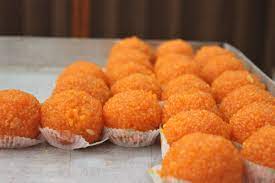
It is high time (more wordplay) that mountaineers and other explorers start carrying Indian sweets on their expeditions. Kendal Mint Cake has proved itself in the lonely heights, and now gulab jamuns and ladoos, and boxes of sandesh, modak, barfi and bowls of payasam should be given a fair chance, to say nothing of kulfi, halwa, gujiya, and my favourite, Mysore pak. Need I list them all? It is not just a question of providing energy to the adventurer, energy that can be expended a very short time after eating the sweets, as opposed to eating healthy foods which provide energy slowly and in trickles. No, there are many other good reasons for adding a broad selection of sweets to the supplies that are to be taken up slopes of staggering steepness into the very clouds.
First of all, sweets are light. They are lighter than so-called healthy foods. I pity the mountaineer who hefts sacks of cabbages and carrots to the top of harsh and fearsome Annapurna or Dhaulagiri. Sweets are considerably more compact than vegetables, especially the unpleasant-tasting vegetables. Sweets can remain fresh for longer and that’s another advantage. You don’t have to eat them all in the foothills but can save some for the ascent.
Sweets are rewards too. The fellow who promises himself a ladoo or two when he finally attains a certain tricky ledge is more likely to be motivated to strive for that ledge than the man who tempts himself with a turnip or beetroot. Who would want to munch on a root vegetable during a blizzard? Not me. The taking of sweets on expeditions also provides work for sweet-makers. It is both economically wise and aesthetically sensible to carry sweets together with ropes and pitons and carabiners and all the other accoutrements of a sober climb if one happens to be a serious climber. Hunger pangs are one thing at sea level, but at altitude they tend to be much worse.
There is another consideration that hasn’t yet been touched on. There is the perennial risk for the mountaineer who attempts the Himalayas that he will meet and be abducted by Yetis. I won’t overstate the risk. Most of the climbers of that range have returned without being abducted. But is it really responsible to poke one’s nose into the eternal snows without something to mollify the beast? There is the question of simply organic respect. The explorer who suddenly encounters a Yeti and emits a shriek has insulted his potential host. The explorer who opens a box of sweets and offers one, or several, or many, to the hairy brute will surely make a good impression. I can almost see them now, in my mind’s eye, man and monster sitting on a crag, sharing gulab jamuns.
Rhys Hughes has lived in many countries. He graduated as an engineer but currently works as a tutor of mathematics. Since his first book was published in 1995 he has had fifty other books published and his work has been translated into ten languages.
.
PLEASE NOTE: ARTICLES CAN ONLY BE REPRODUCED IN OTHER SITES WITH DUE ACKNOWLEDGEMENT TO BORDERLESS JOURNAL
Pran or Life by Tagore was published in 1886 as part of his collection called, Kori O Komal (Sharp and Flat). The book featured 83 poems by him.
Art by Sohana Manzoor
LIFE

I do not desire death in this resplendent universe.
I want to live amidst the ocean of humanity.
In this radiant sunny garden of floral swirls,
I yearn for acceptance from hearts filled with vitality.
Life on Earth ebbs and flows in transient waves.
Partings and meetings are filled with tears and joys.
I want to bead these emotions into melodic strains,
To create songs that will be eternal and spirits buoy.
If I cannot achieve that, then as long as I live,
Let me find shelter in your midst.
Let me, every morning and evening, give
Lyrics that bloom like flowers waiting for a tryst.
Pluck the blossoms happily, and then, without a sigh,
Throw them away, alas, if they wilt or dry.
A recitation of the original poem in Bengali by Swati
(This poem has been translated by Mitali Chakravartywith editorial support from Sohana Manzoor)
PLEASE NOTE: ARTICLES CAN ONLY BE REPRODUCED IN OTHER SITES WITH DUE ACKNOWLEDGEMENT TO BORDERLESS JOURNAL
“It is 5.23 am,” I told myself as I glanced at my watch. “I guess I got up early. Anyway, SK should be here right about now, right on the dot at 5.30am, as he has always been. Today is not going to be any different.”
I plugged on my earphones to hear the continuation of a podcast that I had been listening to from the previous week. It was a day before the full moon, but the cloudy skies and the lack of streetlights made the road look pretty dark. I sat on the raised stone fence as the auto-gate slowly closed from the inside.
Far behind a parked car, I could see a moving shadow. It looked like the silhouette of two stocky legs pacing haphazardly as if they were swaying. At once, I thought that it must be my neighbour’s son struggling to get back to his home after a long Saturday night out with the guys.
“Wow!” I was thinking as I symbolically patted myself on the back for keeping up with the routine all these years despite raging inner demons and concerned naysayers who keep advising me to slow down on account of being a half-centurion! “Only madmen would be running on a Sunday morning when the sane recovers from a stuporous night out!” they say.
Just as I was drowning in the nectar of my self-praise, I realised that the shadow cast under the car was not that of a man. The contour of two legs soon became four, and a greyish, horrendously ugly-looking face with a tinge of what appeared like thick whiskers soon manifested. I was 10 feet away, locking eyes with Vishnu’s third avatar, the Varaha, a wild boar!
Here I was, I thought, in the comfort of city living, enjoying the fruit of my lifelong struggle to benefit from the support of privacy and security of the gated community, I felt I had had it all. Within the luxury of economic independence and intellectual reasoning, the brutal combat of our ancient ancestors and the street smartness of the lesser beings have taken a back seat. Even in my wildest dream, I never envisaged a moment when I would have to face a wild beast!
It was the stare between two worlds; one of the modern domesticated kind who had a fight-or-flight response limited to his autonomic nervous system versus one who had to fight to stay alive and keep his place in the hierarchy of the pecking order of the jungle.
The stare looked like it lasted for an eternity. The boar, of course, hungry and desperate for food, did not want a competitor. As if he knew that I was not interested in his food, thank you very much. Negotiation naturally was out of the question, and so were all civil niceties.
I turned around to ring the bell to my house as I did not have the gate key. The sudden movement must have startled the beast. It gave a low-pitched snorting grunt as if it was showing its displeasure. Interesting, it was my neighbourhood, and the visitor or rather an intruder was displeased! Well, that is the law of the jungle. Might is right, and there is no place for logic. This is the ‘id’ that Freud asks us to put under check by societal pressures. It could manifest in a mob situation when enforcement crumbles.
Just when I thought that nay was near, me being gored by a wild beast, a beacon of hope came in the form of a beam of light from an SUV. My ride arrived right on the dot, just in time to turn the table on the aggressor. Awed by the approach – perhaps it thought the vehicle was a giant animal with a louder roar — its ‘fight’ mode downgraded to ‘flight’ as it turned its back to return to its own home. It retreated.
As we drove along, we saw a humbled pig strutting with its tail between its legs heading towards the secondary jungle. Probably my friend must have been reminded of the carefree days of his childhood when sauteed and spiced wild boar meat with toddy was a delicacy among friends.
That is why we are repeatedly advised by wise men to get back to nature. Nature gives a purpose to our existence. Its massive structures, like the trees, the mountains and elements of nature, awe us to the ground. It impresses upon us our deficiencies and our feebleness. It drills unto us that we are nothing, just a passer-by who makes a cursory appearance, while Mother Nature and the Universe continue into eternity. We are not even a single fragment of a tiny dot in the Milky Way, and even lesser in the ever-expanding dimensions of the Universe.
.
.
Farouk Gulsara is a daytime healer and a writer by night. After developing his left side of his brain almost half his lifetime, this johnny-come-lately decided to stimulate the non-dominant part of his remaining half. An author of two non-fiction books, ‘Inside the twisted mind of Rifle Range Boy’ and ‘Real Lessons from Reel Life’, he writes regularly in his blog ‘Rifle Range Boy’.
.
PLEASE NOTE: ARTICLES CAN ONLY BE REPRODUCED IN OTHER SITES WITH DUE ACKNOWLEDGEMENT TO BORDERLESS JOURNAL
‘King Bimbisara is completely enamoured with Amrapali. He seems to be in love with her, and for that, Ajaatshatru seems to detest him. They are not on speaking terms anymore. Moreover, when I was there, Ajaatshatru did not speak a word even to me…’
‘Are you sure you did not do anything to upset him?’ asked Shuddhodana, concerned. Ajaatshatru giving Siddhartha the cold shoulder was worrying news indeed. He was only a few years younger than Siddhartha and was poised to take the throne from Bimbisara. If, in the future, the rulers of Kapilavastu and Magadha could not see eye to eye, then what would be the point of this trade route that they had so carefully worked on? What would be the point of the independence from the trade route through Kosala?
‘Father, how could I have upset him when he wouldn’t even speak to me? He chose to go hunting both on the day that I arrived as well as the day that I left.’
‘This is not good,’ said Shuddhodana. ‘This is the result of Bimbisara’s own foolishness. The only reason that Ajaatshatru dislikes you is because Bimbisara keeps comparing him to you. He was always very taken by your insight.’
‘But if that were the case, then we have no reason to worry! If I try to establish friendly relations with Ajaatshatru, then perhaps we will not have anything to fear!’
Shuddhodana was taken aback at how optimistic Siddhartha sounded. He wished he could share his optimism but was wary of saying anything to take away his son’s enthusiasm for affairs of the state.
‘But there was still something wrong with King Bimbisara; he seemed to not have any relations at all with Queen Kosala. Instead, he spent most of his time with the courtesan Amrapali. I believe Ajaatshatru took offence to that too, for he didn’t seem interested in spending any time with me.’
‘I wouldn’t give it too much thought, Siddhartha, there are things about that family that you do not know. Perhaps it is not right for us to ascertain from the outside, the merits of their dynamic, but they have shared a very troubled relationship, let us leave it at that…’
‘What do you mean, father?’
‘The stars are powerful, Siddhartha. Great things can be done and undone, depending on whether one has luck and destiny on his side or not. Parents may be invulnerable when it comes to anything else on earth, but they are powerless when it comes to their children. Once the idea that some misfortune might befall their children enters their heads, they will do anything to ensure that this does not happen.’
‘Including banishing every single crippled, injured or maimed person from their kingdom to live in misery?’
Shuddhodana gave Siddhartha a sharp look.
‘Who has told you of this?’ asked Shuddhodana.
‘I have seen Sukhibasti with my own eyes, Father.’
Shuddhodana felt like he had been hit square in the chest with a mace.
‘I did what I believe was right, Siddhartha,’ he said.
‘You could call it that, Father, but I am simply trying to understand how a man as great as you could love his family as much as you have, while showing no mercy to your subjects.’
Shuddhodana was insulted, more so because he was hearing these words from his own son. Siddhartha was crossing a line.
‘Siddartha, I am your Father but I am your king as well. Do not forget that.’
‘Do not threaten me, Father. I have seen what you created. How long did you plan to keep it a secret? How long did you plan to have it hidden from me? How many more lies are there to discover?’
‘Enough!’ bellowed Shuddhodana. ‘I did what I had to, to safeguard the kingdom and its heir from straying off the path that was chosen for him.’
‘Did you think that you needed to take the words of someone who hadn’t seen the future so seriously that it influenced the way you brought up your own child?’
‘He was my Guru, Siddhartha, just as Guru Kondanna was yours.’
‘Guru Kondanna is my guru!’ Siddhartha corrected an angry Shuddhodana.
‘You are overstepping your boundaries, Siddhartha. I have been very patient and understanding, but enough is enough. You cannot take the pain of others and make it your own all the time. At the end of the day, one’s duty must take precedence over everything else.’
Siddhartha calmed down and collected himself. He took off his armour and laid it on the floor of the courtroom at the foot of his father’s throne.
‘Forgive me, Father. I do not mean to disrespect you or my duty but what must one do when he is unable to see the reason behind one’s duty and dharma? When I left Kapilavastu, I encountered nothing but suffering and sadness. The farmers who grow the food we eat are exploited mercilessly by royal guards and collectors. I have been sleepless since I returned from Sukhibasti. Are you aware that our own injured and maimed soldiers are sent there? They fought for us and with us in the war. How can one call this duty?’
(Extracted from Siddhartha: The Boy Who Became the Buddha by Advait Kottary. Published by Hachette India, 2023.)
ABOUT THE BOOK
His family was happy to see him, but they had hoped to meet the Siddhartha they knew, not the Buddha he had become.
Long before Siddhartha became the enlightened leader [Buddha], he was a boy oblivious of the world. As the young prince navigates politics and relationships, he slowly begins to question his oppressively perfect life. Meanwhile his family struggles to maintain their deception in the hope that they can mould him into a dutiful king – from banishing the old and sick to hiding their own advancing age. In Advait Kottary’s intricately woven narrative, raw human emotion and conflict is tempered with the boundless compassion of the Buddha. Exciting and insightful in equal measure, Siddhartha is at once a riveting story and a profound meditation on our shared quest for truth.
ABOUT THE AUTHOR
Advait Kottary is a writer and actor residing in London. Passionate about cars and engineering, he worked as an engine designer before quitting his job to pursue his love of writing and the performing arts. He went on to lead the world’s biggest Bollywood musical Jaan-E-Jigar, and act in international productions such as Beecham House. Advait has also co-conceptualised the award-winning television show Molkki and voiced several audiobooks with Swedish platform Storytel. Siddhartha is his first novel, which stemmed from his own quest to understand the Self and his encounter with the Buddha’s teachings.
Guernica by Pablo Picasso (1881-1973). Courtesy: Creative Commons
SURVIVORS

In truth, we do not feel the horror
of the survivors,
but what passes for horror:

a shiver of “empathy”.

We too are “survivors”,
if to survive is to snap back
from the sight of death

like a turtle retracting its neck.


VEILED

She has belief
without comprehension
and in her crutch work shack
she is
much like us ...

tamping the bread
into edible forms,
regarding her children
at play
with something akin to relief ...

ignoring the towers ablaze
in the distance
because they are not revelations
but things of glass,
easily shattered ...

and if you were to ask her,
she might say—
sometimes God visits his wrath
upon an impious nation
for its leaders’ sins,

and we might agree:
seeing her mutilations.

SALVE

The world is unsalvageable ...

but as we lie here
in bed
stricken to the heart by love
despite war’s
flickering images,

sometimes we still touch,

laughing, amazed,
that our flesh
does not despair
of love
as we do,

that our bodies are wise

in ways we refuse
to comprehend,
still insisting we eat,
drink ...
even multiply.

And so we touch ...

touch, and only imagine
ourselves immune:
two among billions

in this night of wished-on stars,

caresses,
kisses,
and condolences.

We are not lovers of irony,

we
who imagine ourselves
beyond the redemption
of tears
because we have salvaged
so few
for ourselves ...

and so we laugh
at our predicament,
fumbling for the ointment.
Michael R. Burch’s poems have been published by hundreds of literary journals, taught in high schools and colleges, translated into fourteen languages, incorporated into three plays and two operas, and set to music by seventeen composers.
PLEASE NOTE: ARTICLES CAN ONLY BE REPRODUCED IN OTHER SITES WITH DUE ACKNOWLEDGEMENT TO BORDERLESS JOURNAL
Title: Digesting India: A Travel Writer’s Sub-Continental Adventures with the Tummy (A Memoir À La Carte)
Author: Zac O’Yeah
Publisher: Speaking Tiger Books
Digesting India: A Travel Writer’s Sub-Continental Adventures with the Tummy (A Memoir À La Carte)is a culmination of thirty years of experience with the three things Zac O’Yeah loves most about life — eating, drinking and travelling — that put together a delightful travel-cum-food book. A detective novelist, O’Yeah is the creator of the Majestic Trilogy. He freelanced for the Swedish radio for 25 years before moving to India in 2000. Subsequently, he has written several bestsellers, both fiction and nonfiction. His writings have been part of Hindu Business Line and National Geographic Traveler.
The Scandinavian-Indian novelist takes us on an entertaining and informative journey through the country in this book. We learn about dishes we may not have heard of before, and food habits we may not have known about. The author takes the reader through the pleasures of drinking beer in Bengaluru, drinking toddy in Kerala, and eating boiled vegetables and masala-less curries in Sevagram, Maharashtra, to prepare himself for Rajasthan’s rich red flavours. During his travels, he discovers Goa’s literati culture while sipping cashew fenny. He finds two of his favourite foods, mushrooms and cheese, in Bhutan, and finds out what astronauts eat and drink in space.
The book is an intriguing and profound story of an avid traveler’s untiring quest for evolving cultural and culinary experiences. It is a fast-paced, exciting book. In a nutshell, it is a very substantial, coconut-sized shell that captures all of India within its dimensions. It is the right place to learn about dishes we might not have heard of before, and food habits we may never have known existed. It is similar to what we experience when accompanying O’Yeah on a ‘spare parts’ tour. This starts in Shivajinagar, Bengaluru’s slaughterhouse area, where the exploration begins.
As he winds his way through India, he shows us the pleasures of drinking beer in Bengaluru (a slang for ‘beer galore’), drinking toddy in Kerala, and eating boiled vegetables and masala-less curries in Sevagram, the Mahatma’s ashram in Maharashtra, to prepare him for the rich red ‘lal maas’ [deer meet] in Rajasthan. During his visit to Goa, he discovers the literati culture of the state while sipping cashew fenny alongside Nobel laureates Orhan Pahmuk and Amitav Ghosh. In a delightful digression, he explores two of his favourite mushrooms and cheese in the Bhutanese dish, shamudatsi, and learns — while still on earth — what astronauts eat, and more importantly, what they consume, in outer space while still on earth.
It takes O’Yeah more than three hundred pages to guide us through India’s diverse food culture, which he explores in a fascinating way over the course of the book. The author combines history, anecdotes, and travel effortlessly. It is a mesmerising narrative that captures the reader’s attention.
He tells us Indian food traditions are no exception to the diversity of cultures in the country. The cuisine is incredibly diverse, with influences from many cultures. He explains how customs and religion are reflected in food. Food culture is incredibly varied, ranging from the spicy, vegetarian dishes of the south to the rich, meaty curries of the north. Many dishes are cooked with a variety of spices, from mild to extremely hot. Rice is a staple in many parts of the country, and chapati, a flatbread, is common.
Indian cuisine is also known for its wide variety of desserts. Sweets are usually made with milk and sugar, and often feature nuts and dried fruit. One of the most popular sweets is non-diary, jalebi, a deep-fried, syrupy dessert. The cuisine also features many savoury dishes. Another favourite is dal, a stew made with lentils or beans, and spices. Samosas are also a favourite snack, usually filled with vegetables and served with chutney.
He contends through his narrative how the country’s culture can also be observed in the process by which people prepare and consume their food. Meals are often served on large plates and eaten with their hands. “Eating off the floor” is a tradition in India that reflects the country’s diversity and history. India has something for everyone, including vegan curries and rich desserts. Whether you’re looking for something spicy or sweet, he concludes, India has a dish to suit every taste.
A thoroughly enjoyable and informative tour through Indian culinary art, Digesting India is the perfect introduction to Indian cuisine. As O’Yeah explores it, he can stomach anything and everything that grows or walks on earth. A delightful romp based on thirty years of understanding India through its food culture.
The book is an engrossing read — it’s like having a multi-course meal full of wonderful discoveries at every turn. There are thousands of interesting, unanticipated facts about local foods and the many places they come from in this book. A virtual adventure awaits you in the book.
.
Bhaskar Parichha is a journalist and author of Unbiased, No Strings Attached: Writings on Odisha and Biju Patnaik – A Political Biography. He lives in Bhubaneswar and writes bilingually. Besides writing for newspapers, he also reviews books on various media platforms.
.
PLEASE NOTE: ARTICLES CAN ONLY BE REPRODUCED IN OTHER SITES WITH DUE ACKNOWLEDGEMENT TO BORDERLESS JOURNAL
GUN

It always
hides metal seeds
of volcanoes and
new wars inside.

They are as heavy
as human lives.

The bullets pumped into
the flesh of soil
tears the tissue of earth
into pieces as the blood
spreads as roots into the ground.

Not one seed —
There are thousands that
yearn for the effigies of
tribal people.

There won't be
a reason for
the deluge of bullets
but, they say
It has to be done.
Ramesh Karthik Nayak is the author of three books in Telugu—Balder Bandi (Ox Cart, 2018), a poetry collection, Dhaavlo (Song of Lament, 2021), a short story collection, and co-editor of Kesula (Modugu Flower, 2022), a compilation of Banjara stories. His debut collection of poetry Chakmak is forthcoming from Red River Press.
PLEASE NOTE: ARTICLES CAN ONLY BE REPRODUCED IN OTHER SITES WITH DUE ACKNOWLEDGEMENT TO BORDERLESS JOURNAL
Does having a to-do list help or hinder your journey, whether it be exploring the world or having a sense of achievement in your life? Keith Lyons ponders on the pointlessness and purpose of such lists.
In an article I recently came across on how to live with no regrets, it started out with the words ‘Make a bucket list’.
I admit, I didn’t read further. I dislike the term ‘bucket list’. Whether it is a list of random destinations you want to visit before you die, or some vague wish list of goals and accomplishments, there is something fundamentally flawed about creating ‘The List’.
So what’s so bad about coming up with a list of goals and experiences you’d like to complete in your lifetime? I have several qualms about this approach to life.
Firstly, bucket lists imply that you have to be close to actually ‘kicking the bucket’ before you start working on that list. That means they can be put off until there is time. Wait til you’ve raised your family. Defer til you’ve retired from work. Pull out the list when your doctor gives you half a year to live.
The second issue I have about bucket lists is we never know when we are doing to die. The assumption of a bucket list is often that we will live well into old age. Perhaps even make it to 100. But as Allen Saunders pointed out in 1957 Reader’s Digest (and John Lennon later echoed), ‘Life is what happens while you’re busy making other plans’. The upshot is that by ‘kicking the can down the road’ , we end up putting off what we desire the most.
Thirdly, often the formation of these lists comes from fantasy, illusion and magical thinking. We add sights or experiences to the list not from our own innermost selves, but to conform to the aspirations, social norms, and dreams of others. We might hear about a friend’s amazing holiday experiences, be inspired by a travel documentary, or adopt someone’s wish list items, without having compelling reasons or an authentic ownership of the list.
I’ve seen how this plays out in my previous roles as a professional tour guide and travel writer. Some readers have admitted to me that after coming across an article I’ve written about a remote island eco-resort in the Andaman Sea or a Buddhist temple on the hill flanks of a bamboo forest where monks serve green tea to pilgrims that they’ve added the location to their bucket list. But given that we all experience places differently, how can they hope to replicate my (peak) experience? The other problem with having a bucket list is that it creates great expectations, and those perfect ideals might not match the harsh realities.
I believe we shouldn’t focus so much on external achievements and tick-box experiences because often the joy and satisfaction they possibly offer can sometimes be fleeting, ephemeral or non-existent. I’ll give you three examples from my own life of some bucket list goals and how their attainment wasn’t all it was made out to be. Maybe you have the same three on your list: running a marathon, seeing the Taj Mahal, and having a story published in a major newspaper.
Crossing the finish line after 42.195km is a wonderful feeling of completion and exhaustion, and while I still look back on that marathon and marvel at how I managed to sustain my effort over three plus hours, I gained greater satisfaction in training for the run on the coastal hills near my hometown. Perhaps it was the ‘runners high’ and the feelings of agency, freedom and bodily locomotion. I do know the day after the marathon I couldn’t walk up any stairs.
Not all bucket list endeavours are over-hyped. When I finally made it to Agra to witness for myself the immense white marble mausoleum of the Taj Mahal, I got the standard photo sitting on a bench in front of the reflected structure. But just as memorable were the hours I spent on-site before the tourist throngs packed the grounds, meditatively wandering and pausing to observe and appreciate the monument as the sun rose over the Yamuna River. For me, my time and experience there exceeded my expectations. But other visitors I met during my travels reported vastly different perceptions of the heritage ‘Wonder of the World’.
When I was studying post-graduate journalism at university, I had a bet with a colleague about paying our fees by selling articles to newspapers. The first story I had published took up the front page of the features section of the newspaper, and I got two copies of the newspaper to keep for posterity’s sake. So, imagine how I felt the next day seeing a discarded newspaper floating in the lake beside the university library. Working on bigger projects such as books can also be a roller coaster of emotions varying from elation and excitement to anxiety and relief. Still harbour the deep desire to turn your life story into a book? If so, what have you done lately to put your pen to paper?
As you can see from my examples — and from your lived experience — there is often a gap between how we reckon things will be and how they pan out in the end. There are also another couple of issues with having bucket lists. What we want and truly desire can change over time. What’s important in our 20s or what we are expected to do by our peers and communities can evolve over the decades. Swimming with dolphins might drop from the list if you learn about the treatment of marine mammals. Driving on Route 66 might not have that allure and mystique when you look at the practicalities. Crashing a stranger’s wedding to object to the coupling might have other consequences. As we mature, we might find that our achievement orientation and ambition for success wanes, and that being becomes more important than doing.
I suspect that many people who do have bucket lists don’t actually do many of the things they have declared will signal they have accomplished something in their lives. They might talk about the things they want to have and exotic places they wish to see, but it is easy to have those items on the list unfulfilled. Not today. Maybe later.
By the same token, there are many, many people who aspire to better themselves by getting their dream job, migrating to a faraway country, or winning the lottery who never succeed. Having a bucket list is a First World problem. Going through a divorce, developing an addiction, and clocking up debt might be other life experiences we didn’t think we’d signed up for.
The term bucket list comes from the Justin Zackham’s screenplay which was made into the 2007 film featuring Jack Nicholson and Morgan Freeman as two terminally ill guys making a list of things to do before they die. In another (better-known) movie, The Shawshank Redemption, Freeman as Red is told by Andy Dufresne (played by Tim Robbins) the sage advice ‘Get busy living or get busy dying’. Perhaps that is the answer to living in the now without regret, rather than having a list of unobtainable items. What’s the best motivation for you?
Palliative nurse Bronnie Ware compiled a list, but it wasn’t a bucket list. Instead, through her work with the ill and dying, she put together their top five regrets. Number one was ‘I wish I’d had the courage to live a life true to myself, not the life others expected of me’. The second was ‘I wish I hadn’t worked so hard’ — every male patient said this, missing their children’s youth and their partner’s companionship.
Third on the list was ‘I wish I’d had the courage to express my feelings’. Many people suppressed their feelings in order to keep peace with others. As a result, they settled for a mediocre existence and never become who they were truly capable of becoming. According to Ware, many developed illnesses relating to the bitterness and resentment they carried as a result.
Number four on the list of regrets was ‘I wish I’d stayed in touch with my friends’, while the fifth regret was ‘I wish I’d let myself be happier’. “Many did not realise until the end that happiness is a choice. Fear of change had them pretending to others and their selves, that they were content, when deep within, they longed to laugh properly and have silliness in their life again.”
How about you? Anything on this list that resonates with you? Carpe the hell out of this Diem (Don’t let life pass you by!)
.
Keith Lyons (keithlyons.net) is an award-winning writer and creative writing mentor originally from New Zealand who has spent a quarter of his existence living and working in Asia including southwest China, Myanmar and Bali. His Venn diagram of happiness features the aroma of freshly-roasted coffee, the negative ions of the natural world including moving water, and connecting with others in meaningful ways. A Contributing Editor on Borderless Journal’s Editorial Board, his work has appeared in Borderless since its early days, and his writing featured in the anthology Monalisa No Longer Smiles.
.
PLEASE NOTE: ARTICLES CAN ONLY BE REPRODUCED IN OTHER SITES WITH DUE ACKNOWLEDGEMENT TO BORDERLESS JOURNAL






 Borderless