Categories
Stories

How Madhu was ‘Cured’ of Laziness

By Naramsetti Umamaheswararao

From Public Domain

In the town of Seethanagar lived Ramayya and Seethamma with their son Madhu. Though Madhu was twenty-five years old, he did not work at all. He spent his days lazily, eating well three times a day and sleeping soundly, without caring about anything else. His parents were tired of advising him again and again. Sometimes they scolded him out of anger, but Madhu remained indifferent and idle.

One day, Ramayya and Seethamma decided to teach him a lesson. They said firmly, “We will give you food only if you work. Otherwise, you will not get anything from us.” Not liking this condition, Madhu left home secretly.

He went to a nearby town and decided to beg for a living. Sitting on the temple steps, he planned to live on people’s charity and the offerings of the temple priest. To gain sympathy, he wrapped his left leg with a bandage from foot to knee and smeared it with red color to look like blood. He stretched that leg forward and begged from the devotees, pretending to be injured.

One day, a rich man named Subbayya came out of the temple after worship. Seeing Madhu, he stopped and said, “Why have you wrapped your leg? You are young and healthy. Don’t you feel ashamed to sit and beg instead of working?”

Madhu lied, “Sir, my leg is diseased. It always bleeds, and I have no money to get it treated. That is why I am begging here.” 

Feeling sorry for him, Subbayya said, “Come with me. I will feed you and take you to a doctor.” Madhu followed him, limping and rejoicing secretly that he had found an easy way to live comfortably without work.

That day, Subbayya served him a full meal and asked him to rest. In the evening, he called his family doctor to examine Madhu. The doctor carefully checked Madhu’s leg and realized he was pretending. He told Subbayya that Madhu’s leg was perfectly fine and that his laziness must have made him act this way. 

Subbayya then requested the doctor to teach the lazy boy a serious lesson.

Following Subbayya’s advice, the doctor returned to Madhu and pretended to examine him again. As Subbayya entered the room, the doctor said loudly, “This disease is very strange. It cannot be cured easily.”

Hearing that, Madhu felt happy. He thought he could stay in Subbayya’s house forever without doing any work. 

Then the doctor added, “There is only one solution ….  surgery. If we remove the leg, the disease will be cured completely.” 

Subbayya replied, “If that’s the case, go ahead. Do the operation tomorrow. I will bear all the expenses.” 

The doctor said, “But if we remove his leg, how will he live?” 

Subbayya answered, “Anyway, he is used to begging near the temple. That’s his habit. People who refuse to work for their living can survive like that.” 

The doctor said, “Alright, then tomorrow itself, I’ll remove his leg. Till then, don’t give him any food.” 

Madhu overheard their entire conversation. His heart sank. His deception could cost him much. Out of fear, he could not sleep. After deep thought, he understood that no one feeds a lazy person for free. If he could do some work at home, he would never need to struggle like this. Leaving home was a mistake.

That night itself, he quietly slipped out of the house and ran away. By dawn, he reached his village. He met his parents and said, “My laziness is gone. I promise to obey you. From tomorrow, I will work sincerely as you say.” His parents were overjoyed.

From that day onward, Madhu gave up his idleness and began to enjoy the happiness that comes from honest hard work.

Naramsetti Umamaheswararao has written more than a thousand stories, songs, and novels for children over 42 years. he has published 32 books. His novel, Anandalokam, received the Central Sahitya Akademi Award for children’s literature. He has received numerous awards and honours, including the Andhra Pradesh Government’s Distinguished Telugu Language Award and the Pratibha Award from Potti Sreeramulu Telugu University. He established the Naramshetty Children’s Literature Foundation and has been actively promoting children’s literature as its president.

.

PLEASE NOTE: ARTICLES CAN ONLY BE REPRODUCED IN OTHER SITES WITH DUE ACKNOWLEDGEMENT TO BORDERLESS JOURNAL

Click here to access the Borderless anthology, Monalisa No Longer Smiles

Click here to access Monalisa No Longer Smiles on Amazon International
Categories
Stories

The Real Enemy

By Naramsetti  Umamaheswara Rao

Once there lived a farmer named Venkanna in Bhimavaram village.  He had a grown-up son named Somu. But Somu was very lazy. 

One day, Venkanna’s relatives came. They said that they were going on a pilgrimage and invited them along. Venkanna replied, “Our paddy field will be ruined, if we go away for a whole month now. The harvest should be cut and stacked.” 

His relatives persuaded him by saying, “Let your son Somu take care of the work. He will also learn that way. If you both come along, we will see that you face no problems. You won’t get such good company again.” Venkanna agreed after thinking for a while. Overhearing this, Somu promised that he would handle the farm work.  Venkanna and his wife left with their relatives. 

As instructed, Somu went to the fields a couple of times in the beginning. Seeing the paddy, he thought, “The crop is not ripe yet. It needs ten more days.” So, he lazed and postponed the work. Eventually he stopped visiting the field altogether. 

He was reminded twenty days later when his neighbouring farmers enquired why he hadn’t harvested the crop yet. It was already too late by then. He rushed to the field. But he couldn’t find workers immediately. He managed to bring some labourers after five more days. But the crop had become overripe and most of the grains had fallen to the ground.  

Venkanna saw the field when he returned from the pilgrimage. He was heartbroken. “I should never have trusted Somu. I shouldn’t have gone,” he moaned while scolding his son bitterly for his laziness.

Later, when there was a wedding in their family, Venkanna again had to leave. Before going, he told Somu, “There is a crop of groundnuts. Go and check every day. Guard the field so cattle don’t graze on it. There’s still some time before it needs to be harvested, so be careful.” 

Somu remembered his past mistake with the paddy. He wanted to do better this time and called the labourers in advance. He had the groundnut harvested early. He stacked the crop neatly, thinking his father would praise him.

 Venkanna returned later and was shocked. The groundnuts were harvested before the seeds had matured. The grains were soft inside and not ready. Such a crop would fetch no price. Venkanna was distressed again.  He scolded Somu. “I only face losses because of you.  When will you learn?”

Somu replied stubbornly, “Even when I do the work, you’re never satisfied. Then why should I work at all?”   Their argument grew heated. 

At that time, their schoolteacher, Mohan, happened to pass by.  He stepped in hearing the quarrel and asked what had happened. Venkanna explained Somu’s laziness and the losses it caused. 

Then Mohan said, “Your son clearly doesn’t realise how dangerous laziness is. Let me talk to him.” 

He said, turning to Somu, “Laziness is the root cause of failure. A lazy person can never achieve what he wants. The greatest enemy of a man is not someone outside, it is laziness itself.” 

Somu replied honestly, “I want to give up laziness, but I am unable to. What should I do?” 

Mohan smiled and said, “You must practice being active. I’ll give you an example. You’ve raised hens, haven’t you? Have you seen how a mother hen cares for her eggs?” 

“No, I haven’t noticed,” said Somu.

Then Mohan explained, “The mother hen sits patiently on her eggs, waiting for the chick inside to peck its way out. Only when it hears the chick tapping from inside, does the hen carefully break the shell from outside to help it out. If she breaks it too early, the chick, which hasn’t fully formed, will die inside. This is exactly what happened with your groundnut harvest, you were too early.” 

He continued, “But the hen also never delays once the chick is ready. She immediately helps it out or else the chick will die. That was your paddy mistake. You were too late. Do you understand now?” 

Somu nodded realising.“Yes, I see my fault.” 

Mohan concluded, “Just as the hen waits with care and patience, we too must show the same attention in our work. Whatever it is…. Farming or business. Responsibility and timing are important. Then only we will get results. If you are a student, careful planning and sincere effort will always lead to progress.” Somu slowly started working hard and thoughtfully from then on.

Naramsetti Umamaheswararao has written more than a thousand stories, songs, and novels for children over 42 years. he has published 32 books. His novel, Anandalokam, received the Central Sahitya Akademi Award for children’s literature. He has received numerous awards and honours, including the Andhra Pradesh Government’s Distinguished Telugu Language Award and the Pratibha Award from Potti Sreeramulu Telugu University. He established the Naramshetty Children’s Literature Foundation and has been actively promoting children’s literature as its president.

.

PLEASE NOTE: ARTICLES CAN ONLY BE REPRODUCED IN OTHER SITES WITH DUE ACKNOWLEDGEMENT TO BORDERLESS JOURNAL

Click here to access the Borderless anthology, Monalisa No Longer Smiles

Click here to access Monalisa No Longer Smiles on Amazon International

Categories
Review

Silver Strands of Soaring Symphonies

Book Review by Anita Balakrishnan

Title: Silver Years: Senior Contemporary Indian Women’s Poetry

Editors: Sanjukta Dasgupta, Malashri Lal and Anita Nahal.

Publisher: Sahitya Akademi

Several centuries ago, women poets had to fight to be heard, their poems often dismissed as unworthy or mediocre. It is a testament to their determination, grace and sheer talent that today female poets are amongst the most celebrated and respected the world over. In India, pathbreaking women poets such as Toru Dutt, Sarojini Naidu and Kamala Das paved the way for more recent talents such as Eunice de Souza, Suniti Namjoshi and Sujata Bhatt. Of course, this list does not include the vast number of women poets writing in Indian languages ranging from Assamese, Bengali, Hindi, Malayalam, Punjabi, Tamil and Telugu to name but a few.

A recent anthology of poems by senior contemporary Indian women poets titled Silver Years, reflects the centrality of women in today’s Indian society. While elders have always been revered in this society, the overwhelming influence of western media has brought in a certain skepticism towards such traditions. In this context, it is refreshing to read these poems that showcase the maturity, resilience, humour and sagacity of these women. They offer their diverse perspectives on the experience of being an Indian woman, exploring changing societal attitudes to their place in the world, the dynamics of their social roles and the trauma and transcendence they encounter in their lives.

The poems in this collection are not just pretty words that pander to social expectations, they carry the weight of the experiences of fifty senior women poets who have lived rich and varied lives, working in their chosen fields and observing the radical transformation of the world around them. The common thread that runs through this anthology is the forthright tone and boldness of expression in the over 160 poems included. As women who have lived full lives, both in India and across the world, these poets never shy away from controversies, rather expressing with rare grace and tenderness what it means to be sixty plus and female in contemporary society.

The introduction to this volume is no less impressive than the poems. Jointly written by the editors of the collection, Sanjukta Dasgupta, Malashri Lal and Anita Nahal, the introduction traces the evolution of Indian women’s poetry in English, eloquently delineating the political and social challenges faced by women writing in English. Furthermore, the introduction also explores the impact of a deeply patriarchal culture on women in Indian society. The recasting of mythology to suit contemporary societal expectations also finds a mention as well as an emphasis on the voice, agency and power these poets claim for themselves through their poetry. Most significantly, the introduction underscores the resolve, resilience and charm of these sixty plus women, who erase with the power of their words the negativity and weakness associated with aging.

The poems in this anthology vary widely in style and theme, ranging from poems that reimagine gender and societal roles, to those that focus on the havoc wrought by humans on the environment. Perhaps understandably, in an anthology of poems by women poets over sixty, perspectives on aging are numerous.

Anita Nahal’s poem ‘We are the Kali Women’ is a searing condemnation of patriarchal oppression, casteism and discrimination based on skin colour. The poems refrain “Ma Kali. Ma Kali. Ma Kali. Don’t think she’s not watching” strikes a warning note to those hypocrites who are guilty of crimes against her followers while piously bowing before her image.

On a similar theme, but in an entirely different key, is the poetry of Lakshmi Kannan. This poet’s feminism is not overt, but the poems convey an effective message nonetheless. ‘Silver Streaks’ sets forth an idea that is common to many of the poems in the anthology, that senior women do not become less attractive as they age. Instead, this poem emphasizes the power of self-knowledge that maturity brings.

Malashri Lal’s poetry slides into the readers’ consciousness as smooth as silk. Replete with irony and layered with nostalgia, her minimalistic verse has a visceral appeal. ‘Book of Doubts’ evokes a sense of loss for the books one used to treasure. ‘Jaipur Bazar’ is almost like a haiku, conveying the beauty of an emerald and the heritage it encapsulates. ‘Kashmir One Morning’ contrasts the senselessness of sectarian violence with the Gandhian legacy of nonviolence. ‘Krishna’s Flute’, juxtaposes the mellifluous music of the flute and the dreaded coronavirus pandemic. One is associated with the certitude of faith that Krishna’s tunes represent while the other stalks the silent city leaving death and loss in its wake. This is elegant poetry, that does not shock for effect, instead gently evoking images that resonate in the reader’s mind.

Sanjukta Dasgupta’s poems focus on aging with honesty interwoven with humour. Her poems cut to the bone without any unnecessary sentimentality or understatement. Aging, for Sanjukta Dasgupta is an undeniable fact, she asserts that one has to accept the harsh reality of physical debility and the inevitability of death. The poet does not try to gloss over the signs of age, rather she sees them as a culmination of a life lived to the hilt.

The poem ‘When Winter Comes’, is a recasting of P. B. Shelley’s famous line ‘…when winter comes, can Spring be far behind’. The optimism of Shelley’s ‘Ode to the West Wind’ is contrasted with the reality of aging as Dasgupta notes:

In such an intimate Winter
No time
To spring back to Spring

Spreading its embrace….
Scripting a cryptic memoir
On every inch
From face to toe

The poem ‘Fall’ resonates with the repetition of the words ‘falling’ and ‘failing’, which sets the tone for the final descent “into everlasting rest”. The images used in these poems are at once concrete and fanciful, “the swan throat a tortoise neck now” with “countless rings of recorded time”. The poem “Crowning Worry” addresses the anxiety of aging:

Silver waved among blackened hair
Like flags of treachery
Flashing grin of metallic strands

This poem highlights the power of poetry to acknowledge the reader’s anxieties and ameliorate their lack of self-worth:

Black and blonde tresses howled
In low self-esteem, utter frustration
And massive bi-polar manic depression
As the Grey Gorgeous divas
Grinned and Glowed

Poems such as these emphasise the beauty of the older woman, whose youthful innocence may have gone, replaced by something finer, the beauty of self-assurance and poise.

Another significant theme among the poems is climate change and environmental degradation, the burning issue of our times. As mature adults who are aware that their legacy to future generations includes denuded forests, polluted rivers and oceans, arid landscapes and a rampantly consumerist mindset, these poets feel compelled to lament. The elegiac tone is prominent in many poems. Well-known poet from Northeast India, Mamang Dai celebrates the biocentric culture of the tribes of the region in her poem ‘Birthplace’. The poem ‘Floating Island’ also describes the harmony that exists between women and nature. ‘Earth Day’ by Smita Agarwal is another poem that focuses on the negative impact humanity has had on the environment.   

The poems in this anthology reflect the changing status of women in present day society. The poets are successful women and their clear-sighted view of life reflects their wisdom and rich experience. Aging is not seen as degeneration, but an enlightened phase where the wealth of one’s experience makes for a perspective that is to be celebrated. The poets included herein write with skill, empathy and wisdom, showing readers the hidden nuances of life that are often overlooked in the heedlessness of youth. They are unafraid to boldly present their wrinkles and grey hair as signs of a new beauty, one that is bolstered by maturity and self-acceptance. Pathbreaking feminist Betty Freidan sees aging not as decline, but as a new stage of life filled with power and promise. Her famous quote “Aging is not lost youth but a new stage of opportunity and strength” emphasises her views on the fountain of age.

In these 143 poems, these poets have offered readers a fresh perspective on these new horizons, so that they can be viewed with compassion and a renewed appreciation for the felicities of life. Most significantly, these poems reiterate that the silver years are a time of hope and light that shines on the promise of fresh achievement.  

.

Dr. Anita Balakrishnan is former Head, Department of English, Queen Mary’s College, Chennai, India. Author of Transforming Spirit of Indian Women Writers (2012) and contributor to the Routledge Encyclopaedia of Postcolonial Studies, ed by Sangeetha Ray and Henry Schwarz. Has published papers in national and international journals and reviewed books for The Book Review, Borderless Journal  and others. Her interests include contemporary Indian Writing in English, Ecocriticism, Ecofeminism, Cultural Studies and Postcolonial studies.

.

PLEASE NOTE: ARTICLES CAN ONLY BE REPRODUCED IN OTHER SITES WITH DUE ACKNOWLEDGEMENT TO BORDERLESS JOURNAL

Click here to access the Borderless anthology, Monalisa No Longer Smiles

Click here to access Monalisa No Longer Smiles on Kindle Amazon International

Categories
Contents

Borderless, October 2025

Painting by Sohana Manzoor

Editorial

Imagine… All the People… Click here to read

Translations

Jani Jani Priyo, Ea Jebone  (I know my dear one, in this life) by Nazrul has been translated from Bengali by Professor Fakrul Alam. Click here to read.

Four of his own poems in Malay have been translated by Isa Kamari. Click here to read.

Five poems by Hrushikesh Mallick have been translated from Odia by Snehprava Das. Click here to read.

The Headstone, a poignant story by Sharaf Shad has been translated by Fazal Baloch. Click here to read.

Shukh (Happiness) by Tagore has been translated from Bengali by Mitali Chakravarty. Click here to read.

Poetry

Click on the names to read the poems

John Valentine, Saranyan BV, John Swain, Ahmad Al-Khatat, Stephen Druce, Jyotish Chalil Gopinath, Jenny Middleton, Maria Alam, Ron Pickett, Tanjila Ontu, Jim Bellamy, Pramod Rastogi, John Grey, Laila Brahmbhatt, John Zedolik, Snehaprava Das, Joseph K.Wells, Rhys Hughes

Poets, Poetry & Rhys Hughes

Rhys Hughes shares his play, Night in Karnataka. Click here to read.

Musings/ Slices from Life

Just Passing Through

Farouk Gulsara muses on humans and their best friends. Click here to read.

Feeding Carrots to Gentle Herbivores

Meredith Stephens looks back to her past adventures with horses and present ones with giraffes. Click here to read.

Linen at Midnight

Pijus Ash relates a real-life spooky encounter in Holland. Click here to read.

Two Lives – A Writer and A Businessman

Chetan Datta Poduri explores two lives from the past and what remains of their heritage. Click here to read.

My Forest or Your City Park?

G Venkatesh muses on the tug of war between sustainabilty, ecology and economies. Click here to read.

Musings of a Copywriter

In Karmic Backlog, Devraj Singh Kalsi explores reincarnations with a twinge of humour. Click here to read.

Notes from Japan

In DIY Dining in Japan, Suzanne Kamata in a light note talks about restaurants with robots. Click here to read.

Essays

Peddling Progress?

Jun A. Alindogan writes about what is perceived as progress from Philippines. Click here to read.

From Madagascar to Japan: An Adventure or a Dream…

Randriamamonjisoa Sylvie Valencia writes of her journey from Africa to Japan with a personal touch. Click here to read.

From Bombay to Kolkata — the Dhaaks of Durga 

Ratnottama Sengupta explores a UNESCO Intangible Cultural Heritage Festival. Click here to read.

Stories

Sleeper on the Bench

Paul Mirabile sets his strange story in London. Click here to read.

Sandy Cannot Write

Devraj Singh Kalsi takes us into the world of adverstising and glamour. Click here to read.

The Wise Words of the Sun

Naramsetti Umamaheswararao relates a fable involving elements of nature. Click here to read.

Discussions

A conversation with Swati Pal, academic and poet, on healing through writing and bereavement. Click here to read.

A conversation with five translators — Aruna Chakravarti, Radha Chakravarty, Somdatta Mandal, Fakrul Alam and Fazal Baloch from across South Asia. Click here to read.

Book Excerpts

An excerpt from That’s A Fire Ant Right There! Tales from Kavali by Mohammed Khadeer Babu, translated from Telugu by D.V. Subhashri. Click here to read.

An excerpt from Swati Pal’s poetry collection, Forever Yours. Click here to read.

Book Reviews

Somdatta Mandal reviews Banu Mushtaq’s Heart Lamp: Selected Stories, translated from Kannada by Deepa Bhasthi. Click here to read.

Meenakshi Malhotra has reviewed Malachi Edwin Vethamani’s anthology, Contours of Him: Poems. Click here to read.

Rupak Shreshta reviews Sangita Swechcha’s Rose’s Odyssey: Tales of Love and Loss, translated from Nepali by Jayant Sharma. Click here to read.

Bhaskar Parichha has reviewed Kalpana Karunakaran’s A Woman of No Consequence: Memory, Letters and Resistance in Madras. Click here to read.

.

Click here to access the Borderless anthology, Monalisa No Longer Smiles

Click here to access Monalisa No Longer Smiles on Amazon International

Categories
Editorial

Imagine… All the People…

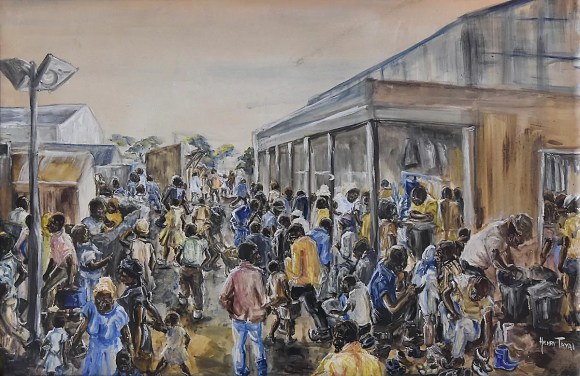
Art by Henry Tayali(1943-1987). From Public Domain

Let us imagine a world where wars have been outlawed and there is only peace. Is that even possible outside of John Lennon’s song? While John Gray, a modern-day thinker, propounds human nature cannot change despite technological advancements, one has to only imagine how a cave dweller would have told his family flying to the moon was an impossibility. And yet, it has been proven a reality and now, we are thinking living in outer space, though currently it is only the forte of a few elitists and astronomers. Maybe, it will become an accessible reality as shown in books by Isaac Asimov, Arthur C Clarke or shows like Star Trek and Star Wars. Perhaps, it’s only dreamers or ideators pursuing unreal hopes and urges who often become the change makers, the people that make humanity move forward. In Borderless, we merely gather your dreams and present them to the world. That is why we love to celebrate writers from across all languages and cultures with translations and writings that turn current norms topsy turvy. We feature a number of such ideators in this issue.

Nazrul in his times, would have been one such ideator, which is why we carry a song by him translated by Professor Fakrul Alam. And yet before him was Tagore — this time we carry a translation of an unusual poem about happiness. From current times, we present to you a poet — perhaps the greatest Malay writer in Singapore — Isa Kamari. He has translated his longing for changes into his poems. His novels and stories express the same longing as he shares in The Lost Mantras, his self-translated poems that explore adapting old to new. We will be bringing these out over a period of time. We also have poems by Hrushikesh Mallick translated from Odia by Snehprava Das and a poignant story by Sharaf Shad translated from Balochi by Fazal Baloch.

We have an evocative short play by Rhys Hughes, where gender roles are inverted in a most humorous way. It almost brings to mind Begum Rokeya’s Sultana’s Dream. Tongue-in-cheek humour in non-fiction is brought in by Devraj Singh Kalsi and Chetan Dutta Poduri. Farouk Gulsara and Meredith Stephens write in a light-hearted vein about their interactions with animal friends. G. Venkatesh brings in serious strains with his musings on sustainability. Jun A. Alindogan slips into profundities while talking of “progress” in Philippines. Young Randriamamonjisoa Sylvie Valencia gives a heartfelt account of her journey from Madagascar to Japan. Ratnottama Sengupta travels across space and time to recount her experiences in a festival recognised by UNESCO as an Intangible Cultural Heritage of Humanity. Suzanne Kamata brings a light touch again when she writes about robots serving in restaurants in Japan, a change that would be only fiction even in Asimov’s times, less than a hundred years ago!

Pijus Ash — are we to believe or not believe his strange, spooky encounter in Holland? And we definitely don’t have to believe what skeletons do in Hughes’ limericks, even if their antics make us laugh! Poetry brings on more spooks from Saranyan BV and frightening environmental focus on the aftermath of flooding by Snehaprava Das. We have colours of poetry from all over the world with John Valentine, John Swain, Ahmad Al-Khatat, Stephen Druce, Jyotish Chalil Gopinath, Jenny Middleton, Maria Alam, Ron Pickett, Tanjila Ontu, Jim Bellamy, Pramod Rastogi, John Grey, Laila Brahmbhatt, John Zedolik and Joseph K.Wells.

Fiction yields a fable from Naramsetti Umamaheswararao. Devraj Singh Kalsi takes us into the world of advertising and glamour and Paul Mirabile writes of a sleeper who likes to sleep on benches in parks out of choice! We also have an excerpt from Mohammed Khadeer Babu’s stories, That’s A Fire Ant Right There! Tales from Kavali , translated from Telugu by D.V. Subhashri. The other excerpt is from Swati Pal’s poetry collection, Forever Yours. Pal has in an online interview discussed bereavement and healing through poetry for her stunning poems pretty much do that.

Book reviews homes an indepth introduction by Somdatta Mandal to Banu Mushtaq’s Heart Lamp: Selected Stories, translated from Kannada by Deepa Bhasthi. We have a discussion by Meenakshi Malhotra on Contours of Him: Poems, edited and introduced by Malaysian academic, Malachi Edwin Vethamani, in which she concludes, “that if femininity is a construct, so is masculinity.” Overriding human constructs are journeys made by migrants. Rupak Shreshta has introduced us to immigrant Sangita Swechcha’s Rose’s Odyssey: Tales of Love and Loss, translated from Nepali by Jayant Sharma. Bhaskar Parichha winds up this section with his exploration of Kalpana Karunakaran’s A Woman of No Consequence: Memory, Letters and Resistance in Madras. He tells us: “A Woman of No Consequence restores dignity to what is often dismissed as ordinary. It chronicles the spiritual and intellectual evolution of a woman who sought transcendence within the rhythms of domestic life, turning the everyday into a site of resistance and renewal.” Again, by the sound of it a book that redefines the idea that housework is mundane and gives dignity to women and the task at hand.

We wind up the October issue hoping for changes that will lead to a happier existence, helping us all connect with the commonality of emotions, overriding borders that hurt humanity, other species and the Earth.

Huge thanks to our fabulous team, especially Sohana Manzoor for her inimitable artwork. We would all love to congratulate Hughes for his plays that ran houseful in Swansea. And heartfelt thanks to all our wonderful contributors, without who this issue would not have been possible, and to our readers, who make it worth our while, to write and publish.

Have a wonderful month!

Mitali Chakravarty

borderlessjournal.com

CLICK HERE TO ACCESS THE CONTENTS FOR THE OCTOBER 2025 ISSUE

.

READ THE LATEST UPDATES ON THE FIRST BORDERLESS ANTHOLOGY, MONALISA NO LONGER SMILES, BY CLICKING ON THIS LINK.

Categories
Stories

The Wise Words of the Sun

By Naramsetti Umamaheswararao

Once upon a time, the Rain God and the Wind God had an argument.

“I am greater than you,” said the Rain God.

“No, I am greater,” replied the Wind God.

To decide who was truly greater, they made a deal: “Whoever can trouble the people of Earth more, will be the greatest,” they agreed.

The next day, the Rain God started the round. It started with light showers but soon turned into heavy rain. It rained non-stop for an entire week! Crops were drowned. Farmers cried over their year-long hard work being washed away. Poor people’s small huts were destroyed. Some people died under collapsing walls. Animals were washed away in floods. Birds shivered in the cold. Rivers and lakes overflowed. Roads were flooded.

For seven days, the Sun didn’t shine, and people were very worried.

They prayed to the Rain God, “Please stop the rain!”

Hearing their cries, the Rain God finally stopped.

He proudly asked the Wind God, “Now do you agree I am the greatest?”

The Wind God replied, “Wait till you see my power. Then we’ll talk.”

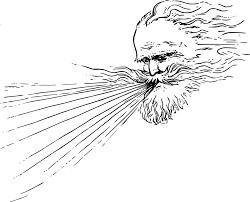
Suddenly, the Wind God blew with all his strength.

Dust flew everywhere. Nothing was visible.

Roofs of huts flew away. People and animals were picked up and thrown down by the strong wind. Trees broke and fell. Even cattle tied in the yard broke their ropes and ran away. People were terrified. They prayed, “Wind God, please calm down!”

Hearing this, the Wind God smiled and stopped.

He told the Rain God proudly, “Look! People couldn’t handle even one day of my power. If I continued, imagine what would’ve happened.”

The Rain God was about to agree when suddenly they heard a voice: “No, you are both wrong!”

Surprised, they looked around. It was the Sun God speaking from the sky.

The Wind God asked, “Are you saying I’m not the greatest?”

The Sun said, “What’s so great about scaring people? If I shine too bright all day, even I can make people suffer. But that’s not our purpose. We exist to help people, not to trouble them.”

The Rain God said, “We just wanted to know who is greater.”

The Sun replied, “If you want to know that, ask Indra or the sages—not the people. You made people cry and suffer. Is that fair?”

Both gods asked, “Then what should we do?”

The Sun said, “Rain God, bring rain when it’s needed—during the rainy season or when the water level is low. Then people will worship you with love and gratitude. Wind God, blow cool breeze during summer. In winter, be gentle. During rains, guide the clouds to where rain is needed. Then people will respect and pray to you. Look at Mother Earth. She gives and serves without asking anything in return. Be like her. Don’t make people suffer just to prove who is better.”

The Rain God and Wind God nodded.

“You are right, Sun God. We agree. We will never make that mistake again.”

And with that, they left peacefully.

From Public Domain

Naramsetti Umamaheswararao has written more than a thousand stories, songs, and novels for children over 42 years. he has published 32 books. His novel, Anandalokam, received the Central Sahitya Akademi Award for children’s literature. He has received numerous awards and honours, including the Andhra Pradesh Government’s Distinguished Telugu Language Award and the Pratibha Award from Potti Sreeramulu Telugu University. He established the Naramshetty Children’s Literature Foundation and has been actively promoting children’s literature as its president.

.

PLEASE NOTE: ARTICLES CAN ONLY BE REPRODUCED IN OTHER SITES WITH DUE ACKNOWLEDGEMENT TO BORDERLESS JOURNAL

Click here to access the Borderless anthology, Monalisa No Longer Smiles

Click here to access Monalisa No Longer Smiles on Amazon International

Categories
Excerpt

Tales from Kavali

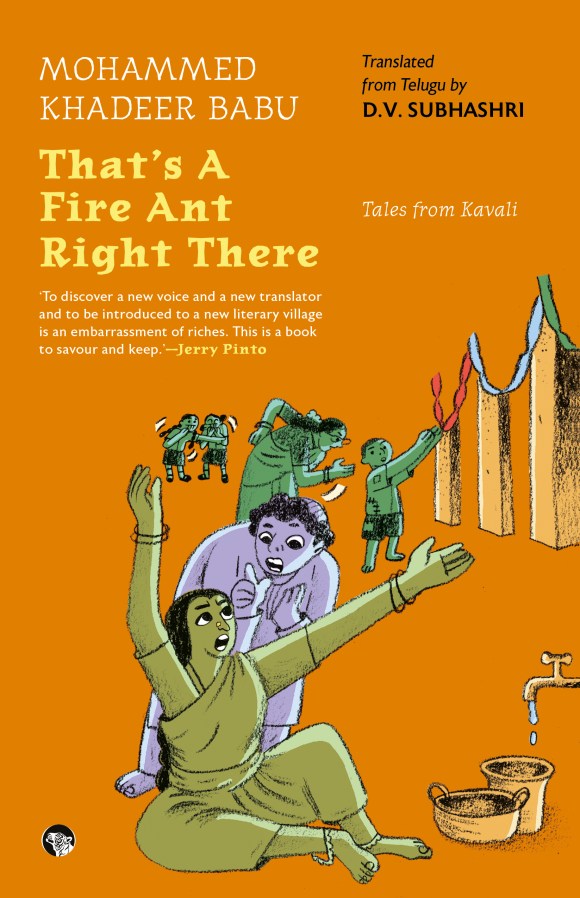
Title: That’s A Fire Ant Right There! Tales from Kavali

Author: Mohammed Khadeer Babu

Translator: D.V. Subhashri

Publisher: Speaking Tiger Books

True-blue Palavenkareddy!

It’s only now when he’s running a Palav Center in front of Kavali Court that he’s able to see twenty-six rupees in his hand for every plate he sells, but there was a time in our childhood when Palavenkareddy too was down on his luck!

Palavenkareddy (Palav + Venkareddy) was my father’s best friend. He was also the one who got him married.

When my grandfather Mastan Sayibu was considering giving my mother’s hand in marriage to my father, it seems he went straight to Palavenkareddy to enquire about my father’s ‘conduct’.

‘Don’t worry about that boy, saami! He’s 24-carat gold. You can get them hitched with your eyes shut!’ Palavenkareddy reassured my grandpa and lifted a load off his mind.

Although seven-eight years older than my father, Palavenkareddy, always dressed in white, appeared much younger, with his toned muscles (he was a wrestler once, I might add), shining skin and dyed hair.

At the time of nikah, as my mother was still a young fourteen-year-old, Palavenkareddy used to address her as ‘ammayi’ or ‘girl’, and continued to call her that even after marriage. Whatever his feelings for my father, he definitely favoured my mother and had more affection for her.

If Sankranti was here, Palavenkareddy wouldn’t be far behind. He’d show up with a large steel carrier full of ariselu, manuboolu, laddulu and hand it to my mother saying, ‘Here you go, girl.’ Then he would take my father, my brother and me to his house, fill our leaf-plates full of sweet payasam and treat us to a full festival meal. (This is also the time to reveal yet another truth. Until recently, whenever my mother had to go to a wedding or any other function, she would borrow Palavenkareddy’s wife’s or daughter-in-law’s jewellery as if she had every right to do so.)

I don’t really know if he was into farming or not, but as kids we always saw she-buffaloes tied up at their house. His wife would wake up early and toil hard, tending to the buffaloes all day. Seemingly in an effort to reduce her drudgery, he dabbled in various businesses, but being a man of truth, failed to make money in any of them. Finally, he hit the jackpot when he opened the Palav Centre. And since then, his surname changed from Remala to Palav and he came to be known as Palavenkareddy to everyone in our town.

During our childhood, he owned a cloth store near the Ongole bus stand. Barely a metre would sell each day at the shop, but Palavenkareddy and his elder son could always be seen dutifully minding the store.

Now why I’ve been telling you this long story about Palavenkareddy is because when the month of Ramzan arrived we were forced to draw on his services—thanks to my mother’s pestering.

‘All the ladies in the street are going to Gademsetty Subbarao’s shop and getting themselves whatever clothes they want. Why don’t you also toss me a hundred or two? I’ll go get the children some new clothes.’ My mother had been badgering my father ever since Ramzan had begun.

My father responded with neither ‘aan’ nor ‘oon’. Ultimately, she decided that this was not the medicine for my father’s attitude and cleverly started instigating my grandma.

‘Rey abbaya! How heartless can you get! Even if we adults don’t buy anything, how can you not get a few pieces of cloth for the children? When other children in the street roam around wearing new clothes, won’t ours feel bad?’ poked my grandma.

Who knows what came over him, but he replied, ‘Send the older one and the second one to the shop in the evening. If I happen to get money by then, I’ll buy them some, alright,’ and left for work.

When evening came, with high hopes my mother dressed us up—not just me and my brother but also our sister—and sent us to our electrical shop on Railway Road.

And my father? What did he do? When we reached there, he was sitting at the table with a deadpan face and hands over his head. The moment he saw us, he stood up and said, ‘Not today. Go home,’ then picked up my little sister and prepared to lock the shop.

We were crestfallen. My brother was on the verge of tears.

That is exactly when, like Gods appearing out of nowhere, Palavenkareddy appeared before us. On seeing us, he laughed, ‘Endayyo? What’s up here? All the little Nawabs have descended together.’

My father too laughed and told him the matter. ‘What, Karim Sayiba? The children have come for their festival clothes and you’re taking them back empty-handed? Didn’t you think of my shop? Come, come, let’s go,’ Palavenkareddy urged him.

‘Not now, Enkareddy. We’ll see when I have the money,’ said my father reluctantly.

‘Do you ask for money when you do electric work in my house? Then why would I demand money for the children’s clothes?’ he insisted, herding us along. And so, together we all went to Palavenkareddy’s cloth shop near Ongole bus stand.

‘Karim Sayiba! It’s not as if you’re going to buy clothes again anytime soon, so might as well pick a sturdy fabric that will last a few days,’ he said, opening a wooden almirah and pulling out a tough-looking piece of blue cloth from the swathes of fabric inside.

‘Guarantee cloth. No question of tearing at all,’ he said.

Whenever my father hears the word ‘guarantee’, he forgets everything else and says, ‘Yes, give that one’, and so, he said the same to Palavenkareddy as well.

That was that! Before we knew it, in five minutes Palavenkareddy had cut the cloth and all of us had given our measurements to the tailor Sayibu beside the shop, who promptly soaked the cloth in an iron bucket.

(Excerpted from That’s A Fire Ant Right There! Tales from Kavali by Mohammed Khadeer Babu, translated by D.V. Subhashri. Published by Speaking Tiger Books)

ABOUT THE BOOK: Captured in the innocent voice of a young boy, Mohammed Khadeer Babu’s Chaplinesque-style of portraying misery through humour shines a sweeping light on Muslim lives in coastal Andhra. Populated with strong women, cheeky scamps, virtuous dawdlers and scrupulous teachers, his witty storytelling in the Nellore dialect is a riveting portrayal of the daily struggles of adapting to a majoritarian world in small-town India. Belying the nostalgic memories of childhood are scathing observations of the education system, child labour, social barriers, and casteist attitudes. Yet, the stories also resound with a clear message of friendship, especially among Hindus and Muslims, making this book essential reading in today’s fraught times, to remind ourselves of our inherited legacy of communal harmony—which makes it possible for the young narrator to say, ‘I’ve never regretted even once that I didn’t learn Urdu or that I don’t know Arabic, or that I have never even touched the Quran in these languages, only in Telugu.’

D.V. Subhashri’s unique translation, which retains all the richness of the original, quaint expressions and sounds et al, brings a smile to our faces, while showing us why the book made Khadeer Babu a household name in the Telugu community. This first English translation of his work opens up a new world for us.

ABOUT THE AUTHOR: Mohammed Khadeer Babu is a senior journalist and award-winning writer in Telugu with short stories, anthologies, non-fiction books and movies to his credit. A two-time Katha awardee, his stories have won various prizes at the state and national level and earned him the Government of Andhra Pradesh Achievement Award in 2023.

ABOUT THE TRANSLATOR: D.V. Subhashri is a multilingual writer and translator based out of Bangalore. Her stories and translations have appeared in various online magazines and her children’s books have won awards in Telugu and English. She is currently translating two books from Telugu and Kannada.

PLEASE NOTE: ARTICLES CAN ONLY BE REPRODUCED IN OTHER SITES WITH DUE ACKNOWLEDGEMENT TO BORDERLESS JOURNAL

Categories
Stories

The Anger of a Good Man

By Naramsetti Umamaheswararao

A wealthy man named Dharmayya hired a carpenter to do the woodwork for his newly constructed house. He handed over the timber required for doors and windows and asked him to begin the work.

The carpenter brought his tools and started working. By the end of the week, the doors and windows were nearly ready. He used nails extensively to join and shape the wooden pieces.

One day, when the carpenter said he ran out of nails, Dharmayya immediately went to the market and bought some more. Showing them to the carpenter, he said, “The price of iron has gone up, so nails are expensive now. Still, I didn’t compromise on quality. Strong nails ensure durability. One shouldn’t hesitate to spend for lasting quality.”

One of the nails overheard these words — a particularly arrogant one — and it swelled with pride. It already had a haughty nature, and now hearing the owner’s praise, it became even more boastful.

Using every opportunity, it began to taunt the wood: “You’re nothing without us! Your strength and durability come only because of us. If you’ve earned any reputation, it’s because of the nails like me!”

But the wood didn’t mind. It calmly replied, “No one can survive alone. If I stand strong today because of you, I’m grateful.”

The nail didn’t like this response. The other nails and tools added, “Don’t say that. In a way, it’s because of you that we have any purpose.”

The arrogant nail was not pleased to hear even the other nails side with the wood. It glared at the wood and muttered, “Just wait. The moment I get a chance to tear through you, I’ll make you cry!”

Two days later, the carpenter happened to pick up that same nail. He placed it on the wood and struck it with a hammer. But the nail refused to go in. Seeing this, the carpenter struck it harder on the head with the hammer. The nail bent sideways. Trying to straighten it, he placed it on a stone and hit it again. This time, the blow landed badly and broke the nail’s head off.

Now useless, the carpenter tossed it into a corner and continued his work with a new nail.

The arrogant nail was shaken by the incident. It had never imagined such an end. Not knowing what to do, it sat there, broken, and wept.

As dusk fell, the carpenter packed up and left, leaving behind the wood, tools, and materials.

Seeing the nail lying sadly in a corner, the saw said, “So, miss high-and-mighty, look what happened to you! You thought the wood’s strength came from you? You mocked the very material that patiently endures our harsh cuts, believing that we are helping it become stronger. You couldn’t recognize its silent strength and goodness.

“When the carpenter hurts the wood while crafting a beautiful home, the wood endures it in silence. We are only tools used temporarily. But the wood is not weak. After being used once, who thinks about nails like you again? You wanted to hurt the wood but ended up ruining yourself. By morning, you’ll be swept away and tossed in the trash. Your life now has no purpose.”

The nail was finally enlightened. “I misunderstood the wood’s kindness as weakness and spoke arrogantly. It’s true — when good people get angry, they leave no trace of those who cross them.”

The truth is, the wood refused to let that nail in — not because it was weak, but to teach a lesson to that arrogant nail. Its resistance came from strength. It proved that the truly strong remain silent and fulfill their purpose without pride.

From Public Domain

.

Naramsetti Umamaheswararao has written more than a thousand stories, songs, and novels for children over 42 years. he has published 32 books. His novel, Anandalokam, received the Central Sahitya Akademi Award for children’s literature. He has received numerous awards and honours, including the Andhra Pradesh Government’s Distinguished Telugu Language Award and the Pratibha Award from Potti Sreeramulu Telugu University. He established the Naramshetty Children’s Literature Foundation and has been actively promoting children’s literature as its president.

.

PLEASE NOTE: ARTICLES CAN ONLY BE REPRODUCED IN OTHER SITES WITH DUE ACKNOWLEDGEMENT TO BORDERLESS JOURNAL

Click here to access the Borderless anthology, Monalisa No Longer Smiles

Click here to access Monalisa No Longer Smiles on Amazon International
Categories
Editorial

‘…I write from my heart of the raging tempest…’

I can see the heartbreak, 
Hear the wailing, the awakening,
I write from my heart
Of the raging tempest.

— Translation of Probhatey or ‘In the Morning’ by Rabindranath Tagore (1906)

All around us, we hear of disasters. Often, we try to write of these as Tagore seems to do in the above lines. However, these lines follow after he says he draws solace and inspiration from a ‘serene lotus’, pristine and shining with vibrancy. He gazes at it while looking for that still point which helps him create an impact with words. That is perhaps what we can hope to do too — wait for a morning where clarity will show us the path to express not just what we see, but to find a way to heal and help. Finding parallels in great writings of yore to our own attempts at recreating the present makes us realise that perhaps history is cyclical. In Rome, new structures rear up against thousand-year walls, reflecting how the past congeals into the present.

Congealing the past into our present in this July’s issue are stories of American migrants — like Tom Alter’s family who made India their home — by Anuradha Kumar in her new non-fiction Wanderers, Adventurers, Missionaries: Early Americans in India. We feature this book with a review and an interview with the author where she tells us how and why she chose to write on these people. We have more people writing of their own wanderings. Mohul Bhowmick wanders into Cambodia and makes friends over a local sport while Prithvijeet Sinha strolls by the banks of the River Gomti in Lucknow. Meredith Stephens not only takes us to the Prime Meridien in Greenwich but also to Carnarvon which houses a science and technology centre in Australia. Devraj Singh Kalsi wanders with humour to discover gastronomical inspiration and hopes for sweeter recompense.

The dialogue started by Professor Fakrul Alam on libraries earlier with his essay and by Kalsi (with a pinch of humour) has been continued by Odbayar Dorj. She talks of the fading culture of libraries in Mongolia, her home country, and the vibrant culture that has blossomed in Japan. Suzanne Kamata writes of the rituals of summer holidays in Japan… including looking after a pet dung beetles.

Farouk Gulsara muses on ‘greatness’ as a concept with irony. Aparajita De muses on the word serendipity, applying it to her own situation while Ratnottama Sengupta muses on her encounter with the writings of eminent cover artist and writer who is not only a recipient of the Bangla Academy literary award but also immensely popular with children, Dhruba Esh, and translates one his many stories from Bengali.

In translations, Professor Alam has brought to us a beautiful poem by Jibanananda Das. Karim Drashti’s Balochi short poems have been rendered in English by Fazal Baloch and Snehaprava Das has found for us Odia poems of Sangram Jena in translation. Ihlwha Choi has rendered his own Korean poem to English while Tagore’s poem, ‘Probhatey (In the Morning)’ winds up the poetry in this section. We have more in prose — Surya Dhananjay’s story, Mastan Anna, translated from Telugu by Rahimanuddin Shaik.

In fiction, we have stories from around the world. Paul Mirabile sets his story in Burgaz. Spandan Upadhyay gives a mysterious narrative set in a world outside our waking consciousness and Vidya Hariharan gives us a glimpse of life in modern day India. From Bangladesh, Md Mujib Ullah writes a short cli-fi based on real life events.

Taking up the theme of cli-fi, Rajat Chaudhuri’s Wonder Tales for a Warming Planet seems to bring hope by suggesting adapting to changing climes. Rakhi Dalal tells us in her review: “It dares to approach the climate crisis through the lens of empathy and imagination rather than panic or guilt. In doing so, Rajat Chaudhuri gives us what many adult climate narratives fail to deliver—a reason to believe that another world is not only possible but already being imagined by the young. All we need to do is listen.” Bhaskar Parichha has discussed the autobiography of a meteorologist and Distinguished University Professor at George Mason University, Jagadish Shukla. In A Billion Butterflies: A Life in Climate and Chaos Theory, he claims Shukla has “revolutionised monsoon forecasting.” Somdatta Mandal has written about Dilip K Das’s Epidemic Narratives: The Cultural Construction of Infectious Disease Outbreaks in India. And Gower Bhat reviews Neha Bansal’s best-selling poetry collection, Six of Cups.

Poetry awakens myriad of hues in Borderless with verses from across the world. We have poems from Luis Cuauhtémoc Berriozábal, Ryan Quinn Flangan, Snehprava Das, George Freek, Laila Brahmbhatt, Tracy Lee Duffy, Amarthya Chandar, Jason Ryberg, Momina Raza, Shahriyer Hossain Shetu and more. Snigdha Agrawal gives a fun-filled poem about a duck and Rhys Hughes has given us a collection of verses like puzzles where we need to guess the animals! We also have an excerpt from Hughes’ The Eleventh Commandment And Other Very Short Fictions and Das’s short stories, Keep It Secret.

With that, we wind up the contents of this month’s issue. Do pause by our content’s page to check it out in more details.

This month’s edition would not have been possible without all our contributors, our fabulous team and especially Sohana Manzoor’s artwork. Huge thanks to all of them and to our wonderful readers who make it worthwhile for us to write and publish. Do write in to us if you have any feedback. Five years ago, we chose to become a monthly from a daily… We have come a long way from then and grown to host writers from more than forty countries and readers from almost all over the world. For this, we owe you all – for being with us and encouraging us to find fresh pastures.

Enjoy the reads!

Wishing you peace and happiness,

Mitali Chakravarty,

borderlessjournal.com

Click here to access the contents for the July 2025 Issue

READ THE LATEST UPDATES ON THE FIRST BORDERLESS ANTHOLOGY, MONALISA NO LONGER SMILES, BY CLICKING ON THIS LINK.

Categories
Stories

Mastan Anna

Story by Surya Dhananjay, translated from Telugu by Rahimanuddin Shaik

Surya Dhananjay

That night, in Tarnaka, Hyderabad city, all the apartments were silent as if lost in deep sleep. Sujatha’s flat was one among those. Her husband and children were sound asleep. Meanwhile, she, in the bedroom, faintly heard the phone ringing in the hall. Sujatha, a lecturer by profession, was awake, preparing for the next day’s class. A strange fear gripped her as the phone rang at that hour. As if someone was chasing her, she rushed to answer the phone. It was an unknown number. She thought of calling back but decided against it, thinking it was too late at night. The phone rang again. She immediately picked it up.

“Hello Attayya[1]! It’s me, me.”

The call got disconnected.

The sounded familiar.

Who could it be? Why would they call at this hour of the night?

Various thoughts raced through her mind. Thinking she’d find out who it was if she called back, she redialled

“Hello,” she said, and that was it!

She could hear crying and shouting from the other end. Then the phone got disconnected again. Anxiously, she redialled, but the phone had been switched off. She checked Truecaller app[2] to see who it might be. ‘Not found’ was the result. Putting aside the book she was reading, she lay down. But she couldn’t sleep. Various thoughts haunted her. She didn’t know when she finally drifted off to sleep.

Morning dawned bright. Waking up, she fearfully picked up her phone. There were four or five messages.

She read: “Mastan anna2 is no more. He has left us.”

She felt like a thunderbolt had stricken her heart. Her eyes filled with tears. Wiping them away, she read the message again. The news slowly sank in – the news that the brother she had cherished since childhood, Mastan anna[3] who eagerly awaited for the rakhi[4] she tied every year, was gone. Tears flowed uncontrollably from her eyes. Her tear-filled eyes became slightly blurry. Through that blur, her childhood memories, mixed with tears, began to drip down drop by drop.

Sujatha was then studying in the sixth standard at Miryalaguda Girls’ High School. She came from Hemanayak tanda,[5] near the Sagar canal. Her mother, Dhwali Bai, and father Bhadru Naik were forward thinking people. Though they had only daughters, they educated them well instead of arranging child marriages for them like everybody else. Sujatha was the youngest. Theirs was a family living happily in the lap of nature, drawing their living from small-scale farming and raising cows.

Dhwali Bai occasionally went to the Miryalaguda market for groceries. On her way back, she would drop off the children’s clothes for stitching at tailor Mastan’s shop in the old bus stand area. Not just her, everyone from the tanda got their clothes stitched there for festivals and occasions. Mastan treated his customers well. He was thin in appearance and always wore clothes as white as jasmine flowers. He captivated everyone with his gentle speech. He had immense respect for Dhwali Bai and Bhadru Naik’s family. He called Dhwali Bai ‘Amma[6]’. Dhwali Bai always wished well for others. He was won over by her kindness. Dhwali Bai, who had no sons, saw a son in him. After some time, their bond grew, and Mastan became a member of the family.

Back then, there was only one bus service from Miryalaguda to Hemanayak tanda. It made only two trips a day – one in the morning and one in the evening. Sujatha, studying in Miryalaguda, would go home every Saturday evening by this bus. Her mother would wash all her school dresses white. She would oil her hair and braid it into two plaits. While making her hair, Dhwali Bai would advise Sujatha to be careful in the town.

“Because I didn’t study, I didn’t know the world. You, at least, study well and bring light to our tanda, Beti[7]. Even if Bhadru Naik has no sons, the daughters he has should study well and become role models for everyone,” Dhwali would say.

One day, Dhwali Bai, having come to drop Sujatha at the hostel, introduced Sujatha to Mastan.

“Look, Beta[8], this is your younger sister. You need to make a uniform for her. Otherwise, they won’t let her into school today. Also, whenever she comes to board the service bus, you must save a seat for her by placing a towel near the window. Tell that conductor to take the girl carefully and drop her off at the tanda gate. There aren’t good boys on the buses these days. Tell the driver to scare those boys a bit,” Dhwali instructed, as if instructing her own son.

Mastan smiled. “Alright, Yaadi[9], I’ll do as you say. I’ll look after Sujatha like my own sister. From the moment she gets off the bus all the way to her school, and after school, putting her on the bus to the tanda – it’s my responsibility,” he said, engaging them in conversation while quickly stitching a skirt and blouse for Sujatha.

“Here, sister, this dress is a gift from your brother,” he offered.

Sujatha shook her head as if declining the gift and looked at Dhwali Bai.

“Don’t take it for free, Amma. Instead, she can tie rakhi on me every year,” he said, placing the dress in her hand. From that day, their bond grew. Mastan looked after Sujatha like the apple of his eye. Their brother-sister relationship became known in the tanda as well. Every year, Mastan would go to the tanda, have Sujatha tie the rakhi, and receive Dhwali Bai’s blessings before returning. Mastan’s wife, Rajitha, was very happy that he treated Sujatha with such respect and love, even though she wasn’t his biological sister.

However, some people in the tanda didn’t like their bond. Naturally, the tanda dwellers lived happily like deer in the forest, away from the plains. Just as deer get agitated by the presence of a new creature, they hesitated when non-tribals mixed with them. They viewed Mastan’s visits to the tanda with suspicion. Kalya, Sakku, and Saida decided they must somehow stop Mastan from coming to the tanda. They didn’t dare discuss this with Bhadru Naik and Dhwali Bai. The tanda dwellers had immense respect for Bhadru. He treated everyone lovingly. Raising his daughters admirably, he stood as a role model. They didn’t dare oppose such a person. But they wanted to stop Mastan from coming to the tanda and were waiting for an opportunity.

Mastan, living amidst the car horns and crowds of Miryalaguda town, constantly stressed, dearly loved the tanda, its people, and its atmosphere. The peaceful tanda air, the innocent talk of the Lambadis, the mouth-watering jowar rotis and garlic chutney, the pleasing sight of green trees, cows, goats, and chickens in every house – Mastan liked all this very much. Moreover, like Bhadru Naik and Dhwali Bai, Mastan had an immense love for people and relationships. He helped those who came to his shop within his means and earned a good reputation around the old bus stand. If anyone came to the Mandal[10] Revenue Office with work, he would inquire about their problem, connect them with officers he knew, and provide appropriate help.

That day was 15th August[11], flag hoisting Day. Mastan went to the school looking for his sister. But Sujatha wasn’t there. As it was also Rakhi that day, Mastan learned from her friends that Sujatha had gone to the tanda the previous day to tie rakhis to her brothers there. Mastan set off for the tanda, cycling. Near the tanda, he saw some children and gave them chocolates. Sakku and Saida, who were coming that way, saw Mastan giving chocolates. They came up to him.

“Hey Mastan! What are you giving the kids? Are you giving them some enchanted marbles?!” they asked suspiciously.

Ayyo, nothing like that, Bhiya[12]! These are just chocolates distributed at school, I brought them in my pocket. That’s what I’m giving,” Mastan replied and moved on.

Reaching Dhwali Bai’s house, Sujatha saw Mastan and shouted joyfully, “Yaadi, Mastan anna has come!”. Sujatha tied the rakhi on Mastan’s wrist and fed him sugar.

“Mastan anna, I tied the rakhi, what will you give me?” she asked.

“You’ll go to Hyderabad for higher studies, won’t you! If you get a job, you’ll stay there. Then, I myself will look after Yaadi and Bapu[13]. That is the gift I give you,” he said, smiling as he mounted his cycle.

Ten days later, suddenly, everyone in the tanda fell sick with fever. Some had diarrhoea and vomiting. Every house had patients. The tanda, which until then was like a marigold field full of bright flowers, now looked like a cotton field stripped of its flowers. Dark and unwell.

‘Some evil misfortune has befallen the village,’ people began to think.

“No, no, some ghost has possessed the tanda,” said one. “No, we didn’t celebrate the Seethlayadi festival grandly this time. That’s why the goddess is angry,” said another.

“Yes, the village deities of the tanda are angry. We must call the priest. We need to talk. Let’s all contribute a hundred rupees each and celebrate the festival well,” said the Tanda Naik[14].

“Oh Naik, these are not the real reasons why the people in the tanda suffer. That tailor shop Mastan is the cause of all this. He did this. They say he knows magic spells. Whatever he wishes, happens, they say. We found out in town,” Saida spoke passionately, his words sparking fear in the hearts of the tanda people.

“Hey, don’t talk nonsense, Saida! Mastan is not that kind of person,” Bhadru Naik thundered angrily.

Realising that his words would be wasted if he didn’t counter Bhadru, Saida looked at Sakku. “Hey Sakku! Didn’t Mastan give marbles to our tanda boys the other day…?”

“Oh… he did, Saida. I saw it too.”

“Ah! He put enchanted spell on those marbles.”

The people slowly nodded their heads, seeming to agree with Saida’s words. Meanwhile, someone from the crowd said, “In that case, we must catch that Mastan! We must make him confess what spell he used. If we just leave him, our tanda will be ruined. Only if we punish him severely will anyone else be afraid to even look towards our tanda,” they said.

“We will go and catch him,” said Kalya, Sakku, and Saida, setting off for Miryalaguda. Since everyone was united on this, Bhadru Naik and Dhwali couldn’t refuse.

The next day, Sakku, Saida, and Kalya met Mastan. “Our tanda dwellers have asked us to bring you. Come!” they said and took him away. Learning about the situation from school friends, Sujatha also left the hostel for the tanda. People gathered in front of the Tanda Naik’s house. Mastan was brought there. Sujatha reached the spot.

“Why have you brought me here?” Mastan asked the Tanda Naik.

“Everyone in our tanda has fallen ill with fever. We have never seen everyone get fevers like this at the same time. We are strong people. We can withstand any disease. But today, the entire tanda is troubled like this. They are saying you are the reason for all this. They say you gave some enchanted marbles to our boys. People apparently saw it. If that is true, tell us the counter-spell. Otherwise, the people are angry. They won’t leave you,” the Naik concluded, looking straight into Mastan’s eyes.

The accusation pierced Mastan’s heart like a crowbar.

“Spells?… I don’t know what those are. I only know how to love others. Please trust me,” he replied pitifully.

“Then what did you mix in those chocolates? What about them?” Kalya questioned.

“Those were distributed on the Independence Day at Sujatha’s school.”

“Then why did you bring them here? Aren’t there any little boys in Miryalaguda? Our boys look healthy and vibrant. That’s why you got jealous. You couldn’t bear it. Isn’t that it?!” they bombarded Mastan with question after question.

Kalya, Sakku, and Saida, who wanted to stop Mastan from coming to the tanda, saw this small opportunity as a great one and launched their attack. The people, suffering from fear and pain due to the fevers, couldn’t think rationally about right and wrong. They almost fell upon Mastan and beat him. Even though Bhadru, Dhwali, and Sujatha tried to stop them, no one listened. Swinging furiously, they attacked him.

“Don’t do this my fellow brothers, Mastan anna is not like that.”

“Hey Mastan, don’t ever look towards our tanda again! Go!” Before the Naik could finish his words, Sujatha interrupted, “Dada[15], is this your wisdom? Can’t your leadership distinguish between good and bad people?” she asked, her voice filled with anger and anguish.

“You don’t know about him, child,”

“I know everything, Dada! I am studying in the sixth standard. Science doesn’t accept spells and magic. Those are just our fears. Mastan anna is a good man. He considers not just me, but all the children of our tanda as his brothers and sisters. To stay in our tanda which suspected and insulted a good man like Mastan anna, I too feel humiliated, Dada!” she cried, taking Mastan away.

From then on, Mastan stopped coming to the tanda and Sujatha moved out of the tanda to study in less than a month. Eventually, she married and settled down in the capital town of Hyderabad. But she would come to Miryalaguda every year on Rakhi just to tie the rakhi on Mastan’s wrist. No matter how much anyone threatened, their brother-sister bond continued.

Hearing the news of Mastan’s death, Sujatha set off from Hyderabad to Miryalaguda with a grief-stricken heart. As she travelled in the car with her husband and children, childhood incidents flashed before her eyes.

“Though not of our caste, our religion, our tribe, the bond of humanity and the jewel of goodness united Mastan anna with our family. How good was Mastan anna! Though his shop was a small one, his heart was vast. Mastan anna always had the quality of helping others in his own way,” she thought to herself, looking out the car window. She realised they had reached the town. People were bustling in the shops along the roads. ‘What is it?’ she wondered, rolling down the car windows. People were enthusiastically buying rakhis. Whichever shop she looked at, only rakhis were visible.

Just then, Mastan’s small shop near the old bus stand came into her view. It was open. Seeing it, her heart grew heavy. Inside, she saw Mastan’s photo with a gentle smile and a serene face. Hundreds of rakhis surrounded the photo. The whole shop was filled with rakhis. Seeing this, crying she got out of the car and paid her respects. She was surprised and astonished looking at the farewell Mastan received.

The car reached Mastan’s house. There was no one outside the house. Only a few people were inside. Seeing Sujatha, Mastan’s wife, Rajitha, came out of the house crying and held her tightly. Rajitha’s told her that the cremation ceremony was over the night before. She said in a gloomy tone that only Mastan’s memories remained for them now. This left Sujatha stunned. She felt immense pain for not being able to have a final glimpse of Mastan.

Composing herself, Sujatha asked, “On the way, I saw many rakhis around Anna’s photo in that small shop. Who put them there?”

Then Rajitha replied, “The people of Hemanayak tanda tied them,” leaving Sujatha even more surprised.

“Our tanda people? Weren’t they angry with Anna, Vadina[16]?”

“That was once upon a time. The very people who misunderstood him under the pretext of spells came to admire him after knowing the truth. The occasion never arose to tell you this matter!”

“Really! How did they find out?” Sujatha asked eagerly.

“A month after they insulted him in front of the tanda Naik’s house, your brother went to the tanda on his cycle to plead with them and to tell them he knew nothing. On the way, beside the road, he apparently saw groups of crows and vultures gathered some distance away. Going closer, he saw that chicken shop owners from Miryalaguda town were dumping their waste there. Crows gathered around it, picking up the rotten stuff with their beaks, flying to the tanda’s water tank, sitting on it to eat, and dropping some of the pieces into the water tank. Those waters got contaminated, and cholera spread throughout the tanda.

She continued, “As soon as he understood the matter, he returned to Miryalaguda, complained to the Municipal Health Department, and got the waste removed. He got the tank cleaned. He got fines imposed on the chicken shop owners who dumped the waste there. He ensured no one came that way again.   

“After some days, the diseases in the tanda subsided. The people learned the truth. Everyone came from the tanda and apologised and expressed their gratitude to your brother. They asked him to come to the tanda again. But your brother had too much self-respect. He said, ‘It’s enough that you know the truth, I won’t come again.’ The occasion never arose to tell you all this,” Rajitha said, handing Sujatha a packed cardboard box.

“Your brother asked me to give this to you,” Rajitha said. Sujatha opened it with great curiosity. Inside, he had carefully preserved all the rakhis she had tied on Mastan over the past twenty years. Seeing them, Sujatha cried profusely, realising Mastan’s noble personality, his heart as vast as the ocean, and his love for her as high as the Himalayas.

Along with the box, Rajitha gave Sujatha a packet that Mastan had also asked her to give. Inside was a green saree with a red border.

“Your brother himself spun the yarn and wove this saree. He worked hard for six months to weave it. Saying one shouldn’t remain indebted to a sister, and that he had never given you anything, he planned to call you for the Dasara festival this time and give you this saree,” Rajitha explained.

Mastan belonged to the Padmashali[17] community. In truth, Mastan had long forgotten how to spin yarn and weave sarees. But Sujatha was astonished that he had personally woven a saree for her.

“How much Mastan anna loved me! Truly, having such a brother is my fortune,” she offered a tribute from her heart. She felt very happy that the tanda people had understood Mastan’s goodness. Assuring Rajitha that she would take responsibility for educating Mastan’s two children and making them successful, Sujatha got into the car.

Now her heart felt elated. The anger she held towards her tanda for twenty years vanished. “My tanda dwellers are children of the forest. They are not aware of the outside world and its cunning ways. They all live together like one family. They don’t easily trust non-Lambadis or newcomers. That’s not just their characteristic. It’s also the law of the forest for their own protection. That’s why they insulted Mastan anna like that, that day. But if they love someone, they cherish them dearly. For them, everything is intense — love or anger. ” thinking thus, Sujatha reached Hyderabad with Mastan’s memories and a heavy heart.

.

Originally published in Telugu as Mastananna Dabba (tr. the box of Mastan brother) in Namaste Telangana, Sunday edition, on 8th March, 2020

[1] Attayya – Aunt or Mother-in-law

[2] Truecaller is a smartphone app that can identify caller ID.

[3] Anna – Elder brother

[4] At this festival, sisters of all ages tie a talisman called the rakhi around the wrists of their brothers.

[5] Tanda – Village or hamlet

[6] Amma — Mother

[7] Beti – Daughter

[8] Beta- Son

[9] Yaadi/Yadi – mother, mom

[10] An administrative subdivision

[11] India’s Independence Day

[12] Bhiya — Brother

[13] Bapu – Father

[14] Tanda Naik – Village Chief

[15] Dada – grandfather

[16] Sister

[17] A weaving community from Telugu states

Prof. Surya Dhananjay is an eminent Telugu scholar and folklorist from Osmania University. She champions tribal heritage and education with her writing. With an illustrious literary career spanning decades, Prof. Dhananjay has authored 28 books, including poetry, short stories, critical essays, historical studies, and compilations, alongside 80+ research papers. Her seminal work, Gor Banjara: An Enduring Tribe (co-authored with Dr. Dhananjay Naik), is a landmark exploration of Banjara (gipsy) heritage. Through her writings and advocacy, she has championed the preservation of cultural identities, leaving an indelible mark on Telugu literature and tribal studies.

Shaik Rahimanuddin has translated children’s literature on Storyweaver, Analpa and Prajasakti have published his children’s book translations.

.

PLEASE NOTE: ARTICLES CAN ONLY BE REPRODUCED IN OTHER SITES WITH DUE ACKNOWLEDGEMENT TO BORDERLESS JOURNAL

Click here to access the Borderless anthology, Monalisa No Longer Smiles

Click here to access Monalisa No Longer Smiles on Kindle Amazon International