Categories
Contents

Borderless August 2021

Editorial

Triumph of the Human Spirit… Click here to read.

Interviews

Goutam Ghose, multiple award-winning filmmaker, writer, actor discusses his films, film-books and journey as a humanitarian artiste. Click here to read.

Dr Kirpal Singh, a well-known poet and academic from Singapore, talks of his life and times through colonial rule, as part of independent Malaya, and the current Singapore. Click here to read.

Translations

Bundu, Consoler of the Rich

A story based on memories of Partition by Nadir Ali, translated from Punjabi by Amna Ali. Click here to read.

Akbar Barakzai’s Songs of Freedom

Akbar Barakzai’s poetry translated from Balochi by Fazal Baloch. Click here to read.

An August Account of ‘Quit India’ Movement

Ratnottama Sengupta translates from Bengali the excerpts recorded by Sandhya Sinha (1928-2016), who witnessed an upsurge in the wake of the Quit India Movement, part of India’s struggle against colonial rule. Click here to read.

Froth

A short story by Dev Kumari Thapa, translated from Nepali by Mahesh Paudyal. Click here to read.

Mother’s Birthday Dinner Table

Ihlwha Choi translates his own poem set in Santiniketan from Korean to English. Click here to read.

Deliverance by Tagore

Tran’ by Tagore translated from Bengali to English by Mitali Chakravarty, art and editing by Sohana Manzoor for Borderless Journal. Click here to read.

Essays

The Idea of India: Bharata Bhagya Bidhata – The Making of a Motherland

Anasuya Bhar explores the history of the National Anthem of India, composed by Tagore in Bengali and translated only by the poet himself and by Aruna Chakravarti. Click here to read.

A Life Well-Lived

Candice Louisa Daquin discusses the concepts of a life well-lived. Click here to read.

Once Upon a Time in Burma: Land of a Thousand Pagodas

John Herlihy explores the magnificent sites of Mandalay in company of a Slovenian friend in the first episode of his quartet on his Myanmar. Click here to read.

Bhaskar’s Corner

In Tagore & Odisha, Bhaskar Parichha explores Tagore’s interactions with Odisha, his impact on their culture and the impact of their culture on him. Click here to read

Poetry

Click on the names to read the poems

Jaydeep Sarangi, Joan McNerney, Vandana Sharma Michael Lee Johnson, Priyanka Panwar, Mihaela Melnic, Ryan Quinn FlanaganKirpal Singh, Sutputra Radheye, John Linwood Grant, Julian Matthews, Malachi Edwin Vethamani, Rhys Hughes, Rachel Jayan, Jay Nicholls, Jared Carter

Nature’s Musings

Becoming Marco Polo: Poetry and photography by Penny Wilkes

Poets, Poetry & Rhys Huges

In Dinosaurs in France, Rhys Hughes explores more than tall tales; perhaps, the passage of sense of humour in our lives. Click here to read.

Musings/Slices from Life

Me and Mr Lowry’s Clown

Mike Smith’s nostalgia about artist Pat Cooke (1935-2000) takes us back to England in the last century. Click here to read.

Seventy-four Years After Independence…

“Mil ke rahe gi Azadi” (We will get our Freedom) by Aysha Baqir muses on Pakistani women’s role in the independence movement and their current state. Click here to read.

The Road to Freedom

Kanchan Dhar explores personal freedom. Click here to read.

The Coupon

Niles Reddick tells us how Covid and supermarkets combined into a discount coupon for him. Click here to read.

Musings of a copywriter

 In 2147 without Borders, Devraj Singh Kalsi meanders over Partitions, borders and love stories. Click here to read.

Stories

Rituals in the Garden

Marcelo Medone discusses motherhood, aging and loss in this poignant flash fiction from Argentina. Click here to read.

The Best Word

Maliha Iqbal explores the impact of wars in a spine chilling narrative, journeying through a range of emotions. Click here to read.

Do Not Go!

Moazzam Sheikh explores dementia, giving us a glimpse of the lives of Asian immigrants in America. Click here to read.

The Protests Outside

Steve Ogah talks of trauma faced by riot victims in Nigeria. Click here to read.

Brother Felix’s Ward

Malachi Edwin Vethamani takes us to an exploration of faiths and borders. Click here to read.

The Literary Fictionist

In The Chained Man Who Wished to be Free, Sunil Sharma explores freedom and democracy versus conventions. Click here to read.

Book Excerpts

Beyond The Himalayas by Goutam Ghose, based on a five-part documentary taking us on a journey along the silk route exploring parts of Pakistan and China. Click here to read.

Our Home in Myanmar – Four years in Yangon by Jessica Muddit, a first hand account of a journalist in Burma. Click here to read.

Book Reviews

A review by Meenakshi Malhotra of Somdatta Mandal’s The Last Days of Rabindranath Tagore in Memoirs, a translation from a conglomeration of writings from all the Maestro’s caregivers. Click here to read.

A review by Keith Lyons of Jessica Muddit’s Our Home in Myanmar – Four years in Yangon. Click here to read.

A review by Rakhi Dalal of Maithreyi Karnoor’s Sylvia: Distant Avuncular Ends. Click here to read.

A review by Bhaskar Parichha of Arundhathi Subramaniam’s Women Who Wear Only Themselves. Click here to read.

Categories
The Literary Fictionist

The Chained Man Who Wished to be Free

By Sunil Sharma

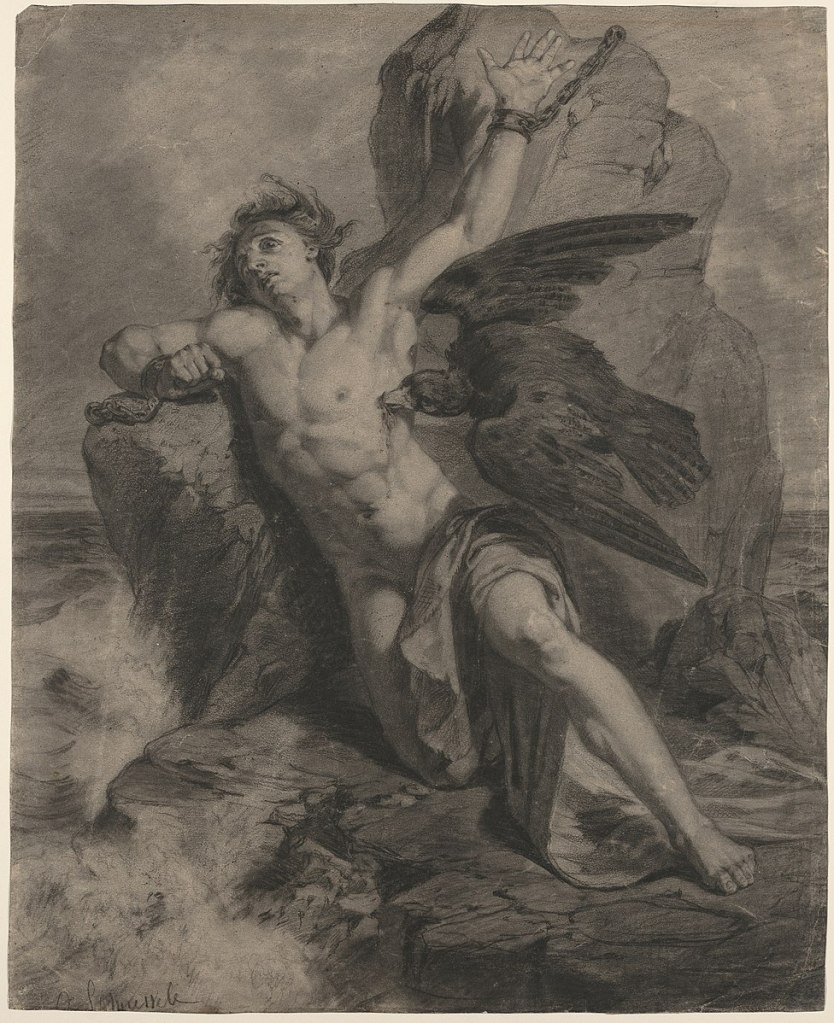
Prometheus Bound, charcoal by Christian Schussele. Courtesy: Creative Commons

When life itself seems lunatic, who knows where madness lies? Perhaps to be too practical is madness. To surrender dreams — this may be madness. Too much sanity may be madness — and maddest of all: to see life as it is, and not as it should be!

— Miguel de Cervantes Saavedra, Don Quixote

.

Surendra was firm.

So were they.

“You are mistaken,” said Raghu.

“No. I am not.” Surendra replied. “You are mistaken.”

“You are free! Free to move around and visit any place of your choice. Nobody can stop you. Nobody is stopping you. Inside or outside. Doors are open. Go for a stroll. You will realise this freedom. Why do you keep on saying this, father,” said the eldest son, while others listened and nodded.

“No, I am not free here—elsewhere. This is the truth. I am in chains. I carry them as a heavy burden, everywhere.”
“Why do you say that dear brother?” asked Mukesh. “Your son is trying to make you understand that there are no chains around you. But you are adamant…and wrong.”

“Where am I wrong, Mukesh? You know me better.”

“Sorry, bro! But you are wrong.”

“How?”

“You say you are chained.” Mukesh replied patiently. “There are no chains. Look around — no chains. It is your illusion only.”

“It is a fact, Mukesh. I am in chains. Trust me, please,” said Surendra calmly. “I mean it. Every word. You know I never tell lies.”

A collective sigh!

Surendra was his usual composed self. Tall and dignified, he sat on the edge of the bed, in a meditating pose. A subtle aura made him appear otherworldly, a sage, among the philistines.

They sat for long. The distant forest could be glimpsed from an open window, a mass of soft shadows.

Raghu bent a look at his uncle.

“What nonsense, bro! You are totally free. I assure you. Absolutely free.” Mukesh broke the stalemate. “You are a well-read man. Why are you tormenting yourself and the rest of us? Please stop believing this wrong notion. You have always been logical. Now, come on. Walk with me to the nearest hotel on the highway. Nobody will stop you from moving around. I repeat, it is a free country!”

“Uncle is right. For the last three hours, we have been trying to prove the simple fact that you are not in chains. It is only a delusion! Come out of that, please, father and spare us this stressful drama.” Raghu pleaded with folded hands.

Surendra was unmoved: “That is the sad part!”

“What?”

“That my chains cannot be seen by my own son!”

“Please! Do not start again this argument now. It is a democracy in which all of us are free. That is it. Final! I do not want to argue on a given. Period.”
“You are a fool. You are in chains, too, invisible chains but you don’t realize that, right now, like the silent majority. Living under the greatest illusion. That is it.”

Raghu gave his father a resigned look, “No point in talking further about this. Nobody can convince you. I am done.”

Raghu got up to leave.

“Fool! You will realize this fact soon.”  Surendra said quietly. “It took me all these years to understand this simple and fundamental truth! We are all in chains in a free country! That is the biggest irony of human condition globally!”

Raghu did not engage with him. He exited, along with others, into the courtyard.

Ma waited there.

“Wastage of time and energy. Refuses to listen to reason. Stubborn as usual. He has never listened to me anyway. The fact is that he does not want to see reason. If not insane, he is not sane, either!”

Ma nodded. “I knew it from the beginning. Married to a top-class nut. Told you also many times. You never believed. Now face it.”

“He was a graduate, first in the community. Mad guys do not finish a B.Com with a first class,” replied Mukesh agitatedly. “Our mother said you drove him crazy. He was an intelligent man who did a lot to the extended family but you and your constant nagging made him mad.”

Ma retorted, “Defending the elder brother, as usual. You all gang up on me — mother-in-law, five brothers-in-law and two nasty sisters-in-law, all these years.”

The brother glowered. Ma glowered back. Mukesh muttered something and left in a huff.

Raghu and others met again, late night, to discuss ways of avoiding a possible public embarrassment of a rational, law-abiding, articulate man going mad in the autumn of his life, for no apparent reason.

It was a big mystery — his absurd claim of being in chains.

They discussed, debated but were unable to figure out the apparent trigger for such an odd behavior of the patriarch.

“We must act fast. The village should not learn that he has lost his mind,” Raghu said. “It will be great shame!”

They agreed to take him to the mental hospital the next afternoon on some ruse.

The gods willed it otherwise.

The village learnt about Surendra’s madness, very next morning, in a most dramatic manner. The author of this revelation was none other than a composed Surendra announcing it in the morning in the public square.

.

“You all are chained! Listen to me. Break your chains, you fools!”

Surendra shouted at the top of his voice.

People came out and watched, curious by the sudden transformation of a much-lauded supervisor in a textile factory in Kolkata, who had moved to Delhi, after the textile mills had closed down and driven taxi and finally owned three, in the Capital for two decades—saved money in the process, raised a large family and returned home in the village in Bihar to spend remaining years in the shadow of his ancestors. Surendra had renovated his old property in the village still mired in poverty. He taught children from the low-income families English and Math. A well-respected son of the soil who was not claimed by the city, like many others, and had returned to his roots.

At the moment, he appeared the usual self– calm, composed, dressed in simple cotton shirt and trousers, all white, and a pair of sandals. He wore a white Gandhi cap and spoke in measured tones.

As more crowd gathered near him, with children jostling for space and better view, he climbed a pile of crates, outside a grocer’s shop and addressed the audience in his familiar baritone: “Hear the truth! Be liberated!”

An old man asked lightly, “Okay. Give us the truth.”

Surendra smiled and said, “You ready for the shock?”

“Yes. We are.” The old man said. “Nothing surprises us anymore.”

Others chorused a big yes.

“Listen then, old man. This will surprise you a lot…” here he trailed off, building up suspense. Surendra surveyed the crowd and exhaled.

They waited for the fun.

Surendra looked again at the assembly of friends and neighbours and declared loudly: “Listen! The Truth. You are all shackled. All in chains!”

The old man was taken aback. “What? Are you drunk?”

Surendra laughed. “The drunk do not tell the truth. They spill secrets, after a peg too many.”

“That is also the truth,” countered the old farmer who had once stood for local elections. “The drunken truth. It also reveals things.”

“Truth is much higher than the alcohol-induced revelation.”

A murmur went around. Some youngsters jeered at the pompous man standing atop his perch, like a self-appointed guru.

“Fools! I give you the truth and you laugh at me!”

They laughed more.

“There is more.”

“What is that?” the old farmer demanded. “More truths!”

“I am the republic!” declared Surendra. “I am the democracy.”

This made the crowd laugh uproariously.

“He is out of mind,” said a neighbor. “How can a common citizen be the republic and democracy?”

“He always thought in grand terms,” said a school chum. “Treated himself as superior to rest of us!”

They laughed and some repeated derisively, “Hey, Republic! Hey, Democracy!”

“Tomorrow he will say he is the President of the Great Banana Republic!” said the chum.

“And day after, he will be the God!” observed the old farmer.

Surendra did not flinch. “Fools! You do not understand. You, too, are the republic and the democracy.”

They jeered again. “He is the Government.”

“Yes. I am the government.” Surendra shouted at the top of his voice. “I am a citizen — and everything. The basic unit. The fuel that keeps the system going.”

The crowd began enjoying the show.

“You are the government?” They asked.

“Yes, I am.”

“Then solve the problem of poverty, my government.” The farmer mocked.

“Who is the government?” A burly inspector asked in a husky voice. He had joined the crowd few seconds earlier. The crowd made way for the new arrival, haughty and walking with a swagger.

“This old villager says he is the new government,” said the school chum sarcastically.

“And the republic and democracy.” Added the old farmer with glee. “See his arrogance, audacity, a common man claiming to be the government!”

The inspector was amused. “Did you say that, old man?”

Surendra showed no fear. “Yes, I did.”

“What did you say?” the inspector asked. “Say it again.”

“I am a citizen.”

“Right.”

“I am the republic.”

“Wrong.”

“Why?”

“Because I am saying that — the police officer who is the real government. My word is last.”

“You are a mere pawn in the power game.”

“Let it be but I am the real government of this area.”

Surendra was patient and then said quietly, “Let it be. Anyway, I repeat, I am a citizen, the republic, the democracy and the government.”

The crowd laughed. They were enjoying the show now.

The inspector was amazed by the bold assertion. “How dare you?’

“Dare what?”

“How dare you call yourself the democracy, the republic and the government?” blazed the inspector.

“And why not? Why cannot I claim that?” persisted Surendra.

“A puny citizen! A low-life — that is what you are — nothing else.”

“Why low-life, inspector? I am the basic unit, like you, of the democracy.”

“So you say you are the government?” the cop jeered.

“Yes. I am. Part of the elected government.”

The crowd clapped for the puny man facing the cop.

The inspector replied, “That is going too far. I have to arrest you…”

“For what crime?”

“For anti-government stand. Being a grave threat.”

Surendra laughed. “Do I look like a threat? An old man standing in the square? How do I constitute a threat to the mighty state?”

The inspector scratched his bald head, pondered and then said, “I say so. I am the authority to decide that.”

“Then you are abusing your office,” replied Surendra.

Surendra’s statement surprised the fat officer. He thought and then said, “Enough! You are proving to be a danger to the security of the country. You are a public enemy number one. I arrest you for inciting people.”

He clapped the handcuffs on Surendra who said nothing.

People mocked him: “The new government goes in handcuffs!”

Surendra smiled and declared, “Fools! If truth leads to arbitrary arrest, you too, are under threat. I am ready to die for my convictions, my truth, which is the universal truth. The real government is always the public!”

Now few youngsters began shouting, “He is right. We are the real power, the voters. He is right!”

A carload of tourist was passing by. They stopped and filmed the scene. There was a local journalist and a lawyer who demanded an explanation from the cop: “How can you arrest a citizen for claiming that he is the legit democracy?”

The crowd was split into two camps: pro- and anti-police.

The seasoned cop understood the gravity of the situation and the volatile mood of the frustrated masses. He was one pitted again a crowd that might question his ways.

The man in khaki dialed a number desperately. Soon two jeeps arrived and took the disruptor to the police station, 10 miles away, followed by a large crowd and the carload of tourists. Within hours, the video began circulating and became viral. Foreign press caught on. Then the national press arrived and parked itself outside the police station.

The inspector refused to budge. “He is a public enemy number one, out to destroy the general peace and to incite people against the state by his bizarre claims of being the State, Democracy and Republic. A real danger to the legitimacy of an elected government. He needs to be kept behind the bars for the sake of peace and order.”

As the “Free Surendra, the Citizen” drive spread within 24 hours, the cops secreted him away to some other place, and, he was never seen again.

Some said he died due to torture. Others said Surendra was put in a maximum security jail in an island. Others claimed he was offered money and land by an opposition party to run on a ticket against the ruling party member.

The opinion was divided: Surendra, the Mad vs. Surendra, the Prophet: The former challenged the status quo and the latter revealed the plain truth to an unbelieving public!

Meanwhile, Surendra’s joint family had gone underground.

As happens in such viral cases, public memory being short, the world soon forgot Surendra  and moved on with other viral videos about crazy dancers, weddings and stars spotted in the public.

Videos that excited the popular imagination.

Surendra and his disappearance no longer mattered.

After all, he was nothing — a zero.

Add zeros — and you become millions! He had once declared.

Sadly, he was ignored.

The thing did not end so tragically, however.

…on moonless cold nights, the ghost of Surendra could be seen in many locations, breaking his big chains and occasionally heard muttering — some said — two Russian names: Akaky Akakiyevich Bashmachkin and  Gogol. After such sightings, the witnesses too, began mimicking his action and wanted to break out of their chains.

But who knows? These can be urban legends.

Fiction.

Or truth. In these days of doctored versions, it is difficult to decide on such matters…

.

Sunil Sharma is an Indian academic and writer with 22 books published—some solo and joint. Edits the online monthly journal Setu. Currently based in MMR (Mumbai Metropolitan Region).

.

PLEASE NOTE: ARTICLES CAN ONLY BE REPRODUCED IN OTHER SITES WITH DUE ACKNOWLEDGEMENT TO BORDERLESS JOURNAL. 

Categories
Editorial

Reach for the Stars

Courtesy: Creative Commons
“Nothing can be unconditional: consequently, nothing can be free.”


“Liberty means responsibility. That is why most men dread it.” 

-- George Bernard Shaw,  Maxims for Revolutionists, Man & Superman (1903) 

George Bernard Shaw (1856-1950), a great writer and playwright, used these epigrammatic lines to bring focus on what people thought was liberty or freedom from oppression, from regimes that were dictatorial. While discussing concepts of freedom, one does wonder if political freedom solves all humane issues, occasions we celebrate with great aplomb, like the birth of a nation.

This month started with the observance of July 4th, the date of the American Revolution in 1776 and the publication date of Whitman’s Leaves of Grass in 1855. In between these two years, in 1789, ten days down the line, on July 14th, another significant occurrence has been handed down by history to be celebrated as the Bastille Day— the day prisoners were freed from Bastille, a major event that led to the overthrow of the insensitive monarchy in France, a symbolic resurgence of the common, exploited man that has often been seen as an inspiration for later uprisings to reinforce the concept of democracy or liberté, égalité, fraternité.

As we move forward in time, towards August, one wonders if liberty attained by these means was good for all fellow humans? France was part of the Allied Forces that with America taking the lead dropped not one but two atom bombs on Hiroshima and Nagasaki on August 6th and 9th, 1945, to end the Second World War. Did the ends justify the means? Reflecting the cry and suffering of these victims, we have poetry from Suzanne Kamata, a well-known writer from Japan. Michael Burch on the other hand has shared poetry with us which shows how the nuclear programme continued unrepentant despite the devastation it caused. One must give kudos to the descendants of the victims of the nuclear blast that they have forgiven the perpetrators, admitted their own hand in the Second World War and moved ahead. In that spirit, we have an essay on peace by Candice Louisa Daquin, who joins the Borderless team as a writer-in-residence.

We have much happening in poetry this time with an interview of American poet Jared Carter, a recipient of number of awards and fellowships, including the Walt Whitman Award and the Guggenheim fellowship. He walks us through how he created the poem ‘Yeti’ (first published in the May edition of Borderless) and talks of the impact of artifacts from China and India on his own thought processes, the impact of Du Fu (712-770) and much more. We have a poem in Du Fu’s style this time by George Freek and an interesting poem with a Chinese title by Carter, a title that can have multiple connotations and yet each seems to fit the poem perfectly.

Rhys Hughes has brought humour into our pages with both his poetry and essay on William Mcgonagall, who bore the sobriquet of the worst writer in the world through his life and had things thrown at him when he read his poetry in Dundee. Yet, his work survived the beatings, and he lives on known as the ‘Scottish Homer’.

More poetry by Singaporean poet Marc Nair gives us a glimpse of the little island as viewed by someone who has grown up on it. Poetry is always multi-hued, and we have Lorraine Caputo transport us to a Garífuna village in Honduras. Penny Wilkes takes us ‘Down the Path of Nostalgia’ with a mix of old and new photography, prose and poetry on how almost a decade after the end of the Second World War, she started her love affair with photography and nature. It hovers between poetry and musings, and this time we have a rare musing by Jared Carter too. Devraj Singh Kalsi continues cogitating with wry humour while arranging bookshelves. We also have the backpacking granny visiting Indonesia. Post sharing this trip, our granny — Sybil Pretious — plans a little break from publishing to complete her memoirs.

A riveting flash fiction by Kaiyi Tan celebrates the spirit of conquest in these dark times, weaving into the pandemic lore the quest for personal freedom. Stories this time carry a real life one by Jean Kortum on adoption — her own struggle. But then, stories can be real or unreal – draw a bit from both to reflect bigger truths or create alternates that sink into the human mind as a perceived reality and leave an imprint deep inside the heart, like that of Niles Reddick. My conviction is that some lived experiences of writers seep into each story, whether it is from Bangladesh or India or by our literary fictionist, Sunil Sharma. His narrative continues infused by suspense.

We have a complete translated story of Tagore by Radha Chakravarty as our book excerpt this time. ‘The Parrot’s Tale’, ostensibly part of a children’s collection, reflects Tagore’s response to conventional schooling — a reason for him to start Shanti Niketan perhaps. She has also shared two of her translations of Rabindranath’s songs from Bhanusingher Padabali (1884, Bhanusingh’s verses). Chakravarty generously consented to an interview and has given us a glimpse of her journey as a translator and critic.  We also have translated a long poem by Tagore on our pages, a poem that inspires hope, though it was named Dushomoy (1897, Bad Times) finally. The original name had been Swarga Patthe (On the Path to Heaven) as can be seen from a page in his diary. We have been fortunate in finding a recording of his voice reciting the poem in Bengali and the print of a sample page of the manuscript bearing his signature.

We continue with Akbar Barakzai’s poetry translated by Fazal Baloch from Balochi – this time addressed to his daughter reminding for some reason of Nehru’s Letters from a Father to his Daughter — a book I read as a child.  In addition, we have translations from Korea and Bosnia & Herzegovina, from where the young poet, Maid Corbic, has taken up the concept of freedom of the self and of the nation, both together.

Keith Lyons from New Zealand in his very brief essay has quoted American novelist William Faulkner, “We must be free not because we claim freedom, but because we practice it.” And perhaps we need to remember this if for no other reason, then, just to maintain our own sanity in these strange, almost unreal times as we attempt to unite as humankind to free ourselves from an unknown and unfathomable virus.

In a more sombre note, last week, untroubled by the virus, a victim of cancer, Bollywood legend Dileep Kumar, aged 98, breathed his last. Ratnottama Sengupta adds an unusual colour to the Borderless Journal with her tribute to this hugely acclaimed actor. In the process, she unfolds for us a brief history of the Indian cinema, and a glimpse of a world that transcends all man made constructs in quest of perfection.

We have an interesting set of reviews this July. Rakhi Dalal has reviewed Anuradha Kumar’s riveting short story collection, A Sense of Time. A murder mystery for young readers, Murder at Daisy Apartments by Shabnam Minwalla, has been reviewed by Gracy Samjetsabam. The Third Eye of Governance–Rise of Populism, Decline in Social Research by Dr N Bhaskara Rao, reviewed by Bhaskar Parichha, seems to be a non-fiction that looks forward to bridging gaps between academia and the real world, a truly felt need. Parichha has also given us an essay on a man who inspired Ian Fleming, the creator of James Bond, to make him a part of his lore, a journalist who moved around all of Asia with equal aplomb and a sense of humour – a truly global citizen called Richard Hughes.

I want to thank all our wonderful contributors for making this edition a reality. And readers, we leave you to explore the unknown… like that place we call outer space. A huge thank you again to not only all our wonderful contributors, our faithful readers but also to the fabulous Borderless team scattered across the world.  

Before I wind up, a little bird trills a song of hope in my ear. Business tycoons have started stepping into the mysterious void of space to eventually – let us hope — create affordable travel for common man, though it has started off as an expensive proposition. Will this be an industry that will generate more jobs on and off Earth and find new places for man to inhabit? After all, when George Bernard Shaw wrote his plays and essays, we had yet to cross the frontiers beyond Earth, had never even thought of flying across the world in budget airlines or mining moons!

Will we have a new world, a new outlook and a new set of hopes and aspirations as we stretch the frontiers of our home planet?

Wish you all a wonderful month of reading and thinking.

Best wishes,

Mitali Chakravarty

Categories
The Literary Fictionist

Scarecrow

By Sunil Sharma

Now imagine this scene, dear reader:

A serpentine road, unpaved, badly lit, and completely deserted; a damp chilly early-night of December; the moon-lit fields running down to the distant horizon, a gleaming railway track parallel to the long gloomy stretch, and a lonely traveler walking briskly along the empty road to a distant suburb, lights beckoning.

The main town is tucked away far behind, receding, merging with shadows, finally swallowed by the wintry darkness. An occasional fire illuminates a remote gypsy camp, on the left side of the railway tracks and a faint folk song can be heard.

There are stars in the clear sky and a biting wind eerily blowing into the face of the young and thin male traveler. Then the traveler suddenly becomes aware of another man, walking a few paces behind, along the empty road.

Where has he sprung from?

Maybe he has come on the road from many of the short cuts.

He is just a few paces behind. There is nobody around. Mild darkness. Thicket of trees harbors other figures.

Is he safe out here? The traveler has no answer—no defense, either.

The man is quickening his pace. He is trying to be level with me. Who is he? Let me not hurry to show to him that I have panicked. Here he comes… one-two-three … He is now walking by my side: a head taller than me, stout, bearded, with a glowing cigarette in his hand.

I search for another man along that stretch of road. No, none is there. He is quietly walking beside me. I am getting upset. Who can he be? A fellow traveler? But why is he walking side by side? Why does he not walk either ahead of me or behind me as people normally do? Only friends walk like this, not strangers.

Look, he is slightly unsteady.

Drunk! He sure is.

I abruptly stop, reach for my cigarette packet, take out one from it. He has also slowed down. Let me light it…he has stopped a few paces ahead. The match is unsteady in my hand, the wind blows it off. He is there patiently standing…these bloody matches, the wind is too powerful for them. Oh, God! That bearded stout man is coming towards me.

Tonight, I am going to be mugged by him.

My fault. I love taking evening walks along this completely deserted road. I love its deathly silence, the ghostly fields around it, the moon and the stars — the touch of nature which is missing in the heavily congested small town where I live, with its back-to-back houses, twisted narrow lanes and overcrowded bazaars. I love open spaces, the solitude of ploughed fields and the cold wind buffeting me in my face and chest. A sort of communion with nature; of meditation on life in the tranquilized moments — these are things I discover almost daily in my night walks.

Tonight, it will be a different story. He is here, reaching for his pocket. Goodness, he is going to kill me with a knife. Sweat stands out on my forehead.

“Hello? Let me light your cigarette with my lighter,” the stranger says to me in a thick voice, lighting my cigarette from a red-coloured lighter. Paralysed, I obey him.

We both exhale a ring of smoke and smile. And resume walking side by side.

“It is raw here in the outdoors,” he observes, his voice slurring slightly.

“Yes, it is cold tonight,” I return almost mechanically, my mind racing: What are his intentions? Why did he stop to light my cigarette? What does he want with me? I do not have cash with me. Suppose he gets angry after learning that I have only two rupees with me and starts hitting me. I will hit back.

A lonely stretch, no soul around. “A bit frightening, isn’t it?”

“Frightening?”  he is asking the obvious.

“No, not exactly,” I say, trying to steady my voice, “I love the quiet of a lonely place. It is so charming, so heavenly.”

“Ha-ha-ha. You sound romantic. What are you? A poet?”

“Yes, I write poems, stories and…”

“V-e-r-y good. Where do you live?”

I see. So, he is interested in knowing my address so that he can burgle it. He is a patient mugger. Enjoys stalking a hapless stranger.

“I live in the main town”.

“Everyone lives in a town or in a village. Ha-ha-ha. Where exactly in a town?”

“Near the clock tower. A bit crowded. I do not like crowded places”.

“Near the clock tower. That is near the vegetable market”.

I have given him false address. I changed the topic.

“And where do you live brother?”

“Me? I live in a village three kilometers away from here.”

“Will you walk down to your village?”

“I often do. I come to the town to visit my elder brother, spend few hours, toss down a couple of drinks and return to my village on foot. I enjoy these walks”.

I am feeling a little reassured by his friendly voice. But can it be deceptive? I do not know. These criminals come in different disguises. I must be on my alert. Why is he so gregarious?

The road stretches far into the night.

I ask him, “Are you not afraid?”

“Of whom?”

“Of, er, robbers,” I say, bit hesitant. “Muggers. Chain snatchers. Druggies.”

He stops suddenly, his huge body lurching. He fumbles in his coat-pocket and brings out a spring-actuated knife. My stomach chums. Now, I am trapped. Only God can save one from this drunken mugger. “This is a knife. This cuts into your belly and you are dead meat. And I am an expert with a knife. Tell me now: who should be afraid? Me or the robber?”

“Of course, the other party,” I sound to be normal, despite cold sweat and churning in my stomach. How to get rid of him? I suddenly see a moonlit short-cut going through the fields.

I hit upon a plan. “Okay, dear friend, here we part. I will take back this path to my home. Already it is cold. I must hurry up.”

The man stops too. He grins broadly. “Why are you making a fool of me?”

I freeze then and there, “What do you mean?”

“You are lying to me. You say you live in the town but no normal person will come to this place except those who live in the outlying neighbourhoods over there.”

I laugh away the truth, “Why should I tell a lie? I live in the town and often come here for my customary evening walks.”

He eyes me for some seconds — an eternity for me — and then says, “Okay. But do not return by this short cut. Can be dangerous for a townsman. Come with me till the next crossing and there I will point out a shortcut which is more frequented. Come.”

Again, feeling paralysed, I automatically begin walking by his side. Next crossing. At least, a seven-to-ten minutes walk. Enough time for him to mug me. I should be cautious. In case he threatens me, I can break into a run. Old stories come into my mind — dangerous or lunatic men waylaying innocent people and then doing them physical harm. Here I have a friendly and drunk highwayman with a knife. He seems to be enjoying his hold over me. Fear can make a man completely robotic!

“I also take this road,” he says in a natural manner, “I also love walking. Does a lot of good to your body. Often, I run into total strangers here and we talk, while walking. It helps while away the time”.

My suspicions grow stronger, “What do you do, Mr.?”

“I am a farmer.”

“Then you would be quite well-off.”

“By His grace, I am rich. I have many bighas (acres) of farm. 1 also have a shop at the town. Yes, we are well-off’.

“You must be having lots of enemies?”

“Why should I?”

“Because folks in a village are hot-tempered and pick quarrels easily.”

“They know me very well. My name inspires terror. I was jailed for a couple of years for a minor offence. I had murdered a thug in the open…in the day light. A goonda terrorizing the poor.”

That settled everything!

I do not have the nerve to further probe him for his past. I look sideways at him. He looks ordinary like a stout bearded farmer we come across in the bazaar. We walk quietly. He is lurching a little. The empty and silent road stretches ahead of us. All around us is deep tranquility.

The brilliant moon is shining in a cloudless sky. Now, far off, faint silhouettes of some houses spring into view. The crossing also is getting visible. We can see paan (betel leaf) shops and tea shops. One or two rickshaws are standing idle. A well-lit square has people in it. I feel greatly relieved. Thank God, I have been spared a painful experience on this deserted road. My companion has not hurt me. We reach the square. He insists that I must have a paan and a cigarette from one of the small shops. The owner greets him respectfully. They exchange pleasantries. I critically study my recent friend in the light of the shop: he is middle-aged, pockmarked, bearded and stout man of good height; an impressive man.

He looks harmless now in the changed context.

The paan-and-cigarette ritual over, the man writes down his name and the name of the shop and hands me the slip, “Well, you are welcome at my shop during evenings. I come down there in the afternoon and remain till evening. Come any day, buddy. I like poets.”

He smiles broadly, shakes my hand and bids me good night.

I start back from the square to my colony, a few paces from the next turning, which is ten-minute walking distance, I put the chit carefully into my hip pocket.

Relieved, I grin broadly. I am no longer afraid. Things become ‘normal’ again. I pat the chit.

One day I am going to visit him and explain my urban fears that can be spine chilling when I meet a fellow human being on an empty road on a moonlit wintry night.

.

Sunil Sharma is an Indian academic and writer with 22 books published—some solo and joint. Edits the online monthly journal Setu. Currently based in MMR (Mumbai Metropolitan Region).

.

PLEASE NOTE: ARTICLES CAN ONLY BE REPRODUCED IN OTHER SITES WITH DUE ACKNOWLEDGEMENT TO BORDERLESS JOURNAL. 

Categories
Index

Nature & Us

Environment and man — are they separate or is man a part of nature? Different writers have interpreted nature and its forces in different ways over a period of time, in glory, in storm and at battle. Explore some of our selections on nature on World Environment Day… Enjoy our oeuvre.

Translations

One Small Ancient Tale

Rabindranath Tagore’s Ekti Khudro Puraton Golpo (One Small Ancient Tale) from his collection Golpo Guchcho ( literally, a bunch of stories) has been translated by Nishat Atiya. Click hereto read.

Bolai

Rabindranath Tagore’s Bolai translated by Chaitali Sengupta. Click here to read.

Songs of Seasons: Translated by Fakrul Alam

Bangla Academy literary award winning translator, Dr Fakrul Alam, translates seven seasonal songs of Tagore. Click here to read.

Poetry

Bodhi Tree by Sumana Roy

Click here to read

Seasonal Whispers by Jared Carter

Click here to read

This Island of Mine by Rhys Hughes

Click here to read

Observances by Michael Burch

Click here to read

Playlet

A playlet by Sunil Sharma set in Badaun, The Dryad and I: A Confession and a Forecast, is a short fiction about trees and humans. Click here to read.

Essays/Musings

Unbowed, She Stayed

Bhaskar Parichha gives us a glimpse of the life of Wangari Muta Maathai founder of the Green Belt Movement, which has  — through networks of rural women — has planted over 30 million trees. Click here to read.

Photo Essay: Birds & Us

Penny and Michael B Wilkes take us on a photographic journey with a narrative in San Diego. Click here to read.

Cyclone & Amphan Lockdown

As cyclone Amphan fireballed and ripped through Kolkata, Nishi Pulugurtha gives a first hand account of how she survived the fear and the terror of the situation. Click here to read.

Stories

This Land of Ours

Shevlin Sebastian captures man’s relentless struggle against unsympathetic forces of nature. Click here to read

Maya & the Dolphins

Mohin Uddin Mizan writes about Dolphin Sighting in Cox Bazaar, Dhaka. Click here to read.

A Fight

Eduard Schmidt-Zorner shows the struggle between man and nature. Click here to read.

Categories
Contents

Borderless, May 2021

Editorial

And this too shall pass… Click here to read

Translations

Songs of Seasons: Translated by Fakrul Alam

Bangla Academy literary award winning translator, Dr Fakrul Alam, translates six seasonal songs of Tagore. Click here to read.

Temples and Mosques

Kazi Nazrul Islam’s fiery essay translated by Sohana Manzoor. Click here to read.

Purify My Life

Kazi Nazrul Islam’s poem, Purify my Life, translated by Shahriyer Hossain Shetu. Click here to read.

Waiting for Godot by Akbar Barakzai

Akbar Barakzai’s poem translated by Fazal Baloch. Click here to read.

Solus

Aditya Shankar translates a poem by Sujith Kumar. Click here to read.

The Last Boat

Tagore’s Diner Sheshe Ghoomer Deshe translated by Mitali Chakravarty with an interpretation in pastels by Sohana Manzoor. Click here to read.

Poetry

Anasuya Bhar, Scott Thomas Outlar, Saranyan BV, Matthew James Friday, Nitya Mariam John, RJ Kaimal, Jay Nicholls, Tasneem Hossain, Rhys Hughes, Vatsala Radhakeesoon, Ihlwha Choi, Himadri Lahiri, Sunil Sharma, Mike Smith, Jared Carter

Nature’s Musings

Photo-Poetry by Penny & Michael Wilkes. Click here to read.

Poets, Poetry & Rhys Hughes

Lear and Far

As a tribute to the 209th anniversary of Edward Lear, Rhys Hughes writes of his famous poem, ‘Owl and the Pussycat’, and writes a funny ending for it rooted in the modern day. Click here to read.

Stories

If at all

Shobha Nandavar, a physician in Bangalore, depicts the trauma of Covid 19 in India with compassion. Click here to read.

First Lady

Rituparna Khan gives us a brief vignette from the life of one of the first women doctors in India, Dr Kadambari Ganguly. Click here to read.

Mr Dutta’s Dream

Atreyo Chowdhury takes us into the world of unquenchable wanderlust. Click here to read.

Neemboo Ka Achaar or Maa’s Lemon Pickle

A compelling flash fiction by Suyasha Singh hovering around food and a mother’s love. Click here to read.

The Literary Fictionist

In A Lunch Hour Crisis, Sunil Sharma raises humanitarian concerns that though raised in a pandemic-free world, have become more relevant and concerning given our current predicament. Click here to read.

Musings/Slices from Life

Serve the People

Danielle Legault Kurihara, a Quebecker in Japan, writes of differences in rituals. Click here to read.

Why I write?
Basudhara Roy tells us how writing lingers longer than oral communications. Click here to read more.

The Quiet Governance of Instinct

Candice Louisa Daquin, a psychotherapist, talks of the importance of trusting our instincts. Click here to read more.

Musings of a Copywriter

In Nations without NobelDevraj Singh Kalsi takes a fresh look at national pride with a soupçon of sarcasm and humour. Click here to read.

Adventures of the Backpacking Granny

In Visit to Rural BaoyingSybil Pretious travels to spend a night with a local family in rural China in a ‘hundred-year-old home’.Click here to read.

Essays

Four Seasons and an Indian Summer

Keith Lyons talks of his experiences of seasons in different places, including Antarctica. Click here to read.

Rabindranath and the Etchings of His Mind

Anasuya Bhar explores the various lives given to a publication through the different edited versions, translations and films, using Tagore as a case study and the work done to provide these online. Click here to read.

My Experiments with Identity

Tejas Yadav explores identity from the context Heraclitus, Rumi down to his own. Click here to read.

Can Songs be the Musical Conscience of a Film?

Prithvijeet Sinha uses Gaman (Departure), a Hindi movie around the pain of migrant workers, as a case study to highlight his contention that lyrics and songs convey much in Indian films. Click here to read.

Bhaskar’s Corner

In Manoj Das – The Master Storyteller, Bhaskar Parichha pays a tribute to one of the greatest storytellers from the state of Odisha, India, Manoj Das( 1934-2021). Click here to read.

Book Excerpt

Excerpted from A Bengali Lady in England (1885): Annotated Translation with Critical Introduction to Krishnabhabini Das’ Englandey Bangamahila by Nabanita Sengupta. Click here to read.

Book Reviews

A review of Feisal Alkazi‘s memoir, Enter Stage Right: The Alkazi Padamsee Family Memoir by Rakhi Dalal. Click here to read.

A review of Shakti Ghosal‘s The Chronicler of the Hooghly and Other Stories by Gracy Samjetsabam. Click here to read.

Bhaskar Parichha reviews Raising a Humanist by Manisha Pathak-Shelat‘s and Kiran Vinod Bhatia. Click here to read.

Interviews

Communication scholars and authors, Manisha Pathak-Shelat and Kiran Vinod Bhatia, discuss how to bring up children in these troubled times, based on their book, Raising a Humanist, which has just been released. Click here to read.

Sonya J Nair of Samyukta Poetry talks about the Samyukta Research Foundation and its affiliates and its festival, Anantha. Click here to read.

Sara’s Selections, May 2021

A selection of young person’s writings from Bookosmia. Click here to read.

Categories
Poetry

Mystical reconnections: Reading Tagore

By Sunil Sharma

I know not what playmate of mine in the sky sends them down
the air to race with my boats!
When night comes I bury my face in my arms and dream that my
paper boats float on and on under the midnight stars.

Rabindranath Tagore

Trapped inside the cage, I look up at the sky 
and am, somehow, by cultural memory
reminded of the above lines of the
Immortal Bard who guides me on
in this astral voyage of recovery of
the  self and  the dim
pathways, out there, now visible again,
modes, perceptions leading directly
to the realities of the heavens and 
the heavenly songs, in our midst.
Gurudev! Pronam!
You restore -- in the post-modern,
post-industrial, consuming unit,
recipient -- a sense of the lost
grandeur, wonder, joy;
a promise of an
uplifting presence around
and, of the missing
 bliss that flows from
ordinary moments of the
enraptured
gazing at the stars from
a locked-down home’s
barred windows, thereby, 
that very moment, feeling
reassured of that
playmate for me, us, in
a single instant of reading,
viewing, experiencing
mystical reconnections
with an original vision,
heritage,
roots,
idiom of the lived lives,
profound
civilizational truths
in these cynical times!

Sunil Sharma is an Indian academic and writer with 22 books published—some solo and joint. Edits the online monthly journal Setu. Currently based in MMR (Mumbai Metropolitan Region).

.

PLEASE NOTE: ARTICLES CAN ONLY BE REPRODUCED IN OTHER SITES WITH DUE ACKNOWLEDGEMENT TO BORDERLESS JOURNAL
Categories
Contents

Borderless, April, 2021

Greetings from Borderless Journal for all Asian New Years! Click here to read our message along with the video and a translation of a Tagore song written to greet the new year, with lyrics that not only inspire but ask the fledgling to heal mankind from deadly diseases.

Editorial

New Beginnings

A walk through our content and our plans for the future. Click here to read.

Interviews

In Conversation with Arundhathi Subramaniam: An online interview with this year’s Sahitya Akademi winner, Arundhathi Subramaniam. Click here to read.

Sumana Roy & Trees: An online interview with Sumana Roy, a writer and academic. Click here to read.

Poetry

(Click on the names to read)

Arundhathi Subramaniam, Jared Carter, Matthew James Friday, Michael R Burch, Aparna Ajith, Jenny Middleton, Rhys Hughes, Jay Nicholls, Achingliu Kamei, Vatsala Radhakeesoon, Ihlwha Choi, Smitha Vishwanath, Sekhar Banerjee, Sumana Roy

Photo-poetry by Penny Wilkes

Poets, Poetry & Rhys Hughes

With an introduction to Blood and Water by Rebecca Lowe, Rhys Hughes debuts with his column on poets and poetry. Click here to read.

Translations

The Word by Akbar Barakzai

Fazal Baloch translates the eminent Balochi poet, Akbar Barakzai. Click here to read.

Malayalam poetry in Translation

Aditya Shankar translates a poem by Shylan from Malayalam to English. Click here to read.

Tagore Songs in Translation

To commemorate Tagore’s birth anniversary, we translated five of his songs from Bengali to English. Click here to read, listen and savour.

Tagore Translations: One Small Ancient Tale

Rabindranath Tagore’s Ekti Khudro Puraton Golpo (One Small Ancient Tale) from his collection Golpo Guchcho ( literally, a bunch of stories) has been translated by Nishat Atiya. Click here to read.

Musings/Slice of Life

Pohela Boisakh: A Cultural Fiesta

Sohana Manzoor shares the Bengali New Year celebrations in Bangladesh with colourful photographs and interesting history and traditions that mingle beyond the borders. Click here to read.

Gliding along the Silk Route

Ratnottama Sengupta, a well-known senior journalist and film critic lives through her past to make an interesting discovery at the end of recapping about the silk route. Click here to read and find out more.

The Source

Mike Smith drifts into nostalgia about mid-twentieth century while exploring a box of old postcards. What are the stories they tell? Click here to read.

Lost in the Forest

John Drew, a retired professor, cogitates over a tapestry of the Ras lila. Click here to read.

Tied to Technology

Naomi Nair reflects on life infiltrated by technology, by Siri and Alexa with a tinge of humour. Click here to read.

Adventures of a Backpacking Granny

In Inspiriting SiberiaSybil Pretious takes us with her to Lake Baikal and further. Click here to read.

Musings of a Copywriter

In Tributes & AttributesDevraj Singh Kalsi pays tribute to his late mother. Click here to read.

Essays

Reflecting the Madness and Chaos Within

Over 150 Authors and Artists from five continents have written on mental illness in an anthology called Through the Looking Glass. Candice Louisa Daquin, a psychotherapist and writer and editor, tells us why this is important for healing. Click here to read.

At Home in the World: Tagore, Gandhi and the Quest for Alternative Masculinities

Meenakshi Malhotra explores the role of masculinity in Nationalism prescribed by Tagore, his niece Sarala Debi, Gandhi and Colonials. Click here to read.

A Tale of Devotion and Sacrifice as Opposed to Jealousy and Tyranny

Sohana Manzoor explores the social relevance of a dance drama by Tagore, Natir puja. We carry this to commemorate Tagore’s birth anniversary. Click here to read

Photo Essay: In the Midst of Colours

Nishi Pulugurtha explores the campus of a famed university with her camera and words and shares with us her experiences. Click here to read.

Bhaskar’s Corner

Oh, That lovely Title: Politics

A short piece by Bhaskar Parichha that makes for a witty comment on the forthcoming Indian elections. Click here to read.

Stories

Pothos

Rakhi Pande gives us a story about a woman and her inner journey embroiled in the vines of money plant. Click here to read.

Elusive

A sensitive short story by Sohana Manzoor that makes one wonder if neglect and lack of love can be termed as an abuse? Click here to read

Ghumi Stories: Grandfather & the Rickshaw

Nabanita Sengupta takes us on an adventure on the rickshaw with Raya’s grandfather. Click here to read

Flash Fiction: The Husband on the Roof

Carl Scharwath gives us a story with a strange twist. Click here to read

Flash Fiction: Flight of the Falcon

Livneet Shergill gives us a story in empathy with man and nature. Click here to read

The Literary Fictionist

A playlet by Sunil Sharma set in Badaun, The Dryad and I: A Confession and a Forecast, is a short fiction about trees and humans. Click here to read.

Book reviews

Bhaskar Parichha reviews Reconciling Differences by Rudolf C Heredia, a book that explores hate and violence. Click here to read.

Nivedita Sen reviews Nomad’s Land by Paro Anand, a fiction set among migrant children of a culture borne of displaced Rohingyas, Syrian refugees, Tibetans and more. Click here to read

Candice Louisa Daquin reviews The First Cell and the Human Costs of Pursuing Cancer to the last by Azra Raza. Click here to read.

Book Excerpt

Excerpted from Raising a Humanist: Conscious Parenting in an Increasingly Fragmented World by Manisha Pathak-Shelat and Kiran Vinod Bhatia, the focus is on media and its impact. Click here to read.

Sara’s Selection, April 2021

A selection of young person’s writings from Bookosmia. Click here to read.

Categories
The Literary Fictionist

The Dryad and I: A Confession and a Forecast

A playlet by Sunil Sharma

Cast:  A young Character as a single speaker

Chorus: A few more young actors

Venue: Any place as the stage

Total Time: Five minutes

.

(Bare stage. Only one character facing the audience. Steps forward.)

Character: Hey there! You, you…and you! Listen! (Pause) Hmm. Ready? (Pause) Well, well, here is my story…the story of a tree-man…yes, Sahiban-kadradan! A tree-man stands before you.

In the background, the chorus is only heard. It stays off stage.

Chorus: What a fiction, man! What a fiction!

Character: No, listen first!

Chorus: Fiction! Fiction!

Character: No, listen, please and then judge. Fiction often tells the truth! Listen, please!

(Silence.)

Character: Well, there was a gnarled tree in our compound in an old mohalla of Budaun, Patiali-Sarai, the street there…

Chorus: Budaun? What is that?

Character: Yes, friends, Budaun, the old and historic city of jinns and saints; of fakirs and generals; of legendary mystics and poets…

Chorus: Wow! Go on!

Character: Here it goes…

The tree was old and always whispered in mornings and evenings to those that elected to listen to its gentle song—a deep mourning…a dirge, sad and heart-rending…

Chorus: Hmm! Interesting! Your version of Harry Potter? Hmm!

Character: No Potter, here!

Chorus: Then?

Character:  It is different. Let me continue…

…Returning home from school, I would throw stones at it and it would sigh and nod its head of branches…and drop its fruits on the ground. We would eat the berries and move around its girth, playing hide-n-seek. Then…

Chorus: Then?

Character: One day, I took out a knife and shaved off pieces of its skin. The moment, the bark came off, blood oozed, and the tree cried in a wounded tone. I was not paying attention…I carved my name on the tender heart of the tree and then…

Chorus: Then? Tell us fast. Interesting tale!

Character: Then…

…a woman appeared out of nowhere, startling me, on that memorable dusk full of fading lights and shadows, in that by lane where history meets the present, memory resides dormant… to be awakened in the young ones by an unusual encounter!

Chorus (almost seems to echo): … history meets the present; memory resides dormant… to be awakened in the young ones by an unusual encounter!

 Character: Terrified! I asked her, the bleeding maiden: Who are you?

I am a dryad.

— What is a dryad?

The spirit of a tree.

I was deeply scared! I asked her, ‘Why are you here, madam dryad?’

Because you have awakened me!

— How?

By turning your knife in my heart.

I was speechless.

And casting stones at me from childhood and tearing my branches and leaves. Your wanton acts of violence have caused injuries and wounds that fester…

— I am sorry! I did not know the trees have spirits.

You mortals are fools! Now it is payback time!

— What?!

Heard me right! Payback time.

So, she said to me on that memorable dusk with light and shadows in interplay in that dusty and narrow by-lane full of memories, my dear friends and I protested but she did not listen. Then…

Chorus: Then? Tell us fast, you foolish mortal!

Character: A sad story…

…The dryad turned me into a tree-man and left me suffering for my acts of violence against trees per se…

Chorus: How? Tell us, ignorant human, ignorant of other worlds, of realms, spirits.

Character: Patience!

…I was infected by the spirit of the wounded dryad and developed strange empathy with her pain. Now, whenever children cast stones on the body of the tree, I suffer and bleed! Any scratch there is a scratch on my body-soul. Look here! Scratches all over my body! I suffer and plead…

Chorus: Plead what?

Character: Plead with the fellow humans not to hurt trees or tear the branches or leaves, carve or cut them into dead wood or…

Chorus: Or? Tell us fast, tree-man. Your wisdom as the hybrid or shape shifter? Mythological or magical creature? Half-imagined and half-real? Tell us in words so that we can understand the others.

Character:  Listen, mortals! Words of wisdom, learnt in this new avatar of twin souls, of a tree and human, residing in the human form.

Here: “The Dirge Unheard”

The more you kill others,

of the silent species and natural order,

the more of your ilk

will be killed and soon,

listen you, homo sapiens,

your species will be annihilated

forever!

Chorus on the stage now, singing:

“The Dirge Unheard”

The more you kill others,

of the silent species and natural order,

the more of your ilk

will be killed and soon,

listen you, homo sapiens,

your species will be annihilated

forever!

The choral actors appear on the bare stage facing the audience. They wear cut-outs of trees — old; wounded, stumps, and new ones, greening.

The chorus faces the audience, while the protagonist or Character remains mute and downcast, on the sides of the wings.

Chorus:

So here was this tale extraordinary

From the by-lanes of Budaun

A tale as fabulous

As the city of Budaun!

Each street—

Steeped in history and magic!

The Character steps forward and chants the remaining part of the song.

Character:

Take it or leave it, you all!

If such stories fail to change you,

You are as dead as the stumps

In a forest, once rich,

Now made barren by

The greed of the corporations

And public apathy!

Chorus:

Then it is adieu!

Few years more

And it will be all a fading memory—

Sky, seas, rivers, forests, hills and trees!

Adieu!

Exit all.

.

Glossary:

Sahiban-kadradan: Valued patrons

Mohalla: colony

.

Sunil Sharma is an Indian academic and writer with 22 books published—some solo and joint. Edits the online monthly journal Setu. Currently based in MMR (Mumbai Metropolitan Region).

.

PLEASE NOTE: ARTICLES CAN ONLY BE REPRODUCED IN OTHER SITES WITH DUE ACKNOWLEDGEMENT TO BORDERLESS JOURNAL
Categories
The Literary Fictionist

Love Beyond Words

By Sunil Sharma

It is raining!

 Such afternoons become depressing. It is a time when bare daylight is sliding into darkness of early night.

You are trapped in a grey zone.

 Winter rain triggers sadness…especially December rains when clouds, cold and gloom create overwhelming melancholy.

Rains add to misery. You cannot step out. Cooped, looking helplessly at the falling rain on empty roads…and the puddles.

It is the same depressing afternoon, my dear!

Can you hear it? Can you feel it? The pattering rain?

The icy drops. I can sense them on my skin. Big diamonds from the sky, grandma would say.

Grandma had this habit of muttering!

Creepy!

Short, frail, half-blind, she would talk in the deserted last room. In the darkness, snow-haired granny looked like a ghost!

Being young is always scary in a house of working parents.

“Why do you talk to yourself?” I had asked.

She smiled. “I have friends you cannot see.”

“Friends?”

“Yes.”

“Where?”

“In the room.”

“Why do I not see them?”

“Only I see them. Nobody else cannot. They follow everywhere,” said grandma quietly.

I got the creeps; her eyes wore the glazed look.

I slept in the corner room; her muted screams and mutterings would wake me up, frightening me.

She and her friends! Strange!

Now I understand better.

We are becoming the frail grandma. When I am alone, even I have started talking to myself . When I hear steps, I grow silent and pretend to read the newspaper. Or do something else.

The rains bring back childhood. No other Indian season has got such power of recall and magic. I see my grandma standing there in the lonely corridor and gesturing and talking excitedly, after a gap of almost sixty-five years.

Diamonds! How they sparkle in the courtyard!

The rain drops.

Hear them, my dearest! Feel the wind in your hair, coming in from the open window.

The wind caresses your sunken cheeks. They tingle…like my fingers on your bare back.

You always loved the outdoors. The wind in your hair. Rain on the bare skin. Catching the diamonds from the sky in the outstretched hands, water drifting from fingers of the cupped hands, your oval face blissful, eyes half-closed, chin raised, water coursing down your body…like a stream flowing in the soggy brown fields.

Are you listening dear?

You would run in the open ground, chasing the rain…a child…with the same delight and spontaneity.

“Come on!” You would say during our occasional tryst with Indian monsoon in the outskirts of Goa. I would smile, photographing you and the retreating rain over the undulating plain…a wet slim figure in white, your favourite colour, against a bleak quivering green backcloth.

 The Goan churches fascinated you. You would stop and insist on being shot against the imposing facade of the Church of St Francis of Assisi, reverential eyes soaking in the material and spiritual grandeur on display.

We would drift in and out of Goa or coastal Kerala.

Rains. Backwaters. Kerala looked magical during monsoons. I have five albums of you against the sun-washed horizons in various poses, with dimples and shy smiles.

We were so happy!

But that was more than four decades ago…a rare period of pure happiness that came from intimacy and togetherness.

Later those grew into mere memories.

“You have changed!” you would say.

“Even you have changed!” I would retort.

We would bicker and fight and sleep in different rooms.

Even if we slept in the same room and the same bed, distances would intrude.

You had exclaimed after a fierce fight over a trifle. I had shouted at you. You had pursed lips, puckered up brows and gone on to watch TV– calm and remote.

I could feel your increasing frigidity towards me. I thought I did not matter anymore.

We were turning into close strangers, from lovers into mere actors.

Our earlier romance looked a caricature, a ghost.

My increasing paunch and odour was a constant turn-off.

I could not help that.

Now, at this moment, all this looks so trifling, irrelevant, when you are slowly drifting into another land of forgetfulness.

I miss you. Our bickering, patched up silences.

Now you are beyond all this!

Are you listening dear?

What a life!

Never thought you would lie strapped, a prostrate figure on the cold metal of a hospital bed in a South Delhi private hospital, surviving on drips and tubes; eyes dilated, fluttering — when a visiting family-member calls out your name softly. Otherwise, you seem to be in total amnesia.

So near, yet so remote!

 Here comes the lightening. That always scared you. It is ominous. Thunder echoes. Darkness heightens. The darkness in the afternoon amplifies your helpless despondency.

I do not like sunless days. Now, with you strapped down, with the monitor on, breathing hard, I am drowned in loneliness.

Alone on this teeming, violent, mad planet!

My God! What would I do?

We were companions for more than five decades and fought and made up like other couples.

I never thought we would also age and reach expiry dates.

Human vanity!

Death and sickness were for the others. We were immortals. What a vain and false assumption!

Now, you and I, in this semi-private room. I am holding your hand in mine…as we did, when we visited the Vasai Fort, near Mumbai.

You always loved ruins. Particularly, the monumental ruins. Ruins of forts cast a spell on you: the citadels, ramparts, bridges, minarets, barracks.

“I can hear history.”You said that visiting the Red Fort in Delhi. “The Mughals, the British, the Indians. I can hear the cannon balls booming, the massacres, the war cries, the blood-bath.”

“Crazy!” I thought. “How one can hear the dead!”

I was wrong!

The dead never leave us. They hover over us.

One can never bury their dead permanently.

I can see the dead. At my age, the past suddenly becomes real. Like a hazy afternoon, it links a dying day with an upcoming night…a threshold to connect the present to past.

Ruins, decay, and a few lessons in life.

Nothing remains as it is. Things change. Empires decline…and new ones rise on those ruins.

Ruins!

We would see the young couples escaping the oppressive city in the ruins of Purana Quila in New Delhi on winter afternoons. Couples, linked, sitting under shades or lawns. The library of the Emperor Humayun, the staircase leading down from it, from where he tumbled and died after three days of the fall, looks desolate on windy afternoons. Structures survive as symbols of lost cultures.

“We are left with ruins!” You had commented, sketching the library, from the lawn.

“What?” I asked.

“The debris of relations only,” you had said and smiled mysteriously.

Again, I had lost you and your enigmatic personality.

Was it about me?

Now, holding your soft hand in mine, I understand.

We are left with the debris of our relationship only. Nothing is left except the departing shadows, fleeting outlines.

See, it is raining heavily.  Gloom has gathered and intensified. A rough wind escapes inside, ruffling your hair again.

What! I see my grandmother and mother clearly before my startled eyes, two figures tentative, quivering shadows.

Believe me. Each morphing into the other and then into you….

Even Maa had stopped talking to us before she died. She would also talk to herself in her dying days, few days of great agony and pain. She talked to her Maa and granny. At that point, I thought the disease could infect you too. But, it did not. In fact, busy as we were, we hardly talked. After a point, elderly Indian couples perhaps do not talk much, withdrawing into shells.

Work separated us.

You toiled in your office, commuting long, working late.

I did, in my office. We sacrificed for the family.

Some of the family does not understand us now. What an irony!

The kids are happy with their families.

We are alone; two of us, despite their living close in proximity. They hardly call us or come to meet us.

And now you are in coma!

Can you hear me darling!

I feel terribly lonely!

Who will care for me after you are gone?

Your absence, though painful, reminds me of your sweet presence!

In fact, I have begun noticing you in last few days only. Days when you were wheeled into the ICU, then moved to general ward and then back to a semi-private room. I began feeling your phantom presence hovering over me, your silent love, your sacrifices that remained unseen.

The way you cooked, washed, shopped, cleaned and cared for all of us.

I could never gift the advertised diamond necklaces or silver rings because we both were poor middle-class Indians working as slaves for surviving in hell! No respite. No money to spare. You dressed modestly. I did humbly. We walked, skipped Dutch parties, in order to meet educational expenses of a growing family.

When the maids would not turn up, you toiled on holidays and Sundays. In the last decade, we avoided long-distance trips and cinemas to save money in a country where all food items cost more than even gold!

We had evolved into mere automatons!

To-day, holding your hand, I reminisce and understand the value of love and togetherness.

Now, it is too late.

You are beyond all this humbug.

The doctors say you will not live long.

You are in coma. On life support.

How fragile is life!

It mocks our ambitions, unbridled desires.

How vulnerable!

Medicines can delay but not prevent decay and death.

After you move out of this bond, I will remain stuck, alone.

Your memories might help.

Now I realize your value. You were created as a superwoman to satisfy our selfish needs. We defied you and used you as a woman, my dear.

I wish I had talked to you more, walked into moonlit courtyards with arms linked. I could have laughed with you more and more…run with you on the open grounds in Goa or admired the heritage sites or listened to your songs…things that made us both human and artists.

Let me tell you, my dearest wife, you mean so much to me. Now, with you sinking rapidly into the oblivion, I realize this bitter fact.

Debris. I wander in the ruins.

And once we had almost split up!

Remember that?

I had seen this message on your cell-phone in the late night — woken by the beep in the dead of night, while you slept like a log. A short message of remembrance at 12.30 am. The next day, I secretly followed you to the bus-stop and saw this tall well-sculpted younger man talking to you. Both of you boarded the same chartered bus to NOIDA and in the evening, I saw both of you alight from the same bus. I watched, for more than seven days. Your smile was divine, your gait light and eyes beaming.

When later on, on Saturday night, I confronted you, you denied everything. When I persisted, you said cruelly, “Cannot a woman whose husband is not working for the last three months, talk to a friend working in another office?”

I was stunned! How you had changed!

“Leave the job,” I had thundered.

“Who will look after the bills?” You were cool, distant, triumphant.

“Who is he?”

“A fine man…kind. Nice. A friend.  Things forgotten by you.”

I was devastated by these icy remarks.

Oh! I could barely manage, a pain bursting inside and sundering my heart.

“He is so fine!” I had remarked viciously, a loser.

“He is a polite guy, a co-traveller. That is all.” You had concluded firmly and moved to your side of the bed.

I had continued to toss. A down-sized man, unwanted by the system. You had become more brazen and often praised him in order to insult my joblessness and enforced stay at home.

Home!

It had become a battleground!

From lovers to enemies.

You had begun to move away…in subtle ways, ignoring me. I was left with no option but to put up with the situation. Once I fell down on the wet floor of the house and you did not react beyond mere lip-sympathy. I saw a mocking smile on your face.

At that moment of coldness, I knew I had lost you forever as my beloved. Only, a spouse remained. Enacting fixed roles for the family and to reinforce our middle-class respectability and image.

We had evolved into perfect strangers. Whenever I raised the topic, you would say I was paranoid, a suspicious man. A cruel man.

Look after the bills and I am happy to look after the family. These two roles and your slurs, suspicions…they were too much for me to handle

You would taunt me. We stopped talking.

I did not have any evidence of adultery. Only my suspicions.

“Your insecurities!” You would laugh and say, “He is my good friend, not lover. Cannot a working woman have a good male friend? He is married…happily…with two kids.”

I had no answers. Perhaps, you were right. I was reading too much into a normal situation. A working woman. A courteous co-traveller. A common chartered bus going to the same locality. A simple fun-loving decent man! A good singer also. You loved singing. I never sang. You loved outdoors. I hated it. You loved travelling. I avoided travel. You loved reading and history. I was a Chemistry student.

Our worlds, exclusive, were held together by an arranged marriage. Subsequently, by the children only…like rest of the middle-class Indians. Two perfect strangers brought together by common practices, who had discovered each other in initial years of marriage. Then, pressurised by work and anti-romance conditions of our living in an Indian metro, we drew apart.…like others of our ilk.

Once you stormed out, remained away; then the children united us again. Then the hasty departure of the other man in our marriage — with a promotion — to Bangalore, cooled the anger and we somehow reconciled.

You became quiet and lost. Hardly sang or read for months. I checked your cell-phone and expectedly found no messages from your decent kind friend, the co-traveller.

I knew you were feeling used again. People had seen you dining and coming out of malls but you denied and threatened to quit always and my long unemployed status increased my humiliating dependency on you. Occasionally, I tried to sing a song and applied a talc powder but both acts of gallantry repelled you further.

I could not live up to the romantic image promoted by Bollywood. I was a Chemist working in a factory located some sixty kilometers away from home and I had no training or patience with sustained courtship.

How can a battered man be a perpetual romantic hero in life?

For me, life was never a constant candle-lit dinner party. It was a constant battle to survive in hell!

My idea of romance was — and is — holding hands and speaking silently.

Love is an emotion transmitted non-verbally.

Love is beyond words. A telepathic experience.

Hope, dear, you understand my love now, as I hold your hand and cry silently for having missed out so much in life simply because I could never afford those expensive signs of media-promoted notion of love and romance.

I loved you from the bottom of my heart. I still do. I could never tell you in these terms — not everybody is a born poet!

I might have mistreated you or neglected you as the long commutes drained me completely but my heart always with you.

Are you listening my love?

Listening to my heart?

Lo, here comes the thunder. And the darkness is increasing…

Sunil Sharma is the editor of SETU. He is a senior academic, critic, literary editor and author with 21 published books, seven collections of poetry, three of short fiction, one novel, a critical study of the novel, and, eight joint anthologies on prose, poetry and criticism, and, one joint poetry collection. 

.

PLEASE NOTE: ARTICLES CAN ONLY BE REPRODUCED IN OTHER SITES WITH DUE ACKNOWLEDGEMENT TO BORDERLESS JOURNAL