My grandfather lies at the foot of an oak
far from the beaten path,
and never before has a spirit so free
lain fettered in sleep.

But although he lies and walks no more,
I see his eyes in the setting of the sun
and I hear his voice when the sap runs,
for these are an old man's hills.

Don't tell me the government "owns" them,
for the government didn't live them
and breathe them and know them—
only he did.

Don't tell me the government "regulates" them,
when seventy years
of his sweat and his blood and his tears
flow through the waters of these hills
to nourish the trees ...

No, these
                are an old man's hills.

No one knew them as he did—
every hole where the woodchucks hid,
every nest where the blue jays lived—
and nobody loved them
as much as he loved them.

Only he cared when the flood waters killed
the tiny buds and the blades of grass
that grew beyond the fields.

And only he cared when the last bear died,
caught killing livestock.
"The oldest bear ever lived,"
he'd brag, "and the smartest."
Though we'd often hear it trip and crash
against the trash cans.

These are an old man's hills,
and they will never be the same
without his loving hand
gently transplanting shrubs and trees
that otherwise would have died
in the rocky, shopworn land.

Yes, these are an old man's hills,
and his eyes were the blue of the autumn skies
he knew so well even after he went blind.

"There's a few wispy clouds to the west today,
fadin' away, ain't they, boy?"
he'd ask me, and of course he was right.
"Sure are, 'pa," I'd reply, and a smile would crease his face
and a warmth would pour out of his soul,
for he loved his hills.

Don't say that someday
the wind and the rain
will weather away
his mark from the land—
the well that he dug
and the wall that he built
and the fields that he planted
with his two callused hands.

A memory cannot wither away
when it’s reborn in the songs of the raucous jays
and heard within the laughing waters
of the sea's silver daughters.

An old man lives within these hills, although he walks no more;
I have often heard his voice within the winter's stormy snore;
and I’ve seen his eyes flash, sometimes, in the bluest summer sky;
and I’ve heard his knowing laughter in my newborn baby's cry.
Michael R. Burch’s poems have been published by hundreds of literary journals, taught in high schools and colleges, translated into fourteen languages, incorporated into three plays and two operas, and set to music by seventeen composers.
PLEASE NOTE: ARTICLES CAN ONLY BE REPRODUCED IN OTHER SITES WITH DUE ACKNOWLEDGEMENT TO BORDERLESS JOURNAL
Jibananada Das’sAndhar Dekhecche, Tobu Ache (I have seen the dark and yet there is another) has been translated from Bengali by Professor Fakrul Alam. Click here to read.
Manish Ghatak’sAagun taader Praan (Fire is their Life) has been translated from Bengali by Indrayudh Sinha. Click hereto read.
Manzur Bismil’s poem,Stories, has been translated from Balochi by Fazal Baloch. Click here to read.
Homecoming, a poem by Ihlwha Choi on his return from Santiniketan, has been translated from Korean by the poet himself. Click here to read.
Tagore’sShotabdir Surjo Aji( The Century’s Sun today) has been translated from Bengali by Mitali Chakravarty. Clickhereto read.
Paul Mirabile wraps his telling like a psychological thriller. Clickhere to read.
Conversations
Ratnottama Sengupta converses with Divya Dutta, an award-winning actress, who has authored two books recently, Stars in my SkyandMe and Ma. Clickhere to read.
Painting by Claud Monet (1840-1926). From Public Domain
Acknowledging our past achievements sends a message of hope and responsibility, encouraging us to make even greater efforts in the future. Given our twentieth-century accomplishments, if people continue to suffer from famine, plague and war, we cannot blame it on nature or on God.
–Homo Deus (2015),Yuval Noah Harari
Another year drumrolls its way to a war-torn end. Yes, we have found a way to deal with Covid by the looks of it, but famine, hunger… have these drawn to a close? In another world, in 2019, Abhijit Banerjee had won a Nobel Prize for “a new approach to obtaining reliable answers about the best ways to fight global poverty”. Even before that in 2015, Yuval Noah Harari had discussed a world beyond conflicts where Homo Sapien would evolve to become Homo Deus, that is man would evolve to deus or god. As Harari contends at the start of Homo Deus, some of the world at least hoped to move towards immortality and eternal happiness. But, given the current events, is that even a remote possibility for the common man?
Harari points out in the sentence quoted above, acknowledging our past achievements gives hope… a hope born of the long journey humankind has made from caves to skyscrapers. If wars destroy those skyscrapers, what happens then? Our December issue highlights not only the world as we knew it but also the world as we know it.
In our essay section, Farouk Gulsara contextualises and discusses William Dalrymple’s latest book, The Golden Road with a focus on past glories while Professor Fakrul Alam dwells on a road in Dhaka , a road rife with history of the past and of toppling the hegemony and pointless atrocities against citizens. Yet, common people continue to weep for the citizens who have lost their homes, happiness and lives in Gaza and Ukraine, innocent victims of political machinations leading to war.
Just as politics divides and destroys, arts build bridges across the world. Ratnottama Sengupta has written of how artists over time have tried their hands at different mediums to bring to us vignettes of common people’s lives, like legendary artist M F Husain went on to make films, with his first black and white film screened in Berlin Film Festival in 1967 winning the coveted Golden Bear, he captured vignettes of Rajasthan and the local people through images and music. And there are many more instances like his…
It's always the common people who pay first. They don’t write the speeches or sign the orders. But when the dust rises, they’re the ones buried under...
Echoing the theme of the state of the common people is a powerful poem by Manish Ghatak translated from Bengali by Indrayudh Sinha, a poem that echoes how some flirt with danger on a daily basis for ‘Fire is their life’. Professor Alam has brought to us a Bengali poem by Jibanananda Das that reflects the issues we are all facing in today’s world, a poem that remains relevant even in the next century, Andhar Dekhecche, Tobu Ache (I have seen the dark and yet there is another). Fazal Baloch has translated contemporary poet Manzur Bismil’s poem from Balochi on the suffering caused by decisions made by those in power. Ihlwha Choi on the other hand has shared his own lines in English from his Korean poem about his journey back from Santiniketan, in which he claims to pack “all my lingering regrets carefully into my backpack”. And yet from the founder of Santiniketan, we have a translated poem that is not only relevant but also disturbing in its description of the current reality: “…Conflicts are born of self-interest./ Wars are fought to satiate greed…”. Tagore’s Shotabdir Surjo (The Century’s Sun, 1901) recounts the horrors of history…The poem brings to mind Edvard Munch’s disturbing painting of “The Scream” (1893). Does what was true more than hundred years ago, still hold?
Reflecting on eternal human foibles, Naramsetti Umamaheswararao creates a contemporary fable in fiction while Snigdha Agrawal reflects on attitudes towards aging. Paul Mirabile weaves an interesting story around guilt and crime. Sengupta takes us back to her theme of artistes moving away from the genre, when she interviews award winning actress, Divya Dutta, for not her acting but her literary endeavours — two memoirs — Me and Ma and Stars in the Sky. The other interviewee Lara Gelya from Ukraine, also discusses her memoir, Camels from Kyzylkum, a book that traces her journey from the desert of Kyzylkum to USA through various countries. In our book excerpts, we have one that resonates with immigrant lores as writer VS Naipual’s sister, Savi Naipaul Akal, discusses how their family emigrated to Trinidad in The Naipauls of Nepaul Street. The other excerpt from Thomas Bell’s Human Nature: A Walking History of the Himalayan Landscape seeks “to understand the relationship between communities and their environment.” He moves through the landscapes of Nepal to connect readers to people in Himalayan villages.
The reviews in this issue travel through cultures and time with Somdatta Mandal’s discussion of Kusum Khemani’s Lavanyadevi, translated from Hindi by Banibrata Mahanta. Aditi Yadav travels to Japan with Nanako Hanada’s The Bookshop Woman, translated from Japanese by Cat Anderson. Jagari Mukherjee writes on the poems of Kiriti Sengupta in Onenessand Bhaskar Parichha reviews a book steeped in history and the life of a brave and daring woman, a memoir by Noor Jahan Bose, Daughter of The Agunmukha: A Bangla Life, translated from Bengali by Rebecca Whittington.
We have more content than mentioned here. Please do pause by our content’s page to savour our December Issue. We are eternally grateful to you, dear readers, for making our journey worthwhile.
Huge thanks to all our contributors for making this issue come alive with their vibrant work. Huge thanks to the team at Borderless for their unflinching support and to Sohana Manzoor for sharing her iconic paintings that give our journal a distinctive flavour.
With the hope of healing with love and compassion, let us dream of a world in peace.
Sun by Edvard Munch (1863–1944). From the Public Domain
ODE TO THE SUN

Day is done . . .
on, swift sun.
Follow still your silent course.
Follow your unyielding course.
On, swift sun.

Leave no trace of where you've been;
give no hint of what you've seen.
But, ever as you onward flee,
touch me, O sun,
touch me.

Now day is done . . .
on, swift sun.
Go touch my love about her face
and warm her now for my embrace;
for though she sleeps so far away,
where she is not, I shall not stay.
Go tell her now I, too, shall come.
Go on, swift sun,
go on.


LAUGHTER FROM ANOTHER ROOM

Laughter from another room
mocks the anguish that I feel;
as I sit alone and brood,
only you and I are real.

Only you and I are real.
Only you and I exist.
Only burns that blister heal.
Only dreams denied persist.

Only dreams denied persist.
Only hope that lingers dies.
Only love that lessens lives.
Only lovers ever cry.

Only lovers ever cry.
Only sinners ever pray.
Only saints are crucified.
The crucified are always saints.

The crucified are always saints.
The maddest men control the world.
The dumb man knows what he would say;
The poet never finds the words.

The poet never finds the words.
The minstrel never hits the notes.
The minister would love to curse.
The warrior longs to spare his foe.

The warrior longs to spare his foe.
The scholar never learns the truth.
The actors never see the show.
The hangman longs to feel the noose.

The hangman longs to feel the noose.
The artist longs to feel the flame.
The proudest men are not aloof;
The guiltiest are not to blame.

The guiltiest are not to blame.
The merriest are prone to brood.
If we go outside, it rains.
If we stay inside, it floods.

If we stay inside, it floods.
If we dare to love, we fear.
Blind men never see the sun;
Other men observe through tears.

Other men observe through tears
The passage of these days of doom;
Now I listen and I hear
Laughter from another room.

Laughter from another room
Mocks the anguish that I feel.
As I sit alone and brood,
Only you and I are real.
Michael R. Burch’s poems have been published by hundreds of literary journals, taught in high schools and colleges, translated into fourteen languages, incorporated into three plays and two operas, and set to music by seventeen composers.
PLEASE NOTE: ARTICLES CAN ONLY BE REPRODUCED IN OTHER SITES WITH DUE ACKNOWLEDGEMENT TO BORDERLESS JOURNAL
Nazrul’s Tumi Shundor Tai Cheye Thaki(Because you are so beautiful, I keep looking at you) has been translated from Bengali by Professor Fakrul Alam. Click here to read.
Hotel Acapulco, has been composed and translated from Italian by Ivan Pozzoni. Click hereto read.
Farouk Gulsara pays a tribute to a doctor and a friend. Click hereto read.
Musings of a Copywriter
InBecoming a ‘Plain’ Writer, Devraj Singh Kalsi explores the world of writer’s retreats on hills with a touch of irony. Clickhere to read.
Notes from Japan
In Educating for Peace in Rwanda, Suzanne Kamata discusses the peace initiatives following the terrors of the 1994 Rwandan Genocide while traveling within the country with her university colleague and students. Click here to read.
Bijoy K Mishra writes of cyclones in Odisha, while discussing Bhaskar Parichha’s Cyclones in Odisha – Landfall, Wreckage and Resilience. Clickhereto read.
By a fountain that slowly shed its rainbows of water, I led my wond’ring-eyed daughter.
And the rhythm of the waves that casually lazed made her sleepy as I rocked her.
By that fountain I finally felt fulfilment of which I had dreamt feeling sublime breezes pelt
petals upon me. And I held her close in the crook of my arm as she slept, breathing harmony.
By a river that brazenly rolled, my daughter and I strolled toward the setting sun,
and the cadence of the cold, chattering waters that flowed reminded us both of an ancient song,
so we sang it together as we walked along —unsure of the words, but sure of our love— as the waterfall sighed and the sun died above.
HAVE I BEEN TOO LONG AT THE FAIR?
Have I been too long at the fair? The summer has faded, the leaves have turned brown, the ferris wheel teeters, not up, yet not down . . . Have I been too long at the fair?
GONE
Tonight, it is dark and the stars do not shine.
A man who is gone was a good friend of mine.
We were friends.
And the sky was the strangest shade of orange on gold when I awoke to find him gone ...
Michael R. Burch’s poems have been published by hundreds of literary journals, taught in high schools and colleges, translated into fourteen languages, incorporated into three plays and two operas, and set to music by seventeen composers.
PLEASE NOTE: ARTICLES CAN ONLY BE REPRODUCED IN OTHER SITES WITH DUE ACKNOWLEDGEMENT TO BORDERLESS JOURNAL
Painting by Laszlo Mednyanszky (1852-1919). From Public Domain
DESCRIBING YOU

How can I describe you?

The fragrance of morning rain
mingled with dew
reminds me of you;

the warmth of sunlight
stealing through a windowpane
brings you back to me again.

SANCTUARY AT DAWN: FORGIVENESS

I have walked these thirteen miles
just to stand outside your door.
The rain has dogged my footsteps
for thirteen miles, for thirty years,
through the monsoon seasons ...
and now my tears
have all been washed away.

Through thirteen miles of rain I slogged,
I stumbled and I climbed
rain slickened slopes
that led me home
to the hope that I might find
a life I lived before.

The door is wet; my cheeks are wet,
but not with rain or tears ...
as I knock I sweat
and the raining seems
the rhythm of the years.

Now you stand outlined in the doorway
—a man as large as I left—
and with bated breath
I take a step
into the accusing light.

Your eyes are greyer
than I remembered;
your hair is greyer, too.
As the red rust runs
down the dripping drains,
our voices exclaim—

"My father!"
"My son!"


SAY YOU LOVE ME

Joy and anguish surge within my soul;
contesting there, they cannot be controlled;
now grinding yearnings grip me like a vise.
Stars are burning;
it's almost morning.

Dreams of dreams of dreams that I have dreamed
dance before me, forming formless scenes;
and now, at last, the feeling grows
as stars, declining,
bow to morning.

And you are music in my undreamt dreams,
rising from some far-off lyric spring;
oh, somewhere in the night I hear you sing.
Stars on fire
form a choir.

Now dawn's fierce brightness burns within your eyes;
you laugh at me as dancing starlets die.
You touch me so and still I don't know why . . .
But say you love me.
Say you love me.
Michael R. Burch’s poems have been published by hundreds of literary journals, taught in high schools and colleges, translated into fourteen languages, incorporated into three plays and two operas, and set to music by seventeen composers.
PLEASE NOTE: ARTICLES CAN ONLY BE REPRODUCED IN OTHER SITES WITH DUE ACKNOWLEDGEMENT TO BORDERLESS JOURNAL
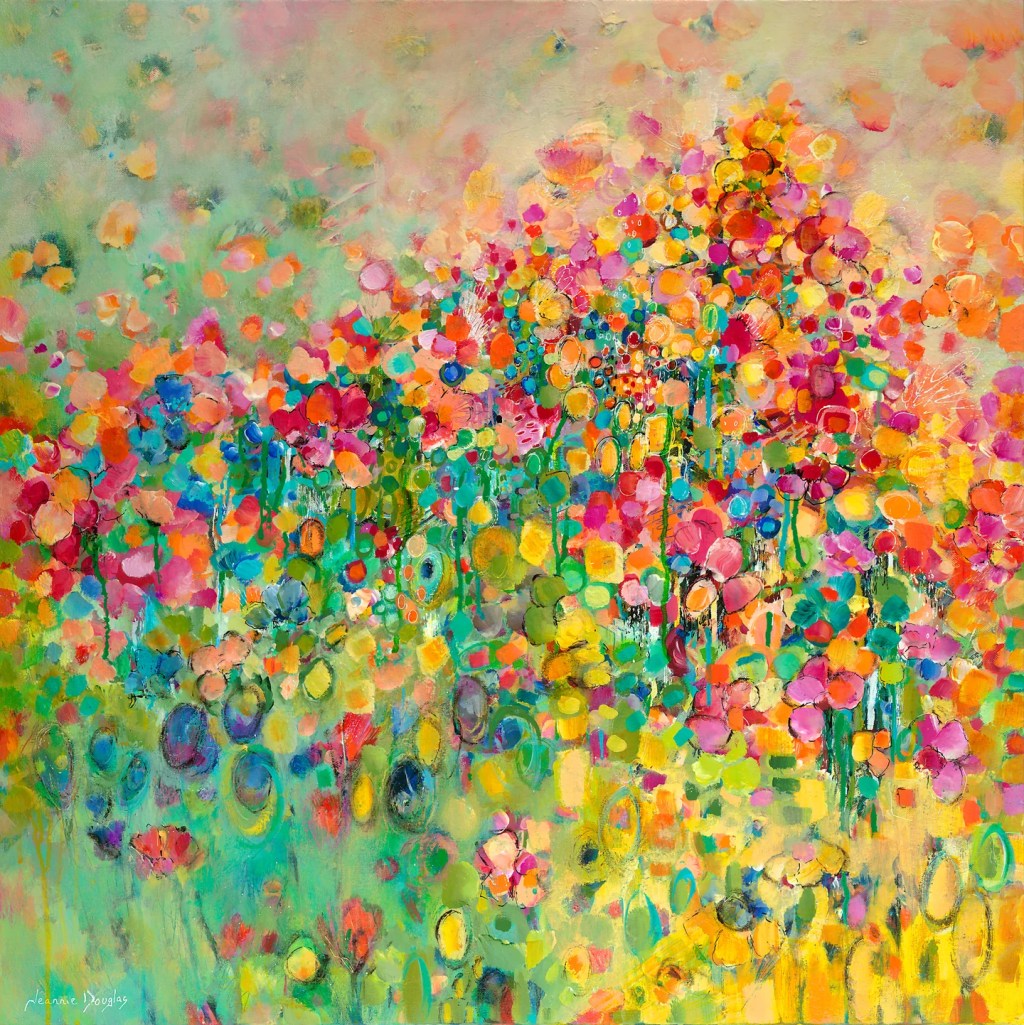
A Pop of Happiness by Jeanie Douglas. From Public Domain
Happiness is a many splendored word. For some it is the first ray of sunshine; for another, it could be a clean bill of health; and yet for another, it would be being with one’s loved ones… there is no clear-cut answer to what makes everyone happy. In Harry Potter and the Half Blood Prince (JK Rowling, 2005), a sunshine yellow elixir induces euphoria with the side effects of excessive singing and nose tweaking. This is of course fantasy but translate it to the real world and you will find that happiness does induce a lightness of being, a luminosity within us that makes it easier to tackle harder situations. Playing around with Rowling’s belief systems, even without the potion, an anticipation of happiness or just plain optimism does generate a sense of hope for better times. Harry tackles his fears and dangers with goodwill, friends and innate optimism. When times are dark with raging wars or climate events that wreck our existence, can one look for a torch to light a sense of hope with the flame of inborn resilience borne of an inner calm, peace or happiness — call it what you will…?
It is hard to gauge the extreme circumstances with which many of us are faced in our current realities, especially when the events spin out of control. In this issue, along with the darker hues that ravage our lives, we have sprinklings of laughter to try to lighten our spirits. In the same vein, externalising our emotions to the point of absurdity that brings a smile to our lips is Rhys Hughes’ The Sunset Suite, a book that survives on tall tales generated by mugs of coffee. In one of the narratives, there is a man who is thrown into a bubbling hot spring, but he survives singing happily because his attacker has also thrown in packs of tea leaves. This man loves tea so much that he does not scald, drown or die but keeps swimming merrily singing a song. While Hughes’ stories are dark, like our times, there is an innate cheer that rings through the whole book… Dare we call it happiness or resilience? Hughes reveals much as he converses about this book, squonks and stranger facts that stretch beyond realism to a fantastical world that has full bearing on our very existence.
A powerful essay by Binu Mathew on the climate disaster at Wayanad, a place that earlier had been written of as an idyllic getaway, tells us how the land in that region has become more prone to landslides. The one on July 30th this year washed away a whole village! Farouk Gulsara has given a narrative about his cycling adventure through the state of Kashmir with his Malaysian friends and finding support in the hearts of locals, people who would be the first to be hit by any disaster even if they have had no hand in creating the catastrophes that could wreck their lives, the flora and the fauna around them. In the wake of such destructions or in anticipation of such calamities, many migrate to other areas — like Ranu Bhattacharya’s ancestors did a bit before the 1947 Partition violence set in. A younger migrant, Chinmayi Goyal, muses under peaceful circumstances as she explores her own need to adapt to her surroundings. G Venkatesh from Sweden writes of his happy encounter with local children in the playground. And Snigdha Agrawal has written of partaking lunch with a bovine companion – it can be intimidating having a cow munching at the next table, I guess! Devraj Singh Kalsi has given a tongue-in-cheek musing on how he might find footing as a godman. Suzanne Kamata has given a lovely summery piece on parasols, which never went out of fashion in Japan!
Radha Chakravarty, known for her fabulous translations, has written about the writer she translated recently, Nazrul. Her essay includes a poem by Tagore for Nazrul. Professor Fakrul Alam has translated two of Nazrul’s songs of parting and Sohana Manzoor has rendered his stunning story Shapuray (Snake Charmer) into English. Fazal Baloch has brought to us poetry in English from the Sulaimani dialect of Balochi by Allah Bashk Buzdar, and a Korean poem has been self-translated by the poet, Ihlwha Choi. The translations wind up with a poem by Tagore, Olosh Shomoy Dhara Beye (Time Flows at an Indolent Pace), showcasing how the common man’s daily life is more rooted in permanence than evanescent regimes and empires.
Fiction brings us into the realm of the common man and uncommon situations, or funny ones. A tongue-in-cheek story set in the Midwest by Joseph Pfister makes us laugh. Farhanaz Rabbani has given us a beautiful narrative about a girl’s awakening. Paul Mirabile delves into the past using the epistolary technique highlighting darker vignettes from Christopher Columbus’s life. We have book excerpts from Maaria Sayed’s From Pashas to Pokemonand Nazes Afroz’s translation of Syed Mujtaba Ali’sShabnamwith both the extracts and Rabbani’s narratives reflecting the spunk of women, albeit in different timescapes…
When migrations are out of choice, with multiple options to explore, they take on happier hues. But when it is out of a compulsion created by manmade disasters — both wars and climate change are that — will the affected people remain unscarred, or like Potter, bear the scar only on their forehead and, with Adlerian calm, find happiness and carpe diem?
Do pause by our current issue which has more content than mentioned here as some of it falls outside the ambit of our discussion. This issue would not have been possible without an all-out effort by each of you… even readers. I would like to thank each and every contributor and our loyal readers. The wonderful team at Borderless deserve much appreciation and gratitude, especially Manzoor for her wonderful artwork. I invite you all to savour this August issue with a drizzle of not monsoon or April showers but laughter.
May we all find our paths towards building a resilient world with a bright future.
There were skies onyx at night ... moons by day ... lakes pale as her eyes ... breathless winds undressing tall elms ... she would say that we’d loved, but some book said we’d sinned.
Soon impatiens too fiery to stay sagged; the crocus bells drooped, golden-limned; things of brightness, rinsed out, ran to grey ... all the light of that world softly dimmed.
Where our feet were inclined, we would stray; there were paths where dead weeds stood untrimmed, distant mountains that loomed in our way, thunder booming down valleys dark-hymned.
What I found, I found lost in her face by yielding all my virtue to her grace.
(Originally published by Romantics Quarterly as “A Dying Fall”)
MIRAGE
You came to me as rain breaks on the desert when every flower springs to life at once. But joys are wan illusions to the expert: the Bedouin has learned how not to want.
Michael R. Burch’s poems have been published by hundreds of literary journals, taught in high schools and colleges, translated into fourteen languages, incorporated into three plays and two operas, and set to music by seventeen composers.
PLEASE NOTE: ARTICLES CAN ONLY BE REPRODUCED IN OTHER SITES WITH DUE ACKNOWLEDGEMENT TO BORDERLESS JOURNAL




 Borderless