Categories
Contents

Borderless, April 2025

Art by Sohana Manzoor

Editorial

Seasons in the Sun?….Click here to read.

Translations

An excerpt from Tagore’s long play, Roktokorobi or Red Oleanders, has been translated by Professor Fakrul Alam. Click here to read.

Tagore’s essay, Classifications in Society, has been translated by Somdatta Mandal. Click here to read.

Poems of Longing by Jibananada Das homes two of his poems translated from Bengali by Professor Fakrul Alam. Click here to read.

Four cantos from Ramakanta Rath’s Sri Radha, translated from Odiya by the late poet himself, have been excerpted from his full length translation. Click here to read.

An excerpt from Syad Zahoor Shah Hashmi’s Nazuk, has been translated from Balochi by Fazal Baloch. Click here to read.

Disappearance by Bitan Chakraborty has been translated from Bengali by Kiriti Sengupta. Click here to read.

Roadside Ritual, a poem by Ihlwha Choi  has been translated from Korean by the poet himself. Click here to read.

Tagore’s Pochishe Boisakh Cholechhe (The twenty fifth of Boisakh draws close…) from Bengali by Mitali Chakravarty. Click here to read.

Poetry

Click on the names to read the poems

Luis Cuauhtémoc Berriozábal, Thompson Emate, Pramod Rastogi, George Freek, Vidya Hariharan, Stuart McFarlane, Meetu Mishra, Lizzie Packer, Saranyan BV, Paul Mirabile, Hema Ravi, Ryan Quinn Flanagan, Rhys Hughes

Poets, Poetry & Rhys Hughes

In Three Gothic Poems, Rhys Hughes explores the world of horrific with a light touch. Click here to read.

Musings/Slices from Life

The Day the Earth Quaked

Amy Sawitta Lefevre gives an eyewitness account of the March 28th earthquake from Bangkok. Click here to read.

Felix, the Philosophical Cat

Farouk Gulsara shares lessons learnt from his spoilt pet with a touch of humour. Click here to read.

Not Everyone is Invited to a Child’s Haircut Ceremony

Odbayar Dorje muses on Mongolian traditions. Click here to read.

From a Bucking Bronco to an Ageing Clydesdale

Meredith Stephens writes of sailing on rough seas one dark night. Click here to read.

Musings of a Copywriter

Stay Blessed! by Devraj Singh Kalsi is a tongue-in-cheek musing on social norms and niceties. Click here to read.

Notes from Japan

On Safari in South Africa by Suzanne Kamata takes us to a photographic and narrative treat of the Kruger National Park. Click here to read.

Essays

Songs of the Adivasi Earth

Ratnottama Sengupta introduces us to the art of Haren Thakur, rooted in tribal lores. Click here to read.

‘Rajnigandha’: A Celebration of the Middle-of-the-Road

Tamara Raza writes of a film that she loves. Click here to read.

‘Climate change matters to me, and it should matter to you too’

Zeeshan Nasir writes of the impact of the recent climate disasters in Pakistan, with special focus on Balochistan. Click here to read.

Bhaskar’s Corner

Ramakanta Rath: A Monument of Literature: Bhaskar Parichha pays a tribute to the late poet. Click here to read.

Stories

Jai Ho Chai

Snigdha Agrawal narrates a funny narrative about sadhus and AI. Click here to read.

The Mischief

Mitra Samal writes a sensitive story about childhood. Click here to read.

Lending a hand

Naramsetti Umamaheswararao takes us back to school. Click here to read.

Conversation

Ratnottama Sengupta talks to filmmaker and author Leslie Carvalho about his old film, The Outhouse, that will be screened this month and his new book, Smoke on the Backwaters. Click here to read.

Book Excerpts

An excerpt from Anuradha Kumar’s Wanderers, Adventurers, Missionaries: Early Americans in India. Click here to read.

An excerpt from Snigdha Agrawal’s Fragments of Time (Memoirs). Click here to read.

Book Reviews

Somdatta Mandal reviews Sheela Rohekar’s Miss Samuel: A Jewish Indian Saga, translated by Madhu Singh. Click here to read.

Gracy Samjetsabam reviews Tony K Stewart’s Needle at the Bottom of the Sea: Classic Bengali Tales from the Sundarbans. Click here to read.

Bhaskar Parichha reviews Raisina Chronicles: India’s Global Public Square by S. Jaishankar & Samir Saran. Click here to read.

.

Click here to access the Borderless anthology, Monalisa No Longer Smiles

Click here to access Monalisa No Longer Smiles on Amazon International

Categories
Editorial

Seasons in the Sun?

April is a month full of celebrations around the world. Asia hosts a spray of New Year festivities. Then there are festivals like Qing Ming Jie, Good Friday and Easter. All these are in a way reminders of our past. And yet, we critique things as old fashioned! So, where does tradition end and ‘outdated’ or ‘outmoded’ start? Meanwhile we continue to celebrate these festivals with joy but what happens to those who have lost their home, family and their living due to war or climate disasters? Can they too join in with the joie de vivre? Can we take our celebrations to them to give solace in some way?

In our April issue, we have stories from climate and conflict-ridden parts of the world. From Bangkok, Amy Sawitta Lefevre gives an eyewitness account of the March 28th Earthquake that originated in Myanmar. While in her city, the disaster was managed, she writes: “I’m also thinking of all the children in Myanmar who are sleeping in the open, who lost loved ones, who are feeling scared and alone, with no one to reassure them.” As news reels tell us, in Myanmar there have been thousands of casualties from the earthquake as well as shootings by the army.

From another troubled region, Pakistan, Zeeshan Nasir gives a heartrending narrative about climate change, which also dwells on the human suffering, including increase in underage marriages.

Human suffering can be generated by rituals and customs too. For instance, if festivals dwell on exclusivity, they can hurt those who are left out of the celebrations. Odbayar Dorje muses along those lines on Mongolian traditions and calls for inclusivity and the need to change norms. On the other hand, Devraj Singh Kalsi hums with humour as he reflects on social norms and niceties and hints at the need for change in a light-hearted manner. Farouk Gulsara makes us laugh with the antics of his spoilt pet cat. And Suzanne Kamata dwells on her animal sightings in Kruger National Park with her words and camera while Meredith Stephens takes us sailing on stormy seas… that too at night.

Art is brought into focus by Ratnottama Sengupta who introduces artist Haren Thakur with his adaptation of tribal styles that has been compared to that of Paul Klee (1879-1940). She also converses with filmmaker Leslie Carvalho, known for his film The Outhouse, and his new novel, Smoke on the Backwaters. Both of these have a focus on the Anglo-Indian community in India. Also writing on Indian film trends of the 1970s is Tamara Raza. Bhaskar Parichha pays tribute to the late Ramakanta Rath (1934-2025), whose powerful and touching poetry, translated from Odia by the poet himself, can be found in our translations section.

We have an excerpt from Professor Fakrul Alam’s unpublished translation of Tagore’s Red Oleanders. It’s a long play and truly relevant for our times. Somdatta Mandal shares with us her translation of Tagore’s essay called ‘The Classification in Society’, an essay where the writer dwells on the need for change in mindsets of individuals that make up a community to move forward. A transcreation of a poem by Tagore for his birthday in 1935 reflects the darkness he overcame in his own life. Two poems expressive of longings by Jibananada Das have been translated from Bengali by Professor Alam aswell. From Balochistan, we have an excerpt from the first Balochi novel, Nazuk, written by the late Syad Zahoor Shah Hashmi and rendered into English by Fazal Baloch. Among contemporaries, we have a short story by Bitan Chakraborty translated from Bengali by Kiriti Sengupta, a poignant story that reflects on gaps in our society. And a Korean poem by Ihlwha Choi rendered to English by the poet himself.

Our poetry section celebrates nature with poetry by Lizzie Packer. Many of the poems draw from nature like that of George Freek and Luis Cuauhtémoc Berriozábal. Some talk of the relationship between man and nature as does Stuart McFarlane. We have a variety of themes addressed in poems by Thompson Emate, Meetu Mishra, Saranyan BV, Paul Mirabile, Pramod Rastogi, Ryan Quinn Flanagan and many more. Rhys Hughes brings in both humour and social commentary of sorts with his poem. And in his column, Hughes has shared three gothic poems which he claims are horrible but there is that twinge of fable and lightness similar to the ghosts of Ebenezer Scrooge’s world[1]— colourful and symbolic.

Stories sprinkle humour of different shades with Snigdha Agrawal’s narrative about mendicants and AI and Mitra Samal’s strange tale about childhood pranks. Naramsetti Umamaheswararao takes us back to schooldays with his narrative. We have a fun book excerpt from Agrawal’s Fragments of Time (Memoirs), almost in tone with some of her stories and musings.

An extract from Anuradha Kumar’s latest non-fiction making bridges across time and geographies. Called Wanderers, Adventurers, Missionaries: Early Americans in India, the book is an intriguing read. We have a review by Professor Mandal of Sheela Rohekar’s Miss Samuel: A Jewish Indian Saga, translated by Madhu Singh. Highlighting syncretic folk traditions, Gracy Samjetsabam has discussed the late Tony K Stewart’s translation of oral folklore in Needle at the Bottom of the Sea: Classic Bengali Tales from the Sundarbans. Parichha has written about a high-profile book that also hopes to draw bridges across the world, Raisina Chronicles: India’s Global Public Square, by S. Jaishankar and Samir Saran.

This issue has been made possible because of support from all of you. Huge thanks to the team, all our contributors and readers. Thanks to Sohana Manzoor for her fabulous artwork. Do pause by our contents page as all the content could not be covered here.

Perhaps, world events leave a sense of pensiveness in all of us and an aura of insecurity. But, as Scarlett O’ Hara of Gone with the Wind[2] fame says, “After all, tomorrow is another day.” 

Looking forward to a new day with hope, let’s dream of happier times filled with sunshine and change.

Enjoy the reads!

Mitali Chakravarty

borderlessjournal.com

[1] A Christmas Carol by Charles Dickens, 1843

[2] Gone With the Wind, a novel by Margaret Mitchell, published in 1936

Click here to access the contents page for the April 2025 Issue

READ THE LATEST UPDATES ON THE FIRST BORDERLESS ANTHOLOGY, MONALISA NO LONGER SMILES, BY CLICKING ON THIS LINK.

Categories
Notes from Japan

On Safari in South Africa

Photographs and Narrative by Suzanne Kamata

On our third morning in the Lowveld, my travel companion and I woke up at 4:00 A.M. for our third game drive in Kruger National Park. We’d signed up for this over a year ago when we first booked ourselves on this group tour. We didn’t know then that it would be raining.

The other ten members of our group had chosen other options. Some were planning to hang out at the lodge, probably anticipating a day of lounging by the pool while kudu and impalas lingered nearby nibbling grass. Another cohort had signed up for a different sightseeing tour, involving waterfalls, with a later starting time. My friend and I were here, however, for the animals.

She and I had first met in Japan. We’d lived in the same town. Our kids had gone to the same schools, and we’d taught at the same universities. When she had moved back to Australia, we’d remained in touch. Both of us loved to travel, and both had dreamed of going on safari in Africa. Neither of us knew of anyone else who shared the same dream, so we vowed to go together. I had imagined that it would be years before I would be able to afford such a trip, but a little over a year ago, she’d come across a great deal. And now here we were, in South Africa.

Half-asleep, we quickly dressed, stuffed our sack-breakfasts into our backpacks, and stumbled out the heavy wooden door into the still dark morning. A light rain was falling. Although signs warned of roaming wild animals, and we’d seen plenty, it seemed safe to walk up to the office building to find our driver. His Toyota safari truck was already parked outside. After a few minutes, he appeared, and we climbed into the back middle seats of the open-sided truck, hoping to stay clear of the rain.

Our driver and guide, a local who drove 20-40 kilometers per hour over the speed limit and doled out one interesting animal fact per sighting, handed us lined ponchos to keep us warm on the forty-minute drive to the park. Then we zoomed off, passing pecan and macadamia groves, on the way to Numbi Gate. People were already waiting at bus stops along the way, probably on their way to work.

As the sky gradually lightened, we could make out the names of the shops along the road: Dragon Flame Car Wash, No Error Driving School, Drama’s Sneaker Wash, God is Able Beauty Salon, and an alarming number of small businesses offering funeral services.

When we finally reached the entrance to the game park, the guide parked and got out to register. Although the parking area had been crowded the previous two days, on this morning, we were the only ones there.

We had seen quite a few animals over the past two days, including elephants, giraffes, zebras, a rare white rhino, and a mama lion and cubs, albeit from a distance. We rattled off our wish list to the guide.

“A hippo out of the water,” my friend said. “And a male lion.”

I had been lucky enough to see both on a previous trip to Rwanda, but I had yet to see a leopard, one of the so-called “big five,” or a cheetah.

“When is the last time you saw a leopard or a cheetah?” I asked.

“I saw a leopard a week ago,” he said. “And a cheetah yesterday.”

He warned us, however, that because of the rain, we might not see anything at all. The animals might be seeking shelter. We understood and accepted that.

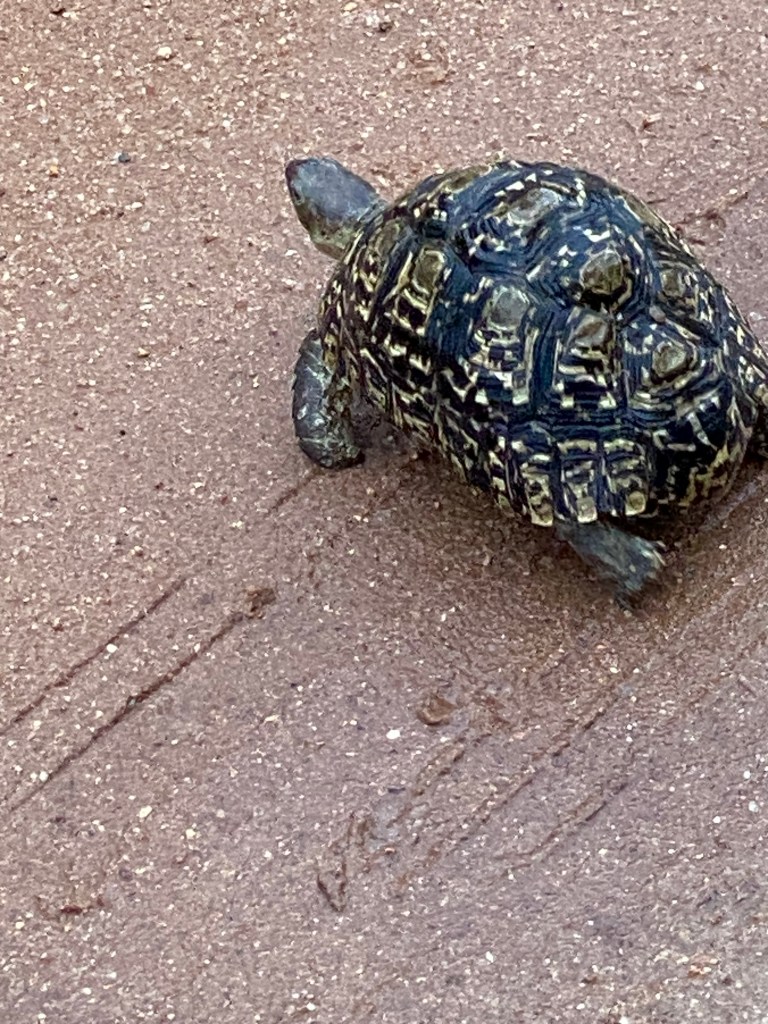
A few minutes into our drive, he braked the truck and pointed out a turtle making its way across the road. Understanding that this might be our biggest sighting of the day, I took a video of the creature with my smartphone. Soon after, we spotted some impalas. Although we’d seen so many the two days before that the guide no longer stopped for them, on this morning, we gave them our full attention.

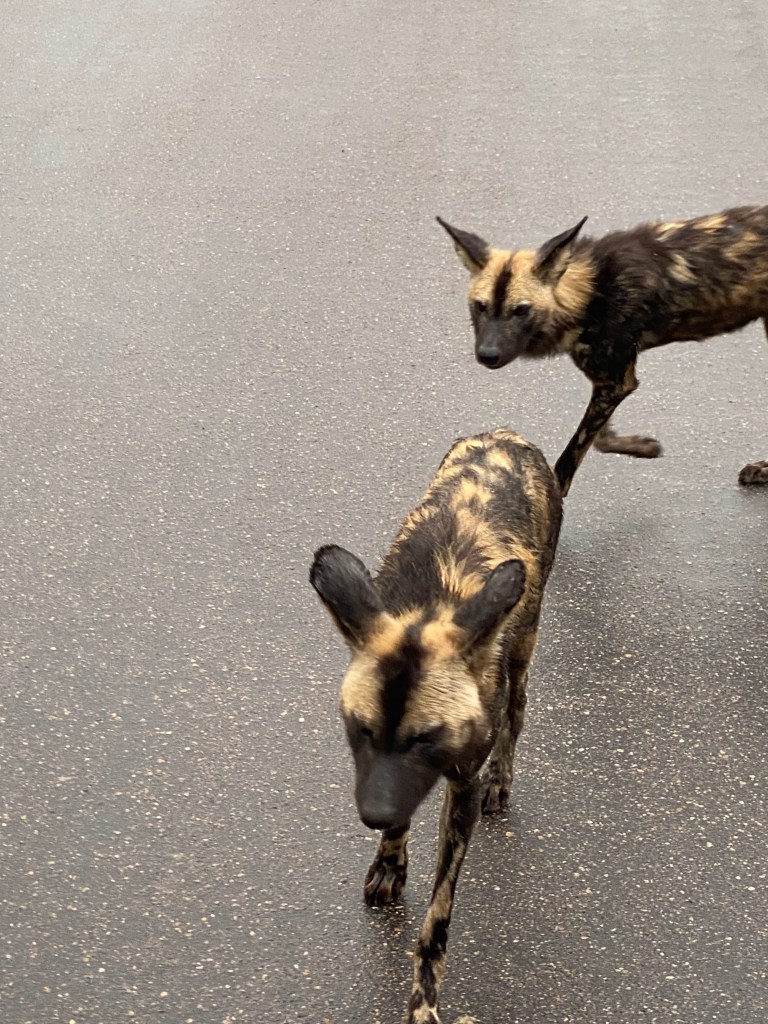
And then we saw something unusual—a pack of African wild dogs alongside and in the middle of the road. I had never seen canines with such colouring. Their fur was brown and black, almost tortoiseshell. These dogs were featured on a signboard at the park entrance indicating the day’s sightings.

“There are only about 150 of these dogs in the park,” our guide told us. He mentioned that they were expert hunters, that they attacked in groups. Since Kruger National Park is vast, with an area of 19,485 square kilometers, much of the terrain being well away from the road, I realized how lucky we were to see these dogs. They trotted along, sniffing at the road, mindless of the truck slowly following them.

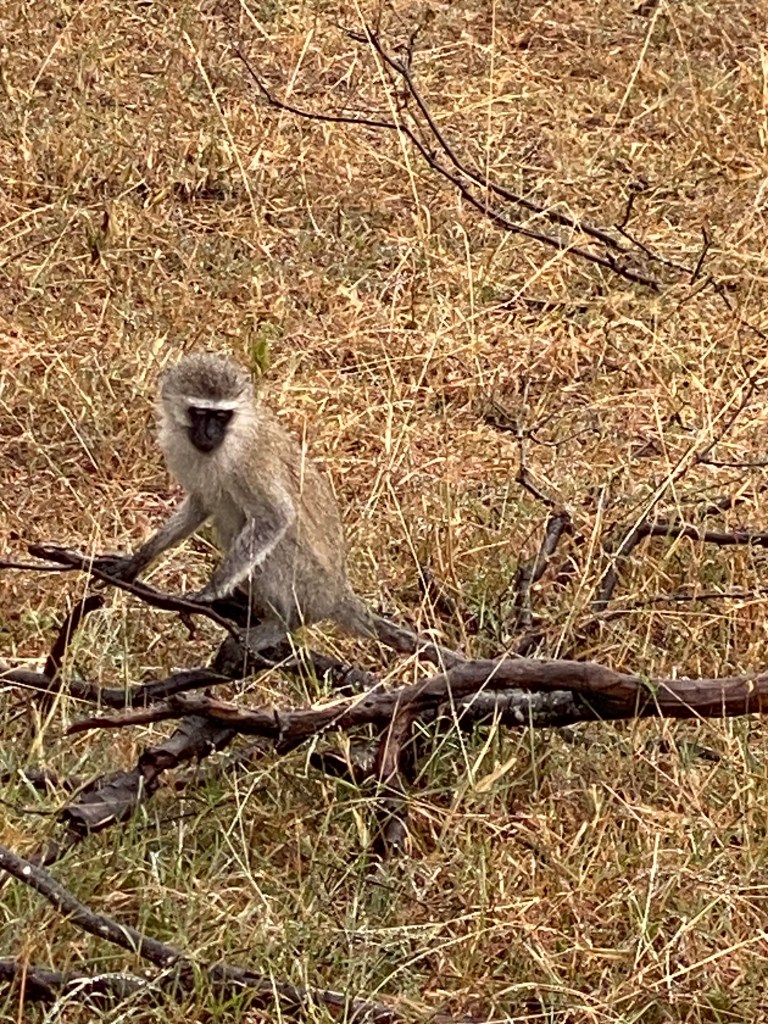
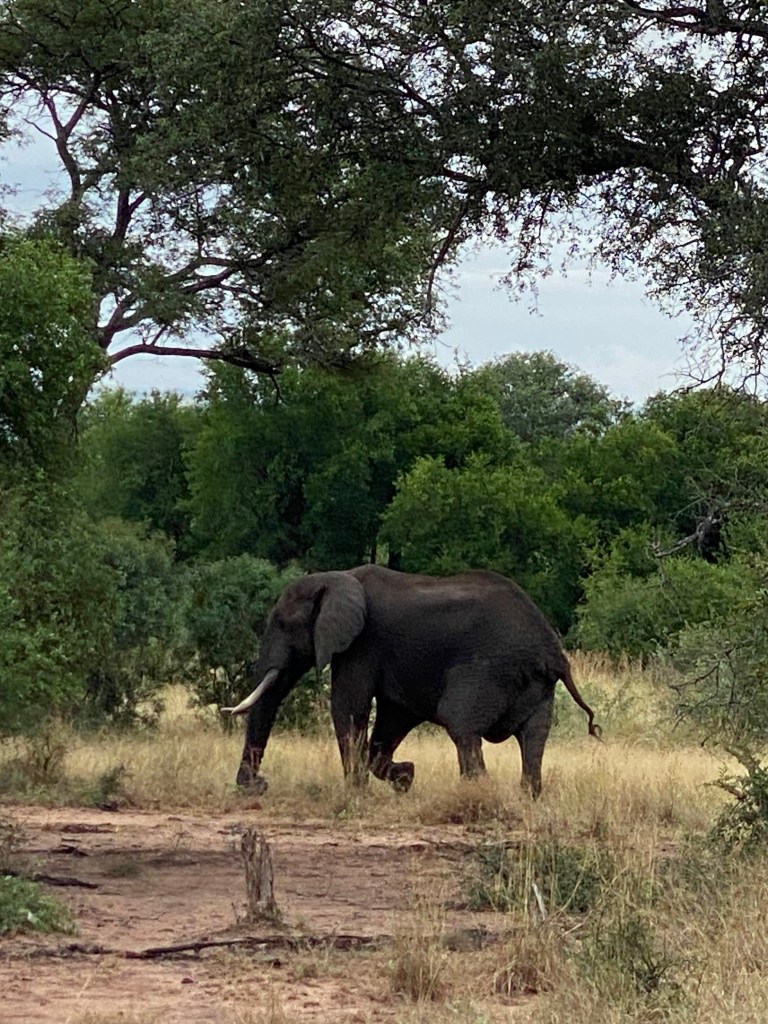
By this time, the rain had let up. Although we did not manage to see any hippos out of the water (they mostly come out at night to eat grass), we did see a herd of wildebeest, some vervet monkeys, an elephant, a water buffalo, baboons, and a Martial eagle perched on a high bare branch. And then our guide got a message on his phone and said, “From now, we’re not stopping for anything. Someone has spotted some cheetahs.”

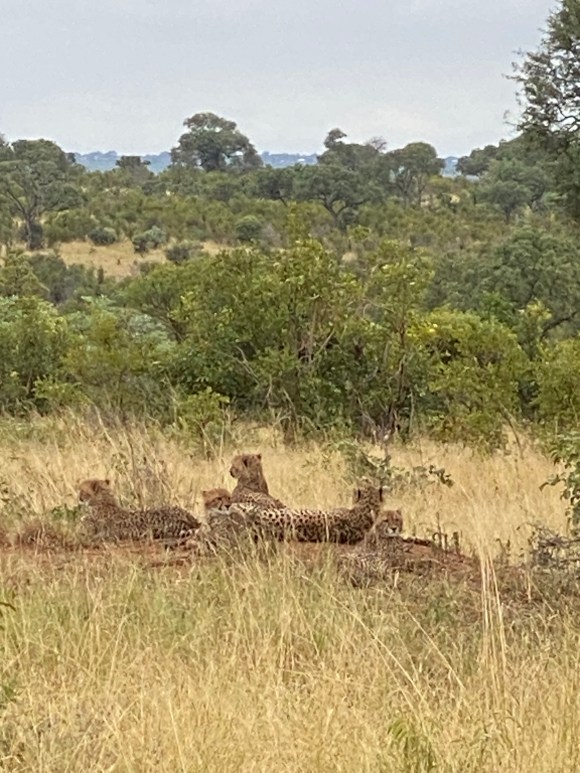
As he sped ahead, we crossed our fingers and readied our cameras. I expected the cheetahs to be far off in the distance, where they wouldn’t be scared off by the sound of cars, as the lions were. Why else would they stay in one place long enough for us to reach them? As it turned out, however, five cheetah cubs were gathered together, sitting still, gazing intently into the bush. They were near the road, only about fifty meters away.

“They’re waiting for their mother,” the guide said. “Maybe she will come back while we are waiting.”

My friend and I took turns admiring them through binoculars. How patiently they watched the impalas nearby. How diligently they groomed themselves. They were gorgeous, leaving us breathless.

We waited awhile, but there were others eager to see them, so our guide suggested it was time to move on. “Are you happy?” he asked us.

“Yes, very,” we both said. 

Later, as we returned to the lodge, we thought about how jealous the rest of the group would be when they heard about the cheetahs. The rain started to fall again.

Suzanne Kamata was born and raised in Grand Haven, Michigan. She now lives in Japan with her husband and two children. Her short stories, essays, articles and book reviews have appeared in over 100 publications. Her work has been nominated for the Pushcart Prize five times, and received a Special Mention in 2006. She is also a two-time winner of the All Nippon Airways/Wingspan Fiction Contest, winner of the Paris Book Festival, and winner of a SCBWI Magazine Merit Award.

PLEASE NOTE: ARTICLES CAN ONLY BE REPRODUCED IN OTHER SITES WITH DUE ACKNOWLEDGEMENT TO BORDERLESS JOURNAL

Click here to access the Borderless anthology, Monalisa No Longer Smiles

Click here to access Monalisa No Longer Smiles on Amazon International