[In 1922, Kazi Nazrul Islam, the famous ‘Rebel Poet of Bengal’, aroused the wrath of the British administration for the revolutionary anti-imperialist writings published in his magazine Dhumketu (Comet), published in Kolkata. The Dhumketu office was raided by the police, Nazrul’s anthology Jugabani was banned, and on 23 November 1922, Nazrul was arrested and imprisoned in Presidency Jail. On 16 January 1923, Nazrul delivered his famous speech “Rajbandir Jabandandi” (Deposition of a Political Prisoner), at his trial. Sentenced to a year’s rigorous imprisonment, Nazrul was confined first in Alipore Jail and subsequently in Hooghly Jail. In February, Tagore dedicated his play Basanta to Nazrul, and later sent him a telegram urging him to call off his hunger strike. Nazrul never received the telegram, and was released from jail in November 1923.]
I am accused of treason. Hence, I am a prisoner of the state, as indicted by the state.
On one side stands the royal crown, and on the other, the flame of the comet. One represents the king, holding the sceptre; the other stands for the truth, holding the rod of justice. On the side of the king are the salaried employees of the state. On my side is the King of kings, Judge of all judges, true from the beginning to the end of time—the living divinity.
Nobody has appointed my judge. In the eyes of this Supreme Judge, all are equal—ruler and subject, rich and poor, the happy and the unhappy. At His throne, the ruler’s crown and the beggar’s musical instrument, the ektara, are placed at par. His laws are the laws of nyaya or justice, and dharma. That law has not been created by any victor for any conquered race, but from the true insights of global humanity. It is the law of universal truth, of omnipresent, all-pervading divinity. On the side of the king is a fragment of creation, minute as an atom; and on my side, the Creator Himself, whole and indivisible without beginning and end.
Behind the king are the insignificant, and behind me, stands the divine force of Lord Shiva himself. The one who backs the king has selfish goals; the one who supports me aims for the truth, to gain perfect bliss.
The king’s words are mere bubbles; my words, the boundless ocean. I am a poet, inspired by the Lord to reveal the hidden truth, to give form to formless Creation. Through the voice of the poet, the Lord makes himself heard. My utterance is the medium that publicly announces the truth, the utterance of the Lord. That utterance can appear as treason in the judgement of the state, but in the judgement of nyaya, that utterance is neither a rebellion against nyaya, nor against the truth. That utterance may be punishable in the king’s court, but in the light of dharma, at the court of nyaya, it is guiltless, untainted, unblemished, clear, inextinguishable, like truth itself.
The truth is self-revealing. It cannot be stopped by an angry, red-eyed royal sceptre. I am the veena, the instrument of that unceasing self-revelation, the veena that resonated as the voice of eternal truth. I am the veena in the hands of the Lord. It may break if it must, but who can break the Lord? It is an eternal truth that the truth exists, and so does the Lord—since the beginning of time, and forever. The one who obstructs the voice of truth today, who wishes to silence that voice, is also one of the minutest atoms of the Lord’s creation. It is by Lord’s signs, signals and wishes that such a person exists today, or may not exist tomorrow. There is no end to the hubris of the foolish mortal: he wants to imprison and punish his own Creator! But one day, this hubris is bound to drown in tears!
As I was saying, I am an instrument for the revelation of truth. There may be heartless powers that imprison that instrument, or destroy it; but the One who plays that instrument, who expresses His fiery message through that veena – what power on earth can confine Him? What power on earth can destroy the vidhata, the supreme arbiter of our destinies? I am mortal, yes, but my vidhata is immortal. I will die, so will the king, for many traitors like me are dying, and so are many kings who summon up such accusations against them, but through the ages, at no point in time, and for no reason, has the manifestation of truth been suppressed – the voice of truth has never perished. Today, too, in the same way, it continues to express itself, and will continue to do so forever. This utterance of mine, stifled by authority, will be heard again, in the voice of another. If you snatch away my flute you do not kill my music, for I can take up another flute, or create a new one, and bring the music back to life. The music does not belong to the flute, you see, it exists in my soul, and in the art of my fashioning of the flute. Hence the fault lies not with the flute, nor with the tune; the fault lies in me, the player of the flute. Likewise, for the utterance that emerges through my voice, I am not responsible. The fault lies not in me, or in my veena. It lies with the One who plays his veena through my voice. Hence, I am not the traitor against the state; the ultimate traitor is that same Lord, the player of the veena. There exists no royal authority or second divinity who has the power to punish Him. No police force or prison has yet been created, that has the power to imprison the Lord.
The royal translator deployed by the king is simply translating the language of that utterance, not its soul. His translation projects that utterance as treason, for his aim is to satisfy the king. But my writing expresses the truth, radiance and the very spirit of life, for my aim is to offer my devotion to the Lord. For the tormented, anguished dwellers on this earth, I appear as a shower of truth, the tears that rain from the Lord’s eyes. I have not revolted against the king, but against injustice. …
[From Kazi Nazrul Islam: Selected Essays, translated by Radha Chakravarty. New Delhi: Penguin Random House, 2024.]
About the Book: Selected Essays reveals to us the extraordinary versatility of Nazrul as an essayist. Addressing subjects as diverse as social reform, politics, communal harmony, environmental concerns, education, aesthetics, ethics, and philosophy, this rich collection showcases Nazrul’s dynamic vision and unique use of language as an instrument of change. The essays chart his evolving consciousness as a thinker, writer and activist, offering vivid glimpses of the ethos of his times, his relationships with leading figures such as Tagore and Gandhi, and his active engagement with social, political and cultural processes. These new translations bring Nazrul’s powerful voice to life, all its vibrant immediacy.
About the Author:
Kazi Nazrul Islam (1899-1976) is widely remembered as the fiery iconoclast who fought against the structures of oppression and orthodoxy. The iconic ‘rebel poet’ of Bengal and the national poet of Bangladesh, Nazrul continues to be loved for his songs and poetry. But he was also a writer of powerful short stories, novels, essays, journalistic editorials and articles. In his literary career, which lasted from 1919 to 1942, Nazrul achieved both fame and notoriety, for his fiery, forthright, unorthodox approach to life and art.
About the Translator:
Radha Chakravarty is a writer, critic, and translator. She has published 23 books, including poetry, translations of major Bengali writers, anthologies of South Asian literature, and critical writings on Tagore, translation and contemporary women’s writing. She was nominated for the Crossword Translation Award 2004 and the Pushcart Prize 2020.
The Bengali poet, Kazi Nazrul Islam (1899-1976), is widely remembered as the fiery iconoclast who fought against the structures of oppression and orthodoxy. The iconic bidrohi or ‘rebel poet’ of Bengal, Nazrul continues to be loved for his songs and poetry that were aimed at arousing the rebellious spirit of both Hindus and Muslims alike. But what of his prose, his journalism, and his politics? Selected Essays reveals to us the extraordinary versatility of Nazrul as a writer, thinker, and activist. Addressing subjects as diverse as social reform, politics, communal harmony, environmental concerns, education, aesthetics, ethics, and philosophy, this rich collection showcases Nazrul’s dynamic vision and unique use of language as an instrument of change. The essays chart his evolving consciousness as a thinker, writer, and activist, offering vivid glimpses of the ethos of his times, his relationships with leading figures such as Tagore and Gandhi, and his active engagement with social, political, and cultural processes.
Of the forty-one essays selected here, (three undated), the first thirteen are all written in different places all in the year 1920. That was the year Nazrul returned to Bengal after serving in Karachi during World War I as a member of the Bengal regiment of the colonial British army. Reacting to the Jallianwallah Bagh massacre he writes, “May the Dyer monument never allow us to forget Dyer’s memory” because on that occasion Hindus and Muslims embraced each other and wept together as brothers. They shared the same agony as children of the same womb. In ‘Strike’, he praises the social awareness that has swept among the ranks of the labouring class and believes that the “protest is not just a rebellion, but the death-bite of the suffering, moribund class”. When some migrants were fired upon after a clash with the armed police at a place called Kanchagarhi, he asked in ‘Who is Responsible for the Killing of Migrants?’, whether anyone can ever tolerate such injustice towards humanity, conscience, self-respect and independence and states that they are no longer going to passively accept such assaults. ‘Awakening Our Neglected Power’ contends that democracy or people’s power cannot be established in our country because of the oppression inflicted by the Bhadra[1] community.
There are several essays in which Nazrul speaks about the state of National Education, he envisages ‘A National University’, and in a very powerful piece that he wrote from Presidency Jail in Kolkata on 7 January 1923, titled ‘Deposition of a Political Prisoner’ he reveals his self-confidence:
“If anything has struck me as unjust, I have described it as injustice, described oppression as oppression, named falsehoods as falsehood. …For that endless mockery, insults, humiliation and assaults have been rained on me, from within my home and beyond. But nothing whatsoever has intimidated me into dishonouring my own truth or my own Lord. No temptation has overpowered me enough to compromise my integrity or to diminish the immense self-satisfaction gleaned through my own endeavours…. I repeat, I have no fear, no sorrow. I am the child of the elixir of immortality.”
Nazrul grew up in a traditional religious environment, yet in his writings he drew upon both Hindu and Islamic sources, and expressed a faith that transcended the limits of any single religion. In several essays, he harps on the problems of Hindu-Muslim amity and enmity and warns us about “this hideous business of purity of touch and untouchability”. He wants only humans to live in India as brothers and wants everyone to be wary of the terrible deceptions created by both the religions.
In the essay ‘Temple and Mosque‘, he states that both parties have the same leader, and his real name is Shaitan, the Devil. Written in response to the communal riots that broke out in Kolkata on 2 April 1926, he feels that those very same places of worship that ought to have been bridges between heaven and earth are instead causing harm to humanity today, and so those temples and mosques should be broken down. In another essay titled ‘Hindu-Muslim’, penned the same year, Nazrul talks about the question of an internal tail in human beings. He says, “There’s no telling what animal excitement lured the human mind to discover a substitute for tails in the beard or tiki[2]!” He further elaborates:
“Both Hindu and Muslim ways of life can be tolerated, but their faith in tikitwa and daritwa, the orthodox ways of tiki and beard, is not to be borne, for both instigate violence and killing. Tikitwa is not Hindutwa, it is perhaps punditwa, the way of the pundit! Likewise, the beard, too, is not Islamic, it is mullatwa, the way of the mullah. These two types of hair tufts, marked with religious dogma, are precisely the reason for all the conflict and hair-splitting we witness today!”
Though it is not possible to discuss all the different editorials, book reviews, and political pieces that are included in this collection, one must mention at least two essays that speak about literary issues as well. In 1932, Nazrul wrote for Patrika (subsequently reprinted in Bulbul the following year), an interesting piece titled ‘World Literature Today’. In it he states that there are two kinds of writers present in the world today and their different tendencies have assumed immense proportions.
“Ranged on both sides are great war heroes, champion charioteers of the battlefield. On one side are the dreamers, such as Noguchi, Yeats and Rabindranath, and on the other, Gorky, Johan Bojer, Bernard Shaw, Benavente and their ilk.”
But Nazrul’s ire in being ostracized comes out clearly in ‘A Great Man’s Love Is a Sandbank’ (1927), where he criticises the high-handedness of Rabindranath Tagore. He begins by telling us how he was a prisoner of state at the Alipore Central Jail when he was informed by the assistant jailor that Tagore had recognised Nazrul’s talent and dedicated his play Basanta to him. The other political prisoners present there had laughed at him not in joy but in incredulity. For him, the blessing turned into a curse. His very close friends and state prisoners also turned away from him. He realised what massive internal damage this outward gain had caused him. Busy with his political agenda, he didn’t have the time to sit and meditate as advised several times by Tagore. So Nazrul writes, “I find that the brighter my countenance shines in this glory, the darker some other famous poets’ faces seem to appear.” He mentions that he had grown accustomed to police torture but when literary personages begin to torment one, their brutality knows no bounds. “Alas, O youthful new literature!” His crime was that young people celebrated his work. He laments further,
“That Kabiguru[3], revered by both parties like the grandsire Bhisma, should assent to this plot of killing Abhimanyu, is the greatest sorrow of our times. …As for me, I have discarded that topi–pyjama—sherwani–beard look[4], only out of fear of being mocked as a ‘Mia Saheb’. But still there is no respite for me…. Now we get the feeling that the Rabindranath of today is not the same Rabindranath we have always known.”
That the trajectories and beliefs of Tagore and Nazrul went in the opposite direction is well- known. In the essay, Nazrul then further continues his complaints against Tagore. He questions whether they have been considered as his enemies, simply because they didn’t go to him frequently. Also, since the goddess of wealth blessed him, Kabiguru did not know what dire poverty the new writers had to struggle against, languishing in conditions of starvation or semi-starvation. So, he humbly requests Kabiguru not to sprinkle salt on their wounds by mocking the impoverishment that is their singular affliction, for that is one form of heartlessness that they cannot tolerate.
Of the last three essays written in 1960, namely, ‘The Science of Life’(where men “are surrounded by all sorts of travails and sufferings, and many of them cannot be alleviated”), ‘A Point to Ponder’(where the nation faces an immense problem regarding the dispute about the instructions and procedure for the worship of the mother, the Bharatmata, our Mother India) and in ‘What We Need Today’, Nazrul speaks of the necessity of a “vast tumult in India”. Making his readers aware of the vast duplicity and trickery in the name of religion, he warns that unless one avoids the baseness of being subjugated by an external power, there is no prospect of heaven for us, only the grotesqueness of hell. He wants the kalboishakhi, the wild summer storm, to “approach in all its fury, rearing his head like a hooded serpent swimming in the unchecked torrents of an ocean of blood” and sweep everything away.
Before concluding one should also make a few comments on the translation. As a veteran translator, Radha Chakravarty, has successfully managed to transcreate some very difficult Bengali idioms, cultural nuances and analogies that Nazrul used in some of his essays. As she admitted in the Introduction, “[T]ranslating Nazrul’s prose proved to be a challenge, as demanding as it was exhilarating. …The endeavour demanded experiment and creativity rather than mechanical lexical ability and involved some difficult choices…Literal translation has been avoided, with greater focus on the sense, emotion, intellectual import, rhetorical features and stylistic particularities of the Bengali source texts.” She further adds that the present translations stemmed from a desire to bring Nazrul’s essays to a contemporary audience in South Asia and the rest of the world, to draw attention to his literary achievement as well as his significance as a writer, thinker, activist, and visionary. Though a lot of research and translation projects on Nazrul has been going on in Bangladesh for quite some time (where he holds the status of National Poet), in India, especially in West Bengal, the response is still rather lukewarm. Hence this volume is strongly recommended as a collector’s item.
[1] Literally decent but here indicates the bourgeoisie.
We have not accepted your message. Forgive us, O Prophet. We have forgotten your ideals, the path you showed. Forgive us, O Prophet.
Lord, you spurned luxury and riches under your feet; You did not want us to be kings and nawabs. All the wealth and treasures of this earth Are for all to share in equal measure. You said all human beings are equal on earth. Forgive us, O Prophet.
Your religion does not reject those of other faiths; You have cared for them, sheltered them in your home. Their temples of worship You did not command to be broken, O brave one. But today we cannot tolerate those of other beliefs. Forgive us, O Prophet.
You did not want shameful wars in the name of religion; You did not put swords in our hands, but your immortal message. We have forgotten your magnanimity; We have embraced blind intolerance. That is why blessings no longer shower upon us from heaven. Forgive us, O Prophet.
These Lovely Flowers, This Luscious Fruit [Ei Shundar Phul Ei Shundar Phal]
Thank you for all these bounties, Lord, For these lovely flowers, this luscious fruit, The sweet water of this river. Thank you for all these bounties, Lord, For these fertile fields of green and grain. You have bestowed precious gems on us, Brothers, companions, sons. You give us sustenance when we are hungry Without our asking. Lord, I disobey your command every day Still you bestow air and light on this worthless being. You gave me the greatest prophet To save me on Judgment Day. That I might not forget the true path You sent the message of the Holy Quran.
To the Poets of the Future [Na-Asha-Diner Kabir Proti]
O poets of the future, may you arise Like the morning sun, Bright and red like hibiscus blossoms. In the golden dawn for which we long May you wake up like countless flocks of birds. I sing in the hope that you will come To soar in the blue sky that I create. I leave behind the memory of my greetings to you: Play on my veena the song of the new day.
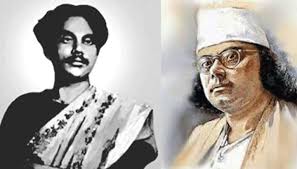
Born in united Bengal, long before the Partition, Kazi Nazrul Islam(1899-1976) was known as the Bidrohi Kobi, or “rebel poet”. Nazrul is now regarded as the national poet of Bangladesh though he continues a revered name in the Indian subcontinent. In addition to his prose and poetry, Nazrul wrote about 4000 songs.
Niaz Zaman is an academic, writer and translator from Bangladesh. She has published a selection of Kazi Nazrul Islam’s work in the two-volume Kazi Nazrul Islam: Selections. In 2016, she received the Bangla Academy Award for Translation. “Forgive Us, O Prophet” and “To the Poets of the Future” were first published in Kazi Nazrul Islam: Selections 1, edited by Niaz Zaman (writers.ink, 2020).
.
PLEASE NOTE: ARTICLES CAN ONLY BE REPRODUCED IN OTHER SITES WITH DUE ACKNOWLEDGEMENT TO BORDERLESS JOURNAL
Roquiah Sakhawat Hossein was born in 1880, Kazi Nazrul Islam in 1899. Apart from their difference in gender, there could not have been more differences in the circumstances of their class and upbringing. Roquiah was born and brought up in an affluent Muslim family of Pairaband. Her brothers went to elite schools in Kolkata. Though she was forbidden to read and write Bangla or English as a child, her brother Ibrahim Saber helped her to learn both languages so that she could write fluently in both. Later, her husband, Sakhawat Hossein, encouraged her to read and write, both Bangla and English.
Kazi Nazrul Islam was born in an impoverished family in the village of Churulia in the district of Bardhaman in West Bengal. Nazrul’s father was the khadim or caretaker of a mosque next to his small mud hut. The death of several earlier children led to Nazrul’s being given the nickname “Dukhu Miah,” the sorrowful one, perhaps also to cast off the evil eye. Initially, Nazrul studied in a maktab, an Islamic elementary school. When Nazrul was about nine, his father passed away, and the young boy was obliged to support his family. This might have meant teaching the children at the maktab, cleaning the mosque, and participating in religious rituals which entailed reciting the Quran.
Sometime in 1915, Nazrul got admitted to Searsole Raj High School, and studied there till 1917. This was the longest time he had spent in one place and in one school. However, he did not sit for the matriculation examination, but went off to join the British Indian Army which had started recruiting Bengalis. Posted to Karachi, Nazrul started subscribing to Kolkata papers and also writing for them.
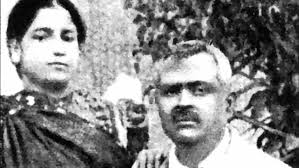
Begum Roquiah (1880-1932) with her husband, Sakhawat Hossein, in 1898
In 1898 – a year before Nazrul was born – Roqiuah Khatun was married to Sakhawat Hossein, an Urdu-speaking widower from Bhagalpur. A civil servant under the British Raj, Sakhawat Hossein, not only encouraged his wife to read and write but was so amazed at her piece of English writing that he showed it to Mr. Macpherson, Commissioner, Bhagalpur. Mr. Macpherson commended the quality and content of the writing. We do not know whether Roquiah sent the story herself to Indian Ladies Magazine (Madras) or whether her husband did so. Nevertheless, Roquiah’s first published writing appeared in the magazine in 1905. Three years later, her Bangla translation of the story – with some changes – was published as a small book by S. K. Lahiri and Co, Kolkata.
Sakhawat Hossein passed away on May 3, 1909, leaving a large sum to his widow to start a school. Roquiah initially started the school in Bhagalpur but was unable to continue there and moved to Kolkata. It was there that, onMarch 16, 1911, she re-started Sakhawat Memorial School at 13 Wellesley Lane. Besides persuading Muslim parents to let their daughters enrol in her school and running it, she also had to write letters explaining why certain things were being done or not being done in her school. In addition to these activities, she started writing for local Kolkata newspapers and journals.
Perhaps the earliest Bangla essay of hers that was published was “Pipasha.” This piece about Muharram was published in Nabaprabha in Falgun 1308 [1](Bangla) corresponding to mid-February to mid-March 1912. She also wrote in other journals such as Mahila, Nabanur, BharatMahila, Al-Eslam, Bangiya Mussulman Sahitya Patrika, Saogat, Sadhana, Naoroz, Mohammadi, Sahityik, Sabujpatra, Muezzin, Bangalakshmi, Gulistan, and Mah-e-Nau. News about her school was published in The Mussulman under her initials, Mrs. R. S. Hossein.
During his deployment in Karachi, Nazrul subscribed to Bangla journals from Kolkata and also sent them some of his writings. His first publication was a short story “Baundeler Atmakahini” [The Autobiography of a Vagabond], which was published in Saogat in May 1919. The short stories “Hena” and “Byathar Dan” [The Gift of Sorrow] were published in Bangiya Mussalman Sahitya Patrika in November 1919 and January 1920 respectively. Roquiah’s writings too were being published in Saogat and Bangiya Mussulman Sahitya Patrika. Though it is not known whether Nazrul and Roquiah actually met, it is impossible that they did not know about each other’s writings.
A few years ago, I asked Majeda Saber, Roquiah’s grandniece who has written considerably on her grandaunt, whether Nazrul and Roquiah had ever met. Majeda Saber did not know. However, even if they did not meet, it is quite evident that Nazrul and Roquiah did meet in print and that they shared some common ideas. Nazrul reveals a deep empathy for women in both his poetry and his fiction. The short story “Rakshushi[2],” about a woman who has killed her husband and gone to jail for her crime, is a sympathetic portrayal of a murderess in her own voice. Nazrul’s poem “Nari[3]” demands equality for women.
I sing of equality.
In my eyes, there is no difference
Between a man and a woman.
Whatever is great and blessed in this world,
Has come equally from both, man and woman.

		(Translated by Selina Hasib)
His song, “Jaago Nari Jaago” [Rise Up, Women], gives a clarion call to all women to rise.
Rise up women – rise up like the flaming fire!
Rise up, O wife of the Sun god,
with the mark of blood on your forehead!!
...

Like the fire blazing out of a smouldering heap,
rise up – all you mothers, daughters, wives, sisters!
              (Translated by Sajed Kamal)
In his epistolary novel, Bandhon Hara [4]– which began to be serialized in Moslem Bharat from mid-April 1920 and was published as a book in 1927 – the feelings of the women letter writers reflect Roquiah’s ideas.
The narrative of Bandhon Hara seems to focus on the soldier-protagonist Nuru. However, the letters of the women not only contribute to the narrative of the triangular love story but also reflect on the condition of Muslim women in seclusion. For example, Mahbuba writes to Sophie – her friend, who, like her, is also in love with Nuru – about the claustrophobic nature of the inner quarters where women reside. It is a place where even the sun may not enter. But women are not criminals, Mahbuba says. “We are entitled to some freedom, for are we not human beings? Are we not made of flesh and blood, don’t we have feelings? Do we not possess a soul?”
After Mahbuba gets married, she writes to Shahoshika, a Brahmo teacher and a family friend, that women are supposed to be self-sacrificing. She tells Shahoshika that she has no wish to be renowned for self-sacrifice. She would like to die but refuses to die locked up in the inner quarters. “If I have to die, I would wish to have all the doors and windows around me open wide . . . I want to die looking straight at Mother Earth”.
In her essay “Subeh Sadek” [Dawn], published in Muezzin between mid-July-mid-August 1930, Roquiah asked women to proclaim aloud that they were human beings, not possessions. “Buk thukiya bolo ma! Amra poshu noi. Bolo bhogini! Amra asbab noi. Bolo konye! Amra jarau olonkar rupe lohar sinduke aboddha thakibar bostu noi. Sokole somoswore bolo,Amra manush. Mother, proclaim aloud, we are not animals. Proclaim, sister, we are not inanimate objects. Proclaim daughter, we are not ornaments set with precious gems to be locked up in iron trunks. Proclaim together, we are human beings.” In Aborodhbashini [The Secluded Ones], published in 1931, several years after Bandhon Hara, she described the claustrophobic, unhealthy, and often fatal conditions of extreme purdah.
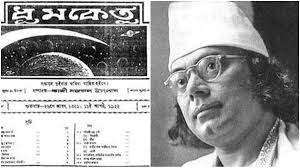
Dhumketu edited by Nazrul
These similarities might simply be coincidences. However, it is clear that Nazrul thought highly of Roquiah and that she too reciprocated that feeling. Roquiah had been contributing to several Kolkata journals. In 1922, she contributed two pieces to the newly founded bi-weekly paper, Dhumketu[5], edited by Nazrul. The paper started publication from 26 Sravan 1329 BS/11 August 1922. A month later, a large extract from Roquiah’s essay “Pipasha”[Thirst] was published in the Muharram issue of 16 Bhadra 1329/ September 2, 1922.
Thanks to Selina Bahar Zaman[6], we have facsimiles of Dhumketu. From this valuable collection we realise that, from the very beginning, the paper not only voiced Nazrul’s anti-British views but also displayed his non-communal and non-gendered outlook. Many of the contributors to the paper included Hindu writers as well as women. There were at least ten women who wrote at least once. One of these included a ten- or eleven-year-old girl as well as a thirteen-year-old girl, the former Hindu, the latter Muslim. Mrs. M. Rahman, to whom Nazrul dedicated his book Bisher Banshi[7], wrote several times. Roquiah – as Mrs R. S. Hossein – was published twice in Dhumketu.
We do not know whether Roquiah sent the extract from “Pipasha” herself or whether Nazrul asked her for the piece for the special issue of twenty pages. The extract published in Dhumketu reflects on the plight of Hazrat Imam Hossain and the group of warriors, women and children, who accompanied him on his tragic journey to Karbala.
The only other piece by Roquiah to appear in Dhumketu was a poem, “Nirupam Bir” [The Dauntless Warrior], published on 5 Ashwin 1329 BS / September 22, 1922. Unlike “Pipasha”, the poem does not seem to have been published before. This time, Roquiah might herself have sent the poem to Dhumketu. She would not have had to go in person to the office of Dhumketu. With a good postal service, contributions were mailed to journals.
“Nirupam Bir” is a remarkable poem from a woman who has been called an “Islamic Feminist.” The 18 August issue of Dhumketu had published a photograph of Kanailal Dutt (1888-1908). Did this inspire Roquiah to write the poem? Kanailal was a revolutionary belonging to the Jugantor Group[8]. Arrested with a number of other revolutionaries, he was imprisoned in Alipore Jail. There, along with another revolutionary, he succeeded in assassinating Narendranth Goswami, a government approver. Kanailal was hanged on 31 August, 1908. He was the second revolutionary to be hanged by the British after Khudiram Bose – whose picture also appeared in Dhumketu.
In the poem, Roquiah eulogises Kanai as the dauntless warrior. The poem begins with the magistrate telling Kanai that he will be hanged. But Kanai – addressed here as Shyam, another name of Krishna – laughs. The one who willingly sacrifices his life does not fear hanging. “Moriya kanai hobe omor/ Shadhyo ki bodhe tarey? By dying Kanai will become immortal. Who can slay him?” The poem ends with a strident call hailing Kanailal: “Bolo bolo ‘Bande Shyam[9].’” It is a brave poem by a woman who was the widow of a government servant, a woman who ran a school for Muslim girls and promised their parents that purdah would be observed.
There were no Muslim revolutionaries at the time – though Nazrul’s friend Muzaffar Ahmad was a communist – and in Mrityukshudha Nazrul would describe a Muslim Bolshevik and in Kuhelika[10] he would portray a Muslim revolutionary. In his two poems on Durga, “Agamoni[11]” and “Anandamoyeer Agamone”, published in the Puja issue of Dhumketu on 9 Ashwin 1329 BS /September 26, 1922, Nazrul used the legend of the goddess to call for the overthrow of the British. In his editorial in the thirteenth issue of Dhumketu, 26 Ashwin 1329 BS / October 13,1922, Nazrul called for complete independence from the British: “‘Dhumketu’ bharater purno swadhinata chay.[Dhumketu wants India’s complete independence]” He quoted a line from his poem “Bidrohi”: “Ami aponare chhara kori na kahare kurnish [I bow to no one but myself].” Unlike Khudiram and Kanai, Nazrul did not resort to bombs or pistols, but to soul-stirring words. Just as in some of his writings, Nazrul revealed the feminist perspectives of Roquiah; in “Nirupam Bir”, Roquiah approached the revolutionary spirit of Nazrul.
Selected Bibliography
Hossein, Roquiah Sakhawat, “Subeh Sadek.” Rokeya Rachanabali ed. Abdul Mannan Syed et al, revised edition. Bangla Academy: 1999.
Islam, Kazi Nazrul. Unfettered (translation of Bandhon Hara).Translated by The Reading Circle Nymphea Publication: 2015.
Niaz Zaman is an academic, writer and translator from Bangladesh. She has published a selection of Kazi Nazrul Islam’s work in the two-volume Kazi Nazrul Islam: Selections. In 2016, she received the Bangla Academy Award for Translation. This essay was first published in In Focus, the Daily Star, December 12, 2022.
.
PLEASE NOTE: ARTICLES CAN ONLY BE REPRODUCED IN OTHER SITES WITH DUE ACKNOWLEDGEMENT TO BORDERLESS JOURNAL
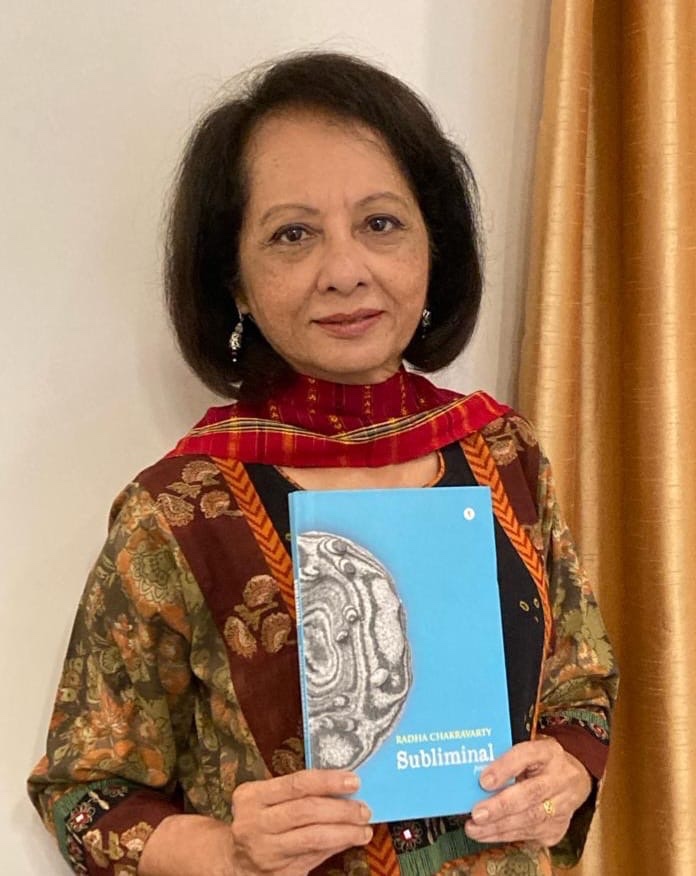
In conversation with Radha Chakravarty about her debut poetry collection, Subliminal, published by Hawakal Publishers
Radha Chakravarty
Words cross porous walls
In the house of translation—
Leaf cells breathe new air.
We all know of her as a translator par excellence. But did you know that Radha Chakravarty has another aspect to her creative self? She writes poetry. Chakravarty’s poetry delves into the minute, the small objects of life and integrates them into a larger whole for she writes introspectively. She writes of the kantha — a coverlet made for a baby out of soft old sarees, of her grandmother’s saree, a box to store betel leaves… Her poetry translates the culture with which she grew up to weave in the smaller things into the larger framework of life:
Fleet fingers, fashioning
silent fables, designed to swaddle
innocent infant dreams, shielding
silk-soft folds of newborn skin
from reality’s needle-pricks,
abrasive touch of life in the raw.

--'Designs in Kantha’
She has poignant poems about what she observes her in daily life:
At the traffic light she appears
holding jasmine garlands
selling at your car window for the price
of bare survival, the promise
of a love she never had, her eyes
emptied of the fragrance
of a spring that, for her, never came.

--‘Flower Seller’
Some of her strongest poems focus on women from Indian mythology. She invokes the persona of Sita and Ahalya — and even the ancient legendary Bengali woman astrologer and poet, Khona. It is a collection which while exploring the poet’s own inner being, the subliminal mind, takes us into a traditional Bengali household to create a feeling of Bengaliness in English. At no point should one assume this Bengaliness is provincial — it is the same flavour that explores Bosphorus and Mount Everest from a universal perspective and comments independently on the riots that reft Delhi in 2020… where she concludes on the aftermath— “after love left us and hate filled the air.”
The poems talk to each other to create a loose structure that gives a glimpse into the mind of the poetic persona — all the thoughts that populate the unseen crevices of her being.
In Subliminal, her debut poetry book, Radha Chakravarty has brought to us glimpses of her times and travels from her own perspective where the deep set tones of heritage weave a nostalgic beam of poetic cadences. Chakravarty’s poems also appear in numerous journals and anthologies. She has published over 20 books, including translations of major Bengali writers such as Rabindranath Tagore, Bankim Chandra Chatterjee, Mahasweta Devi and Kazi Nazrul Islam, anthologies of South Asian writing, and several critical monographs. She has co-edited The Essential Tagore (Harvard and Visva-Bharati), named ‘Book of the Year’ 2011 by Martha Nussbaum.
In this conversation, Radha Chakravarty delves deeper into her poetry and her debut poetry book, Subliminal.
Your titular poem ‘Subliminal’ is around advertisements on TV. Tell us why you opted to name your collection after this poem.
Most of the poems in Subliminal are independent compositions, not planned for a pre-conceived anthology. But when I drew them together for this book, the title of the poem about TV advertisements appeared just right for the whole collection, because my poetry actually delves beneath surfaces to tease out the hidden stories and submerged realities that drive our lives. And very often, those concealed truths are startlingly different from outward appearances. I think much of my poetry derives its energy from the tensions between our illusory outer lives and the realities that lurk within. In ‘Memories of Loss’, for example, I speak of beautiful things that conceal painful stories:
In a seashell held to the ear
the murmur of a distant ocean

In the veins of a fallen leaf
the hint of a lost green spring

In the hiss of logs in the fire,
the sighing of wind in vanished trees

In the butterfly’s bold, bright wings,
The trace of silken cocoon dreams
So, when and why did you start writing poetry?
I can’t remember when I started. I think I was always scribbling lines and fragments of verse, without taking them seriously. Poetry for me was the mode for saying the unsayable, expressing what one was not officially expected to put down in words. In a way, I was talking to myself, or to an invisible audience. Years later, going public with my poems demanded an act of courage. The confidence to actually publish my poems came at the urging of friends who were poets. Somehow, they assumed, or seemed to know from reading my published work in other forms, that I wrote poetry too.
Did being a translator of great writers have an impact on your poetry? How?
Yes, definitely. In particular, translating Tagore’s Shesher Kabita(as Farewell Song), his verses for children, the lush, lyrical prose of Bankimchandra Chatterjee (Kapalkundala) and the stylistic experiments of contemporary Bengali writers from India and Bangladesh (in my books Crossings: Stories from India and Bangladesh, Writing Feminism: South Asian Voices, Writing Freedom: South Asian Voices and Vermillion Clouds) sensitised me to the way poetic language works, and how the idiom, rhythm and resonances change when you translate from one language to another. Translating poetry has its challenges, but it also refined my own work as a poet. Let me share a few lines of poetry from Farewell Song, my translation of Tagore’s novel Shesher Kabita:
Sometime, when you are at ease,
When from the shores of the past,
      The night-wind sighs, in the spring breeze,
	The sky steeped in tears of fallen bakul flowers,
Seek me then, in the corners of your heart,
    For traces left behind. In the twilight of forgetting,
	Perhaps a glimmer of light will be seen,
The nameless image of a dream.
	And yet it is no dream,
For my love, to me, is the truest thing …
What writers, artists or musicians have impacted your poetry?
For me, writing is closely associated with the love for reading. Intimacy with beloved texts, and interactions with poets from diverse cultures during my extensive travels, has proved inspirational.
Poetry is also about the art of listening. As a child I loved the sound, rhythm and vivacity of Bengali children’s rhymes in the voice of my great-grandmother Renuka Chakrabarti. She has always been a figure of inspiration for me, a literary foremother who dared to aspire to the world of words at a time when women of her circle were not allowed to read and write. A child bride married into a family of erudite men, and consumed by curiosity about the forbidden act of reading, she took to hiding under her father-in-law’s four-poster bed and trying to decipher the alphabet from newspapers. One day he caught her in the act. Terrified, she crept out from her hiding place, and confessed to the ‘crime’ of trying to read. Things could have gone badly for her, but her father-in-law was an enlightened individual. He understood her craving to learn, and promised that he would teach her to read and write. Under his tutelage, and through her own passion for learning, she became an erudite woman, equally proficient in English and Bengali, an accomplished but unpublished poet whose legacy I feel I have inherited. Subliminal is dedicated to her.
As a child I absorbed both Bengali and English poetry through my pores because in our home, poetry, and music were all around me. I was inspired by Tagore and Nazrul, but also by modern Bengali poets such as Jibanananda Das, Sankho Ghosh and Shamsur Rahman. In my college days, as a student of English Literature, I loved the poetry of Shakespeare, Donne, Yeats, T. S. Eliot and the Romantics.
Later, I discovered the power of women’s poetry: Emily Dickinson, Sylvia Plath and Adrienne Rich, to name a few. I am fascinated by the figure of Chandrabati, the medieval Bengali woman poet who composed her own powerful version of the Ramayana. Art and music provide a wellspring of inspiration too, for poetry can have strong visual and aural dimensions.
You translate from Bengali into English. How is the process of writing poetry different from the process of translation, especially as some of your poetry is steeped in Bengaliness, almost as if you are translating your experiences for all of us?
Translation involves interpreting and communicating another author’s words for readers in another language. Writing poetry is about communicating my own thoughts, emotions and intuitions in my own words. Translation requires adherence to a pre-existing source text. When writing poetry, there is no prior text to respond to, only the text that emerges from one’s own act of imagination. That brings greater freedom, but also a different kind of challenge. Both literary translation and the composition of poetry are creative processes, though. Mere linguistic proficiency is not enough to bring a literary work or a translated text to life.
English is not our mother tongue. And yet you write in it. Can you explain why?
Having grown up outside Bengal, I have no formal training in Bengali. I was taught advanced Bengali at home by my grandfather and acquired my deep love for the language through my wide exposure to books, music, and performances in Bengali, from a very early age. I was educated in an English medium school. At University too, I studied English Literature. Hence, like many others who have grown up in Indian cities, I am habituated to writing in English. I translate from Bengali, but write and publish in English, the language of my education and professional experience. Bengali belongs more to my personal, more intimate domain, less to my field of public interactions.
Both Bengali and English are integral to my consciousness, and I guess this bilingual sensibility often surfaces in my poetry. In many poems, such as ‘The Casket of Secret Stories,’ ‘The Homecoming’ or ‘In Search of Shantiniketan’, Bengali words come in naturally because of the cultural matrix in which such poems are embedded. ‘The Casket of Secret Stories’ is inspired by vivid childhood memories of my great-grandmother’s daily ritual of rolling paan, betel leaves stuffed with fragrant spices, and arranging them in the metal box, her paaner bata[1]. When she took her afternoon nap, my cousins and I would steal and eat the forbidden paan from the box, and pretend innocence when she woke up and found all her paan gone. Of course, from our red-stained teeth and lips, she understood very well who the culprits were. But she never let on that she knew. It was only later, after I grew up, that I realised what the paan ritual signified for the housebound women of her time:
In the delicious telling,
bright red juice trickling
from the mouth, staining
tongue and teeth, savouring
the covert knowledge
of what life felt like in dark corners
of the home’s secluded inner quarters,
what the world on the outside looked like
from behind veils, screens,
barred windows and closed courtyards
where women’s days began and ended,
leaving for posterity
this precious closed kaansha* casket,
redolent with the aroma of lost stories

*Bronze
But I don’t agree that all my poetry is steeped in Bengali. In fact, in most of my poems, Bengali expressions don’t feature at all, because the subjects have a much wider range of reference. As a globe trotter, I have written about different places and journeys between places.
Take ‘Still’, which is about Mount Everest seen from Nagarkot in Nepal. Or ‘Continental Drift’, about the Bosphorus ferry that connects Asia with Europe. Such poems reflect a global sensibility. My poems on the Pandemic are not coloured by specific Bengali experiences. They have a universal resonance. I contributed to Pandemic: A Worldwide Community Poem (Muse Pie Press, USA), a collaborative effort to which poets from many different countries contributed their lines. It was a unique composition that connected my personal experience of the Pandemic with the diverse experiences of poets from other parts of the world. The poem was nominated for the Pushcart Prize. I guess my poems explore the tensions between rootedness and a global consciousness.
What are the themes and issues that move you?
I tend to write about things that carry a strong personal charge, but also connect with general human experience. My poems are driven by basic human emotions, memory, desire, associations, relationships, and also by social themes and issues. Specific events, private or public, often trigger poems that widen out to ask bigger questions arising from the immediate situation.
Sometimes, poetry can also become for me what T. S. Eliot calls an “escape from personality,” where one adopts a voice that is not one’s own and assume a different identity. ‘The Wishing Tree’ and the sequence titled ‘Seductions’ work as “mask” poems, using voices other than my own. This offers immense creative potential, similar to creating imaginary characters in works of fiction.
There are a lot of women-centred poems in Subliminal. Consider, for example, ‘Designs in Kantha’, ‘Alien’, ‘River/Woman’, ‘That Girl’, ‘The Severed Tongue’ and ‘Walking Through the Flames’. These poems deal with questions of voice and freedom, the body and desire, and the legacy of our foremothers. Some of them are drawn from myth and legend, highlighting the way women tend to be represented in patriarchal discourses.
The natural world and our endangered planet form another thematic strand. I am fascinated by the hidden layers of the psyche, and the unexpected things we discover when we probe beneath the surface veneer of our exterior selves. My poems are also driven by a longing for greater connectivity across the borders that separate us, distress at the growing hatred and violence in our world, and an awareness of the powerful role that words can play in the way we relate to the universe. ‘Peace Process’, ‘After the Riot’ and ‘Borderlines’ express this angst.
How do you use the craft of poetry to address these themes?
Poetry is the art of compression, of saying a lot in very few words. Central to poetry is the image. A single image can carry a welter of associations and resonances, creating layers of meaning that would require many words of explanation in prose. Poems are not about elaborations and explanations. They compel the reader to participate actively in the process of constructing meaning. Reading poetry can become a creative activity too. Poems are also about sound, rhythm and form. I often write “in form” because the challenge of working within the contours of a poetic genre or form actually stretches one’s creative resources. In Subliminal, I have experimented with some difficult short forms, such as the Fibonacci poem, the Skinny, and the sonnet. Take, for instance, the Skinny poem called ‘Jasmine’:
Remember the scent of jasmine in the breeze?
                   Awakening
                    tender
                   memories
                  bittersweet,
                   awakening
                    buried
                    dormant
                    desires,
                   awakening,
in the breeze, the forgotten promise of first love. Remember?
The last two lines of the poem use the same words as the beginning, but to tell a different story. The form demands great economy.
I pay attention to the sound, and even when writing free verse, I care about the rhythm. Endings are important. Many of my poems carry a twist in the final lines. I mix languages. Bengali words keep cropping up in my English poems.
Are your poems spontaneous or pre-meditated?
The first attempt is usually spontaneous, but then comes the process of rewriting and polishing, which can be very demanding. Some poems come fully formed and require no revision, but generally, I tend to let the first draft hibernate for some time, before looking at it afresh with a critical eye. Often, the final product is unrecognisable.
Which is your favourite poem in this collection and why? Tell us the story around it.
It is hard to choose just one poem. But let us consider ‘Designs in Kantha’, one of my favourites. Maybe the poem is important to me because of the old, old associations of the embroidered kantha with childhood memories of the affection of all the motherly women who enveloped us with their loving care and tenderness. Then came the gradual realisation, as I grew into a woman, of all the intense emotions, the hidden lives that lay concealed between those seemingly innocent layers of fabric. The kantha is a traditional cultural object, but it can also be considered a fabrication, a product of the creative imagination, a story that hides the real, untold story of women’s lives in those times. Behind the dainty stitches lie the secret tales of these women from a bygone era. My poem tries to bring those buried emotions to life.
As a critic, how would you rate your own work?
I think I must be my own harshest critic. Given my academic training, it is very hard to silence that little voice in your head that is constantly analysing your creative work even as you write. To publish one’s poetry is an act of courage. For once your words enter the public domain, they are out of your hands. The final verdict rests with the readers.
Are you planning to bring out more books of poems/ translations? What can we expect from you next?
More poems, I guess. And more translations. Perhaps some poems in translation. My journey has taken so many unpredictable twists and turns, I can never be quite sure of what lies ahead. That is the fascinating thing about writing.
Nazrul’s lyrics translated by Professor Fakrul Alam
Painting by Jamini Ray (1887-1972)
DO LOVE MY SONGS

Dearest, even if you won’t love me,
Do love my songs.
Who remembers forest birds
When they cease singing and fly out of sight?
Whoever wants the moon by itself?
Everyone enthuses only about moonlight!
No one ever notices how wicks get burnt
When lamps emit their light!
Cut stems drip tear drops
But in time blossom as flowers.
But when plucking flowers and taking them away,
Do you ever think of helping the plant in any way?
All quench their thirsts with river water
But the act parches the riverbed so!
Seek, seek the river’s water in an ocean of sorrow…
But dearest, even if you won’t love me
Do love my songs!
A rendition of the original song in Bengali by the legendary singer, Feroza Begum(1930-2014)
Born in united Bengal, long before the Partition, Kazi Nazrul Islam(1899-1976) was known as the Bidrohi Kobi, or “rebel poet”. Nazrul is now regarded as the national poet of Bangladesh though he continues a revered name in the Indian subcontinent. In addition to his prose and poetry, Nazrul wrote about 4000 songs.
Sewn into soft, worn layers, forgotten fabric of grandmother tales – patterns of the past, secret memories, hidden designs, intriguing patterns in silk strands dyed in delicate dreamy shades— embroidered story-lines in exquisite, dainty kantha-stitch.
Years of laughter, heartache, bliss, tears and yearning, rage, despair— worked by artful needle into guileless fictions of innocence, pure and tender baby love.
Fleet fingers, fashioning silent fables, designed to swaddle innocent infant dreams, shielding silk-soft folds of newborn skin from reality’s needle-pricks, abrasive touch of life in the raw.
(Previously published in Journal of the Poetry Society of India. Vol. 31 & 32, 2020-2021)
UPROOTED
Fallen tree on concrete sidewalk – thirsty roots clawing the air, screaming silently for the succour of your own familiar soil, where all these years I saw you live and grow, blossom and bear fruit, and spread your shade while, in your green branches, joyous songbirds nested—
Fallen tree, forgotten forbear, uprooted to make way for the merciless coldness of concrete— your plight robs me of my breath. I remember now my human ancestors, uprooted, like you, from native soil, by the concrete-hard harshness of a land divided, under foreign rule, displaced persons forced to find new homes, on alien, unfamiliar soil— in a different world, indifferent to the fate of trees or men who stand in the way of progress, the high road of history— dispensable, left to live or die, in a world where the climate has changed.
Fallen tree, your exposed roots lay bare the callousness of our world, which destroys trees, fish, birds, people, and our own ancestral roots, to build in steel, concrete and plastic its developing story of growth, even as it blindly digs its own grave.
[From Subliminal: Poems, Hawakal, 2023]
Radha Chakravarty is a poet, critic and translator based in Delhi, India. Her new book of poetry, Subliminal: Poems, has recently been published by Hawakal. Her poems also appear in numerous journals and anthologies, including Journal of the Poetry Society of India, Contemporary Major Indian Women Poets, Narrow Road Journal, Soul Spaces, Culture Cult, The Poet (Lockdown 2020), Krishna in Indian Thought, Literature and Music and Indian Poetry through the Passage of Time. She has published over 20 books, including translations of major Bengali writers such as Rabindranath Tagore, Bankimchandra Chatterjee and Kazi Nazrul Islam, anthologies of South Asian writing, and several critical monographs. She has co-edited The Essential Tagore (Harvard and Visva-Bharati), named Book of the Year 2011 by Martha Nussbaum. She contributed to Pandemic: A Worldwide Community Poem (Muse Pie Press, USA), nominated for the Pushcart Prize 2020. She was Professor of Comparative Literature and Translation Studies at Ambedkar University Delhi.
.
PLEASE NOTE: ARTICLES CAN ONLY BE REPRODUCED IN OTHER SITES WITH DUE ACKNOWLEDGEMENT TO BORDERLESS JOURNAL
Nazrul’s poem, Proloyullash, has been translated as ‘The Frenzy of Destruction’ by Professor Fakrul Alam, published in his first anthology Agnibeena (Fiery Instrument) in 1922.
Born in united Bengal, long before the Partition, Kazi Nazrul Islam(1899-1976) was known as the Bidrohi Kobi, or “rebel poet”. Nazrul is now regarded as the national poet of Bangladesh though he continues a revered name in the Indian subcontinent. In addition to his prose and poetry, Nazrul wrote about 4000 songs.
THE FRENZY OF DESTRUCTION

Ring bells of victory!
Ring bells of victory!
Summer’s storm flutters the flag of the New!
Ring bells of victory!
Ring bells of victory!

He who was to come is coming,
Dancing as if possessed and bent on destruction!
Crossing Oceans, storming the Main Gate, smashing portals,
Into the dark hole of death
In the guise of the eternal executioner—
Through smouldering smoke
Lighting the lamp of lightning
The Violent One comes,
Bursting with glee!
Ring bells of victory!
Ring bells of victory!

Locks swaying in the overcast sky, He makes the sky flare,
Forcing even the fiery all-consuming comet’s tail to tremble.
In the very heart of the Creator of the universe
Like an unsheathed sword the blood sparkles
Roll and sway!
His loud laughter stuns the universe into silence—
Look how stunned the universe is!
Ring bells of victory!
Ring bells of victory!

A dozen suns’ rays stream fiercely from His eyes
The sorrows of the world stick in His disheveled hair.
Every teardrop falling from His eyes
Makes the seven seas roll and swell
His cheeks flush and glow!
Hugging Mother Earth in His huge arms,
He thunders, “Let destruction triumph!”
Ring bells of victory!
Ring bells of victory!

Take heart, take heart, cataclysms shake the universe,
The sluggish and shrunken, the dying and decrepit,
Hide and flee because of the coming catastrophe.
Cheerfully, compassionately,
The infant moon’s beams will shine in the sky’s unkempt locks.
Light will flood your home now!
Ring bells of victory!
Ring bells of victory!

The eternal charioteer comes, lashing his bloodied whip,
His horses neigh out; their cries resound in thunder and rain.
Their hooves spark off stars and scatter them across the blue sky
In the covered well of the dark dungeon
The gods are tied up with sacrificial stakes
And heaped in cold stony pillars.
Time for Him and His chariot to shake the earth.
Ring bells of victory!
Ring bells of victory!

Why fear destruction? It’s the gateway to creation!
The new will arise and rip through the unlovely.
Hair disheveled and dressed carelessly
Destruction makes its way gleefully.
Confident it can destroy and then build again!
Ring bells of victory!
Ring bells of victory!

Why fear since destruction and creation are part of the same game?
Ring bells of victory!
Wives, hold up your lamps of welcome!
The Beautiful comes in the guise of the Violent One

Ring bells of victory!


(The translation was first Published in Daily Star, 2007)
It was converted to a song called Tora Sab Jayadhani Kar or ‘Ring Bells of Victory’ in 1921 and set to tune by Nazrul himself.
Tora Sab Jayadhwani Kar sung in Bengali by contemporary singer Swagatalakshmi.
Born in united Bengal, long before the Partition, Kazi Nazrul Islam(1899-1976) was known as the Bidrohi Kobi, or “rebel poet”. Nazrul is now regarded as the national poet of Bangladesh though he continues a revered name in the Indian subcontinent. In addition to his prose and poetry, Nazrul wrote about 4000 songs.
WHY PROVIDE THORNS

Why provide thorns as well as flowers?
Wouldn’t lotuses bloom if thorns didn’t prick?

Why must fluttering eyes become moist with tears?
Why provide hearts if hearts won’t unite?

Why do cool wet clouds allure the swallow
Only to greet it with thunder and lightning?

Why allow buds to blossom if flowers wither?
Why stain the moon’s brow with a frown?

Why must desire for beauty be mired in lust?
Won’t faces look beautiful without the dark mole?

Poet, keep imaging bliss in this bower of thorns,
While restraining yourself within your moist eyes.

(First published in the Daily Star, 2007)
Keno Dile E Kanta rendered in Bengali by Khairul Anam Shakil
Ratnottama Senguptagives a glimpse of the life of Zohra Sehgal, based on the book Zohra: A Biography in Four ActsbyRitu Menon, and her own personal interactions with the aging Zohra Sehgal. Click here to read.






 Borderless