It has been a strange year for all of us. Amidst the chaos, bloodshed and climate disasters, Borderless Journal seems to be finding a footing in an orphaned world, connecting with writers who transcend borders and readers who delight in a universe knit with the variety and vibrancy of humanity. Like colours of a rainbow, the differences harmonise into an aubade, dawning a world with the most endearing of human traits, hope.
A short round up of this year starts with another new area of focus — a section with writings on environment and climate. Also, we are delighted to add we now host writers from more than forty countries. In October, we were surprised to see Borderless Journal listed on Duotrope and we have had a number of republications with acknowledgement — the last request was signed off this week for a republication of Ihlwha Choi’s poem in an anthology by Hatchette US. We have had many republications with due acknowledgment in India, Bangladesh, Pakistan and UK too among other places. Our team has been active too not just with words and art but also with more publications from Borderless. Rhys Hughes, who had a play performed to a full house in Wales recently, brought out a whole book of his photo-poems from Borderless. Bhaskar Parichha has started an initiative towards another new anthology from our content — Odia poets translated by Snehaprava Das. We are privileged to have all of you — contributors and readers — on board. And now, we invite you to savour some of our fare published in Borderless from January 2025 to December 2025. These are pieces that embody the spirit of a world beyond borders…
I Am Not My Mother: Gigi Baldovino Gosnell gives a story of child abuse set in Philippines where the victim towers with resilience. Click here to read.
Persona: Sohana Manzoor wanders into a glamorous world of expats. Click here to read.
In American Wife, Suzanne Kamata gives a short story set set in the Obon festival in Japan. Click here to read.
Sandy Cannot Write: Devraj Singh Kalsi takes us into the world of advertising and glamour. Click here to read.
Reminiscences from a Gallery: The Other Ray: Dolly Narang muses on Satyajit Ray’s world beyond films and shares a note by the maestro and an essay on his art by the eminent artist, Paritosh Sen. Click here to read.
A discussion of Jaladhar Sen’s The Travels of a Sadhu in the Himalayas, translated from Bengali by Somdatta Mandal, with an online interview with the translator. Click here to read.
After Geetanjali Shree’s Tomb of Sand, the first novel to receive the International Man Booker Prize in 2022 for a work of fiction written in an Indian language and translated into English, history repeated itself once again when this year in 2025, Banu Mushtaq’s book of selected short stories Heart Lamp, written originally in Kannada and translated into English by Deepa Bhasthi, was recipient of the same coveted prize. It proved that translating from Indian bhasha languages to compete worldwide with other canonical literatures has gained maturity to impress the jury who finally evaluate the prize.
In the twelve stories of Heart Lamp, published originally in Kannada between 1990 and 2023, Banu Mushtaq exquisitely captures the everyday lives of women and girls in Muslim communities in southern India. As a journalist and lawyer, most of the stories are women-centric and in all of them she tirelessly champions women’s rights and protests all forms of caste and religious oppression. As a believer in the highly influential literary movement in Kannada during the 1970s and ‘80s – the Bandaya Sahitya tradition – that started as an act of protest against the hegemony of upper caste and mostly male-led writing that was then being published and celebrated, Banu Mushtaq’s literary career therefore gave importance to dissent, rebellion, protest, resistance to authority, revolution and its adjacent areas at par with the movement that urged women, Dalits and other social and religious minorities to tell stories from their own lived experiences.
The author goes on to highlight several harmful social practices that are still prevalent in the Muslim community and even supported by law, which impede girls including women of all ages, from having freedom to make positive choices, thus hampering them from realizing their full potential. In story after story, the deeply patriarchal structure of Muslim society is depicted in such a manner that it is not only applicable to the Muslims living in villages and town in south India but can be applicable elsewhere too. She shows how child marriage is still in practice and mentions the suffering and trauma women experience because of legally sanctioned polygamy which causes social and financial insecurity and hardship for women and their offspring. The curse of teen talaq[1]and the practice of issuing multiple fatwas[2] which are deliberately aimed at constricting women are urgently in need of being addressed legally.
In the very first story, ‘Stone Slabs for Shaista Mahal’, we find Iftikar’s too much effusive declarations of love for his wife Shaista vanish into thin air immediately after her death and he soon marries a young girl leaving all his children to be looked after by his eldest daughter. The ‘Fire Rain’ has mutawalli[3] Usman Saheb heading the community and making hundreds of decisions for others, but when her sister comes begging he refuses to give her the legitimate share of his ancestral house. Whereas the ‘Black Cobras’ has the mutawalli saheb refuse to help a woman whose husband has deserted her for giving birth to three daughters and provide any support for her youngest sick daughter who dies without any treatment. The story ends with a focus on female revolt when his own wife decides to go and have an operation to stop childbirth. In an interesting story ‘A Decision of the Heart’ the author narrates the plight of a man called Yusuf who is unable to balance the love between his wife and his mother and finally decides to arrange a nikah for his mother Mehaboob Bi.
One story that delves deep into Muslim customs that we generally are not aware of, is entitled ‘Red Lungi’. It tells us about a mass circumcision programme at the mosque for the poor where a young boy Arif undergoes the procedure and is cured in due course. His plight is then contrasted with Samad, the son of a rich man who remains weak and unfit despite the elaborate festivities for his circumcision and the gifts.
The titular story ‘Heart Lamp’ centres around Mehrun who is left to fend for herself as her husband falls for another woman. When she goes to her parents’ house for support, her brothers send her back. Leaving the responsibility of her children upon her eldest daughter Salma, she attempts to burn herself to death. The scene where her daughter begs her to stop and so finally, she aborts her suicide attempt, is extremely moving. The depiction of rural Karnataka comes out very clearly in ‘Soft Whispers’. The story narrates in detail the childhood antics of an eight-year-old girl visting her grandparent’s house in Mabenahalli village. Her young playmate, Abid, who would join her to play tricks, turns into the supervisor of a dargah[4]. When he comes to invite her to join the festival, he keeps his head lowered and does not even meet her eye.
Despite mentioning serious social issues pertaining to the average middle and lower-middle class Muslim families, Mushtaq’s stories are laced with a sense of wry humour and pathos. For instance, in ‘High-Heeled Shoes’, Niaz Khan envies his sister-in-law who comes from Saudi Arabia wearing gorgeous high-heeleded shoes and, in the end, manages to buy a pair for his pregnant wife Arifa which does not fit her at all. The difficulty in walking with those shoes on, and the interaction she has with her unborn child in her womb takes this story to a different level altogether. ‘A Taste of Heaven’ has Bi Dadi, who turns into stone after her ja-namaz[5]is soiled, gaining solace by drinking Pepsi and thinking it to be aab-e-kausar, the nectar from heaven, and starts living in a delusory world of her own in the company of her long-lost husband. In ‘The Arabic Teacher and Gobi Manchuri’, the young Maulvi Hazrat’s penchant for eating “gobi manchuri[6]” is the comic fulcrum on which the story turns. Again, Shazia’s desperate attempts in ‘The Shroud’ to locally procure a kafan[7] and sprinkle it with the holy zamzam water from Mecca after having callously forgotten to bring one for poor Yaseen Bua from her Hajj pilgrimage, makes her grief and being conscience-stricken rather ludicrous.
In the 2025 International Booker Acceptance Speech Mushtaq said: “This book is my love letter to the idea that no story is ‘local’ – that a tale born under a banyan tree in my village can cast shadows as this stage tonight…. [It] was born from the belief that no story is ever ‘small’ – that in the tapestry of human experience, every thread holds the weight of the whole.”
Her observation power is indeed very strong. Muslim women have been victims of deprivation and discrimination in various matters owing to a dearth in education and awareness. To bring a change in the family, a change in mentality is very crucial. The last story of this collection, ‘Be A Woman Once, Oh Lord!’ is a typical tale of male chauvinism, where deprived a dowry, a man throws out his sick wife and children to get married again.
A woman must construct her own identity besides being someone’s daughter, somebody’s wife or someone’s mother. Only education and self-dependence can establish a woman as a human being beyond her religious and family identities. But as her translator rightly points out, it would be a disservice to reduce Mushtaq’s work to her religious identity, for stories transcend the confines of a faith and its cultural traditions. So, she should not be seen as writing only about a certain kind of woman belonging to a certain community, that women everywhere face similar, if not the exact same problems, and those are the issues that she writes about.
Before concluding, a few words need to be written about the translator and the translation too. In the Translator’s Note, titled ‘Against Italics’, Deepa Bhashti reiterates that the “translation of a text is never merely an act of replacing words in one language with equivalent words in another: every language, with its idioms and speech conventions, brings with it a lot of cultural knowledge that often needs translating too.” She mentions that she was very deliberate in her choice to not use italics for the Kannada, Urdu and Arabic words that remain untranslated in English. She believes that italics serve to not only distract visually, but more importantly, they announce words as imported from another language, exoticizing them and keeping them alien to English. She also mentions that there are no footnotes used at all.
In her separate International Booker Prize Acceptance Speech, Bhasthi also tells us how through the work they could bring out what would otherwise be unread, uncelebrated texts to a new and very different sets of readers. She stated how the story of the world was really a history of erasures. It was “characterized by the effacement of women’s triumphs and the furtive rubbing away from collective memory of how women and those on the many margins of this world live and love.” Therefore, the stories in this collection are recommended for reading not by reducing Mushtaq’s work to her religious identity, but by transcending the confines of a faith and its cultural traditions.
[1] It’s an Islamic practice in which a Muslim man could divorce his wife by uttering the word “talaq” (divorce) three times.
Night in Karnataka. And the chapatti-flat pointy faced chap taking a nap on the lap of the cool breeze, spearlike chin piercing the caps of his hard knees, finally wakes...
My nap was nipped in the bed… I mean bud, he said.
And he yawns in an hour long before dawn. Soon she will return and he will sing:
Yours were the tamarind tipped mammaries from which I sipped with my lips without pause.
Already he can hear her footsteps as she walks along the path next to the river. O! night in balmy Karnataka! Mango fandango and guava palaver. She croons the following:
I will strip you down and kiss you all over. And tickle you with my sweet tongue on the sides of your ribs. Then I’ll pluck one of your ribs and make a woman. A rib-cage ready-made maid.
HE: She can cook for us? SHE: Yes, but you must pay her well. HE: With what? I am penniless and feckless, a freckle-cheeked pointy faced chap, brow-beaten and lacking grace, who clearly hasn’t eaten for several days. SHE: I have brought you a coconut. We will eat it together inside the hut. A rhyme will fill us up until then, will it not?
(She dances alluringly)
Coconut husk or husky voice. We have no choice but to enjoy the coconut milk of human kindness.
HE: There is no tool to open it. SHE: Crack it with your chin, O pointy faced chap! Thwack it once or twice or even thrice and don’t be such a fool. HE: I know that a man in love is like a glove without a hand. I am that glove and I need a hand with the gift that you bring. To crack a nut as big as that requires more than a simple chin. It would damage my heavenly head and to be well fed I am not inclined to sin. I am feckless but clearly not reckless. That shell would be hell for my infernal chin.
And then she says:
Wary of shells you are. I wear tinkling bells on my ankles. Can you hear them from afar? O! pointy faced chap you should clap your hands and tap your heels to keep the fine timing of this rhyme, to keep the sublime rhythm of this auspicious, meretricious, quite delicious song.
HE: I will clap and tap as I am bid.
(An hour or two goes by)
From his rib she makes a maid but he is afraid something will go wrong. And it does. The maid has no desire to work like a slave. She plucks one of his other ribs and makes a man before they can stop her. The maid and the new man sing an amorous duet before eloping:
Robbed of ribs he rubs his chest. We must confess that we would take any part of his body that was required for us to achieve our desire. A ready made maid and her bony beau. Off we go to set up house together…
(No matter the weather, they flee.)
HE: They are eloping on a horse. There are no horses here. I don’t understand! SHE: O! pointy faced chap. The coconut halves are hooves and this proves that nothing but nothing is an obstacle to true love. He: Nothing but nothing? Now then. What is this second nothing of which you speak? Tell me quickly and kiss my cheek. SHE: Pay attention then! Pay it with any amount of rupees you please. Pay with the coin-like reflections of stars on your knees.
O! That is the nothing of the void that we must avoid for as long as we can. We squeak when we contemplate it, for it’s a void that sits on the chair of our souls. Be bold! Forget the ways of the old, we have each other. Closer than sister and brother, you and I. Never before in history has a pointy faced chap quite as daft been so truly adored….
And they embrace each other and she sinks more deeply into his chest than usual, for he is missing two ribs. Dawn has broken but love has been mended. And there will be other nights when they will sing the simple refrain:
O! night in Karnataka! O! night in Karnataka!
Rhys Hughes has lived in many countries. He graduated as an engineer but currently works as a tutor of mathematics. Since his first book was published in 1995 he has had fifty other books published and his work has been translated into ten languages.
.
PLEASE NOTE: ARTICLES CAN ONLY BE REPRODUCED IN OTHER SITES WITH DUE ACKNOWLEDGEMENT TO BORDERLESS JOURNAL
The title plunges us into the sacrality of resonant words, the Nadistuti sukta being a hymn in the Rigveda in praise of rivers. Poet, novelist and translator Lakshmi-Kaaveri equates the flow of the waters with ‘the flow of poetry’, the quiet mingling of streams of remembrance and phrases that shape into lines of verse. Her book is dedicated to Jayanta Mahapatra ‘who lives on’ and an exordium titled ‘Naman’ offers gentle tribute to H.K. Kaul, who was among the founders of the Poetry Society of India and passed away during the recent pandemic. Nadistuti is a brilliant and thought-provoking collection of poems that charts the timeless continuums while being aware of the fragility of human existence.
The book begins with a prayer to the River Narmada (meaning ‘the giver of pleasure’), which divides the north from the south of India. Yet the rippling waters have no boundary—a philosophical observation that I find marks much of this remarkable volume. Remembering Ganga, Yamuna, Godavari, Saraswati, Narmada, Sindhu, Kaaveri, devotees recite the shloka[1] at their morning bath seeking the blessings of the rivers. Though such rituals are mostly forgotten in modern times, the climate crisis should remind us of the consequences of such amnesia. The invisible Saraswati is possibly a metaphor for such “forgetting” simply because of her partial invisibility. Lakshmi Kannan’s vibrant lines recall the disappearance of the river as also of Saraswati’s appearance in another form as a revered Goddess invoked by “students, writers, musicians, dancers, painters”. From the Nadistuti I learned the word— ‘potomologist’—the study of rivers, but the book is far greater than an academic enquiry—it’s a recognition of the civilisational bloodline that is linked to the ancient rivers which were the earliest cradles of humankind.
Some extraordinary and innovative aspects Lakshmi’s book deserve special mention. First, the remarkable prose- poem called ‘Ponni Looks Back’ which stretches the boundaries of imagination in a charming manner. Ponni is the name of the river Kaaveri in classical Tamil Literature. It flows through Tamil Nadu and Karnataka and is always perceived as a woman. Lakshmi tracks Ponni’s autobiography as though writing a Bildungsroman, the education and growing up of an innocent girl and her experiences along the way. Therefore, Ponni is born as a small unobtrusive stream on the Mysore-Coorg border. Then she becomes prominent and significant, and a vital witness to history—the Hoysala kingdom, the classical arts of Belur, Halibid, Somnathpur, then carrying on further to wrap around the islands of Srirangapatnam and Srirangam and so on. I enjoyed the autobiographical voice of Ponni reveling in her centuries of testimony to all the changes she has observed and imbibed—till we come to the new politics that is destroying rivers and society today. Ponni says, “One day I heard different voices floating over my waters…they sit around tables, shout at each other and refer to me dryly as the Kaaveri dispute, wrenching my waters apart”. Like yet another goddess, Sita, she chooses to end her journey. Ponni merges with her mother, the Bay of Bengal —her love and amity having completed what tasks she could undertake towards humanitarian goals. The world of manmade disasters is a chapter River Kaaveri would rather not participate in.
My question here is: “Do poetry and politics merge?… Can poets continue to be as Shelley called them ‘the unacknowledged legislators of the world’?” This brings me to another significant aspect of Nadistuti: Lakshmi’s brand of subtle feminism. Predictably, I am drawn to the poems that argue against son-preference, challenge gender stereotypes, and poke gentle barbs at unenlightened men.
Second, I cite a longish poem called “Snake Woman” from the section titled Chamundi, because it combines rituals, dream imagery, gender prejudice and the paradox of son preference. The ritual is called Nagapuja and has strict rules of abstinence from certain foods like snake gourd, and it entails hours of prayer—the chant being:
Please grant me a male child
Oh, King of Cobras
I will name him Nagaraja
In your honour.
Something strange started happening that the pregnant woman could never dare reveal to the world. She dreamt every night of a female baby cobra wearing jhumkies (long earrings) and a jeweled girdle and sporting a red dot on her forehead. Well, the baby born was female—and the happy mother, though a little fearful, called her Nagalakshmi. The mother-in-law showed acute displeasure: “She can have any name. Who cares!”
Another pregnancy, again the rituals of Nagapuja—more stringent than before. No dreams this time. And an eagerly welcomed boy-child is born, enthusiastically named Nagaraja. And guess what? As he grows up, he ‘hissed at is mother’, ‘bared his fangs at his father’ and ‘spewed venom on his sister’. These are poet Lakshmi Kannan’s vivid vocabulary for the revered son! And the snake woman sister, what happened to her? She sloughed off her skin seasonally, grew strong, capable and emerged as a “lustrous one”.
I selected this poem for more than just Lakshmi’s clever reversal of gender prejudice. Snakes have a central place in the folktales and folklore of India. The word used, “theriomorphic”, denotes situations, where animals and human beings interchange bodies and identities. Snakes are not evil—they are often the progenitors of good deeds and the shapeshifting happens for many commendable reasons. The figuration of the snake as exclusively evil does not derive from Indian mythology. Lakshmi’s poem, this one and several others, tread this beautiful territory of humans and non-humans sharing a common abode, the Earth, and there is an implied lament that we have ignored this vital connectivity.
And finally, I am delving into the emotive, personal poems that end the collection. Called ‘Fireside’, it invites memories of WB Yeats’ classic lines:
When you are old and grey and full of sleep,
And nodding by the fire, take down this book…
Lakshmi addresses many members of her family; they are named, thanked and remembered for their acts of love and compassion. Because Lakshmi believes in history and continuities, as we have seen in ‘Ponni Looks Back’, and the Nagalakshmi reference, these too are poems about lineage, heritage, respect and love—the attributes that make life worthwhile. Lakshmi’s mother (addressed in the poems as Amma) was Sharada Devi, an acclaimed painter in Mysore and Bangalore whom the daughter remembers with her easel-mounted canvas gently acquiring colours, the landscapes emerging from the contours of her imagination. Today, Lakshmi Kannan, the poet of Nadistuti, looks at a blank sheet of paper and compares that to her Amma’s canvas—the words will surely incarnate. Another poem has a redolent title ‘In Search of Father’s Gardens’, upturning African American writer Alice Walker’s book In Search Of Our Mothers’ Gardens, but for me it’s a tale reminiscent of Lakshmi’s early novel Going Home that I had reviewed decades ago. It was a book about ancestral homes and families breaking up. In the reconfigurations over time, Nadistuti’s final section presents poems to members of Lakshmi’s immediate family, named, but not too personalised, making this an exemplary template for those who hesitate to present the private in public poetry. With beauty, grace, gratitude, humour, irony—each person emerges as a tributary in the flow of the poet and writer we know and love as Lakshmi- Kaaveri. The last poem ‘If You Want to Visit’ is deeply poignant. It’s not a farewell poem—instead it’s an invitation to an eternal companionship:
Come
Visit me now
I’ll not have a word of complaint
I’ll gather all of these and leave with you.
Here is the confluence of all that Nadistuti says: the day’s prayer in the morning, the Ponni River encapsulating history, the rituals that pass through many generations, and the legacy of a poet’s words embedded in the annals of time. An exquisite and meaningful collection of poems, Lakshmi has introduced concepts of poetic writing that are evocative of the ancient Rigveda and equally provide the guiding lamps for modern choices.
Malashri Lal, Former Professor in the English Department, University of Delhi, has published twenty one books of which Mandalas of Time: Poems, and Treasures of Lakshmi: The Goddess Who Gives are the most recent. Lal has received several research and writing fellowships. She is currently Convener, English Advisory Board of the Sahitya Akademi.
.
PLEASE NOTE: ARTICLES CAN ONLY BE REPRODUCED IN OTHER SITES WITH DUE ACKNOWLEDGEMENT TO BORDERLESS JOURNAL
Title: Common Yet Uncommon: 14 Memorable Stories from Daily Life
Author: Sudha Murty
Publisher: Penguin Books
For those who have not listened to her humorous and motivational talks and seen her bright and smiling face on social media platforms and talk shows, Sudha Murty is an educator, author and philanthropist who is the chairperson of Infosys Foundation. She is married to the co-founder of Infosys, N. R. Narayana Murthy. Writing both in Kannada and English, she has authored collections of short stories, travelogues, technical books, non-fiction stories, novels, and children’s books. The present volume under review, as the sub-title rightly claims, are simple yet memorable stories from daily life.
In the ‘Preface’, the author tells us that she has written her stories based upon her personal experiences of a particular region in northern Karnataka where she was born and raised in a middle-class family and has chosen this area as the setting for this book since it is her homeland. She says: “The river Tungabhadra divides Karnataka into two parts – North and South. The northern part of Karnataka has its peculiar history…. There was an amalgamation of cultures, languages and food habits…. By and large, the people here are open-minded and outspoken, much like the flat and open land that Mother Nature has bestowed on them.”
Growing up in a small town with a distinct culture, she is well-versed with the customs of its community, though she herself has immensely changed with time.
Written in Sudha Murty’s inimitable style, Common Yet Uncommon is an invigorating picture of everyday life where the foibles and strange behaviour of ordinary people are charmingly depicted. In the fourteen tales that make up the collection, Murty delves into her memories of childhood, life in her hometown, and the people she’s crossed paths with. These and the other “unembellished” characters who populate the pages of this book do not possess wealth or fame. According to her, they are outspoken, transparent, and magnanimous and are not polished in their speech or appearance. The crude veneer is no testimony to their unparalleled love and affection. Yet, each one is unique. Their stories are tales of unvarnished humans, with faults and big hearts. But she has learnt something from each of them and they have left an indelible impression on her mind.
The title of each story is simple and tells us about fourteen unique characters who have nothing in common. They are “mutually exclusive but collectively exhaustive”. But in all of them, Sudha Murty herself appears as Nalini –- fondly called Nali by several –- who keeps on peeping in and out of every chapter, sometimes as a young girl, sometimes as a young adult and sometimes as a married woman.
In ‘Bundle Bindu’, she portrays the character of a man called Bindu who “had a knack for exaggerating”, but whatever knowledge of history and love for Kannada that she inculcated was not from the history teachers at her school but because of Bindu’s lessons. So, she considers him one of the most influential people from her childhood. ‘Jayant the Shopkeeper’ describes the failed business acumen of the protagonist and how many people would gather at his shop in the morning to drink tea, read the newspaper, and leave without buying anything. Later, after investing his entire savings, Jayant’s new shop called Modern Gift Centre also closed permanently within three months of its inauguration. Thus, he had no other option but to go and look after his son’s house and his child in Bangalore.
The next story, called ‘Jealous Janaki’, talks about an extremely assertive woman who was like a military commander and who “loved gossip, rumourmongering, misunderstandings, looking down on people and passing sharp remarks”. ‘Ganga the Unadaptable’ tells us how the beautiful Ganga would reject marriageable boys for different things and ultimately continued a spinster. In ‘Hema the Woman Friday’, Murty finds Hema to be one of the best philanthropists she had ever met as philanthropy doesn’t always mean giving money but helping others without expecting anything in return. A strange sort of husband-and-wife relationship comes out in a story called ‘Not Made for Each Other’, where one need not express his or her love only through words, but emotions prevail even in quietude. ‘Selfish Suman’ describes the activities of a woman who always remained “within the circumference of me, myself and mine” and one who only looked out for her advantage in any situation.
‘Adventurous Bhagirathi’ chronicles the worldly-wise acumen of a woman brought up in a joint family whose prime asset was the balance of her mind and ‘Miser Jeevraj’, relates the story of a man who had always thought that money gave him an edge, and his wife and children would listen to him because of it. As time passed, Jeevraj became lonely and in the end, he realized that money is required in life, but it is not everything. ‘Amba the Super Chef’ tells the story of a man who realised his wife’s worth only after she became ill with typhoid and could no longer make different dishes in different seasons and take care of his health. In ‘Sharada the Fortunate’, we read the story of a widow who chanced to meet an earlier rejected suitor, marry him in strange circumstances during a pilgrimage, and lead a new life once again with a new identity. ‘Chami the Charmer’ describes another woman protagonist who believed in making a strategy for everything in life and follow it. The final interesting story entitled ‘Lunch Box Nalini’ is narrated in the first person by the author herself and begins like this:
“I am Nalini Kulkarni. Elders have always called me Nali – a typical shortening of the name in North Karnataka. Here, Anand becomes Andya and Mandakini becomes Mandi. No wonder, the transition from Nalini to Nali was effortless.
Until now, I have peeped into everyone’s life and written about their characters. Now let me talk about myself – the best way to joke is not at someone else’s expense but at your own.
But how did lunch box get affixed to my name, you may wonder.”
The rest of the story is told in an extremely humorous manner of how her lost lunch box ultimately managed to find a groom for herself.
Testament to the unique parlance of a small town, Common Yet Uncommon speaks a universal language of what it means to be human. Reading these simple stories, one is instantly reminded of R.K. Narayan’s inimitable style and glorification of the common man. “Each character in these stories is a pearl. I am just the thread that weaves into this necklace, which I owe to my people and my land,” admits the author. A must read for everyone who loves to indulge in light-hearted reading and the spontaneous narrative style of Sudha Murty.
.
Somdatta Mandal, author, critic, and translator, is a former professor of English at Visva-Bharati University, Santiniketan, India.
PLEASE NOTE: ARTICLES CAN ONLY BE REPRODUCED IN OTHER SITES WITH DUE ACKNOWLEDGEMENT TO BORDERLESS JOURNAL
Our Tanda


Our tanda is a bird’s nest
our homes: broken refuges
and our lives are feathers
swirling in the air.

The moon and the sun
hatch time so long as they wish
and flee, leaving folds,
on the lips of time.

Mirrors raise our hopes
showing ourselves
break our knuckles quietly
shatter into fragments and prick hearts.

Goats, cows, buffaloes, sheep and hearts,
all dig out rivers of forests with desires
as kids draw winged horses on the black of night
with fingers
dreaming of sugary peppermints or custard blobs.

Mothers sing lullabies,
oil-lamps
embellishing the night
to sleep.

Fathers guard homes
one eye on the house
the other eye on the field
with their heads out of their windows
they turn into flaming torches.

The ippa flowers grieve
releasing inebriety
listening to the story of our tanda.


Chakmak


	I

There were a few chakmak
at the window, ants and insects wandered
among them.

Whenever I visit the window,
I licked the chakmak,
no sweetness touched my heart,
nor did smell hit my nostril,
though they look like candy jellies.

I picked them
and threw them out of the window.

Daada picked them up,
took them again into the house
and placed them at the sill.
I thought of doing the same again.
He taunted our hen indirectly —
I could understand that the hen was me.

I thought the mysterious relationship
of our folk remains untold,
hid in the skulls
about chakmak.


	II

One day when daadi was busy
in stitching her tukri
she kept the chakmak beside her
sharpening the needle on a chakmak.

I sat beside her staring at the chakmak —
darkness and light played about,
I was astonished by the sharp light
emitting from them.

The beads were placed in front of daadi
on a piece of cloth for stitching them on her tukri,
they stopped singing and rolling,
were trying to peep into daadi's honey eyes.

The needle writing the joy of tukri on the chakmak,
white stains swelled out from the black chakmak
when accidentally her sweat fell on it.

She saw me and asked me to sit beside her,
started narrating the tales of chakmak,
as I continued staring at them.


	III

Birth after the water broke —
you crept out of your mother's womb
with stains of the eternal world
giving her womb to rest from the eternal sea.

This black stone gave you the world,
cut your umbilical cord
but it suffered by your birth,
fevered, it one day burnt our hut.

At the age of two
when the moon was peeping into the rice
squeezed in my hand with milk,
my hand filled with moonlit serpents crawling down
that trembled in my blood tunnels.

Your daada sang a song —
the red stones brought joy to earth,
consoling the hard skin of daada's hand,
illuminating his loneliness

Then you got an invitation to the wonderland,
and there you slept in the bed of the red stone's reflection.

At the age of five,
we were summoned by the monsoon and started migrating.
We were stuck in the forest
you weeping of darkness and hunger,
in the fierce night.

Flesh-coloured stones devoured the darkness,
sprinkled its hunger on your fear
and roasted a few onions for you.

At the age of eight,
you were anxious about seeing the lunar eclipse —
the milk stone dragged the sky in its reflection.

She kept on stitching her tukri.
I was plunged into gazing at the chakmak,
my heart sensed something strange strange is about to happen.


	IV

I picked the chakmak into my palm.
The curves in the palms and lines on the chakmak
are trying to mate, and the curiosity in me reached my neck.
A cleft appeared in the chakmak.
I checked others for any more.

After a few minutes,
a butterfly soars from stone,
a man falls from its wing.
I take him in my hand,
he turns into a flute
made of animal bone.
I train my ear to hear him.

A voice from the bone flute starts talking
from the rusted past,
how we vanished from our identities,
how we were sheltered in the tortoise shells
and hung on horns of deers.

The world is trying to heap the chakmak together,
ransack our tribe for stones
and change the tanda into a haat
of banjara tribes.

The chakmak in the haat were ready to burst
with chronicles untold.
You gather the people.
The flute disappears.
I try fabricating the remaining tale.
Courtesy: Chakmak, art by Ramavath Sreenivas Nayak
Canvassing the Lives of Banjaras
By Surya Dhananjay
Banjara is an indigenous ethnic tribe of India. Banjara were historically nomads and later established settlements called tanda. Generally known as Gor-Banjara, they are also called Lambadis in Telangana, or Banjaras collectively across India. However, they are known by different names in various parts of the country, including Banjara, Gor, Gorya, Tanda, Laman, Lambadi, Sugali, Labhan, Labhana, Baladiya, Ladniya, Adavi, Banjari, Gypsy, Kora and Gormati, among others. The other names also indicate synonyms and signify the principal nature — wandering of Banjaras in various parts of the country.
Banjaras generally suffix Nayak with their names, along with other surnames such as Jadhav, Rathod and Pawar. Nayak was a title given by the local kings, Britishers and Mughals, as the Banjaras were warrior transporters, who transported essential commodities, such as salt, food grains (as well as weapons) on ladenis, bullock caravans for their armies. The titles were bestowed in appreciation of their honesty and hard work. Over time, the title has become the traditional name of many of the Banjaras.
The word Banjara is derived from the Sanskrit word Vana Chara — wanderer of the jungle. The word Lambani or Lamani, by which our community is also known, is derived from the Sanskrit word lavana (salt), which was the principal product the community transported across the country. Their moving assemblage on a pack of oxen was named tanda by the European traveller Peter Mundy in 1632 AD.
Historically, they were the original inhabitants of Rajputana, Rajasthan, and professional cattle breeders and transported these essentials to different parts of the region, using crucial transport routes. They are known to have invented Laman Margass1.
They then migrated to North India, East Asia and Europe in the ancient periods and to Central India and South India in the medieval periods along with the armies of Mughals from thirteenth to eighteenth century.
Banjaras lost their livelihood during British rule when the railways and roadways were constructed and they became the victims of predatory capitalism. Banjaras who were uprooted by the British government from their transportation profession were forced to indulge in petty crimes for their livelihood, which invited the wrath of the British and brought them under the ambit of the Criminal Tribes Act of 1871. Later, abandoning their traditional Ladeni profession, they settled wherever their Ladenis had halted in the colonial period and established their tandas, dwellings.
Traditionally, Banjaras depended on the pack of bullocks and bullock carts, called balder bandi in their Gorboli, for carrying out their ladenis and the cattle and oxen only were their properties for the ages, on which they built their livelihood through centuries. Many generations of Banjaras have taken birth on the balder bandi and have used it as shelter too.
Their language is called Gorboli, an Indo-Aryan language in addition to their own culture and traditions.
Gorboli has no script, it is either written in Devanagari script or the script of the local language, such as Hindi, Marathi, Telugu and Kannada, etc.
Most of their populations are concentrated in Maharashtra, Karnataka, Telangana, Andhra Pradesh, Bihar, Madhya Pradesh, Gujarat, Tamil Nadu, Himachal Pradesh, Orissa and West Bengal.
As such the local languages have much impact on their language, the words of which have found their way into Gorboli.
Owing to the fact that it is a dialect, the Banjaras do not have much written literature either. However, they keep their songs, lyrics, and literature alive orally. As there is no written literature available to the outer society about Banjaras, the chances of knowing their history, sentiments, culture and traditions are meagre.
Banjaras show a unique lifestyle, holding steadfast to their ancient dress code, perhaps the most colourful and elaborate of any tribal group in India.
The versatile and colourful Banjaras are found to be interspersed amidst tribal and non-tribal populations and yet tenaciously maintain their cultural and ethnic identity. Their dress and decoration and social practices have remained almost unchanged through the ages despite the habitation shift from northwest India to across India. Banjaras are a strong and virile race with tall stature and fair complexion.
The Banjara women’s dress and jewellery are auspicious and the whole outfit consists of elaborately embroidered and studded phetya or ghagro (skirt), kaacnhli or kaali (blouse), tukri and ghunghto (veil stitched in patches of cloth of various colours along with mirrors of different shapes, cowries and beads).
Women also wear baliya, bangles made of ivory to save their lives from wild animals. They wear many ornaments like topli, hanslo, rapiyar haar, wankdi, kasse, ghughara and phula pawla, which weigh nearly 20 kgs or more.
Banjara men (maati mankya) wear turban on their heads, a few wear babli (earrings) on the top of the right ear, kameez (white shirt) and dhoti, kolda (silver fat ring wrapped to wrist) in turban they hide chutta (cigar), tobacco, beedi leaves, cotton and chakmak (flint stone), etc.
Tattoos on their body parts define philosophies and memories of childhood. The main intention of tattoos is to sell them and buy food after death in heaven or hell. They make sacrifices to the earth and stones because they believe that God is in nature.
Banjaras have their own culture and traditions that reflect their life and beauty. Banjaras celebrate the festival of Goddess Seethla Matha (starting at the time of the rainy season to save us and our cattle from seasonal disease and for good yield) at the end of the rainy season.
They celebrate Teej Festival, a celebration of wheatgrass grown for nine days in bamboo baskets by maiden girls to get married to a good groom in the presence of Goddess Jagdamba,
Baar Nikler/ Baarand khayer is a feast in the forest, exposing the love towards nature that protects them.
Historically they had a big struggle to settle down since they led a nomadic life for centuries. During difficult times, they ate grass and clay. Their regular diet consists of grass poppies, leafy boiled dough-made baatis (chapattis), bran, maize, jowar, deer, pigeon, rabbit, fish, hen, turkey, peacock, tortoise, turtle, porcupine, goat, sheep, radish, raw onions, wild onions, green chilli, roasted potatoes, red clay, black clay, tamarind sprouts, rela pulu (golden shower flower as used to make curry) and monitor lizard.
Few folks sell their children, lands, traditional dress, ornaments and even wombs and many girls and women are known to have faced human trafficking. Many people have slaved as daily labours, women were sexually exploited, many of their tandas were wiped out and they have been killed.
Though The Constitution of India had provided many rights to the tribes, the provisions are unknown to these people who lead their lives as daily labourers, selling firewood and children for food, becoming street vendors, roadside chapati-makers and the like. People who do not know this stare at them. A small percentage of people use the reservation benefits, and most of them are subject to discrimination and exploitation.
As such, not much is spoken about in media channels and newspapers about the atrocities of land evictions and exploitations of Banjaras. This still happens throughout the country.
Only a few scholars have written books and presented papers on their lives. Few non-fiction collections have been published in Telugu, Kannada and Hindi languages. But no creative literature has been produced from the community.
This effort of bringing out the poetic illustration of the life of Banjaras is made by Ramesh Karthik Nayak, a young member of the Banjara community.
He hails from the small, remote village of VV Nagar Tanda of Jakranpally Mandal of Nizamabad District. He has published a poetry book, Balder Bandi (Ox Cart) and a short story collection, Dhaavlo (Mourning Song), canvassing the life of Banjaras in Telugu.
Both books have been received well by the literary world and have since opened the doors to Banjara literature. Within a short span, he has been able to bring before us this wonderful poetic format, which shows his interest in bringing out the historical, cultural, traditional and contemporary issues of Banjaras before the world.
I believe that he is like a popular flower called kesula (moduga puvvu in Telugu), which is seen brightly among all the trees in a jungle.
According to my knowledge, this is the first poetry collection written on the lives of Banjaras in the English language which brings out the rawness of Banjara’s lives and the poems are brilliantly written. It is a rare drop of honey from a kesula flower, in which the lives of Banjaras are carved transparently.
I believe that each poem of this collection is a chakmak, flint stone, which ignites many endless thoughts in the reader. I hope that this poetic creation of Ramesh Karthik Nayak will also definitely be received in a big way by all the literary minds. I hope this introduction about Banjara tribes will help you understand the tribal communities a little.
Finally, without going into the depth of his poems, I would like to quote a few lines from his poem ‘Tanda’:
Our tanda is a bird’s nest
our homes: broken refuges
and our lives are feathers
swirling in the air.
In this poem Ramesh has carved the picture of the status of the lives of Banjara tribes in the present-day context and earlier days. Banjara lives are indeed shattering day by day.
Courtesy: Chakmak, art by Ramavath Sreenivas Nayak
About the Book
Ramesh Karthik Nayak’s poems are marked by rich imagery, poignant stanzas, and moving stories about his people. I enjoyed reading his poems. — Hansda Sowvendra Shekhar
Ramesh Karthik Nayak distills all the pains and fears of his tribe to create a poetry of intense suffering and profound communion with nature. There is something primal, elemental, about his poetry that helps the reader distinguish it from the dominantly urban Indian English poetry. The poet brings a fresh voice, a new tone, and timbre seldom seen in traditional English poetry in the country, without making his poetry less sophisticated. — K Satchidanandan
Through his poems, Ramesh Karthik Nayak presents the celebratory life of the Banjara people; at the same time, he questions his existence. The questions he poses to us are both poignant and plausible. The poet expresses the truth with spontaneity and ferocity that if we are untouchables then, from nature to your vitality to your body, everything in this world has been touched by us. — Sukirtharani
Ramesh Karthik Nayak’s poems represent the dimensionalisation of Indian poetry in English. It’s appalling to think that a mature collection of poetry from a tribal/nomadic tribe poet had to wait for so long after Maucauley’s initiatives. Anchored in his cultural inheritance, Nayak documents with elan his dreams for the future. — Chandramohan S
About the Author
Ramesh Karthik Nayak is a Banjara (nomadic aboriginal community in South Asia) bilingual poet and short story writer from India. He Writes in Telugu and English. He is one of the first writers to depict the lifestyle of the Banjara tribe in literature. His writings have appeared in Poetry at Sangam, Indian Periodical, Live Wire, Outlook India, Nether Quarterly, and Borderless Journal and his story, “The Story of Birth was published in Exchanges: Journal of Literary Translation, University of IOWA. He was thrice shortlisted for the Sahitya Akademi Yuva Puraskar in Telugu.
Chakmak is his first collection of poems in English.
The poet can be reached at rameshkarthik225@gmail.com
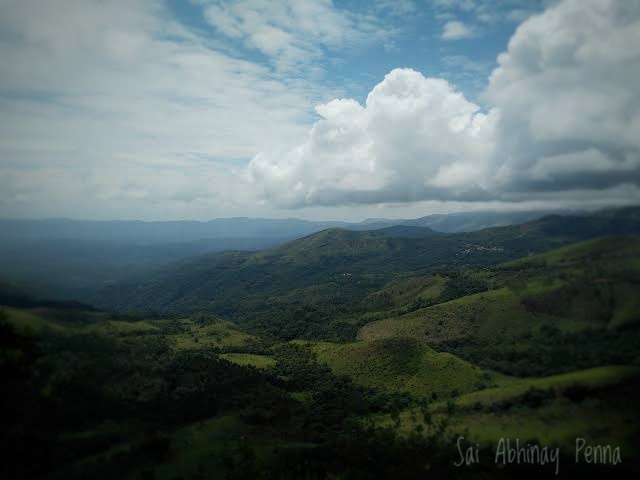
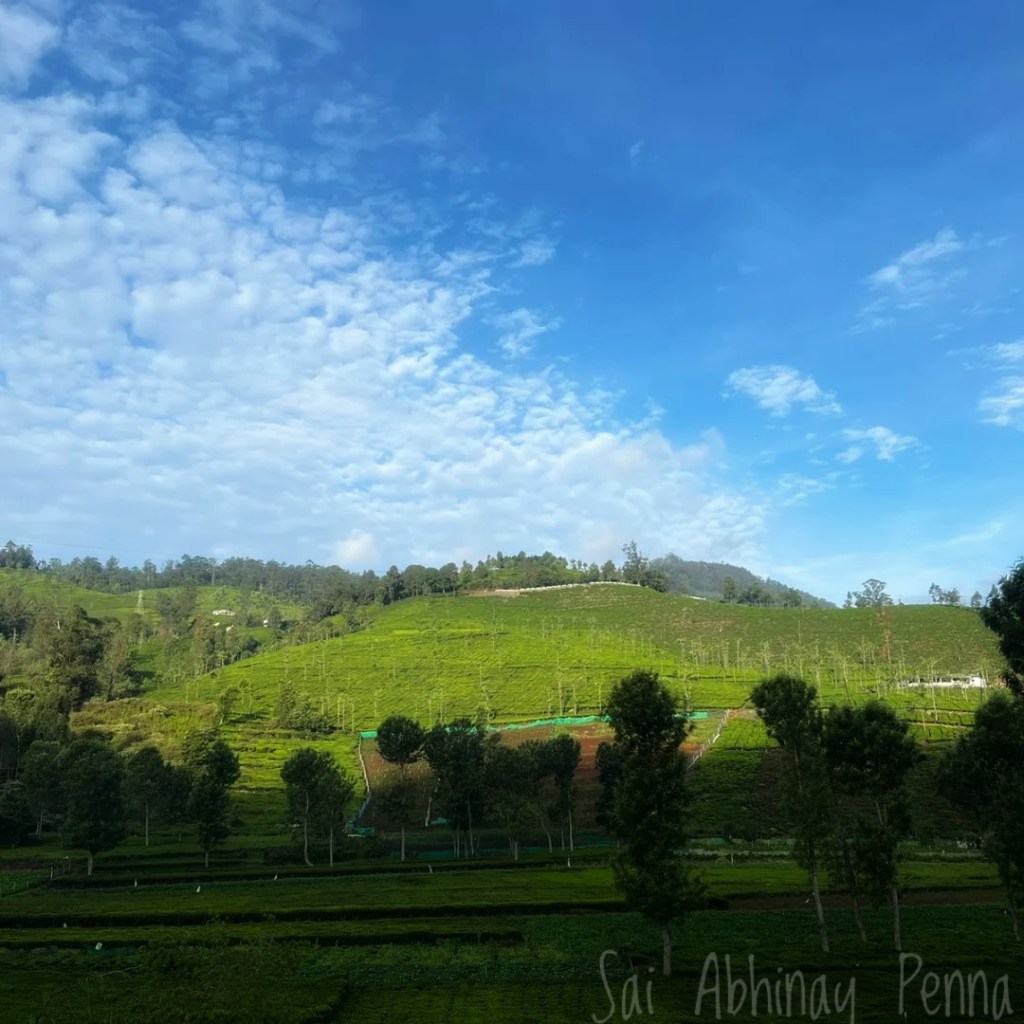
As the first rays of the morning sun arose from beyond the distant hills, their gentle touch painted the sky with hues of warm gold, igniting a symphony of colours that kissed the vast canvas of the mist-laden valleys of Chikmagalur.
Mist laden valleys of Shishila
Veiled within the ever-shifting embrace of the drifting clouds, the resolute peaks of the Kudremukh Mountains played a tantalising game of hide-and-seek with the heavens. Each passing moment held the promise of a fleeting revelation as I embraced nature’s games.
Shishila Valley
All at once, like an artist’s brushstroke on nature’s canvas, the Shishila Valley appeared from its shroud — a spectacle sending a shiver of awe through my being.
As I walked through the winding paths lined with coffee plantations, the rich aroma of the beans seemed to be woven into the very fabric of the place and filled the air to the brim. The scent, as I stepped through the intricate trails of the estate, thrilled the heart of a coffee maven like me.
Coffee plantations with varied shades of green
The emerald leaves of the coffee plants glistened with dewdrops that captured the sun’s rays, resembling precious gemstones. Each step was an immersion into a world where nature’s palette had painted every hue imaginable.
From the coffee plantations, I trekked through the unexplored trails of the long-lost Ballalarayana Fort built in the twelfth century. In the heart of the wilderness — I found myself surrounded by the rhythmic symphony of the forest.
Ballalarayana Fort trail
The dense vegetation enveloped me like a shroud of mystery, and the air carried the earthy scent of history as if the very soil held the secrets of generations. The crumbling stones and weathered walls of the fort emerged from the undergrowth, standing as silent witnesses to the passage of time. Here history seemed to come alive, the stones carrying the burden of stories now carved into every crack and crevice.
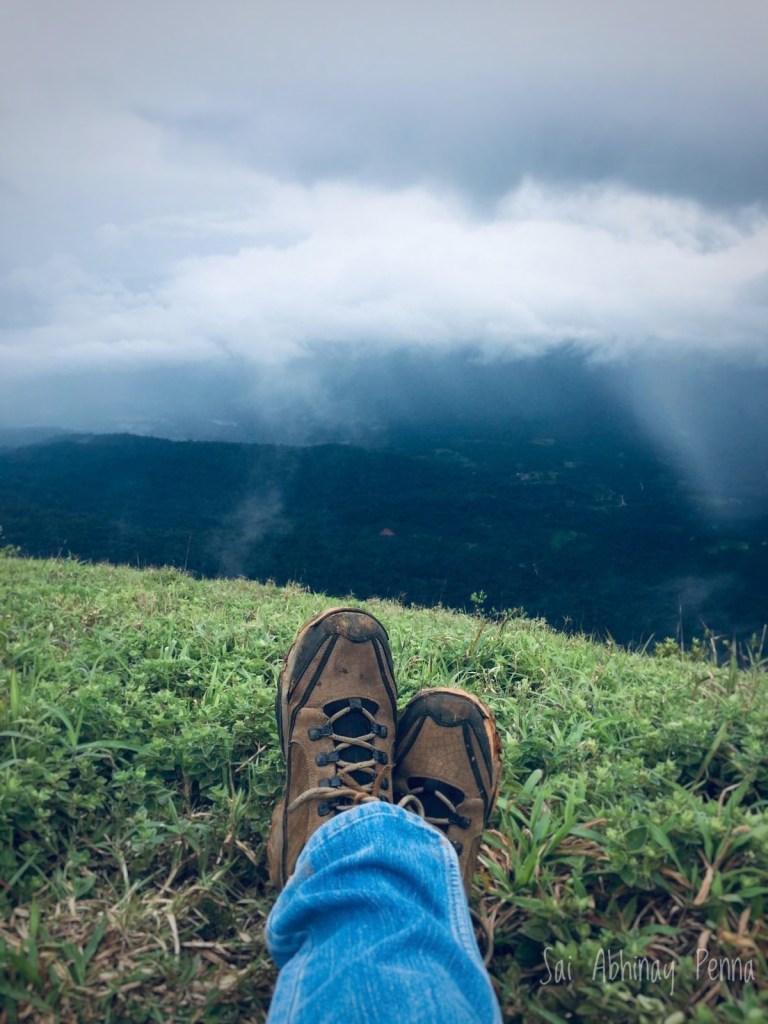
As I ascended the rugged trail, the panorama that unfolded in front of my eyes was breath-taking. Rolling hills, verdant valleys, and mist-shrouded peaks stretched out in every direction — the lines between earth and sky were thin. I felt like I was one among the clouds.
The feeling of being suspended in this vast expanse was humbling and revitalizing.
Descending from the highest peak of Karnataka, I ventured into Baba Budangiri, the sacred mountain with its mystical aura that captivated me to surrender myself to its embrace.
The shrine of Dattagiri, nestled atop the hills, stood as the tangible proof of the spiritual sanctity of the place. A small conversation with the priest from the Dattagiri shrine opened my eyes to the history behind this place. The shrine has been made to resemble a meeting place between Sufism and the Hindu Avudutha tradition.
As I humbly paid my respects, the echoes of devotees’ chants intertwined with the tranquil symphony of nature, weaving an ambience of enlightenment that seemed to touch the very soul of the surroundings.
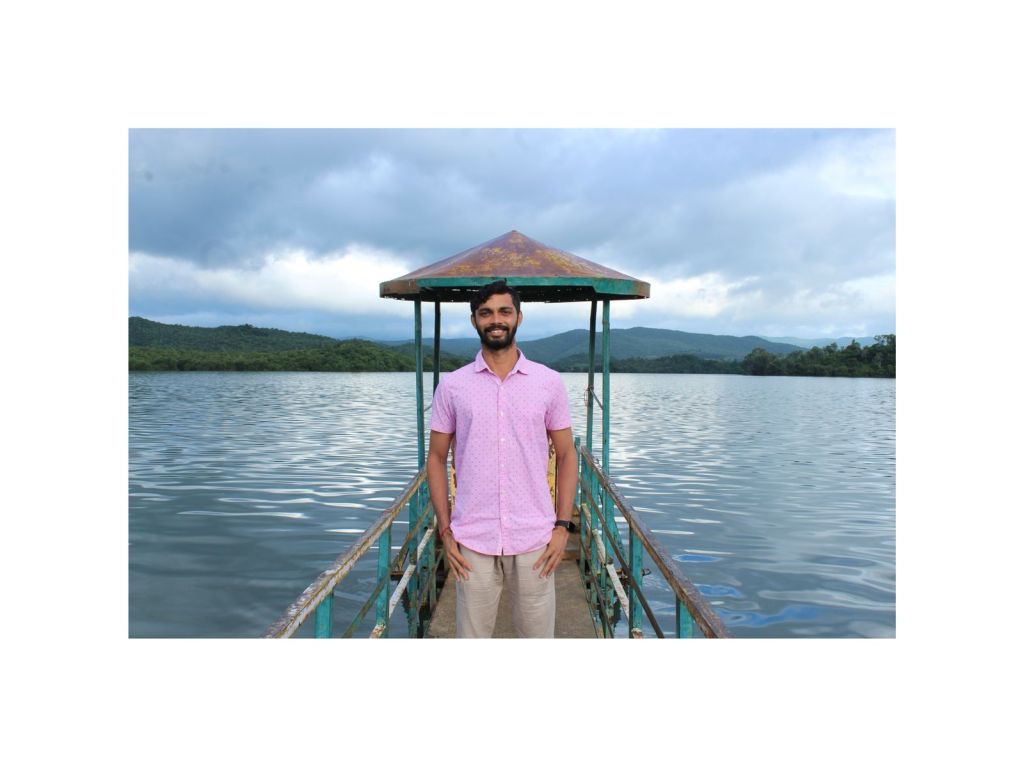
The lake’s surface transformed into a canvas of reflection, capturing the heavens above as if they had found their home in its depths. Hirekole Lake in the evenings was a sanctuary of tranquility, a haven; where the world seemed to hold its breath, inviting me to step away from the rush of life and savour the sheer magic of the present moment.
The author at the lake. Photo provided by the author
The ambience was one of unhurried contentment as if time had chosen this place to slow its pace, allowing all the on-goers to submerge into that beautiful moment.
As I navigated the winding pathways through the dense woods, my anticipation grew with every passing curve. The whispering leaves and dappling sunlight seemed to guide me toward the elusive waterfall, the Hebbe Falls.
As I walked towards the waterfall, the distant murmur of cascading water gradually intensified, and it felt like a symphony of nature’s melody in my journey. Nature’s music, I must say.
Finally, as the foliage parted, I beheld the spectacle: a magnificent cascade of glistening white that descended like a celestial curtain. The mist kissed my skin, carrying the essence of the falls, and I couldn’t help but marvel at the timeless masterpiece sculpted by nature’s patient hand.
Hebbe Falls
In a final blaze of glory, the sun slips beneath the edge of the Shishila Valley, leaving behind a trail of stars, a full moon, and a sky that glows with the memory of its fiery embrace.
As the star-studded canopy, a symphony of crickets and the soft murmur of rustling leaves painted the air with an orchestration of nature’s melodies. It was as if the very fabric of the night had come alive, crafting a captivating masterpiece for my senses.
A myriad of stars shimmered like diamonds carelessly strewn across the inky canvas. The mountains stood as solemn sentinels, their peaks silhouetted against the night sky, seemingly whispering secrets to the heavens. A gentle breeze carried whispers of pine and earth, infusing the air with an invigorating freshness, and the faint fragrance of wildflowers lingered, an exquisite freshness that filled my lungs.
In the embrace of Chikmagalur’s undulating hills, veiled valleys, calming lakes, and tranquil panoramas, I uncovered a profound truth: the odyssey that stretches beyond familiar vistas is not merely a voyage of the body but a stirring expedition of the soul.
.
Sai Abhinay Penna is a professional cricketeer and writer based in Chennai.
.
PLEASE NOTE: ARTICLES CAN ONLY BE REPRODUCED IN OTHER SITES WITH DUE ACKNOWLEDGEMENT TO BORDERLESS JOURNAL
Because Indian food is the best in the world, as everyone knows, a scientist who worked for an educational institute on the outskirts of Bangalore once tried to devise a method of ensuring there was more of it. The more the better, was his motto. His attempts to construct a machine that would multiply chapatis, vadas, dosas, idlis and bowls of curry failed, for it turned out to be impossible to create new matter from nothing — thanks to the physical laws of the universe. But this scientist wasn’t a man to be so easily discouraged. Where there’s a will there’s a way, was his other motto. He had two mottos, just as he had two arms, two legs, two eyes and a pair of spectacles on his nose.
He thought of a way he could get around the particular law of physics that had sabotaged his first plan. Instead of multiplying the food in order to increase the amount available, why not shrink the eaters instead? A man or woman the size of a thumb would be confronted with chapatis that were like islands, vadas like boulders, bowls of curry like the craters of active volcanoes. Yes, that was the best solution. He got to work on it right away and he even stayed late in his makeshift laboratory at the institute and ignored all phone calls from his parents, who wanted to know when he was going to marry a nice girl, or failing that, any girl at all. He was wedded to his experiments.
At last, he chanced on a viable method of shrinking people to a specific size. He celebrated by going home and sleeping for three days. When he awoke, a wide smile on his face, he knew that finding volunteers would be fairly easy. He placed an advertisement in a local newspaper, and it wasn’t long before people began contacting him. He would pay them a small honorarium for taking part in the trial run and they would be allowed to eat as much food as they wanted. So many applicants contacted him that he was overwhelmed, and he had to declare that the offer was over. No more volunteers were required. He had two suitable candidates and wanted to use them immediately.
Pawan Kumar and Shruti Patil were both at loose ends, like pieces of string that knew knot what they had let themselves in for. That’s a pun, but neither one of them cared for wordplay. Pawan was an auto driver and Shruti worked as a maid in a gated community. Neither were gluttons but it must be admitted that they hadn’t had a notable feast for a long time. They jumped at the opportunity that the scientist offered. And in case you are wondering why this scientist has remained nameless so far, it’s because after what happened he preferred to stay anonymous for all time, and we must respect that.
Pawan had found a copy of the newspaper left by a passenger on the back seat of his auto, and Shruti had found one stuffed into the bin that she took out of the apartment she was cleaning. Both had paused for less than one minute in order to read the advertisement. This was a happy chance, if chance can ever be said to be truly happy and isn’t faking it, and then and there they had decided to plunge headlong into this new adventure. They were perfect volunteers, in other words, without a twinge of anxiety between them.
The scientist said, “Are you sure?”
They both nodded in agreement, bemused that he should seem more nervous than they were. All they were risking was their existence, but he was risking his entire career, and success in this unfortunate world is often held to be more important than life itself. He continued, “There might be complications, but I don’t think it is likely. I just want you to be aware.”
They were aware, fully so, and he ought to worry less.
“So be it,” he said dramatically.
It’s still a trade secret as to how he shrank them from ordinary sized people to miniature versions of themselves, so I am unable to describe the machine he used and the green rays it beamed on them from a series of crystal lenses all of which were carved into different shapes that were offset polyhedra, and even the copper coils and capacitors and diodes as big as cucumbers must be passed over in discreet silence, nor can I say how the whole contraption was powered by an array of solar cells on the institute’s roof.
Pawan and Shruti found themselves diminishing rapidly but that’s not how it seemed from their perspective. It appeared to them that the outside world was expanding, rushing to inflate itself, and the effect was so startling and alarming that they clung to each other for comfort, despite the fact they hardly knew each other, and their parents didn’t know each other either. This embrace also helped them to keep their balance as they rushed down the scale until they were almost exactly the size of the scientist’s thumbs.
The scientist spoke and his voice was so deafening that it boomed like the thunderclaps that sometimes echo from the crowded buildings of Bangalore and rumble down the streets before fading. They understood none of his words and it was a minute before they could gather their wits to act on their own initiative. He had simply said, “Please begin eating.”
He had picked them up and was lowering them on a long table that groaned with the amount of food it held. He was careful not to squeeze them too tightly. Then he released them, and they wandered in utter amazement among the plates, bowls, dishes and banana leaves, all heaped with delicious foodstuffs. The idea that they should devour this landscape seemed as absurd to them as any resident of Mysore supposing he can munch his way through the Amba Vilas Palace. It was too overwhelming, far too miraculous.
The scientist now clapped his hands impatiently. “Come, come, tuck in, I don’t have all day. Let’s see what happens!”
But his voice was still too low in pitch for their tiny ears to hear anything more than an incomprehensible booming. That was of no importance because the mission that had been assigned to them was plain. They had to eat as much as they liked in the time available to them.
It never occurred to Pawan or Shruti to ask whether the miniaturisation was permanent, and in fact even the scientist didn’t know if the effects would wear off naturally, or if he might find it necessary to try reversing the polarity of his machine in the hope it would restore them to their former size. But they had full faith in his competence and began nibbling at tasty objects that were in their vicinity. They were only a little cautious.
Soon they grew confident, then became joyous. They bounded between dishes and plates, climbed mounds of sweet and savoury foods, waded through curries, cavorted among the vegetables.
In the meantime, a reporter from the newspaper was on his way to the institute on the outskirts of Bangalore to find out why this scientist needed the volunteers he had asked for. The reporter smelled a story in the making. When he entered the building, after showing his press credentials, and approached the laboratory, he smelled something beyond a story. It was a banquet! He rapped on the door with his knuckles and cried: “Good afternoon, sir.”
To which the scientist replied, “Go away! You are disturbing the future of the human race. The door is locked.”
“I merely wish to interview your volunteers.”
“They are far too small to answer your questions. You must depart now. I will have you ejected from the premises if you refuse to leave of your own free will. The volunteers can’t understand your words, no matter what language you speak. They are cavorting on the table.”
“How so? You mean that they are monkeys?”
The scientist cursed at this.
The reporter struggled to see anything coherent through the frosted glass of the door. All he could make out was the shape of the banqueting table, which at this distance was like an operating table, and parallel rows of foodstuffs, which to him looked like an array of gadgets. The scientist stood with a spoon ready to serve rice onto plates and to the reporter it seemed he was clutching a surgical instrument that could probe brains.
“Is he brainwashing monkeys? Turning them into robots or assassins! I will write an article about this scandal.”
And he dashed out of the institute building as fast as he could run. During this rumpus, Pawan and Shruti had gained even more confidence. They started to eat with gusto and passed from dish to dish like explorers among the ruins of an ancient civilisation, taking morsels from every alluring display. Most of this food was from Karnataka but not all.
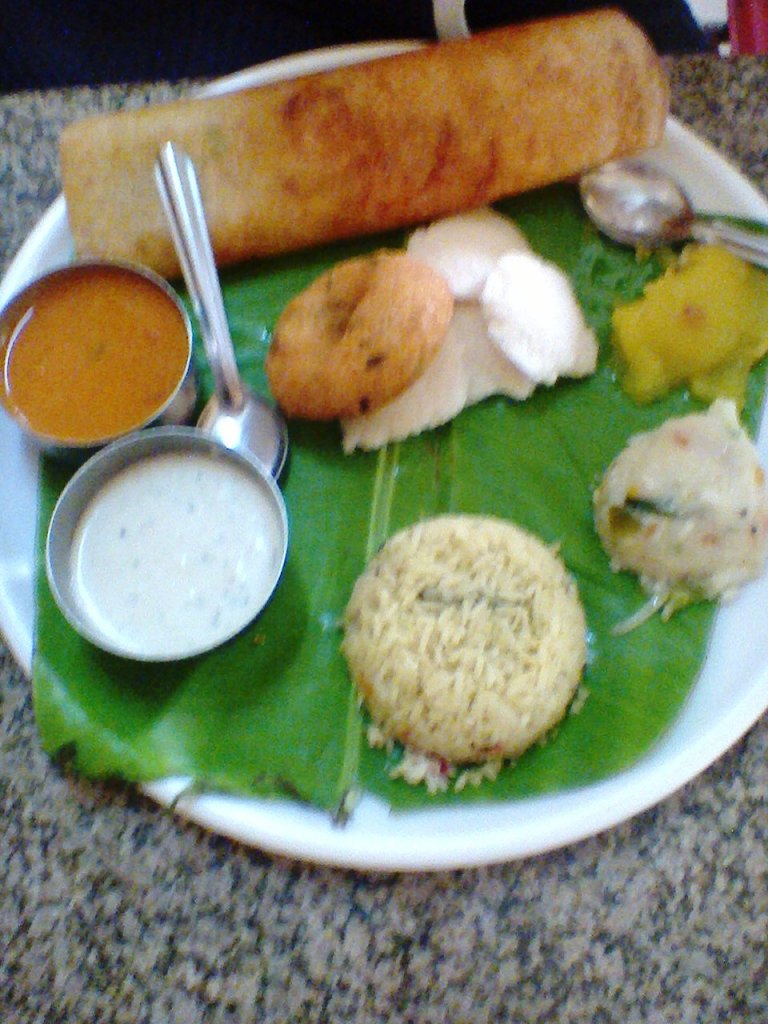
They chewed and swallowed bisi bele bhath, maddur vada, Dharwad peda, akki roti, saagu, upma, ladoos, three variants of idli, namely thatte idli, rava idli and Muday idli, churumuri and many other typical foods. They were soon full, but they continued eating, more on aesthetic grounds than from physical need. It was like a chain reaction. They would keep going until something exploded and that something would be their bellies.
But now something strange happened, and the simple adventure became a much more complex and tricky exploit. Pawan found a paper dosa, a very long and crispy example, and it had been rolled into a tunnel and he peered into the mouth of the tunnel and he was baffled.
“The landscape on the other side of the tunnel looks different,” he said to Shruti with a frown. “Come and see.”
She did so and she was no less astonished.
“There’s a garden there.”
“Yes, there is, and it makes no sense.”
A dosa with a tunnel. Courtesy: Creative Commons
They exchanged meaningful glances, but the exact meaning was unclear to both of them. Nonetheless they tingled with anticipation and Pawan gave into temptation and suggested they walk together through the dosa tunnel in order to see what the far side might actually be like.
Have you ever walked through a dosa yourself? It is surely an odd feeling. They stumbled on the batter, which yielded too readily to their feet, cracking a piece off here and there, but soon enough they emerged from the exit. And what they saw was remarkable. They were no longer on a table in a laboratory in an institute on the outskirts of Bangalore.
Pawan and Shruti were unworldly people and had never heard of the myth of the Garden of Eden, but that’s what they found on the other side of the magic dosa. There are some special points in our world that are portals to other worlds and if you step through them, you will end up in that new dimension. They saw that the garden was full of trees, but the trees had gulab jamuns hanging from the branches instead of fruits. Gulab jamun trees! Was that even possible? Clearly, yes it was, here in this incredible place.
Gulab Jamuns. Courtesy: Creative Commons
As they strolled deeper into the garden, enchanted by the sights, they took slightly diverging paths and ended up alone. Shruti stopped by a tree and despite the fact she was full, she reached up to pluck a gulab jamun that glistened most invitingly just above her head. And that’s when the snake appeared. It slithered down from the top of the tree and said:
“You are allowed to eat the sweets from any tree in the garden with the one exception of this tree, which is the tree of knowledge. But I think you should be a rebel and eat it anyway. Why not?”
The snake had the voice and face of the scientist.
Shruti pouted at him.
“Because that would be greedy,” she said.
“Don’t be so timid!”
“Knowledge is overrated. You have plenty of knowledge and what has it done for you? Turned you into a snake.”
“Don’t say that. I am an intellectual benefactor.”
“You eat it then.”
And she held out the gulab jamun for him.
He hissed and swayed in annoyance, his forked tongue flicking, but at that very moment Pawan came over to see what the fuss was about, and he shook his fist at the snake and warned him: “I am an auto driver. I often have passengers like you. I will throw you out of the garden if you don’t behave.”
The snake continued hissing angrily but it slid away and they still don’t know where it went because they have never seen it again. Meanwhile, the scientist mysteriously disappeared from the laboratory and the only theory that explained his vanishing was that he had turned the rays of his own machine on himself and shrunk down to a dot and then to an atom.
But why would he do that? Nothing made sense any longer. Pawan and his wife, Shruti, still live in the garden beyond the dosa, and because all the food in the laboratory has been taken away, there is no way for them to return to the real world. They don’t care about that. They are satisfied where they are. They keep the gulab jamun of knowledge safe and maybe one day they will take bites from it. But they are in no rush to do so.
The reporter wrote his story about monkey robots and assassins, but it was never published because his editor thought he had gone mad. He was told to take a week off work and go on holiday. He went but never returned. Searching for him proved futile but rumours persisted of a monkey on the coast who liked to read the newspaper as if he understood the words. Probably some sort of coincidence. The world is stuffed full of them.
.
Rhys Hughes has lived in many countries. He graduated as an engineer but currently works as a tutor of mathematics. Since his first book was published in 1995 he has had fifty other books published and his work has been translated into ten languages.
.
PLEASE NOTE: ARTICLES CAN ONLY BE REPRODUCED IN OTHER SITES WITH DUE ACKNOWLEDGEMENT TO BORDERLESS JOURNAL
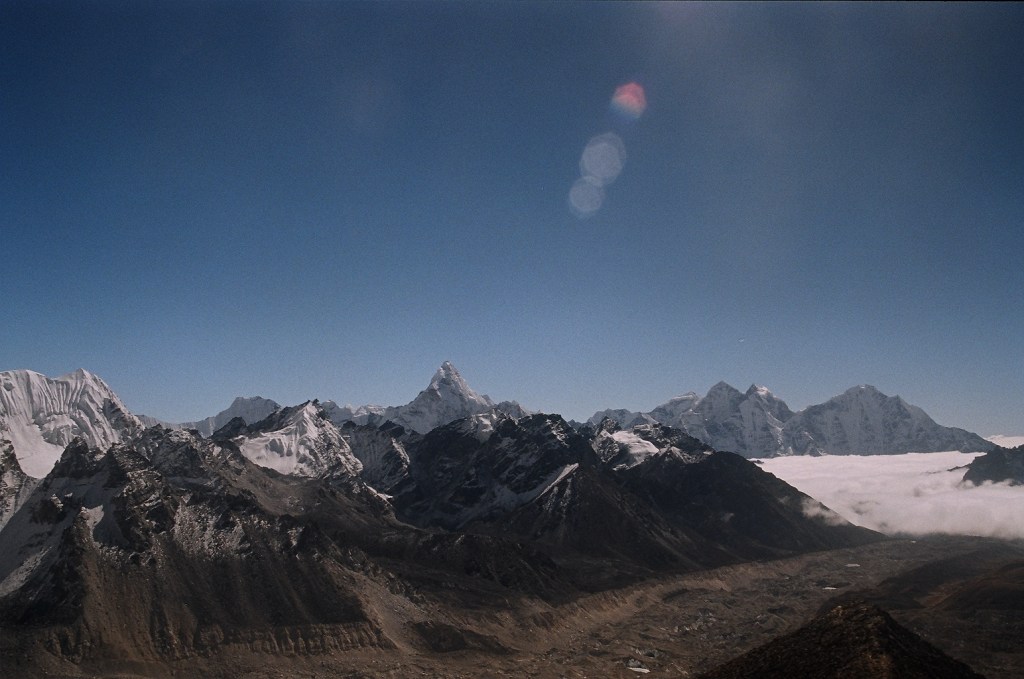
The Magnificent Himals… Photo courtesy: Ravi Shankar
The windows were getting misty. Outside it was freezing cold and rainy. However, the cast iron heater kept the dining room hot and toasty. We were enrolling trekkers/hikers for a study on high altitude. The Himalayan Rescue Association (an organisation catering to the health needs of trekkers, mountaineers, and the local population) conducts various studies in high altitude locations in Nepal. These studies are usually conducted during the peak trekking and mountaineering seasons in spring and autumn. The participants (trekkers) were enrolled either at Pheriche or at Dingboche, in the Everest region of Nepal. We had just finished dinner and were discussing the how the studies were going. We were happy. The room was warm, our stomachs full and the company interesting. The owner of the lodge, Nuru Sherpa often joined us. Other trekkers were seated at neighbouring tables and could join in. The atmosphere was relaxed and friendly. Our study leader had brought dried apple cider sachets from California, that could be reconstituted with warm water. The apple cider was delicious.
Pheriche had been originally a yak pasture situated at a height of 4300 m in the Everest/Khumbu region of Nepal. There are several place names ending with ‘boche’ in this region. ‘Boche’ means a flat land seen from a hilltop. In this mountainous region a plateau like area is a rarity. As tourism developed in the Khumbu, several lodges were constructed. Pheriche however, is mostly overcast and windy. Most trekkers prefer to stay in Dingboche, 150 m higher on the other side of the hill. The place is higher but gets more sunshine and is warmer.
The research team had split with two of our colleagues staying at Lobuche uphill at 4900 m. We had flown to the Tenzing-Hillary airport at Lukla and then hiked uphill acclimatizing along the way. There is a 700 m ascent between Pheriche/Dingboche and Lobuche and different studies have been done on this stretch of the trail. The Himalayan Rescue Association runs an aid post at Pheriche to provide medical treatment to trekkers, guides, porters, and locals. The post was established in 1973 and has seen extensive upgrades. It has been equipped with oxygen concentrators and has the ability to manage most cases of altitude sickness. The doctors volunteering at the clinic have been giving talks on staying healthy at high altitude every afternoon. We attended these talks, which even helped to recruit trekkers for our study. Later, we would hike uphill to Dingboche and visit the trekkers staying at different lodges. Even in 2007, Dingboche had more than twenty-five lodges spread out along the trail.
We were staying at the Himalayan Hotel in Pheriche. The hotel was run by Nuru Sherpa from Kunde who had studied interior design in Karnataka, India. The rooms were cozy but cold. In the tea houses (lodges), only the dining room is heated during the evening and sometimes during the morning hours. The lodge had squat toilets and Nuru used to mix some kerosene in the toilet water to prevent it from freezing. I saw a recent photo and the lodge has been expanded and now has private rooms with attached western-style toilets. There has been a lot written about toilets at trekking lodges. Some are luxurious, western-style flush toilets while others are just a hole in the ground. Most do not have a sewage system and the environmental consequences may be high. Lobuche had a terrible reputation for its toilets and was widely known as the armpit of Nepal. Things have improved significantly since then.
Most lodges have a greenhouse where you could sit, and lounge comfortably protected from the wind during the day. We used to take full advantage of the greenhouse. As the temperature inside was significantly higher, we could sit in our T-shirts. This was a great luxury in this cold and windy locale. Pheriche is often used as an acclimatisation stop by trekkers before heading higher. The hotel had a good collection of books and we used to spend hours in the greenhouse reading and chatting. People came and went but we stayed on. Staying put in a place in constant flux was a strange experience. Days coalesced into weeks and weeks into a month.
Pheriche had suffered damage during the earthquake of 2015 and rebuilding was mostly by local efforts. Today there are internet and phone services and websites allowing you to book lodges in advance. In the 2000s, you had to book the rooms physically. The lodge owners sometimes used satellite phones to access the internet, but it was expensive. During the peak trekking season in the fall, the lodges could get incredibly crowded. The global pandemic has negatively impacted tourism, and the economic consequences have been bad. Lodge owners often take loans at high-interest rates to renovate and expand their facilities and if the number of tourists drop, they can easily go into debt.
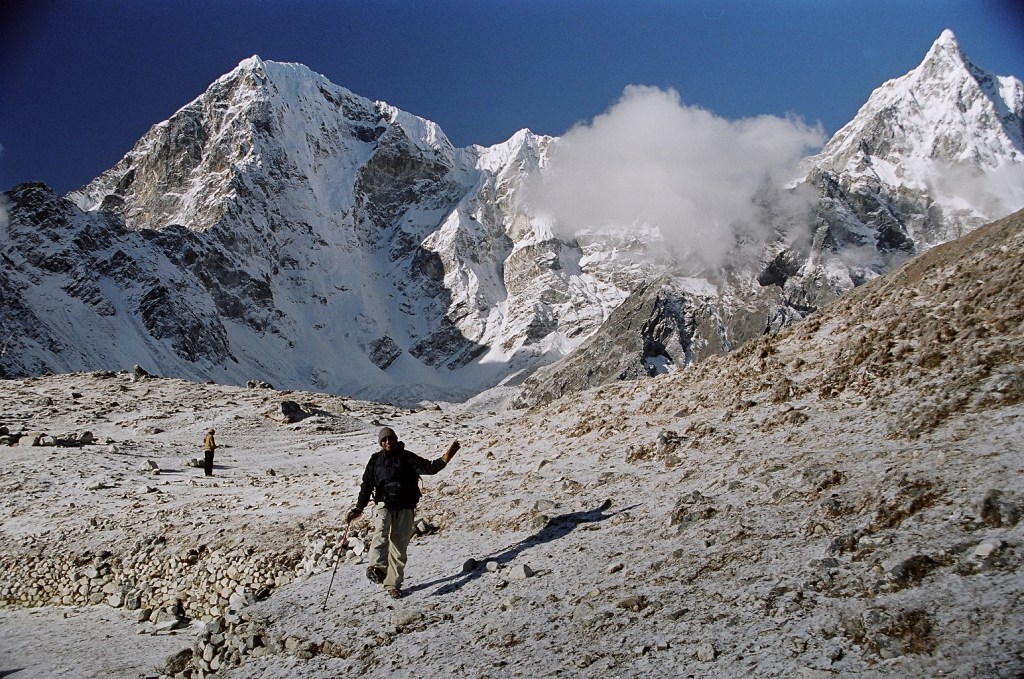
The landscape was barren with a few shrubs struggling to grow in the high altitudes. There are spectacular mountain views from around Pheriche. These are among the tallest mountains in the world at over 7000 m. Pheriche and Dingboche are over 4000 m. The village of Pheriche is on the banks of the Tsola river. The wind roars across the valley and clouds, rain and snow follow. Tibetan Buddhism is dominant and mani walls inscribed with Lamaist prayers and cairns of towers of rocks are scattered all around. Prayer flags send the Buddhist law riding on the wind. On a sunny and warm day, the land is at peace and a hike through this landscape is enchanting. However, at these altitudes, the weather can change rapidly. As you climb towards Dughla and Lobuche, there are spectacular mountain views. There is a memorial to those who have died on Everest as you climb out of Dughla. There are a variety of memorials to climbers in this region. There is one on the grounds of the Pheriche hospital/aid post.
Memorials to climbers… Photo Courtesy Ravi Shankar
Sherpas are the inhabitants of the Khumbu and have earned an enviable reputation as mountain guides. Sherpas originally migrated to Nepal from Tibet several centuries ago. Namche Bazar is the unofficial capital of Sherpa country. Potatoes play an important role in Sherpa cuisine. The introduction of the potato from the South American Andes made settled life possible in many mountain regions globally. Potatoes are used in several ways. Rikikur (potato pancake) is a breakfast staple. There is a small restaurant by a waterfall serving potato pancakes called rikikur on the hike to Namche Bazar. You wait and enjoy the scenery as your pancake is freshly prepared. A spicy chili sauce is a usual accompaniment. There is a type of red round chili grown in the Himalayas called dalle khursani or jyanmaara (life-taker) khursani. The chili is extremely spicy and can literally take your life away, hence the name.
The Khumbu region at an average height of over 3500 m is one of the most spectacular on the planet. Getting there may not be easy, and you need to plan your journey properly. Acclimatization is important. Compared to other treks in Nepal this is more expensive and has a risk of altitude sickness. However, the spectacular views of the highest mountains on earth cannot be matched elsewhere. Things have certainly changed with the advent of cell phones and the internet. Roads have also made steady inroads in the surrounding regions. In the good old days, there were no roads in Nepal outside the Kathmandu valley and the early Everest expeditions used to start their walk from the outskirts of the valley. It used to take well over a month to reach the Khumbu region.
Hopefully, the pandemic will stay controlled. This will allow us to hike this autumn in the Khumbu region and enjoy Sherpa culture, religion, fresh air, cold winds, and the spectacular mountains!
Fun in the snow… Photo courtesy: Ravi Shankar
N.B: We miss our friend Dr Ashutosh Bodhe who accompanied us on several treks. He passed away in 2021. His raw energy and passion for life will be missed!
Dr. P Ravi Shankar is a faculty member at the IMU Centre for Education (ICE), International Medical University, Kuala Lumpur, Malaysia. He enjoys traveling and is a creative writer and photographer.
.
PLEASE NOTE: ARTICLES CAN ONLY BE REPRODUCED IN OTHER SITES WITH DUE ACKNOWLEDGEMENT TO BORDERLESS JOURNAL








 Borderless