Categories
World Poetry Day

What is Home?

Celebrating poetry around the world, our focus this year is on refugees, immigrants or poetry by migrants… In a way, we are all migrants on this Earth and yet immigration for both climate and war has created dissatisfaction in the hearts of many. Can mankind unify under the single blue dome which covers all our home?


“The Journey” by Alwy Fadhel, an asylum seeker to Australia. The piece is included in the Exile collection of the Refugee Art Project. Art from Public Domain.

We start by welcoming migrants from Jupiter but how do we react to human migrants within Earth… ?

All the Way from Jupiter

By Rhys Hughes

All the way
from Jupiter came the refugees,
their heads
made of hydrogen,
and helium, their knees.
No one cried:
depravity!
for we were pleased
to help them
relocate to Earth: we offered
them homes
inside plastic domes
uncrowded but
full of swirling clouds
blown by the music of
fierce trombones
to mimic the crushing gravity.

All the way
from one of our homegrown
war zones
came refugees on their knees
and we said:
no, no, no, and no again!
Go back home right now,
be killed,
assaulted,
it’s all your own fault
for being born here on Earth.
The newcomers
from Jupiter are tubular
like cucumbers,
but men, women and children
like yourselves
aren’t welcome.

And what do refugees from war-torn zones on Earth have to add?These are poems by those who had to escape to safety or move homes for the sake of conflict.

I am Ukraine brought to us by Lesya Bakun, while she was on the run from her home to a place of refuge outside her homeland. Click here to read.

Immigrant’s dream brought to us by Ahmad Al-Khatat, who migrated from Iraq to the West to find sustenance. Click here to read.

In some cases, the wounds lingered and the progeny of those who escaped earlier conflicts give voice to past injuries as well as some immigrants who wandered to find a better life share their experiences.

In 1947, Masha Hassan writes of her grandmother’s plight during the Partition of the Indian Subcontinent. Click here to read.

Bringing along their homeland by Abdul Jamil Urfi talks of immigrants from Lahore in Delhi in the 1960s. Click here to read.

Stories Left Unspoken: Auschwitz & Partition Survivors by Cinna give us stories of people who moved for wars and politics. Click here to read.

A Hunger for Stories by Quazi Johirul Islam, translated from Bengali by Professor Fakrul Alam, gives a migrant’s saga. Click here to read.

Reminiscence by Mitra Samal reflects on an immigrant’s longing for her home. Click here to read.

Finding the Self in Rooted Routes by Isha Sharma explores at an individual level the impact of immigration. Click here to red.

Birth of an Ally reflects Tamoha Siddiqui’s wonder with new flavours she experiences away from her original homeland. Click here to read.

Two Languages by Luis Cuauhtémoc Berriozabal explores linguistic diversity in immigrants. Click here to read.

These could be listed as turns of history that made people relocate.

Red Shirt Hung from a Pine Tree by Ryan Quinn Flanagan takes two issues into account — violence against humanity and colonial displacement of indigenous people — is that migration? Click here to read.

Products of War by Mini Babu talks of the displacement of humanity for war. Click here to read.

This Island of Mine by Rhys Hughes reflects on climate disaster. Click here to read.

Some empathise with those who had to move and write of the trauma faced by refugees.

Migrant Poems by Malachi Edwin Vethamani reflect on migrants and how accepted they feel. Click here to read.

Birds in Flight by A Jessie Michael empathises with the plight of refugees. Click here to read.

The Ceramicist by Jee Leong Koh records the story of a migrant. Click here to read.

And some wonder about the spiritual quest for a homeland… Is it a universal need to be associated with a homeland or can we find a home anywhere on Earth? If we stretch the definition of homeland to all the planet, do we remain refugees or migrants?

Anywhere Particular by Wendy Jean MacLean reflects on the universality of homes — perhaps to an extent on nomadism. Click here to read.

Where is Home? by Shivani Shrivastav meditates on the concept of home. Click here to read.

Sparrows, a poem translated from Korean by the poet — Ihlwha Choi — questions the borders drawn by human laws. Click here to read.

 Journey of Hope  by Tagore has been translated from Bengali by Mitali Chakravarty. It explores the spiritual quest for a home. Click here to read the poem in English and listen to Tagore’s voice recite his poem in Bengali. 

Some look forward to a future — perhaps in another galaxy — post apocalypse.

In Another Galaxy by Masud Khan translated from Bengali by Fakrul Alam wonders at the future of mankind. Click here to read.

And yet others believe in the future of humankind.

We are all Human by Akabar Barakzai, translated from Balochi by Fazal Baloch, is a paean to humanity. Click here to read.

We are all Human 

By Akbar Barakzai...

Russia, China and India,
Arabs and the New World*,
Africa and Europe,
The land of the Baloch and Kurds --
Indeed, the whole world is ours.
We are all human.
We are all human...

Click here to read the full poem.

.

PLEASE NOTE: ARTICLES CAN ONLY BE REPRODUCED IN OTHER SITES WITH DUE ACKNOWLEDGEMENT TO BORDERLESS JOURNAL. 

Categories
Contents

Borderless, December 2023

Art by Sohana Manzoor

Editorial

Celebrating the Child & Childhood… Click here to read.

Special Tributes

An excerpt from Rabindranath Tagore’sThe Child‘, a poem originally written in English by the poet. Click here to read.

Vignettes from an Extraordinary Life: A Historical Dramatisation by Aruna Chakravarti… Click here to read.

Conversations

A conversation with the author, Afsar Mohammed, and a brief introduction to his latest book, Remaking History: 1948 Police Action and the Muslims of Hyderabad. Click here to read.

A conversation with Meenakshi Malhotra over The Gendered Body: Negotiation, Resistance, Struggle, edited by Meenakshi Malhotra, Krishna Menon and Rachana Johri and a brief introduction to the book. Click here to read.

Translations

The Monk Who Played the Guitar, a story by S Ramakrishnan, has been translated from Tamil by T Santhanam. Click here to read.

The White-Coloured Book, a poem by Quazi Johirul Islam has translated from Bengali by Professor Fakrul Alam. Click here to read.

Indecisiveness has been written and translated from Korean by Ihlwha Choi. Click here to read.

Tagore’s 1400 Saal (The Year 1993) has been translated from Bengali by Mitali Chakravarty. Click here to read.

Nazrul’s rejoinder to Tagore’s 1400 Saal has been translated from Bengali by Professor Fakrul Alam. Click here to read.

Poetry

Click on the names to read the poems

Ron Pickett, Prithvijeet Sinha, George Freek, Sutputra Radheye, Caroline Am Bergris, Thoyyib Mohammad, Kumar Bhatt, Patricia Walsh, Hamza Azhar, John Grey, Papia Sengupta, Stuart McFarlane, Padmanabha Reddy, Ryan Quinn Flanagan, Jee Leong Koh, Rhys Hughes

Poets, Poetry & Rhys Hughes

In His Unstable Shape, Rhys Hughes explores the narratives around a favourite nursery rhyme character with a pinch of pedantic(?) humour. Click here to read.

Musings/ Slices from Life

Trojan Island

Nitya Amalean writes of why she chooses to be an immigrant living out of Sri Lanka. Click here to read.

Wayward Wayanad

Mohul Bhowmick travels to the tea gardens and hills of Wayanad. Click here to read.

Musings of a Copywriter

In Visiting Cards & Me…, Devraj Singh Kalsi ponders on his perspective on the need and the future for name cards. Click here to read.

Notes from Japan

In Kyoto: Where the Cuckoo Calls, Suzanne Kamata introduces us to Kyoto. Click here to read.

Essays

Peeking at Beijing: The Epicentre of China

Keith Lyons travels to the heart of Beijing with a sense of humour and a camera. Click here to read.

To Be or Not to Be or the Benefits of Borders

Wendy Jones Nakanishi argues in favour of walls with wit and facts. Click here to read.

Where Eagles Soar

Ravi Shankar gives a photographic treat and a narrative about Langkawi. Click here to read.

Stories

Heather Richards’ Remarkable Journey

Paul Mirabile journeys into a womb of mystery set in Thailand. Click here to read.

The Untold Story

Neeman Sobhan gives us the story of a refugee from the 1971 Bangladesh Liberation War. Click here to read.

Wrath of the Goddess?

Farouk Gulsara narrates a story set in 1960s Malaya. Click here to read.

No Man’s Land

Sohana Manzoor gives us surrealistic story reflecting on after-life. Click here to read.

Book Excerpts

An excerpt from Dr Ratna Magotra’s Whispers of the Heart – Not Just A Surgeon: An Autobiography. Click here to read.

An excerpt from Manjima Misra’s The Ocean is Her Title. Click here to read.

Book Reviews

Somdatta Mandal reviews Indian Christmas: Essays, Memoirs, Hymns, an anthology edited by Jerry Pinto and Madhulika Liddle. Click here to read.

Christopher Marks reviews Veronica Eley’s The Blue Dragonfly: healing through poetry. Click here to read.

Basudhara Roy reviews Kuhu Joshi’s My Body Didn’t Come Before Me. Click here to read.

Bhaskar Parichha reviews Permacrisis: A Plan to Fix a Fractured World by Gordon Brown, Mohamed El-Erian, Michael Spence, Reid Lidow 

.

Click here to access the Borderless anthology, Monalisa No Longer Smiles

Click here to access Monalisa No Longer Smiles on Kindle Amazon International

Categories
Editorial

Celebrating the Child & Childhood…

‘Victory to Man, the newborn, the ever-living.’
They kneel down, the king and the beggar, the saint and
the sinner,
the wise and the fool, and cry:
‘Victory to Man, the newborn, the ever-living.’

The Child’ by Rabindranath Tagore1, written in English in 1930

This is the month— the last of a conflict-ridden year— when we celebrate the birth of a messiah who spoke of divine love, kindness, forgiveness and values that make for a better world. The child, Jesus, has even been celebrated by Tagore in one of his rarer poems in English. While we all gather amidst our loved ones to celebrate the joy generated by the divine birth, perhaps, we will pause to shed a tear over the children who lost their lives in wars this year. Reportedly, it’s a larger number than ever before. And the wars don’t end. Nor the killing. Children who survive in war-torn zones lose their homes or families or both. For all the countries at war, refugees escape to look for refuge in lands that are often hostile to foreigners. And yet, this is the season of loving and giving, of helping one’s neighbours, of sharing goodwill, love and peace. On Christmas this year, will the wars cease? Will there be a respite from bombardments and annihilation?

We dedicate this bumper year-end issue to children around the world. We start with special tributes to love and peace with an excerpt from Tagore’s long poem, ‘The Child‘, written originally in English in 1930 and a rendition of the life of the philosopher and change-maker, Vivekananda, by none other than well-known historical fiction writer, Aruna Chakravarti. The poem has been excerpted from Indian Christmas: Essays, MemoirsHymns, an anthology edited by Jerry Pinto and Madhulika Liddle, a book that has been reviewed by Somdatta Mandal and praised for its portrayal of the myriad colours and flavours of Christmas in India. Christ suffered for the sins of humankind and then was resurrected, goes the legend. Healing is a part of our humanness. Suffering and healing from trauma has been brought to the fore by Christopher Marks’ perspective on Veronica Eley’s The Blue Dragonfly: healing through poetry. Basudhara Roy has also written about healing in her take of Kuhu Joshi’s My Body Didn’t Come Before Me. Bhaskar Parichha has reviewed a book that talks of healing a larger issue — the crises that humanity is facing now, Permacrisis: A Plan to Fix a Fractured World, by ex-British Prime Minister Gordon Brown, Nobel Laureate Michael Spence, Mohamed El-Erian and Reid Lidow. Parichha tells us that it suggests solutions to resolve the chaos the world is facing — perhaps a book that the world leadership would do well to read. After all, the authors are of their ilk! Our book excerpts from Dr Ratna Magotra’s Whispers of the Heart – Not Just A Surgeon: An Autobiography and Manjima Misra’s The Ocean is Her Title are tinged with healing and growth too, though in a different sense.

The theme of the need for acceptance, love and synchronicity flows into our conversations with Afsar Mohammad, who has recently authored Remaking History: 1948 Police Action and the Muslims of Hyderabad. He shows us that Hyderabadi tehzeeb or culture ascends the narrow bounds set by caged concepts of faith and nationalism, reaffirming his premise with voices of common people through extensive interviews. In search of a better world, Meenakshi Malhotra talks to us about how feminism in its recent manifestation includes masculinities and gender studies while discussing The Gendered Body: Negotiation, Resistance, Struggle, edited by her, Krishna Menon and Rachana Johri. Here too, one sees a trend to blend academia with non-academic writers to bring focus on the commonalities of suffering and healing while transcending national boundaries to cover more of South Asia.

That like Hyderabadi tehzeeb, Bengali culture in the times of Tagore and Nazrul dwelled in commonality of lore is brought to the fore when in response to the Nobel laureate’s futuristic ‘1400 Saal’ (‘The year 1993’), his younger friend responds with a poem that bears not only the same title but acknowledges the older man as an “emperor” among versifiers. Professor Fakrul Alam has not only translated Nazrul’s response, named ‘1400 Saal’ aswell, but also brought to us the voice of another modern poet, Quazi Johirul Islam. We have a self-translation of a poem by Ihlwha Choi from Korean and a short story by S Ramakrishnan in Tamil translated by T Santhanam.

Our short stories travel with migrant lore by Farouk Gulsara to Malaysia, from UK to Thailand with Paul Mirabile while chasing an errant son into the mysterious reaches of wilderness, with Neeman Sobhan to Rome, UK and Bangladesh, reflecting on the Birangonas (rape victims) of the 1971 Bangladesh Liberation war, an issue that has been taken up in Malhotra’s book too. Sobhan’s story is set against the backdrop of a war which was fought against linguistic hegemony and from which we see victims heal. Sohana Manzoor this time has not only given us fabulous artwork but also a fantasy hovering between light and dark, life and death — an imaginative fiction that makes a compelling read and questions the concept of paradise, a construct that perhaps needs to be found on Earth, rather than after death.

The unusual paradigms of life and choices made by all of us is brought into play in an interesting non-fiction by Nitya Amlean, a young Sri Lankan who lives in UK. We travel to Kyoto with Suzanne Kamata, to Beijing with Keith Lyons, to Wayanad with Mohul Bhowmick and to Langkawi with Ravi Shankar. Wendy Jones Nakanishi argues in favour of borders with benevolent leadership. Tongue-in-cheek humour is exuded by Devraj Singh Kalsi as he writes of his attempts at using visiting cards as it is by Rhys Hughes in his exploration of the truth about the origins of the creature called Humpty Dumpty of nursery rhyme fame.

Poetry again has humour from Hughes. A migrant himself, Jee Leong Koh, brings in migrant stories from Singaporeans in US. We have poems of myriad colours from Ryan Quinn Flanagan, Patricia Walsh, John Grey, Kumar Bhatt, Ron Pickett, Prithvijeet Sinha, Sutputra Radheye, George Freek and many more. Papia Sengupta ends her poem with lines that look for laughter among children and a ‘life without borders’ drawn by human constructs in contrast to Jones Nakanishi’s need for walls with sound leadership. The conversation and dialogues continue as we look for a way forward, perhaps with Gordon Brown’s visionary book or with Tagore’s world view of lighting the inner flame in each human. We can hope that a way will be found. Is it that tough to influence the world using words? We can wish — may there be no need for any more Greta Thunbergs to rise in protest for a world fragmented and destroyed by greed and lack of vision. We hope for peace and love that will create a better world for our children.

As usual, we have more content than mentioned here. All our pieces can be accessed on the contents’ page. Do pause by and take a look. This bumper issue would not have been possible without the contribution of all the writers and our fabulous team from Borderless. Huge thanks to them all and to our wonderful readers who continue to encourage us with their comments and input.

Here’s wishing you all wonderful new adventures in the New Year that will be born as this month ends!

Mitali Chakravarty

borderlessjournal.com

  1. Indian Christmas: Essays, MemoirsHymns edited by Jerry Pinto & Madhulika Liddle ↩︎

Click here to access the content’s page for the December 2023 issue

.

READ THE LATEST UPDATES ON THE FIRST BORDERLESS ANTHOLOGY, MONALISA NO LONGER SMILES, BY CLICKING ON THIS LINK.

Categories
Poetry

A Migrant’s Story

Poetry by Jee Leong Koh

THE CERAMICIST 

For Hong-Ling Wee (arr. 1992)

On a NASA scholarship to map the world,
she walked into a workshop on a whim
to throw a lump of clay on a wheel and feel 
a foggy, quiet, pink, revolving world
evolve into an object of the mind
under the body’s pressure, slight and sure,
and, afterwards, surrender to the fire,
not that of fire, but that of accident,
for a ceramic rocket fallen back
to earth. And this she did, for many years,
living on little, explaining less, until
she was surrounded by the fuselage.
When the towers gashed vermilion and buckled, 
she was alone at home in Union Square.
The noise expanded as it dribbled off
to meet its echo, second detonation
worse than the first report, in summoning
half-buried images of Hiroshima
and Nagasaki. In a foreign mood,
she heard the phone ring and a female voice,
acclimatised but recognisable
as Singaporean, asked for Wee Hong Ling.
She never tires of telling this story, how
the Consulate located her and every
Singaporean within an hour of disaster,
when a black hole opened but was avoided
because a star had called, a star called home.
She never tires of telling this story, which
I now tell you in my own fanciful way,
each iteration also explanation,
the how developing into the why,
why her pitchers, bowls, vases levitate.

(First published in the Quarterly Literary Review of Singapore and collected in Sample and Loop: A Simple History of Singaporeans in America, Bench Press, 2023)

Jee Leong Koh is a Singaporean writer, editor, and publisher living in New York City. His hybrid work Snow at 5 PM: Translations of an insignificant Japanese poet won the 2022 Singapore Literature Prize in English fiction. His book of poems Steep Tea (Carcanet) was named a Best Book of the Year by the Financial Times in the UK and a Finalist by Lambda Literary in the US. Other honours include being shortlisted twice for the Singapore Literature Prize in English poetry for The Pillow Book and Connor & Seal.

PLEASE NOTE: ARTICLES CAN ONLY BE REPRODUCED IN OTHER SITES WITH DUE ACKNOWLEDGEMENT TO BORDERLESS JOURNAL

Click here to access the Borderless anthology, Monalisa No Longer Smiles

Click here to access Monalisa No Longer Smiles on Kindle Amazon International

Categories
Poetry

The Chef

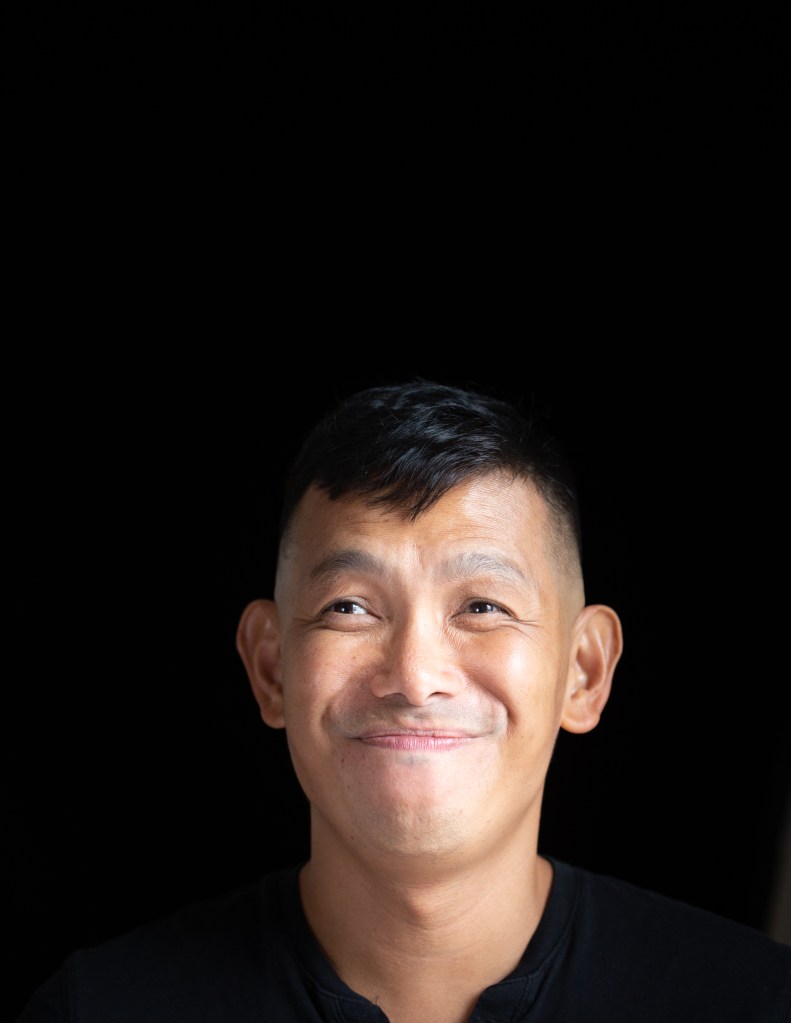
Jee Leong Koh Photo credit Mihyun Kang

By Jee Leong Koh

for Richard Chan (Yummy Tummy, Flushing, New York, March 24, 2019)

Unctuously fried oyster omelet.

Hainanese chicken rice. Sambal fish balls

pierced on a stick, as in the old night markets,

airborne kerosene lamps lisping with a flair.

Mee goreng with sliced fish cake, Chinese sausage

and egg. Bak kut teh spelled the correct way,

the way of memory, for bone meat tea.

And finally, the chef’s very own favorite,

the pièce de résistance, on which he lavished

a fiery, slurry, egg tomato sauce,

the chilli crab, made from Dungeness crabs,

in which we dig with fingers for sweet flesh.

The critics got him wrong. He has not changed

profession. He is still a travel agent.

.

Jee Leong Koh is the author of Steep Tea (Carcanet), named a Best Book of the Year by UK’s Financial Times and a Finalist by Lambda Literary in the US. His latest book is Connor & Seal: A Harlem Story in 47 Poems (Sibling Rivalry). Originally from Singapore, Koh lives in New York City, where he heads the literary non-profit Singapore Unbound.