Categories
Slices from Life

Sleepless in the High Desert, Slumber in the Sierra

Narrative and photographs by Meredith Stephens

Alex and I had completed our road trip from California to Colorado and now it was time to make the two-day drive back along the interminable desert roads.

Every time we stopped, I would try to get into the driver’s side of the vehicle, thinking it was the passenger side. My brain would not adapt to a car with the steering wheel on the left. Once back in the passenger seat, the sun blazed on my temple, so I manoeuvred my visor to cover the right window to block it from penetrating my eyes. It was hard sitting still, so I stretched my legs before me, then slid them beneath me to elevate my height.

“As soon as we hit the Nevada border you will see a casino town,” Alex informed me.

Sure enough, we crossed the border into Nevada from Utah and a town immediately arose from the desert. Alex made a detour into the town to get some fuel.

“Can we drive down the strip?” I asked.

“Sure,” he replied. “Are you hoping to find a hotel here?”

Yes, I thought, but kept my silence. I was too proud to confess that I wanted to stay anywhere near a casino, but I would have welcomed clean sheets and hot water.

I took hold of Alex’s phone and searched for campsites en route, but they all involved deviations that would rob us of precious time.

“We can always stop at a rest area,” suggested Alex.

He searched his phone and found a rest area nestled into a hill, with outdoor tables surrounded by trees. We arrived at sunset and parked the car at the far end, away from other vehicles. We gratefully hopped out, picked up the ice box, and headed for the picnic tables, which we had to ourselves. No sooner had we started anticipating our picnic than we heard the murmur of a refrigerated truck.

“He probably has to keep his engine on to keep the food cool,” observed Alex.

The din was inescapable, so we decided to park back near the entrance to the rest area. I noticed a car parked with sheets draping the windows. Clearly, we were not the only ones seeking sleep in the rest area. Alex parked the car at an angle contrary to the parking lines so that nobody would be tempted to park right next to us. We hauled the icebox to a nearby picnic table to consume our leftovers. Alex proceeded to pour us a glass of wine, and we snacked on sourdough, cheese, avocado, deli meats, and corn chips.

I ate a little too quickly because it was getting late, and I was hungry. It was high desert, so the air was cool, even though it was mid-June. We packed up our picnic and headed for the car, where Alex moved all of our goods to the front seat and made up our bed in the back.

It was nearly 9 pm and we went to bed in the twilight. I revelled in the sensation of the thick flannelette cotton sheets, but I could not slip into a deep sleep. The overhead lights snuck through cracks in the fabric I had put up to cover the window, and the traffic rumbled on the adjoining freeway. Then, a few hours into the night, I heard a clanging outside the car. I peered myopically outside.

“That’s just a dumpster diver,” explained Alex, who turned back to sleep, obviously not too alarmed.

I had never heard that expression before, but I realised that some poor soul was working their way through the bins in the rest area in the wee hours when nobody could see them. I reflected on what I had thrown out after dinner, which had included a nectarine seed, and hoped their fingers did not come into contact with its slime. Then I started worrying whether the dumpster diver would come after us in the night. The next morning Alex explained to me that they were probably collecting cans to sell to a recycling centre. That, at least, was preferable to scrounging around in the bins for food.

We left early the next morning because Alex wanted to show me Lake Tahoe en route to California.

“That reminds me of Lac Leman in Switzerland,” I told him.

“Yes, there’s California on one side, and Nevada on the other. They share the lake.”

We stopped for photos, then resumed our way, winding through snowy mountains, and passing cattle, horses and foals down below. It was a huge relief after the deserts of Utah and Nevada. Then we wound our way through a canyon, following a rushing river, passing through picturesque towns adjoining Yosemite National Park.

“I need a coffee,” lamented Alex, typing ‘coffee shop’ into Google Maps. We entered the town of Columbia, heeding Google’s directions. We were directed down a narrow road through wooded hills. We passed a large car park the size of an oval, much too large for this rolling wooded area. Then Google Maps told us we had arrived. We parked under some shady trees to arrive at a tea shop from another place and time.

We wandered inside. They had a wide range of teas but no coffee, so we took our leave. The voice on Google Maps kept insisting we take a detour, so we followed her urgings past what seemed to be a historical town.

We turned the corner to find the coffee shop Google Maps had been directing us to. We entered and ordered Americano coffee, which despite the 19th-century decor was served in 21st-century paper cups.

We then realised in our quest to find a roadside coffee shop we had stumbled on Columbia Historic Park. The buildings which had been used in the town in the gold rush had been restored and made available to tourists. I wanted to linger in this authentic setting. Unlike a theme park, this was not a re-creation. Alex was worried that we still had several hours driving to go, so we had to resume our journey.

We wound back home through gentle valleys, passing cattle and horses. The sun in my eyes gave me an aura; a circle of lights started appearing in my vision. After 25 hours of driving, we arrived at our cabin at Shaver Lake. I crashed on the sofa, while Alex made a fire. He made up a bed in cotton flannelette sheets in front of the fire, and I rolled onto it from the sofa. What a relief it was to sleep in comfort, in contrast to the person in the rest area scrounging for cans in the wee hours. For us, sleeping in a rest area was a novelty, but for others, it was a way of life.

Meredith Stephens is an applied linguist from South Australia. Her work has appeared in Transnational Literature, The Muse, The Font – A Literary Journal for Language Teachers, The Journal of Literature in Language Teaching, The Writers’ and Readers’ Magazine, Reading in a Foreign Language, and in chapters in anthologies published by Demeter Press, Canada.

PLEASE NOTE: ARTICLES CAN ONLY BE REPRODUCED IN OTHER SITES WITH DUE ACKNOWLEDGEMENT TO BORDERLESS JOURNAL

Click here to access the Borderless anthology, Monalisa No Longer Smiles

Click here to access Monalisa No Longer Smiles on Kindle Amazon International
Categories
Slices from Life

Awesome Arches and Acrophobia

Narrative and photographs by Meredith Stephens

My partner, Alex, has always been enthralled with the natural beauty of the west of the United States, having spent sixteen years studying and working there in his youth. He wanted to share his love of this part of the world with me, so took me on a seven-day road trip from his base in the Sierra Nevada Mountains to Fort Collins in Colorado and back.

“You must see Arches National Park in Utah!” urged Alex’ long-time friend Ryan. “Bryce National Park is worth visiting too.”

Two days later we arrived at Bryce National Park. At first, the scenery was pleasant but unremarkable. I wondered why there were so many tourists and so many cars in the carpark. We donned our raincoats and walked towards the trail to follow the other tourists. It started hailing and I pulled my hood around my face. Thunder and lightning resounded. A tall thin park ranger approached us from the other direction and looked directly at me.

“We advise you to turn around immediately and seek shelter. We have lost ten people in twenty-five years in these weather conditions.”

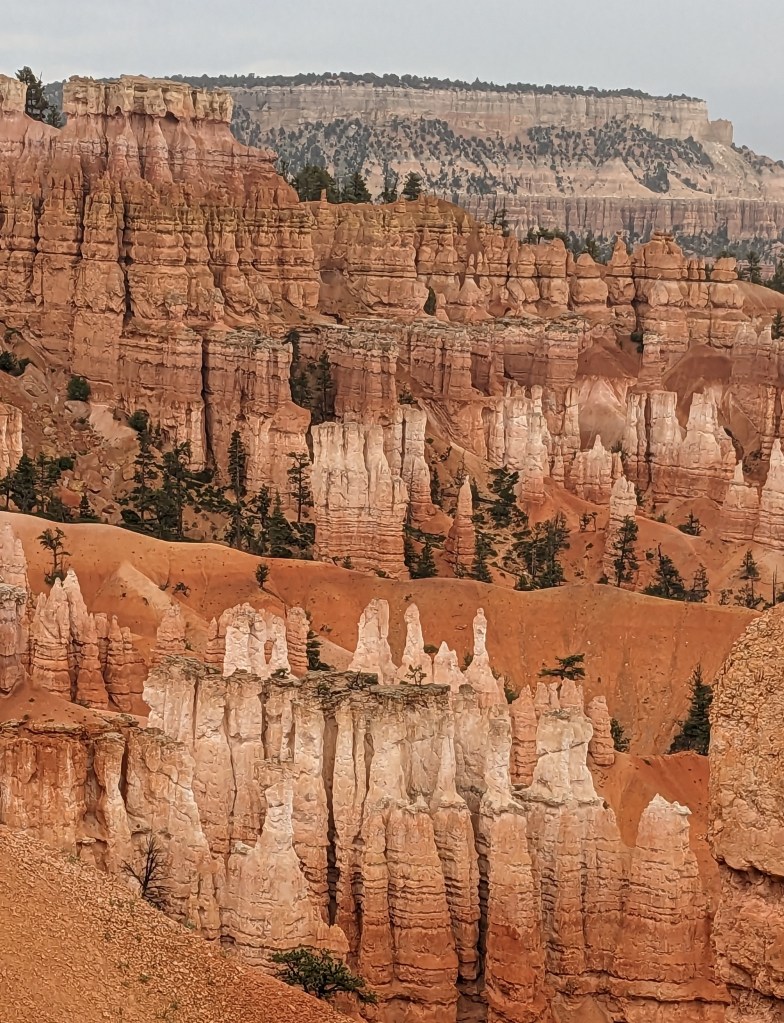
We looked at the brochure to confirm this and read that there had been four fatalities and six injuries. I would have been happy to follow the park ranger’s advice, but we had driven for eleven hours to get there and were too curious to turn back. We started walking towards the Navajo Loop trailhead at Sunset Point. Tourists were posing for photographs at the rim. I wondered what the attraction was and peered over the rim myself. Suddenly, I understood why the site was so crowded.

Navajo Loop

I gingerly placed one foot after another to carefully descend the steep muddy trail. Each time I planted my foot down I held it steadily to ensure I would not slide. A couple approached us from the opposite direction as they ascended the trail.

“We strongly recommend you turn around immediately!” they warned. “It’s treacherous in these muddy conditions.”

Muddy trail

We thanked them, but I continued to gingerly traipse through the mud along the downward trail for a few metres.

“You go ahead,” I urged Alex. “I can’t go any further.”

It continued to hail, and we could hear thunder. I turned around and slowly plodded back up the muddy trail back to the edge of the rim, closely followed by Alex. We contented ourselves with the less slippery 2 km walk along the rim to Sunrise Point and back. Back at the car, we scraped the mud off our shoes, fairly unsuccessfully, and continued our drive to Arches National Park.

The Arches National Park is so popular that visitors have to book through a timed entry system. At 6 pm, when the booking system opened, Alex opened the booking site and secured one of the few remaining availabilities for a 7am entry the next day. He hoped we could also enter just before sunset that day, after 6pm when entry was not timed.

Four-and-a half-hours later we arrived at Arches National Park. The drive had been uneventful along straight desert roads and it had been difficult to force myself to stay awake, as I sat in the passenger seat.

“If we are too tired, we can go straight to our accommodation,” suggested Alex.

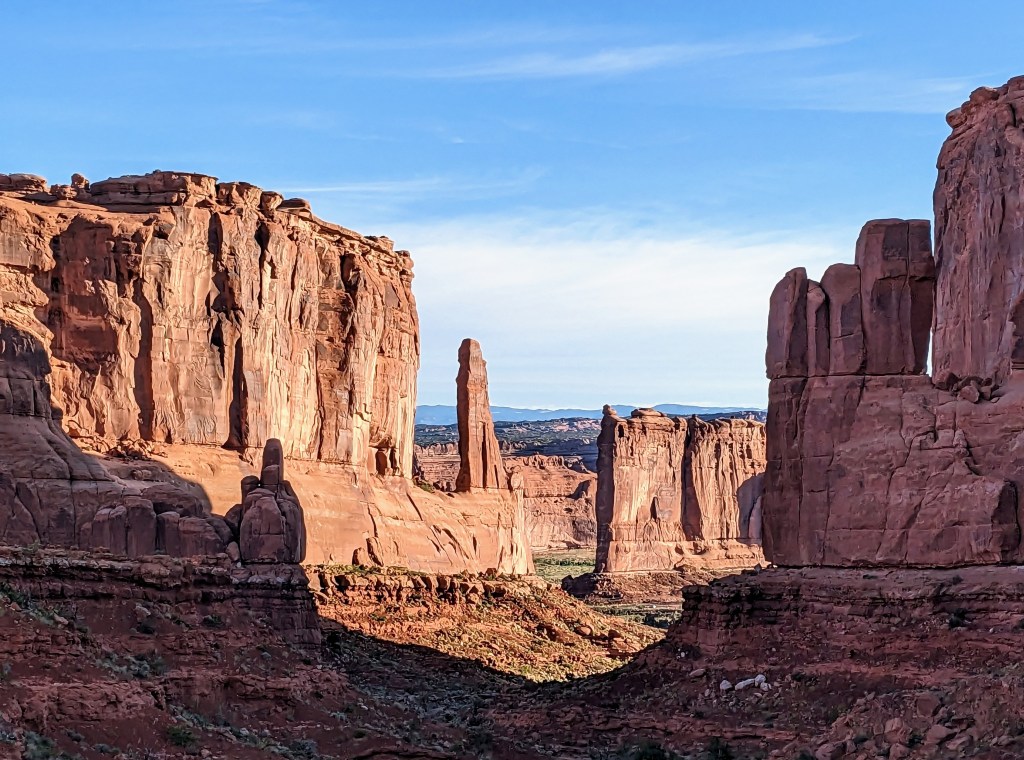
I hoped we would do so. I needed to escape from the enclosed space of the passenger seat. Suddenly huge rock formations loomed just beyond the park gates, and we decided to enter. I was lulled from my stupor into a sense of shock from the grandeur of the giant ochre rocks emerging from the plains. I could sense the onset of palpitations.

“I think I’m going to faint, Alex,” I warned him.

“I think you’re experiencing ‘geophilia’,” he responded.

Suddenly, I realised why people found the study of geology so fascinating. Strata upon strata of ochre rocks rose before us. Their layers indicated the movement of the earth’s surface over eons of time,

Entrance to the Arches

The sunset light flattered the rock formations. Cars lined the road heading to the distant formation of Delicate Arch thirteen miles into the park, and tourists parked their vehicles at the many carparks along the wayside to walk amongst the various giant rock formations.

The next morning, we rose to meet our 7am booking to enter the park. The light portrayed the rock formations in a slightly different way from the light of the evening before. We headed to the trail leading to the Delicate Arch. Even at that early hour, the carpark was almost full, and we secured a space before following the throng of tourists walking the trail heading to the arch. We scrambled across rocks and boulders in the piercing sunshine. I glanced at the climbers ahead of me and thought it would be impossible to reach where they were climbing, but with Alex’s encouragement found myself joining them. After a series of false summits, we found ourselves within sight of the arch. I looked at the abyss below and suddenly decided I would content myself with watching others pose for photographs in the arch rather than entering myself. A photographer was set facing a couple posing in the arches perilously close to the drop-off. Couples and children walked across the rocks in front of me towards the arches.

“I feel sick, Alex! I can’t go any further.”

I wondered why the others were walking so freely along the rocks in front of me, in full view of the yawning abyss.

“I promise I’ll hold your hand.”

“I don’t want to drag you down!”

“You won’t!”

I continued to worry I would drag Alex down with me in the abyss, but as usual, succumbed to his confidence. I gripped his hand and refused to gaze below me, carefully placing one foot in front of the other. Fellow tourists were taking turns to pose under the arch. A couple noticed us heading towards the arches.

“Shall we take your photo for you?” they offered.

Alex accepted and handed them his phone.

We continued to inch towards the arch. Finally we reached it and posed beneath it. I tried to assume a confident stance that I did not feel, all the while steeling myself away from glancing down at the abyss. I was naturally inclined to hold myself steady in a tense position, but instead decided to stretch my free arm outwards and pretend to exert confidence.

Arches

After standing there for long enough for the couple to take turns photographing us, we returned to the smooth large boulders ready for our trail down the mountain. As we walked down, I started reflecting on the contrast between how brave others seemed to feel as they freely walked over the boulders facing the abyss, and how timid I had felt.

“I think I have a fear of heights!” I announced to Alex. “I don’t know how I made it to retirement age without noticing this.”

There was one more trail we wanted to pursue, namely, the Devil’s Garden. As before, there were few empty places in the carpark. We finally edged into a free space, and then headed to the trail on our way to the Landscape Arch. This time I decided to read the information posted on the sign at the entrance. It read “Drop-offs on both sides challenge those with fear of heights”. I realised that there must be at least some people who shared my fear.

Arches National Park remains the most impressive national park I have ever visited. The force of nature had never felt so overwhelming.  I felt small in this vast ancient landscape but privileged to be able to witness it.

Meredith Stephens is an applied linguist from South Australia. Her work has appeared in Transnational Literature, The Muse, The Font – A Literary Journal for Language Teachers, The Journal of Literature in Language Teaching, The Writers’ and Readers’ Magazine, Reading in a Foreign Language, and in chapters in anthologies published by Demeter Press, Canada.

PLEASE NOTE: ARTICLES CAN ONLY BE REPRODUCED IN OTHER SITES WITH DUE ACKNOWLEDGEMENT TO BORDERLESS JOURNAL

Click here to access the Borderless anthology, Monalisa No Longer Smiles

Click here to access Monalisa No Longer Smiles on Kindle Amazon International

Categories
Editorial

Can Love Change the World?

The night has nearly come to an end.
The old year is almost past.
Under this dust, it will lay down
Its worn-out life at last.
Whether friend or foe,      wherever you go,
Old wrongs cast
Away. On this auspicious day,
Old grievances shed as the old year parts.

— Nobo Borshe or on New Year by Tagore

Art by Sohana Manzoor

Mid-April, Thailand celebrates Songkran and Cambodia, Thingyan — water festivals like Holi. These coincide with the celebration of multiple New Years across Asia. Sikhs celebrate Baisakhi. Kerala celebrates Bishu and Tamil Nadu, Puthandu. Nepal celebrates Nava Varsha and Bengal Nobo Borsho or Poila Boisakh. A translation of Tagore’s poem on the Bengali New Year in spirit asks us to dispense with our past angst and open our hearts to the new day — perhaps an attitude that might bring in changes that are so needed in a world torn with conflicts, hatred and anger. The poet goes on to say, “I want to tie all lives with love” but do we do that in our lives? Can we? Masud Khan’s poems on love translated by Professor Fakrul Alam explore this from a modern context. From Korea, Ihlwha Choi tells us in his translation, “Loving birds is like loving stars”. But the translation that really dwells on love bringing in changes is Nabendu Ghosh’s ‘Gandhiji’, translated by Ratnottama Sengupta, his daughter. The short story by Ghosh highlights the transformation of a murderous villain to a defender of a victim of communal violence, towering above divides drawn by politics of religion.

Another daughter who has been translating her father’s works is Amna Ali, daughter of award-winning Punjabi writer, Nadir Ali. In ‘Khaira, the Blind‘, the father-daughter duo have brought to Anglophone readers a lighter narrative highlighting the erasure of divides and inclusivity. A folktale from Balochistan, translated by Fazal Baloch, echoes in the footsteps of ‘Emperor’s New Clothes’ — a story that can found in the Andersen’s Fairy Tales published in the nineteenth century. I wonder which narrative had come first? And how did it cross cultures retaining the original ideas and yet giving it a local colour? Was it with traders or immigrants?

That such narratives or thoughts are a global phenomenon is brought to the fore by a conversation between Keith Lyons and Asian Australian poet Adam Aitken. Aitken has discussed his cross-cultural identity, the challenges of travel, writing, and belonging. Belonging is perhaps also associated with acceptance. How much do we accept a person, a writer or his works? How much do we empathise with it — is that what makes for popularity?

Cross cultural interactions are always interesting as Rhys Hughes tells us in his essay titled ‘My Love for RK Narayan’. He writes: “Narayan is able to do two contradictory things simultaneously, namely (1) show that we are all the same throughout the world, and (2) show how cultures and people around the world differ from each other.” The underlying emotions that tie us together in a bond of empathy and commonality are compassion and love, something that many great writers have found it necessary to emphasise.

Mitra Phukan’s What Will People say?: A Novel is built around such feelings of love, compassion and patience that can gently change narrow norms which draw terrifying borders of hate and unacceptance. We carry an excerpt this time from her ‘Prologue’. Somdatta Mandal has reviewed Chitra Banerjee Divakurni’s latest , Independence. Starting from around the time of the Indian Independence too is Song of the Golden Sparrow – A Novel History of Free India by Nilanjan P. Choudhary, which has been discussed by Rakhi Dalal. The Partition seems to colour narratives often as does the Holocaust. Sometimes, one wonders if humanity will ever get over the negative emotions set into play in the last century.

Closer to our times, when mingling of diverse cultures is becoming more acceptable in arts, Basudhara Roy introduces us to Bina Sarkar Ellias’s Ukiyo-e Days…Haiku Moments, a book that links poetry to a Japanese art-form. While a non-fiction that highlights the suffering of workers by enforcing unacceptable work ethics, Japanese Management, Indian Resistance: The Struggles of the Maruti Suzuki Workers by Anjali Deshpande and Nandita Haksar has been reviewed by Bhaskar Parichha. The narrative, he writes, “tells the story of the biggest car manufacturer in India through the voices of the workers, interviewed over three years. They give us an understanding that the Maruti Suzuki revolution wasn’t the unmitigated success it was touted to be when they tell us about their resistance to being turned into robots by uncompromising management.” That lack of human touch creates distress in people’s hearts, even if we have an efficient system of management and mass production is well elucidated in the review.

To lighten the mood, we have humour in verses from Rhys Hughes and Richard Stevenson’s tongue-in-cheek dino poems. Michael Burch’s poetry explores nuances of love and, yet, changes wrought in love has become the subject of poetry by Malachi Edwin Vethamani and Anasuya Bhar with more wistful lines by George Freek highlighting evanescence.  Sutputra Radheye and Jim Landwehr bring darker nuances into poetry while Scott Thomas Outlar mingles nature with philosophical meanderings. We have more poetry by Ryan Quinn Flanagan, Abdul Jamil Urfi and many more exploring various facets of changes in our lives.

These changes are reflected in our musings too. Sengupta has written on how change is wrought on a murderous villain by the charisma of Gandhi in her father’s fiction, as well as this world leader’s impact on Ghosh and her. Devraj Singh Kalsi addresses food fads with a pinch of sarcasm. From Japan, Suzanne Kamata has written of a little island with Greek influences, a result of cultural ties brought in by the emperor Hirohito. Ravi Shankar takes us to Pokhara, Nepal, and Meredith Stephen expresses surprise on meeting a shipload of people from Colorado in the far reaches of the Southern Hemisphere while on her sailing adventures with beautiful photographs. Stories by moderns reflect diverse nuances depicting change. While Brindley Hallam Dennis writes of the passing of an era, PG Thomas integrates the past into the present to reflect how they have a symbiotic structure in the scheme of creating or recreating natural movements through changes wrought over time in his story. Paul Mirabile explores the darker recesses of the human existence in his fiction. As if in continuation, the excerpt from Rhys Hughes’ The Wistful Wanderings of Perceval Pitthelm seems to step out of darker facets of humanity with a soupçon of wit at its best.

To create a world that endures, one looks for values that create inclusivity as reflected in these lines from Charles Chaplin’s My Autobiography, “Mother illuminated to me the kindliest light this world has ever known, which has endowed literature and the theatre with their greatest themes: love, pity and humanity.” This quote starts off a wonderful essay from film-buff Nirupama Kotru. Her narrative carries the tenor of Chaplin’s ‘themes’ to highlight not only her visit to the actor’s last home in Switzerland but also glances at his philosophy and his contributions to cinema across borders.

Our issue rotates around changes and the need for love and compassion to rise in a choral crescendo whirling with the voices of Tagore, Charles Chaplin as well as that of twenty-first century writers. Perhaps this new year, we can move towards a world – at least an imagined world — where love will wipe away weapons and war, where love will take us towards a future filled with the acceptance of myriad colours, where events like the Partition and the Holocaust will be history, just like dinosaurs.

Huge thanks to all our readers and contributors, some of whom may not have been mentioned here but are an integral and necessary part of the issue. Do pause by our April edition. I would also like to give my thanks to our indefatigable team whose efforts breathe life into our journal every month. Sohana Manzoor needs a special mention for her lovely artwork.

Thank you all and wish you a wonderful April.

Mitali Chakravarty

borderlessjournal.com

.

Read reviews and learn more about Monalisa No Longer Smiles: An Anthology of Writings from across the World by clicking here

Categories
Slices from Life

Colorado Comes to Eden

Photographs & Narrative by Meredith Stephens

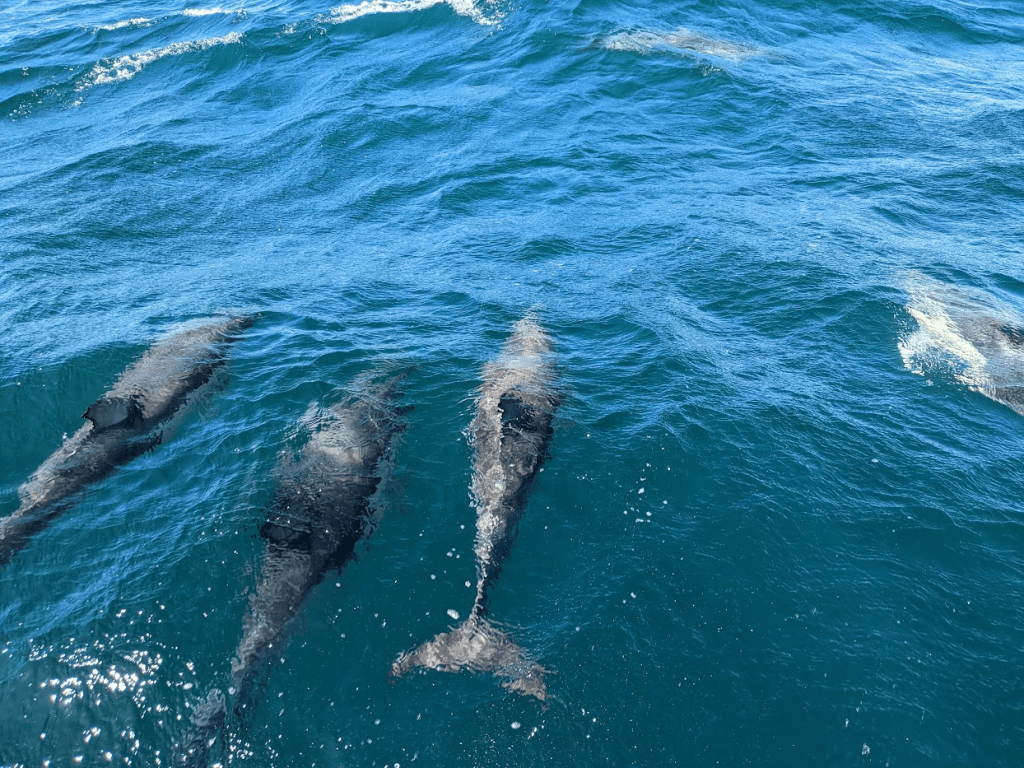
We had safely completed our voyage back across the Coral Sea from New Caledonia to Australia. The next leg was south, from Shellharbour to Eden, hugging the New South Wales coast. Unlike our outbound voyage, the whales were no longer in sight. They must have returned to Antarctica after having come north for calving. I was encouraged by the sight of dolphins accompanying us for spurts of the voyage.

We had hoped to reach Eden by midnight but somehow the trip dragged on until 3.30 am. I wanted to pull my weight during the night sail but was overwhelmed by fatigue and fell into a deep sleep on the sofa. Meanwhile, Alex directed the vessel to a safe point in the bay and dropped anchor.

The next morning in the security of daylight we moved the boat closer to shore, and spied a cruise ship at the docks. It was such a surprise to see a vessel with a capacity of thousands at the wharf of a township of only around three thousand two hundred people.

We made our way to shore in the dinghy, then climbed the steep hills into Eden to provision our boat for the next few days. We noticed tandem cyclists in bright lycra outfits making their way up the hill from the wharf into the town. We greeted them and their accents told us that most of them were from America. Each cyclist had a place name emblazoned on the back of their shirt. Some read California, others the Netherlands. We walked up the main street towards the supermarket, making way for passing cyclists on the footpath.

After we emerged from the supermarket laden with shopping bags, the last of the tandem cyclists, an older couple, were struggling up the hill. Curious, we couldn’t help asking that tedious question that tourists are asked worldwide.

“Where are you from?”

“Colorado.”

“Wow!” I exclaimed. I had never met anyone from Colorado in Australia. Now that the borders were open after pandemic closures tourists must be eager to resume roaming the globe.

A workman in an orange, fluorescent jacket approached the tourists from Colorado.

“Are you with the cruise ship?” he enquired.

I assumed it was an innocent question, or at least a polite enquiry.

“Yes,” they confirmed.

“Can you please tell the cruise ship company to tell these cyclists how to mind their manners? Some of them are cycling on the wrong side of the road. Others are cycling through bitumen that we have just laid,” complained the workman.

“What did he say?” enquired the Colorado tourist of his wife,

She was better able to understand his accent than her husband, so she interpreted it for him.

“We are the last off the boat so there won’t be any more problems,” she reassured the workman, as they resumed their cycle.

“Enjoy the rest of your trip!” I urged them, trying to counter the rudeness of the workman.

“Thank you!” she replied, turning back and beaming at me.

I was surprised that the workman had chosen to berate the tourists. Perhaps he could have contacted the cruise ship managers. I hope the tourists received more civility at their next port of call. When you are a tourist and have no friends in the country you are visiting, it’s those unanticipated encounters with locals that form the lasting impressions.

Meredith Stephens is an applied linguist from South Australia. Her work has appeared in Transnational Literature, The Muse, The Font – A Literary Journal for Language Teachers, The Journal of Literature in Language Teaching, The Writers’ and Readers’ Magazine, Reading in a Foreign Language, and in chapters in anthologies published by Demeter Press, Canada.

PLEASE NOTE: ARTICLES CAN ONLY BE REPRODUCED IN OTHER SITES WITH DUE ACKNOWLEDGEMENT TO BORDERLESS JOURNAL

Click here to access the Borderless anthology, Monalisa No Longer Smiles

Click here to access Monalisa No Longer Smiles on Kindle Amazon International
Categories
Poetry

Odd Shoes in Hands

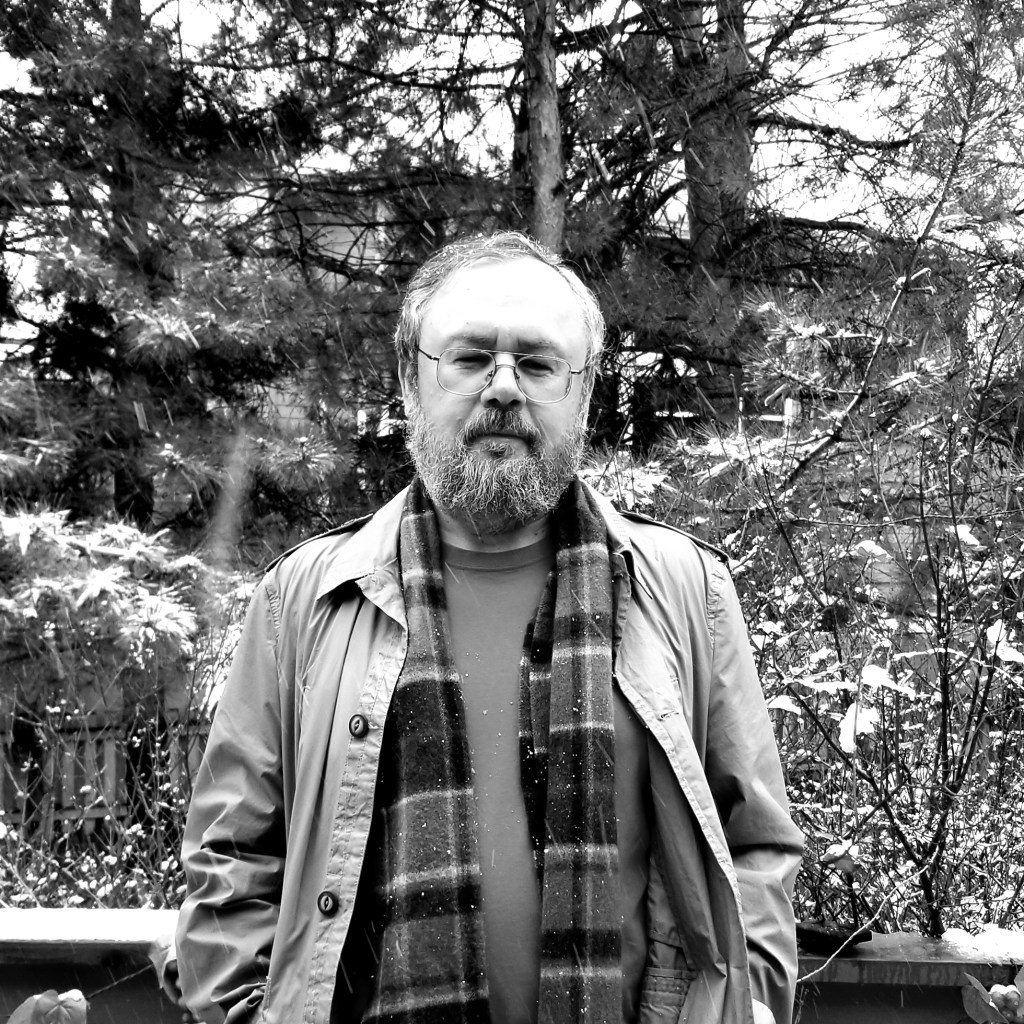
By Ivan Peledov

ODD SHOES IN HANDS

The days pass in a desolate universe:
Dogs stumble over shiny tresses of the sky,
sunflowers imbibe coughs and sneezes,
cars desperately try to turn themselves inside out,
wasps spit out the shreds of yesterday’s sun,
weeds scratch at basement windows.
The secret assassin of pretty things
has lost all his clocks, all his socks,
all his aquatic mates.
His dreams are brimming with the music
he cannot catch.

Ivan Peledov lives in Colorado. His poems have been published in Artifact Nouveau, Sonic Boom, Eunoia Review, and other magazines. He is the author of the book Habits of Totems

.

PLEASE NOTE: ARTICLES CAN ONLY BE REPRODUCED IN OTHER SITES WITH DUE ACKNOWLEDGEMENT TO BORDERLESS JOURNAL