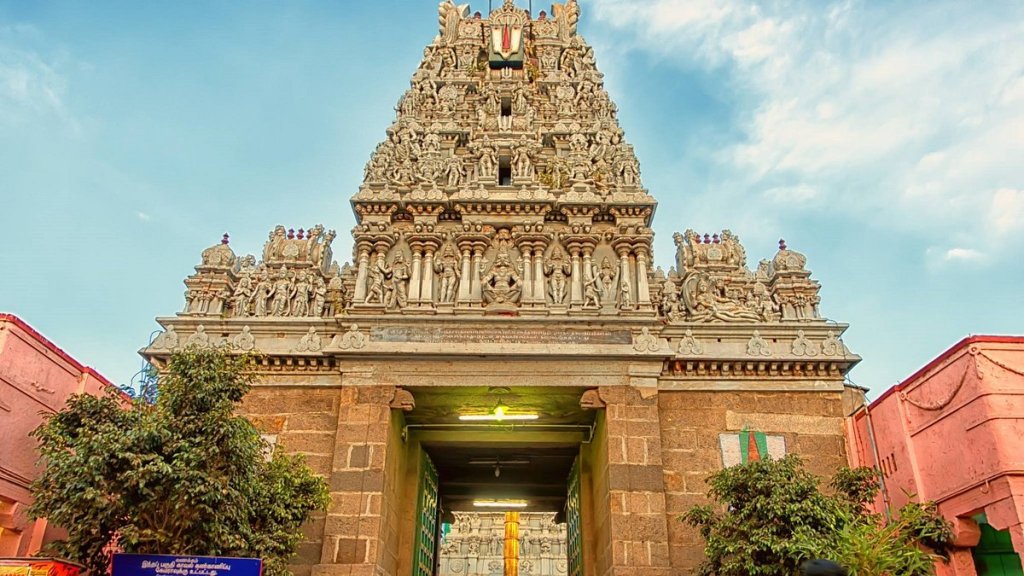
“Which part of India did your people come from?” asked the Tamil tour guide during our last trip to Chennai.
“I know my forefathers came from Tamil Nadu, but, sorry can’t tell you which part of Tamil Nadu or village they came from,” I told him in Tamil. “I am a third generation Malaysian Indian. We lost touch with all the relatives back home.”
“Your Tamil is very good for someone out of this country. Judging from way you speak, you could pass off for someone from Thanjavur!” he went on.
“People from Malaysia have mostly left their original accent and have developed new ones with Malay and Chinese words in theirs, so you cannot pigeonhole them to any region in India anymore.” I replied.
In a philosophical tone, he paused, then said, “I am here in Chennai, and you are there in Malaysia, and the only thing that connects us is the Tamil language.”
Of course, there is the DNA that unites us, but the bond that draws us to India is independent of the language spoken or written.
Our little conversation reminded me of the 1980s music video ‘Down Under’ by the Australian rock band, Men at Work. In that scene, the singer goes around the world, and everyone recognises him with his characteristic Aussie mannerisms. “Do you come from a land Down Under?” is their first response.
My grandparents and parents believed that, despite moving away from their homeland due to increasingly hostile living conditions, it was necessary to pass down their culture and language. Perhaps it was the only language they knew. They did not turn their backs on Tamil Nadu, nor let their offspring immerse themselves solely in the local culture. They had no anger towards their country. They did not turn their backs on her. They understood their motherland was going through difficult times and that tides would eventually change. Maybe they thought that one day their descendants would return and boast about how their princes of the soil had succeeded in a distant land, even while still holding onto their ancestral roots – the mother tongue.
It looks like the sun has risen, and the country has awakened from her long slumber, continuing to pursue what she stopped in her glorious past. Even her children, who have spread across all corners of the Earth, have made her proud.
For the rest of my trip, I conversed in Tamil, checked into a four-star hotel, and even conducted transactions at a bank counter. At first glance, I am sure they could tell I was not local, with liberal use of the word ‘lah’[1] in my sentences and the distinctive sing-song manner Malaysians use when speaking Tamil, it seems. The Malaysians are also described as extremely courteous, unlike the locals there.
[1]Lah is a phrase used by Malaysians and Singaporeans in local parlance
.
Farouk Gulsara is a daytime healer and a writer by night. After developing his left side of his brain almost half his lifetime, this johnny-come-lately decided to stimulate the non-dominant part of his remaining half. An author of two non-fiction books, Inside the twisted mind of Rifle Range Boy and Real Lessons from Reel Life, he writes regularly in his blog, Rifle Range Boy.
PLEASE NOTE: ARTICLES CAN ONLY BE REPRODUCED IN OTHER SITES WITH DUE ACKNOWLEDGEMENT TO BORDERLESS JOURNAL
Come now, little frightened one. That twinge is all you’ll feel as death tears you from the desiccated husk that lingers in your carapace. Then it’s done and all is light. You are floating now above your shell. You seem surprised I hover, spreading protection of bright wings as you stare down at your remnant. There is nothing you should fear as I reach to catch you, shielding you from Valkyries and other predatory fowl circling in hope that you will stray into the bardo space where you become their choice reptilian feast of sorrow. Come closer now and let me wrap my webbed, clawed feet around you as I bear you up to where you swim, with myriad freshwater turtle souls, in the river of light. Some you may recognise: your mother, who passed over soon after she laid your clutch. Several of her hatchlings swim in this bright stream in which the golden minnows jump: Leonardo, Donatello, Michelangelo. Here it’s always summertime. You will remember me as Raphael, the Terrapin of Seraphim. You may hear Ella Fitzturtle ‘rise up singing’ to Gershwin’s melody ‘as I spread my wings and take to the sky.’
Andrew Leggett is an Australian author of fiction, poetry, interdisciplinary academic papers, reviews and songs. His latest collection of poetry Losing Touch was published by Ginninderra Press in 2022. His fiction collection In Dreams and Other Stories will be published by Ginninderra Press in 2026.
.
PLEASE NOTE: ARTICLES CAN ONLY BE REPRODUCED IN OTHER SITES WITH DUE ACKNOWLEDGEMENT TO BORDERLESS JOURNAL.
The weather has landed and moved on. The house evokes candy with its frosted roof, creamy shingles, and crystalline hangings. The grass is heavy with its burden of snow. And the trees gleam like porcelain in the tepid sun.
Bundled up outside, we leave visible footprints in the yard, whereas, in previous seasons, our presence lacked such evidence and yet, intuitively, we always know where we are, what is ours, who we belong to.
The winter merely reiterates the point I’m making. It lacks our self-awareness. So it sinks us deep instead.
ENVISION
Each evening, though shaped by oncoming sleep, my body informs me that knowledge need no longer conform to the physical. So I gaze at black waters of night, at sleep caves, dream tunnels -- Senses float...sight on sound, vision on taste. Something awakens in me. No, distractions ebb so consciousness can flow.
NO POINT LOOKING UP
Jupiter…it’s all just hydrogen and helium. A liquid body with a small solid core. No one gets to love on a planet like that. Or vote. Or watch sports. See movies.
The sky, for all its heavenly associations, is sure no cosmic comfort. The light is dead by the time it reaches me. And the moon, near as it is, is just a rocky squib.
My escape cannot be collapsing nebulae. Or atmospheres of methane and ammonia. Or icy dots. Or superdense neutron stars. And spare me your planet X.
There is no treasure up there. No future. No work. No woman. The good air sticks to what I know. If I’m to breathe it, I can only be here.
.
John Grey is an Australian poet, US resident, recently published in Shift, River And South and Flights. His latest books Bittersweet, Subject Matters and Between Two Fires are available through Amazon. He has upcoming work in Rush, Spotlong Review and Trampoline.
PLEASE NOTE: ARTICLES CAN ONLY BE REPRODUCED IN OTHER SITES WITH DUE ACKNOWLEDGEMENT TO BORDERLESS JOURNAL
Odbayar Dorj writes of celebrating the start of the new school year in Mongolia and of their festivals around teaching and learning. Click here to read.
Naramsetti Umamaheswararao gives a story set in a village in Andhra Pradesh. Clickhere to read.
Feature
A conversation withAmina Rahman, owner of Bookworm Bookshop, Dhaka, about her journey from the corporate world to the making of her bookstore with a focus on community building. Clickhereto read.
There’s a slowness to packing boxes when there’s nowhere to take them. It’s the deliberation that surrounds every item of clothing as it’s neatly folded, placed gently with the others.
With the child, there’s an even greater sluggishness when it comes to the dolls and stuffed animals, an unwillingness even for fear that there won’t be enough room to fit them all.
For haste in that apartment house, you’d need to look to the landlord’s first floor apartment, the tapping of his fingers on the kitchen table, like tiny impatient jackhammers.
For mother and child, the sidewalk awaits. It’s both leisurely and brisk… and indifferent, which is not a speed at all.
KISS AND MAKE UP, THE LATEST ITERATION
Your words slap my face around. Now you have me where you want me – an effigy of everything you hate.
My response is a prison-riot of old angers.
Pain doesn’t travel well so hurting others is our go-to.
We learned it from our parents. We were taught it in school.
To be cruel is a mega-aspirin, a vein-load of morphine.
But we love each other. Our harshness knows this. Our rages are intrinsically aware.
So our voices soften. Red cheeks whiten. Flaming eyes are doused by tears.
Then it’s kiss and makeup time. Our mouths are like tunnels in a mountainside. Tongues collide but there’s little collateral damage.
.
John Grey is an Australian poet, US resident, recently published in Shift, River And South and Flights. His latest books Bittersweet, Subject Matters and Between Two Fires are available through Amazon. He has upcoming work in Rush, Spotlong Review and Trampoline.
PLEASE NOTE: ARTICLES CAN ONLY BE REPRODUCED IN OTHER SITES WITH DUE ACKNOWLEDGEMENT TO BORDERLESS JOURNAL
The kids in the seat behind me are already pushing and shoving each other. They’ll be bored out of their tiny skulls before the bus even gets to Worcester. We take Grand Street out of town, and pass an estate sale at one of the mansions that once housed prosperous mill-owners.
The sloping front lawn is like a giant green shelf piled with boxes and evening clothes, antique chairs and tables and, as a genuine gift to poets, an escritoire and an armoire. I didn’t need to see this to know it was time to leave this dying town. But the buyers sure do look like vultures as they pick among books and jewelry. My guess is they’re not from around here.
The kids, done fighting, are now whining to their parents, “We got nothing to do.” So take a bus out of here, I want to tell them. But wait – they’re already doing that.
NARRAGANSETT BEACH IN AUGUST
This is a town of seaside pleasure from barefoot steps on sand to flights of terns and shearwaters.
The beach is fragmented by waves coming and going, skittery sandpipers, darting sanderlings, but there’s enough wet and dry for all.
Here the world is bird-nesting cliff-face dunes that rise soft as clouds and rocks offshore that bear the brunt of brief battering.
Fun is democratic: old man and woman in chairs shaded by umbrella, young women on towels tanning gently, children splashing in shallows, older siblings bobbing in the deep.
The sky towers overall. The sun smells of salt. And, every now and then, somebody laughs for no reason.
Little used on the day, the mind doesn’t mind at all.
From Public Domain
John Grey is an Australian poet, US resident, recently published in New World Writing, River And South and The Alembic. His latest books, Bittersweet, Subject Matters and Between Two Fires are available through Amazon. He has upcoming work in Paterson Literary Review, White Wall Review and Flights.
.
PLEASE NOTE: ARTICLES CAN ONLY BE REPRODUCED IN OTHER SITES WITH DUE ACKNOWLEDGEMENT TO BORDERLESS JOURNAL
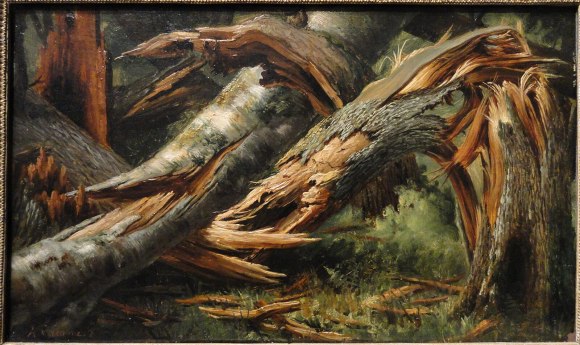
Fallen Tree by Alexandre Calame (1839-1845). From Public Domain
DEAR MAPLE

You had to come down.
You were just too close to the house.
Your branches tapped on the windows
and your roots were upsetting the foundation

But, as I stood beside you, my fallen giant,
I couldn't help but count the rings.
I almost made it to a hundred
before your beginnings
crowded out my eyes.

A truck hauled you away
leaving nothing but the odd scattered leaf.
And the stump of course,
already claimed by foraging insects.

One hundred years of life,
now no more than remnants
scatter to the far fences --
a chunk of wood reduced to rot
and the feeding of the nameless.

My being here was your bad luck.
I have to keep that in mind those times
when I think I’ve made a difference.


ON A MORNING IN MAY

Red cardinal, blue jay, goldfinch,
perch on a nearby branch –
looks like they’re working on a spectrum.

The trees are in full regalia.
And the bird’s cry for a mate
is answered in a heartbeat.

The pond ripples as constant
as the wind.
A snowy egret steps
as slow as consideration.
Willows are in water-kissing mode.
And the morning sun
is on the lookout
for its own reflected self.

This is the view from my window.
Such modest ways
of holding nothing back.


THE MAN FROM THE NORTH

He comes down from the north.
Do not go looking for him.
He’s more spirit than solid flesh.
It’s too chilly out to manifest more.

Yes, there’s someone out there
but the light is as poor as our skin is thin.
So, we hunker down in our fire-warmed houses,
prefer not to make his acquaintance.

He’s grown so large, yet still invisible.
All presence. No substance.
We see the white bird
but not the shoulder it’s perched upon.
John Grey is an Australian poet, US resident, recently published in New World Writing, River And South and The Alembic. His latest books, Bittersweet, Subject Matters and Between Two Fires are available through Amazon. He has upcoming work in Paterson Literary Review, White Wall Review and Flights.
.
PLEASE NOTE: ARTICLES CAN ONLY BE REPRODUCED IN OTHER SITES WITH DUE ACKNOWLEDGEMENT TO BORDERLESS JOURNAL
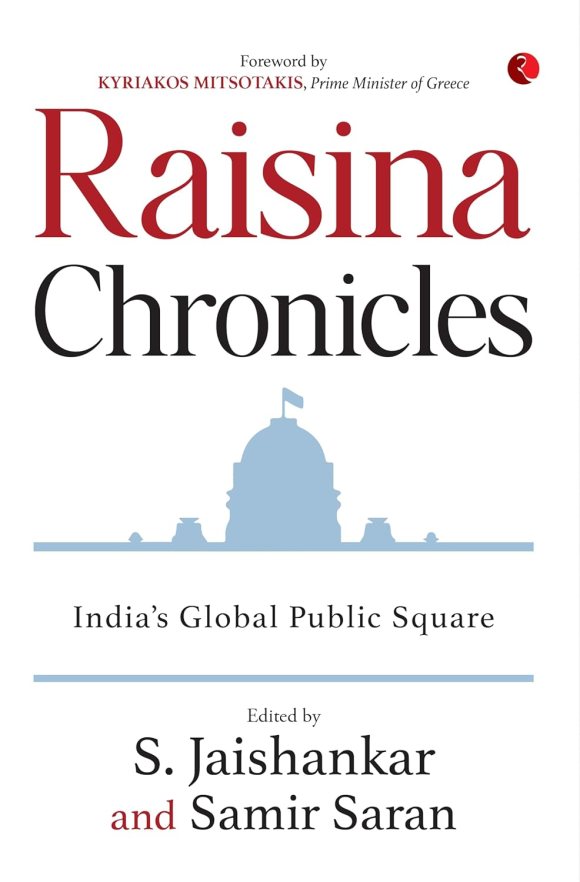
Title: Raisina Chronicles: India’s Global Public Square
Author: S. Jaishankar & Samir Saran
Publisher: Rupa Publications
Raisina Chronicles: India’s Global Public Square by S. Jaishankarand Samir Saran commemorates a decade of the Raisina Dialogue, India’s flagship geopolitical and geo-economics conference. The book reflects on the journey of the Raisina Dialogue and its impact on global discourse. It brings together contributions from leaders, thinkers, and diplomats, scholars, and policymakers worldwide, offering insights into addressing global challenges through collaboration and dialogue.
S. Jaishankar has been India’s External Affairs Minister since May 2019 and represents Gujarat in the Rajya Sabha. He was the Foreign Secretary from 2015 to 2018 and has held ambassadorial roles in the U.S., China, and the Czech Republic, as well as High Commissioner to Singapore. He authored notable books like The India Way: Strategies for an Uncertain World and Why Bharat Matters. Samir Saran is the President of the Observer Research Foundation (ORF), a leading Indian policy think tank. He has enhanced ORF’s influence in the U.S. and the Middle East and provides strategic guidance at the board level. Saran curates the Raisina Dialogue, co-chairs the World Economic Forum’s Global Future Council on Geopolitics, and serves on the Board of Governors of The East West Centre in the US. He has written five books, edited key monographs and journals, and contributed to numerous academic papers and essays, appearing in both Indian and international media.
The book brings together voices from across the world—of leaders and thinkers reflecting on the Raisina Dialogue’s impact on how we may navigate global challenges and create solutions that work. Putting India at the forefront of leading the change, the effect of these Dialogues is felt across policies and projections.
The editors emphasise that diversity, dissent, discord, and divergence of opinion make for the necessary ingredients for a sustainable future, shaped and owned by all. Ten years since its inception, the Raisina Dialogue has become the paramount platform for bringing together cultures, peoples and opinions. It is now India’s flagship geopolitical and geo-economics conference and has truly become a global public square—located in New Delhi, incubated by the world.
It emphasises the importance of diversity in thought, approaches, beliefs, and politics. It highlights how pluralism and heterogeneity contribute to resilience and societal evolution. Raisina Dialogue serves as a platform for inclusive participation, welcoming voices from underrepresented geographies and institutions.
While it showcases India’s emergence as a global leader in addressing development challenges and fostering international cooperation, it reflects the philosophy of Vasudhaiva Kutumbakam (the world is one family) and its efforts to harmonise local solutions with global needs.
Through initiatives like the G20 Presidency, India has shared transformative models such as digital public infrastructure (e.g., India Stack), offering templates for financial inclusion and tech-enabled development globally.
Alongside the carefully organised discussions, Raisina Chronicles examines the evolution of the Dialogue and presents its audience with a comprehensive volume that offers deep insights and an unwavering optimism for achieving shared solutions to worldwide issues.
As the globe approaches significant structural and historical transformations, the core aspiration of this work is to ensure that the voices of the populace are prioritised in global politics and policymaking, echoing through influential circles and reaching the broader community. For leaders to effect change, it is essential for society to unite and take a decisive step forward in the right direction.
Raisina Dialogue is also portrayed as a crucial venue for bridging divides in a fractured world. It fosters open discussions among diverse stakeholders—diplomats, scholars, business leaders, civil society members—to discover shared futures and solutions. The book underscores the importance of dialogue over polemics and inclusivity over exclusivity in shaping global policies.
Contributions from high profile global leaders such as Kyriakos Mitsotakis (Prime Minister of Greece), Mette Frederiksen (Prime Minister of Denmark), Penny Wong (Australian Foreign Minister) and others enrich the book with perspectives on international cooperation, climate goals, defence partnerships, and multilateralism.
The book serves as both a retrospective of the Raisina Dialogue’s achievements over ten years and a forward-looking guide for navigating global challenges. It positions India at the heart of global conversations, highlighting its role in fostering equitable dialogue and creating solutions that resonate across borders.
This volume is not just a collection of essays but also an intellectual testament to the transformative power of dialogue in shaping a sustainable future for humanity.
Bhaskar Parichha is a journalist and author of Cyclones in Odisha: Landfall, Wreckage and Resilience, Unbiased, No Strings Attached: Writings on Odisha and Biju Patnaik – A Political Biography. He lives in Bhubaneswar and writes bilingually. Besides writing for newspapers, he also reviews books on various media platforms.
.
PLEASE NOTE: ARTICLES CAN ONLY BE REPRODUCED IN OTHER SITES WITH DUE ACKNOWLEDGEMENT TO BORDERLESS JOURNAL
Drops of water gather to make a wave. The waves make oceans that reshape land masses over time…
Five years ago, on March 14th, in the middle of the pandemic, five or six of us got together to start an online forum called Borderless Journal. The idea was to have a space that revelled with the commonality of felt emotions. Borderless was an attempt to override divisive human constructs and bring together writers and ideators from all over the Earth to have a forum open to all people — a forum which would be inclusive, tolerant, would see every individual as a part of the fauna of this beautiful planet. We would be up in the clouds — afloat in an unbordered stratosphere— to meet and greet with thoughts that are common to all humans, to dream of a world we can have if we choose to explore our home planet with imagination, kindness and love. It has grown to encompass contributors from more than forty countries, and readers from all over the world — people who have the same need to reach out to others with felt emotions and common concerns.
Borderless not only celebrates the human spirit but also hopes to create over time a vibrant section with writings on the environment and climate change. We launch the new section today on our fifth anniversary.
Devraj Singh Kalsi with a soupçon of ironic amusement muses on humans’ attitude to the fauna around him and Farouk Gulsara lays on a coating of sarcasm while addressing societal norms. Meredith Stephens brings us concerns for a green Earth when she beachcombs in a remote Australian island. Prithvijeet Sinha continues to familiarise us with his city, Lucknow. Suzanne Kamata, on the other hand travels to Rwanda to teach youngsters how to write a haiku!
Professor Fakrul Alam takes us to libraries in Dhaka with the hope that more will start writing about the waning of such paradises for book lovers. Other than being the month that hosts World Environment Day, March also homes, International Women’s Day. Commemorating the occasion, we have essays from Meenakshi Malhotra on the past poetry of women and from Ratnottama Sengupta on women in Bengali Cinema. Sengupta has also interviewed Poulami Bose Chatterjee, the daughter of the iconic actor Soumitra Chatterjee to share with us less-known vignettes from the actor’s life. Keith Lyons has interviewed Malaysian writer-editor Daphne Lee to bring to us writerly advice and local lores on ghosts and hauntings.
We also have a translation by Lourdes M Supriya from Hindustani of a student’s heartrending cry to heal from grief for a teacher who faced an untimely end — a small dirge from Tanvir, a youngster with his roots in Nithari violence who transcended his trauma to teach like his idol and tutor, the late Sanjay Kumar. With this, we hope to continue with the pandies corner, with support from Lourdes and Anuradha Marwah, Kumar’s partner.
Borderless has grown in readership by leaps and bounds. There have been requests for books with writings from our site. On our fifth anniversary, we plan to start bringing out the creative writing housed in Borderless Journal in different volumes. We had brought out an anthology in 2022. It was well received with many reviews. But we have many gems, and each writer is valued here. Therefore, Rhys Hughes, one of our editorial board members, has kindly consented to create a new imprint to bring out books from the Borderless Journal. We are very grateful to him.
We are grateful to the whole team, our contributors and readers for being with us through our journey. We would not have made it this far without each one of you. Special thanks to Sohana Manzoor for her artwork too, something that has almost become synonymous with the cover page of our journal. Thank you all from the bottom of my heart.
Wish you all happy reading! Do pause by our content’s page and take a look at all the wonderful writers.
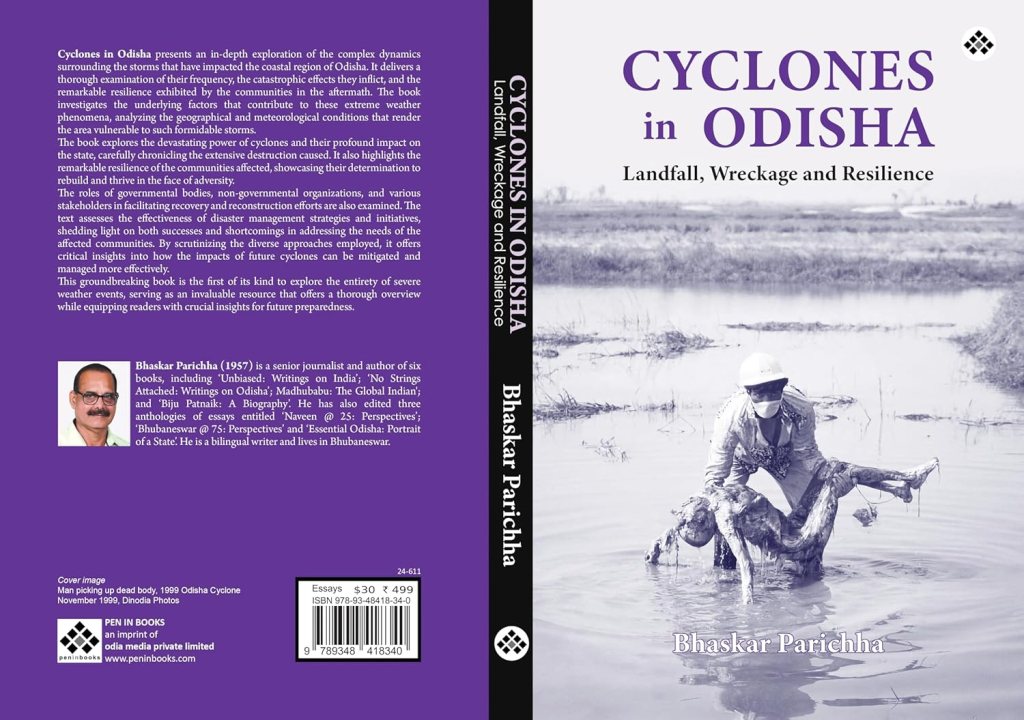
A discussion with Bhaksar Parichha, author of Cyclones in Odisha, Landfall, Wreckage and Resilience, published by Pen in Books.
While wars respect manmade borders, cyclones do not. They rip across countries, borders, seas and land — destroying not just trees, forests and fields but also human constructs, countries, economies and homes. They ravage and rage bringing floods, landslides and contamination in their wake. Discussing these, Bhaskar Parichha, a senior journalist, has written a book called Cyclones in Odisha, Landfall, Wreckage and Resilience. He has concluded interestingly that climate change will increase the frequency of such weather events, and the recovery has to be dealt by with regional support from NGOs.
Perhaps, this conclusion has been borne of the experience in Odisha, one of the most vulnerable, disaster prone states of India, where he stays and a place which he feels passionately about. Centring his narrative initially around the Super Cyclone of 1999, he has shown how as a region, Odisha arranged its own recovery process. During the Super Cyclone, the central government allocated only Rs 8 crore where Rs 500 crore had been requested and set up a task force to help. They distributed vaccines and necessary relief but solving the problem at a national level seemed a far cry. Parichha writes: “As a result, the relief efforts were temporarily limited. To accommodate the displaced individuals, schools that remained intact after the cyclone were repurposed as temporary shelters.
“The aftermath of the cyclone also led to a significant number of animal carcasses, prompting the Government of India to offer a compensation of 250 rupees for each carcass burned, which was higher than the minimum wage. However, this decision faced criticism, leading the government to fly in 200 castaways from New Delhi and 500 from Odisha to carry out the removal of the carcasses.”
He goes on to tell us: “The international community came together to provide much-needed support to the recovery efforts in India following the devastating cyclone. The Canadian International Development Agency, European Commission, British Department for International Development, Swiss Humanitarian Aid Unit, and Australian Government all made significant contributions to various relief organisations on the ground. These donations helped to provide essential aid such as food, shelter, and medical assistance to those affected by the disaster. The generosity and solidarity shown by these countries underscored the importance of global cooperation in times of crisis.” They had to take aid from organisations like Oxfam, Indian Red Cross and more organisations based out of US and other countries. Concerted international effort was necessary to heal back.
He gives us the details of the subsequent cyclones, the statistics and the action taken. He tells us while the Bay of Bengal has always been prone to cyclones, from 1773 to 1999, over more than two centuries, ten cyclones were listed. Whereas from 1999 to 2021, a little over two decades, there have been nine cyclones. Have the frequency of cyclones gone up due to climate change? A question that has been repeatedly discussed with ongoing research mentioned in this book. Given the scenario that the whole world is impacted by climate disasters — including forest fires that continue to rage through the LA region in USA — Parichha’s suggestion we build resilience comes at a very timely juncture. He has spoken of resilience eloquently:
“Resilience refers to the ability to recover and bounce back from challenging situations. It encompasses the capacity of individuals, communities, or systems to withstand, adapt, and overcome adversity, trauma, or significant obstacles. Resilience involves not only psychological and emotional strength but also physical resilience to navigate through hardships, setbacks, or crises.
“Resilience is the remarkable capacity of individuals to recover, adapt and thrive in the face of adversity, challenges, or significant life changes. It is the ability to bounce back from setbacks, disappointments, or failures, and to maintain a positive outlook and sense of well-being despite difficult circumstances.
“Resilience is not about avoiding or denying the existence of hardships, but rather about facing them head-on and finding ways to overcome them. It involves developing a set of skills, attitudes, and strategies that enable individuals to navigate through difficult times and emerge stronger and more capable.”
He has hit the nail on the head with his accurate description of where we need to be if we want our progeny to have a good life hundred years from now. We need this effort and the ability to find ways to solve and survive major events like climate change. Parichha argues Odisha has built its resilience at a regional level, then why can’t we? This conversation focusses on Parichha’s book in context of the current climate scenario.
Bhaskar Parichha
What prompted you to write this book?
Odisha possesses an unfavorable history of cyclones with some of the most catastrophic storms. People suffered. My motivation stemmed from documenting this history, emphasising previous occurrences and their effects on communities, infrastructure, and the environment.
What kind of research went into this book? How long did it take you to have the book ready?
The idea for the book originated more than a year ago. It was intended for release to commemorate the twenty-fifth anniversary of the 1999 Super Cyclone and the cyclones that followed. Having witnessed the disaster first-hand and having been involved in the audio-visual documentation of the relief and rehabilitation initiatives in and around Paradip Port after the Super Cyclone, I gained a comprehensive understanding of the topic. The research was largely based on a thorough examination of the available literature, which included numerous documents and reports.
Promptly after you launched your book, we had Cyclone Dana in October 2024. Can you tell us how it was tackled in Odisha? Did you need help from the central government or other countries?
Cyclone Dana made landfall on the eastern coast on the morning of October 25, unleashing heavy rainfall and strong winds that uprooted trees and power poles, resulting in considerable damage to infrastructure and agriculture across 14 districts in Odisha. Approximately 4.5 million individuals were affected. West Bengal also experienced the effects of Cyclone Dana. After effectively addressing the cyclone’s impact with a goal of zero casualties, the Odisha government shifted its focus to restoration efforts, addressing the extensive damage to crops, thatched homes, and public infrastructure. The government managed the aftermath of the cyclone utilizing its financial resources.
Tell us how climate change impacts such weather events.
Climate change significantly influences weather events in a variety of ways, leading to more frequent and intense occurrences of extreme weather phenomena. As global temperatures rise due to increased greenhouse gas emissions, the atmosphere can hold more moisture, which can result in heavier rainfall and more severe storms. This can lead to flooding in some regions while causing droughts in others, as altered precipitation patterns disrupt the natural balance of ecosystems.
What made people in Odisha think of starting their own NGOs and state-level groups to work with cyclones?
The impetus for establishing non-governmental organisations and state-level entities in Odisha is fundamentally linked to the region’s historical encounters with cyclones, which have highlighted the necessity for improved community readiness. Through the promotion of cooperation between governmental agencies and civil society organisations, Odisha has developed a robust framework that is adept at responding to natural disasters while simultaneously empowering local communities.
What are the steps you take to build this resilience to withstand the destruction caused by cyclones? Where should other regions start? And would they get support from Odisha to help build their resilience?
Building resilience to withstand the destruction caused by cyclones involves a multi-faceted approach that encompasses infrastructure development, community engagement, and effective disaster management systems. Odisha has established a robust model that other regions can learn from. Odisha’s experience positions it as a potential leader in sharing knowledge and best practices with other regions. The state has demonstrated its commitment to enhancing disaster resilience through partnerships with international organisations and by sharing its model of disaster preparedness with other states facing similar challenges. Odisha can offer training programs and workshops based on its successful strategies, guide in implementing early warning systems, building resilient infrastructure and also collaborating with NGOs and international agencies to secure funding for resilience-building initiatives in vulnerable regions.
You have shown that these cyclones rage across states, countries and borders in the region, impacting even Bangladesh and Myanmar. They do not really respect borders drawn by politics, religion or even nature. If your state is prepared, do the other regions impacted by the storm continue to suffer…? Or does your support extend to the whole region?
Odisha is diligently assisting its impacted regions through comprehensive evacuation and relief initiatives, while adjacent areas such as West Bengal are also feeling the effects of the cyclone. The collaborative response seeks to reduce damage and safeguard the well-being of residents in both states. Odisha’s approach to cyclone response has garnered international acclaim.
Can we have complete immunity from such weather events by building our resilience? I remember in Star Wars — of course this is a stretch — in Kamino they had a fortress against bad weather which seemed to rage endlessly and in Asimov’s novels, humanity moved underground, abandoning the surface. Would you think humanity would ever have to resort to such extreme measures?
The idea of humanity seeking refuge underground, as illustrated in the writings of Isaac Asimov, alongside the perpetual storms on Kamino from the Star Wars franchise, provokes thought-provoking inquiries regarding the future of human settlement in light of environmental adversities. Although these scenarios may appear to be exaggerated, they underscore an increasing awareness of the necessity for adaptability when confronted with ecological challenges. The stories from both Kamino and Asimov’s literature act as cautionary narratives, encouraging reflection on potential strategies for human resilience in the future.
With the world torn by political battles, and human-made divisions of various kinds, how do you think we can get their attention to focus on issues like climate change, which could threaten our very survival?
A comprehensive strategy is crucial for effectively highlighting climate change in the context of persistent political conflicts and societal rifts. Various methods can be utilised to enhance public awareness, galvanise grassroots initiatives, promote political advocacy, emphasise economic prospects, frame climate change as a security concern, and encourage international collaboration.
Can the victims of weather events go back to their annihilated homes? If not, how would you suggest we deal with climate refugees? Has Odisha found ways to relocate the people affected by the storms?
Individuals affected by severe weather events frequently encounter considerable difficulties in returning to their residences, particularly when those residences have been destroyed or made uninhabitable. In numerous instances, entire communities may require relocation due to the devastation inflicted by natural disasters, especially in areas susceptible to extreme weather conditions. Odisha’s proactive stance on disaster management and community involvement has greatly improved its ability to address challenges related to cyclones. The state’s initiatives not only prioritise immediate evacuation but also emphasize long-term resettlement plans to safeguard its inhabitants against future cyclonic events. For instance, residents from regions such as Satabhaya in Kendrapara district are being moved to safer locations like Bagapatia, where they are provided with land and support to construct new homes. This programme seeks to reduce future risks linked to coastal erosion and flooding.
Thanks for your book and your time.
(This review and online interview is by Mitali Chakravarty.)







 Borderless