Little fish are transparent in their felicity, darts Rippling over gullies and flat stones, shadows On the sand, flashes of lightning as they hide themselves, My big feet stirring grit and making such a din They cannot hear the gulls’ songs.
And thou art dancing in the shallows, all heart, All joyousness as the afternoon sun follows, Looping over the cliffs at Port Stanvac to dwell Like Neptune in the depths of Gulf St. Vincent, Hymning to the marine throng.
We had swum out to the reef, and were startled By the passage of a shark, no, a dolphin, ogling To know if we were some kind of fish as well: O Nereid! Would that the moment return again, Neither knowing of right nor wrong.
Edward Reilly is a retired teacher and lecturer. His poetry has been published in Australia and overseas, as well as a travelogue, First Snow (2004).
.
PLEASE NOTE: ARTICLES CAN ONLY BE REPRODUCED IN OTHER SITES WITH DUE ACKNOWLEDGEMENT TO BORDERLESS JOURNAL
Most people like you and me connect with the commonality of felt emotions and needs. We feel hungry, happy, sad, loved or unloved and express a larger plethora of feelings through art, theatre, music, painting, photography and words… With these, we tend to connect. And yet, larger structures created over time to offer security and governance to the masses—of which you and I are a part — have grown divisive, and, by the looks of it, the fences nurtured over time seem insurmountable. To retain these structures that were meant to keep us safe, wars are being fought and many are getting killed, losing homes and going hungry. We showcase such stories, poems and non-fiction to create an awareness among those who are lucky enough to remain untouched. But is there a way out, so that all of us can live peacefully, without war, without hunger and with love and a vision towards surviving climate change which (like it or not) is upon us?
Creating an awareness of hunger and destruction wreaked by war is a heartrending story set in Gaza by JK Miller. While Snigdha Agrawal’s narrative gives a sense of hope, recounting a small kindness by a common person, Sayan Sarkar shares a more personal saga of friendship and disillusionment — where people have choice. But does war leave us a choice as it annihilates friendships, cities, homes and families? Naramsetti Umamaheswararao’s story reiterates the belief in the family – peace being an accepted unit. Vela Noble’s fantastical fiction and art comes like a respite– though there is a darker side to it — with a touch of fun. Perhaps, a bit of fantasy and humour opens the mind to deal with the more sombre notes of existence.
The translation section hosts a story by Hamiruddin Middya, who grew up as a farmer’s son in Bengal. Steeped in local colours, it has been rendered into English by V Ramaswamy. Nazrul’s song revelling in the colours of spring has been translated from Bengali by Professor Fakrul Alam. Atta Shad’s pensive Balochi lines have been brought to us in English by Fazal Baloch. Isa Kamari continues to bring the flavours of an older, more laid-back Singapore with translations of his own Malay poems. A couple of Persian verses have been rendered into English by the poet, Akram Yazdani, herself. Questing for harmony, Tagore’s translated poem while reflecting on a child’s life, urges us to have the courage to be like a child — open, innocent and willing to imagine a world laced with trust and hope. If we were all to do that, do you think we’d still have wars, violence and walls built on hate and intolerance?
Mario Fenech takes a look at the idea of time. Amir Zadnemat writes of how memory is impacted by both science and humanities while Andriy Nivchuk brings to us snippets from Herodotus’s and Pericles’s lives that still read relevant. Ravi Varmman K Kanniappan gives the journey of chickpeas across space and time, asserting: “The chickpea does not care about your ideology, your portfolio, or your meticulously curated identity. It will grow, fix nitrogen, feed someone, and move on without a press release.” It has survived over aeons in a borderless state!
In book excerpts, we have a book that transcends borders as it’s a translation from Assamese by Ranjita Biswas of Arupa Kalita Patangia’s Moonlight Saga. Any translation is an attempt to integrate the margins into the mainstream of literature, and this is no less. The other excerpt is from Natalie Turner’s The Red Silk Dress. Keith Lyons has interviewed Turner about her novel which crosses multiple cultures too while on a personal quest.
Holding on to that idea, we invite you to savour the contents of our February issue.
Huge thanks to all our contributors and readers for making this issue possible. Heartfelt thanks to our wonderful team, especially Sohana Manzoor for her fabulous artwork.
Enjoy the reads!
Let’s look forward to the spring… May it bring new ideas to help us all move towards more amicable times.
sometimes they arrive like a fox with a mouthful of feathers
because somewhere, something has died or been eaten alive
or they startle you like the clapping of pigeon wings – a spasm of applause in a silent wood –
an idea stirring up there in the wet branches, one you’d half forgotten
others push their way out of dreams, in the way tiny quills would poke through a feather bed
or goose down pillow, to remind you of all you are resting on
but the best of them drift down like a blessing, rocking like an airborne cradle
to land between the gold of the nib and the cream of the paper
with a message from the bird who’s already flown
Chris Ringrose is a writer of poetry and fiction who lives in Melbourne, Australia. His latest poetry collection is Palmistry (ICoE Press, Melbourne, 2016). Creative Lives, a collection of interviews with South Asian writers, was published by Ibidem Press, Stuttgart, in 2021. His poetry website is http://www.cringrose.com
.
PLEASE NOTE: ARTICLES CAN ONLY BE REPRODUCED IN OTHER SITES WITH DUE ACKNOWLEDGEMENT TO BORDERLESS JOURNAL.
Beside a relentless freeway, which is anything but free and takes its toll on users and non-users as well, ‘boys’ meet for coffee at Mothers Instinct with no apostrophe or wives in sight. They’re old boys now, content to breathe and able to coast on Old Age Pension. They laboured long, fathered kids by un- leashing millions of apostrophes into wives, had operations via Medicare to fix things that could have meant never retiring. Considering current high price of houses in their suburb, they are now wealthy but that does not stop them breakfasting at home before venturing out for second coffees. Too late to become loose with money, they leave that to the next generation. Every boy knows what every other boy knows – they watch same TV shows – so, no serious debate. Chuckle, toss gossip, kid each other, talk sport while picking at pastries that wives wouldn’t approve. You’d think their lives had been one long joke here in big city. Sip that pricey espresso, chat, zone out then wander home for lunch. Their wives, the ‘girls’, are elsewhere for pre-coffee yoga. They also laboured long, had the babies, kept every body fed. Fact is women usually outlive men, perhaps due to mothers’ instinct.
Allan Lake is a migrant poet from Allover, Canada, who now lives in Allover, Australia. He has published poems in 24 countries. His latest chapbook of poems, entitled My Photos of Sicily, was published by Ginninderra Press.
PLEASE NOTE: ARTICLES CAN ONLY BE REPRODUCED IN OTHER SITES WITH DUE ACKNOWLEDGEMENT TO BORDERLESS JOURNAL
Narrative by Meredith Stephens: Photographs by Alan Noble
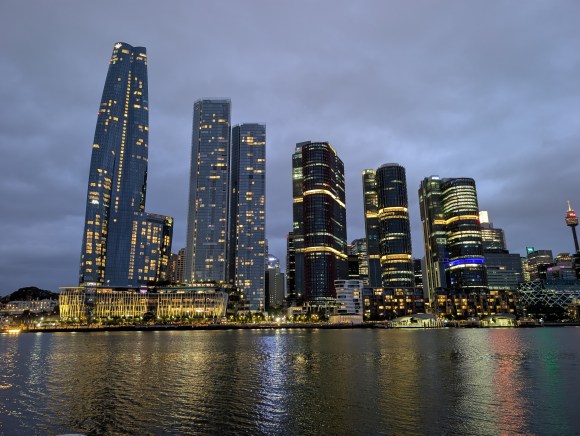
Sydney Skyline
We are not champagne sailors. The only time Alex and I drink champagne aboard a boat is to celebrate the end of a voyage of hundreds of nautical miles. Our sailing expeditions are characterised by breakages, deprivations and isolation. Sometimes the seas are so rough that I cannot move around the boat, let alone change clothes. I can only bathe once a week, and that consists of a dip in the ocean at anchor.
Our meals often consist of fish we have caught and cooked, unless we consume them immediately as sashimi. A single fish might last us days, served in various guises. Other meals are prepared from lentils or canned foods. In contrast to land trips, I usually lose a kilogram or two when at sea. I prefer not to use the term ‘yacht’, because people imagine us sunning ourselves on the deck while sipping champagne. Instead, I use the term ‘sailboat’. I do confess to a tad of reverse snobbery in the deprivations I endure and look down on those I describe as ‘champagne sailors’. But was that about to change?
We had been invited aboard the luxury observer vessel known as The Jackson to watch the start of the annual Sydney to Hobart Yacht Race on Boxing Day. After Christmas lunch, we headed to Adelaide Airport to catch our ninety-minute flight to Sydney. Upon arrival at our hotel, we caught the lift to our room. The lift doors opened on the third floor to let two brothers in, aged around 10 and 12. They met our gaze.
“Would you like us to sing you a Christmas carol?” the younger one asked.
The older one looked a bit embarrassed, but I thought asking strangers to join in singing a carol in a lift on Christmas Day was a nice, if not brave gesture, so I nodded enthusiastically. The younger one started singing ‘We wish you a merry Christmas’, and facing us, moved his hands in the manner of a choir conductor. I joined in. Then the boys noticed that they had arrived at their floor and stopped singing.
“See ya!” said the older one, as they exited.
We continued to the seventh floor and deposited our bags. The light was fading, so we decided to head back outside to take a stroll around the harbour. We returned to the lift. Once we reached the fifth floor the doors opened and the two boys entered again. Three other guests were standing behind us.
“More carols?” asked Alex.
They nodded and smiled. “Yes!”
They launched into another familiar carol, and again I joined in. The tall guest behind me gave a kindly chuckle. Then they reached the third floor, bade us farewell, and exited. We continued to the ground floor and made a tour of Darling Harbour in the remaining light. It had been a wonderful Christmas Day, and what better way to end it than the act of goodwill in being serenaded by children in a hotel lift.
The next day was the yacht race, which has been held annually since 1945 and is one of the world’s great ocean races. The sailors would be competing in a gruelling and treacherous race of 128 boats covering 628 nautical miles (1,200 km), south down the Tasman Sea, across Bass Strait, to Hobart in the south of Tasmania. This race is one of the highlights of Boxing Day and a television staple.
Start of Sydney to Hobart race
We walked to the appointed wharf and noticed a long queue waiting to board. Upon being noticed by our hosts, we were directed to a shorter queue and were ushered up the stairs to the top deck, limited to fewer than sixty people. A ribbon with ‘The Jackson’ written on it was affixed to our wrists. We were greeted by a waiter holding a tray proffering a range of drinks. Alex picked up two glasses of champagne and handed one to me. Was this the beginning of my new career as a champagne sailor?
The Jackson soon departed and we headed out to the deck to view the boats lining up for the race. Even though it was summer the cold penetrated my body and my hands shook. I was determined to brave the cold in order to hold my place to view the start of the race. The lady next to me made some commentary.
“That’s the start line,” she said, pointing to two yellow buoys. The start lines are staggered depending on the the size of the boats to help prevent collisions. It’s a southerly, so that should help.”
I nodded, feigning comprehension. I was not yet a competent enough sailor to pick up the wind direction so quickly. The cannon sounded on the deck below, and a plume of smoke rose. The yachts set off. Soon they had overtaken our observation vessel and most of the guests moved back inside the boat to watch the race on a large screen. Alex and I and a few other hardy souls remained on the outside deck to savour the unique setting of Sydney Harbour. Waiters braved the cold regularly to top up our champagne and offer us canapes. We accepted each time, although I eventually slowed down and shared a glass of champagne with Alex. Had we become the dreaded champagne sailors?
The yachts sailed through the heads until most of them disappeared from view. The Jackson turned around and headed back to King Street Wharf. We remained outside on the deck in the cold, making the most of every minute because Sydney Harbour is so far from home, and we may never have this opportunity again.
I stubbornly refuse to accept the title of champagne sailor though. We are temporarily boatless (which is another story) but once we resume sailing again later this year, we hope to return to the days of self-reliance on the boat and sourcing our meals from the ocean. Maybe not too much deprivation though, because we will continue to uncork a bottle of champagne, as is our tradition, after completing a major ocean passage of several hundred nautical miles.
Sydney to Hobart race
.
Meredith Stephens is an applied linguist from South Australia. Her recent work has appeared in Syncopation Literary Journal, Continue the Voice, Micking Owl Roost blog, The Font – A Literary Journal for Language Teachers, and Mind, Brain & Education Think Tank. In 2024, her story Safari was chosen as the Editor’s Choice for the June edition of All Your Stories.
PLEASE NOTE: ARTICLES CAN ONLY BE REPRODUCED IN OTHER SITES WITH DUE ACKNOWLEDGEMENT TO BORDERLESS JOURNAL
“Please show me your international driver’s licence.”
“Certainly!”
Alex produced the licence.
“This is out of date! I’m sorry but we can’t hand over the car.”
“No! It’s current! It’s valid for five years.”
We scrutinized the licence. The start date was prominently displayed, but not the expiration date. As we squinted to decipher the fine print on page three, we discovered that it had expired three years ago. Alex had thought it would be valid for five years, but it was only valid for one. We attributed it to his light-heartedly referred to “OCD Deficit Disorder”. And that is how a one-week road trip suddenly became a public transport and taxi trip.
This was my first visit back to Japan after having left at the beginning of the pandemic. Alex and I had been deliberating where to spend our honeymoon, and we agreed that the island of Shikoku in western Japan where I had spent over twenty years would be our first choice.
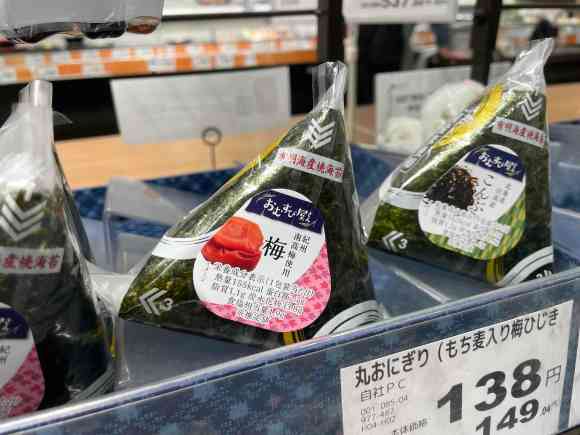
Onigiri. Photo courtesy: Mariko Hisamatsu
There were so many things to look forward to. The first thing I did, before even leaving Kansai Airport, was rush into the convenience store and buy an onigiri flavoured with an umeboshi pickled plum. An onigiri is a triangle of rice, with a choice of flavours in the centre such as fish, seaweed, or the aforementioned umeboshi. It is wrapped in a crisp sheet of seaweed. Before eating it you gently pull away a thin layer of wrapping which protects the outer seaweed from absorbing the moisture of the rice. As you bite into it you can enjoy the three distinct textures and flavours – the piquant centre, the contrasting bland rice, and the crisp outer layer of seaweed. Next, I purchased a mugwort daifuku. This is a Japanese sweet, consisting of a layer of pounded mugwort-flavoured rice around a centre of sweet azuki bean paste. All of this was washed down with a bottle of green tea.
From the above account, it might sound like I was returning to Japan to indulge in simple culinary delights from a convenience store, and maybe this is a possibility I am unwilling to admit to myself. Of course, the main purpose was to reconnect with old friends, the second to reconnect with old pleasures, such as the aforementioned onigiri and daifuku, and the third, to stay in a traditional Japanese house.
After having been refused permission to drive our hire car, we headed back towards the terminal and searched for the railway station. We caught trains out to the UNESCO heritage listed site of Koyasan to enjoy the autumn leaves, and then seven trains and two buses later, to Wakayama station. Finally, we caught a taxi to our accommodation, which turned out to be a house that was over two hundred years ago, dating from the end of the Edo Period.
Jiomaru-an Edo period house. Photo Courrtesy: Alan Noble Inside the house. Photo Courtesy: The Host
The door slid open to reveal an earthen floor. We walked down the hall to the kitchen, left our shoes in the sunken area, and donned the provided slippers. The kitchen opened onto two traditional tatami rooms, with fusuma sliding cupboards, and latticed paper shoji screens leading onto the garden. Beyond the shoji was a narrow hall known as an engawa, with a small wooden table and chair where you could enjoy sipping a drink while looking out over the garden. This was the kind of room I had been longing for during my five years away from Japan.
But we hadn’t had dinner yet and I was longing to ride to a local supermarket to purchase a ready meal.
‘“Do you have any bicycles?” I asked the host.
“Certainly. We have mountain bikes too!”
“You don’t want to go cycling in the dark?” queried Alex. “Not after a long-distance flight, seven trains, two buses, and a taxi ride? Surely not!”
I insisted, and Alex gave up persuading me otherwise. Rather than a mountain bike I chose the mamachari, a vintage bike replete with a shopping basket attached to the front handlebars.
We cycled to the supermarket, as I had done almost daily during my twenty years of living in Shikoku. There we bought sushi and sashimi ready meals, and cycled home, scanning to avoid roadside ditches with sheer drops and no guard rails. Once safely home, we indulged in the much longed for sushi and sashimi, enjoyed the traditional deep Japanese bath, spread out the futons on the tatami, and luxuriated in a deep sleep.
The next morning, we woke to a gentle light streaming through the latticed paper shoji screens. We cycled to Wakayama castle, Alex on the mountain bike and me on the mamachari. We strolled around the traditional garden before entering the castle and then completed it with a visit to the adjacent tearoom, where we enjoyed green tea and a sweet bean paste confectionery.
The following day, we bid farewell to our Edo Period home, and our kind host drove us to the ferry terminal. As soon as I saw the sign in Japanese for Tokushima, I could feel the colour rising to my cheeks. This had been my home in Japan for fifteen of my twenty years in Shikoku, until the day I departed for a routine visit to Australia, just before the international borders were closed due to COVID. Little did I know that the pandemic would prevent me from returning to Japan. I boarded the ferry as I had so many other times after returning from various work trips, but this time I was visiting on my honeymoon. The two-hour crossing readied me for the arrival in my old stomping ground and was heralded by the sentimental music played to signal a homecoming. Alex and I exited the ferry to be met by my old friend and writing mentor, Suzanne. Overcome with emotion, I covered my face with my hands to spare her the sight of my crumpled features and then gave her a hug. Then I went back to covering my swollen eyes and gave her another hug.
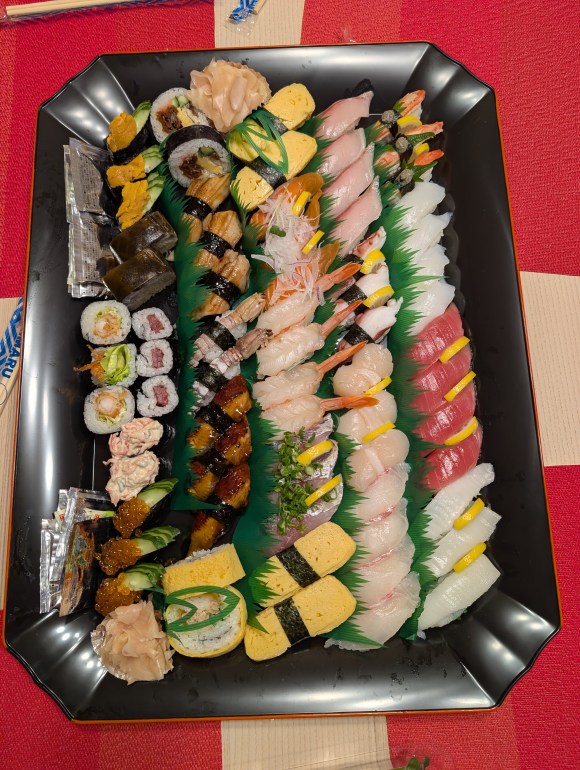
Platter of Sushi at Sally’s home. Photo courtesy: Alan Noble
Suzanne drove us to the home of the son of another old friend, Sally, who had kindly offered us a couple of nights’ accommodation. That evening a subset of old friends dropped in to see us and eat sushi. I braced myself for the entry of each friend into the house, trying to compose my features, after an unanticipated five-year interval. My eyes, however, betrayed me. I caught the expressions of those who returned by gaze, and they could sense my relief and excitement of meeting them again. Over five years people’s appearances were a little different. Those who had long hair now wore it shorter. Those with shorter hair had grown it. Those who were curvaceous were now svelte, and those who were svelte were now curvaceous. A child had now become a lanky teenager. I’m sure I must have looked different to them too. What had not changed was people’s smiles, conversation and sense of humour. People who I would normally see a few times over a month were now all present in the same room in the space of a few hours.
A few days later, we took the bus across Shikoku to Matsuyama, where another happy reunion took place of eight friends from six different countries. I was freshly aware of the joys of the expat life, where you can make friends from a greater range of countries, and a greater range of ages, than you would at home.
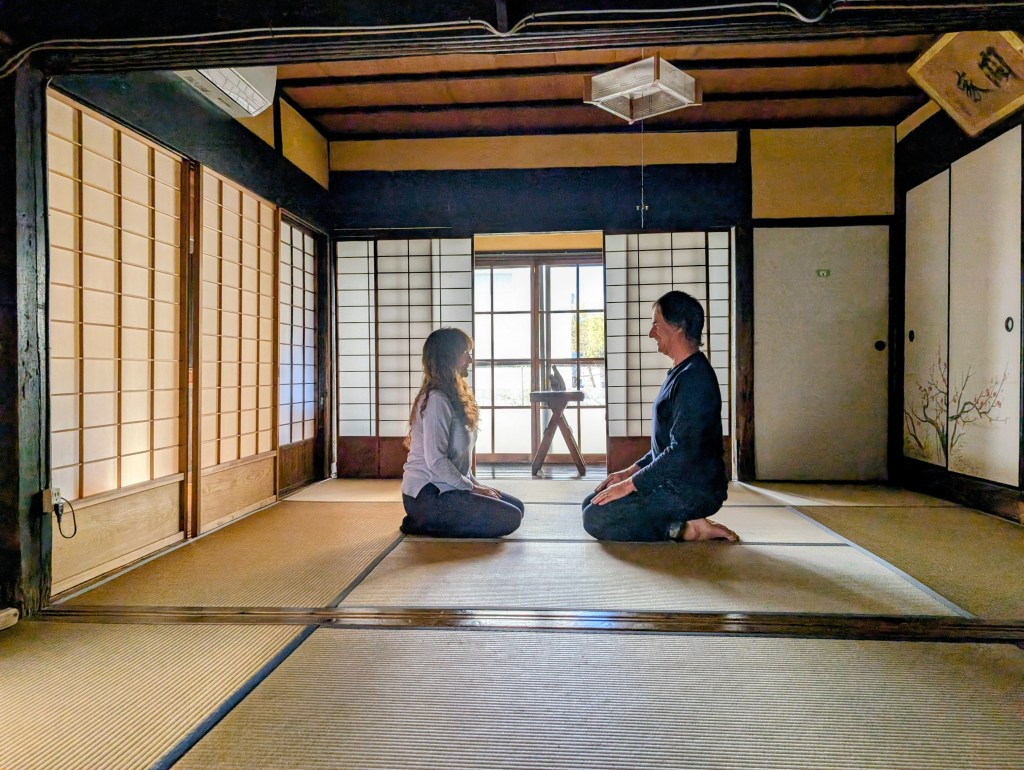
Ranma Carvings in a traditional room. Photo Courtesy: Alan Noble
I had been craving another stay in a traditional house, and we savoured a room with ranma carvings suspended from the ceiling, letting in light and air flow from the adjacent room. We sat at the kotatsu low heated table on the tatami, and slept on futon, in a room featuring shoji paper screens facing outside and fusuma cupboards where futons were stored. Features which had once seemed so ordinary were now infused with nostalgia.
Family obligations called us back to Australia after only one week of our Japanese honeymoon. A taxi was followed by a bus which took us on the long trek back across Shikoku, driving through impossibly long tunnels, crossing elegant bridges, with views of the sea and mountains. Once we crossed the final bridge onto the largest main island of Honshu, the landscape was transformed into high rise apartments, and dense traffic. We alighted from the bus at Kobe’s Sannomiya Station.
There we asked directions to the airport limousine bus and made a final purchase of onigiri. My favourite umeboshi pickled plum one was not on sale, so I had to make do with a tuna mayonnaise one and a pickled seaweed one. We ran to the bus stop, purchased tickets, and skipped into the bus holding our luggage. There was no time to store the luggage in the hold. Once the bus pulled into the traffic, we knew we could relax after our long and complicated journey. I gently pulled away the wrapping separating the layers of the tuna mayonnaise onigiri and savoured the contrasting flavours and textures. Our fleeting trip to Japan was punctuated by savouring onigiri on both arrival and departure. We bade farewell to this land of delectable tastes, exquisite arts, historic houses, hair-raising bicycle rides, and precious friends.
.
Meredith Stephens is an applied linguist from South Australia. Her recent work has appeared in Syncopation Literary Journal, Continue the Voice, Micking Owl Roost blog, The Font – A Literary Journal for Language Teachers, and Mind, Brain & Education Think Tank. In 2024, her story Safari was chosen as the Editor’s Choice for the June edition of All Your Stories.
PLEASE NOTE: ARTICLES CAN ONLY BE REPRODUCED IN OTHER SITES WITH DUE ACKNOWLEDGEMENT TO BORDERLESS JOURNAL
My dida, my maternal grandmother, is perpetually dissatisfied. It is better to die young, my mother often says, than to live to ninety and be like her. For as long as I can remember, she has not smiled. Her face has twisted into a permanent grimace at the torments that each passing day on earth brings.
“After a certain age,” she sighs as she sips her morning tea, “living itself becomes a sin.”
When I was younger, these pronouncements would worry me, and I’d consider my mother’s laughter the height of callousness. With time, I’ve changed my tune.
“Have you considered dying?” I ask her conversationally in response. “I can make arrangements.”
She harrumphs at me and tells me that when she does die, I’ll be sorry. I reply that she’ll outlive her daughter, not to mention me. I hear my mother, who has just entered the dining room, mutter that death will be a sweet release.
“What did you say?” Dida demands, cupping an ear in one hand. “I’ve told you not to mumble, Mishti, no one can understand a word you say.”
Mishti vanishes again. Dida, thankfully, has been overcome by a fit of coughing and has already forgotten what we were talking about.
The cough had appeared approximately one week ago, the day after Dida’s ninetieth birthday, and she is sure that is it, her time has come. After tea each morning, she opens the drawer to her bedside table and takes out an aluminium case that houses several dozen strips of medicines. She inspects each one carefully. Then, it is time to call Ujjal.
Ujjal is our neighbour – and a medical doctor besides. Dida likes to catch him before he leaves for the hospital.
“Hello Ujjal?” she bellows into her mobile phone. “No, I feel terrible – this cough will be the end of me. Is it allergic, do you think? Should I take the Levocetirizine and Montelukast combined tablet? No? How about some Paracetamol? No, you’re right, sometimes home remedies are the best, who needs these newfangled medications? You’re right, Ujjal, what a good boy you are. What a blessing it is to have you so close by. If not for you… I have no one, you know. Nobody to take care of me, or care whether I live or die.”
After this conversation, she chews on some dried clove, that tried and tested home remedy, and then takes a nap. Ujjal calls up my mother and pleads with her to hide Dida’s medicine stash – my mother replies wearily that she would if she could.
After her nap, it is time for Dida to call up various relatives and let them know that she is not being taken care of. Their commiserations, stories of their own aches and pains, and reassurances that she if comes to visit, they will keep her in the lap of luxury, has her happily occupied until lunchtime.
“I won’t eat anything,” she announces when she emerges from her room for lunch. “I have no appetite because of this sickness.”
“Ma made goat curry,” I tell her. This is considered. Then – “I suppose I can force myself to have a few bites,” she concedes grudgingly. “Otherwise, I’m just wasting away.”
She eats three helpings with gusto, pausing to point out that the curry could do with a little more salt and two more minutes in the pressure cooker, but is otherwise not too bad. My mother drops a courtesy and is heading back to the kitchen when Dida makes her announcement.
“Mousumi and her husband are coming to visit me this evening,” she says with some satisfaction. “At least my sister’s children love me, even if my own daughter… No, I can’t even say it.”
She remains in good spirits all afternoon, only half-heartedly telling me that I don’t love her. After lunch, she shoos my mother out of the kitchen and does all the dishes. Then, she changes the sheets on her bed. Finally, she changes from her usual nightgown into a white saree with blue border. Now that all the props have been arranged, it is time to set the scene.
Carefully, she arranges herself on the bed and lets out an experimental cough.
“Is there anyone there?” she calls in a weak but carrying voice. “Could someone at least fetch me a glass of water?”
“Coming, Dida,” I call, heading to the kitchen and coming back with a bottle and glass.
She drinks deeply and hands it back to me before another fit of coughing overtakes her.
“I think my temperature is rising,” she says sadly. “This is what will kill me. And no one to switch the fan off, even!”
I turn off the ceiling fan and beat a hasty retreat.
My mother’s cousin Mousumi, or Mou for short, and her husband Somnath ring the doorbell at five p.m. sharp. I let them in and take them to Dida’s room, where the old lady is in bed, as I have left her – but hadn’t I left the lights on? She is silent – she does not move or say a word as we enter the room, and a moment of disquiet steals over me.
At that moment, she tosses her head and moans weakly.
“Oh, Mani!” cries Mou, rushing to her side. “I’m here, Mani. Tell me what I can do for you.”
“Mou, my dear sister’s child,” comes my grandmother’s frail voice in the darkness. “How good of you to come all this way to see your poor old aunt… I fear it may be for the last time.”
She moves to sit up, ignoring her niece’s protests.
“I’ll make you some tea,” she announces in a quavering voice.
“No, no Mani!” Mou says, aghast. “How can you be made to do these things in your condition! Mishti will make you tea, of course. And we’ll have some too, just to keep you company.”
My mother, as always, is amused by the old lady’s antics. As she and I bring in a tea tray loaded with snacks, including fresh samosas from our local sweet shop, we hear Mou earnestly reasoning with Dida.
“You must come stay with us,” Mou Mashi is saying. “We will make sure you’re comfortable – you won’t have to lift a finger.”
“I couldn’t possibly,” replies Dida tremulously. “It would be such an imposition. How could I ask so much of my only niece?”
“No, no, ask anything you want of me! We just moved to a new apartment – it has a brand-new elevator, and a clinic with a doctor available 24/7, and all the comforts you can imagine! And I’ll make all your favourite foods…you look so thin, Mani, it just breaks my heart to look at you.”
“How wonderful that sounds… No one lets me eat anything nice anymore,” Dida says sadly. “It’s all watery dal and plain rice and boiled papayas.”
Mou made appropriately soothing noises.
“I’m here for you, Mani,” she says, holding Dida’s hand. “I’m going to take good care of you.”
The visit is cut short because Mou needs to let her driver off for the night, but she leaves Dida with several more promises of a visit soon-to-be-planned. Before she departs, though, she has some stern words for my mother.
“If you can’t take proper care of a frail old lady,” she fumes. “At least have the decency to put her in a good care home!”
And on that parting note, she and her husband get into their car and drive off.
“Do you think they’ll take Dida away?” I ask my mother after they are out of sight.
“Wouldn’t that be nice,” Ma replies. “The old lady would never agree to leave!”
“What’s that?” calls Dida from her room, with her unerring sixth sense for whenever she is the subject of discussion. Her voice has entirely returned to normal.
“Nothing, Dida,” I tell her, going in to switch on the mosquito repellent and administer her eyedrops. “So, when are you going to stay with Auntie Mou?”
“Uff, now I’ll have to visit her for politeness’ sake,” the old lady says, sounding disgruntled. “Isn’t she so tiring? Turned out just like my sister, she has. Won’t let me lift a finger, indeed! She makes me sound completely helpless!”
And on that note, she bites into her third samosa with gusto.
Priyanjana Pramanik is a doctoral student of geography and writer of fiction and popular science articles, splitting their time between Kolkata, India, and Hobart, Australia, and a parent to seven cats.
.
PLEASE NOTE: ARTICLES CAN ONLY BE REPRODUCED IN OTHER SITES WITH DUE ACKNOWLEDGEMENT TO BORDERLESS JOURNAL
Parry Lines was an ordinary fellow, so much so that even his friends couldn’t be bothered to find out his actual name and were content to call him “Parallel,” his nickname since childhood. Regular, indeed nondescript features were surmounted by his trademark bald pate; the most you could say was that occasionally he wore a bright plaid shirt in neon pastels to liven things up a bit.
Ten weeks A.G. (After Gherkin)
Yet his death (by gherkin) caused a butterfly effect that changed the world. Until the incident with the gherkin, the most notable thing that had ever happened to Parry was when his surprisingly dashing teenaged son had consumed an entire teacup full of gravy during Thanksgiving dinner. Honoured guests had watched in horror as Parry Jr. (PJ for short), notable for his twinkling hazel eyes and flowing chestnut hair, gulped down the rich, brown fluid–though they should have expected something of the kind when he poured the gravy from the pitcher on the table into the China cup ready at his place setting for after-dinner tea.
Present at that event, and at the gherkin incident as well, was Mrs. Honoria Tadpole, English professor and amateur sleuth. Her demure, conservative appearance (she always wore a smart, tailored suit–or at least the best the local thrift shop could provide–and had her silver-blonde hair cut in a perky, short bob) and her self-effacing manner and diminutive (if plump) stature belied the sharpest mind north of California. It would fall to her to unravel the complicated mystery that the local paper dubbed “Gherkingate.”
Interviewed by the features’ editor, as the criminal trial of the alleged murderer dragged on, Mrs. Tadpole was asked the inevitable question of how it had all started. The interview took place in Mrs. Tadpole’s well-appointed parlour, a room replete with Victorian bric-a-brac. With characteristic hospitality, she poured out a strong brew of BC Bold to accompany the delicate sandwiches (ham, egg, and cucumber) and homemade oatmeal cookies that were her signature “high tea,” known to local islanders as a four o’clock tradition at the old manse where Mrs. Tadpole rented a small suite.
“Now, Mrs. Catchpole, I understand you were part of the original party that travelled to Moany Bay,” the interviewer began.
“Tadpole,” Mrs. Tadpole corrected. A veteran instructor of nineteen- and twenty-year-olds, she was used to misspellings and mispronunciations. Marpole, Rumpole, Toadpole: she had heard and seen it all, and could make the necessary correction without even flinching anymore. She cast her mind back almost three months to a mid-summer weekend off British Columbia’s Sunshine Coast.
She began with an allusion to classic culture: “Just sit right back and you’ll hear a tale, a tale of a fateful trip…”
Sadly, the features’ editor of the Island Gleaner failed to catch the reference to Gilligan’s Island, one of the best sit-coms of the 1960s. Mrs. Tadpole had been a toddler when the series was first aired, but its popularity throughout her childhood made it a touchstone for, really, almost everything in life, according to her observations. She knew that some people accorded such a status to the iconic, original Star Trek, but what did Captain Kirk have that “the Skipper” did not? Not much, thought Mrs. Tadpole.
The premise of Gilligan’s Island was classic: a small number of people, randomly-assorted, stranded on an island together with no real prospect of deliverance. After all, wasn’t that just the paradigm of human existence? You didn’t need to be an English proffessor (though Mrs. Tadpole was one, of course) to figure that out.
That fateful weekend, when the seeds of the gherkin incident was sown, had been rife with undertones of Gilligan’s Isle.
Breathing deeply of the fresh Pacific breeze, the passengers sat out on the deck of the vessel as it hugged the rugged BC coastline. The rushing water behind the Skirmish flumed out into a fan of spray, while the murky depths offshore spat out seals and sealions–even the occasional humpback whale–with random irregularity. Black bears hid among the rocks and evergreens in the uninhabited areas; cabins dotted the beaches in the populated areas of cottage country. On the way up the coast, the party of friends and family had composed their own version of the theme song, with each member of the group assigned to a role from the original cast. Mrs. Tadpole was the Professor, of course. Never mind that the community college where Mrs. Tadpole worked had opted not to accord academic titles to their teachers, or that the original Professor in the TV series was a man. (As Mrs. Tadpole had been known to say to her first-year college students, we live in a post-gender, post-glass-ceiling world. And if we don’t, we should).
Aboard the Bayliner, Skirmish, Parry Lines was the Skipper, and his hapless, gravy-drinking son was typecast as the irrepressible Gilligan, full of mischief and ridiculous ideas. Mrs. Tadpole could only hope that her adorable niece, Mary Anne (same name as her Gilligan’s Island counterpart!), was immune to his sauce-swilling charms.
The Millionaire role was assumed by the reclusive entrepreneur Deadhead, Mickey Garcia (if that were in fact his real name), accompanied by his charming wife, Penelope, a voluptuous brunette. Together they had built an empire founded on tribute bands and biopics. The rumour mill had it that there was trouble in paradise, but no one outside his immediate family had seen Mickey for years, so it was difficult to substantiate the gossip.
The cast was fleshed out (so to speak) with a bona fide movie star, the internet sensation who began as one of the central figures in a YouTube series called Project Man Child (“For the price of a cup of coffee… you can buy this underemployed househusband a cup of coffee!”) and had gone on to a viral barrage of TikToks under the sobriquet of “The Naked Gardener”. Mrs. Tadpole was relieved (as no doubt were the others) to note that all the passengers aboard the Skirmish, including this one, appeared to be fully clothed.
At least, all whom she could see wore conventional travelling attire: Mr Garcia, recovering from surgery and groggy with heavy opiates, was shrouded in a blanket and wearing dark glasses. He slumped a little to the side, and his heavy breathing attested to a well-earned reputation for napping as a pretense in order to ignore his surroundings.
As Mrs Tadpole later told the Gleaner interviewer, the real concern of the trip quickly emerged: not the rapprochement of Mary Anne and Parallel Jr., but the burgeoning, even violent antagonism between Parry Sr. and Penelope Garcia, whom the latter insisted on calling “Cherry” with a suggestive leer while her husband languished in his bunk. “Is he grateful? Or just dead?” quipped Lines. One night, Penelope went so far as to brandish a knife in Lines’ general direction and had to be restrained by Mrs Tadpole and Mary Anne in tandem.
Although Madame Garcia was the only one to meet his taunts with open animosity, no one was spared the self-proclaimed wit of Parallel Lines.
He had the nerve to call Mrs Tadpole’s beloved niece, whose sunny disposition was outshone only by the sweet, fair face that perched above her perfect figure, “Mistress Mary, Quite Contrary” –nothing could have been further from the truth! Of course, Mary Anne merely smiled and shrugged it off, as if no insult could penetrate her cheerful exterior … but others were less armour-clad.
The bully referred mercilessly to the Naked Gardener as “Jamie Oliver, the Naked Chef” (whom he slightly resembled) a slur that obviously got under the man’s skin (“I couldn’t boil an egg to save my life!” he protested angrily. “That’s not my brand at all! He’d better watch his back…”).
Even Mrs. Tadpole (surprisingly resilient after having been bullied through her shy youth as resembling a chubby little toad) came in for her share of abuse, rechristened as “Mrs Toad” after making her one of specialties, toad-in-the-hole, for her shipmates. (Once she discovered that the galley of the Bayliner was stocked with a potato ricer and La Ratte potatoes, there was no holding her back. A ring of caramelized onions surrounded each serving dish, with two nut-brown sausage-ends sticking out of the centre, for all the world like a couple of froggy eyes.) “No one calls me Toad,” she intoned ominously.
Cruelly and unaccountably, Parallel Lines saved his worst tirade for his own son. Recalling that terrible moment of youthful folly, that mind-gripping shame that only time could heal, the father saluted the son like a champion hog-caller summoning his prize sow. “Sooooo-Eeeeee! Want some gravy with that?” Alternatively, he would break into song to the tune of ‘Hey, Jude’:
"Au jus,
Just make it fat,
Take some gravy
And make it wetter..."
It was pitiful to see the boy’s response, especially in front of Mary Anne. His pale face was suffused with a ruddy glow beneath his chestnut fringe, and hot, angry tears rose in his sensitive, hazel eyes.
“I’ll kill him,” PJ muttered under his breath.
And now the tranquil Mary Anne, who couldn’t have cared less about any vitriol directed her way, was at last roused to fury in defense of her maligned and helpless friend. “I’ll do it for you!” she offered. “By G—!”
Two Hours B.G. (Before Gherkin)
Suffice it to say, no one was all that distressed when Parallel Lines failed to return to the Skirmish after an afternoon in the seaside village of Egmont (pronounced with an “egg” and not an “edge”).
Penelope had steered Mickey off in a collapsable wheelchair they had stowed on the boat; “the millionaire and his wife” were off for lunch al fresco, heading for a picnic table in an accessible, though private, spot. Roast beef sandwiches and condiments, along with champagne and a couple of plastic flutes, had been assembled into a decorative yet sturdy straw basket which the amazon-like Penelope slung easily over one arm as she manouevred the wheelchair down the forest path.
The movie star had gone in search of Egmont’s famous cream cheese cinnamon buns, hoping to be recognised at the Forest Cafe by someone who would do a double take and exclaim, “Hey! Wait! Aren’t you that man child?”
Mrs Tadpole and her niece decided to go for a refreshing swim in the brisk waters of the bay, washing off the grime of shipboard life before stopping at the Village Green Room for a bowl of veggie curry soup and some fresh, hot rolls.
As for PJ, he declared himself too upset to leave the Skirmish, and was hoping to curl up with a graphic novel, a diet soda, and a bag of Doritos, to forget all his cares for a few hours while the rest of the party looked around Egmont Village.
But where was Parallel? It was time to cast off. If they didn’t leave soon, they wouldn’t make it to the Coastal Lodge before dark. And–not to mention–P. Lines was the skipper!
“I’m perfectly capable of getting us there,” insisted PJ, fortified by his power nap. “I’ll bet you anything, dad’s holed up at the Drifter Pub, and he’ll crash at the hotel there. I’m sure he’s as tired of us as we are of him. Let’s just go. We’ll all have cooled off by tomorrow morning, and I’ll swing back and get him then, bring him up to the Lodge for the rest of the weekend.”
The plan sounded good, and all agreed to it willingly. Off they set for the rustic cabin someone had dubbed the Coastal Lodge in hopes (quite justified, as it turned out) of charging a tidy sum in AirBnB rates. Never mind that it featured a remote outhouse and a camp kitchen; the setting was beyond beautiful, and the (now) congenial group looked forward to beach and forest walks, blazing bonfires, and midnight swims. Mrs Tadpole insisted on taking charge of the outdoor kitchen: she had brought the ingredients for her famous moussaka and looked forward to the challenge of cooking it in a casserole dish on the barbecue. PJ and Maryanne diced feta, tomatoes, onions and cucumbers for a Greek salad, while the movie star tried in vain to get a cell signal and the millionaires played cribbage by the big bay window in the cabin.
Parallel Lines could cool his heels at the Drifter until morning, thought PJ and crew.
G.T. (Gherkin Time)
“So,” said Mrs. Tadpole to her interviewer, “Can you guess who did it?”
“Uh,” said the Features editor. “Nope.”
“I’ll give you a hint: don’t ask who was the perpetrator. Ask who was the victim!”
“Well, that would be Mr. Lines, would it not?”
“Would it? What if the wheelchair-bound invalid, Mr. Garcia, was really Parallel Lines in disguise?”
“But–”
“He was wrapped in a blanket, wearing dark glasses and a mask, slumped in his chair. And there was a switcheroo.”
“A what?”
“A switch. In the forest.”
“Well, I’ll be jiggered. Why haven’t you said anything?”
“Blackmail.”
“You’re blackmailing the unlikely lovers? Parry Lines and Madame G?”
“No, they’ve been blackmailing me. But it’s time to come out. My trans-formation is at hand!”
“Mrs Tadpole! What a story for the Gleaner–and for the world! May I be the first to congratulate you?”
“You may.”
Deborah Blenkhorn is a poet, essayist, and storyteller living in Canada’s Pacific Northwest. Her work fuses memoir and imagination, and has been featured in over 40 literary magazines and anthologies in Canada, the United States, Britain, the Netherlands, Germany, Australia, Brazil, India, and Indonesia.
PLEASE NOTE: ARTICLES CAN ONLY BE REPRODUCED IN OTHER SITES WITH DUE ACKNOWLEDGEMENT TO BORDERLESS JOURNAL
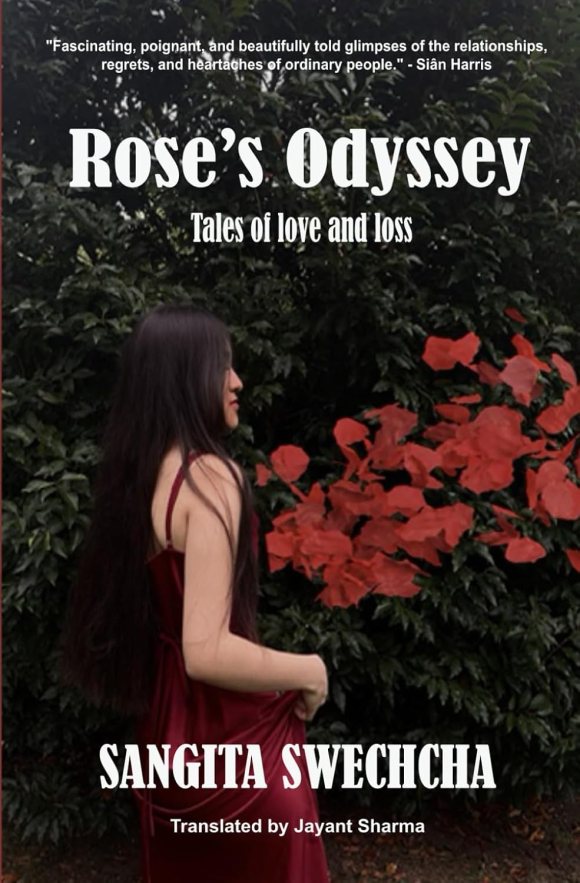
Rose’s Odyssey:Tales of Love and Loss is a translation of ‘Gulafsangako Prem1’, a short story collection in Nepali by Sangita Swechcha. Jayant Sharma, the translator, has displayed his incredible skill transmitting the essence and the texture in his translation as they are in the original version.
Swechcha’s writing moves across geographies and emotional landscapes. In Rose’sOdyssey, we see the influence of her own journey: born and raised in Nepal, her time spent in Australia, and her life in the UK. Her experience of multiple cultures gives her work both depth and relatability. She writes not just as a woman, or a feminist, or a diasporic voice, but as a humanist. Her stories resonate because they are grounded in truth and told with generosity.
Several reviewers on Amazon have echoed the sentiments generated by the stories. Dr. Tamer Mikhail describes the experience as “mesmerising,” noting how vividly the characters come to life. Ketan Varia praises Swechcha’s exploration of how life unfolds and the unintended consequences of human choices, while Nirmala Karanjeet highlights the wit, humour, and deep perception of human emotions in every story. These voices of readers moved by the same qualities.
Among the twenty stories, a few stood out with particular force. The titular story, ‘Rose’s Odyssey’, reminded me in scope and ambition of Homer’s Odyssey. Yet this is no imitation. Swechcha’s tale of love, betrayal, vengeance, and repentance transcends a simple love story. It is a story within stories, a tapestry woven with dramatic shifts and psychological insight.
Another memorable piece is the final story, presented in diary format. The narrative offers a poignant glimpse into diasporic life, told in a male voice, which is an unusual and ambitious choice for a female writer. The story’s ability to inhabit male psychology with such authenticity is no small achievement.
The shortest story, ‘Ram Maya’, dealing with the issue of human trafficking, is devastating. In just a few pages, it trembles with urgency. Then there is ‘Shattered Dream’, a story I had previously read in its original Nepali and was eager to revisit in English. The translation, no easy feat, is executed beautifully, preserving cultural nuances while making the narrative accessible to a broader audience. In fact, I was reminded of Toni Morrison’s The Bluest Eye (1970), particularly in how Sweccha addresses themes of bodily autonomy, survival, and the commodification of womanhood.
What ties all these stories together is Swechcha’s ability to write about complex emotional terrain with elegance and restraint. Each story is deeply personal, yet universal. The immigrant experience, cultural duality, gender, longing, and resilience are all present without ever feeling heavy-handed. It is heartening to see readers on Amazon responding so positively. One reviewer calls it “an easy and interesting read,” while another from Holistic World notes how each tale is “captivating and alluring,” connected by “the thread of love.” This feedback is not only encouraging, it also affirms the book’s power to reach readers from all walks of life.
In addition to the warm reader responses and literary features, I also recall Shahd Mahanvi, author of White Shoes, at the launch event aptly described Rose’s Odyssey as “a powerful exploration of human emotions.” She added that it is “a compelling collection that delves into themes of control, mistrust, the impulse to hurt those we love, and the complex intersections of human relationships, provoking deep reflection.”
In the year since its release, Rose’s Odyssey has had a successful run, from warm reader responses to literary features, several book signings in the UK and Nepal, and community events. Its journey is far from over. The success of the book is not just a testament to Swechcha’s literary talent, but to her ability to connect across continents, cultures, and hearts.
Dr. Rupak Shrestha, a London-based Nepali poet from Pokhara, is acclaimed for diverse literary forms and translation. He also serves as Advisor to the International Nepali Literary Society (INLS) UK Chapter.
.
PLEASE NOTE: ARTICLES CAN ONLY BE REPRODUCED IN OTHER SITES WITH DUE ACKNOWLEDGEMENT TO BORDERLESS JOURNAL.
Sharifa panicked briefly, looked around for Rhys, saw him near a row of tiny trains further inside the shop and waved at him to come to her. He didn’t see her, and the skinny boy wearing black nail polish was now waving the card right in her face. She frowned and said, “Sorry. I’ll get my husband.”
The punk whose name tag said Gee, shrugged and swept aside the scarves and tote bags Sharifa had placed on the counter and picked up the book he’d been reading.
“Rhys!” Sharifa tapped him on the arm, and he turned, smiling. “Something’s wrong with this card. Can I have yours?”
Later, bags tucked under the wrought iron table at the café they found around the corner, they sipped their coffees and tried not to grimace.
Rhys took off his windcheater and dropped it on the empty chair beside him. “Americans are coffee drinkers, right? How come this stuff tastes so horrible?”
“Maybe we don’t know where to find the best coffee in town. We should stalk those snappy office goers and see where they get theirs.”
They laughed and Rhys brought up the declined card again. She knew it bothered him even though her ANZ card was still working. She rarely used it because of the $2000 limit. But they’d used it to pay for the watery coffees and the horse carriage ride through Central Park earlier, and she knew there was enough to cover them for a week, if needed.
“Give us a look at that card.” Rhys put his hand over hers.
She sighed and placed it on the table.
“Shari. Love. This isn’t your card.”
“What do you mean? Of course it’s my card. I’ve been using it in Vegas casinos, for crying out loud.”
“Look.”
He was right. The name on the card said Sabiha Evans, not Sharifa Evans, but the signature was hers. Her writing. It didn’t make sense.
Sharifa withdrew her hand from his. “No, before you ask, I haven’t left it lying around, haven’t picked up someone else’s by mistake. You know me, Rhys. Paranoid from way back. I grew up in a country where you assume you’re going to be robbed, so I never take chances. This is seriously weird.”
“I know love.” Rhys’s hand covered hers again and he shook his head. “It’s the name that worries me. And that signature. It’s yours. How can this happen?’ And who’s this woman? Got a sister you haven’t told me about?”
“Yeah right. Also married to someone called Evans.” Sharifa tried not to sound annoyed. “This isn’t my fault.”
“Never said it was.”
They were meeting friends at a waterfront restaurant in New Rochelle, and arrived ahead of time, barely speaking to each other. An early thunderstorm prevented them from walking around the neighbourhood, and now they checked their phones, avoiding eye contact.
“Please …,” started Sharifa, wondering what she was pleading about, and Rhys looked back, nodding.
“I won’t say anything.”
“Thanks. I mean, maybe we can mention it?”
Mark and Andy were strolling towards them, hand in hand, and they both got up and hugged them, waving towards the table they’d booked.
“It is bizarre.” agreed Andy, looking at the card Sharifa had placed between them. “Spooky, almost. Have you gone to the Embassy? I mean, this could be fraud on a grand scale and you’re just at the start of your holiday. You don’t want to be aiding and abetting crime.”
“Andy.” Mark laughed. “Stop scaring them. Yes, it’s weird and we are in New York, but it doesn’t need to be quite so dramatic. Ring the bank and cancel the card. You have others?”
“Yes,” said Rhys. “Mine is fine. It’s Shari’s that’s gone whacko.”
.
Andy and Mark insisted on driving them to their tiny hotel room in midtown Manhattan, where they’d spend the rest of the week. Promising to update their friends on The Great Card Saga, they fell asleep almost immediately, Sharifa dreaming of kittens walking on windowsills.
The man from the bank was not helpful. Despite Sharifa repeating her name and date of birth and typing her password on the link that was sent, the outcome was the same. There was no record of her ever having an account with them. Yes, they had Rhys, but not her. No, they couldn’t cancel a card that was never issued to her. Cutting up the card into little strips seemed to be the only option until they returned to Australia.
.
A week after they got home, Sharifa stared at the envelope from the bank before ripping it open. Inside, a letter informing her that her replacement card was enclosed and that she should change the password at her nearest branch. A new card, with a blank signature strip, in the name of Sabiha Evans.
Rashida Murphy is a writer living in Perth, Western Australia. She is the author of a novel and a collection of short stories. Her novella titled Old Ghosts is forthcoming next year.
.
PLEASE NOTE: ARTICLES CAN ONLY BE REPRODUCED IN OTHER SITES WITH DUE ACKNOWLEDGEMENT TO BORDERLESS JOURNAL











 Borderless