They tell you one must learn to let go to remain sane. What they miss out telling is how much it takes to forget and let go people who make a whole city in your life. A city that is not home still, the only home you know; A home that consumes and yet the only place that sustains you; A sustenance that holds but offers no release. When you have lived long in such a city, your hopes are entangled with the unyielding forces of knots difficult to untie.
THE OFFERING
I despair when things don’t go as I planned. I forget to breathe, and lament the spaces around for smothering me. I forget time is as mercurial as the fancies of my mind. I forget it only takes as much warmth as that bestowed by a weak winter sun to step out and begin from the beginning.
Resilience makes itself every day appear from unexpected places. We are shown in abundance if we stop to notice amidst the muddle beget by ordinary ordeals. A shoot emerging from the stem of a withered plant in your balcony, long after you thought it had died because you forgot to water it for months, tells you life clutches tightly after all. And pushes forth with might through everything it is denied.
Rakhi Dalal writes from a small city in Haryana, India. Her work has appeared in Kitaab, Scroll, Borderless Journal, Nether Quarterly, Aainanagar, Hakara Journal, Bound, Parcham and Usawa Literary Review.
.
PLEASE NOTE: ARTICLES CAN ONLY BE REPRODUCED IN OTHER SITES WITH DUE ACKNOWLEDGEMENT TO BORDERLESS JOURNAL
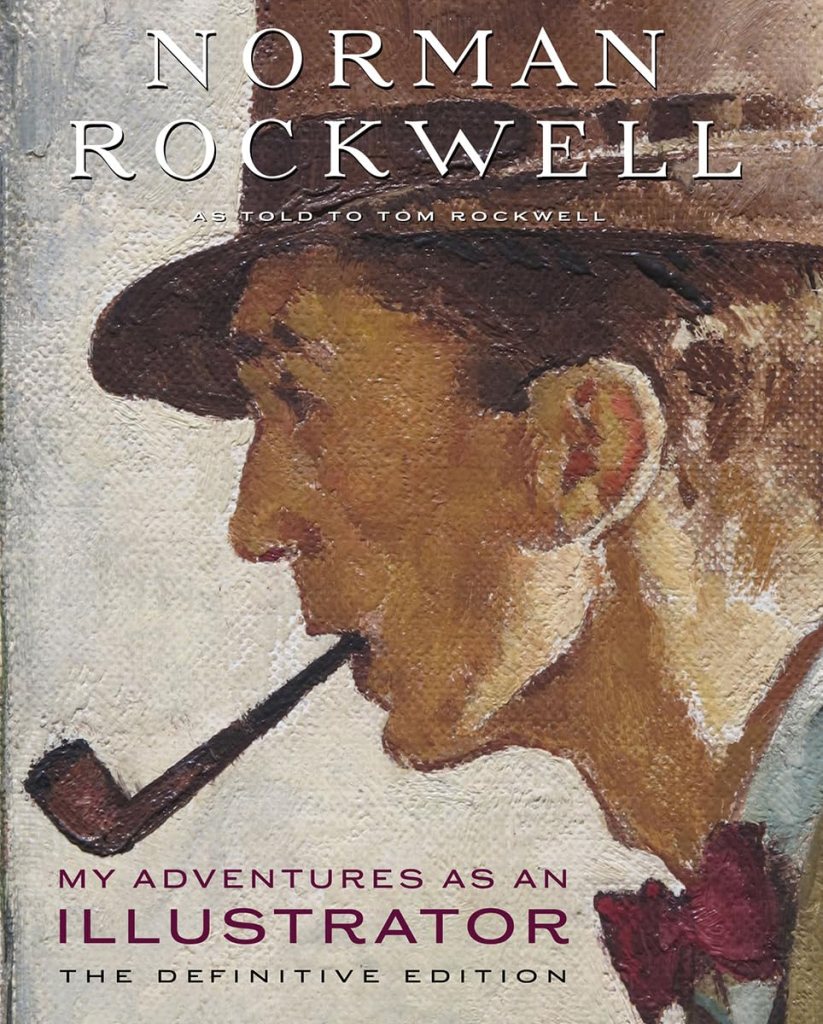
Norman Rockwell (1894-1978)Art by Norman Rockwell Photographs from Public Domain
Norman Perceval Rockwell went into dementia in the last years of his life and died at 84 in 1978. He was a deeply insecure human being—about himself and his work. Even as a cultural icon, he still distrusted his judgement, wondering if the quality of his work was slipping, if editors would still take it, if he and his work were passé—too old fashioned. His insecurities—masculinity among them; his struggles with self-worth and the worthiness and meaningfulness of his work, drove him to achieve a kind of surface perfection in his work and self.
He wore rose coloured glasses an inch thick, refusing to acknowledge the seamier side of life, though in a few pictures, very few, he stepped out of character: with a poster/picture of a machine gunner, 1942; with a 1960’s painting of a little black girl being escorted by U.S. Marshalls, he presented a deeper reality, clearer vision, than his usual joshingly superficial emotionalism—the signature of his work. His seven years in therapy with Eric Erikson did bring a deeper psychological nuance to his work, but the depth remained at the shallow end of the pool.
“I have the ability,” he wrote in his autobiography My Adventures As An Illustrator,“to ignore unpleasant or disturbing experiences.” (In the autobiography, he failed to mention his second wife’s alcoholism—they were married for twenty years.)
He remained blinkered to reality, setting out purposely to create an alternative and prominently adenoidal looney-tune world.
As a product of a valetudinarian mother and a cold remote father (a salesman) Norman became an emotionally stunted pedantic oddball whose work straddled worlds of illustration and fine art. Whenever asked, he always declined to describe himself as an “artist,” insisting he was an “illustrator.” A display of humility, Deborah Solomon noted in her Rockwell biography, or a defensive feint—“he couldn’t be rejected by the art world if he rejected it first” (American Mirror, ‘The Life and Art of Norman Rockwell’). The insipid emotionalism of his characterisations ensured his place as illustrator.
Though Americanising Dutch Realism, as Solomon also noted, his technique—fidelity to realism, and to the shallowness of his vision—made his work’s elevation to rarified “art” probable though only as a side-show, as an art of eccentricity, and not for the big tent.
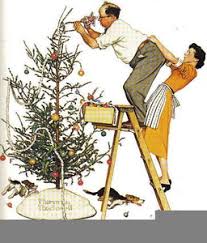
More art from Norman Rockwell. Photographs from Public Domain
Wayne F. Burke is, primarily, a poet–with 8 published poetry collections to date–but also writes prose fiction, nonfiction, and expository. His most recently published book, a nonfiction work, is titled “the VAN GOGH file: POTATO EATERS, PREACHERS, AND PAINTERS,” Cyberwit.net., publisher. He lives in the state of Vermont (USA).
.
PLEASE NOTE: ARTICLES CAN ONLY BE REPRODUCED IN OTHER SITES WITH DUE ACKNOWLEDGEMENT TO BORDERLESS JOURNAL
Going back to when I played here, running up the path mama mama kissing your sweet forehead
now motionless and cold
Dreaming of leaving
Not wishing to go But there is no one here, just the buzz Of the drone overhead And night falling in my soul
Leaving leaving Dreaming dreaming of leaving leaving leaving leaving…
David Mellor has been published and performed widely from the BBC, The Tate, galleries and pubs and everything in between. Now, resident in Turkey he has continued his literary career with his work appearing in journals including a weekly column in Canakkale Gündem about his observations of Turkish life. His poems and writings are autobiographical, others topical and several his take on life.
.
PLEASE NOTE: ARTICLES CAN ONLY BE REPRODUCED IN OTHER SITES WITH DUE ACKNOWLEDGEMENT TO BORDERLESS JOURNAL.
Summer is a reality check that strengthens our resolve to survive each day, after a vacation. It is a sizzling 47 degrees Celsius outside. Even a simple task is a battle that needs to be won. My short morning walk almost finishes me, though I go in the very early hours. It becomes difficult to take it, making me sweat as in the gym. Even an urgent car drive can roast you. Going to the nearest market becomes an odyssey. The best thing about summer is that you can blame everything on it.
As I look back, from April through June, North India would descend into hell. As the mercury rose above 40C, the air turned progressively drier. Homes were cooled with curtains of the fragrant “khus”. This dried herb needed to be watered and the dry wind blows fragrance and moisture into the house. It was surprisingly effective. In school, students routinely suffered nosebleeds and fainted from the heat during morning assembly which held in the school grounds. Now we have air conditioners in some places.
There were sandstorms accompanying the heat wave from deserts around Delhi. People would shut their doors and windows but the dust would still find its way in. In this lower ring of Hades, students would battle their final exams. Summer always brought the sense of an ending.
What also ended, was the supply of good vegetables. Bhindi (okra), eggplant, gourds, sundry root vegetables were all that could be found in the shops. Everything else died from the heat. But there were cucumbers — long, slender, foot long cucumbers with very fine skin. These were referred to, poetically, as “Laila ki ungliyan; Majnu ki pasliyan[1]”. And there was Rooh Afza: A lurid pink “sherbet” which came in a glass bottle and was made with Unani herbs to counter the heat. Jugs of this were served with ice and slices of lime. There were “cooling” foods with coriander, limes and raw white onions. Icy cold lassi with mint and roasted cumin were invariably present at every meal.
What would summer be without mangoes? We didn’t get the King of mangoes, Alphonso, always but there was the Dusshehri and Langda and so many varieties. Mangoes in every way and in every variety– juice, pulp, fresh, fried, pickled, jams — sweet savoury.
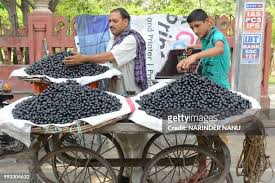
Men selling Jamun fruit. From Public Domain
Occasionally, on the way out of town as kids, we would buy sugary honeydews and watermelons on the dusty road of Rajasthan. A tall glass of nimbu pani[2], watermelon juice, buttermilk were very welcome. Or relief of a cool shower at the conclusion of a punishing day. The soothing balm of an evening breeze. Sometimes, we bought deep purple Jamuns from handcarts. These stained our faces and dresses with its colour. The dresses would be thin cottons or muslin which turned into butter with repeated washes.
The summer was as cruel as it was generous. It sang a melodious tune — the cuckoo’s cry woke us up every morning.
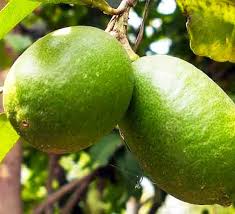
The Gondhoraj Lebu or lemon. From Public Domain
Many years ago, I had discovered in Bengal this marvellously rich, soothing, fresh scent which has become synonymous with the fragrance of summer for me. The scent lingered and I knew the sapling was coming home with me. The great gondhorajlebu, lime, lemon — call it as you will — but it is the king (raj)of taste and fragrance (gondho). It has a distinctive flavour and aroma akin to its South East Asian, lumpy bumpy cousin the kaffir lime. Lime to lemon in size and really used more for its zest rather than the pitiful amount of juice, although its still worth the trouble, trying to squeeze every last drop of it out into your meal or drink.
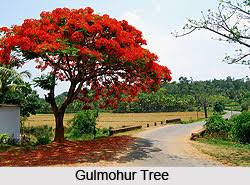
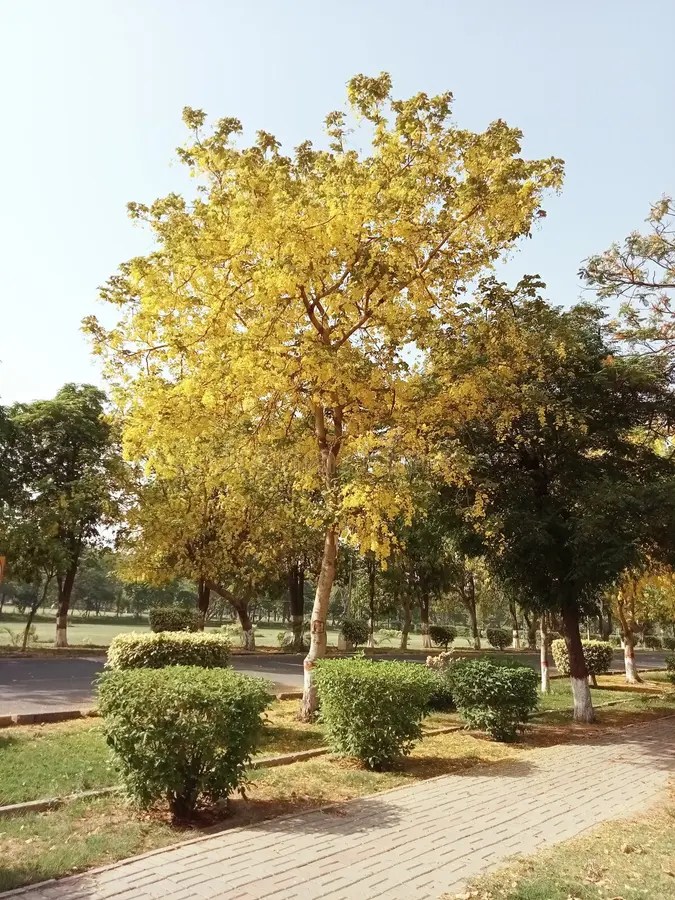
The streets stayed deserted all afternoon in the summer. There wouldn’t be a crow in sight. Though they stayed ablaze with the skies with flames of gulmohar and the gold of amaltas. The curtains would be drawn, the cooler, would be on. We would listen to music or watch television.
Amaltas tree in full bloomFrom Public Domian
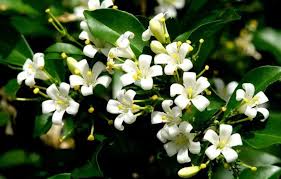
And the saga of summer continues. At night, we are greeted with intoxicating perfumes of nature. Though the garden completely shrivels, jasmines and tuberoses bloom in the tender moonlight. Madhukamini wafts like a hundred blessings around my senses. It seems all pervasive, and the light breeze seems to control its intensity in the night…
Madhukamini Blooms. From Public Domain
[1] the fingers of Laila, the ribs of Majnu: From the legendary love story of Laila Majnu
I wonder what people felt at the turn of the century, with Waterloo behind them now; and the Crimea and the hundred wars fought by men to prove I'm not sure what. I wonder what they felt as the thick black smoke of industry cleared now on the skyline; and there, for the first time, they saw the blue sky, the sunlight shining through. I wonder what they felt when they saw their century slip away, like a fine ship pushed out to sea. And there, before them, the great unknown; mile on mile of endless ocean. Did they feel hope or fear, I wonder? Or maybe both? And, seeing the gravestones in the rain, perhaps a sense of sadness, too, for those who had not made it. For many had lived, but many more had died.
II
We survived the shock of the millennium, with Passchendaele behind us now; and Auschwitz, Hiroshima, Korea, Vietnam. And, I wonder, as the years subside, what we will feel at the turn of our century... With Iraq behind us now, and Gaza and Ukraine and the hundred wars yet to be fought by men to prove I'm not sure what. I wonder what we'll feel as the thick clouds of radioactive gas clear slowly on the skyline. And there, for the first time, we see the blue sky, the sunlight shining through. I wonder what we'll feel as our century slips away, like part of a rocket jettisoned silently in outer space. And there, before us, the great unknown; a thousand light years, bright with stars; yet so very, very far away. Will we feel hope or fear, I wonder? Or maybe both? And, seeing the gravestones in the rain, perhaps a sense of sadness, too, for those who did not make it. For many will live, but many more will die.
Stuart MacFarlane is now semi-retired. He taught English for many years to asylum seekers in London. He has had poems published in a few online journals.
.
PLEASE NOTE: ARTICLES CAN ONLY BE REPRODUCED IN OTHER SITES WITH DUE ACKNOWLEDGEMENT TO BORDERLESS JOURNAL
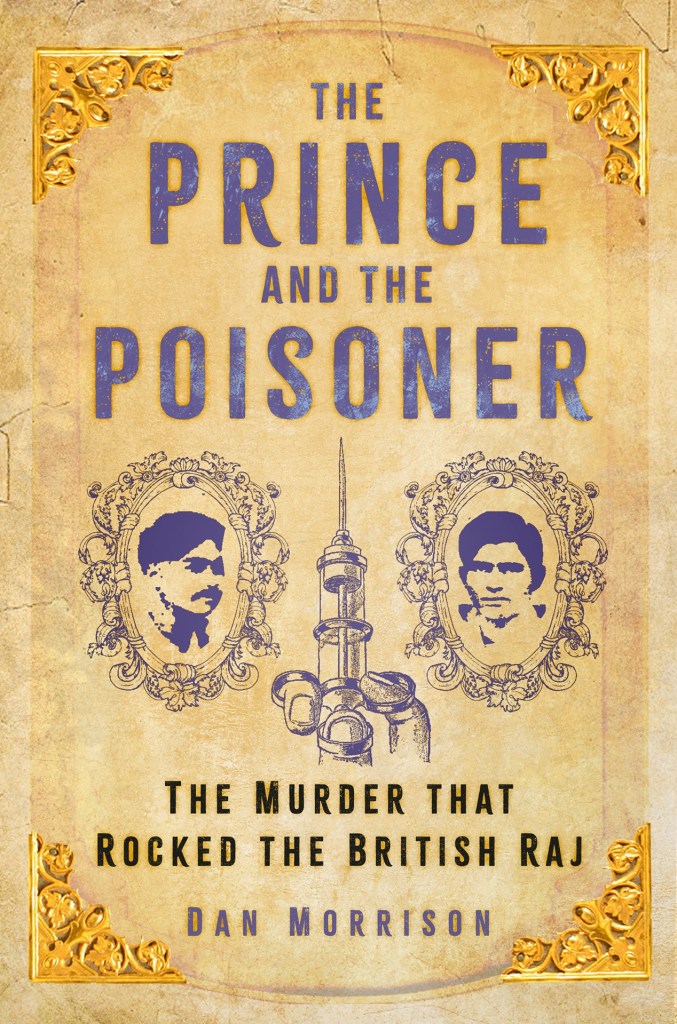
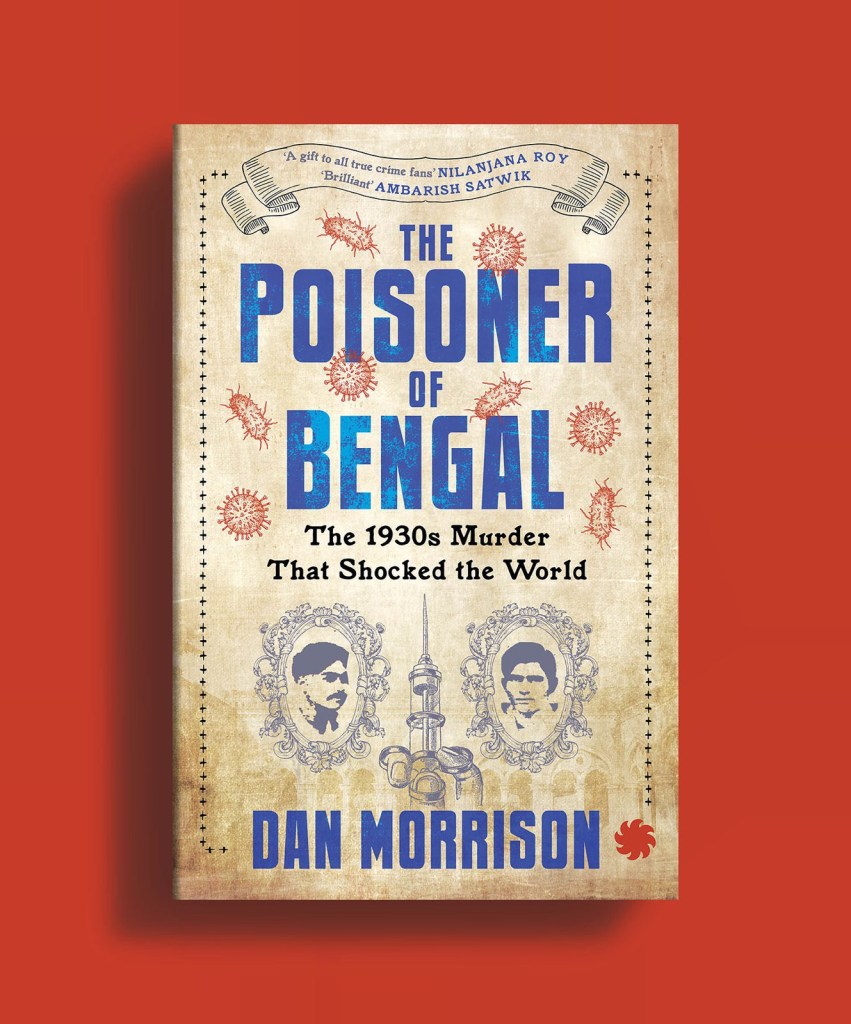
Titles: The Poisoner of Bengal/The Prince and the Poisoner
Author: Dan Morrison
Publishers: Juggernaut (India)/ The History Press (UK)
November1933:HowrahStation
For most of the year, Calcutta is a city of steam, a purgatory of sweaty shirt-backs, fogged spectacles, and dampened décolletage. A place for melting. In summer the cart horses pull their wagons bent low under the weight of the sun, nostrils brushing hooves, eyes without hope, like survivors of a high desert massacre. The streets are ‘the desolate earth of some volcanic valley’, where stevedores nap on pavements in the shade of merchant houses, deaf to the music of clinking ice and whirring fans behind the shuttered windows above.
The hot season gives way to monsoon and, for a while, Calcuttans take relief in the lightning-charged air, the moody day- time sky, and swaying trees that carpet the street with wet leaves, until the monotony of downpour and confinement drives them to misery. The cars of the rich lie stalled in the downpour, their bonnets enveloped in steam, while city trams scrape along the tracks. Then the heat returns, wetter this time, to torment again.
Each winter there comes an unexpected reprieve from the furious summer and the monsoon’s biblical flooding. For a few fleeting months, the brow remains dry for much of each day, the mind refreshingly clear. It is a season of enjoyment, of shopping for Kashmiri shawls and attending the races. Their memories of the recently passed Puja holidays still fresh, residents begin decking the avenues in red and gold in anticipation of Christmas. With the season’s cool nights and determined merriment, to breathe becomes, at last, a pleasure.
Winter is a gift, providing a forgiving interval in which, sur- rounded by goodwill and a merciful breeze, even the most determined man might pause to reconsider the murderous urges born of a more oppressive season.
Or so you would think.
On 26 November 1933, the mercury in the former capital of the British Raj peaked at a temperate 28°C, with just a spot of rain and seasonally low humidity. On Chowringhee Road, the colonial quarter’s posh main drag, managers at the white- columned Grand Hotel awaited the arrival of the Arab-American bandleader Herbert Flemming and his International Rhythm Aces for an extended engagement of exotic jazz numbers. Such was Flemming’s popularity that the Grand had provided his band with suites overlooking Calcutta’s majestic, lordly, central Maidan with its generous lawns and arcing pathways, as well as a platoon of servants including cooks, bearers, valets, a housekeeper, and a pair of taciturn Gurkha guardsmen armed with their signature curved kukri machetes. Calcuttans, Flemming later recalled, ‘were fond lovers of jazz music’. A mile south of the Grand, just off Park Street, John Abriani’s Six, featuring the dimple-chinned South African Al Bowlly, were midway through a two-year stand entertaining well-heeled and well-connected audiences at the stylish Saturday Club.
The city was full of diversions.
Despite the differences in culture and climate, if an Englishman were to look at the empire’s second city through just the right lens, he might sometimes be reminded of London. The glimmer- ing of the Chowringhee streetlights ‘calls back to many the similar reflection from the Embankment to be witnessed in the Thames’, one chronicler wrote. Calcutta’s cinemas and restaurants were no less stuffed with patrons than those in London or New York, even if police had recently shuttered the nightly cabaret acts that were common in popular European eateries, and even if the Great Depression could now be felt lapping at India’s shores, leaving a worrisome slick of unemployment in its wake.
With a million and a half people, a thriving port, and as the former seat of government for a nation stretching from the plains of Afghanistan to the Burma frontier, Calcutta was a thrumming engine of politics, culture, commerce – and crime. Detectives had just corralled a gang of looters for making off with a small fortune in gold idols and jewellery – worth £500,000 today – from a Hindu temple dedicated to the goddess Kali. In the unpaved, unlit countryside, families lived in fear of an ‘orgy’ of abductions in which young, disaffected wives were manipulated into deserting their husbands, carried away in the dead of night by boat or on horseback, and forced into lives of sexual bondage.
Every day, it seemed, another boy or girl from a ‘good’ middle- class family was arrested with bomb-making materials, counterfeit rupees, or nationalist literature. Each month seemed to bring another assassination attempt targeting high officials of the Raj. The bloodshed, and growing public support for it, was disturbing proof that Britain had lost the Indian middle class – if it had ever had them.
Non-violence was far from a universal creed among Indians yearning to expel the English, but it had mass support thanks to the moral authority of Mohandas Gandhi. Gandhi, the ascetic spiritual leader whose campaigns of civil disobedience had galvanised tens of millions, was then touring central India, and trying to balance the social aspirations of India’s untouchables with the virulent opposition of orthodox Hindus – a tightrope that neither he nor his movement would ever manage to cross.
And from his palatial family seat at Allahabad, the decidedly non-ascetic Jawaharlal Nehru, the energetic general secretary of the Indian National Congress, issued a broadside condemning his country’s Hindu and Muslim hardliners as saboteurs to the cause of a free and secular India. Nehru had already spent more than 1,200 days behind bars for his pro-independence speeches and organising. Soon the son of one of India’s most prominent would again return to the custody of His Majesty’s Government, this time in Calcutta, accused of sedition.
It was in this thriving metropolis, the booming heart of the world’s mightiest empire, that, shortly after two o’clock in the afternoon on that last Sunday in November, well below the radar of world events, a young, slim aristocrat threaded his way through a crowd of turbaned porters, frantic passengers, and sweating ticket collectors at Howrah, British India’s busiest railway station.
He had less than eight days to live.
About the Book:
A crowded train platform. A painful jolt to the arm. A mysterious fever. And a fortune in the balance. Welcome to a Calcutta murder so diabolical in planning and so cold in execution that it made headlines from London to Sydney to New York.
Amarendra Chandra Pandey, 22, was the scion of a prominent zamindari family, a model son, and heir to half the Pakur Raj estate. Benoyendra Chandra Pandey, 32, was his rebellious, hardpartying halfbrother – and heir to the other half. Their dispute became the germ for a crime that, with its elements of science, sex, and cinema, sent shockwaves across the British Raj.
Working his way through archives and libraries on three continents, Dan Morrison has dug deep into trial records, police files, witness testimonies, and newspaper clippings to investigate what he calls ‘the oldest of crimes, fratricide, executed with utterly modern tools’. He expertly plots every twist and turn of this repelling yet riveting story –right up to the killer’s cinematic last stand.
About the Author:
Dan Morrison is a regular contributor to The New York Times, Guardian, BBC News and the San Francisco Chronicle. He is the author of The Black Nile (Viking US, 2010), an account of his voyage from Lake Victoria to Rosetta, through Uganda, Sudan and Egypt. Having lived in India for five years, he currently splits his time between his native Brooklyn, Ireland and Chennai.
.
PLEASE NOTE: ARTICLES CAN ONLY BE REPRODUCED IN OTHER SITES WITH DUE ACKNOWLEDGEMENT TO BORDERLESS JOURNAL
“One night, the mortar launcher awakened superstition from its sleep and dragged it away with an F-16 saying, ‘I cannot exist . . . unless there is a refugee.’”
We celebrate the human spirit in those who surviving war-torn zones or climate disasters reach out for new homes or refuges in safer places. They are referred to as refugees. Yet, many people who are living without the fear of having their homes ransacked, burnt, bombed or annihilated because of reasons we don’t quite understand — for who could fully explain the logic of war, floods or fires — find it hard to allow the dispossessed shelter within the bounds of their safe haven. They get blamed for creating scarcities of resources.
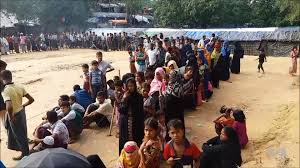
“Is it our instinct to always blame the victim?” asks Ramy Al-Asheq in Ever Since I Did Not Die. We share more such questions from him and others in this special issue. He was born and bred in a refugee camp, eventually incarcerated and suffered till he found a safe haven. An account from Timothy Jay Smith on the plight of refugees who escaped to Lesbos from as far as Afghanistan and Iraq brings to the fore the crises faced by host countries too. Shaheen Akhtar’s short story takes us to a refugee camp for Rohingyas, people who have lived in the region of the Rakhine state from the seventh century but in the last few years have been facing violent displacement. A UN report gives out they are being beheaded, shot and burnt out of their homes.
We have poetry from a refugee from Ukraine who is trying to rebuild her life in Scandinavia, Lesya Bakun, and from Ahmad Al-Khatat of Iraq. Michael Burch brings in the story of Christ while talking of modern day refugees, given that he describes the Child as a ‘Palestinian’. Though did these borders drawn by political needs exist at that time? LaVern Spencer McCarthy questions laws and attitudes that nurture such fences while Ihlwha Choi of Korea talks of love and acceptance being the best balm for refugees — whether North or South Korean or Ukrainian.
The flowers are already in full bloom, In the hearts of the Northern and Southern Koreans, Also in the hearts of the people of Ukraine and Russia.
When will we find a way to get in touch with the same ‘flowers of love’ and acceptance for all humanity living on this beautiful green planet? Do we need to redefine our norms to let our species survive and thrive? Let’s ponder with these writers…
An excerpt from Ramy Al-Asheq’sEver Since I Did Not Die, translated from Arabic by Isis Nusair, edited by Levi Thompson. The author was born in a refugee camp. Click here to read.
Mister, They’re Coming Anyway: Timothy Jay Smith writes on the refugee crisis in Lesbos Island, Greece with photographs by Michael Honegger. Click here to read.
The Magic Staff , a poignant short story about a Rohingya child by Shaheen Akhtar, translated from Bengali by Arifa Ghani Rahman. Click here to read.
Ratnottama Sengupta muses on acts of terror and translates a Bengali poem by Tarik Sujat which had come as a reaction to an act of terror. Click here to read.
Renee Melchert Thorpe recounts her mother’s migration story, hopping multiple countries, starting with colonial Calcutta and Darjeeling. Click here to read.
Paul Mirabile wanders into the realm of the supernatural dating back to the Potato Famine of Ireland in the 1800s. Clickhere to read.
Conversations
In conversation with eminent Singaporean poet and academic, Kirpal Singh, about how his family migrated to Malaya and subsequently Singapore more than 120 years ago. Click hereto read.
There was a time when humans walked the Earth crossing unnamed landmasses to find homes in newer terrains. They migrated without restrictions. Over a period of time, kingdoms evolved, and travellers like Marco Polo talked of needing permissions to cross borders in certain parts of the world. The need for a permit to travel was first mentioned in the Bible, around 450BCE. A safe conduct permit appeared in England in 1414CE. Around the twentieth century, passports and visas came into full force. And yet, humanity had existed hundreds of thousand years ago… Some put the date at 300,000!
While climate contingencies, wars and violence are geared to add to migrants called ‘refugees’, there is always that bit of humanity which regards them as a burden. They forget that at some point, their ancestors too would have migrated from where they evolved. In South Africa, close to Johannesburg is Maropeng with its ‘Cradle of Humanity’, an intense network of caves where our ancestors paved the way to our evolution. The guide welcomes visitors by saying — “Welcome home!” It fills one’s heart to see the acceptance that drips through the whole experience. Does this mean our ancestors all stepped out of Africa many eons ago and that we all belonged originally to the same land?
And yet there are many restrictions that have come upon us creating boxes which do not allow intermingling easily, even if we travel. Overriding these barriers is a discussion with Jessica Mudditt about Once Around the Sun: From Cambodia to Tibet, her book about her backpacking through Asia. Documenting a migration more than a hundred years ago from Jullundur to Malaya, when borders were different and more mobile, we have a conversation with eminent scholar and writer from Singapore, Kirpal Singh. Telling the story of another eminent migrant, a Persian who became a queen in the Mughal Court is a lyric by Nazrul, Nur Jahan, translated by Professor Fakrul Alam from Bangla. Ihlwha Choi has self-translated his own poem from Korean, a poem bridging divides with love. Fazal Baloch has brought to us some exquisite Balochi poems by Munir Momin. Tagore’s poem, Okale or Out of Sync, has been translated from Bengali to reflect the strange uniqueness of each human action which despite departing from the norm, continue to be part of the flow.
We have a tongue in cheek piece from Devraj Singh Kalsi on traveling in a train with a politician. Uday Deshwal writes with a soupçon of humour as he talks of applying for jobs. Snigdha Agrawal brings to us flavours of Bengal from her past while Ratnottama Sengupta muses on the ongoing wars and violence as acts of terror in the same region and looks back at such an incident in the past which resulted in a powerful Bengali poem by Tarik Sujat. Kiriti Sengupta has written of a well-known artist, Jatin Das, a strange encounter where the artist asks them to empty fully even a glass of water! Ravi Shankar weaves in his love for books into our non-fiction section. Recounting her mother’s migration story which leads us to perceive the whole world as home is a narrative by Renee Melchert Thorpe. Urmi Chakravorty takes us to the last Indian village on the borders of Tibet. Taking us to a Dinosaur Museum in Japan is our migrant columnist, Suzanne Kamata. Her latest multicultural novel, Cinnamon Beach, has found its way to our book excerpts as has Flanagan’s poetry collection, These Many Cold Winters of the Heart.
In reviews, Somdatta Mandal has written about an anthology, Maya Nagari: Bombay-Mumbai A City in Storiesedited by Shanta Gokhale and Jerry Pinto. Rakhi Dalal has discussed a translation from Konkani by Jerry Pinto of award-winning writer Damodar Mauzo’sBoy, Unloved. Basudhara Roy has reviewed Trailokyanath Mukhopadhyay’s Tales of Early Magic Realism in Bengali, translated by Sucheta Dasgupta. Bhaskar Parichha has introduced us toThe Dilemma of an Indian Liberal by Gurcharan Das, a book that is truly relevant in the current times in context of the whole world for what he states is a truth: “In the current polarised climate, the liberal perspective is often marginalised or dismissed as being indecisive or weak.” And it is the truth for the whole world now.
Our short stories reflect the colours of the world. A fantasy set in America but crossing borders of time and place byRonald V. Micci, a story critiquing social norms that hurt by Swatee Miittal and Paul Mirabile’s ghost story shuttling from the Irish potato famine (1845-52) to the present day – all address different themes across borders, reflecting the vibrancy of thoughts and cultures. That we all exist in the same place and have the commonality of ideas and felt emotions is reflected in each of these narratives.
We have more which adds to the lustre of the content. So, do pause by our content’s page and enjoy the reads!
I would like to thank all our team without who this journal would be incomplete, especially, Sohana Manzoor, for her fabulous artwork. Huge thanks to all our contributors who bring vibrancy to our pages and our wonderful readers, without who the journal would remain just part of an electronic cloud… We welcome you all to enjoy our June issue.
‘Okale‘ (translates as ‘out of sync with time’) is a part of Tagore’s poetry collection, Khanika (translates to ‘moments’) published in 1900.
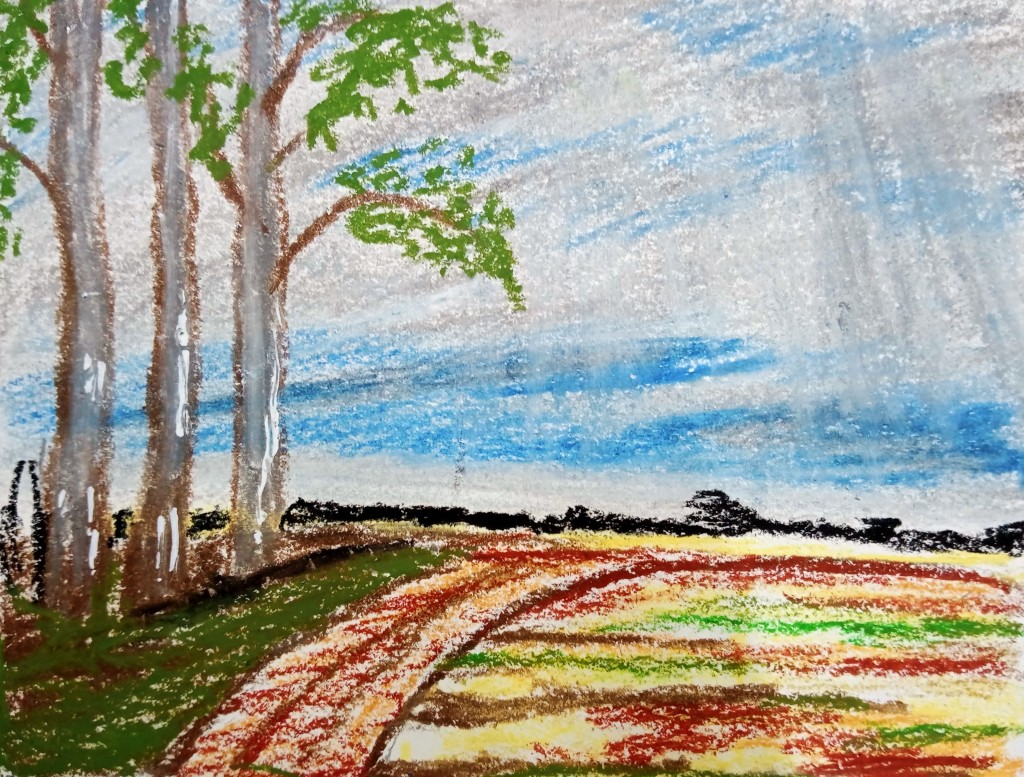
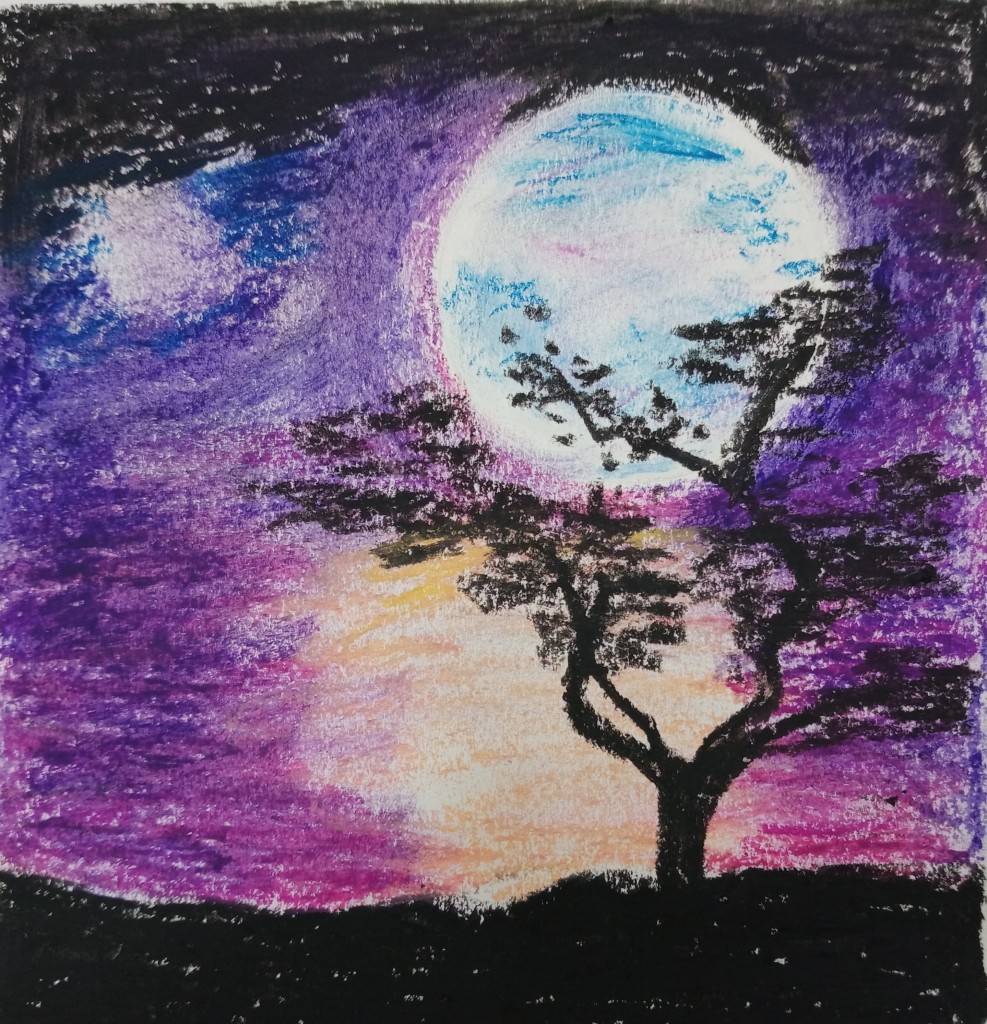
Art by Sohana Manzoor
OUT OF SYNC

Who is it that runs burdened with
           Merchandise to the closed haat*?
Dusk has set in.
             The day is past.

Carrying burdens on their heads,
Vendors return to their homestead.
A fragment of the new moon
                     Has risen in the vale.
Those from the other shore,
Call out loudly to the boats.
The riverside reverberates with
                       Their echoes evermore.

With what hope have you come
              At this hour
To the closed haat, breathlessly,
              With your load?

Sleep has caressed
              The woods to bed,
The cawing of crows have halted
              In their nests.

In the shrubs near the pond,
By the fence, crickets call.
Stunned branches of bamboo,
          Sway softly in the breeze —
Within the courtyard of their homes,
The weary sleep in their abodes.
The night-lamp brightens
          The flickers of shades.

When all are at rest,
        As the time to work is past,
Who is it that runs burdened with
           Merchandise to the closed haat?


*Rural Bazaar
This poem has been translated by Mitali Chakravarty with editorial input by Sohana Manzoor
.
PLEASE NOTE: ARTICLES CAN ONLY BE REPRODUCED IN OTHER SITES WITH DUE ACKNOWLEDGEMENT TO BORDERLESS JOURNAL






 Borderless