Categories
Tagore Translations

Rabindranath’s Paean to Humanity

Olosh Shomoy Dhara Beye (Time Flows at an Indolent Pace) was part of Tagore’s 1941 collection called Arogya (Healing). In the poem, the poet celebrates the lives of common people over empires.

Painting by Sohana Manzoor
TIME FLOWS AT AN INDOLENT PACE

Time flows at an indolent pace.
The mind floats in an empty space.
Into that vast void, images drift.
Over many eons, many have flit
To the distant past.
Arrogant conquerors sped fast.
Pathans rode to satiate their greed.
Then, Mughals wheeled
Victories, whipping dust-storms,
Flying flags for their throngs.
These empires have left no trace
On the vast void at which I gaze.
Through ages, the serene sky
Is with sunset and sunrise dyed.
Now the might of Britons holds sway
Penetrating new pathways
With the power of steam
And vehicles of fiery steel.
With vigour, they spread
Their dominions across the land’s breadth.
I know their regime will also pass.
Their empire will crumble at last.
On the astral plane, despite their strength,
Their army will not leave a single indent.


When I look around the Earth,
An ocean ripples along its girth
Heaving huge waves of humanity
Through myriad paths, in myriad coveys,
Over centuries as their daily needs are met
In life and in death.
Forever, they row,
With their rudders tow,
Work in fields, plant seeds,
Their harvests reap.
They work all the time,
In towns or in wilds.
Empires decline silencing bugles of war.
People forget histories of battles fought.
Stories of glory, angst and gore,
Stay concealed in children’s lore.
They struggle to work hard,
In Punjab, Bombay and Gujarat,
In Bengal, in Kalinga, all over the land,
By the coastline and the riverbank.
These stories of daily life hum
Reverberating like drums;
Joys, sorrows, day and night
Resonate as hymns to our lives.
Empires are ruined to ashes.
Over eons, they toil as masses.

This poem has been translated by Mitali Chakravarty with editorial input by Sohana Manzoor 

.

PLEASE NOTE: ARTICLES CAN ONLY BE REPRODUCED IN OTHER SITES WITH DUE ACKNOWLEDGEMENT TO BORDERLESS JOURNAL

Click here to access the Borderless anthology, Monalisa No Longer Smiles

Click here to access Monalisa No Longer Smiles on Kindle Amazon International

Categories
Excerpt

Shabnam: A Novel by Syed Mujtaba Ali

Title: Shabnam

Author: Syed Mujtaba Ali

Translated from Bengali by Nazes Afroz

Publisher: Speaking Tiger Books

Badshah Amanullah was surely off his rocker. Or else why would he hold a ball-dance in an ultra-conservative country like Afghanistan? On the occasion of Independence Day, Afghanistan’s first ball-dance would be held.

We, the foreigners, were not that bothered. But there was a buzz of restlessness among the mullahs and their followers—the water carriers, tailors, grocers, and the servants. My servant, Abdur Rahman, while serving the morning tea, muttered, ‘Nothing is left of religious decency.’

I did not pay much heed to Abdur Rahman. I was no messiah like Krishna. The task of saving ‘religious decency’ had not been bestowed upon me.

‘Those hulking men will prance around the dance floor holding on to shameless women.’

I asked, ‘Where? In films?’

After that there was no stopping Abdur Rahman. The ancient Roman wild orgies would have sounded like child’s play compared to the juicy imageries of the upcoming dance event that he described. Finally, he concluded, ‘Then they switch off the lights at midnight. I don’t know what happens after that.’

I said, ‘What’s that to you, you mindless babbler?’

Abdur Rahman went mum. Whenever I called him a blathering prattler, he understood that his master was in a bad mood. I would use the Bengali slang word for it and being a seasoned man, though Abdur Rahman did not know the language, he would be able to read my mood.

I was out in the mild evening. Electric lamps lit up the bushes of Pagman. The tarmacked road was spotlessly clean. I was meandering absentmindedly, thinking it was the month of Bhadra and Sri Krishna’s birthday had been celebrated the previous day. My birthday too, according to Ma. It must be raining heavily in Sylhet, my home. Ma was possibly sitting in the north veranda. Her adoptive daughter Champa was massaging her feet and asking her, ‘When will young brother come home?’

The monsoon season is the most difficult one for me in this foreign land. There is no monsoon in Kabul, Kandahar, Jerusalem or Berlin. Meanwhile in Sylhet, Ma is flustered with the nonstop rain. Her wet sari refuses to dry; she is in a tizzy from the smoke of the wet wood of the oven. Even from here I can see the sudden pouring of rain and the sun that comes out after a while. There are glitters of happiness on the rose plants in the courtyard, the night jasmine at the corner of the kitchen, and on the leaves of the palm tree in the backyard.

There was no such verdant beauty here.

Look at that! I had lost my way. Nine at night. Not a soul on the street. Who could I ask for directions?

A band was playing dance numbers in the big mansion to the right.

Oh! This was the dance-hall as described by Abdur Rahman. The waiters and bearers of the building would surely be able to direct me to my hotel. I needed to go to the service doors at the back of the building.

I approached.

Right at that moment, a young woman marched out.

I first saw her forehead. It was like the three-day-old young moon. The only difference was the moon would be off-white—cream coloured—but her forehead was as white as the snow peaks of the Pagman mountains. You have not seen it? Then I would say it was like undiluted milk. You have not seen that either. Then I can say it was like the petals of the wild jasmine. No adulteration of it is possible as yet.

Her nose was like a tiny flute. How was it possible to have two holes in such a small flute? The tip of the nose was quivering. Her cheeks were as red as the ripe apples of Kabul; yet they were of a shade that made it abundantly clear it was not the work of any rouge. I could not figure out if her eyes were blue or green. She was adorned in a well-tailored gown and was wearing high-heeled shoes.

Like a princess she ordered, ‘Call Sardar Aurangzeb Khan’s motor.’

Attempting to say something, I fumbled.

She, by then, looked properly at me and figured out that I was not a servant of the hotel. She also understood that I was a foreigner. First, she spoke in French, ‘Je veux demand pardon, monsieur—forgive me—’ Then she said it in Farsi.

In my broken Farsi I said, ‘Let me look for the driver.’

She said, ‘Let’s go.’

Smart girl. She would be hardly eighteen or nineteen.

Before reaching the parking lot, she said, ‘No, our car isn’t here.’

‘Let me see if I can arrange another one,’ I said.

Raising her nose an inch or so, in rustic Farsi she said, ‘Everyone is peeping to see what debauchery is taking place inside. Where will you find a driver?’

I involuntarily exclaimed, ‘What debauchery?’

Turning around in a flash, the girl faced me and took my measure from head to toe. Then she said, ‘If you’re not in a hurry, walk me to my house.’

‘Sure, sure,’ I joined her.

The girl was sharp.

Soon she asked, ‘For how long have you been living in this country? Pardon—my French teacher has said one shouldn’t put such questions to a stranger.’

‘Mine too, but I don’t listen.’

Whirling around she faced me again and said, ‘Exactment—rightly said. If anyone asks, say I’m going with you, or say Daddy introduced me to you. And don’t you ask me any question like I’m a nobody. And I will not ask anything as if you have no country or no home. In our land not asking prying questions is akin to the height of rudeness.’

I replied, ‘Same in my land too.’

She quipped, ‘Which country?’

I said, ‘Isn’t it apparent that I’m an Indian?’

‘How come? Indians can’t speak French.’

I said, ‘As if the Kabulis can!’

She burst out laughing. It seemed in the fit of laughter she suddenly twisted her ankle. ‘Can’t walk any longer. I’m not used to walking in such high heels. Let’s go to the tennis court; there are benches there.’

Dense darkness. The electric lamps were glowing far away. We needed to reach the tennis court through a narrow path. I said, ‘Pardon,’ as I touched her arm inadvertently.

Her laughter had no limits. She said, ‘Your French is strange, so is your Farsi.’

My young ego was hurt. ‘Mademoiselle!’

‘My name is Shabnam.’

(Extracted from Shabnam by Syed Mujtaba Ali, translated by Nazes Afroz. Published by Speaking Tiger Books, 2024)

About the Book

Afghanistan in the 1920s. A country on the cusp of change. And somewhere in it, a young man and woman meet and fall in love.

Shabnam is an Afghan woman, as beautiful as she is intelligent. Majnun is an Indian man, working in the country as a teacher. Theirs is an unlikely love story, but it flowers nonetheless. Breaking the barriers of culture and language, the two souls meet. Shabnam is poetry personified—she knows the literary works of Farsi poets of different eras. Majnun is steeped in the language and thoughts of Bengal. Together, they find love in immortal words and in the wisdom of the ages.

As the country hurtles towards yet another cataclysmic change, and the ruling king flees into exile, Shabnam is in danger from those who covet her for her famous beauty. Can she save herself and her Indian lover and husband from them?

Shabnam has been hailed as one of the most beautiful love stories written in Bengali. Lyrical and tragic, this pathbreaking novel appears in English for the first time in an elegant translation by the translator of Syed Mujtaba Ali’s famous travelogue Deshe Bideshe (In a Land Far from Home).

About the Author

Born in 1904, Syed Mujtaba Ali was a prominent literary figure in Bengali literature. A polyglot, a scholar of Islamic studies and a traveller, Mujtaba Ali taught in Baroda and at Visva-Bharati University in Shantiniketan. Deshe Bideshe was his first published book (1948). By the time he died in 1974, he had more than two dozen books—fiction and non-fiction—to his credit.

About the Translator

A journalist for over four decades, Nazes Afroz has worked in both print and broadcasting in Kolkata and in London. He joined the BBC in London in 1998 and spent close to fifteen years with the organization. He has visited Afghanistan, Central Asia and West Asia regularly for over a decade. He currently writes in English and Bengali for various newspapers and magazines and is working on a number of photography projects.

PLEASE NOTE: ARTICLES CAN ONLY BE REPRODUCED IN OTHER SITES WITH DUE ACKNOWLEDGEMENT TO BORDERLESS JOURNAL

Categories
Poetry

Hurricane Laura’s Course

By Jane Hammons

HURRICANE LAURA’S COURSE 


Backwards flow the waters of the mighty Mississippi. Unchart the chart of known courses. Rewrite maps. History. Story. Correct course of usual tellings.

Ippississim: teach your children that spell.

Reclaim mark twain*: let it mean again and only two fathoms, twelve feet.

The raft is Jim’s.

Along the shores teach: Choctaw Chickasaw Quapaw Osage Caddo Natchez Tunica Sioux Sauk and Fox Ojibwe Pottawatomie Illini Menominee Ho-chunk.

Ditch de Soto: he discovered nothing.

Over your flow under the Danziger Bridge turn bullets. Return Hurricane Katrina gunfire truth.

Flow the waters over Minneapolis St. Paul. Overflow. Ten miles from the shores to Cup Foods. Revive George Floyd. Wash away the Chauvin gang.

New Mississippi River baptisms called for. Called forth. Forthcoming.

Along shores awaiting reversal trickster water invites.

* ‘mark twain’ is in lower case as the words have been used to name the nautical measure

.

Jane Hammons has work forthcoming in Scrawl Place and The East Over Anthology of Rural Writers. She lives in New Mexico and is an enrolled citizen of the Cherokee Nation.

PLEASE NOTE: ARTICLES CAN ONLY BE REPRODUCED IN OTHER SITES WITH DUE ACKNOWLEDGEMENT TO BORDERLESS JOURNAL

Click here to access the Borderless anthology, Monalisa No Longer Smiles

Click here to access Monalisa No Longer Smiles on Amazon International

Categories
Slices from Life

Breaking Bread

By Snigdha Agrawal


However much as one would like to get over and be done with doctor appointments, some days get completely derailed.  Never mind the fear lurking in the mind of the outcome of such visits. Perforce one has to sit patiently waiting to be called by the receptionist, clad in a short white coat, bursting with self-importance. And when she announces unapologetically “We are running behind schedule…please come back after lunch,” tempers justifiably hit the ceiling. Having to deal with sore bums and hunger pangs, further compounds the woes.

On such a day, with frayed tempers, we stepped outside in search of an eatery, and located one closest to the hospital, on the sidewalk. Small, with limited indoor and outdoor seating.  Serving the usual South Indian fare of crispy golden-brown dosas, idlis, pongal, and vegetarian thali meals.  Comfort food for hungry stomachs, most enjoy for its freshness, quick service and pocket-friendly prices. A few four-wheeler taxi drivers, construction workers, hospital staff along with us quickly filled up the space during the lunch break. Placing our order at the counter, we opted for the kerbside sit-outs.  Grabbing a vacant table and chair, we made ourselves comfortable enjoying the breeze under the awning of a big banyan tree. An altogether different and humbling experience.

The food arrived in nanoseconds. And we dug into it pronto. The smell of clarified butter preceding it had already activated the salivary glands.  While we were at it, in walked Lady Moo, in her shiny black coat, udders full, demanding to have lunch with the rest of us.  No one seemed disturbed by her presence or irritated at her persistent calling out for lunch.  I confess it was unnerving to have her breathing down my neck, mortally scared of being guillotined with her ivory polished horns, ringed with a marigold garland. Unfounded.  She stood unmoving on her ground, polite and gentle, belying her size and appearance.

That she was a regular was evident with the waiter bringing out a steel plate heaped with idlis and vadas, which she polished off in no time.  Lifted her tail and took a dump right there in front of a ‘no-class distinction’ audience. Shook her tail a couple of times, as if to say “thank you” to the manager and the waiters.  Gently stepping down the kerb, ambled across to the opposite side, unconcerned about holding up the traffic flow in both directions. No one honked to upset Lady Moo, the privileged one who has the right of way in our country, at all times, disregarding any urgencies or emergencies.  Not uncommon in a marriage of the urban with the rural, across big cities. Mind calmed, we returned to the hospital to face the ‘wait challenge’. 

They say happiness comes in small bytes. This incident sparked a silver line of hope that suddenly made its appearance to lift the spirits that had taken a beating in the hospital. A complete volte-face!   

Snigdha Agrawal (nee Banerjee) is a published author of four books and a regular contributor to anthologies published in India and overseas.  A septuagenarian, she writes in all genres of poetry, prose, short stories and travelogues.


.

PLEASE NOTE: ARTICLES CAN ONLY BE REPRODUCED IN OTHER SITES WITH DUE ACKNOWLEDGEMENT TO BORDERLESS JOURNAL

Click here to access the Borderless anthology, Monalisa No Longer Smiles

Click here to access Monalisa No Longer Smiles on Kindle Amazon International


Categories
Poetry

‘Like people, winters come and go’

Poetry by George Freek


Storm at Sea on a Moonlit Night, Painting by Ivan Aivazovsky (1817-1900)
AT THIS MOMENT

The moon is a frightened bride,
with nowhere to hide.
The wind is a wolverine.
Wandering lost in a fog.
My boat shakes like a leaf of tea,
as I drift like a sodden log.
I look for a crack in the sky,
Where light can shine,
but rain falls like razors.
At such a time,
I should think of my wife,
how worried she’ll be,
but in moments like this,
afraid for my life,
I can only think of me.


IN NOVEMBER


Dead leaves fall from trees
with a cancer-like disease.
Clouds drift by
in their ordinary way,
moving too quickly to say
what they might say.
The river still flows somewhere.
I don’t know where.
I’ll never go there.
Time is only important
when you need to say goodbye.
It will soon be snowing.
Like people, winters come and go.
The snow begins falling.
I stare at my unmade bed.
It’s now been a year,
that you’ve been dead.

George Freek’s poetry has recently appeared in The Ottawa Arts Review, Acumen, The Lake, The Whimsical Poet, Triggerfish and Torrid Literature.

PLEASE NOTE: ARTICLES CAN ONLY BE REPRODUCED IN OTHER SITES WITH DUE ACKNOWLEDGEMENT TO BORDERLESS JOURNAL

Click here to access the Borderless anthology, Monalisa No Longer Smiles

Click here to access Monalisa No Longer Smiles on Amazon International

Categories
Poetry

Watching by Stuart MacFarlane

                WATCHING

I

The nurse says quietly, efficiently.
'I'm sorry but you can't disturb the chairs.'
So we push them back,
a tentative scraping;
now, regimented at the bedside,
we form a silent circle around
a patient centre.
We talk a little, laugh when we can.
The air is hot and stuffy;
and always the pungent tang of disinfectant.
In the adjacent bed lies an older man,
tubes snaking from his body to a 'Life trace' machine.
At his side his wife holds his hand;
and, as he tries to speak,
she says softly, again and again,
'I know. I know.'
His hand, in hers, struggles to squeeze
out a response.
On the screen a white line
scales small mountain peaks.
Up, down. Up and down.
Random numbers flash erratically.

II

We hear a rasping cough.
See the old man's arm swing through the air,
describing a careless arc.
His hand thumps off the bedside table,
upsetting a vase of flowers.
Slowly, very slowly, the vase tips
over the edge, sudden water
leaping at the brim.
One by one, the flowers,
daffodils, I think,
spill out.

III

Now the glass vase turns through the air,
scooping up the sunlight,
bright water gasping at the neck.
Someone moves, as if to catch it.
But no-one does.
It smashes on the hard, scrubbed floor,
scattering into a hundred pieces.
Fingers of sunlight seem to pick
at the pieces;
nimble beams on
gleaming glass.
The flowers' flaccid stems lie,
forlorn there, on the floor;
and, helpless, we can merely look on;
just watching the water spread.

From Public Domain

Stuart MacFarlane is now semi-retired. He taught English for many years to asylum seekers in London. He has had poems published in a few online journals.                                                                                                                    

.

PLEASE NOTE: ARTICLES CAN ONLY BE REPRODUCED IN OTHER SITES WITH DUE ACKNOWLEDGEMENT TO BORDERLESS JOURNAL

Click here to access the Borderless anthology, Monalisa No Longer Smiles

Click here to access Monalisa No Longer Smiles on Kindle Amazon International

Categories
Review

Never Never Land

Book Review by Rakhi Dalal

Title: Never Never Land

Author: Namita Gokhle

Publisher: Speaking Tiger Books

Namita Gokhale is a writer and a festival director. Her work spans various genres, including novels, short stories, Himalayan studies, mythology and books for young readers. She is the author of twenty-three works of fiction and non-fiction, including the novels Paro: Dreams of PassionShakuntalaJaipur JournalsThings to Leave Behind and The Blind Matriarch; and the edited anthologies Mystics and Sceptics: In Search of Himalayan MastersHimalaya: Adventures, Meditations, Life (with Ruskin Bond), and (with Malashri Lal) In Search of SitaFinding Radha and Treasures of Lakshmi. Gokhale is the recipient of several awards, including the Sahitya Akademi Award (2021). She is the co-founder and co-director (with William Dalrymple) of the famed Jaipur Literature Festival.

At the outset, Namita Gokhle’s Never Never Land seems conventional, centering on the protagonist’s quest for meaning amidst loneliness in a bustling city life, where relationships and even “monsoon is a betrayal”. What sets this book apart is the imperative nostalgia of both lived and unlived experiences that permeate through the narrative. The author captures the nostalgia well with her style which skilfully moves between a first and third person narrative, navigating between the past and the present, with the principal character embarking upon a journey back to her roots.  

The protagonist, Iti Arya, is a single, middle-aged freelance editor/ writer struggling to find a footing in her life. Undetermined about her writing which doesn’t seem to take off, she decides to return to The Dacha, a place of her childhood, in the hilly Kumaon region, where life for her had been beautiful if not downright perfect. It was a place she had longed for while living in dusty Gurgaon surrounded by a concrete forest, a place she hoped to return to find herself, a place where she could find meaning in relationships, a place where validation for who she was and what she strove for ceased to exist. ‘Never Never Land’ seems to be for her, both a literal and symbolic place of return.

Iti returns to her grandmother with whom she has spent the happiest days of her school life, her Badi Amma who used to tell her that when mountains speak, one must listen carefully. She returns to find out the stories that she can only find in the mountains. At Dacha, the cottage owned by a hundred and two years old Rosinka (her amma’s erstwhile employer), she also comes across Nina, around whom an aura of secrecy hovers. The course of the novel then ripples with their interactions providing contexts for Iti’s quest forth. At times, she is awash by the unspoken love of her Badi Amma and Rosinka, feeling secure in their presence and in the knowledge of their affection for her and for each other, an unlikely friendship that is stronger than any relationship she has known. Her stay there makes her re-examine her life to find the missing pieces that lead her to feel lonely and uncomfortable.

An inheritance, a theft, a strange recovery in a deluge, and an unfolding of a truth later, make Iti come face to face with her reality. She makes peace with memories of her now departed mother whom she did not love but wished to be seen by. She holds onto her Badi Amma and Rosinka whom she dreads to lose. She holds onto the place that makes her feel protected. A place she belongs.

The essence of the book lies in the warm relationship shared by the women whose stories are uncovered layer by layer. Women, who lonely in their own ways in life, find comfort with each other and stand guard of each other’s happiness. Reading the book reminds one of the likes of Little Women by Louisa May Alcott, only that here women are not bound by blood but by an understanding that has come with years of living together for one reason or another. 

The cover page of the book, inspired by Nicholas Roerich’s painting ‘Himalayas — the Abode of Light’, resonates with Iti’s journey towards clarity and finding a meaning that illuminates her life. At the end of the monsoon, as the sun comes out, she feels revived and willing to carry on, with herself, her grandmothers and the mountains.

Rakhi Dalal is an educator by profession. When not working, she can usually be found reading books or writing about reading them. She writes at https://rakhidalal.blogspot.com/ .

.

PLEASE NOTE: ARTICLES CAN ONLY BE REPRODUCED IN OTHER SITES WITH DUE ACKNOWLEDGEMENT TO BORDERLESS JOURNAL

Click here to access the Borderless anthology, Monalisa No Longer Smiles

Click here to access Monalisa No Longer Smiles on Kindle Amazon International

Categories
Poetry

Loneliness

Poetry and translation from Korean by Ihlwha Choi

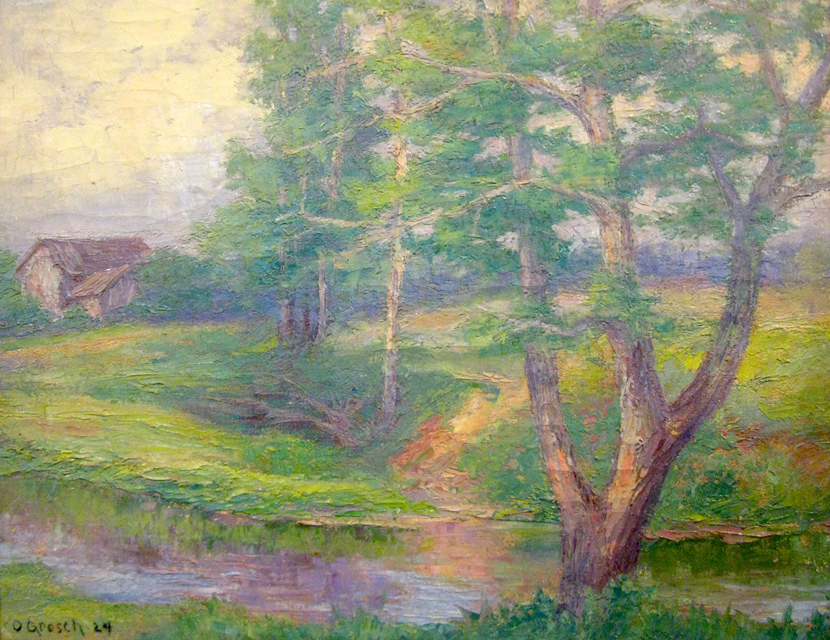
Pond near Springfield by Oscar Grosch (1863–1928). From Public Domain.
Like a breeze, I walk lightly.
Sitting in the spring sun,
Gazing at the green valley,
Life is truly a lonely thing.

Even with yesterday's memories and tomorrow's hopes,
Even with friends coming and going and daily business,
Living is truly a lonely thing.

All day today, I've been thinking of you.
Is my life lonely because I miss you?
Is this spring day lonely because you're there?

Like a breeze, I walk aimlessly.
Sitting on the grassy field, gazing at the waves in the lake,
Even this blossoming season feels lonely

Ihlwha Choi is a South Korean poet. He has published multiple poetry collections, such as Until the Time When Our Love will Flourish, The Color of Time, His Song and The Last Rehearsal.

.

PLEASE NOTE: ARTICLES CAN ONLY BE REPRODUCED IN OTHER SITES WITH DUE ACKNOWLEDGEMENT TO BORDERLESS JOURNAL. 

Click here to access the Borderless anthology, Monalisa No Longer Smiles

Click here to access Monalisa No Longer Smiles on Kindle Amazon International

Categories
Poetry

‘Where toads (nee princes) ruled in chinks…’

Poetry by Michael Burch

JOY IN THE MORNING 

(for my grandparents George Edwin Hurt and Christine Ena Hurt)

There will be joy in the morning
for now this long twilight is over
and their separation has ended.
For fourteen years, he had not seen her
whom he first befriended,
then courted and married.
Let there be joy, and no mourning,
for now in his arms she is carried
over a threshold vastly sweeter.
He never lost her; she only tarried
until he was able to meet her.


LADY’S FAVOUR

May
spring
fling
her riotous petals
devil-
may-care
into the air,
ignoring the lethal
nettles
and may
May
cry gleeful-
ly Hooray!
as the abundance
settles,
till a sudden June
swoon
leave us out of tune,
torn,
when the last rose is left
inconsolably bereft,
rudely shorn
of every device but her thorn.

(Published by The Lyric and Suravejiliz)


HAPPILY NEVER AFTER
(the Second Curse of the Horny Toad)


He did not think of love of Her at all
frog-plangent nights, as moons engoldened roads
through crumbling stonewalled provinces, where toads
(nee princes) ruled in chinks and grew so small
at last to be invisible. He smiled
(the fables erred so curiously), and thought
bemusedly of being reconciled
to human flesh, because his heart was not
incapable of love, but, being cursed
a second time, could only love a toad’s . . .
and listened as inflated frogs rehearsed
cheekbulging tales of anguish from green moats . . .
and thought of her soft croak, her skin fine-warted,
his anaemic flesh, and how true love was thwarted.

(Originally published by Romantics Quarterly)
From Public Domain

Michael R. Burch’s poems have been published by hundreds of literary journals, taught in high schools and colleges, translated into fourteen languages, incorporated into three plays and two operas, and set to music by seventeen composers.

PLEASE NOTE: ARTICLES CAN ONLY BE REPRODUCED IN OTHER SITES WITH DUE ACKNOWLEDGEMENT TO BORDERLESS JOURNAL

Click here to access the Borderless anthology, Monalisa No Longer Smiles

Click here to access Monalisa No Longer Smiles on Kindle Amazon International

Categories
Musings

The Chameleon’s Dance

By Chinmayi Goyal

The photo captures it all in a moment. 

An eight-year-old girl stands near the bustling confines of an airport: her eyes are wide, her smile bright. However, beneath that radiant smile lies subtle hints of deeper emotions known only to the girl herself.

The discovery of this photograph had been an accident as I was sifting through a neglected box of keepsakes. The moment my eyes met the image, a floodgate of memories unleashed. I could feel myself stepping off the plane and onto American soil, the soft glow of the cabin lights, and the sea of unfamiliar faces. The conversations flowed around me as I stumbled blindly into a linguistic labyrinth. 

The memory of that first day in American school etched itself in my mind. The teacher introduced me, and I blushed as the other kids looked upon me with fascination. I felt like an outsider unable to fit in. My thick Indian accent, which I had never thought about, was now a stain that separated me from others. My tongue stumbled over words spoken with the cadence of another world. The perplexed gazes of strangers mortified me. That day I made a promise: I would do anything and everything to fit in and change my accent. It was an instinctive reaction, born out of my desire to be native in a foreign land. It was a survival mechanism, a way to navigate the social structures that formed the scaffolding of this new world.

Beyond verbal communication was the challenge of writing and spelling. On the first day, we had a benchmark spelling test. I performed miserably. Growing up in India, I was educated in the British English system. Words like “colour,” “favourite,” and “theatre” adorned my vocabulary with their extra “u”s and “re”s. These linguistic quirks had been ingrained in me since childhood, and I had never questioned their correctness. Soon I realised that my spelling, which I considered impeccable, was peppered with these “mistakes.” I was embarrassed. I developed an obsession with consciously correcting my old habitual spellings, like “colour” to “color,” and “favourite” to “favorite.” Like leaving behind my Indian accent, I sought to rewrite this part of my identity.

I grew up to become a chameleon, forever adapting my linguistic hues to blend seamlessly into the ever-changing landscape of my life. In a peculiar dance of identities, I became a performer mastering the art of disguise. Even now, I marvel at my own adaptability, at how I can effortlessly switch between rhetorical worlds. It’s as if I have a wardrobe of culture, with an American accent for the world outside and my own familiar Indian accent tucked away at home. When I’m with my family, when I return to the comfort of my roots, the switch is automatic. The words flow with the rhythms of home, and my voice reverberates with the echoes of my heritage. It’s a return to a world that doesn’t require adaptation, a place where I can be unapologetically myself.

In this continuous performance of linguistic acrobatics, I’ve realised that my identity is not fixed but fluid, a reflection of the multiple worlds I inhabit. I am the chameleon, forever changing and adapting in this intricate dance between accents and authenticity. I’ve found a new version of myself—a person who can navigate two cultures, seamlessly switching between accents yet remaining true to my unique identity. I was neither wholly Indian nor entirely American; I was the synthesis of these two worlds, a living metaphor of cultural fusion. As the years passed, I found solace in the poetic beauty of my dual identity. In the end, I realised that it was in this tapestry of language, accent, and identity I had truly discovered myself—a narrative still being written, a story still unfolding, a girl who had found her place in a land of dreams.

.

Chinmayi Goyal, a student at Yorktown High School in New York, is passionate about writing. She serves as editor-in-chief of a newspaper called VOICE and has published several of her pieces there.

.

PLEASE NOTE: ARTICLES CAN ONLY BE REPRODUCED IN OTHER SITES WITH DUE ACKNOWLEDGEMENT TO BORDERLESS JOURNAL
Click here to access the Borderless anthology, Monalisa No Longer Smiles

Click here to access Monalisa No Longer Smiles on Amazon International