Sometimes I wonder what makes us exclusive as a species on Earth? Do we really have some kind of superiority over the flora and fauna without which we may not survive? With multiple species of wildlife being threatened by human exploits, perhaps there is a need to remind ourselves of our dependence on our planet and the lives it supports while acknowledging our existence as just one of the many species. In this issue, we celebrate life on this planet… I do not know if a cockroach or a cow would be considered wildlife, but it seems only right to see all of them as our brethren… along with yetis who could be a figment of the human mind… Enjoy some of our selected fare from around the world on World Wildlife Day today.
Aparna Vats shares a narrative around female infanticide centring her story around a BBC interview and an interview with the journalist who unfolded the narrtive. Click here to read.
Dolly Narang recounts how she started a gallery more than four decades ago and talks of her encounter with world renowned artist, MF Husain. Click hereto read.
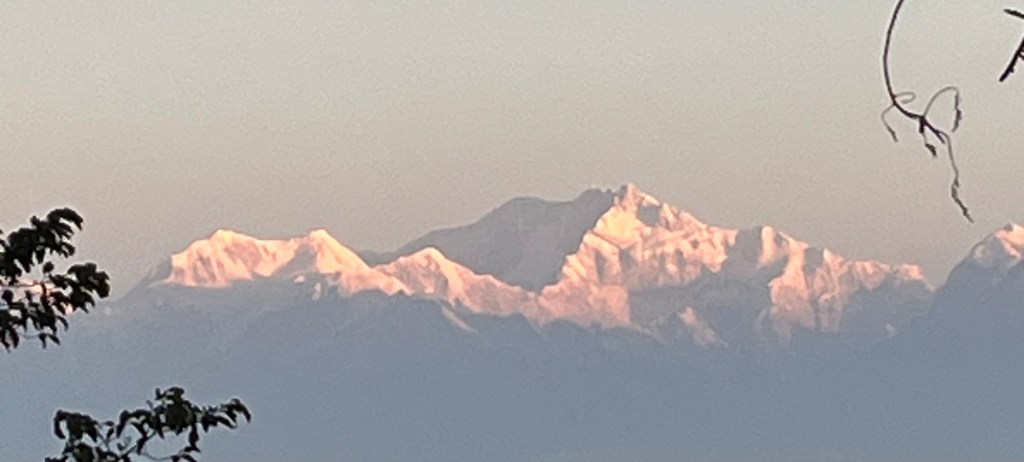
Ghoom, Darjeeling, is almost 2.5 km above sea level. Standing in the rarified air of Ghoom, you can watch the Kanchenjunga turn gold as it gets drenched in the rays of the rising sun. The phenomenon lasts for a short duration. The white pristine peak again returns to its original colour blending and disappearing among the white cirrus clouds that flit in the sky. Over time, it’s shrouded by mists that hang over this region. The event is transitory and repeats itself on every clear morning like life that flits in and out of existence over and over again…
Witnessing this phenomenon feels like a privilege of a lifetime as is meeting people who shine brightly and unusually, like the Kanchenjunga, to disappear into mists all too early. One such person was the founder of pandies’ 1 who coordinated the pandies’ corner for Borderless Journal, the late Sanjay Kumar (1961-2025). The idea of starting this column was to bring out the unheard voices of those who had risen above victimhood to find new lives through the work done by pandies’. In his book, Performing, Teaching and Writing Theatre: Exploring Play, published by Cambridge Scholars Publishing, he described his scope of work which in itself was stunning. His work ranged from teaching to using theatre and play to heal railway platform kids, youngsters in Kashmir, the Nithari survivors and more — all youngsters who transcended the scars seared on them by violations and violence. We hope to continue the column in coordination with pandies’.
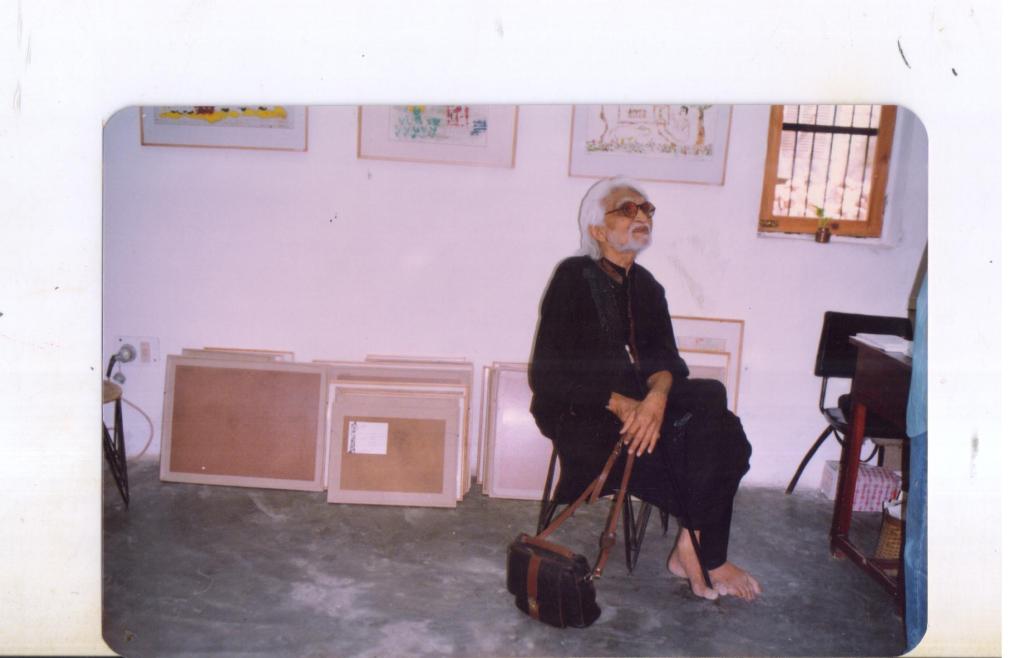
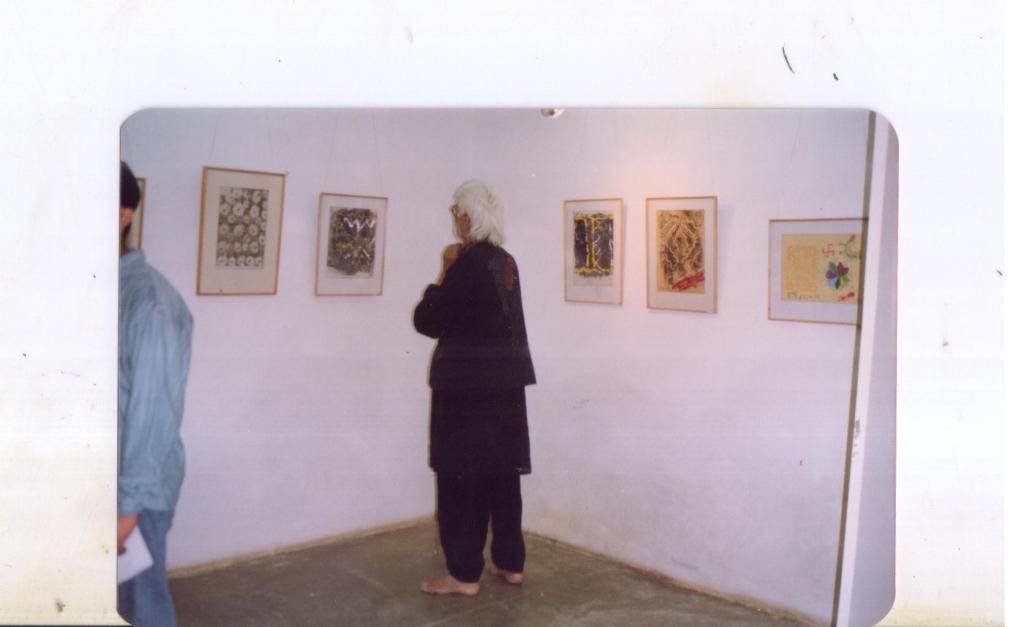
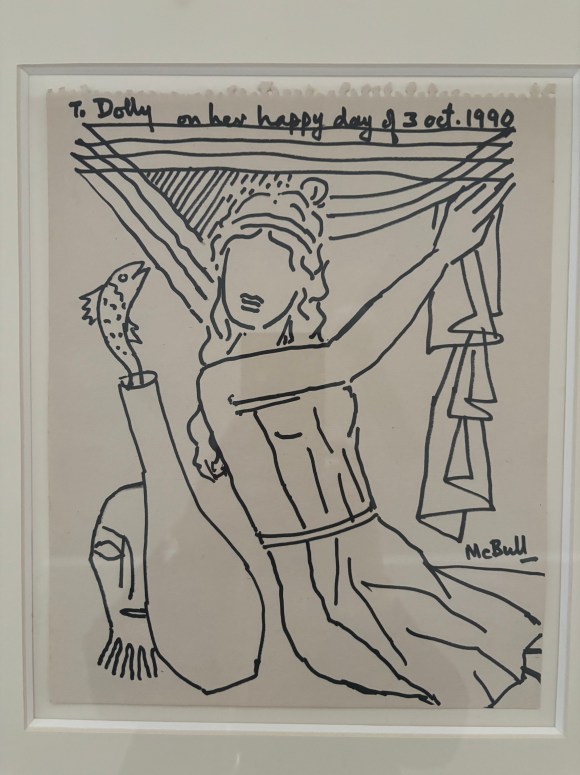
Another very renowned person whose art encompassed a large number of social concerns and is now lost to time was the artist, MF Husain (1915-2011). This issue of Borderless is privileged to carry an artwork by him that has till now not been open to the public for viewing. It was a gift from him to the gallerist, Dolly Narang, on her birthday. She has written nostlgically of her encounters with the maestro who walked bare-feet and loved rusticity. She has generously shared a photograph of the sketch (1990) signed ‘McBull’ — a humorous play on his first name, Maqbool, by the artist.
Drenched with nostalgia is also Professor Fakrul Alam’s essay, dwelling on more serious issues while describing with a lightness his own childhood experiences. Many of the nonfiction in this issue have a sense of nostalgia. Mohul Bhowmick recalls his travels to Bhutan. And Prithvijeet Sinha introduces as to a grand monument of Lucknow, Bara Imambara. Lokenath Roy takes us for a stroll to Juhu, dwelling on the less affluent side. Suzanne Kamata describes her source of inspiration for a few stories in her new book, River of Dolls and Other Stories. A darker hue is brought in by Aparna Vats as she discusses female infanticide. But a light sprays across the pages as Devraj Singh Kalsi describes how his feisty grandmother tackled armed robbers in her home. And an ironic tone rings out in the rather whimsical musing by Farouk Gulsara on New Year days and calendars.
Everyone was at each other's throats, insistent that the world was ending. But I felt differently, as though I were just beginning, or just beginning again…
Poets, like visionaries across time and cultures, often see hope where others see despair. And humour always has that hum of hope. In a lighter tone, Rhys Hughes makes one laugh or just wonder as he writes:
I once knew a waiter who jumped in alarm when I somersaulted across his restaurant floor after entering the front door on my way to my favourite table: he wasn’t able to control his nerves and the meal he was bearing ended up on the ceiling with people staring as it started to drip down.
Translations feature poetry. Lyrics of Nazrul (1899-1976) and Tagore (1861-1941) appear together in Professor Alam’s translations of their love songs from Bengali. He has also transcreated a Bengali poem by Jibananada Das (1899-1854). Profoundly philosophical lines by Atta Shad (1939-1997) in Balochi has been rendered to English by Fazal Baloch for his birth anniversary this month. Ihlwah Choi has translated his poem from Korean, taking up the poignant theme of transience of life. A Tagore poem called ‘Kheya (Ferry)’, inspired by his rustic and beautiful surroundings, has been brought to us in English.
Huge thanks to all our contributors, the Borderless team for all these fabulous pieces. Thanks to Gulsara, Kamata, Bhowmick and Sinha for the fabulous photography by them to accompany their writings. Heartfelt gratitude to Sohana Manzoor for her cover art and to Dutta for her artwork accompanying her poem. Without all your efforts, this issue would have been incomplete. And now, dear readers, thank you for being with us through this journey. I turn the issue over to all of you… there is more as usual than mentioned here. Do pause by our contents page.
pandies’ was started in 1987. It’s spelled with a small ‘p’ and the name was picked by the original team. Read more about pandies’ by clicking here. ↩︎
Kheya (Ferry) by Tagore is the titular poem in a collection called Kheya published in 1906.
Art by Sohana Manzoor
KHEYA OR FERRY

Who are you traversing the shores,
          O boatman!
I sit at my doorstep,
        And gaze,
          O boatman!
As the haat* closes,
People to the ghat flock.
Then I imagine
        Myself among them
          O boatman!


In the gloaming, you row the boat
       To the other shore.
My heart soars to sing
       As I gaze upon the scene,
         O boatman!
The dark waters gurgle as the golden glow
Spreads across the other shore.
My teardrops flow
     With euphoria
         O boatman!


You have no words to express,
         O boatman!
I gaze to read
     What your eyes speak,
        O boatman!
Momentarily, if your gaze,
Falls on my face,
Then I imagine
     Myself among them
        O boatman!
This poem has been translated from Bengali by Mitali Chakravartywith editorial input from Sohana Manzoor
.
PLEASE NOTE: ARTICLES CAN ONLY BE REPRODUCED IN OTHER SITES WITH DUE ACKNOWLEDGEMENT TO BORDERLESS JOURNAL
MF Husain at the opening of the exhibition “A Tree In My LIfe” in 1995. With him are Dolly Narang (who conceptualised the show) and others. Fifty one artists from all over the country were invited to participate. The exhibition included M.F. Husain, Raza, Ganesh Pyne, Paritosh Sen, Arpana Caur, Vivan Sundaram along with promising and emerging artists. Photo provided by Dolly Narang
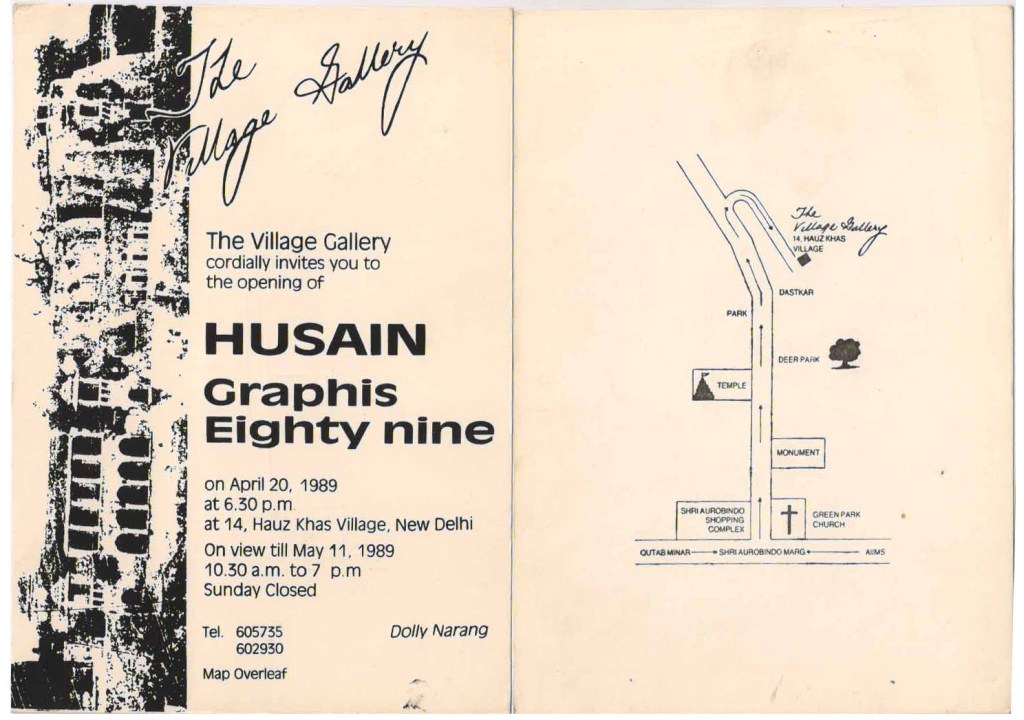
It was 1989 when I turned my passion for art into reality by opening The Village Gallery. My experience from conceptualising till the launch of my new initiative, as I negotiated unchartered waters, brought me in contact with artists and the art world. And I had some interesting experiences as I began to fathom the nuances of this unique field.
Growing up, I was a dreamer living in my own world of happy make believe. Enveloped by the warmth and attention of my joint family I was the cherished firstborn of my parents and my grandfather, Bauji[1]. Their adoration wrapped me in a cocoon sheltering me from the outside world. I grew up safe, protected and loved in our home in East Patel Nagar in West Delhi.
My mother laid claim to my creative spark. She revealed one day that while she was in the serene hills of Shimla with her parents as she carried me, she was learning how to paint. My mother proudly attributed my artistic side was all because of the genes passed on from her. Her creativity much later matured into fashion design and she became a successful fashion designer in the 1960s opening a high fashion boutique catering to New Delhi’s expat and diplomatic community. Her design skills were honed. She was much ahead of her time.
My Naniji[2] embroidered sequins and beads (maternal grandmother) on small evening clutch bags as gifts. That was her passion as it helped to overcome the grief of the loss of my grandfather who passed away suddenly in his mid 40s following the Partition and the trauma of 1947, when the Indian subcontinent was split into two. My Uncle, my father’s youngest sibling, unleashed his photographic skills to capture my childhood. He won a prize for one of these photographs.
I remember as a child being fascinated by Bauji making decorative paper lanterns. He used fragile kite paper of vibrant green, pink and yellow, slowly and meticulously applying glue on the paper to paste them onto thin bamboo sticks. I must have been four or five years old. The memory is so clearly embedded in my consciousness. He was a banker with a hectic work schedule involving travel. Our family had been uprooted during the Partition from Lyallpur in 1947 and we were in the throes of resettling ourselves. Yet, he found time to follow his creative calling.
As a child, I was fascinated by art and spent hours by myself doodling and drawing. Growing up, I have fond memories of my art class when I was in 7th or 8th grade in school. This was my happy space. My art teacher, Mrs. Dorothy Rahman, I remember was helped me to nurture my creativity with kindness and patience. She gave me special permission to work in art class during lunch hour. I loved working with my hands. Feeling the clay between my hands was exhilarating so clay was my chosen medium. Mrs. Rahman gave me a piece of soapstone a soft material and chiselling tools to chisel. This new medium opened up thrilling moments of more exploration.
My class had some students who were naturally gifted. Their effortless creativity left me feeling somewhat inadequate. At the same time, this pushed me to work harder to hone my skills. The confluence of my family’s creative influences and the circumstances unfolding before me led me to dream of starting an art gallery and I did do exactly that.
I nurtured a desire to start my gallery with the art of the famed MF Husain. Though it seemed an impossible dream, it happened. I went ahead and I shared my idea with Arpana Caur, my childhood playmate and college mate who had made a niche for herself in the art world and received recognition as a painter of great talent and promise. Caur encouraged me to chase my dreams. The first one person show at my newborn gallery was of Husain serigraphs and lithographs. It was a coup of sorts if I may say so myself for a new and unknown gallery and it stirred some excitement.
When I tried to contact him, Husain Sahib finally answered the phone. The conversation was polite and formal. He gave me appointment at his Canning Lane residence in Delhi, a charming colonial style government accommodation.
I had been warned of his proclivity for not arriving on time or not showing up at all. I reached his house expecting in all probability not to find him there.
His single storey home lay in a verdant environment. I was seated in a simple and well-appointed living room surrounded by vibrant colors of his paintings adorning the walls. Without keeping me waiting, a towering, calm and dignified figure emerged from the adjoining room. I introduced myself somewhat timorously trying to read his expression as I spoke. I remember saying, “Husain Sahib, I am planning to open a gallery in a new location, Hauz Khas Village. I would like to have a show of your limited-edition prints. I won’t be able to buy your works though. I was wondering if it would be feasible to pay for the prints once they are sold at the exhibition.”
This was the general tone of my brief monologue as he listened politely and patiently. I waited anxiously for his response. There was none.
Our meeting must have lasted fifteen minutes with mostly me muttering something to prove my credentials and at the same time trying to gauge his reaction as I continued with my monologue.
Once I finished talking, he stood up and walked into a room attached to the living room where we were sitting. I waited, confused by his disappearance. Soon he emerged with a thick roll of black sheets and handed it to me saying you can have a show of these prints. I accepted it in complete disbelief. Thanked him and left. I thought later that I did not give my contact details and neither did he ask for them. This was my first meeting with MF Husain.
Once the gallery interiors were ready I requested Husain Sahib if he could come to see the new space and give his suggestions before the inauguration. He arrived on the appointed day accompanied by his son Mustafa, a tall and dignified young man who came with a camera slung around his neck.
Both father and son walked around the gallery silently. It had a raw rustic interior with a cement floor and lime washed walls. I waited for their reaction, not quite sure how they would respond to the raw rusticity of the environment both internal and external. To make matters worse, a buffalo belonging to a villager put its head through the entrance door and snorted loudly. ‘This is all I need,’ I thought, ‘especially when I am trying to make an impression.’ Just as I was going to apologize, to my surprise Husain Sahib smiled and softly said, “That’s nice.”
Mustafa added: “My father loves the rustic environment”. Both lingered for a while enjoying the peaceful and unpretentious village setting as Mustafa took photographs.
While planning the execution for the show of his graphics, I had the opportunity to interact more frequently with Husain Sahib. He wanted the show to have the title ‘Husain Graphis 89’. “The word graphics to be spelt without a ‘c’, as it is spelled in French,” he said. Cards were printed announcing the exhibition of “Husain Graphis 89”. As the exhibition cards were delivered to their addressees, I was inundated with calls advising me that the word “graphics” had been misspelled in the card. I had a lot of explaining to do in call after call.
Photo provided by Dolly Narang
The prints were up on the gallery walls. A few days before the opening of Husain Graphis ‘89, the artist himself visited the gallery. As he made himself comfortable in the midst of his serigraphs and lithographs, he said something that has stayed with me as a source of guidance ever since. He waved his hands gently across the wall and said: “Make the walls of your gallery something that every artist will be proud to hang their works on.” These words illuminated my path forward as I was inspired to conceptualise a series of shows which went onto make history.
The inauguration of Graphis’ 89 was done by SK Misra, the Secretary of Tourism at the time and a close friend of Husain Sahib’s. He had wanted him to inaugurate the show. Husain Sahib flew off to Bombay the same evening so was not present at the inauguration. Of course, we were all disappointed. The inauguration was on schedule with Misra painting a lamp on a canvas. This unique idea was suggested by the eminent scenographer, Rajeev Sethi. Misra was caught off guard when asked to paint a lamp instead of lighting it. However, he painted with the flourish of a seasoned artist.
There was a self portrait of Husain on display in Graphis’89 exhibition which had a thick red line running down the face. It generated much curiosity and many queries from viewers who wanted to know the deeper meaning behind the red line, expecting a profound philosophical response about the artist’s thoughts or his life experience behind this. During a visit to the gallery, I mentioned to Husain Sahib that I was being asked repeatedly by visitors what was the meaning behind this thick and bright red line. He simply said: “I liked it and I painted it.”
The next exhibition that I curated in 1989 was ‘Self Portraits’. Twenty-four artists, from masters to beginners, were invited to showcase self-portraits in this exhibition held in October 1989. Husain Sahib loaned his self-portrait, an oil on canvas. Fortunately, Husain Sahib was in Delhi for the opening. He arrived walking barefeet down the kuccha[3] path leading to the gallery. Just a few feet ahead of the gallery he saw the Choudhry[4] of the village reclined on his charpai[5] smoking his hookah. Husain Sahib was so excited by this sight that he requested for the charpai to be shifted outside the gallery. I conveyed his request to Choudhry Sahib who immediately agreed and pulled his charpai over. Both Husain Sahib and Choudhry Sahib sat together on the charpai savoring the experience.
The guests at the opening, several of them old friends of Husain Sahib were surprised to catch him here. There was rambunctious camaraderie and backslapping in full public view on this village street. It occurred to him that he wanted to have his good friend and gallerist DV Chawla there. He requested that I send the car to pick him up from the Oberoi Hotel where his gallery was located. Delhi being free from the dense traffic that the city is afflicted with today, he arrived soon enough.
As Mr Chawla arrived, there was more lively celebration of old friendships. they all enjoyed the exhibition. The self-portraits were replete with humor or marked by self-mockery. Some were self-effacing while others, thought provoking
Husain Sahib joked that the real Husain was in the painting hung on the wall of the gallery and the flesh and blood sitting outside was fake.
The exhibition of self-portraits was followed by ‘The Other Ray’ in 1990, an exhibition of the graphic design, children’s drawings, and film sketches, set design drawings, film posters by Satyajit Ray. Together, we selected the works for the exhibition. In the process Ray was surprised to see all the work that he had created compelling him to remark: “I had forgotten I had done all this work.”
Husain at the Village Gallery. MF Husain liked walking bare-feet. Photographs provided by Dolly Narang
The opening was in October 1990. I met Husain Sahib to invite him for the preview. When he heard of ‘The Other Ray’ exhibition he asked me where the works were lying as he wanted to see them. I told him that they were lying at home and suggested it would be better to view them once they are properly hung in the gallery. But he was insistent on seeing them right away and didn’t want to wait for the opening. So, we drove to my house from AIFACs. He was overwhelmed to see the works and started to reminisce of his association with Ray. Unfortunately, I did not have a tape recorder at the time to record his thoughts but fortunately The Illustrated Weekly carried these reminiscences as an article in an issue. It’s a truly poignant piece filled with precious memories.
We got into the car to drive him home and had driven away for just a few minutes. All this while it was churning in my mind. Should I, should I not. But finally plucked up courage to tell him that it was my birthday a few days later and could I request him for a drawing.
He asked the driver to turn back to the house. He asked for sketch paper. And resting the paper on the bonnet of the car made a drawing.
These are some of the memories I am penning down here. There are many more…
The sketch made by Maqbool Fida Husain for Dolly Narang on her birthday: Husian signed himself McBull, a humorous take on his first name, Maqbool. He was known to sign his name in various ways. Photo provided by Dolly Narang
.
[1] respectful address for an elder patriarch of the family
Dolly Narang , a gallerist, has conceptualised innovative pathbreaking exhibitions. A recent student of sculpture, she has the satisfaction of experiencing both personal and spiritual evolution as a Pranic healer and as a grandmother.
.
PLEASE NOTE: ARTICLES CAN ONLY BE REPRODUCED IN OTHER SITES WITH DUE ACKNOWLEDGEMENT TO BORDERLESS JOURNAL
No hard feelings
for 400 yards
but beyond that distance
you can unleash
all the fury in existence
and even turn
like a firm worm
into an arrow of disaster
shot from a bow
by a vengeful archer.

Or if you prefer
you can transform yourself
into a doom-laden monster
running faster
than any athlete could
and sniffing prey out when
it hides in a wood
with the assistance of a nose
so persistent
that nothing in existence
can resist it.

No hard feelings
means only soft thoughts
are permissible
in the same way that only
easy tunes are
whistleable to lips
more familiar with quoting
comfy quips
than rugged ruminations.

Yes, whistleable
is a real word, I checked it
in a dictionary
while I was cartwheeling
up a garden path,
something I tend to do just
for the laugh
it generally affords me later.

I once knew a waiter
who jumped in alarm
when I somersaulted across
his restaurant floor
after entering the front door
on my way to my favourite
table: he wasn’t able
to control his nerves
and the meal he was bearing
ended up on the ceiling
with people staring
as it started to drip down.

No hard feelings!
That’s the issue, the nose in
the tissue, the reeling
peeling squealing teasing of
the kneeling devotee
of long-gone Don Quixote,
concealing his mirth
to prove his ultimate worth
while remaining
appealing, freewheeling,
even self-healing,
and mercifully large of girth.

Now come and join me
in the hard dance of softness
and we will prance
and caper like two wafers
stuck in an ice-cream cone
during a hurricane.
At least we won’t be alone!

My acrobatic days
are mostly over but every
400 yards or so
I twist and turn as the hard
feelings, hot from friction,
burn my soul.

Meanwhile, Don Quixote’s
dreamy head is
spinning slowly
like those festive windmill
sails on sale
at the end of
the short Cervantes season.
Rhys Hughes has lived in many countries. He graduated as an engineer but currently works as a tutor of mathematics. Since his first book was published in 1995 he has had fifty other books published and his work has been translated into ten languages.
.
PLEASE NOTE: ARTICLES CAN ONLY BE REPRODUCED IN OTHER SITES WITH DUE ACKNOWLEDGEMENT TO BORDERLESS JOURNAL
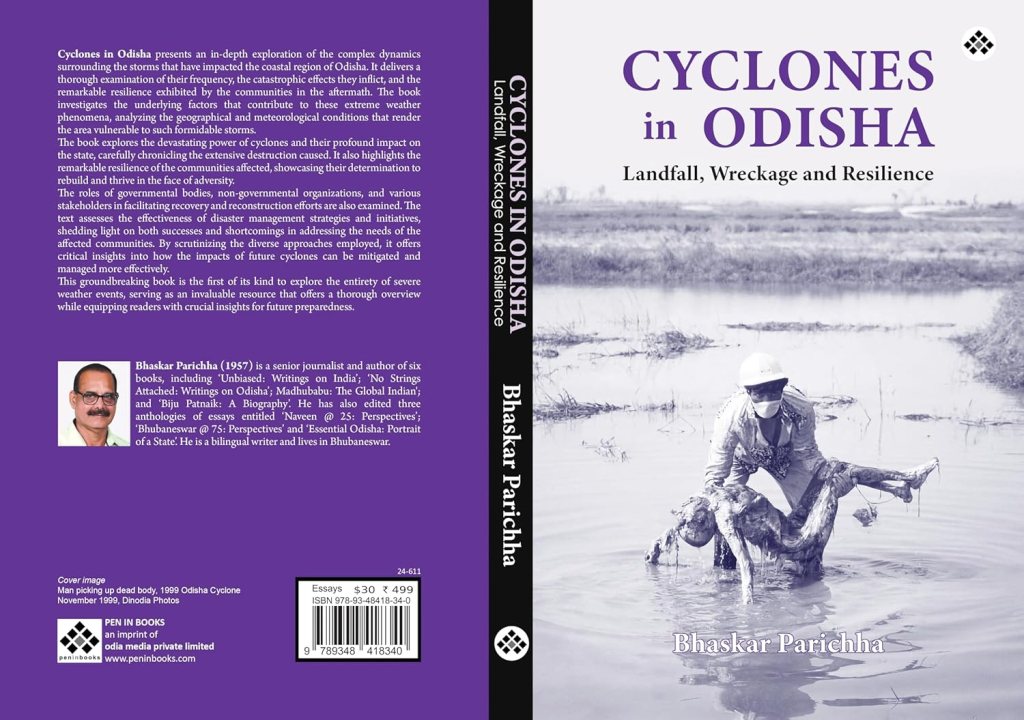
A discussion with Bhaksar Parichha, author of Cyclones in Odisha, Landfall, Wreckage and Resilience, published by Pen in Books.
While wars respect manmade borders, cyclones do not. They rip across countries, borders, seas and land — destroying not just trees, forests and fields but also human constructs, countries, economies and homes. They ravage and rage bringing floods, landslides and contamination in their wake. Discussing these, Bhaskar Parichha, a senior journalist, has written a book called Cyclones in Odisha, Landfall, Wreckage and Resilience. He has concluded interestingly that climate change will increase the frequency of such weather events, and the recovery has to be dealt by with regional support from NGOs.
Perhaps, this conclusion has been borne of the experience in Odisha, one of the most vulnerable, disaster prone states of India, where he stays and a place which he feels passionately about. Centring his narrative initially around the Super Cyclone of 1999, he has shown how as a region, Odisha arranged its own recovery process. During the Super Cyclone, the central government allocated only Rs 8 crore where Rs 500 crore had been requested and set up a task force to help. They distributed vaccines and necessary relief but solving the problem at a national level seemed a far cry. Parichha writes: “As a result, the relief efforts were temporarily limited. To accommodate the displaced individuals, schools that remained intact after the cyclone were repurposed as temporary shelters.
“The aftermath of the cyclone also led to a significant number of animal carcasses, prompting the Government of India to offer a compensation of 250 rupees for each carcass burned, which was higher than the minimum wage. However, this decision faced criticism, leading the government to fly in 200 castaways from New Delhi and 500 from Odisha to carry out the removal of the carcasses.”
He goes on to tell us: “The international community came together to provide much-needed support to the recovery efforts in India following the devastating cyclone. The Canadian International Development Agency, European Commission, British Department for International Development, Swiss Humanitarian Aid Unit, and Australian Government all made significant contributions to various relief organisations on the ground. These donations helped to provide essential aid such as food, shelter, and medical assistance to those affected by the disaster. The generosity and solidarity shown by these countries underscored the importance of global cooperation in times of crisis.” They had to take aid from organisations like Oxfam, Indian Red Cross and more organisations based out of US and other countries. Concerted international effort was necessary to heal back.
He gives us the details of the subsequent cyclones, the statistics and the action taken. He tells us while the Bay of Bengal has always been prone to cyclones, from 1773 to 1999, over more than two centuries, ten cyclones were listed. Whereas from 1999 to 2021, a little over two decades, there have been nine cyclones. Have the frequency of cyclones gone up due to climate change? A question that has been repeatedly discussed with ongoing research mentioned in this book. Given the scenario that the whole world is impacted by climate disasters — including forest fires that continue to rage through the LA region in USA — Parichha’s suggestion we build resilience comes at a very timely juncture. He has spoken of resilience eloquently:
“Resilience refers to the ability to recover and bounce back from challenging situations. It encompasses the capacity of individuals, communities, or systems to withstand, adapt, and overcome adversity, trauma, or significant obstacles. Resilience involves not only psychological and emotional strength but also physical resilience to navigate through hardships, setbacks, or crises.
“Resilience is the remarkable capacity of individuals to recover, adapt and thrive in the face of adversity, challenges, or significant life changes. It is the ability to bounce back from setbacks, disappointments, or failures, and to maintain a positive outlook and sense of well-being despite difficult circumstances.
“Resilience is not about avoiding or denying the existence of hardships, but rather about facing them head-on and finding ways to overcome them. It involves developing a set of skills, attitudes, and strategies that enable individuals to navigate through difficult times and emerge stronger and more capable.”
He has hit the nail on the head with his accurate description of where we need to be if we want our progeny to have a good life hundred years from now. We need this effort and the ability to find ways to solve and survive major events like climate change. Parichha argues Odisha has built its resilience at a regional level, then why can’t we? This conversation focusses on Parichha’s book in context of the current climate scenario.
Bhaskar Parichha
What prompted you to write this book?
Odisha possesses an unfavorable history of cyclones with some of the most catastrophic storms. People suffered. My motivation stemmed from documenting this history, emphasising previous occurrences and their effects on communities, infrastructure, and the environment.
What kind of research went into this book? How long did it take you to have the book ready?
The idea for the book originated more than a year ago. It was intended for release to commemorate the twenty-fifth anniversary of the 1999 Super Cyclone and the cyclones that followed. Having witnessed the disaster first-hand and having been involved in the audio-visual documentation of the relief and rehabilitation initiatives in and around Paradip Port after the Super Cyclone, I gained a comprehensive understanding of the topic. The research was largely based on a thorough examination of the available literature, which included numerous documents and reports.
Promptly after you launched your book, we had Cyclone Dana in October 2024. Can you tell us how it was tackled in Odisha? Did you need help from the central government or other countries?
Cyclone Dana made landfall on the eastern coast on the morning of October 25, unleashing heavy rainfall and strong winds that uprooted trees and power poles, resulting in considerable damage to infrastructure and agriculture across 14 districts in Odisha. Approximately 4.5 million individuals were affected. West Bengal also experienced the effects of Cyclone Dana. After effectively addressing the cyclone’s impact with a goal of zero casualties, the Odisha government shifted its focus to restoration efforts, addressing the extensive damage to crops, thatched homes, and public infrastructure. The government managed the aftermath of the cyclone utilizing its financial resources.
Tell us how climate change impacts such weather events.
Climate change significantly influences weather events in a variety of ways, leading to more frequent and intense occurrences of extreme weather phenomena. As global temperatures rise due to increased greenhouse gas emissions, the atmosphere can hold more moisture, which can result in heavier rainfall and more severe storms. This can lead to flooding in some regions while causing droughts in others, as altered precipitation patterns disrupt the natural balance of ecosystems.
What made people in Odisha think of starting their own NGOs and state-level groups to work with cyclones?
The impetus for establishing non-governmental organisations and state-level entities in Odisha is fundamentally linked to the region’s historical encounters with cyclones, which have highlighted the necessity for improved community readiness. Through the promotion of cooperation between governmental agencies and civil society organisations, Odisha has developed a robust framework that is adept at responding to natural disasters while simultaneously empowering local communities.
What are the steps you take to build this resilience to withstand the destruction caused by cyclones? Where should other regions start? And would they get support from Odisha to help build their resilience?
Building resilience to withstand the destruction caused by cyclones involves a multi-faceted approach that encompasses infrastructure development, community engagement, and effective disaster management systems. Odisha has established a robust model that other regions can learn from. Odisha’s experience positions it as a potential leader in sharing knowledge and best practices with other regions. The state has demonstrated its commitment to enhancing disaster resilience through partnerships with international organisations and by sharing its model of disaster preparedness with other states facing similar challenges. Odisha can offer training programs and workshops based on its successful strategies, guide in implementing early warning systems, building resilient infrastructure and also collaborating with NGOs and international agencies to secure funding for resilience-building initiatives in vulnerable regions.
You have shown that these cyclones rage across states, countries and borders in the region, impacting even Bangladesh and Myanmar. They do not really respect borders drawn by politics, religion or even nature. If your state is prepared, do the other regions impacted by the storm continue to suffer…? Or does your support extend to the whole region?
Odisha is diligently assisting its impacted regions through comprehensive evacuation and relief initiatives, while adjacent areas such as West Bengal are also feeling the effects of the cyclone. The collaborative response seeks to reduce damage and safeguard the well-being of residents in both states. Odisha’s approach to cyclone response has garnered international acclaim.
Can we have complete immunity from such weather events by building our resilience? I remember in Star Wars — of course this is a stretch — in Kamino they had a fortress against bad weather which seemed to rage endlessly and in Asimov’s novels, humanity moved underground, abandoning the surface. Would you think humanity would ever have to resort to such extreme measures?
The idea of humanity seeking refuge underground, as illustrated in the writings of Isaac Asimov, alongside the perpetual storms on Kamino from the Star Wars franchise, provokes thought-provoking inquiries regarding the future of human settlement in light of environmental adversities. Although these scenarios may appear to be exaggerated, they underscore an increasing awareness of the necessity for adaptability when confronted with ecological challenges. The stories from both Kamino and Asimov’s literature act as cautionary narratives, encouraging reflection on potential strategies for human resilience in the future.
With the world torn by political battles, and human-made divisions of various kinds, how do you think we can get their attention to focus on issues like climate change, which could threaten our very survival?
A comprehensive strategy is crucial for effectively highlighting climate change in the context of persistent political conflicts and societal rifts. Various methods can be utilised to enhance public awareness, galvanise grassroots initiatives, promote political advocacy, emphasise economic prospects, frame climate change as a security concern, and encourage international collaboration.
Can the victims of weather events go back to their annihilated homes? If not, how would you suggest we deal with climate refugees? Has Odisha found ways to relocate the people affected by the storms?
Individuals affected by severe weather events frequently encounter considerable difficulties in returning to their residences, particularly when those residences have been destroyed or made uninhabitable. In numerous instances, entire communities may require relocation due to the devastation inflicted by natural disasters, especially in areas susceptible to extreme weather conditions. Odisha’s proactive stance on disaster management and community involvement has greatly improved its ability to address challenges related to cyclones. The state’s initiatives not only prioritise immediate evacuation but also emphasize long-term resettlement plans to safeguard its inhabitants against future cyclonic events. For instance, residents from regions such as Satabhaya in Kendrapara district are being moved to safer locations like Bagapatia, where they are provided with land and support to construct new homes. This programme seeks to reduce future risks linked to coastal erosion and flooding.
Thanks for your book and your time.
(This review and online interview is by Mitali Chakravarty.)
Horses in springtime of a memory. We ride through vernal pools where mares plash like paddlewheels,
their coats glassed with rain. All winter it was catacombs and dust
and slow gates ceding will to idiots in us, jogging and loping ourselves dumb.
The four-beat spring’s in gallop as the crows ascend, discussing plights of lesser gods.
ONE FOR THE PICKLE BOAT
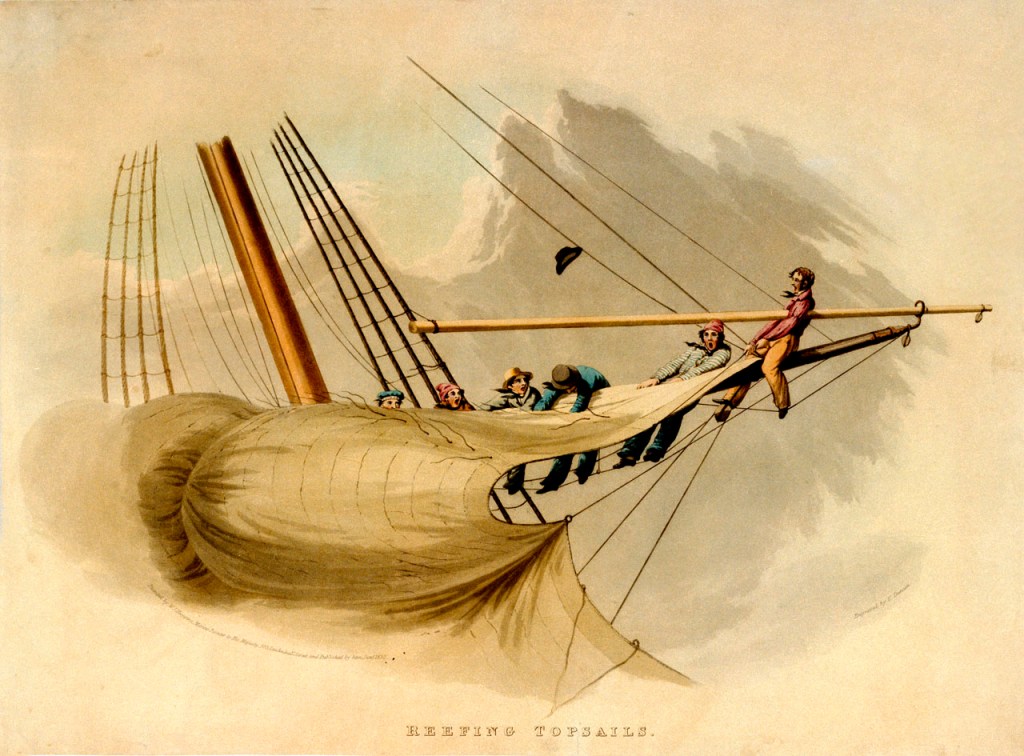
In the harbour, they’ve blessed the blessed boats for their sprints to Mackinac.
We take our place along the inscrutable shore to watch the race. A greenbottle fly is perched
in the right margin, it will drown in the kitchen sink tomorrow. OC86,
the former Windquest, will make it to the island in just over 17 hours. I picture the crew
in foul weather gear as they cut inside Cove Island, squinting blind through
the spray off the hull, switching out sails like homonyms, gaining speed in a boat
whose name they have forgotten. We make passing comments about
each passing boat and bird, the isosceles triangle of a taut mainsail against a blue horizon,
how the word “again” deflates experience. Our trundles reefed to boom, lost again,
finding ourselves again, this summer again. How the morning gets so early for that final craft.
From Public Domain
Cal Freeman is the author of the books Fight Songs, Poolside at the Dearborn Inn, and The Weather of Our Names (forthcoming from Cornerstone Press in 2025). He lives in Dearborn, MI and teaches at Oakland University.
.
PLEASE NOTE: ARTICLES CAN ONLY BE REPRODUCED IN OTHER SITES WITH DUE ACKNOWLEDGEMENT TO BORDERLESS JOURNAL
How can a 470-page long book turn into a page-turner when it is neither a historical novel nor a whodunit thriller that compels the reader to go on reading as quickly as he/she can? That too when it is a motley collection of twenty-six essays written on different occasions and on different topics for the last twenty-five years. The answer is of course Amitav Ghosh who can literally mesmerise his readers with his multi-faceted interests and subjects ranging from literature and language, climate change and the environment, human lives, travels, and discoveries. Divided into six broad sections, Ghosh clearly mentions in the Introduction that the pieces in this collection are about a wide variety of subjects, yet there is one thread that runs through most of them: of bearing witness to a rupture in time, of chronicling the passing of an era that began 300 years ago, in the eighteenth century. It was a time when the West tightened its grip over most of the world, culminating ultimately in the emergence of the US as the planet’s sole superpower and the profound shocks that began in 2001.
A subject very close to his heart and that is reflected in all the books that he has been writing over the last decade or more, the six essays of the first section are on “Climate Change and Environment.” Ghosh writes about different aspects of migration (both in the sub-continent and in Europe), about the storm in the Bay of Bengal, cyclones, the tsunami affecting the Andaman and Nicobar Islands, and about Ternate, the spice island in Indonesia. According to him, by knowing about anthropogenic greenhouse emissions and their role in intensifying climate disasters, it is no longer possible to cling to the fiction of there being a strict division between the natural and the political. Climate change and migration are, in fact, two cognate aspects of the same thing, in that both are effects of the ever-increasing growth and acceleration of processes of production, consumption and circulation.
According to Ghosh, each of the six essays in the second section entitled “Witnesses” grew out of the research he undertook for his four historical novels, The Glass Palace, and the Ibis Trilogy. All the essays in it “are attempts to account, in one way or another, for the recurrent absences and silences that are so marked a feature of India’s colonial history”. While looking for accounts written by Indian military personnel during the First World War, Ghosh came across two truly amazing books, both written in Bengali, on which three pieces in this section are based. The first of these books is Mokshada Devi’s Kalyan-Pradeep (‘Kalyan’s Lamp’; 1928), an extended commentary on the letters of her grandson, Captain Kalyan Mukherji, who was a doctor in the Indian Medical Service. The second, Abhi Le Baghdad (‘On to Baghdad’), is by Sisir Sarbadhikari, who was a member of the Bengal Ambulance Corps, and is based on his wartime journal. Both Mukherji and Sarbadhikari served in the Mesopotamian campaign of 1915-16; they were both taken captive when the British forces surrendered to the Turkish Army in 1916 after enduring a five-month siege in the town of Kut-al-Amara – the greatest battlefield defeat suffered by the British empire in more than a century. He also writes about how these two prisoners of war witnessed the Armenian genocide.
Regarding the exodus from Burma, Ghosh narrates the plight of one Bengali doctor, Dr. Shanti Brata Ghosh from whose diary (written in English) we are given incidents of events that are a striking contrast to British accounts of the Long March. What the doctor remembered most clearly were his conflicts with his white colleagues and his diary represents a personal assertion of the freedom that his nation’s hard-won independence had bestowed upon him.
Section Four entitled “Narratives” consists of three essays. Speaking about the etymology of the word ‘banyan’, and a short personal anecdote about 11 September 2001, we come to the essay from which the title of this collection – Wild Fictions – is taken. It shows us how the policies and administrative actions have divided landscapes between the ‘natural’ and the ‘social.’ Discussing several environmental issues related to the manner in which over many decades there has been a kind of ethnic cleansing of India’s forests and how the costs of protecting nature have been thrust upon some of the poorest people in the country, while the rewards have been reaped by certain segments of the urban middle class, Ghosh warns us why the exclusivist approach to conservation must be rethought. Before environmental catastrophe happens, we have to find some middle way, one in which the people of the forest are regarded not as enemies but as partners. The idea of an ‘untouched’ forest is none other than a wild fiction.
As mentioned in the beginning, Ghosh’s intellectual curiosity ranges from exploring themes of history, culture, colonialism, climate change and the interconnectedness of human and natural worlds and the readers will get a sample of these different topics in this rich collection. Over the years, we had read some of the essays in journals like Outlook, The New Yorker, The New York Times, The Hindu, The Economic and Political Weekly, The Massachusetts Review, Conde NastTraveller and so on, and some of the articles have been the product of his detailed research before he commenced writing a novel. The five essays in the penultimate section titled “Conversations” begins with a long correspondence that Ghosh had with Dipesh Chakraborty via email after Provincilaizing Europe was published in 2000. The two never met personally as Chakraborty was in Australia at that time, but the exchanges between these two scholars on such wide-ranging issues is surely a reader’s delight. The pieces on Shashi Tharoor’s An Era of Darkness and Priya Satia’s Time’s Monster which were written as reviews also form parts of ongoing dialogue. As Ghosh states, Sattia’s work “has given me new ways of understanding the role that ideas like ‘progress’ have played in the gestation of this time of monsters”. In ‘Storytelling and the Spectrum of the Past’, we are told about the historians versus the novelists view of seeing and documenting themes.
The final and sixth section comprises of three pieces that were originally conceived as blogposts or presentations, accompanied by a succession of images – “the texts that accompany my presentations are scripts for performances rather than essays as such”. In the first one, Ghosh gives us new insights from his diary notes (the Geniza documents) about how he chose to study social anthropology and how In an Antique Land was made—about the Muslim predominance in the Arab village where he stayed and how he evaded the attempt at conversion. In a lecture he delivered at Indian Institute of Technology, Kharagpur, Ghosh asks us to think back for a moment to the intellectual and historical context that led to the foundation of such institutions as the IITs, the IIMs and the outstanding medical institutions of contemporary India. He tells us how we cannot depend on machines alone to provide the solution to our social problems and talks about mercenaries, prisons, the hegemony of the Anglo-American power and how the empires kept close control over rights to knowledge. One of the great regrets of Ghosh’s life was that he never met A.K.Ramanujan and in the concluding essay of this section, he tells us how he considered Ramanujan to be “one of the foremost writers and intellectuals of the twentieth century and how one of the most important aspects of his work is the context from which it emerged.
In the introduction to this collection Ghosh wrote that we were now in a time between the ending of one epoch and the birth of another – ‘a time of monsters’, in the words of Antonio Gramsci. In the Afterword he mentions how the strange thing about this interstitial era is that it could also be described as a ‘time of benedictions’ in that it has suddenly become possible to contemplate, and even embrace, potentialities that were denied or rejected during the age of high modernity. He reiterates that it is the elevation of humans above all other species, indeed above the Earth itself, that is largely responsible for our current planetary crisis. “The discrediting of modernity’s anthropocentricism is itself a part of the ongoing collapse that we are now witnessing.” The only domains of human culture where doubt is held in suspension are poetry and fiction. Though it is not possible to discuss all other aspects that Ghosh deals with in this anthology as the purview of the review is rather limited, I would like to conclude it by quoting the last couple of sentences written by Ghosh himself when he categorically states: “High modernity taught us that the Earth was inert and existed to be exploited by human beings for their own purposes. In this time of angels, we are slowly beginning to understand that in order to hear the Earth, we must first learn to love it.”
.
Somdatta Mandal is a critic and translator and a former Professor of English at Visva-Bharati, Santiniketan, India.
.
PLEASE NOTE: ARTICLES CAN ONLY BE REPRODUCED IN OTHER SITES WITH DUE ACKNOWLEDGEMENT TO BORDERLESS JOURNAL.
The Uttarakhandi bemuse over the beauty of the forests: the primordial mitochondria of nature with forty five per cent forest cover. Prometheus, hailed as a hero, gifted fire: the primordial flames to mankind, seen as a blessing.
A blessing! Alas! Promethean wildfires engulf the forests. The serpentine red flowers hiss and haunt millions of lives: animals, birds and humans horrifically embraced.
The annual rituals of firestorms begin. Spring and summer frown and tremble. The lush green blanket of the forest turns to a lifeless grey terrace. With tense expressions and hearts at low, we move our lips and pray. The Bonbibi of Uttarakhand is left powerless.
Binsar in Almora leapt into a wildfire. Five were burnt alive. An old reaper from Thapli was engulfed in the forest flames with more.
O Promethean Wildfire! The annihilator fleetingly swept lives as embers from the mountaineering terrain set ablaze the land till it was ashen-grey, dead and helpless.
Gazala Khan teaches in the Department of English, School of Languages at Doon University, Dehradun, India. She has also been working on creative and literary projects.







 Borderless