Categories
Tagore Translations

Classifications in Society by Rabindranath Tagore

This essay was first published in Tattwabodhini Patrika, Ashwin issue, 1319 B.S.(September-October, 1912) and reprinted in Pather Sanchoy (Gleanings of the Road). It has been translated from Bengali by Somdatta Mandal.
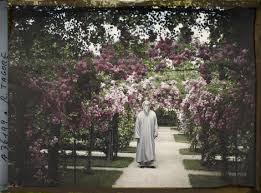
Tagore at Paris, 1921. From Public Domain

When we travel to Vilayet[1], then it is not simply going from one country to another; for us it is like entering a new household. The external differences of lifestyle are not that important. It is expected that there will be a difference between us and the foreigners in our dress, ornaments, eating and pleasure habits and so that doesn’t bother us too much. But not only in lifestyle, there is a deeper dissimilarity in our evaluation of life and to find a sense of direction there suddenly becomes a very difficult task.

We start feeling this from the moment we board the ship. We understand that we will have to abide by the rules of another different household. This sudden change is not to the liking of man. This is why we do not try to understand it very clearly; we somehow try to follow it or feel disgusted and then utter to ourselves—their manner and behaviour is too artificial.

The truth is that what is important is the difference we have with them regarding our social position. Our society has come and stopped within the limits of our family and village. Within those limits we have evolved certain fixed rules about how to behave with one another. Keeping those limits in mind it has been decided what we should do and what we should not. Some of those rules are superficial whereas others are quite normal.

But the society which is the target of these rules being framed is not very big in size and it is a society of relatives. So, our habits are quite domesticated. You cannot smoke tobacco in front of your father, you are supposed to pay obeisance to the guru and pay him some money, the sister- in- law must cover up her face in the presence of the elder brother-in-law and close proximity to your uncle- in- law is totally prohibited. Those rules that are outside the family or village society are based on caste(varna) differences.

It can be said that the thread of caste difference has tied our village society and families like a chain or necklace. We have reached a conclusion. India has resolved its societal problems once and for all and she feels that if this system can be permanently retained then there is nothing to worry about. That is why modern India is trying to strengthen in all manner this family and social bonding laws woven through the thread of varnashram[2].

It has to be admitted that India had been able to find a solution to the problems it was facing at one point of time. She has somehow reconciled the differences between diverse castes, she has pacified the struggle between diverse classes; by classifying professions she has managed to contain competition and disputes and has staved off the vanity created by differences of wealth and capacity through the fence of caste differences. Though, on the one hand, India has maintained through all means the independence of Brahmins who are at the helm of society to the people belonging to other castes, at the same time, she has also spread out small and big processes through which all facilities and education could be disseminated among the others. This is why what the rich person enjoys in India is also partly distributed among the ordinary people on various pretexts and in this way, by giving shelter to the ordinary and appeasing them, the powerful retains his power. In our country, there is no reason to go into a major clash between the rich and the poor and the necessity has not arisen by which the incapable person has to be protected by legal means.

The Western society is not family oriented; it is an open and large society which is much more widespread than ours. It is more on the outside than on the inside. The concept of family that is there in our country is absent in Europe and that is why the people of Europe are spread everywhere.

The nature of this spread-out society is such that on the one hand it is loosely assimilated and on the other it is more diverse and stronger. It is like composing a prose piece. Poetry is restricted within its rhymes and that is why its binding is simpler. But the prose spreads out. That is why on the one hand it is independent and on the other its steps are bound through logic and reason, through diverse rules on ideas about the development of the mind in a greater way.

Because the English society is so spread out and because all its activities are externally motivated, it must be always prepared for different social rituals. It hardly has time to wear casual domestic clothes. It must remain dressed up because its social area is not that of relatives. Relatives pardon you, tolerate you, but you cannot expect such tolerance on the part of outsiders. Everyone must do each and every work in due time, otherwise one will encroach upon another. If the rail line is in my area or is under the control of a few of my friends and relatives, then we can run the train as we wish and can even halt each other’s train as and when we desire. But if we try to detain a train for five minutes in the ordinary train route where lots of trains move up and down, then there will be lots of problems and that will be difficult to tolerate. Because our society is extremely domesticated or maybe because we are habituated with domestic practices, we behave with each other very loosely—we spread ourselves as much as possible, waste time and criticise formal behaviour as lacking in fraternal feelings. This is the first thing that prevents us from feeling at home in English society—there one cannot act in a carefree manner and then expect that people will pardon us. They have created different rules that will on an average benefit the maximum number of people. They have set up fixed rules for meeting each other, for invitation formalities, for dressing up, for entertaining guests. If we try and impose the laxity that we display with relatives in a place that is not actually a society of relatives, then everything turns out to be horrible and life becomes impossible.

Till now this wide European society has not come up with any solutions. It has made an effort through certain rules and regulations in external rituals and behaviour to retain self-restraint and gracefulness but is unable to make arrangements by which the internal strife at a personal level can be resolved. Europe is only going through experimentation, change and revolution. There is a constant rivalry cropping up between men and women, between religious society and professional society, between the power of the ruler and the ruled, between businessmen and worker groups. It has not pacified itself like the halo round the moon. Even now it is ready like a volcano waiting to erupt.

But how can we say that we have solved all our problems, have finalised our social structure, and are resting as peacefully as dead bodies? Even though time has elapsed, we can retain the system for some time, but we cannot keep the situation in chains. We are facing the entire world, now we cannot do with our domesticated society; these people are not merely our fathers, grandfathers or uncles, they are outsiders. They belong to different countries and so we should be extremely alert while interacting with them. If we are absent-minded and behave in a loose manner, then one day we will be totally unfit to act.

We are proud of our tradition, but it is not at all true that the society of India has not evolved through history. In different situations even India had to go through newer revolutions—there is no doubt about that—and history is replete with instances. But I don’t want to even utter that it is the end of all treading for her and from now on till eternity she will just be there and hold on to her traditionality. Society gets fatigued after each large revolution; during that time, it shuts its doors, switches off all lights and prepares to go to sleep. After the Buddhist revolution India had gone off to sleep latching her doors and windows with the hook of strict laws. She was sleepy. But to boast about this as eternal sleep will become a laughable though pitiable thing. Sleep is good only during the night, when there are no crowds of people outside, and when all the big shops and markets are shut down. But in the morning when everyone is awake and there is activity all around, if you go on quietly lying down and close all the old doors and windows, then you will be the loser.

The rules of the night are very simple. Its arrangements are sparse, and its requirements are very little. That is why we can complete all our tasks and go to sleep in an unperturbed manner. Then things go on lying where they were kept because there is no one to move them. The arrangements during the day are not so simple and completing the job once and for all in the early morning does not mean that one can relax and smoke tobacco the rest of the day. Work keeps pouring down our necks. We must keep attempting new things and if we cannot adjust ourselves to the flow of the outside world, then everything else falls out of place.

For some time, India has spent her nights in a system of strict and fixed set of rules. That does not mean that that situation will permanently remain very comfortable. Getting a beating is most painful and difficult, especially when it falls upon a sleeping body. Daytime is the period to receive such blows. That is why it is most comfortable to remain awake during the daytime.  

It is time for us to wake up whether we wish it or not, whether we are full of laziness or not. We are constantly being hurt both internally and externally in society and so we are sad. We are suffering from poverty and famine. The society is breaking down; the joint family system is being split into bits and pieces. And the role of the Brahmins in society has become so demeaning that with the aid of ‘Brahmin societies’ and such other things, they keep on shouting loudly to prove their existence and thus only attest to their weakness. The panchayat[3] system worn in the neck by the government’s chaprasi[4] has committed suicide and its ghost is dominating the village. The food in the country is incapable of satiating the small village schools. Due to famine, they are now relying on the charity of government dole. The rich people of the country have doused the light in their birthplaces and are roaming around in Calcutta in motor cars, and people of noble descent are ready to sacrifice their entire wealth and their daughters at the feet of a graduate groom. There is no point in blaming the Kaliyuga[5], or the foreign king or the native English-speaking people for this misfortune. The truth is that our lord has sent his assistant during the daytime, and he will not stop till such time he can drag us out of our traditional bedrooms. So, we cannot forcibly close our eyes and try to create the night at odd hours. The world that has come to our threshold has to be welcomed inside our house. If we don’t give it a cordial welcome, then it will break open our doors and gain entry. Hasn’t the door not yet been broken now?

So once again, we must think about resolving our problems. It cannot be done by imitating Europe, but we must learn from her. Learning and imitating are not the same thing. Actually, if we learn in the correct way, we will be relieved from the art of imitating. If we cannot know the other truly, then we cannot understand the truth ourselves.

But I was saying that we cannot adjust ourselves in the European society with our loose domestic habits. We can never prepare ourselves in any way. It seems that everyone is pushing us aside, no one is waiting for us for a moment. We are pampered human beings; we feel out of place without our relatives in society. After coming here, I have noticed that since our students are not used to entering other people’s houses, most of them come here and learn things by heart but they do not keep any contact with the society here. The society here is large and so it has more responsibilities. Only if we undertake those responsibilities, can we find a sort of connection with the people of this society. If we cannot connect then we shall be deprived of the greatest learning prevalent here. This is because society is the greatest truth here. The greatest strength, the greatest sublimity is in the society here and not in the battlefield. Sacrifice and self-respect suitable for a broad-minded society are being expressed at every step. They are nurtured here and are preparing themselves in different ways to sacrifice their lives for the welfare of man. In modern India, the educated class of people still consider school education to be the true education. They are deprived of the education of greater society. Even after coming here and entering the school factory, if they come out simply as mechanical things and do not enter the birthplace of humanity visible here then they will be deprived even after coming to a foreign country.
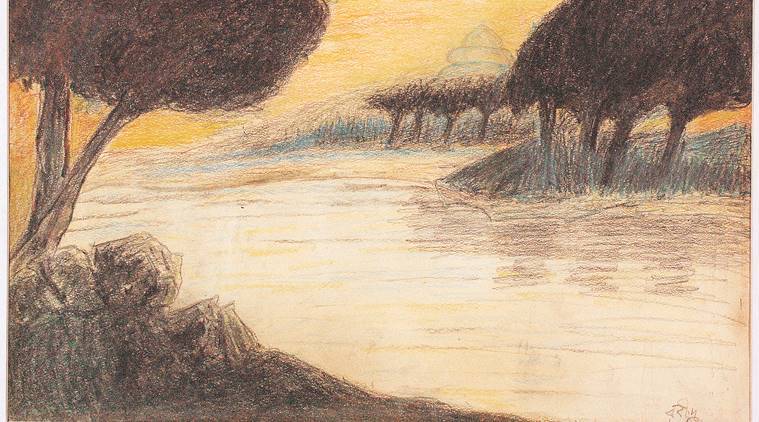
Art by Rabindranath Tagore. From Public Domain

[1] England or the Western world

[2] Casteism

[3] Villages in India are still administered by the panchayat, a council of five selected members from the community.

[4] Peon

[5] The current age in Hindu mythology which ends when the Kalki avatar comes to rescue humanity from darkness.

Somdatta Mandal is a critic and translator and a former Professor of English at Visva-Bharati, Santiniketan, India. An earlier version of this essay was published in Gleanings of the Road (Niyogi Books, pg 20).

.

PLEASE NOTE: ARTICLES CAN ONLY BE REPRODUCED IN OTHER SITES WITH DUE ACKNOWLEDGEMENT TO BORDERLESS JOURNAL

Click here to access the Borderless anthology, Monalisa No Longer Smiles

Click here to access Monalisa No Longer Smiles on Amazon International

Categories
Poets, Poetry & Rhys Hughes

Three Gothic Poems


THE CLOCK DEMON


The demon in the clock
haunted the early hours
of the heir
to an estate
so old that
all the hate
of countless generations
had faded
to a murmur in the walls.

The face behind the dial
was as melancholy, vile,
as the iron
crocodile
in the room
below the
passage where the gloom
had grown
much louder than a shout.

But this demon was silent
throughout the long nights
of winter
when the
freezing
mansion
reversed a grim expansion,
wheezing
in a manner not displeasing.

The clock: it is a guardian,
charged by aeons archean,
to chime
to death
the heir
bearing
ghoulish responsibilities
nowhere
without ceremonial fury.

They claim the creature
trapped there, not daring
to beware
will stare
at forever
resentfully
until those who truly care
decimate
the new legions of eternity.

And still the hours pass,
the demon tries a laugh,
cascading
the shades
of certain
odd hues
into a tone that you alone
will adore
if cosmic doors slam shut.


THE BEGGAR

The beggar
remembers a time
when he drank the rarest
wine from a goblet
and sprawled
on a couch, eyes hooded.

Then one day
an uninvited guest
arrived at his house, worn out,
a man in rags,
eyes ablaze, his tongue hanging
like a vast flatworm
from the lower lip of a blistered
mouth: or like a flag
drooping from a derelict ship
one evil afternoon.

The stars had shuddered
over him: the moon had juddered
high like the jawbone
of a slain man, crescent shattered
by a twisted club
and hurled into the sky.

The rich man spilled his wine
and demanded
without quite knowing why:
Are you me? A future vision
of what I will become?

And the stranger answered:
No, you are me. The future image
of what I will be
when I am no longer just a beggar
but the subject
of nostalgia: the figure in a memory.
When you become
a beggar yet again, the circular path
that pretends to be
a shady lane
may reveal itself to be a spiral chute
leading to the centre
of a brute tormentor’s awful domain.

This paradox is painful, the irony
stabs the beggar’s side
like the barbed tip of a javelin.
From rags to riches
and back to rags:
pain, bliss, and then more agony,
tragedy, comedy,
an inevitable turn of the axletree.

And so he sips his cheaper wine
philosophically,
hunched in the inadequate
shelter of the leaning tombstone
he now calls home.


THE ROTTEN DUNGEON

The dungeon rotted away:
stones crumbled,
iron rusted,
slime evaporated,
heavy keys in grim locks
melted: even
the sense of despair faded
until nothing
was left but stubborn bones.

And the archaeologists say:
there is nothing
here worth excavating.

But the screams
still radiate, propagate,
through the interstellar dust
between nebulae:
extinct at source, of course
they persist elsewhere,
swirling unknown particles
in waves of fear.

The dungeon,
a sullen impression, appears
to have done its work well:
degradation
broadcasting itself as a type
of Hell among
the brimstone constellations.
From Public Domain

Rhys Hughes has lived in many countries. He graduated as an engineer but currently works as a tutor of mathematics. Since his first book was published in 1995 he has had fifty other books published and his work has been translated into ten languages.

.

PLEASE NOTE: ARTICLES CAN ONLY BE REPRODUCED IN OTHER SITES WITH DUE ACKNOWLEDGEMENT TO BORDERLESS JOURNAL

Click here to access the Borderless anthology, Monalisa No Longer Smiles

Click here to access Monalisa No Longer Smiles on Kindle Amazon International

Categories
Musings

Felix, the Philosophical Cat

By Farouk Gulsara

Just the other day, a visitor to my home made a remark. She observed that my cat, Felix, was staring into the horizon while sitting by the glass window. Felix seemed unfazed by the activities within the house, instead focusing his gaze on the neighbour’s gate. In front of the neighbour’s compound stood a few stray cats, returning his stare. It resembled a kind of staring competition.  

The visitor remarked that Felix might be looking at all his stray friends on the other side of the fence, envying their lifestyles. They could roam freely whenever they wished, accompanied by their pack of friends. Wherever they rested their heads was their home. Moreover, they did not have to endure his fortnightly baths or grooming. Oh, how Felix loathed those cold showers and the bare feeling afterwards when there was not enough fur on his Persian body to lick, beautify, and flaunt. As for the food… throughout his life, the only sustenance he consumed was in pellet form. The occasional lizards and insects he hunted down with the remnants of what his dormant DNA offered were swiftly intercepted by his owners. This is why Felix the Cat was often seen engaged in forlorn glances, brooding over his seemingly helpless situation. 

In response, I told the visitor that Felix’s feline friends on the other side of the fence would likely feel the same way. They would be gazing at him with eyes brimming with envy. If only they grasped a bit of philosophy, they would be yelling, “life is not fair!” Here sits Felix in the comfort of the house, in an aesthetically pleasing environment shielded from the harsh forces of weather and nature, with love overflowing all around, soothing tactile stimuli to caress and rub against him, protected from noxious ailments, and safeguarded against prancing predators and cruel individuals discontented with their presence or their annoying mating calls.

They would probably pray to swap places with a house cat in their next life. Felix, were he to believe in rebirth, would likely yearn to roam free without being tethered—symbolically, of course, as cats are not leashed, a privilege they possess over their fellow domesticated ‘friends’, the dogs!

That is life, is it not? No one is truly satisfied with their existence. Everyone believes the grass is greener on the other side of the fence. What they may fail to grasp is that it appears greener because the soil is fertilised with manure. One must endure the stench of excrement to appreciate the outcome. The poor man looks at his wealthy neighbour and assumes that once he secures that coveted high-paying job and some money, everything will be splendid. Meanwhile, the rich man gazes at the poor, reminiscing about his long-lost days of poverty when life was simple and sleep was undisturbed.  

Poet Kannadasan[1], in one of his many wisdom-filled compositions, envisioned a situation: the snake, a natural prey of the eagle, residing upon Lord Shiva’s neck, haughtily sneering at Garuda[2] and inquiring if he was well. The snake, securely nestled in the protection of the Lord, knows that Garuda cannot harm him. Garuda responds that everyone would be just fine if they were in the place they are meant to be. Kannadasan then quotes the Tamil poet Avvaiyar[3],who asserted that the world respects you when you hold a prominent position. When you stumble, even your shadow will defy you. I believe the essence of the message is to accept and appreciate what one possesses in life. Unrealistic expectations lead only to disappointment, whilst acceptance fosters contentment.

.

[1] Kannadasan (1927-81), also known as Kaviarasu (King of Poets) is considered one of the greatest Tamil poets.

[2] A legendary divine eagle-like bird who is the mount of Vishnu.

[3] A Tamil woman poet (supposed to have lived in the first century BCE) from the Sangam period (300BCE – 300 CE).

Farouk Gulsara is a daytime healer and a writer by night. After developing his left side of his brain almost half his lifetime, this johnny-come-lately decided to stimulate the non-dominant part of his remaining half. An author of two non-fiction books, Inside the twisted mind of Rifle Range Boy and Real Lessons from Reel Life, he writes regularly in his blog, Rifle Range Boy.

.

PLEASE NOTE: ARTICLES CAN ONLY BE REPRODUCED IN OTHER SITES WITH DUE ACKNOWLEDGEMENT TO BORDERLESS JOURNAL

Click here to access the Borderless anthology, Monalisa No Longer Smiles

Click here to access Monalisa No Longer Smiles on Kindle Amazon International

Categories
Poetry

Poems by Luis Cuauhtémoc Berriozábal

From Public Domain
CATCH THAT MOON

In the evening at sea
I fish the moon’s reflection.
It is my recreation
and my white whale.
I never catch that moon
but I like the challenge.
The lost souls at sea
sing throughout the night.
They sing an old song lost for years.
The song is a curse of course,
a spell from the waning moon.

GONE INTO EXILE

Pretend I am not here.
Pretend I am long gone.
Imagine my leaving
was no magic trick,
but something ordinary.
I do not feel my presence
is at all necessary.
Forget about me and
do not expect my return.

FLY AWAY MOTH

Fly away moth
To the moon
Of the streetlight
The hot bulb
That is miles
Away from the
Actual moon
Once you get
To the light bulb
Don’t let go
You’ll be satisfied
By the false moon
Its bright light
Warm and round
Like a breast

Luis Cuauhtémoc Berriozábal lives in California, works in Los Angeles in the mental health field, and is the author of Raw Materials (Pygmy Forest Press). His poetry has appeared in Blue Collar Review, Borderless Journal, Escape Into Life, Mad Swirl, and Unlikely Stories. His latest poetry book, Make the Water Laugh, was published by Rogue Wolf Press. Kendra Steiner Editions has published 8 of his chapbooks.

.

PLEASE NOTE: ARTICLES CAN ONLY BE REPRODUCED IN OTHER SITES WITH DUE ACKNOWLEDGEMENT TO BORDERLESS JOURNAL

Click here to access the Borderless anthology, Monalisa No Longer Smiles

Click here to access Monalisa No Longer Smiles on Kindle Amazon International

Categories
Review

‘A Journey Beyond Imaginary Borders’

Book review by Somdatta Mandal

Title: Miss Samuel: A Jewish Indian Saga

Author: Sheela Rohekar

Translator from Hindi: Madhu Singh

Publisher: Speaking Tiger Books

India is perhaps the one country where the Jews have maintained their identity without ever being exposed to antisemitism at the hands of their host. Although representing a microscopic segment of the Indian population, the Bene Israel is one of the largest and oldest of the three major Jewish communities of India, the other two being the Cochin Jews of the Malabar Coast and the Baghdadi Jews of Bombay and Calcutta. The Bene Israels arrived at the Konkan coast, shipwrecked, and have lived in India for more than 2,000 years and claim descent from the ten lost tribes of Israel. After they had settled down permanently in the Konkan villages of Western Maharashtra, the Bene Israels were called ‘Shaniwar Telis’ or Saturday oil pressers – a relatively low-caste designation – by the local population because they refrained from working on Saturday, the Jewish Sabbath. Later, they also farmed their land, peddled produce, and took up petty jobs, with the majority working as clerks in government offices and private firms. With time, they adopted Hindu names similar to their Biblical names and took up Marathi surnames such as Rohekar, Penkar, Palkar, and Ashtamkar by adding the suffix ‘-kar’ to the villages and town they came from. They adopted Marathi, the local language, as their mother tongue, and to outsiders, became physically indistinguishable from the local population. But within the village society, the Bene Israels were clearly differentiated from others because they adhered to Judaism. Initially overtones of a caste system coloured the Bene Israelis but they changed with time. Intermarriages between other Jewish communities became common.

With the formation of the nation-state of Israel in 1948, the exodus of the Jews of India took place on a very large scale, and only a few hundred members were left in Gujarat. Initially the integration of the Bene Israels into Israeli society was not easy and many of them returned to India but re-emigrated to Israel later after 1964 when their religious status was finally accepted.

Miss Samuel: A Jewish Indian Saga is written by Sheela Rohekar, a Bene Israel Jew, who is probably the sole-living Jewish Hindi author, and she managed to recreate the distinct identity of her own community. Bearing across life histories of her ancestors, she seeks answers to those questions that troubled her in the novel.  Originally written in Hindi, it is aptly translated into English for the first time by Madhu Singh, a professor of English teaching at the University of Lucknow. The novel is narrated by Miss Seema Samuel, an almost 70-year-old Bene Israel living at an old age home called Parisar on the outskirts of Pune, and it portrays her unsuccessful struggle to fit into a majoritarian Hindu society along with the plight of being an unmarried woman in India. She tells the story of her community, of their trials and tribulations, love and loss, and their longing for ‘Aliyah’ — the return to the Promised Land of Israel. Shifting from the Konkani shores to the bustling streets of Ahmedabad (called Amdavad in the local parlance), and finally to the tranquility of an old-age home, each generation of Seema’s family grapples with the tension between their Jewish faith and Indian identity, struggling with their fear of persecution on the one hand and a yearning for acceptance on the other.

In the novel, apart from giving a macrocosmic view of the Bene Israel community which makes its members victims of isolation and alienation from mainstream Indians, and depicting their ancient history and present status, Sheela Rohekar also very deftly presents the microcosmic view of the extended family of her community along with the problems of cross-cultural liaisons and the problems each individual member of her family faces. She states: “But some images embed themselves in the mind, not in the eyes, and chase you – all your life. The role of time in fusing images is not much but the trick of a fading memory. They light up in a flash!”

Since her narration spans six generations and moves deftly backwards and forwards in time, in some places it becomes difficult for the readers to keep track of who’s who in the narrative and occasionally one must go back to the family tree chart at the beginning to place the characters in their proper perspective.

Miss Seema tells the story of Isaji Eloji, who, having married a Hindu woman named Narayani, is believed to have ‘blackened’ the Jewish name. Two generations later, burdened by his grandfather’s transgression, David Reuben stops at nothing to keep his Jewish identity pure, even poisoning his daughter Lily for loving a non-Jewish man.

Again, years later, his son Samuel David (Miss Seema’s father) finds that his Jewish identity makes him an outsider in his own country; and his grandson, Bobby, faces persecution of the worst kind – when he is murdered by a mob in Ahmedabad. It is through reading the loose notes and a long essay that Bobby had left behind that Seema manages to tell us the background history of their community. With his collection of yellow, crumbling newspaper cuttings about the Jews, old coins, badges, awards, certificates, degrees, and moth-eaten black and white photographs that were around 150 years old, Bobby tried to illuminate the path taken by the fellow members of his community – the Bene Israel, the pardesi, the foreigners – whom the people of Amdavad did not know in the twentieth century and believed to be Maharashtrians or converted Christians. The story of how his brother, David, and his Hindu wife. Jyotsna Prajapati, managed to throw Seema out of their apartment in Gitanjali Society also reminds us about such machinations that prevail in our Indian society in general. Through the different tales, the narrator remains a constant, and her memories commingling the past with the present are deftly handled by the novelist.

Further, Miss Samuel becomes a key novel to understand not only for its Indian-Jewish identity but also its multicultural Indian identity and its challenges in the present time. The old age home, Parisar, is not at all a closed space and it opens to new forms of solidarity among elderly abandoned women who, though belonging to different faiths and identities, abandon their frustration with the twists of patriarchal society to discover the meaning of friendship, love and solidarity.

Seema writes: “The campus where I live is surrounded by hills. There is silence, always. I can see residents of my age, some even older, shuffle from one room to another. Constructed at a distance of two hours from Pune, all stories seem to end up here, in this building.”  Parisar is thus a model of a tolerant society that not only accepts differences but even respects, maintains and transcends them at the same time. The translation is lucid, and the translator labels her endeavour as ‘interpretive performance’ and a journey beyond imaginary borders. A good read indeed.

.

Somdatta Mandal, critic and translator, is a former Professor of English at Visva-Bharati, Santiniketan, India.

.

PLEASE NOTE: ARTICLES CAN ONLY BE REPRODUCED IN OTHER SITES WITH DUE ACKNOWLEDGEMENT TO BORDERLESS JOURNAL

Click here to access the Borderless anthology, Monalisa No Longer Smiles

Click here to access Monalisa No Longer Smiles on Amazon International

Categories
Poetry

When the Tree Men are Gone…

By Stuart McFarlane

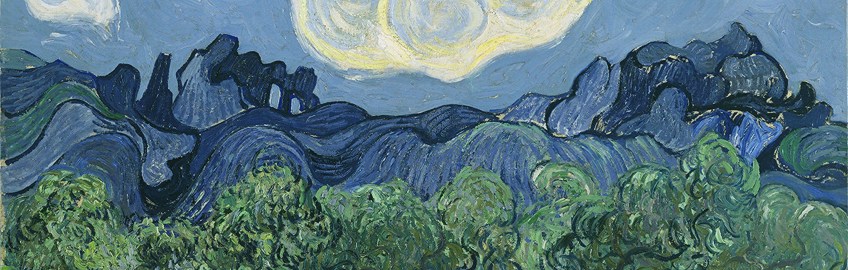
Painting by Vincent Van Gogh(1853-1890)
 THE FIRST DAYS OF SPRING 

The last, forlorn days of winter;
still do they stubbornly cling.
Idle thoughts turn to graveyards.
I hear a mournful bell ring.
Yet there stirs an awakening.
I see a bluebird take wing.
Violets bloom, and daffodils.
I resist an urge to sing.
My thoughts now turn to sunlight;
to the new life it will bring.
Farewell, the last days of winter.
Behold! The first days of spring.


THE TREE MEN

I

Walking through the park,
this winter morning,
I saw how the Council's been at the trees.
Some men, in heavy, black jackets, were throwing
branches in the back of a truck.
One was still sawing hard,
finishing the job.
The branch rolled onto the grass.
The man wiped his brow with his leather glove.

II

They said the trees blocked the view;
of what, exactly, it was hard to see.
But trees, I suppose, you can't talk to;
or urge to have smaller families.
You just take an axe to them.


III

All along the avenue there are now
trees marked with yellow paint.
These are the next for hacking;
and those, already cut, stand stark
against the winter sky;
their severed limbs now stacked
in the back of council trucks.
And, now, I wonder if,
when the tree men are gone,
maybe in the quiet of night,
these mutilated stumps will still feel
a spark crackle along a tattered nerve-way;
that savage lunge, as a sharp blade
splits the skin.

Stuart McFarlane is now semi-retired. He taught English for many years to asylum seekers in London. He has had poems published in a few online journals.                                                                                                                    

.

PLEASE NOTE: ARTICLES CAN ONLY BE REPRODUCED IN OTHER SITES WITH DUE ACKNOWLEDGEMENT TO BORDERLESS JOURNAL

Click here to access the Borderless anthology, Monalisa No Longer Smiles

Click here to access Monalisa No Longer Smiles on Kindle Amazon International

Categories
climate change

‘Climate change matters to me, and it should matter to you too’

Zeeshan Nasir writes of a region whose carbon footprint is next to zero, yet it suffers some of the worst climate-related disasters…

The perennial consequence of climate change is affecting the lives of people all over the world, particularly in the remote and underprivileged parts of Balochistan.

Noora Ali, 14, was oblivious to the temperature shifts because she had grown up in Turbat, a city in the centre of CPEC (China-Pakistan Economic Corridor). They had frequent floods during the monsoon season and blazing heatwaves during summers, with temperatures rising above 51 centigrade. Compared to other cities in Balochistan, Turbat experiences hot summers and typical winters. As a result, the majority of wealthy families in the city travel to Gwadar, Quetta, or Karachi during the sweltering summers and return to Turbat during the winters. The Water and Power Development Authority (WAPDA) moved Noora’s father, who works there, to the neighbouring Gwadar in 2022.

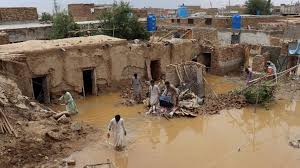
In the February of 2022, the sea seemed calm while boats of the fishermen busily dotted the waters of the Padi Zir (Gwadar’s West Bay). It was a typical Thursday morning when rain started pouring down. The rain was so intense that the sea became wild and uncontrollable. The roads were washed away, bridges collapsed, with streets being inundated with flood water and the port city became completely disconnected with the rest of the country. Back in Turbat, her ancestral hometown was also submerged under flood water.

Noora had also heard from her school fellows that Gwadar and Turbat had never experienced such heavy and intense rainfall before. She knew and felt that the temperature of her native city was rising and that Gwadar beneath flood water didn’t seem normal.  “This is due to climate change.” Her elder brother told her. At the age of 14, typical children in Balochistan have no idea what climate change and global warming are but they are already feeling it impacts.

Like Noora, thousands of children in South Asia, particularly Pakistan, Bangladesh, Nepal, India and Afghanistan are at the risk of climate related disasters, as per the UNICEF 2021 Children’s Climate Risk Index. The report further reiterates that children in these countries have vigorously been exposed to devastating air pollution and aggressive heatwaves, with 6 million children confronting implacable floods that lashed across these countries in the July of 2024.

On the 11th and 22nd November 2024, over 20 youths urged the world leaders to come up with plans to mitigate the impacts of climate change on children at the 2024 United Nations Climate Change Conference (COP 29) held in Baku, Azerbaijan. Among those 20 resolute children was the 14 years old, Zunaira Qayyum Baloch representing the 241.5 million children and women of Pakistan. 

Dressed in her traditional Balochi attire, with a radiant smile in her face and resolute in her commitment, Zunaira Qayyum Baloch, startled everyone. Hailing from the far-flung district of Hub in the Southwest of the Pakistan’s Balochistan, Ms. Baloch went to represent the children of a country whose carbon footprint is next to zero, yet it suffers some of the worst climate-related disasters. Her message to world leaders was clear: step up and combat climate-induced inequalities, particularly those affecting women and children.

She had always remained conscious about the changing climate in her city, observing the floods of 2022 that had wreaked havoc in Hub Chowki, initiating awareness programmes and youth advocacy guide training in her home city to advocate for girls right to education and climate change.

“After my father passed away, my mother became the sole breadwinner. She helped us get an education and met all our requirements.” Zunaira explains. “During the catastrophic rains of 2022, an incident changed my perspective on climate change.  Rainwater had accumulated in the roof of our home and streets were flooded with water. The destruction was so overwhelming that I realised that such events were no longer rare but increasing constantly. “

During the COP29, Ms Baloch expressed her concerns with the experts how Pakistan, particularly Balochistan has been detrimentally affected by climate disasters like frequented floods, heatwaves, hurricanes and droughts. Lamenting that climate change was a child-rights crisis, she told the world how the changes in the climate had jeopardised the lives of millions of women and children throughout the world.

Asking the world leaders to join determined children like her to combat climate change, she addressed them in the COP29: “Climate change matters to me, and it should matter to you too.”

Stark Reality of the Past

Bibi Dureen, 80, is a testimony to how climate is continuously transforming. She hails from the outskirts of the Kech district in a town called Nasirabad.

“The seasons are changing.” She says with her voice laced with sorrow. “The heatwaves have become more aggressive, and floods are common. It all started around 1998 in Turbat. Then in 2007, a devastating flood destroyed our homes, date palm trees, livestock –and worst of all, it took lives.” She pauses, her wrinkled hands trembling.

As she talks to me in front of her thatched cottage, through which sunlight is streaming in, tears well up in her eyes as she recalls a painful childhood memory, “I was young at that time. It was a pitch-black night, and the rain was pouring down mercilessly when a man came shouting that the flood water had reached the fields.” She exclaims with grief. “My mother, desperate to save what little we had, sent her only son, my sixteen-year-old brother, Habib, our family’s only breadwinner, to find the only cow we had in the fields.  Neither the cow nor Habib returned. Later some men found his dead body in the jungle.”

In June 2007, when the Cyclone Yemyin hit the coast of Balochistan, it wrought unprecedented damage to the province, particularly Turbat, Pasni and Ormara and rendered 50,000 homeless within 24 hours, including children. According to reports 800,000 were affected and 24 went missing.

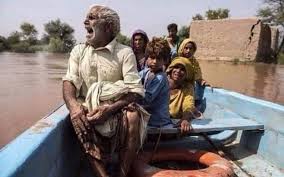
The 2022 floods had a devastating impact across Pakistan, with the province of Balochistan being one of the hardest hit. With 528 children dying nationwide, 336 people died in Balochistan, including children as per the reports of the Provincial Disaster Management Authority (PDMA).

Tragedy struck again in 2024 when torrential rains engulfed 32 districts of Balochistan, particularly, the port city of Gwadar and Kech district. The PDMA put the death toll of children dying due to the flood at 55 out of the total of 170, with 16 others injured.

The Double Crisis Facing Girls

Regions in Balochistan, such as Naseerabad, Jaffarabad, Sohbatpur, Nokundi, Sibi and Turbat have seen severe heatwaves in the past few decades. On May, 2017, the Mercury rose to a record breaking of 53.5 centigrade in Turbat, making the district to be the hottest place of the year after Mitribah, Kuwait. During heatwaves, cases of fainting and health-related illness among residents, particularly children are rarely uncommon. According to a 2023 report by the Pakistan Meteorological Department, Balochistan has seen a 1.8°C rise in average temperature over the past three decades, leading to longer and harsher heatwaves.

Dr Sammi Parvaz, a gynaecologist at the university hospital in Turbat, tells that rising temperatures in the district not only contribute to higher dropout rates among school-girls but their menstrual cycle is also affected.

 “According to the recent research of the National Institute of Health (NIH) , menstruation– a biological process that occurs in females when they reach puberty — is severely affected in countries which are vulnerable to climate change and Pakistan is one them.” She explains. “The menstruation in girl children living in extreme heat, such as, in Turbat and Karachi, becomes very intense, painful and with cramps.”

Dr Sammi further elaborates that this phenomenon is linked to the increased release of cortisol and oestrogen, the hormones which regulate the female reproductive cycle. “Girl children exposed to harsher environments such as severe heat or cold, experience hormonal imbalances leading to irregular periods and severe menstrual cramps. The hospitals in Turbat are frequented by patients suffering from intense cramps or irregular periods.”

Hygiene becomes another pressing issue during floods, especially for young girls. Research published by the International Journal of Environmental Research and Public Health states that floodwater contains lead, polychlorinated biphenyls (PCBs) and other chemicals which are the cause for irregular periods.

During floods thousands of girl children struggle to manage their periods amidst the chaos of the disaster and remain without period products.  For instance, after the 2022 floods, 650,000 pregnant women and girl children in Pakistan were without essential maternal care, with a significant proportion from Balochistan.

Admist all this chaos climate activist like Zunaira Qayyum Baloch raise awareness while women like Maryam Jamali work directly on the ground to ensure that every women has ration in her house and access to menstruation products during catastrophes.

 Madat Balochistan [1]— a non-profit organisation — has supported more than 31,000 people across 34 districts in Sindh and Balochistan. With its major work concentrated in and around Quetta, Dera Bugti, Jaffarabad, Jhal Magsi, Sohbatpur, and Khuzdar, they are a women-led organisation fundamentally prioritising women and young girls in their work because even on the frontlines, they are bearing most of the cost of climate change, according to its co-founder, Maryam Jamali.

 “Our conversations on climate change vulnerability often treat everyone as ‘equal’ in terms of impact, when that is far from the truth. Vulnerability is a multi-dimensional concept and in a country like Pakistan where most of the women and girls are pushed to the margins of society in every way possible — we cannot just overlook their struggles.” Maryam Jamali tells.

“Take the 2022 floods, for example — the most recent catastrophes etched in our memories. Women and girls were responsible for most of the labour when it came to evacuating to safer places. As soon as they did, their needs when it came to menstruation or pregnancy care were completely ignored by aid agencies as they sent out packages or set up medical camps. Most of our work at Madat was compensating for things like this. We worked with midwives to ensure that women, who could not stand in lines for ration, received it regardless or women who did not want to interact with male doctors didn’t have to. In our housing projects, we prioritise women especially those who don’t have a patriarch in the household because that severely limits their access to resources for rehabilitation.”

Floods, heatwaves and other natural calamities are gender neutral. However,  female children are more likely to be affected by them. According to the UN Assistant Secretary-General Asako Okai that when disaster strikes, women and children are 14 times more likely to die than men. In Pakistan, 80% of people displaced by climate disasters are women and children.

 In patriarchal societies in Pakistan, women and female children are the primary caregivers of the family and they are the sole persons to grow crop, do house chores, fetch firewood and water. With little to no potable water nearby, girls have to travel far to help their parents, further exacerbating their vulnerability.

These household responsibilities create an educational gap. Girls are taken out of schools in Balochistan during floods. With Pakistan’s lowest girl literacy rate at just 27 per cent, the International Rescue Committee (IRC) reported that the province of Sindh and Balochistan have seen greater educational disruptions due to heatwaves and floods, with the 2022 flood causing more educational institutions closure than the combined two-year COVID-19 pandemic.

Extreme heatwaves and recurrent flooding in Balochistan have further compounded this gap. For instance, the 2022 flood damaged or destroyed 7,439 schools in the province, affecting the education of over 386,600 students and 17,660 teachers and staff members. Reports also mention that most of the government school were used as flood shelters in the province. In the 2024 floods, 464 schools were again damaged.

The destruction of educational infrastructure has forced many children out of school, contributing to the province’s high out-of-school rate.

Monsoon Brides during Floods

 Though floodwater is no longer accumulating in the Mulla Band Ward of Gwadar district in Balochistan, the damage it has wrought will stay with the people for a long time for many years. For Gul Naz[2],16, the loss has been devastating.She was only 16 years at the time when flood water entered their home in 2022. Her father, being a fisherman, struggled to make ends meet, as the sea was completely closed for fishing, cutting off the family’s only source of income.

“I was in the Jannat Market and when I returned home, I was told by my mother that my marriage has been fixed to a man twice my age in exchange for money.” She discloses that her parents were given Rs.50,000 ($178.50) which is a whooping sum for a poor family, who survive on around one dollar a day.

“I have two kids now and I am a child raising a child.”

The sadness in Gul Naz’s voice is palpable and she isn’t alone in her predicament. During floods and emergency situations, families in Balochistan resort to any desperate means for survival. The first and most obvious way is to give their daughters away in marriage for financial relief — a practice that usually surges during the monsoon season, hence, the name monsoon brides.

In the Sindh province of Pakistan, where this trend is more prevalent, there has been a spike in the number of monsoon brides during the last flash floods of 2022. In the Khan Mohammad Mallah Village, Dadu district, approximately 45 were married off in that year, according to the NGO organisation, Sujag Sansar[3], which works to reduce child marriages in the region.

Pakistan stands at the sixth position in the world when it comes to marrying children below eighteen. While there has been a reduction in child marriages in Pakistan in recent years, UNICEF warns that extreme weather patterns put the girl child at risk.

Madat Balochistan has also been on the forefront in the reduction of child marriages in Balochistan, “It’s not intuitive to think of girls’ education or loan relief or housing provision as measures to build climate change resilience, but in our contexts, these are the very things that drive vulnerability to climate change.” Says the Maryam Jamali. “We have been working on supporting farmers with loan relief so that young girls aren’t married off to compensate for the financial burden of loans after a lost harvest. We are also working on initiatives for sustainable livelihoods for women as well as ensuring that young girls in all the communities we work in have access to education despite geographic or financial limitations.”

Jamali thinks that gender inequality is one of the biggest aspects here which makes it absolutely necessary for a region like Balochistan, where physical vulnerability and socio-economic vulnerability is high, to have young girls at the decision-making table.

“Activists like Zunaira can ensure that when we come up with solutions for climate change, we contextualize them through a gender lens and make sure that this does not become another instance of taking away women’s agency but becomes an opportunity to involve them in climate change policy decision-making.” Jamali contends. “It is rewarding to see the girls we support do great things. One of our girls from Musakhel is studying at Cadet College Quetta, the first in her family to be able to pursue education beyond 8th grade.”

The Way Forward

“Extreme weather can fuel conflict and be a threat multiplier,” says Siraj Gul, a lawyer at the Balochistan High Court, Quetta, citing the recent research published in the journal Alternatives: Global, Local, Political. He stresses that the decades long running insurgency in Balochistan stems from human rights violations, inequality and government negligence. “Climate related catastrophes further destabilise the region’s development. For instance, there was a surge in the number of protests during the 2022 floods in Gwadar, Lasbela and Turbat, reflecting the deep frustration and despair of the people.” According to Mr. Gul if children like Zunaira are given a platform to speak and work for Balochistan, they are not merely advocating for the environment, they are working for a more peaceful and tranquil region.

A climate resilient infrastructure and child-oriented disaster relief have become a must in climate-torn regions like Balochistan.

[1] Help Balochistan

[2]Her name has been changed to retain her privacy

[3] Awake World

Zeeshan Nasir is a Turbat-based writer and currently pursuing his MBBS Degree from the Makran Medical college, Turbat. He tweets on X @zeeshannasir972. He has contributed to Daily Dawn, Countercurrents, Pakistan Today, The Diplomat and others. A different version of this essay has been published earlier in Countercurrents and Pakistan Today.

.

PLEASE NOTE: ARTICLES CAN ONLY BE REPRODUCED IN OTHER SITES WITH DUE ACKNOWLEDGEMENT TO BORDERLESS JOURNAL

Click here to access the Borderless anthology, Monalisa No Longer Smiles

Click here to access Monalisa No Longer Smiles on Amazon International

Categories
Poetry

Dirt Magicians by Ryan Quinn Flanagan

From Public Domain
DIRT MAGICIANS

I go outside.
Bounding back into childhood.
Split melon in hand with infernal separation.

The fatherless sun above
rips dancing cornea from my eyes.

While the garden lice under rocks
ball up like dirt magicians.

And the balance girls walk the curb,
arms extended.

Trying not to fall off.

Ryan Quinn Flanagan is a Canadian-born author residing in Elliot Lake, Ontario, Canada with his wife and many bears that rifle through his garbage.  His work can be found both in print and online in such places as: Evergreen Review, The New York Quarterly, Borderless Journal, GloMag, Red Fez, and Lothlorien Poetry Journal.

.

PLEASE NOTE: ARTICLES CAN ONLY BE REPRODUCED IN OTHER SITES WITH DUE ACKNOWLEDGEMENT TO BORDERLESS JOURNAL

Click here to access the Borderless anthology, Monalisa No Longer Smiles

Click here to access Monalisa No Longer Smiles on Amazon International

Categories
Stories

‘Jai Ho’ Chai

By Snigdha Agrawal

From Public Domain

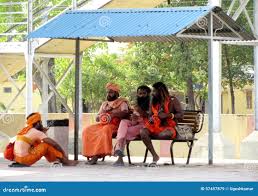
The sun beat down mercilessly on the railway platform of Karwar Railway Junction, where a group of rotund, saffron-clad priests huddled together, fanning themselves with cardboard pieces ripped from cartons. Their expressions were grim, their bellies noticeably less jolly than usual.

“It’s the end of an era, brothers,” sighed Pandit Upadhyaya, his triple chins wobbling like unset strawberry Jello. “First, they replaced bulls with tractors. Then, they put machines in our post offices. And now; NOW, they have brought AI into our temples!”

The sacred threads worn over their left shoulder, diagonally across the body, seemed to protest against their protruding bellies, yellowed and stringy, yet proudly declaring the caste hierarchy would soon be rendered null and void.  The looks of concern on their faces screamed, “Not fair…not fair at all”.

From Public Domain

“I still cannot believe it!” moaned Pandit Shastri, wiping his forehead with the end of his dhoti[1]. “A robot priest? Is this then the end of the Kalyug [2]? Else, how can a machine do what we do?”

“They say it chants flawlessly,” added Pandit Joshi, shaking his head. “Not one mispronounced shloka[3]!  No breaks for tea or chewing on betel leaves! No accidental burps during the aarti[4]!”

“Profaneness!” chorused the group, clutching their prayer beads in outrage.

“I even heard,” Pandit Sharma whispered conspiratorially, “that the AI priest does not accept dakshina[5]! No envelopes, no fruit baskets, no ghee-laden sweets. What kind of priest didn’t accept gifts?” they nodded looking puzzled.

Pandit Upadhyaya lamented. “What is our next recourse? If these AI priests take over, who will feed us? Who will drape us in silk? Who will offer us ghee-laden sweet boxes?”

A train pulled into the station just then; the platform transformed with the usual activity commencing on arrivals. Passengers stuck their heads out, looking around for tea and snacks.  Pandit Sharma suddenly came up with an idea. “Not all is lost yet.”

“Meaning?” asked Pandit Joshi, narrowing his eyes suspiciously.

“We shall sell tea! But not just any tea—Prasad[6] Chai! Sacred! Blessed! Tea infused with the wisdom of the Vedas!”

The priests considered this. It was true. If there was one thing, they were experts in, it was making offerings with dramatic flair. Why not apply that skill elsewhere?

Within weeks, they set up stalls on the platform, offering passengers their special chai.  As trains pulled in, the platform echoed with the chorus…”Om Chai Namah![7]” “Divine Masala Chai.  Guaranteed to bring you good karma!” “Blessed by Brahmins, brewed with bhakti[8]!”

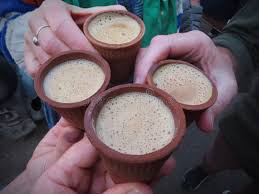
Soon enough, their stall was milling with passengers keen to taste this unique concoction, prepared by none other than the four Brahmin Head Priests. The spectacle of their tea-making performance, with dramatic gestures, had everyone gawking. Served in earthen cups, each sip elicited murmurs of appreciation from the passengers.  The “Jai Ho” brand of tea didn’t take long to become a hot success.

Word spread like wildfire in the temple town.  Business boomed. The tea, laced with just the right amount of saffron, cardamom, and sacred nostalgia, had an irresistible charm. Soon, the platforms were buzzing with satisfied sippers. Every train passing through the station had passengers stepping out to sip on this special tea.

As they counted their first earnings, Pandit Upadhyaya sighed, “Brothers, who knew AI would push us into a more profitable business?”

But then, one day, a group of railway officials swooped down on them in their khaki outfits with officious looks on their faces. One of them, a spectacled man with a voice that needed no loudspeaker, spoke, “Pardon me, Swamiji’s, but we’ve received some complaints. Your tea business is so blessed that passengers are delaying boarding their trains. This is causing major delays and loss of revenue to the railways.  Moreover, it’s illegal to do business on the platform without a licence from the authorities.  Can you show the vendor licence?” he asked hesitatingly.

The priests exchanged guilty glances.

The official adjusted his spectacles, “Of course, we can set that right, as we have received a special request from the high command. The Railway Ministry wishes to introduce your “Jai Ho” chai at all major railway junctions!”

Jowls dropped, mouths agape, the priests couldn’t believe they heard right. The tufts of hair on the back of their shaved heads stood erect in surprise.

Pandit Upadhyaya beamed, “Brothers, the Gods have truly blessed us! It no longer matters that non-humans have overtaken our profession, we continue to gain from selling the brew the Gods’ drink!”

As they sipped their divine brew, laughing heartily, they looked up at the temple in the distance, where the AI priest continued chanting slokas flawlessly.

“Well,” chuckled Pandit Sharma, “at least that machine can’t make chai!”

And so, from AI adversaries to tea sellers, the priests of Karwar found their unexpected salvation—not in temples, but in terracotta cups of steaming, saffron-infused chai.

From Public Domain

[1] A loose piece of cloth wrapped in the lower half of the body

[2] The current age according to Hindu eras, supposed to be dark.

[3]Sanskrit chants 

[4] Holy offerings

[5] Honorariums

[6] Offerings blessed by Gods

[7] Bow to the blessed chai

[8] Devotion

Snigdha Agrawal (nee Banerjee) is an author of five books and a regular contributor to anthologies and e-magazines.  A septuagenarian, she has recently published a book of memoirs titled Fragments of Time, available on Amazon and Flipkart.

PLEASE NOTE: ARTICLES CAN ONLY BE REPRODUCED IN OTHER SITES WITH DUE ACKNOWLEDGEMENT TO BORDERLESS JOURNAL

Click here to access the Borderless anthology, Monalisa No Longer Smiles

Click here to access Monalisa No Longer Smiles on Amazon International

Categories
Poetry

Prose Poems by Lizzie Packer

FAR NORTH QUEENSLAND
(Phil and Kaye’s place, Malanda FNQ June 2024)

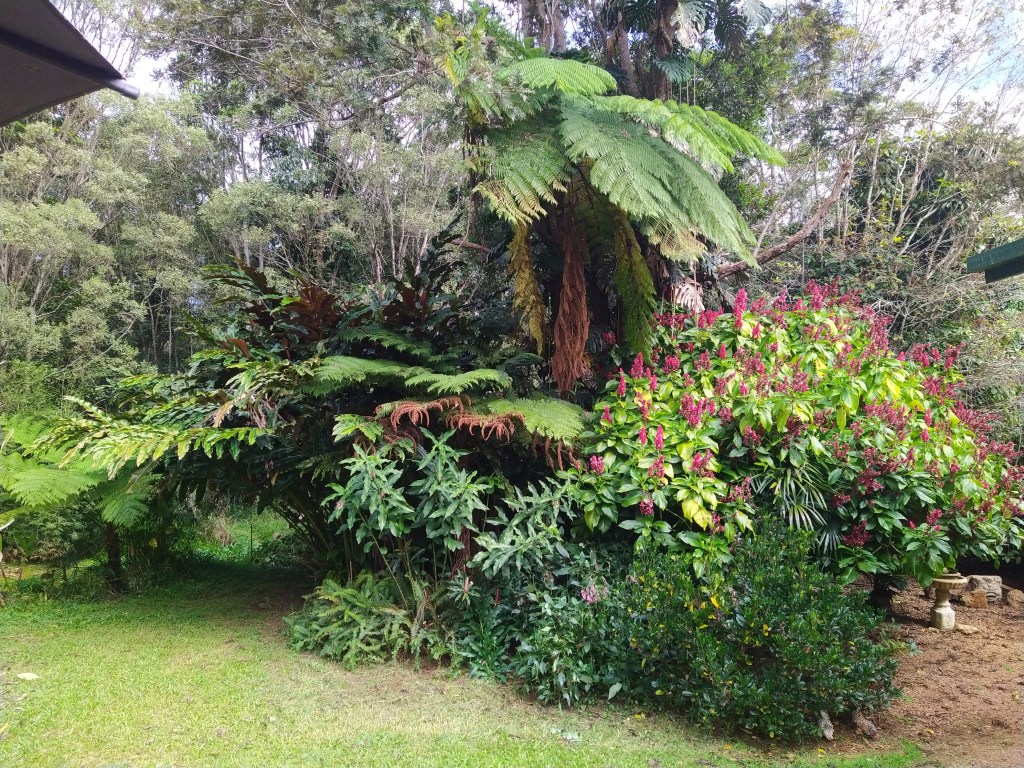
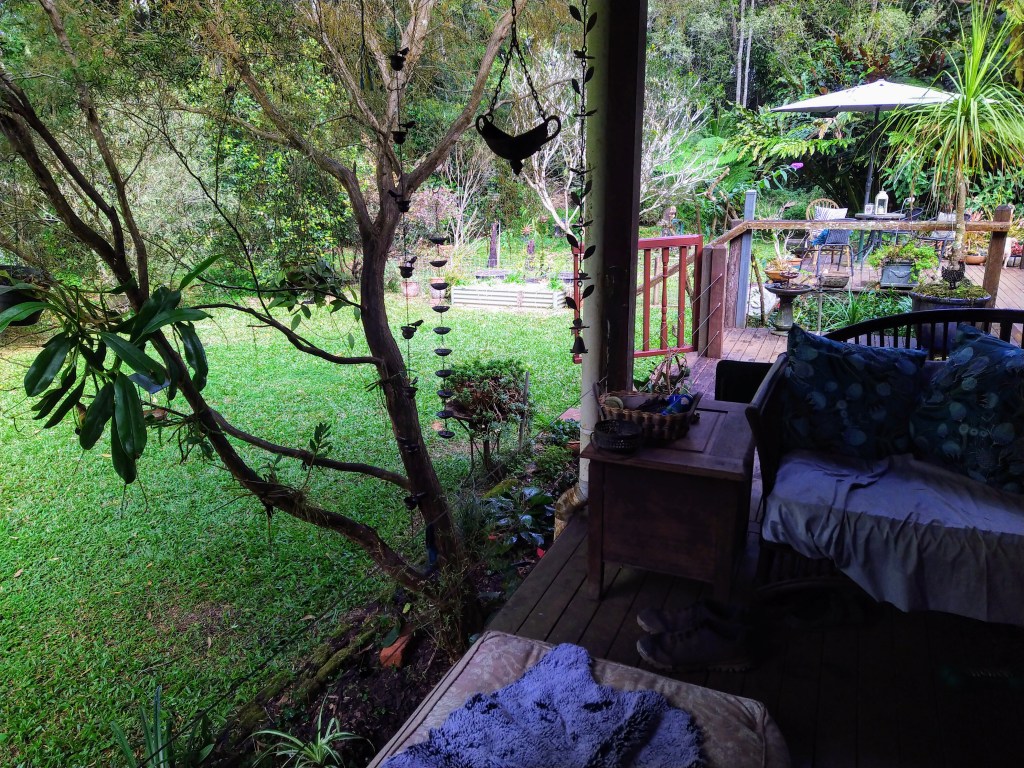
Overcast sky – air moist with pending drops – from the comfortable chair on the back verandah in this micro-Eden framed by roof and posts I watch the green King Parrots fly to the feeders and boot the Emerald Doves and little Mannikin Finches out. They soon return like a scherzo in a symphony – the Bar-shouldered Doves and cheeky Lorikeets follow. Almost everything else is green except the surprise of flowers in winter – Flame of the Forest and Morning Glory – red and purple survivors of uncertain weather – days of warmth and sunshine after a slow cold front.
On this afternoon it’s humid but cool enough for a cardigan. At dusk dwarfed by the Black Wattle and Kaurie Pines behind – the leafless Frangipani’s ghostly white limbs reach for the stars. It blooms in summer – an effusion of pink and yellow blossoms thick with bright green leaves – an arboreal attention-getter beside the huge Red Torch Ginger clump and the pond bursting with water lilies.
The old tall trees creak and chatter in the afternoon flurries –– stories and secrets veiled in their leafy realm – and I drift dreamily between the worlds –– here and there –– like the lovely Blue Emperor butterfly in the canopy.

TRIANGULATION OF HOME


Home is barely more than 100 metres from the beach, though I rarely take the wretched stairs. I make the five-flight descent, all the way thinking about the return climb.
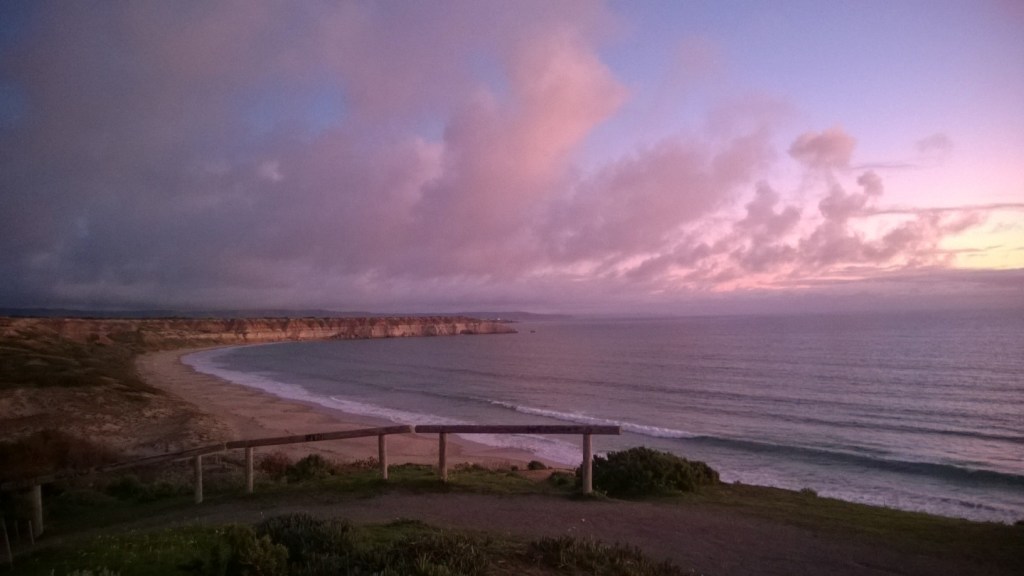
Walking with icy sand underfoot, in strong wind, as waves suck back, and forth again, I notice the seaweed, the shells, the crumbling cliffs, the open space, the expanse of sky.
But from the table high on the bluff, east-southeast I see the round hills of the Mount Lofty Ranges, the lush McLaren Vale vineyards, and full south, past the cliffs, I imagine the southern tip of Cape Jervis.
To the west at dusk, the sun sets over the gulf, most days in splendiferous colour. It’s a very long drop to the sea, and winter cold after heavy rain, with seagulls cawing overhead.
Disembodied in this timeless space above the wild grey ocean, my mind takes flight to the north
through the car park, over the combis, the SUVs, the 741 bus, and children playing on swings.
From the bluff, near home, it seems as though below the lone fisherman stands on the edge of the earth, and for a luminous moment, we merge in a quantum mist.
Atoms in fleeting form at the interstices.

Photo Courtesy: Lizzie Packer

Lizzie Packer is an experienced freelance writer, and an emerging poet. At Adelaide College of Arts, Lizzie established the online creative writing program and led it for over a decade.

.

PLEASE NOTE: ARTICLES CAN ONLY BE REPRODUCED IN OTHER SITES WITH DUE ACKNOWLEDGEMENT TO BORDERLESS JOURNAL

Click here to access the Borderless anthology, Monalisa No Longer Smiles

Click here to access Monalisa No Longer Smiles on Amazon International