On our third morning in the Lowveld, my travel companion and I woke up at 4:00 A.M. for our third game drive in Kruger National Park. We’d signed up for this over a year ago when we first booked ourselves on this group tour. We didn’t know then that it would be raining.
The other ten members of our group had chosen other options. Some were planning to hang out at the lodge, probably anticipating a day of lounging by the pool while kudu and impalas lingered nearby nibbling grass. Another cohort had signed up for a different sightseeing tour, involving waterfalls, with a later starting time. My friend and I were here, however, for the animals.
She and I had first met in Japan. We’d lived in the same town. Our kids had gone to the same schools, and we’d taught at the same universities. When she had moved back to Australia, we’d remained in touch. Both of us loved to travel, and both had dreamed of going on safari in Africa. Neither of us knew of anyone else who shared the same dream, so we vowed to go together. I had imagined that it would be years before I would be able to afford such a trip, but a little over a year ago, she’d come across a great deal. And now here we were, in South Africa.
Half-asleep, we quickly dressed, stuffed our sack-breakfasts into our backpacks, and stumbled out the heavy wooden door into the still dark morning. A light rain was falling. Although signs warned of roaming wild animals, and we’d seen plenty, it seemed safe to walk up to the office building to find our driver. His Toyota safari truck was already parked outside. After a few minutes, he appeared, and we climbed into the back middle seats of the open-sided truck, hoping to stay clear of the rain.
Our driver and guide, a local who drove 20-40 kilometers per hour over the speed limit and doled out one interesting animal fact per sighting, handed us lined ponchos to keep us warm on the forty-minute drive to the park. Then we zoomed off, passing pecan and macadamia groves, on the way to Numbi Gate. People were already waiting at bus stops along the way, probably on their way to work.
As the sky gradually lightened, we could make out the names of the shops along the road: Dragon Flame Car Wash, No Error Driving School, Drama’s Sneaker Wash, God is Able Beauty Salon, and an alarming number of small businesses offering funeral services.
When we finally reached the entrance to the game park, the guide parked and got out to register. Although the parking area had been crowded the previous two days, on this morning, we were the only ones there.
We had seen quite a few animals over the past two days, including elephants, giraffes, zebras, a rare white rhino, and a mama lion and cubs, albeit from a distance. We rattled off our wish list to the guide.
“A hippo out of the water,” my friend said. “And a male lion.”
I had been lucky enough to see both on a previous trip to Rwanda, but I had yet to see a leopard, one of the so-called “big five,” or a cheetah.
“When is the last time you saw a leopard or a cheetah?” I asked.
“I saw a leopard a week ago,” he said. “And a cheetah yesterday.”
He warned us, however, that because of the rain, we might not see anything at all. The animals might be seeking shelter. We understood and accepted that.
A few minutes into our drive, he braked the truck and pointed out a turtle making its way across the road. Understanding that this might be our biggest sighting of the day, I took a video of the creature with my smartphone. Soon after, we spotted some impalas. Although we’d seen so many the two days before that the guide no longer stopped for them, on this morning, we gave them our full attention.
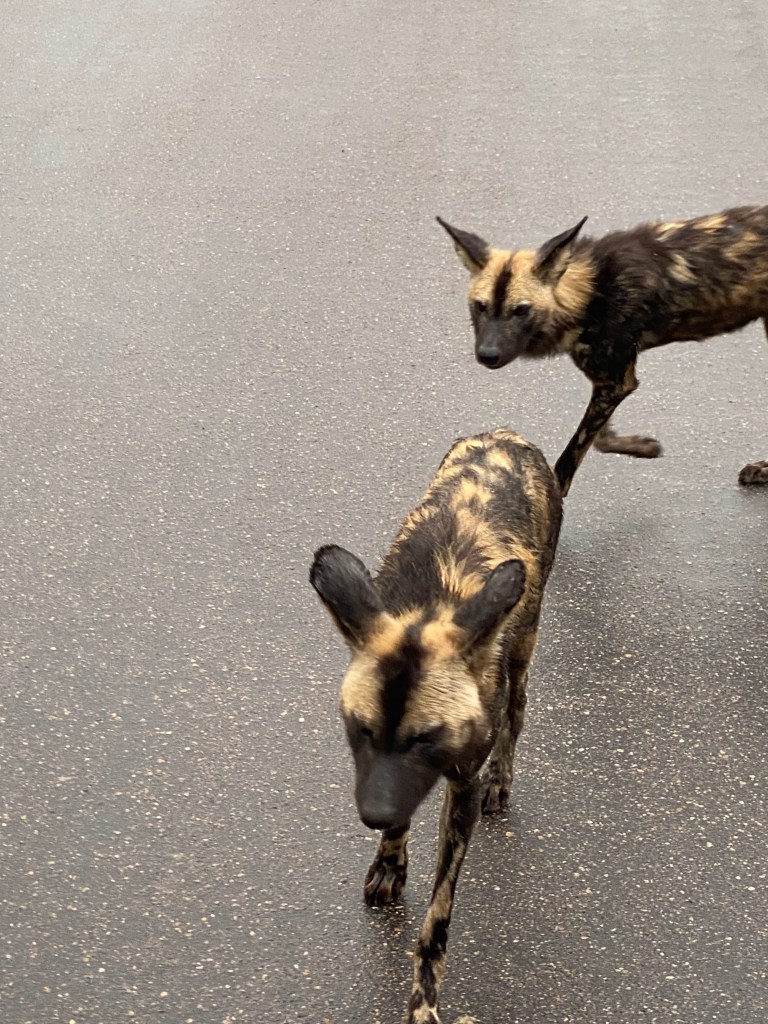
And then we saw something unusual—a pack of African wild dogs alongside and in the middle of the road. I had never seen canines with such colouring. Their fur was brown and black, almost tortoiseshell. These dogs were featured on a signboard at the park entrance indicating the day’s sightings.
“There are only about 150 of these dogs in the park,” our guide told us. He mentioned that they were expert hunters, that they attacked in groups. Since Kruger National Park is vast, with an area of 19,485 square kilometers, much of the terrain being well away from the road, I realized how lucky we were to see these dogs. They trotted along, sniffing at the road, mindless of the truck slowly following them.
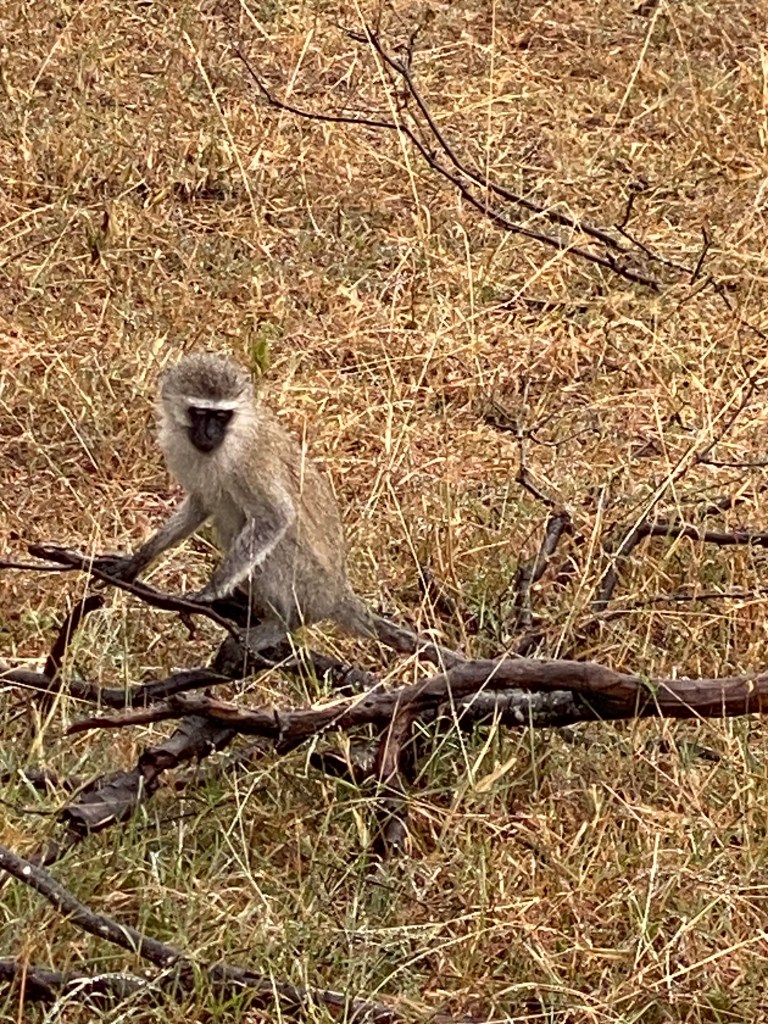
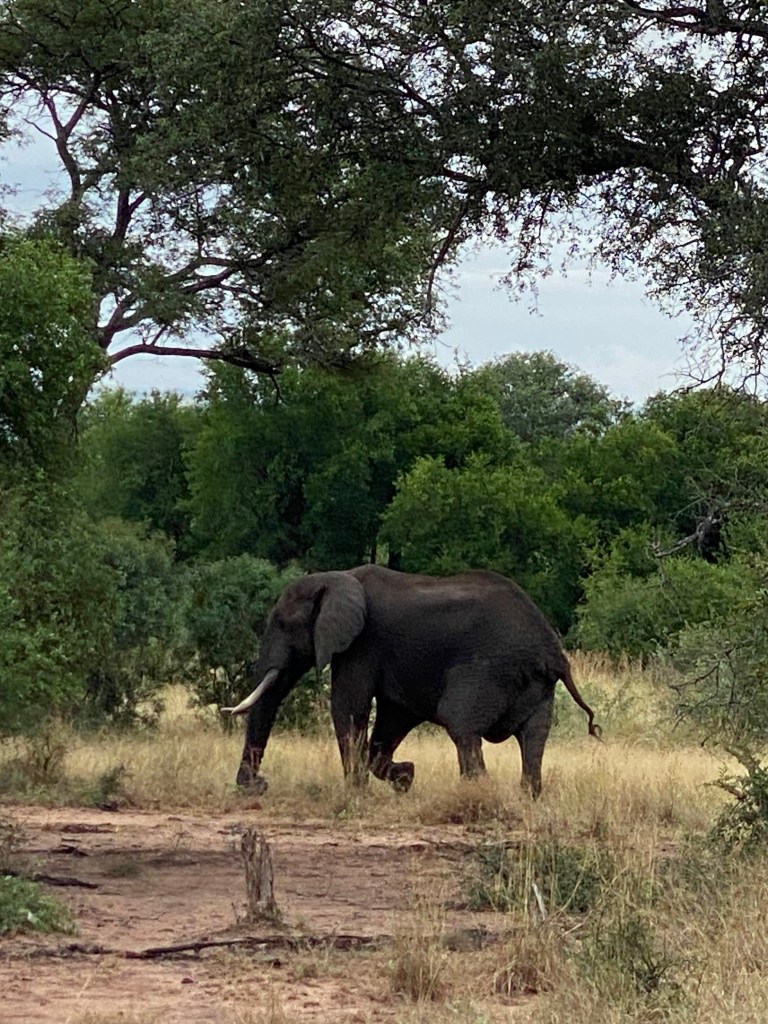
By this time, the rain had let up. Although we did not manage to see any hippos out of the water (they mostly come out at night to eat grass), we did see a herd of wildebeest, some vervet monkeys, an elephant, a water buffalo, baboons, and a Martial eagle perched on a high bare branch. And then our guide got a message on his phone and said, “From now, we’re not stopping for anything. Someone has spotted some cheetahs.”
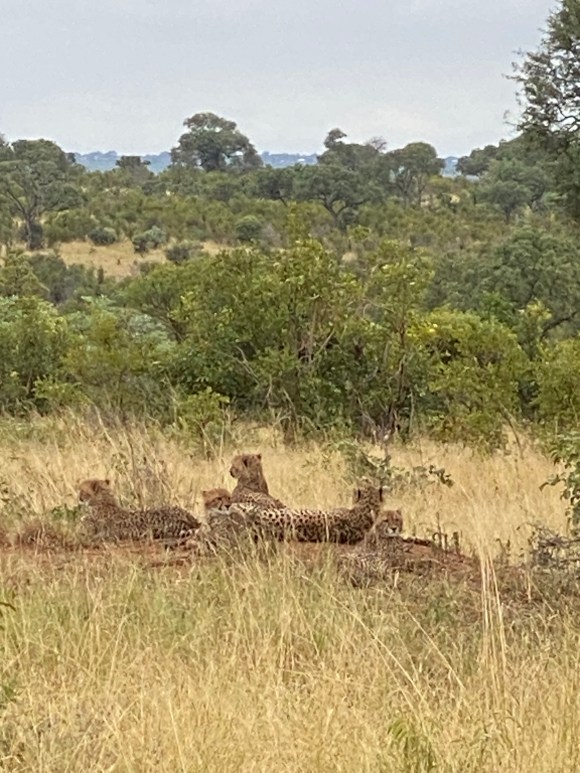
As he sped ahead, we crossed our fingers and readied our cameras. I expected the cheetahs to be far off in the distance, where they wouldn’t be scared off by the sound of cars, as the lions were. Why else would they stay in one place long enough for us to reach them? As it turned out, however, five cheetah cubs were gathered together, sitting still, gazing intently into the bush. They were near the road, only about fifty meters away.
“They’re waiting for their mother,” the guide said. “Maybe she will come back while we are waiting.”
My friend and I took turns admiring them through binoculars. How patiently they watched the impalas nearby. How diligently they groomed themselves. They were gorgeous, leaving us breathless.
We waited awhile, but there were others eager to see them, so our guide suggested it was time to move on. “Are you happy?” he asked us.
“Yes, very,” we both said.
Later, as we returned to the lodge, we thought about how jealous the rest of the group would be when they heard about the cheetahs. The rain started to fall again.
Suzanne Kamatawas born and raised in Grand Haven, Michigan. She now lives in Japan with her husband and two children. Her short stories, essays, articles and book reviews have appeared in over 100 publications. Her work has been nominated for the Pushcart Prize five times, and received a Special Mention in 2006. She is also a two-time winner of the All Nippon Airways/Wingspan Fiction Contest, winner of the Paris Book Festival, and winner of a SCBWI Magazine Merit Award.
PLEASE NOTE: ARTICLES CAN ONLY BE REPRODUCED IN OTHER SITES WITH DUE ACKNOWLEDGEMENT TO BORDERLESS JOURNAL
You are the fragrance of rocks, the lamentation of each flower, the unbearable heat of the moon, the icy coolness of the blazing sun, the language of my letters to myself, the smile with which all despair is borne, the millenniums of waiting without a wink of sleep, the ultimate futility of all rebellion, the exquisite idol made of aspirations, the green yesterdays of deserts, the monsoon in an apparel of leaves and flowers, the illuminated pathway from the clay to the farthest planet, the fantastic time that's half-day and half-night, the eternity of the sea's brief silence, the solace-filled conclusion of incomplete dreams, the dishevelled moment of an awakening with a start, the reluctant star in the sky brightening at dawn, the unspoken sentences at farewell, the restless wind sentenced to solitary confinement, the body of fog seated on a throne, the reflection asleep on the river's abysmal bed, the undiscovered mine of the most precious jewel, the outlines of lunacy engraved in space, and the untold story of lightning. You have, my dearest, always suffered all my inadequacies with a smile. I know I am not destined to bring you back once you've left. All I can do hereafter, till the last day of my life, is to collect the fragments of what you are and try to piece them together.
Sri Radha Canto 19
Come, take half of the remainder of my life, but fill every moment of the half that is mine with your infatuation. Was the bargain unfair? Then leave me with a single moment and take away the rest of my life, but like the sky, fill the whole space above that moment.
No, not like the sky. Come closer and become the cloud over my past, present and future so that, when I touched myself, I would touch the monsoon of your body. Your sighs would breathe the gale spewed by the despair of a distant ocean and, when I smile and touch myself, the gale would cease.
My lifetime, unconcerned with its nearing death, would everyday renew its pilgrimage to the early years of your youth. You would exist as a mass of blue carved by my command, or as the blue of all my known, partly known and unknown desires. Since I always dress in blue, you too must be blue. How can you have any other colour when it would break my heart if you had any other hue other than blue?
Was the bargain unfair? Then come, take away even that single moment. But do not bend down, look straight into my eyes. Meet the impudent traveller who has passed through hell after hell and, at the end of the very last hell, stands under a kadamba tree and awaits your coming.
Sri Radha Canto 25
It was a bad day yesterday. My husband dragged me by the hair and knocked my head against the wall several times, and insisted that I come out with the true account of where I had spent the previous night. It hurt for some time, but when he began an inspection of my body, I could not hold back my laughter.
God, I said to myself, what an imbecile I have for a husband! He is looking for proof of my infidelity in the body and at daytime too!
Sri Radha Canto 61
Reports of your passing away have reached us here.
Don’t count me among your widows or among those who carry your body in procession.
Your body, mercifully, Is far, far away.
In the parting of my hair, the vermilion mark is brighter than ever. Now stop joking, become the bridegroom, and come.
I wear the bride’s heavy silk and gold. My bangles tinkle And snub all sandals.
You no longer are anyone’s father, son, husband. You are the pure naughtiness of our last night together, the voice that teases me, and the touch that breaks the virginity of my loneliness. Just when I would stop crying, you will arrive and tickle my lifeless longing into unrestrained laughter.
When they deposit your body on the pyre, all that you ever meant to them will be consumed by flames. They would return home and, a few days later, would fill your absence with thoughts of you and a thousand other things.
My joy today is uncontrollable. If you had not died for them, you would not have become entirely mine.
Since everyone believes you are dead, my journey to the riverbank will now be without fear. All claims to you are now void, Except mine. They will forget I was ever there Or even know how I held on To your glamour-doll shoulders.
I fold up Under your common hand of desire As you disable my jelly-limbs Filling my spaces Beyond all that exists Or does not exist.
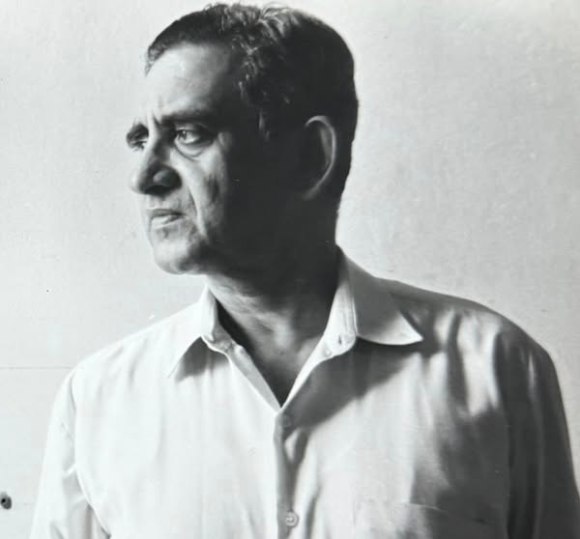
Ramakanta Rath is one of the most renowned modernist poets in the Odia literature. The quest for the mystical, the riddles of life and death, the inner solitude of individual selves, and subservience to material needs and carnal desires are among this philosopher-poet’s favourite themes. His poetry betrays a sense of pessimism along with counter-aesthetics, and he steadfastly refuses to put on the garb of a preacher of goodness and absolute beauty. His poetry is full of melancholy and laments the inevitability of death and the resultant feeling of futility. The poetic expressions found in his creations carry a distinct sign of symbolic annotations to spiritual and metaphysical contents of life. Often transcending beyond ordinary human capabilities, the poet reaches the higher territories of sharp intellectualism.
The contents have varied from a modernist interpretation of ancient Sanskrit literature protagonist Radha in the poem “Sri Radha” to the ever-present and enthralling death-consciousness espoused in “Saptama Ritu” (The Seventh Season). Some of his other major poetry collections include Kete Dinara (Of a Long ,Long Time), Aneka Kothari (Many Rooms), Sandigdha Mrigaya (Suspicious Hunting), Sachitra Andhara (Picturesque Darkness), and Sri Palataka (Mr. Escapist).
Ramakanta Rath was born in Cuttack, Orissa (India) on 13th December 1934 and passed way on 15th March 2025.
He obtained his MA in English Literature from Ravenshaw College, Orissa. He joined the Indian Administrative Service in 1957 but continued his writing career. He retired as Chief Secretary Orissa after holding several important posts in the Central Government such as Secretary to the Government of India. He received the Sahitya Akademi Award in 1977, Saraswati Samman in 1992, Bishuva Samman in 1990 and India’s 3rd highest civilian honour, the Padma Bhushan in 2006. He was the Vice President of the Sahitya Academy of India from 1993 to 1998 and the President of the Sahitya Akademi of India from 1998 to 2003, New Delhi. In February 2009 he was awarded a fellowship by the Central Sahitya Akademi.
These cantos have been excerpted from Ramakanta Rath’s own translation of his long Odiya poem, “Sri Radha”, by his son, Pinaki Rath.
.
PLEASE NOTE: ARTICLES CAN ONLY BE REPRODUCED IN OTHER SITES WITH DUE ACKNOWLEDGEMENT TO BORDERLESS JOURNAL.
The death of Ramakanta Rath, a provocative figure in contemporary Odia poetry, has left a considerable gap in the literary landscape. Born on December 13, 1934, in Cuttack, Ramakanta was a prominent modernist poet in Odia literature. He obtained his Master’s degree in English Literature from Ravenshaw College and joined the Indian Administrative Services (IAS) in 1957.
His work was significantly shaped by the influences of poets such as T.S. Eliot and Ezra Pound, often delving into themes of mysticism, mortality, and human isolation. Ramakanta Rath’s contributions have profoundly impacted modern Odia literature in various ways. He brought modernist themes and styles to Odia poetry, drawing significant inspiration from Western poets such as T.S. Eliot and Ezra Pound. His examination of topics like the search for the mystical, the concepts of life and death, and the experience of inner solitude facilitated a transition in Odia poetry towards more contemporary and universal themes.
Rath’s poetry is marked by symbolic references to spiritual and metaphysical dimensions of existence, which enhanced the intellectual richness of Odia literature. This methodology enabled readers to engage with intricate philosophical concepts through the medium of poetry. Rath’s poetry is noted for its somber tone and symbolic references to the spiritual and metaphysical dimensions of existence.
His significant literary contributions include Kete Dinara (Of Bygone Days, 1962), Aneka Kothari (Many Rooms, 1967), Sandigdha Mrigaya (Suspicious Hunting, 1971), Saptama Ritu (The Seven Seasons, 1977), Sachitra Andhara (Picturesque Darkness, 1982), Sri Radha (1984), and Sri Palataka (Mr Escapist, 1997). Rath was honoured with the Sahitya Akademi Award in 1977, the Saraswati Samman in 1992 for Sri Radha, the Bishuva Samman in 1990, and the Padma Bhushan in 2006. He also received the Sahitya Akademi Fellowship in 2009 before which he was the vice-president of the Akademi.
Rath is particularly celebrated for his lengthy poem, Sri Radha, in which he reimagines Radha, freeing her from theological limitations and depicting her as a remarkable character who embodies deep emotions, love, defiance, and resilience. This poem uniquely intertwines themes of erotic love with existential introspection. This notable work initiated a new trend in Odia poetry that echoed the confessional styles of poets like Sylvia Plath, infusing a personal and introspective quality into Odia literature.
He skillfully combined traditional Odia poetic meters and techniques with contemporary free verse, creating a unique hallmark of his artistic expression. Odia poetry is characterised by its extensive use of classical meters and forms, such as chhanda, chautisa and champu which serve to articulate intricate emotions and themes in a structured and rhythmic manner. By incorporating these traditional elements, Rath infused his poetry with cultural richness and musicality, thereby amplifying its emotional resonance and thematic depth.
Ramakanta Rath’s integration of traditional Odia meter enriched his themes in multiple ways. By using these familiar poetic forms, his work connects more profoundly with readers who recognise them. This cultural connection amplifies the emotional resonance of his themes, making them easier for his audience to relate to. Additionally, traditional Odia meters often hold symbolic significance, which Rath skilfully utilises to deepen his modernist themes.
The combination of symbolic annotations and modernist concepts enhances Rath’s poetry, adding depth and encouraging reflection. By contrasting traditional forms with modernist ideas, his work creates a dynamic tension. This tension amplifies the emotional resonance of his poetry, prompting readers to navigate the clash between traditional values and contemporary realities, which adds layers to his themes. Rath’s incorporation of traditional meters with modern free verse invites readers to think critically about his poetry.
This fusion of styles encourages a deeper exploration of his themes, leading to a more profound appreciation of his work. While the traditional Odia meters offer a cultural base, Rath’s modernist themes keep his poetry relevant on a global scale. This interplay between tradition and modernity enables his work to reach beyond local confines, attracting a wider audience interested in existential and philosophical questions.
Rath’s poetry stands out for its masterful incorporation of irony and wit, elements that add depth and complexity to his body of work. Critics note that his use of irony can often be challenging to interpret, reflecting the nuanced and multifaceted nature of his poetic viewpoint. This unique approach, combined with his thematic explorations, has sparked a resurgence among a new generation of Odia poets, playing a crucial role in the advancement of modern Odia literature.
Ramakanta Rath’s impact has been instrumental in shaping the landscape of contemporary Odia poetry, solidifying his reputation as a monumental figure in the realm of Indian literature today. His passing signifies the conclusion of a significant era in the narrative of Odia literature, leaving behind a legacy that will continue to inspire future writers and poets.
Bhaskar Parichha is a journalist and author of Cyclones in Odisha: Landfall, Wreckage and Resilience, Unbiased, No Strings Attached: Writings on Odisha and Biju Patnaik – A Political Biography. He lives in Bhubaneswar and writes bilingually. Besides writing for newspapers, he also reviews books on various media platforms.
.
PLEASE NOTE: ARTICLES CAN ONLY BE REPRODUCED IN OTHER SITES WITH DUE ACKNOWLEDGEMENT TO BORDERLESS JOURNAL
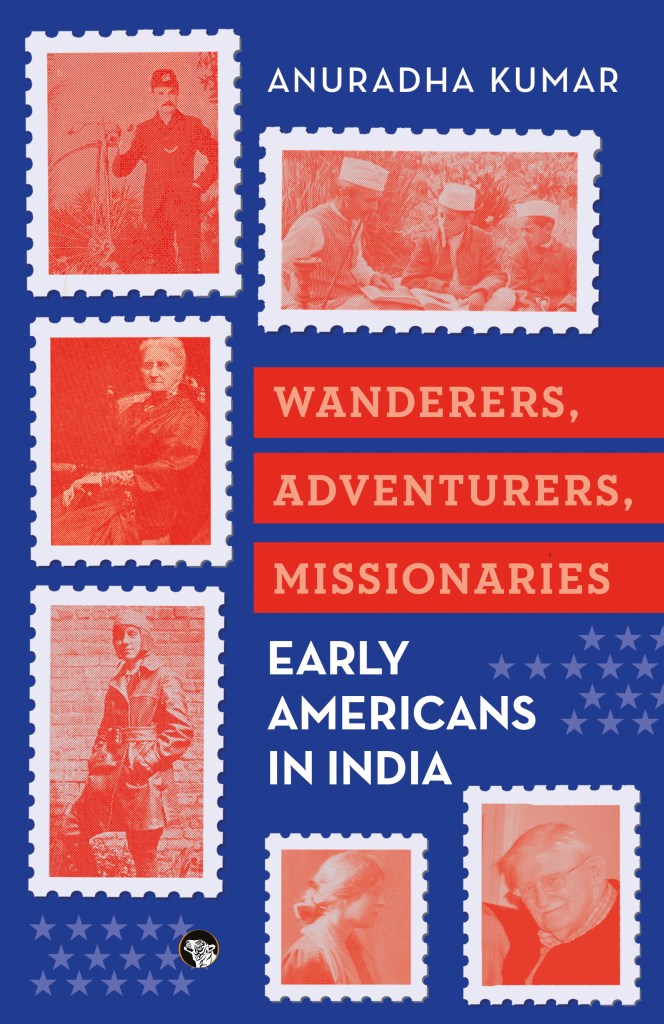
Title:Wanderers, Adventurers, Missionaries: Early Americans in India
Author:Anuradha Kumar
Publisher: Speaking Tiger Books
INTRODUCTION
The Wanderers, Lost and Seeking
The people you will meet here—the ‘first Americans in India’—were indeed all wanderers. They came, not attached to the intentions of a country, or even protected by it, unlike their peers, the Englishmen who made up the East India Company, and who came to trade backed by a royal charter granted by Elizabeth I in the year 1600.
The wanderers, the first of whom came at a time when the United States of America had not come into being—and their actions, thus, were different from what was ordained as state policy. The ‘wanderers’ were not ‘state actors’ in that sense, but they, men, and some women, came to India, on their own, driven by their own spirit of search. They were brought here by a sense of adventure, or by a wild dream—that of finding something that would make their fortune—gold or inspiration quite like gold—or by the need to do something good and enobling.
But they were in some ways quite lost after they came to India.
Stepping Into a Mosaic
To these wanderers who travelled to Asia between 1700-1950s, India came as a mosaic of many impressions, a spread of colour and many experiences. It offered a field of new sensations compelling them to revise received knowledge. They were intrigued, they saw its contradictions, its strangeness, and how things were very different from the homes they had left behind. In the process, life for these wanderers was made afresh.
They came as traders, adventurers, military men, fortune hunters, seekers of knowledge, storytellers, mystics, those seeking a new career, or who came simply to serve.
To them, India—that looked quite different from what it does now—was a land of adventure. A land to make a fortune in, or to find fame.
It was a mysterious, magical place, one that fuelled the imagination, a land that contained the ancient truths of the universe. Yet it was a place caught in the ‘medieval age’, a place they had been sent to, a matter ‘divinely ordained’—as the missionaries and mystics believed—to save souls.
A place one could write about, for it was as strange as fiction; it was a land that offered inspiration and where one could find new, yet old, wisdom. A place to serve and cure and heal. A land where a new world was possible, or an arena to set the world aright.
The wanderers were awed and overwhelmed, and then, scandalized and shocked in equal measure. Some of what they wrote mirrored each other’s experiences. For example, their surprise at the number of servants that were needed. The astonishing beauty of the temples. The majesty of the Taj Mahal. The artistry produced by craftsmen and artisans, an art passed down generations. The riot of unexpected colour—in the bazaars, in the turbans men wore, and in the forests with ‘exotic’ fauna and flora yet to be named and classified by the new science of taxonomy. Balmy days spent on houseboats—‘doongas’—in Kashmir. The spiciness of the food, the liberal doses of pepper in curries. And then, the sad state of its women, especially the child brides, and the young widows, who had to be ‘saved’. The timeless stubbornness of the caste system. The very unchanging nature of things.
Change in America
To look at this period—1700-1950—and talk of Americans is somewhat anomalous. For one thing, for the early part of this time, America was a British colony. By the mid-1770s things would change. The United States of America emerged as a new political entity only in 1776.
On the other hand, from the early 18th century onward, the once dominant Mughal Empire was in decline. Aurangzeb, the last powerful ruler of that dynasty, had worn himself and the empire out with his battles in the Deccan and the upsurge of discontent elsewhere that he failed to contain. Even before the Battle of Plassey in 1757 tilted the balance—beginning in the east—in the East India Company’s favour, India was a patchwork of regional rulers, each brimming over with ambition and jostling for power. To adventurers and fortune-seekers—like the ‘wanderers’—who had no master, who came lacking the conqueror’s zeal, but who had their own sense of adventure, such a state of affairs was ideal to make a fortune, to remake a life.
It is thus of little surprise that the first of the wanderers came as part of the East India Company, to associate themselves with it, as ordinary private traders. America at that time, showed the same precarity that characterized India. It was a continent divided up between competing European powers, and to the west of the continent, the different native American groups too had their territories.1
In the next decades, as America extended westward into new frontiers, set its own foundations as a young democracy, some of the wanderers, citizens of a new nation, also faced their own frontiers, as they sailed eastward onto an unknown land.
Most of these early travellers were those who lived on the northeastern seaboard of the American continent, that is, in the port towns of New England that had historic links with England since the early 17th century. These travellers who came all the way from the faraway West to the East were immigrants themselves, children of people who had moved a generation or two ago, a westward journey from Europe to the ‘New World’. The wanderers to India—the South Asian subcontinent—were thus children of wanderers themselves.
(Extracted from Wanderers, Adventurers, Missionaries: Early Americans in India by Anuradha Kumar. Published by Speaking Tiger Books, 2025)
THE BOOK
In 1833, Frederic Tudor, an American businessman, made history when he shipped 180 pounds of ice harvested from Walden Pond in Boston, to Calcutta—this luxury item being much in demand amongst the elites of British India. Tudor was deservedly christened the ‘Ice King’, and soon built a flourishing trade exporting American ice to India.
Others were drawn to the country by less materialistic goals. Like the ‘medical missionaries’ who were deeply concerned with the ‘women’s condition’ in India. Ida Scudder’s efforts in the 1900s resulted in the setting up of the Christian Medical College in Vellore, which continues to save lives till this day; in 1873, ‘Doctor Miss Sahiba’ Clara Swain set up the first hospital for women and children in Asia, in Bareilly, on land donated by the Nawab of Rampur.
There were also those who came to stay. Twenty-two-year-old Samuel Evans Stokes came to Kotgarh in the Himalayan foothills in 1904, embraced Hinduism and became Satyanand Stokes. He revolutionized apple cultivation in the area, now in Himachal Pradesh, by introducing the ‘Red Delicious’ apples of Missouri; today, his descendants still live and work in the region. Likewise, the Alter family. Martha and David Emmet Alter arrived in Mussoorie in 1917, to spend the summer studying at the Landour Language School; in 1941, Emmet became principal of Woodstock School, just around the hillside. Twenty-five years later, his son Robert occupied the same position. Robert’s son Stephen continues to live in Mussoorie, pursuing a successful writing career; his cousin Tom Alter was a much-loved actor in Indian films until he passed away in 2017.
These are just some of the ‘first Americans in India’ who came here, beginning in the 1700s, with different motives and dreams—as adventurers, traders, reformers, writers and artists. All of them, without exception, were fascinated, astonished, moved and, in the end, profoundly changed by their ‘Indian experience’.
Anuradha Kumar’s skilful and well-researched account of these early visitors makes this an important and engrossing book that informs, surprises and amuses in equal measure.
THE AUTHOR
Anuradha Kumar lived in Mumbai for over a decade, where she worked for the Economic and Political Weekly. She now lives in New Jersey in the US, and writes often for Scroll, The India Forum, The Missouri Review, Catamaran Literary Reader, The Common and Maine Literary Review. Two of her essays received ‘notable’ mention in Best American Essays editions of 2023 and 2024.
PLEASE NOTE: ARTICLES CAN ONLY BE REPRODUCED IN OTHER SITES WITH DUE ACKNOWLEDGEMENT TO BORDERLESS JOURNAL
Lagoon Boss:
We will pull it off.
That’s what he
said as he mopped
his forehead
with a damp cloth.

Pull off what?
I wanted to know.

The Boss replied:
The disguise worn
by the Creature from
the Black Lagoon.

Then he sighed
and seemed rather
sad. I was just glad
he didn’t cry. It was
too soon for that.

He was very upset
and I bet the issue
with the eerie chill
waters of that geographical
feature (the Lagoon
where the Creature
lurks in the light
of the reflected full moon)
had made him sweat
more than the tissues
in his coat pocket
could cope with. Hence the
handkerchief pressed now
to his brow.

My next question was
inevitable: How
was he aware
that the Creature liked
to wear a disguise?

Because one night,
he said solemnly,
I turned over in bed
and saw that the face
of my wife had fallen off
in her sleep: and I knew
immediately that she
was really a monster.
Yes, she was a demon
from the deep, and not
Mrs Boss, as I’d always
believed. I can’t say
I was relieved to discover
this squamous fact. No,
it rather rattled my nerves.

Those were his very words
and I believed him.

The Creature from the Black Lagoon
had clearly decided
it preferred a bedroom
to the slimy bottom of a grubby lake.
There are no snakes
in ordinary houses, no crocodiles,
alligators or toxic frogs,
and even if the style
of the furniture is quite passé
on any given day
it’s still better to dwell in peace
than cavort with leeches
and torment one’s thoughts with
the strange dangers
that exist in a legendary Lagoon.

The Boss shrugged his shoulders
and made a statement
bolder than any uttered so far:

He was duty bound
to pull off the monster’s disguise
in public and shame
the soggy villain to such a degree
that it would agree
to depart the region forevermore.

But I had my doubts
about the wisdom of this
strategy. I said:
What if the Creature doesn’t feel
any shame? What if it
refuses to accept the blame? The
game will be lost.

The Boss glared at me
as if I was trying
to trick him or take the monster’s
side. He snarled
and lifted a gnarled fist and cried:

I am the chief of this town
and my frown
is feared by all and sundry.
If I crease the
skin above my eyes, don’t
be surprised at
the fuss it might create. I
am sure the bravest men
in the vicinity
will help me in my quest,
whether they walk about
bare chested
or prefer to wear a vest.

While waiting for infinity
to finally arrive
we are inclined
to be a little petty. I sighed
and volunteered
to join the band
of volunteers he proposed
to assemble. Not because
I wanted to help
the Boss unmask the beast,
but simply for
the lily-lagoony experience.

But I knew deep down
that love is mysterious
and that the Boss
was secretly pleased he had
married a monster
who liked to tease him
by pretending
to be his devoted wife.

Life is strange:
the Boss is stranger,
he thrives on danger,
and when he plays his nose
like a flute, the tune
he elicits will be sure
to attract her back to him.

His scaly underwater spouse
will leap into his arms
from the gloom of the Lagoon:
houseproud but dripping,
his awfully web-handed wife.
Rhys Hughes has lived in many countries. He graduated as an engineer but currently works as a tutor of mathematics. Since his first book was published in 1995 he has had fifty other books published and his work has been translated into ten languages.
.
PLEASE NOTE: ARTICLES CAN ONLY BE REPRODUCED IN OTHER SITES WITH DUE ACKNOWLEDGEMENT TO BORDERLESS JOURNAL
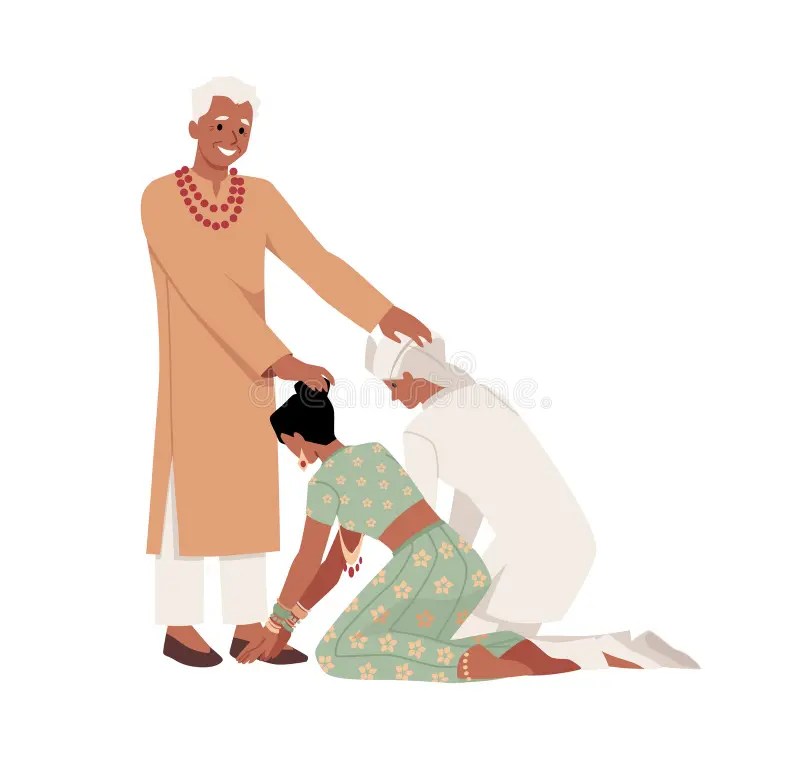
Just like attaining the eligible age to vote or marry, I am convinced that some individuals – awakened souls I mean – acquire the power to bless only after a certain age. Premature greying of hair lends the wrong impression that I have already reached the age to raise my hand to shower blessings like rose petals. Misled by the ageing process showing visible signs, a senior couple came home with their newly-wed son and daughter-in-law, directing them to touch my feet and seek blessings. I withdrew my pedicured feet before they could reach there and patted the padded shoulder of the bridegroom wearing a sherwani instead of placing my hand on his head. It must have appeared odd to the family that I had not shown the willingness to bless the newly-married couple in a proper, traditional manner. My heavy pat was an attempt to boost his morale and brace him up for the challenges ahead or it could be interpreted as a thumping appreciation that he had garlanded the right partner after a long wait since the pandemic.
My life has not been spiritually gifted or divinely blessed, so I do not wish to behave like a saint to transfer goodness or good wishes. Besides, I do not think my soothing words of blessings have any magical power to alter the destiny of an individual. If the guy drinks and drives and rams his car into a truck, my live-long blessings would have no meaning. If the fellow turns into a gambler, my tons of blessings cannot save his wealth.
When it comes to seeking blessings, I am always ready to receive. I have tried to build a reservoir of blessings over the years but these have not proved to be beneficial in terms of growth. Maybe those who blessed me were also spiritually weak or they did not possess the divine aura to bless. Or perhaps my fate was so overloaded with tragedies that most of those blessings had been utilised to neutralise dark episodes and ensure a smooth, steady life without any highs or lows. The stabilising influence of blessings has been the most convincing and comforting argument I can offer myself, to feel assured that blessings do have an impact if sourced well.
Forget the blessings of ordinary mortals, which come with a doubtful efficacy rate like vaccine shots. Focus on the blessings of the divine alone. My double standards are revealed when I ask other people to stop seeking blessings from me but always look eager to receive blessings from people all around me. The opportunity to seek blessings from mendicants when they receive foodgrains or currency is never lost. I go out of the way in my greed to collect blessings. My key objective behind every act of charity is to receive blessings and raise a buffer stock – fit to use during troubled times.
In the matter of seeking blessings from the Lord, I forget to make a list of what I want. Usually, it is long like a grocery list. I know the others praying are also seeking similar blessings from the Lord. Sometimes I feel I should rein in my greed to receive blessings and request the Lord to distribute my share among the other seekers. But this noble thought perishes soon. The fear of a dull, aching life without divine blessings returns to haunt me. The arrogance of having to survive without his blessings can only invite curse and misfortune.
There have been several instances where young people have come forward to seek my blessings. I give them a warm hug instead without explaining why I am incapable of giving blessings. A fanboy reader in my neighbourhood made the mistake of considering me a wise, well-read scholar and hoped to get blessed to write better – simply by touching my feet. I stepped back and asked him to write more and face rejections to improve his creative skills instead of pinning high hopes on a direct benefit transfer through his act of submissiveness.
Even if I proclaim myself as a sinner, those who associate me with goodness will never buy my story. I cannot tell them I do not think I have reached the fag-end of my life when all I can do is sit by the riverside and distribute blessings to the world. I think my life itself is a blessing and I must stay afloat and blessed forever to live it to the fullest.
A situation emerged when I was enraged and felt I must curse the chap with a bleak future as he tested the limits of my patience by challenging my faith in God. I said in anger that he would suffer horribly for offending me though I had been kind and helpful to him. I was confident that my curse would wreak havoc but within a few years he really prospered. Though we did not meet after that incident and I do not intend to bump into him again, I am sure he must be eager to tell me that my curse was nothing more than a fake mumbling of an overheated brain. It made me conclude that even though I had not tested my power to bless, the power to curse had been tested and it misfired. Sometimes I feel like writing a mythological tale based on curses but then I am reminded whether those curses would lack potency and weaken the plot instead.
Incurring the wrath of saints is never a good idea – a lesson acquired after a memorable encounter with a group of sadhus who came close to getting offended by my tendency to bargain with them. As their kohl-lined eyes grew wider to scare me and the tongue began lashing out invectives to scold me for monetary attachment in this transient world, I loosened my purse strings to bring them back from the verge of spewing fire and converted their harsh words into the nectar of admiration.
I have not cursed too many people, not even those who ditched me, ever since I realised my zero potential to curse effectively. Many people have been offended or snubbed without a valid reason and they have cursed me behind my back – quite effectively in my case at least. Whenever I accost them, they are so cheerful that I forget their tendency to curse.
Seeking blessings is reduced to a mere formality prevalent all around. There are many opportunists who fake it and come forward to seek blessings just to make you feel superior. The younger relatives who visit me to seek blessings are politely asked to identify the actual elders in the family and bow down before them. A septuagenarian wields more power to bless vis-à-vis a person who is flirting with middle-age. I prefer to seek blessings from elders even today and permanently occupy the slot of a recipient instead of becoming a donor of blessings.
Having realised that I am not the one empowered to bless or curse a person, I avoid getting into this trap now. No divine light emerges from my palm so I keep my hands clasped in prayer instead of raising it too often to bless like a godman popping up through the panoramic sunroof of his luxurious SUV.
Devraj Singh Kalsiworks as a senior copywriter in Kolkata. His short stories and essays have been published in Deccan Herald, Tehelka, Kitaab, Earthen Lamp Journal, Assam Tribune, and The Statesman. Pal Motors is his first novel.
PLEASE NOTE: ARTICLES CAN ONLY BE REPRODUCED IN OTHER SITES WITH DUE ACKNOWLEDGEMENT TO BORDERLESS JOURNAL
Story by Bitan Chakraborty, translated from Bengali by Kiriti Sengupta
Bitan Chakraborty. Photo Courtesy: Kiriti Sengupta
The black smoke rises in a straight line. It will fade into the air as it reaches a certain altitude in the sky. The wind feels still today, causing a grey layer to form. Not long ago, Lali experienced recurrent bouts of excruciating pain, but now it refuses to subside. She tries to relax, her spine loosely resting against the wall of the leather factory. Lali shrinks again as her little baby stretches its limbs inside her womb. In the distance, her husband, Fatik, is tending to their domestic belongings in the dilapidated house. He is vigilant, working hard to safeguard their utility items. He won’t let anyone take away their hard-earned household goods. Fatik does not know what will be put into the fire. A few government-appointed people collect the crushed bamboo walls from the ghetto and add them to the flames. The more they burn, the more smoke rises. At a safe distance, a curious crowd observes the unfolding events.
Fatik packs goods in small quantities and takes them to Lali, who is resting under the shade. He quips, “I could have packed up sooner if I had someone to help. You’re in pain, huh? Hold on for a bit; we will board the train shortly.”
“Hey scoundrels, that’s mine. Keep it there, I’m telling you! Otherwise, I’ll put y’all in that fire.” Fatik rushes to their ruined house. It’s not a house anymore! An empty stretch reveals the impressions of bricks laid down for years. Fatik’s shanty looks the same — a square piece of land with torn plastic sheets and scattered, fragmented earthen roof tiles.
Lali continues to endure pain. Fatik appears exhausted; he is busy organising goods. There’s no point in disturbing him further with another complaint of discomfort. Lali remains silent and attempts to sketch the new place they will inhabit for the next few months or possibly years. No one will be a stranger there; they cannot afford the luxury of exploring exotic living. Fatik once told her, “Shashthida has affirmed that we can come back here once the air cools down.”
It’s easy to earn a living in the city, but finding a job is difficult in the countryside, where opportunities are scarce. Once the flyover is built, Fatik plans to return and set up a small eatery for the evenings. In a tone filled with love and care, Fatik tells Lali, “No one can resist the mutton curry you cook. All visitors will become regular customers at our shop.” Lali adds a touch of sass to her response, “I won’t. I’d rather teach you the recipe. You can then cook and feed them.” Gazing at the ceiling with wide eyes, Fatik remains lying in bed.
Lali does not believe in Fatik’s words that they will be able to come back here again. A few minutes ago, Hema came to see her, “My bad luck; I won’t get a chance to see your child. But you never know if I will meet you again somewhere else.”
“Won’t you come back here?” Lali asks.
“They will not allow us here again,” Hema replies. “The officials informed us that they were planning to build a marketplace below the flyover after its construction.”
Mum’s the word when Lali relays the news to Fatik. He murmurs, “But then Shashthida[1] has assured…”
“You can pursue a small shop in the proposed market,” Lali advises.
“I can’t say; they might ask for a cash lump sum as advance payment.” Fatik appears worried.
The pain shoots once again. Lali flings her legs aimlessly. The dusty floor reflects her movements. She remains silent. On the other side, Fatik gets into trouble with Dulu and his family. Dulu’s mother seems to have taken Lali’s rice pot. Lali raises her voice, “The pot is mine!” Unfortunately, her words go unheard.
2
Fatik knocks Lali with his bag, “Come on, the Hasnabad local is at platform eight. Walk along the straight direction.”
Lali has heard of the Sealdah railway station, but she has never been there. It is a large station with several platforms, numerous trains, and huge crowds. Passengers jostle against one another. With great caution, Fatik quickly walks across the platform to board the train and get into a compartment by any means necessary. There are likely a few travelling ticket examiners around, but during this time, they usually don’t enter the coach. Lali is unable to keep pace with Fatik and remains far behind him, but she compensates for the distance by tightly gripping one side of the gamcha[2] draped around his neck. Fatik collides with the commuters approaching from the other end, and a few passengers express their annoyance with a word or two of irritation. Fatik does not respond at all. Lali pulls her saree to cover her breast. She has no control over the saree girded around her head, which has now slipped onto her back.
The train will start in ten minutes. All coaches are full; not a single seat is vacant. Fatik quickly decides on a favourable compartment and boards the train with his wife. Lali cannot stand any longer, so she sits on the floor beside the door, her hands resting on her belly. Fatik arranges their bags around Lali. An elderly gentleman asks, “Where will you get off?”
“Barasat,” Fatik answers.
“What the hell are you doing here? Get inside the coach. Have you lost your mind or what? How can a sensible man board the train in such conditions?”
Fatik turns to his wife and whispers, “There aren’t any vacant seats. Do you still want to go inside?”
Lali refuses to move. The spasm has taken over her body and mind. She cannot stand up. She wants to stretch her legs to give her baby more space. However, the situation does not allow for that privilege. With each passing minute, more passengers crowd the coach, and the draft is cut off. In a dry voice, Lali calls out to her husband, “I cannot breathe. I need some air.”
“Wait a moment. The crowd should thin out after we pass two stations,” Fatik says.
As soon as the train departs, more than a handful of late passengers hurriedly board the coach. They will travel a long distance and want to get inside. The bags and goods piled around Lali create an obstacle to their movement. One of them raises his voice, “Is this a place to sit?” Another man from the crowd yells at Lali, “Stand up, I said!” Someone empathetically informs, “Try to understand; she is carrying.”
“Oh! This is horrible. Hey brother, you aren’t pregnant, are you? Better you stand up. More passengers will enter the coach at Bidhan Nagar and Dum Dum. They will smash you to death.”
Fatik gets anxious and follows the instructions. Lali shrinks in fear, feeling breathless. In her womb, she carries their only child, who waits to see the world — as if the baby complains, “I cannot stay in this small dark space anymore, Ma!” The passengers become frightened as Lali lets out a low moan of pain.
“Are you okay?”
Fatik bends toward Lali as much as possible to ask, “I’m sure it’s terrible to bear any longer.”
“No air; it’s suffocating!” Lali sounds fragile.
“It won’t be long; I’ll take you to the hospital as soon as we reach there. Shashthida has shared the address.”
Lali’s facial muscles contort in extreme agony. Fatik isn’t sure whether she has heard him. Intoxicated, Fatik had seen her suffer from pain before; during those times, he did not feel her distress. Lali wept profusely. Fatik never intended to hurt her but lost control as he downed liquor. The very next day, Fatik committed to his wife, saying, “I won’t trouble you anymore. All I want is a son!”
With a hint of dejection in her eyes, Lali poked, “Right! So, he can run a liquor shop you longed for.”
“Shut up! I’ll make him a real gentleman,” Fatik readily addressed her concern.
3
Several travellers board the train as soon as it stops at the next stations. Lali, who somehow remains seated on the floor, gets pressed painfully against the legs. She feels worse than ever. Fatik seems restless and cautiously peeks out from behind the crowd to read the station names. At times, he turns to look at the goods around him. A few passengers become irritated, saying, “What’s wrong with you? Why don’t you stand still?”
“Be careful, dada! Take care of your pocket. You never know…Dasbabu lost three hundred bucks yesterday only.” Someone from the crowd airs the words of caution.
Fatik understands the meaning of such lines. He does not utter a word, for he knows if he begins an argument, they will forcibly push him out of the coach at the next station and beat him like hell. He requests the passenger beside him, “Dada, please let me know as we reach Barasat.”
“We are currently at Cantonment. Please be patient; it will take another thirty minutes or so to reach Barasat.”
4
Lali wants to scream. She feels thirsty. Amid the numerous legs visible to her, she cannot identify Fatik’s. Even when Lali looks up to see the faces, she is unable to locate her husband. The child in her womb revolts; it will not tolerate the torture to which the mother is subjected. The baby twirls, rapidly changing positions. Lali realises that her child is responding to the world — specifically, the passengers in the coach. The tiny tot wishes to emerge from confinement to greet them. Lali is afraid — will they treat the child as lovingly as their family?
Fatik bends down and says, “We will get off at the next station. Several others will disembark. I’ll first grab the bags, and then I’ll help you off the coach. Be careful.”
Lali gathers her courage and prepares for the exit. She moves her palm over her belly, saying, “A little more waiting, Baba[3]!”
The train halts at Barasat. Passengers disembark from the train like a vigorous flow of water. Fatik feels puzzled as the bags scatter. A few passengers are still getting off. Meanwhile, many commuters waiting to board the train begin to enter. Ignoring the chaos, Lali tries to stand but fails. Fatik quickly gathers their bags and helps them to ensure a swift exit. The passengers ready to disembark push him out of the coach. Fatik cannot withstand the force and is shoved away from the train. The coach has room for more passengers and fills up quickly. Lali crouches toward the gate and cries, “Help! I’ll get off; stop the train.” People leaning out of the coach warn her.
No one can hear Lali. Fatik rushes to the coach to grip the gate’s rod, but he fails every time he stretches his hand to grasp it. A guy leaning out of the coach holds it in such a way that Fatik cannot access the rod. He refuses to give up and keeps running alongside the train. The thick crowd challenges his swift movement. Amid several passengers inside the coach, Fatik sees his wife’s hands and the two pairs of bangles she wears. He reaches the far end of the platform.
Fatik breathes rapidly. He is exhausted and sweating profusely. He shivers while keeping his head lowered. A drop of sweat rolls down his forehead and falls onto the tip of his nose. Fatik can see the passengers hanging out of the coach, trying their best to get inside. Amid their relentless efforts, Lali’s hands disappear.
[1] Dada/Da: In Bengali, the elder/older brother is calledDada(Dain short).Dada or Daissuffixed to the first or last name when addressing an acquaintance, relative, or stranger during a conversation. Bengalis also suffix Babu to a name (first or last) to show respect.
[2] A traditional, thin cotton cloth (generally, a handloom product) of varyinglengths used in Bengali households to dry the body after bathing or wiping sweat. It is also used in several Hindu rituals.
[3] Baba is father. But parents often use this word affectionately to address their sons.
(Translated from the original Bengali by Kiriti Sengupta. First published in the EKL Review in December 2021)
Bitan Chakraborty is essentially a storyteller. He has authored seven books of fiction and prose, translated two collections of poems, and edited a volume of essays. Bitan has received much critical acclaim in India and overseas. Bougainvillea and Other Stories, The Mark, Redundant and The Blight and Seven Short Stories are four full-length collections of his fiction that have been translated into English. He is considered one of the flag-bearers of Indian poetry in English, being the founder of Hawakal Publishers. When Bitan isn’t writing or editing, he is photographing around Rishikesh, Varanasi, Santiniketan, among other places. He has successfully participated in the 3-day-long Master Class on Photography led by the legendary Raghu Rai. Chakraborty lives in New Delhi with Jahan, a pet Beagle. More at www.bitanchakraborty.com.
Kiriti Sengupta has had his poetry featured in various publications, including The Common, The Florida Review Online, Headway Quarterly, The Lake, Amethyst Review, Dreich, Otoliths, Outlook, and Madras Courier. He has authored fourteen books of poetry and prose, published two translation volumes, and edited nine anthologies. Sengupta serves as the chief editor of Ethos Literary Journal and leads the English division at Hawakal Publishers Private Limited, one of the top independent presses established by Bitan Chakraborty. He resides in New Delhi. Further information is available at www.kiritisengupta.com.
.
PLEASE NOTE: ARTICLES CAN ONLY BE REPRODUCED IN OTHER SITES WITH DUE ACKNOWLEDGEMENT TO BORDERLESS JOURNAL
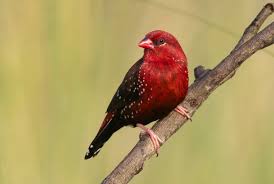
If I get to live forever — then forever, I’ll be all alone — If I return to the paths of the world, I’ll see green grass Sprouting — will see yellow grass scattering — the sky Whitening in the morning — like a tattered munia bird, Breast blood - stained in the evening — again and again I’ll see stars And view a strange woman untying braided hair and leaving Alas, her face devoid of traces of the setting sun’s soft glow
If I get to live forever — forever, I’ll walk the ways of the world All alone. If I ever return to the world’s pathways, I’ll see Trams, buses, dust. Innumerable slums and, broken bowls too — Dark and dirty lanes; fights, people swearing; squinted eyes Rotten prawns; I’ll see a whole lot of things interminably And yet all this time I won’t get to meet you again — for eternity!
If I have eternal Life ( Anante Jebon Jodi)
Given the boon of eternity, I would walk the ways of the world eternally. All, all alone — what if I would see lush green grass in full bloom then? And what if I beheld the yellowing grass withering away — And view The sky full of wan white clouds at dawn? Like a tattered munia bird Blood reddened breast in the evening — I would see the stars repeatedly; I would see an unknown woman’s hair drifting away from a loosened bun; A woman who would leave — with a face bereft of the evening sun’s glow.
Munia birds. From Public Domain
Jibanananda Das (1899-1954) was a Bengali writer, who now is named as one of the greats. In his lifetime, he wrote beautiful poetry, novels, essays and more. He believed: “Poetry and life are two different outpouring of the same thing; life as we usually conceive it contains what we normally accept as reality, but the spectacle of this incoherent and disorderly life can satisfy neither the poet’s talent nor the reader’s imagination … poetry does not contain a complete reconstruction of what we call reality; we have entered a new world.”
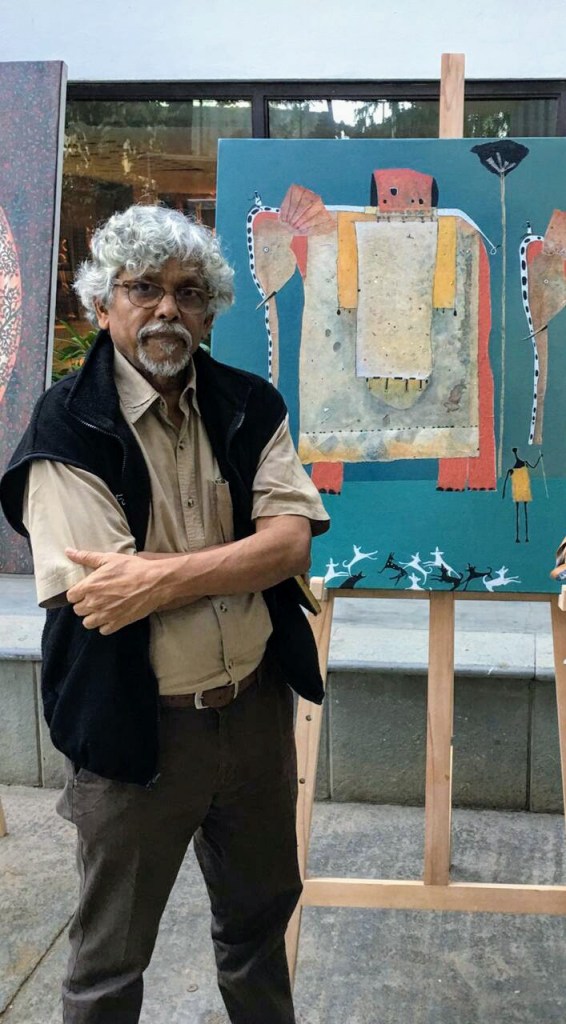
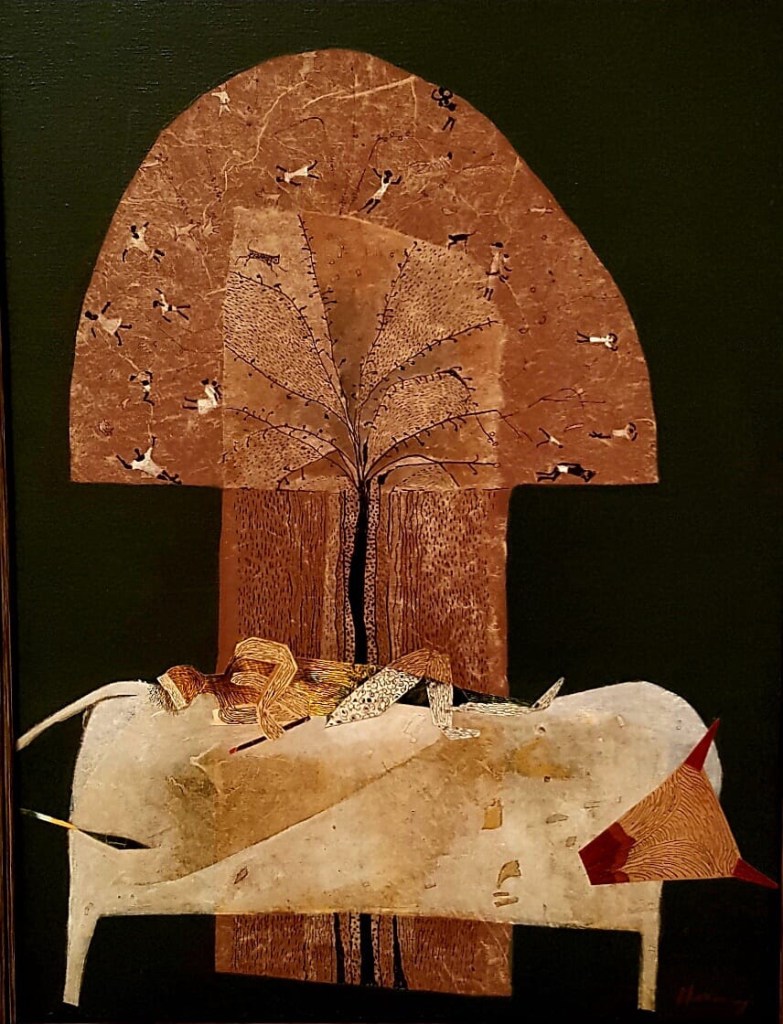
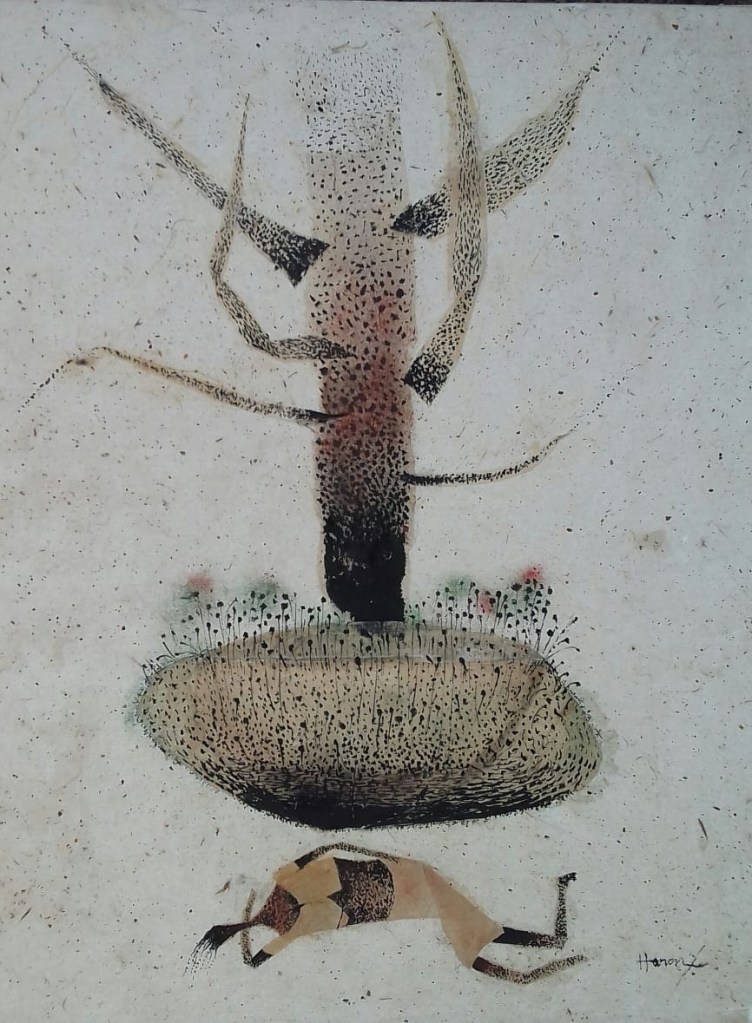
For 50 years now Ratnottama Sengupta has seen Haren Thakur adroitly create art from the humdrum of tribal life. And his stylised abstract of the dark-toned humans still makes her sit up and take note.
Haren Thakur with his painting. Photo provided by Ratnottama Sengupta
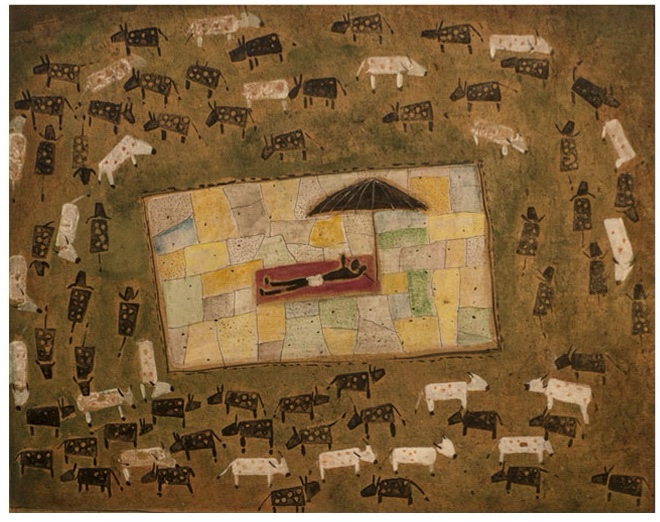
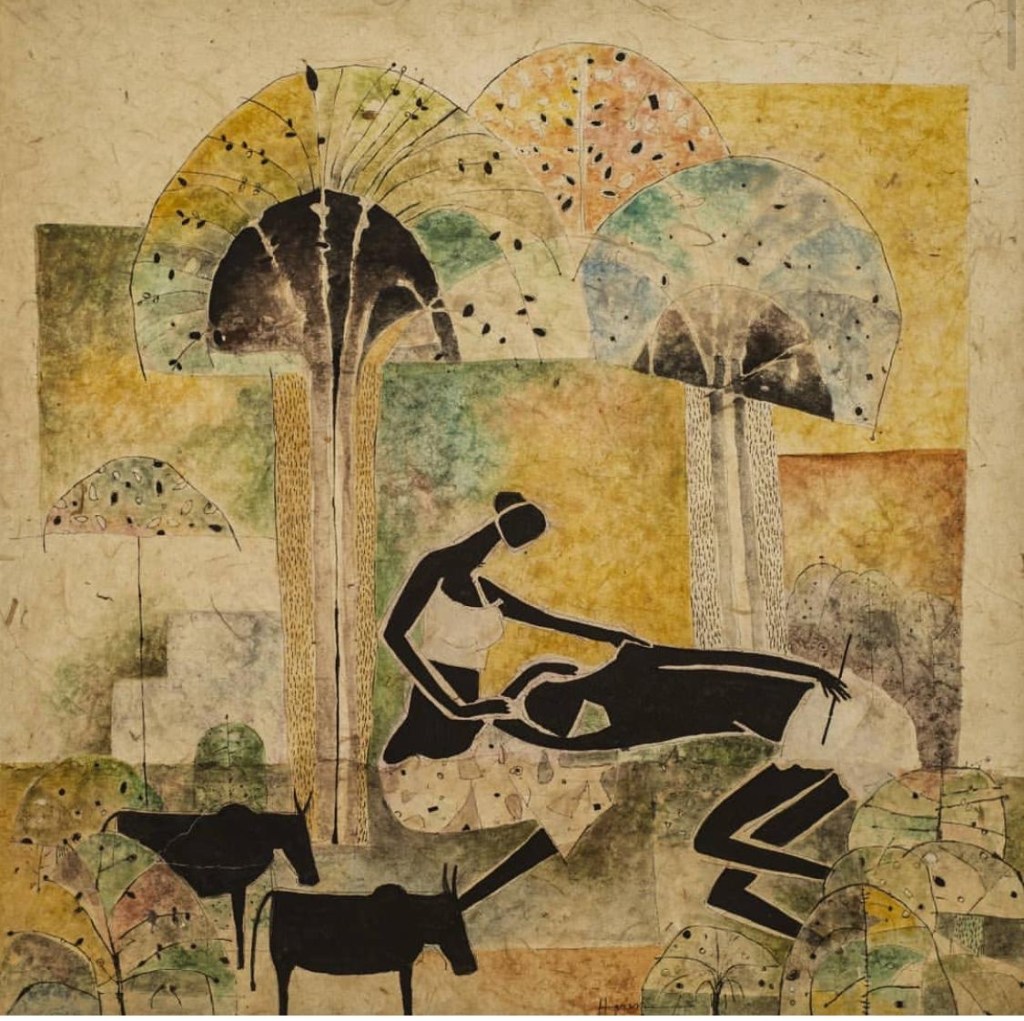
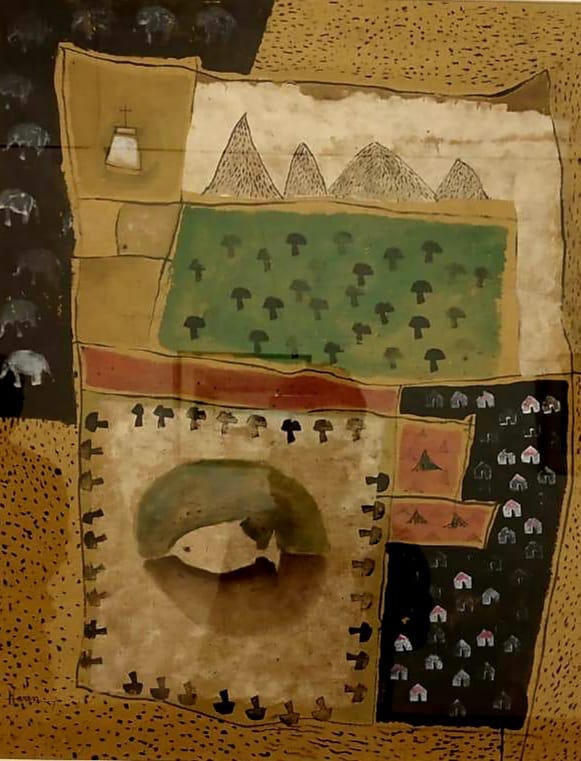
A dark, stick-like outline encompasses a human of the male species. A triangle, an oblong, a rectangle. A white patch in the midst of a sepia-green landscape. A drummer. A mother with a child holding aloft a balloon. Two women bathing in a primitive pond. A quizzical duck. A wriggling worm. Trees hills fish pigs cows fox… And, yes! A train zigzagging its way through a vast expanse of meadows. As we view the watercolours of Haren Thakur from Ranchi, you might think of the rice-white art of the Warli tribals characterised by geometric shapes that depict the rituals of everyday life. I might be inclined to revisit the painted layers on the 100,000-year laterite at the prehistoric rock shelters of Bhimbetka in the foothills of the Vindhyas in Madhya Pradesh. Another viewer might think of the ancient Sauras and the adornment of their walls in their adobe huts in Odisha. The artist himself might have recollections of the animated Santhal pats he saw being created during his student years in Tagore’s Santiniketan. However, none of Haren’s figures are simplistic. They are all stylised. And so adroitly that you are bound to sit up and take note of them no matter how many times you have come across the theme.
Art by Haren Thakur. Photos provided by Ratnottama Sengupta
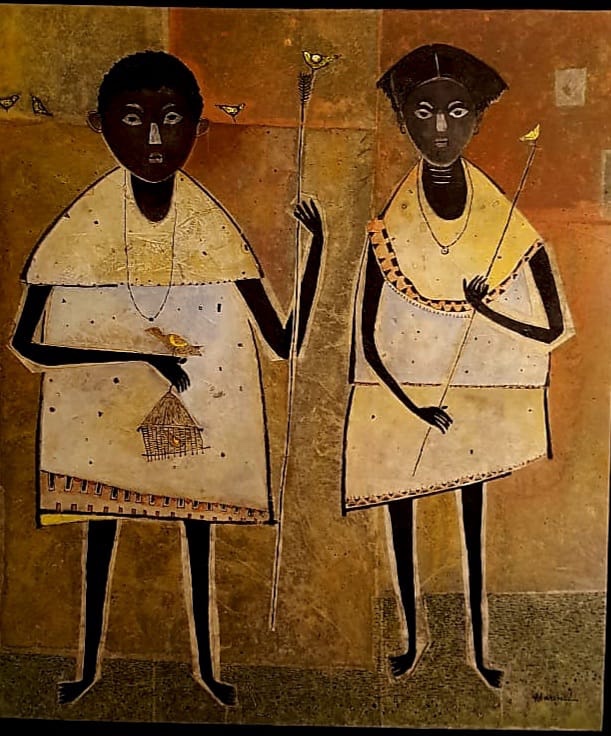
Form and content come seamlessly together in the paintings that Haren Thakur will exhibit in Delhi’s Habitat Centre from April 15. The artist who mastered Art at Santiniketan — home to Santhals, the native dwellers of Bengal and Odisha — then made his living in Jharkhand, which is home to 32 tribes… Indeed, from his very beginning, the beauty in the dark skin-tone of the men and women going about their chores was the most natural rhythm of life in the bazaars and streets of Bankura Bishnupur, where his family hailed from, or in Purulia, where his father made his home.
Beyond doubt, Rabindranath’s deep affection for the Santhals and the Bauls reinforced this love. Much like Gurudev, Haren finds poetry in their tilling of the earth. In their mono-toned songs and the repetitive steps of their dance. In the fulfilment they find in the primeval life and archetypal love. And when, following in the footsteps of the Universal Poet, Haren finds beauty in a grain of sand, the everyday life ceases to be an essay in deprivation and rises to the level of art.
*
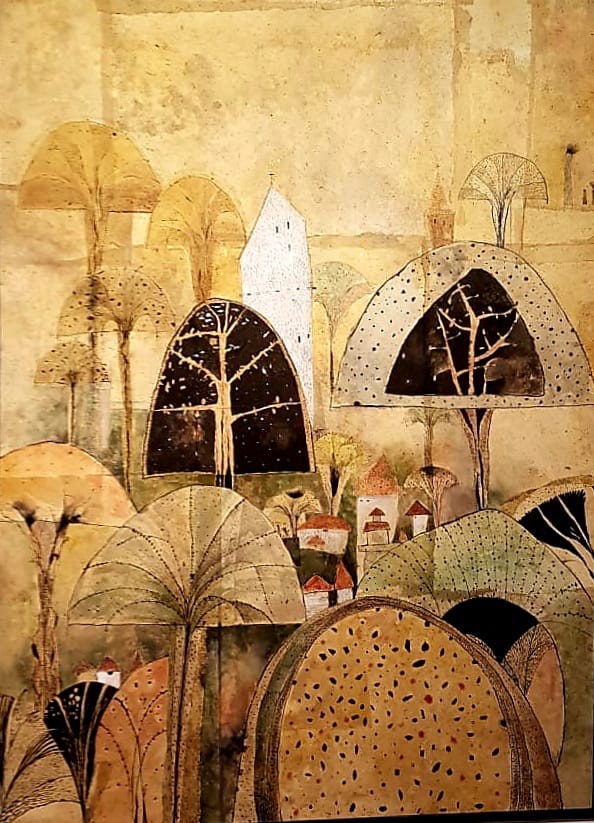
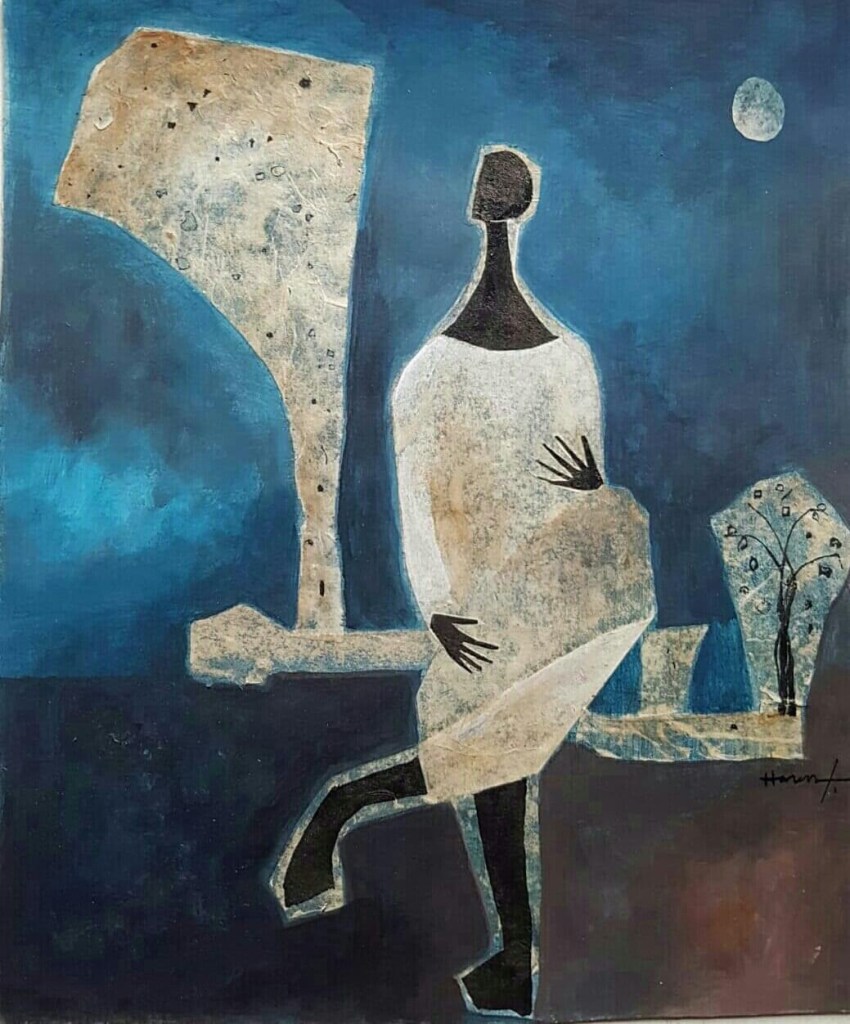
And his colour palette? That too came off the walls of his hostel in Santiniketan, from the frescoes and murals by Binode Behari Mukherjee. From the brick-toned ‘canvas’ that is the prehistoric rock painting of Bhimbetka. The pigment on Haren’s brush and tubes is never loud then, never grating. It is always muted, always mellow. And the impact is heightened by Haren’s utilisation of rice paper, and Chinese ink, on watercolour.
The Nepali rice paper became his signature in 1974. Prior to that he would work the rice paper in the tempera process that was ‘Master Moshai’ Nandalal Bose’s gharana, school – or Indian shaili, style. But in that process of painting layer by layer, the rice paper would lose its original character and serve merely as a background surface.
Then, in his fourth year, for a scholarship test of the Visva Bharati University, Haren experimented by soaking the rice paper in water. It became so pliant that he could spread it out like a piece of cloth. “And its texture!” It won him the scholarship — and immense appreciation from his teachers, Dinkar Kaushik and Somnath Hore. “They said, ‘Go ahead and explore this medium and this process further. It adds a dimension that has immense possibility.”
Art by Haren Thakur. Photos provided by Ratnottama Sengupta
Fifty years have gone by since, but Haren has not given it up. Sometimes, when painting on canvas, he does apply acrylic directly on its surface. But at times, even here, he pastes rice paper on the canvas, primes it with watercolour, then inks in the forms. However he adds, “when I paint on rice paper mounted on board, I do not – cannot – use acrylic. It simply doesn’t have the capacity to be absorbed by the rice paper the way watercolour gets absorbed.” So, in such cases Haren uses transparent watercolour.
Clearly the chemistry between rice paper and watercolour is amazing. Unique.
*
Circling back to the content: Haren’s understated pitch was reinforced by the Zen worldview of a teacher like Somnath Hore. The master minimalist’s use of the white, barely scratched by the red of a wound, spoke volumes — and it made Haren introspect. Once, while exhibiting the Wound series, Somnath Da had said, “I discovered such depth of emotion in the reticence of tones!” This soliloquy got deeply etched in Haren’s unconscious. And eventually it came to express itself in the rusty red of the iron oxide rich Birbhum soil; the roasted brown of Purulia’s rocky earth; the weathered green of the Bauls; the soothing blue of the open sky high above the woolly white of floating clouds.
Art by Haren Thakur. Photos provided by Ratnottama Sengupta
Flattened figures. Non-realistic features. Do you see a hint of Husain – or perhaps Paul Klee – in the abstraction of the human world? I notice a reflection of the figures encountered on Egyptian papyrus. Or the African world. Haren, on his part, reiterates his original inclination: the attraction towards the lack of artifice in Adivasi life. How else would the tribals go about their daily humdrum with a baby knotted to their back? Or float in an open pool under the sun-kissed sky? To the city-bred mind, this would be unthinkable — until Haren captions it ‘Nature’s Bathtub’!
But, notwithstanding my references, the art traditions of the indigenous people over the world have never influenced Haren. “Their art tradition is so rooted in their environment – be it of Jharkhand or of any other.” Even their pigments, brush, and surface are integral to their life. But he certainly derives inspiration from the lifestyle of the original inhabitants, he affirms.
“I have always admired their direct application, the spontaneity of their form,” Haren further explains. “But I am influenced rather by the uncomplicated lives they lead. Since I was in Santiniketan I have admired the way they connect with nature in everything they do. Their intimacy with animals is incredible – they seem to be in dialogue with the animals they domesticate! This became a part of my visual world, especially when I came to live in Ranchi. The same reality imbues the lives of the natives – Oraon, Munda, Ho, Sabar, Bedia, Lohar… They rest under the tree unconcerned about how the ‘civilised’ world looks at them. They speak with the hills, with clouds in the sky, with cattle and kids, trees and waters, rivers and streams!”
Art by Haren Thakur. Photos provided by Ratnottama Sengupta
This they do with no inhibition. Because this routine is a reality they have inherited from their ancients. “That is why I believe there is nothing more ‘Contemporary’ than this,” Haren asserts. This innate natural life, and the Santiniketan grooming, combined to forge his vocabulary, his visual language.
So, in the exhibits, you encounter an abundance of water bodies. Pools and ponds. Rivers and waterfalls. Lotus and lily. Big fish. Many small fish in its tummy. Ducks and kingfishers. Hyacinth and hayfield. All this is a natural part of the countryside that has made Haren theirs.
Interestingly there is also this play with size. In one of the frames an elephant walks down the road – and at every footfall he is greeted by a number of… ants?! Look closely and you will decipher that they are dogs!
Haren is giving you a worm’s eye view. And, in addition to the proportion, he is picturing the Hindi proverb Haathi chaley bazar, kutta bhaukey hazaar/ when an elephant walks to the market, a thousand dogs will bark! Political comment? You said it!
Stay tuned to the song of the Adivasi earth, Haren.
.
Ratnottama Sengupta, formerly Arts Editor of The Times of India, teaches mass communication and film appreciation, curates film festivals and art exhibitions, and translates and writes books. She has been a member of CBFC, served on the National Film Awards jury and has herself won a National Award.
.
PLEASE NOTE: ARTICLES CAN ONLY BE REPRODUCED IN OTHER SITES WITH DUE ACKNOWLEDGEMENT TO BORDERLESS JOURNAL
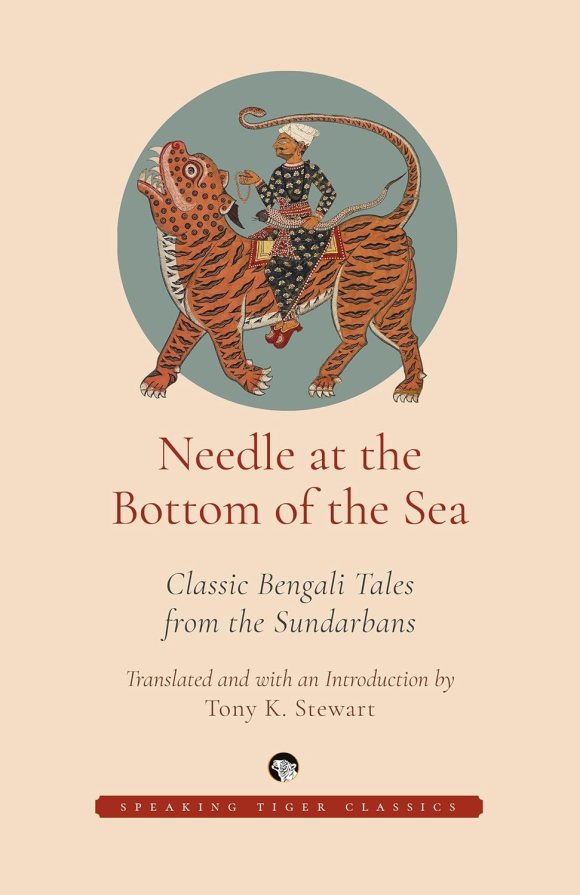
Title: Needle at the Bottom of the Sea: Classic Bengali Tales from the Sundarbans
Translator: Tony K. Stewart
Publisher: Speaking Tiger Books
What comes to mind when we think of the Sundarbans? Verdant mangroves, elusive Bengal tigers, and the mystique of the Bay of Bengal. But the late Tony K. Stewart’s Needle at the Bottom of the Sea reminds us of another legacy—its rich cultural heritage. Stewart, a Gertrude Conway Vanderbilt Chair who did pioneering work in Bengali narratives, passed on in October 2024. This vivid collection of five timeless kathas (stories), one co-translated with Ayesha A. Irani, a scholar from University of Massachusetts, starts with a compelling introduction to the diverse syncretic traditions of the region.
The anthology has five stories that are translated lyrically in the form of story poems filled with suspense and surprises. The opening verse from the first translated katha “The Auspicious Tale of the Lord of the Southern Regions — the Rāy Maṅgal of Kṛṣṇarām Dās” poetically sets the mood of the genre and gracefully takes the reader to familiar and unfamiliar grounds and it goes as follows —
With palms pressed together in respect,
I praise the lotus feet and magnificent girth of
the Lord Dakṣiṇ Rāy, Master of the Southern Regions, …
Against Baḍa Khān Gāji, the Great Sufi Warrior,
You waged war throughout the territory’s canals and channels,
but in the end you became close, fast friends.
The narrative depicts the incredible sophistication of the diversity in India with relatable characters and compelling themes, evoking emotions that we feel at different junctures of life, between life and death irrespective of religion, caste, culture or creed. Stewart uses vivid imagery and figurative enhanced with rhyme and rhythm to bring just enough for the reader in English without diluting the beauty of the language or history and culture of the original work. The beauty and quality of the literature is translation set in the beginning is maintained throughout the five sections. The rich mystical and spiritual spirit of the region is evoked in the coming together of the cultural elements in Hinduism and Sufism. As the introduction is named, the book is truly a unique flavour that brings “Bengali Tales from the Land of Eighteen Tides”
In these tales, the mythic meets the moral. Demigod Daksin Ray and Sufi warrior Bada Khan Gaji clash on the battlefield, commanding armies of tigers, until God intervenes as Satya Pir to mediate peace. They cross paths again when Gaji battles for his beloved Princess Campavati, and once more during Ray’s confrontation with Bonbibi, the forest’s matron-protector—each time with Gaji or Satya Pir stepping in to guide or save. Other stories follow Madansundar’s search for his lost brothers with Satya Pir’s help, while Khwaja Khizr aids Gaji in retrieving a needle from the sea, affirming his identity as a living saint, or “jinda pir”.
Stewart’s translation is a triumph of linguistic artistry. He brings alive a world of talking tigers, floating rocks, flying trees, giants, miracle-working saints, and more. These fantastical elements coexist with deeply human struggles, as the characters strive for honor and morality in a corrupt and chaotic world. The stories, drawn from 16th- and 17th-century oral traditions, are richly interwoven with both Hindu and Muslim worldviews, offering a textured portrayal of a pluralistic Bengali society.
The tales are full of romance and adventure—unlikely heroes and heroines, ocean-faring merchants, whimsical gods, revered prophets, and powerful zamindars. They reflect familiar events and cultural motifs of the Bangla-speaking world, infused with imaginative solutions and heroic feats. Stewart captures the emotional and linguistic nuance of the original Bangla, carefully preserving idioms and explaining cultural references to ensure resonance with an English-speaking audience.
The result is not just a literary collection, but a vital cultural document. It offers anglophone readers insight into the everyday lives, beliefs, and spiritual practices of the Sundarbans’ inhabitants, where Islam and Hinduism blend in creative harmony. These tales situate the Sundarbans within the broader currents of South Asian and Indian Ocean history, illustrating how Islamic narratives became integral to the Bengali literary imagination.
Needle at the Bottom of the Sea is a scholarly feat and a literary delight. Stewart’s careful and rich translations open a portal to a fantastical world grounded in real human values. These stories resonate across boundaries, blending chaos with compassion, conflict with harmony, and myth with morality. A remarkable contribution to Bengali literary studies and interreligious history, this book is essential reading for anyone interested in Translation Studies, South Asian literature, folklore, or cultural syncretism.
.
Gracy Samjetsabam is a freelance writer and copy editor. Her interest is in Indian English Writings, Comparative Literature, Gender Studies, Culture Studies, and World Literature.
.
PLEASE NOTE: ARTICLES CAN ONLY BE REPRODUCED IN OTHER SITES WITH DUE ACKNOWLEDGEMENT TO BORDERLESS JOURNAL




 Borderless