My mother asks about the black spots on my cheeks over and over when I sit beside her on the sofa.
The smudgy patch of melasma is visible to her sharp eye, as she remembers once, I had a flawless face.
It is not her fault. She does not mean to annoy when she asks over and over. like the chorus of a song.
She is worn down. Full only with old memories.
Places are lost. Time is lost. Joy is fleeting.
She smiles at me, repeating questions that she forgot were on her lips before.
*Little Song
Shobha Tharoor Srinivasan is an award-winning author and voice-over artist whose books and narration span genres, audiences, and continents, celebrating culture, language, and storytelling across media.
.
PLEASE NOTE: ARTICLES CAN ONLY BE REPRODUCED IN OTHER SITES WITH DUE ACKNOWLEDGEMENT TO BORDERLESS JOURNAL
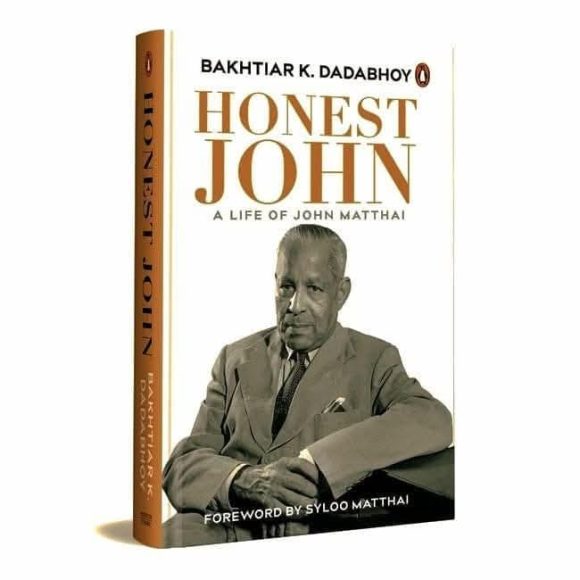
John Matthai’s name has little resonance for today’s generation, but he was one of the brightest stars in the firmament of his time, and even in retrospect. He cultivated many gardens, starting his life as a lawyer and later becoming a professor, administrator, banker, corporate leader, and Minister. In this delightful biography of Matthai, whom Nehru called “Honest John”, Bakhtiar K Dadabhoy tells us of the different hats worn by him. For his students in Madras, he was a shy professor who was one of the most lucid exponents of a dry subject like economics. JRD Tata would always turn to him for sagacious advice.
For Nehru, who greatly respected his ability and integrity, Matthai filled two cabinet posts, even though the parting was somewhat unpleasant when Matthai resigned as Finance Minister, as he feared that the newly created Planning Commission would be a ‘parallel cabinet’ and would be in perennial conflict with his department. CD Deshmukh, the redoubtable civil servant who succeeded him as FM in the Matthai Memorial Lecture said: “He was one of the most cultured products of India, having a perceptive and thoughtful mind, a sobriety of judgment of men and affairs, a rare concern for principles, scholarliness, with its flames kept lit by regular reading.”
He was the first Indian to get his DSc from LSE in 1916 and worked under Professor Sidney Webb, a Fabian socialist, who was at the height of his powers and fame. Though Webb was his guide, he was at no time a Leftist or socialist Professor of Economics. He had a thorough understanding of what free enterprise could do. He was one of the principal authors of the Bombay Plan, a memorandum submitted to the government in 1944 led by Tata, Birla and Thakurdas.
The Bombay Plan represented a search for a new style of capitalism that would chart a middle path between state-led planning and private enterprise. This was in the background of a fierce intellectual debate fought in England between two towering economists, Hayek and Keynes.
While Keynes advocated active state intervention and the desirability of state-funded programs, Hayek favored non-interventionism and free trade. It was to the credit of Matthai that the planners envisaged a mixed economy, in which the state and the private sector would play a complementary role, thus proposing a visionary compromise between two systems, free market and state control.
Ironically, he resigned as Finance Minister after failing to reconcile with Nehru on the setting up of the Planning Commission. According to historian Rakesh Ankit, it was an individual and an institution that made the widening differences unbridgeable. It was Trone, born to Jewish parents and an engineer with General Electric involved in an electrification drive in the USSR, who impressed Nehru with his All India Plan of a ‘managed mixed economy’ that was sufficiently controlled to ensure equity.
While Nehru was taken by Trone’s view that a Planning Commission would reflect regional aspirations and diversity, and his view that Indian capitalists were only out to make profits, Matthai did not share his enthusiasm. In a letter to Nehru, he wrote that the Indian economy was like a “damaged ship and our job is to repair it and not as naval architects but experienced, competent workmen.” Nehru responded by defending planning as ‘a positive active policy’, giving examples of planned progress made by England, Germany, Italy, the Soviet Union, and Japan since the war.
Unlike Patel, who was a hard-headed realist, Nehru loved the abstract argument and delighted in drawing generalised inferences from situations that offered the slightest provocation to his nimble mind. Speaking six years later, after the Planning Commission was formed, Matthai said that “the planning commission has become a body of amateurs, with whom, for all practical purposes, the final decision rests in matters of economic development.” Most of Matthai’s fears about the Planning Commission proved to be well-founded. Critics like Kripalini and Rajagopalachari openly showed their displeasure. Rajaji founded the anti-socialist party.
Dadabhoy also gives a glimpse of how Liaquat Ali Khan, as FM in the interim government, proposed a business profits tax, an increase in corporate tax, a dividend tax, capital gains tax and a high-powered tribunal to deal with tax evasion. Matthai was the only non-league cabinet minister to defend the budget in public. But Patel and Rajgopalchari, who made no secret of being pro-capitalist, saw the budget as a way of harassing businessmen.
Ventilating his frustration with the hegemony planning enjoyed, he wrote to Nehru: “I fear a church is growing around the God of Planning”. However, planning remained the master narrative, and the plans laid the foundation for infrastructure in sectors like steel, fertilizers, cement and chemicals, promoting agricultural self-sufficiency and focusing on inclusive growth and social justice.
Wavell noted in his diary on 5th March 1947, “Nehru, Patel & Bhabha find that the budget is not popular with their big business supporters and are trying to rat or hedge.”Matthai abolished the capital gains tax and reduced super taxes. Pandit Kunzru doubted, “If such reductions would lead to greater productivity. A time has come if free enterprise is to be given a free hand or the country should opt for a socialist economy.” It was only a decade ago that Prime Minister Modi abolished the Planning Commission without any discussion.
Matthai had an unconventional approach to budget presentation. He is the only railway minister to deliver a budget speech without a prepared text. In 1950, he chose to deliver his Union Budget speech extempore. Dadabhoy also brings out unknown facets of Matthai’s personality. He approached Nehru and Patel to bail out his son, who had run over someone while driving his car in Allahabad. Nehru was reluctant to help, but Patel intervened, and Matthai’s son was bailed out and quietly sent to England to escape the net of law. Matthai was known for his honesty and uprightness, but his fondness for his son blinded him to those values.
Matthai, despite his serious differences with Nehru on the issue of the Planning Commission, was a great admirer of Nehru. He wrote after his first meeting with him, “If he ever asked me to go to prison with him, I should find it difficult to refuse.” Mathai considered his long association with the Tatas to be the happiest period of his life. Sir Homi Mody, a Tata luminary later to become the governor of Uttar Pradesh was known for his wit. Homy contended, “Matthai had all the advantages of face, figure, manner, and voice and invested everything he said with an air of profundity. Matthai was a technocrat of different timber who did not mix personal respect with policy differences.”
Though trained under Fabian socialist, Sydney Webb, whom Nehru adored, he did not jump into the trap of socialism. He was a pragmatist who looked at India’s damaged ship, post-Partition, through the lens of competent workmen. Judging a visionary like Nehru and a pragmatist like Matthai can be a nightmare for any biographer. However, Dadabhoy skirts the issue with skill.
.
Professor Satya Narayan Misra is a distinguished expert in Public Procurement & Contracts with over three decades of experience in the Indian Economic Service & Indian Defence Accounts Service. He has made significant contributions in drafting a manual for defence procurement and bolstering self-reliance in critical technology. He has authored seven influential books and published 127 research articles, including 18 in prestigious Scopus-indexed journals such as the Economic and Political Weekly (EPW) and Defence Studies (UK). He looks at macroeconomic issues through the lens of Constitutional expectations. He is a Professor Emeritus and a sought-after speaker on public policy, budget, development issues, and Constitutional Cases.
.
PLEASE NOTE: ARTICLES CAN ONLY BE REPRODUCED IN OTHER SITES WITH DUE ACKNOWLEDGEMENT TO BORDERLESS JOURNAL
Sangita Swechcha’s poem has been translated from Nepali by Saudamini Chalise
Sangita Swechha
ANIMATE DEBRIS

A living dream
smoulders
in the boulevard,
blowing the trumpet of revolution.

Not a dream anymore—
he turned to ash.

In that animate rubble,
dampened eyes
batted lashes.
Someone’s soul
had incinerated.

Some took to the streets,
seeking justice.
Some said he lacked the mettle to survive,
and self-immolated.

Others said he martyred himself
for the revolution.

Tender hearts grew pensive.
The one who dreamed for them
had burned.

And now, they would wonder:
Why even dream
where dreams are doused
before they’re born,
where realities,
before turning to corpses,
were already draped for the cortege?

But for those
who had clung to that burning dream—
who lived off its flickering light—
they are now
reborn from its ashes.
Sangita Swechcha is a Nepali writer, poet, and scholar based in England. She published her debut novel Seto Siundo at 18. Her other works include Rose’s Odyssey, a collection of short stories and co-edited anthologies like The Himalayan Sunrise and A Glimpse Into My Country.
Saudamini Chalise, author of three thrillers, is also a prolific translator and biographer, known for translating works by Khagendra Sangraoula, Dr. Bhagwan Koirala, and Kiran Acharya.
.
PLEASE NOTE: ARTICLES CAN ONLY BE REPRODUCED IN OTHER SITES WITH DUE ACKNOWLEDGEMENT TO BORDERLESS JOURNAL
In Parvatipuram, there lived a merchant named Sunanda. He used to run his business by fulfilling the needs of the people. He had two sons – the elder one, Anand, and the younger one, Vinay. Anand completed his education at the gurukul and returned home, while Vinay was still studying.
Anand told his father that he didn’t want to work under anyone, and instead, he wanted to start a profitable business of his own—one that would also provide employment to others. Hearing this, Sunanda was very happy and made arrangements to help Anand start a business in a nearby town.
He chose an auspicious time for the opening and invited Anand’s guru, Medho Nath, to bless the occasion. The guru, moved by his affection for Anand, came for the inauguration. In the presence of his guru, Anand performed the rituals and made his first sale.
To show his respect, Anand offered silk clothes and thamboolam (a traditional token of respect) to his guru and bowed to him. Accepting them, Guru Medho Nath blessed him saying, “May your business grow like the saying—three types of goods, six kinds of deals. But for that, you must follow three conditions. First, you must come and go without being seen. Second, receive with one hand and give with the other. Third, always eat five-course feasts. Follow these, and you will reach great heights in business, my son!”
“Yes, Guruji! With your blessings, my business will flourish just as I dreamed,” Anand replied happily.
Standing beside them, Sunanda could not understand the meaning behind the guru’s blessing. The conditions seemed strange to him. “What kind of blessing is this, filled with such odd conditions?” he thought to himself.
Guru Medho Nath sensed this and turned to Anand, asking, “My son, did you understand the deeper meaning of my blessing?”
Anand replied, “Yes, Guruji, I understood it clearly.”
“Then explain the meaning of these conditions to your father,” the guru instructed.
Anand nodded in agreement and turned to his father. “Guruji’s first condition was to go and return without being seen,” he began.
Sunanda interrupted, “How is that possible? When going out for business, you meet many people. Business means interacting with customers. How can one go unseen?”
Anand smiled and said, “Listen to the deeper meaning. He meant that I should leave for work at dawn and return only after sunset. If I go late in the morning, I’ll see many others along the way, and by then, other merchants would already have done a lot of business. But if I start early, I’ll have more time and more opportunities.”
“I see! That makes sense. What about the second condition—receiving with one hand and giving with the other?” asked Sunanda.
Anand explained, “Customers often try to buy on credit. If we keep giving goods on credit, the business won’t survive. Later, when asked to repay, some customers avoid us. That’s why Guruji advised me to take cash with one hand and deliver the goods with the other—no credit.”
“That’s very sensible. And what about the third condition? He told you to always eat five-course meals. Is that practical? If you eat like that daily, you’ll lose money—and it could even cause indigestion!” said Sunanda.
Anand laughed and replied, “Guruji didn’t mean literal feasts. He meant that I should work so hard that I feel truly hungry before eating. When someone is really hungry, even a simple meal feels like a royal feast. So, work hard, earn your hunger, and only then eat. That was his advice.”
Satisfied with his son’s explanation, Sunanda’s face lit up with happiness.
Guru Medho Nath then praised Anand, saying, “Well done! You have truly proven yourself my disciple. You’ve understood the essence of my message.”
Sunanda expressed heartfelt gratitude to the guru who had shaped his son into such a wise man.
In time, Anand not only earned great profits through his clever business sense, but also gained respect and fame.
.
Naramsetti Umamaheswararao has written more than a thousand stories, songs, and novels for children over 42 years. he has published 32 books. His novel, Anandalokam, received the Central Sahitya Akademi Award for children’s literature. He has received numerous awards and honours, including the Andhra Pradesh Government’s Distinguished Telugu Language Award and the Pratibha Award from Potti Sreeramulu Telugu University. He established the Naramshetty Children’s Literature Foundation and has been actively promoting children’s literature as its president.
.
PLEASE NOTE: ARTICLES CAN ONLY BE REPRODUCED IN OTHER SITES WITH DUE ACKNOWLEDGEMENT TO BORDERLESS JOURNAL
There are plenty of daytime dancers
When the sun is smiling
And the grass singing
And vigour rises like smoke from the hills...
So then let me be
The duskdancer
Closing my eyes
And flailing my arms
I'll dance till I make you see
How shadows can be strangely free
Of all social decree
And I'll dance till you smile
At the beauty of darkness…
Ananya Sarkar is a creative writer from Kolkata currently living in Bangalore. Her work has been published in various ezines. She loves to go on long walks, cloud gaze and ponder upon miracles. She can be found on Instagram @just_1ananya and reached at ananya7891@gmail.com
.
PLEASE NOTE: ARTICLES CAN ONLY BE REPRODUCED IN OTHER SITES WITH DUE ACKNOWLEDGEMENT TO BORDERLESS JOURNAL
In 2015, Shashi Tharoor’s speech at the Oxford Union exploded across social media, striking a chord far beyond academic or diplomatic circles. Framed around the motion “This House Believes Britain Owes Reparations to Her Former Colonies”, Tharoor—alongside eloquent speakers from Ghana and Jamaica—argued persuasively for moral accountability from the former empire. Tharoor’s speech was widely appreciated in India because of the succinctness with which he illustrated how and why colonial rule exploited the subcontinent, and how violence and racism were the order of those days.
“It’s a bit rich to oppress, enslave, kill, torture, maim people for 200 years and then celebrate the fact that they are democratic at the end of it. We were denied democracy, so we had to snatch it, seize it from you,” he said to loud applause from the audience.
But while insightful points such as these formed the crux of Tharoor’s eloquent speech, it was his rapier barbs that had the esteemed audience (and netizens alike) crowing. “No wonder that the sun never set on the British Empire,” he says at one point, referencing a common boast used to illustrate the sheer extent of Britain’s power, “because even God couldn’t trust the English in the dark.”
The speech’s viral success revealed a yearning—particularly among millennials raised on televised debates and editorials—for a mode of discourse that is rapidly disappearing. Where once prime-time slots featured fiery discussions on social and political issues about caste, class, gender, and policy, today’s digital platforms prioritise speed, relatability, and aesthetics.
In the India of today, a viral tweet can spark more conversation than a peer-reviewed article. A beauty influencer’s “Get Ready With Me” vlog is more likely to trend than a lecture by a scholar on social justice. The thought leaders of the past were expected to speak with gravity; the content creators of the present are expected to sparkle. When public intellectuals are replaced by public influencers, the nature of cultural discourse changes. Popular culture, once a mirror held up to society, now leans into escapism. Complex socio-political debates are flattened into clickable soundbites, and intellectual inquiry is often sidelined by algorithm-friendly content categories, sorted by SEO value[1].
Intellectuals once forced us to think harder, ask more difficult questions, live with complexity. Influencers invite us to feel seen, validated, or soothed. One expands the self, the other simply flatters it.
India’s Golden Age of Thought: When Public Intellectuals Shaped the Nation’s Conscience
Once upon a time, India did not lack public intellectuals. In fact, the early decades after Independence saw them thrive because India’s tradition of intellectual dissent is long and storied. Figures like Nehru, Gandhi, Ambedkar, Tagore—they were not just leaders or writers; they were public philosophers.
Thinkers engaged with the moral and political questions of their time, not just within academia but in public forums, books, interviews, op-eds, and essays that reached a wide, engaged readership. They helped build the intellectual spine of a newly independent nation grappling with secularism, caste, democracy, and justice.
Even in Bollywood, cinema once offered social critique—from Guru Dutt’s Pyaasa (Thirsty, 1957) to Shyam Benegal’s Ankur (The Seedling, 1974). They were conscience-keepers, cultural critics, and truth-speakers. They didn’t shy away from controversy—many actively courted it. They weren’t afraid to speak against majoritarianism, economic inequality, censorship, or communalism.
Meanwhile, halfway across the world in Texas, a young boy named Wes Anderson—who would go on to become one of the most distinctive voices in contemporary cinema—found himself deeply influenced by Satyajit Ray. It wasn’t just Ray’s pioneering cinematic style that captivated him, but also his prolific work as a writer and illustrator, and his powerful engagement with public discourse. Through his films, Ray offered a radical and empathetic lens on Indian society, boldly confronting issues such as poverty, gender roles, the tension between tradition and modernity, and the human consequences of social change—perspectives that were remarkably ahead of their time and continue to resonate across cultures.
Dr. A.P.J. Abdul Kalam was one of modern India’s most beloved and influential public intellectuals—a scientist, teacher, and former President who embodied the rare blend of deep technical knowledge and visionary humanism. Revered as the “Missile Man of India” for his pivotal role in advancing the country’s space and defence programs, Kalam also brought science into the public imagination with clarity, humility, and hope. His presidency (2002–2007) was marked by an earnest outreach to young people, whom he inspired to dream beyond the limitations of circumstance. Unlike many in power, Kalam believed in the democratisation of knowledge—he made complex ideas accessible, challenged youth to innovate, and constantly linked progress with ethics and spirituality. In doing so, he redefined what it meant to be a public intellectual in India: not someone cloistered in academia, but a leader who imagined a better future and invited the nation to build it with him.
Brains Behind Paywalls: How Intellectualism Lost Its Spotlight
There’s no shortage of brilliant minds today—but intellectualism requires both platform and patience. Neither is abundant. A YouTuber dissecting colonial legacy in Indian education may get a few thousand views; a beauty blogger with “chai latte skin” content racks up millions. But now, intellectuals are trapped producing work for journals and conferences rather than the public sphere. As a result, public-centred intellectualism has become rare. It’s not because intellectuals of that caliber no longer exist, but that the structures that once made their ideas visible have been buried under layers of institutional gatekeeping.
The decline of the public intellectual isn’t just the result of a shifting media landscape—it’s also tied to how our access to and expectations around knowledge have evolved. There was a time when intellectuals were celebrated as generalists, able to navigate literature, politics, science, and philosophy, and translate complex ideas for a broader audience. Think of Susan Sontag or Bertrand Russell—figures who didn’t confine themselves to narrow academic lanes but moved fluidly across disciplines to spark public thought and dialogue.
Today, intellectual life has become increasingly siloed. Hyper-specialization has turned academia into an insular world where scholars speak primarily to other scholars. Rather than bridging the gap between advanced knowledge and public discourse, modern academics are often locked within their own echo chambers. The public philosopher who once commented on culture and politics has given way to specialists producing work for a niche audience of peers.
Even when academics do attempt to reach beyond their field, they’re often met with suspicion. A historian writing on political theory or a physicist reflecting on metaphysics is likely to be dismissed for stepping outside their “expertise.” Intellectual authority today is rigidly policed, and interdisciplinarity—once a hallmark of great thinkers—is now treated with skepticism.
From Public Intellectuals to Public Aestheticism: How Influence Got a Makeover
Today’s cultural powerhouses operate on a very different wavelength than their predecessors. Where figures like Susan Sontag or James Baldwin once shaped public consciousness through sharp intellect and critical writing, today’s influencers—like Kim Kardashian—wield their power almost entirely through aesthetics. Kardashian doesn’t publish essays; she sets the tone for global beauty trends. With each new look—glazed donut skin, brownie lips, strawberry makeup, and the almost comically indulgent cinnamon cookie butter hair—the Kardashians and Jenners reshape beauty norms with a force that rivals traditional intellectuals.
In India, the landscape mirrors this shift. Influencers like Ananya Panday and Ranveer Allahbadia amass millions of views despite offering little in terms of originality or eloquence. Much of their content borrows from what’s already been done, often repackaged with no clear voice of their own. Unlike cultural figures such as Shabana Azmi or even Priyanka Chopra[2]—whose words once commanded attention and mattered—many of today’s digital celebrities struggle when pulled out of the comfort zone of scripted, bite-sized platforms. Their polished online personas crumble under the pressure of unscripted public discourse.
What we’re left with is a curated illusion, a constant performance of identity. And the troubling part? Young audiences are watching, emulating, and internalising these facades—until, inevitably, a scandal breaks the spell. In an era ruled by surface and spectacle, authenticity has become the rarest currency of all.
If Joan Didion or Arundhati Roy represented a time when public intellectualism had mass appeal, these influencers represent what has replaced it: public aestheticism. A philosopher might spend years constructing a critique on our society, but an influencer can change peoples’ worldviews with a single Instagram post. Influence now moves at the speed of an Instagram story. The philosopher builds theory; the influencer sells a mood. In this new aesthetic economy, they are the message, the medium, and the marketplace all at once. This is not an incidental shift, but a reflection of our broader cultural transformation.
Although, this is absolutely not a wholesale condemnation of influencers. Many use their platforms to raise awareness, fundraise, and spotlight important issues. But influence has become aestheticised. And when beauty, brevity, and branding become the dominant currencies of expression, difficult truths become harder to hear.
Even figures with a platform one would consider intellectual, like a podcast or blog, tend to operate within a different framework than the public intellectuals of the past. The most successful are the ones who know how to package their ideas into easily consumable formats. Their content may demand engagement, but not necessarily deeper thinking. The most successful cultural critics of our digital age are simply a different kind of influencer, one who may sell a worldview rather than a skincare routine, but are selling something nonetheless.
Amidst all of this, we have lost the expectation of being challenged by our cultural figures. We have lost the collective memory of what it means to gather around an idea rather than a trend. We have lost the stamina for long-form thinking. We now crave hot takes instead of deep dives, personality over principle, vibes over values. We’ve also stopped expecting our cultural figures to challenge us. We ask them to inspire us, to entertain us, to market their authenticity. We no longer crowd into halls for heated debates—we scroll.
When Influence Replaces Insight: The Rise of Apathy and the Fall of Public Thought
The culture hasn’t gone quiet though. Indian influencers—fashion bloggers, tech reviewers, lifestyle curators, “finance bros”, even comic creators—are the new cultural capital. They dominate conversations on what matters to people: from wedding aesthetics and productivity hacks to skincare routines and budget investments. The currency of their influence isn’t depth but relatability, not dissent but delight. Even in the realm of “education”, we find influencers gamifying complex financial or political ideas into simplified carousels or 60-second explainers. It’s not necessarily bad—but it is diluted.
It’s also understandable why many hesitate to enter intellectual spaces today—there’s a prevailing sense that everything worth saying has already been said. We live in an age where every thought seems pre-articulated, every argument countered, every counterpoint already dissected. The landscape isn’t lacking in intellectual potential; it’s that fewer people feel confident stepping into the role of a public intellectual, believing true originality is no longer possible.
This mindset breeds an intellectual echo chamber. Rather than contributing to the discourse, many settle into passive consumption, convinced that someone else has already voiced every worthwhile idea.
But the truth is, no conversation is ever truly finished. History shows us that ideas are living things—they shift, adapt, and deepen depending on who engages with them and when. The same philosophical questions that animated thinkers centuries ago continue to evolve, finding new relevance in each generation. Feminism as it was understood in the 1970s is not the feminism of today. Jean Baudrillard’s meditations on media and hyperreality in the 1980s feel hauntingly prescient in our digital age—but our reading of him is inevitably shaped by the world we now inhabit. Every era reinterprets the past, and every new voice brings a fresh lens. That’s what keeps the intellectual tradition alive.
Reclaiming Thought: Can Intellectualism Survive the Age of Spectacle?
So, can the intellectual space be reclaimed, or has it been permanently absorbed into digital spectacle? Long-form discussions found in podcasts, essays, and forums are a great starting point. Platforms of these media types allow for deeper exploration of ideas, where nuance and depth are greatly valued.
And it’s not that intellectuals have disappeared. They are still here, writing essays, protesting laws, mentoring students. But they’ve been pushed to the peripheries of public attention. Their audiences are shrinking, and their words are often drowned out by the louder, shinier pull of influencer content.
But intellectual spaces aren’t only limited to these traditional platforms. Niche online communities like internet book clubs on Fable or Instagram create new ways for people to connect with unique ideas. You can also incorporate intellectual conversation into your everyday life. Attend local events, art galleries, or even start casual discussions among friends to make these topics more accessible and relevant. The intellectual sphere may have shifted, but it isn’t gone. We simply have to work to reclaim these spaces with people who are willing to engage deeply with ideas.
Ultimately, the death of the public intellectual may not be as tragic as it seems, it may just mean that intellectualism is taking on new forms. But we have to ensure we’re not losing sight of what really matters—the depth, complexity, and refusal to settle for easy answers in the pursuit of something greater.
Culture Is Still Loud—It Just Doesn’t Want to Make You Uncomfortable Anymore
There’s another reality unique to India: the active suppression of dissent. To be an intellectual in India today, particularly one critical of the status quo, is to court danger. Writers have been jailed (Anand Teltumbde), journalists have been shot (Gauri Lankesh), and students have been arrested for protest slogans. In such an atmosphere, who would choose to be a public intellectual?
The public intellectual, by definition, is someone who speaks truth to power. In India, speaking truth to power comes at a high cost. And so, instead, we scroll. Meanwhile, the influencer class thrives because they are apolitical by design. Their influence is rooted in apathy, in not asking uncomfortable questions. This is not a coincidence. It is by systemic design. The less we think, the more we consume. The more aestheticised our discontent, the less threatening it becomes. Influencers now perform the soft work of culture—sedating, distracting, pacifying—while hard truths are hidden behind paywalls, FIRs, and broken institutions.
But if the public intellectual is to make a comeback, we as an audience must do our part. We have to choose depth over dopamine, discomfort over convenience. We must resist the temptation to aestheticise every idea until it’s just another lifestyle choice.
Because when thought leaders become brand ambassadors, and reflection becomes a trend, we risk forgetting that ideas—not images—are what truly shape society.
The public intellectual may be on life support, but the conversation isn’t over. It never is.
[1] SEO (Search Engine Optimisation) value refers to the estimated monetary worth of organic traffic generated by a website through search engine optimisation efforts.
Lopamudra Nayak is a poet, freelance writer, and biotechnologist with a passion for literature and storytelling. She writes poetry, book reviews, and reflections on pop culture on her blog, Substack and Instagram.
.
PLEASE NOTE: ARTICLES CAN ONLY BE REPRODUCED IN OTHER SITES WITH DUE ACKNOWLEDGEMENT TO BORDERLESS JOURNAL.
Our home is our planet with it’s unique combinations which have made life possible. These evolve and mutate with human intervention and the passage of time. The changes affect the flora and the fauna — of which we are a part — of this beautiful green planet. The World Environment Day is a UN initiative to protect the environment and to create an awareness about the changes wrought on it and how it could impact us as a species. Writers from yore have written of the beauty and the inspiration invoked by nature as have the moderns. Today, we share with you vintage writings as well as modern writing in prose on the world around us, showcasing the concerns of a century ago and the reality today.
Vintage Prose
One Small Ancient Tale: Rabindranath Tagore’s Ekti Khudro Puraton Golpo (One Small Ancient Tale) has been translated by Nishat Atiya. Click hereto read.
Bolai: Story of nature and a child translated by Chaitali Sengupta. Click hereto read.
Baraf Pora (Snowfall) : This narrative gives a glimpse of Tagore’s first experience of snowfall in Brighton and published in the Tagore family journal, Balak (Children), has been translated by Somdatta Mandal . Clickhere to read.
The Day of Annihilation, an essay on climate change by Kazi Nazrul Islam, has been translated from Bengali by Radha Chakravarty. Clickhereto read.
Modern Prose
The Gift : Rebecca Klassen shares a sensitive fiction about a child and an oak tree. Click here to read.
A Penguin’s Story: Sreelekha Chatterjee writes a fiction from a penguin’s perspective. Clickhere to read.
Navigational Error: Luke P.G. Draper explores the impact of pollution with a short compelling narrative. Click here to read.
Pigeons & People : In his fiction, Srinivasan R explores human nature and imagines impact on our fauna. Click here to read
The Theft of a River: Koushiki Dasgupta Chaudhuri reveals a poignant truth about how a river is moving towards disappearance due to human intervention. Clickhereto read.
Potable Water Crisis & the Sunderbans: Camellia Biswas, a visitor to Sunderbans during the cyclone Alia, turns environmentalist and writes about the potable water issue faced by locals. Click here to read.
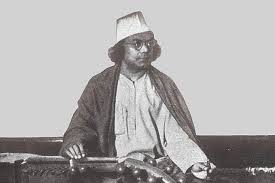
Kazi Nazrul Islam was born in Churulia in India on 24th May, and he died a Bidrohipoet in Bangladesh. When he was born in 1899, it was before the McMahon Line of Partition had been drawn. He looked up to Rabindranath Tagore as his mentor but his form of poetry was more rebellious and his lyrics, different, though no less beautiful. His heart belonged to a united Bengal as can be seen from much of his works. He started magazines, supported feminism, brought out Begum Rokeya’s work in his journal, spoke of rising beyond borders and he has even written of climate change more than a hundred years ago…
His essay on melting icebergs has been translated by Radha Chakravarty. Today, we celebrate Nazrul’s birth anniversary with translations of his works from Bengali. These showcase the diversity in his writings, broadness of his thought and his concern for global issues that remain unresolved to date: his essay on climate change, a story grown out of his experiences as a soldier translated by Sohana Manzoor, a poem on poverty and lyrics on women and living in a world that transcends human constructs rendered in English by Fakrul Alam and more. Welcome to Nazrul’s world!
In Did He Ever?,Rhys Hughes gives fun-filled verses on Lafcadio Hearn, a bridge between the East and West from more than a hundred years ago. Clickhere to read.
Dolly Narang muses on Satyajit Ray’s world beyond films and shares a note by the maestro and an essay on his art by the eminent artist, Paritosh Sen. Clickhere to read.
Poetry, prose — all art forms — gather our emotions into concentrates that distil perhaps the finest in human emotions. They touch hearts across borders and gather us all with the commonality of feelings. We no longer care for borders drawn by divisive human constructs but find ourselves connecting despite distances. Strangers or enemies can feel the same emotions. Enemies are mostly created to guard walls made by those who want to keep us in boxes, making it easier to manage the masses. It is from these mass of civilians that soldiers are drawn, and from the same crowds, we can find the victims who die in bomb blasts. And yet, we — the masses — fight. For whom, for what and why? A hundred or more years ago, we had poets writing against wars and violence…they still do. Have we learnt nothing from the past, nothing from history — except to repeat ourselves in cycles? By now, war should have become redundant and deadly weapons out of date artefacts instead of threats that are still used to annihilate cities, humans, homes and ravage the Earth. Our major concerns should have evolved to working on social equity, peace, human welfare and climate change.
One of the people who had expressed deep concern for social equity and peace through his films and writings was Satyajit Ray. This issue has an essay that reflects how he used art to concretise his ideas by Dolly Narang, a gallery owner who brought Ray’s handiworks to limelight. The essay includes the maestro’s note in which he admits he considered himself a filmmaker and a writer but never an artist. But Ray had even invented typefaces! Artist Paritosh Sen’s introduction to Ray’s art has been included to add to the impact of Narang’s essay. Another person who consolidates photography and films to do pathbreaking work and tell stories on compelling issues like climate change and helping the differently-abled is Vijay S Jodha. Ratnottama Sengupta has interviewed this upcoming artiste.
Reflecting the themes of welfare and conflict, Prithvijeet Sinha’s essay takes us to a monument in Lucknow that had been built for love but fell victim to war. Some conflicts are personal like the ones of Odbayar Dorj who finds acceptance not in her hometown in Mongolia but in the city, she calls home now. Jun A. Alindogan from Manila explores social media in action whereas Eshana Sarah Singh takes us to her home in Jakarta to celebrate the Chinese New Year! Farouk Gulsara looks into the likely impact of genetic engineering in a world already ripped by violence and Devraj Singh Kalsi muses on his source of inspiration, his writing desk. Meredith Stephens tells the touching story of a mother’s concern for her child in Australia and Suzanne Kamata exhibits the same concern as she travels to Happy Village in Japan to meet her differently-abled daughter and her friends.
As these real-life narratives weave commonalities of human emotions, so do fictive stories. Some reflect the need for change. Fiona Sinclair writes a layered story set in London on how lived experiences define differences in human perspectives while Parnika Shirwaikar explores the need to learn to accept changes set in her part of the universe. Spandan Upadhyay explores the spirit of the city of Kolkata as a migrant with a focus on social equity. Both Paul Mirabile and Naramsetti Umamaheswararao write stories around childhood, one set in Europe and the other in Asia.
Do pause by our contents page for this issue and enjoy the reads. We are ever grateful to our ever-growing evergreen readership some of whom have started sharing their fabulous narratives with us. Thanks to all our readers and contributors. Huge thanks to our wonderful team without whose efforts we could not have curated such valuable content and thanks specially to Sohana Manzoor for her art. Thank you all for making a whiff of an idea a reality!









 Borderless