Categories
Review

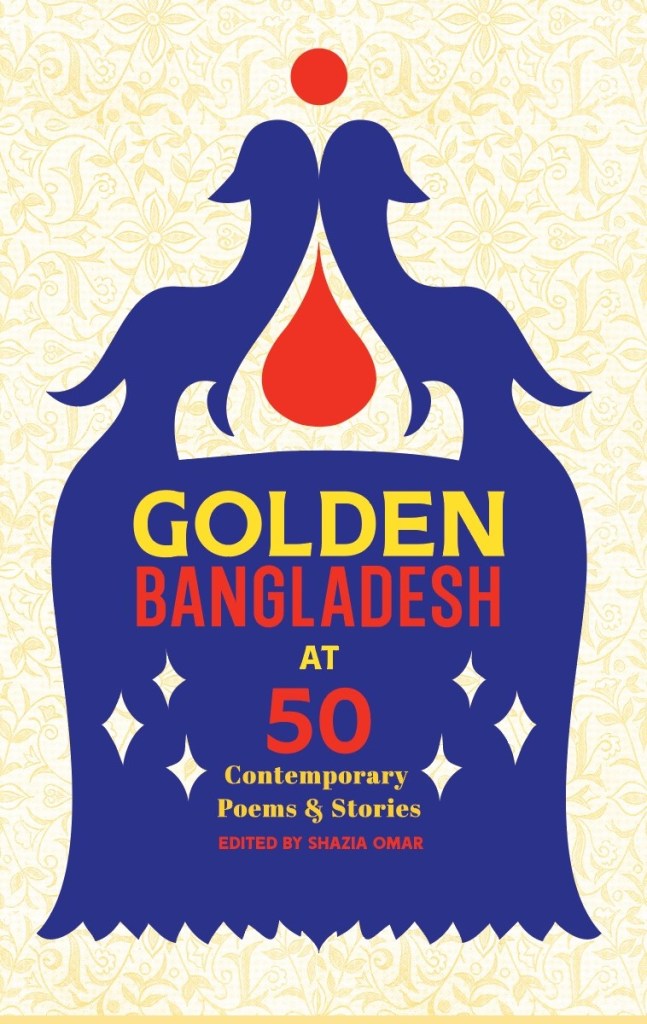
Golden Bangladesh at 50: Book Review by Aruna Chakravarti


Title: Golden Bangladesh at 50, Contemporary Poems & Stories

Editor: Shazia Omar

 Publisher: The University Press Ltd, 2021

The title of the collection of poems and short stories under review is apt for two reasons. First, that it derives from Rabindranath Tagore’s lyric Amaar Shonar Bangla … the national anthem of the country. Second, that the book has been published in 2021, the Golden Jubilee year of the formation of Bangladesh.

The political partition of Pakistan in 1971 caused one of the greatest convulsions in the history of the subcontinent. The Bengalis of Pakistan suffered barbaric violence and bloodshed because they valued their distinctive identity above everything else and refused to submit to a harsh regime’s determination to quell and subdue it. Civil wars have been fought before but never, in the history of mankind, over a language and culture.

Interestingly, Rabindranath’s poem, too, was written as part of movement led by him against Lord Curzon’s infamous Partition of Bengal bill in 1905. The intention of the government was clear. Bengalis were waking up to a sense of nationhood and coming together through the growth and spread of the Bengali language and literature. A blow had to be struck to curb it. And what could be more effective than division based on ethnicity and religion?

The editor Shazia Omar deserves our congratulations for bringing together a vast range of voices. Some are new and unknown, some old and established and some culled from across a wide diaspora. From New York, Chicago and San Francisco. From London, Rome, Toronto and Hongkong. This anthology, to use her own words is, “a way of honouring all that we have learned, yearned for, found and let go. To give our readers a sense of who we are now.” Accordingly, itencapsulates the joys and sorrows, hopes and aspirations, losses and anxieties of two generations of Bangladeshis both from home and abroad.

That partition trauma continues to shape the literature of Bangladesh is apparent from this volume. But the new enquiry has moved away from a nationalistic obsession with the horror of the event to a closer probe into people’s history through recollections of lived experience. Social, familial and personal attempts at restoration of identity seems to be the primary concern in these stories.

The contributions are all in English. The last few decades have been marked by a great deal of discourse about the decolonization of the language. In the past, much colonial creativity has felt throttled by the dominance of English as written and spoken by the ruling class. Today the fragmented pieces of the old empire are striking back with a vengeance. Each erstwhile colony has come up with its own brand of English. This book is a triumphant vindication of Binglish… tried and tested in the literature of West Bengal and Bangladesh. The volume is replete with cultural nuances. Phrases like eta ki, amaar kukoor, or naam, madhur hanshi and names of seasons and festivals phagun, boishakh, agrahayan, eid, nabanno are used freely without footnotes or glossary. The writers have felt no compulsion to translate kinship terms, exclamations and natural phenomena. English has triumphantly broken its original grammatical and syntactical mode and become a hybrid — both a native and a foreign language.

The issues examined in this collection are varied. Class struggle, patriarchy, dogma, superstition, displacement, loss and reclamation of identity. The characters are culled from a wide spectrum of society. From the very rich to the very poor; from the shamelessly privileged to the shockingly deprived. Such yawning gaps, some of the writers seem to imply, are a reality in Bangladesh even in its 50th year of Independence.

 Some stories depict a polarisation of power along the lines of gender. Women are victims of exclusion and varied forms of subjugation. Some are seen as trapped in the iron fist of a feudal order. A few others, westernized and seemingly empowered, share the same fate though the mode of suppression is refined and sophisticated.

Yet, that is not always true. Many of the stories are set in the bustling metropolis of Dhaka where women from all religions, classes and persuasions roam freely. The city is seen as a place of pluralism and diversity. One senses freedom of thought and action as well as a strong sense of belonging to larger whole.

The book is a rich multi-site ethnography that spans continents and traces personal histories and movements of Bangladeshis. It is a notable addition to the literature of the diaspora in that the stories present sensitively nuanced accounts of the East West encounter. In ‘Neighbours’, Nadeem Zaman explores the dilemma of a Bangladeshi woman trying to make a life in Canada during the Liberation war. Struggling against a harsh climate and what she considers an unloving culture, she is forced to pause and reflect when she becomes friendly with her next-door neighbour. She finds his identity troubling, since he seems to combine a sensitive, warm and compassionate outlook with a violent relationship with his wife and indifference to his daughters. The Other seems embodied in paradox.

 Neeman Sobhan’s ‘Bengali Lessons’ is a poignant diaspora story stretching across space and time. Employing a seamless mix of three languages, English, Bengali and Italian, she moves her story between two worlds and timeframes. Two eras run parallel. War ridden Bangladesh of 1971 and Covid afflicted Rome of 2020. The central character, a professor teaching Bengali to a group of Italian girls on Zoom, remembers her traumatic childhood, trapped in her grandfather’s house in 1971, and finds it astonishingly similar to her present-day situation in another country and another time. It is a severed world she remembers but one in which a Muslim child saves a Hindu soldier from an excruciatingly painful death.

Another excellent examination of child psychology is contained in Fatma Ahmad’s ‘Phultokka’ . Childhood is often considered to be the happiest phase of a person’s life. That the notion is far from the truth is seen in the mental struggles, failed aspirations, jealousies and misunderstandings suffered by the intelligent and sensitive teller of the story. She is called Taalgaach (palm tree)a derogatory reference to her height and complexion, by the school bullies. Why do bullies bully? Why can’t some children, especially exceptional ones, cope with the real world and retreat into an inner one, while others have no difficulty in merging and being part of a larger whole? These are some of the questions raised in the story.

 ‘Charaiveti’ and ‘Kalpanta Sthayina’ by Lubna Mariam, derive from the ancient Hindu texts Rigveda and Hitopadesha. The first describes an undefined urge to go on a journey without a destination. Man’s existential freedom drives him towards an imagined Utopia. Keep going,” the sages say, “because life itself is the journey; an inner journey from darkness to light, from ignorance to knowledge”.

Kalpanta Sthaniyah is a Sanskrit phrase meaning enduring till the end of the Universe. A grandfather’s replies to his grandchild’s innocent question about where the river comes from and where it goes, encompass deep philosophical concepts. He speaks of beginnings and ends, past and present, old and new…flowing in an unbroken stream. A glorious merging in the free flow of time. An unending celebration of life.

I conclude with a few words on the poetry section. From the whimsical effusions of ‘Ode to a sari’ to evocations of sights, sounds, smells, taste and feel of their beloved country in ‘Daydream’ ‘Midnight blues’ and ‘For you’, the writers offer a carpet rich with colour and design, light and life. Capricious and fanciful at times, a glimpse of truth is invariably offered at the end of each poem.

 Zeesham Khan’s ‘Banglar desh’, one of the best of the collection, portrays the generosity and compassion of nature as against the callous brutality of the human race. Here is a personification of nature that is amazingly poignant, graceful and symmetrical. The world pulsates with life. Trees have flesh and blood. All organisms speak; feel pain and pleasure. An achingly immediate, hauntingly sensuous, world! The all too real river under a canopy of moon and stars. Paddy fields, bamboo shoots, wild flowers, butterflies and moths. Should not all meld together with humans to make a complete whole? But does such a whole exist in the universe? The writer thinks not. He deplores…

I have seen blissful harmony pause
To give way to aggressive survival
And humans being homo sapiens
Unencumbered by unnecessary compassion.

Glossary:

Amaar Shonar Bangla –My Golden Bengal.

eta ki, amaar kukoor, or naam, madhur hanshi – what is this, my dog, or name, sweet smile

Phultokka — A game played by children. Phool means flower and tokka, touch. One child is blindfolded while others touch the youngster lightly. The blindfolded child has to guess who the person is.

Aruna Chakravarti has been the principal of a prestigious women’s college of Delhi University for ten years. She is also a well-known academic, creative writer and translator with fourteen published books on record. Her novels JorasankoDaughters of JorasankoThe Inheritors have sold widely and received rave reviews. Suralakshmi Villa is her fifteenth book. She has also received awards such as the Vaitalik Award, Sahitya Akademi Award and Sarat Puraskar for her translations.

.

PLEASE NOTE: ARTICLES CAN ONLY BE REPRODUCED IN OTHER SITES WITH DUE ACKNOWLEDGEMENT TO BORDERLESS JOURNAL
Categories
Author Page

Arundhathi Subramaniam

Arundhathi Subramaniam is a poet who has recently won the Sahitya Akademi Award, 2020, for her book When God is A traveller (2014). She has authored a number of books and won multiple awards and fellowships. She has been part of numerous anthologies and journals.

Interview

In Conversation with Arundhathi Subramaniam: An online interview with the 2020 Sahitya Akademi winner, Arundhathi Subramaniam. Click here to read.

Poetry

Catabolic Woman by Arundhathi Subramaniam. Click here to read.

More Poems by Arundhathi Subramian houses three poems. Click here to read. The following poems from her collection can be found here.

  • When God is a Traveller
  • Eight Poems for Shankuntala
  • The Fine Art of Ageing

Book Review

A review by Bhaskar Parichha of Arundhathi Subramaniam’s Women Who Wear Only Themselves, published by Speaking Tiger Books. Click here to read.

Book Excerpt

Arundhathi Subramaniam’s Women Who Wear Only Themselves. Click here to read.

Categories
Editorial

The Caged Birds Sing

...Don't you know
They're talkin''bout a revolution
It sounds like a whisper...
-- Tracy Chapman,'Talkin 'Bout a Revolution
Thou shalt love thy neighbour as thyself. 
— Bible 

We are living in strange times that seem to be filled with events to challenge the innovativeness of man. As if the pandemic were not enough, concepts that had come out of the best in our civilisation to unite mankind have been convoluted by a minority to manipulate and hurt the majority into submission. Life is not about surviving with faint-hearted compliance but about having the courage to live it as you want, facing it full up front, to voice out in unison against injustices, wrongs, and most of all to loan strength to help and care for each other. Often to understand this, we need to hinge on to our past, to learn from our heritage. But do we do that? In the hectic drive to be successful, we tend to ignore important lessons that could have been imbibed from the past. Like, did you know that the tribes in the Andaman can save themselves from a tsunami?

Padma Shri Anvita Abbi tells us all about the Andamanese and her attempts to revive their moribund language in her interview and book, Voices from the Lost Horizon, reviewed by Rakhi Dalal. While the review focusses on the uniqueness of Abbi’s work and the publication with its embedded recordings of the tribe fast dissolving into the morass of mainstream civilisation, her interview highlights the need to revive their lores that evolved out of a 70,000-year-old culture. On the other hand, Jessica Mudditt, interviewed by Keith Lyons, dwells on the ongoing crisis in Myanmar, which has been clearly the focus of her book, Our Home in Yangon. This interview focusses on the here and now of the crisis. But most crises have their roots deep and perhaps an exploration of these could help. There are 135 ethnicities in Myanmar but how many are actually integrated into the mainstream? Are they in the process of getting ‘lost’ like the voices of the speakers of Greater Andamanese?

That is why we tried to showcase a few such strains that are going unheard in the loudness of the ‘civilised’ mainstream. We have translations in poetry from Santhali and Adivasi, touching on the concerns of those who are often considered underdeveloped. And, perhaps, as Abbi said in her interview about the Andamanese, we can say much the same for these tribes too.

“These tribes are neither poor, nor uneducated (their knowledge of environment comprising birds, fishes, medicinal plants and their … weather predictions, and the Earth they walk on is amazing) …”

Distinctions have been created by a ‘civilisation’ entrenched in mono-cognitive enforcements leading to the loss of trust, confidence, languages, cultures and valuable knowledge about basic survival. Perhaps we can attempt to heal such wounds by imbibing the openness, love, devotion and compassion shown by the Buddhist monk, Upagupta (who is still revered in Myanmar as Shin Upagutta), in the translation of Tagore’s story poem, ‘Abhisar’ or ‘The Tryst’.  Somdatta Mandal’s translation of Tagore’s letters introduce similar humanitarian concerns when the maestro mentions a German anthropologist and his wife who for the betterment of mankind were journeying to study tribals in India. Tagore remarks, “The people for whom they are willingly prepared to undergo hardship and to overlook all sorts of danger are not their relatives, nor are they civilised.” And yet even a century ago to fathom more about mankind, attempts were being made to integrate with our ancient lore. The concept of being ‘civilised’ is of course now much under the microscope. What is being ‘civilised’?

 Is it about having power? We have Akbar Barakzai’s poem translated by Fazal Baloch on creation looking at the divide between a ‘civilised’ God and man. The theme stresses the two sides of the divide. More translations from Odiya, Dutch and Korean further mingle different flavours of the world into our journal — each questioning the accepted norm in different ways.

In an edition focussed on myths and stories from which we evolved, Rhys Hughes has created an unusual legend around elephants. His poetry also deals with animals — cats. One wonders if the T S Eliot’s famed ‘Macavity, the Mystery Cat’ could have to do something with his choices?  We were fortunate to have Arundhathi Subramaniam share her poetry on myths around Indian figures like Shakuntala and Avvaiyar and the titular poem from When God is a Traveller that won her the 2020 Sahitya Akademi Award. Michael R Burch continues on the theme dwelling on Circe, Mary Magdalene and Helen. Sekhar Banerjee has a more iconoclastic approach to myths in his poetry. Jared Carter talks of modern myths perpetuated through art and cultural studies as does Mike Smith in his musings with his glance back at the last century through a photograph.

We have poetry by a Filipino writer Gigi Baldovino Gosnell from South Africa, looking for a new world, a new legend, perhaps a world without borders. Tohm Bakelas has given us a few lines of powerful poetry. Could these poems be a reaction to world events? Smitha Vishwanath has responded to the situation in Afghanistan with a poem. In this edition, photographs and verses in Penny Wilkes’ ‘Nature’s Musings‘ draw from the universe. She writes, “The sun never asks for applause” — a powerful thought and perhaps one mankind can learn from.

Ghost stories by Niles Reddick and Sunil Sharma perpetuate the theme, especially the latter has a ghost that questions myths of ‘isms’ created in the modern-day world. We also have a writer from Malaysia, P Ravi Shankar, with a futuristic legend set in a far-off time where man has embraced the reality of climate change and artificial intelligence. An interesting and fun read as is Devraj Singh Kalsi’s professions about why he did not become a professor, Geetha Ravichandran’s light musing on word play and a young writer Saurabh Nagpal’s musing, ‘Leo Messi’s Magic Realism‘ — a footballer viewed from a literary perspective!

While our musings make us laugh, our essays this time take us around the world with the myth of happiness deconstructed by Candice Louisa Daquin, to Burma and deep into Kolkata’s iconic history of the detective department started in the nineteenth century. There is an essay by Bhaskar Parichha that explores politics and media and mentions ‘gatekeepers’ of the media who need to be responsible for influencing public opinion. Guess who would be the gatekeepers?

Bhaskar Parichha’s review of Wendy Donniger’s non-fiction exploring myths around horses, Winged Stallion and Wicked Mares, and Basudhara Roy’s review of Bina Sarkar Ellias’ Song of a Rebel and Other Selected Poems perpetuate the theme of the importance of the past on the one hand and question it on the other. But that is what Borderless is about — exploring the dialectics of opposing streams to re-invent myths towards a better future.

We have a bumper issue again this time with nearly fifty posts. I invite our wonderful readers on a magical journey to unfold the hidden, unmentioned gems scattered on the pages of the September Issue of Borderless. Thank you again to an outstanding team, all our global contributors who make every edition an adventure and a reality and our wonderful readers. Thank you all.

Have a beautiful month!

Mitali Chakravarty

Borderless Journal

Categories
Review

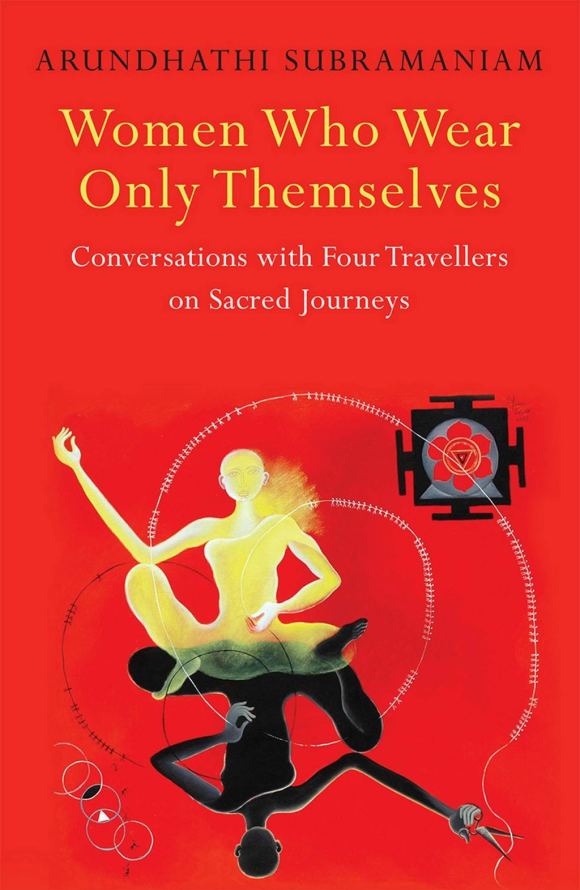
Women Who Wear Only Themselves by Arundhathi Subramaniam

Book Review by Bhaskar Parichha   

 Title: Women Who Wear Only Themselves

Author: Arundhathi Subramaniam

Publisher: Speaking Tiger Books, 2021
                                                                              

This is an unusual book–unusual because of the theme, approach and style. And when it comes from a skilled author, it ought to be still more engrossing. A tiny book of about two hundred pages but not so diminutive in its journey to profile four women — who are known little outside their small world of followers and who matter in the arena of spirituality. It is a melodious presentation.

Women Who Wear Only Themselves–Conversations with Four Travelers on Sacred Journeys’ by Arundhathi Subramaniam is prophetic, in-depth and counter-revolutionary.

Author of a dozen books of poetry and prose, Arundhathi is an award-winning author. Her most recent book is Love Without a Story. The Other books include an anthology of bhakti poetry, Eating God, and a book of essays, Pilgrim’s India. The Book of Buddha and the bestselling biography of a modern-day mystic, Sadguru: More Than a Life are also the talked about ones. Arundhati is widely known as a poetry editor, curator and critic. Her book, When God Is a Traveller, won the Sahitya Akademi Award 2020 besides being shortlisted for various other prizes.

Arundhathi’s book provides glimpses of four spiritual practitioners – Sri Annapurani Amma, Balarishi Vishwashirasini, Lata Mani, and Maa Karpoori — who unlike the chatty sadhus prominent on the social media, practice in isolation. Arundhati talks at length to these women of substance and in doing so, she gives some promise for the jaded souls. Besides, she looks for a gender-balancing act and tries to widen the circle of women spiritual leaders.

In a world where women have been seen traditionally as someone’s wife, mother, daughter, or sister, why would a woman choose to follow a spiritual path? Perhaps because, deep inside every woman has a longing to be someone in her own self, confident and in control.

In the last two thousand years, women have not fully used their spiritual power. Instead, aspects of the feminine have taken mainly symbolic forms from the Virgin Mary to the vestal virgins, from Earth Goddesses to the Shakti Devis. Women have been put on pedestals and worshiped on account of their purity or femininity; but have been excluded from religious activities and barred from entering places of worship.

In the present book, she talked to Annapurani Amma who left the safety of home and family to follow the summons of a long-dead saint (she lives naked but delivers prophecies.) Balarishi Vishwashirasini who was predicting futures ultimately transformed into a guru. Now in her thirties, she is a gifted teacher of nada yoga. Lata Mani, a respected academician in the US, was plunged into the path of tantra after a major accident left her with a brain injury. The fourth woman is Maa Karpoori, who had a rollercoaster ride that catapulted her from marriage to monkhood.

Writes Arundhathi in the Preface: “The primary motivation behind this book is simple. Thirst. Hopefully, a shared one. As a seeker, I have spent years thirsting for conversations. With spiritual teachers, with fellow travellers committed to the life of the spirit. I cannot complain. My life has been rich in conversations.

“I have had conversations with seekers of various persuasions. I have spent long hours listening to the yogi and mystic who later became my guru. I have eavesdropped on countless conversations with mystics in books — Shirdi Sai Baba, J. Krishnamurti, Ramana Maharishi, Nisargadatta Maharaj, Osho. I’ve even imagined the lapping waters of the Hooghly quieting to listen to the extraordinary exchanges between Ramakrishna Paramahamsa and his disciples. But another kind of thirst remained.”

So, what made her plan this book? “There was no crusading zeal that motivated this book. There was no schematic design. No spirit of advocacy. But there was a longing to listen to the voices of lesser-known women—women who choose to live in relative seclusion and shadow, and yet burn brightly. Women whom I met, accidentally, in the course of my own journey, and who generously allowed me a glimpse of their light. Something shifted within me after each of these chance encounters. I did not leave any of them unmoved.”

Arundhati doesn’t skip history: “The Indian spiritual landscape is not devoid of its women. We are routinely reminded of an illustrious litany: Maitreyi, Gargi, Andal, Karaikal Ammaiyar, Akka Mahadevi, Janabai, Muktabai, Bahinabai, Lal Ded, Rupa Bhavani, Gangasati, Meerabai. The list is long and varied. There are well-known figures in more recent times too, from the 20th-century mystics, Anandamayi Ma and The Mother of Pondicherry, to contemporary guru, Mata Amritanandamayi. Remarkable women. Beacons for many even today.”

 Says Arundhathi admittedly: “These women made no effort to impress. They were gracious enough to share their life journeys, without trying to flaunt their attainments, win recruits, or garner publicity. I am a seasoned listener, and instantly alert to subtle attempts to broker deals. There were no bargains being hatched here. I write about these conversations primarily because they were so remarkably free of agenda.

“My initial encounters with the women in this book were unplanned. I happened to have spent large swathes of time in southern India in the past decade, and so, not surprisingly, that is where these meetings happened. They are not meant to represent the religious plurality of the Indian subcontinent, although I do believe that they reveal the still-vanquished hospitality of vision that characterizes its spiritual ethos.”

While she is on the subject, her incredulity and concerns goes farther than the original remit: “The terror of uncertainty is more blazingly evident in our world than it ever has been. To carve a path between the certitudes of a frozen faith and the dogmas of arid materialism can be challenging. I marvelled at how these women held their own in a world so conceptually fragmented. A world that divides the material and the spiritual into such impermeable categories. How did these women tune into their own inner guidance? How did they come to terms with that simple but oddly elusive truth: that we are both flesh and spirit? That we do not have to masquerade as simply one or the other?”

Elevated or chastised, exonerated or condemned, the perturbation unworldly women in India face is that they have never been treated as equal to men as spiritual leaders. This lack of equality finds its roots not only in sociological and cultural systems, but more particularly at the levels of consciousness upon which spirituality and attitudes are finally based.

Interspersed with her own poems to uphold the content, the four conversations in the book are as fascinating as pathbreaking. Appropriate for an awakened reading!

.

Bhaskar Parichha is a journalist and author of No Strings Attached: Writings on Odisha and Biju Patnaik – A Political Biography. He lives in Bhubaneswar and writes bilingually. Besides writing for newspapers, he also reviews books on various media platforms.

.

Click here to read Arundhathi Subramaniam’s interview and poetry.

PLEASE NOTE: ARTICLES CAN ONLY BE REPRODUCED IN OTHER SITES WITH DUE ACKNOWLEDGEMENT TO BORDERLESS JOURNAL

Categories
Author Page

Aruna Chakravarti


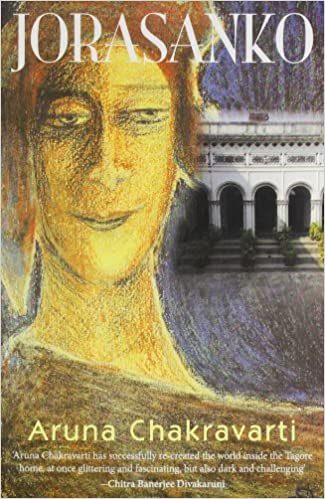
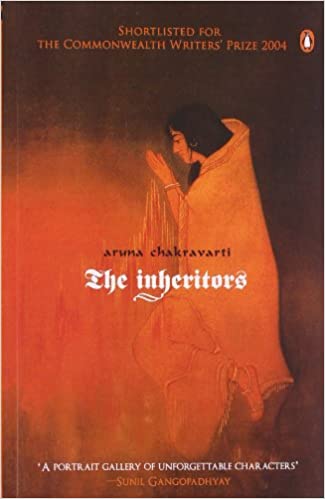
Aruna Chakravarti  has been Principal of a prestigious Women’s College of Delhi University for ten years. She is also a well-known academic, creative writer and translator with seventeen published books on record. They comprise five novels, two books of short stories, two academic works and eight volumes of translation. Her first novel The Inheritors (published by Penguin Random House) was shortlisted for the Commonwealth Writers’ Prize and her second, Jorasanko (published by HarperCollins India)received critical acclaim and also became a best seller. Daughters of Jorasanko, a sequel to Jorasanko, (HarperCollins India) has sold widely and received rave reviews.Her novel Suralakshmi Villa, published by Pan Macmillan Ltd under the Picador imprint, has been adjudged “Novel of the year (India 2020)” by Indian Bibliography published in The Journal of Commonwealth Literature U.K. Her latest work, The Mendicant Prince, a semi-fictional account of the Bhawal legal case, was released by Pan Macmillan Ltd, in July this year to widespread media coverage and acclaim. Her second book of short stories Through a Looking Glass: Stories has just been released by Om International Ltd.

Her translated works include an anthology of songs from Rabindranath Tagore’s Gitabitaan, Sarat Chandra Chattopadhyay’s Srikanta and Sunil Gangopadhyay’s Those Days, First Light and Primal Woman: Stories. Among the various awards she has received are Vaitalik Award, Sahitya Akademi Award and Sarat Puraskar.

She is also a script writer and producer of seven multi- media presentations based on her novels. Comprising dramatised readings interspersed with songs and accompanied by a visual presentation by professional artists and singers, these programmes have been widely acclaimed and performed in many parts of India and abroad.

Interviews

In Conversation with Aruna Chakravarti: Click here to read.

The Making of Historical Fiction: A Conversation with Aruna Chakravarti unfolds the creation of her latest novel, The Mendicant Prince, based on the prince of Bhawal controversy in the first part of the last century. Click here to read. 

Discussion

Rabindranath Tagore: A Universal Bard.

This conversation between Aruna Chakravarti and Sunil Gangopadhyay that took place at a Tagore Conference organised by the Sahitya Akademi in Kochy in 2011. Click here to read.

Translations

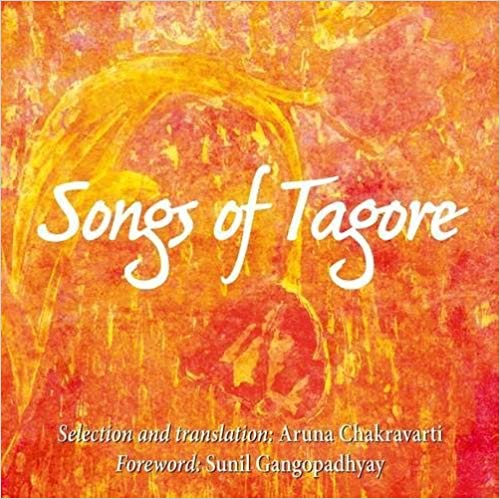
Songs of Tagore translated by Aruna Chakravarti

We launch our Tagore section with the translation of seven of his songs by the gifted Sahitya Akademi winning translator and author, Aruna Chakravarti. Click here to read.

  • Tomar eyi Madhuri Chaapiye ( This Loveliness of Yours…)
  • Jibon Moroner Shimana Charay ( Beyond the Horizons of Life and Death..)
  • Esho Shyamalo Shundoro ( Come, Dark, Beauteous One)
  • Asha Jaaoar Pother Dhare (By the Path)
  • Shopney Amar Money Holo ( I Thought in my Dream)
  • Amra Notoon Jibonyeri Doot (We are the New Youth)
  • Amar Bela Jey Jaay (My Day Wanes)

Janaganamana by Tagore (Lord of Masses, National Anthem of India) — complete version translated by Aruna Chakravarty at the end of the essay. Click here to read.

Abhagi’s Heaven

A poignant story by Saratchandra Chattopadhyay translated by Sahitya Akademi winner, Aruna Chakravarti. Click here to read.

The Witch

The witch is Aruna Chakravarti’s translation of a short story by renowned writer, Tarasankar Bandopadhyay . The original story titled, Daini, was first published in 1940 in Probashi magazine in Bengali. Click here to read.

Nagmati 

A story by Prafulla Roy has been translated from Bengali as Snake Maiden by Aruna Chakravarti. Click here to read.

Aparichita 

A short story by Tagore has been translated as The Stranger by Aruna Chakravarti. Click here to read. 

Musalmanir Galpa (A Muslim Woman’s Story)

A short story from Tagore has been translated from Bengali by Aruna Chakravarti. Click here to read.

Features

The Oral Traditions of Bengal: Story and Song by Aruna Chakravarti describes the syncretic culture of Bengal through its folk music and oral traditions. Click here to read.

Vignettes from an Extraordinary Life: A Historical Dramatisation by Aruna Chakravarti… Click here to read.

Book Excerpt

An excerpt from The Mendicant Prince (based on the Bhawal sannyasi case) by Aruna Chakravarty. Click here to read.

Tagore’s Last Birthday Celebration excerpted from Aruna Chakravarti’s Daughters of Jorasanko, has her translation of the last birthday song he wrote in 1941 a few months before he died. Click here to read.

Book Reviews

Reba Som has reviewed Aruna Chakravarti’s Through the Looking Glass: Stories. Click here to read.

Aruna Chakravarti reviews Golden Bangladesh at 50: Contemporary Stories & Poems edited by Shazia Omar. Click here to read.

Aruna Chakravarti reviews Devika Khanna Narula’s Beyond the Veil. Click here to read.

Categories
Review

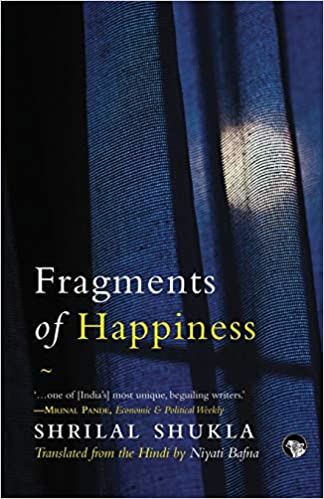
Fragments of Happiness

Book Review by Rakhi Dalal

Title: Fragments of Happiness

Author: Shrilal Shukla, translated from Hindi by Niyati Bafna

Publisher: Speaking Tiger Books, 2021

Fragments of Happiness is a translation of Shrilal Shukla’s novel, Seemayein Tootati Hain, originally published in 1973. Shrilal Shukla (1925 –2011) was a Hindi writer, notable for his satire. He has written more than 25 books and received the Jnanpith Award, the highest national recognition for writers (2011), the Padma Bhushan (2008) and the Sahitya Akademi (1969). Seemayein Tootati Hain has been translated to English by Niyati Bafna, who has studied translation under Arunava Sinha and is currently a student of Computational Linguistics pursuing an MSc in Prague as an Erasmus Mundus scholar.

In this novel, Shukla, widely known for his satire, weaves the story of a family struggling to come to terms with its reality in the aftermath of an unfortunate incident. Durgadas, a businessman based in Delhi, is convicted for a murder and is sentenced to life imprisonment. He has two sons and a daughter. His children believe in their father’s innocence. Over time, the brothers become convinced that the murderer is Vimal, their father’s partner and a long-time friend. The story is centred on the idea of their father’s innocence and the subsequent efforts of the brothers to find the real criminal. However, the book is not a murder mystery. It does not offer a solution to the impasse that the brothers Taranath and Rajnath seem to find themselves in. And it certainly is not a story which offers closure. Rather it is an exploration of the beliefs, opinions, and nature of its characters as well as of the dynamics of relationships shared by them. The author takes on a well-to-do family in early 1970s Delhi to track the trajectory of each character as they tackle the situation.

Taranath runs a college. Rajnath takes care of his father’s business. Their younger sister Chaand is a 23-year-old researcher in the field of Chemistry.  Rajnath’s thoughts and actions are dictated by his desire to restore the reputation of his family whereas those of Taranath to see his father happy. Chaand is more of a realist, who accepts the situation and is more focused upon her career and her personal life. Vimal, on the other hand, stands by the family through the trial of Durgadas and believes him to be innocent too. However, the zenith of the plot revolves around the relationship between Chaand and Vimal.

Mrinal Pande, an eminent author and journalist, dubs Shrilal Shukla as one of India’s most unique and beguiling writers. This is evident as the author treads ahead with the narrative that is crisp and advances effortlessly to portray remarkably the interplay between societal influences and individual opinions and behaviour. Speckled with spiritual and philosophical musings and satire, the narrative skilfully captures the subconscious of its characters. The characters are life-like, with their fears and insecurities governing their responses and actions. One of the most unpredictable characters is that of Julie, Vimal’s confidante and once a sex worker. She is taken aback when she comes to know of Vimal’s deliberate silence about his presence at the scene of murder in which Durgadas was convicted and adds she wouldn’t have done so in his place, that she would have spoken the truth. Vimal’s character remains beguiling till the very end, and it may unsettle some readers.

Also, quite notable in the novel is the depiction of early 70s Delhi. Connaught Place, its cafes, espressos, cinema, localities –flavours and sounds of old Delhi, reminiscent of a distinctive era that may tickle the senses of a reader. In carving the character of Chaand, the author portrays an independent woman who has the courage to make her life choices, is determined and not affected by the expectations of her family or friends. Her individuality parallels the rising class consciousness among women in early 70s which recognised the inequalities within power structures of family, tribe and region as well. With Taranath’s character, he addresses the question of religion and with that of Rajnath and his wife Neela, the restrictions imposed within the familial structures. We know next to nothing of the character of Durgadas, around whose conviction and sentence, the story is constructed. By making this choice, the author has consciously aimed to focus on recounting the ways in which different characters try to cope with adverse circumstances in their lives.

To translate such a distinctive novel by an acclaimed author from Hindi to English, while capturing the nuances of the language, is not an easy task. Bafna has done a commendable job. Although, those who have read the novel in Hindi may wonder at some points about the choices made by the translator, the overall experience is closer to reading the original work and is, definitely, a step forward in making the work reach diverse readers.

.

Rakhi Dalal is an educator by profession. When not working, she can usually be found reading books or writing about reading them. She writes at https://rakhidalal.blogspot.com/ .

.

PLEASE NOTE: ARTICLES CAN ONLY BE REPRODUCED IN OTHER SITES WITH DUE ACKNOWLEDGEMENT TO BORDERLESS JOURNAL. 

Categories
Editorial

New Beginnings

We wish all our readers and writers fabulous varieties of new year celebrations across Asia! We also complete one year and waft towards a new beginning. We have had some alterations as you know over the last few months — new faces on our board and writers in residence. Now, in addition to hosting writers from across all borders and ages, we have decided to also become an online forum for translated Tagore songs and writings. This will be launched on Tagore’s Birth Anniversary — 7th May. We hope that the transcreations in this section will take the treasures of the great writer and philosopher closer to the non-Bengali speaking populations from all over the world. We will try to retain the spirit of his poetry and attempt to recreate the impact of the Bengali verses for everyone who can read in English. We have already started with transcreations of about half-a-dozen of his songs. Do take a look and tell us what you think.

To celebrate our diverse new years, we have a musing by Sohana Manzoor. Did you know that Pohela Baishakh or the Bengali New Year is a national holiday in Bangladesh and is observed on the 14th of April each year?

A new year bodes a new beginning, a new sunrise and a new day — a new bunch of experiences. That is why our theme this time was new beginnings. What did we have in the beginning? Dylan Thomas tells us —

In the beginning was the word, the word 
That from the solid bases of the light 
Abstracted all the letters of the void; 
And from the cloudy bases of the breath 
The word flowed up, translating to the heart 
First characters of birth and death. 

On that theme of words, we have a fabulous poem by Balochi writer, Akbar Barakzai, who created a furore by turning down an award from the Pakistan Academy of Letters last year. His poem has been translated by Fazal Baloch. That is just one of the treasures. This time to celebrate this bouquet of new years across Asia, we have a bumper issue which includes, interviews with the 2020 Sahitya Akademi winner, Arundhathi Subramaniam, and academic-cum-writer Sumana Roy. Both poets have been kind enough to share a poem each with us. Arundhathi’s poem is inspiring and Sumana’s is a moving one about a tree, a tree that made history. We have powerful poetry from a number of other writers, Pushcart winner Jared Carter, Michael Burch, Sekhar Banerjee, Vatsala Radhakeesoon, Ihlwa Choi and of course our inimitable Rhys Hughes. Rhys has also started a column for us in which he will talk of poets, poetry and whatever else he chooses (within the confines of our magazine’s needs, of course). Our focus this year will shift even more towards quality of content.

In translations, other than Tagore songs and Baloch’s translations, we have Aditya Shankar’s translation of Malayalam writer, Shylan. A short story by Tagore from his famous collection Golpo Guchcho has been translated by Nishat Atya. To celebrate Tagore’s anniversary, we have essays by Meenakshi Malhotra and Sohana Manzoor too. Interestingly Sohana Manzoor’s essay has Tagore’s vision of Buddha — and Sumana Roy gave us a poem on the Bodhi tree, a tree under which the Buddha meditated his way to salvation!  Looking at the sad situation in Myanmar, we definitely have a need for reviving Buddhism, a theme that has been touched on by well-known film critic, journalist and translator Ratnottama Sengupta, in her ponderings on the Silk Route. Branching off from the journey across Asia towards Europe and moving up north to Siberia is a narrative from our spunky back packing granny, Sybil Pretious. She writes of her travels all the way to Lake Baikal!

Devraj Singh Kalsi suffered personal loss and has given us a poignant in memoriam on his mother. Mike Smith takes us on a memorable nostalgic journey with postcards from the past with stories that want to make you weep. There is more on memorabilia with a photo-essay by Nishi Pulugurtha and a photo-poem by Penny Wilkes (have you ever adventured with one of these?). Sunil Sharma tried out a playlet! The other exciting and new thing is Bhaskar Parichha has started a witty column with us. We are calling it Bhaskar’s Corner! I won’t tell you what about but do take a peek!

Books reviewed are Paro Anand’s Nomad’s Land by Nivedita Sen — a book on migrants, a theme which is there in the piece on silk route too; Rudolf C Heredia’s Reconciling Difference by Bhaskar Parichha and Candice Louisa Daquin has reviewed a book on cancer, The First Cell by Azra Raza. Our book excerpt is from a book on parenting, Raising a Humanist: Conscious Parenting in an Increasingly Fragmented World by Manisha Pathak-Shelat and Kiran Vinod Bhatia. An interesting read in a world of changing values. Our young person’s section run by Bookosmia owe a huge thanks to the untiring efforts of Nidhi Mishra and Archana Mohan. Thank you both. Thanks to the whole team for your immense support.

I have as usual not covered all the content in my note. I leave you to unfold the surprises! Much thanks to all our writers and readers for continuing to be with us!

Again, we wish you all a new beginning in our diverse new years!

Hope and happiness to you all!

Mitali Chakravarty

Categories
Editorial

Happy Birthday Borderless Journal🎉

A huge thank-you to all our contributors and readers across the world.

Borderless Journal has contributors from all the marked areas in the world map.

Borderless Journal was launched on March 14th, 2020, exactly one year ago, with eight published pieces from four countries. Today, we celebrate our journal’s year-old existence with more than six hundred publications online from 31 countries across the world. All this would not have been possible without the commitment of some very gifted writers. So, we have made a couple of additions to our ‘About Us’ — Writers in Residence and the Children’s Section Facilitator. We did this to express our gratitude to these excellent writers and the Children’s Section Facilitator, Archana Mohan of Bookosmia, for contributing pro bono to Borderless, selflessly and generously with words that enriched our journal. We plan to continue pro bono with goodwill as our only profit, giving our readers free, unpaid, advertisement-free access to excellent works.

In this first year, not only has our content grown but we have moved forward in our attempt to be a repository of quality writing in the virtual world. Translations of greats like Saratchandra Chatterjee, Tarashankar Bandopadhyay, Rabindranath Tagore, Bijan Najdi, Syad Zahoor Shah Hashmi and Nabendu Ghosh nestle along with writings by the moderns. We have published works by winners of the Sahitya Akademi award and the Pushcart along with that of novices. Our oldest contributor was born in 1924 and the youngest, in our young persons’ selections, was four years old.

Values and issues taken up by writers across time have often been similar. At Borderless, we look for writing that breaks borders, not so much of techniques but of issues that affect our civilisation. We want to create a flood of positive values that will deluge the world’s negatives, help to usher in an era of development, tolerance, love and peace. We are often told that this is unrealistic. But when have ideals and utopias ever been based on realism? And yet they changed the world over a period of time. We would not have the wheel or the fire if cave dwellers had not imagined them.  Borderless hopes to walk untrodden paths. Our journal also aspires to respond to the calls made by youngsters for a better Earth, to explore and store samples of human excellence for posterity, and to support attempts to improve the future of our species.

As a part of our celebrations, we are also announcing two books, constructed with selected content from Borderless. Bookosmia is bringing out a book from the children’s section, thanks to both Nidhi Mishra and Archana Mohan. For our adult contributors and readers, we are also announcing a second book stocked with some of the gems we have collected over the year. We are in conversation with a publisher. Once that is finalised, we will announce the book on social media.

This month, we had given the theme of ‘as mad as a March hare’ and aliens were invited to contribute. That resulted in some fantastic poetry from Rhys Hughes and Vatsala Radhakeesoon and also from one of our Contributing Editors, Michael R. Burch. Rhys has given us a funny story poem about an alien who tickles our sensibilities. Our poetry section only improves with Michael’s touch. We have poetry again from Pushcart winner Jared Carter, Tom Merrill, Ihlwa Choi, and new writers like Vijayalakshmi Harish and Shraddha Arora.

We carry a translation of a well-known poet from Nepal, Krishna Bajgai. Aditya Shankar translated a Malayalam poem about violence against women by young Krispin George. It is a powerful poem and an excellent translation that sets the tone for the month hosting the International Women’s Day. That the protest is voiced by men is also significant, especially in a world where margins need to blend into a single united shout against all injustices. While the poem critiques a crime, the translated prose shows how despite violations and oppressions, humankind have progressed.

A short story by Tagore’s sister, Swarnakumari Devi (1855-1932), one of the first female editors of the Tagore family journal and one of the earliest progressive women of the nineteenth century, has been translated by Chaitali Sengupta. Juxtaposed to the story by Swarnakumari Devi which was perceived as an act of defiance against the voicelessness imposed on women in a patriarchal set up, we have an unusual reflection translated by the noted filmmaker and journalist, Ratnottama Sengupta. Written in Bengali by Sandhya Sinha (1928-2016) the piece, while being an in-depth analysis of Arabian Nights, is an emphasis on how women progressed within the century to become independent, intellectual, thinking entities beyond the bounds set on them by outmoded norms. Thus, while the prose showcases how much women have progressed, the poetry contribution by young Krispin George and Aditya Shankar reflects how men and women are now united in their struggle for justice. We have indeed come far from the biases inherent in Rudyard Kipling’s poem, ‘Mandalay’, which was written after Swarnakumari Devi had already started writing and working against such divisive mindsets. Historically, we have moved forward.

A literary essay by Mike Smith tries to explore a new paradigm. He ponders if a short fiction by the first émigré Nobel Laureate from Russia, Ivan Bunin, could have been a precursor to flash fiction. We have experimented with a photo essay by Penny and Michael Wilkes. Some lovely photographs of the sea can also be found in the slice of life sent to us from Australia by Meredith Stephens. In Travels with the Backpacking Granny, Sybil Pretious takes the readers to the slopes of the Kiliminjaro with her 63-year-old self. Devraj Singh Kalsi in Musings of the Copywriter gives us his perception of creativity and madness – which you might say go hand-in-hand when you think of Vincent Van Gogh cutting off his ear and F Scott Fitzgerald who along with his wife, Zelda, suffered from depression. Kalsi gives the subject a satirical twist to explore if insanity can be substituted as medals of honour by a writer instead of ‘bits of metal’ that subscribe to more conventional concepts of fame and sanity. It is a fun read!

One of my favourite essays is by Debraj Mookerjee, who has shown how when West meets East, greatness blooms. He takes on giants like Tagore, Tolstoy, Emerson and many more. Reflecting the thoughts of one of these giants mentioned in the essay, is a book on the socio-political thoughts of Tagore where the author, Bidyut Sarkar, who is also the Vice Chancellor of Vishva-Bharati University and an erudite scholar, states: “Tagore stayed away from the hurly-burly of national politics. Despite sharing the nationalistic condemnation of the colonizer, Tagore never allowed this restrictive vision to cloud his concern for human emancipation.” Bhaskar Parichha has done an excellent review of the book.

Sutputra Radheye’s poetry collection from the Delhi Slam has been reviewed by Rakhi Dalal and Suzanne Kamata’s Indigo Girl has been reviewed by Gracy Samjetsabam. Indigo Girl is a novel that breaks cultural borders and norms to find love through a part-Japanese-part-American’s journey, with lessons learnt from a survivor of the Tohoku Tsunami in March 2011, where more than 15,500 died, a disaster that also led to the Fukushima nuclear plant melt down. The economic losses were estimated at $235 billion and people continue to be impacted by the decade-old disaster to this date. Indigo Girl, thus, is a celebration of mankind’s survival against multiple odds. It builds bridges across differences and disasters, a story of hope and friendships, values cherished in a borderless world.

We have an interesting excerpt from a book I really enjoyed, a collection of short stories that challenge man-made constructs, A Sense of Time and Other Stories. The author whom we interviewed, Anuradha Kumar, has 31 books with publishers like Hachette India to her credit, plus two Commonwealth awards and more. The other interview also stretches geographical bounds drawn by politicians. An American translator who lives in Thailand and translates from Japanese to English, Avery Fischer Udagawa, speaks to about her journey. Finding literature and bridging borders with translations is a recurrent theme in Borderless.

A number of stories that again look for the unusual can be found in this issue. I would like to mention an interesting one from Jessie Michael of Malaysia exploring blind beliefs, ‘Orang Minyak or The Ghost‘, while Sunil Sharma gives us a story that I will let you explore yourself. Sara’s Selections, showcasing a selection of writing from Bookosmia, adds to our oeuvre.

As usual, I have mentioned a few but not all of our content, which remains tempting.

I hope all of you will continue to enhance our writing and publishing experience by patronising our site and reading us regularly. Please do share our posts with your friends and family. We continue a family-friendly journal.

Again, a huge thanks and warm congratulations to the Borderless team and to all our fabulous contributors. We value each one of your pieces. Thank you.

To all our readers, welcome to our world and thanks for being with us and inspiring us to aspire for more. We have readership from more than 130 countries across the world.

Looking forward to the next lap of our journey –

Mitali Chakravarty

Borderless, March, 2021

Borderless Journal is read in more than 130 countries across the world.
Map Courtesy: WordPress
Categories
Review

Ray’s Goopy Bagha Revisited

Book Review by Nivedita Sen

Title: The Adventure of Goopy the Singer and Bagha the Drummer

Author: Upendrakishore Ray Chowdhury, translated from Bengali to English by Tilottama Shome. Illustrations by Sayan Mukherjee.

Publisher: Talking Cub, an Imprint of Speaking Tiger Books, 2020.

Upendra Kishore Ray Chowdhury’s name was well-known as an innovative children’s writer, painter, musician, photographer and a pioneer printer-publisher in the late nineteenth century. His grandson, Satyajit Ray, immortalized his long short story for children ‘Goopy Gyne Bagha Byne’ as a reputed film that deployed a lot of music, dancing and fantasy elements.

This graphic version of the story, particularly its musical score that was penned and directed by Satyajit Ray himself, had almost obliterated the children’s tale that was a household word in Bengal earlier. Since it is a story about two naïve, rustic boys who desperately try to be a singer and a drummer respectively, Satyajit Ray worked on and elaborated the musical potential of the story by writing lyrics for songs that could be sung by Goopy, with Bagha’s drumming as accompaniment. The songs like Dekho re Nayan Mele ( Opening Your Eyes and Look), Bhuter Raja Dilo Bor (The King of Ghosts Grants a Wish) and Maharaja Tomare Selaam (Salute to you Maharaja) have been all time favourites for the last fifty years. The two sequels to the film, Hirak Rajar Deshe (Hirak King’s Kingdom) and Goopy Bagha Phire Elo (Goopy Bagha Return) were written by Satyajit Ray himself, although the latter was directed by Ray’s son Sandip Ray. The innocuous Bengali story therefore surfaced on the celluloid screen, and then extended through sequels to follow the adventures of Goopy and Bagha through time.

The status of an internationally acclaimed film also enabled the story to traverse across space by getting translated in different languages, particularly English. Among recent translations are those by Swagata Deb (Penguin, 2004) and Barnali Saha (Parabaas, 2012). Perhaps in order to communicate a different tone and emphasis, in this one, Tilottama Shome took up another translation. She has stuck to each and every word of the original. Although Upendrakishore’s stories have been translated by well-known scholars, editors and translators like William Radice, Madhuchhanda Karlekar and Arunva Sinha, this translation is also very fluent. The use of casual vocabulary in English that is used on a daily basis, like ‘vocal warm-ups’, ‘country bumpkins’ and ‘spooked’, add to the readability of it. The illustrations by Sayan Mukherjee, which include a lot of the ghosts, is brilliantly evocative of the ghostly fun and frolic in Ray’s film.

The story, which is something between a folk tale, a benign ghost story and a fantasy around a realistic setting with two ingenuous protagonists, has many violent episodes. Most of Bengali children’s folk-fairy tales like those in Dakshina Ranjan Mitra Majumdar’s Thakurmar Jhuli portray such unpleasant interludes, which is not different from Grimms’ or Hans Andersen’s Fairy Tales depicting brutal human behavior and blood and gore. Such violence and deaths go back to the earliest children’s stories, possibly to equip children with the overpowering truth that is an important, if an unsavoury, aspect of life. The violence becomes an indispensable component of children’s stories, since children need to be aware of what they might confront in the real world.

Bruno Bettelheim, a psychologist who tried to read fairy tales in terms of Freudian psychoanalysis, said that children need to be exposed to fairy tales with grim episodes in them. He demonstrated that these dark happenings, fantastic as they may be, expose and initiate the child to real life that is inclusive of the ruthless and the arbitrary and contribute to children’s holistic understanding of life. In this story, when Bagha goes home, he finds that his parents have died in the interim he was away. Goopy’s parents remain alive, perhaps to signify that deaths in real life are ubiquitous, imminent but random. But there is greater cruelty than death in children’s stories.

According to Ernest Jones, Sigmund Freud’s biographer and a psychoanalyst in his own right, the savagery in children’s stories represents expressions of the unconscious mind like the jealousy and hostility inherent within family relationships. He elaborated how abstract moral concepts like anger, fear and guilt are ‘physicalized’ and ‘externalized’ in children’s tales to enable children to conquer them. Also, after acknowledging these harsher primal feelings and instincts, the child gets to make sense of what is happening all around.  Goopy and Bagha’s boat loses balance and capsizes due to their cacophonous singing and drumming, causing the passengers to tremble and roll around. This drowns and kills all the passengers except the two of them who are also terrified but keep afloat by clutching on to Bagha’s drum. But Gidwitz, a twenty first century children’s writer, explains how violence is deployed as a didactic tool to reinforce the moral certainty of good triumphing over evil, which must be punished. For example, in another episode where the garden house of the king is burnt down by the guards in accordance with royal injunctions, everyone who was responsible for proactively setting fire to the house dies but Goopy and Bagha, who are inherently good,  escape with the help of their magic boots.

Goopy Gyne is also a ghost story with a difference. Ghosts appear in such a story within a realistic backdrop, not by invoking them or within a supernatural setting, but out of the blue. They also do not haunt an individual human being, a particular place/ house or a specific object, and are therefore aliens who are removed as suddenly as they appear from the forest in which they are discovered, after they have performed their task. They are not characters who take part in the narrative.

Goopy and Bagha initially get panic-stricken on seeing the glowing eyes of the ghosts that are like burning coal and their radish-like teeth. However, these are not the spirits of the dead that have revived to take revenge or to try to fulfill their unfulfilled desires in life. These ghosts continue to act as external agents who empower the two friends, much like the fairy godmothers in fairytales who grant boons to the protagonists and rescue them from perilous situations.

The terror that these ghosts have the potential to invoke is one that instead becomes a pleasant experience because Goopy and Bagha learn very soon that these spirits are extremely generous. The film is also enlivened with the scene with the ghosts. The narrative describes a curious reversal in which Goopy and Bagha are themselves mistaken as ghosts, thanks to all the miraculous scenes associated with their magical powers.  But their achievement of raining delicacies and sweets, their accoutrements in looking like princes or the magic episodes of the two friends fleeing from any difficult situation with the help of their enchanted boots is actually an outcome of the three wishes granted to Goopy and Bagha by the ghosts. The ghosts are responsible for bestowing melody and rhythm to Goopy and Bagha’s music that used to be tuneless, jarring and noisy before.

The music in the story is wholly their contribution, something that has been underscored by Satyajit Ray in delightful compositions in the film. It might, in fact, be a pioneering enterprise, copyright permitting, to translate the screenplay that includes the songs.

Nivedita Sen is Associate Professor in English at Hansraj College, University of Delhi. She works on Bangla children’s literature, and has translated authors like Tagore, Sukumar Ray, Asha Purna Devi, Leela Majumdar and others for Harvard University Press, Vishwabharati Press, Sahitya Akademi, Katha, Tulika and more.

.

PLEASE NOTE: ARTICLES CAN ONLY BE REPRODUCED IN OTHER SITES WITH DUE ACKNOWLEDGEMENT TO BORDERLESS JOURNAL. 

Categories
Interview

In Conversation with Aruna Chakravarti

Sahitya Akademi winner Aruna Chakravarti

A woman who weaves stories from the past, from history, from what has been and makes them so real that they become a part of ones’ own existence – this has been my experience of Dr Aruna Chakravarti and her writing. A winner of the Sahitya Akademi award for her translation of Sarat Chandra’s Srikanta, Vaitalik award and Sarat Puraskar, Chakravarti was the principal of a prestigious women’s college of Delhi University for ten years. She is also a well-known academic, creative writer and translator with fifteen published books. Her novels JorasankoDaughters of JorasankoThe Inheritors have sold widely and received rave reviews. Jorasanko and its sequel are based on the women in the household of Rabindranath Tagore. Jorasanko is one of the best and most impactful books I have read in my life and with a flavour of realism that transports you into that era. The focus on the strength that resided in women trapped with a set of patriarchal values in colonial India is amazing and attractive. Suralakshmi Villa, her latest novel which was released at the start of 2020, is also modelled on a woman from the past as she will reveal in this exclusive interview.

You are a multiple national award- winning writer. At a point you stopped writing. Why?

I had started writing during my childhood and had continued to do so through my school days happily and unselfconsciously. I wrote poems, short stories and even tried my hand at a novel. But when I joined the English Honours course in college and was introduced to the academics of literature; when I learned the principles of criticism and picked up the ability to distinguish good writing from mediocre, a change came over me. I suffered from a loss of self-worth. I felt I was not and could never be a good writer. Self-criticism is good but unfortunately it worked adversely for me. I convinced myself that my work was imitative and lacking in merit. From that time onwards I stopped writing.

When did you take up writing again? Did your translations come first?

It happened nearly twenty- five years later. Yes, my translations came first. The cycle of negative feelings about my writing, to which I had strapped myself, broke in a miraculous way. The year was 1982.  At a chamber concert of Rabindra sangeet, in which I was taking part, a Gujarati gentleman from the audience made a request. He asked if one of the participants could translate the songs that were being sung so that non-Bengalis, many of whom were present, could understand the words. Since I was teaching English in a Delhi University college at the time, all eyes turned to me. I was horrified. To be called upon to translate a literary giant like Rabindranath Tagore, that too his lyrics, without any preparation whatsoever, would have daunted anyone leave alone me with my record of diffidence and self-doubt. But to my own shock and bewilderment, I agreed. The rest is history. There was a publisher in the audience who offered to bring out a collection of Tagore songs in translation. That was my first publication. Tagore: Songs rendered into English came out in 1984. Though the publisher was practically unknown, the book created waves in literary circles. Other translations followed. Srikanta by Saratchandra Chattopadhyay and later Those days and First Light by Sunil Gangopadhyaywere published by Penguin India. I also picked up a number of awards.

It was Sunil Gangopadhyay who advised me to try my hand at creative writing. After some hesitation I did so. My first novel The Inheritors was accepted by Penguin India and published in 2004. After it was shortlisted for the Commonwealth Writers Prize, I found the courage to write more.

You were the Principal of a Delhi University college. Did your work impact your writing?

No strangely enough it didn’t. My creative inspiration never drew from my experience as a Principal. I was dealing with women from a younger generation. I was privy to their concerns, their joys and sorrows, their fears and aspirations.  I understood their psychology. Yet I never wanted to write about them except in a tangential way. As part of a larger context. For me the present failed to provide the spark that kindled my creative imagination. That came invariably from some past memory. In a strange way the past seems more meaningful to me than the present.

But my role as an administrator helped me in another way. Office work is dry and prosaic. But it is worthwhile work. And, much as I felt good doing it, I looked forward intensely to the end of the day when I could doff my Principal’s hat and don my writer’s one. And, having indulged myself by writing till late into the night, I was ready to take up my work schedule the next morning. The two interests sustained each other and created a balance.

Why did you translate the writers? What did you learn by translating them? Did it impact your own story telling or knowledge base?

My first translation, as I’ve just explained, was commissioned. But I would not have taken up the offer if I didn’t consider the original work a significant contribution to Bengali literature. My other books were self-chosen. For me the most important consideration when taking up a translation project has been the literary value of the piece. I had to enjoy the process of translation and could only do so if I thought the subject worthwhile. And, yes, I learned a lot. I learned how lyricism could be infused into prose from Rabindranath. I learned how to write with brevity and precision from Saratchandra and the art of simple, direct, almost colloquial communication with the reader from Sunil Gangopadhyay. The process also intensified my interest in Bengal and the evolution of its society, literature and culture. I was enthused to read and learn more.

Some awards nowadays ask for applications from authors. Did you apply for your awards? Did you work towards getting an award?

No. This is the first time I’m hearing that authors can apply for awards. I thought that was the publisher’s job. As for working towards getting an award — no, I’ve never even thought of it.  Networking is a totally alien term for me. I admire people who can do it perhaps because I, myself, have very little skill at it. Whatever recognition has come my way has come as a surprise. I feel some of the books that have brought me awards didn’t deserve them. On the other hand, the ones that I think should have attracted them, didn’t do so. However, I suppose writers aren’t always the best judges of their work. Assessment of quality should be left to critics.

How long does it take you to churn out a book?

In the case of novels, it depends on the amount of research that has to go into it. For example, Jorasanko took nearly three years. But Daughters of Jorasanko was completed in a year and a half. That’s because most of the research had been done already. Translations take less time depending on the length. Srikanta, Those Days and First Light, took about two years each. The shorter ones The Way Home, Primal Woman and On the Wings of Music were done in less than a year.

Were your novels Jorasanko and Daughters of Jorasanko impacted by your translation of Tagore? Did having done the translations help?

I suppose it did… at some level. Some of the lyricism and emotionally charged quality of Rabindranath’s language must have seeped into my consciousness while doing the translation. But its manifestation is present not only in the Jorasanko series. It is there in all my writing. The Inheritors is suffused with a Tagorean kind of heightened sensibility. So is Suralakshmi Villa.

In your latest novel Suralakshmi Villa you have drawn a very independent woman in the last century — so independent that it would be difficult to find people similar to her in today’s world. Is she modelled on a real person?

I had heard of such a woman from a colleague of mine. The lady, a relation of my friend’s, belonged to a conservative South Indian Brahmin family of Chennai. A few years after her marriage she abandoned her husband and infant son, for no apparent reason, left Chennai and started teaching in an obscure village school. This was way back in the twenties when such an action was unheard of. She never came back. But that was all I knew. I had never met her or heard anything more about her. My imagination provided the rest. So, the answer to your question is both Yes and No. Suralakshmi has been modelled on someone I have heard of. That too only in partial context.

The Inheritors was based on your own family’s past if I’m not mistaken. What kind of research went into it? How long did it take you to write the book?

You are right. The Inheritors is a semi-fictional reconstruction of life as lived by previous generations of my paternal ancestors. Though names have been changed, many of the characters are drawn from real people. Most of the events, too, are located in family history. Not all though. Some are purely fictional. Since everything I wished to describe happened before I was born, it has all been seen through the light of the imagination.

To answer your query about research–there was a lot of primary reading involved. But I had been doing that for years before I took up the project. The ambience was provided by my reading of the classics. Rabindranath, Saratchandra, Bankimchandra, Bibhutibhushan, Tarashanker and many other writers provided sketches of rural life in the 19th and early 20th centuries, all of which were invaluable to my understanding of how life was lived in a Bengal village at the time.

I had very little real material to rely on barring faint memories. Anecdotes heard from my parents, uncles and aunts. Family legends passed down the generations. But I did visit my ancestral village a couple of times. I was shown the house in which my forefathers lived, the location of the Adi Ganga — now extinct, and the temple, Vaidyanath Mandir, which bore the name of the village in an inscription on a terracotta tablet above the door. I also managed to get hold of a family tree, dating from our earliest known ancestor Srikrishna Tarkapanchanan, and an ancient map of the area.

It took me about a year and a half to do the actual writing.

Both in Jorasanko and Suralakshmi Villa, you have strong heroines. Can you tell us if you are doing so with an intent?

Well, I do believe that women of the past had a lot of inherent strength. Most of them kept it hidden because that is how patriarchal society liked its women. Silence and obedience were highly rated qualities and most women abided by family and societal expectations. Some, of course, were exceptionally ahead of their times and displayed courage and independence even at the risk of upsetting the applecart. But even those who were apparently meek and subservient were seen to display enormous inner reserves of strength at a time of crisis. I have shown both kinds in my novels.

What are your future plans? When can we expect a new novel?

I am working on something but it is still in the initial stages. The pandemic has made travelling impossible so field work has had to be postponed. It is too early to share details and impossible to tell when the work will see the light of day.

This has been an online interview conducted by Mitali Chakravarty.

Click here to read more by Aruna Chakravarty.

.

PLEASE NOTE: ARTICLES CAN ONLY BE REPRODUCED IN OTHER SITES WITH DUE ACKNOWLEDGEMENT TO BORDERLESS JOURNAL