Categories
Review

Six of Cups

Book Review by Gowher Bhat
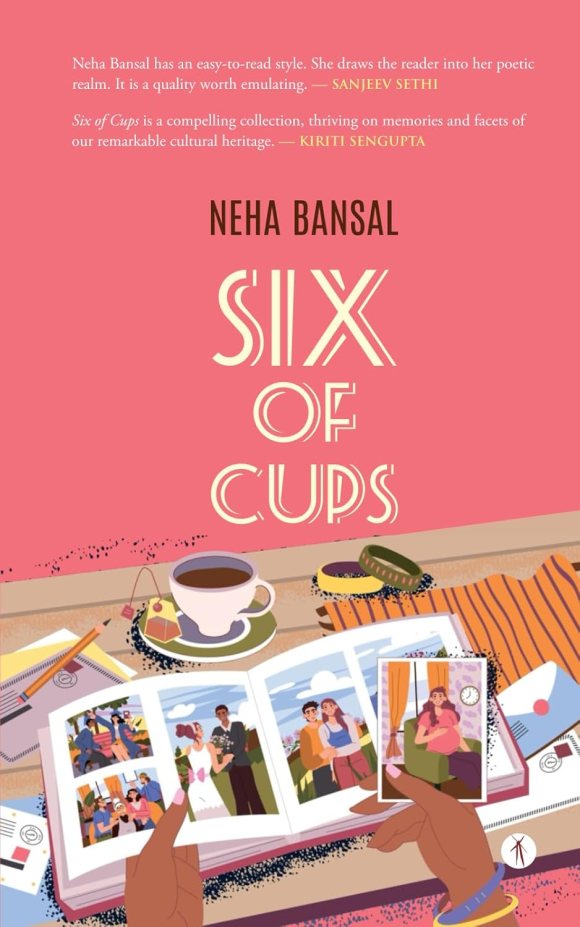
Title: Six of Cups

Author: Neha Bansal

Publisher: Hawakal Publishers

Some books speak in metaphors. Some shout their brilliance. Some want to be dissected, reviewed, analysed like puzzles. But Six of Cups isn’t that kind of book. It doesn’t ask you to do much. It just wants you to sit with it.

Neha Bansal’s poems don’t pretend. They don’t try to be clever. They don’t need you to clap. What they ask for is something quieter — your stillness, maybe. Your memory. They speak softly. Almost like they’re afraid of waking something in you. And maybe that’s exactly what they do.

This is a collection of fifty poems. Simple on the surface. But like most simple things, they carry weight. Not the kind that crushes. The kind you forgot you were holding until you’re reminded.

Reading Six of Cups is like finding an old sweater at the back of your closet. You didn’t even know you were missing it. But the moment you hold it, you’re somewhere else. In another time. Another house. Another life.

The title itself comes from the tarot — a card about childhood, nostalgia, kindness, innocence. The poems live in that space. They revisit things that aren’t just personal, but also collective such as homemade meals, festivals, sibling fights, old TV serials, chalk-smeared hands, and monsoon evenings. There’s a familiarity here that doesn’t feel manufactured. You don’t get the sense that Neha Bansal is trying to be nostalgic. She just is.

There’s a poem about Doordarshan[1]. It doesn’t try to explain the significance. It just takes you there — back to the old wooden cabinet TV, the warm static before the signal settled, the family crowding around the screen. It doesn’t say much and yet it says everything.

‘Sibling Squabbles’ is a small miracle. It captures that strange love we carry for the ones who shared our roof, our food, our secrets. The kind of love that includes shouting, pushing, sulking. But also defending each other, silently. Even now.

‘Paper Boat’ and ‘Mint Chutney’ — two more standouts don’t indulge in poetic imagery. Instead, they lean into the senses. The tartness of raw mango on your tongue. The wet smell of monsoon earth. The steam of evening tea. You read them and you’re not just reading. You’re smelling things. Tasting them. Hearing the old kitchen door creak open.

Neha Bansal is an Indian Administrative Services officer. It’s an unexpected background for a poet, maybe. Bureaucracy is about order. Poetry, one imagines, is about chaos. But in these poems, there’s order in the chaos. There’s discipline, but not rigidity. Every word is chosen carefully. Nothing feels excessive. Nothing is wasted. She writes like someone who listens closely to the world, to people, to memory. Maybe that’s what makes her poetry so honest. Her poems for people who’ve lived. People who remember the smell of their mother’s shawl. People who know the comfort of routine — boiling milk, folding bedsheets, watching Ramlila in the open field. They’re for the ones who’ve carried small hurts for years and never said a word.

There’s a kind of sacred quiet in this collection. That might be its most remarkable trait. In a time when poetry is often loud, performative, and built for clicks, these poems resist the noise. They’re not dramatic. They don’t climax. They settle in. They let silence speak.

In one of the most moving pieces, Neha Bansal writes about an old family tradition — Janmashtami, the celebration of Lord Krishna’s birth. But it’s not about religion. It’s about her grandmother drawing tiny footprints with rice flour. The quiet anticipation of the festival. The waiting. The softness of belief, not its spectacle. It’s in those tiny footprints that the poem finds its magic. You can almost see them fading slowly on the tiled floor.

These poems understand that memory is not a highlighted reel. It’s a soft murmur. A drawer that squeaks when you open it. A spoon stirring something warm. A phrase you haven’t heard in years but still know by heart. Neha Bansal knows that nostalgia isn’t about grandeur. It’s about the details we almost miss.

Her form is mostly free verse. But that doesn’t mean it’s careless. She knows how to pause — where to breathe. The white space around her lines isn’t empty. It holds meaning. A kind of emotional residue. You finish a poem, and it doesn’t end. It lingers. Like the scent of someone who just left the room.

There’s no poetic ambition here and that’s its strength. These poems don’t ask to be poetry. They just are. And that’s why they work. You trust them. You feel at home in them.

I thought of my own home while reading these pages. Kashmir. The long winters. My grandmother in her worn pheran, roasting cornflakes and walnuts on an old iron tawa, her hands, cracked and slow. The hush of mornings. No urgency. Just living.

That’s what Six of Cups reminded me of — the art of simply being. And how much that art is vanishing now.

Some poems mention festivals like Lohri, Janmashtami, Diwali. They present them as they are — domestic, lived-in, full of ordinary magic. For those unfamiliar, there’s a glossary at the end. But the real understanding happens not through translation, but emotion. Neha Bansal doesn’t lean on metaphor much. And when she does, it’s light. A passing breeze, not a storm. She doesn’t build complex imagery. But she does ask you to notice. In a world of scrolling, skimming, glancing — she’s saying, “Stop. Look. Listen.”

Even the titles of her poems have that simplicity: ‘Old Shawls’, ‘Grandmother’s Halwa’, and ‘First Rain’. They sound like diary entries. And in a way, they are. Only they’re not just her diary — they become ours too.

The brilliance of Six of Cups is that it democratises poetry. It makes it accessible again. You don’t need a theory. You need memory. You need feeling. That’s it. If you’ve ever missed someone or some place or even some version of yourself — you’ll get this.

And maybe that’s the beauty of it. It doesn’t want to be studied. It wants to be remembered. Like an old friend. Like a childhood street. Like a scent you can’t name but know in your bones.

The last poem in the collection doesn’t try to wrap everything up. There’s no neat ending. It just… fades out. The way light fades at dusk. Slowly. Gently. Without warning.

You close the book and feel something that isn’t quite sadness. It’s quieter than that. Maybe it’s the feeling of being seen. Or the feeling of remembering something small that meant something big. You sit with it for a while. You let it settle.

Six of Cups is not a loud voice. It’s a warm room. A soft light. A hand reaching back, not to pull you into the past, but to remind you it’s still with you. That you are made of it.

And maybe that’s what poetry should be sometimes — not a performance but a presence.

[1] Official Indian TV channel

Gowher Bhat is a published author, columnist, freelance journalist, and educator from Kashmir. He writes about memory, place, and the quiet weight of things we carry. His work often explores themes of longing and belonging, silence and expression. He believes the smallest moments hold the deepest truths.

PLEASE NOTE: ARTICLES CAN ONLY BE REPRODUCED IN OTHER SITES WITH DUE ACKNOWLEDGEMENT TO BORDERLESS JOURNAL

Click here to access the Borderless anthology, Monalisa No Longer Smiles

Click here to access Monalisa No Longer Smiles on Amazon International

Categories
Musings of a Copywriter

Taking Stock…Finally

By Devraj Singh Kalsi

Reading stories of investors with the foresight to invest in the right kind of stocks that created wealth for them is truly motivational as it showcases their bravery. Without much technical data to support their decision-making decades ago, it is rather difficult to believe the sound fundamental homework they conducted before tossing their hard-earned money into the choppy seas of equity markets.

The sight of a charging bull on the road is certainly a fearful sight, but the bullish run on the bourses warms the cockles of the heart when you read your money has fetched four-fold, multi-bagger returns in just a few months and you wish to plough back the profits and stake the capital on another dark horse that only you know can pull off a major rally that takes all financial experts for a ride. You really wish God to whisper the name of the stock that can make you a billionaire and save you from the struggles and uncertainties of a writer’s life.

Not all writers churn out best-sellers to get hefty paychecks from publishers and there aren’t too many maharanis or dowagers left to sponsor an indulgent lifestyle in exchange of literary companionship.

Stock market, despite all the risks, offers a window of opportunity for writers to build a retirement corpus. There needs to be a smart sense of investing to get a rocking portfolio that draws envy from experts who wonder how this non-financial wizard operates. If profit is indeed imagination, writers are also entitled to imagine it in abundance.

Optimism and positive outlook is important as the stock market is similar to life in many ways. You have to be patient and stay invested for long term as those who saw their wealth perish during the recession of 2008 without suffering a heart attack were able to bounce back with double their earnings in just a decade. This is the most recent story of stock market success that is read out as a template to every investor who thinks it is the place to gamble away all you are left with.

The story of recovery is supported by facts and the financial experts give credible example of a modest investment of how a few thousands has given over fifty times in certain stocks and this makes you determined to try your luck when the EMI[1] lifestyle fails to leave behind much for you. Driven by the greed to grow wealth manifold, middle-class families now talk of mutual funds, IPOs, and shares. Homemakers and students also invest some amount in blue-chip shares to fund their lifestyle needs. With the share market giving handsome returns consistently, hopes are high that 2024 will repeat the successful rally seen in the previous year.

With elections lined up, the aspect of volatility is a concern. With nations going to war like having a tournament, nobody knows how this year is going to pan out. But the strong fundamentals of the economy and a robust banking system fuel hopes that even if it is a slower than expected, it would still be a good year for the stock market indices. The fear of another recession does not intimidate the small investor or the big player as diversification mitigates the risks involved. He continues to park his funds in the leading sectors promising double-digit returns.

For a salaried middle-class householder, the stock market makes it easy to meet the growing demands of his family without stress. Greed is no longer a bad word and a better option than trying out foul means to fund big dreams. This paradigm shift in the mindset is the biggest achievement in a decade.

Now you hear parents proudly declare they have bought blue chip shares of the best companies and leading banks to ensure higher education and marriage of their kids. With stocks entering the life of the new generation, the older generation is also forced to do a rethink. The liberalised economy with a huge market size is not going to make the banks fail. With retail banking turning out to be more attractive than corporate banking, with housing and car loans growing, it is most unlikely they will crash. The instances of recent bail-out by the government further cements the faith of investors.

Buy business class tickets with stock market gains and go for a holiday trip abroad. Relish the experience of five-star exotic dining with family and friends. Everything is possible if you scoop up a big chunk of profit by selling your shares. You do not mind spending it as the windfall gain came sparkling just like your Diwali bonus to sponsor your fancy outings. The ‘live for the day’ mantra makes people free from guilt as they know they have not wasted their hard-earned money but sponsored the treat with the profit earned from the stock market. Some divine force collaborates and delivers lucrative returns to make life a roller-coaster ride for you!

When it comes buying consumer durables, a similar mindset prevails. The stock option is the best way to bring home a smart LED or a side-by-side refrigerator by utilising the profit from the shares to avoid the pocket pinch. Meeting the rising aspirations, ranging from branded apparel to gadgets and luxury watches to durables, in the times of inflationary market trends without banking on a salary hike is quite within the realm of possibility.

Exercising prudence and displaying the tendency to create wealth for the long term, even if the shares do not deliver positive returns in the short term, there is always the scope to deny you have put it in the wrong basket and keep boasting that the fundamentals are strong and your research analysis says the chosen stock would soar twenty times after a decade of staying investing to deliver windfall gains. It is most comforting to forget the investment and continue with the journey to buy profitable stocks instead of mourning over the lost opportunity. Such is the philosophy of life that matches with the snakes and ladders kind of movement of stock indices. One has to move ahead in life and look forward to better times instead of mulling over the wrong choices and decisions made in the past.

When you see your driver or the housemaid trading in shares and offering you tips regarding the best picks for the day, it is time to realise you are a late entrant in a market that has already broken the class barriers with commendable success.

[1] Equated Monthly Instalment

Devraj Singh Kalsi works as a senior copywriter in Kolkata. His short stories and essays have been published in Deccan Herald, Tehelka, Kitaab, Earthen Lamp Journal, Assam Tribune, and The Statesman. Pal Motors is his first novel.  


PLEASE NOTE: ARTICLES CAN ONLY BE REPRODUCED IN OTHER SITES WITH DUE ACKNOWLEDGEMENT TO BORDERLESS JOURNAL

Click here to access the Borderless anthology, Monalisa No Longer Smiles

Click here to access Monalisa No Longer Smiles on Kindle Amazon International

Categories
Review

‘Burradin’: An Indian Christmas

Book Review by Somdatta Mandal

Title: Indian Christmas: Essays, Memories, Hymns

Editors: Jerry Pinto and Madhulika Liddle

Publisher: Speaking Tiger Books

We all know that Christmas Day, the night that Jesus came to earth, bringing with him peace and love for all humanity, is celebrated by Christians all around the world with great enthusiasm and merriment. Interestingly, for a multicultural country like India, Christmas is equally celebrated — not only as a religious festival but also as a cultural one. For a country where less than three percent of the population is Christian, the central celebration is the birth of a child, but it takes on new meaning in different Indian homes.  Known in local parlance also as “Burradin”[big day] Indians from all classes and communities look forward to this day when they can at least buy a cake from the local market, shower their children with stars, toys, red Santa caps and other decorative items, and go for a family picnic for lunch, dine at a fancy restaurant or visit the nearby church. This syncretic cult makes this festival unique, and for Jerry Pinto and Madhulika Liddle editing this very interesting anthology comprising of different genres of Indian writing on the topic – essays, images, poems and hymns, both in English and also translated from India’s other languages is indeed unique.

In his introduction which he titles “Unto All of Us a Child is Born,” Jerry Pinto reminisces how he was surprised when he saw his first live Santa Claus. He was a figure in red that Akbarally’s, Bombay’s first department store, wheeled out around Christmas week. “He was a thin man, not very convincingly padded… seemed to be from my part of the world, someone who would climb up our narrow Mahim stairs and leave something at the door for us at three or four a.m., then take the local back to his regular job as a postman or seller of second-hand comics. The man in the cards and storybooks preferred London and New York. And a lot of snow. … Today, it is almost a cliché to say that Christmas, like every other festival, is hostage to the market.”

The other editor, Madhulika Liddle in her introduction “Christmas in Many Flavours” states, “According to the annals of the Mambally Royal Biscuit Factory bakery in Thalassery, Kerala, its founder Mambally Bapu baked the first Christmas cake in India”.  It was way back in 1883, at the instance of an East India Company spice planter he set about trying to create a Christmas cake. Liddle wondered what that first Christmas cake tasted like; how close it was to the many thousands of cakes still baked and consumed at Christmas in Kerala? She also writes about the situation in India, where instead of wholesale and mindless importing of Christmas ideas, the people have been discerning enough to amalgamate all our favourite (and familiar) ideas of what a celebration should be and fit them into a fiesta of our own.


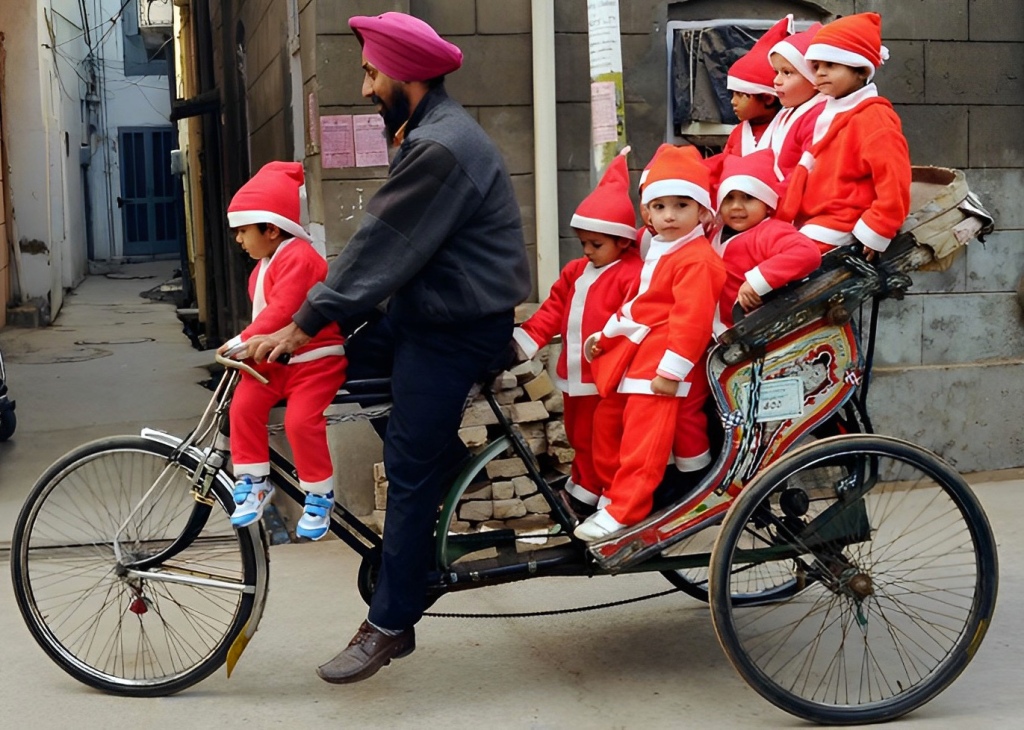
Images from Indian Christmas: Essays, Memories, Hymns: dressed up as Santa Claus leave for school in Punjab. (Picture courtesy: Ecocabs,Fazilka).

There are several other aspects of Christmas celebrations too. The Christmas bazaars are now increasingly fashionable in bigger cities. The choral Christmas concerts and Christmas parties are big community affairs, with dancing, community feasts, Christmas songs, and general bonhomie. Across the Chhota Nagpur area, tribal Christians celebrate with a community picnic lunch, while many coastal villages in Kerala have a tradition of partying on beaches, with the partying spilling over into catamarans going out into the surf. In Kolkata’s predominantly Anglo-Indian enclave of Bow Bazar, Santa Claus traditionally comes to the party in a rickshaw, and in much of northeast India, the entire community may indulge in a pot-luck community feast at Christmas time. Thus Liddle states:

“Missionaries to Indian shores, whether St Thomas or later evangelists from Portugal, France, Britain, or wherever brought us the religion; we adopted the faith, but reserved for ourselves the right to decide how we’d celebrate its festivals.”

Apart from their separate introductions, the editors have collated twenty-seven entries of different kinds, each one more interesting than the other, that showcase the richness and variety of Christmas celebrations across the country. Though Christianity may have come to much of India by way of missionaries from Europe or America, it does not mean that the religion remained a Western construct. Indians adopted Christianity but made it their own. They translated the Bible into different Indian languages, translated their hymns, and composed many of their own. They built churches which they at times decorated in their own much-loved ways. Their feasts comprised of food that was often like the ones consumed during Holi or Diwali.

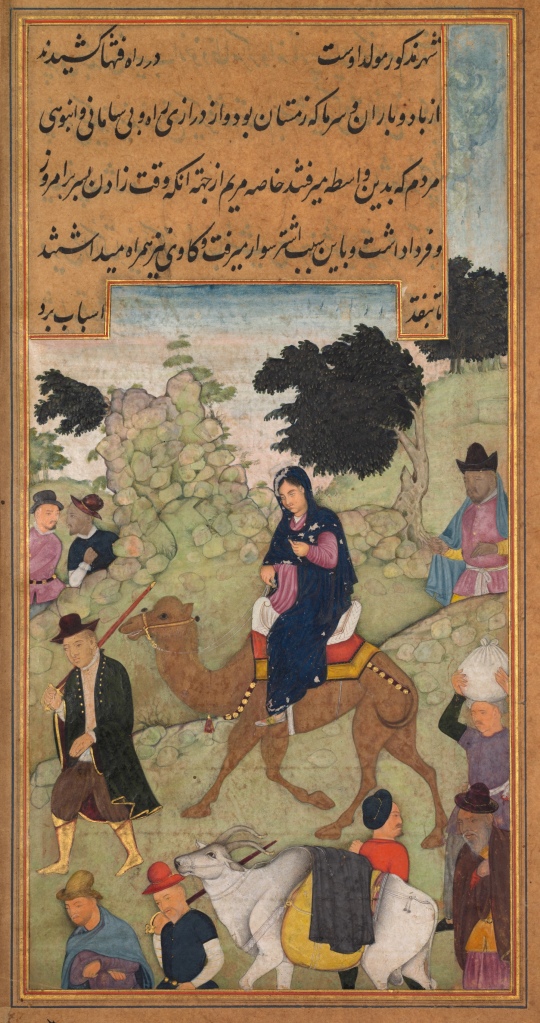
Thus, Christmas in India turned to a great Indian festival that highlighted the syncretism of our culture. Damodar Mauzo, Nilima Das, Vivek Menezes, Easterine Kire, Hansda Sowvendra Shekhar, Nazes Afroz, Elizabeth Kuruvilla, Jane Borges and Mary Sushma Kindo, among others, write about Christmas in Goa, Nagaland, Kerala, Jharkhand, Delhi, Kolkata, Mumbai, Shillong and Saharanpur. Arul Cellatturai writes tender poems in the Pillaitamil tradition to the moon about Baby Jesus, and Punjabi singers compose tappe-boliyan about Mary and her infant. There are Mughal miniatures depicting the birth of Jesus, paintings by Jyoti Sahi and Sister Claire inspired by folk art, and pictures of Christmas celebrations in Aizawl, Bengaluru, Chennai and Kochi and these visual demonstrations enrich the text further.

Interestingly, the very first entry of this anthology is an excerpt from the final two sections of one of Rabindranath Tagore’s finest long poems, inspired by the life of Jesus Christ. Tagore wrote the poem “The Child” in 1930, first in English and translated it himself into Bengali the following year, titling it “Sishutirtha.” But many years even before that, every Christmas in Santiniketan, Tagore would give a talk about Christ’s life and message. Speaking on 25 December 1910, he said:

“The Christians call Jesus Man of Sorrow, for he has taken great suffering on himself. And by this he has made human beings great, has shown that the human beings stand above suffering.”

India celebrates Christmas with its own regional flair, its own flavour. Some elements are the same almost everywhere; others differ widely. What binds them together is that they are all, in their way, a celebration of the most exuberant festival in the Christian calendar.

Apart from the solemnity of the Church services, there is a lot of merrymaking that includes the food and drink, the song and dance. The songs often span everything from the stirring ‘Hallulujah Chorus’ to vibrant paeans sung in every language from Punjabi to Tamil, Hindi to Munda, Khariya and Mizo tawng.

Among the more secular aspects of Christmas celebrations are the decorations, and this is where things get even more eclectic. Whereas cities and towns abound in a good deal of mass decorating, with streets and public places being prettied up weeks in advance, rural India has its own norms, its own traditions. Wreaths and decorated conifers are unknown, for instance, in the villages of the Chhota Nagpur region; instead, mango leaves, marigolds and paper streamers may be used, and the tree to be decorated may well be a sal or a mango tree. Nirupama Dutt tells us how since her city had no firs and pines, she got her brother’s colleague to fetch a small kikar tree as kikars grew aplenty in the wild empty plots all over Chandigarh. In many entries we read about how Christmas decorations were rarely purchased but were cleverly constructed at home.

A very integral part of the Christmas celebrations of course is music. In many Goan Catholic neighbourhoods, Jim Reeves continued to haunt the listeners in his smooth baritone: “I’ll have a blue Christmas without you/ I’ll be so blue thinking about you/ Decorations of red on a green Christmas tree/ Won’t mean a thing, dear, if you’re not here with me.”  Simultaneously, the words and music of “A Christmas Prayer” by Alfred J D’Souza are as follows: “Play on your flute/ Bhaiyya, Bhaiyya/ Jesus the saviour has come./ Put on your ghungroos/ Sister, Sister/ Dance to the beat of the drums!/ Light up a deepam in your window/ Doorstep, don with rangoli/ Strings of jasmine, scent your household/ Burn the sandalwood and ghee,/ Call your neighbour in, smear vermillion/ Write on his forehead to show/ A sign that we are one/ Through God’s eternal Son/ In friendship and in love ever more!/ Ah! Ah!” But the most popular Christmas song was of course “Jingle bells, jingle bells, jingle all the way….”

In “Christmas Boots and Carols in Shillong”, Patricia Mukhim tells us how the word ‘Christmas’ triggers a whole host of activities in Meghalaya and other Northeastern states that have a predominantly Christian population. Apart from cleaning and painting the houses, everything looks like fairyland during Christmas, a day for which they have been waiting for an entire year. She particularly mentions the camaraderie that prevails during this time:

“Christmas is a time when invitations are not needed. Friends can land up at each others’ homes any time on Christmas Eve to celebrate. Most friends drop by with a bottle of wine and others pool in the snacks and the party continues until the wee hours of morning. It’s one day in the year when the state laws that noise should end at 10 p.m. is violated with gay abandon. …Shillong [is] a very special place on Planet Earth. Everyone from the chief minister down can strum the guitar and has a voice that could put lesser mortals to shame. And Christmas is also a day when all VIPism and formalities are set aside. You can land up at anyone’s home and be welcomed in. It does not matter whether someone is the chief minister, a top cop, or the terrifying headmistress of your school.”

One very significant common theme in all the multifarious entries is the detail descriptions provided on food, especially the makeshift way Christmas cakes are baked in every home and the Indian way meat and other specialties are being prepared on the special day. There are several entries that give us details about the particular food that was prepared and consumed at the time along with actual recipes about baking cakes. “Christmas Pakwan[1]” by Jaya Bhattcharji Rose, “The Spirit of Christmas Cake” by Priti David, and “Armenian Christmas Food in Calcutta” by Mohona Kanjilal need special mention in this context.  Liddle in her introduction wrote:

“Our Christmas cakes are a reflection of how India celebrates Christmas: with its own religious flair, its own flavour. Some elements are the same almost everywhere; others differ widely. What binds them together is that they are all, in their way, a celebration of the most exuberant festival in the Christian calendar.”

Later in her article “Cake Ki Roti at Dua ka Ghar[2],” the house where they lived in Saharanpur, Uttar Pradesh, she wrote how her parents told her that ‘bajre ki tikiyas’, thin patties made of pearl millet flour sweetened with jaggery, used to be a staple at Christmas teatime at Dua ka Ghar[3], though she has no recollection of those. She of course vividly recalls the ‘cake ki roti’. This indigenisation of Christmas is something that’s most vividly seen in the feasting that accompanies Christmas celebrations across the country. While hotels and restaurants in big cities lay out spreads of roast turkey (or chicken, more often), roast potatoes and Christmas puddings, the average Indian Christian household may have a Christmas feast that comprises largely of markedly regional dishes.

In Kerala, for instance, duck curry with appams is likely to be the piece de resistance. In Nagaland, pork curries rich in chillies and bamboo shoots are popular, and a whole roast suckling pig (with spicy chutneys to accompany it) may hold centre stage. A sausage pulao, sorpotel and xacuti would be part of the spread in Goa, and all across a wide swathe of north India, biriyanis, curries, and shami kababs are de rigueur at Christmas.

This beautifully done book, along with several coloured pictures, endorses the idea of religious syncretism that prevails in India. As a coiner of words, Nilima Das came up with the idea that ‘Christianism’ in our churches is after all, a kind of ‘Hinduanity’ (“Made in India and All of That”). This reviewer feels guilty of not being able to mention each of the unique entries separately that this anthology contains, so it is suggested that this is a unique book to enjoy reading, to possess, as well as to gift anyone during the ensuing Christmas season.

[1] Cuisine

[2] Cake bread

[3] Blessed House

Somdatta Mandal, critic, academic and translator, is a former Professor of English at Visva-Bharati, Santiniketan, India.

Click here to access an excerpt of Tagore’s The Child

PLEASE NOTE: ARTICLES CAN ONLY BE REPRODUCED IN OTHER SITES WITH DUE ACKNOWLEDGEMENT TO BORDERLESS JOURNAL

Click here to access the Borderless anthology, Monalisa No Longer Smiles

Click here to access Monalisa No Longer Smiles on Kindle Amazon International

Categories
Slices from Life

Belongingness and the Space In-Between

By Disha Dahiya

Humans are in a perpetual state of motion — be it intercity, interstate, or inter-country — and the relentless quest to assimilate commences. Embracing a new culture, blending seamlessly with the locals, and adopting regional slangs and accents become daily endeavours. In this race without a finish line, a persistent anxiety takes hold. “What if I don’t quite fit in?” “Will people forever perceive me as an outsider?” “Could I lose touch with my roots?” Trust me, this apprehension intensifies when one immigrates to a foreign land.

The inner conflict of belonging experienced in transcultural migrations casts light on the concept of cultural dysphoria. When I first encountered this term, it piqued my interest in how individuals navigate their daily lives while carrying this weight. Cultural dysphoria, a recent term, is an extension of the concept of dysphoria. EverydayFeminism defines cultural dysphoria as: “…the dissonance between the societal expectations for an individual’s broad cultural performance or identity and their desired embodiment of that culture, or uncertainty about where they fit into cultural categories.”

In simpler terms, someone experiencing cultural dysphoria feels like an alien in a new culture. They grapple with the space between two distinct cultures. While their mind urges them to embrace the tenets of the new cultural paradigm, their heart insists on preserving their native cultural heritage.

It was only recently that I comprehended how the concept of cultural dysphoria applied to both me and my family. This understanding took nearly two decades to crystallise, but as the adage goes, “better late than never.” Such realisation would not have dawned upon me without the pursuit of my Ph.D. thesis. Over time, I delved into novels penned by first-generation South Asian American writers such as Chitra Banerjee Divakaruni, Amulya Malladi, Naomi Munaveera, and Bapsi Sidhwa. These authors were born in South Asian countries and subsequently migrated to America. Their literary works often delve into the challenges faced by immigrant families in a foreign land. Reading allows us to explore the world, but essays and books also furnish a window through which we can empathise with someone’s narrative. Nevertheless, one’s own story offers a distinct and nuanced perspective. Indeed, first-hand experiences yield unique vantage points.

I was a mere eight-years-old when my father obtained Canada’s Permanent Residency Card, and our journey towards establishing roots in a foreign land began. As a second grader, comprehending that you’re about to traverse over 7,000 miles is no small feat. At times, the gravity of such a situation eluded me. On other occasions, I found excitement in the impending turbulence. It was exhilarating, even though questions like ‘why are we relocating?’ and ‘why must I leave my school?’ continually lingered in my mind, spanning the distance from Delhi to our future home in Calgary.

This is the nature of belongingness – it doesn’t instantaneously manifest if you’ve have never before contemplated the possibility of residing in a country far removed from your homeland. The initial step in transcultural migration involves recognition, transcendence, and integration. One must acknowledge the reality of transcending boundaries, leaving behind their original cultural heritage, and stepping foot in a foreign land with its own distinct cultural tapestry. I refer to this stage as ‘Acceptance’, as it encompasses a multitude of thoughts regarding one’s capacity to accept and be accepted within this new environment.

For my family, the journey of assimilation began the moment we exited YYC Calgary International Airport in November 2006. A friend of my maternal uncle’s son welcomed us—a network woven through connections—a common phenomenon in Indian culture. Connecting with familiar faces, who then introduce you to others, and this chain keeps expanding, is deeply ingrained in our cultural fabric. From being surrounded by individuals of a different ethnicity to grappling with the nuances of time zones, my family sought to adapt to our new Canadian milieu. Isn’t it peculiar how one day you’re in the tranquility of your home, and the very next day, you soaring through the skies, crossing international borders?

Recalling the sequence of events surrounding our immigration, nearly two decades later, is no simple task. Much has evolved, particularly my perspective on life. What once seemed normal has shifted, no longer aligning with my current perceptions. This is the natural progression of personal growth – forgetting, reminiscing, comprehending, and de-constructing. Each emotion makes sense in hindsight, guided by wisdom acquired over time.

At times, we relegate certain emotions to the shadows of our heart. We normalise the experience of residing in the in-between and the accompanying sense of non-belongingness, presuming it to be an idiosyncrasy. However, South Asian diaspora members share these particular sentiments of the in-between. We accept our role as outsiders among the locals, convinced that this is the way it should be, right?

Navigating the new environment while endeavouring to retain a strong connection to one’s roots becomes paramount when relocating to a foreign country. A part of me yearned to return to India to celebrate the Festival of Lights with those left behind, while another part was eager to explore innovative ways of preserving our culture and traditions amidst the bustling streets of a land predominantly inhabited by individuals of a different ethnicity.

During those years, Canada had not yet become the Mecca for Indian students pursuing higher education, as it is today. The immigrant community consisted mainly of those who had relocated in the ’70s or ’80s in pursuit of a brighter future for their children. Consequently, the Indian community was relatively smaller.

The question of belongingness emerged from as early as my first day at school. Where does one truly belong in a classroom of over twenty students with varied ethnicity? Among these students, four were of Indian descent, two hailed from Pakistan, one each from Australia and France, while the remainder were Canadian natives. Yet none of these students were unequivocally ‘Indian.’

The logical assumption might be that I belonged with the group of four Indian-origin students. However, this was not the case because, fundamentally, I was Indian. A subtle distinction lies between being Indian and being of Indian origin. It wasn’t a matter of passports; it ran deeper. I was too Indian to seamlessly integrate with non-Indians and just slightly more Indian than those of Indian origin. I existed as an ‘other’ amidst the ‘others,’ with the four Indian-origin students occasionally amused by my Indian accent. Emerging from a decent background, having received education in a convent school, initiating casual conversations with a simple ‘hey, what’s up?’ was effortless. Yet, adopting a foreign accent was not within my purview. My peers of the same age knew precisely when and how to employ phrases like ‘screw it,’ ‘for God’s sake’, I’m not interested,’ and ‘nahhhh…’ The only phrase that came to mind whenever I wished to express my lack of interest was ‘it doesn’t matter’. As a non-native English speaker, it was the most apt phrase I could muster. Apparently, seamless alignment in terms of accent, language, and communication is pivotal to establishing friendships in a foreign land. Failure to do so results in being cast aside as an outsider.

The nagging thought that permeated my family’s collective consciousness during those early days in Canada was this: Do we belong here among people who do not perceive us as one of themselves? We had successfully traversed the initial stage of transcultural migration. Consequently, the second stage — which I’ve labelled ‘Non-belongingness’ — became a pivotal moment, shedding light on our lack of alignment with both people of Indian origin and non-Indians. Our cultural identity remained a poignant question mark, casting a shadow over our Canadian experience.

For my father, commuting to work entailed a daily two-hour journey to and from his workplace. Occasional weekend outings, mostly for groceries, marked the extent of our excursions. Indian suits were my mother’s customary attire, but how long would that persist? After a few months, she transitioned to wearing jeans and long shirts. While Indian suits exude grace and elegance, she lamented the difficulty of blending in. “Passing by a row of foreigners while wearing a salwar kameez is a daunting task; one becomes the subject of unwarranted stares,” she confided. Her eyes betrayed a longing for the life she left behind in India, where she could choose her favourite salwar kameez and embellish it with the most exquisite dupatta in her wardrobe without attracting undue attention. I sensed her yearning for India, particularly when my maternal grandfather — whom I affectionately called Nanu — phoned. Each call filled her with joy, and her countenance radiated even more than usual. Perhaps Nanu sensed her yearning to return, which manifested as glistening tears on my mother’s cheeks.

Life in Canada was a far cry from what it used to be in India. As Diwali approached, I eagerly anticipated the deluge of sweets and gifts that would typically inundate our home in India. However, that year, those customary tokens of celebration were conspicuously absent, a stark reminder that we had yet to establish a substantial social network in Canada. Everything had changed. People in Canada appeared disinterested in the Festival of Lights. It was just another day for them. Some were engrossed in preparations for Christmas, while others seemed oblivious to the existence of Diwali, India’s most eagerly awaited festival. With no candles adorning our home, no gifts to fuel our excitement, and nothing resembling the grandeur of an Indian Diwali, our spirits plummeted upon realising that we had yet to sever our emotional ties to our culture. It was a perplexing sensation. While I yearned to embrace the festivities of Christmas, the absence of enthusiasm for Diwali contrasted starkly with my Canadian expectations. I believe my parents experienced a similar sentiment because on that day, an uncharacteristic sombreness shrouded our smiles. We smiled for each other, but the glint in our eyes bespoke our longing for our true home, India.

In this narrative, where did we truly belong? Some may argue that we belonged where we resided at that moment, while others might reflect on their immigrant experiences and ponder their sense of belonging. This is where the bitter realisation of cultural dysphoria takes root. The inability to fully integrate into a foreign land, the feeling of being an outsider, and the disconnect between cultural expectations and reality culminate in a dysphoric sensation, marking the onset of the third stage in an individual’s transcultural migration journey. At this juncture, it becomes imperative to recognise that while certain aspects of one’s former culture must be relinquished, others must be preserved. I refer to this third stage as the ‘In-Between.’

The third stage of the transcultural migration experience delineates the unique space an individual occupies, betwixt and between two cultures. As immigrants, we embraced certain facets of the new culture while shedding some of our own, and vice versa, to carve out a niche that could accommodate and harmonise both cultures. Within this ‘In-Between,’ a new persona emerged. We remained too Indian for the world outside, yet our hearts affirmed it was for the best.

That year in Canada unfolded with a plethora of surprises. And then, we returned to India. But that’s a story for another essay!

The feeling of cultural dysphoria is far from uncommon. A majority of migrants grapple with the turmoil of cultural conflicts when transitioning to a new country. While this narrative offers a glimpse into how transcultural migrations can affect an individual, there exist countless other stories waiting to be shared with the world. In the area of transcultural migration, each thread tells a unique story, and my narrative is but one strand in this rich fabric of human experience. As my family and I navigated the in-between of two cultures, I am reminded that our journey is a testament to resilience, adaptability, and the enduring power of cultural identity. While the road may be fraught with challenges, the experience has imbued us with a profound appreciation for new cultures. Cultural dysphoria may cast its shadow, but it also offers a canvas for personal growth and understanding. It is my hope that by sharing our story, we illuminate the path for others embarking on similar journeys and foster a deeper understanding of the intricate web of the transcultural in-between.

Disha Dahiya is a PhD Research Scholar in English Literature. She has a keen interest in exploring the South Asian narrative across borders and boundaries while focusing on the cultural aspect of transcultural migrations.

.

PLEASE NOTE: ARTICLES CAN ONLY BE REPRODUCED IN OTHER SITES WITH DUE ACKNOWLEDGEMENT TO BORDERLESS JOURNAL

Click here to access the Borderless anthology, Monalisa No Longer Smiles

Click here to access Monalisa No Longer Smiles on Kindle Amazon International

Categories
Halloween Greetings

Ghosts, Spooks & Spirits of the Night Arise…

Halloween returns, bringing back memories of trick or treating with children collecting candies, celebrating — celebrating perhaps to get over the fear of darkness, the unknown or perhaps, even the experience of global disasters ? The Bengali equivalent of Halloween — Bhoot Chaturdashi — was celebrated a day before Diwali. And as people do up ‘haunted homes and dress as witches, zombies and ghosts, I wonder, why do we celebrate such dark festivals and also enjoy them?

Perhaps, the answer is given in an essay by Candice Louisa Daquin that we have a gene that helps us enjoy such occasions… And then there is always the necessary adjunct of ghost stories and spooky rhymes that makes us feel ooky as our hearts beat and nervous snots of laughter explode from chests beating in anticipation…Wafting on borderless clouds that float mysteriously on Halloween nights, we invite you to visit a few spooks, ghosts, goblins, witches and spirits…

Poetry

It’s Halloween by Michael R Burch… Click here to read.

Horrific Humour by Rhys Hughes… Click here to read.

Prose

My Christmas Eve “Alone” : Erwin Coombs has a ghostly encounter at night. Is it real? Click here to read. 

Flowers on the Doorstep :Shivani Shrivastav writes of an encounter with a mysterious creature in Almora. Click here to read. 

A Curse: San Lin Tun gives us a macabre adventure with malicious spirits lurking in a jungle in Myanmar. Click here to read.

Pothos: Rakhi Pande gives us a macabre story set in Singapore that borders on the supernatural? Click here to read.

I Grew into a Flute: A Balochi Folktale involving the supernatural retold by Fazal Baloch. Click here to read.

Categories
Greetings from Borderless

Illuminate the World…

“Light festive lamps, make bright the night,
Shine your own lights, illuminate the world.”

— Tagore’s Autumnal Nights, translated by Professor Fakrul Alam
Courtesy: Creative Commons

Celebrating and reinforcing the victory of the human spirit over darker forces is a cathartic experience in a world reeling under the impact of senseless wars, depression and economic crises. While the Earth too upheaves changes to create new lores, we draw comfort from the perpetuation of rituals that have solaced us over centuries. These festivals are celebrated in different ways across the world on different days. But, the festival of lights has become a major one, celebrated by a diaspora across all continents. The rituals were varied but the celebrations include lighting of lamps across the board.

The Combat of Rama and Ravana (late 18th century) Courtesy: Creative Commons

Lamps were lit to celebrate Rama’s return home after destroying darker forces as Diwali among North Indians. Among those from the South and West, it was the victory of Krishna over demon Narakasur that warranted the celebration of Deepavali. And yet those from the East, celebrate Kali’s victory over the rakshasas with lamps, sparklers and prayers. The Jain and Buddhist communities also have their special observances on this day.

To bring to you a flavour of these festivals, we have writings by Farouk Gulsara from Malaysia on the celebration of Deepavali during his childhood; Debraj Mookerjee on Kali Puja celebrations in his ancestral home and a sample of Bibhutibhushan’s stories on the darker tantric practices — intrinsically linked to the worship of Kali along with Basudhara Roy’s review of the translation of his book by Devalina Mookerjee.

We begin our selection to jubilate this festival of lights with a translation of Tagore’s poem on light and another by Mike Smith.

Poetry

Tagore’s Paean to Light. Click here to read.

Last Lights by Mike Smith. Click here to read. 

Prose

In Dim Memories of the Festival of Lights, Farouk Gulsara takes a nostalgic trip to Deepavali celebrations in the Malaysia of his childhood. Click here to read.

In Vignettes of Life: Unhurried at Haripur, Debraj Mookerjee revisits Kali Puja in his ancestral home. Click here to read

Basudhara Roy reviews Taranath Tantrik and Other Tales from the Supernatural by Bibhutibhushan, translated from Bengali by Devalina Mookerjee. Click here to read.

An excerpt from Taranath Tantrik and Other Tales from the Supernatural by Bibhutibhushan, translated from Bengali by Devalina Mookerjee. Click here to read.

Categories
A Wonderful World

Where “Divides of Class, Religion & Ethnicities Collapse”

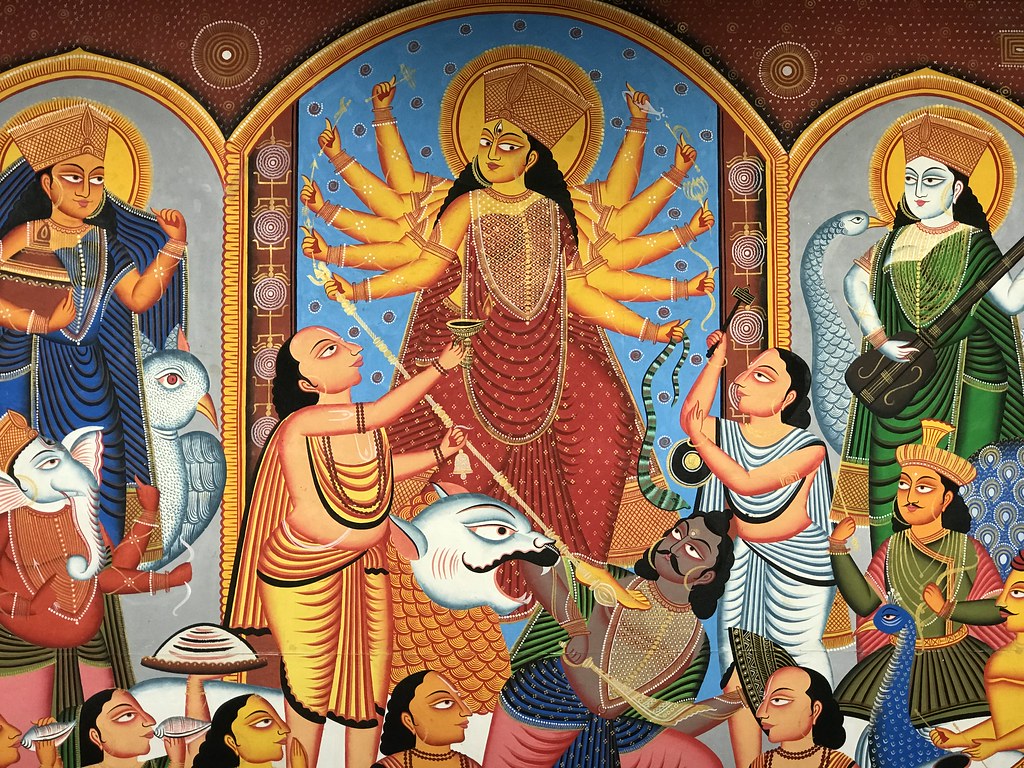
Painting of Durga Puja. Courtesy: Creative Commons
Wherever I look, a golden light 
Suffuses a vision of holidays,
The festive sun rises in the woods
Of puja* blossoms drenched in gold rays. 
             -- Tagore, Eshechhe Sarat

This has been a favourite poem of many who grew up reading Tagore, lines that capture the joy and abandon of the spirit that embodies the celebration of Durga Puja, a festival that many Bengalis deem as important as Christmas, Chinese New Year, Diwali or Eid. It is a major celebration in Bengal and large parts of the sub-continent, though not in all parts.

The reason that reviving the lore associated with this fiesta has become very important is that it centres around women. Given the situation in Iran, where the battle over how to wear headscarves has turned bloody, murderous and violent, celebrating an empowered woman, even if mythical, takes precedence over all else. Mythology has it that Durga was empowered by weapons given to her by various deities, all of who were men, and then, she did what all the male Gods failed to do — destroyed a demon called Mahisasur. Rama too prayed to Durga for victory around this time. And on Bijoya Doushami, the last day of the Durga Puja, some celebrate Rama’s victory over Ravana and call it Dusshera or Dashain.

Taking up this theme of the narratives around Durga Puja and how it has been made into an “Intangible Cultural Heritage of Humanity” by UNESCO is Meenakshi Malhotra’s essay on the festival. Part of the citation reads: “During the event [Durga Puja], the divides of class, religion and ethnicities collapse….” 

To bring to you a flavour of the Puja, we have translations of poetry by Tagore describing the season and of a poet who was writing before Rabindranath, Michael Madhusdan Dutt, by Ratnottama Sengupta, verses exploring the grief of parting Durga’s mother expresses as her daughter returns to her husband’s home. This is also a festival of homecoming for, like Durga, those living far from their homes return to the heart of their families. Rituparna Mukherjee has woven a story specially around this aspect of the festival. Journals in Bengal, traditionally, brought out special editions with writings of eminent persons, like Satyajit Ray. We have an interview with a writer who wrote a book on Satyajit Ray, an actor called Barun Chanda, to bring a flavour of that tradition along with the translation of a celebrated contemporary Bengali writer, Prafulla Roy, by Aruna Chakravarti. We hope you enjoy savouring our Durga Puja Special.

Poetry

Eshechhe Sarat (Autumn) , describing the season of Durga Puja, by Tagore has been translated from Bengali by Mitali Chakravarty. Click here to read. 

Bijoya Doushumi, a poem on the last day of Durga Puja, by the famous poet, Michael Madhusudan Dutt, has been translated from Bengali by Ratnottama Sengupta. Click here to read.

Prose

A Mother, a Daughter & a Demon Slayer?, an essay by Meenakshi Malhotra, checks out the festival of Durga Puja against the concept of women empowerment. Click here to read.

Homecoming by Rituparna Mukherjee is a poignant story about homecoming during Durga Puja. Click here to read.

Nagmati by Prafulla Roy has been translated from Bengali as Snake Maiden by Aruna Chakravarti. Click here to read. 

Interview

Meet Barun Chanda, an actor who started his career as the lead protagonist of a Satyajit Ray film and now is a bi-lingual writer of fiction and more recently, a non-fiction published by Om Books International, Satyajit Ray:The Man Who Knew Too Much in conversation Click here to read.

Categories
Greetings

Festival of Lights

After welcoming the dark half of the year with Halloween, we light lamps to observe yet one more homecoming festival — that of the legendary Rama. Though Diwali or Deepavali is interpreted variously in different parts of India, in the North, Rama’s homecoming after fourteen years of exile and victory over various demons is celebrated with the lighting of lamps and fireworks. Simultaneously, in Eastern India, they celebrate the victory of good over evil with the worship of Goddess Kali. In the Southern part, the victory of Krishna over a demon or asura known as Narakasura is jubilated. This festival is observed as a national holiday across a dozen countries now. There are a dozen different rituals, Gods and Goddesses correlated with the festivities. But victory of good over evil is a concurrent narrative along with prayers for prosperity and well being of the world. Both of these themes are a felt need in the present times.

In keeping with the theme of light, at Borderless, we celebrate this season with stories and poems connected with lights or lamps along with narratives around the festivals themselves… all from within our treasury.

Poetry

Light a Candle by Ameenath Neena. Click here to read.

One Star by Ihlwha Choi. Click here to read.

The Candle by Matthew James Friday. Click here to read.

The Starry Night by Sunil Sharma. Click here to read.

Prose

What Ramayan taught me about my parents: Smitha R gives a humorous recap of how the legendary epic brought the family together. Click here to read.

How a dark Goddess lights up a Fallen World: Meenakshi Malhotra talks of Kali and the narrative of the festival that lights up during this festive season. Click here to read.

The Dark House: A Balochi folk tale translated by Fazal Baloch that reflects on the crucial role of light in a young girl’s life. Click here to read.