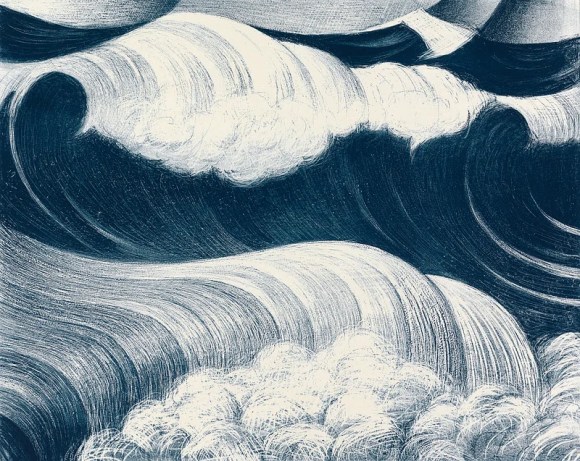
The Wave (1917), vintage illustration by C. R. W. Nevinson. From Public Domain
On world poetry day, we gather the colours of humanity to bring to you flavours of peace, compassion and love. With these poems, we seek solace and a future laced with the vibrant shades of humanity living in harmony with nature, the Earth and the Universe. These poems bring together not just writers from across the world but also some writings that are cross-cultural. Some of the poems express the condition of people living across the world. In this one page, we meet poets and translators from more than 25 countries fand translations from a dozen languages… Enjoy!
The Dragonfly, a poem by Ihlwha Choi, has been translated from Korean by the poet himself. Click here to read.
Four of his ownMalay poemshave been translated by Isa Kamari. Clickhere to read.
Hotel Acapulco, has been composed and translated from Italian by Ivan Pozzoni. Click hereto read.
Poetry in Bosnianfrom Bosnia & Herzegovina, written and translated by Maid Corbic. Click here to read.
Amalkantiby Nirendranath Chakraborty has been translated from Bengali by Debali Mookerjea-Leonard. Click hereto read
Poems of Longing by Jibananada Das homes two of his poems translated from Bengali by Professor Fakrul Alam. Clickhereto read.
Masud Khan’s poem,In Another Galaxy, has been translated from Bengali by Professor Fakrul Alam. Click hereto read.
Quazi Johirul Islam’s The White-Coloured Book has been translated from Bengali by Professor Fakrul Alam. Click here to read.
Four cantos from Ramakanta Rath’sSri Radha, translated from Odiya by the late poet himself, have been excerpted from his full length translation. Click here to read.
For Sanjay Kumar: To Sir — with Love has been written for the founder of pandies’ theatre by Tanvir, a youngster from the Nithari village where pandies’ worked with traumatised victims.
Miathili Poetryby Vidyanand Jha has been translated from Maithil by the poet himself. Click hereto read.
Meenakshi Malhotra writes of the diverse ways histories can be viewed, reflecting on the perspective from the point of view of water, climate, migrations or women. Click here to read.
Sometimes, we have an idea, a thought and then it takes form and becomes a reality. That is how the Borderless Journal came to be six years ago while the pandemic raged. The pandemic got over and takeovers and wars started. We continued to exist because all of you continue to pitch in, ignoring the differences created by certain human constructs. We meet with the commonality of felt emotions and aesthetics to create a space for all those who believe in looking beyond margins. We try to erase margins or borders that lead to hatred, anger, violence and war. Learning from the natural world, we believe we can be like the colours of the rainbow that seem to grow out of each other or the grass that is allowed to grow freely beyond manmade borders. If nature gives us lessons through its processes, is it not to our advantage to conserve what nurtures us, and in the process, we save our home planet, the Earth? We could all be together in peace, enjoying nature and nurture, living in harmony in the Universe if only we could overlook differences and revel in similarities.
A young poet Nma Dhahir says it all in her poem that is a part of our journal this month —
This is how we stay human together: by refusing the easy damage, by carrying each other without calling it sacrifice, by believing that what we protect in one another eventually protects the world.
Translations has more poetry with Professor Fakrul Alam bringing us Nazrul’s Bengali lyrics in English and Fazal Baloch familiarising us with beautiful Balochi poetry of the late Majeed Ajez, a young poet who left us too soon. Isa Kamari translates his own poems from Malay, capturing the colours of the community in Singapore to blend it with a larger whole. And of course, we have a Tagore poem rendered into English from Bengali. This time it’s a poem called ‘Jatra (Journey)’ which reflects not only on social gaps but also on politics through aeons.
Christine C Fair has translated a story from Punjabi by Lakhvinder Virk, a story that reflects resilience in women who face the dark end of social trends, a theme that reverberates in Flanagan’s poetry and Meenakshi Malhotra’s essay, which while reflecting on the need of different perspectives in histories – like water and nomads — peeks into the need to recall women’s history aswell. This is important not just because March hosts the International Women’s Day (IWD) but because one wonders if women in Afghanistan are better off now than the suffragettes who initiated the idea of such a day more than a century ago?
This time our non-fiction froths over with scrumptious writings from across continents. Tamara-Lee Brereton-Karabetsos muses on looking at numbers and beyond to enjoy the essence of nature. Farouk Gulsara ideates about living on in posterity through deeds and ideas. Gower Bhat shares how he learns story writing skills from watching movies. Meredith Stephens talks of her experience of a fire in the Australian summer. Bhaskar Parichha writes with passion about his region, Odisha. We have a heartfelt tribute to Mark Tully, who transcended borders, from Bhowmick. And an essay on Arundhati Roy’s memoir, Mother Mary Comes to Me, from Somdatta Mandal, which explores not just the book but also the covers which change with continents. Prithvijeet Sinha travels beyond Lucknow and Suzanne Kamata brings to us stories about her trip to Phnom Penh.
Keith Lyons draws from the current crises and writes about changing times, suggesting: “Changes aren’t endings, but thresholds.” Perhaps, if we see them as ‘thresholds of change’, the current events are emphasising the need to accept that human constructs can be redefined. I am sure a Neolithic or an Australopithecus would have been equally scared of evolving out of their system to one we would deem ‘superior’. Life in certain ways can only evolve towards the future, even if currently certain changes seem to be retrogressive. We can never correctly predict the future… but can only imagine it. And Devraj Singh Kalsi imagines it with a dollop of humour where tails become a trend among humans again!
Humour and absurdity are woven into a series of short fables by Hughes while Naramsetti Umamaheswarao weaves a fable around acceptanceof differences. In fiction, we have stories of resilience from Jonathon B Ferrini and Terry Sanville. Bhat gives us a story set in Kashmir and Sohana Manzoor gives us one set in Dhaka, a narrative that reminds one of Jane Austen… and perhaps even an abbreviated version of the 2001 film, Monsoon Wedding.
In reviews we have, Mohammad Asim Siddiqui discussing Anisur Rahman’s The Essential Ghalib. Rituparna Khan has written on Malashri Lal’s poetry collection reflecting on women, Signing in the Air. And Bhaskar Parichha has reviewed Deepta Roy Chakraverti’s Daktarin Jamini Sen: The Life of British India’s First Woman Doctor, a book that reflects on the resilience that makes great women. Thus, weaving in flavours of the IWD, which applauds women who are resilient while urging humans for equal rights for one half of the world population.
While we ponder on larger realities, Borderless Journal looks forward to a future with more writings centred around humanity, climate change, our planet and all creatures great and small. This year has not only seen a rise in readership and contributors — and the numbers rose further after our unsolicited Duotrope listing in October 2025 — but has also attracted writers from more challenged parts of the world, like Ukraine, Iran, Tunisia and Kurdistan. We are delighted to home writing from all those who attempt to transcend borders and be a part of the larger race of humanity. I would like to quote Margaret Atwood to explain what I mean. “I hope that people will finally come to realize that there is only one ‘race’—the human race—and that we are all members of it.” And I would like to extend her view to find solidarity with all living beings. I hope that there will be a point in time when we will realise there’s not much difference between, a lizard, a fly, a human or a tree… All these lifeforms are necessary for our existence.
I would want to hugely thank all our team for stretching out and making this a special issue for our sixth anniversary and Manzoor for her fabulous artwork. Huge thanks to all our contributors and readers for being with us through our journey. Let’s change the world with peace, love and friendship!
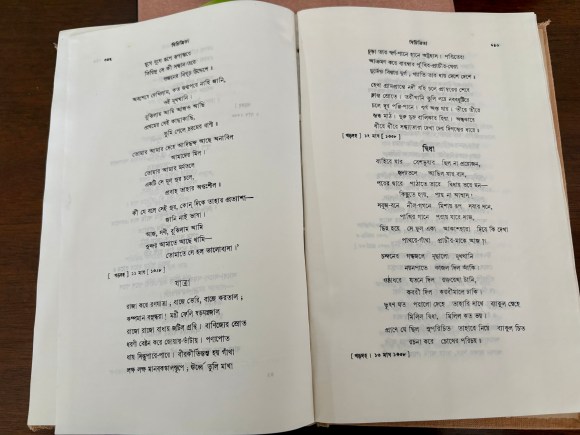
Written in 1932 by RabindranathTagore, Jatra (Journey) is a part of Rabindra Rachnabali (Writings of Ranbindranath) and Sanchayita (Compilation — in this case of poems).
The poem, Jatra (Journey) in Sanchayita
                JOURNEY

The emperor journeys to battle. The earth trembles
With the clash of drums and cymbals. The minister
Conspires, spreads web of deceit through realms.
Trading streams encircle the world with ebb and flow.
Cargo ships travel to distant shores. Monuments of
Heroism grow out of piles of human skeletons raising
Their heads heavenward to laugh with disregard.
The learned repeatedly attack impenetrable fortresses
Of knowledge, walled by books. The king’s fame spreads far and wide.

Here, in the village, the river flows sluggishly
In the distance. The ferry picks up the new bride
Sailing to a far colony. The sun sets. The shores
Are lined with silent fields. The girl’s heart shivers.
In the darkness, slowly, the evening star rises on the horizon.
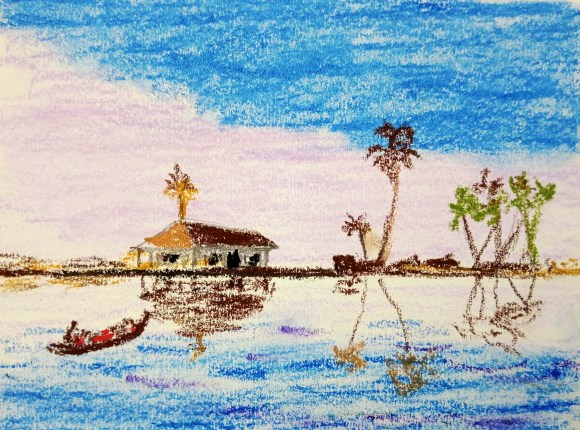
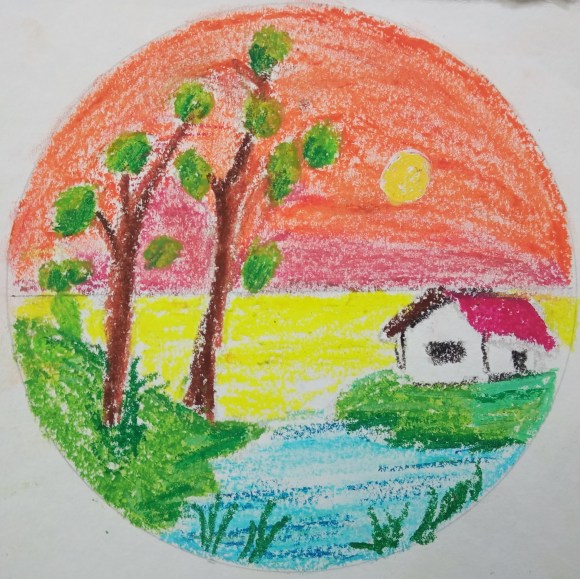
Art by Sohana Manzoor
.
This poem has been translated from Bengali by Mitali Chakravarty with editorial input by Sohana Manzoor
.
PLEASE NOTE: ARTICLES CAN ONLY BE REPRODUCED IN OTHER SITES WITH DUE ACKNOWLEDGEMENT TO BORDERLESS JOURNAL
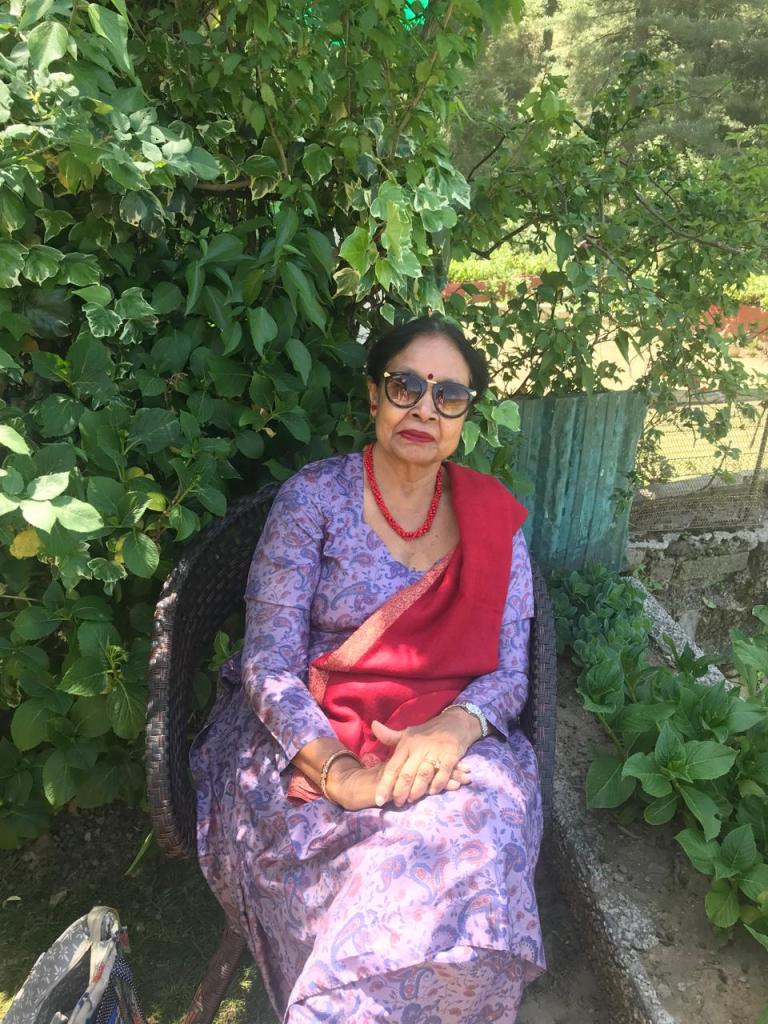
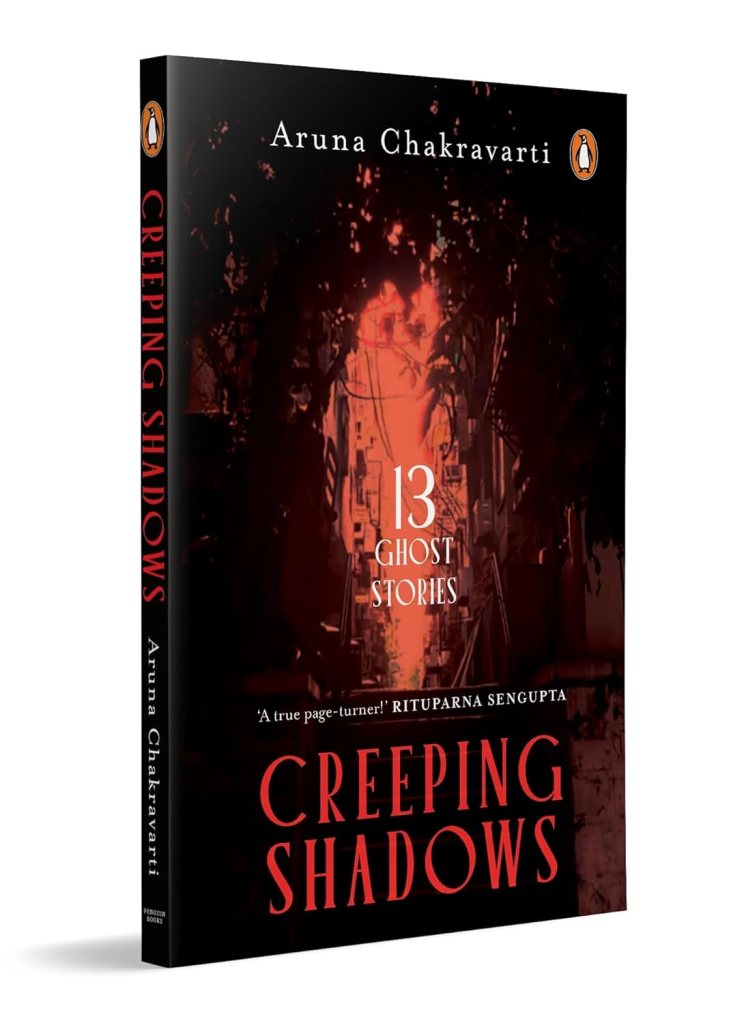
An introduction to Aruna Chakravarti’s Creeping Shadows: 13 Ghost Stories, published by Penguin India, along with a discussion with the author.
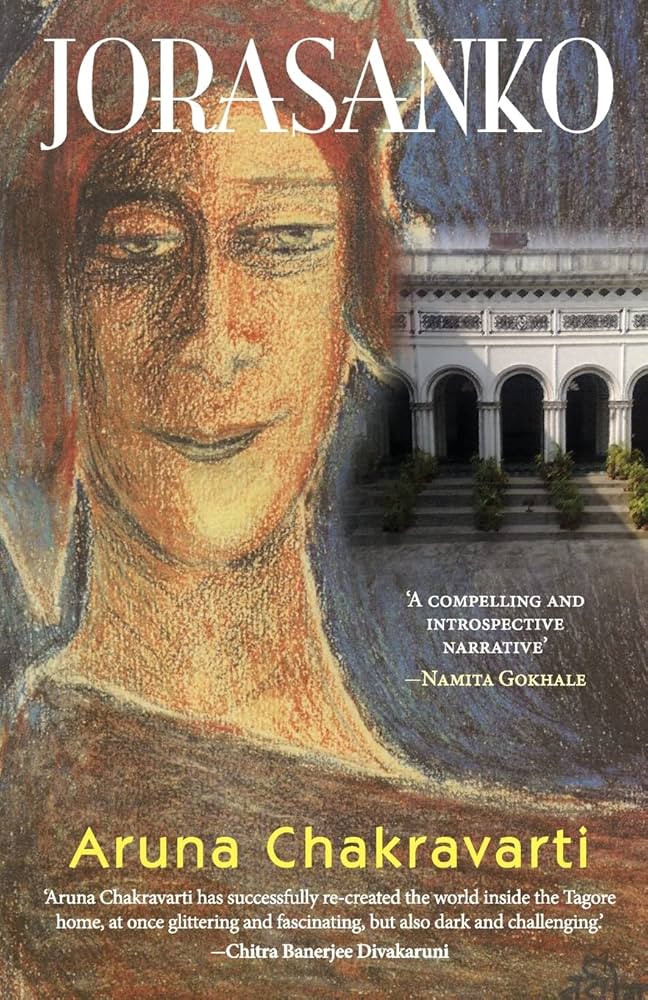
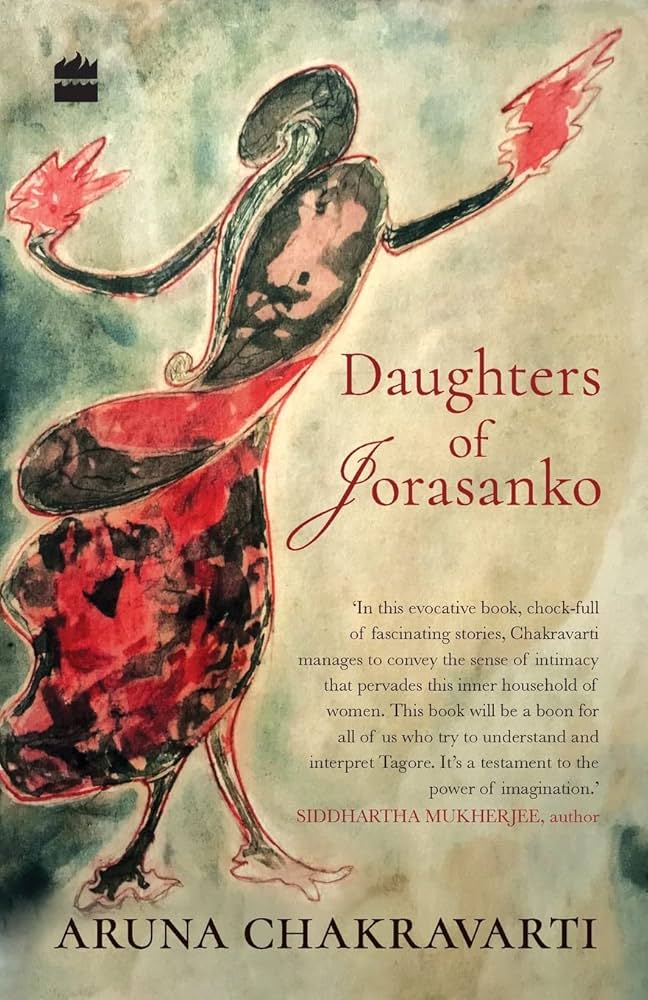
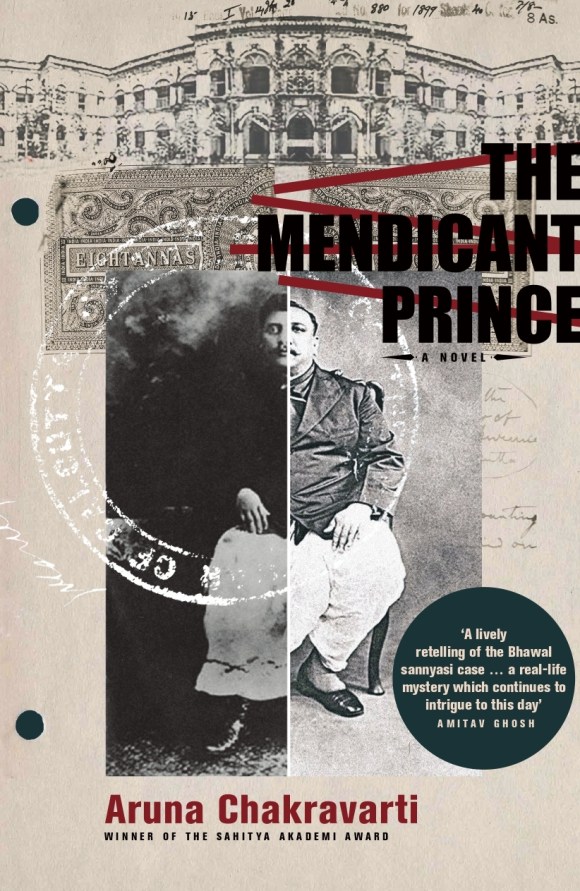
Ghosts are evocative of a past… of history one could say. Then who could be a better storyteller of the past than an author steeped in colours of historical fiction — Aruna Chakravarti! In the past she not only translated novels set in colonial India but evoked the Bengal Renaissance to perfection in her two Jorasanko novels and details of a court hearing in her retelling of the Bhawal prince! This time the diva of historical fiction brings to us a book of spine chilling, ghost stories, Creeping Shadows: 13 Ghost Stories. It is her third collection of short stories.
Aruna ChakravartiPublished in 2026
The narratives are so vivid and visual that they could be worthy of being made into films. They are distinctive in that she has mostly created her own very horrific ghouls – not the traditional ones. They pop up and frighten the reader with their bizarreness and terrifying presences which linger even when you try to sleep at night! She has given us thirteen stories — a spooky number in itself — spread across multiple communities in Asia.
Some of the narratives evoke the past, starting from the 1800s. ‘The House of Flowers’ is set in China partly and partly in Kolkata, where there is now a thriving Chinatown known as “Tangra” and a Kali temple that serves ‘noodles’ as its prasad or offering. The story has echoes of Pearl S Buck’s China interestingly. What comes as a surprise is the fluency with which she has woven in the influences that impact a community of migrants!
Chakravarti has used her skills as a writer of historical fiction in some of the stories like, ‘The Road to Karimganj’, in which a spook takes us back to undivided Bengal, when passports were not needed as in the story of the migrant Chinese. Hovering around history are more narratives like ‘Possessed’, where a courtesan who performs with the legendary Girish Ghosh1 of the nineteenth century Kolkata undergoes, along with the audience, a strange spooky experience!
Traveling down the century, closer to our times, is the story that is perhaps one of the most bizarre and yet most relatable, ‘The Necklace’. Set in the Anglo-Indian community and the glamour of Park Street — where Wiccan writer, Rajorshi Patranabis, claimed to have met a colonial ghost awaiting her lover — Chakravarti’s narrative is of black magic and betrayal. The fiction is far more impactful and frightening than the factual narrative, which too was spine chilling! You realise what makes fiction so much more gripping than facts — anything can happen in fiction. Chakravarti is imaginative enough to make it as creepy and shadowy as any regular horror writer!
Holding on to that thought, the author holds the key to our experiences as she skillfully outlines two demons grown out of poverty in ‘A Winter Night’. The conclusion has a sense of irony and tragedy. ‘Truth is stranger than Fiction’ weaves in more of the diversity in the historic annals of Bengal. The story that starts the book, ‘The Caregivers of Gazipur’, has an unresolved ending, like some of her other narratives. Though there is a frightful resolution in ‘They Come Out After Dark’. The ghosts play spine chilling havoc with fears of the living while recalling the senseless violence of 1947. ‘There are More Things in Heaven and Earth’…takes us back to the atrocities committed during the Sikh riots of 1984 in Delhi. The mingling of fact and fiction to create weird a fantastical narrative is addressed during a conversation on the supernatural. And there is an exploration of the lines from Shakespeare’s Hamlet, which probably is a touch of the academic as Chakravarti had a long tenure as the principal of a girl’s college in Delhi. It also defines the authorial stance in this story:
‘Don’t forget what Hamlet said to Horatio? There are more things in heaven and earth, Horatio, than are dreamt of in your philosophy.’
What is unusual about these stories is the way she has created fictitious geographies and personas, evoking historic realities. They seem perfectly authentic to the reader, including the one set in China. There is a vast mingling of facts and fiction in these stories all to lead to spine-chilling ends with strange twists.
‘Grandmother’s Bundle’ stands out in its rendition as the ghosts given out are part of the mythical lore of Bengal — stories that were related to most Bengali kids of the twentieth century. They have a touch of humour and dry wit, perhaps introducing a sense of comic relief among very dark and horrific stories that transport us into different worlds.
‘The Motorcycle Rider’, set in modern times, takes us into a university campus to shock us with horrific spooks born out of tragic deaths, while ‘Twenty-nine Years, Seven Months and Eleven Days’, merges a modern outlook with an unfathomable past, touching upon strange tantric yearnings. ‘Vendetta’ twirls nature and supernatural to give a frightening narrative of how nature takes its revenge… a theme that reiterates in writings addressing our current concerns with climate change.
The ease and fluidity with which she has switched from history and realism to horror and fantasy is amazing. Let’s find out more from her about this new persona that inhabits her writerly self…
Till now we have had translations, numerous novels—many of which can be called historical fiction—and realistic short stories with their base in history or contemporary life. What made you think of writing ghost stories?
After writing The Mendicant Prince which involved extensive research into the life and times of Prince Ramendranarayan Roy of Bhawal, I didn’t feel up to writing a historical novel again. The work had demanded delving into sociological texts, court records, letters, insurance papers and medical reports. Apart from research, historical fiction also demands a certain amount of field work.
Published in 2013Published in 2016
Before writing the Jorasanko novels I visited the Tagore mansion thrice and while writing The Mendicant Prince, I went to Bangladesh to see the royal palace in Bhawal, renamed Gazipur. Though it has been totally neglected, with shopkeepers and squatters having overtaken most of the area, I was able to get some idea of the topography of the palace and its grounds. I saw the lake and the temple (which was locked) and was able to visualise where the halls and galleries and the apartments of the queens and princesses would have stood. All this work was exhausting. So, for a change, I decided to try my hand at short stories which emerge straight from the imagination. And while at it, I decided to break out of the mould of “historical fiction” writer in which I had trapped myself and try a completely new genre.
Published in 2022
I wrote the first one on an impulse and found myself quite enjoying the process. I didn’t even think of publishing at that time. The first story led to another and another. When eleven stories had been written I sent the manuscript to three publishers and was surprised when all three accepted it. It was then that I found out that ghost stories were the in-thing. That they were selling well and that publishers were looking out for them. I signed up with Penguin as you know. At one point my editor Moutushi Mukherjee suggested I write another two. Thirteen stories will make it even more spooky, she said. So, I wrote another two.
Would you list these stories as fantasies or fantastical? Or are they stories of personal experience? Please elaborate.
No. They are not born out personal experience. I must confess that I have never seen a ghost in my life. I believe in sixth sense. As a matter of fact, I have acted on my sixth sense on occasions. I have had sudden impulses to do certain things and realised later that if I hadn’t yielded to the impulses, I would have regretted it. But I have had no brush with the supernatural. These stories were sparked off by sudden memories. Something I had read somewhere. Something somebody had told me years ago. A face I had seen in childhood which had stuck in my mind though whose I don’t remember. A conversation overheard which made no sense at the time but which, as an adult, seemed ridden with sinister nuances. A phrase from a book whose title and author’s name I had forgotten. In fact, I didn’t even remember the context from where the phrase had come.
Sudden flashes such as these triggered off the stories. But in the writing, they took on a life and soul of their own. I even feel, sometimes, that the pen took over and they were written by an invisible hand.
Your stories are set, sometimes in real landscapes and sometimes in fictional ones. What kind of research went into creating them? How do you make them so vivid and real?
There wasn’t any immediate research. I needed to look up a few facts, now and then, mostly to be sure of their authenticity. But nothing truly back breaking. The landscapes, both physical and of the mind, were culled from my travels and my reading of both English and Bengali writers over the eight decades of my life. Much of it stayed with me tucked away in some unconscious part of the mind. Although I write in English, you will notice that almost all the stories are about Bengalis. Bengalis living in Delhi, Kolkata, Bihar and the small towns and villages of Bengal. There are Anglo-Indians, Punjabis and Chinese, too among my characters. But having lived in Bengal for generations, they have adopted Bengali customs and a quasi-Bengali way of living. Many of the locales in which, they appear are fictional…gathered from my reading and observation of people from different strands of Bengali life.
You have a story set in China which also has the Chinatown of Kolkata in it. Have you been to China? What was the reason for the choice? Were you influenced by any Chinese writers? How did you visualise the Chinese migrants in Kolkata?
Yes, I have been to China. I visited the cities of Guangzhou, Shanghai and Beijing in 2004. Naturally, I have no personal experience of life as it was lived in the late 18th century which is the period covered in the story ‘The House of Flowers’. For this I had to rely totally on my reading of English authors writing about China like Pearl Buck and Amy Tan. Pearl Buck was a great influence on me while writing this story. It was from her books that I was able to catch the ambience of tea houses and brothels of the period. In depicting the Chinese family who lived in Calcutta in the early 20th century I had to rely on childhood experience, I knew some Chinese girls who had lived for several generations in Calcutta. And my imagination went into full play, of course.
In ‘Grandmother’s Bundle’ you have written about spooks from Bengal. It departs from your other stories in as much as it does not really introduce the supernatural except as a source of folklore. Do you feel it blends with the other narratives in your collection?
Well. It is different from my other stories in certain ways. Firstly, it is three stories rolled into one. Secondly, unlike the others, they are children’s stories. Thirdly, it is the only one that deals with ghosts and other supernatural beings with humour. Lastly, they have been drawn from folklore. I agree that it doesn’t quite blend with the others in this collection. But it is also true that each story in this collection is different from another. There are different time spans. Different locales. Different themes. Characters from different levels of society. That being the case, I think that this story lends variety and another flavour to the collection.
Your stories aren’t like the usual ghost stories one reads. The structure and content seem different. Your comments.
You are right. These stories do not belong to the gothic/horror genre. They are not about vampires, blood sucking bats, severed heads or violence heaped on violence. They are essentially human-interest stories with a supernatural twist at the end. I have taken my cue, you may say, from Coleridge’s demand for a willing suspension of disbelief before reading his poetry. These stories have innocuous beginnings. Two friends sharing an apartment, a boy walking from his village to an unseen destination, a dinner party in an exclusive area of the capital, a marital spat or a telephone call at dawn. Then, a few paragraphs later a subtle hint is dropped startling the reader into a realisation that it is not a simple story of human relationships. That it is headed in another, more sinister direction. Another hint is dropped and another. Then in the final sentence the bomb bursts. The last line is the most important line of the story.
Which is your favourite story? And why?
Just as a mother loves all her children, I love all my stories. But mothers also have favourites and so do I. “The House of Flowers,” “Vendetta,” “Possessed” and “The Necklace” are my favourites. That’s because their themes are unusual and posed a greater challenge. And, perhaps, because I had to work harder on them than on the others.
Are you planning any new books? Exploring any new genres? Any new book we can expect soon?
I always think of a new book even when I am writing the current one. Yes, I am planning to explore yet another genre of writing. But my ideas are nebulous at the moment. Still in a fluid state That being the case I cannot share them with you. All I can say is that the work will be a challenging one and I’m not even sure I’ll be able to see it through. So, we must both wait for some more time
Girish Ghosh (1844-1912) Actor and Director from Bengal ↩︎
(This review and online interview by email is by Mitali Chakravarty)
                RIVER

Is a river alive? A cloud?
          Who knows? And what
Is the right thing to do? A crowd
          gathers with bats

And clubs at the gate, to demand
         that something be
Strictly obeyed. Who gives commands,
         who bends the knee?

Clouds dissipate, though shadows surge
         and slip below;
The river contains things that merge
         within its flow.


               EKSTASIS

Those gone before admonish us,
          who shelter in
Uncertain refuge from the gusts
          of angry wind;

They testify not for what seems,
          but what holds true—
Trees that give shade, and flowing streams
          that beckon you

To step outside the self—where shade,
          now one with tree,
Flows far beyond what is displayed,
          or thought to be.
From Public Domain
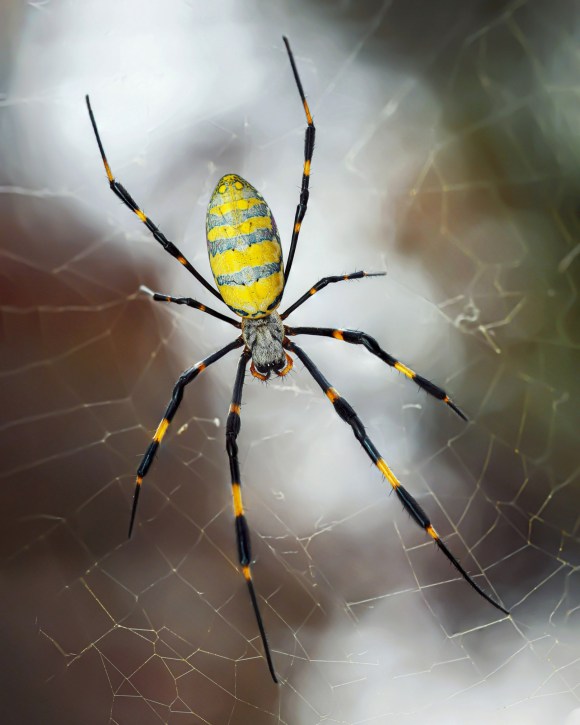
A folk belief in the American South and Midwest held that if someone tears down the web of a yellow garden spider, it will write that person’s name in the rebuilt web. This could mean misfortune, illness, or death for that individual.
       FOLKLORE

An accident, he said, her broom
          brushed it away.
It was rebuilt, and in that room
          where she would lay

By evening, we recalled her name
          in script within
The spider’s web. She died the same
          night. “But again,

You don’t believe—” I saw the line
          of letters there,
And so did she. I misjudged time,
          and she, despair.
Jared Carter’s most recent collection, The Land Itself, is from Monongahela Books in West Virginia. His Darkened Rooms of Summer: New and Selected Poems, with an introduction by Ted Kooser, was published by the University of Nebraska Press in 2014. A recipient of several literary awards and fellowships, Carter is from the state of Indiana in the U.S.
.
PLEASE NOTE: ARTICLES CAN ONLY BE REPRODUCED IN OTHER SITES WITH DUE ACKNOWLEDGEMENT TO BORDERLESS JOURNAL
Whose story are we recounting when we attempt to narrate history? An unexamined acceptance of anthropocentric biases have placed man at the centre of historical narratives and historical accounts. The time has come when this assumption of man’s centrality is being challenged and overturned. Both posthumanism, a concept that directly challenges man’s centrality and planetarism[1], which sees the interconnectedness of the natural, animal and human, have displaced the human entity from its position of unquestioned and unquestionable centrality.
Amitav Ghosh’s latest novel, Ghost Eye(2025), made one go back to the earlier novels in the series with a similar cast of characters, Gun Island (2029) and The Hungry Tide (2004). Like many of his other novels, these works also encapsulate the themes that Ghosh communicates with increasing urgency in successive novels-climate change and man’s hubris which has catapulted mankind into an increasing tailspin hurtling towards ecological disaster.
In Gun Island, Ghosh asks a whole series of questions which make us look at history differently. What if history is understood through the lens of migrations and mass movement or natural disasters, through unexpected bird migrations, beaching of dolphins and the shifting movement of oceanic boundaries? Is there a pattern to extraordinary events, coincidences or are they a matter of pure chance? Is time always linear? What if temporality works in loops? What happens when we are faced by recurrences and presentiments?
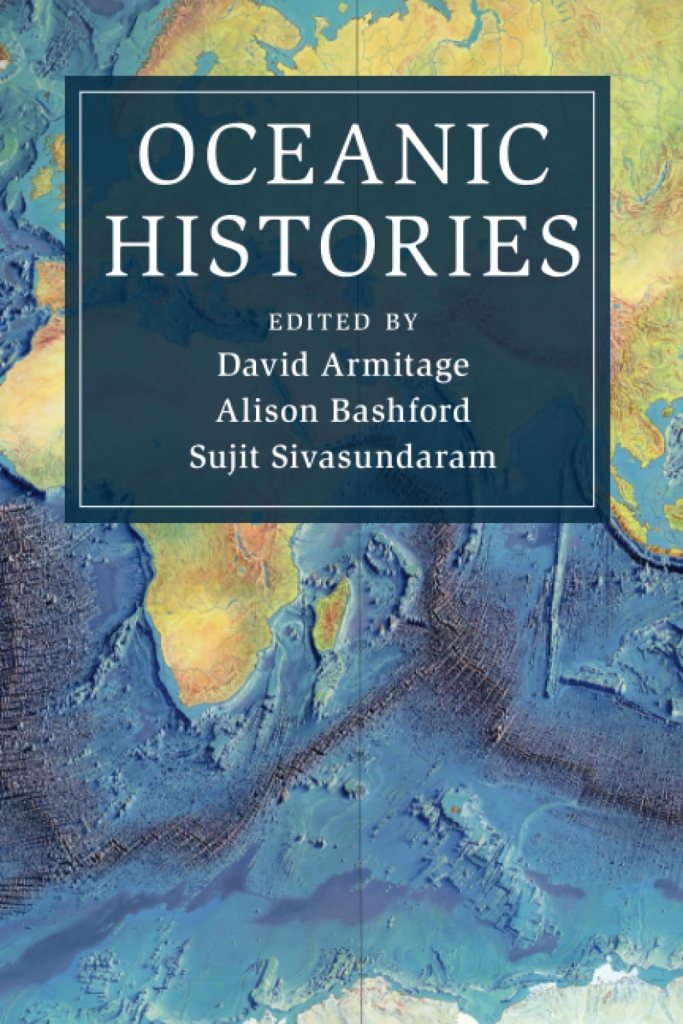
What if we review and revisualise history not as bounded by national boundaries but a more fluid and flowing substance — water, sea and water bodies? Some contemporary books like Oceanic Histories (2017)offers the first comprehensive account of world history focused not on the land but viewed through the seventy per cent of the Earth’s surface covered by water. Tracing the histories and the historiographies of the various oceanic regions, the book highlights the links between human and non-human history and the connections and comparisons between parts of the World Ocean. If history is a set of geo-political narratives centred around land and its acquisition, why can’t we have histories of waterways? As a life-giving but also potentially destructive substance, water occupies a prominent place in the imagination. At the same time, water issues are among the most troubling ecological and social concerns of our time.
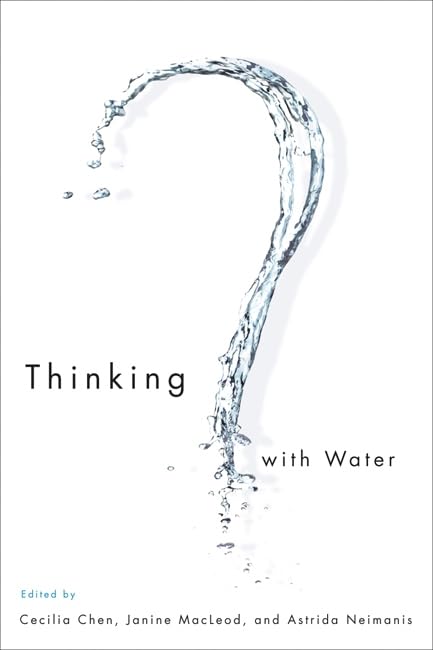
Water is often studied only as a “resource,” a quantifiable and instrumentalised substance. Thinking with Water instead invites readers to consider how water — with its potent symbolic power, its familiarity, and its unique physical and chemical properties — is a lively collaborator in our ways of knowing and acting. What emerges is both a rich opportunity to encourage more thoughtful environmental engagement and a challenge to common oppositions between nature and culture.
Thinking about history brings me to women’s history and the issue of international women’s day, which falls on March 8th. While the question of women’s day maybe a matter of individual opinion, the question maybe rephrased as “do we need a woman’s day” or “why do we need a woman’s day”at all?
Do we need it as a kind of affirmative action? Given the historic lack of a level playing field, it is perhaps a reparative action? Or is it a needed inclusive action, that reflects changes in social policy? Much as we would like to think along positive lines about women’s development and empowerment, the picture across the world is a grim one.
For those who feel that everyday is women’s day, we could perhaps recall the broader historical context. The IWD originated from early 20th-century labour and suffrage movements in North America and Europe, demanding better pay, shorter working hours and better working conditions.
Ideally , women and girls should have equal rights under the law, rendering them safe from violence, with rights to access education, livelihoods, resources, and justice on equal terms. When these rights are realised, the impact extends far beyond individual women and girls to their families, communities, and society as a whole. Research shows that gender equality delivers better outcomes across economies, health systems, peace processes, and democratic resilience. In this context, 8th March provides an occasion to recall how far we have come. It is also a necessary reminder of how far we still have to travel in order to ensure that women and other oppressed minorities get their fair share on earth, rather than direct their eyes to heaven.
It may seem a form of tokenism to earmark one day out of 365 days in the calendar as women’s day, but at least it’s a beginning where we could begin to reassess how much we take women’s roles as caregivers and nurturers for granted. Many descriptions of women are couched in a familiar vocabulary which views women as daughters ,wives and mothers, who are the backbone of the family, pillars of society, the glue that binds communities to each other and models of resilience and endurance. Yet this idioms of approbation do not protect women from harassment , abuse and gendered violence of many kinds; in Catherine McKinnon’s words , they are rendered less than human. When we begin to recognise women as human beings with agency, legitimate claimants of human rights and deserving gender parity and justice, we will probably not need International Women’s Day.
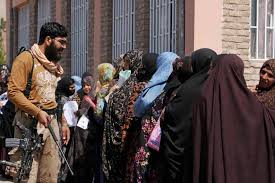
In 1906…Current day Afghanistan From Public Domain
[1] A new subject that deals with the health of the planet
Meenakshi Malhotra is Professor of English Literature at Hansraj College, University of Delhi, and has been involved in teaching and curriculum development in several universities. She has edited two books on Women and Lifewriting, Representing the Self and Claiming the I, in addition to numerous published articles on gender, literature and feminist theory. Her most recent publication is The Gendered Body: Negotiation, Resistance, Struggle.
.
PLEASE NOTE: ARTICLES CAN ONLY BE REPRODUCED IN OTHER SITES WITH DUE ACKNOWLEDGEMENT TO BORDERLESS JOURNAL
Stand still in a forest long enough
And you will hear it…
The quiet arithmetic
Of change:
Leaf to loam,
Bud to bloom,
Green to gold.

What falls away
Feeds what is becoming.
Nothing truly leaves.
It just changes shape
Like an old banyan tree,
Hunched over
Making new connections

And so, it is with us.
We are not fading,
We are editing ourselves.
Occasionally creaking
Like dignified wooden doors,
Hinges rusted,
Announcing ourselves to empty rooms
With whimpers and groans.
Sometimes slowly.
Sometimes with a bang
But making our presence,
Felt nonetheless.
Snigdha Agrawal (née Banerjee) is the author of five books and a lifelong lover of words, writing across genres. Based in Bangalore, writing and travelling continue to remain her lifelong passions.
.
PLEASE NOTE: ARTICLES CAN ONLY BE REPRODUCED IN OTHER SITES WITH DUE ACKNOWLEDGEMENT TO BORDERLESS JOURNAL
Last month the Doomsday Clock had moved closer to midnight than at any point since it was created in 1947. Maintained by the Bulletin of the Atomic Scientists, the clock is meant to signal how close humanity stands to destroying itself, whether through nuclear conflict, climate breakdown or new technologies. Its latest shift suggests that we are living through a particularly dangerous moment.
That is one way to look at the year ahead.
Another comes from a friend of mine who follows astrology. “2026 will be intense,” she told me after we had worked out the time difference to talk. “There are major planetary shifts happening. But that also means there is potential for growth.”
Between scientific warning and planetary symbolism sits a familiar question. Are we heading towards catastrophe, or simply moving through another period of change?
It is difficult to judge the scale of events while we are inside them. Perspective usually comes later. At the time, everything feels amplified. The media leans towards urgency. Our own thoughts do the same. The expectation of upheaval can sometimes be more overwhelming than the experience itself.
In recent weeks there have been many reminders of transition: the turning of the calendar year; the Lunar New Year observed across China, parts of Southeast Asia, Korea and the Himalayan region; the beginning of Ramadan for Muslims around the world. These moments draw people together in ritual and reflection. They offer continuity, even when the wider world feels unstable.
At the same time, global leaders speak in stark terms. The Secretary-General of the United Nations recently described a world marked by conflict, inequality and unpredictability. Climate scientists warn that we have entered uncharted territory. Heat records continue to fall. Rain arrives in sudden deluges. Winters in some places are no longer as cold as they once were.
For centuries, seasonal rhythms have provided reassurance. Spring follows winter. Festivals return at roughly the same time each year. Even the Gregorian calendar, introduced in 1582, was an attempt to bring order to time.
The Greek philosopher, Heraclitus, wrote that no person steps into the same river twice. The water flows on, and so do we. It is a simple image, but it captures something steady and true about human life.
What feels different now is the speed. Changes that once unfolded across generations now seem compressed into years. Climate patterns shift within decades. Technology reshapes industries almost overnight. Artificial intelligence systems are altering the nature of work, leaving some people optimistic and others uncertain. I know people who are struggling to find employment, both those nearing the end of long careers and those only just starting out.
My friend attributes the turbulence to a conjunction of Saturn and Neptune. She links economic instability and political upheaval to movements in the sky. When she mentioned the recent increase in visible auroras, I thought of astronomers pointing out that the Sun is nearing the peak of its eleven-year solar cycle. Different explanations, same phenomena.
Whether we turn to science, philosophy or astrology, the underlying experience is similar. Things feel unsettled. Time feels faster. The future feels closer than it used to.
It is tempting either to tune out the warnings or to become consumed by them. Neither response changes what is happening. Ignoring risk does not reduce it. Constant alarm does not resolve it either.
We cannot return to a previous version of stability. The seasons will continue to shift, though perhaps less predictably. Technologies will continue to develop. Political arrangements will evolve. Some changes are small and gradual. Others are abrupt and disorienting.
The real question is how we live through them.
After our conversation, my friend sent a message: “Changes aren’t endings, but thresholds.” It is a hopeful way to think about uncertainty. Crossing a threshold suggests movement rather than collapse.
Perhaps this year calls for small, steady practices. Paying attention to what we consume, digitally and otherwise. Slowing down our thinking when everything pushes us to react. Staying connected to the people around us. These are modest responses, but they are within reach.
We step into the river again. The water is different. So are we.
.
Keith Lyons (keithlyons.net) is an award-winning writer and creative writing mentor originally from New Zealand who has spent a quarter of his existence living and working in Asia including southwest China, Myanmar and Bali. His Venn diagram of happiness features the aroma of freshly-roasted coffee, the negative ions of the natural world including moving water, and connecting with others in meaningful ways. A Contributing Editor on Borderless journal’sEditorial Board, his work has appeared in Borderless since its early days, and his writing featured in the anthology Monalisa No Longer Smiles.
.
PLEASE NOTE: ARTICLES CAN ONLY BE REPRODUCED IN OTHER SITES WITH DUE ACKNOWLEDGEMENT TO BORDERLESS JOURNAL.
Ishrat looked at the girl staring at her from the computer screen. Smooth and silky dark hair framed a face with wide eyes and lips that curved into a tender smile. According to her bio-data, Raihana Mimi finished her Bachelor’s from Stony Brook three years earlier. Then she did a Master’s in Social Work from UMASS Boston before going back to Bangladesh. Ishrat wondered why the girl liked Asif. At first glance, Asif seemed like an ordinary young man, even if pursuing a PhD in Computer Science. He was not handsome and he carried himself like a bear with a perpetual frown on his forehead. So why this lovely girl took a liking to Asif seemed a mystery to Ishrat. She hoped it wouldn’t end like the affair two years ago. It had broken Asif’s heart, and until very recently he would not hear of marriage.
“She’s very pretty,” Ishrat finally said. “But marriage is a life-long commitment, Asif. Do not marry for the wrong reasons. Do you love her?”
Asif looked at the somber face gazing upon him and smiled sadly. “Love? I thought I was in love the last time I went home. You know the rest.” Both of them went silent reminiscing about the unprecedented series of events that occurred about two years ago when Asif had gone back to Bangladesh to marry the girl he had been planning to wed for years. He came back alone a month later as the girl’s family had refused to allow their youngest daughter to marry him, and his sweetheart accepted the decision made by her family without protest.
Ishrat still remembered the bleak look on Asif’s face when he had asked her after returning from home, “What’s wrong with being fatherless, Apa[1]? And is an American passport essential for marriage? Tania’s uncle told me to get a US passport and then ask for their daughter’s hand in marriage.”
Ishrat couldn’t tell him that the marriage mart in Dhaka was a fish market. Most people with assets in the capital city would turn up their noses at someone like Asif whose father had died leaving his children still struggling to make a place for themselves. Instead, she had said, “It’s better that this match didn’t work out, Asif. Obviously, the girl didn’t care enough to stand up for you. I’m sure that you have a better person waiting for you in the future.”
“I told you Apa, she got married last year, didn’t I?” asked Asif.
“Who? Tania? Yes, you did. But Asif, I hope you are not planning to get married just because you want to show off that you’ve got a better wife,” said Ishrat with a frown. “Raihana is surely prettier than Tania and more accomplished. But just that would be a wrong reason for getting married.”
Asif shook his head. “That’s not why I want to marry Mimi. I’ve been talking to her for a few months now. She seems. . . how to put it. . . very mature, level-headed and practical. Has a lot of good sense,” he paused and then added, “something Tania never had.”
Ishrat asked again, “So, how does your family take it? I thought your mother had somebody in mind?
“That was years ago,” Asif said. To him, Kakon was just a next-door girl, the daughter of her mother’s best friend. It was a plan hatched by the mothers. He and Kakon never discussed this. There was never an occasion. “My sisters have already paid Mimi’s family a visit. And Mimi’s eldest brother and one of her sisters went to my elder sister’s house to meet my mother. Anju Apa is complaining even though Laiju is quite taken in.”
Ishrat nodded, “What does Laiju say?” Laiju was Asif’s younger sister, and not sentimental like Anjuman.
Asif smiled. “She says that Mimi seems friendly and sensible. Even though Anju Apa pulled a long face in front of everybody, she didn’t take offense. When Laiju apologised on her behalf to Mimi she said that she didn’t mind. People say a lot of things during such negotiations. It’s not wise to hold on to them.”
Ishrat nodded approvingly. “That sounds like uncommonly good sense to me. Marriage is a complex business though. Since you two like each other, you must keep a level head.”
*
Hamida Khatun looked helpless as her eldest daughter ranted about her brother’s marriage. “You’ll see that it will come to no good. That girl’s family is way better off than ours. Two of her sisters are settled in the US. And you still want him to marry her?”
“And how do you propose that I stop it, Anju?” asked Hamida. “You heard him. He is determined to have her.”
“I still don’t understand what was wrong with Kakon,” grumbled Anjuman. Kakon was their neighbour from their hometown in Khulna. They had known her since childhood. Kakon’s mother, Nahar, and Hamida once made plans to get their children married. But Asif was always busy with other things and once he went off to Dhak to study at BUET[2], he changed altogether. He fell in love with a girl named Tania who practically abandoned him at the altar. After that Hamida had tried to incline him toward Kakon once more. But Asif did not budge. At one point he told his mother, “If you nag like this, I will marry an American girl and never return home.” That sealed her mouth as Asif knew it would.
Hamida heaved a sigh and said, “Look, daughter, I don’t have a choice in this. If he can’t marry this girl, I’m afraid he will marry an American Christian girl. Do you want that?” Anju looked up at her mother, horrified. “You must be mad! What will our relatives say? American! And Christian too!”
“What do I care about our relatives?” asked an irritated Hamida. “Their tongues have been wagging since your father died. I just want my son to marry well and be happy.”
Anjuman grimaced. She was sure that this rich girl will only bring trouble for their family.
At this point, Laiju entered the room with a bundle of shopping bags in hand. She was buoyed up by the upcoming wedding of her only brother. Many of their close relatives had already arrived in Dhaka. She and her mother were staying in Rampura where Anjuman lived with her husband and two children.
Laiju looked at her elder sister keenly and said, “I don’t understand why you’re making such a big deal. I like Mimi Bhabi already. She is not like those typically snobbish rich girls. On the contrary, she seems very nice and sensible.” She paused and then added, “The kind of scene you made at their house! ‘I know our brother will be taken away from us after his marriage’—That was poor taste, Apa. I would have been mad if I was in her place.”
Anju shuffled uneasily and Hamida nodded gravely. “Yes, that was really bad.”
Laiju was about to say something more when they heard a commotion outside. Several voices were shouting, and one gruff voice most of all.
“I need to talk to Bhabi[3]. Where is she? This is insufferable and totally unacceptable. . .”
“Oh no, that’s Chhoto Chacha[4]!” groaned Laiju. As soon as she uttered the name, a dark burly man entered the room.
Without preamble he said, “Did you buy a saree for my wife? The eldest son of our family is getting married—where is the saree for his Chhoto Chachi?”
“We got sarees for everyone,” said Laiju. “And of course, Chhoto Chachi has got one too.”
“You call that a saree?” sneered their uncle. “That’s a gamchha[5]! If my brother was alive…”
“Unfortunately, he is not,” Laiju interrupted. “And his son is still a student. If you don’t like the saree we got for your wife, go and buy one yourself. Do you ever get anything for her?”
“You have such a foul mouth! No respect for elders at all!” growled Chhoto Chacha. He turned to his sister-in-law and bellowed, “I won’t come to the wedding, Bhabi. And I won’t allow my family to attend either.” He stormed out of the room. They heard him slam the front door shut.
Hamida Khatun heaved another sigh. “When will Asif come? I can’t take all this any longer. My poor boy! Nobody to give him peace of mind.”
Anjuman dried her eyes and said, “I won’t give you any more trouble. I, too, will keep away from the ceremony. . .” she stopped as her mother’s eyes started gleaming ominously. Laiju said, “For once, Apa, please act your age. How long will you behave like a 15-year-old?”
“What did I say?” asked a nervous Anjuman.
“You will act like a proper, respectable elder sister,” said Hamida quietly. “If I hear you babbling like a fool, I will leave your house. Just because we’re staying in your flat, don’t assume that you can do and say whatever you want. If necessary, I will rent a place and conduct the marriage ceremony from there. Understood?”
Anjuman eyed her mother with a newly found apprehension. Laiju gaped at her mother too. Then recovering herself she said half-laughing, “O dear! I didn’t know you could talk like that! You should take on that tone more often, Amma[6]. Chhoto Chacha will never dare to say anything again.”
*
“I still don’t understand why she has chosen that guy,” Gulshan Ara grumbled. “He looks more like an ape than a human being.”
Her fourth daughter Moni shook her head. “Ma, you’ve said that at least ten times.”
“So?” asked Gulshan Ara. “Your headstrong little sister doesn’t pay heed to anything I say. She has her heart set on that ape.” She stopped and lowered her voice. “You and I are the only two with good sense. Even Muhib and Moin are taken in.”
“I’m more worried about his family,” said Moni. “Remember how the elder sister spoke?”
“I can’t understand why you’re so worried about the family,” said a third voice. Moin had entered the room silently like a cat. “Mimi will be living abroad with her husband. She may have to visit Khulna only once or twice in her lifetime. Honestly, how much trouble can her in-laws cause?”
In the next room of the plush apartment in Dhanmondi, the subject of their conversation was busy wrapping up the gifts for her wedding. She had already brought several sarees for herself. She meant to save at least some money for Asif. She understood that he was still a graduate student and could not be expected to spend a fortune on his bride. He also had nobody to support him with expenses. She insisted that there should be only one ceremony and the expenses should be borne by her family. She used to be indifferent when her family members rejected one suitor after another. But something about Asif made her stand up for him and maneuver her siblings, especially her brothers and eldest sister, into accepting him as a prospective candidate. Asif also went out of his way and visited her two elder sisters in New York. Whatever initial reservations they had about his appearance vanished after meeting him face to face. Both spoke approvingly of him, and Mimi’s parents also gave in reluctantly.
When her sister Moni had asked her what she liked so much about Asif, Mimi avoided a direct answer and asked, “What’s wrong with him? He is a good guy, pursuing higher studies. That’s what you wanted too.” She paused, then added, “Okay, so he is not very handsome. But Mishu Apu’s husband was. Did that help?” Mishu was her second sister who had died a few years ago. Her husband was the most handsome and obnoxious man imaginable. Mishu’s untimely death had cast a perpetual gloom on their family.
Moni wrung her hands, “No, but…”
“If you people continue like this, I may never get married, you know,” Mimi had said, half-teasingly. “I’ll be thirty in November.”
Mimi counted the boxes and eyed the suitcase carefully. These were mostly things for her in-laws. They still had not got anything for Asif who was arriving in Dhaka that very afternoon. The two of them had planned to do the shopping for their wedding clothes themselves. Asif’s mother already had the jewelry. Apparently, she had them made three years ago, which proved to be an excellent decision.
Asif’s elder sister Anjuman and Mimi’s mother had been raising a hue and cry over every little thing. Anjuman took it to her head that her brother’s wife should have her nose pierced, and Asif should give her a diamond studded nose-pin. Mimi let Asif handle that. Both of them had discussed the situation and decided to largely ignore their comments and avoid unreasonable suggestions without being directly offensive. Asif seemed to rely a lot on her judgment, which Mimi appreciated.
She remembered when her eldest brother’s wife had shown her Asif’s Facebook page. “He’s so funny, Mimi. Just take a look! Says he has all A’s in everything except in his love life. There he has an F!” Mimi had smiled, but somehow it didn’t appear funny to her. She still thought Asif shouldn’t have put such personal information on Facebook, but it pulled a string at her heart. She knew exactly how it felt to get an F in love. She wondered where Dipak was, and if he was still looking for a pretty face with a ton of money. Mimi’s family was very affluent and that turned out to be his main reason for pursuing her. Dipak was gone from her life forever, and Mimi had no intention of bringing him back.
Once upon a time she held Dipak dear, but now she shuddered to think what might have happened if they had been married. He was making advances on three girls at the same time, and Mimi was one of them. The incident taught Mimi a number of things. She promised herself that she would only marry someone she could trust and would look beyond physical appearance. She may never have love, but she would also never feel humiliated or pitied.
*
When Asif and Mimi finally met in person, it was the most unromantic situation possible. His flight was delayed, and he arrived three hours late. After assuring his nervous mother, a pouting elder sister, and an over-enthusiastic younger one, he reached his future in-laws’ house around 9 p.m. along with two uncles and a cousin. He looked tired and harassed, in a crumpled purple shirt and khaki pants. Mimi’s parents were a bit awkward, but her brothers were very cordial as they had heard glowing reports about Asif from their sisters in New York.
While the others were talking, Mimi observed her intended husband surreptitiously. She almost smiled at his attire—he was so unpretentious. Obviously, he was more worried about keeping his engagement than his appearance. She noticed that he also looked at her once in a while, and realized with a jolt that he wished, just as she did, to talk to her, to be away from this crowd, just to be by themselves. Mimi was surprised at her own reaction—she had known this man for only a few months, and yet she longed to be with him. She tried to concentrate on the conversation and heard that they were discussing her Kabin. Asif was saying, “Whatever you decide is fine with me. I won’t be able to pay it right away, though, as I am still pursuing higher studies.”
Her eldest brother Muhib said, “Of course, we understand as much. Will 10 lakhs be too much for you?”
At this point, her mother spoke up. “I won’t allow my daughter’s Kabin[7] to be less than fifteen.”
“Fifteen!” someone in Asif’s party gasped. “Fifteen lakhs is too much! Even ten is a lot.”
Everyone in the room shifted uncomfortably while Gulshan Ara sat straight and glared at Asif with animosity. Mimi was about to pinch her brother Moin when Asif said in a quiet voice, “Whatever you say, I will accept. It’s your daughter we are discussing, after all.”
Even Mimi gaped at Asif. As everybody in the room started talking once again, Mimi realised that Asif’s move was the best possible strategy. Gulshan Ara would not complain any more. And Asif was not in serious trouble because he did not have to pay the amount right away. She didn’t know how Asif’s family would take it, though. She promised herself that she would always try to make things easier for him. He didn’t have any idea how rich her family was. He wanted to marry her.
*
The wedding reception was held at a posh restaurant in Dhanmondi. Asif sat on the stage and watched his bride smile and greet the guests who approached them. She was as beautiful as a fairy, thought Asif. Wise and kind too.
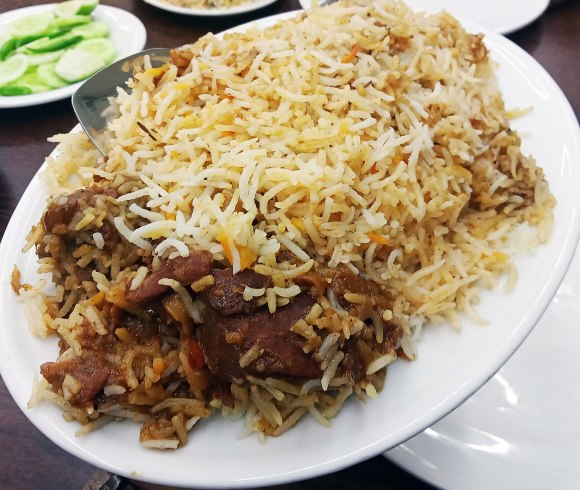
Then Asif saw his Chhoto Chacha approaching the stage and he said a swift prayer so that nothing disastrous happened. His uncle addressed Mimi, “The others are saying that the food is good. But I felt it was aida.” He looked triumphantly at Asif, as if saying, “You can’t fool me!” Mimi also looked at Asif, not knowing what aida meant. Asif hastily said, “That was kachchi biriyani, Chacha. It is the standard food for weddings in Dhaka. But we will have a reception in Khulna too. You can have your menu there with your favourite fish.” Chhoto Chacha nodded, looking pleased. “You have a pretty wife,” he said approvingly, “much prettier than your mother ever was.” He walked away. Asif heaved a sigh of relief.
Kachchi Biriyani. From Public Domain
Mimi whispered, “What’s aida?”
“I’ll explain later,” mumbled an embarrassed Asif. How could he say that aida meant food that has been half-eaten by somebody else? Basically, it suggested that the guests had not been properly treated.
Then came Asif’s friends. They were all laughing and joking. Asif was quite popular among his friends, and they seemed happy about Asif’s marriage and his choice of bride. Mimi had very few friends present—understandable, since she did her bachelor’s in the US. Someone mentioned that they had attended Tania’s wedding the previous year whose husband was a bald man in his forties and held an American passport.
A heavily bejeweled, fat lady appeared before them, and Mimi introduced her to Asif. “This is my Chhoto Mami. Mama[8] couldn’t come as he is in Singapore right now.”
Asif smiled and greeted her. “I’ve heard a lot about you,” the lady said with a broad smile like a crocodile. “You are not very handsome, are you? But then, Rahat was very handsome, and it didn’t help us at all.” She sighed, then added, “Hopefully, you’ll take good care of Mimi.”
Mimi made a face as she walked away. “Sorry about that.”
“Who is Rahat?” asked a puzzled Asif.
“My ex-brother-in-law,” replied Mimi briefly. “I’ll tell you later.”
“You and I both seem to have a fine lot of relatives,” observed Asif. Mimi smiled. “It seems so, doesn’t it?” They smiled at each other, and Asif knew that they would be working as a team. Their relatives wouldn’t be able to make a rift like they did in his parents’ case. He thoughts turned to Tania probably for one last time, and he wished he had never met her. Then he realised that it did not really matter. She was already a distant memory. Asif started to comprehend what Ishrat had meant by marriage being a life-long commitment.
Mimi sat contentedly. She liked her husband, she thought. Fair enough. He was sometimes a little rash, but good-natured. He had also shown himself to be sensitive to her needs. She remembered the scuffle over her wedding saree. They got it from Mansha. It was quite expensive and Mimi did not want to buy it even though she liked it very much. Asif, however, insisted that at least the main wedding saree should be costly, so that everybody was content.
*
Anjuman sat in one corner, still resentful at the turn of events. She looked at her children on stage with their uncle, nodding and smiling at their new aunt. Anjuman wondered how nobody could see what she saw—her only brother slowly moving away from them. She remembered what Laiju had said a few days ago: “He is not the same guy who left Bangladesh 4 years ago. He has changed. He has been leading a different life, his friends and peers are of a different sort. His world has changed, Apa. He couldn’t be happy with someone like Kakon. Don’t you see?”
No, Anjuman did not see. All she saw was a rich and beautiful girl taking her only brother away from them. Her resentment rose higher. She had tried to derail her own husband—to move him away from the influence of his nagging mother. But she had failed. The old woman had died only recently, and her husband still cried like a baby over the loss. And here was this girl, a mere chit of a girl, accomplishing what she could not in nine years. “If only it was Kakon!” thought Anjuman wistfully, their brother would have always been theirs. She did not see why he would be unhappy. What was the duty of a wife? To cook, bear children and maintain the house. Their mother did all this, she herself was doing the same; what more could Asif want? And in spite of all her good looks, what could Mimi give him that Kakon could not? Did he have to sell himself to money?
Somewhere at the back of her mind, Anjuman felt cheated. She felt that her brother got something she never even dreamt of. She saw the light of a different life on Laiju’s face, or even on their mother’s, a light she could not share. She thought of the flat in Rampura where she had so far lived with her husband and children. The 1200 square feet she had been so proud of owning suddenly seemed to have diminished into nothing. Owning a flat in Dhaka did not seem so great anymore as she wondered what kind of a house Asif and his wife would have in the US.
Hamida Khatun noticed the tear-stained face of her elder daughter from a distance and heaved a sigh of relief. “Thank God she realises that they are happy, and she is praying for them,” she thought, and smiled with misty eyes. Her thoughts then flew to the future where she saw herself surrounded by grandchildren. She did not see even the flicker of any dark shadow on the bright stage where her son gazed lovingly at his bride.
[7] Marriage registration fees determined by the dowry
[8]Mami is wife to mother’s brother referred to as Mama
.
Sohana Manzoor is a writer and academic from Bangladesh, with a PhD in English from Southern Illinois University Carbondale. Her works have appeared in Bellingham Review, Eclectica, Litro, Singapore Unbound, Borderless Journal, and elsewhere. She was the Literary Editor of The Daily Star from 2018- 22. Currently, she is pursuing an MFA in Creative Writing at UBC, Vancouver.
.
PLEASE NOTE: ARTICLES CAN ONLY BE REPRODUCED IN OTHER SITES WITH DUE ACKNOWLEDGEMENT TO BORDERLESS JOURNAL.








 Borderless